Address for correspondence
Dr. Mehwash Kashif , Associate Professor, Department of Oral Pathology,
Karachi Medical and Dental College, Karachi Ph: 0333-3265501
Email: [email protected]
Original Article
Depression in patients with fungal infection in
tertiary care hospital
Introduction
Brig et al. suggested that there is positive
relation between skin and psychological
problems.
1Psychological stress could have a
pessimistic collision on healthy skin, which may
exacerbate
or
precipitate
dermatological
disorders, indicative of the existence of
relationship
between
psychiatry
and
dermatology.
2Due to visibility and appearance
of the dermatological disorders, not only they
are related with cosmetic deformity but also
results in a variety of psychopathological
troubles which may cause distress to the patient,
his/ her family, and society.
3The relation
between psychiatry and skin diseases is
bidirectional
i.e.
psychiatric
comorbidity
Muhammad Irfan Khan, Mehwash Kashif*, Javed Iqbal*, Minah Aslam#, Huma Waseem#, Rafia Mubbashir#, Syeda Javeria Mehak#, Rija Sirajuddin#, Javeria Khalid#Department of Microbiology, Karachi Medical and Dental College, Karachi. * Department of Oral Pathology, Karachi Medical and Dental College, Karachi. #
4th year MBBS student, Karachi Medical and Dental College, Karachi.
Abstract
Objective To document the incidence of depression in patients who have fungal infections in tertiary care hospitals of Karachi.Design Cross sectional study.
Settings Tertiary general hospital.
Methods The study was initiated in the dermatology outpatient department of a tertiary general hospital after committee permission from November 2017 to April 2018. In this study the patients were recruited through convenience sampling and the inclusion criteria was patients diagnosed as having cutaneous and/or mucosal fungal infection by the consultant dermatologist after clinical evaluation and skin/mucosal biopsy with a confirmation of the same on histological report. Patients not willing to participate in the study were excluded. All the patients were informed about the nature of study and its applications and verbal informed consent was obtained from patients who were willing to participate in the study. Data collection was done in 350 patients having fungal infections out of which 219 have contagious fungal infections.
Results Total 62.57% patients had contagious fungal infections, 36.57% had depression, 40.28% patients had altered social behavior, 14.28% were associated with comorbids, 20% were on medicine and 41.14% patients had previous fungal infections.
Conclusion This study showed that cutaneous and mucocutaneous fungal infections affects the quality of life of people, their social and professional life.
Key words
manipulates the development and itinerary of
dermatologic diseases by way of the effects of
stress, depression, and anxiety,
4on the other
hand, cosmetically disfiguring dermatologic
diseases may cause significant psychosocial
miseries to the patients.
5Fungal infections are one of the major cause of
skin diseases. Superficial and cutaneous fungal
infections may be caused by dermatophytes,
yeasts,
and
non-dermatophyte
molds.
6,7Dermatophytosis and other superficial and
cutaneous fungal infections are still regarded as
a chief health problems in many parts of the
world.
8,9The lipophilic yeast Malassezia is a
normal microflora of the human skin that may
be
pathogenic
under
certain
conditions.
Malassezia species is the most frequent reason
of dandruff, seborrhoeic dermatitis, folliculitis,
papillomatosis,
and
tinea
(pityriasis)
versicolor.
10-13Patients in a psychiatric hospital may have
difficulty in taking care of themselves properly,
especially including performing daily foot care.
For a variety of reasons, including lack of
concern or lack of interest, a psychiatric patient
with tinea pedis might not be able to uphold the
appropriate cleanliness and foot care which is
essential to treat the disease. Hence the
condition of the foot could worsen.
However, skin fungal infections are caused
mainly by dermatophytes such as Trichophyton,
microsporum, and epidermophyton that can
invade the stratum corneum and keratinized
tissues.
14-16The skin and the central nervous
system are embryologically related as the
epidermis and the neural plate both derive from
embryonic ectoderm. Stress might act as a
precipitating factor in commencement or
exacerbation
of
skin
disease
through
psychosomatic mechanisms.
17Some studies
reported that anxiety and depression are not
connected with age and sex,
18,19but some studies
reported that these disorders are more prevalent
in women.
20,21Few studies are available internationally,
regarding clinical and mycological features of
tinea pedis and tinea unguium in psychiatric
patients.
14In
Pakistan,
populace
have
multifactorial etiology of depression. After in
depth exploration of data scanty research was
found on the topic. Therefore, this study was
intended and conducted with the objective to
assess the frequency of depression in patients
who are infected with fungus in tertiary care
hospitals of Karachi.
Methods
pedis and tinea versicolor and mucocutaneous
fungal
infections
like
mycetoma
and
sporotrichosis were suspected.
Specimens were collected for mycological
analysis from the sites of possible dermatophyte
infections. Direct microscopy in potassium
hydroxide (KOH) was done and causative
species were identified by culturing the fungi in
the Sabouraud’s Glucose agar.
A questionnaire was designed to enquire into the
sociodemographic
details
like
age,
sex,
residence, occupation, address, and comorbid; it
also included details about triggering factors like
stress, depression, stigma, addiction, previous
fungal infections and medication history. The
patients with fungal infections, were assessed
and classified on the basis of their altered social
behaviour and stage of depression i.e. no
depression, moderate depression and severe
depression. The data was analysed on SPSS
version 17.
Results
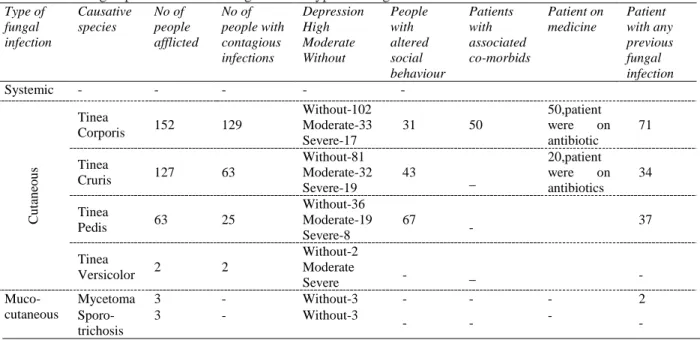
The main characteristics of the study groups are
described in
Table 1
. Overall no significant
difference could be found between clinical
samples.
There were 350 patients afflicted with different
types of fungal infections, out of which 219
(62.571%) patients had contagious fungal
infections,
128
(36.571%)
patients
had
depression, 141 (40.285%) patients had altered
social behaviour, 50 (14.285%) patients were
associated with co-morbids, 70 (20%) patients
were on medicines and 144 (41.142%) patients
had previous fungal infections
(Table 1)
.
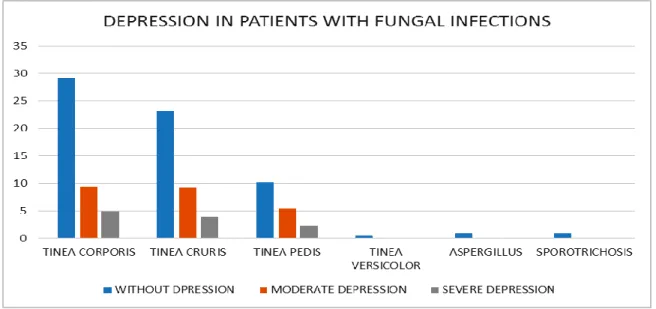
Depression was found in patients afflicted with
tinea corporis, tinea cruris and tinea pedis while
rest of the patients with other fungal infections
were without depression. Out of 128 patients
with depression, 84 (24%) patients were found
with moderate depression and 44 (12.571%)
patients were found with severe depression,
while the rest of the patients were without
depression.
Table 1 showing depression level among different types of fungal infections
Type of fungal infection Causative species No of people afflicted No of people with contagious infections Depression High Moderate Without People with altered social behaviour Patients with associated co-morbids Patient on medicine Patient with any previous fungal infection
Systemic - - - -
-Cu tan eo u s Tinea
Corporis 152 129
Without-102 Moderate-33 Severe-17
31 50
50,patient
were on
antibiotic
71
Tinea
Cruris 127 63
Without-81 Moderate-32 Severe-19 43 _ 20,patient
were on
antibiotics 34
Tinea
Pedis 63 25
Without-36 Moderate-19 Severe-8
67
- 37
Tinea
Versicolor 2 2
Without-2 Moderate
Severe - _
- Muco-cutaneous
Mycetoma 3 - Without-3 - - - 2
Sporo-trichosis
3 - Without-3
-Figure 1 Showing severity of depression in different types of infection
Altered social behaviour was found in patients
afflicted with tinea corporis 31 (8.857%)
patients, tinea cruris 43 (12.285%) patients and
tinea pedis 67(19.142%) patients.
The study was also correlated with co-morbids
of other diseases associated with fungal
infections, in which 50 (14.285%) patients of
tinea corporis were associated with co-morbids
like hypertension and diabetes.
Among 350 patients, 70 (20%) patients were on
antibiotics for the treatment of fungal infections,
out of which 50 (14.285%) patients were of tinea
corporis and 20 (5.714%) patients were of tinea
cruris.
Previous fungal infections were found in 144
(41.142%) patients, in which 71 (20.285%)
patients were of tinea corporis, 34 (9.714%)
patients were of tinea cruris, 37 (10.571%)
patients of tinea pedis and 2 (0.571%) patients
suffered from mycetoma
(Figure 1)
.
Discussion
Psychodermatology is an appealing region of
interface between psychiatry and dermatology
because of bidirectional contact between skin
and brain, which probably is due to ectodermal
origin of brain and most of the skin.
Psychosocial stress can precede autoimmune or
inflammatory
skin
disorders
through
neuroendocrine and neuroimmune deregulations.
The body's reaction to stress is mediated by
hypothalamus, pituitary, cerebral cortex, and the
limbic system, in addition to the adrenal gland,
as proposed by Selye.
28interdigital+vesicular+hyperkeratotic type. The
hyperkeratotic type was defined as dry-type
tinea pedis
(
moccasin foot or dry-type infection
according to Textbook of Dermatology.
27Patients with cutaneous and mucocutaneous
fungal infections do experience stressful events
after the inception of the disease. Dermatophyte
infections formed the majority of cutaneous
disorders in the study groups. This may be
accredited to the humid climate and hence
increased sweating.
28There was a higher
incidence of dermatophyte infection in the study
group as 98% of the patients had this disease in
which tinea corporis was seen more frequently
(43.4%). As a part of bidirectional interaction,
dermatologic disorder may leave to psychiatric
morbidities like depression, anxiety, social
phobia, panic symptoms, and negative impact on
quality of life.
29-31This research showed that
64.8% of cutaneous and mucocutaneous fungal
infections patients were mentally sane, whereas,
24% of patient had moderate and 12.57% of
patients had severe mental disturbances. By this
study we found 40.28% in our patients having
distorted social behavior. The reason could be
female preponderance in our study. Generally,
females experience more depression because of
the more stress experienced and have a greater
reactivity to it with a higher rate of body
displeasure and low confidence.
32,33This was
comprehensible due to infection on uncovered
body parts leading to humiliation or
self-consciousness Females may be more beauty
consciousness than males and may evade going
to school, office work, and so forth due to
sensation of looking unappealing or being stared
at by others.
34Many experienced treatment
difficulties because of frequent follow ups and
long treatment periods which caused turbulence
in their daily routine. In both the genders,
depression and the various domains of quality of
life were considerably associated. This indicates
that depressed patients have considerably
impaired quality of life and vice versa.
Researches have shown that the impact of a skin
disorder on the quality of life is considered in
many cases to be a stronger predictor of
psychiatric morbidities like depression, anxiety,
sleep disturbances, and adjustment disorder than
physician’s evaluation of clinical disease
severity.
35In a nutshell skin disorders have a greater impact
on quality of life, patients’ usual daily activities
and work, and it is a stronger interpreter of
psychiatric morbidities like anxiety, stress and
depression.
Cross sectional design and small sample size are
the
limitations
of
study.
Hence
it
is
recommended that more studies should be
conducted with large sample size so that data
should
be
representative
of
the
whole
population.
Conclusions
This study showed that cutaneous and
mucocutaneous fungal infections affects the
quality of life of people, their social and
professional life.
Recommendations
In the light of this study it is recommended that
community awareness programmes must be
arranged by the health care professionals and
dermatologists in order to awareness early
diagnose and treatment of these fungal
infections so that individuals can improve their
quality of life.
References
2. A. Kimyai-Asadi and A. Usman, “The role of psychological stress in skin disease,” c, vol. 5, no. 2, pp. 140–145, 2001.View at Publisher · View at Google Scholar· View at Scopus
3. M. Jafferany, “Psychodermatology: a guide to understanding common psychocutaneous disorders,” Primary Care Companion to the Journal of Clinical Psychiatry, vol. 9, no. 3, pp. 203–213, 2007.View at Publisher · View at Google Scholar· View at Scopus
4. H. Y. Schultz, “Society for investigative dermatology skin disease Co-Morbidities Project Launch Conference Proceedings,” Journal of Investigative Dermatology, vol. 129, no. 3, pp. 525–528, 2009. View at Publisher · View at Google Scholar · View at Scopus
5. M. A. Gupta, “Psychiatric comorbidity in dermatologic disorders,” in Psychodermatology, C. Walker and L. Papadoulos, Eds., Cambridge University Press, Cambridge, UK, 2005. View at Google Scholar
6. Picardi A, Abeni D. Stressful life events and skin diseases: Disentangling evidence from myth. Psychother Psychosom 2001; 70:118-36.
7. Bassiri-Jahromi S, Khaksari AA. Epidemiological survey of dermatophytosis in Tehran, Iran, from 2000 to 2005. Indian J Dermatol Venereol Leprol. 2009; 75(2): 142–7.
8. Pakshir K, Hashemi J. Dermatophytosis in Karaj, Iran. Indian J Dermatol. 2006; 51(4): 262.
9. Havlickova B, Czaika VA, Friedrich M. Epidemiological trends in skin mycoses worldwide. Mycoses. 2008; 51(Suppl 4):2– 15.
10. Gemmer C.M., DeAngelis Y.M., Theelen B. Fast, noninvasive method for molecular detection and differentiation of Malassezia yeast species on human skin and application of the method to dandruff microbiology. J Clin Microbiol. 2002 Sep; 40: 3350–57. [PubMed] [Ref list]
11. Shokohi T., Afshar P., Barzgar A. Distribution of Malassezia species in patients with pityriasisversicolor in Northern Iran. Indian J Med Microbiol. 2009; 27(4): 321–24. [PubMed] [Ref list]
12. Prohic A., Ozegovic L. Malassezia species isolated from lesional and non-lesional skin in patients with pityriasisversicolor.
Mycoses. 2007; 50(1): 58–63. [PubMed] [Ref list]
13. Difonzo E.M., Faggi E., Bassi A. Malassezia skin diseases in humans. G Ital Dermatol Venereol. 2013 Dec; 148(6):609–619. [PubMed] [Ref list]
14. English MP, Wethered RR, and Duncan EH: Studies in the epidemiology of tinea pedis: Fungal infection in a long-stay hospital. Br Med J. 1967 Jul 15; 3(5558): 136-39. 15. Kwon-Chung K.J., Bennett J.E. Lea
&Febigger; Philadelphia: 1992. Medical mycology; pp. 105–161. [Ref list]
16. Hainer B.L. Dermatophyte infections. Am Fam Physician. 2003 Jan; 67(1):101–109. [PubMed] [Ref list]
17. Picardi A, Abeni D. Stressful life events and skin diseases: Disentangling evidence from myth. Psychother Psychosom 2001; 70:118-36.
18. Pearl A, Arroll B, Lello J, Birchall NM. The impact of acne: A study of adolescent's Attitudes, Perception and Knowledge. N Z Med J. 1998; 111:269–71. [PubMed] 19. Yazici K, Baz K, Yazici AE, Köktürk A, Tot
S, Demirseren D, et al. Disease -specific Quality of life is associated with anxiety and depression in patients with acne. J Eur Acad Dermatol Venereol. 2004; 18:435–9. 20. Kellett SC, Gawkrodger DJ. The
psychological and emotional impact of acne and the effect of treatment with isotretinoin. Br J Dermatol. 1999; 140: 273–82.
21. Aktan S, Ozmen E, Sanli B. Anxiety, depression and nature of acne vulgaris in adolescents. Int J Dermatol. 2000; 39: 354– 7.
22. Schwartz RA, Fox MD. Office Dermatology. Kansas City, Missouri: American Academy of family Physicians Publications, 1992.
23. Geary LK. Epidemiology of the dermatophytoses, sources of infection, modes of transmission and epidemicity. Ann NY Acad Dermatol 1958; 31:15-7.
24. Roberts SO, Hay RJ, Mackezie DW. A Clinician s guide to fungal disease. New York: Marcel Dekker; 1984.
25. Zarei Mahmoudabadi A, Zarrin M. Mycetomas in Iran: a review article. Mycopathologia 2008; 165: 135-41.
25–31, 2005. View at Publisher • View at Google Scholar • View at Scopus
27. Hay RJ, Moore MK: Dermatophytosis, In: Burns T, Breathnach S, Cox N, Griffith C( eds: Textbook of Dermatology, Vol 2, 7th Ed, Oregon, Blackwell Science 31: 19-31, 55, 2004
28. Selye H. The general adaptation syndrome and the diseases of adaptation. J ClinEndocrinol 1946; 6: 117-230.
29. E. L. M. Tawil, N. Sediki, and H. Hassan, “Psychobiological aspects of patients with lichen planus,” Current Psychiatry 2009; 16(4): 370–80.
30. P. J. Magin, C. D. Pond, W. T. Smith, A. B. Watson, and S. M. Goode, “A cross sectional study of psychological comorbidity in patients with acne, psoriasis and atopic dermatitis in specialist dermatology and general practices,” Eur Acad Dermatol and Venereol 2008; 23(2): 239–40.
31. E. N. Lundqvist, Y. B. Wahlin, M. Bergdahl, and J. Bergdahl, “Psychological health in patients with genital and oral erosive lichen planus,” Journal of the
European Academy of Dermatology and Venereology 2006; 20(6): 661–6.
32. N. L. Galambos, B. J. Leadbeater, and E. T. Barker, “Gender differences in and risk factors for depression in adolescence: a 4-year longitudinal study,” International J Behav Develop 2004; 28(1): 16–25.
33. S. Nolen-Hoeksema, “Gender differences in depression,” Current Directions in Psychological Science 2001; 10(5); 173–76. 34. R. W. Simon and K. Lively, “Sex, anger and
depression,” Social Forces 2010; 88(4): 1543–68.
35. M. A. Gupta and A. K. Gupta, “Psychiatric and psychological co-morbidity in patients with dermatologic disorders: epidemiology and management,” Am J Clin Dermatol 2003; 4(12): 833–42.