Early resumption of sexual activity following
voluntary medical male circumcision in
Botswana: A qualitative study
Jenny H. Ledikwe1,2*, Nankie M. Ramabu2, Lisa P. Spees2,3, Scott Barnhart1, Conrad Ntsuape4, Bazghina-werq Semo1,2, Kathleen E. Wirth2,5,6
1 Department of Global Health, University of Washington, Seattle, Washington, United States of America, 2 Botswana International Training and Education Center for Health (I-TECH), Gaborone, Botswana, 3 The
Cecil G. Sheps Center for Health Services Research, University of North Carolina at Chapel Hill, Chapel Hill, NC, United States of America, 4 Department of HIV/AIDS Prevention and Care, Botswana Ministry of Health, Gaborone, Botswana, 5 Department of Epidemiology, Harvard T.H. Chan School of Public Health, Boston, Massachusetts, United States of America, 6 Department of Immunology and Infectious Diseases, Harvard T. H. Chan School of Public Health, Boston, Massachusetts, United States of America
Abstract
Unprotected sexual intercourse after undergoing voluntary medical male circumcision but prior to complete wound healing can lead to major adverse events including HIV acquisition. To better understand perceptions related to early resumption of sex prior to wound healing, 27 focus group discussions were conducted among 238 adult men, women, and community leaders in Botswana. Median age among all participants was 31 years of whom 60% were male and 51% were either employed and receiving salary or self-employed. Only 12% re-ported being currently married. Pain, not risk of HIV acquisition, was perceived as the main adverse consequence of early resumption of sex. In fact, no participant mentioned that early resumption of sex could lead to an increase in HIV risk. Demonstrating masculinity and viril-ity, fear of losing female partners, and misperception about post-operative wound healing also played key roles in the decision to resume sex prior to complete wound healing. Find-ings from this study highlight a potentially widespread lack of awareness of the increased risk of HIV acquisition during the wound healing period. Strengthening post-operative counseling and identifying strategies to discourage the early resumption of sex will be increasingly important as older men and HIV-positive men seek voluntary medical male cir-cumcision services.
Introduction
The World Health Organization (WHO) and the joint United Nations program on HIV/AIDS (UNAIDS) recommended voluntary medical male circumcision (VMMC) as an add-on strat-egy for HIV prevention in 2007 [1]. This recommendation was prompted by evidence from three randomized clinical trials demonstrating that VMMC reduces the risk of acquiring HIV infection by 51% to 60% among heterosexual men [2–4]. Since 2007, there have been
a1111111111 a1111111111 a1111111111 a1111111111 a1111111111
OPEN ACCESS
Citation: Ledikwe JH, Ramabu NM, Spees LP,
Barnhart S, Ntsuape C, Semo B-w, et al. (2017) Early resumption of sexual activity following voluntary medical male circumcision in Botswana: A qualitative study. PLoS ONE 12(11): e0186831.
https://doi.org/10.1371/journal.pone.0186831
Editor: Graciela Andrei, Katholieke Universiteit
Leuven Rega Institute for Medical Research, BELGIUM
Received: June 16, 2016
Accepted: October 9, 2017
Published: November 14, 2017
Copyright:©2017 Ledikwe et al. This is an open
access article distributed under the terms of the
Creative Commons Attribution License, which permits unrestricted use, distribution, and reproduction in any medium, provided the original author and source are credited.
Data Availability Statement: The transcripts from
the focus group discussions cannot be made publicly available for ethical reasons. Specifically, it may be possible to identify some of the study participants based on their responses, particularly in combination with their age-range, gender, and village. For purposes of the publication, any quotations with identifying stories or
substantive efforts to expand VMMC interventions in countries with high HIV prevalence and low rates of male circumcision [5,6]. Mathematical modeling suggests that rapid scale-up of VMMC in high HIV prevalence settings is a cost-effective intervention to reduce population-level HIV transmission [7–10].
WHO/UNAIDS recommends sexual abstinence for six weeks following the VMMC proce-dure to ensure complete wound healing [1]. Resumption of sexual activity prior to the recom-mended abstinence period can delay wound healing, increase the risk of adverse events, and increase the risk of HIV acquisition [11–13]. During the three randomized clinical trials that demonstrated the efficacy of VMMC [2–4], 3.9% to 22.5% of the participants reported early resumption of sexual activity [14]. Studies with less rigorous implementation protocols con-ducted in Kenya, Zambia, and Tanzania found that between 25% and 50% of men engaged in sexual activity before the wound had healed [12,15–18]. These data suggest that early resump-tion of sexual activity is common in real world settings and therefore may attenuate the poten-tial benefits of VMMC [12,19,20].
Given the high prevalence of early resumption of sexual activity in non-trial settings, strate-gies are needed to address this challenge. Previously identified risk factors for early resumption of sex include older age, married or living with a partner, engaging in risky sexual behavior, and concerns about losing sexual partners [15,16,18]. However, limited evidence exists on effective strategies for encouraging post-procedure sexual abstinence; a recently published lit-erature review highlighted the need for additional research on facilitating abstinence during wound healing [21]. A randomized controlled trial conducted among 1,200 circumcised adult men in Kenya evaluated the effect of providing a series of text messages during the post-opera-tive period on self-reported resumption of sexual activity prior to six weeks. Although the intervention was unsuccessful at improving post-procedure abstinence, the authors were able to identify risk factors for early resumption of sexual activity. They also highlighted the need for in-depth qualitative studies to better understand the reasons for early resumption of sex [16], as have other studies [22]. To maximize safety and ensure the population-level benefits of VMMC against HIV infection in real world settings, abstinence needs to be effectively pro-moted during the six-week period following VMMC. Using qualitative methods, we sought to better understand early resumption of sex following VMMC in Botswana.
Methods
The study was conducted by the International Training and Education Center for Health (I-TECH), which is a collaboration between the University of Washington and University of California, San Francisco. Ethical approvals for the study were received from the Health Research and Development Committee at the Botswana Ministry of Health as well as the Uni-versity of Washington Institutional Review Board. All procedures performed in studies involv-ing human participants were in accordance with the ethical standards of the institution and/or national research committee and with the 1964 Helsinki declaration and it later amendments or comparable ethical standards.
Focus group discussions were conducted among adult men, women, and community lead-ers in four communities in Botswana: Gaborone, Palapye, Molepolole, and Maun. These sites were purposefully selected based on district, predominant ethnic affiliation, and volume of cir-cumcisions performed within the community. Specifically, the chosen communities are located in different districts within Botswana and primarily serve populations with different ethnic affiliations. Two communities with high-volume VMMC and two communities with low-volume VMMC clinics were chosen to represent VMMC clinics operating in the top 25% and bottom 25% of the total number of circumcisions performed nationwide, respectively.
Stepaniak [email protected]. All relevant quantitative data are with the paper and its Supporting Information files.
Funding: This work was supported by the
President’s Emergency Plan for AIDS Relief (PEPFAR), through funding to the University of Washington and I-TECH from the US Department of Health and Human Services, Health Resources and Services Administration (HRSA) Global HIV/ AIDS Bureau under Cooperative Agreement No. U91HA06801.
Competing interests: The authors have declared
The two communities supporting high-volume VMMC clinics included Gaborone, the capital city of Botswana, and Palapye, a village 240 km northeast of Gaborone. The two communities supporting low-volume VMMC clinics included Molepolole, a village 50 km northwest of Gaborone, and Maun, the administrative center of a rural district located in the northwest region of Botswana (Fig 1).
Participants were eligible for participation if they were aged 18 to 49 years and willing to provide written informed consent and to be audio-recorded. No upper age limit was applied to community leaders. Within each community, convenience sampling was used to recruit subjects according to age and circumcision status (males only). Study staff approached and screened potential participants at the central bus station and shopping malls within the com-munity. Two focus group discussions were convened each among circumcised men, uncir-cumcised men, and women with one group in each category reserved for individuals aged 18 to 30 years and one among those aged 31 to 49 years (Fig 1). Circumcision status for male par-ticipants was based on self-report. The number of parpar-ticipants in each focus group ranged from 5 to 14 individuals. Community leaders were recruited through the offices of local politi-cal, religious, and educational leaders. Each office or organization was sent a letter introducing the study and inviting their participation, followed by an in-person meeting or phone call to confirm interest in and availability for participation. All discussions were carried out at mutu-ally-agreeable times and places, typically in the evening, to maximize participation. A focus group discussion planned among community leaders was not held in Maun due to unresolv-able scheduling conflicts among participants.
A trained same-sex interviewer facilitated the discussions in the local language, Setswana, using a semi-structured discussion guide (S1andS2Texts). This included open-ended ques-tions related to early resumption of sex followed by probing quesques-tions generated a priori based on the published literature. All discussions were audio-recorded, transcribed verbatim, and
Fig 1. Map of selected communities and stratified sampling schema of focus discussion groups among men, women and community leaders according to age and circumcision status, Botswana, July to November 2013.
translated to English. Written informed consent for participation in and recording of the dis-cussion were obtained for all participants. Basic demographic information was collected from each participant and directly entered into a customized REDCap (Research Electronic Data Capture) database hosted at the University of Washington [23].
Following the independent content analysis method, we began by having two investigators (KW, JL) individually identify concepts and key themes suggestive of early resumption of sex after reviewing all transcripts. The concept lists generated by each investigator were shared and discussed to construct a coding scheme consisting of a unified list of concepts and stan-dardized definitions for each concept. Two members of the research team (KW, NR) indepen-dently coded the same randomly selected transcript to assess consistency between coders. Areas of inconsistency were discussed, noting why a particular code was assigned, and if appropriate, the operational definition was modified. The entire dataset was then reviewed and coded by both team members using Atlas.ti v7.0 software (http://www.atlasti.com). Any discrepancies on the assignment of concept codes were resolved by a third team member (JL). The coded data was then used to develop thematic categories that correspond to and represent early resumption of sex and risk compensation identified through the analysis. Categories were developed by grouping codes and coded data into meaningful clusters to form larger concepts. The final version of each category contained the category label or name, the opera-tional definition of the category, and examples of the data from which the category was constructed.
Results
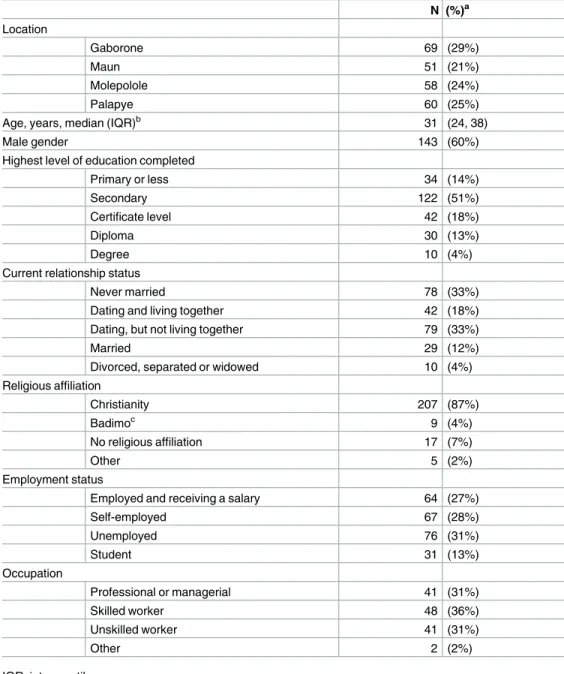
A total of 238 men, women, and community leaders participated in 27 focus group discussions from July to November 2013 (S1 Table).Table 1summarizes the demographic characteristics of the participants. Median age was 31 years, and 60% were male. Thirty-four participants (14%) reported a primary education or less while 122 (51%) reported at least a secondary edu-cation. Only 12% of participants were married.
Painful sex as a deterrent to early resumption of sexual activity
Pain, not HIV risk, was perceived as the main adverse consequence of early resumption of sex. Pain was reported by participants across all focus groups as the main adverse outcome of early resumption of sex post-circumcision (Table 2; Row 1–4). No participant mentioned a potential increase in HIV infection risk associated with early resumption of sex. Despite acknowledging pain as an undesirable consequence of engaging in sex prior to complete wound healing, it did not necessarily prevent early initiation of sex. One circumcised man stated, “I blame us who have circumcised because we keep telling them [uncircumcised men] that it [sex] is painful and it tears the sutures. But if you feel the pain, just get off the bed, put your feet on the floor, and the coldness from the floor will make you forget about the pain” (Table 2; Row 3).
Demonstration of masculinity and virility
Fear of losing female partners
In addition to the virility of male partners, virility of female partners was also seen as a barrier to adherence to the post-operative abstinence period (Table 2; Row 9–12). Focus group partici-pants commonly mentioned that potential promiscuity among female partners was a concern. As stated by a circumcised older man in Palapye, “When we think of circumcision most of us start having thoughts of other men taking our women whilst we are recuperating. The woman Table 1. Descriptive characteristics of 238 men, women, and community leaders who participated in 27 focus group discussions across four communities in Botswana.
N (%)a
Location
Gaborone 69 (29%)
Maun 51 (21%)
Molepolole 58 (24%)
Palapye 60 (25%)
Age, years, median (IQR)b 31 (24, 38)
Male gender 143 (60%)
Highest level of education completed
Primary or less 34 (14%)
Secondary 122 (51%)
Certificate level 42 (18%)
Diploma 30 (13%)
Degree 10 (4%)
Current relationship status
Never married 78 (33%)
Dating and living together 42 (18%)
Dating, but not living together 79 (33%)
Married 29 (12%)
Divorced, separated or widowed 10 (4%)
Religious affiliation
Christianity 207 (87%)
Badimoc 9 (4%)
No religious affiliation 17 (7%)
Other 5 (2%)
Employment status
Employed and receiving a salary 64 (27%)
Self-employed 67 (28%)
Unemployed 76 (31%)
Student 31 (13%)
Occupation
Professional or managerial 41 (31%)
Skilled worker 48 (36%)
Unskilled worker 41 (31%)
Other 2 (2%)
IQR, interquartile range
aPercentages may not sum to 100% due to rounding. b25thand 75thpercentiles
cTraditionally circumcising ethic group
Table 2. Early resumption sex following voluntary medical male circumcision (VMMC) from the perspectives of 238 men, women, and community leaders in four communities in Botswana.
Row Theme Focus Group Discussion Representative quotation
1 Painful sex as a deterrent to early resumption of sexual activity
Women, 31 to 49 years, Gaborone
It is a difficult situation. . .the problem is that at an older age, men think a lot about sex. After circumcision, before the wound has fully recovered, men are likely to have strong desires to have sex with their partners. This results in them going through much pain.
2 Uncircumcised men, 31 to
49 years, Molepolole
As a guy, I believe you know that you can’t survive that long without wanting to do a little something [sex]. Now imagine when you get an erection and you have those stitches, I just can’t imagine the pain and like I said, six weeks of no sex is torture.
3 Circumcised men, 31 to 49
years, Palapye
If you were able to withstand the pain for an hour, that is what I call initiation. If you were able to withstand that pain in the morning after sex tore the sutures apart, you are a real man. We men are loose in conduct. . .we fail to just abstain for six weeks. I blame us who have circumcised because we keep telling them [uncircumcised men] that it [sex] is painful and it tears the sutures; but if you feel the pain, just get off the bed, put your feet on the floor, and the coldness from the floor will make you forget about the pain.
4 Circumcised men, 18 to 30
years, Molepolole
In some instances, I have seen guys who tried to have sex after two weeks and they were forced to go back to the hospital
5 Demonstration of masculinity and virility Uncircumcised men, 31 to 49 years, Gaborone
As men our behaviors are diverse, some men cannot imagine six weeks of not engaging in sexual activities. I feel if the wound took a shorter period of time to heal, things would be better.
6 Circumcised men, 31 to 49
years, Maun
Some are impatient or should I say they are addicted. Sex is very addictive in the sense that if you are used to having sex regularly some men become anxious at that thought [of abstaining for six weeks], because there is a belief that if you go for long without sex you may go crazy. . .they say the ‘sack’ [testicles] will drive you crazy!
7 Uncircumcised men, 18 to
30 years, Palapye
The other issue is six weeks. It is a long time and men wonder whether they can afford to stay for that long without doing anything sexual because the nerves or veins may block in one way or the other.
8 Circumcised men, 18 to 30
years, Palapye
There are men with high libido and high sex drive, who want to have sex every day. They think they are strengthening their bodies. If they think of going for such a long time without doing anything sexually, they cringe. 9 Fear of losing female partners Circumcised men, 31 to 49
years, Palapye
When we think of circumcision most of us start having thoughts of other men taking our women whilst we are recuperating. The woman will also feel sexually starved, and I will think that so-and-so [another man] will take my girl because he has being following her and he may have even encouraged me to circumcise.
10 Circumcised men, 18 to 30
years, Maun
If my friend goes to circumcise, I will be surprised and say to him that “you have gone to circumcise and I am going to sleep with your girl”. That is one of the issues that scares men, these six weeks. There is a high possibility of losing a girl in that six weeks. Men are afraid that they [other men] will take their women.
11 Women, 31 to 49 years,
Gaborone
Men may think that women are likely to cheat on them whilst they are still in the six weeks healing period.
12 Circumcised men, 18 to 30
years, Palapye
During the recuperation period, woman may go and look for something [sex] somewhere else because of loneliness.
13 Misperceptions about post-operative wound healing
Women, 18 to 30 years, Gaborone
It does not even take long to heal. One of my friends took just two weeks or even less to heal.
14 Women, 18 to 30 years,
Gaborone
You do not take the whole month with the wound. . .it takes about two weeks to heal. I really do not understand what they are scared of, basically yes it is painful, but after two weeks I think they can assume sex.
15 Women, 31 to 49 years,
Maun
Men are worried about the time they are given before they can have sex, if I am not mistaken it’s a month.
16 Uncircumcised men, 31 to
49 years, Maun
From what I have observed and heard, when we are discussing these things as men, we only focus on negatives like it is painful, things like you are going to spend three weeks without having sex and stuff like that. Those are the main things that we talk about.
will also feel sexually starved. That is one of the issues that scare men, these six weeks” (Table 2; Row 9). This was succinctly described by a circumcised participant from Maun who stated that “There is a high possibility of losing a girl in that six weeks” (Table 2; Row 11).
Misperceptions about post-operative wound healing
In several discussion groups, there were clear misperceptions related to the recommended time period of abstinence post-circumcision. In some cases, female participants suggested the healing period was shorter than six weeks (Table 2; Rows 13–15). One woman stated, “It does not even take long to heal. One of my friends took just two weeks or even less to heal.” (Table 2; Row 13) While misperceptions related to the duration of the abstinence period were more common within the focus groups with women, misperceptions were also mentioned in discussions with men (Table 2; Row 16).
Table 2. (Continued)
Row Theme Focus Group Discussion Representative quotation
17 Influence of women to promote post-operative abstinence
Circumcised men, 31 to 49 years, Gaborone
I told her that I was instructed from the hospital not to be engaged in any sexual activities and should stay [abstinent] for a specific period.
18 Women, 31 to 49 years,
Palapye
I have been with my partner for six years. In 2010 he went to be circumcised. He never gave me any troubles though at times before he could heal he would attempt to lure me in to having sex with him and I would tell him to take it easy as he is yet to heal.
19 Women, 31 to 49 years,
Gaborone
I think after circumcision, if you stay together with your partner, there should be a certain way you care for him. You sleep in separate beds to avoid contact. . .if there is contact there would be erection, hence more pain caused by the sutures tightening
20 Women, 31 to 49 years,
Palapye
Yes, you will hear someone saying ‘Hey I am so horny’ then you just have to tell him to persevere until he has recovered
21 Women, 31 to 49 years,
Maun
When I met my current man, I asked him to go with me for testing. When we got there they encouraged him to get circumcised. We discussed the issue and he did not refuse and he went to get circumcised. I used to visit him to check on him. . .I never spent a night at his place until the wound was completely healed. He is now fine.
22 Women, 18 to 30 years,
Palapye
When you are living together in the same house it is difficult. . .I put a sanitary pad on and told him that I was having my period.
23 Linking VMMC to the post-partum period to promote post-operative abstinence
Circumcised men, 18 to 30 years, Gaborone
It might be easier if you get your partner pregnant and then while on confinement, you get circumcised so that the both of you can wait six weeks.
24 Molepolole Leaders I look at this issue and think of confinement. When my wife had her first child, I had to stay away from her for three months without having sex and I believe that is what most men have experienced. My question now is, if that was possible, what makes us now think that 6 weeks is a long time. All I can say is men are just fronting their lustful desires instead of being worried about their health
25 Women, 31 to 49 years,
Palapye
I have a younger brother who told me that six weeks is a long time, but I reminded him that he has children and much as he was able to wait for his woman during confinement he should do likewise about circumcision. 26 Infant male circumcision to eliminate
post-operative abstinence concerns
Women, 18 to 30 years, Molepolole
Maybe the reason they do not circumcise when they are older is because they feel the six weeks they have to wait before resuming sex is long; because they are reluctant to do it when they are older, let’s do it at birth.
27 Circumcised men, 31–49
years, Palapye
When you are older circumcision is a daunting task. . .it is best if they are circumcised when they are young because then they are still innocent.
28 Women; 18 to 30 years,
Palapye
I suggest that they get circumcised at a younger age because if they are already sexually active or living with a girlfriend; it won’t be easy to abstain during the recuperating time. I think it will be best to circumcise them when they are still young.
Influence of women to promote post-operative abstinence
Both male and female participants volunteered strategies on how women could encourage abstinence during the wound healing period. One older circumcised man recounted his own experience with his partner following VMMC, indicating that he purposefully communicated with his partner that “[he] was instructed from the hospital not to be engaged in any sexual activities.” (Table 2; Row 17). This experience, however, was not commonly reported by other male participants. In contrast, women were more likely to identify a role in encouraging absti-nence during the post-operative period (Table 2; Rows 18–22). This included reminding their partners and/or male relatives of the need for abstinence (Table 2; Row 18) and undertaking strategies targeted at reducing sexual desire, including sleeping in separate beds during the wound healing period.
Linking VMMC to the post-partum period to promote post-operative
abstinence
Participants frequently compared the abstinence period following VMMC with the postpar-tum abstinence undertaken by women (Table 2; Row 23–25). One male participant explicitly suggested that VMMC be linked to the postpartum period, stating that “It might be easier if you get your partner pregnant and then while on confinement [postpartum abstinence period], you get circumcised so that both of you can wait six weeks” (Table 2; Row 23). Simi-larly, participants felt circumcision-related abstinence should be treated no differently than abstinence related to the postpartum period. One community leader stated the following: “I look at this issue and think of confinement. When my wife had her first child, I had to stay away from her for three months without having sex and I believe that is what most men have experienced. My question now is, if that was possible, what makes us now think that six weeks is a long time.” (Table 2; Row 24).
Infant male circumcision to eliminate post-operative abstinence
concerns
Many participants indicated that the challenges related to post-operative sexual abstinence could be solved by promoting medical male circumcision among male infants and children (Table 2; Rows 26–28). Circumcising infants and boys prior to sexual debut would eliminate any challenges related to early resumption of sex. One female participant stated, “I suggest that they get circumcised at a younger age because if they are already sexually active or living with a girlfriend it won’t be easy to abstain during the recuperating time. I think it will be best to cir-cumcise them when they are still young” (Table 2; Row 28).
Discussion
This study highlights a potentially widespread lack of awareness of the increased risk of HIV acquisition during the wound healing period. Pain, not risk of HIV acquisition, was perceived as the main deterrent of early resumption of sex. This adverse consequence was not, however, sufficient for maintaining abstinence during wound healing. Participants strongly believed that regular sex was not only normal but required for maintaining health and mitigating part-ner infidelity. Strategies to promote post-procedure abstinence shared by participants included educating women about the wound healing process, linking VMMC with female partners’ post-partum period, and encouraging infant male circumcision.
including HIV acquisition [11–14,19,20]. Mathematical modeling has suggested that early resumption of sex would not likely outweigh the population-level benefits, given the strength of the protective benefit of VMMC after the circumcision wound has healed [12,14,19,20]. It is, nevertheless, critical that VMMC services are delivered in a manner that ensures the safety of clients and their partners. There is a clear need to ensure that health workers highlight that early resumption of sex puts both clients and their partners at heightened risk of HIV infection.
As VMMC programs grow, they will need to increase their focus on older men to reach overall program targets, which will make finding strategies to motivate post-procedure absti-nence critical. Three studies from Kenya have found that older men are more likely to resume sex prior to wound healing compared to younger men [15,16,18]. For example, one study found that among men who resumed sex prior to six weeks, 25% were 30 years or older whereas only 8% of those who adhered to the abstinence guideline were in this age group [15]. Strong post-procedure counseling for older men will also be important because HIV incidence and prevalence are highest in these populations [24–26]. In the case of Botswana, HIV inci-dence and prevalence peaks among men aged 45–49 years [27] and 40–44 years, respectively [28].
Increased focus on implementing effective strategies to support post-procedure abstinence will be critical among not only older men but also HIV-positive clients undergoing VMMC. Resumption of sexual activity by HIV-positive clients prior to complete wound healing would potentially increase risk of transmission to HIV-negative partners. HIV infection is not a con-traindication for VMMC. Moreover, there are non-HIV-related medical benefits, including improved hygiene, reduced STI risk and reduced genital cancers in men and their female sex-ual partners [29,30]. Yet, data from Uganda suggest that this population may be more likely than HIV-negative men to resume sex before complete wound healing [11].
Several recommendations can be considered for promoting sexual abstinence following VMMC based on data from this qualitative study. First, men undergoing circumcision, together with their partners, may benefit from additional counseling on the temporary increase in HIV risk during wound healing. Second, new and innovative social messaging should be developed to promote post-VMMC abstinence as a healthy social norm and to encourage women to support their partners during this period. Involving women may be par-ticularly important. Reports from Kenya found that men resuming sexual activity early were more likely to report that women were increasingly attracted to them after VMMC [15]. Another strategy to encourage adherence to post-procedure abstinence was promoting link-ages between VMMC, antenatal care and post-partum services. Healthcare workers in antena-tal clinics are well-positioned to promote VMMC services to partners of pregnant women to align the timing of the post-procedure abstinence period for VMMC with the abstinence period already observed after labor and delivery.
been inhibited to speak freely due to the traditional cultural and social norms related to dis-cussing sexual behavior. Skilled, same sex moderators were used to mitigate this limitation.
Evidence suggests that men and women are not well informed about the increase in HIV risk during wound healing. As VMMC programs in sub-Saharan Africa aggressively move for-ward to reach population-level scale-up targets, greater numbers of older men as well as men who are HIV-positive will seek VMMC services. Attention to early resumption of sex following VMMC will be increasingly important, especially given that to date, clients and their partners appear unaware of the increased risk of HIV prior to complete wound healing and effective strategies to promote abstinence following VMMC are lacking [16].
Supporting information
S1 Text. Focus group discussion tool in English. (DOCX)
S2 Text. Focus group discussion tool in Setswana. (DOC)
S1 Table. Demographic data file of focus group participants. (CSV)
Acknowledgments
The authors would like to gratefully acknowledge Boyce Otlhomile, Maggie Nkgau and Spen-cer Manthe for their assistance in recruitment of study participants and transcription of audio recordings.
Author Contributions
Conceptualization: Jenny H. Ledikwe, Scott Barnhart, Conrad Ntsuape, Bazghina-werq Semo, Kathleen E. Wirth.
Formal analysis: Jenny H. Ledikwe, Nankie M. Ramabu, Lisa P. Spees, Kathleen E. Wirth.
Funding acquisition: Scott Barnhart.
Methodology: Jenny H. Ledikwe, Kathleen E. Wirth.
Project administration: Jenny H. Ledikwe, Conrad Ntsuape, Kathleen E. Wirth.
Software: Jenny H. Ledikwe, Nankie M. Ramabu, Kathleen E. Wirth.
Supervision: Jenny H. Ledikwe, Bazghina-werq Semo.
Writing – original draft: Jenny H. Ledikwe.
Writing – review & editing: Nankie M. Ramabu, Lisa P. Spees, Scott Barnhart, Conrad Ntsuape, Bazghina-werq Semo, Kathleen E. Wirth.
References
1. World Health Organization, UNAIDS, editors. New Data on Male Circumcision and HIV Prevention: Pol-icy and Programme Implications. WHO/UNAIDS Technical Consultation on Male Circumcision and HIV Prevention: Research Implications for Policy and Programming; 2007; Montreux, France: World Health Organization and UNAIDS.
medicine. 2005; 2(11):e298.https://doi.org/10.1371/journal.pmed.0020298PMID:16231970; PubMed Central PMCID: PMC1262556.
3. Bailey RC, Moses S, Parker CB, Agot K, Maclean I, Krieger JN, et al. Male circumcision for HIV preven-tion in young men in Kisumu, Kenya: a randomised controlled trial. Lancet. 2007; 369(9562):643–56. https://doi.org/10.1016/S0140-6736(07)60312-2PMID:17321310.
4. Gray RH, Kigozi G, Serwadda D, Makumbi F, Watya S, Nalugoda F, et al. Male circumcision for HIV prevention in men in Rakai, Uganda: a randomised trial. Lancet. 2007; 369(9562):657–66.https://doi. org/10.1016/S0140-6736(07)60313-4PMID:17321311.
5. Sgaier SK, Reed JB, Thomas A, Njeuhmeli E. Achieving the HIV Prevention Impact of Voluntary Medi-cal Male Circumcision: Lessons and Challenges for Managing Programs. PLoS medicine. 2014; 11(5): e1001641. Epub 2014/05/08.https://doi.org/10.1371/journal.pmed.1001641PMID:24800840; PubMed Central PMCID: PMCPmc4011573.
6. Ledikwe JH, Nyanga RO, Hagon J, Grignon JS, Mpofu M, Semo BW. Scaling-up voluntary medical male circumcision—what have we learned? Hiv/Aids. 2014; 6:139–46.https://doi.org/10.2147/HIV. S65354PMID:25336991; PubMed Central PMCID: PMC4199973.
7. Andersson KM, Owens DK, Paltiel AD. Scaling up circumcision programs in Southern Africa: the poten-tial impact of gender disparities and changes in condom use behaviors on heterosexual HIV transmis-sion. AIDS and behavior. 2011; 15(5):938–48.https://doi.org/10.1007/s10461-010-9784-yPMID: 20924783; PubMed Central PMCID: PMCPMC3112296.
8. Njeuhmeli E, Forsythe S, Reed J, Opuni M, Bollinger L, Heard N, et al. Voluntary medical male circumci-sion: modeling the impact and cost of expanding male circumcision for HIV prevention in eastern and southern Africa. PLoS medicine. 2011; 8(11):e1001132.https://doi.org/10.1371/journal.pmed.1001132 PMID:22140367; PubMed Central PMCID: PMC3226464.
9. Williams BG, Lloyd-Smith JO, Gouws E, Hankins C, Getz WM, Hargrove J, et al. The potential impact of male circumcision on HIV in Sub-Saharan Africa. PLoS medicine. 2006; 3(7):e262.https://doi.org/10. 1371/journal.pmed.0030262PMID:16822094; PubMed Central PMCID: PMC1489185.
10. White RG, Glynn JR, Orroth KK, Freeman EE, Bakker R, Weiss HA, et al. Male circumcision for HIV prevention in sub-Saharan Africa: who, what and when? Aids. 2008; 22(14):1841–50.https://doi.org/10. 1097/QAD.0b013e32830e0137PMID:18753931.
11. Kigozi G, Gray RH, Wawer MJ, Serwadda D, Makumbi F, Watya S, et al. The safety of adult male cir-cumcision in HIV-infected and uninfected men in Rakai, Uganda. PLoS medicine. 2008; 5(6):e116. https://doi.org/10.1371/journal.pmed.0050116PMID:18532873; PubMed Central PMCID: PMC2408615.
12. Hewett PC, Hallett TB, Mensch BS, Dzekedzeke K, Zimba-Tembo S, Garnett GP, et al. Sex with stitches: assessing the resumption of sexual activity during the postcircumcision wound-healing period. Aids. 2012; 26(6):749–56.https://doi.org/10.1097/QAD.0b013e32835097ffPMID:22269970.
13. Wawer MJ, Makumbi F, Kigozi G, Serwadda D, Watya S, Nalugoda F, et al. Circumcision in HIV-infected men and its effect on HIV transmission to female partners in Rakai, Uganda: a randomised con-trolled trial. Lancet. 2009; 374(9685):229–37.https://doi.org/10.1016/S0140-6736(09)60998-3PMID: 19616720; PubMed Central PMCID: PMCPMC2905212.
14. Mehta SD, Gray RH, Auvert B, Moses S, Kigozi G, Taljaard D, et al. Does sex in the early period after circumcision increase HIV-seroconversion risk? Pooled analysis of adult male circumcision clinical tri-als. Aids. 2009; 23(12):1557–64.https://doi.org/10.1097/QAD.0b013e32832afe95PMID:19571722; PubMed Central PMCID: PMC2772053.
15. Herman-Roloff A, Bailey RC, Agot K. Factors associated with the early resumption of sexual activity fol-lowing medical male circumcision in Nyanza province, Kenya. AIDS and behavior. 2012; 16(5):1173– 81.https://doi.org/10.1007/s10461-011-0073-1PMID:22052231; PubMed Central PMCID: PMC3677080.
16. Odeny TA, Bailey RC, Bukusi EA, Simoni JM, Tapia KA, Yuhas K, et al. Effect of text messaging to deter early resumption of sexual activity after male circumcision for HIV prevention: a randomized con-trolled trial. Journal of acquired immune deficiency syndromes. 2014; 65(2):e50–7.https://doi.org/10. 1097/QAI.0b013e3182a0a050PMID:23846561; PubMed Central PMCID: PMC3867588.
17. Layer EH, Beckham SW, Momburi RB, Peter M, Laizer E, Kennedy CE. ’He is proud of my courage to ask him to be circumcised’: experiences of female partners of male circumcision clients in Iringa region, Tanzania. Culture, health & sexuality. 2014.https://doi.org/10.1080/13691058.2013.873481PMID: 24400819.
18. Odoyo-June E, Rogers JH, Jaoko W, Bailey RC. Factors associated with resumption of sex before com-plete wound healing in circumcised HIV-positive and HIV-negative men in Kisumu, Kenya. Journal of acquired immune deficiency syndromes. 2013; 62(4):465–70.https://doi.org/10.1097/QAI.
19. Hallett TB, Alsallaq RA, Baeten JM, Weiss H, Celum C, Gray R, et al. Will circumcision provide even more protection from HIV to women and men? New estimates of the population impact of circumcision interventions. Sexually transmitted infections. 2011; 87(2):88–93.https://doi.org/10.1136/sti.2010. 043372PMID:20966458; PubMed Central PMCID: PMCPMC3272710.
20. Hallett TB, Singh K, Smith JA, White RG, Abu-Raddad LJ, Garnett GP. Understanding the impact of male circumcision interventions on the spread of HIV in southern Africa. PloS one. 2008; 3(5):e2212. https://doi.org/10.1371/journal.pone.0002212PMID:18493593; PubMed Central PMCID:
PMC2387228.
21. Kamath V, Limaye RJ. Voluntary medical male circumcision for HIV prevention and early resumption of sexual activity: a literature review. AIDS care. 2015:1–4.https://doi.org/10.1080/09540121.2015. 1017797PMID:25738780.
22. Plotkin M, Castor D, Mziray H, Kuver J, Mpuya E, Luvanda PJ, et al. "Man, what took you so long?" Social and individual factors affecting adult attendance at voluntary medical male circumcision services in Tanzania. Global health, science and practice. 2013; 1(1):108–16. https://doi.org/10.9745/GHSP-D-12-00037PMID:25276521; PubMed Central PMCID: PMC4168557.
23. Harris PA, Taylor R, Thielke R, Payne J, Gonzalez N, Conde JG. Research electronic data capture (REDCap)—a metadata-driven methodology and workflow process for providing translational research informatics support. J Biomed Inform. 2009; 42(2):377–81.https://doi.org/10.1016/j.jbi.2008.08.010 PMID:18929686; PubMed Central PMCID: PMCPMC2700030.
24. Shisana O, Rehle T, Simbayi LC, Zuma K, Jooste S, Zungu N, et al. South African National HIV Preva-lence, Incidence and Behaviour Survey,2012. Cape Town, South Africa: 2014.
25. Zaidi J, Grapsa E, Tanser F, Newell ML, Barnighausen T. Dramatic increase in HIV prevalence after scale-up of antiretroviral treatment. Aids. 2013; 27(14):2301–5.https://doi.org/10.1097/QAD. 0b013e328362e832PMID:23669155; PubMed Central PMCID: PMCPMC4264533.
26. Gonzalez R, Munguambe K, Aponte J, Bavo C, Nhalungo D, Macete E, et al. High HIV prevalence in a southern semi-rural area of Mozambique: a community-based survey. HIV medicine. 2012; 13 (10):581–8.https://doi.org/10.1111/j.1468-1293.2012.01018.xPMID:22500780.
27. Government of Botswana. Botswana AIDS impact survey III (BAIS III). 2009.
28. Government of Botswana. Botswana AIDS impact survey IV (BAIS IV) Summary Results. 2014.
29. Weiss HA, Thomas SL, Munabi SK, Hayes RJ. Male circumcision and risk of syphilis, chancroid, and genital herpes: a systematic review and meta-analysis. Sexually transmitted infections. 2006; 82 (2):101–9; discussion 10.https://doi.org/10.1136/sti.2005.017442PMID:16581731; PubMed Central PMCID: PMC2653870.
30. Zetola N, Klausner JD. Male circumcision reduces human papillomavirus incidence and prevalence: clarifying the evidence. Sexually transmitted diseases. 2012; 39(2):114–5.https://doi.org/10.1097/ OLQ.0b013e318242b4f3PMID:22249299.