The Gut-Brain Axis in Healthy Females: Lack of
Significant Association between Microbial
Composition and Diversity with Psychiatric
Measures
Susan C. Kleiman1, Emily C. Bulik-Sullivan2, Elaine M. Glenny1, Stephanie C. Zerwas3, Eun Young Huh3, Matthew C. B. Tsilimigras4, Anthony A. Fodor4, Cynthia M. Bulik1,3,5, Ian
M. Carroll2,6*
1 Department of Nutrition, The University of North Carolina at Chapel Hill, Chapel Hill, North Carolina, United
States of America, 2 Department of Medicine, The University of North Carolina at Chapel Hill, Chapel Hill, North Carolina, United States of America, 3 Department of Psychiatry, The University of North Carolina at Chapel Hill, Chapel Hill, North Carolina, United States of America, 4 Department of Bioinformatics and Genomics, The University of North Carolina at Charlotte, Charlotte, North Carolina, United States of America,
5 Department of Medical Epidemiology and Biostatistics, Karolinska Institutet, Stockholm, Sweden, 6 Center
for Gastrointestinal Biology and Disease, The University of North Carolina at Chapel Hill, Chapel Hill, North Carolina, United States of America
Abstract
Objective
This study examined associations between the composition and diversity of the intestinal microbiota and measures of depression, anxiety, eating disorder psychopathology, stress, and personality in a group of healthy adult females.
Methods
Female participants (n = 91) ages 19–50 years with BMI 18.5–25 kg/m2were recruited from central North Carolina between July 2014 and March 2015. Participants provided a single fecal sample and completed an online psychiatric questionnaire that included five measures: (i) Beck Anxiety Inventory; (ii) Beck Depression Inventory-II; (iii) Eating Disor-der Examination-Questionnaire; (iv) Perceived Stress Scale; and (v) Mini International Per-sonality Item Pool. Bacterial composition and diversity were characterized by Illumina sequencing of the 16S rRNA gene, and associations were examined using Kendall’s tau-b correlation coefficient, in conjunction with Benjamini and Hochberg’s False Discovery Rate procedure.
Results
We found no significant associations between microbial markers of gut composition and diversity and scores on psychiatric measures of anxiety, depression, eating-related thoughts and behaviors, stress, or personality in a large cohort of healthy adult females.
a1111111111 a1111111111 a1111111111 a1111111111 a1111111111
OPEN ACCESS
Citation: Kleiman SC, Bulik-Sullivan EC, Glenny EM, Zerwas SC, Huh EY, Tsilimigras MCB, et al. (2017) The Gut-Brain Axis in Healthy Females: Lack of Significant Association between Microbial Composition and Diversity with Psychiatric Measures. PLoS ONE 12(1): e0170208. doi:10.1371/journal.pone.0170208
Editor: Brenda A Wilson, University of Illinois at Urbana-Champaign, UNITED STATES
Received: January 29, 2016
Accepted: January 2, 2017
Published: January 19, 2017
Copyright:©2017 Kleiman et al. This is an open access article distributed under the terms of the
Creative Commons Attribution License, which permits unrestricted use, distribution, and reproduction in any medium, provided the original author and source are credited.
Data Availability Statement: All data files are available from the MG-RAST database (accession number: mgp20265).
Discussion
This study was the first specifically to examine associations between the intestinal micro-biota and psychiatric measures in healthy females, and based on 16S rRNA taxonomic abundances and diversity measures, our results do not suggest a strong role for the enteric microbe-gut-brain axis in normal variation on responses to psychiatric measures in this pop-ulation. However, the role of the intestinal microbiota in the pathophysiology of psychiatric ill-ness may be limited to more severe psychopathology.
Introduction
Investigations conducted over the last decade have generated consensus among researchers that the intestinal microbiota plays a vital role in a range of physiologic processes, especially those related to immunologic and metabolic function. Emerging evidence also suggests that a healthy intestinal microbiota is important for normal brain development [1]. The enteric microbe-gut-brain axis has garnered increasing attention as a key, bidirectional communica-tion pathway that influences mood, cognicommunica-tion, and behavior [2–4]. In addition to a direct con-nection via the vagus nerve, it may be possible that gut bacteria interact with the brain through production of neurotransmitters, hormones, and other metabolites [5].
Whether a dysbiosis in the intestinal microbiota, an unhealthy change in the normal micro-bial ecology of the gut, plays a direct role in the pathophysiology of psychiatric disorders remains to be determined; however, both preclinical animal studies and clinical human studies are actively investigating this question. Numerous studies in animal models have documented behavioral changes following manipulation of the intestinal microbiota, including effects on behavior associated with stress [6], anxiety [1,7–9], and depression [5,10]. Validating animal models of the enteric microbe-gut-brain axis in human populations has reported modest asso-ciations and has been limited by small sample sizes and lack of consistency in assessment of psychiatric and microbial outcome measures. Although underpowered, these studies in human cohorts suggest a potential role for the intestinal microbiota in anxiety, depression, stress, cognitive reactivity, and eating disorders [11–15].
The majority of the emerging data reporting a relationship between the intestinal micro-biota and psychological/behavioral traits has been demonstrated in either rodents or in humans who suffer from threshold psychiatric disorders [16]. It is unknown whether these associations hold across the entire spectrum of severity of psychopathology, or if they are con-fined to the more pathological extremes. Our goal, therefore, was to determine whether the associations between the intestinal microbiota and psychological measures hold across the spectrum of severity of our target psychological dimensions in healthy individuals. We exam-ined associations between the composition and diversity of the intestinal microbiota and mea-sures of depression, anxiety, eating disorder psychopathology, stress, and personality in a group of healthy adult females.
Materials and Methods
The study was approved by the Biomedical Institutional Review Board at the University of North Carolina at Chapel Hill. All participants provided written consent before study participation.
P30DK03498 awarded to Dr. Carroll. Dr. Bulik acknowledges funding from the Swedish Research Council (VR Dnr: 538-2013-8864). The remaining authors reported no financial disclosures. The funders had no role in study design, data collection and analysis, decision to publish, or preparation of the manuscript.
Study Population
To limit the natural variability in the composition of the intestinal microbiota between healthy individuals, we recruited healthy adult females (n = 100) ages 19–50 years with BMI 18.5–25.0 kg/m2from central North Carolina via listserv announcements, targeted emails, and social media to serve as controls for ongoing research (clinicaltrials.gov—NCT01916538). Partici-pants were recruited between July 2014 and March 2015. Due to possible impact on the intesti-nal microbiota, potential participants were excluded for the following reasons: (i) history of gastrointestinal tract surgery (other than appendectomy or cholecystectomy); (ii) history of inflammatory bowel diseases, irritable bowel syndrome, or celiac disease; (iii) history of eating disorders (anorexia nervosa, bulimia nervosa, binge-eating disorder); (iv) treatment in the last two months with antibiotics or steroids; (v) intentional use of probiotics during the last two months (via food or supplement); and/or (vi) abuse of laxatives within the last month.
Body Composition and Assessments
Participants self-reported current height and weight during the screening process. Participants completed an online psychiatric questionnaire that included five widely used and validated measures: (i) Beck Anxiety Inventory (BAI) [17,18]; (ii) Beck Depression Inventory-II (BDI) [19,20]; (iii) Eating Disorder Examination-Questionnaire (EDE-Q) [21,22]; (iv) Perceived Stress Scale-10 (PSS) [23,24]; and (v) Mini International Personality Item Pool (Mini IPIP) [25].
Sample Collection, Processing, and Storage
During the consent process, participants were provided with an at-home stool collection kit and trained in sample collection procedures. Each kit included: Styrofoam container, dispos-able collection hat, stool collection tube, biohazard bag, pair of non-latex gloves, two ice packs, and stool collection record sheet. Participants were instructed to return the sample (in the bio-hazard bag, with ice packs, in the Styrofoam box) to the research office within 24 hours of col-lection and to keep the sample refrigerated during any interim period. Samples were then immediately transferred to the laboratory, where they were mechanically homogenized with a sterile spatula, aliquoted into sterile 2 ml cryotubes, and stored in a−80˚C freezer for future DNA isolation and molecular microbiological analysis.
DNA Isolation
Bacterial DNA was isolated from collected samples using a phenol/chloroform extraction method combined with physical disruption of bacterial cells and a DNA clean-up kit (QIAmp DNA Stool Mini Kit [Qiagen, Valencia, CA]), as previously described [26,27].
Sequencing of 16S rRNA Genes
KAPA2G Robust PCR kit (Kapa Biosystems, Wilmington, MA); and (2) 95˚C for three min-utes, then 22 cycles of 95˚C for 30 seconds, 50˚C for 30 seconds, and 72˚C for 30 seconds, fol-lowed by one cycle of 72˚C for five minutes using 5μL of purified PCR product from the first amplification as template, 10μM of forward and reverse primers that contain Illumina MiSeq adapter sequences with a 12-base error-correcting Golay barcode incorporated in the reverse primer, and the KAPA HiFi HotStart ReadyMix PCR kit [28]. Purification of PCR products was carried out after each amplification using the HighPrep PCR clean-up kit (MagBio, Lau-sanne, Switzerland) with a DynaMag-96 side magnet (Life Technologies, Carlsbad, CA). Equi-molar 16S rRNA PCR products were then quantified and pooled for sequencing. Sequencing was performed on an Illumina MiSeq desktop sequencer (Illumina, San Diego, CA) by the High-Throughput Sequencing Facility in the Carolina Center for Genome Sciences at the UNC School of Medicine. Demultiplexed MiSeq data for each of the 91 participants can be accessed on the MG-RAST online metagenomics server [29]:http://metagenomics.anl.gov/ linkin.cgi?project=mgp20265(Project ID: mgp20265).
Analysis of 16S rRNA Sequences
16S rRNA sequencing data were processed by the Quantitative Insights Into Microbial Ecology (QIIME) pipeline [30], with quality filtering as previously described [27]. Forward sequence reads (250 bp) were clustered into Operational Taxonomic Units (OTUs) based on their sequence similarity at a 97% threshold using BLAST and assigned taxonomy using the Green-genes database [31]. Principal coordinates were generated using unweighted and weighted UniFrac distances [32–34].
Results were validated using an alternate pipeline, in which forward reads from the 16S rRNA sequencing data were classified with version 2.10.1 of the RDP classifier with a threshold of a 50% RDP score [35].
Statistical significance was determined using Kendall’s tau-b correlation coefficient in R [36]. R scripts are available at:https://github.com/mcbtBINF/healthyCohort/.
The diversity of the intestinal microbiota was characterized by the Shannon diversity index [37,38].
Statistical Analysis
Results
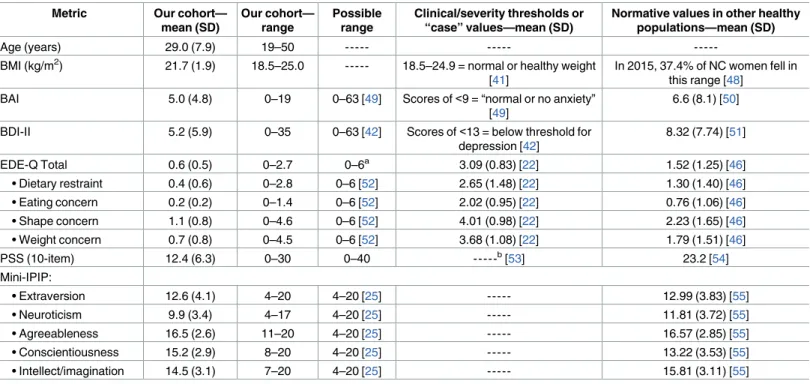
Of 100 participants who consented to participate in the study, 94 completed the psychiatric questionnairesandsubmitted a fecal sample, of which sequencing results from 91 samples met minimal sequencing depth standards for analysis. Demographic and clinical characteristics of the final participant sample (n = 91) are shown inTable 1. In brief, the participants had a mean (SD) age of 29.0 (7.9) years and were within the normal or healthy weight range for adults [41]. On average, their scores indicate normal or minimal levels of anxiety (BAI), depression (BDI), and stress (PSS) and are in line with, or lower than, those of similar non-clinical samples [18,42–44]. Total scores on the EDE-Q and its four subscales (dietary restraint and eating, weight, and shape concerns) are lower than norms for U.S. college students and young adult females in Sweden and Australia [45–47], which is likely a reflection of the partici-pant recruitment and screening process, which eliminated individuals with a lifetime eating disorder history.
Following sequencing of 16S rRNA genes, we had 91 samples with complete data, after excluding those samples with insufficient depth of sequence reads for our downstream analysis.
The total number of 16S rRNA sequence reads was 15,391,194, and the mean number of reads was 169,134 per sample (range: 47,492–317,380 sequence reads).
When examining associations between psychiatric measures and the composition and diversity of the intestinal microbiota, there were no associations that met established
Table 1. Demographic and clinical characteristics of participants in this study (n = 91) as compared to clinical and normative values.
Metric Our cohort—
mean (SD)
Our cohort— range
Possible range
Clinical/severity thresholds or “case” values—mean (SD)
Normative values in other healthy populations—mean (SD)
Age (years) 29.0 (7.9) 19–50 --- ---
---BMI (kg/m2) 21.7 (1.9) 18.5–25.0 --- 18.5–24.9 = normal or healthy weight
[41]
In 2015, 37.4% of NC women fell in this range [48]
BAI 5.0 (4.8) 0–19 0–63 [49] Scores of<9 = “normal or no anxiety” [49]
6.6 (8.1) [50]
BDI-II 5.2 (5.9) 0–35 0–63 [42] Scores of<13 = below threshold for depression [42]
8.32 (7.74) [51]
EDE-Q Total 0.6 (0.5) 0–2.7 0–6a 3.09 (0.83) [22] 1.52 (1.25) [46]
• Dietary restraint 0.4 (0.6) 0–2.8 0–6 [52] 2.65 (1.48) [22] 1.30 (1.40) [46] • Eating concern 0.2 (0.2) 0–1.4 0–6 [52] 2.02 (0.95) [22] 0.76 (1.06) [46] • Shape concern 1.1 (0.8) 0–4.6 0–6 [52] 4.01 (0.98) [22] 2.23 (1.65) [46] • Weight concern 0.7 (0.8) 0–4.5 0–6 [52] 3.68 (1.08) [22] 1.79 (1.51) [46]
PSS (10-item) 12.4 (6.3) 0–30 0–40 ---b[53] 23.2 [54]
Mini-IPIP:
• Extraversion 12.6 (4.1) 4–20 4–20 [25] --- 12.99 (3.83) [55]
• Neuroticism 9.9 (3.4) 4–17 4–20 [25] --- 11.81 (3.72) [55]
• Agreeableness 16.5 (2.6) 11–20 4–20 [25] --- 16.57 (2.85) [55]
• Conscientiousness 15.2 (2.9) 8–20 4–20 [25] --- 13.22 (3.53) [55]
• Intellect/imagination 14.5 (3.1) 7–20 4–20 [25] --- 15.81 (3.11) [55]
BMI, body mass index; BAI, Beck Anxiety Inventory; BDI, Beck Depression Inventory-II; EDE-Q, Eating Disorder Examination-Questionnaire; PSS, Perceived Stress Scale-10; Mini-IPIP, Mini-International Personality Item Pool.
a
Average of subcategory values.
bThe PSS is not used to index diagnostic thresholds. Higher scores reflect higher perceived stress.
---No suitable clinical data available, e.g. there is no clinical threshold for Agreeableness.
significance thresholds. We considered 17 different measures from our human participants— the 15 measures inTable 1plus participant height and weight. The RDP classifier reported 232 non-rare taxa (12 phyla, 19 classes, 22 orders, 46 families, and 133 genera) that were present in at least 25% of our samples. At each taxonomic level, we also calculated the Shannon diversity index. We therefore evaluated 3,944 hypotheses [17 measures(232 taxa + 5 Shannon diver-sity metrics)] using the non-parametric Kendall’s tau-b test for association. Histograms of gen-erated p-values across all possible associations (Fig 1) are largely uniform, suggesting that the null hypothesis of no association is generally supported across all taxonomic levels. Using FDR correction for all 3,944 hypotheses, there were no significant hits even if the threshold were set to 93% FDR (S1 Table).
We also used a less conservative correction, in which associations between each of the 17 human measurements and each taxonomic level were corrected independently (for example, the comparisons of BDI and the 12 phyla were corrected only for the 12 phyla independent of all the other tests that we ran). Even using this much less stringent threshold, where we might expect some spurious correlations, there were no significant hits at a 5% FDR. We conclude
Fig 1. Histograms of p-values for associations with psychiatric measures by taxonomic level.
Associations between psychiatric and microbial measures were examined using Kendall’s tau-b correlation coefficient, in conjunction with Benjamini and Hochberg’s False Discovery Rate procedure, using data generated by the RDP classifier. Psychiatric measures included: Beck Anxiety Inventory, Beck Depression Inventory-II, Eating Disorder Examination-Questionnaire, Perceived Stress Scale, and Mini-International Personality Item Pool. P-value frequencies were examined at each taxonomic level: (a) phylum; (b) class; (c) order; (d) family; and (e) genus.
that there is a striking lack of correlation between microbial community composition and the measurements we have gathered from this human cohort.
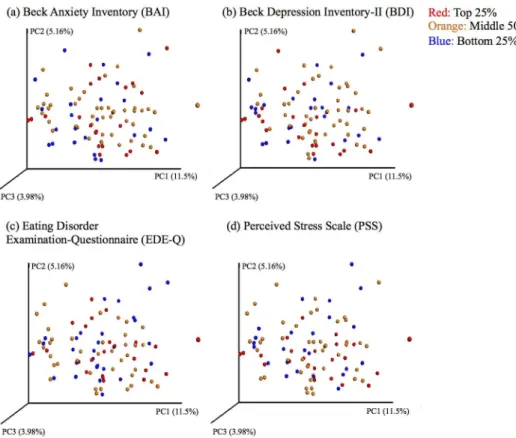
To further visualize the associations in our data set, we generated principal coordinate plots using unweighted UniFrac distances and colored these plots by quartiles of the main psychiat-ric measures of interest (BAI, BDI, EDE-Q total, PSS) (Fig 2). These plots are based on the first three principal coordinates, which explain 11.5% (PC1), 5.16% (PC2), and 3.98% (PC3) of the variance in microbial composition. The plots do not show evidence of clustering or segrega-tion based on extreme values on psychiatric measures, which further supports a lack of micro-bial markers for these psychiatric outcomes in this population. The regression of PC1 and PC2 against each of the psychiatric measures and other participant variables did not indicate any significant linear relationships after FDR correction.
Discussion
Our results provide evidence for a lack of association in physically and psychologically healthy adult females between microbial markers of gut composition and diversity and a collection of psychiatric measures, including anxiety, depression, eating-related thoughts and behaviors, stress, and personality. No associations between these measures met established significance thresholds in our analysis. Consistent with our results, recent work in large (>1000) Dutch Fig 2. Principal coordinate plots of psychiatric measures by quartile. Principal coordinates were
generated using unweighted UniFrac distances from the QIIME pipeline and allocated to quartiles (red: top quartile; orange: middle two quartiles; blue: bottom quartile) based on scores from the (a) Beck Anxiety Inventory; (b) Beck Depression Inventory-II; (c) Eating Disorder Examination-Questionnaire; and (d) Perceived Stress Scale. Plots are based on the first three principal coordinates, which explain 11.5% (PC1), 5.16% (PC2), and 3.98% (PC3) of the variance in microbial composition, and do not cluster by quartile— supporting a lack of association between microbial markers and these psychiatric measures in healthy individuals.
and Flemish cohorts suggests that effect sizes for a wide variety of clinical and lifestyle variables associated with the microbiome in healthy individuals are on the order of 0.01 or smaller, likely below what would be detectable with our sample size of ~100 [56,57].
Animal models suggest a role for the intestinal microbiota in anxiety, depression, and stress, and many animal studies have documented behavioral changes following manipulation of the intestinal microbiota using prebiotics, probiotics, antibiotics, infection with pathogenic bacte-ria, or microbial transfer to germ-free (GF) mice (i.e., mice raised in a sterile environment and lacking an intestinal microbiota). Seminal work by Sudoet al. (2004) on hypothalamic-pitui-tary-adrenal (HPA) axis activity showed that GF mice have exaggerated stress response when compared to conventionally raised mice [6]. GF mice also have reduced anxiety-like behavior compared to conventional mice [1,7–9], which can be reversed via early-life colonization with intestinal bacteria [1,7]. Anxiety-like behavior can also be increased in mice with pathogenic infection [58–60] or transferred between mice with a characteristic anxiety phenotype and non-anxious GF mice using microbial transfer [61]. Probiotic formulations, such as Lactobacil-lus rhamnosusandBifidobacterium infantis, have been shown in animal models to reduce depressive and anxiety-like behavior at effect sizes similar to antidepressant treatment [5,10], and prebiotic human milk oligosaccharides may reduce stress-induced anxiety-like behavior and stimulate changes in microbial diversity [62]. Furthermore, using GF mice, it has recently been discovered that the intestinal microbiota is necessary for appropriate and dynamic regu-lation of myelin-related genes [63]. Altogether, these findings, together with ours, suggest that changes within the intestinal microbiota may be of central importance to the development or maintenance of depression and anxiety—but that the effects are only observed in more extreme expressions of the traits.
The majority of studies investigating the enteric microbe-gut-brain axis has been in animal models with few attempts to translate these findings to a psychologically healthy human popu-lation [16]. Significant results generally lack replication. Mixed evidence has emerged from investigations comparing the intestinal microbiotas of individuals with major depressive disor-der to healthy controls, with one study failing to find significant between-group differences in microbial diversity or taxonomic composition [64], while the other found increased diversity and significant taxonomic differences at the phylum, family, and genus levels [11]. In patients with acute anorexia nervosa, which is frequently comorbid with depression, work from our laboratory has shown that microbial diversity was both associated with depression and signifi-cantly lower than in healthy controls [12]. Composition and diversity of the intestinal micro-biota may also be associated with temperament in young children, but how such links may evolve during the development of adult personality is unclear [65].
Prebiotic and probiotic supplementation has emerged in human clinical studies as potential means for altering mood, but connecting post-intervention changes in mood to differences in microbial composition or diversity is lacking. Studies have reported improvement in measures of depression, anxiety, cognitive reactivity, and stress levels in healthy volunteers after pla-cebo-controlled supplementation trials of prebiotic or probiotic formulas [13–15], but these supplements may not be associated with observable compositional changes to the intestinal microbiota. As probiotic supplementation has been found to have little effect on the composi-tion of the intestinal microbiota, changes in mood or behavior may be mediated by the meta-transcriptome (i.e., functional activity of enteric microbes) rather than the intestinal
microbiota community composition [66,67].
healthy volunteers and as an augmentation to antidepressant treatment for individuals with treatment-resistant depression [3]. Another ongoing randomized controlled trial is examining the potential benefit of minocycline (a tetracycline antibiotic) treatment as an adjunctive treat-ment for individuals with moderate to severe depression [68]. Yet because these intervention studies use microbial strains that are not permanent members of the enteric microbiota, it is possible that any evidence of behavioral change is not due to changes to the intestinal micro-biota but rather more direct mechanisms of action.
The majority of the emerging data relating to associations between mood and the composi-tion of the intestinal microbiota has been demonstrated in either rodents or in humans with diagnosable psychiatric disorders such as major depressive disorder [16]. Our goal was to see if this phenomenon translates to subthreshold psychological variation in healthy individuals. This would inform us as to whether the link between enteric microbial communities and behavior is found in all individuals—across the full spectrum of a trait (e.g., depression/anxi-ety)—or is only detectable in individuals at the extreme end of the distribution such as those suffer from a psychiatric illness. To this end, we designed this study explicitly to investigate the relationship between the composition of the intestinal microbiota and continuous measures of psychological traits in healthy individuals. Our findings are in line with an emerging trend in microbiome research: little taxonomic association with healthy variation. Associations between microbial composition and diversity and a wide range of variables reflecting anthro-pometry, lifestyle, diet, disease, and medication were recently examined in two large European cohorts (Flemish Gut Flora Project: n = 1106; Dutch Lifelines-DEEP: n = 1135). In addition to the high levels of inter-individual variation reported, findings suggest that, while many factors may be associated with microbial variation, any individual factor would have averymodest effect size [56,57]. These papers did not measure psychiatric variables as broadly or deeply as we did, in which we have demonstrated that effect sizes for healthy cohorts with regard to psy-chological measures are likely also very small.
The enteric microbe-gut-brain axis has attracted considerable attention in recent years, with much focus on the potential role of enteric microorganisms in the development or main-tenance of psychiatric illness. Studies involving GF mouse models or clinical populations pres-ent extreme cases of psychopathology, which may not reflect microbial mechanisms in a healthy human population.
This study was the first specifically to examine associations between composition and diversity of the intestinal microbiota and psychiatric measures in healthy females, and our results do not reveal associations between the intestinal microbiota and low levels of symp-tomatology in a healthy population. However, the role of the intestinal microbiota in the pathophysiology of psychiatric illness and evidence of the enteric microbe-gut-brain axis may only be observable in the presence of wider variability of symptom measures and more severe psychopathology.
Supporting Information
S1 Table. Associations between clinical measures and composition and diversity of the intestinal microbiota. We considered associations between 17 different clinical and psychiat-ric measures from our human cohort (column B) and 232 bacterial taxa (12 phyla, 19 classes, 22 orders, 46 families, and 133 genera) (column A) present in at least 25% of our samples, as well as the Shannon diversity index. We evaluated 3,944 hypotheses [17 measures(232 taxa + 5 Shannon diversity metrics)] using the non-parametric Kendall’s tau-b test for association (column D), and there were no associations that met established significance thresholds (col-umn C), even after FDR correction (col(col-umn E).
(TXT)
Acknowledgments
We would like to thank Natalie Bulik-Sullivan for assistance with participant recruitment and sample collection and Amy Perou at the UNC High-Throughput Sequencing Facility for advice and assistance with sequencing preparation.
Author Contributions
Conceptualization: SCK SCZ CMB IMC.
Data curation: SCK MCBT AAF.
Formal analysis: SCK MCBT AAF.
Funding acquisition: CMB IMC.
Methodology: SCK ECBS EMG EYH IMC.
Supervision: CMB IMC.
Writing – original draft: SCK ECBS CMB IMC.
Writing – review & editing: SCK ECBS EMG SCZ EYH MCBT AAF CMB IMC.
References
2. Dinan TG, Cryan JF. The impact of gut microbiota on brain and behaviour: implications for psychiatry. Curr Opin Clin Nutr Metab Care. 2015; 18(6):552–8. doi:10.1097/MCO.0000000000000221PMID:
26372511
3. Friedrich MJ. Unraveling the influence of gut microbes on the mind. JAMA. 2015; 313(17):1699–701. doi:10.1001/jama.2015.2159PMID:25942709
4. Sampson TR, Mazmanian SK. Control of brain development, function, and behavior by the microbiome. Cell Host Microbe. 2015; 17(5):565–76. doi:10.1016/j.chom.2015.04.011PMID:25974299
5. Bravo JA, Forsythe P, Chew MV, Escaravage E, Savignac HM, Dinan TG, et al. Ingestion of
Lactobacil-lus strain regulates emotional behavior and central GABA receptor expression in a mouse via the vagus
nerve. Proc Natl Acad Sci U S A. 2011; 108(38):16050–5. Epub 2011/08/31. doi:10.1073/pnas. 1102999108PMID:21876150
6. Sudo N, Chida Y, Aiba Y, Sonoda J, Oyama N, Yu XN, et al. Postnatal microbial colonization programs the hypothalamic-pituitary-adrenal system for stress response in mice. J Physiol. 2004; 558(Pt 1):263– 75. Epub 2004/05/11. doi:10.1113/jphysiol.2004.063388PMID:15133062
7. Clarke G, Grenham S, Scully P, Fitzgerald P, Moloney RD, Shanahan F, et al. The microbiome-gut-brain axis during early life regulates the hippocampal serotonergic system in a sex-dependent manner. Mol Psychiatry. 2013; 18(6):666–73. Epub 2012/06/13. doi:10.1038/mp.2012.77PMID:22688187 8. Neufeld KA, Kang N, Bienenstock J, Foster JA. Effects of intestinal microbiota on anxiety-like behavior.
Commun Integr Biol. 2011; 4(4):492–4. Epub 2011/10/04. PMID:21966581
9. Neufeld KM, Kang N, Bienenstock J, Foster JA. Reduced anxiety-like behavior and central neurochemi-cal change in germ-free mice. Neurogastroenterol Motil. 2011; 23(3):255–64, e119. Epub 2010/11/09. doi:10.1111/j.1365-2982.2010.01620.xPMID:21054680
10. Desbonnet L, Garrett L, Clarke G, Kiely B, Cryan JF, Dinan TG. Effects of the probiotic Bifidobacterium
infantis in the maternal separation model of depression. Neuroscience. 2010; 170(4):1179–88. Epub
2010/08/11. doi:10.1016/j.neuroscience.2010.08.005PMID:20696216
11. Jiang H, Ling Z, Zhang Y, Mao H, Ma Z, Yin Y, et al. Altered fecal microbiota composition in patients with major depressive disorder. Brain Behav Immun. 2015; 48:186–94. doi:10.1016/j.bbi.2015.03.016
PMID:25882912
12. Kleiman SC, Watson HJ, Bulik-Sullivan EC, Huh EY, Tarantino LM, Bulik CM, et al. The intestinal micro-biota in acute anorexia nervosa and during renourishment: relationship to depression, anxiety, and eat-ing disorder psychopathology. Psychosom Med. 2015; 77(9):969–81. doi:10.1097/PSY.
0000000000000247PMID:26428446
13. Messaoudi M, Lalonde R, Violle N, Javelot H, Desor D, Nejdi A, et al. Assessment of psychotropic-like properties of a probiotic formulation (Lactobacillus helveticus R0052 and Bifidobacterium longum R0175) in rats and human subjects. Br J Nutr. 2011; 105(5):755–64. doi:10.1017/S0007114510004319
PMID:20974015
14. Schmidt K, Cowen PJ, Harmer CJ, Tzortzis G, Errington S, Burnet PW. Prebiotic intake reduces the waking cortisol response and alters emotional bias in healthy volunteers. Psychopharmacology (Berl). 2015; 232(10):1793–801.
15. Steenbergen L, Sellaro R, van Hemert S, Bosch JA, Colzato LS. A randomized controlled trial to test the effect of multispecies probiotics on cognitive reactivity to sad mood. Brain Behav Immun. 2015; 48:258–64. doi:10.1016/j.bbi.2015.04.003PMID:25862297
16. Cryan JF, Dinan TG. Mind-altering microorganisms: the impact of the gut microbiota on brain and behaviour. Nat Rev Neurosci. 2012; 13(10):701–12. doi:10.1038/nrn3346PMID:22968153 17. Beck AT, Steer RA. Manual for the Beck Anxiety Inventory. San Antonio, TX: Psychological
Corpora-tion; 1993.
18. Creamer M, Foran J, Bell R. The Beck Anxiety Inventory in a non-clinical sample. Behav Res Ther. 1995; 33(4):477–85. PMID:7755538
19. Beck AT, Steer RA, Brown GK. Manual for the Beck Depression Inventory-II. San Antonio, TX: Psy-chological Corporation; 1996.
20. Carmody DP. Psychometric characteristics of the Beck Depression Inventory-II with college students of diverse ethnicity. Int J Psych Clin Pract. 2005; 9(1):22–8.
21. Fairburn CG, Beglin SJ. Assessment of eating disorders: interview or self-report questionnaire? Int J Eat Disord. 1994; 16(4):363–70. PMID:7866415
23. Cohen S, Williamson G. Perceived stress in a probability sample of the United States. In: Spacapan S, Oskamp S, editors. The Social Psychology of Health: Claremont Symposium on Applied Social Psy-chology. Newbury Park, CA: Sage; 1988.
24. Taylor JM. Psychometric analysis of the Ten-Item Perceived Stress Scale. Psychol Assess. 2015; 27 (1):90–101. doi:10.1037/a0038100PMID:25346996
25. Donnellan MB, Oswald FL, Baird BM, Lucas RE. The mini-IPIP scales: tiny-yet-effective measures of the Big Five factors of personality. Psychol Assess. 2006; 18(2):192–203. doi:10.1037/1040-3590.18. 2.192PMID:16768595
26. Carroll IM, Ringel-Kulka T, Keku TO, Chang YH, Packey CD, Sartor RB, et al. Molecular analysis of the luminal- and mucosal-associated intestinal microbiota in diarrhea-predominant irritable bowel syn-drome. Am J Physiol Gastrointest Liver Physiol. 2011; 301(5):G799–807. Epub 2011/07/09. doi:10. 1152/ajpgi.00154.2011PMID:21737778
27. Carroll IM, Ringel-Kulka T, Siddle JP, Ringel Y. Alterations in composition and diversity of the intestinal microbiota in patients with diarrhea-predominant irritable bowel syndrome. Neurogastroenterol Motil. 2012; 24(6):521–30, e248. Epub 2012/02/22. doi:10.1111/j.1365-2982.2012.01891.xPMID:22339879 28. Werner JJ, Zhou D, Caporaso JG, Knight R, Angenent LT. Comparison of Illumina paired-end and
sin-gle-direction sequencing for microbial 16S rRNA gene amplicon surveys. ISME J. 2012; 6(7):1273–6. doi:10.1038/ismej.2011.186PMID:22170427
29. Meyer F, Paarmann D, D’Souza M, Olson R, Glass EM, Kubal M, et al. The metagenomics RAST server—a public resource for the automatic phylogenetic and functional analysis of metagenomes. BMC Bioinformatics. 2008; 9(1):386.
30. Caporaso JG, Kuczynski J, Stombaugh J, Bittinger K, Bushman FD, Costello EK, et al. QIIME allows analysis of high-throughput community sequencing data. Nat Methods. 2010; 7(5):335–6. Epub 2010/ 04/13. doi:10.1038/nmeth.f.303PMID:20383131
31. McDonald D, Price MN, Goodrich J, Nawrocki EP, DeSantis TZ, Probst A, et al. An improved Green-genes taxonomy with explicit ranks for ecological and evolutionary analyses of bacteria and archaea. ISME J. 2012; 6(3):610–8. Epub 2011/12/03. doi:10.1038/ismej.2011.139PMID:22134646
32. Lozupone C, Knight R. UniFrac: a new phylogenetic method for comparing microbial communities. Appl Environ Microbiol. 2005; 71(12):8228–35. Epub 2005/12/08. doi:10.1128/AEM.71.12.8228-8235.2005
PMID:16332807
33. Lozupone C, Lladser ME, Knights D, Stombaugh J, Knight R. UniFrac: an effective distance metric for microbial community comparison. ISME J. 2011; 5(2):169–72. Epub 2010/09/10. doi:10.1038/ismej. 2010.133PMID:20827291
34. Lozupone CA, Hamady M, Kelley ST, Knight R. Quantitative and qualitative beta diversity measures lead to different insights into factors that structure microbial communities. Appl Environ Microbiol. 2007; 73(5):1576–85. Epub 2007/01/16. doi:10.1128/AEM.01996-06PMID:17220268
35. Wang Q, Garrity GM, Tiedje JM, Cole JR. Naive Bayesian classifier for rapid assignment of rRNA sequences into the new bacterial taxonomy. Appl Environ Microbiol. 2007; 73(16):5261–7. Epub 2007/ 06/26. doi:10.1128/AEM.00062-07PMID:17586664
36. R: A language and environment for statistical computing. Vienna, Austria: R Foundation for Statistical Computing; 2015.
37. Hill MO. Diversity and evenness: A unifying notation and its consequences. Ecology. 1973; 54(2):427– 32.
38. Haegeman B, Hamelin J, Moriarty J, Neal P, Dushoff J, Weitz JS. Robust estimation of microbial diver-sity in theory and in practice. ISME J. 2013; 7(6):1092–101. doi:10.1038/ismej.2013.10PMID:
23407313
39. Benjamini Y, Hochberg Y. Controlling the false discovery rate: a practical and powerful approach to mul-tiple testing. J R Stat Soc Series B Stat Methodol. 1995; 57:289–300.
40. Benjamini Y, Drai D, Elmer G, Kafkafi N, Golani I. Controlling the false discovery rate in behavior genet-ics research. Behav Brain Res. 2001; 125(1–2):279–84. PMID:11682119
41. CDC. About Adult BMI: Division of Nutrition, Physical Activity, and Obesity, National Center for Chronic Disease Prevention and Health Promotion; 2015 [updated May 15, 2015; cited 2015 December 8].
http://www.cdc.gov/healthyweight/assessing/bmi/adult_bmi/index.html.
42. Wang YP, Gorenstein C. Psychometric properties of the Beck Depression Inventory-II: a comprehen-sive review. Rev Bras Psiquiatr. 2013; 35(4):416–31. doi:10.1590/1516-4446-2012-1048PMID:
24402217
44. Birks Y, McKendree J, Watt I. Emotional intelligence and perceived stress in healthcare students: a multi-institutional, multi-professional survey. BMC Med Educ. 2009; 9:61. doi:10.1186/1472-6920-9-61
PMID:19761603
45. Welch E, Birgegard A, Parling T, Ghaderi A. Eating disorder examination questionnaire and clinical impairment assessment questionnaire: general population and clinical norms for young adult women in Sweden. Behav Res Ther. 2011; 49(2):85–91. Epub 2010/12/28. doi:10.1016/j.brat.2010.10.010
PMID:21185552
46. Mond JM, Hay PJ, Rodgers B, Owen C. Eating Disorder Examination Questionnaire (EDE-Q): Norms for young adult women. Behav Res Ther. 2006; 44(1):53–62. doi:10.1016/j.brat.2004.12.003PMID:
16301014
47. Quick VM, Byrd-Bredbenner C. Eating Disorders Examination Questionnaire (EDE-Q): norms for US college students. Eat Weight Disord. 2013; 18(1):29–35. doi:10.1007/s40519-013-0015-1PMID:
23757248
48. North Carolina State Center for Health Statistics. 2015 BRFSS Survey Results: North Carolina Derived Variables and Risk Factors-Females: Body Mass Index Grouping-Underweight, Recommended Range, Overweight and Obese Web2015 [cited 2016].http://www.schs.state.nc.us/data/brfss/2015/nc/female/ rf1.html.
49. Julian LJ. Measures of anxiety: State-Trait Anxiety Inventory (STAI), Beck Anxiety Inventory (BAI), and Hospital Anxiety and Depression Scale-Anxiety (HADS-A). Arthritis Care Res. 2011; 63(S11):S467– S72.
50. Gillis MM, Haaga DAF, Ford GT. Normative values for the Beck Anxiety Inventory, Fear Questionnaire, Penn State Worry Questionnaire, and Social Phobia and Anxiety Inventory. Psychol Assess. 1995; 7 (4):450–5.
51. Hunt M, Auriemma J, Cashaw ACA. Self-report bias and underreporting of depression on the BDI-II. J Pers Assess. 2003; 80(1):26–30. doi:10.1207/S15327752JPA8001_10PMID:12584064
52. Mond JM, Myers TC, Crosby RD, Hay PJ, Rodgers B, Morgan JF, et al. Screening for eating disorders in primary care: EDE-Q versus SCOFF. Behav Res Ther. 2008; 46(5):612–22. doi:10.1016/j.brat.2008. 02.003PMID:18359005
53. Cohen S, Kamarck T, Mermelstein R. A global measure of perceived stress. J Health Soc Behavior. 1983; 24(4):385–96.
54. Cole SR. Assessment of differential item functioing in the Perceived Stress Scale-10. J Epidemiol Com-munity Health. 1999; 53:319–20. PMID:10396541
55. Cooper AJ, Smillie LD, Corr PJ. A confirmatory factor analysis of the Mini-IPIP five-factor model person-ality scale. Pers Individ Diff. 2010; 48(5):688–91.
56. Falony G, Joossens M, Vieira-Silva S, Wang J, Darzi Y, Faust K, et al. Population-level analysis of gut microbiome variation. Science. 2016; 352(6285):560–4. doi:10.1126/science.aad3503PMID:
27126039
57. Zhernakova A, Kurilshikov A, Bonder MJ, Tigchelaar EF, Schirmer M, Vatanen T, et al. Population-based metagenomics analysis reveals markers for gut microbiome composition and diversity. Science. 2016; 352(6285):565–9. doi:10.1126/science.aad3369PMID:27126040
58. Goehler LE, Park SM, Opitz N, Lyte M, Gaykema RP. Campylobacter jejuni infection increases anxiety-like behavior in the holeboard: possible anatomical substrates for viscerosensory modulation of explor-atory behavior. Brain Beh Immun. 2008; 22(3):354–66. Epub 2007/10/09.
59. Lyte M, Li W, Opitz N, Gaykema RP, Goehler LE. Induction of anxiety-like behavior in mice during the initial stages of infection with the agent of murine colonic hyperplasia Citrobacter rodentium. Physiol Behav. 2006; 89(3):350–7. Epub 2006/08/05. doi:10.1016/j.physbeh.2006.06.019PMID:16887154 60. Lyte M, Varcoe JJ, Bailey MT. Anxiogenic effect of subclinical bacterial infection in mice in the absence
of overt immune activation. Physiol Behav. 1998; 65(1):63–8. Epub 1998/11/12. PMID:9811366 61. Bercik P, Denou E, Collins J, Jackson W, Lu J, Jury J, et al. The intestinal microbiota affect central levels
of brain-derived neurotropic factor and behavior in mice. Gastroenterology. 2011; 141(2):599–609, e1– 3. Epub 2011/06/21. doi:10.1053/j.gastro.2011.04.052PMID:21683077
62. Tarr AJ, Galley JD, Fisher SE, Chichlowski M, Berg BM, Bailey MT. The prebiotics 3’Sialyllactose and 6’Sialyllactose diminish stressor-induced anxiety-like behavior and colonic microbiota alterations: Evi-dence for effects on the gut-brain axis. Brain Behav Immun. 2015; 50:166–77. doi:10.1016/j.bbi.2015. 06.025PMID:26144888
63. Hoban AE, Stilling RM, Ryan FJ, Shanahan F, Dinan TG, Claesson MJ, et al. Regulation of prefrontal cortex myelination by the microbiota. Transl Psychiatry. 2016; 6:e774. doi:10.1038/tp.2016.42PMID:
64. Naseribafrouei A, Hestad K, Avershina E, Sekelja M, Linlokken A, Wilson R, et al. Correlation between the human fecal microbiota and depression. Neurogastroenterol Motil. 2014; 26(8):1155–62. Epub 2014/06/04. doi:10.1111/nmo.12378PMID:24888394
65. Christian LM, Galley JD, Hade EM, Schoppe-Sullivan S, Kamp Dush C, Bailey MT. Gut microbiome composition is associated with temperament during early childhood. Brain Behav Immun. 2015; 45:118–27. doi:10.1016/j.bbi.2014.10.018PMID:25449582
66. Kristensen NB, Bryrup T, Allin KH, Nielsen T, Hansen TH, Pedersen O. Alterations in fecal microbiota composition by probiotic supplementation in healthy adults: a systematic review of randomized con-trolled trials. Genome Med. 2016; 8(1).
67. McNulty NP, Yatsunenko T, Hsiao A, Faith JJ, Muegge BD, Goodman AL, et al. The impact of a consor-tium of fermented milk strains on the gut microbiome of gnotobiotic mice and monozygotic twins. Sci Transl Med. 2011; 3(106):106ra.
68. Dean OM, Maes M, Ashton M, Berk L, Kanchanatawan B, Sughondhabirom A, et al. Protocol and ratio-nale-the efficacy of minocycline as an adjunctive treatment for major depressive disorder: a double blind, randomised, placebo controlled trial. Clin Psychopharmacol Neurosci. 2014; 12(3):180–8. doi:
10.9758/cpn.2014.12.3.180PMID:25598820
69. Ridlon JM, Kang D-J, Hylemon PB. Bile salt biotransformations by human intestinal bacteria. J Lipid Res. 2005; 47(2):241–59. doi:10.1194/jlr.R500013-JLR200PMID:16299351
70. Guinane CM, Tadrous A, Fouhy F, Ryan CA, Dempsey EM, Murphy B, et al. Microbial composition of human appendices from patients following appendectomy. MBio. 2013; 4(1).
71. Bla´zquez AB, Berin MC. Microbiome and food allergy. Transl Res. 2016.
72. David LA, Maurice CF, Carmody RN, Gootenberg DB, Button JE, Wolfe BE, et al. Diet rapidly and repro-ducibly alters the human gut microbiome. Nature. 2013; 505(7484):559–63. doi:10.1038/nature12820