https://doi.org/10.1177/0956797617701186 Psychological Science
1 –12
© The Author(s) 2017 Reprints and permissions:
sagepub.com/journalsPermissions.nav DOI: 10.1177/0956797617701186 www.psychologicalscience.org/PS Research Article
Both death and its inevitability are central to the human condition, inspiring countless poems, books, and plays— as well as substantial psychological research. Much of this research has focused on the general idea of one’s own death (Kashdan et al., 2014; Lambert et al., 2014) or reactions to other people’s deaths (Kastenbaum, 2000; Nelson & Nelson, 1975), rather than the actual experi-ence of dying. What is it like to have only days—or even minutes—left to live? We investigated the emotional lives of individuals about to die from terminal illness or execu-tion and assessed whether their experience differs from how people imagine dying.
Becker (1997) suggested that the mere thought of eventual death is so terrifying that ideologies, such as religion, can automatically suppress or sublimate these thoughts—an idea borne out by early research (Rosenblatt, Greenberg, Solomon, Pyszczynski, & Lyon, 1989). These systems of belief can, at times, be effective in allaying explicit chronic death anxiety (Halberstadt & Jong, 2014) and can dampen affective responses to the threat of dis-tant death (DeWall & Baumeister, 2007; Kashdan et al.,
2014). However, evidence for conscious death anxiety is mixed; more recent research suggests that death anxiety, if present, likely occurs for relatively distal threats (e.g., situations that might lead to death) or at a subconscious level (Jong & Halberstadt, 2016). At the same time, cul-tural narratives suggest that people believe that dying will be dreadful (Gawande, 2014; Reiss, 1991), and some evi-dence shows that being forced to confront imminent death can produce negative affect in the moment (Lambert et al., 2014).
These negative beliefs about dying may be overin-flated. Research on affective forecasting suggests that peo-ple overestimate the affective impact of negative events because of both focalism—thinking of the negative events in isolation (Wilson, Wheatley, Meyers, Gilbert, & Axsom, 2000)—and immune neglect—discounting their ability to
Corresponding Author:
Kurt Gray, Department of Psychology & Neuroscience, University of North Carolina at Chapel Hill, Chapel Hill, NC 27599
E-mail: [email protected]
Dying Is Unexpectedly Positive
Amelia Goranson
1, Ryan S. Ritter
2, Adam Waytz
3,
Michael I. Norton
4, and Kurt Gray
11Department of Psychology & Neuroscience, University of North Carolina at Chapel Hill; 2Department of Psychology, University of Illinois at Urbana–Champaign; 3Management and
Organizations Department, Kellogg School of Management, Northwestern University; and
4Marketing Unit, Business School, Harvard University
Abstract
In people’s imagination, dying seems dreadful; however, these perceptions may not reflect reality. In two studies, we compared the affective experience of people facing imminent death with that of people imagining imminent death. Study 1 revealed that blog posts of near-death patients with cancer and amyotrophic lateral sclerosis were more positive and less negative than the simulated blog posts of nonpatients—and also that the patients’ blog posts became more positive as death neared. Study 2 revealed that the last words of death-row inmates were more positive and less negative than the simulated last words of noninmates—and also that these last words were less negative than poetry written by death-row inmates. Together, these results suggest that the experience of dying—even because of terminal illness or execution—may be more pleasant than one imagines.
Keywords
death, language, LIWC, positivity, affective forecasting, open materials
positively reinterpret negative events (Gilbert, Pinel, Wilson, Blumberg, & Wheatley, 1998). When imagining death, for example, people may envision feelings of loneliness and meaninglessness, rather than feelings of social connection and meaning. This research suggests that people forecasting feelings about death might over-look people’s tendency to focus on positive information (Addis, Leclerc, Muscatell, & Kensinger, 2010; Reed, Chan, & Mikels, 2014) and use more positive-affect words (Pennebaker & Stone, 2003) as they age or approach the end of life events, such as college years (Reed & Carstensen, 2012). Grounding our predictions in these two streams of research, we therefore hypothesized that people who are close to death will view it more positively and less nega-tively than those who are imagining their death from a greater distance. Evidence that dying is more pleasant than expected may suggest a reassessment of one of humanity’s great fears.
Given that language offers insight into individuals’ emotional lives (Lindquist, Barrett, Bliss-Moreau, & Russell, 2006), we tested our account by examining language from individuals who were near death—terminally ill patients and death-row inmates—and comparing it with language from individuals who were only imagining death. We assessed the positivity and negativity of these language samples using both the Linguistic Inquiry and Word Count program (LIWC; see Kahn, Tobin, Massey, & Anderson, 2007; Pennebaker & Francis, 1996; Pennebaker & King, 1999) and independent coders.
One analysis of death-row utterances (Hirschmüller & Egloff, 2016) revealed substantial positivity among inmates just prior to execution, which is consistent with our pre-dictions. We built on this research in three ways. First, we included conditions in which people forecast the emo-tional experience of death, which allowed us to compare their predictions with reality. Second, we included a sam-ple of death-row inmates’ poetry to compare the emo-tional experience of simply being on death row (which can last for years) with that of facing imminent execution. Third, we included a unique sample of people approach-ing death: terminally ill patients who maintained blogs over the course of their illness. This allowed us to com-pare their near-death emotional experience with both their own earlier emotional experience and the emo-tional experience of nonpatients writing blog posts while imagining imminent death.
In sum, we compared blogs of terminally ill patients (Study 1) and the last words of death-row inmates (Study 2) with forecasts of everyday people imagining themselves facing death. We also examined affect over time in the blogs of terminally ill patients (Study 1) and compared death-row last words with death-row poetry (Study 2).
Study 1: Blogs of Terminally
Ill Patients
In our first study, to compare forecasts with experiences of death, we contrasted the affective tone of blog posts of terminally ill patients with that of simulated posts of non-patient forecasters. To examine these writings, we used both LIWC and affect ratings by independent coders, which were important to include because LIWC is less focused on context (e.g., it codes “I am not happy” and “I am happy” as containing equal numbers of positive-affect words). Exploratory analyses also examined how the affective character of the terminally ill patients’ lan-guage changed as they approached death. We hypothe-sized that affective forecasts about death would be inaccurate, and specifically that they would be less posi-tive and more negaposi-tive than the blog posts of the patients.
Method
Patients’ blogs. The blogs about terminal cancer and amyotrophic lateral sclerosis (ALS) were chosen using stringent selection criteria prior to any analysis. First, we narrowed the focus to cancer and ALS, because individu-als terminally ill with these diseases retain mental func-tioning relatively far into the course of their illness (which is not the case for illnesses such as Alzheimer’s disease or multiple sclerosis). To find the blogs, we used Google to search for “cancer blog” and “ALS blog.” We took the first 100 hits for each illness and then pared them down using the following three requirements. The first require-ment was that the individual who was actually diagnosed with the illness—not a family member, friend, or spouse— was the author of the blog. The second requirement was that the individual died during the process of writing the blog—in other words, any blogs that were “in progress” were excluded from all analyses. We confirmed that each selected writer did, indeed, pass away by locating either his or her obituary or a blog post in which a fam-ily member or friend reported the death (and date) to the blog’s followers. The third requirement was that the blog had at least 10 posts over a span of at least 3 months, which would provide sufficient time and data density for longitudinal analysis. Twenty cancer blogs and five ALS blogs met these criteria and yielded a total of 2,616 blog posts. Fifty-two percent of the bloggers were female, and 80% were American. The median number of posts per blog was 73 (range: 17–477), and the median number of weeks spanned before death was 57 (range: 12–171).
number of weeks prior to death (e.g., a post written 32 weeks before death was coded −32). For purposes of comparing nonpatients’ forecasts about the death experi-ence with patients’ blogs, we selected the last 3 months (12 weeks) of blog posts as representing the “near death” period (n = 597 posts). To ensure that 12 weeks was not an unrepresentative cutoff value, we performed robust-ness checks by comparing mean positive and negative affect in Week −12 with mean positive and negative affect for each other week from Week −8 through Week −16. As the 95% confidence intervals for Week −12 overlapped with those from the comparison weeks (see Fig. S1 in the Supplemental Material available online), we concluded that positive and negative affect in Week −12 were not unrepresentative of these data. This reassured us that results of comparing patients’ blogs posts with nonpa-tients’ forecasts would be similar across different near-death cutoffs.
Nonpatients’ forecasts. To obtain forecasts of nonpa-tients, we recruited 50 participants on Amazon’s Mechan-ical Turk (MTurk). Internet samples are often used in psychological research (Skitka & Sargis, 2006), and MTurk samples provide reliability (Buhrmester, Kwang, & Gosling, 2011) and quality (Peer, Vosgerau, & Acquisti, 2014) equal to that of lab samples. Of the 50 participants recruited, 45 (23 female, 22 male; mean age = 38.8 years) successfully met length requirements (see the next paragraph) and followed directions. Given that we were unable to obtain complete demographic information from the bloggers, it was not possible to match the bloggers and nonpatient forecasters on demographic factors.
The nonpatient forecasters were asked to imagine that they had been diagnosed with terminal cancer and had created a blog in which they wrote about their experi-ence with this illness. They were asked to “write a post for your blog, keeping in mind that you only have a few months left to live.” The instructions specified that the non-patients should write at least 200 characters (approx-imately 40 words). Most wrote substantially more; the mean word count was 165.73 (range: 82−373). Many of these nonpatient forecasters reported that they found writing the post therapeutic.
Coding of the blog posts and forecasts. Positive and negative affect of the patients’ blogs and nonpatients’ forecasts were coded with the standard LIWC dictionaries (Pennebaker, Booth, & Francis, 2007), which control for total word use. Despite its advantages, one limitation of LIWC in the present study is that it was designed to assess psychological processes rather than sentiment (Pennebaker, Mayne, & Francis, 1997). Though existing studies have successfully used LIWC to examine affective content (e.g., Bantum & Owen, 2009; Kahn et al., 2007; Ullrich &
Lutgendorf, 2002) and LIWC’s estimates of affective expe-rience have been shown to correlate with those of human raters (Bantum & Owen, 2009), it may be slightly less sensitive to context than human raters are. For example, LIWC identifies “I am not happy” and “I am happy” as containing equal numbers of “positive” words because both sentences reflect psychological attention to the affective dimension of positivity (“happy”). Therefore, we sought a more specific measure of affective experience to provide convergent validity. For this purpose, we used MTurk coders to assess the affective content of the blogs and forecasts.
Each of 68 MTurk participants (39 female, 29 male; mean age = 32.16 years) coded five randomly selected posts of patients and five randomly selected forecasts of nonpatients, as pilot testing indicated that MTurk coders could rate a total of 10 posts without becoming fatigued. In total, these participants provided ratings for 248 of the patients’ blog posts and 42 of the nonpatients’ forecasts. The coders were blind to condition.
The coders were asked to imagine how each author felt when writing the blog post or forecast and then rated it using the items (e.g., upset, excited, scared, inspired ) from the Positive and Negative Affect Schedule (PANAS; Watson, Clark, & Tellegen, 1988). On a rating scale from 1 (very slightly or not at all ) to 5 (extremely), the coders indicated the extent to which they imagined the author felt each affect listed. Responses to the positive- and negative-affect items were averaged separately to create a positivity index (α = .91) and a negativity index (α = .91).
Reliability and replication. To test the reliability of the coding and the robustness of the results, we collected data from two additional samples. First, we recruited an MTurk sample with 75 participants (32 male; mean age = 33.19 years). They followed the same coding procedure with the same subset of posts and forecasts as the origi-nal MTurk sample (positive affect: α = .92; negative affect: α = .91). The correlation between samples for the affec-tive ratings of each post and forecast was rather low: r(246) = .38, p < .001, for positive affect and r(246) = .39, p < .001, for negative affect. Accordingly, we recruited a sample of research assistants to serve as trained coders.
assessed using the KALPHA macro for SPSS (Hayes & Krippendorff, 2007). These lab coders showed sufficient reliability for both positive (Krippendorff’s α = .87) and negative (Krippendorff’s α = .86) affect.
Results
LIWC comparisons between the patients’ blogs and nonpatients’ forecasts. Using LIWC, we compared the positive and negative affect of the patients and non-patient forecasters by examining the percentage of posi-tive- and negaposi-tive-affect words they used (Fig. 1). The nonpatient forecasters (M = 2.25, SD = 1.49) used signifi-cantly more negative-affect words than the terminal patients did (M = 1.70%, SD = 1.27%), t(640) = −2.78, 95% CI for the mean difference = [−0.94%, −0.16%], p = .006, d = 0.40. There were no significant differences in positive affect between the terminal patients (M = 3.43%, SD = 1.84%) and the nonpatient forecasters (M = 3.61%, SD = 1.66%), t(640) = 0.64, 95% CI for the mean differ-ence = [−0.73%, 0.37%], p = .52, d = −0.10. Analyses also revealed that for the terminal patients (but not the fore-casters), the ratio of positive- to negative-affect words was very similar to the ratio in the population norms reported in the LIWC psychometric manual (Pennebaker et al., 2007; Pennebaker, Boyd, Jordan, & Blackburn, 2015; Tausczik & Pennebaker, 2010). This suggests that the forecasters imagined the experience of dying as dif-ferent from the experience of everyday living—an incor-rect assumption but one consistent with research on the pitfalls of affective forecasting (Wilson et al., 2000).
One potential limitation of this study is that the patient bloggers and nonpatient forecasters (who each wrote
only one “post”) differed on the total amount of text written, given that the act of writing can improve coping with affective experiences (Pennebaker, 1997). However, among the patients, the total number of blog entries was positively correlated with both the percentage of positive-affect words (r = .06, p = .003) and the percentage of negative-affect words (r = .16, p < .001), which suggests that increased writing did not unidirectionally increase positivity. In fact, an exploratory two-tailed Fischer’s r -to-z test suggested that the total number of posts was more strongly correlated with the percentage of negative-affect words than with the percentage of positive-affect words (z = 3.66, p = .0003). This test was somewhat underpow-ered, so these results should be taken with caution; however, situated within the broader pattern of results, they reinforce the idea that the act of writing does not exclusively increase positivity—at least, it did not in this sample.
Independent coders’ ratings of the patients’ blogs and nonpatients’ forecasts. The original sample of MTurk coders rated the blog posts of the terminal patients significantly higher on positive affect (M = 2.65, SD = 0.92) than the forecasts of the nonpatients (M = 2.43, SD = 0.97), t(675) = −3.01, 95% CI for the mean difference = [−0.36, −0.08], p = .003, d = 0.23 (see Fig. 2). These coders also rated the posts of the terminal patients (M = 2.00, SD = 0.86) as significantly lower in negative affect than the forecasts of the nonpatients (M = 2.36, SD = 0.91), t(669) = 5.25, 95% CI for the mean difference = [−0.36, −0.08], p < .001, d = 0.41 (see Table S1 in the Supplemental Material for results for each of the 20 PANAS items). We also assessed whether the coders’ ratings of positive and
4
2
Percentage of Total Words
Nonpatients Patients Nonpatients Patients
Positive-Affect Words Negative-Affect Words
0
negative affect were influenced by their demographic characteristics, such as gender or age, and found that they were not, Fs < 0.90, ps > .60 (see the Supplemental Material for analyses of gender and age effects).
Consistent with the LIWC analyses, these results reveal that the experience of dying is less negative than people think. They also reveal that death is more positive than people believe, thus providing further evidence for the disconnect between imagining versus experiencing dying.
Replication. The additional MTurk sample rated the blog posts of the patients as containing significantly more positive affect (M = 2.80, SD = 0.76) than the forecasts of the nonpatients (M = 2.47, SD = 0.57), t(224) = −2.72, 95% CI for the mean difference = [−0.58, −0.09], p = .007, d = 0.50, and also as containing significantly less negative affect (M = 1.92, SD = 0.63) than the forecasts of the non-patients (M = 2.46, SD = 0.56), t(224) = 5.15, 95% CI for the mean difference = [0.33, 0.75], p < .001, d = 0.91. These results replicated those obtained with the original MTurk sample.
The research assistants rated the patients’ blogs (M = 2.58, SD = 1.04) as significantly less negative than the nonpatients’ forecasts (M = 3.44, SD = 1.33), t(246) = 4.03, 95% CI for the mean difference = [0.44, 1.30], p < .001, d = 0.72. These coders did not rate the patients’ blogs (M = 3.06, SD = 1.02) as significantly differing in positivity from the nonpatients’ forecasts (M = 2.91, SD = 1.26), t(246) = −0.724, 95% CI for the mean difference = [−0.56, 0.26], p = .472, d = 0.13. Thus, these results are consistent with those obtained in the LIWC analyses.
In summary, the results from these replication samples again indicate that dying from a terminal illness is less negative than merely thinking about dying and that dying from a terminal illness is either more positive than (MTurk
coders) or as positive as (RA coders) merely thinking about dying.
Longitudinal LIWC analysis of the patients’ blogs. As an exploratory investigation, we examined the affective character of the terminally ill patients’ blogs over time. Given the hierarchical, nonindependent structure of these data, we used multilevel, slope, random-intercept models. Separate models were conducted for positive and negative affect (measured using LIWC scores), given their distinct properties (Cacioppo, Gard-ner, & Berntson, 1997) and the nature of the data avail-able to us (see the Supplemental Material for results of models controlling for affect).
The models specified affect (Level 1) nested within blog (Level 2). They initially failed to converge because of the data distribution: There was a hard cutoff at Time 0 (blogs cannot be written posthumously), which exacer-bated an otherwise mild positive skew of 0.55 (SE = 0.048). We took the natural log of time to normalize the data, and then the models converged.1
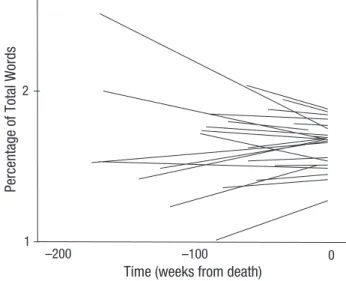
These analyses indicated that positive affect increased significantly as the patients approached death, b = −0.14, SE = 0.05, 95% CI = [−0.26, −0.02], p = .026, and despite laypeople’s dread of death, negative affect did not increase significantly as the patients approached death, b = 0.008, SE = 0.04, 95% CI = [−0.07, 0.09], p = .839 (see Figs. 3 and 4 for the change in positive and negative affect, respectively, in the individual patients’ blogs).
We also examined the effects of specific negative emo-tions over time, again using multilevel models with affect nested within blog. Data for the LIWC categories of gen-eral affect, anger, sadness, and anxiety were all submitted to separate multilevel models. All models included ran-dom slopes and intercepts unless otherwise noted. The Patients
Nonpatients 3
2
Affective Rating
Positive Affect
Patients Nonpatients
Negative Affect
1
base model of general affect suggested that the change in general affect over time was marginally significant, b = −0.14, SE = 0.08, 95% CI = [−0.31, 0.02], p = .09; use of all affect words tended to increase over time. However, the use of words referring to anger, b = 0.03, SE = 0.02, 95% CI = [−0.01, 0.07], p = .15, and anxiety, b = −0.002, SE = 0.01, 95% CI = [−0.03, 0.02], p = .85, did not change over time. The use of sadness words over time showed a trend that may suggest that individuals increase their use of sadness words as they near death, b = −0.03, SE = 0.02, 95% CI = [−0.07, 0.004], p = .08. Because the slope vari-ance was quite small in the anxiety model, we report the results of a reduced random-intercept, fixed-slope model that more appropriately fit these data. (See the Supple-mental Material for models of positive affect controlling for negative affect and models of negative affect control-ling for positive affect.)
Finally, because research suggests that writing can aid in coping with trauma (e.g., Pennebaker, 1997), we inves-tigated whether we would still observe an increase in positive affect over time when we controlled for word count and total number of posts in a series of multilevel models. The effect of word count on positive affect was nonsignificant, b = −0.00007, SE = 0.0001, 95% CI = [−0.0003, 0.0002], p = .52, and the increase in positive affect remained significant over time when we controlled for word count, b = −0.14, SE = 0.05, 95% CI = [−0.26, −0.02], p = .026, which suggests that the uptick in positive affect as death neared was not simply due to increased writing over time. Moreover, the number of words per blog entry did not change over time, b = −18.34, SE = 23.02, 95% CI = [−66.48, 29.80], p = .44, which suggests that the increased positivity found as the patients neared death cannot be accounted for solely by increased vol-ume of writing in each post.
The effect of the total number of blog posts on posi-tive affect was also nonsignificant, b = −0.0008, SE =
0.0008, 95% CI = [−0.002, 0.0009], p = .372, and positive affect still increased significantly over time when we controlled for the total number of posts per blog, b = −0.13, SE = 0.05, 95% CI = [−0.25, −0.01], p = .03. Taken together, these analyses suggest that neither writing lon-ger posts nor writing a greater number of posts can fully account for the increase in positive affect over time that we observed.
These longitudinal results complement the forecasting results reported earlier, as they reveal that terminal patients become more positive as they approach death. This results from increased focus on meaning-making frameworks, such as religion and relationships with close friends and family, during one’s final days (see the Sup-plemental Material for exploratory analyses of the effects of these factors). Of course, there are limitations to this study: The terminal patients were still some distance from death when they started blogging (M = 68.24 weeks, SD = 46.08), the total number of blogs in our sample was not large, and the blog writers were a self-selected sam-ple. Study 2 addressed these limitations by using a large sample of one-time reports obtained immediately before death: the final words of death-row inmates.
Study 2: Last Words of
Death-Row Inmates
This study examined the affect of death-row prisoners immediately before execution, contrasting their last words with the imagined last words of forecasters and with poetry written by death-row inmates, who constitute a matched sample further from death. We again used both LIWC and independent coders to assess emotional content. Given the results of Study 1, we predicted that inmates’ last words would be more positive and less 5
–200 –100 0
4
3
Percentage of Total Words
Time (weeks from death)
Fig. 3. Results from Study 1: percentage of positive-affect words in individual patients’ blogs as a function of time.
2
1
Percentage of Total Words
–200 –100 0
Time (weeks from death)
negative than affective forecasts or poetry written by death-row inmates.
Method
Death-row inmates’ last words. Inmates’ last words were gathered from the Texas Department of Justice, which lists all executed prisoners’ last words from 1982 to the present. Our analyses included all last words from December 7, 1982, to June 26, 2013 (N = 500 inmates). However, 104 inmates either were reported to have given no last statement or simply had a recorded last statement of “no” or some variant thereof. Thus, the final sample consisted of the last words of 396 inmates.
Of the executed prisoners, 225 were White or Cauca-sian, 187 were Black, 86 were Hispanic, and 2 were iden-tified as “other.” Four hundred ninety-five were male, and 5 were female. The mean age was 38.76 years. The final statements had a mean number of 110.15 words (range: 1–1,269).
Death-row inmates’ poetry. To create a well-matched sample for comparison with death-row last words, we gathered a sample of poetry (N = 188 poems) written by death-row inmates. We searched the University of North Carolina’s library system and gathered all books with death-row poetry—five in total. In addition, we included in our sample all of the poems from the Web site that compiled death-row poetry at the time we conducted this study, humanwrites.org. Each poem was entered into a text file to make it compatible with LIWC.
Noninmates’ forecasts. One-hundred fifty participants were recruited from MTurk. Of this group, 117 success-fully followed directions and passed attention checks (53 female, 64 male; mean age = 33.89 years). The forecasters imagined that they had been found guilty of a crime that is punishable by death, were on death row, and would be executed the next day. They were instructed as follows: “Take a moment to place yourself in this situation. Try to imagine what you would think about the day before your execution. Try to feel the emotions you would feel when facing execution.” They were then asked to write their last statement. Participants wrote a mean of 41.61 words (range: 1–169).
Independent coding of the last words, forecasts, and poetry. We analyzed the affective content of the inmates’ last words, the noninmates’ forecasts, and the inmates’ poetry using LIWC. To complement this analysis, as in Study 1, we asked a sample of MTurk participants to code the positive and negative affect of these texts using the PANAS. Forty condition-blind MTurk partici-pants (20 female, 20 male; mean age = 34.02) each rated
10 randomly selected texts (5 last words, 5 forecasts). In total, this gave us 200 ratings of last words and 200 rat-ings of noninmates’ forecasts. As in Study 1, indices for positive affect (α = .91) and negative affect (α = .81) were created.
A separate group of 45 MTurk participants (22 female, 23 male; mean age = 33.00 years) rated 10 randomly selected death-row inmates’ poems using the PANAS; a total of 169 of the possible 188 poems were coded. These participants rated only true death-row poetry, as there was no forecasted poetry. The poems were randomly selected. Positive- and negative-affect ratings were again averaged separately to create a positivity index (α = .87) and a negativity index (α = .86).
Reliability and replication. To test the reliability of the coding and the robustness of the results, we collected data from two additional samples, as in Study 1, focusing on the comparison between inmates’ last words and non-inmates’ forecasts.
An MTurk sample of 40 participants (18 female, 22 male; mean age = 36.05 years) followed the same coding procedure for positive affect (α = .88) and negative affect (α = .86) as the original MTurk sample, using with the same subset of inmates’ last words and noninmates’ fore-casts. The correlation between samples for the affective ratings of each text was rather low: r(246) = .38, p < .001, for positive affect and r(246) = .39, p < .001, for negative affect. Accordingly, we asked the trained research assis-tants from Study 1 to rate the same subset of texts on positive affect (“How positive is the inmate in this last statement?”) and negative affect (“How negative is the inmate in this last statement?”), using a scale from 1 (not at all) to 5 (very; α = .95 for positive affect and α = .96 for negative affect). Interrater reliability was calculated using the KALPHA macro for SPSS (Hayes & Krippendorff, 2007) and was reasonable for both positive (Krippendorff’s α = .76) and negative (Krippendorff’s α = .79) affect.
Results
LIWC comparisons of inmates’ last words, inmates’ poetry, and noninmates’ forecasts. A one-way anal-ysis of variance (ANOVA) revealed that last words, fore-cast last words, and death-row poetry differed significantly in both negative affect, F(2, 695) = 28.10, p < .001, ηp2 =
.075, and positive affect, F(2, 695) = 4.54, p = .011, ηp2 =
noninmates’ forecasts (M = 7.00%, SD = 11.57%, 95% CI = [5.90%, 8.11%]). In addition, the percentage of positive-affect words was higher in the last words (M = 9.23%, SD = 7.49%, 95% CI = [8.14%, 10.32%]) and death-row poetry (M = 10.25%, SD = 17.55%, 95% CI = [8.67%, 11.83%]) than in the forecast last words (M = 6.37%, SD = 6.62%, 95% CI = [5.14%, 7.60%]). The inmates’ last words and poetry did not differ significantly from each other in positive affect.2
Consistent with the results of Study 1, these results reveal that forecasters overestimate the negativity and underestimate the positivity of dying. Death-row inmates’ last words are less negative but not more positive than their poetry, which suggests that forecasters (death-row poets) also overestimate the negativity of life under an eventual death sentence. Of course, death-row poetry is not a perfect control for last words, as this poetry is not always specifically about dying, and poetic death-row inmates may be generally more negative and less posi-tive than death-row inmates who do not write poetry. However, prior research suggests that experience with poetry is linked to less use of negative words rather than more (Kao & Jurafsky, 2012). Future research could more fully investigate differences in affect between (a) poetry and other types of writing, (b) different types of poetry, and (c) different types of poets (e.g., amateurs vs. professionals).
Exploratory analyses revealed that, compared with noninmates’ forecasts, death-row last words had higher rates of words in the LIWC categories of religion and social connection ( ps < .05; see Table S4 in the Supple-mental Material for results for each LIWC category), fac-tors previously shown to be associated with stress and
well-being (Cohen & Wills, 1985; Mochon, Norton, & Ariely, 2011). Exploratory bootstrapped mediation analyses using the SPSS PROCESS macro (Hayes, 2012, 2013) fur-ther revealed that the increased use of religion and social-connection words in the last words partially medi-ated the differences in positive affect between the last words and forecasts, bs > −0.09, ps < .05. Religion also partially mediated group differences in negative affect (see Figs. S2–S5 in the Supplemental Material for media-tion results for both positive and negative words). These analyses suggest that religion and other meaning- making processes and ideologies may help allay death anxiety for individuals for whom death is salient (for a full review of religion’s effects on death anxiety, see Jong & Halberstadt, 2016).
Independent coders’ ratings of inmates’ last words, inmates’ poetry, and noninmates’ forecasts.3 A
one-way ANOVA on the independent coders’ ratings revealed that last words, forecast last words, and death-row poetry differed significantly in both negative affect, F(2, 847) = 11.97, p < .001, ηp2 = .027, and positive affect,
F(2, 847) = 10.02, p < .001, ηp2 = .023 (see Fig. 6 for
means). The inmates’ last words were rated as less nega-tive (M = 1.96, SD = 0.83, 95% CI = [1.84, 2.06]) than the death-row poetry (M = 2.19, SD = 0.80, 95% CI = [2.12, 2.27]), and the noninmates’ forecasts were rated as the most negative (M = 2.33, SD = 0.81, 95% CI = [2.23, 2.46]). Also, the last words (M = 2.24, SD = 0.77, 95% CI = [2.12, 2.35]) and death-row poetry (M = 2.39, SD = 0.86, 95% CI = [2.32, 2.47]) were rated as more positive than the forecast last words (M = 2.08, SD = 0.78, 95% CI = [1.98, 2.21]). Inmates’ last words and inmates’ poetry did not 12
8
4
Poetry
Percentage of Total Words
Forecasts Last
Words
Poetry Forecasts Last
Words
Positive-Affect Words Negative-Affect Words
0
differ significantly from each other in ratings of positive affect.4 (For mean ratings of specific PANAS items, see
Table S2 in the Supplemental Material.)
Replication. The additional sample of MTurk coders rated inmates’ last words (M = 2.45, SD = 0.88) as con-taining significantly more positive affect than noninmates’ forecasts (M = 2.24, SD = 0.74), t(291) = 2.18, p = .029, d = 0.26. Furthermore, these coders rated the inmates’ last words (M = 2.23, SD = 0.88) as significantly less negative than the noninmates’ forecasts (M = 2.51, SD = 0.68), t(291) = −3.04, p = .003, d = 0.36.
The trained coders rated the inmates’ last words (M = 2.82, SD = 0.89) as significantly more positive than the noninmates’ forecasts (M = 2.15, SD = 0.74), t(309) = 7.03, p < .001, d = 0.82. However, they rated the inmates’ last words (M = 2.52, SD = 1.23) and the noninmates’ fore-casts (M = 2.58, SD = 0.94) as not significantly different in negative affect, t(309) = −0.51, p = .61, d = 0.05.
Results in context. These results further suggest that death is more positive than people believe, and less neg-ative than suggested by the affective content of death-row poetry. However, it is important to note that the noninmate forecasters differed in many ways from the death-row inmates. Although the inmates and noninmate forecasters were in the same age range, the mid to upper 30s on average (inmates: M = 38.75 years; noninmates: M = 33.89 years), other potential differences between the two samples include differences in education, race, and religion; for this reason, we also analyzed poetry written by death-row prisoners, who more closely match the
demographics of the last-words sample. Of course, this control also had limitations, and we acknowledge that future research would benefit from more closely matched comparison groups (e.g., prisoners sentenced to life without parole).
Also, although poetry was limited as a sample of writ-ing for our purposes because it need not directly concern death (although many poems do), it allowed us to assess change in positivity and negativity over time, as in the exploratory longitudinal analyses of Study 1. Unlike Study 1, which revealed an increase in positivity but no change in negativity as death neared, this study revealed no change in positivity but a decrease in negativity. Taken together, however, these longitudinal results suggest that death never becomes worse as one approaches it, and either becomes more pleasant or less unpleasant.
Most important, the key finding of this study—and that of Study 1—is that forecasters overestimate the negativity and underestimate the positivity of dying.
Internal Meta-Analysis
Given that the observed effects varied in magnitude across our studies and coding methods, we performed an internal meta-analysis using all effect sizes (Cohen’s ds) from comparisons of individuals facing imminent death and those only imagining imminent death (Table 1). Averaging across coding methods and studies revealed clear evidence for our hypotheses. Relative to individu-als who are imagining death, those who are about to die are more positive (d = 0.31) and less negative (d = 0.48).
3
2
1
Last Words
Poetry Forecasts Last
Words
Poetry Forecasts
Affective Rating
Positive Affect Negative Affect
General Discussion
Death is inevitable, but dread is not. These two studies reveal that the experience of dying is unexpectedly posi-tive. Not only do the blog posts of terminally ill patients tend to become more positive as death approaches, but they also tend to be less negative and more positive than the forecasts of nonpatients (Study 1). The last words of death-row inmates are also more positive and less nega-tive than the forecasts of noninmates (Study 2)—in part because of a differential focus on social connection and religion. Although results varied somewhat across differ-ent coding methods, one fact is clear from our internal meta-analysis: In every comparison, dying was either more positive or less negative—or both—than people imagined it to be.
These findings are consistent with previous research calling into question the assumed link between death and feelings of dismay (DeWall & Baumeister, 2007; Kashdan et al., 2014). Nevertheless, open questions remain. Although we used two distinct samples of peo-ple facing death, our results may not generalize to all people as they near death, such as those who die from old age. However, as people tend to focus more on the positive as they age, the effects we observed could be even stronger in the elderly (Reed & Carstensen, 2012). Our experiments included multiple controls—forecasts from laypeople, within-participants longitudinal analy-ses, independent coders, and matched poetry samples— but inclusion of additional comparison groups would be informative and would strengthen future research on this topic. Furthermore, although personally dying may be better than expected, standing by while a loved one dies may take a different affective course.
Given the growing aging population, this work has potential to inform the contentious political debate
surrounding palliative care (Hughes-Hallett, Craft, Davies, Mackay, & Nielsson, 2011). Currently, the medical system is geared toward avoiding death—an avoidance that is often motivated by views of death as terrible and tragic (Gawande, 2014). This focus is understandable given cul-tural narratives of death’s negativity, but our results sug-gest that death is more positive than people expect: Meeting the grim reaper may not be as grim it seems.
Action Editor
Jamin Halberstadt served as action editor for this article.
Author Contributions
A. Goranson, A. Waytz, M. I. Norton, and K. Gray developed the idea for this research. R. S. Ritter collected the data from blogs. A. Goranson coded and analyzed the data. A. Goranson, A. Waytz, M. I. Norton, and K. Gray wrote and edited the manuscript.
Acknowledgments
We thank Emma Barthold, Lindsey Helms, Arianna Holder, David Luong, Alex Martin, Betsy Neill, Gracie Reinecke, Hristo Shimerov, and Mary Smith for their assistance.
Declaration of Conflicting Interests
The authors declared that they had no conflicts of interest with respect to their authorship or the publication of this article.
Funding
A. Goranson is funded by a National Science Foundation Grad-uate Research Fellowship. K. Gray is funded by the Templeton Foundation–funded Immortality Project (S-000607), the National Science Foundation (SES-1534083), the Russell Sage Foundation (93-16-08), and the Charles Koch Foundation.
Supplemental Material
Additional supporting information can be found at http:// journals.sagepub.com/doi/suppl/10.1177/0956797617701186
Table 1. Meta-Analysis of the Effect Sizes (Cohen’s ds) for Comparisons of Terminally Ill Patients’ Blogs and Inmates’ Last Words With Nonpatients’ and Noninmates’ Forecasts
Study and measure
LIWC analysis
MTurk coders
MTurk coders (replication)
Research- assistant
coders Overall d
Terminal illness (Study 1)
Positive affect −0.10 0.23 0.50 0.13 0.19
Negative affect 0.40 0.41 0.91 0.72 0.61
Death row (Study 2)
Positive affect 0.40 0.21 0.26 0.82 0.42
Negative affect 0.52 0.45 0.36 0.05 0.35
Combined studies
Positive affect 0.15 0.22 0.38 0.48 0.31
Negative affect 0.46 0.43 0.64 0.39 0.48
Open Practices
All materials have been made publicly available via Dataverse and can be accessed at https://dataverse.unc.edu/dataverse/ dyingisunexpectedelypositive. The complete Open Practices Disclosure for this article can be found at http://journals .sagepub.com/doi/suppl/10.1177/0956797617701186. This arti-cle has received the badge for Open Materials. More informa-tion about the Open Practices badges can be found at http:// www.psychologicalscience.org/publications/badges.
Notes
1. When we excluded blog posts less than 25 words long, this did not affect the overall pattern of results, so we report analy-ses using the full data set (see the Supplemental Material for results excluding posts less than 25 words long).
2. We note that 10 inmates’ last words were at least partially written. Results were the same as those reported here when we excluded these 10 statements.
3. We wondered whether individuals would be able to tell the difference between death-row last statements and noninmates’ forecasts, so we had 151 MTurk workers (72 female) read 30 last statements (15 by inmates, 15 by noninmate forecast-ers) and rate whether they thought a death-row prisoner or an MTurk worker had written each one. A multilevel model revealed that participants could not distinguish between the groups, b = 0.003, SE = 0.06, p = .95. For a full description of the method and results, see the Supplemental Material.
4. As a robustness check, we examined whether the results remained similar when we excluded all statements with fewer than 25 words—as these short statements may skew results. This exclusion did not affect the pattern of results, so we report results of analyses using the full data set. See the Supplemental Material for results of the analyses with statements less than 25 words long excluded.
References
Addis, D. R., Leclerc, C. M., Muscatell, K. A., & Kensinger, E. A. (2010). There are age-related changes in neural connectivity during the encoding of positive, but not negative, informa-tion. Cortex, 46, 425–433. doi:10.1016/j.cortex.2009.04.011 Bantum, E. O., & Owen, J. E. (2009). Evaluating the validity of
computerized content analysis programs for identification of emotional expression in cancer narratives. Psychological Assessment, 21, 79–88. doi:10.1037/a0014643
Becker, E. (1997). The denial of death. New York, NY: Free Press.
Buhrmester, M., Kwang, T., & Gosling, S. D. (2011). Amazon’s Mechanical Turk: A new source of inexpensive, yet high-quality, data? Perspectives on Psychological Science, 6, 3–5. doi:10.1177/1745691610393980
Cacioppo, J. T., Gardner, W. L., & Berntson, G. G. (1997). Beyond bipolar conceptualizations and measures: The case of attitudes and evaluative space. Personality and Social Psychology Review, 1, 3–25.
Cohen, S., & Wills, T. A. (1985). Stress, social support, and the buffering hypothesis. Psychological Bulletin, 98, 310–357. DeWall, C. N., & Baumeister, R. F. (2007). From terror to
joy: Automatic tuning to positive affective information following mortality salience. Psychological Science, 18, 984–990.
Gawande, A. (2014). Being mortal: Medicine and what matters in the end. New York, NY: Metropolitan Books.
Gilbert, D. T., Pinel, E. C., Wilson, T. D., Blumberg, S. J., & Wheatley, T. P. (1998). Immune neglect: A source of dura-bility bias in affective forecasting. Journal of Personality and Social Psychology, 75, 617–638. doi:10.1037/0022-3514 .75.3.617
Halberstadt, J., & Jong, J. (2014). Scaring the bejesus into peo-ple: The role of religious belief in managing implicit and explicit anxiety. In J. P. Forgas & E. Harmon-Jones (Eds.), Motivation and its regulation: The control within (pp. 331– 350). New York, NY: Psychology Press.
Hayes, A. F. (2012). PROCESS: A versatile computational tool for observed variable mediation, moderation, and conditional process modeling. Retrieved from http://is.muni.cz/el/1423/ podzim2014/PSY704/50497615/hayes_2012_navod_ process.pdf
Hayes, A. F. (2013). Introduction to mediation, moderation, and conditional process analysis: A regression-based approach. New York, NY: Guilford Press.
Hayes, A. F., & Krippendorff, K. (2007). Answering the call for a standard reliability measure for coding data. Communication Methods and Measures, 1, 77–89. doi: 10.1080/19312450709336664
Hirschmüller, S., & Egloff, B. (2016). Positive emotional lan-guage in the final words spoken directly before execu-tion. Frontiers in Psychology, 6, Article 1985. doi:10.3389/ fpsyg.2015.01985
Hughes-Hallett, T., Craft, A., Davies, C., Mackay, I., & Nielsson, T. (2011). Creating a fair and transparent funding system; the final report of the Palliative Care Funding Review. London, England: The Palliative Care Funding Review.
Jong, J., & Halberstadt, J. (2016). Death anxiety and reli-gious belief: An existential psychology of religion. London, England: Bloomsbury.
Kahn, J. H., Tobin, R. M., Massey, A. E., & Anderson, J. A. (2007). Measuring emotional expression with the Linguistic Inquiry and Word Count. The American Journal of Psychology, 120, 263–286. doi:10.2307/20445398
Kao, J., & Jurafsky, D. (2012). A computational analysis of style, affect, and imagery in contemporary poetry. In Workshop on Computational Linguistics for Literature (pp. 8–17). Retrieved from http://www.aclweb.org/anthology/W12-25#page=18
Kashdan, T. B., DeWall, C. N., Schurtz, D. R., Deckman, T., Lykins, E. L. B., Evans, D. R., . . . Brown, K. W. (2014). More than words: Contemplating death enhances positive emo-tional word use. Personality and Individual Differences, 71, 171–175. doi:10.1016/j.paid.2014.07.035
Lambert, A. J., Eadeh, F. R., Peak, S. A., Scherer, L. D., Schott, J. P., & Slochower, J. M. (2014). Toward a greater under-standing of the emotional dynamics of the mortality salience manipulation: Revisiting the “affect-free” claim of terror management research. Journal of Personality and Social Psychology, 106, 655–678. doi:10.1037/a0036353 Lindquist, K. A., Barrett, L. F., Bliss-Moreau, E., & Russell, J. A.
(2006). Language and the perception of emotion. Emotion, 6, 125–138.
Mochon, D., Norton, M. I., & Ariely, D. (2011). Who benefits from religion? Social Indicators Research, 101, 1–15. Nelson, L., & Nelson, C. (1975). A factor analytic inquiry into
the multidimensionality of death anxiety. OMEGA - Journal of Death and Dying, 6, 171–178.
Peer, E., Vosgerau, J., & Acquisti, A. (2014). Reputation as a sufficient condition for data quality on Amazon Mechanical Turk. Behavior Research Methods, 46, 1023–1031.
Pennebaker, J. W. (1997). Writing about emotional experiences as a therapeutic process. Psychological Science, 8, 162–166. Pennebaker, J. W., Booth, R. J., & Francis, M. E. (2007).
Linguistic Inquiry and Word Count: LIWC [Computer soft-ware]. Austin, TX: liwc.net.
Pennebaker, J. W., Boyd, R. L., Jordan, K., & Blackburn, K. (2015). The development and psychometric properties of LIWC2015. Retrieved from https://repositories.lib.utexas.edu/ bitstream/handle/2152/31333/LIWC2015_LanguageManual .pdf?sequence=3
Pennebaker, J. W., & Francis, M. E. (1996). Cognitive, emo-tional, and language processes in disclosure. Cognition & Emotion, 10, 601–626. doi:10.1080/026999396380079 Pennebaker, J. W., & King, L. A. (1999). Linguistic styles:
Language use as an individual difference. Journal of Personality and Social Psychology, 77, 1296–1312.
Pennebaker, J. W., Mayne, T. J., & Francis, M. E. (1997). Linguistic predictors of adaptive bereavement. Journal of Personality and Social Psychology, 72, 863–871. doi:10.1037/0022-3514.72.4.863
Pennebaker, J. W., & Stone, L. D. (2003). Words of wisdom: Language use over the life span. Journal of Personality and Social Psychology, 85, 291–301.
Reed, A. E., & Carstensen, L. L. (2012). The theory behind the age-related positivity effect. Frontiers in Psychology, 3, Article 339. doi:10.3389/fpsyg.2012.00339
Reed, A. E., Chan, L., & Mikels, J. A. (2014). Meta-analysis of the age-related positivity effect: Age differences in prefer-ences for positive over negative information. Psychology and Aging, 29, 1–15. doi:10.1037/a0035194
Reiss, S. (1991). Expectancy model of fear, anxiety, and panic. Clinical Psychology Review, 11, 141–153.
Rosenblatt, A., Greenberg, J., Solomon, S., Pyszczynski, T., & Lyon, D. (1989). Evidence for terror management theory: I. The effects of mortality salience on reactions to those who violate or uphold cultural values. Journal of Personality and Social Psychology, 57, 681–690. doi:10.1037/0022-3514.57.4.681
Skitka, L. J., & Sargis, E. G. (2006). The Internet as psychologi-cal laboratory. Annual Review of Psychology, 57, 529–555. doi:10.1146/annurev.psych.57.102904.190048
Tausczik, Y. R., & Pennebaker, J. W. (2010). The psychological meaning of words: LIWC and computerized text analysis methods. Journal of Language and Social Psychology, 29, 24–54. doi:10.1177/0261927X09351676
Ullrich, P. M., & Lutgendorf, S. K. (2002). Journaling about stressful events: Effects of cognitive processing and emo-tional expression. Annals of Behavioral Medicine, 24, 244– 250. doi:10.1207/S15324796ABM2403_10
Watson, D., Clark, L. A., & Tellegen, A. (1988). Development and validation of brief measures of positive and negative affect: The PANAS scales. Journal of Personality and Social Psychology, 54, 1063–1070.