THE MULTILEVEL INNOVATION POLICY MIX: THREE ESSAYS ON STATE SBIR MATCHING PROGRAMS
Lauren Lanahan
A dissertation submitted to the faculty of the University of North Carolina at Chapel Hill in partial fulfillment of the requirements for the degree of Doctor of Philosophy in the Department of Public Policy.
Chapel Hill 2015
iii ABSTRACT
LAUREN LANAHAN: The Multilevel Innovation Policy Mix: Three Essays On State SBIR Matching Programs
(Under direction of Maryann P. Feldman)
iv
v
ACKNOWLEDGEMENTS
The term dissertation comes from the Latin dissertatio, meaning “path.” While on this incredible path, I have had the great opportunity to grow as a researcher both through self-guided study, but also through mentorship and collaboration. Recognizing that one’s dissertation is an exciting opportunity to ask critical questions, I also view it as a path to guide a research project, build professional skills and join the larger academic community of scholars. None of this would have been possible, however, without the generous support of my committee, faculty, peers and policy community. I am forever indebted to this community for their continued support. As I move forward in a career devoted to scholarship and academic inquiry, I hope to pay it forward in the generous and constructive manner that has been directed to me.
vi
I would also like to extend my thanks to the rest of my dissertation committee: Virginia Gray, John Hardin, Jeremy Moulton and Rosemarie Ziedonis. Virginia Gray has offered valuable guidance in the development of my first essay; moreover, I have gained so much from her notable contributions to the field of policy diffusion. John Hardin has been integral in understanding the policy context for this research project. Serving as the Executive Director of the One NC Small Business Program, I appreciate his insight as I learned about state R&D policy activity. Moreover, he was generous to share both the project-level state match data and results from the NC survey of SBIR match recipients. Jeremy Moulton’s open door policy has been so useful while on this path. His expertise in econometrics has been invaluable for each of the three studies, notably in improving the paper’s robustness and sensitivity analyses. Lastly, I would like to thank Rosemarie Ziedonis for her critical eye towards research design and analysis. Her constructive encouragement has not only strengthened all three of the essays, but also my own critical approach as a scholar.
In addition, a number of faculty and students in the Department of Public Policy at the University of North Carolina at Chapel Hill have offered valuable feedback on earlier iterations of this project. I would like to recognize Christine Durrance, Nicola Lowe, David Ernsthausen, Jade Marcus Jenkins, Alexandra Graddy-Reed, Jesse Hinde, Mary Donegan, and current and prior members of Maryann Feldman’s lab – Daniel Smith, Emily Nwakpuda, Paige Clayton, Jongmin Choi, Stephanie Schmidt, Lisa Goble, Jennifer Miller and Antonio Jose Balloni.
vii
(IA), Tom Krol & Ryan White (KS), Kenneth Roland (KY), Robbie Melton (MD), Sara Gumina & Mary Sue Hoffman (MI), David P. Desch (MT), Dave Honz (NE), Marcie Sonneborn (NY), John Ujvari & Samuel Taylor (NC), Eric Veidel (ND), Steven Martinez & Will Graves (OK), Kelly Wylam (PA), Adriana Dawson (RI), Lori Mack (SC), Nikita Rogers (TX), Robert Brooke & Nancy Vorona (VA), Jim Sampson (WA), and Aaron Hagar (WI). Lastly, I would like to thank Don Walls & Associates regarding gaining access to the National Establishment Time Series data and Dan Berglund & Mark Skinner (SSTI) for feedback on accessing state R&D policy legislative statues.
In addition, I want to acknowledge the Ewing Marion Kauffman Foundation and the Graduate School of the University of North Carolina at Chapel Hill for awarding me fellowships for this research. The Kauffman Dissertation Fellowship not only offered generous support during the early stages of this dissertation project, the award was presented as part of as emerging scholars workshop. As part of this workshop, I was able to connect with a larger community of scholars – both senior researchers and graduate students. I thank Bob Strom, E. J. Reedy, Bill Kerr, David Audretsch, John Haltiwanger, Stuart Rosenthal, Erik Hurst and David Robinson for comments on earlier versions of this research project. The UNC Graduate School Fellowship, moreover, provided me with the opportunity to focus solely on this dissertation research in the final stages.
Earlier versions and components of this research project have been presented at the 2014 Annual Technology Transfer Society (Baltimore MD) and the 2014 Academy of Management Annual Conference (Philadelphia, PA). I would like to thank Dr. David Hsu for moderating the panel at AOM and offering constructive comments on my job market paper.
viii PREFACE
I vividly remember that exciting “ah-ha” moment when the topic for my dissertation materialized. Maryann and I were driving back from an interview in Chapel Hill – for another project focused on building a dataset of the entrepreneurial activity in the Research Triangle Region. A week or so prior to this meeting, John Hardin, the Executive Director of the Board of Science, Technology & Innovation, had shared the NC SBIR State Match data and we had finished pulling the award data for NC recipients of the federal SBIR program. As we stopped at a red light at the intersection of Estes and MLK, I asked Maryann if she knew of any other states with a comparable SBIR program. It immediately occurred to me that this type of program, placed within the context of the federal SBIR program, offered a solid framework for a strong research design. This was both in terms of defining the population of activity (federal SBIR recipients) and in defining a clear outcome measure (Phase II awards). She had heard of Kentucky’s program, but suggested I follow up with John. In a follow up conversation, John mentioned that, “there are maybe 10 or so.” There was no central repository for this information, but he emphasized that state governments were definitely showing greater interest in the SBIR program.
ix
TABLE OF CONTENTS
LIST OF TABLES ... xiii
LIST OF FIGURES ... xv
LIST OF ABBREVIATIONS ... xvi
CHAPTER ONE: PUBLIC R&D AND INNOVATION ... 1
1.1 Introduction ... 1
1.2 State Innovation Policy ... 4
1.3 Policy Analysis within a Multilevel Innovation Policy Mix ... 6
1.4 Overview of Dissertation ... 8
1.4.1 First Essay – Multilevel Innovation Policy Mix: A Closer Look State Policies that Augment the Federal SBIR Program ... 9
1.4.2 Second Essay – Multilevel Funding for Small Business Innovation: A Critical Review of State SBIR Match Programs ... 9
1.4.3 Third Essay – Approximating Exogenous Variation in R&D: SBIR Projects and State Matching Funds ... 10
CHAPTER 2: MULTILEVEL INNOVATION POLICY MIX ... 12
2.1 Introduction ... 12
2.2 Theoretical Framework: Multilevel Innovation Policy Mix ... 15
2.3 Case Study: U.S. Small Business Innovation Research Programs ... 19
2.3.1 Complementary Policy Responses: State SBIR Outreach Programs ... 21
2.3.2 Policy Augmentation: State SBIR Match Programs ... 22
2.4 Empirical Analysis: Multilevel Motivations of State Responses ... 25
x
2.4.2 Multilevel Motivations ... 28
2.4.3 Methods & Data ... 31
2.4.4 Results ... 35
2.5 Discussion ... 37
2.6 Conclusions ... 40
CHAPTER 3: MULTILEVEL PUBLIC FUNDING FOR SMALL BUSINESS INNOVATION ... 51
3.1 Introduction ... 51
3.2 Theoretical Framework: Multilevel public support for small business innovation ... 53
3.3 Case study: State Match Phase I program ... 56
3.3.1 Policy implications of the State Match Phase I program ... 58
3.4 Research Design ... 59
3.4.1 Methods ... 62
3.4.2 Data ... 66
3.4.3 Sample ... 67
3.5 Empirical Results ... 69
3.5.1 Outcome: Phase II Success Rates ... 69
3.5.2 Outcome: Phase I Application ... 71
3.6 Discussion ... 72
3.7 Conclusions ... 76
CHAPTER 4: APPROXIMATING EXOGENOUS VARIATION IN R&D ... 89
4.1. Introduction ... 89
4.2 Research Design ... 94
4.2.1 Stratifications ... 95
4.2.2 Identification ... 97
xi
4.3.1 Data ... 100
4.4 Results ... 102
4.4.1 DD Results ... 102
4.4.2 Marginal Results ... 103
4.4.3 Robustness Checks ... 103
4.4.4 Sensitivity Analysis ... 105
4.4.5 Cohort Study ... 106
4.5. Discussion ... 107
4.5.1 Other Considerations ... 110
4.6 Conclusions & Policy Recommendations ... 111
CHAPTER FIVE: CONCLUSION & POLICY IMPLICATIONS ... 121
5.1 Chapter Two: Aims and Contributions ... 122
5.2 Chapter Three: Aims and Contributions ... 123
5.3 Chapter Four: Aims and Contributions ... 125
5.4 Future Research ... 126
APPENDIX ... 128
Appendix A: Data collection methods for identifying state SBIR-related programs ... 128
Appendix B: Arellano Bond Ex-post Specification Tests ... 130
Appendix C: Matching Procedure ... 131
Appendix D: Robustness Checks ... 134
D.1 DD Analysis ... 134
D.2 Marginal Analysis ... 136
Appendix E: Sensitivity Analysis – Data Imputation Considerations ... 137
Appendix F: Cohort Study ... 140
xii
F.2 DD Analysis (Eq. 4.1) ... 143 F.3 Robustness & Sensitivity Checks ... 144
xiii
LIST OF TABLES
CHAPTER ONE
1.1 Overview of Dissertation ……… 11
CHAPTER TWO 2.1 State SBIR-related programmatic activity ..……… 43
2.2 List of State SBIR Outreach programs …...……… 45
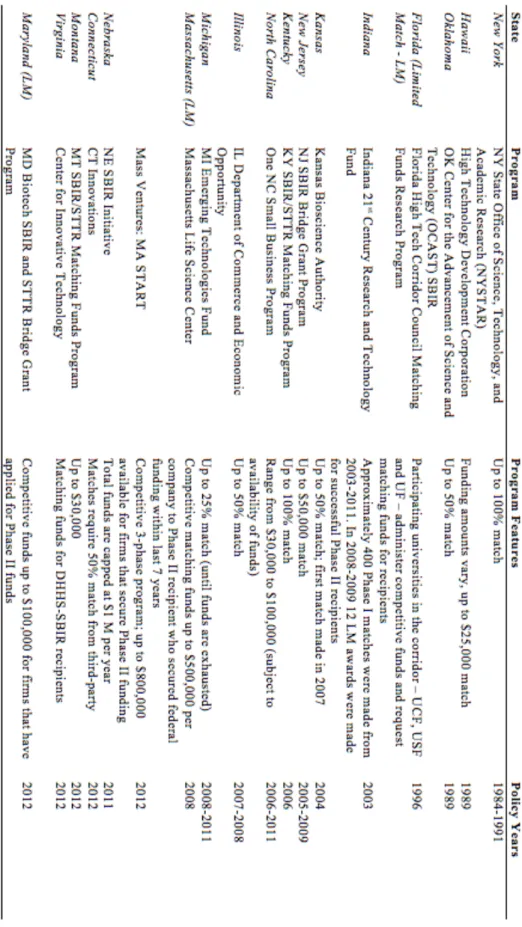
2.3 State SBIR Match programs …...……… 46
2.4 Indicators for Empirical Model …...……… 47
2.5 Descriptive Statistics …..……… 48
2.6 Correlation Matrix ……..……… 49
2.7 LPM State fixed effects model …...……… 50
CHAPTER THREE 3.1 Potential policy implications of State Match …..……… 79
3.2 Variables, functional form and data sources ...……… 80
3.3 Descriptive Statistics ………... 81
3.4 Regression Results – NSF Phase II success rates ...……… 82
3.5 Regression Results – DoE Phase II success rates ...……… 83
3.6 Regression Results – NASA Phase II success rates ……… 84
3.7 Regression Results – NSF Application Activity .……… 85
3.8 Regression Results – DoE Application Activity ….……… 86
3.9 Regression Results – NASA Application Activity ….……… 87
3.10 Correlation Matrix ……… 88
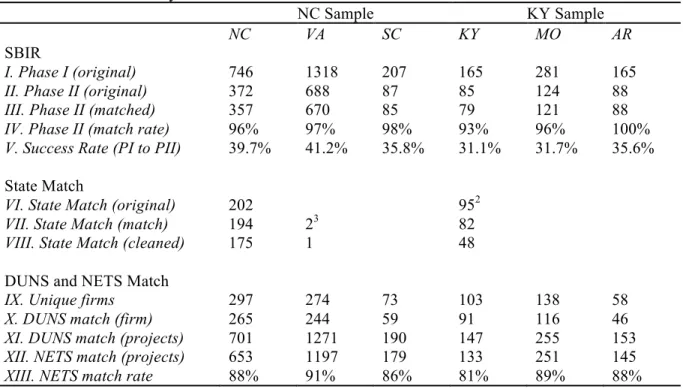
CHAPTER FOUR 4.1 SBIR Phase I Activity ….……… 114
xiv
4.3 Indicators for Empirical Models ….……… 116
4.4 Descriptive Statistics …...……… 117
4.5 Different in Difference (Eq. 4.1) .……… 118
4.6 Marginal Effects (Eq. 4.2) ..……… 119
APPENDIX B.1 Serial Correlation ……...……… 130
B.2 Overidentifying restrictions ……… 130
C.1 Match Rates by State …..……… 131
D.1 Robustness Checks – DD Analysis ……… 134
D.2 Robustness Checks – Marginal Analysis ...……… 136
E.1 Descriptive Statistics ……….. 137
E.2 Sensitivity Analysis – Imputation Techniques (Differential Analysis) …..……… 138
E.3 Sensitivity Analysis – Imputation Techniques (Marginal Analysis) …..……… 139
F.1 Identification on firm-level characteristics – KY Sample ..……… 141
F.2 Identification on firm-level characteristics – NC Sample ..……… 142
F.3 Difference in Difference – North Carolina Cohort .……… 143
F.4 Robustness Checks – NC Cohort ……… 144
F.5 Sensitivity Analysis – Imputation Techniques for NC Cohort ...……… 145
xv
LIST OF FIGURES
CHAPTER TWO
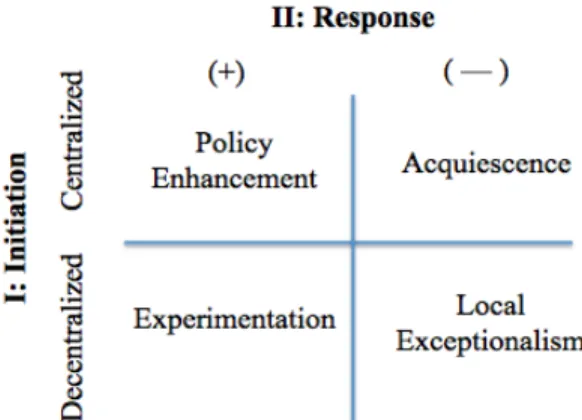
2.1 Multilevel Innovation Policy Responses – 2 x 2 Matrix ………. 42 CHAPTER FOUR
xvi
LIST OF ABBREVIATIONS
AB Arellano Bond Model
DD Difference-in-Difference
DoA Department of Agriculture
DoC Department of Commerce
DoD Department of Defense
DoE Department of Energy
DoEd Department of Education
DHS Department of Homeland Security
DoT Department of Transportation
EPA Environmental Protection Agency
FAST Federal and State Technology program
GPRA Government Performance and Results Act of 1993 DHHS Department of Health and Human Services
LM Limited Match (State SBIR program)
LPM Linear Probability Model
LQ Location Quotient
NASA National Aeronautics and Space Administration NETS National Establishment Time Series
NSF National Science Foundation
PI Principal Investigator
R&D Research and Development
ROP Rural Outreach Program
SBA Small Business Administration
1
CHAPTER ONE: PUBLIC R&D AND INNOVATION
1.1 Introduction
It is well understood that innovation is a crucial driver of economic growth; this dissertation research is an effort toward determining what institutions and reward structures are most efficient at producing innovation in a particular context. A sizeable literature has examined federal investment in research and development (R&D), but there are disproportionately few studies evaluating the growing number of state government R&D initiatives. A recent National Science Foundation report estimates that state governments invested over $1.5 billion in 2011. Although the amount of federal investment in R&D exceeds this level of funding, the share of state R&D is increasing.1
Public institutions are collectively taking on an expanded role within the innovation process (Block & Keller, 2009; Schrank & Whitford, 2009). While federal investment in R&D is well justified with attention directed towards spurring national competitiveness and economic prosperity (Bush, 1945), state government investments have recently stepped in (e.g. Berglund & Coburn, 1994; Plosila, 2004; Feldman et al., 2013). This interest is likely a function of the growing evidence that R&D activity is spatially proximate and maps out in a systematic manner via spillovers and agglomeration economies over geographically concentrated and industry-focused trajectories (Griliches, 1998; Jaffe et al. 1993; Audretsch & Feldman, 2004; Greenstone et al., 2010). The spatial nature of R&D places state governments in a fortuitous position to invest in local research capacity.
Taken together, public support for R&D stems from multiple levels of government and agencies that comprise a multilevel innovation policy mix (Flanagan et al., 2010). The shared imperative of bolstering economic activity ties these multiple systems together. Nevertheless, our understanding of how
2
these policies interact and overlap is lacking. A complete and clear understanding of the public’s myriad roles deserves more attention. This dissertation aims to contribute by paying particular attention to state and federal policy directed toward small business innovation – specifically the Small Business Innovation Research (SBIR) programs.
The U.S. federal SBIR program stands as one of the most well known public programs supporting early-stage R&D activity for small firms (e.g. Lerner, 1996; Wallsten, 2000; Audretsch, 2003; Toole & Czarnitski, 2007; Wessner, 2008). Established in 1982, the Small Business Administration (SBA) oversees an interagency consortium of eleven federal agencies2 that provide competitive extramural R&D funds in for small businesses to demonstrate proof-of-concept (Phase I), product development (Phase II) and ultimately commercialization (Phase III).3 Forty-five U.S. states have introduced one or more SBIR-inspired programs designed to complement the federal program. These state programs can be broadly classified as either outreach efforts to increase participation with the federal SBIR program or more aggressive match efforts to improve the competitiveness and advance the project downstream toward development and commercialization. There is considerable scholarship on the federal SBIR program, but there are no studies that consider the broader SBIR policy context that include state programs. Among the portfolio of state SBIR programs, the State Match Phase I program (referred to herein as State Match) provides a unique opportunity to empirically examine the larger SBIR policy mix. This is the most diffuse of the state match programs with a common structure that offers noncompetitive awards to successful Phase I recipients.
The central aims of this dissertation research are twofold. First, this project seeks to motivate the multilevel innovation policy mix as a framework for innovation policy analysis within a federalist system.
2 The eleven federal agencies that participate in the SBIR program include: Department of Agriculture, Department of Commerce (National Oceanic and Atmospheric Administration and National Institutes of Standards and Technology), Department of Defense, Department of Education, Department of Energy, Department of Health and Human Services, Department of Homeland Security, Department of Transportation, Environmental Protection Agency, National Aeronautics and Space Administration, and National Science Foundation.
3
In doing so, this research first brings greater attention to state innovation policies and then places state policy within a larger policy context. Second, drawing upon the portfolio of federal and state SBIR programs as an exemplar of a multilevel innovation policy mix, this project critically examines the set of complementary state policies. The structure of the State Match programs, moreover, provides a unique opportunity to assess variation in the size of R&D expenditures in innovative projects. This not only has policy implications for state and federal policymaking, but also more broadly for innovation-based policy.
To achieve these aims, this dissertation is organized in a three-essay format. The first essay – Chapter Two – develops a theoretical framework for the multilevel innovation policy mix within a federalist structure. As an initial step toward understanding the broader policy context, this paper examines an illustrative case of the multilevel innovation policy mix drawing upon the federal and state SBIR policy context. In addition, an empirical analysis is presented to assess the antecedent factors that lead states to adopt the complementary State Match program. The second essay – Chapter Three – offers a comprehensive state-level analysis of the State Match program by considering dual advantages of the program – Phase II success rates and Phase I applications. Extending this, the third essay – Chapter Four – presents a narrower analysis of the State Match program at the project level. By viewing the noncompetitive state match as exogenous variation to the initial federal SBIR award, this study utilizes the variation in size of the state match and examines the differential and marginal effect of changes in R&D funding for innovative projects.
4 1.2 State Innovation Policy
Public R&D is central to innovation given limited private financing. Moreover, this early-stage activity can be viewed as a public good given that it is a source for developing the skills required to translate knowledge into practice, enhancing the ability to solve complex technological problems and serving as an entry ticket for absorbing information (Nelson, 1959; Arrow, 1962; Salter & Martin, 2001). These benefits have the capacity to reduce the barriers for firms in the market and in turn increase competition.
Although federal investment in R&D outweighs state-level investment, over the past thirty years state R&D investment has notably increased. In the early 1980s, state governments started playing a greater role by providing early-stage R&D support to leverage economic benefits. This is largely attributed to the following events: (i) revenue sharing between the federal government with state and local governments (Vogel, 1979); (ii) the passage of the Bayh Dole Act of 1980, which granted researchers the rights to intellectual property that resulted from publicly funded research (Cozzens, 1997); and (iii) the concurrent decline and subsequent uncertainty of federal and industry support for university R&D (Teich, 2009).
5
Scholars have also found that the decentralizing shift of authority from the federal government to states, which took place most notably during the Reagan administration, has allowed them greater political freedom to administer a more customized set of R&D programs that better aligns to the state’s proximate economic and research climate (Bozeman, 2000). Expanding from Tiebout’s discussion of “feet voting,” this flexibility essentially allows state policy makers to allocate public goods such that they more closely reflect the preferences of the constituent population (1956).
Improved understanding of state R&D investment is essential given the growing evidence that knowledge spillovers and agglomeration economies produced by R&D investments are spatially proximate. Research on knowledge spillovers has shown that the knowledge produced from R&D holds characteristics of a public, non-rival good that spills over and contributes to the work of other researchers and R&D initiatives producing “dynamic complementaries” (Cerulli, 2010; p. 424). The rate and success of these production externalities, however, depends on the relative level of absorptive capacity of the local economy to recognize, assimilate and apply the new scientific knowledge (Jaffe, 2000). Spatial benefits that range from increased levels of supply, proximity, pooling of demands for specialized labor, reduced transportation costs and knowledge spillovers explain why certain localities demonstrate heightened levels of innovative output and economic success.
Although R&D benefits may extend beyond the local municipality or, in the longer-term, beyond the state bounds, there is convincing evidence to suggest that R&D activity has a geographically concentrated component. The knowledge spillovers and agglomeration economies that result from R&D activity have direct implications on bolstering economic activity. State policy makers, therefore, are in a fortuitous position to actively promote local economic activity by investing in R&D.
6
multifaceted attributes of state innovation activity and extensive variation make systematic analysis a challenge.
Despite these challenges, state-level evaluation of R&D investment is lacking. Outside the realm of academia, efforts toward better understanding state economies have gained considerable policy traction recently. This is most notably exemplified by Dave Heineman’s 2011-12 National Governor’s Association Initiative, “Growing State Economies,”4 a recent report issued by the Kauffman Foundation, “The State of Entrepreneurship: State and Local Governments Hold the Key to Accelerating Economic Growth in 2012,”5 and Taylor’s (2012) recent paper on the role of Governors as economic problem solvers. All three highlight the potential of state governments, especially in regards to promoting S&T activity and economic development. Despite this policy interest, scholarship has little to offer in terms of guidance.
Improved understanding of state R&D initiatives offers a broader and more complete understanding of innovation policy within the U.S. context. While the significant financial demands and links to national competitiveness have placed the federal government at the forefront of innovation policy – both in terms of the levels of investment and in terms of setting policy agendas – state innovation policies deserve our attention. State innovation policy not only offers a more complete assessment of the policy context, the federalist structure promotes a process of trial and error that propels states to experiment and maximize their intended goals (Karch, 2007). Scholars and policy makers thus have an opportunity to evaluate the successes and failures of these state policies and arrive at more enlightened policy recommendations.
1.3 Policy Analysis within a Multilevel Innovation Policy Mix
4 Source: http://www.subnet.nga.org/ci/1112/
5 Source:
7
Both the increased level of involvement of the public sector in S&T activity and belief that scientific knowledge and technology innovation will foster societal benefits have placed program evaluation and accountability at the forefront of policy debates (Feller, 2007, Georghiou, 2000). This gained considerable attention with the passing of the Government Performance and Results Act of 1993, a congressional mandate centered on program transparency and accountability. Despite this mandate, federal R&D program evaluations remain at a nascent stage (Cozzens, 2003). Moreover, this mandate does not extend to states. As Osborne (1988) cogently noted, “clearly, state governments view their spending on technology development as an investment, yet they rarely measure the return they got on that investment” (p. 58).
Accurately tracing public R&D investments – at the federal or state government levels – presents a notable challenge. Many agree that R&D investments in S&T spur economic activity and yield societal gain; however, the challenge remains of breaking down the R&D process from inputs to impacts over an extended time horizon. Collectively, this complex process comprises the infamous black box that is hard to illuminate (Feller, 2007; Glaeser, 2009; Campbell, 2009). Moreover, examination of a policy mix – one that includes multiple levels of government policy – presents an added hurdle given myriad factors including decentralization of data and programmatic fragmentation. In short, the innovation policy context is complex. Some have even argued for random R&D allocations to enable more rigorous research designs (Storey, 1994), not surprisingly, political support for this approach is lacking. Viewing innovation policy as a multilevel mix, nevertheless, more accurately reflects the public policy context and complete impact of policy investments.
8
consideration in the federal review. This addresses concerns about selection bias in defining the population for the study. Second, placing the State Match program within the context of the federal SBIR program offers a clearly defined outcome variable – Phase II awards. The definitive characteristic of the State Match program is the noncompetitive match for Phase I recipients as they progress to compete for Phase II funds. This stands in contrast to many other R&D analyses that seek to examine approximated and therefore more intangible outcomes related to innovation and economic development (Salter & Martin, 2001; Cerulli, 2010). Moreover for policy evaluation, use of the Phase II award offers a more immediate measure of progress towards commercialization. This helps to lessen concerns of confounding factors that are common with R&D analyses that measure relationships over longer time horizons. Third, state comparisons are feasible within this policy context given the common design of the State Match program. This is both in terms of assessing the antecedent factors that lead states to adopt the program and evaluating the benefits of the state program. Lastly, the SBIR program invests in innovative projects. Viewing the State Match as exogenous variation to the size of public investment in the innovative projects offers a unique opportunity to assess the effect of public R&D in projects rather than firms. With a firm level analysis the potential for confounding factors is greater. This policy context allows for critical analysis of direct investment in early-stage innovation on developmental progress. While this brings light to only a subsection of the infamous black box, it offers a more complete perspective of the policy context and greater insight into the role of public R&D on innovation.
1.4 Overview of Dissertation
Table 1.1 overviews the data and context, aims and policy implications for each essay. All three essays share a common theme by focusing on the multilevel innovation policy mix through the context of the federal and state SBIR programs. The first essay develops the conceptual framework of the policy mix and provides a foundational overview of the SBIR policy context. The second essay presents a
9
essay narrows the analysis to a contiguous region and offers a project-level analysis of the differential and marginal impacts of the program. Each essay is briefly discussed in turn.
1.4.1 First Essay – Multilevel Innovation Policy Mix: A Closer Look State Policies that Augment the Federal SBIR Program
This chapter examines nested, multilevel innovation policies paying particular attention to U.S. federal and state small business innovation research programs. With 45 states offering a range of SBIR Outreach and SBIR Match programs specifically designed to enhance the federal SBIR program, such programs provide a useful lens for examining the nature of the multilevel innovation policy mix. The contributions of this essay are twofold. First, the study provides theoretical motivation for multilevel innovation policy responses placing emphasis on positive policy responses in which state policies enhance federal policies. Second, it provides an empirical analysis examining the multilevel factors associated with a state government response that augments the federal SBIR program. The results from this analysis indicate these state policy actions are associated with a confluence of multilevel factors driven not only from top-down federal actions, but also from bottom-up, internal state political and economic factors as well as from lateral pressures from peer states.
1.4.2 Second Essay – Multilevel Funding for Small Business Innovation: A Critical Review of State SBIR Match Programs
10
the federal SBIR program by offering noncompetitive matching funds to the state’s successful SBIR Phase I recipients. This offers an opportunity to examine the marginal impact of public R&D given the state intervention. This study employs a state level fixed effects model and considers two outcome variables – Phase II success rates and Phase I application activity. To account for industrial heterogeneity, the data are stratified by the federal mission agencies. Results from the empirical analysis indicate that the state match increases the Phase II success rates for firms participating in the National Science Foundation SBIR program.
1.4.3 Third Essay – Approximating Exogenous Variation in R&D: SBIR Projects and State Matching Funds
11 Table 1.1 Overview of Dissertation
Chapter 2 Chapter 3 Chapter 4
Data & Context
Classification of the portfolio of State SBIR Outreach and Match policy activity
Comprehensive state-level analysis of the State Match program
Narrow project-level analysis of State Match program in a contiguous region spanning six states Central Aims • Articulate the
multilevel innovation policy mix
• Assess the antecedent factors associated with adoption of the State Match program
• Motivate the policy implications for program evaluation of the
multilevel innovation policy mix
• Examine the dual advantages of the State Match program – Phase II success rates and Phase I application activity
• Set up rigorous research design to examine exogenous variation of public R&D in innovative projects rather than firms
Policy
Implications • Present a framework for understanding innovation policy within a federalist context
• Offer a foundational understanding of state R&D policy by assessing motivating factors
Provide broad, empirical examination of a diffuse state program. Find evidence that presence of the State Match program increases
competitiveness for NSF projects
Marginal adjustments in public R&D on innovation are heterogeneous,
12
CHAPTER 2: MULTILEVEL INNOVATION POLICY MIX
A CLOSER LOOK AT STATE POLICIES THAT AUGMENT THE FEDERAL SBIR PROGRAM
(With Maryann P. Feldman)1
2.1 Introduction
Innovation policy is the outcome of multiple layers of programs and investments made by different jurisdictions with overlapping objectives, diverse mandates and different resource constraints. Given limited resources for early stage activity from the private sector, innovative projects undertaken by firms are commonly subject to national and subnational policies. Taken together, different levels of policies comprise a policy mix that involves significant complementary interactions and interdependencies that requires joint analysis (Flanagan et al., 2011). National policies are designed to spur international economic competitiveness and thereby increase aggregate societal welfare (Kuhlmann, 2001: 954). Whereas subnational governments, recognizing that the locus on innovative activity occurs at a more concentrated geographic scale, enact policies to build or reinforce existing local innovative capacities and capture greater returns within their jurisdiction. Taken together the rationales, domains and instruments among different administrative units define a multilevel innovation policy mix (Magro & Wilson 2013: 1654). The policy mix is not static but represents the agenda-setting outcome of a policymaking process that involves learning and dissemination (Flanagan et al., 2011). The resulting multilevel policy mix is the product of differing motives, interacting incentives and diffusion. At a time when market fundamentalism guides policy debates, the full impact of multiple layers of the innovation
13
policy mix needs to be understood so that better policy options may be articulated and implemented (Whitford & Shrank 2011; Block & Keller, 2009; Schrank & Whitford, 2009).
Federalist systems provide a context to understand the dynamic interaction between different levels of government. Policy actions may be conceptualized as a response to other policies: they are adopted in a pre-existing context and institutional framework that have been shaped by successive policy changes (Uyarra, 2010). Most examinations of the multilevel policy mix focus on the European context (e.g. Uyarra & Flanagan, 2010); however, the U.S. offers an example not only for theoretical development but also for empirical examination. Scholars have overwhelmingly focused attention on federal programs (Keller & Block, 2013; Link & Scott, 2012; Toole & Czarnitski, 2007; Wallsten, 2000; Lerner, 1996; and others). Yet states are actively engaged with innovation policies (e.g. Berglund & Coburn, 1995; Feldman et al., 2014; Plosila, 2004). This sets the stage for greater theoretical development of the dynamic temporal relationships that define the multilevel policy mix.
This paper’s first contribution is to provide a theoretical framework that considers multilevel innovation policy responses within a federalist system. We consider innovation policy responses within a dynamic context highlighting that initiation can originate either from the centralized or decentralized levels to then yield a positive or null policy response. We then develop four archetypes – policy enhancement, experimentation, acquiescence and local exceptionalism. For the empirical context, we pay particular attention to policy enhancement, as states tend to respond to the greater resources for innovation at the federal level.
The U.S. Federal Small Business Innovation Research (SBIR) program2 provides an example of a national public program supporting early-stage R&D activity that has prompted a policy response by states. Established in 1982, the Small Business Administration (SBA) oversees an interagency consortium
14
of 11 federal agencies3 that provide competitive extramural R&D funds to small businesses for proof-of-concept, demonstration and commercialization. Since 1984, all but five U.S. states4 have introduced formal programs specifically designed to enhance the federal SBIR program. The intentional design of these programs offers an ideal case for examining one archetype of multilevel policy responses – specifically state policies designed to enhance an existing federal policy. From a detailed analysis of state responses to the federal SBIR program, two different types of policy enhancement emerge. The first type offers information and consulting services that complement the federal program, while the second type provides more aggressive financial incentives that augment and extend the existing federal policy. Forty-two states have enacted SBIR Outreach Programs that complement the federal SBIR program, and 17 states have enacted more aggressive SBIR Match programs to augment.5 This paper’s second contribution is to provide an empirical analysis to understand the multilevel conditions that motivate state policy responses that become part of this policy mix. Specifically, we consider a range of top-down, bottom-up and lateral antecedent factors that influence the adoption of the SBIR State Match Phase I (SMP-I) program. This is the most broadly diffuse SBIR Match program and among the more aggressive state policy responses to the federal program.
3 The 11 federal agencies that participate in the SBIR program include: Department of Agriculture, Department of Commerce (National Oceanic and Atmospheric Administration and National Institutes of Standards and Technology), Department of Defense, Department of Education, Department of Energy, Department of Health and Human Services, Department of Homeland Security, Department of Transportation, Environmental Protection Agency, National Aeronautics and Space Administration, and National Science Foundation.
4 These include Colorado, Nevada, New Mexico, Rhode Island, and Texas. Interestingly, not all states have formal programs to complement the federal SBIR program. While this paper focuses on factors leading states to adopt these programs, future work could examine why some states opt not to establish formal programs. States are not required to have these programs; nevertheless, there is growing evidence to suggest that state interest in this policy realm is on the rise.
15
The paper is organized as follows. Section two presents a theoretical framework for multilevel innovation policy responses within a federalist system and develops the concept of policy enhancement – state government innovation policy responses that either complement or augment federal policy. Section three illustrates the concept of policy enhancement with a discussion of two broad types of state SBIR programs that have been implemented in response to the federal SBIR program. Section four presents the methods and empirical results of models that estimate multilevel factors associated with implementing and maintaining an SMP-I program. Section five discusses the empirical results, and section six offers concluding comments and directions for future research.
2.2 Theoretical Framework: Multilevel Innovation Policy Mix
Drawing from economic policy debates, Flanagan et al. (2011) place attention on the policy mix, highlighting the activity between different governance levels. Importantly, this offers a clearer framework not only for understanding the public sector’s complex and myriad roles but also for discerning how public policy goals are realized (Flanagan et al., 2011: 702). Multiple levels of governments have vested interests in innovation policy to strengthen the competitiveness of the economy (or selected sectors of an economy) and to increase societal welfare (Kuhlmann, 2001: 954).6 Considerable attention has focused on the evolution of objectives and the variety of instruments used in national, centralized innovation policy (Dosi & Nelson, 2010; Mytelka & Smith, 2003). However, the spatial concentration of the benefits of innovative activity offers strong incentives for decentralized innovation policies (Jenkins et al., 2008). Importantly, policies interact at the regional level; and outcomes are commonly felt in local jurisdictions (Uyarra & Flanagan, 2010). Nevertheless, less is known about motivations for the adoption of innovation policies between different jurisdictions or governance levels that comprise a policy mix.
Policy implemented at one level of government may induce a response from other levels of government. While the literature has considered national systems of innovation (Nelson, Mowery,
16
Fagerberg, 2006) and regional or subnational systems of innovation (Asheim & Cooke, 1999), Uyarra and Flanagan (2010: 683) find a tendency to overestimate the homogeneity among different levels and argue the need to compare roles. The national system, or centralized level, is the highest level of jurisdiction with the greatest command of resources and ability to direct broad agendas. Subnational, or decentralized, levels comprise smaller geographic jurisdictions and are in touch with local conditions, yet they have fewer resources. The shared imperative of bolstering economic activity among these innovation-based policies ties these multiple systems together into a policy mix. Where they vary are in terms of their capacity and approach; nevertheless, they share a common directive. Depending on the circumstances and context, actions from one level may solicit positive or null responses from other levels. Taken together these interactions form the policy mix. As Brickman (1979) notes this policy coordination is varied, ranging from centralized, top-down or vertical to bottom-up or horizontal.
17
In some cases innovation policy is more efficiently offered at the federal level for the U.S. or the Union level for the E.U. For example, intellectual property (IP) protection is clearly reserved for the federal government by the U.S. constitution. Decentralized jurisdictions have little incentive to set their own standards for IP or incur the expense of setting up a patent examiner system. Indeed, the movement has been towards uniformity with patent treaties and the establishment of the European Patent Office and the World Intellectual Property Organization. In addition, E.U. innovation policy initiatives are officially restricted to benefitting the European economy as a whole, an objective that, on theoretical grounds, is most efficiently pursued at the Union level (Kuhlmann, 2001: 963).7 Decentralized policy units, such as states, have little incentive to respond and implement innovation policies with aspatial objectives and that would benefit from economies of scale, potentially increase transaction costs and subsequently decrease innovation.
In other cases, innovation policies that are designed at the decentralized level and respond to local context are examples of local exceptionalism. These include programs with tailored objectives. Expanding from Tiebout’s (1956) discussion of “feet voting,” state policymakers have the discretion to allocate public goods such that they more closely reflect the preferences of their constituent population. While this is an efficient approach to address concerns with the local context, these narrow programs yield null responses given that they are at cross-purposes with other jurisdictions. Gray et al.’s (2010) and Lowery et al.’s (2011) examinations of state-level initiatives provide an illustrative example where decentralized policies fail to elicit a response from the federal level.
The third archetype – experimentation – involves multilevel innovation policies that percolate from the bottom up and are designed to respond to more local conditions. This is the classic “laboratories of democracy” argument as first articulated by U.S. Supreme Court Justice Louis Brandeis in New State
Ice Company v. Liebmann (1932) to describe how a “state may, if its citizens choose, serve as a
18
laboratory; and try novel social and economic experiments without risk to the rest of the country.” Essentially, the U.S.’s federalist structure naturally encourages experimentation in policymaking. This has been explored in a number of studies including Volden’s (2006) assessment of the Children’s Health Insurance Program, which argues that decentralized policymaking generates the adoption of more effective policies. Of course, state policies that are perceived as successful or as offering some advantage will diffuse widely and may be further adapted. In an earlier study, Glick and Hays (1991) find evidence of a non-uniform diffusion process as state living will laws are amended and refined as opposed to being directly emulated. The manner of the policy response may vary – from direct emulation to refinement – and the motivation may stem from competition, policy learning or socialization (Gray, 1994; Glick & Hays, 1991). As the literature on state policy diffusion and adoption suggests, both of these will vary by context and circumstance (e.g. Graham et al. 2008; Berry & Berry, 2007). Whitford and Schrank (2011: 274) point out that experimentation by U.S. states can, if successful, not only diffuse to other state governments but also trickle up to the federal level.
The fourth archetype – policy enhancement – comprises nested innovation policies where multiple levels of government implement reinforcing policies. This occurs when a policy activity at the centralized level yields a positive policy response from the decentralized level. The inherent nature of innovation demands substantial investment, placing centralized governments in a critical position to afford and therefore initiate policy responses (Elder & Georghiou, 2007). Considering this within the context of the U.S., federal R&D programs in contrast to state investments are larger in scale8 and aim to competitively fund R&D projects based on merit regardless of the location of the recipient. State innovation policies, in contrast, are smaller in size and target activity within their own political boundaries. State response to these federal actions can be viewed as an effort to garner a larger share of the federal funds and capture the resulting benefits. The role of state jurisdictions in innovation policy, nonetheless, is a question of the degree of involvement and mode of interaction (Fritsch & Stephan,
19
2005). These policies might be as simple as complementing the initial program by providing information to applicants to encourage more participation and to produce proposals that conform to the expectations of the federal program. A more aggressive policy response would be programs designed to augment the federal program; these may provide a financial incentive that rewards successful applicants with additional funding. A state’s response is likely predicated on the nature of the national program and on the prevailing state context.
In sum, too often attention on public R&D conflates public investment as a single source when in fact public support comprises a multilevel policy mix. Policies are evaluated in isolation rather than considering the interplay and interdependencies between multiple policies enacted at different levels of government (Uyarra and Flanagan, 2010). The fourth archetype, policy enhancement, is the most prominent archetype for U.S. innovation-based policies given that the federal government has historically led in R&D efforts. While much of the literature is theoretical or uses illustrative case studies, the next section illustrates this archetype in greater detail with an empirical example: the federal SBIR program and supplemental state SBIR Outreach and SBIR Match programs.
2.3 Case Study: U.S. Small Business Innovation Research Programs
The U.S. portfolio of SBIR programs offers an example of a multilevel innovation policy mix in which states have reacted to the federal SBIR program by establishing a range of supplemental SBIR-related programs. Created through the Small Business Innovation Development Act of 1982, the federal legislation currently requires federal mission agencies with annual extramural R&D budgets in excess of $100 million to set aside 2.5 percent of their funds to provide financial resources for small businesses engaged in early-stage R&D activity.9 Competitive funding is available through two phases10 – Phase I
9 2.5% was the set aside rate when the 2011 reauthorization was initially passed, though the amount is set to increase between 0.1% - 0.2% annually up to 3.2% in 2017. Source:
https://www.federalregister.gov/articles/2012/08/06/2012-18119/small-business-innovation-research-program-policy-directive
20
(the proof-of-concept demonstration phase) and Phase II (the product development stage); only those businesses that have been awarded a Phase I are eligible to apply for a much larger Phase II award.11 Applications are evaluated solely on their scientific, technical and commercial merit. As of 2013, over $30 billion has been obligated by these federal agencies to support the program, making this the largest U.S. public effort to support R&D activity for small businesses.12
Numerous academic studies have examined the federal SBIR program (e.g. Keller & Block, 2013; Link & Scott, 2012; Audretsch et al., 2002; Wallsten, 2000; Lerner, 1996, others). While the academic evidence is mixed, from a policy perspective the program is widely regarded as a success (Keller & Block, 2013; Wessner, 2008). The program has been reauthorized in 1992, 2000 and 2011. Domestically, 45 states have adopted programs designed to leverage the federal SBIR program, and internationally, seven countries13 have adopted comparable programs.
The methodology used to gather information on these state SBIR-related programs broadly follows the approach used in Feldman et al.’s (2014) study of state-funded university research programs. Information on state SBIR-related programs was gathered from the State Science and Technology Institute’s (SSTI) online archive of press releases, state legislative statutes, state program materials from individual states’ websites and via correspondence with state and federal economic development officials. Appendix A provides more detail on the data collection efforts for the range of state SBIR-related programs.14
The state SBIR-related programs that have been implemented since the 1982 passing of the federal SBIR program can be classified into two broad categories – SBIR Outreach and SBIR Match programs. Viewed as a dichotomy, these responses can be viewed as efforts either to complement or
11 Phase I and Phase II awards are approximately $150,000 and $1,000,000, respectively. 12 Source: www.sbir.gov
21
augment the federal program, respectively. We define the former set of programs as SBIR Outreach programs, which provide information about the federal SBIR program to potential applicants that lower the costs of applying for federal funding. We define the latter set as SBIR Match programs, which more aggressively offer cash incentives in the form of prizes to firms that have successfully been awarded funding by the federal program.
Table 2.1 provides a comprehensive list of state SBIR-related programmatic activity that aim to promote R&D activity by complementing the federal SBIR program.15 The SBIR Outreach programs can be further divided into three types – Phase 0, Phase 00, and Support Services. These state programs aim at increasing awareness of the federal SBIR program and supporting firms with federal SBIR proposal submissions. The SBIR Match programs are more aggressive state policies that provide matching funds for successful SBIR recipients to support technical aspects of their projects. These programs can be further divided into three types – SBIR State Match Phase I I), SBIR State Match Phase II (SMP-II), and SBIR Limited Match (LM) programs.
2.3.1 Complementary Policy Responses: State SBIR Outreach Programs
As of 2013, all but eight states16 have established some form of SBIR Outreach program. Table 2.2 lists the states and their respective outreach programs. Reliable data on the year of adoption or the budget for these programs was difficult to find. The majority of the state statutes clarify that a portion of
15 We would like to note that the range of U.S. complementary SBIR programs extends beyond the Federal SBIR program and state SBIR Outreach and Match programs. Notably, at the federal level, there are a number of additional programs designed to complement the SBIR program – Department of Energy’s Clean Energy Alliance Partnership and the Industry and Growth Forum, the National Aeronautics and Space Administration’s Space Alliance Technology Outreach Program (SATOP), the National Institutes of Standards and Technology’s “Nanofab” Lab, and the National Institute of Health’s Niche Assessment Program. In addition, there are numerous non-profit, for-profit, and quasi-governmental programs that provide complementary support for SBIR firms (eg. SC Launch). Overviewing the comprehensive list of nested policies and programs related to the SBIR program falls outside the scope of this research project. We introduce the concept of multilevel complementary policy looking at the federal SBIR program and all state government programs related to the SBIR program, rather than the broader set of programs that also include the federal government and private sector. Exploring these additional venues is an option for future research.
22
the initial funding for the programs came from the SBA’s Federal and State Technology Partnerships (FAST) and Rural Outreach Programs (ROP) initiatives. With the first FAST and ROP competitions taking place in 1999 and 2001, respectively, these federal programs were designed to address variance in distribution of small high-technology firms across U.S. states. Recipients of these competitions – primarily state agencies – are required to provide a supplemental match.17 As of 2013, there have been a total of six FAST and three ROP competitions.
In many cases, with the top-down stimulus of initial federal funds state governments have established their own Phase 0, Phase 00, and Support Service programs to improve the applicant base for the federal SBIR program. Nineteen states have established Phase 0 and/or Phase 00 programs that provide direct or in-kind funding to defray the costs of proposal writing for Phase I and Phase II grants, respectively. Grants typically have ranged from $1,50018 to $10,00019 with the average size ranging from $3,000 to $5,000. In-kind funds are commonly used to cover consultant fees associated with proposal preparations.
In addition to Phase 0/00 programs, 31 states have established Support Services programs. These programs offer a range of services for firms interested in applying for the federal SBIR program. These services include proposal review, workshops, access to business expertise and one-on-one mentoring. With each of the 11 federal mission agencies administering the SBIR competition, these programs are designed to assist prospective applicants in matching their project’s concepts with agency solicitations. The features of these support services have greater variety across states than the Phase 0/00 programs.
2.3.2 Policy Augmentation: State SBIR Match Programs
17 The size of the state match is contingent on the relative SBIR performance of the state. Leading states require a larger match than those that lag.
18 South Dakota SBIR Center provides $1,500 support.
23
The state SBIR Match programs constitute a second category of state policies designed to augment the federal SBIR program by offering a financial reward or prize to firms that received a federal SBIR award. As of 2013, 17 states have adopted at least one of three state Match programs – the SMP-I, SMP-II, and LM programs. Table 2.3 lists the states, programs, program attributes and years of programmatic activity. This set of state policies is designed for successful SBIR applicants to bridge the funding gap from Phase I to Phase II or from Phase II to commercialization.20 The SMP-I classifies the former and the SMP-II defines the latter. These matching programs differ from Phase 0/00 programs in that they only support successful federal SBIR recipients; in addition, the funds are notably larger than the proposal writing grants and are intended to aid technical aspects of the project. State governments are in essence relying on the federal SBIR program to identify firms with promising early-stage R&D projects. The size of the match varies by state with Michigan’s Emerging Technologies Fund offering a 25 percent match on Phase I awards and Kentucky’s SBIR/STTR Matching Funds program and New York’s NYSTAR program offering dollar for dollar matches.
The SMP-I programs provide additional early-stage capital to successful Phase I SBIR recipients as they work to demonstrate proof-of-concept. More than a simple investment in a promising firm, this match can be viewed as a state investment aimed at increasing the chances for the firm to secure the larger Phase II award and thereby direct additional federal R&D funds to the state. Moreover, with an average time lapse of 14 months for successful Phase II recipients,21 the state match serves as a bridge from Phase I to Phase II funding. All successful Phase I applicants qualify for this funding although the size and number of awards are subject to the availability of state funds. It is worth noting that Virginia’s SMP-I is unique in limiting the matching funds only to firms that secure SBIR funds through the Department of Health of Human Services (DHHS). The state matching funds, however, are not competitive and are thus classified as an SMP-I.
20 The Federal SBIR program defines this point of the project as Phase III.
24
The federal SBIR program was designed with the expectation that successful Phase II recipients would be able to secure non-federal funding as they move toward product commercialization. To assist firms in this effort, the SMP-II provides matching funds to successful Phase II SBIR recipients. Following in line with the structure of the federal SBIR program, the size of II matches is larger than the SMP-I matches, ranging as high as $500,000 for KY-based firms. Of the states with an SMP-SMP-I program, only four states have an SMP-II program as well. These are the Kansas Bioscience Authority (KBA), Kentucky’s SBIR/STTR Matching Funds program, Michigan’s Emerging Technology Fund, and the Oklahoma Center for the Advancement of Science and Technology (OCAST). Again, all successful Phase II applicants qualify for this funding although the size and number of awards are subject to the availability of state funds.
SBIR Limited Matching (LM) programs, in contrast with the other two types of non-competitive state matching programs, offer competitive funds to only a selection of SBIR recipients. Four states have been identified as having LM programs. Florida’s High Tech Corridor Council Matching Funds Research Program has teamed up with three universities22 offering a range of competitive awards with the additional requirement that the firm secure external matching.23 Massachusetts has two programs that offer matching funds specifically for SBIR recipients. MassVentures’ START program is a three-stage program offering competitive funds up to $800,000 for early-stage R&D activity for SBIR Phase II recipient firms. The Massachusetts Life Science Center provides competitive matches for Phase II recipients focusing on life science research. Indiana’s 21st Century Research and Technology Fund provided $4.1 million of competitive funds in 2008 for 12 successful Phase I SBIR recipient firms. Lastly, Maryland’s Biotech SBIR and STTR Bridge Grant Program provides ten matching grants annually of up to $100,000.
25
Although there is commonality in the types of programs across states, the information in Table 2.1 highlights the range in the combination of state programs available to small firms engaged in early-stage R&D activity. Fourteen states24 notably have offered both Outreach and Match programs. Kentucky stands out as having one of the more aggressive portfolios of state programs, offering up to a 100% match through its SMP-I and SMP-II programs in addition to the support services offered through the Kentucky S&E Foundation. These programs reveal a proactive approach to foster early-stage R&D activity in firms within the state and attract firms from outside the state.25 North Carolina stands out as another proactive state with a slightly different portfolio of programs. These include the One NC Small Business Program (SMP-I), the NC SBIR-STTR Incentive Program offering up to $3,000 for proposal preparations (Phase 0), and the NC SBTDC (Support Services), which provides a range of support services for firms interested in applying for the federal SBIR funds. Although NC’s SMP-I ended in 2011, the state program was reinstated as of 2014. Virginia is another state offering a large range of SBIR-related programs including matching funds for successful DHHS SBIR recipients (SMP-I), training programs for prospective SBIR applicants (Support Services), and funding assistance for proposal development (Phase 0/00). Of the states that offer a more limited range of programs, three states (Massachusetts, Maryland, and Michigan) have only Match programs while 28 states have only Outreach programs.
2.4 Empirical Analysis: Multilevel Motivations of State Responses
We motivate examination of multilevel policy responses given the nature of innovative activity and its appeal to multiple levels of government. Moreover, the state SBIR policy responses reviewed above serves as an illustrative example of the multilevel innovation policy mix. While useful, our understanding of the policy mix at this point remains cursory without a stronger understanding of the
24 Connecticut, Florida, Hawaii, Illinois, Indiana, Kansas, Kentucky, Montana, Nebraska, New Jersey, New York, North Carolina, Oklahoma, and Virginia.
26
motivating factors that drive policy responses. In this section we focus on the most aggressive match program and empirically examine a range of motivating factors associated with this policy response.
While SBIR Outreach programs are more prevalent across state governments, they are more heterogeneous in terms of services offered to complement the federal SBIR program. The SBIR Match programs, however, represent more uniform and aggressive state policy responses designed to augment the federal program.26 Of the 17 states with some form of match, 14 share the most common program – the SMP-I program. Not only is this the most diffuse among the Match programs, it continues to gain traction as three additional states – Alabama, Nevada, and Rhode Island – have publicly expressed interest in adopting the SMP-I program in the near future.27
2.4.1 Institutional Overview
By reviewing press releases from SSTI and legislative statutes related to these SMP-I program adoptions and reauthorizations and through follow-up correspondences with each of the state agencies administering the program, we were able to gain a preliminary understanding of the conditions that motivate states to adopt and maintain this program. This preliminary understanding, coupled with a review of the broad literatures on state policy diffusion and science policy, inform the design of the empirical model. Below, we first overview the qualitative information we gathered on each SMP-I program and then couch this information within the broader theoretical literature.
26 It is worth emphasizing data limitations and methodological hurdles limit the analysis to the SMP-I program rather than the wider array of state SBIR Match and Outreach programs. Not only does the SMP-I programs have the feature of sharing a consistent structure across all states allowing for between state comparisons, the qualitative differences across the SBIR Outreach and even Limited Matching programs make such comparisons a notable empirical challenge. For example, the state of Washington oversees an internship program that matches graduate students or postdocs with companies to assist in the proposal writing process, while Utah’s SBIR/STTR Assistance Center offers more basic logistical support in terms of helping firms identify the most appropriate federal agency solicitation and assisting with proposal submissions. Different states’ Outreach or Limited Match programs might be compared in terms of the size of the program budgets; however, this information is not easily accessible and this approach would overlook important qualitative differences in the structure of these programs.
27 Alabama: Accelerate Alabama (http://www.madeinalabama.com/assets/2013/03/AccelerateAlabamaPlan.pdf); Nevada: Governor’s Office of Economic Development (GOED)