Alcohol Consumption and Metabolic Syndrome
Among Hispanics/Latinos:
The Hispanic Community Health Study/Study of Latinos
Denise C. Vidot, PhD,1Mark Stoutenberg, PhD,2Marc Gellman, PhD,1Kristopher L. Arheart, EdD,2 Yanping Teng, MSPH,3Martha L. Daviglus, MD,4Hector M. Gonza´lez, PhD,5Gregory Talavera, MD,6
Carmen R. Isasi, MD,7Gerardo Heiss, MD,8and Neil Schneiderman, PhD1
Abstract
Background:
The association between alcohol consumption and metabolic syndrome (MetS) among Hispanic/
Latino populations has not been studied in great detail. Our study examined the relationship between alcohol
consumption and MetS among U.S. Hispanics/Latinos and explored whether this relationship varied by age,
body mass index, gender, and Hispanic/Latino backgrounds.
Methods:
The Hispanic Community Health Study/Study of Latinos (HCHS/SOL) is a multisite, prospective,
population-based, cohort study of Hispanics/Latinos, ages 18–74 years from four U.S. communities.
Partici-pants were categorized into never, former, occasional, low, moderate, and high alcohol consumption categories.
A cross-sectional analysis of 15,905 participants with complete data was conducted. Survey design appropriate
chi-squared and logistic regression models were run to detect significant associations between alcohol
con-sumption categories and cases of MetS.
Results:
Almost half (47.4%) of the sample was classified as occasional, low, moderate, or heavy drinkers. Low
and moderate alcohol consumers had lower odds of MetS than never drinkers. Low and heavy drinkers had
higher odds of presenting with elevated central obesity, while occasional, low, moderate, and heavy drinkers
had higher odds of having low high-density lipoprotein cholesterol levels compared to never drinkers. Low and
moderate wine drinkers had lower odds of MetS compared to never drinkers. There were no significant findings
among beer or liquor drinkers, or with binge drinking after model adjustments.
Conclusions:
Our findings suggest that low and moderate alcohol consumption may lower the odds of MetS in a
sample of Hispanic/Latino adults, but that the relationship of alcohol consumption varies with the individual
components of MetS.
Introduction
P
revious studies have established evidence for a protective role of light-to-moderate levels of alcoholconsumption in the development of coronary heart disease,1
stroke,2and mortality.3Conversely, low-to-moderate levels
of alcohol consumption have been associated with liver disease, peptic ulcers, certain types of cancers, and brain
damage4; more than 90,000 U.S. deaths are attributed to
alcohol misuse annually.5These relationships among
alco-hol consumption, morbidity, and mortality are of particular importance given that alcohol consumption is prevalent in
more than half of the U.S. population.6
Although the prevalence of alcohol consumption has re-mained relatively stable over the past decade (51.0% in
2002 vs. 52.1% in 2012),6,7patterns of alcohol consumption
1
Department of Psychology and Behavioral Medicine Research Center, University of Miami, Coral Gables, Florida. 2
Department of Public Health Sciences, University of Miami Miller School of Medicine, Miami, Florida. 3
Department of Biostatistics, Gillings School of Public Health, University of North Carolina at Chapel Hill, Chapel Hill, North Carolina.
4Institute for Minority Health Research, University of Illinois at Chicago, Chicago, Illinois.
5
Department of Epidemiology and Biostatistics, Michigan State University, East Lansing, Michigan.
6Institute for Behavioral and Community Health, Graduate School of Public Health, San Diego State University, San Diego, California.
7
Department of Epidemiology and Population Health, Albert Einstein College of Medicine, Bronx, New York. 8
Department of Epidemiology, Gillings School of Public Health, University of North Carolina at Chapel Hill, Chapel Hill, North Carolina.
METABOLIC SYNDROME AND RELATED DISORDERS Volume 14, Number 7, 2016
Mary Ann Liebert, Inc. Pp. 354–362
DOI: 10.1089/met.2015.0171
differ among race/ethnic groups.8,9 In the 2012 National Survey on Drug Use and Health, Hispanics/Latinos reported less current alcohol consumption compared to other race/ ethnicities; yet, among those who did consume alcohol, the prevalence of binge and heavy alcohol consumption was
significantly higher in Hispanics/Latinos.6Aside from higher
rates of binge drinking and heavy consumption, Hispanics/ Latinos also experience more severe consequences from drinking. Specifically, Hispanics/Latinos have a higher risk for liver disease and death from cirrhosis of the liver
com-pared to non-Hispanic whites.8,10,11Given the popularity of
alcohol and its varied effects across race/ethnic groups,8,10,11
it is essential to obtain a clearer understanding of its asso-ciation on other health outcomes in the United States.
Metabolic syndrome (MetS), a cluster of abnormalities that includes central obesity, low high-density lipoprotein (HDL) cholesterol, high fasting blood glucose, high triglycerides (TG),
and elevated blood pressure (BP),12is a major public health
challenge, especially among Hispanics/Latinos.13,14 This
combination of cardiometabolic risk factors has received an increasing level of attention due to its association with the development of diabetes and increased risk of cardiovascular
morbidity and mortality.15 The age-adjusted prevalence of
MetS among Hispanics/Latinos in the United States (31.9%) is higher when compared to non-Hispanic whites (21.8%) and
non-Hispanic blacks (22.7%).14 Stratified by gender, the
prevalence of MetS among Hispanics/Latinos has been re-ported at 36% and 34% among Hispanic/Latino women and
men, respectively.16There is an urgent need to obtain a greater
understanding of modifiable factors that may mitigate the progression of events leading toward the development of MetS. Existing literature on the association between alcohol consumption and MetS is conflicting. Most studies show
that alcohol has a protective effect,17,18 while some report
the opposite.19A recent review determined that low levels
of consumption were significantly protective against MetS,
but all other levels were not.20Furthermore, little work has
been done to examine this relationship among Hispanic/ Latino populations in the United States. Therefore, the purpose of our study was to examine the relationship be-tween the patterns of alcohol consumption and MetS among U.S. Hispanics/Latinos and to explore whether this rela-tionship differs by age, gender, body mass index (BMI), and Hispanic/Latino background.
Materials and Methods
Study population
The Hispanic Community Health Study/Study of Latinos (HCHS/SOL) is a prospective, population-based, cohort study designed to examine chronic disease risk and protective factors among U.S. Hispanic/Latino 18–74-year olds. At baseline (2008–2011), participants were recruited from U.S. commu-nities (Bronx, NY; Miami, FL; Chicago, IL; San Diego, CA) representing various self-identified Hispanic/Latino back-grounds. The HCHS/SOL recruited 16,415 participants through a two-stage area household probability design and probability sampling method within census-drawn geographical tracts in predefined communities. Specific details regarding the HCHS/
SOL are described elsewhere.21,22
Participants completed a baseline examination that in-cluded a questionnaire, physical and clinical examinations,
and a 24-hr dietary recall. They received a follow-up tele-phone call within 6 weeks to complete a second 24-hr
die-tary recall. Dietary intake was obtained with two
interviewer-administered 24-hr recalls using the Nutrition Data System for Research software developed by the Uni-versity of Minnesota. Clinical examinations were conducted by centrally trained and certified study staff. Weight, height, abdominal and hip girth were measured with participants wearing light clothing. Three seated BP measurements were obtained after a 5-min rest using an oscillometric automated sphygmomanometer. Serum samples were obtained fol-lowing a standardized protocol and shipped daily to the
HCHS/SOL Central Laboratory.16,22 Protocols were
ap-proved by the institutional review board at the participating institutions, and all participants provided informed consent.
Metabolic syndrome
The primary outcome, MetS, was defined using the
standardized guidelines.15 An individual was defined as
having MetS if they presented with abnormal/elevated cut-off values for at least three of the following: (1) waist
cir-cumference (WC)‡102 cm for males or‡88 cm for females;
(2) systolic BP‡130 mmHg and/or diastolic BP‡85 mmHg,
and/or report of current hypertensive medication use; (3)
HDL cholesterol <50 mg/dL for females, <40 mg/dL for
males; (4) serum TG levels ‡150 mg/dL; and (5) fasting
blood glucose concentrations‡100 mg/dL, and/or report of
antidiabetic medication use.
Alcohol consumption
Alcohol consumption was obtained through a self-report
questionnaire adapted for use in Hispanic/Latino adults.23
Questions were asked about lifetime and current use of al-coholic beverages, the frequency of use per week, and type of alcohol consumed. Participants who reported alcohol consumption were also asked about binge drinking fre-quency. Binge drinking was assessed based on a question that asked whether four or more alcoholic drinks (for females) or five or more drinks (for males) were consumed within a 2-hr period.
Covariates
Gender, age, Hispanic/Latino background, BMI, cigarette smoking status, education level, physical activity level, and total daily caloric consumption were included as covariates
a priori. Participants reported being male or female, their age in years, and their Hispanic/Latino background as Do-minican, Central American, Cuban, Mexican, Puerto Rican, South American, or more than one heritage. BMI was
de-fined as normal weight (BMI £24.9 kg/m2), overweight
(25.0 kg/m2£BMI£29.9 kg/m2), and obese (BMI>30.0 kg/
m2). Individuals self-reported their cigarette smoking status
as never, former, or current smoker. Education level was defined as having no high school diploma, at least a high school diploma, and greater than a high school diploma. Physical activity levels were represented by the total phys-ical activity min/day as self-reported in the Global Physphys-ical Activity Questionnaire (GPAQ). Total daily caloric sumption was derived based on 24-hr dietary recalls con-ducted at the initial examination and again within the following 6 weeks.
Statistical analysis
Participants were excluded from the current study sample if they did not complete the alcohol consumption frequency
questionnaire (n=70), were missing data used to calculate
MetS (n=20), or were missing any of the covariate data
(n=420). Missing covariate data were less than 5.0% of the
study sample, and sensitivity analyses confirmed no signif-icant differences in demographic, predictor, or outcome variables between those with missing data and those with complete data. Thus, this cross-sectional analysis was based on 15,905 participants.
Individual alcohol consumption was categorized as for-mer (lifetime consumption of at least one drink, but not a current consumer), occasional (lifetime consumption of at
least one drink, current consumer of <1 drink/week), low
(females: 1–3 drinks/week; males: 1–7 drinks/week), mod-erate (females: 3–7 drinks/week; males: 7–14 drinks/week),
and heavy (females: >7 drinks/week; males: >14 drinks/
week) drinkers. Never drinkers were defined as participants who reported no lifetime alcohol consumption. Each al-cohol type (beer, wine, and liquor) was categorized into low, moderate, and heavy drinkers following the afore-mentioned definitions for analysis purposes. Categories of
binge drinking were collapsed into the following: (1)£1 day
a month; (2) 2–3 days a month; (3) 1–2 days a week; (4)
‡3 days a week; and (5) never.
The sample was analyzed using survey design methods in Statistical Analytic Software (SAS) version 9.3 (SAS In-stitute, Inc., Cary, NC). Subsample weights, clusters, and strata were incorporated in all analyses in accordance with analytical guidelines for the two-stage probability sampling design. Domains were created to represent the analysis
sample (domain=1) and those excluded due to missing
variables (domain=0). Survey frequencies and chi-squared
tests were used to compare descriptive characteristics, as well as prevalence of alcohol consumption patterns, and each individual component of MetS.
Logistic regression models were fit with MetS factors as
a binary outcome (Yes: ‡3 abnormal factors; No: £3
ab-normal factors) and alcohol consumption (former, occa-sional, low, moderate, and heavy) as the predictor, with never drinkers serving as the reference group. A second model was adjusted for age, gender, BMI, smoking status, education level, and Hispanic/Latino background. The final model was adjusted for all variables from model two, plus physical activity level and total daily caloric consumption. Logistic regression analyses were repeated with each in-dividual MetS component in binary form based on
stan-dardized cutoff values (0=normal, 1=abnormal), adjusted
for the same variables as in the final model above. Apost
hoc analysis was done using the International Diabetes
Federation cutoff point for waist circumference (80 cm for women, 90 cm for men) within the definition of MetS to examine whether using ethnic-based cutoffs for waist cir-cumference impacted the results. These procedures were then repeated with binge drinking as the predictor variable. Finally, stratification of the logistic regression analysis was performed for alcohol beverage type (beer, wine, and li-quor), age, gender, BMI, and Hispanic/Latino background. Adjusted odds ratios (AOR) were reported with
corre-sponding 95% confidence intervals and P values with an
alpha set to 0.05.
Results
Sample characteristics
Table 1 describes characteristics of the sample. Almost one-half (47.4%) of the sample was categorized as occa-sional, low, moderate, or heavy drinkers. One-third (32.9%) were former drinkers and 19.7% reported never drinking. Females represented the majority among each category of noncurrent alcohol consumption (never, former, and occa-sional). Conversely, there was a higher prevalence of males in all active alcohol consumption categories. Among all categories of current drinkers, beer was reported as the most common beverage of choice. MetS was present in 32.0% of the overall sample (Table 1). Never drinkers had the highest prevalence (37.2%) of MetS within an all alcohol con-sumption category. Among current alcohol consumers, the prevalence of MetS within an alcohol category was the highest among heavy drinkers (31.6%).
Alcohol consumption and metabolic syndrome
The relationship between each category of alcohol con-sumption and MetS is illustrated in Table 2. There were no significant relationships found between former or heavy drinkers and MetS in any of the models when compared to never drinkers. Consistent across the unadjusted and ad-justed models, low and moderate drinkers had lower odds of presenting with MetS than never drinkers. Specifically, in
the fully adjusted model, low drinkers had 0$81 (95% CI
0.67–0.97) and moderate drinkers had 0.77 (95% CI 0.62– 0.96), the odds of presenting with MetS when compared to never drinkers. Results remained consistent across all
al-cohol consumption categories inpost hocanalyses using the
International Diabetes Federation WC cutoff values for men and women.
Individual risk factors of metabolic syndrome. Table 3 presents the prevalence of each component of MetS across alcohol consumption categories. There were no significant differences in the prevalence of elevated TG levels among drinkers compared to never drinkers. The majority of never drinkers (61.5%) presented with elevated WC, which was significantly higher than low (44.4%), moderate (43.6%),
and heavy (51.2%) drinkers (P<0.0001). Similarly, never
drinkers had a higher prevalence of low HDL (49.8%), el-evated BP (37.1%), and elel-evated fasting glucose (32.9%) compared to most other current alcohol consumption
cate-gories (allP£0.02).
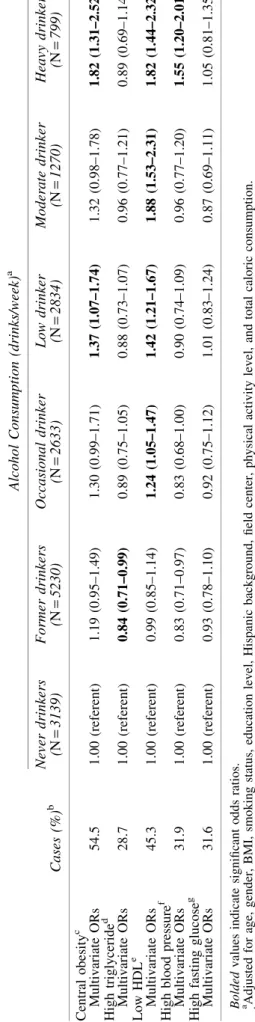
Table 4 details the results for the individual components of MetS across alcohol consumption categories. Low and heavy drinkers presented with higher odds of elevated WC than never drinkers (low AOR: 1.37, 95% CI 1.07–1.74; heavy AOR: 1.82, 95% CI 1.31–2.52). Former drinkers had lower odds of elevated TG levels (AOR: 0.84, 95% CI 0.71– 0.99) than never drinkers. Occasional, low, moderate, and heavy drinkers had higher odds of low HDL than never drinkers (occasional AOR: 1.24, 95% CI 1.05–1.47; low AOR: 1.42, 95% CI 1.21–1.67; moderate AOR: 1.88, 95% CI 1.53–2.31; heavy AOR: 1.82, 95% CI 1.44–2.32). Fi-nally, heavy drinkers had higher odds of presenting with elevated BP (AOR: 1.55, 95% CI 1.20–2.01) when com-pared to never drinkers. There were no significant rela-tionships between alcohol consumption and high fasting glucose levels.
Table 1. Demographic and Clinical Characteristics of the Sample ( N = 15,905) Overall sample ( N = 15,905), N (%) Never drinkers ( N = 3139), n (%) Former drinkers ( N = 5230), n (%)
Occasional drinkers (N
= 2633), n (%) Low drinker ( N = 2834), n (%)
Moderate drinker (N=
Age, gender, BMI, and Hispanic/Latino background. Inter-actions between alcohol consumption and age, gender, BMI, and Hispanic/Latino background were assessed with respect to MetS. There were no statistically significant interactions found; therefore, stratified analyses were not conducted.
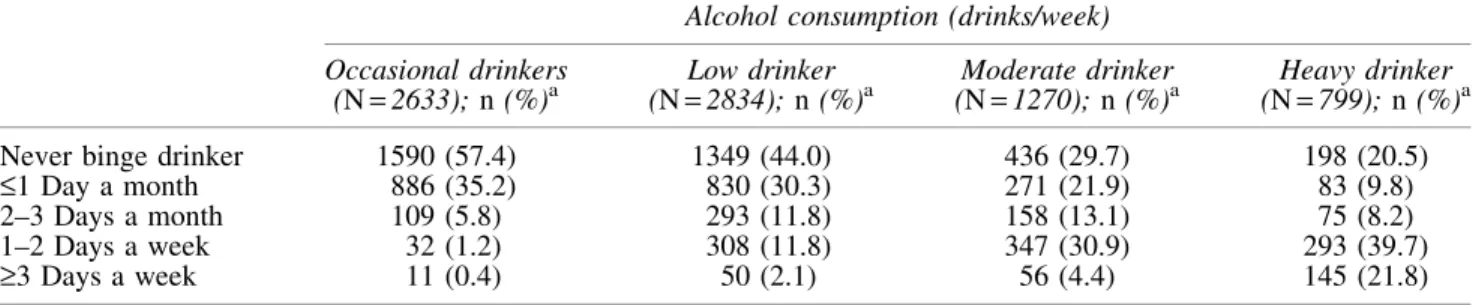
Binge drinking and type of alcoholic beverage. The preva-lence of binge drinking within each alcohol consumption category is described in Table 5. The prevalence of MetS across binge drinking categories and the relationships be-tween binge drinking and MetS are depicted in Table 6. Slightly more than half of the current alcohol consumers (57.2%) reported binge drinking. The highest prevalence of MetS was among nonbinge drinkers (47.3%), followed by
those who engaged in binge drinking £1 day a month
(25.5%). Participants who engaged in binge drinking£1 day
a month and 2–3 days a month had lower odds of presenting with MetS compared to nonbinge drinkers in the unadjusted model (OR 0.77, 95% CI 0.65–0.91; OR: 0.62, 95% CI 0.47–0.82, respectively). However, in the adjusted models, there were no significant relationships between frequency of binge drinking and presenting with MetS.
Table 7 presents the relationship between MetS and al-cohol consumption based on the type of alal-coholic beverage. Among wine drinkers, low and moderate drinkers were found to have lower odds of presenting with MetS compared to never drinkers (AOR: 0.72, 95% CI 0.55–0.96, AOR: 0.43, 95% CI 0.21–0.87, respectively). Beer and liquor consumption was not related to significant changes in the prevalence of MetS across any of the alcohol consumption categories or odds of MetS.
Discussion
This study is one of the first to examine the relationship between alcohol consumption and MetS in a large study of Hispanic/Latino adults of diverse backgrounds living in the United States. Our findings suggest that low and moderate alcohol consumption is associated with lower odds of MetS. This finding is consistent with current literature that sug-gests low-to-moderate alcohol consumption is protective
against MetS.18,20,24,25A novel finding from our study is the
use of an occasional drinking category among Hispanics/ Latinos. In most of the current literature, the lowest con-sumption category is light drinking, which is often defined
as £3 drinks per week. Future studies should consider
in-cluding occasional drinking as the lowest consumption category.
The association between alcohol consumption and indi-vidual components of MetS varied in the current study. Consistent with others, we found that low levels of wine consumption, but not beer or liquor, were related to lower
odds of MetS.26Our results were similar to current literature
in the general U.S. population, except for WC and HDL
cholesterol.18,24–28 In contrast to our findings of increased
odds of elevated WC among low and heavy drinkers, pre-vious work found decreased odds of elevated WC as the
number of alcoholic beverages increased20; however, this
was a population-based study consisting of only 5.6% His-panics/Latinos, who were primarily of Mexican American background. Our finding of increased odds of low HDL with greater alcohol consumption is unique to the literature. Previous studies, none in Hispanic/Latino populations, have found that greater alcohol consumption leads to decreased
Table 4. Odds Ratios of the Individual Components of the Metabolic Syndrome Across Categories of Alcohol Consumption Cases (%) b Alcohol Consumption (drinks/week) a Never drinkers ( N = 3139) Former drinkers ( N = 5230) Occasional drinker ( N = 2633) Low drinker ( N = 2834) Moderate drinker ( N = 1270) Heavy drinker ( N = 799) Central obesity c Multivariate ORs 54.5 1.00 (referent) 1.19 (0.95–1.49) 1.30 (0.99–1.71) 1.37 (1.07–1.74) 1.32 (0.98–1.78) 1.82 (1.31–2.52) High triglyceride d Multivariate ORs 28.7 1.00 (referent) 0.84 (0.71–0.99) 0.89 (0.75–1.05) 0.88 (0.73–1.07) 0.96 (0.77–1.21) 0.89 (0.69–1.14) Low HDL e Multivariate ORs 45.3 1.00 (referent) 0.99 (0.85–1.14) 1.24 (1.05–1.47) 1.42 (1.21–1.67) 1.88 (1.53–2.31) 1.82 (1.44–2.32) High blood pressure f Multivariate ORs 31.9 1.00 (referent) 0.83 (0.71–0.97) 0.83 (0.68–1.00) 0.90 (0.74–1.09) 0.96 (0.77–1.20) 1.55 (1.20–2.01) High fasting glucose g Multivariate ORs 31.6 1.00 (referent) 0.93 (0.78–1.10) 0.92 (0.75–1.12) 1.01 (0.83–1.24) 0.87 (0.69–1.11) 1.05 (0.81–1.35) Bolded values indicate sig nificant odds ratios. a Adjus ted for age, gender, BMI, smoking status, education level, Hispanic background, field center, physical activity level, and tot al caloric consu mption. b Percent of cases on overall sample based on weighted analyses. c De fined as a waist circumference ‡ 102 cm (men) or ‡ 88 cm (women). d Defined as serum triglycerides ‡ 150 mg/dL. e De fined as £ 40 mg/dL (men) or £ 50 mg/dL (women). f Defined as systolic blood pressure ‡ 130 mm Hg, a diastolic blood pressure ‡ 85 mm Hg, or current use of medication for hypertension. gDefined as ‡ 100 mg/dL or current use of medication for diabetes.
odds of low HDL.29 Although low and moderate drinkers had lower odds of presenting with MetS, similar relation-ships were not observed among any of the individual com-ponents of the MetS leaving unanswered the source of the protective benefit of alcohol consumption on MetS. It is recommended that future investigations examine these re-lationships and underlying mechanisms more closely among Hispanics/Latinos.
The second aim of this study was to explore whether the relationship between alcohol consumption and MetS dif-fered by age, gender, BMI, and Hispanic/Latino back-ground. We observed no statistically significant interactions when analyzing within the context of our full model. Al-though we did not continue with subanalyses based on the lack of significant interaction terms, there is literature that suggests lower risk of coronary heart disease among older
adults who engage in moderate alcohol consumption.30
There is also literature from the general U.S. population that suggests a reduction of the odds of MetS among women
who engage in moderate levels of alcohol consumption.18
Previous studies have only reported on Mexican Americans or a general Hispanic/Latino category, not the diverse His-panic/Latino backgrounds found in our study. Our study contributes to the literature by suggesting no significant interaction between BMI and alcohol consumption in rela-tion to MetS. Although no interacrela-tion was found, future studies may want to look at this relationship more closely. In regard to the relationship between MetS and alcohol con-sumption by Hispanic/Latino background, no significant interaction was found in the current study. The sample sizes among each Hispanic/Latino background category may
contribute toward the lack of significance found; however, our study is unique in that it includes diverse Hispanic/ Latino backgrounds compared to the current literature that only reported on Mexican Americans or a general Hispanic/
Latino category.18
Strengths of the current study include the population-based sampling frame of HCHS/SOL, which increases its representative nature in targeted geographic regions. Sec-ond, the data collection methodology used across sites was standardized for alcohol consumption, MetS and its indi-vidual components, along with centralized sample proces-sing. Despite these strengths, the study is not without limitations. First, the cross-sectional nature limits our ability to examine temporal or causal relationships. Second, alcohol use was self-reported, which can lead to recall bias; how-ever, this was partly addressed by adding specific time
frames (i.e., the week) as a reference point. Finally, as noted
previously,31 inferences about Hispanic/Latino individuals
beyond the targeted areas covered by the study sites may not be completely appropriate.
Conclusion
In this study of alcohol consumption and MetS among U.S. Hispanics/Latinos, we found that low and moderate levels of alcohol consumption lowered the odds of pre-senting with MetS. Furthermore, results suggest that the relationships vary among alcohol consumption categories and the individual components of MetS. Caution should be used considering known deleterious effects of alcohol con-sumption such as liver disease.
Table 6. ORs of Metabolic Syndrome Across Frequency of Binge Drinking
Frequency of binge drinkinga
Never binge drinkers
£1 Day a month
2–3 Days a month
1–2 Days a week
‡3 Days a week
Binge drinkers (%)b 42.8 27.9 9.8 15.2 4.3
Metabolic syndrome cases (%)c 47.3 25.5 7.6 14.6 5.0
OR (CI)
Model 1 1.00 (referent) 0.77 (0.65–0.91) 0.62 (0.47–0.82) 0.82 (0.67–1.00) 1.11 (0.74–1.65)
Model 2d 1.00 (referent) 0.90 (0.73–1.10) 0.92 (0.68–1.26) 1.10 (0.86–1.39) 1.25 (0.77–2.03)
Model 3e 1.00 (referent) 0.90 (0.73–1.10) 0.95 (0.70–1.29) 1.10 (0.87–1.41) 1.25 (0.76–2.05)
Boldedvalues indicates significant odds ratios. a
Defined as consuming 4+(women) and 5+(men) drinks within a 2-hr period.
b
Percent of binge drinkers based on weighted analyses. c
Percent of cases based on weighted analyses. d
Adjusted for age, gender, BMI, smoking status, education level, Hispanic background, and field center. e
Further adjusted for physical activity level and total caloric consumption.
Table 5. Prevalence of Binge Drinking Across Categories of Current Alcohol Consumption
Alcohol consumption (drinks/week)
Occasional drinkers (N=2633);n(%)a
Low drinker (N=2834);n (%)a
Moderate drinker (N=1270);n (%)a
Heavy drinker (N=799);n(%)a
Never binge drinker 1590 (57.4) 1349 (44.0) 436 (29.7) 198 (20.5)
£1 Day a month 886 (35.2) 830 (30.3) 271 (21.9) 83 (9.8)
2–3 Days a month 109 (5.8) 293 (11.8) 158 (13.1) 75 (8.2)
1–2 Days a week 32 (1.2) 308 (11.8) 347 (30.9) 293 (39.7)
‡3 Days a week 11 (0.4) 50 (2.1) 56 (4.4) 145 (21.8)
a
Percent in each alcohol consumption category based on weighted analyses.
Acknowledgments
The Hispanic Community Health Study/Study of Latinos was carried out as a collaborative study supported by con-tracts from the National Heart, Lung, and Blood Institute (NHLBI) to the University of North Carolina–Chapel Hill (N01-HC65233), University of Miami (N01-HC65234), Albert Einstein College of Medicine (N01-HC65235), Northwestern University (N01-HC65236), and San Diego State University (N01-HC65237). The following Institutes/ Centers/Offices contributed to the HCHS/SOL through a transfer of funds to the NHLBI: National Institute on Min-ority Health and Health Disparities, National Institute on Deafness and Other Communication Disorders, National Institute of Dental and Craniofacial Research, National In-stitute of Diabetes and Digestive and Kidney Diseases, National Institute of Neurological Disorders and Stroke, and the NIH Institution-Office of Dietary Supplements.
Author Contributions
D.C.V. contributed toward the literature search, data analysis, data interpretation, figures, and writing. M.S., K.A., and Y.T. contributed toward the data analysis, data inter-pretation, figures, and writing. M.G. contributed toward the study design, data collection, data interpretation, and writing. M.L.D., H.M.G., G.T., C.R.I., G.H., and N.S. contributed toward the study design, data collection, and writing.
Author Disclosure Statement
No competing financial interests exist.
References
1. Hvidtfeldt UA, Tolstrup JS, Jakobsen MU, et al. Alcohol intake and risk of coronary heart disease in younger,
middle-aged, and older adults.Circulation2010;121:1589–
1597.
2. Sacco RL, Elkind M, Boden-Albala B, et al. The protective effect of moderate alcohol consumption on ischemic stroke.
JAMA1999;281:53–60.
3. Di Castelnuovo A, Costanzo S, Bagnardi V, et al. Alcohol dosing and total mortality in men and women: An updated
meta-analysis of 34 prospective studies. Arch Intern Med
2006;166:2437–2445.
4. U.S. Department of Agriculture, US Department of Health
and Human Servise. Dietary Guidelines for Americans.
Washington, DC: U.S. Government Printing Office; 2010.
5. Danaei G, Ding EL, Mozaffarian D, et al. The preventable causes of death in the United States: Comparative risk as-sessment of dietary, lifestyle, and metabolic risk factors. PLoS Med2009;6:e1000058.
6. Substance Abuse and Mental Health Services
Administra-tion.Results from the 2012 National Survey on Drug Use
and Health: Summary of National Findings. Rockville, MD: Substance Abuse and Mental Health Services Ad-ministration; 2013.
7. Substance Abuse and Mental Health Services
Administra-tion.Results from the 2002 National Survey on Drug Use
and Health.Rockville, MD: Substance Abuse and Mental Health Services Administration; 2003.
8. Chartier K, Caetano R. Ethnicity and health disparities in
alcohol research.Alcohol Res Health2010;33:152–160.
9. Caetano R, Vaeth PA, Chartier KG, et al. Epidemiology of drinking, alcohol use disorders, and related problems in US
ethnic minority groups.Handb Clin Neurol2014;125:629–
648.
10. Flores YN, Yee HF, Jr, Leng M, et al. Risk factors for chronic liver disease in Blacks, Mexican Americans, and Whites in the United States: Results from NHANES IV,
1999–2004.Am J Gastroenterol2008;103:2231–2238.
11. Yoon Y, Yi H. Surveillance Report No. 83, Liver Cirrhosis Mortality in the United States, 1970–2005. 2008. Accessed at http://pubs.niaaa.nih.gov/publications/surveillance83/ Cirr05.htm on December 2, 2014.
12. Third Report of the National Cholesterol Education Program (NCEP) Expert Panel on Detection, Evaluation, and Treat-ment of High Blood Cholesterol in Adults (Adult TreatTreat-ment
Panel III) Final Report.Circulation2002;106:3143–3421.
13. Beltran-Sanchez H, Harhay MO, Harhay MM, et al. Pre-valence and trends of metabolic syndrome in the adult U.S.
population, 1999–2010.J Am Coll Cardiol2013;62:697–703.
14. Falkner B, Cossrow ND. Prevalence of metabolic syndrome and obesity-associated hypertension in the racial ethnic
minorities of the United States.Curr Hypertens Rep2014;
16:449.
15. Alberti KG, Eckel RH, Grundy SM, et al. Harmonizing the metabolic syndrome: A joint interim statement of the In-ternational Diabetes Federation Task Force on Epidemiol-ogy and Prevention; National Heart, Lung, and Blood Institute; American Heart Association; World Heart Fed-eration; International Atherosclerosis Society; and
Inter-national Association for the Study of Obesity.Circulation
2009;120:1640–1645.
16. Heiss G, Snyder ML, Teng Y, et al. Prevalence of meta-bolic syndrome among Hispanics/Latinos of diverse back-ground: The Hispanic Community Health Study/Study of
Latinos.Diabetes Care2014;37:2391–2399.
Table7. ORs of Metabolic Syndrome Among Current Alcohol Consumers Stratified by Type of Alcohol Beverage
Alcohol consumption (drinks/week)
Never drinkers Low drinker Moderate drinker Heavy drinker
Alcohol type
Beer (n=3656) 1.00 (referent) 0.84 (0.65–1.07) 0.87 (0.64–1.19) 1.39 (0.99–1.95)
Wine (n=765) 1.00 (referent) 0.72 (0.54–0.96) 0.43 (0.21–0.87) 1.16 (0.43–3.16)
Liquor (n=482) 1.00 (referent) 0.87 (0.62–1.23) 0.93 (0.57–1.53) 1.07 (0.39–2.93)
Boldedvalues indicates significant odds ratios.
Adjusted for age, gender, BMI, smoking status, education level, Hispanic background, field center, physical activity level, total caloric consumption, and alcohol type (except within its own stratification).
17. Yoon YS, Oh SW, Baik HW, et al. Alcohol consumption and the metabolic syndrome in Korean adults: The 1998 Korean National Health and Nutrition Examination Survey. Am J Clin Nutr 2004;80:217–224.
18. Freiberg MS, Cabral HJ, Heeren TC, et al. Alcohol con-sumption and the prevalence of the Metabolic Syndrome in the US: A cross-sectional analysis of data from the Third
National Health and Nutrition Examination Survey.
Dia-betes Care2004;27:2954–2959.
19. Vieira EC, Peixoto Mdo R, Silveira EA. Prevalence and factors associated with Metabolic Syndrome in elderly users
of the Unified Health System. Rev Bras Epidemiol 2014;
17:805–817.
20. Alkerwi A, Boutsen M, Vaillant M, et al. Alcohol con-sumption and the prevalence of metabolic syndrome: A
meta-analysis of observational studies.Atherosclerosis2009;
204:624–635.
21. Lavange LM, Kalsbeek WD, Sorlie PD, et al. Sample de-sign and cohort selection in the Hispanic Community Health
Study/Study of Latinos.Ann Epidemiol2010;20:642–649.
22. Sorlie PD, Aviles-Santa LM, Wassertheil-Smoller S, et al. Design and implementation of the Hispanic Community
Health Study/Study of Latinos. Ann Epidemiol 2010;20:
629–641.
23. The Atherosclerosis Risk in Communities (ARIC) Study:
Design and objectives. The ARIC investigators. Am J
Epidemiol1989;129:687–702.
24. Djousse L, Arnett DK, Eckfeldt JH, et al. Alcohol con-sumption and metabolic syndrome: Does the type of
bev-erage matter?Obes Res2004;12:1375–1385.
25. Churilla JR, Johnson TM, Curls R, et al. Association be-tween alcohol consumption patterns and metabolic
syn-drome.Diabetes Metabol Syndr2014;8:119–123.
26. Taylor B, Irving HM, Baliunas D, et al. Alcohol and hy-pertension: Gender differences in dose-response relation-ships determined through systematic review and
meta-analysis.Addiction2009;104:1981–1990.
27. Baliunas DO, Taylor BJ, Irving H, et al. Alcohol as a risk factor for type 2 diabetes: A systematic review and
meta-analysis.Diabetes Care2009;32:2123–2132.
28. Wannamethee SG, Shaper AG. Alcohol, body weight, and
weight gain in middle-aged men.Am J Clin Nutr2003;77:
1312–1317.
29. Brien SE, Ronksley PE, Turner BJ, et al. Effect of alcohol consumption on biological markers associated with risk of coronary heart disease: Systematic review and
meta-analysis of interventional studies.BMJ2011;342:d636.
30. Mukamal KJ, Chung H, Jenny NS, et al. Alcohol con-sumption and risk of coronary heart disease in older adults:
The Cardiovascular Health Study.J Am Geriatr Soc2006;
54:30–37.
31. Rodriguez CJ, Daviglus ML, Swett K, et al. Dyslipidemia patterns among Hispanics/Latinos of diverse background in
the United States.Am J Med2014;127:1186–1194 e1181.
Address correspondence to:
Mark Stoutenberg, PhD, MSPH Department of Public Health Sciences University of Miami Miller School of Medicine 1120 NW 14th Street Clinical Research Building, Suite 1008 Miami, FL 33136
E-mail:[email protected]