Kent Academic Repository
Full text document (pdf)
Copyright & reuse
Content in the Kent Academic Repository is made available for research purposes. Unless otherwise stated all content is protected by copyright and in the absence of an open licence (eg Creative Commons), permissions for further reuse of content should be sought from the publisher, author or other copyright holder.
Versions of research
The version in the Kent Academic Repository may differ from the final published version.
Users are advised to check http://kar.kent.ac.uk for the status of the paper. Users should always cite the published version of record.
Enquiries
For any further enquiries regarding the licence status of this document, please contact: [email protected]
If you believe this document infringes copyright then please contact the KAR admin team with the take-down information provided at http://kar.kent.ac.uk/contact.html
Citation for published version
Milton, Damian (2016) The development of a mentor training program for practitioners working with autistic adults. Project report. London South Bank University, London, UK
DOI
Link to record in KAR
https://kar.kent.ac.uk/62659/
Document Version
1
The development of a mentor training program for practitioners
working with autistic adults
Damian E M Milton
Submitted as a dissertation in partial fulfilment of the requirements for the degree of Master of Arts of London South Bank University
2
Abstract
This study focuses on the development and evaluation of a training program for would-be mentors of adults on the autism spectrum. Relevant literature in this field is reviewed along with existing training and mentoring services for autistic adults, and the development of a mentor training programme described. The training programme was developed by the project team with advice from the project advisory and steering groups. This thesis reports on the development of participant feedback as to the effectiveness of the training model devised. Unlike many contemporary mentoring models in the field of autism, this project took a social model approach with training informed, designed and delivered with significant input from autistic people. In participant feedback, this aspect of the training was the best received. Following feedback from participants however, it is recommended that this training model be developed to be covered over a two-day period and contain added emphasis on the reliability and consistency of mentors, role boundary setting, and the facilitating of goal-setting.
3
Contents
Acknowledgements 4
Section 1: Introduction 5
Section 2: Literature Review 9
Section 3: Methodology 28
Section 4: Research Methods 31
Section 5: Results and analysis 37
Section 6: Conclusions 49
Bibliography 57
4
Acknowledgements
I would like to thank my supervisor for this study and project lead for the mentoring project, Professor Nicola Martin for her continued support. I would also like to thank my colleagues on the mentoring project, Gemma Dawkins, Tara Sims and Jo Krupa, as well as the members of the advisory and steering groups. Most of all I would like to thank the participants in this study.
5
Section 1: Introduction
1.1 A note on terminology
There is much current debate regarding the terminology related to autism. This article will resist people first phrasing, in accordance with other autistic voices (Sinclair, 1993; Sainsbury, 2000):
W
separated from who we are as people, nor is it something shameful that has to be reduced to a sub- “
1.2 Project rationale
Until recent decades autism was considered to be a rare deve
affected a small proportion of the population. However, with the widening of diagnostic criteria, the numbers of those now considered to be somewhere on the autism spectrum is estimated to be around 1 in 100 (NAS, 2016a). Although prevalence figures for autism are hard to judge, due to the changeable criteria and diagnostic practices that it has undergone historically, and due to autism being diagnosed using behavioural characteristics, an accurate figure is not possible, as there is much contention over what exactly autism is (Milton, 2012a; Runswick-Cole et al. 2016). What can be said however, is that at least the majority of those now considered to be on the autism spectrum are those without significant learning disabilities and who are often highly articulate in their communications. However, research in the field of autism is primarily concentrated on a medical model framework and concentrated on children and young people (Pellicano et al. 2015).
6 Research into, as well as practical support, for the needs of adults on the autism spectrum is sparse, and the nuanced needs many have within educational and work settings can lack recognition. At a forum held by Research Autism in 2007 entitled “ F
Adults with Autism
life, including: managing their own practical and financial affairs, accessing education and training opportunities, securing and maintaining employment, and maintaining good physical and mental health. There was a common feeling expressed that existing models of support for adults on the autism spectrum, which often involve being part of a large group of people, were not helpful. Many described how they felt stressed or unsure in such surroundings, preferring a one-to-one relationship which could then be broadened over time. Many said that they would only want this support on a time-limited basis, but that it should be goal-oriented, specialised and based on a personal life coach or mentor model. Many participants said they would like to use the allowances they received for personal support to pay for such services, but few had access to such services in their locality.
Due to these findings, Research Autism later acquired funding to undertake a two-year pilot study to establish a mentoring scheme, designed with significant input from autistic people and their families, in order to evaluate the programmes effects on the well-being of the participants and progression toward their stated goals. The aims of this study were to two-fold and included subordinate aims as follows:
Aim one: to develop a sustainable research-informed mentor training programme:
1a: To review existing training for mentors of people on the autism spectrum.
7 Aim two: to assess the effectiveness of the mentoring programme developed for adults on the autism spectrum:
2a: To assess whether mentoring impacts on goal achievement and satisfaction for mentors and mentees.
2b: To assess whether it has any impact on the quality of life of both mentors and mentees.
T
mentoring programme in order to improve the programme based on the views of those involved.
This dissertation report concentrates on the first of these project aims, of reviewing existing training and mentoring services for autistic adults, and the development of a mentor training programme. The remit of the project included the production of a one-day training course for would-be mentors of autistic adults. This training programme was developed by the project team with advice from the project advisory and steering groups. This thesis reports on this initial phase and concentrated on the following research questions:
What information and activities are most effective for meeting the training needs of would-be mentors of autistic adults?
What aspects of a training programme for would-be mentors of autistic adults are most appreciated by those undertaking the training?
This dissertation report is structured into six sections. Following this introduction is a literature review which considers the mentoring role, relevant literature on autism and how this related to the mentoring of autistic people and literature regarding the use of Personal
8 Construct Theory in the design of the mentoring program and accompanying training materials. In section 3, the methodology of this dissertation is discussion, followed by section 4 regarding the research methods employed. Section 5 gives an overview of the results, whilst section 6 discusses and concludes the main findings and limitations of the study, before giving recommendations for continued research in the area.
9
Section 2: Literature review
The aspect of the mentoring project being focused on in this dissertation report set out to answer the following questions:
What information and activities are most effective for meeting the training needs of would-be mentors of autistic adults?
What aspects of a training programme for would-be mentors of autistic adults are most appreciated by those undertaking the training?
In this section, a review of relevant literature is given regarding mentoring, autism, research in the area of mentoring autistic people, and lastly in the area of Personal Construct Theory (PCT) which through the literature review became influential on the mentoring model and training adopted within this project.
2.1 Literature regarding the mentoring role
According to The Mentoring and Befriending Foundation (2014), mentoring is a time-limited goal-orientated relationship that supports both personal and vocational learning and development. It involves an experienced person providing guidance and support to another (less experienced) person through a variety of methods (Western 2012). Western (2012) suggest that it is a necessity for a mentor to have an understanding of the social world and perspective of their mentee, as well as the skills to share their experience in an effective and helpful way.
Mentor M I
10 planned mentoring operates within a structured programme with clear objectives, where mentors and mentees are matched. Planned mentoring can vary vastly depending on the institution in which it is delivered and the philosophy guiding its practice, but there are usually some shared characteristics, described by Miller (2002) as including:
It is a deliberate, conscious and voluntary relationship. It may or may not be time limited.
It is supported by an organisation.
It occurs between an experienced person and one or more other (less experienced) persons.
It is non-hierarchical.
The relationship is expected to be beneficial to both mentor and mentee.
It will typically include elements of interpersonal support, guidance, mutual exchange, sharing of wisdom, and coaching.
Despite these characteristics, both mentors and mentees are involved in negotiating the form of their responsibilities within the relationship and are therefore involved in defining what mentoring is and what mentors do (Miller 2002).
Within the initial meeting between mentor and mentee the initial parameters of the relationship are established. The mentor and mentee need some time to start to plan what the goals of the mentoring experience are to be. Commitment to the mentoring relationship from both parties is essential for its potential success, but not always an easy process to sustain. According to The Mentoring and Befriending Foundation (2014), distinctions need to be made between mentoring and other support roles such as coaching. Whilst there are
11 similarities between mentoring and coaching and other support roles such as befriending, advocacy and counselling, there are also important differences that need to be addressed when setting the parameters of the mentoring relationship. As an example, in both mentoring and coaching roles, one may work toward set goals and objectives, with outcomes potentially being measured in some way with regard to improved performance of a task. However, a mentoring relationship is often more open-ended, with the mentor more in the role of facilitating the learning of their mentees, as well as more holistic goals such as self-discovery or personal growth. Within mentoring relationships it is vital to maintain professional boundaries for the sake of both parties. The outcomes of a mentoring relationship are often broadly defined and reflect the mentees progress in their development toward a negotiated goal. Such a partnership can be time-limited or long-term, and can evolve in to a mutually beneficial collaboration where mentors can learn as well from the feedback, insights and reflections of their mentees. The positive outcomes of a mentoring relationship can be seen to be largely dependent on the quality of the mentoring experience and the interactions between mentor and mentee.
2.2 Literature regarding autism
In order to develop a mentoring programme for autistic adults, it is necessary to look at what aspects of autism people need to know about in developing their mentoring expertise. Whilst a person-centred ethos is essential for a mentoring programme, there may be many aspects of the autistic experience which could impact on mentoring relationships, and could act as a foundational knowledge to reflect upon for would-be mentors working with autistic adults.
12 The term autism was first used by a psychiatrist called Bleuler in 1911 to try and describe a
H
show a passing resemblance to how autism is thought of today:
"The schizophrenics who have no more contact with the outside world live in a world of their own. They have encased themselves with their desires and wishes...they have cut themselves off as much as possible from any contact with the external world. This detachment from reality with the relative and absolute predominance of the inner life, we term autism." (Bleuler, 1911, cited in Parnas et al., 2002: 131).
I K A
Bleuler, studying small groups
B
distinct symptoms were being identified that were markedly different from schizophrenia as
it was conceived of K
autism, whilst the work of Asperger was left largely undiscovered until the 1970s. Definitions of what autism is, and also what caused an autistic developmental pattern in children have been hotly contested ever since, including an unfortunate era where autism
totally untrue.
One of the most important developments in the history of autism in Britain was the work of Wing and Gould (1979) and the subsequent widening of the autism spectrum to include Asperger syndrome. This work largely created the contemporary definition of autism as a
13 (repetitive interests/activities). Since this time, diagnostic systems have changed to reflect these changes in definition.
The most commonly utilised definition of autism that one sees today is that it is a:
isability that affects how a person communicates with, and relates to, other people. It also affects how they make sense of the
(NAS, 2016a).
Although this definition of autism is much contested, such a definition of behavioural deficit and impairment has come to characterise both the DSM-V (2013) and ICD-10 (1992)
A
three areas.
In terms of theorising the ways in which autistic people make sense of the world around them, explanations have been dominated by cognitive theories framing autistic ways of thinking in terms of deficit and impairment. One of the most commonly cited theories suggests that autistic people can have a deficit in executive functioning. This phrase refers to the cognitive ability to maintain an appropriate problem-solving strategy needed in order to complete a task. Although first-hand accounts of autistic people often reference difficulties in switching attention, or adverse reactions to interference with attention (e.g. Tammet, 2006), such a theorising of autistic ways of thinking are not without their critics. Some on the autistic spectrum can perform well in executive functioning tasks, whilst people with other medically defined conditions may also struggle with such tasks, suggesting a lack of specificity to autism. It may be the case that such differences are better
14 explained by theories such as a weak drive toward central coherence and monotropism theory.
Happe (1994a) suggested that another difficulty with executive functioning theory is the lack of explanatory value regarding the strengths and talents that are often displayed by autistic people. Shah and Frith (1983) found that autistic people outperformed non-autistic people in tasks such as the embedded figures test, or picking out details from a visual array. Shah and Frith (1983, 1993) suggested that autistic people are often better at tasks that
order to complete. Happe (1994a) suggested
meanings grasped from any given context, whilst simultaneously having the ability to process fine details within their perception. A difficulty with this theory is that autistic people are able to process contextual meanings, yet it may be the case that in some contexts there may be a cognitive tendency to focus on particular aspects of a situation, rather than others.
Murray et al. (1992; 2005) argue that rather than framing autistic cognition in terms of a dysfunctional deficit, the central core feature of such ways of thinking would be the atypical strategies employed by autistic people in their distribution of attention, or perceptual
interest. Thi This
theory would suggest that the amount of attention available to any individual at one time is limited, and that the shaping of cognitive processes depends on a competition between mental processes for this scarce resource. Murray et al. (2005) argue that the way in which attention is utilised by people is normally distributed from those who concentrate deeply on a small number of interests and those with a diffuse but wide attention strategy, akin to a
15
hose at the tightly focused end of this spectrum can be said to be autistic. Murray et al. (2005) suggest that social interaction, the use of language, and the shifting of object attention (implicated by other psychological theories) are all tasks that require a broad attention, and are inhibited by a narrow use of attention.
This theory highlights aspects of the autistic experience not explained sufficiently by the dominant psychological theories in the field. For instance, how individuals on the autism spectrum show a tendency toward either being passionately interested in a task or phenomena, or not interested at all, or how an unanticipated change can lead to a catastrophic disconnection from a previously safe state of mind. When employing a monotropic interest perceptual strategy, the ability to use previously learnt information and schema may be compromised, as information can be channelled along a limited range of interests.
We suggest that the uneven skills profile in autism depends on which interests have been fired into monotropic superdrive and which have been left unstimulated by any felt
(Murray et al. 2005: 143).
A
T
understandable through the theoretical perspective of monotropism, yet is often unrecognised by service providers and support workers, particularly if they are reliant on categorical notions of the cognitive functioning of autistic people. Highly verbal or articulate autistic people may be perceived to be capable in areas in which they struggle, and those with less verbal ability may be assumed to be lacking in skills and learning capacities.
16 Following the theory of monotropism, social interaction with other people may be somewhat dependent on connections being made in the fulfilling of passions and interests that the autistic person shows. From such a perceptual viewpoint, difficulties understanding the perceptions of others may become apparent, but it can also be said that non-autistic theory of autistic mind can leave something to be desired (Milton, 2012a).
Perhaps the most dominant theory in the study of autism is that autistic people have a
B -Cohen et al. 1985). The concept of theory of mind refers to the ability to empathise with other people and imagine their thoughts and feelings, which can then be used to comprehend and predict their likely behaviour. Baron-Cohen et al. (1985) initially based this theory on the finding that 80% of their sample of autistic children between the ages of six and sixteen failed at false belief tasks such as the
“ -A T
instead of toy dolls (Leslie and Frith, 1988).
This theory has been criticised on a number of levels however: Task failure on false-belief tasks could be due to difficulties in language processing or memory (Eisenmajer and Prior, 1991), or a lack of motivation to deceive (DeGelder, 1987). Some theorists questioned its applicability to all on the spectrum when 20% of children passed such tests, or its value for explaining all the aspects of what constituted the autistic difference (Happe, 1994a). An impaired theory of mind deficit as a general theory of autism has since been revised in order to differentiate between an ability to ascertain the feelings of others, and the development of affective empathy once those feelings are recognised. Later studies by Baron-Cohen (1992) and Happe (1994b) also found that the ability to successfully complete theory of
17 Autistic scholars, such as Milton (2012a; 2014) and Chown (2014) have argued that a so-called deficit in social functioning cannot solely be located within the mind of an individual, and that in social interactions between autistic and non-autistic people a breakdown in understanding can easily occur in both directions due to the differing dispositions and perceptions of the parties involved. As coined by Milton (2012a
challenges in understanding the intentions of each other.
An extremely important aspect of the autistic experience is that of sensory sensitivities. This feature of autism was only recently recognised within diagnostic criteria (DSM-V, 2013). Autistic people often report both hyper and hypo sensitivities to all sensory sensations. Such sensitivities can vary from person to person and across contexts. With a fragmented or monotropic cognitive style, sensory integration for autistic people can also be a challenge, with a high level of crossover with those diagnosed with Dyspraxia.
Due to the sensory and social experiences that autistic people experience, many also report high levels of stress. Experiences of stress are certainly not unique to autistic people, yet problems associated with chronic stress levels are common. Without available options or the ability to communicate when highly stressed, reactions can lead to what can be
withdrawal), and panic attacks. Such reactions can be seen as fight, flight or freeze type of responses, yet may be misinterpreted by others due to issues such as the double empathy problem (Milton, 2012a).
The dominant theories of autism, much like the diagnostic criteria for autism, locate the challenges faced by autistic people primarily within the brains/minds of the autistic person,
18 rather than in the social milieu within which they might find themselves, or in the relationships they have with others. Milton (2012a) argues in contrast however, that the social subtext of a situation is never a given, but actively constructed in the interactions people have with one another.
Within wider disability activism and critical disability studies, there are a number of models that have been explored in regard to the study of disability (the two most frequently referenced being the traditional medical and social models). The traditional medical model of disability would view disability as a set of problems or deficits belonging to the individual and in need of remedial intervention. This view has been widely criticised by disability activists (Oliver, 1990). In contrast to the medical model is the social model of disability which sought to socially situate the experience of disability. The traditional social model of disability (e.g. Oliver, 1990) demarcates socially situated disability from biological impairment. However, the notion of impairment also being socially constructed has been explored by disability scholars (Milton, 2015; Sherry, 2016). Within the field of autism, it can be seen that medical and cognitive models dominate the discourse. Yet, this pattern is reversed within the autistic community, with many autistic adults expressing a view more akin to a social model approach (Milton, 2016a).
2.3 Relevant research regarding mentoring for autistic people
Both Access to work and student mentoring for people on the autism spectrum is available through various schemes in the UK, yet specialist schemes are rare and research on the topic rarer still. The only area of mentoring for people on the autism spectrum to have begun to gain the attention of researchers has been student mentoring schemes for College and University students. Gelbar et al. (2014) conducted a systematic review of articles
19 describing the experience and support schemes made available for people on the autism spectrum attending College or University. This review only found twenty articles referring
to sixty-nine people in total, with o
neither of which were evaluating a mentoring scheme. The other eighteen studies were all individual case study reports. Such a scarcity of research into the area indicated a genuine need for further study.
Gelbar et al. (2014) found that the majority of the studies looking into experiences of post-compulsory education included accounts of isolation and loneliness, and problematic mental health. Much guidance that has been written for preparing and supporting people on the autism spectrum in post-compulsory education has been done so from a clinicians perspective, suggesting interventions to address academic modifications, independent living and social skills, vocational goals, and mental health supports in order to improve the quality of life of such students (Van Bergeijk et al. 2008). There are some potentially valuable insights in such accounts, such as smaller settings and class sizes, and utilising strengths and areas of interest. By taking a medicalised deficit model view of autism, however, they also recommend strategies such as role playing, generalising, teaching people on the spectrum to recognise their own emotions through explicit instruction, and so on, which would be much criticised by a number of autistic scholars and activists (Milton, 2012a, 2014).
Mentoring can be seen as the development of a one-to-one relationship that helps an individual to learn from their own experiences as well as from the experiences of another, with both mentors and mentees potentially gaining from the experience. In the context of
20 autistic people however, the benefits from such a relationship may be difficult to attain due to the double empathy problem (Milton, 2012a; 2014; Chown, 2014).
Brown et al. (2010) examined evidence regarding mentoring practices for students with disabilities in post-compulsory education. They found that literature in the area was minimal, with only ten pieces of research meeting their criteria for review. A number of themes did emerge from this review however, including: the potentially useful role of technology, focusing on particular disability groups, the usefulness of mentoring for
long-term
mentoring relationship. Brown et al. (2010) conclude by stating that mentoring relationships with students with disabilities have the best opportunity for success where there is a flexible and multi-layered system of support in place.
There is some contention within the literature however regarding the goals of mentoring and who should set them. Whilst the Mentoring and Befriending Foundation (2014) suggest that goals should ideally be set by mentees, Griffith et al. (2012) argue that little is known about what extent people on the autism spectrum need supports to help ameliorate the
“
need of remediation from the outset. Griffith et al. (2012) suggest th
I
significant negative effects on autistic well-being. Such negative consequences include the
leading to inaccurate expectations being placed on people by others, the potential for exhaustion, and so on. Griffith et al. (2012) present a model of support based on a
21 behavioural deficit and remedial model of autism and could be argued to mis-frame the issues faced by their participants, or at least they ignore alternative explanations. For example, they suggest that participants were concerned about how they might be perceived
I
potential internalised stigma and psycho-emotional disablement (Reeve, 2011; Milton and
M o
autistic people and may reduce proneness to anxiety and depression. In the view of Milton and Moon (2012), such a view would be clear example of normalisation and cognitive ableism and could lead to exacerbating the very problem such a behavioural model is attempting to remediate. Whilst Griffith et al. (2012) acknowledge that other participants
; they seem to
have had more of a difficulty themselves in this regard. Griffith et al. (2012) argue that autistic people and their families should be actively consulted and included and have a valued role in relevant contexts. From the point of view of community-based participatory research however, such efforts at inclusion fall a long way short of the ideal.
Curtin et al. (2015) conducted a small pilot study regarding the feasibility and efficacy of an individualised mentoring program for teenagers on the autism spectrum. In this program, mentees met with mentors for two hours a week over a six month period. Like Griffith et al. (2012), they introduce a normative approach through the program described, with a focus on the teaching of social skills and competencies, framed by Curtin et al. (2015) as critical for independence in adulthood. The learning of normative social skills were assumed by Curtin
22 et al. (2015) to lead to better quality of life and well-being. Such work ignores the criticisms that autistic people make of normative social skills training and academic work that critiques such a normative approach (Milton, 2016a). Curtin et al. (2015) did have goals set and how to reach them through mutual discussion between mentor and mentee, and a clear distinction was made on the program between mentoring and befriending services. The goals set were constrained however to five core areas: self-esteem, healthy relationships, independent living, community involvement, and education/vocation. It is questionable as to what extent structuring goal setting to this extent is really person-centred. The mentors on this program received training
Training in autism that ignores social model approaches and the voices and concerns of the autistic community may lead to unhelpful or even counterproductive practices being implemented. Despite these issues, Curtin et al. (2015) found a general trend toward improvement in self-esteem and quality of life measures for their participants. They also found that the mentoring worked best, when the pairings worked on the goals that mentees had primarily set for themselves. Issues were also found with regard to the boundaries of
The normative trend in studies regarding mentoring and autistic people is continued by Arnes et al. (2015). This study evaluated a mentoring program designed to help students navigate both social and academic aspects of post-compulsory education. Despite presenting a highly normative model of autism, the authors attempted to locate the study within disability theory and also highlighted issues regarding a sense of belonging within a University setting, such as safety and the building of a network of peers. In this program,
23 matched pairings would meet either weekly or bi-weekly, with mentors drawn from graduate psychology students and supervised by a clinical psychologist.
A contrasting study to the standard normative approach was reported by Beadle et al. (2013) which suggested that autistic people themselves were in the best position to offer insights to others about why autistic people acted in the way that they may do, and that all services for autistic people should have significant input from autistic people. Such calls for inclusion and participation have also been mirrored by autistic writers within the context of research practice (e.g. Milton and Bracher, 2013). Beadle et al. (2013) report on a project that was set up to enhance the presentation skills of young autistic adults who expressed an interest in talking publicly about their lives. Whilst a specific goal and one open to criticism
from within the autistic
-, it is one often found amongst young autistic adults and an interest that can be exploited. Their project involved a series of mentoring sessions and drew heavily of participatory research methods to determine the content of the sessions. After each session, each participant was invited to record their thoughts in reflective journals. The project received a great deal of positive feedback from all involved in it, in terms of having a positive experience, gaining confidence, and learning new skills.
In order to try and build bridges across the divide that can occur in social interactions between autistic and non-autistic people (Milton, 2012a), tacit understanding, trust and rapport, need to be nurtured over time. Thus, personal qualities such as humility, patience and willingness to listen are paramount. Imposing interpretive frameworks and normative ideologies onto autistic people are likely to be less successful. A recent study by Hamilton et al. (2016) found that good quality training was essential to University mentors working with
24 autistic people. With significant input from autistic people, such training could be even more impactful and productive.
Where studies have used wellbeing indicators with adults on the autism spectrum, one often finds much lower self-assessments (Bracher, 2014). Yet, it is debatable to what extent standardised measures of wellbeing capture autistic experience and sensibilities. Current measures of wellbeing used in the context of autism have been developed with a non-autistic population and hence, may not adequately reflect an non-autistic perspective. Therefore, this area of research has been gaining increasing attention (Jones and Hurley, 2014). A number of studies have shown the potential of utilising Personal Construct Theory (PCT) (Kelly, 1955, Salmon, 2003) with autistic populations however for gaining a clearer insight into the perspectives of autistic participants (Moran, 2006; Williams and Hanke, 2007; Milton, 2012b; Greenstein, 2013).
2.4 Literature regarding the use of Personal Construct Theory (PCT)
PCT developed as a pragmatic theory through George K (1955) psychotherapy practice. At the time of conception, such therapy was dominated by two divergent schools of thought: Psychoanalysis and Behaviourism. Both perspectives were vastly different to one another, yet both took the standpoint that people were moved to act by forces largely outside of their own control (the unconscious mind and environmental influences respectively). In contrast, PCT saw the person as an agent, making choices and decisions and acting upon them. This conceptualisation would not divorce actions from the context within which people act, but for Kelly (1955), it was the constructions that an individual places on events that shapes the meanings they form and the reactions they have to events.
25 Thus, the starting point for PCT was the idiosyncratic ways in which people make sense of the world and how that leads to social action.
Such an approach to personal constructions draws heavily on a phenomenological approach, attempting to approach issues through the viewpoint of the individual experiencing them, rather than fitting them into a priori theories. Kelly (1955) used the
perceiving and making sense out of the same thing or event, and rather than seeing any interpretation as correct, one should look pragmatically at how useful such a framing is to
F K M s
were not fixed positions, but something navigated by an individual in their interactions with others. Importantly in the context of autism, it involved placing oneself in the position of the other with whom one was interacting, so that one could adjust
accordingly:
"He [George Kelly] argued that there were two ways of treating other people. You can relate to others in the way that the early behaviourists thought normal, and treat them as 'behaving mannequins'. Only psychopaths do this, he claimed. The moral way to relate is to act in the light of the other person's view of things. In other words, taking their thoughts and feelings into consideration." (Butt, 2008: 13).
Kelly (1955) envisaged the personal construct to be ways of construing events along bipolar continuums, e.g. from happy to sad, anxious to relaxed. This is not to say constructions are of the nature of either/or extremes, but can be placed along continuums. Placed together
I
26 Constructs are more than just conceptualisations however, as they are both ways of reflecting upon phenomena and of motivating social action. Construing can also be seen as
T
a construct system is not a cognitive entity existing in a vacuum, but is socially and discursively situated.
A PCT
E
ons, or as later post-modernists
D G attari, 1980). To make sense of this
K
construct systems, which are therefore essentia I
meaning-making activity (Milton, 2013; 2013a; 2013b; 2016b
-T I
idiosyncratic psycho- B
A PCT “
creator Phillipa Salmon (2003). This technique asks an individual to draw a line with words representing opposite extremes at each end (e.g. anxious to relaxed). The individual is then asked to place themselves along this line and where they would like to be in future. The individual is then asked to write or talk about how they think they will get from one point to the other. It is in this discursive space that for Salmon (2003), the learning experience takes
27 -image (of course with both being seen as constructions), or of the organisation one works within. Such techniques have helped inspire participatory work with autistic children (Moran, 2006; Williams and Hanke, 2007; Greenstein, 2013).
Williams and Hanke (2007) employed PCT methods to explore with autistic children how they experienced school life and imagining how it might be different. They argued that pupils should be involved as much as possible in making decisions about issues that most directly affected them. Williams and Hanke (2007) recognised that they needed practical
tools with which to gain a -determining
what these might be. This led to methods being used with the children such as building a model of their ideal school.
PCT examines how a person construes and constructs themselves in narrative meaning (and themselves in relation to others). Within this theory, people were initially regarded as like
in real life situations. Although this idea can be critiqued, as people are often not very conscious about the decisions they make and the meanings they form, as Moran (2006) points out, this way of meaning-making may be more akin to some autistic sensibilities. By focussing on how an individual construes the world, idiosyncratic constructions are anticipated, and if understood better, can help practitioners to engage with the autistic people that they work with.
28
Section 3: Methodology
In section 2, literature regarding mentoring, the nature of autism, and the links between autism and mentoring was all reviewed. In the following section the methodological rationale for this study is outlined, followed by a report regarding ethical considerations and a positionality statement.
3.1 Methodological rationale
It has been argued that traditional research in the social sciences has perpetuated unequal power relationships experienced by groups of people who have historically experienced
marginalisation in soc people (Barnes &
Sheldon 2007). The 'emancipatory' research paradigm purports that the participants of research should have involvement with and control over the research agenda and process (Barnes & Sheldon 2007). Furthermore, the overall aim of emancipatory research is to empower its participants and bring about a positive change for them, as opposed to for the benefit of researchers or institutions (as in traditional research) (Barnes & Sheldon 2007).
O standpoint, user involvement was central to the
design of this project and its activities. The mentoring scheme and training was designed by people on the spectrum, including a member of the research team and members of an advisory panel.
The training was then evaluated through feedback forms given to mentors at the end of the mentoring session, which included both qualitative (open) and quantitative (closed) question formats. Further evidence on the relevance of the training was then reviewed following the delivery of the mentoring program through interviews conducted with the
29 participants. At the stage of the writing of this dissertation however, not all of this information had been collated, and so the data utilised for reflection in this dissertation have focused on the feedback gained from would-be mentors who undertook the training, whether they continued to be in the pool of mentors used for the full mentoring program or not.
3.2 Ethical considerations
The mentoring training and project as a whole was conducted according to the ethical guidelines of the British Education Research Association (BERA, 2011) for research with children and young people; and approved by a London South Bank University ethics panel.
Parameters for the role of the mentor were clearly defined in the training and guidance documents both for mentors and mentees for the full project. This included information on mentoring skills, risk assessment and safeguarding, and positive ways of working with
autistic adults info F
who wanted to become mentors needed to go through DBS checks and an interview process before being admitted to the mentor pool that was used for the full project.
All data from the project has been kept securely and anonymity of participants ensured. All participants will be debriefed about the findings of the project and a wider dissemination event has been planned for the full project.
Participants were invited to take part in the study through poster advertising displayed at a number of Universities, Further Education Colleges and public internet forums. The advert was also distributed by the National Association of Disability Practitioners (NADP). Respondents to the recruitment advert were then sent an introductory letter, participant
30 information sheet and expression of interest form (see Appendix 1). Consent was sought at the beginning of this process and checked at intervals throughout the mentoring program.
During the process of recruitment it was decided to change the initial sampling of mentees to be between the ages of 16-24 to be changed to 18+ in order to widen access to the mentoring program.
3.3 Positionality statement
As a researcher who both has a diagn A I
study and to the mentoring project as a whole. Whilst being a member of the autistic community may be said to bias me in favour of social model approaches, this is reflected by many within the autistic community (Kenny et al. 2015; Milton, 2016a). The ethos of this project was mutually agreed upon by the other researchers involved in the main mentoring project and the advisory group that was established to advise the project. Indeed, having researchers from a multitude of perspectives working on a project helped to maintain a participatory and emancipatory ethos (Milton and Bracher, 2013).
31
Section 4: Research methods
In section 3 of this dissertation, the methodological rationale, ethical considerations and positionality of the researcher were explored. In section 4, the design of the mentor training is outlined, followed by a report on the piloting of the mentor training with the project advisory group. The design of the training feedback forms are then explained and a description of the sampling used on the project and proposed data collection for the mentoring project as a whole (this latter aspect feeding back into the development of the training materials).
4.1 The design of the mentor training
Following the remit of the mentoring project as a whole, the mentor training was constrained to one-day of training. Following the literature review outlined in section 2 of this dissertation and advice from the advisory group, the training day was broken up into thirty-minute time slots on a variety of topics as follows:
- An introduction to the project, aims of the training day, and introduction to mentoring.
- Autism in an historical and social context. - A different way of thinking.
- Sensory perceptions and autism. - Interaction and communication. - Stress and anxiety.
- Autism and gender. - The SPELL framework.
32 - Boundaries, recording risks and safeguarding.
- The Personal Well-being Index (PWI), goal-setting and Personal Construct Theory (PCT).
- Concluding guidance.
The introductory section of the training day sought to settle participants into the expectations of the day and the project, as well as introducing mentors to current theory and practice in the field of mentoring more generally. Within this section an exercise was designed for participants to reflect on the differences between mentoring and other support roles such as counselling, advocacy, befriending, and coaching.
A section was included on the historical and social context of autism, not only to set the scene as to where contemporary notions of autism originate, but to introduce models of disability and the framing of the project within a social model, emancipatory, and person-centred approach. This section is then followed by a number of core sections relating to
T
weak central
coherence, and monotropism, as well as relevant criticisms of these theories and interactive activities and case study examples to help situate the theories in mentoring practice. A section was included regarding autism and gender following input from the advisory group and written and delivered by members of the advisory group.
The final aspects of the training day was to frame the ethos of the mentoring project, reviewing role boundaries, advising on safeguarding issues, and covering the data collection needed for the project. This included an introduction to the SPELL framework, as developed
33 by the National Autistic Society over many years (NAS, 2016b). This framework concentrates on the needs of autistic people in terms of: structure, positive approaches, (building) empathy, (employing) low-arousal (techniques), and (building) links (between the autistic person and significant others in their life).
4.2 Piloting the training with the advisory group
The training was initially piloted with the advisory group for the project. Feedback gained suggested that personal references in the training material needed to be taken out in order to standardise the information. It was also suggested that the training day needed less information and more time for discussion and activities related to the issues covered. The training was then adapted to take account of this feedback, personal references were removed, and information in many of the sections was made more succinct to add in more time for participant reflection, discussion, and example activities. The training was also edited following the experience of delivering subsequent training sessions. Four training days were conducted in the course of the project.
4.3 Design of training session feedback forms
Following the training sessions, participants were asked to rate the training session on Likert scales in the following categories, from strongly agreement to strong disagreement:
- A good balance of the information presented. - Relevance and usefulness.
- Organisation and being easy to follow. - The materials being useful.
34 - That the trainers delivering the training were knowledgeable.
- That the training met expectations. - The training being of the right length.
- The standard of the room and facilities within which the training took place.
Participants were also asked a number of qualitative questions regarding: what they liked most about the project, what could be improved in the training, the likely impact on their practice, if anything should be added or removed from the training, and whether they felt that they needed additional training in autism.
4.4 Design of the mentoring scheme
The full mentoring project looked to study the impact of access to mentoring on the wellbeing of twelve adults on the autism spectrum. Each participant received one hour of mentoring per week over a six month period. A period of six months was chosen because of the view expressed by adults on the autism spectrum in the Research Autism consultation held in 2007, that a short-term mentoring scheme would be most effective for them, and
that they would not be looking for a long-
-term goal oriented support to help them move on with their lives.
A variety of mentoring arrangements were implemented in this project, including face-to-face interactions and email based interactions depending on the preferences of the participants. For some participants access to funded mentoring was possible. For example, some adults on the autism spectrum receive mentoring within the context of a package of support in College or University, or through an Access to Work grant. Where no such
35 arrangements were available the project recruited people who already had experience of supporting people on the autism spectrum. Mentors and mentees were matched as guided
form/screening tool. All mentors and mentees were able to contact the research team during the programme in case of any issues that they feel unable to resolve within their mentoring sessions. Additionally, mentors were invited to attend a peer support session approximately three months into the mentoring programme.
4.5 Sampling
Opportunity sampling was utilised to recruit both mentors to the training program and for mentees. Mentors were recruited through advertising (see section 3.2) at a number of organisations and internet forums. Those who received the training then were invited to apply to the mentor pool for the main project.
4.6 Data collection and analysis for main mentoring program
The research team employed the standardised tool, the PWI-A (2006) developed by the International Wellbeing Group at Deakin University in Melbourne, to measure changes in
and after completion, on the
mentoring programme. This tool asks participants to rate their standard of living, personal health, achievement in life, personal relationships, personal safety, community connectedness, future security, and spirituality and religion.
This data was supported by qualitative indicators from a number of data collection methods. Semi-structured interviews were conducted with both mentors and mentees after completion of the mentoring programme. The mentors were also given materials
36 based on the Salmon Line technique (as used in PCT, Salmon 2003) to utilise with participants through the mentoring programme that were also used to analyse progression from the subjective viewpoint of the participants (see Appendix 2). Additionally, mentors and mentees were asked to complete a mentoring record sheet and reflective journal after each mentoring session. Qualitative data from this is now being analysed using thematic analysis (Braun & Clarke 2006). Questions were included in the interviews with mentors following the program that were specifically focused to feedback into the development of the training materials used in the project.
37
Section 5: Results and analysis
The training feedback forms used in this project used both closed and open-ended questions to produce quantitative and qualitative data to help answer the following research questions:
What information and activities are most effective for meeting the training needs of would-be mentors of autistic adults?
What aspects of a training programme for would-be mentors of autistic adults are most appreciated by those undertaking the training?
In this section results from the four training sessions conducted are reported on. Across these four sessions, 45 participants agreed to fill out these feedback forms.
5.1 Analysis of training feedback quantitative data
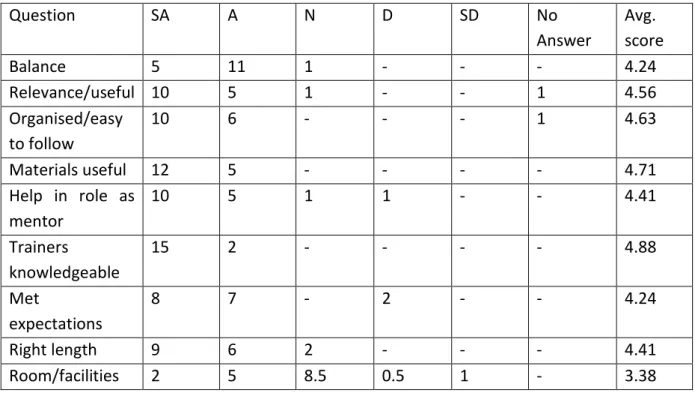
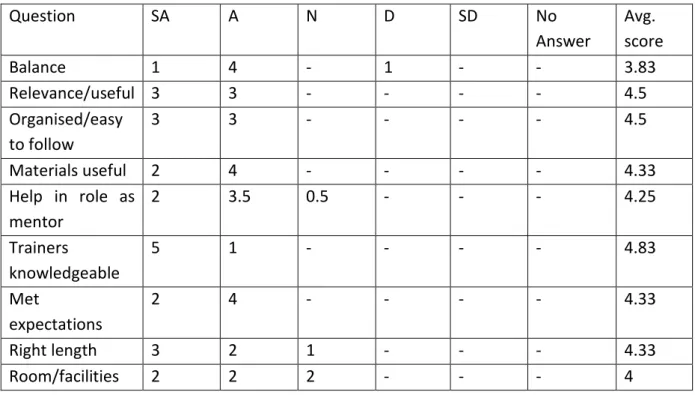
Responses to the Likert-scale questions contained in the training feedback forms are shown below for the four training sessions conducted (SA = Strongly Agree, A = Agree, N = Neither agree nor disagree, D = Disagree, SD = Strongly Disagree; average score was found by scoring each ranking 5, 4, 3, 2, and 1 respectively):
38
Table 5.1.1 Feedback from training day one:
Question SA A N D SD No Answer Avg. score Balance 5 11 1 - - - 4.24 Relevance/useful 10 5 1 - - 1 4.56 Organised/easy to follow 10 6 - - - 1 4.63 Materials useful 12 5 - - - - 4.71 Help in role as mentor 10 5 1 1 - - 4.41 Trainers knowledgeable 15 2 - - - - 4.88 Met expectations 8 7 - 2 - - 4.24 Right length 9 6 2 - - - 4.41 Room/facilities 2 5 8.5 0.5 1 - 3.38
Table 5.1.2 Feedback from training day two:
Question SA A N D SD No Answer Avg. score Balance 3 7 2 - 1 - 3.85 Relevance/useful 7 4 1 - 1 - 4.23 Organised/easy to follow 5 4 3 1 - - 4 Materials useful 6 6 1 - - - 4.38 Help in role as mentor 4 5 2 1 - 1 4 Trainers knowledgeable 11 1 1 - - - 4.78 Met expectations 6 3 3 - 1 - 4 Right length 4 4 2 2 1 - 3.62 Room/facilities 6 6 1 - - - 4.38
39
Table 5.1.3 Feedback from training day three:
Question SA A N D SD No Answer Avg. score Balance 1 4 - 1 - - 3.83 Relevance/useful 3 3 - - - - 4.5 Organised/easy to follow 3 3 - - - - 4.5 Materials useful 2 4 - - - - 4.33 Help in role as mentor 2 3.5 0.5 - - - 4.25 Trainers knowledgeable 5 1 - - - - 4.83 Met expectations 2 4 - - - - 4.33 Right length 3 2 1 - - - 4.33 Room/facilities 2 2 2 - - - 4
Table 5.1.4 Feedback from training day four:
Question SA A N D SD No Answer Avg. score Balance 5 3 - - - - 4.63 Relevance/useful 7 1 - - - - 4.88 Organised/easy to follow 5 3 - - - - 4.63 Materials useful 6 2 - - - - 4.75 Help in role as mentor 7 1 - - - - 4.88 Trainers knowledgeable 8 - - - 5 Met expectations 5 2 1 - - - 4.5 Right length 5 2 1 - - - 4.5 Room/facilities 7 1 - - - - 4.88
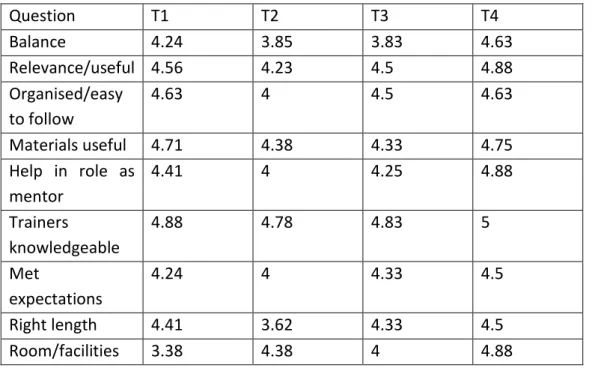
40 Feedback from the initial training days was generally very positive, particularly in regard to the knowledge of the trainers delivering the programme, but also in terms of the training being easy to follow, well organised, and with useful materials. A similar pattern was found with the last two training days, with the knowledge of the trainers being the most highly scored. The final training day was scored the highest of the four, indicating that the small changes made during the process and the trainers becoming more acquainted with the materials and timings, were beneficial to participant perceptions of the training program. A comparison of the training day feedback can be seen in the table below:
Table 5.1.5 Collated feedback from all four training days:
Question T1 T2 T3 T4 Balance 4.24 3.85 3.83 4.63 Relevance/useful 4.56 4.23 4.5 4.88 Organised/easy to follow 4.63 4 4.5 4.63 Materials useful 4.71 4.38 4.33 4.75 Help in role as mentor 4.41 4 4.25 4.88 Trainers knowledgeable 4.88 4.78 4.83 5 Met expectations 4.24 4 4.33 4.5 Right length 4.41 3.62 4.33 4.5 Room/facilities 3.38 4.38 4 4.88
The lowest marks were given during the second and third training days in regard to the training day being of the right length and balance. This could indicate that a longer period of training would be ideal. It should be noted that the only negative comments about the training came from a couple of participants who attended the second and third training
41 days. Of the others who attended and offered feedback, the vast number of responses were very positive and encouraging.
5.2 Analysis of training feedback qualitative data
Qualitative data was collated in regard to a number of questions (as outlined in section 4) and then thematically categorised. In terms of what participants liked most about the training the main themes were as follows (in order of the occasions mentioned by participants throughout the four training sessions):
- Speakers being on the autism spectrum
V
(Participant from training day 2).
T P
I P
The most often aspect of the training that attendees most appreciated was having the training delivered with significant input from more than one autistic trainer.
- The balance, variety and structure of the content
T clear sections split
P training day 1).
T I
P
The breaking down of the training into sections that allowed participants to apply their learning to case examples was also highly appreciated by participants.
42 - Activities and discussions regarding strategies
B P
day 3).
A number of participants commented on the ability to discuss and question issues in-depth with the other participants and trainers.
- Straightforward and informative materials
“ P
H Participant from training day 3).
- The talk on autism and gender being included
T P
from training day 4).
A fferences may manifest in
P
The section of autism and gender, delivered by a member of the advisory group for the mentoring project was often highlighted as a particularly strong aspect of the training.
- Networking and learning from others
M P
- Focus on more effective relationships
F
P pant from training day 2).
43
L - P
The social model and person-centred account given to frame the project was also well received by participants.
The best aspect of the training in the perception of participants was that the training was delivered by people with personal experience of autism. This was closely followed by the balance, variety and structure of the content, and the interactive activities of the training program. The aspect of the training program designed and delivered by members of the advisory group regarding autism and gender was also very well received. Only one negative or critical response was found in regard to the initial question of what participants liked
T
NT
The second open question was in regard to what could be improved about the training. The main themes found in response to this question were:
- More interactive activities or videos of mentoring in practice
M -2- P day 2).
P - P
“ P
A common response to how the training could have been improved was to have included yet more interactive exercises and also video-clips or role-play activities.
44
P
(Participant from training day 1).
P P
Another very common response was to expand the training over a two-day period in order to fit in more discussion and activities.
- More information and advice on mentoring in practice and practical strategies
F P
training day 1).
M P
- Environmental factors about the venue
C P
- Participants not wanting to change anything about the training
I P
I P
- The pace of the training for some too slow, others too fast
These responses indicate that the training was generally well received, yet would have benefitted with yet more time for interactive activities, discussion of practical strategies, and delivered over a longer period of time.
45 The third open-ended question regarded what impact the training would have on the practice of the participants. The following main themes were found:
- Increasing understanding in person-centred way
I I P
M P
B P om training day 3).
H -
(Participant from training day 4).
- The use of PCT and the Salmon line
“ “ P ay 2).
L “ P
PCT “ P
Following general comments regarding an increased understanding, the Salmon line tool was highlighted by a high number of participants as having influenced them regarding their future practice.
- Providing structure and practical strategies
T “PELL
(Participant from training day 2).
I has clarified where the boundaries lie and it is good to have the structure to the
46 - Feeling empowered as practitioners
F P
- Would have little impact on practice
‘ P
It is clear from these responses that the person-centred ethos coupled with the practical strategies and materials offered by the project were seen as useful by the participants, particularly the use of the Salmon line. Only two participants commented that they thought that the training would have little impact on their practice (from 45 respondents).
When asked if participants would change, add or remove anything from the training program, the following themes were identified:
- Not changing anything
N A N (Participant(s) from all training days). - More on mentoring case studies and examples
M P
M P
- More exercises and activities
M P
- Some slides could be delivered as a handout
T P
- Less on autism history
47 By far the most common response to this question was that the training should not be changed at all. However, some participants wanted to have more time with interactive activities and be given more practical examples. These issues could be addressed if the training were to be expanded into a two-day model.
Lastly, when asked what additional training the participants felt they needed, the most common themes were:
- A simple response suggesting additional training would be always helpful
M A P
day 4).
- A meeting once/twice a year to refresh knowledge
A training / meeting once or twice a year at least (Participant from training day 1).
- Videos of good / bad mentoring sessions
A P .
- Looking into overlaps with mental health
O P
training day 1).
- Navigating forms and bureaucracy
H P
48 Only one participant stated that they did not need additional training. Some wanted more information on the overlap with the experience of mental health difficulties. The suggestion of meeting again to refresh knowledge however directly influenced the structure of the main mentoring program.
5.3 Initial findings from mentoring program
The initial findings that are currently being collated for the mentoring project have been very encouraging, with every mentee that has finished the full six-month program showing increases in well-being and substantial progress toward their self-selected goals. When asking mentors to look back on hindsight on the training, responses again have been very positive about the usefulness of it, and the benefit of having training designed and delivered with significant input from autistic people. The use of the Salmon Line was also referenced as being of particular practical usefulness. Again though, mentors described how the training could have been perhaps better delivered over two days instead of one. On mentor suggested that they had not gained a great deal from the section of the training regarding the SPELL framework, however this comment came from a participant who already had a great deal of experience in the field and with mentoring.
During the mentoring program it was found that the reliability of mentors was variable, and seemed to have an impact on the quality of the mentoring relationship. Although consistency and reliability was emphasised in the mentoring training, this may show that this aspect needed added emphasis. Similarly, in regard to advice for mentors to facilitate the initial setting of goals, mentees sometimes struggled with this aspect of the program at first, and some mentors struggled to facilitate this process.
49
Section 6: Conclusions
This study looked to answer the following research questions:
What information and activities are most effective for meeting the training needs of would-be mentors of autistic adults?
What aspects of a training programme for would-be mentors of autistic adults are most appreciated by those undertaking the training?
In section 5: results and analysis, it was shown that the training day was well received by the vast majority of participants. Those who also went on to become mentors on the project, found the advice and materials offered of practical use, particularly in regard to the Salmon line tool. The strongest aspect of the training was that it was designed and delivered with significant autistic input. Tackling issues from a s
greatly appreciated by participants. The main criticisms of the training regarding its length and having more time to explore the issues at hand, with more practical examples and strategies. Some participants reflected upon how the use of video clips of mentoring in progress would have enhanced the training. The most common suggestion from participants to resolve these issues was to extend the training over two days.
In this section, these findings will be discussed in more depth, and limitations of the study investigated. This section will conclude by exploring possible next steps for the mentoring project as a whole, and reflect upon how the training aspect of the project can potentially be improved.