Graduate Theses and Dissertations
2017
Mathematical Discourse in Elementary
Classrooms
Mary M. Shortino-Buck
Follow this and additional works at:https://pilotscholars.up.edu/etd Part of theEducational Leadership Commons
This Doctoral Dissertation is brought to you for free and open access by Pilot Scholars. It has been accepted for inclusion in Graduate Theses and Dissertations by an authorized administrator of Pilot Scholars. For more information, please [email protected].
Recommended Citation
Shortino-Buck, Mary M., "Mathematical Discourse in Elementary Classrooms" (2017).Graduate Theses and Dissertations. 30.
Mathematical Discourse in Elementary Classrooms
by
Mary M. Shortino-Buck
A dissertation submitted in partial fulfillment of the requirements for the degree of
Doctor of Education in
Learning and Leading
University of Portland School of Education
Abstract
Mathematic reasoning of elementary aged students in the United States is low compared to other like nations. For students living in poverty the disparity is even greater. Previous research has linked mathematical discourse with the improvement of mathematic conceptual understanding and reasoning. This research, which employed a qualitative case study methodology, examined six elementary classrooms, to
investigate the complex nature of including mathematical discourse in instruction. The purpose of examining mathematical discourse in elementary classrooms was to
provide contextual insight into teacher beliefs about mathematical discourse, how instruction was prepared and facilitated by the teacher, and how students responded through participation. Interview, observation, and artifact data were gathered, and cross analyzed. First, this study suggested that a combination of post-graduate coursework, adopted curriculum, and district professional development supported participating teachers to develop the content and pedagogical knowledge needed to include mathematical discourse in their instruction. Secondly, this study indicated that a teacher’s personal experience with mathematic learning influenced his or her beliefs and impacted his or her instructional practices. Finally, a discrepancy in the cognitive level of discussions between high and low poverty 4th and 6th grade classrooms was
noted, but no difference in participation was noted in 2nd grade classrooms. This study supports current research by cross analyzing six in-depth case studies and providing insights into commonalities and differences in teacher beliefs, instructional
Keywords: elementary, K-6, mathematical discourse, mathematics, math instruction, SES, student participation, teacher belief, poverty
Acknowledgements
This dissertation could not have been completed without the calm, consistent guidance of my chair, Dr. James Carroll. His patience with my binge writing habits and gentle nudges to, “get it done,” throughout the dissertation process made my research possible. When I became overwhelmed he refocused and reframed my efforts and thinking. Additionally, I would like to thank my committee members, Dr. Patricia Morrell, Dr. Nicole Ralston, and Dr. Nicole Rigelman. Each committee member offered expert knowledge and inspiration that greatly improved my research. Dr. Morrell’s attention to detail and challenge to think more critically and clearly, Dr. Ralston’s precise feedback that supported my understanding of the process and her encouragement and support to be a better researcher, writer, and presenter, and Dr. Rigelman’s depth and breadth of knowledge about elementary math instruction and research that guided me through the intricacies of mathematical discourse and her enthusiasm that made me want to understand more, inquire more, and contribute more to the improvement of mathematic instruction for students and teachers.
I would also like to express my gratitude for the TOSA, teachers, and students from my study district. Without your contributions, flexibility, and insight this study would not have been possible. I appreciate the openness of the teachers who shared their opinions and beliefs as well as opened their classrooms to an inquisitive stranger. Your commitment to improving elementary students’ mathematic instruction is
I would like to thank the friends that were always there to provide
encouragement. Laura and Judy had faith in my ability when I had none and they always listened to my thought process and lifted my spirits. Also, the friendships that were forged in my doctoral cohort were vital to my success during these intense years of study.
Finally, I would like to thank my family. They were there to encourage me and support me throughout this entire process. They listened, talked through my struggles, picked up the slack when I was not able, and let me know they were proud of my work. I do not have the words to express the admiration and love I have for them. They are what made this all possible.
Dedication
To Tom, Julia, and Angela, are and always will be my inspiration for being a better person. They make the world a better place and give me the confidence and support to achieve more than I think I am capable. Tom has gone above and beyond, taking on all aspects of our life so that I could concentrate on my work. He fed me literally and spiritually so I had the energy to keep going and succeed. My wish for my family is that they always see themselves through the eyes of those that love and admire them, of which I am merely one.
Table of Contents
Abstract ... iii
Acknowledgements ... v
Dedication ... vii
Table of Contents ... viii
List of Tables ... xii
List of Figures ... xiii
Chapter I: Introduction ... 1
Mathematical Discourse ... 7
Pedagogy of Mathematical Discourse ... 9
Purpose ... 10
Study Significance ... 11
Dissertation Overview ... 12
Chapter II: Literature Review ... 14
Context of Mathematical Discourse ... 15
Definitions of Mathematical Discourse ... 21
Theory ... 23
Conceptual Understanding ... 24
Learning Mathematical Concepts Through Discourse ... 27
The Pedagogy of Mathematical Discourse ... 32
Mathematical Instruction: Teacher Beliefs ... 34
Chapter III: Methodology ... 37
Research Questions ... 37
Rationale for Methodology ... 38
Participants and Setting ... 40
Design and Procedure ... 44
Instruments ... 46
Instructional Quality Assessment (IQA) ... 46
Teacher Interview ... 48
Problem solving belief and instruction model ... 49
Ethical Considerations ... 49
Role of Researcher ... 49
Data Analysis ... 52
Limitations ... 54
Summary ... 55
Chapter IV: Results ... 57
Research Questions ... 57
Beliefs ... 58
What is important for students to learn? ... 58
Math confidence ... 59
Student Struggle ... 62
The Importance of Discourse in Learning Mathematics ... 62
Pedagogical Beliefs ... 64
Beliefs About Mathematical Discourse in High and Low SES Schools ... 67
Family and Community ... 67
Lesson Preparation ... 69
Resources ... 70
Material Influence on Mathematical Discourse ... 73
Preparation Process ... 75
Mathematical Discourse Integration into Lesson ... 75
Sentence frames ... 76
Tasks ... 77
Lesson Facilitation ... 78
Teacher reflection on implementation ... 79
Teacher task expectations ... 81
Implementation of task ... 84
Teacher linking, press, and questioning ... 90
The residue ... 95
Student Participation ... 96
Teacher views ... 97
Student participation ... 98
Student responses and discussion ... 103
Student artifacts ... 110
Summary ... 112
Chapter V: Discussion, Recommendations, and Conclusions ... 114
Discussion ... 114 Beliefs ... 115 Lesson Preparation ... 119 Lesson Facilitation ... 123 Student Participation ... 127 Limitations ... 129 Major Findings ... 130 Future Research ... 132 Conclusion ... 134 References ... 138 Appendix A ... 155 Appendix B ... 175
List of Tables
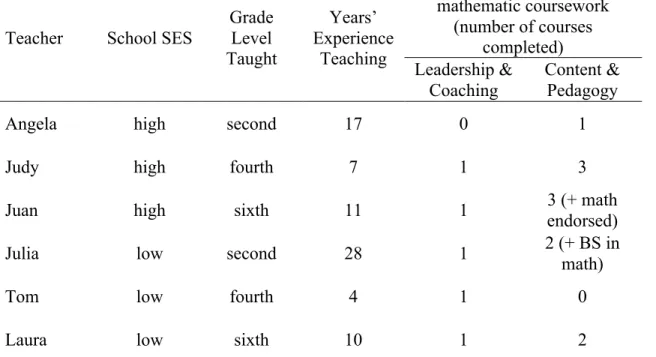
Table 1: School Demographic ... 42 Table 2: Participating Teacher Demographics ... 44 Table 3: Distribution of Student Artifacts ... 111
List of Figures
Figure 1: Anderson ... 35 Figure 2: Student 1, sixth grade example ... 101
Chapter 1: Introduction
The United States can no longer consider itself a leader in educating its population. Mann (1848, p.87) stated, “Education then, beyond all other devices of human origin, is the great equalizer of the conditions of men - the balance-wheel of the social machinery.” If education is the balance-wheel then our social machinery is out of alignment. This is evident in the mathematical achievement of U.S. students. For decades, the concern over how mathematics is taught in the U.S. has been prominent in analyses of instruction (Romberg, 1993; Smith, 1996; Yackel & Cobb, 1996). With the release of the Common Core State Standards (National Governors Association Center for Best Practices, Council of Chief State School Officers [CCSS]) in 2010 and international mathematics scores indicating a decline in U.S.
mathematical understanding in 2015 (U.S. Department of Education Institute of Education Sciences National Center for Education Statistics [IES], 2015) there is greater urgency to implement curriculum and pedagogy that facilitates students’ conceptual understanding of mathematics.
According to the National Assessment of Educational Progress (NAEP) mathematics scores dropped in 2015 from the last administration in 2013 (IES, 2015). The results of the NAEP mathematics assessment provide a general overview of what U.S. students in fourth and eighth grades understand and can do in mathematics. The assessment measures both a student’s content knowledge and ability to apply
mathematical reasoning. This assessment is given every two years to a cross section of U.S. students.
The 2015 administration of the test is the first time since 1990 that NAEP math scores have dropped in the U.S. Only 40% of 4th graders and 33% of 8th graders in the United States are considered proficient in mathematics an overall 2% drop since the previous year (IES, 2015). This 2% is reported as significantly different (p < .05) than 2015 (The Nations Report Card, 2017). Of greater interest for mathematics instruction is that U.S. students’ achievement was higher when performing lower level
mathematic skills such as handling data directly from tables or using simple formulas according to the Programme for International Student Assessment (PISA)
(Organisation for Economic Co-operation and Development, 2013). Interpretations of the same data indicate that problems involving mathematical reasoning and strategies that ask students to think mathematically are a weakness for U.S. students with scores falling below like nations. Fewer than 9% of students in the U.S. achieved proficient or advanced in mathematical reasoning compared to 16% percent of students in Canada and 30% of students in Hong Kong, China, Korea, and Chinese Taipei. The composite results are even more troublesome for some underserved children with 19% of 4th grade Black students and 26% of 4th grade Hispanic students scoring at or above proficiency compared to 51% of White students and 65% of Asian students.
For children from low-income households only 33% of 4th grade students
reached basic achievement levels as defined by NAEP (U.S. Department of Education, 2015). The rate is two times higher for higher SES levels (U.S. Department of
Education National Center for Education Statistics, 2011). In Oregon, 27% of fourth grade students who were eligible for free and reduced lunch scored proficient or
above, compared to 54% of those who did not qualify. Reardon (2011) has found that the achievement gap between income groups in recent years has surpassed that of the black and white achievement gap. The achievement gap in mathematics is even greater for children whose mothers have not completed high school than that of overall family income (Reardon, 2011).
Carpenter, Franke, and Levi (2003) state,
Students who learn to articulate and justify their own
mathematical ideas, reason through their own and others’ mathematical explanations, and provide a rationale for their answers develop a deep understanding that is critical to their future success in mathematics and related fields. (p. 6)
This quote is pertinent to the state of mathematics education in the U.S. as reflected in the weak scores in mathematical reasoning on the 2015 NAEP. In reaction to the lower levels of mathematic achievement in the United States and ongoing research indicating that mathematical discourse is vital for student achievement, the National Council of Teachers of Mathematics (NCTM, 2014) provided eight teaching practices with the intent of strengthening student acquisition of mathematical concepts through improvement of instruction. Prominent in these eight teaching practices is including mathematical discourse as an important feature of instruction. “Effective teaching of mathematics facilitates discourse among students to build shared
understanding of mathematical ideas by analyzing and comparing student approaches and arguments” (NCTM, 2014, p. 10).
Current mathematical achievement in the U.S. indicates a need to re-examine how and what is being taught in classrooms across the United States. Testing results like those reported above indicate an increase in a U.S. population unable to think mathematically which may have ramifications well beyond the classroom. The fact that the results indicate a large portion of students are unable to use mathematics for problem solving can have a negative impact on students’ adult lives. Problem solving applications are used in the daily lives of adults for personal finances to careers that depend on being able to reason mathematically. Poor mathematical reasoning skills in the lives of adults, could result in loss of income and the inability to manage personal finances.
In response to the need for mathematics education to be more coherent in the United States, the National Governors’ Association Center for Best Practices (2010) used state standards and international models for mathematical practices that have been shown to be effective to develop the Common Core State Standards (CCSS) for mathematical content and practices. The design of the CCSS was based on Schmidt, Houang, and Cogan’s (2002) work that stressed conceptual understanding of key mathematical strands in addition to procedural skills.
Many teachers believe they should teach mathematics as they were taught through memorization of facts and repetitive practice of rote skills (Banilower, Boyd, Pasley, & Weiss, 2006; Boaler, 2016a; Weiss & Pasley, 2004). This discrepancy between everyday classroom instruction and research dates back decades. The American Behavioral Scientist (pre-1986) stated that, “The supposed agreement on
pragmatic philosophy has not lead to agreement on the techniques most effective in furthering that pragmatism,” (Chapter VIII Education, 1964, p. 93).
Despite evidence representing the acquisition of mathematics as a social activity, mathematic pedagogy has persisted in the United States as an unrelated series of procedures (Banilower, et. al., 2006). This view of mathematics is static, which leads to a belief that if a student is efficient at using formulas or procedures the student understands math. However, students can skillfully perform procedures without
understanding the mathematical concepts that lead to the procedures. In this way, a student’s mathematical ability remains at low cognitive levels of achievement (Thompson, 1992).
An aspect of why students are proficient at procedures and not mathematical thinking is the lack of instructional focus on mathematical concepts in elementary schools. Stipek, Givvin, Salmon, and MacGyvers’ (2001) study examined the link between a teacher’s beliefs and instructional practice finding that teacher beliefs about mathematical learning and ability, as well as a teacher’s self-confidence and
enjoyment of mathematics, are associated with instructional practices and their
students’ self-confidence. The more teachers’ beliefs align with a student constructing his or her own understanding of mathematic concepts, the more instruction reflected an emphasis on understanding and the importance of mistakes in learning rather than speed and the right answer. This emphasis on conceptual understanding was found to improve student confidence and participation (Stipek, et. al., 2001).
Ball and Forzoni (2011) suggest there is a lack of agreement in schools and our greater society as to what constitutes good quality math instruction, with some
suggesting speed and accuracy are most important and others suggesting conceptual mathematical thinking as the primary emphasis. This lack of agreement makes it difficult for school districts to establish coherent mathematics instruction because there is a disjointed implementation of pedagogy with teachers inconsistently applying instructional practices shown to increase student understanding along with pedagogy that research has shown (Jackson & Leffingwell, 1999; Swetman, 1994; Tankersley, 1993; Young, Wu, & Menon, 2012) to be detrimental to student learning, such as speed tests for basic facts.
Karp, Bush, and Dougherty (2014) have shown that, in an attempt to cover large quantities of content quickly or because of a general lack of content knowledge, teachers presented students with misrepresented generalizations that hold true for the moment but that do not broaden a student’s understanding of mathematical concepts, cannot be used out of context, and should not be generalized outside of that context. The results are students that apply procedures incorrectly, with no means of
understanding their error, because they do not understand the math behind the procedure. The authors explained this phenomenon as “always rules that are not so always” (p. 20). This is often expressed in terms of math tricks taught to students such as “when you multiply two numbers your answer is a bigger number.” This math trick
holds true until a student starts working with fractions, decimals, and negative
numbers. This short-term fix in the classroom leads to long term misunderstanding of mathematic concepts that impede higher mathematic achievement.
Mathematical Discourse
A large part of encouraging students to develop reasoning skills and strategies in mathematics revolves around developing a classroom culture that emphasizes discourse to develop a shared understanding (Cobb & McClain, 2005). Several definitions of mathematical discourse exist but consistently include discussion, justification, argumentation, and negotiation as vital aspects at the center of mathematic pedagogy to improve student conceptual understanding (Cobb &
McClain, 2005; Donovan & Bransford, 2005; NCTM, 2014; Thompson, 1994; Yackel & Cobb, 1996). Whitin and Whitin (2000) discussed the importance of recognizing children as the constructors of their own learning and encouraging them to express that learning through multiple avenues that both clarify their understanding and
communicate it to others. The student interactions of discourse recognize the social aspects of conceptually understanding mathematic content.
Conceptual understanding in elementary school mathematics can be thought of as the ability to justify procedures through reasoning rather than to describe the
computational procedures themselves (Kazemi, 2008). Mathematical discourse is an effective method for facilitating a child’s conceptual understanding and the acquisition of mathematical knowledge that allows for growth in achievement across student populations (Stylianou, Blanton, & Knuth, 2006). It is also the way in which knowledge is validated and organized providing a role in building new knowledge. When participating in mathematical discourse, students reason through their current thinking with input from peers and are asked to clarify their own, as well as peer understanding of the mathematical concept. This emphasis on understanding why, and
the paths to the answer, as opposed to the correct answer, develops a deeper conceptual understanding for students. This process provides students time and
feedback to understand how to amend their thinking to grasp concepts more precisely. Chapin, O’Connor, and Anderson (2009) found that mathematical discourse cleared up student misconceptions, improved students’ ability to reason logically, gave students more opportunity to participate in their learning, and provided socially grounded motivation to learn.
As a social activity, mathematical discourse is dependent on language acquisition of the students participating in the discourse and the scaffolding that the teacher provides to bridge language gaps. While mathematical discourse encompasses more than linguistic patterns, it relies heavily on the ability of the student to explain or show his or her thinking to another participant. Johnstone (2002) defined discourse as communication using language. However, not all communication uses formal
language. Communication occurs with symbols, physical gestures, visually, as well as orally, and with written language. When talking about mathematical discourse, these features of communication must be included to form a complete representation of the knowledge or understanding being passed from one person to the next.
Mathematical discourse is different than talk in other social contexts because in mathematical discourse one person, the teacher, controls the direction and topic of the discourse. The teacher’s influence in student to student discourse can be seen when the teacher prepares students for mathematical interactions within the classroom and how discussion between students will be carried out. Not only is the direction and topic of the discourse guided by the teacher but the teacher also directs how student
interactions will proceed; the accepted norm for classroom discussions. If there is a mismatch between the language norms of the teacher and the language norms the student produces and understands, the student’s ability to fully participate can be negatively impacted which will interfere with the student’s academic achievement (Herbel-Eisenmann, Choppin, Wagner, & Pimm, 2012). Taking this into consideration when analyzing levels of student discourse provides another important aspect of the teacher’s influence in facilitating the student’s conceptual understanding of
mathematics.
Pedagogy of Mathematical Discourse
Along with believing that discourse is important to mathematical achievement, teachers need to understand the pedagogy of mathematical discourse. Smith and Stein (2011) developed five practices to be used in classrooms that implement mathematical discourse:
1. Anticipating student responses prior to the lesson
2. Monitoring students’ work on and engagement with the task 3. Selecting particular students to present their mathematical work 4. Sequencing students’ responses in a specific order for discussion 5. Connecting different students’ responses and connecting the responses
to key mathematical ideas.
A teacher’s pedagogical skills are central to mathematical discourse because skilled questioning leads to productive discourse. By modeling a high cognitive level of questioning teachers show students how to interact with each other with rich discussion that leads to conceptual understanding (Akkuss & Hand, 2010). When a
teacher can engage students in this manner as active participants in their own mathematical learning, the teacher creates an equitable environment for all students (Croom, 1997; Dale & Cuevas, 1992). An abundance of pedagogical strategies beyond questioning are needed to engage students in mathematical discourse to move students to higher cognitive understanding while simultaneously supporting the understanding of the variety of students in the classroom (Cazden, 2001).
Purpose
The purpose of this study was to examine the processes teachers with post graduate mathematic coursework took to implement mathematical discourse. This was done through analyzing how teachers believed mathematical discourse fit into the learning process, how lessons were prepared, how teachers facilitated mathematical discourse, and how students participated in it.
This study examined mathematical discourse in six second, fourth, and sixth grade classrooms. Data collection was focused with the domains of the Instructional Quality Assessment (IQA) (Boston, 2012) (Appendix A). The qualitative data were parsed into the four categories being examined; teacher belief, teacher planning, teacher facilitation, and student participation. The collected qualitative data was then used to analyze discourse.
Data were triangulated through individual teacher interview, classroom observation, in which students participated and teachers facilitated, and collection of student artifacts. These data were pertinent not only to measure discourse in
classrooms but also to provide insight into teacher beliefs and practices that helped guide instruction in elementary mathematics.
This study considered mathematical discourse the dialogic communication whether oral, written, gestural, or graphic that purposefully reaches toward a shared mathematical understanding of specific mathematical content initiated by the teacher.
Specifically, this study will answer:
1. How do teachers think about mathematical discourse in the learning process?
2. How are lessons prepared to include mathematical discourse? 3. How do teachers facilitate mathematical discourse?
4. How do students participate in mathematical discourse?
Conceptually this research recognized four factors: the mathematical discourse used by students, the mathematical discourse facilitated by the teacher, the task chosen by the teacher, and the attitude and beliefs about math instruction held by the teacher. Study Significance
Research has provided evidence to include mathematical discourse as a central tenet to develop conceptual understanding and improve mathematical achievement (Ball & Forzoni, 2011; Cobb & McClain, 2005; Donovan & Bransford, 2005; Kazemi, 2008; NCTM, 2014; Romberg, 1993; Schmidt, et al., 2002; Yackel & Cobb, 1996), however, not all talk is equal, indicating a need for teachers to engage students in higher cognitive levels of discourse that develop reasoning. The cognitive rigor of student participation in mathematical discourse has the potential to broaden a student’s mathematical understanding. The process, knowledge, and skills a teacher must
possess to implement mathematical discourse at a high cognitive level are great. This study focused on how teachers developed the knowledge and skills needed to
implement mathematical discourse in their classrooms and how that knowledge was implemented. Starting from the individual teacher’s personal experiences with mathematics, how those experiences impacted their belief, planning, and implementation of mathematical discourse to how students participated in mathematical discourse to understand content was examined.
Schools in economically diverse communities were considered to cross-reference discourse differences in various contexts. The results provided insights into instructional beliefs that impacted practices and student participation in these
economically diverse communities. Dissertation Overview
Divided into five chapters this study provided an investigation into current mathematic instructional practices in elementary classrooms in the Pacific Northwest. Chapter One provided a clarification of this study’s focus and provided a rationale for the study. Chapter Two reviews relevant literature and provides a theoretical base for the study. Socially constructed understanding, teacher belief about mathematic
instruction, and the impact of mathematical discourse on student understanding are the foci of Chapter Two.
Chapter Three describes methods used in the study. Collecting data that
impacted various dimensions of mathematical instruction was triangulated to provide a full analysis of mathematical discourse that occurred in the classroom.
Chapter Four provides results of the study. The narrative includes qualitative data. The qualitative data includes quoted language used by students and teachers to give the classroom a voice in this study. The data in this chapter is organized to
support the four study questions covering teacher beliefs, preparation, facilitation, and student participation. SES of the community is also provided in order to more clearly understand how these aspects interacted and impacted mathematic instruction as a whole.
Chapter Five provides an analysis of the data and meaningful conclusions based on the research questions presented above. It views the qualitative data both globally and in its parts noting similarities, patterns, relationships, and themes in an effort to shed light to various aspects that influenced mathematical discourse in these six elementary classrooms. Implications of the findings are discussed as they related to current literature on the importance of mathematical discourse in a child’s
understanding of mathematical concepts. The implications were then applied to the impact on teacher instruction and the development of best practices for mathematic pedagogy. The outcome provided an insight into current practices in mathematical discourse and from that insight possible avenues elementary teachers should consider to improve student outcomes through mathematical discourse.
Chapter 2: Review of Literature
Organized to address the vital aspects that impact mathematical discourse this review of literature builds on historical perspectives of mathematic instruction which is the basis for continued pedagogical influences in the classroom. Within this history various definitions of mathematical discourse have arisen from fields inside and outside mathematic education which changes the lens through which research on mathematical discourse has been conducted. One perspective addressed is how mathematical discourse promotes conceptual understanding of mathematics which goes beyond memorization of math facts and formulas (Kazemi, 1998; National Council of Teachers of Mathematics, 2014). While this perspective continues to gain momentum, it is not the only view of best practices in mathematics.
Within classrooms that conduct mathematical discourse, learning happens in a social context that provides support for students’ shared understanding of concepts which can present opportunities for students who are situated socially within the academic culture of the classroom. An exploration of inequitable practices will be addressed when classroom culture is not aligned with a student’s culture (Bishop, 2008; D’Ambrosio, 2008; Herbel-Eisenmann, Choppin, Wagner, & Primm, 2012; Forgasz & Rivera, 2012). Language levels of students play a large role in
mathematical discourse, for this reason the literature review will cover equity issues in the mathematics classroom focusing on language norms used in mathematical
discourse and teacher bias that goes into opportunities presented to students to expand their understanding.
This research adds to literature by looking at the intersection of the observed mathematical discourse in elementary classrooms, the belief system and planning process of the teacher, and any variance that occurs between classroom communities. Highlighting how mathematical discourse is facilitated in elementary classrooms illuminates an understanding of the various aspects that go into classroom instruction using mathematical discourse to improve student understanding of mathematical concepts. This conceptual understanding developed through mathematical discourse can provide the foundation to improve mathematic performance at higher cognitive levels beyond rote memorization of basic calculation (Boston, 2012).
Context of Mathematical Discourse
It is important to look at how mathematical instruction has been conceived in the past because it is still impacting how mathematics is being taught today. For decades mathematics reform in the United States has suggested a move away from rote memorization of rules to understanding mathematical concepts. In 1957 Gibbs and Van Engen wrote about the increase in the “discovery method” of pedagogy to learn mathematical concepts (Dawson & Ruddell, 1955) and described how the “meaning method” was shown to be more effective than the “rule method” (Miller, 1957). Both of which indicated a need to develop conceptual understanding over rote memorization, yet instructional methods focusing on memorization of rules and formulas continued to be prevalent in elementary mathematics instruction (Banilower, et. al., 2006).
One illustration of this comes from the QUASAR (Quantitative
Stein, 1996) which provided professional development and instructional materials for teachers in order to implement mathematical discourse in the classroom as a tool for improving student understanding of content. The study, led by a team of researchers at the Learning Research and Development Center (LRDC) at the University of
Pittsburgh, began in 1990 and ran for 5 years in inner city middle schools with diverse populations across the United States. Research focused on issues of equity through the lenses of gender, race, ethnicity, and poverty.
Teacher focus included instructional strategies that developed discourse communities and cooperative strategies that encouraged students to develop their own thinking while teachers supported student collaborative reasoning through discourse and questioning (Silver, Smith, & Nelson, 1995). This structured discourse supported students in communicating their own thinking and reasoning as well interpreting another student’s mathematical methods and reasoning.
While student participants in the QUASAR project showed improvement in mathematical performance over time (Silver & Stein, 1996) not all teacher participants implemented instruction in the same manner which demonstrates the difficulty faced with putting research into practice. A teacher participant in this study went to every professional development on the importance of allowing students to discuss
mathematical tasks and build their own understanding of the mathematic concepts through mathematical discourse. She was provided with all the material support to instruct using this method yet she continued, throughout the year, to use the
mathematic tasks to teach in a directive manner; providing students with the procedure they should use to solve the task and requiring students to use the procedure given by
her to complete the task. It was not till she was videotaped and her colleagues, upon viewing the videotape together, discussed the pros and cons of her teaching style, did she understand the impact of allowing students to formulate their own understanding through talk.
In another study of over 350 elementary, middle, and high school lessons (Weiss, Pasley, Smith, Banilower, & Heck, 2003) the research team found that fewer than one in five lessons emphasized making sense of the mathematic content. Like the teacher participant in the QUASAR study, teacher practice did not move away from rule based memorization to promote conceptual understanding. These studies demonstrate that while the benefits to students of emphasizing mathematical understanding over the solitary use of rules based instruction is known, there is a reluctance to change instructional practice.
Historical perspectives about the purpose of education, social interaction, language use and development, role of teacher and student, are all vital to a complete view of mathematical discourse and how it impacts student understanding.
Problem solving has long been identified as a favorable method of teaching mathematics (Freudenthal, 1973; Polya, 1954). Traditionally students passively solved the problem posed by the teacher, in the way the teacher imparted to them (Silver, 1995). Students independently repeated the steps the teacher gave to get the answer the teacher anticipated. Students became skilled number crunchers but may not have understood why the procedures worked. For that matter, the teacher may not have been able to articulate or understand the math behind the procedure. In fact,
elementary teacher’s preparation to teach mathematics. Discourse in an academic community lead by a teacher who does not understand mathematic concepts or may understand but does not promote students arriving at their own understanding may accept mathematical rules as explanation. In these cases, the student is often not aware of the plausibility of their reasoning in real life because repeating procedure through memorization was the discursive norm that has been encouraged by the teacher.
These cultural beliefs about teaching and learning mathematics present a roadblock to student mathematic acquisition (NCTM, 2014). The prevalence of implementing the belief that supports memorizing procedures through teacher
demonstration and repetitive duplication of the demonstration indicate a reluctance to stray from the cultural tradition and mathematic practices and the lack of belief that discourse and conceptual understanding are beneficial to students (Barkatsas & Malone, 2005, Wilkins, 2008).
Sfard (2008) takes the stance that all human intellectual activities are driven by communication. Since discourse can only be taken in the context of the community in which the communication is taking place the social context of that mathematical community must be examined. The way in which teachers and students interact with the content is influenced by the culture of their individual contexts and its relationship to the academic community which the mathematical discourse is taking place. What may seem obvious but deserves to be said is that the way students think about
mathematics is influenced by the way they talk about mathematics. And the way they talk about mathematics is directly influenced by the teacher and the way the teacher thinks about mathematics.
Discourse in the classroom does not form arbitrarily, it is greatly influenced by the culture of the teacher and the classroom culture that the teacher cultivates (Sfard, 2008). In elementary classrooms there are rules of discourse that are explicitly taught but other discursive rules that are culturally based and instinctively followed and promoted as the expected norm in academic situations. “The way we speak and
communicate with others conveys [these] unwritten regulations” (Sfard, 2008, p. 168). Lampert (1990) explains that students do not learn rules “simply by being told what to do anymore than one learns how to dance by being told what to do” (p. 58).
Bateson (1973) discussed the conflict that often occurs between discursive rules that are explicitly taught and those that are implied through action. He explains that this conflict creates a “double bind” in which the rules learned through action will be prominent over those taught explicitly. This conflict between actual practice and explicit instruction has the potential to impede learning mathematical content.
Another set of roadblocks to students’ mathematic education take the form of cultural bias that is embedded and expressed in our educational system, in sometimes subtle ways. As previously discussed the implied discursive norms of a mathematics classroom are greatly influenced by the cultural norms of the teacher and what has been accepted by the teacher as preferred mathematical discourse (Sfard, 2008). Components of language and its biases are considered by Orfield (2013) who
discusses the issue of societal inequalities that are reinforced by the very system that is touted to be “the great equalizer” by Mann (1848). While saying education helps level the playing field educators continue to maintain the status quo of the dominant culture through the way mathematics is taught. Secada (1992) has accounted for ways in
which multilingual students who are learning English are marginalized even when exceptional teachers are instructing. Often students of color, girls, and those in poverty do not see themselves as part of, or leaders in, the education system (Wagner, Herbel-Eisenmann, Choppin, 2012). These groups are not deemed acceptable until they adopt the dominant culture’s manner and language. Yackel and Cobb (1996) used the term “sociomathematical norms” to describe the idea that each classroom has a set of routines or patterns of discussion that participants follow in order to relate understanding and participate in learning. These norms can be simultaneously supportive and disruptive to student understanding dependent on the cultural match between the norms and the student.
Vygotsky (1978) studies focused on the potential of students by building on what the students already know and do, their background, to be used as a point of entry to understanding new concepts. He recognized that students come to school as people who have life experiences in which new learning can be supported for a fuller understanding. However, historically, the background that Vygotsky spoke of was based on western white male culture. When starting from that perspective there is a possibility to skew what is useful background knowledge in which to build upon, and creates the perspective that non-dominant culture students are entering the education system with deficits. Anyon (1995) acknowledges these cultural biases in mathematic instruction by stating “Educational reforms cannot compensate for the ravages of society" (p. 88) however attention to educational history, classroom discursive norms, and how students build their own knowledge takes steps to addressing discursive bias.
Definitions of Mathematical Discourse
Ryve’s (2011) review of 108 articles, addressed the topic of mathematical discourse, and found that only 20 articles contained a definition of mathematical discourse. Within those articles the definition varied and was often not clear. In some instances, discourse referred to talk only, while in others the greater human interaction concerning dialogue that includes symbolic representation was referenced. With the various definitions of mathematical discourse come different positions about
mathematics in classroom discourse and mathematics as discourse. Discourse in mathematics is the action of having conversation about mathematic content. Mathematics as discourse refers to the nature of mathematics that does not exist without the language of mathematics to talk about the content. Sfard (2008) refers to mathematics as discourse not as the acquisition of knowledge but as the participation of creating that knowledge through the social activity of discourse.
Most definitions of mathematical discourse involve more than classroom talk. Visual representations are important to mathematical discourse because they give students a discussion point in which to make sense of problems, as well as support students with developing academic language skills needed to talk about mathematics (Arcavi, 2003; Fuson & Murata, 2007; Stylianou & Silver, 2004).
Johnstone (2002) defines discourse as communication using language. However, not all communication uses formal language. Communication occurs with symbols, physical gestures, visually, as well as, orally and with written language. When talking about mathematical discourse these features of communication must be included to form a complete representation of the knowledge or understanding being
passed from one person to the next. Johnstone (2002) goes on to discuss the idea that discourse is both the source and the result of knowledge. The discourse people
participate in together creates knowledge while the discourse used to explain what has been conceptualized interprets knowledge.
O’Halloran (2005) drawing on Halliday’s (1978) social semiotic theory of discourse develops the idea that sign systems are used to impose order through meaning. These sign systems are composed of language, visual imagery, music, gesture, action and stance, and three-dimensional objects. When applied to
mathematical discourse, connections can be made between Halliday’s social semiotic theory and what takes place in the classroom. Through discourse students make sense and put order to mathematical concepts by using oral and written symbols, both linguistic and specialized, as well as using visuals, and possibly gestures by “acting out” mathematical situations. Three-dimensional objects that Halliday (1978) suggest can be equated to mathematical manipulatives. While Halliday’s theory is a general language theory it does apply very directly to mathematical discourse which further emphasizes the social and linguistic nature of mathematic learning. Halliday focusses not only on the practice of discourse but the context in which such practices are conducted and informed. Based on this theory meaning is derived from a set of choices made through the intention of the signs and the social context of the problem (O’Halloran, 2005). While O’Halloran’s work is useful, there is still a need for theoretical connections in research to be more clearly defined to analyze mathematics as a discourse (Ryve, 2011).
The idea of mathematics as discourse, theorized by Sfard (2008), suggested that mathematics makes great use of visual components that are developed primarily for the sake of being able to talk about math. In this way, mathematical discourse is circular. To communicate a collective understanding of math, a symbolic language was created in which math is represented, and that symbolic language becomes the math in which students communicate to understand. Whereas, zoology and history are discourse around animals and past societies, mathematical discourse is discourse around numbers, functions, sets, and geometric shapes. But unlike zoology and history where the objects being talked about exist as physical objects whether you discuss them or not, the objects of mathematics are abstract and were created for the sole purpose of discussing mathematics. Hence, Sfard’s (2008) definition of mathematics as discourse is self-generating. If you are to participate in mathematical discourse there needs to be an understanding of mathematics, however, to understand mathematics there is a need to participate in the discourse of mathematics. Theory
Social semiotics addresses the social aspect of developing meaning. In mathematics classrooms students use mathematical discourse as a method to develop this shared meaning of mathematic content that is facilitated by the classroom teacher. Halliday’s social semiotic theory (1978) developed the concept of the use of language and interpersonal interactions to arrive at a common understanding. When applied to mathematic classrooms students and teachers develop a math culture where discourse - aural, verbal, visual – is the vehicle in which conceptual understanding is
mathematical discourse lies a variance of cognitive levels that produce a variety of understanding outcomes, within the same classroom.
The way the teacher facilitates student conversation, and the agency that the student has during discourse, impact a student’s ability to develop shared meaning with other participants that use the language of mathematics. Theorists have suggested that only in true dialogic exchanges can learning take place (Alexander, 2005; Freire, 1993; Mead, 1962; Nystrand, Wu, Gamoran, Zeiser, & Long, 2003). Bakhtin (1984) distinguishes true dialogic exchange from an exchange where one participant
possesses the, “ready made truth” (p. 110) and the receptor of that truth passively accepts the truth without question or understanding. When this occurs, the student mimics the procedure of the teacher, but cannot be said to have learnt the
mathematical concept. Conceptual Understanding
According to NAEP, mathematics scores dropped in 2015 from the last administration in 2013 (IES, 2015). This is the first time since 1990 that NAEP math scores have dropped in the United States. Only 40% of 4th graders and 33% of 8th graders in the United States are considered proficient in mathematics (IES, 2015). According to the Programme for International Student Assessment (PISA)
(Organisation for Economic Co-operation and Development, 2013) it appeared that U.S. students performed better when executing lower level mathematic skills such as handling data directly from tables or using simple formulas. The same data indicated that problems involving mathematical reasoning and strategies that ask students to think mathematically are a weakness for U.S. students with scores falling well below
like nations. Fewer than 9% of students in the U.S. achieved the highest two mathematic levels compared to 16% percent of students in Canada and 30% of students in Hong Kong, China, Korea, and Chinese Taipei.
Based on the NAEP (U.S. Department of Education, IES, 2015) findings that presented a picture of low mathematical achievement among U.S. students, there is a need to understand how to teach mathematics so students of all backgrounds
understand concepts and are not applying procedures to numbers without the
conceptual understanding of those procedures. When procedures are applied without conceptual understanding students find it difficult to apply those procedures to new contexts or recognize when their recall of the procedure is flawed (NCTM, 2014).
The National Council of Teachers of Mathematics (NCTM, 2014) highlighted mathematical discourse as one of the primary instructional practices a teacher can facilitate to develop a student’s conceptual understanding. NCTM (2014) promoted a greater emphasis on developing the ability to explain mathematical thinking in a manner that others can understand which challenges how math instruction has been traditionally conducted as well as basic beliefs around what effective mathematical instruction is. The idea of math reform has been suggested for decades but has been slow to have large scale adoption in classroom instruction (Jacobs, Lamb, & Phillip, 2010; Stigler & Hiebert, 2004; Weiss, Pasley, Smith, Banilower, & Heck, 2003).
Conceptual understanding of mathematic content has been shown to be developed through mathematical discourse (Lack, Swars, & Meyers, 2014).
Development of expressive language both in an academic setting and at home not only influence students’ ability to express their understanding but influence students’
ability to participate in discussion that improves their understanding of mathematical concepts (Moschkovich, 2012). It follows that low levels of mathematical discourse decreases mathematical understanding and it is on that premise that this study is based. Lack, et. al. (2014) found that when the teacher was not present to facilitate discussion low-status students’ quality of involvement decreased and was overshadowed by high-status students. It was postulated that these differences in discussion participation would be exacerbated over time without teacher facilitation indicating the need for teacher expertise in not only mathematical content but mathematical discourse pedagogy.
Research conducted by Donovan and Bransford (2005) as well as Lester (2007) suggest the foundation of effective mathematical teaching includes
constructing “knowledge socially, through discourse, activity, and interaction related to meaningful problems,” (NCTM, 2014, p. 9). A large part of encouraging students to develop reasoning skills and strategies in mathematics revolves around developing a classroom culture that emphasizes discourse as a means to develop a shared
understanding. Discussion, justification, argumentation, and negotiation are all vital aspects of mathematical discourse (Cobb & McClain, 2005; Yackel & Cobb, 1996). These researchers believe, with the purpose to improve mathematical understanding, discourse should be at the center of student learning. As the complexity of
mathematical discourse increases students’ understanding of mathematical concepts deepens (National Research Council, 2001). In the transverse if a student has been relying on memorized algorithms and formulas early in their mathematic learning,
they may struggle when math complexity increases, and requires an understanding of basic concepts for application to new learning.
Learning Mathematical Concepts Through Discourse
Theorist and researchers suggest that the pedagogy of mathematical discourse involves active participation of students collaboratively constructing meaning by equally controlling the conversation, and sharing in developing a conclusion based on the exchange of thinking, questioning, and critiquing (Alexander, 2008; Burbules, 1993; Freire, 1993; Reznitskaya & Gregory, 2013; Webb, Franke, Ing, Chan, Battey, Freund, & Shein, 2007). Discourse is thought of as both cognitive and social because discourse does not only involve use of language but also using and developing conceptual knowledge (Moschkovich, 2007).
It has been theorized that all learning takes place in a community and the main vehicle for communal participation and understanding is language (Davydov & Radzikhovski, 1985; Lave & Wenger, 1991). Steinberg, Empson, and Carpenter (2004) based their study on a community of learners and reported that classroom discussion was key to a student’s conceptual understanding. This connection between conceptual understanding and student contribution to class discussion does not stand alone. Teachers must explicitly communicate participation procedures, and establish a classroom culture in which students are encouraged to participate even when they do not fully understand (Walshaw & Anthony, 2008). An important part of teacher communication to increase student participation and acquisition is making clear to students that contributions, whether correct or not, enhance the conceptual
One of the barriers that arises with implementing mathematical discourse in the elementary classroom is the lack of teacher training in mathematical concepts, and the unfamiliarity with the pedagogy that supports mathematical discourse (Hungerford, 1994). With poor teacher preparation to teach conceptual understanding of
mathematics, implementing effective mathematical discourse can be very challenging and often not sustainable (Ball, 1991; Battista, 1993).
Equity in Mathematical Discourse
Mathematics is not usually thought of as a content that could be biased because it pertains to numbers which are thought of as culturally neutral. However, if we consider how vital language is to understand mathematical concepts, we must also acknowledge the possibility of bias built into that academic language. As with any society that uses language to realize a shared understanding there are inequities in the mathematical society of the classroom (Bishop, 2008).
Since mathematical discourse cannot happen in isolation, theories of
community and social dynamics come into play (Burke & Stets, 2009). The context of the society in which the mathematical language is taking place, allows the student to go beyond stimulus-response patterns, of non-human animals, by participating in the interaction with another to arrive at a common understanding through shared language (Burke & Stets, 2009). Burke and Strets (2009) suggest that based on this interaction a student’s agent identity is negotiated through the language between the student and the greater mathematical society. They go on to postulate that a student’s agency in
mathematical discourse impacts developing further insight of mathematical content, or it creates an atmosphere of preventing the student from developing a deeper
understanding and marginalizing the student in the mathematical community. This marginalization further diminishes the student’s ability to participate and learn more mathematical content.
Mathematic and social language play a role in Moschkovich and Nelson-Barber’s (2009) study in which they consider how students must sort out the differences in meanings of terms, as well as phrases, that are used in both
mathematical discourse and everyday communication. A person may “reduce” their calorie intake which results in a lessoning of the value of calories, whereas, “reducing” a fraction does not change the value of the fraction. These differences in meaning require students to learn the language of academic math which itself varies across different communities and across its different uses in the mathematics classroom. Within the same mathematics task, a student may have to linguistically navigate a situation in which there is “more” debt, which results in less money and “more” salary which results in an increase in money. Moschkovich and Nelson-Barber (2009)
postulate that because of the influence of academic and everyday language in mathematical discourse it is not always possible to tell if a student’s ability to
participate and learn through discussion is initiated from school or outside school. The influences of both impact the effectiveness of classroom discourse. Students could be using colloquial meanings, while others in the classroom are using mathematical meanings, which can cause confusion or an incorrect analysis by the teacher of the student’s understanding (Moschkovich & Nelson-Barber, 2009). Depending on the alignment of school language and outside of school language this negotiation of meaning is either impeded or benefitted.
When looking at vocabulary development to bridge the gap between neighborhood and school Moschkovich and Nelson-Barber (2009) point out that vocabulary development is not sufficient to mathematic content learning.
Mathematical learning is most successful when it is in the context of a language rich lesson that requires receptive as well as expressive understanding, and when students actively participate in mathematical discourse. This active participation is highly influenced by teacher facilitation and development of mathematic culture (Walshaw & Anthony, 2008) within the classroom.
The importance of knowledge attainment, learning from and explaining through discourse, is central to the widening achievement gaps of various populations of students within the classroom (O’Connor, Hill, & Robinson, 2009). As student’s progress through the school system, when the starting point is equalized, students from marginalized groups, especially those growing up in poverty, lose ground to white economically stable students and the achievement gap increases. O’Connor, et al.’s (2009) data shows that not only are students who live in poverty starting behind their white economically stable counterparts, but they are losing more ground as the years progress indicating an instructional system that benefits economically stable students to those living in poverty. This growing achievement gap has the possibility of being reduced with the facilitation of mathematical discourse that is aware of the discourse differences of students. Language choices made by teachers and students reflect what they value and what their culture values (Bishop, 2008). Bishop (2008) indicates that a teacher’s known and unrecognized values pertaining to math and mathematical
achievement directly influence a student’s values of mathematics. These values are conveyed through the language that is used in the classroom.
The broad range of communicative practices, reading, writing, speaking, listening, is considered by Herbel-Eisenmann, Choppin, Wagner, and Pimm (2012), as well as prosodic features of communications which include gestures. Continued variances in student achievement levels emphasize the need for further research on mathematical discourse practices that have the potential to include or exclude various groups of children because classroom discourse is matched or mismatched to home discourse.
D’Ambrosia (2008) uses the term ethnomathematics to refer to the connection of mathematics to culture. For mathematics to be meaningful to students there needs to be a connection to that student’s culture. One way to achieve this connection is
through mathematical discourse when the discourse is made available to students in their cultural language. D’Ambrosia (2008) concludes that recognizing the culture of students influences how students think about and learn math. This indicates that how teachers choose their mathematical language is important. By examining the language teachers and students use in mathematical discourse, students can be encouraged to construct personal mathematical understanding and express that understanding through mathematical discourse which engages their cultural characteristics. Supportive classroom communities in which the teacher creates a safe classroom environment that values and encourages all student’s participation through asking questions and sharing ideas creates opportunities for marginalized students to learn (Boaler, 2016b).
Embedded within discourse are attitudes and values along with social identities as to the student’s place in the math community that become an important part of successful academic acquisition of math (Ball, 1991; Cobb, Wood, & Yackel, 1993; O’Connor, 1998; Sfard, 2000). With students coming from a multitude of
backgrounds, some students come to school with the linguistic culture of the typical U.S. classroom while others may have conflicting home and community norms (Michaels, O’Connor, & Resnick, 2007). This variance in the teacher and other students’ views of an individual’s place in the math community impacts how students participate in mathematical discourse which in turn impacts the student’s mathematic understanding.
The Pedagogy of Mathematical Discourse
Making discourse available to students happens in classroom decisions made daily by elementary teachers. Teachers decide routinely about how children will participate in mathematical discourse, what language is appropriate, and what
language needs to be explicitly taught. An elementary school teacher would not expect students to conduct mathematical discourse as a mathematician but content
appropriate vocabulary would be expected (NCTM, 2014). This is where mathematical discourse varies from general discourse.
Chapin, O’Connor, and Anderson (2009) suggest five teaching practices that convey to students the importance of their thinking and participation in discourse:
1. Revoicing – both teacher and students restate a previous speakers statement asking whether they understood correctly
2. Teacher initiated request that a student repeat a previous contribution by another student
3. Teacher’s elicitation of a student’s reasoning 4. Teacher’s request for students to add on 5. Teacher wait time
Mathematical discourse is not only essential in acquiring mathematical
understanding it is also the medium in which equity or inequality of that understanding is developed (Herbel-Eisnmann et al., 2011). Language choices made by the teacher and students in mathematical discourse impact the way understanding of concepts can be interpreted and expressed. A teacher’s language can be privileging or limiting to students whose home language aligns with or differs from the language of discourse in the mathematics’ classroom (Barton, 2008). There is a need to continue to analyze how students from various demographic populations use mathematical discourse, and the way teachers facilitate discussions on mathematical concepts in respect to those groups within the mathematics classroom.
What and how students learn, through the medium of mathematical discourse, is influenced through the discourse structures teachers put into place (Rigelman, 2009). The decisions teachers make on how to structure instruction projects to students what is valued and what is not. The teacher’s questioning techniques, press for
justifications, tools available to students, and the very structure of how students and teachers interact reflect a teacher’s pedagogical beliefs and impact student learning.
Mathematical Instruction: Teacher Beliefs
While research points to mathematical discourse as a way to promote conceptual understanding in mathematics, the realization of this depends on teacher beliefs (Cross, 2009). Instructional decisions are filtered through teacher beliefs which are impacted by teachers’ personal experiences as a teacher and as a learner (Hofer, 2001; Muis, Bendixen, & Haerle, 2006; Pajares, 1992). There is a large body of research that illustrates how teachers’ understanding about what math is and how it should be taught is often based on their beliefs (Boaler, 2008; Laurenson, 1995).
Cooney (1985) found a disconnect between teachers’ stated beliefs and practices, however, Ernest (1991) accounted for this discrepancy by taking into
consideration the context of teaching with outside influences that impacted a teacher’s ability to implement their stated beliefs. Anderson, Sullivan, and White (2005) took this component into consideration with their study and presented a model (Figure 1) in which the factors that influence a teacher’s beliefs as well as their instruction are considered.
Figure 1. Teacher Mathematic Practice model (Anderson, et. al., 2005, Figure 1).
Casa, McGivney-Burelle, and DeFranco (2007) developed a theory that explored the themes that make up preservice teachers’ beliefs regarding discourse. This initial theory was analyzed through the development of an instrument, Preservice Teachers’ Attitudes About Discourse in the Mathematics Classroom (PADM). From this instrument three reliable factors emerged: promoting mathematical reasoning, examining complex mathematical concepts, and valuing students’ mathematical ideas. This instrument measures the attitudes of teachers about mathematical discourse but does not look at the relationship between those attitudes and instruction. This research also found that the questioning initiated by the teacher was limiting student cognitive discourse levels by only expecting short recall answers which draws a connection to the intricacies of belief in mathematical discourse to improve student outcome and execution of that belief to effectively instruct through mathematical discourse.
An earlier study conducted by Walsh and Sattes (2005) arrived at similar results. It found the more questions a teacher asked during a 30-minute period, the
lower the cognitive level of student thinking. As in Casa, et. al. (2007) the presence of teacher questioning does not indicate the quality of the questions. Wash and Sattes (2005) study found an increase in number of questions often indicated that students were only asked to recall or perform rote tasks in a short amount of time. Walsh and Sattes’ (2005) findings suggested that to develop higher cognitive demand in student discourse the questions or tasks implemented by the teacher needed to be thought provoking and engaging. These types of tasks and questions require students to spend a longer amount of time analyzing and formulating their thoughts through
mathematical discourse. The latter instructional method conveys a teacher belief of math as discourse (Sfard, 2008) and a means to conceptual understanding.
The type of teacher belief, about mathematic content and pedagogical knowledge, needed to support higher cognitive demand in mathematical discourse requires teachers to personally experience and build confidence in their own mathematical ability. Polly, Neale, and Pugalee (2014) found that 84 hours of professional development which addressed content, pedagogy, and student learning produced a statistically significant gain in teachers’ mathematical knowledge of mathematics and teaching mathematics. As a result of a change in teacher belief, pedagogical change was also noted. The results noted in Polly, et al.’s (2014) study support the Teacher Mathematic Practice model (Anderson, et. al., 2005, Figure 1) which demonstrates the need for belief change, in response to new knowledge, prior to practice change. This model forms the theoretical foundation of this study.
Chapter 3: Methodology
This chapter describes the methods in which data were gathered through observation, artifact, and interview. These data shed light on teacher instructional beliefs, planning, and implementation of mathematical discourse, and student participation in mathematical discourse to provide further understanding of the instructional practice of mathematical discourse in elementary instruction. Research Questions
The purpose of this study was to examine the processes teachers with post graduate mathematic coursework took to implement mathematical discourse. This was done through analyzing how teachers believed mathematical discourse fit into the learning process, how lessons were prepared, how teachers facilitated mathematical discourse, and how students participated in it.
This qualitative study took a post-positivist interpretive approach through the triangulation of data from multiple sources and followed a process of data distillation during analysis while still using interpretive data collection methods of observation and interview. The post-positivist researcher does, “not assume that their methods ensure certainty and universally generalizable results, or even take this as their goal” (Charney, 1996, p. 579). The post-positivist approach makes efforts toward context based generalizations.
Six elementary classrooms in one Oregon school district were studied, three in each of the top 20% and bottom 25% SES levels, to provide a comparative analysis of four factors: the mathematical discourse used by students, the mathematical discourse facilitated by the teacher, materials and planning of the instruction by the teacher, and