Revista de cercetare [i interven]ie social\
ISSN: 1583-3410 (print), ISSN: 1584-5397 (electronic) Selected by coverage in Social Sciences Citation Index, ISI databasesCZECH LOWER SECONDARY SCHOOL PUPILS’ KNOWLEDGE
ABOUT DEVELOPING COUNTRIES
Milan KUBIATKO, Muhammet USAK, Alfiya R. MASALIMOVA
Revista de cercetare [i interven]ie social\, 2016, vol. 55, pp. 215-230 The online version of this article can be found at:
www.rcis.ro, www.doaj.org and www.scopus.com
Published by:
Expert Projects Publishing House
On behalf of:
„Alexandru Ioan Cuza” University, Department of Sociology and Social Work
and
Holt Romania Foundation
REVISTA DE CERCETARE SI INTERVENTIE SOCIALA is indexed by ISI Thomson Reuters - Social Sciences Citation Index
(Sociology and Social Work Domains)
expert
projects
Czech Lower Secondary School Pupils’
Knowledge about Developing Countries
Milan KUBIATKO1, Muhammet USAK2, Alfiya R. MASALIMOVA3
Abstract
The developing countries are hiding potential risk in many considerations (e.g. migration). The study is focused on the lower secondary school pupils’ knowledge about developing ountries. Costs and benefits associated with the problematic of the study are in the presentation of pupils’ knowledge about developing countries. It provides not only identification of countries on the map, but also the real problems of developing countries. The partial aims were to examine the influence of gender, residence, grade level and attitudes to geography on the knowledge about developing countries. The sample size consisted of 158 Czech lower se-condary school pupils. The data were evaluated by the methods of descriptive and inferential statistics. The results showed that only the grade level influenced the knowledge level, the gender a residence had not got an influence on knowledge. The correlation between knowledge and attitudes was slightly positive and signi-ficant. The results are discussed and in the conclusion part are suggestions for further research and implications into pedagogical practice.
Keywords: Czech Republic, developing countries, knowledge, lower secondary
school pupils.
Introduction
The world, where people live, is moving by the period of radical and rapid changes. People not only live in their own local environment, but are also in contact with problems from all over the world, including the problems that occur in the developing countries. The developing countries are showed in many lists
1 University of Zilina, Faculty of Humanities, Department of Pedagogical Studies, Zilina,
SLOVAKIA. E-mail: [email protected] (Corresponding author)
2 Science Education Research Centre, 06760, Ankara, TURKEY. E-mail: [email protected] 3 Institute of Psychology and Education of Kazan (Volga Region) Federal University, Department
(e.g. World Bank List of Developing Countries, 2015). The typical characteristics of developing countries are: low income, weak human resources and low level of economic diversification. All of these characteristics have got an influence on the life of developing countries and also in direct and indirect aim also the life in developed countries (UNESCO, 2012). The developing countries have got a problem with basic health care, education and clean water and there is only little chance to improve this situation. The world poverty has a negative influence on all people. Children, pupils and students could learn about problems of developing countries in a way that was unknown to the previous generation. The media, Internet, wide possibilities of traveling and others bring fragments of information about world issues into our daily lives. Although the problems of developing countries are relatively alarming, this issue is not among the frequently examined ones. Nowadays, it is possible to see the huge migration of people from some developing countries to Europe (the main aim of the migration is Germany) and many people do not know the reason for the migration. And this ignorance can lead to refusal of immigrants and it can invoke riots among the population. The migration is not only one risk of developing countries next is for example the risk of disease transmission, which are originally occurring only in developing coun-tries and its transmission to developed councoun-tries could bring higher costs on the medication. The next point is connecting with political situation in developing countries, which cause financial problems in these countries due to higher level of corruption. There are certainly more risks, which can influence all world from the economical and also political view. The risks of developing countries should not be mentioned only among politics, but also they should be considered already among young people. So the main aim of the study was to find out lower secondary school pupils’ knowledge about developing countries. Costs and benefits asso-ciated with the problematic of the study are in the presentation of pupils’ know-ledge about developing countries. This study is providing not only identification of countries on the map, but also the real problems of developing countries.
Theoretical background
There are only a very small number of researches on the issue of developing countries, more concretely researches focused on the knowledge of pupils about this problematic. On the other side the presented research studies (see below) did not touch directly the problems of developing countries like poverty, education, economic and political problems are. The research studies were focused on the basic knowledge about countries, more concretely to identify and to draw the developing countries. The real problems of developing countries are still rarely examined. Some of studies are described below. For example, Jahoda (1963) studied children’s ideas about country and nationality. The author found that they
had difficulties mainly with the concept of “town” and “country”. Wiegand and Stiell (1996a) examined the estimated sizes of the continents in relation to Europe by selecting from a range of cut-out continents of different sizes among children. The results indicated that the size of Asia was underestimated and the sizes of Australasia and Antarctica were overestimated. Wiegand and Stiell (1996b) fo-cused on the ability to identify continent shapes and to arrange them to form a map of the world among 10 and 11-year-old children. Australasia, Europe and Asia were the most recognized continents. Africa and Antarctica were the least well-known and least correctly located continents and their orientations were mostly misaligned. The same authors (Wiegand & Stiell 1997) found out the ability to draw a freehand sketch map of the British Isles among postgraduate students. Significant differences in the map scores were found for gender, under-graduate degree subject and students’ home region. Mouzoune & Mouzoune (1998) studied the ability of pupils to draw a map of the world. The Lebanese pupils drew the Arabic world most often and authors quoted, 10 % of pupils drew developing countries. The Salvadorian pupils drew more accurately North and South Africa. Masilela (1994) focused on the possibilities of how to teach Ame-rican students about urbanization in developing countries. As a research method the author used case-study and the main result is that a role-playing simulation exercise is an effective pedagogical technique. So, as it is possible to see, the issue of pupils’ knowledge about developing countries does not belong among the examined topics. The above presented studies touch the issue only very margi-nally. Maybe, the problem lies in the unpopularity and unimportance of this subject in many countries (Homoki & Suto 2014). Of course, it is possible to describe studies which regard the development of geographical literacy (Turner & Leydon 2012), because our research tool comprised verbal and graphical question, which could be connected with geographical literacy, but our study is not primarily focused on the geographical literacy, but on the pupils’ knowledge about de-veloping countries. From the previous kinds of information could be obvious, that the problematic about developing countries does not belong among often exa-mined. This problem is little bit marginal, because the problems of these countries are out of our world and the researchers have only been able to examine problems, which are close them.
The geography education in Czech Republic in the lower secondary schools is presented in the Framework Educational Programme (FEP). The FEP document is obligatory and represents the educational content and the expected outcomes set by the state. This document must be respected during the development of the school level curricular document, the School Educational Programme (SEP), which is specific for every school. SEP documents represent how schools distri-bute the educational content mandated by the state into particular grades of school attendance. In the FEP document, the content of lower secondary education is divided into specific educational areas. The educational content of geography,
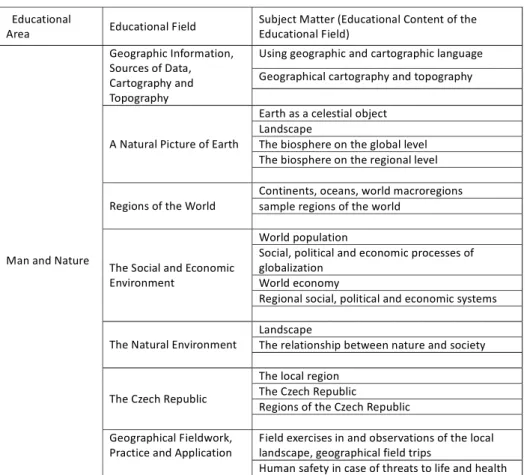
including its social aspects, was implemented into the FEP educational area entitled Man and Nature. This educational area is divided into seven educational fields. The issue of developing countries does not have its own educational area or field; it is fragmented among other educational areas regarding social geography. The detailed description of geographical curriculum in Czech Republic is also described in the study of Kubiatko, Janko & Mrazkova (2012). The Table 1
contains geographical fields in Czech Republic.
Table 1. Man and Nature educational content
The teachers had a chance to include kinds of information about developing countries in the area “Regions of the World”, where it was possible to present kinds of information about different world regions and their relationships with other regions. The teachers also had the possibility to create own model of region, where they could simulate different economic, social, politic and also envi-ronmental problems. The second are, where is possible to include kinds of in-formation about developing countries is “The social and economic environment”,
Educational
Area Educational Field
Subject Matter (Educational Content of the
Educational Field)
Using geographic and cartographic language
Geographical cartography and topography
Geographic Information,
Sources of Data,
Cartography and
Topography
Earth as a celestial object
Landscape
The biosphere on the global level
The biosphere on the regional level
A Natural Picture of Earth
Continents, oceans, world macroregions
sample regions of the world
Regions of the World
World population
Social, political and economic processes of
globalization
World economy
Regional social, political and economic systems
The Social and Economic
Environment
Landscape
The relationship between nature and society
The Natural Environment
The local region
The Czech Republic
Regions of the Czech Republic
The Czech Republic
Field exercises in and observations of the local
landscape, geographical field trips
Man and Nature
Geographical Fieldwork,
Practice and Application
where teachers could present basic characteristics of different nations. Next, there is possible to present information about political and economic ratios of different nations. The other point is to present information about world economy, concretely about indicators of economic development and quality of life. The last point of this area is to present information about political, economic and social systems, where teachers have got to say about geopolitical processes, main world conflict areas and others. All these topics could be the starting point for the geography teachers, regarding how to present different kinds of information about developing countries to pupils and they can think and propose the solutions, on how to improve the level of life in these countries.
Methodology
Aims of the study
The main aim of the study was to find out lower secondary school pupils’ knowledge about developing countries. The partial aims were to examine the influence of gender, residence, grade level and attitudes to geography on the knowledge about developing countries
Participants
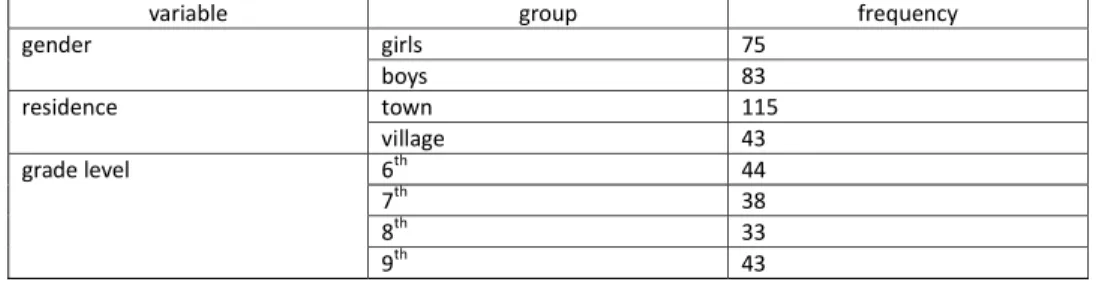
The sample size consisted of 158 Czech lower secondary school pupils from 8 different lower secondary schools. The demographic characteristics of respondents are presented in the Table 2.
Table 2. Basic demographic characteristics of respondents
Research tool
The research tool consisted of three parts. The first part included demographic variables such as gender, grade level and residence. The second part was focused on knowledge about developing countries and the third part was attitudinal. The
variable group frequency
girls 75 gender boys 83 town 115 residence village 43 6th 44 7th 38 8th 33 grade level 9th 43
research tool was self-constructed by author of the study. The research tool is possible to find on the web page of author. For the determination of pupils’ knowledge a test on knowledge was used which was comprised of 10 questions regarding to examine issue (for example: What do you imagine when someone says developing country?). The test was verified in the pilot study. The questions were open-ended, multiple-choice and one question was also graphical. All ques-tions were based on the information present in school textbooks. The quesques-tions in test were trying to include some of the characteristics connecting with the pro-blematic of developing countries, but also there was the effort to stay in contact with curriculum of geography in Czech Republic.
The attitudes were examined by a 20 Likert-type items questionnaire, which was divided into two parts. The first one was focused on the attitudes to geography and included 11 items (for example: The geography belongs among my favorite subject) and the second part was focused on the attitudes to developing countries (for example: I know minimally one problem, which is occurring in the developing countries). All 20 items were positive in meaning. The administration of research tools was ensured by teachers who were trained on how to work with research tools. The pupils were assured about anonymity of the research and the time limit for the filling was one learning lesson.
Analysis of data
The data from the knowledge part of the research tool was binary coded. The incorrect answers were coded with 0 and correct answers with 1. The decision of whether the answer is correct or incorrect was discussed with the two teachers of geography from lower secondary schools. The average score showed overall index of pupils’ knowledge about developing countries. The questions were also ana-lysed proportionally to show which field is the most problematic for the pupils. Also the ratio of correct answers with respect to variables (gender, residence and grade level) was also found. The statistically significant differences were found by Pearson chi-square (χ2).
The average score was in the statistical analysis as dependent variable; the demographic variables were used as independent variables. For the influence of gender, grade level and residence the analysis of variance (ANOVA) was used. The data from questionnaire were coded from 1 for “strongly disagree” to 5 for “strongly agree”. The average score showed pupils’ attitudes to geography and developing countries. For the determination of the relationship between attitudes and knowledge Pearson product moment was used.
The reliability of the research tool was determined by Cronbach's alpha coefficient. For the knowledge part there was the value α = 0.60. This value of alpha is considered sufficient (e.g. Cortina 1993). For the part of the questionnaire focusing on attitudes to geography there was α = 0.81 and for attitudes to de-veloping countries α = 0.79.
Results
Analysis of questions from the knowledge part
The questions from the knowledge part of the research tool are presented in the first part of the results. The first question was: “What do you imagine when someone says developing country?”. Approximately one half of the respondents answered correctly. The correct answers should contain information about eco-nomic problems of countries, which are leading to poverty, illiteracy, wars and other problems. The boys achieved a higher ratio of correct answers, but the difference was not statistically significant. The insignificant effect was also ob-served in the effect of residence, the ratio of correct answers was similar for the pupils from village and from town and similarly the effect of grade level was not significant. The pupils from 7th grade achieved the highest score. Among the
incorrect answers for example were “the developing country is very rich country” or “it is a country which has a huge amount of electronic products, for example Japan” and the last one “the store in Paris, it is a first idea, which I have in my head, when I hear this concept”. There were also a high amount of correct answers in every grade. The examples of correct answers are “The countries, which have got low economy, but they are trying to improve” or “The countries, which need economy support from developed countries”.
The second question was connected with previous one, the pupils were asked about the example of any developing country. The correct answer had contained strict name of country, not name of continent or any part of the world. The successfulness was similar to the previous question. One half of respondents wrote at least one developing country. But there is an interesting fact that only a few respondents answered both questions correctly. The effect of all three obser-ved variables was insignificant, but when we look at the results in more detail, we can see that the pupils from 7th grade were the most successful and the lowest
score was achieved by the 8th graders. The most incorrect answers were “Slovakia
and the Czech Republic”, which is maybe the effect of media, alternatively the influence of teachers or parents, who say in many cases that our country has lower salary compared to Western Europe or the USA. In some cases, it is possible to see that pupils wrote USA or Japan as an example of a developing country. The correct answers contained countries like Venezuela, Ecuador, Colombia, India, Bangladesh, Cuba and others.
The third question regarded the explanation of the concept of developing cooperation. The correct answer was built on the help of economic strong country to economic low country. All correct answers from pupils were presented on this idea. Approximately one half of the respondents answered correctly, the minimal differences were among groups of variables, so the statistically significant diffe-rences were not observed. The most frequent incorrect answer was: “it is only the cooperation among countries”.
The other question has graphic character. The pupils were supposed to mark the developing countries on the world map. Nearly 60 % of pupils marked the area of developing countries on the map correctly. A statistically significant difference was found between boys and girls (χ2 = 7.83; p < .01), the boys
achieved higher score (70 %) in comparison with girls (48 %). The other variables (residence and grade level) had an insignificant effect on the results. The youngest pupils (6th grade) had the lowest score. Some examples are presented below of the
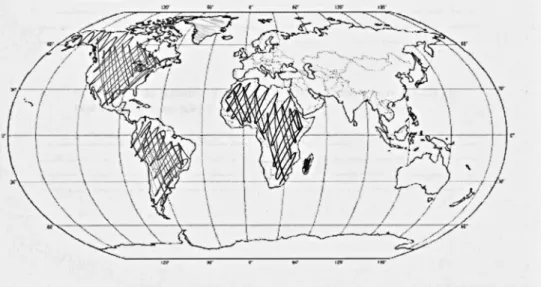
incorrectly marked areas of developing countries (Figure 1). In the first figure it is possible to see that pupils marked the area of North America incorrectly and that there is not the area of south Asia.
Figure 1. The incorrectly marked area of developing countries
In the second figure all marked areas are wrong. All areas belong among developed countries.
Figure 2. The incorrectly marked area of developing countries
In the following question pupils were asked to explain why the world is divided into the rich north and poor south due to economic reasons. The correct answers had to contain information about economic reasons connected with work, people, history and also minerals, for example “The countries in north are economically strong, because from historical view they accepted many things earlier than countries in south” or “In the north people are better in using of minerals in comparison with people form south”. Nearly half of respondents answered this question correctly. The girls answered this question more correctly (58%) in comparison with boys (42 %). This difference was statistically significant (χ2 =
3.89; p < .05). The effect of residence was not significant, but the effect of grade level was significant χ2 = 8.06; p < .05). The 6th graders achieved the lowest score
(30 %) and pupils from other grades achieved similar score, approximately 55 %. The most frequent answers were for example: “The rich north does not want to be a friend with poor south.” and other answers were “The Negros live in the south and their number is higher in comparison with north” or “Someone created it and put rich people on the north”.
In the following question respondents were supposed to explain what poverty and corruption mean. These two problems often occurred in Africa and it is also possible to see these two concepts in Czech geography textbooks. The concept of poverty was correctly explained by 94 % of pupils, statistically significant diffe-rences were not observed. The pupils knew, that poverty is connected with lack of money and the countries had lesser amount of money for development. Some pupils extended the answers on the consequences of poverty, for example: “It is lack of money, people live in slums, their houses are dilapidated” or “There is
lack of work for people, lack of food and also dirty water. Pupils do not attend the schools, so illiteracy is common in these countries”.
The concept of corruption was more problematic for pupils. Approximately 40 % of pupils explained this concept correctly. The correct answers contained the abuse of power and also bribery. The boys achieved higher score (48 %) in comparison with girls (30%) and this difference was statistically significant (χ2 =
4.29; p < .05). The effect of residence was not significant. But the effect of grade level was significant (χ2 = 15.61; p < .01). The pupils from the 9th grade achieved
the highest score (61%), and other graders achieved a similar score (30 – 35%). The most often incorrect answers said that it is discrimination of women or that the corruption means wars and violence. But there were also interesting incorrect answers “it is eruption of volcano” or “Revolt of people”. The last mentioned thing is only a consequence of corruption, the explanation whose meaning is missing. The correct answers were for example: “Bribery of clerks” or “The money from the developed countries was not for poor people, but president from developing country used them for the building of palace”.
The other question was regarding south Asia. We wanted to know which religions met in the region of south Asia and what kind of problems it brings. Approximately 60 % of respondents answered correctly. For the correct answer was considered if pupils wrote minimally two religions and write the effect their meeting (war, religion conflict). The influence was gender and residence was not significant. The influence of grade level was significant (χ2 = 15.29; p < .01). The
respondents from sixth grade answered the most incorrectly (37%), the ratio of correct answers among other graders was between 65 – 75 %. The most often incorrect answers included only one religion, namely Christianity, and without any explanation of the problems. The correct answers were, for example: “Islam, Hinduism, and Buddhism. All believe in something different and that causes the religious conflicts” or “Muslims and Christians, these two religions are enemies and it causes wars and it leads to low economy growth”.
The last question regarded disparity between men and women in Latin Ame-rica. Pupils were supposed to write some examples of the disparity between men and women. More than a half of the respondents (55 %) wrote correct examples. The correct answers were considered if pupils wrote characters of disparity like low education of women, women are without any law, too strict judgment for the small transgression. The correct answers from pupils were for example: “Women have not got possibility to study as men have” or “Women have not got any law and they are only property of men”. The difference between boys and girls was very small, so the effect was insignificant. The statistically significant difference was observed in the variable residence (χ2 = 4.58; p < .05). The respondents from
town achieved higher score (60 %) in comparison with respondents from village (40%). Also the influence of grade level was significant (χ2 = 13.51; p < .01). The
lower (45 – 50 %). The majority of incorrect answers claimed that there is no problem with disparity.
The influence of selected variables on the knowledge
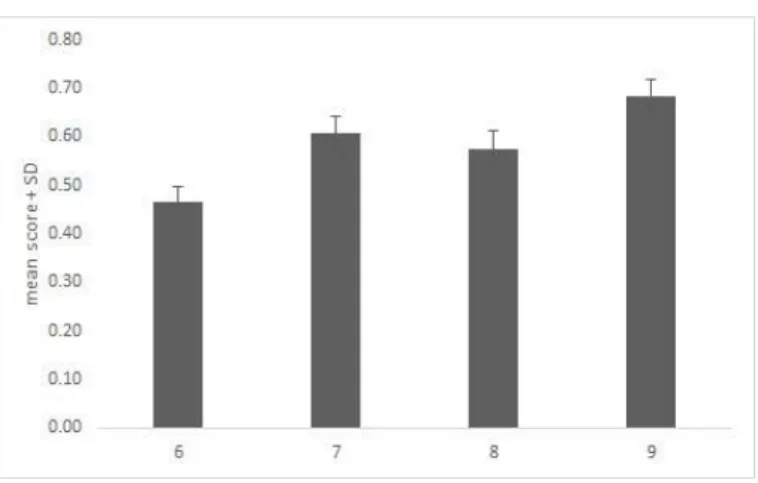
The effect of gender on the pupils’ knowledge was not statistically significant (F = 0.30; p = .59). Similarly, the effect of residence was not statistically signi-ficant (F = 0.40; p = .53). The effect of grade level on the pupils knowledge was statistically significant (F = 7.81; p < .001). The figure 3 showed that pupils from the 6th grade achieved the lowest score and pupils from 9th grade achieved the
highest score. The Tukey post-hoc test was applied and it showed the statistically significant result between 6th grade and 7th grade (p < .05) and between 6th grade
and 9th grade (p < .001).
Figure 3. The mean score of pupils from knowledge part of the research tool with respect to grade level
The significant correlation between knowledge and attitudes was found. As it was mentioned in the methodological part, the attitudinal research tool was divided into two parts (attitudes to geography and attitudes to developing countries). The relationship was in both cases significant, but it was moderate. The relationship between knowledge and attitudes to geography was r = .22; p < .05 and in the second case r = .27; p < .05.
Discussion
The pupils’ knowledge about developing countries is relatively low. However, as was written in the introduction part of the study, the awareness which is devoted to the issue of developing countries in the school curriculum is at a very low level. The kinds of information about developing countries are fragmented among all topics of social geography. This situation is probably causing a relatively low level of pupils’ knowledge about developing countries. As we can see mainly in local researches, the geography curriculum is stagnant in comparison with curri-culum in developed country. As Hopwood (2004) wrote, pupils in the UK saw geography as about the world, people and ways of life, countries, and world problems, and as a dynamic subject in which multiple points of view were considered. In the conditions of former socialistic countries this view of pupils on geography is still low. Only some enthusiastic teachers presented the kinds of information which are current, interesting and important for pupils’ development. The studies regarding the knowledge about any geographical concept are rare. This fact also referred to by Ozturk & Alcis (2010). For example, Mackintosh (2005) found pupils’ misconceptions of rivers. She used children drawings as a research tool. However, the majority of published studies are focused on the issue of working with maps and pupils’ orientation in the maps (e.g. Klonari 2012), so the comparison with other sources is relatively difficult. The problem with know-ledge of children with different science phenomena were presented also in others studies (e.g. Stefanikova & Prokop 2015).
Gender differences in knowledge about developing countries were not signi-ficant. In some questions boys were significantly more successful than girls and vice versa. When we look into other studies where gender was studied, some authors asserted that boys are more interested in science subjects and they devote more effort to these subjects (e.g. Quinn & Lyons 2011; Schreiner & Sjoberg 2007). Similar findings are possible to be found in the study of Steinkamp & Maehr (1983), who analyzed more than 50 studies where the gender differences in science achievement were examined. But, when we look at the answers of pupils in more detail, it is possible to see that the boys were more successful in those questions where pupils were supposed to draw (marking of developing countries on the map) or where the simple definition was required. The girls were more successful in the questions where the explanation of facts was required. Maybe this finding is connected with the higher success of girls in the solving of problem-based tasks. It is possible to read this fact in the study of Liu (2004) and also later in the study of Cohen-Schotamus (2008). In both studies girls achieved higher scores in problem-based tasks in comparison with boys. This finding is possible to be seen in other literary resources. It can explain why girls are more successful in the solutions of more demanding tasks in comparison with boys.
The next examined variable was residence of respondents. The effect of this variable was insignificant. This variable does not belong among the often exa-mined. Brief mention is possible to be found in the study of Arcury (1990), but the author did not mention any influence on the level of pupils’ knowledge. The relatively distant study is from Kellert (1984), who studied the influence of residence on pupils’ knowledge about animals. The author quoted that pupils from rural area achieved higher score. In our study, the pupils from town achieved significantly higher score only in one question; in other questions their score was similar. This could be caused by the larger and wider connection of towns and villages in comparison with past conditions of the Czech Republic. Nowadays many pupils from villages are studying in the town lower secondary schools, so the distinguishing of rural and urban pupils is a little hidden.
The next examined variable was grade level of respondents. This variable had significant effect on the results. The oldest pupils (nine graders) achieved higher score in comparison with others. A similar finding is possible to be found in many studies where this variable was examined. For example, Thompson & Logue (2006) found that the level of knowledge about different science phenomena was increasing with higher age of respondents. It can be caused by the reception of information from different sources. The youngest children produce intuitive res-ponses based on direct experience and observation. Also, there is a higher in-fluence of parents and peers in comparison with older respondents who are possible to distinguish the kinds of information which are not so truthful from the correct ones. There is a bigger chance that older pupils have the ability to compare two or more kinds of information about one thing and evaluate which information is verified and corresponds most with reality.
The last variable was attitudes toward geography and this variable had a positively low, but significant effect on knowledge about developing countries. This fact is verified by many researches, some of whom are mentioned above. For example Arcury (1990) wrote about a relatively slightly positive relationship between environmental knowledge and environmental attitudes. Allum et al. (2008) reviewed many studies regarding the relationship between knowledge and attitudes. They found a small positive correlation between general attitudes to-wards science and general knowledge of scientific facts, after controlling for a range of possible confounding variables. These findings are contradictory to our results.
Conclusion
As the results indicate, the issue of developing countries in the curriculum of the Czech Republic is fragmented, which caused the relatively low level of knowledge about this phenomenon among lower secondary school pupils. The situation should be improved by authors of curriculum, we are not in this position, and we can only suggest some points which can influence the decisions of curriculum makers. But the situation in the Czech Republic with teachers is a little bit problematic. Although teachers have the ability to modify curriculum by themselves and to present pupils the kinds of information about developing countries in a more integrated unit, there is still a prevailing style of teaching focused on memorizing, not critical thinking. This is caused by a poor appreciation of Czech teachers, so as the population of teachers gets older young teachers are trying to find different jobs. This is the reason why Czech schools are still using the old ways of teaching. Next, are some possibilities, which can be implemented into the teaching process and can lead to a better understanding of developing countries. One possibility, which was mentioned also in the discussion part, is the implementation of problem based learning. Pupils constructed their own know-ledge about the relevant problem. They formulated their own learning issues, identified their own learning resources, and discussed the information with their fellow group members. They then reflect on their progress in solving the problem, which they did by using information from other subdisciplines of geography, such as urban geography, economic geography, population geography, hydrology, and climatology (Golightly & Schaal 2015). The results of this study support the view of Wilson and Fowler (2005) that an active learning environment stimulates students to adopt deeper learning strategies in their prescribed module within an exam driven curriculum. The results also support work by Ellis et al. (2008) that students who adopt a deeper approach to learning are said to engage with subject matter in a way that promotes understanding. In this study we agree with Mar-getson (2000) that problem-based learning can reflect a “growing web” in which problems constitute knowledge, understanding, and practice. The next possibility on how to increase the pupils interest about the issue is to incorporate the methods of case study, which is a study conducted within a story framework, which places the participants in a decision-making position regarding certain issues (Ben-Zvi & Damri 2009; Hugerat & Kortam 2014) and there is also very useful the willin-gness of teacher to have deeper knowledge about different educational situations (Rovnanova 2013). Also, the problematic of developing countries could have interdisciplinary effect, some topics should be taught on the lessons of geography, other topics should be taught on the lessons of civics, because pupils need complex of the information about risks of developing countries, not only from geographical point of view, but also from economical point of view.
References
Allum, N., Sturgis, P., Tabourazi, D., & Brunton-Smith, I. (2008). Science knowledge and attitudes across cultures: a meta-analysis. Public Understanding of Science,
17(1), 35-54.
Arcury, T. (1990). Environmental attitude and environmental knowledge. Human Orga-nization, 49(4), 300-304.
Ben-Zvi, A., & Damri, S. (2009). University science graduates’ environmental per-ceptions regarding industry. Journal of Science Education and Technology,18(5), 367-381.
Cohen-Schotanus, J., Muijtjens, A. M. M., Schönrock-Adema, J., Geertsma, J., & Van der Vleuten, C. P. M. (2008). Effects of conventional and problem-based learning on clinical and general competencies and career development. Medical Education,
42(3), 256-265.
Cortina, J. M. (1993). What is coefficient alpha? An examination of theory and appli-cations. Journal of Applied Psychology, 78(1), 98-104.
Ellis, R. A., Goodyear, P., Brilliant, M., Prosser, M. (2008). Student experiences of problem-based learning in pharmacy: Conceptions of learning, approaches to learning and the integration of face-to-face and on-line activities. Advances in Health Sciences Education,13(5), 675-692.
Golightly, A., & Raath, S. (2015). Problem-Based Learning to Foster Deep Learning in Preservice Geography Teacher Education. Journal of Geography, 114(2), 58-68. Homoki, E., & Suto, L. (2014). Studying the public opinion of geography as a subject and its knowledge elements: A case of Hungary. Journal of Baltic Science Education, 13(4), 508-522.
Hopwood, N. (2004). Pupils’ conceptions of geography: towards an improved under-standing. International Research in Geographical and Environmental Education, 13(4), 348-361
Hugerat, M., & Kortam, N. (2014). Improving higher order thinking skills among fresh-men by teaching science through inquiry. Eurasia Journal of Mathematics, Science & Technology Education,10(5), 447-454.
Jahoda, G. (1963). The development of children’s ideas about country and nationality.
British Journal of Educational Psychology, 33(1), 47–60.
Kellert, S. R. (1984). Attitudes toward animals: Age-related development among children. In M.W. Fox & L.D. Mickley (Eds.), Advances in animal welfare science 1984/85 (pp. 43-60). Washington, DC: The Humane Society of the United States. Klonari, A. I. (2012). Primary school pupils’ ability to use aerial photographs and maps
in the subject of ge ography. European Journal of Geography, 3(2), 42-53. Kubiatko, M., Janko, T., & Mrazkova, K. (2012). Czech students attitudes towards
Geography. Journal of Geography,111(2), 67-75.
Liu, M. (2004). Examining the performance and attitudes of sixth graders during their use of a problem-based hypermedia learning environment. Computers in Human Behavior,20(3), 357-379.
Mackintosh, M. (2005). Children’s understanding of rivers. International Research in Geographical and Environmental Education, 14(4), 316-322.
Margetson, D. (2000). Depth of understanding and excellence of practice: The question of wholeness and problem-based learning. Journal of Evaluation in Clinical Practice,6(3), 293-303.
Masilela, C. O. (1994). Teaching American students about urbanization in developing countries: The use of role-playing. Journal of Geography,93(3), 114-124. Mouzoune, A., & Mouzoune, N. (1998). Socio-spatial representations of the world among
Lebanese and Salvadorians. Prospects, 28(2), 285-301.
Ozturk, M., & Alkis, S. (2010). Misconceptions in geography. Geographical Education,
23(1), 54-63.
Quinn, F., & Lyons, T. (2011). High school students’ perceptions of school science and science careers: A critical look at a critical issue. Science Education International,
22(4), 225-238.
Rovnanova, L. (2013). Subjective evaluation of demand on performance of teacher professional activities. The New Educational Review, 34(4), 292-304.
Schreiner, C., & Sjøberg, S. (2007). Science education and youth’s identity construction - two incompatible projects? In D. Corrigan, Dillon, J. & Gunstone, R. (Eds.), The Re-emergence of Values in the Science Curriculum. Rotterdam: Sense Publishers. Stefanikova, S., & Prokop, P. (2015). Do we believe pictures more or spoken words? How specific information affects how students learn about animals. Eurasia Journal of Mathematics, Science & Technology Education, 11(4), 725-733. Steinkamp, M. W., & Maehr, M. L. (1983). Affect, ability, and science achievement: A
quantitative synthesis of correlational research. Review of Educational Research,
53(3), 369-396.
Thompson, F., & Logue, S. (2006). An exploration of common student misconceptions in science. International Education Journal, 7(4), 553-559.
Turner, S., & Leydon, J. (2012). Improving geographic literacy among first-year under-graduate students: Testing the effectiveness of online quizzes. Journal of Ge-ography, 111(2), 54-66.
UNESCO. (2012). Twenty percent of young people in developing countries fail to complete primary school and lack skills for work. Available on: <http://www. unesco.org/new/en/media-services/single-view/news/twenty_percent_of_young_ people_in_ developing_countries_fail_to_complete_primary_school_and_lack_ skills_for_work/#.Vv-P_fmLSUk> [2016-04-02].
Wiegand, P., & Stiell, B. (1996a). Children’s estimations of the sizes of the continents.
Educational Studies, 22(1), 57-68.
Wiegand, P., & Stiell, B. (1996b). Lost continents? Children’s understanding of the location and orientation of the Earth’s land masses. Educational Studies, 22(3), 381-392.
Wiegand, P., & Stiell, B. (1997). Mapping the place knowledge of teachers in training.
Journal of Geography in Higher Education, 21(2), 187-198.
Wilson, K., & Fowler, J. (2005). Assessing the impact of learning environments on students’ approaches to learning: Comparing conventional and action learning designs. Assessment and Evaluation in Higher Education,30(1), 87-101. World Bank List of Developing Countries. (2015). <http://www.tislr12.org/wp-content/
uploads/2015/05/TISLR-World-Congress2015_Low-Resource-Countries-List1. pdf> [2016-04-02].