Toward Development Game-Based Adaptive Learning
Jamal Raiyn
Computer Science Department, Al Qasemi Academi College for Education, Baqa Al Gharbiah, Israel Abstract
Digital educational games have been used in schools for more than twenty years. Nowadays, digital educational games are being developed to serve goal-orient purposes. This paper introduces ways to develop students’ HOT skills based on a structured approach to digital game-based adaptive learning (DGLA). The game approach in this study used a visual learning environment aimed at developing students’ HOT skills, which involve ordering, selecting, evaluating, contrasting, and comparing. The Learning- based visual tools were designed to motivate primary school children and engage them in computer programming. Furthermore, we distributed a questionnaire to gauge the attitudes of students toward a learning game approach with a visual environment. The questionnaire was focused on the categories of motivation and challenges. The results show a clear gap between pre and post- test in all categories.
Keywords: HOT skills, game based learning, visual learning environment
1. Introduction
Over the last two decades, traditional schools aimed to prepare children to be good citizens. Students were expected to sit quietly, listen the teacher, and do exactly as they were told. The teacher played an important role in the class-room and he served as the main information resource. However, technological innovation in the 21st century has changed the design of the modern classroom. New learning strategies are being proposed to provide students with new skills, such as decision making, analysis, and collaborative problem solving, so that they can face new challenges in various complex fields such as health care, manufacturing, and economics. The important benefits of higher order thinking skills enable students to apply their knowledge to solving new problems (Raiyn, 2016). In a project -based learning approach, the teachers’ tasks include moderation, monitoring, analysis, and intervention. The teacher decides on learning goals, composes working groups, and divides tasks according to various strategies.
This paper introduces a learning strategy that aims to improve the higher order thinking (HOT) skills of students. HOT skills are focused on analytical, ordering, selecting, evaluating, contrasting, and comparing. The learning game proposed there is based on visual learning technology (Khaled et al, 2016)(Raiyn, 2016). The visual learning environments used Pencil Code, Blockly & Woofji. The rest of the paper is organized as follows: Section 2 gives an overview of students’ attitudes toward learning mathematics and computer science in various learning environments. Section 3 describes a design for game- based learning activities to develop students’ HOT skills. Section 4 concludes the paper and describes plans for future work.
2. Related Research
In general, examining attitudes is a significant way to study the combination of behaviors, feelings, and thoughts, directed towards objects (Parveen et al., 2014; Kislenko et. al., 2005; Byrne et al., 2001; Triandis, 1971). This section gives an overview of research on the attitudes of elementary and secondary students toward computer science (CS). Wiebe et al. (2001) conducted a survey to measure CS students’ attitudes towards computer programming and computer science in general. Hoegh and Moskal (2009) conducted a study of science and engineering students’ attitudes toward computer science, in which they developed and validated a survey to measure undergraduate student perceptions of computer science in science and engineering fields. Paulson (2002) studied the effectiveness of a strong mathematical background on learning and understanding theoretical concepts of computer science, particularly the theory of computation. Tekerek et al. (2011) conducted broader research on the attitudes toward math of computer education and instructional technology students in Turkey. The principle focus of the current study was to develop an efficient instrument that would measure computer science students’ attitudes toward mathematics and its usefulness for learning computer science effectively. Khald et al. (2016) studied the attitudes of pupils in primary school toward visual coding. Rodger et al. (2009) integrated Alice 3-D into middle school curriculum and designed lessons in math, science, language arts, social studies and technology. Alice is an innovative, 3-D visual programming environment that enables users to use object-oriented programming to create interactive games, animations, and videos. Wilson at al. (2012) introduced games-based learning, such as Scratch, and game construction to engage children at the primary level with computer programming concepts. Scratch helps young people learn to think creatively; with it, users can program interactive stories, games, and animations. Stolee and Fristoe (2011) used Kodu Game Lab, a 3-D visual programming platform, to introduce children to programming at an early age. Kodu can be used to teach creativity and; problem solving, as well as programming. Ioannidou (2011) used games to support the
105
development of computational thinking skills and to promote increased opportunities for computer science education in the regular curriculum. Hero et al. (2015) used the visual programming platform, MIT App, to increase interest and skills in computational practices. A visual programming platform, MIT App, enables users to create and to design Android apps and games. It can be used in various fields. The App Inventor platform teaches students how to program mobile apps, and the material is suitable for middle school, high school, and college courses. Game based learning is used to promote students learning (Oldfield, 1991). Game-based learning- based computing (Carron and Marty, 2012) has been used in mathematics education to develop computational thinking (Hildebrandt, 1998). This paper proposes designs for activities to develop primary school students’ HOT skills. The activities were developed by using mobile learning tools, such as Pencil Code.
3. Learning Based Games Approaches
Over the course of 10 weeks, as part of a learning based game approach using a visual learning environment, children were given a one hour lesson with Pencil Code, Blockly and Woofji, involving activities designed to improve their HOT skills. The study took place in a middle school. The study population comprised 42 pupils, male and female, half of them in 7th grade and the rest in 8th grade. All of the participants were pupils at the school. They were given a description of the project and its objectives and were invited to participate. Most of the pupils had experience using online games.
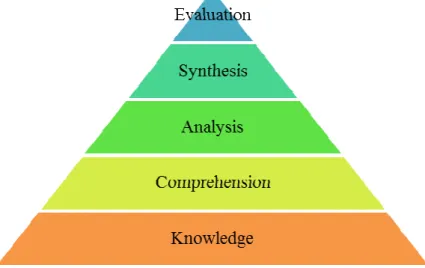
3.1 Design Activities Based on Bloom’s Taxonomy i. Remembering
Information recall and knowledge collection are important part of using one’s intellectual abilities. Memory is needed to answer questions and process data. Activities may include memory-invoking tasks, such as match, select, define, locate and write.
ii. Understanding
At this level, students use the knowledge they have attained in order to construct answers. Activities designed to assess comprehension include classifying, explaining, comparing, summarizing, contrasting, illustrating, translating, demonstrating and rephrasing.
iii. Application
When Students acquire knowledge and comprehend information, they can begin to use their understanding to apply what they have learned. Activities at this stage may consist of applying, developing, building, solving, choosing, interviewing, experimenting, and selecting.
iv. Analyzing
This phase leads to discovering reasons for why something has happened or to determining how basic parts are interrelated. Activities at this level may include simplifying, discovering, taking part in, distinguishing, examining, describing relationships, and categorizing.
v. Evaluation
After analyzing a problem, a student can develop and design solutions based on a set of criteria. Activities at this level essentially involve answering the question “Why?” and explaining.
Figure 1: Bloom’s taxonomy
3.2 Design Activities Based on PBL
PBL stands for both problem-based learning and project-based learning. PBL has been used successfully in various fields. Within higher education, especially in academic college for education new concepts of PBL have
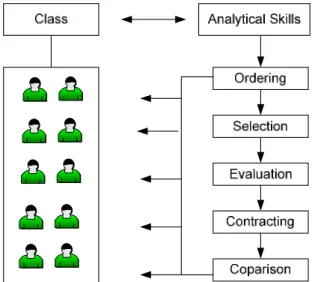
been developed by teachers of computer science education. The goal of the proposed approach is to develop the HOT skills of students through visual learning tools. Visual learning helps students to develop visual thinking, which is a learning style whereby the learner comes to better understand and retain information by associating ideas, words and concepts with images. Visual information is presented through various interactive visual tools, such as information and communication technologies (e.g., web services), and 2- and 3-D visual environments. This study focuses on interactive 2-D games, such as Pencil Code, at different levels for children between the ages of 10 and12. The visual representation of algorithms is useful both for teachers and pupils in their teaching and learning. Project-based learning (PBL) leads to the development of higher-order thinking (HOT) skills and collaborative skills in students. There are two distinct types of HOT skills needed for problem solving: analytical and creative. Analytical, or logical, thinking skills use critical thinking and help the reasoner select the best alternative; they consist of ordering, comparing, contrasting, evaluating, and selecting as shown in Figure 2. Creative thinking skills are also needed for problem solving; these consist of problem finding, efficiency, flexibility, originality, and elaboration. (Hmelo-Silver, 2004; Bednarz, 2011; Cottrell, 2011, 2013). The goal of the proposed approach is to study the role of a visual learning environment that is based on information and communication technology, in improving students’ HOT skills.
107 Table 1: Activities- based HOT skills
Knowledge: Write a program to help the monkey to get
the banana. Understanding: following command.Draw the path based on the
Selection: Select the right answer that helps the monkey to get the banana.
Ordering: write all programs that may help the monkey
to get the banana and order the programs based on efficiency.
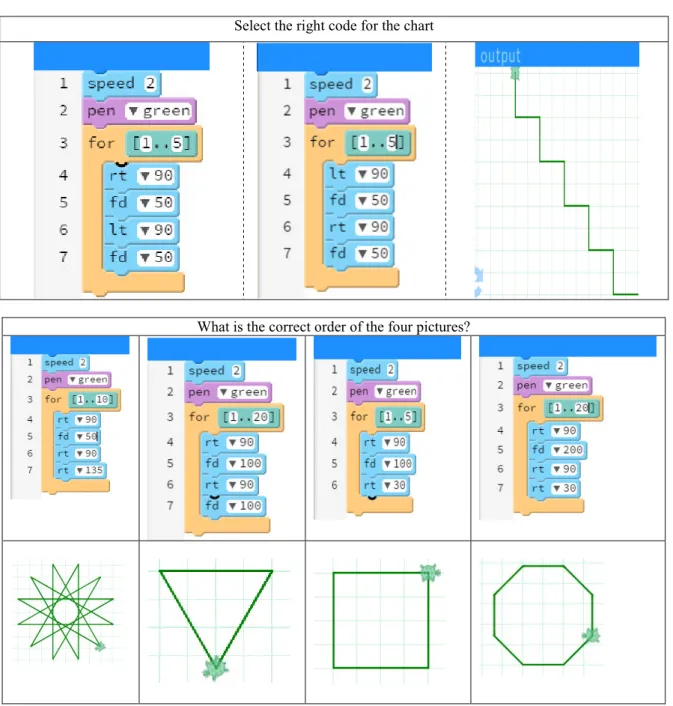
Select the right code for the chart
What is the correct order of the four pictures?
4. Results and Analysis
In this paper, we have designed activities that are based on higher-order thinking skills. The activities are based on a digital game learning approach. There are many online and offline visual learning tools. We have used some of these tools to design games and activities based on HOT skills as shown in Figure 3.
109
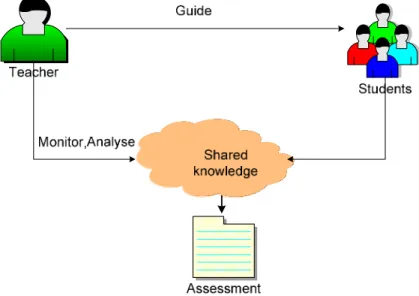
The digital game learning approach includes three main parts, as shown in Figure 4, the teacher, the students, and the visual learning tools. The pupils work in collaborative groups and use the Cloud to share knowledge. The teacher designs the games and guides the students. The assessment of students’ higher-order thinking skills is performed self-formative by collaborative groups. The self-formation of collaborative groups is based on sharing of accountability among students for solving instructional problems.
Figure 4: Collaborative learning scenario
4.1 Attitudes
Various tools are available for evaluating motivation, attitudes toward challenges, and completion rates, including pre/post questionnaires, and observational approaches. Many of these approaches are used to collect and to analyze data, even with a small number of participants. In this study, we have a pre/post questionnaire approach to measure middle school students’ attitudes towards a learning process in a visual environment. The questionnaire addressed categories of motivation, competition, challenges, and observation as illustrated in Table 2 and 3. The questions were closed questions to be answered on a five-point Linkert scale ranging from “strongly disagree” to “strongly agree”.
Table 2: Questionnaire categories Motivation
- I feel more excited when they ask me to write a difficult program.
- When I write difficult computer programs I do not feel fun and entertained. Competition
- I am willing to try hard to be the best in programming among my colleagues.
- I try hard to write programs and solve difficult issues before the rest of my colleagues. Challenge
- I like to write computer programs that are challenging and need deep thinking.
- If I am required to write a difficult computer program, I feel challenged and keep working on it until I finish it.
Table 3: Pupils’ observations
Observations
- Pupils continued to solve the exercises and did not to go out for a break - They continued the exercise at home
- They presented solutions in several ways.
- They involved parents and friends in their learning.
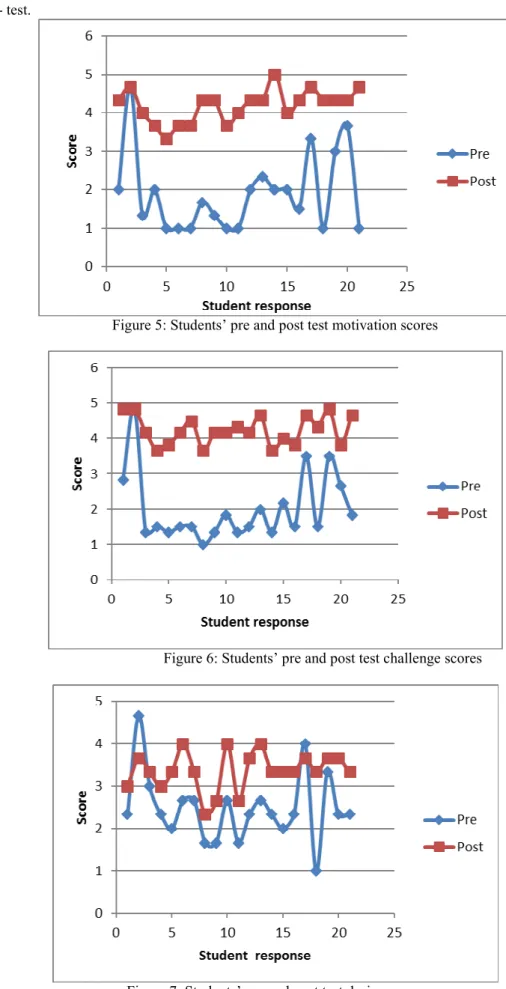
The graph in Figure 5 illustrates the fact that the motivation and the competitive spirit of the pupils were increased after they finished the course, whereas the perception of challenge in the pre and post -tests remained quite the same. Figure 5 shows that there was an improvement in students’ motivation when they engaged learning process based games’ activities that relied on visual learning.
The average of students’ motivation increased from 1.897 in the pre -test to 4.191 in post- test. Figure 6 shows that there was a clear difference in their attitude toward challenges. The average increased from 1.992 in the pre -test to 4.238 in the post -test. Figure 7 illustrates that was no significant difference in the students’ desire between the pre and the post- test. The average of students’ desire increased from 2.477 in the pre -test to 3.351
in the post- test.
Figure 5: Students’ pre and post test motivation scores
Figure 6: Students’ pre and post test challenge scores
111
5. Conclusion and Future Works
This study aimed to develop an exploratory model to explain and understand students’ attitudes toward the use of a mobile learning- based visual environment, both before and after participation in the course. We propose that an academic unit based on visual interactive environments be taught in primary school. The activities of this academic unit would be designed to develop higher order thinking skills and collaborative skills in students. The results revealed, in general, that the participants' attitudes towards mobile learning remained positive after the participation in the course. We found that self-efficacy, willingness, and the perception of challenges presented by learning programming were high on the post -tests. We also found clear difference between the results in the pre and post -tests. Finally, we conclude that pupils in primary schools are capable of writing software programs using visual code.
References
Asad, K., Tibi, M. & Raiyn, J. (2016). Primary school pupils’ attitudes toward learning programming through visual interactive environments, World Education Journal, 7, 5. 20-26.
Byrne, P. & Lyons, G. (2001). The effect of student attributes on success in programming, in Proc. the 6th Annual Conference on Innovation and Technology in Computer Science Education, 49-52.
Bednarz, T. F. (2011). Developing critical thinking skills: Pinpoint Leadership Skill Development Training Series, Majorium Business Press.
Carron, T & Marty, J-C. (2012). Enhancement of adaptation and monitoring in game-based learning environments. Student Usability in Educational Software and Games: Improving Experiences, page 201. Cottrell, S. (2011). Critical Thinking Skills: Developing effective analysis and argument, Palgrave Macmillan,
2nd edition Cottrell, S. (2013). The Study Skills Handbook, Palgrave Macmillan, 4th edition.
Hildebrandt, C. (1998). Developing mathematical understanding through invented games. Teaching Children Mathematics, 5(1), 191-95.
Hoegh, A. & Moskal,B.M. (2009). Examining science and engineering students’ attitudes toward computer science, in Proc. the 39th ASEE/IEEE Frontiers in Education Conference, San Antonio, TX, October 2009. Hmelo-Silver, C. E. (2004). Problem-Based Learning: What and How Do Students Learn?, Educational
Psychology Review, 16, 3.
Herro, D. & McCune-Gardner, C. & Boyer, M.D. (2015). Perceptions of Coding with MIT App Inventor: Pathways for their Future. Journal for computing teachers, 30-40.
Hildebrandt C. Developing mathematical understanding through invented games. Teaching Children Mathematics, 5(1),1998. 191-95.
Ioannidou A. (2011). Computational Thinking Patterns, Annual Meeting of the American Educational Research Association (AERA).
Leonard, L.M. & Tracy, D. M. (1993). Using games to meet the standards for middle school students. Arithmetic Teacher, 40(3), 499-501
Kislenko, K. Grevholm, B. and Lepik, M. (2005). Mathematics is important but boring: Students’ beliefs and attitudes towards mathematics, in Relating practice and research in mathematics education. Proceedings of NORMA 05,
Parveen J. Ali, Sanwar Ali, and Waleed E. Farag (2014). An Instrument to Measure Math Attitudes of Computer Science Students, International Journal of Information and Education Technology, Vol. 4, No. 5, October 2014.
Paulson, H.G. (2002). Computer Science Students Need Adequate Mathematics Background. [Online]. Available: http://www.math.uoc.gr/~ictm2/Proceedings/pap398.pdf
Raiyn, J. and Tilchin, O. (2015). Evaluation of Adaptive PBL’s Impact on HOT Development of Computer Science Students, Journal of Education and Practice, 6, 30, 51-58.
Raiyn, J. (2016). Developing a Mathematics Lesson Plan based on Visual Learning Technology, International Journal of Education and Management Engineering, 6, 4, 1-9.
Raiyn, J. (2016). The Role of Visual Learning in Improving Students’ High-Order Thinking Skills, Journal of Education and Practice, 7, 24, 115-21.
Rodger et.al. (2009).Engaging Middle School Teachers and Students with Alice in a Diverse Set of Subjects.SIGCSE09, March 3-7, 2009.
Stolee, T.K., & Fristoe, T. (2011). Exprssing computer science concepts through Kodu Game Lab, SIGCSE’11, March 9-12, 2011, Dalla, Texas, USA.
Tekerek,M., Yeniterzi, B. & Ercan, O. (2011). Math Attitude of Computer Education and Instructional Technology Students, The Turkish Online Journal of Educational Technology, 10, 3, 168- 174.
Triandis, H.C. (1971). Attitude and attitude change, New York, NY: Wiley. Oldfield, BJ. (2015). Game in the learning. Mathematics in School, 20 (3), 16-18.
Mathematics, 90, 581-592
Oldfield, B. J. (1991).Game in the learning. Mathematics in School, 20(3), 16-18.
Wiebe, E.N. Williams, L. Yang, K. & Miller, C. (2003). Computer Science Attitude Survey. [Online]. Available: http://www4.ncsu.edu/~wiebe/www/articles/prl-tr-2003-1.pdf
Wilson, A., Hainey, T. & Connolly, T. M.(2012). Evaluation of Computer Games Developed by Primary School Children to Gauge Understanding of Programming Concepts, 6th European Conference on Game-based Learning (ECGBL) 4-5 October 2012. Cork, Ireland.