Applying and Augmenting Deep
Reinforcement Learning in Serious
Games through Interaction
Aline Dobrovsky
1*, Uwe M. Borghoff
1, Marko Hofmann
1Received 22 November 2016; accepted 08 March 2017 Abstract
Serious games belong to the most important future e-learn-ing trends and are frequently used in recruitment and traine-learn-ing. Their development, however, is still a demanding and tedious process, especially when regarding reasonable non-player
character behaviour. Serious games can generally profit from
diverse, adaptive behaviour to increase learning effectiveness. Deep reinforcement learning has already shown considerable results in automatically generating successful AI behaviour, but its past applications were mainly focused on optimization and short-horizon games. To expand the underlying ideas to serious games, we introduce a new approach of augment-ing the application of deep reinforcement learnaugment-ing methods by interactively making use of domain experts’ knowledge to guide the learning process. Thereby, we aim to establish a synergistic combination of experts and emergent cognitive systems to create adaptive and more human behaviour. We call this approach interactive deep reinforcement learning and point out important aspects regarding realization within a novel framework.
Keywords
Serious Games, Deep Reinforcement Learning, Interactive
Learning, Cognitive Systems, Game Artificial Intelligence
1 Introduction
The term serious game (SG) origins from [1] and refers to games not exclusively developed for mere entertainment, but primarily for creating educational value. SGs are counted among the current e-learning trends and are gaining more and
more acceptance and influence [2]. SG development slightly
differs from that of entertainment games: SGs are often indi-vidual products for a restricted target audience, industrial
branch or company. This results in high expenditure and defi -cient reusability, although the market shows growing interest in
cost-efficient and customized applications [2]. One of the most
relevant, but also most time-consuming tasks is the creation of reasonable, human-like non-player character (NPC) behaviour [3-5]. Thus, simplifying authoring and adaptation of AI in SGs
seems desirable and profitable.
Machine learning, especially reinforcement learning (RL), is occasionally used for automated NPC behaviour generation. Nevertheless, several issues arise when applying RL to create believable and diverse behaviour in complex scenarios. We indicate a way to overcome these issues by combining RL with human guidance, including effective collaboration between a learning system and human experts.
In this paper, we give a short introduction to some chal-lenges of behaviour generation in serious games and to the background of RL, deep reinforcement learning (DRL) and interactive reinforcement learning (iRL). We show related approaches and depict current issues of applying DRL methods to SGs. Furthermore, we introduce SanTrain as a SG providing challenging scenarios for NPC behaviour generation. Finally, we show how our approach of interactive deep reinforcement
learning (iDRL), integrated into a flexible framework, could
enhance AI development in SGs and exemplarily indicate valu-able application opportunities in SanTrain.1
1 This paper is an extended version of a preliminary conference paper that
was presented at CogInfoCom 2016 [6].
1 Fakultät für Informatik, Universität der Bundeswehr München,
85577 Neubiberg, Germany
* Corresponding author, e-mail: [email protected]
61(2), pp. 198-208, 2017 https://doi.org/10.3311/PPee.10313 Creative Commons Attribution b
research article
PP
Periodica Polytechnica
Electrical Engineering
1.1 Challenges in Serious Game AI Development
Fig. 1 shows a simplified outline of the serious game AI
development process and depicts two prevalent challenges we
identified: the effort of AI generation and the communication
gap between developers and domain experts.
• Effort of AI generation Non-player character behaviour is still mainly produced through writing scripted instruc-tions as hand-coded, rule-based systems. The effort needed to create reasonable behaviour for every scenario of the game is dependent on its complexity, but always requires the ability to thoroughly anticipate reasonable behaviour for all possible game situations.
• Communication gap In regular meetings during an repetitive process, the stakeholders (project leaders,
do-main experts, developers) iteratively refine the AI model.
Domain experts give feedback to the current, presented behaviour and provide additional data and domain knowledge. They describe the intended behaviour of the AI model in a qualitative manner, e.g. ‘search for cover
when under fire’. This behaviour is subsequently trans
-lated into a rule-based behaviour system with quantified values, e.g. ‘distance of enemy bullet impact to avatar’.
Developers and experts communicate about behaviour that is strongly dependent on training, experience and
personality. The goal of trying to find a game imple
-mentable definition and description of desirable AI be -haviour easily leads to misunderstandings and creates a communication gap (cf. [7]).
1.2 Reinforcement Learning (RL)
Reinforcement learning means learning a mapping of situa-tions to acsitua-tions from interaction with an environment. RL agents
try to maximize a numerical reward signal received from their environment. Fig. 2 shows the standard interaction model over
a sequence of discrete time steps. At each time step, the agent selects an action according to the current state and receives a reward in the following state. The learned mapping is called a policy and describes the probability of selecting action a in
state s. In Q-learning, the agent follows a policy that promises
to maximize the function Q(s,a), where Q describes the max-imum discounted future reward when performing action a in state s and continuing with optimal choices. A comprehensive RL overview can be found in [8].
Fig. 2 Agent-environment interaction in reinforcement learning [8] 1.3 Deep Reinforcement Learning (DRL)
DRL means the combination of RL with deep machine learn-ing methods. Deep machine learnlearn-ing is inspired by the research of structure and information processing of the neocortex. It tries to capture spatio-temporal dependencies and involves training on large sets of observations to overcome the curse of dimensionality [9]. Within RL, a deep learning architecture can be used as function approximator in large state-action spaces. In deep Q-learning, the conventional table containing all state-action pairs and the learned rewards is replaced by a deep
artificial neural network (ANN). The ANN is more compact, generalizes better on unknown states and captures hierarchical
features of the problem. The successful applications of deep
Q-Learning to a set of different Atari games [10] and computer
Go [11] are commendable examples.
When applying DRL in a serious game, the game provides the environment from which the agent receives a representa-tion of the current game state and a reward value (as illustrated
in Fig. 3). A deep ANN can be used as the agent’s decision
making component. The action to be executed in the game is selected depending on the current state representation input and the learned behaviour.
1.4 Interactive Reinforcement Learning (iRL)
Fig. 4 Example of an iRL framework with interactive feedback and the
teach-er’s ability to undo the last action [12].
In iRL, an agent obtains reward signals not only from its environment, but additionally or exclusively from interactions with a human trainer. Human trainers could be domain experts and maybe non-programmers. They are able to give feedback
at any time and not only in goal states. Objectives of using an
interactive approach in RL are to improve convergence speed
and to create biased and influenceable behaviour in complex
tasks. Different interaction methods are possible, e.g. a human trainer can give numeric rewards, advise a concrete action or
demonstrate a desired behaviour. Objectives of using interac -tive approaches are improved convergence speed in learning tasks and biased behaviour in complex scenarios. However, there are still a lot of open issues in combining expert knowl-edge and automated learning. Deciding for a method and tuning of the form and intensity of human feedback cannot be
stan-dardized. It remains an intriguing task and strongly depends on
the application scenario. 1.5 Objectives
Our motivation is to help developers in creating believable
NPC AI and thereby simplify serious game development. The use of machine learning techniques can partially automate the process but requires machine learning experts, complex
software integration, parameter tuning, powerful hardware and long training times. Furthermore, vague objectives of game
AI like ‘fun’ and ‘learning’ are hard to encode. We aim to
overcome some of the current problems by integrating expert
knowledge in an efficient learning process and by establish -ing a synergistic collaboration between experts and cognitive
systems. Our concepts are to be implemented within a flexible
framework, which shall be easy to use by AI developers and domain experts.
2 Related Work
To the best of our knowledge, we found no similar approach of combining DRL and iRL. Particularly, we found no frame-work offering interactive DRL to support SG development. Nevertheless, we were inspired by different engaging ideas and current research in the areas of DRL, iRL and General Game Playing (GGP) [13]. A general overview of ML techniques used in SG can be found in the literature overview of [14].
Ongoing research in the area of General Video Game Play
-ing (GVGP) [15] attempts to develop algorithms that play any game without knowing it a priori. GVGP provides relational, object-oriented representations of 2D Atari-like game world
features and offers information about game states and a for-ward model. The planned learning track of the corresponding competition, excluding the forward model, is considered to induce promising new approaches in the areas of unsupervised learning and RL. A related attempt is pursued by the Arcade
Learning Environment (ALE) [16]. It offers a platform for
evaluating domain-independent AI by providing an interface to
a large number of various Atari 2600 game environments. The
available games can be used as RL problems, whereby the state
and action space is given through pixel-arrays of the 2D game
screen and possible joystick controller moves. ALE notices the agent about the current accumulated score and whether the game has ended.
Several approaches use evolutionary techniques in
com-bination with artificial neural networks (ANN) to produce
human-like behaviour. The authors of [17] present a system for
automatic evolution and adaptation of ANN based on
evolution-ary algorithms. Their approach is based on long offline learning
sessions with subsequent testing procedures. In [18], neuro-evo-lution for deep learning is investigated, showing good results in training a feature extractor for use by other ML approaches. The authors of [19] apply neuro-evolution to general Atari game
playing in the ALE. They investigate the mutual influence of
different state representations and the application of different neuro-evolution algorithms and show that the use of neuro-evo-lution overcomes previous RL problems with large state spaces and sparse reward gradients. A variant of deep learning is used
in [20] for player goal recognition, a player-modeling task. It is used to predict players’ goals in an open-ended digital game
world by learning from a collection of player interactions.
In 2013, the authors of DeepMind Technologies, later Goo
-gle DeepMind, stated to present the first successful approach
of applying RL for learning control policies directly from
high-dimensional sensory input [10, 11]. A convolutional neural
network is trained with an algorithm called ‘Deep Q-learning
with Experience Replay’ on several games of the ALE and par -tially outperforms other approaches and human players. This approach is combined with Monte Carlo Tree Search (MCTS)
in [21]. The use of model-based, slow planning agents proves
to be a good way of supplying training data for a deep learning architecture used in real-time gameplay. The combination of RL and MCTS is also used by Google DeepMind for their computer
Go program ‘Alphago’, which is the first to ever have defeated a human professional Go player [22]. The authors combine super -vised learning of expert moves with RL in self-plays to train policy- and value-networks used by MCTS. Recent research shows that DRL for Atari game-playing can also be trained
efficiently on customary hardware using asynchronous gradient descent and parallel actor learners [23]. The method of asyn -chronous actor critic even succeeds on continuous motor control
tasks and on finding rewards in a 3D random maze.
3 Problem Statement
Our examinations focus on the support of SG AI develop -ers in NPC controlling. We intend to cover a wide range and
variety of games, e.g. single-player board games like 8puzzle
up to complex multiplayer 3D games. Thus, we need a method to cope with different state-action space representations and accesses to game-relevant information. Traditional NPC behaviour generation methods, primarily containing scripting
and rule-based systems like finite-state machines, imply labo -rious hand-crafting of NPC AI. Especially in complex game worlds, self-adapting AI can relieve developers of the need to anticipate reasonable behaviour for every possible game
situa-tion [24]. Addisitua-tionally, the lack of dynamic, adaptive behaviour makes hard-coded approaches easily exploitable [25].
Machine learning can help to ease the authorial burden of creating such game AI. However, there are some prevalent
challenges in applying ML to games [26]. ML algorithms often
need long time and vast data for training and a meaningful target function. Additionally, game AI is often granted only
a specific period of time and limited resources. A high-level
symbolic knowledge representation would allow for a straight-forward and understandable AI manipulation, but also require
expense in obtaining this knowledge representation [27]. Fur -thermore, explainability of algorithms and their results is an
important factor to gain trust in the algorithms’ decisions,
because learning methods are known to sometimes produce
unpredictable outcomes. Moreover, specific problems of RL must be handled in computer games [28]: curse of dimension -ality (large state-action spaces), partial observability problem
(hidden states), generalization and exploration-exploitation
dilemma, credit structuring and temporal credit assignment problem (delayed and sparse rewards).
DRL can resolve some of these issues: it enables efficient training on large datasets and raw data input. The use of Artifi
-cial Neural Networks (ANN) improves generalization, even on unknown states. The presented approach [10] also showed that there’s no need to adapt a game and that efficient application
is possible. Although DRL can handle quick-moving, complex games based on visual input, the game score results of [11]
indicate that there remain issues with long-horizon games that offer only sparse rewards (e.g. platformers like ‘Amidar’ or games with open, complex worlds and differently visualized information like ‘Battle Zone’).
Fig. 5 8puzzle game example
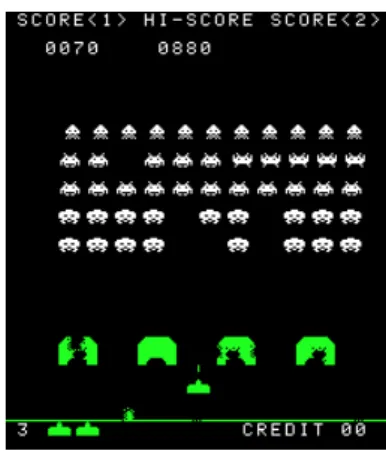
Fig. 6 Atari Space Invaders screenshot [29]
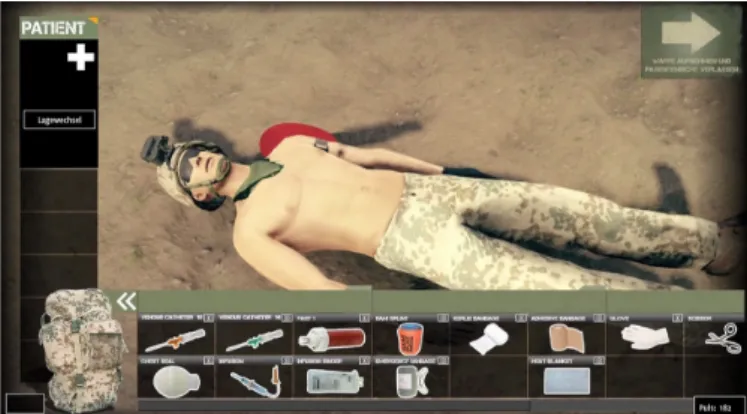
The described challenges grow with size of the state-action space and scenario complexity. Figs. 5, 6 and Figs. 7, 10 illus -trate increasing demands on AI for different types of games.
In Fig. 5, the state-action space can easily be defined by the positions of all tiles and the player-actions of ‘do nothing’, ‘select tile’ and ‘move tile’. Time limits for action selection are optional (cf. GGP competition [13]). Fig. 6 shows an exemplary Atari game. States can be defined as is done in ALE, by 2D
pixel arrays. The action space consists of 18 possible actions. Games of this type require fast perception and reaction in real-time environments containing non-deterministic elements.
If we move on to modern 3D multiplayer games, we often
can’t specify a straightforward definition of the state-action
space. In these games, AI has to deal with real-time environ-ments containing large amounts of various game objects and many (non-)deterministic events. Players and NPCs can take different positions and stances, possess equipment and perform sets of different actions (e.g. move, shoot) with varying con-straints (e.g. stamina, perception). In the following section, we will introduce SanTrain as an example of a modern 3D serious game we use as an application scenario for research.
3.1 SanTrain: A Serious Game for Tactical Combat Casualty Care (TCCC)
SanTrain is a serious game in development in the domain of
military first aid. It provides a game-based learning and train -ing platform to train TCCC decision mak-ing skills in an ego-shooter perspective.
Fig. 7 Screenshot of SanTrain
TCCC means specialized first aid on the battlefield and is
based on a series of simple life saving steps and clear priorities
for the first minutes following injuries. The goals are to pri
-oritize and treat life-threatening injuries, to prevent additional
injuries and to be able to complete the military mission. The
underlying principles origin from US special operation forces’
experiences in real combat scenarios. It has been shown that,
through prioritized emergency treatment on battlefield, lives of injured with life threatening injuries can be saved [30]. At
present, TCCC training is practised in armed forces not only by medical personnel but also by regular servicemen.
SanTrain can provide parts of TCCC training in a cost effec-tive manner through simulating the major aspects in a game, whereas purely traditional TCCC training is limited through time, budget and the number of competent tutoring personnel. As an educational tool, SanTrain has to teach an extremely
complex subject matter efficiently. One of the most important
aspects for realistic TCCC training is a very precise pathophys-iologic model of the human body. It has to represent all visible
vital signs of a patient’s body, because diagnosis and treatment
is based on their perception. Furthermore, it has to model all relevant vital parameters, consequences of injuries and effects
of medical treatment and their evolution over time. A realistic simulation and versatile modeling is needed, as the outcome of survival is dependent on timeliness and correctness of a
train-ee’s decisions. Furthermore, as a 3D game, SanTrain has to enhance learning motivation through convincing visualization
capabilities, natural interaction between players, demonstration
of realistic stories in domain specific scenarios and convincing,
supportive AI capabilities.
The development of serious games like SanTrain requires effective cooperation of subject-matter experts, didactic
experts, simulation experts and game developers [32]. Further -more, there are requirements for cost-effective development and simple adaptability, with limited number of potential users
and limited availability of trainer capacities in very specific domains. One major challenge is that algorithms modeling
learning matter have to be validated, which is often done by showing SME typical courses of action in the game. Therefore, a playable version must be available; a late validation can delay development because thorough validation is critical regarding
plausibility and learning effects [32]. SanTrain meets these challenges through the design of a flexible game-architecture with well defined-interfaces, as shown in Fig. 8 and the use
of separate development teams; game developers for designing an attractive game and a pedagogical expert team for teaching
of medical principles. Various application scenarios for using elaborate AI exist in a SG like SanTrain and the flexible archi -tecture offers simple integration potential. Some examples of integration possibilities of our interactive DRL approach are described in Section 4.4.
3.2 Application Goals and Implications
The described characteristics and development challenges illustrate the implications on the SG AI development process and objectives. Serious game AI has to be supportive, meet the needs of teaching and the learning goal and, when applied on human NPCs, has to exhibit realistic and variable behaviour to enhance learning success. Nonetheless, there is need for a cost-effective development process and less effort in AI development due to limited time and capacities. Furthermore, regarding the need for validation in SGs, AI development must be integrated in the general SG development process, including and involving different subject matter experts. Therefore, AI and its development have to be accessible to, comprehensible
for and influenceable by different experts.
As we intend to cover games of differing complexity, we
have to deal with the most difficult cases. Furthermore, we can’t
generally assume to have direct access to game state informa-tion or subsequent game states or to get recorded and stored replay data. DRL has successfully proven to generate satisfying behaviour even when only provided with visual input. This sup-ports our assumption that DRL could also generate reasonable behaviour in more complex 3D games. Nonetheless, we will
be confronted with the issues of long training times, slow or
deficient convergence and generation of undesired behaviour. In particular, we have to consider that DRL is an optimization
algorithm, which means that it will eventually lead to optimal, but not necessarily human, behaviour.
In contrast, human players are able to quickly capture a
situ-ation and rhetorical objectives like ‘fun’ and ‘learning’. Human
programmers can provide characters with knowledge exciting their own perception and with diverse, interesting actions. To
improve DRL with these human capabilities won’t only lead
to faster convergence but also to more reasonable and varying behaviour, increasing the trust of users and trainers in a SG application.
4 Approach to an Interactive Deep Reinforcement Learning (iDRL) Framework
To overcome the mentioned challenges and support SG developers by reducing complexity and effort in AI genera-tion, we propose to offer relevant functionalities within a new interactive DRL (iDRL) framework. We aim for a system that provides a general solution for applying DRL to SG. The focus
is on user- and game-specific adaptability of the framework
and its AI components, whereby no profound changes to games should be needed. Furthermore, the communication between
experts and the DRL component should besimple and efficient. Our prospect is a modular, reusable and easy to use framework,
which provides help in developing believable and variable AI through interactive online-learning.
4.1 Outline of iDRL Framework
The general demands we impose on our framework are
modularity, efficiency and scalability (particularly on custom
-ary hardware) and parametrized control of structures and pro -cesses. The basic architecture will offer default components
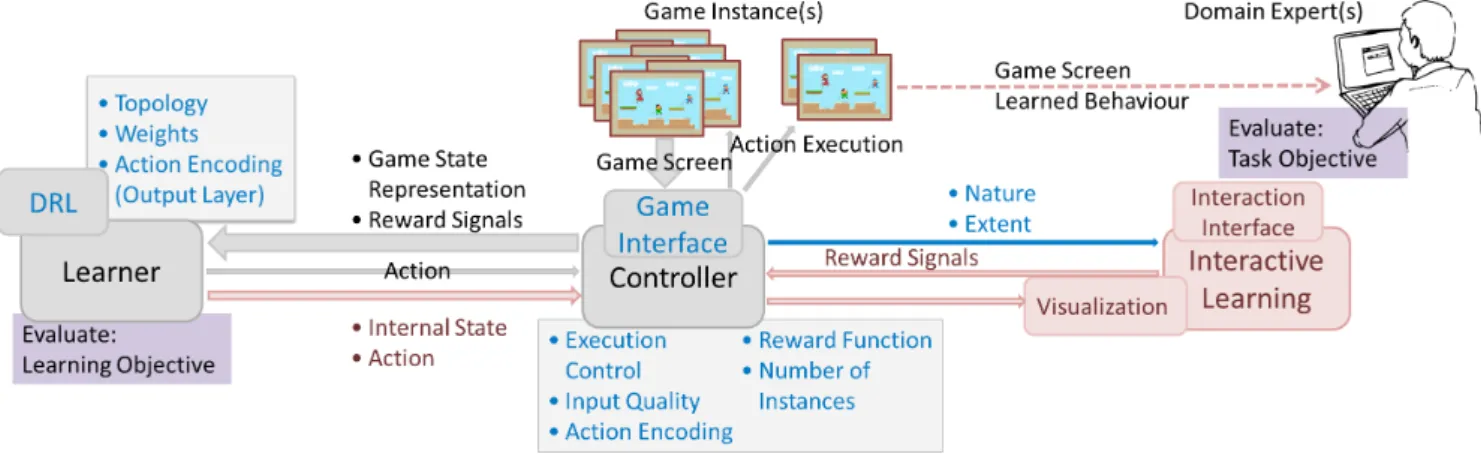
and functionality (outlined in Fig. 9). The flexible and generic
approach will allow for the possibility to compare different learning and expert knowledge integration methods. Multiple
learning instances will facilitate efficient use and quick con
-vergence (cf. [23]). Establishing a connection between game
instances and the learning component by a game interface has to be simple. DRL will be the default learning process, which
is controlled by the framework. The learner’s input and out -put will be composed of the current game-screen and possi-ble actions, encoded as keyboard inputs. This will lead to a human-like perception and avatar control. The only necessary game changes are to allow execution control and to provide
reward values. The flexible architecture will offer configuration
options, exchangeable components and extensions, exemplar-ily shown in blue colour. Nevertheless, the developer will get
support through default parameters and automated configura
-tion op-tions. Important configura-tion possibilities are specifi -cation of input quality (game screen resolution, abstraction),
number of game instances, possible actions and definition of a
numeric reward function. Several interactive aspects are shown in red colour. Domain experts can play multiple games, offer
rewards and get visualizations of the learner’s state and deci
-sions. One of the most important parts regarding usability is
offering an adaptable interface for interaction of experts with
the framework’s learner, which must be easy and natural to use by non-programmers. More specific aspects of our DRL and
iRL design objectives are discussed in the next subsections. 4.2 Application of Deep Reinforcement Learning
As DRL is a key aspect of our framework, we show which conditions for its application in SGs arise from the issues
described in Section 3 and why the existing approach of [10]
is an appropriate basis for use in our framework. We assume to have no explicit state information, no forward model, different possible actions (depending on the game) and no game log or replay data for training of ML algorithms. If only visual infor-mation of the game screen is used, the state space is composed
of all possible screen representations (e.g. 160*210 coloured
pixels in ALE Atari games). Thus, the described issues with RL (cf. Section 3) in large state spaces obligatorily lead to the application of model-free learning methods and approxima-tion funcapproxima-tions. Model-free RL methods learn a value funcapproxima-tion
directly instead of a state-transition model and don’t presume
the functionality of predicting next states and consequences of actions. Furthermore, the use of approximation functions allows handling of large and continuous state-spaces. They scale well
and are able to generalize over unknown states whereby retain -ing a compact representation.
At first, we will pursue a similar approach to Google’s Atari player [10] including some further developments and exten
-sions (e.g. [23]). A state is given by visual input signal from
several consecutive frames. A convolutional neural network as function approximator implicitly models spatial information. The use of several hidden layers corresponds to abstraction layers of hierarchical state representation. Actions are encoded straightforward as single nodes in the output layer of the neural network. We will include and compare the Temporal Differ-ence (TD)-learning based model-free approaches of
Q-learn-ing, Sarsa and Actor-Critic (cf. [8]). Our focus lies primarily on flexibility; we want to offer applicability and comparability of
different network topologies, connection weights and different
output action encodings. In the long term, we intend to include different approaches, like different forms of action encoding, allowing multiple output actions or output of parameters for easier human-understandable methods.
4.3 Essential Aspects of Interactive Reinforcement Learning
As mentioned above, DRL is an effective method, but also entails slow convergence on complex tasks. Furthermore, the
goal of RL is to optimize an expected reward. Thus, a fixed
reward function implies telling the agent what to achieve but not
how, which doesn’t necessarily lead to believable behaviour.
To address these drawbacks, we present the interactive learning component as important part of our framework. By combin-ing machine learncombin-ing and human intelligence, a trainer could
guide an agent in a goal-oriented way, biasing it’s behaviour
towards a desired outcome. The trainers to be included should be able to give feedback to specify behaviour and share their task-knowledge as domain experts, regardless of their program-ming skills or machine learning knowledge. This combination will decrease problem complexity on both sides - reducing the need for laborious hand-crafted behaviour and support DRL in
finding solutions in complex environments. Nevertheless, the
nature and extent of human trainer integration have to be deter-mined beforehand. We have to consider two different angles: How should interactive learning be included in DRL and how does a human trainer want to interact with a learning system? Both imply investigating the communication between a human expert and a learning system.
In the area of cognitive infocommunications, this problem falls within the categories of inter-cognitive, sensor-sharing and sensor-bridging communication (cf. [33] and [34]). The DRL component, containing an ANN, is a connectionist emergent cognitive system that is able to adapt and act effectively through
interaction with its environment (cf. [35]). Thus, the efficient use of iRL requires efficient infocommunication between the DRL
system as cognitive thing and human experts as cognitive beings.
In the following, we will summarize different possibilities of
human-RL interaction, state our selected approach and indicate remaining issues. Thereafter, we will show some implications from DRL properties and human evaluation characteristics for our interactive learning component.
Integrating human domain experts as trainers in the
tradi-tional machine learning workflow often means an iterative pro -cess, whereby nature and extent of involvement are mediated by practitioners. Experts only provide data, answer domain questions, and give feedback about the learned model. This pro-cedure creates communication gaps between experts,
program-mers and agent behaviour and is seen as inefficient involvement
of experts [7]. The approach of interactive shaping, whereby an agent receives exclusively human reward in the form of
posi-tive and negaposi-tive values [36], requires intensive participation
and effort on the part of domain experts. Learning from human demonstration or inverse reinforcement learning means the automated reconstruction of a reward function from a sample
of policies provided by human players, which requires suffi -cient training data. Examples are TD-learning in backgammon
by offline policy learning from experts plays [37] and learning policies for first person shooter games to generate human-like
behaviour [38]. In active learning, an agent queries a trainer
for getting labelled samples at specific learning states [39]. The
role of a trainer as a pure question-answering oracle without control on the interaction process is often perceived as frustrat-ing [7]. In heuristically-accelerated multiagent reinforcement learning (HAMRL) [40], hand-crafted heuristic functions are
used to accelerate RL by suggesting the selection of particular
actions over others. This approach implies laborious finetuning
of heuristics and machine learning skills of experts.
In our framework, we will focus on an approach of com-bining capabilities of DRL and human experts by applying a combination of pure RL and interactive shaping; thus letting an agent learn from both environment and trainer reward. It has been shown that, in complex settings, interactive learning improves learning speed and quality compared to non-interac-tive learning and that interaction seems to make learning more
robust [12]. An advantage of giving reward over demonstra -tion is that an agent learns relative values of ac-tions instead of
merely when to choose a specific action [41]. Further advan
-tages are relatively simple realization through an interface and simplicity of use [42]. In general, we have to differentiate
between the task objective as the objective of an expert (what he gives reward for) and the learning objective of the agent
(maximize expected reward) [42]. Several concrete combina -tion techniques of human and environment reward, applicable in action-value functions, are described and compared in [41]. Initially, we have to take into account some more general issues
that occur when applying human reward in RL (see [42]). These include reward positivity of trainers’ reward values,
which means the tendency to give more positive than negative reward. Especially episodic tasks seem vulnerable to positive
reward circles, whereas continuing learning sessions are less sensitive. Furthermore, the temporal discounting of human
reward has to be considered. A discount rate of 0 accords to
a form of supervised learning, which is easier to handle but leads to laborious micromanagement. Experiments showed that non-myopic rewards proved successful in continuing tasks by pursuing higher-level goals and leading to more robust learning regarding unknown states.
We briefly summarize some demands on and desirable
characteristics of our interaction component that arise from
the selected methods and mentioned challenges. At first, the
most promising time period of expert involvement is at the beginning of learning; early training seems more effective in terms of mean reward [41]. Furthermore, an agent should show steady behaviour by default, but nevertheless apply reward immediately and appropriately [41, 7]. Additionally, domain experts should be provided with a variety of complex feedback and control mechanisms [43], because users favour transparency and are willing to learn how a system works to give nuanced feedback [44]. Even though, the user should be supported with an appropriate level of guidance and offered summaries and explanations of system behaviour, which should preferably be lightweight but also scalable [43]. For
example, a visualization of higher level features of convolu
-tional layers in deep networks [39], as was used in [21]. In
the long term, we want to offer a comprehensive repository of
visualized information, resulting in system transparency and
understandable NPC behaviour.
4.4 iDRL Application Scenarios in SanTrain
This section offers a short outline of how a SG like SanTrain
can profit from iDRL techniques. We found several possible
application scenarios we think inspiring to support SG development and offering some additional value over classical approaches. The following areas are not meant as strictly separable but rather conceptual application categories.
• Single NPC Control This is the most obvious possible use of iDRL and has been the main focus of our previous descriptions. In SanTrain, using iDRL for decision mak-ing of NPC enemies offers less effort for individual pro-gramming and leads to heterogeneous and adaptive NPC AI. Multiple NPCs can be controlled by iDRL within a single scenario as well.
• Multiplayer Human Replacement Single or multi-ple NPC control can be used as replacement for human players in multiplayer games. This reduces the need for additional persons in multiplayer scenarios and iDRL is assumed to lead to more varying decisions than scripted NPCs and therefore showing more realistic and entertain-ing behaviour.
• Scenario Control Multiple instances of NPCs in a scenario can be controlled in order to manage an entire
scenario development. The control objectives or learning
objectives of a scenario can be defined according to differ -ent criteria, e.g. in a multiplayer scenario in SanTrain, ‘the
trainees’ team should have one injured person on average’.
• Game Adaptation Scenario control and NPC control can be used for adapting the game to individual player
capabilities, depending on an appropriate definition of
objective function in form of rewards for DRL.
• Game Testing NPCs controlled by iDRL can also be used for gameplay-testing purposes during development.
The created behaviour may be used to determine flaws
and inconsistencies in gameplay, level-design and agent behaviour.
Fig. 10 Demonstration of enemy position possibilities for scenario control and adaptation in SanTrain
As mentioned in Section 3.1, algorithms that are important for learning matter should be validated as soon as possible, ide-ally already in earlier phases during development. This means that behaviour generation with iDRL should also be integrated
in this process from the beginning and thereby get influence and
bias from experts. The learning and calibration process before
the real game is finished can be partially realized by using the concepts of fishtanks and sandboxes (cf. [45]). Fishtank means a simplified version of a game with limited gameplay complex -ity. Sandbox describes a game version with similar gameplay but more positive outcomes. Both concepts are often used,
pos-sibly combined, as a tutorial or first levels in computer games.
We are aware that an autonomous learning algorithm should be used with caution. Not all NPCs in a SG should be con-trolled by adaptive AI, as sometimes a strict and scripted sce-nario is more important for learning. Additionally, a large
pro-portion of successful application is also depending on finding and defining an appropriate reward function. In all cases, the
combination of DRL and interactivity enables relief of already
limited trainer availability and capacity due to the offline learn -ing capability of DRL. The integration of expert knowledge in learning is expected to lead to faster convergence, coun-teract unpredictable outcomes and increasing acceptance of resulting behaviour. This process can be supported by our pro-posed framework; by including domain experts and users more directly without the need of translating a desired behaviour into a technical layer and thus lessen the communication gap.
5 Conclusion
Combining deep reinforcement learning methods with interactive human guidance may be a promising solution to reduce effort and complexity issues in NPC behaviour gener-ation while at the same time creating believable and diverse behaviour. Since SGs often require convincing human-like NPC behaviour, their development often includes laboriously hand-crafted AI design. We showed that although the applica-tion of machine learning techniques like DRL has already been successful in different games, there are still enormous issues with more complex scenarios, resulting from incomprehen-sibly large state-action spaces. However, we also mentioned that previous studies have shown that interactive RL methods can improve learning speed and quality, particularly in
com-plex tasks. We therefore proposed a flexible and easy to use
framework, providing the possibility to apply a combination of their genuine qualities during SG development. Furthermore, we showed some concrete implications for the application of DRL and interactive learning, especially considering effective collaboration between a learning system and human experts. We presented SanTrain for soldier TCCC training as practical example for a recent serious game development and introduced some of the challenges it provides for AI behaviour generation. Regarding some exemplary but easily transferable problem settings from SanTrain, we described possible application
sce-narios and expected benefits from applying our iDRL approach
in this SG. In the long term, we hope to overcome the cur-rent issues and communication gaps between developers and experts during SG development in general, thus transforming
the generation of reasonable NPC AI into an efficient, collabo -rative process with reduced complexity.
References
[1] Abt, C. C. "Serious games." University Press of America. 1987.
[2] Doujak, G. "Serious Games und Digital Game Based Learning. Spiele-basierte E-Learning Trends der Zukunft." GRIN Verlag, 2015.
[3] Brisson, A., Pereira, G., R. Prada, R., Paiva, A., Louchart, S., Suttie,
N., Lim, T., Lopes, R., Bidarra, R., Bellottiet, F., Kravcik, M., Oliveira, M. "Artificial intelligence and personalization opportunities for serious
games." In: Human Computation and Serious Games: Papers from the
2012 AIIDE Joint Workshop. AAAI TechnicalReport WS-12-17. pp. 51–57. 2012.
[4] Vik, E. "State of the Art Report on Serious games: Blurring the lines
between recreation and reality." In: INF358 Seminar on Visualization.
(Violaand, I., Hauser, K. (Eds.)). The EurographicsAssociation. 2008. [5] Lara-Cabrera, R., Nogueira-Collazo, M., Cotta, C., Fernández-Leiva,
A. J. "Game artificial intelligence: Challenges for the scientific commu
-nity." In: Proceedings 2st Congreso de la Sociedad Española para las Ciencias del Videojuego. (Camacho, D., Gómez Martin, M. A., González Calero, P. A. (eds.)). Barcelona, Spain, Jun. 24, 2015. pp. 1-12
[6] Dobrovsky, A., Borghoff, U. M., Hofmann, M. "An approach to inter -active deep reinforcement learning for serious games." In: Proceedings of 7th IEEE International Conference on Cognitive Infocommunications.
(CogInfoCom 2016), Wroclaw, Poland, Oct. 16-18. 2016. pp. 85-90.
[7] Amershi, S., Cakmak, M., Knox, W. B., Kulesza, T. "Power to the peo -ple: The role of humans in interactive machine learning." AI Magazine.
35(4), pp. 105–120. 2014.
[8] Sutton, R. S., Barto, G. A. "Reinforcement learning: An introduction." MIT press, 1998.
[9] Arel, I., Rose, D. C., Karnowski, T. P. "Research frontiers: Deep machine
learning - a new frontier in artificial intelligence research." IEEE Compu-tational Intelligence Magazine. 5(5), pp. 13–18. 2010.
https://doi.org/10.1109/MCI.2010.938364
[10] Mnih, V., Kavukcuoglu, K., Silver, K., Graves, A., Antonoglou, I., Wi -erstra, D., Riedmiller, M. "Playing Atari with deep reinforcement
learn-ing." Deep LearningWorkshop NIPS. 2013.
[11] Mnih, V., Kavukcuoglu, K., Silver, D., Rusu, A. A., Veness, J., Belle
-mare, M. G., Graves, A., Riedmiller, M., Fidjeland, A. K., Ostrovski, G.,
Petersen, S., Beattie, C., Sadik, A., Antonoglou, I., King, H., Kumaran, D., Wierstra, D., Legg, S., Hassabis, D. "Human-level Control through Deep Reinforcement Learning." Nature. 518(7540), pp. 529–533. 2015.
https://doi.org/10.1038/nature14236
[12] Stahlhut, C., Navarro-Guerrero, N., Weber, C., Wermter, S. "Interaction is more beneficial in complex reinforcement learning problems than in simple ones." In: Interdisziplinärer Workshop Kognitive Systeme:
Mensch, Teams, Systeme und Automaten, Bielefeld, Germany, March,
2015. pp. 142-150.
[13] Genesereth, M., Love, N., Pell, B. “General game playing: Overview of
the AAAI competition." AI magazine. 26(2), pp. 63-65. 2005.
[14] Frutos-Pascual, M., Zapirain, B. G. "Review of the use of AI techniques in serious games: Decision making and machine learning." IEEE Transac-tions on Computational Intelligence and AI in Games. PP(99), p. 1. 2016.
https://doi.org/10.1109/TCIAIG.2015.2512592
[15] Perez-Liebana, D., Samothrakis, S., Togelius, J., Lucas, S. M., Schaul, T.
"General video game AI: Competition challenges and opportunities." In:
Thirtieth AAAI Conference on Artificial Intelligence. (AAAI-16). Phoe
-nix, Arizona, USA, Febr. 12-17, 2016, pp. 4335-4337.
[16] Bellemare, M. G., Naddaf, Y., Veness, J., Bowling, M. "The arcade learn -ing environment: An evaluation platform for general agents." Journal of
Artificial Intelligence Research. 47, pp. 253–279. 2013.
https://doi.org/10.1613/jair.3912
[17] Asensio, J. M. L., Donate, J. P., Cortez, P. "Evolving artificial neural
networks applied to generate virtual characters." In: IEEE Conference on
Computational Intelligence and Games (CIG), Dortmund, Aug. 26-29, 2014. pp. 1–5.
https://doi.org/10.1109/CIG.2014.6932862
[18] Verbancsics, P., Harguess, J. "Generative neuroevolution for deep learn -ing."
[19] Hausknecht, M., Lehman, J., Miikkulainen, R., Stone, P. "A Neuroevo -lution Approach to General Atari Game Playing." IEEE Transactions on Computational Intelligence and AI in Games. 6(4), pp. 355–366. 2014.
https://doi.org/10.1109/TCIAIG.2013.2294713
[20] Min, W., Ha, E. Y., Rowe, J., Mott, B., Lester, J. "Deep learning-based goal recognition in open-ended digital games." In: AIIDE’14 Proceed
-ings of the Tenth AAAI Conference on Artificial Intelligence and Interac
-tive Digital Entertainment. Raleigh, NC, USA, Oct. 3-7, 2014, pp. 37-43. [21] Guo, X., Singh, S., Lee, H., Lewis, R. L. Wang, X. "Deep learning for
real-time atari game play using offline Monte-Carlo tree search plan
-ning." In: Advances in Neural Information Processing Systems 2014. pp. 3338–3346. 2014.
[22] Silver, D., Huang, A., Maddison, C. J., Guez, A., Sifre, L., Van Den Driessche, G., Schrittwieser, J., Antonoglou, I., Panneershelvam, V., Lanctotet, M., Dieleman, S., Grewe, D., Nham, J., Kalchbrenner, N.,
Sutskever, I., Lillicrap, T., Leach, M., Kavukcuoglu, K., Graepel, T., Hassabis, D. "Mastering the game of go with deep neural networks and tree search." Nature. 529(7587), pp. 484–489. 2016.
https://doi.org/10.1038/nature16961
[23] Mnih, V., Badia, A. P., Mirza, M., Graves, A., Lillicrap, T. P., Harley, T.,
Silver, D., Kavukcuoglu, K. "Asynchronous methods for deep
reinforce-ment learning." arXivpreprintarXiv:1602.01783, 2016.
[24] Mehta, M., Ontanón, S., Ram, A. "Adaptive computer games: Easing the
authorial burden." In: AI Game Programming Wisdom 4. (Rabin, S. (ed.))
pp. 617–632. 2008.
[25] Ontañón, S., Synnaeve, G., Uriarte, A., Richoux, F., Churchill, D., Pre -uss, M. "A survey of real-timestrategy game AI research and competition in star craft." IEEE Transactions on Computational Intelligence and AI in Games. 5(4), pp. 293–311. 2013.
https://doi.org/10.1109/TCIAIG.2013.2286295
[26] Muñoz-Avila, H., Bauckhage, C., Bida, M., Congdon, C. B., Kendall,
G. "Learning and game AI." In: Dagstuhl Follow-Ups, 6. (Lucas, S. M., Mateas, M., Preuss, M., Spronck, P., Togelius, J. (eds.)). pp. 33-43. Schloss Dagstuhl, Leibniz-Zentrum fuer Informatik. 2013.
[27] Galway, L., Charles, D., Black, M. "Machine learning in digital games: a
survey." Artificial Intelligence Review. 29(2), pp. 123–161. 2008.
https://doi.org/10.1007/s10462-009-9112-y
[28] Mahajan, S. "Reinforcement learning in complex real world domains: A
review." Indian Journal of Computer Science and Engineering (IJCSE).
5(2), pp. 32-40. 2014.
[29] Taito "Atari space invaders screenshot." https://web.archive.org/
web/20040902162808/http://archive.gamespy.com/legacy/halloffame/
spaceinvaders.shtm. [Accessed: 21st June 2016].
[30] Butler, F. K., Jr. Butler, F. K., Jr. Holcomb, J. B., Giebner, S. D., McSwain, N. E., Bagian, J. "Tactical combat casualty care 2007: evolving concepts and battle field experience." Military Medicine. 172(11), pp. 1-19. 2007. [31] Lehmann, A., Hofmann, M., Palii, J., Karakasidis, A., Ruckdeschel, P.
"SanTrain: A Serious Game Architecture as Platform for Multiple First
Aid and Emergency Medical Trainings." In: AsiaSim 2013. Communica
-tions in Computer and Information Science. 402. pp. 361–366. Springer, Berlin, Heidelberg Berlin, Heidelberg. 2013.
[32] Feron, H., Hofmann, M. "Tactical combat casualty care: Strategic is -sues of a serious simulation game development.” In: Proceedings of the
2012Winter SimulationConference (WSC). Dec. 9-12, 2012. pp. 1–12.
https://doi.org/10.1109/WSC.2012.6465005
[33] Baranyi, P., Csapo, A. "Definition and synergies of cognitive infocom -munications." Acta Polytechnica Hungarica. 9(1), pp. 67–83. 2012.
[34] Baranyi, P., Csapo, A., Sallai, G. "Cognitive Infocommunications (CogInfoCom)." Springer International, 2015.
https://doi.org/10.1007/978-3-319-19608-4
[35] Vernon, D., Metta, G., Sandini, G. "A survey of artificial cognitive sys -tems: Implications for the autonomous development of mental capabili-ties in computational agents." IEEE Transactions on Evolutionary Com-putation. 11(2), pp. 151–180. 2007.
https://doi.org/10.1109/TEVC.2006.890274
[36] Knox, W. B., Stone, P. "Combining manual feedback with subsequent
MDP preward signals for reinforcement learning." In: Proceedings of the 9th International Conference on Autonomous Agents and Multiagent
[37] Tesauro, G. "Neurogammon: A neural-network back gammon program."
In: 1990 IJCNN International Joint Conference on Neural Networks, San Diego, CA, USA, June 17-21, 1990, pp. 33-39.
https://doi.org/10.1109/IJCNN.1990.137821
[38] Tastan, B., Sukthankar, G. R. "Learning policies for first person shoot -er games using inv-erse reinforcement learning." In: Proceedings of the
Seventh AAAI Conference on Artificial Intelligence and Interactive Digital Entertainment. AIIDE’11. Stanford, California, USA, Oct. 10-14, 2011. pp. 85–90.
[39] Erhan, D., Bengio, Y., Courville, A., Vincent, P. "Visualizing higher-lay -er features of a deep network." Univ-ersity of Montreal. Technical Report.
Number: 1341. 2009.
[40] Bianchi, R. A. C., Martins, M. F., H. Ribeiro, C. H. C., Costa, A. H.
"Heuristically-accelerated multiagent reinforcement learning." IEEE Transactions on Cybernetics. 44(2), pp. 252–265. 2014.
https://doi.org/10.1109/TCYB.2013.2253094
[41] Knox, W. B., Stone, P. "Reinforcement learning from simultaneous hu-man and mdp reward." In: Proceedings of the 11th International
Confer-ence on Autonomous Agents and Multiagent Systems. 1, pp. 475-482. 2012.
[42] Knox, W. B., Stone, P. "Framing reinforcement learning from human re -ward: Reward positivity, temporal discounting, episodicity, and perfor-mance." Artificial Intelligence. 225, pp. 24–50. 2015.
https://doi.org/10.1016/j.artint.2015.03.009
[43] Amershi, S. "Designing for effective end-user interaction with machine
learning." PhD dissertation, University of Washington. 2012.
[44] Kulesza, T., Burnett, M., Wong, W-K., Stumpf, S. "Principles of explan
-atory debugging to personalize interactive machine learning." In: Pro
-ceedings of the 20th International Conference on Intelligent User Inter
-faces. Atlanta, Georgia, USA, March 29 – Apr. 01. 2015. pp. 126–137. [45] Gee, J. P. "Learning by design: Good video games as learning ma
![Fig. 2 Agent-environment interaction in reinforcement learning [8]](https://thumb-us.123doks.com/thumbv2/123dok_us/10981022.2985992/2.892.206.684.75.303/fig-agent-environment-interaction-in-reinforcement-learning.webp)
![Fig. 4 Example of an iRL framework with interactive feedback and the teach- teach-er’s ability to undo the last action [12].](https://thumb-us.123doks.com/thumbv2/123dok_us/10981022.2985992/3.892.193.709.77.307/example-framework-interactive-feedback-teach-teach-ability-action.webp)
![Fig. 8 Generic SanTrain architecture [31]](https://thumb-us.123doks.com/thumbv2/123dok_us/10981022.2985992/6.892.152.723.76.494/fig-generic-santrain-architecture.webp)