Master of Science – Mathematics Education
USING ERRORS AND MISCONCEPTIONS AS A RESOURCE TO
TEACH FUNCTIONS TO GRADE 11 LEARNERS
Moloko Victor Malahlela
Student Number: 692718
Protocol Number: 2015ECE021M
A research report submitted to the Wits School of Education and the Faculty of Science, University of the Witwatersrand in partial fulfilment of the requirements for the degree of
Master of Science by combination of coursework and research
ii ABSTRACT
This research report focussed on the teaching of the function concept directed at the errors the learners make as well as the misconceptions which could be associated with those errors. The study was conducted at a secondary school in Johannesburg, South Africa. This was a qualitative error analysis study which also had a form of interventional or remedial teaching. The research was driven by the following research questions: (1) What errors and misconceptions do grade 11 learners show on functions?, (2) What learning affordances and constraints can be created if teaching is directed at learners’ errors and misconceptions? and, (3) To what extent can the learners’ achievement on the topic functions be boosted if teaching is directed at learners’ errors and misconceptions?
The study used a purposive sample of six grade 11 mathematics learners from a group of 34 learners. To answer these questions, I structured the study to encompass numerous phases of data collection using different instruments. Firstly, I constructed a test instrument and used it on this group of grade 11 learners. These learners had been taught functions earlier in the year, so the test was diagnostic to measure the cognitive levels of the learner on the concept and also to establish the errors made and misconceptions they carried onto the section from other sections or picked up from the function concept. The study was mainly based on the constructivism theory of learning and teaching, but also had other theories to link to it such at the socio-cultural theory, the APOS (actions, process, object and schema) theory, the concept image and concept definition as well as the variation theory. The errors I picked up from the pre-test I classified and analysed using the conceptual framework grounded on the abovementioned theories. It was this analysis which enabled me to structure the desired intervention program together with the teacher after which I conducted a post-test with the subjects. Other forms of data collection such as the interview and observation were employed during the study. I used the interview to get clarity from the learners’ pre-test questions responses, whilst the observation I used during the intervention lessons the teacher had with the learners. Indeed the findings were that, while there was a substantial improvement on learner performance on the post-test, it appeared clearly that cognitive levels of the learners on the function concept had been enhanced. This improvement of performance was a result of the teaching that was directed at the errors, which also interprets to having created a favourable environment which could be interpreted as learning affordances to boost the learners’ understanding of the function concept.
iii KEYWORDS Constructivism Functions Errors Misconceptions Remediation Intervention Schema
iv
DECLARATION
I declare that the content of this thesis is my own unaided work. It is being submitted for the degree of Master of Science at the University of the Witwatersrand, Johannesburg. It has not
been submitted before for any degree or examination at any other University.
______________________________________________________________ Moloko Victor Malahlela
v DEDICATION
This work is dedicated to my late sister Stephina Malahlela whom I would have loved to be with when I receive this degree but unfortunately we cannot be together in person although I believe that we are in spirit. We will always love you Mekadi ‘a Mmazwi á Phaahla! The kindness and love you have always shown me from my childhood is now rewarded by this achievement to the family.
vi
ACKNOWLEDGEMENTS
Firstly, I would like to express my deepest gratitude to my supervisor, Dr Judah Makonye for his unconditional support and encouragement throughout the study and the reporting period. I appreciate deeply, the various ways in which you contributed to the work presented in this document as well as to my own personal development.
My coursework lecturers, Prof. Jill Adler, Prof. Hamsa Venkat and Prof Karin Brodie, whose work involved engaging me thoroughly with literature, which immeasurably contributed to this product, thanks a lot. Being a Masters student in the Wits school of education has been an honor and a privilege. I also thank the teacher, the learners, the principal and the school governing body of the school where I conducted the research. The Gauteng Department of Education for letting me use one of their schools to do the research for which the findings are reported on this paper.
My wife Nomonde Malahlela, my two sons Oatile and Tshegofatso Malahlela, thank you so much for the enduring love and support you have shown me throughout this process.
The last but not least heartfelt gratitude goes to the National Research Foundation (NRF) for their provision of a partial funding towards the completion of this course.
vii
CONTENTS
CHAPTER 1: STUDY BACKGROUND ... 1
1.1 Introduction ... 1
1.2 Studies done on Mathematics performance in South Africa ... 1
1.3 Context of the research ... 3
1.4 Research Problem ... 5
1.5 Purpose of the research ... 6
1.6 Research questions ... 6
1.7 Significance of the study and justification ... 6
1.8 Conclusion and the structure of the report ... 9
1.8.1 Organization of the thesis ... 9
CHAPTER 2: LITERATURE REVIEW AND THEORETICAL FRAMEWORK ... 11
2.1 Introduction ... 11
2.2 Research on Mathematical Errors and Misconceptions ... 11
2.3 The function concept and difficulties in learning it ... 14
2.4 Theoretical Framework ... 16
2.4.1 Constructivist Learning Theory ... 17
2.4.2 Socio-Cultural Theory ... 19
2.4.3 How I explain errors and misconceptions using constructivism and socio-cultural theory .... 20
2.4.4 Errors and misconceptions as the essential part of a constructivist framework ... 22
2.4.4.1 Variation Theory ... 24
2.4.4.2 Affordances and Constraints in Learning ... 26
2.4.5 Conceptual Framework ... 26
2.5 Remedial Teaching/Intervention ... 29
2.6 Conclusion ... 30
CHAPTER 3: METHODOLOGY AND RESEARCH DESIGN ... 31
3.1 Introduction ... 31
3.2 Qualitative study ... 31
3.3 Research design ... 32
viii
3.5 Procedure ... 33
3.6 Research Instruments ... 35
3.6.1 The Written Test (Pre-test & Post-test) ... 36
3.6.2 The Interview with the Learners ... 41
3.6.3 The Class Observation of the Intervention ... 42
3.7 Reliability and Validity ... 43
3.8 Ethical Considerations ... 44
3.9 Data Analysis Strategy ... 45
3.10 Conclusion ... 47
CHAPTER 4: DATA ANALYSIS ... 48
3.1 Introduction ... 48
4.2 Analysis of Learner Responses to the Pre-test ... 48
4.2 Error identification, classification and analysis ... 49
4.3 The Intervention Lesson ... 70
4.4 Analysis of the Post-test in Comparison with the Pre-test Learner Responses ... 76
4.5 Discussion ... 85
4.5.1 Types of errors identified ... 86
4.5.2 What is implied by the errors identified ... 88
CHAPTER 5: CONCLUSIONS, FINDINGS AND RECOMMENDATIONS ... 92
5.1 Limitations of the Study ... 99
5.2 Recommendations and Implications for Theory, Research and Practice ... 100
REFERENCES ... 101
ANNEXURES ... 107
ANNEXURE A: Pre-test ... 107
ANNEXURE B: Post-test ... 111
ANNEXURE C: Letter to the Principal ... 115
ANNEXURE D: Participant Information Sheet ... 117
ANNEXURE E: Participant Information Sheet for the Teacher ... 118
ANNEXURE F: Participant Information Sheet for the Parents and Guardians ... 119
ANNEXURE G: Participant Information Sheet for the Parents and Learners ... 120
ANNEXURE H: Consent form for Audio-taping the Teacher During the Lesson ... 121
ix
ANNEXURE J: Consent Form for Learner Observation during the Lesson ... 123
ANNEXURE K: Learner Consent Form for Written Assessment ... 124
ANNEXURE L: Learner Consent Form for Audio-taping during Lesson ... 125
ANNEXURE M: Learner Consent Form for Observation during Lesson ... 126
ANNEXURE N: Parent Consent Form for Child Writing Tests ... 127
ANNEXURE O: Parent Consent Form for Child Interview... 128
ANNEXURE P: Learner Consent Form for Interview ... 129
ANNEXURE Q: Observation Schedule ... 130
ANNEXURE R: Interview Schedule ... 131
x LIST OF FIGURES
Figure 1: The Zone of Proximal Development (ZPD)……….19
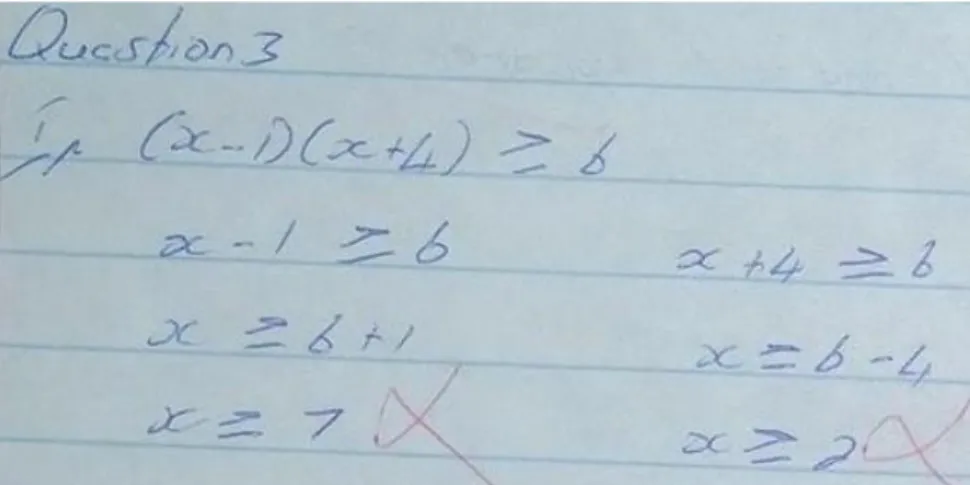
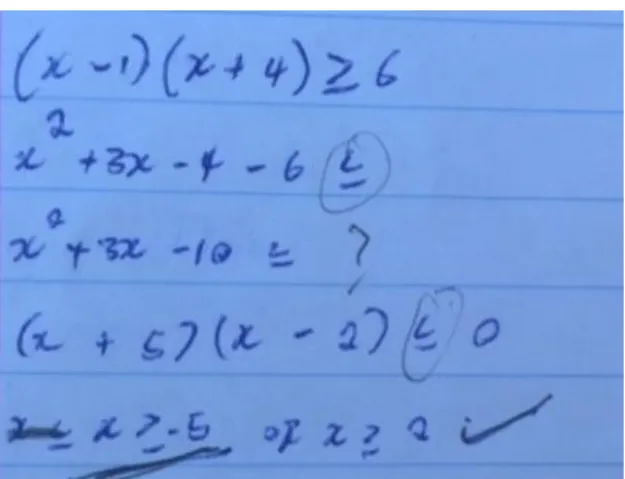
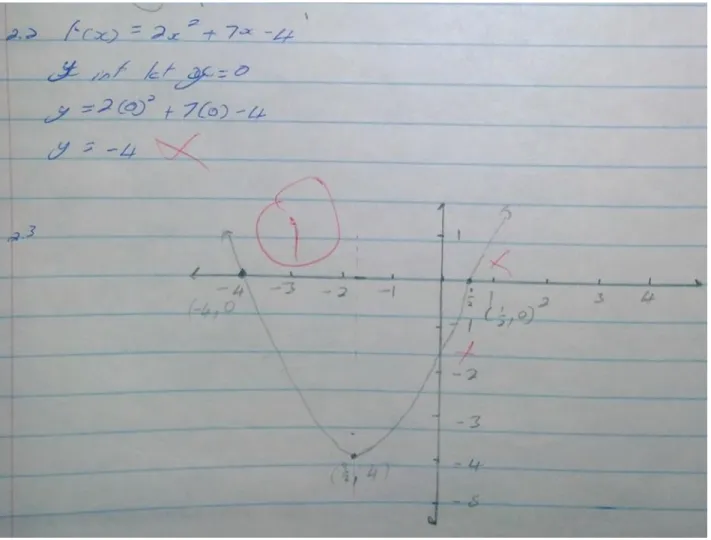
Figure 2: Learner response to Pre-test question 3 (Case 1)………..…49
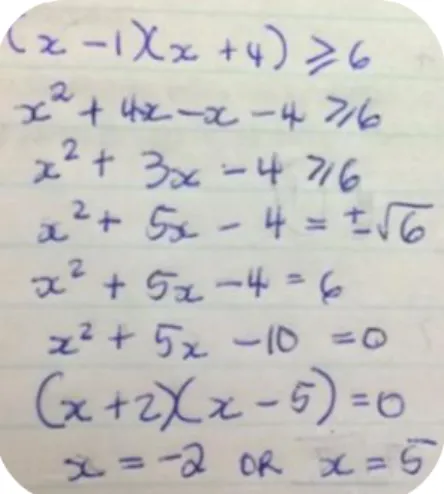
Figure 3: Learner response to Pre-test question 3 (Case 2)..………..……..50
Figure 4: Learner graphical representation of solution to Q 3 of the pre-test (Case 2)…………50
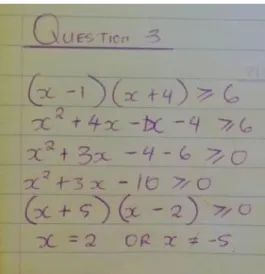
Figure 5: Learner response to question 3 of the pre-test (Case 3)………53
Figure 6: Learner response to question 3 of the pre-test (Case 4)………56
Figure 7: Learner response to question 2 of the pre-test (Case 5)………57
Figure 8: Learner response to question 2 of the pre-test (Case 6)………60
Figure 9: Learner response to question 1 of pre-test (Case 8)………63
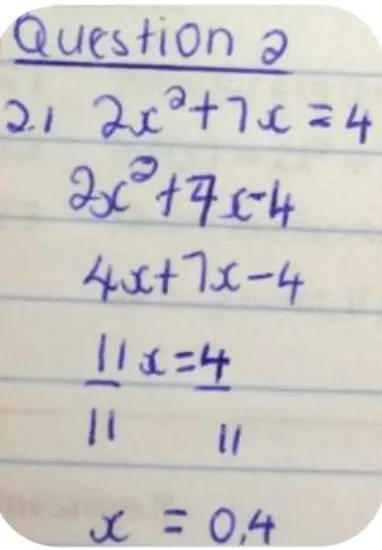
Figure 10: Learner response to question 2.1 of pre-test (Case 9) ………....65
Figure 11: Question 4 from the pre-test……….66
Figure 12: Learner response to question 4.1 of pre-test (Case 10) ...……….….66
Figure 13: Learner response to question 4.2 of pre-test (Case 11)………..67
Figure 14: Learner response to question 4.4 of pre-test (Case 12)………..68
Figure 15: Diagram for question 5 of the pre-test ………...69
Figure 16: A schematic representation of the approach used for remediation………..75
Figure 17: Graphical representation of learner performance (Line graph)………..…85
xi LIST OF TABLES
Table 1: Overview of the topic of functions as per CAPS requirements (DBE, 2011)………14
Table 2: Types of errors and their descriptions………..……. 26
Table 3: Limitations and advantages of a written test ………..39
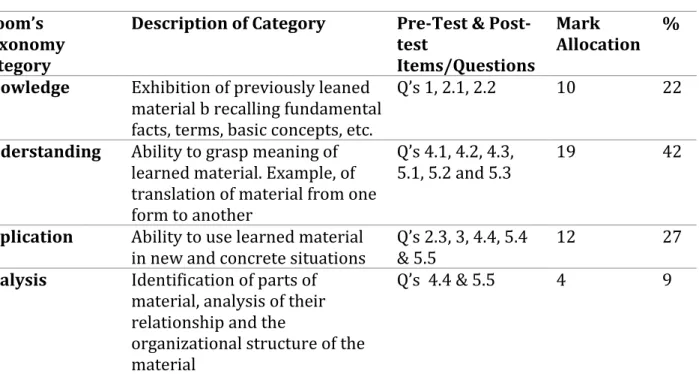
Table 4: Analysis of the written test using the Bloom’s Taxonomy………40
Table 5: Different types of errors……….46
Table 6: Question 1 for the pre-test (Case 7)…………..…….………..…..63
Table 7: Question 1 for the pre-test and post-test……….77
Table 8: Question 1 for the post-test………..…………78
Table 9: Learner responses to question 1 of pre-test and post-test………...78
Table 10: Question 3 of pre-test and post-test……….79
Table 11: Question 3 learner responses for pre-test and post-test………90
Table 12: Question 4 for pre-test and post-test………..81
Table 13: Question 4.1 and 4.2 learner responses for the pre-test and the post-test……….82
1
CHAPTER 1: STUDY BACKGROUND
1.1
Introduction
In this chapter I discuss in detail the background of the study. I did this by breaking it down into a variety of subsections. I explain the empirical settings’ context, the research problem (whereby I introduce the research questions), the purpose of the study as well as its significance. This gives an outline of the South African context versus other countries on the performance of learner on Mathematics in general, and narrowing it further to the concept of functions in particular. The chapter deals with aspects that necessitated the pursuing of this study as well as how the findings might be of use to mathematical education theory and practice.
1.2
Studies done on Mathematics performance in South Africa
The quality of learner performance in South Africa on Mathematics has been poor over the years (Department of Basic Education (DBE), 2011). This is evident from various international and local studies conducted to establish the level of performance of learners on mathematics and other subjects such as science. The Trends in Mathematics and Science Study (TIMSS) conducted in 1999 as discussed in Howie (2001), aimed at establishing trends of learner performance in Mathematics and Science between different countries. Another study with similar objective is the TIMSS-R (discussed in Reddy, 2004) and was conducted in 2003. Both studies revealed successive poor learner performance of South African children on mathematics. Participating countries for the TIMSS include South Africa, Indonesia, Morocco, as well as other developing countries. This poor performance can be attributed to poor understanding of basic mathematics concepts (Sasman, 2011), and have dire long run consequences as South Africa may end up not being in a position to produce a sufficient number of matriculants who pursue STEM (Science, Technology, Engineering and Mathematics) careers at institutions of higher learning (Howie, 2003). These are careers which provide crucial manpower for economic development. The Annual National Assessment (ANA) results also
2
reflect a consistent poor performance of Grade 9 learners on Mathematics from 2012 to 2014 despite the upward shift of scores of Grade 1 to 6 learners. In the South African schooling system, Grade 9 is the exit level of the General Education and Training (GET) Band. It is a grade just before the Further Education and Training (FET) band which includes Grades 10, 11 and 12 (exit level). This steady decline in Grade 9 Mathematics performance from 2012 to 2014 poses a big challenge to the future of the subject in the country as the work covered at Grade 9 is the building block of the basis for the FET band content.
The Mathematics curriculum is divided into a number of topics or chapters each of which contributes to a pool of mathematical concepts which must be learnt and be mastered for promotional purposes from one grade to the next. Among the many topics learners are expected to master in the Mathematics curriculum, functions and graphs happen to be one of the most challenging concepts (DBE, 2011; Sasman, 2011; DBE, 2014b & DBE, 2015).
In the Department of Basic Education’s Curriculum and Assessment Policy Statement (DBE CAPS) (2011), the function concept is introduced at grade 10 level in the form of a straight line [𝑔(𝑥) = 𝑚𝑥 + 𝑐]. The basic exponential [ℎ(𝑥) = 𝑎𝑥𝑛], basic parabola [𝑦 = 𝑎𝑥2+ 𝑐] and basic hyperbolic [𝑓(𝑥) =𝑎𝑥+ 𝑞] are also introduced at this level and are learnt in both graphical and symbolic forms. The functions and algebra build up further into relatively advanced versions as well as trigonometric function at grades 11 and 12. The topic further develops into cubic function and inverse functions at grade 12 level. In general, as evident from the 2014 final examination paper, the grade 12 curriculum percentage contribution of this topic content was at least 37% (about 110 marks out of 300) which was distributed over both papers one and two. Considering the significant weight this concept has on the curriculum, I believe that if better ways of teaching it are established, learners are likely to do well on the subject in general. This can aid their performance even further at the institutions of higher learning since the concept of functions appears to carry a fundamental value and it’s essential for related learning areas at school level, at institutions of higher learning as well as to operations in industry (Okur, 2013).
In trying to deal with the problem at hand, it is worth noting that the process of teaching mathematics has over the decades been under scrutiny and has drawn enormous attention
3
from various educational reformers and education specialists all over the world (for example Okur, 2013; Smith, Disessa & Roschelle, 1994; etc.). The aim of the investigations on the learning and the teaching of the subject would be mainly exploring and establishing better instructional approaches for its delivery. This refers to ways which provide learners with opportunities or affordances to learn mathematics better for proper mastery of mathematical concepts taught.
1.3
Context of the research
South Africa as a whole is in a situation whereby learner performance in Mathematics has raised a concern amongst educationists and the entire academia (Howie, 2003; Howie, 2001; Mji & Makgato, 2006).
The Third International Mathematics and Science Study-Repeat (TIMSS -R) conducted in 1998 and 1999 revealed that South African pupils performed last among a total of 38 countries which participated in the study (Howie, 2003). The study also revealed that grade 8 learner performance scored poorly at 275 which was significantly below the mean of 487. The results of another TIMSS study conducted in 2003 showed no improvement on Mathematics among South African pupils (Mji & Makagatho, 2006).
Consistent with the abovementioned findings, grade 12 Mathematics results in the country have been poor over the years. While diagnostic reports compiled on performance of learners revealed poor performance on Mathematics, one of the topics highlighted consecutively from year to year as problematic is functions (National Diagnostic Report on Learner Performance, 2012, 2013, 2014). This has been consistently the case over many years.
It is important to note that, although I conducted my study at grade 11 level, I thought I should use grade 12 final examination results as an appropriate reference frame since they (results) emanate from standardised and endorsed promotional examinations. Another reason is that a substantial percentage of work covered at grade 11 is examined at grade 12 level.
The performance of learners on Mathematics from 2010 to 2014 ranges between 47% and 59.1% (DBE, 2014b).
4
It is worth noting also that although the above figures are on overall performance of learners on Mathematics as a subject, among other components of the Mathematics curriculum learners have been grabbling through from year to year is functions. Sasman (2011) covered the concern stated above in her analysis of the 2009 NCS examination as follows:
“Many candidates did not have a clear understanding of the characteristics of various families of functions and are unable to sketch graphs...Candidates also lack an understanding of the behavior of functions. The notation embedded in functions and the transformations of functions were poorly understood in 2008 and 2009” (p. 7).
The situation did not get better as a few years later (i.e. in 2012), functions was still a topic on which learners had dire challenges as displayed by their performance from the end of year National Senior Certificate examination (DBE, 2012). The report echoes as suggestions for improvement, in line with Sasman (2011) that, “Functions need much more attention in the teaching process. Learners should be able to understand the different characteristics of the various functions…Many candidates find working with functions challenging” (p. 127). This was due to the fact that questions which tested learners/candidates’ knowledge directly on functions were answered poorly by the candidates, nationally. One of the issues raised by Sasman (2011) was that while learners/candidates had huge challenges interpreting graphs, some had problems with understanding the basic relationship between functions and function equations.
While the findings of this study may provide some recommendations for dealing with the learners’ poor performance on functions, it also aims to find out if the poor understanding of the topic by learners may be attributed to errors and misconceptions which learners carry over from certain mathematical domains to this topic, and how teachers can deal with them.
According to the constructivist theory, learning is the construction of knowledge which happens within an individual. It is a process which allows interaction of numerous processes in the mind of an individual (Hatano, 1996), which would make it not so easy to figure out without involving the learner himself/herself in the research.
5
1.4
Research Problem
Learners’ relational understanding of the mathematics content is the big issue in this study, and it results from learners’ inability to cope with the subject among other factors. It is for this reason that I decided to carry out this research.
The process of teaching mathematics has over the decades drawn enormous attention from various educational reformers and education specialists all over the world, for example, Smith et. al, (1994), Nesher (1987) and Hatano (1996). The main aim of the inquiry on the learning and the teaching of the subject would be exploring ways which provide learners with opportunities to learn mathematics relationally, i.e. improving opportunities for learners to acquire more the conceptual understanding and mastery than just the procedural fluency (Kilpatrick, Swafford & Findell, 2001).
As one of the concepts which are a requirement for learners to master in order to progress to the next level of mathematics learning at a secondary school, the concept of function appears to be one of the fundamental mathematical features not only in South African curriculum as I have stated above, but also in other parts of the world. For example, the Malaysian curriculum among others also puts so much value on the function concept as it is found to play a vital role in algebra and trigonometry and leads to the teaching and learning of calculus (Abdullah & Saleh, 2005).
Applications of the function concept go beyond mathematics as a discipline. Decision sciences, economic sciences, geographical sciences are some of the areas in which functions are applied as means of communicating information (Okur, 2013), and thus makes sense as to why it contributes a great deal of content to the South African education system (curriculum). Learners are thus expected to be at mastery level of the concept when they exit a secondary school system despite the fact that it is a requirement for the learners to pass the subject mathematics.
6
1.5
Purpose of the research
Firstly, the research aims to establish the types of errors which learners make on the topic functions at grade 11. From the identified errors, the study seeks to investigate the possible misconceptions which might have lead the learners to making these errors. Secondly, this study critiques the learning affordances and/or constraints when a teaching approach is used to address the identified errors and misconceptions. Lastly this research aims to determine the extent of cognitive growth if any of learners as a result of this teaching intervention. This I shall achieve by carrying out a qualitative study whose findings will provide answers to the questions which follow in the next section.
1.6
Research questions
The study is organized to provide answers to the following three interrelated questions: 1.6.1 What errors and misconceptions do grade 11 learners show on functions?
1.6.2 What learning affordances and/or constraints can be created if teaching is directed at learners’ errors and misconceptions?
1.6.3 To what extent can the learners’ achievement on the topic functions be boosted if teaching is directed at learners’ errors and misconceptions?
While there could be several ways of researching on learning on this topic, I decided to start from the angle of learner errors and misconceptions on functions because errors can be traced to incorrect or correct learning which happened before (Olivier, 1996) and can be pathways for constructing knowledge. Therefore, they need not be eradicated, but instead be capitalised on and used as ‘springboards for inquiry’ (Borasi, 1994).
1.7
Significance of the study and justification
In South Africa, tests and examinations are used as measures for learner attainment of learning outcomes (Makonye, 2010). From standardized assessments conducted on South African learners, locally and internationally, it is evident that the country is not coping with the demanding nature of mathematics from both ends (i.e. from the teachers to the learners). For
7
example, (TIMSS-R, 2013) results illustrate no improvement whatsoever on South African learners’ performance in mathematics as compared to another study by TIMMS conducted in 1999 when South Africa scored way below the international mean score (Reddy, 2004). Locally, mathematics learner performance on the Annual National Assessment (ANA) DBE (2014a) has also been poor since its inception in 2012. The ANA served as “a landmark assessment tool that annually measured progress in learner achievement in Literacy and Numeracy at entry and exit grades of a phase up to grade 9, focussing on the government’s prioritised goal of improving the quality of basic education” (DBE, 2011). For example, grade 9 learner performance (in mathematics) in 2012 was averaged at 13% whereas for 2013 and 2014 it was at 14% and 11% respectively. Yet on the other hand and similarly, the overall performance of grade 12 learners on mathematics from the DBE common promotional examination ranged between 47.4% and 59.1% from 2010 to 2014.
Poor as they are, these results puzzled and motivated me to pursue this study, which I believe may contribute to the mathematics education body of knowledge by revealing the possible causes of this predicament, as well as getting trends and patterns which may assist with making recommendations for improving instruction. This leads to what is referred to as the Pedagogic Content Knowledge (PCK) of the teachers who are entrusted with the work of educating these learners. Shulman (1986) argued that the PCK is the field on which the mathematics teachers are struggling with and is a very important aspect of education system. Mji and Makgato (1996) also alluded to the same problem that while some of the teachers who teach the subject are under-qualified, a percentage of those qualified as teachers are not qualified to teach the subject. This increases the complexity of the situation. Thus, the outcomes of this study will also contribute to the PCK of the mathematics teachers as it somewhat focuses on the reaction of teachers to learners’ errors and misconceptions (on the topic function).
Consistent with the complexity of the teaching and learning process, errors and misconceptions are defined differently by numerous authors. For example, according to Olivier (1989), misconceptions are over-generalizations of previous knowledge onto the domain where it does not apply (Olivier, 1989). According to Baker, McGaw and Peterson (2007), misconceptions are seen as being among the persistent and hard to change core ideas learners generate during the process of constructing knowledge. These are the ideas which are inconsistent with the
8
scientifically accepted ideas. On the other hand, learning is seen as a process through which learners transform and refine prior knowledge into more sophisticated forms (Smith et al., 1994), through the processes of assimilation and accommodation (Hatano, 1996). It is during these processes whereby learners tend to get lost in the midst of trying to cope with learning. Learners who do not manage to make it through these processes, tend to lose interest on the concept and unfortunately, their lack of understanding of the concept grows as they progress from grade to grade as the cognitive demand of the concept increases.
Throughout my career as a teacher for mathematics at secondary school, I also did not have a good strategy of dealing with learners’ errors and misconceptions. It was however possible for me to see that some learners experienced challenges moving from one level of understanding a concept to the next, but did not really know how to approach the situation. It was also evident from my involvement in the education system that as the learners I taught progressed from working with a straight line graph to other forms of functions (and their graphs), they seemed to lose interest on the function concept. This loss of interest I observed result with poor conceptual understanding and poor performance on assessment tasks. This is one of the things which encouraged me to base this study on functions.
Instead of attempting to eradicate misconceptions, a teacher needs to incorporate in their teaching, strategies which enable them to become aware of learners’ errors and misconceptions (Borasi, 1994; Brodie, 2007 & Olivier, 1989). The authors posit that being aware of, and paying attention to learners’ errors and misconceptions can be used to shape up, guide and enhance learning.
The findings of this study are to assist in getting to the bottom of the predicament the mathematics community of practice is facing in the form of identifying the causes and making recommendations for improvement of the teaching practice.
9
1.8
Conclusion and the structure of the report
The section dealt with poor performance of learners on Mathematics locally and internationally. These I have drawn from various studies done on learners from South Africa and other countries with the function concept being the central point. The concept is found to be of high fundamental value to the subjects as it is through it that mathematical and other forms of information can be communicated. One of the aspects contributing to this poor performance in South Africa was found to be the concept of functions among others (Sasman, 2011). Thus the study will attempt to get insights into the use of errors and misconceptions as a resource to the teaching of functions since errors and misconceptions are key to construction of knowledge rather than things which must be prevented (Olivier, 1996).
1.8.1 Organization of the thesis
I have organised this thesis into five interrelated chapters.
Chapter one outlines the background to the study. The chapter is broken down into a series of sections which individually treats in detail, aspects to do with the background of the study. The sections include a brief examination of the study done on the mathematics performance in South Africa as a way to contextualise the problem. The chapter also serves to introduce the research problem, the purpose of the study, the research questions as well as the significance of the study.
Chapter two is designed to explore a variety of literature and theory which underpins my study. The chapter commences with the introduction and extends to establishing the link between the objectives of the study and its theoretical basis.
Chapter three discusses the methodological constructs employed to conduct this research. The discussion encompasses a brief presentation of the study paradigms, the research design, the participants, the procedure, the instruments used to collect data, the validity and reliability, the ethical considerations as well as the strategy I used to analyse the data collected.
10
Chapter four presents the analysis and findings of the study. The chapter reports on the analysis of the learner’s responses to the pre-test questions, identifies and analyses the errors; and locates the misconceptions attributed to the errors. It also presents a detailed itemised comparison of the learner performance on the pre-test and on the post-test.
Chapter five reports on what the findings interpret to, the limitations of the study as well as the recommendations for theory, future research and practice.
11
CHAPTER 2: LITERATURE REVIEW AND THEORETICAL
FRAMEWORK
2.1
Introduction
In this chapter I use elaboration from literature on the analysis of errors made by learners as well as misconceptions which may have led to these errors. The main basis of this discussion is the theory of constructivism which I link with other theories such as socio-cultural theory, the APOS theory. I also discuss the variation theory to explain how teaching and learning unfolds if the teaching process is directed at the errors learners make.
2.2
Research on Mathematical Errors and Misconceptions
Among studies done on learning mathematics in general, there are those which point to the same direction as this study. In further relation to this study, there is also some research which has been conducted on learners’ errors and misconceptions displayed while trying to cope with mathematics (Olivier, 1996). Drawing also from Sarwadi and Shahrill (2014) who argue that some existence of errors and misconceptions dates back to early learning and makes it difficult for learners to cope with the subsequent demands of mathematics, hence affect their performance in tests or assessment tasks. This problem persists and prevails throughout the learners’ period of schooling if not dealt with and thus end up affecting their general attitude towards the subject (Dowker, 2004).
Literature which serves to identify errors and misconceptions from learners’ verbal and written work exists, but more needs to be suggested on what then to do. It is not sufficient just to identify the errors and misconceptions (Smith et al., 1994). In light of the need raised by Smith et al. that future research should focus on using the misconceptions and errors to build on learners’ conceptions, Sarwadi and Shahrill (2014) make a contribution towards the instruction from a teacher’s end. The authors posit that teachers need to be ‘made’ aware of how these errors and misconceptions come about and accordingly device pedagogical means
12
to incorporate them in their teaching. They should develop diagnostic expertise so as to be able to deal with errors and misconceptions from learners’ written and verbal work constructively Prediger (2010). This special skill required of a teacher because constructivism accounts for the fact that errors and misconceptions are pathways for constructing knowledge, and must not be eradicated, but instead be capitalised on and used as ‘springboards for inquiry’ (Borasi, 1994). This is all because learners are viewed by constructivism as NOT passive recipients of imposed facts and information/opinions, but rather as active participants in the construction of their own knowledge (Hatano, 1996). It is through this process whereby learners engage with new information and process it to what eventually becomes knowledge. Misconceptions tend to emanate from this process as by-products. These lead to learners making errors which are persistent and resistant to change. Teachers also find it difficult to convince learners that what they know (which might be incorrectly structured but making sense to them) are wrong mathematical conceptions (Brodie & Berger, 2010).
Learners’ thinking abilities can also be recognised from the mathematical conversations they participate in. It is from this platform whereby teachers can pick up ideas from learners and use them to facilitate the learners’ process of constructing knowledge despite it being a discouraging process (Brodie, 2007).
Despite the issues acknowledged and raised by authors some of whom I have referred to in this review of the literature, it is expected of a teacher to ensure that s/he is able to create a learning environment which embraces the above mentioned teaching strategies so that learners’ ideas/thinking can be integrated in the learning process to enhance knowledge construction Jacobs, Lamb & Phillips’s (2010).
Still on learning through acknowledgement of errors and misconceptions, Bray and Santagata (2013) also maintain a very strong view that for teaching to result with learning of actual mathematical concepts, teachers need to implement an instructional strategy to expose learners’ errors and misconceptions, and deal with them openly. Since this is a complex phenomenon which involves both the teacher and the learner, it is also vital to bear in mind
13
what it commands of the teacher up and above what I have mentioned in the preceding sentence.
The concept of hearing and listening are also vital in the process of teaching-and-learning as part of the teacher’s role. This is because the teaching and learning processes encompass lots of other sub-processes. Coles (2002) established a valuable link between the concepts of hearing and listening, and their implications on the teaching strategies. Her findings emanated from her analysis of classroom interactions where she used the three forms of listening from Davis (1997). Due to the thin line that seems to exist between the two concepts (i.e. listening and hearing), it makes it easy for teachers to confuse one with the other. Hearing needs a full and conscious effort to tune into the ‘how’ and the ‘what’ of the student’s idea, and thereby enabling understanding of the students’ meanings and thinking (Coles, 2002). But the extent to which a teacher can understand the students’ meanings and thinking is somewhat dependent on the form of listening and the teaching strategies they employ. This implies that a teacher also needs to carefully look into his/her teaching strategies, which Coles (2002) refers to as any activity undertaken by a teacher in relation to organising his/her teaching and learning space, the teaching resources, the assessment procedures and the nature problems he/she chooses. This does not leave out a teacher’s personal view of the Mathematics subject and the manner in which he/she chooses to interact with the learners. Coles (2002) brings about the fact that, of the three forms of listening by (Davis, 1997), transformative listening was found to carry some special feature of enabling the slowing down and opening up of discussions, affording students with opportunities to ask questions and work with their own questions, thereby allowing a teacher to engage with learners’ thinking. This form of listening enables a teacher to get insights if learners ideas, which may in turn enable him/her to pick up conceptions and misconceptions through a learning and teaching process.
In addition to the mere identification of errors and misconceptions, Makonye and Luneta (2013) explain their possible roots with their focus specifically on the function concept. My study is aiming to go slightly beyond Makonye and Luneta (2013)’s work. That is, establishing if capitalising on the identified errors and misconceptions on teaching functions and using them to shape up the teaching can enhance the teaching and learning process and enable a better understanding and mastery of the concept. The study also takes into consideration the
14
constructivist theory of learning and how closely related it is to learners’ errors and misconceptions as they (Makonye & Luneta, 2013) write of other scholars who argue of a strong link between constructivism and learners’ mathematical misconceptions (Smith et al., 1994; & Nesher, 1987).
2.3
The function concept and difficulties in learning it
The function concept is considered to have fundamental value in Mathematics. While in graphical representation form it also serves as a means of communication (Okur, 2013), it finds its way into a wide variety of branches of mathematics which include algebra, trigonometry, calculus and many more (Abdulla & Saleh, 2005). Application of the function concept extent beyond Mathematics as subject learnt at school and at institutions of higher learning to economic and management sciences, decision sciences, geographical sciences, as well as in other disciplence (Okur, 2013). Its nature of being broadly compatible with many disciplines and practices apart fron Mathematics could be the reason why it is found abundantly throughout the curriculum from elementary to tertiary education (Cansız, Küçük, & İşleyen, 2011).
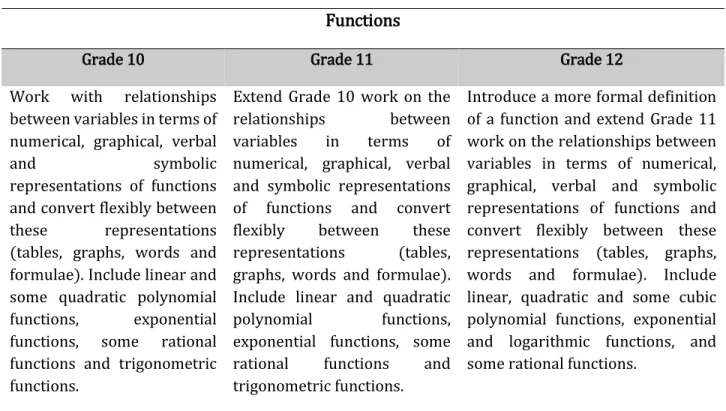
The difficulties which learners come to experience and have to deal with when learning functions (which in most cases are represented graphically) include both sketcking of graphs (Dubinsky & Wilson, 2013) and interpreting graphs (Eraslan, 2008). This does not leave out basic understanding of the function concept itself right from identification (which enables classification of functions) from understanding the algebraic arguments linked with each type of function. For example, the secondary school curriculum in South Africa is structured in a way that it covers a considerably broad family of functions. Relevant to this study, in the Further Education and Training (FET) phase alone, learners are expected to acquire a full understandung of all functions and their graphs as prescribed (Department of Basic Education, CAPS, 2011). These include linear, quadratic, cubic, hyperbolic, exponential, logarithmic and trigonometric functions whereby learners are expected to know how to sketch graphs of these functions and interprete them. The table below gives a summary of the topic overview as per the Department of Basic Education (2011) CAPS document requirements (p.12).
15
Table 1: Overview of the topic functions as per CAPS requirements DBE (2011) Functions
Grade 10 Grade 11 Grade 12
Work with relationships between variables in terms of numerical, graphical, verbal and symbolic representations of functions and convert flexibly between these representations (tables, graphs, words and formulae). Include linear and some quadratic polynomial functions, exponential functions, some rational functions and trigonometric functions.
Extend Grade 10 work on the relationships between variables in terms of numerical, graphical, verbal and symbolic representations of functions and convert flexibly between these representations (tables, graphs, words and formulae). Include linear and quadratic polynomial functions, exponential functions, some rational functions and trigonometric functions.
Introduce a more formal definition of a function and extend Grade 11 work on the relationships between variables in terms of numerical, graphical, verbal and symbolic representations of functions and convert flexibly between these representations (tables, graphs, words and formulae). Include linear, quadratic and some cubic polynomial functions, exponential and logarithmic functions, and some rational functions.
While the above requirements clearly indicate how demanding the concept is of learners, the process of learning it can be explained using Leinhardt, Zastavsky and Stein (1990)’s approach. The authors use the concept of intuitions and misconceptions. They define intuitions as features of the knowledge possessed by a learner/student that exist prior to specific formal instruction. These are forms of knowledge which arise from the learner’s/student’s everyday experiences. Leinhardt et al. (1990)’s view on intuitions is consistent with that of Piaget (1967) in which he uses the word schema (or schemata in plural) instead. Piaget defines a schema as a set of cognitive structures which exist in an individual’s mind and represent certain aspects of the world. These he says result from pre-conceived ideas humans have about the world generally. In line with these two concepts and what they actually are about, Hatano (1996) posits that these cognitive structures differ from individual to the next. These mental structures develop in accordance with an individual’s social, religious, cultural background, and general life experiences which are not the all the same for different people.
16
Apart from intuitions, learning of Mathematics is also characterised by misconceptions according to Smith et al. (1994). They define misconceptions as features of a students’ knowledge about a specific piece of mathematics knowledge that may or may not have been instructed.
Some of the errors on functions from research include the learners’ inability to differentiate between types of functions, inability to interpret graphs of functions, inability to represent functions graphically, converting flexibly between different representations of functions, and more (Sasman, 2011). This is consistent with Markovits, Eylon and Bruckheimer (1986)’s view of learning functions since good understanding of the concept requires two stages, the passive stage and the active stage. The passive stage they say pertains to classification, identification, etc. whereas the active stage (which they regard more complex) is about giving examples of functions which satisfy some give constraints, ability to convert flexibly between different forms and representations of functions, i.e. numerical, graphical, verbal and symbolic representations. Markovits et al. (1986) revealed that among other difficulties learners have when working with functions is the transfer from graphical to algebraic, technical manipulations of functions, more adherence to linearity every time examples of functions are required, etc. (p.24). While the findings by Markovits et al. (1986) are consistent with the South African curriculum statement requirement (DBE CAPS, 2011), they also match the DBE (2011, 2014 & 2015)’s findings on grade 12 learner’s inability to cope with functions.
2.4
Theoretical Framework
In this section, I outline the theoretical framework that enlightens this study on using learners’ errors and misconceptions on grade 11 functions topic as a resource to learn the topic. I discuss constructivism (Piaget, 1967 & Von Glaserfeld, 1995) and the socio-cultural theory of learning (Vygotsky, 1978) as they impinge on my study. Another theory of teaching and learning I draw from is the variation theory, which I discuss in details in latter sub-sections. Piaget’ (1967)’s theory of epistemology (i.e. Constructivism) is the basis for my study as well as Vygotsky (1978)’s socio-cultural theory of learning. I use both theories to discuss how learning mathematics and in particular how learners may have misconceptions which lead to
17
making errors as they learn the topic functions. I also discuss the need for teacher mediation to help learners resolve their errors and misconceptions using the socio-cultural theory in learners’ zones of proximal development (ZPD) (Vygotsky, 1978).
2.4.1 Constructivist Learning Theory
Piaget (1967)’s view of constructivism was brought to light after early deliberations on the theory in the 17th century. This view was that, what is in the mind of a human being, is what is made or constructed by the human mind. Throughout the process of interpretation, the theory was disseminated into different categories two of which being radical constructivism and social constructivism. Notwithstanding their differences, both these types of constructivism point out to cognitive constructivism.
Unlike Radical constructivism, social constructivism is based on postulates about reality, knowledge and learning (Kim, 2001). In this perspective knowledge is constructed based on the culture and the context of the society and environment in which individuals live (Kim, 2001). Social constructivists believe that learning is a social process (Ernest, 1998). At the same time they believe that reality is invented by members of a society or community.
General perspectives of social constructivism on learning include the cognitive tools, idea-based pragmatic approach and situated cognitive perspectives. Hatano (1996) points out that constructivists with the pragmatic/emergent approach believe that understanding of the world can be made possible in a classroom (within a group) from the views of the learners, teachers and the collective views of the other members of the group.
The different views of constructivism which I have alluded to above are a clear indication that over the years of educational reform, the theory has been interpreted and re-interpreted. During these processes of interpretation and re-interpretation, it has also been understood and misunderstood by some educational reformers.
In explaining the learning process in terms of constructivism, Piaget introduced the concept of schema (or schemata in plural), which he referred to as something that helps individuals to understand the world they live in. He defines it as a set of cognitive structures that represent certain aspects of the world. They result from pre-conceived ideas which individuals have. Due
18
to different social, religious, cultural background, and general life experiences, different people have different schemata (Hatano, 1996). This leads to the concepts of assimilation and accommodation. Assimilation involves taking in new information and fitting it into the pre-existing schema. What is newly absorbed loses most of its original meaning and acquires new meaning due to the pre-existing schema. Accommodation happens when a completely new schema forms due to newly acquired information not matching with the pre-existing schema (Hatano, 1996; Sarwadi & Shahrill, 2014; & Smith et al., 1994).
In line with the Piagetian view of learning, I strongly agree with Hatano, (1996) who also strongly believes that human beings have different and unique ways in which they construct knowledge. While Hatano argues that, construction of knowledge is more conceptual by nature, she also believes that construction of knowledge is from experiences of solving problems from those they create rather than those they are imposed with. In the context of this investigation, the problems individuals create or rather the misconceptions which emanate from the process are due to them attempting to cope with mathematics (Olivier, 1989).
Baker, McGaw and Peterson (2007) have also introduced what they refer to as the core ideas in constructivist learning as follows: (a) Knowledge is actively constructed by the learner, not passively received from the outside. It is something done by the learner, not something imposed on the learner. (b) Learners come to the learning situation with existing ideas about many phenomena. Some of these ideas are deeply rooted and well developed whilst others are temporary and unstable. (c) Learners have their own individual ideas about the world, but there are also many similarities and common patterns in their ideas. Some of these ideas are socially and culturally accepted and shared, and they are also part for the languages supported by the metaphors. (d) These ideas are often at odds with accepted scientific ideas, and some of them may be persistent and hard to change. (e) Knowledge is represented in the brain’s conceptual structures and it is possible to model and describe it in some detail. (f)Teaching has to take learner’s existing ideas seriously if it is to be changed or challenged. (g) Although knowledge in one sense is personal and individual, the learners construct their knowledge through their interactions with the physical world, collaboratively in social settings and in cultural and linguistic environment.
19
Constructivism explains how learners come to make errors which result from misconceptions they acquire in the process of learning mathematics (see a latter subsection).
Vygotsky, a Russian educationist who in most cases appeared to be in opposition with Piaget (1967)’s views put forward his own theory of learning, namely, the socio-cultural theory.
2.4.2 Socio-Cultural Theory
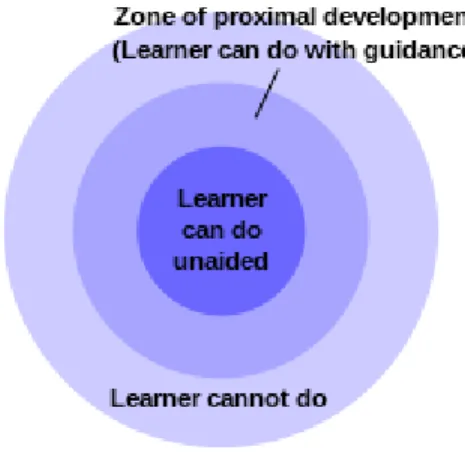
I believe that another lens to use in looking at and explaining the process of error and misconceptions formation (which happen through the process of teaching and learning) could be the socio-cultural theory (Vygotsky, 1978). In this theory Vygotsky presented a relationship between learning and development from a psychological perspective. He proposed what he referred to as the Zone of Proximal Development (ZPD) which he defined as the distance between what an individual can be able to do independently (the actual developmental level) and what they cannot do even when with guidance (the level of potential development). The theory also incorporates the notions of tools, signs, mediators and scaffolding which are important to explaining learning. According to Vygotsky (1978), mediators can be in the form of a teacher, or a parent or an experienced fellow to the learner. Mediators use tools (for example, language of learning and teaching or symbols) to scaffold. Scaffolding is the provision of support and unpacking of the social nature of participatory teaching and learning which takes place within the ZPD, with the aim of initiating effective learning.
Figure 1: The Zone of Proximal Development (ZPD)
20
In attempting to merge Piaget (1967)’s cognitive constructivism with Vygotsky (1978)’s socio-cultural theory, for a learner to construct knowledge (or for learning and development to happen), he/she must be moved by a mediator from the innermost ring of the diagram above to the outermost ring. The ring in between the innermost and the outer rings could be associated with a level of disequilibrium (Hatano, 1996). At this level a learner is stuck with a misunderstanding (or an error or a misconception) but needs a mediator or a more knowledgeable other to be moved through to the next level of development but still within the ZPD.
Learning occurs firstly on the social plane (i.e. within the interaction between the learners and the mathematical tasks) and later on the psychological plane. It starts with learners acquiring information from the environment, and then allowing it to engage with his/her cognitive structures in his/her mind (Smith et al., 1994). This long procession of activities makes a learner to be more prone to misinterpretations and hence development of misconceptions which in turn lead them to making errors.
2.4.3 How I explain errors and misconceptions using constructivism and socio-cultural theory
In this sub-section, I look at learners’ errors and misconceptions in a constructivist perspective but also through the lens of social-cultural theory. I reveal how the two theories together explain how misconceptions can emanate from a learning process and how they lead to learners’ errors.
According to constructivists (Smith et al., 1994) learning is the gradual re-crafting of existing knowledge that despite many intermediate difficulties, it eventually becomes successful. It takes place in the form of constructing knowledge. It is from this learning process whereby errors and misconceptions emanate as a result of learners’ intelligent constructions based on correct or incomplete previous knowledge, and the learners’ rational and meaningful efforts to cope with mathematics (Olivier, 1989).
21
Hatano (1996) considers knowledge to be constructed through a spontaneous reaction which takes place in a learner’s mind as a result of what they are observing or the information they are presented with. In that process misconceptions as well as what Hatano (1996) refers to as procedural bugs emanate. A constructivist then capitalizes on the emerging misconception as in his terms, misconceptions are the strongest pieces of evidence for the constructive nature of knowledge acquisition. Humans have a tendency of interpreting and enriching what is presented to them or what they are observing through construction and restructuring (Hatano, 1996).
In mathematics, misconceptions are said to emanate from overgeneralization of previous knowledge among other things as due to the subject’s cumulative nature, any new learning depends on the previous learning (Olivier, 1989). On the other hand, Mason, Graham and Johnston-Wilder (2005) posit that for any learning to happen there has to be some form of generalization. It just so happens that more often than not, learners tend to over generalize, and that results with misconceptions which drive them into making mathematical errors. Misconceptions are difficult to eradicate because humans do not easily accommodate new ideas when necessary, but rather assimilate new ideas into existing schema (Hatano, 1996). Many people have difficulty relinquishing misconceptions because the false concepts may be deeply ingrained/rooted in the mental map of an individual, and also because later teaching emphasizes computational and manipulative skill than conceptual understanding (Olivier, 1989). Learners learn through transforming and refining prior knowledge into more sophisticated forms (Smith et al., 1994).
As discussed above, the processes which take place as a learner construct knowledge result with “procedural bugs” (Hatano. 1996) which teachers and educationists need to take advantage of and build up knowledge from (Borasi, 1994). As such the following points are vital according to the constructivist perception of the learning process (Smith et al., 1994 & Olivier, 1998): While misconceptions cannot be avoided, they need to be tolerated and be regarded as part of learning. Misconceptions must be exploited by a teacher as opportunities to enhance learning and knowledge construction. Thus, there is a strong interrelation between cognitive development and the constructivist framework for learning.
22
2.4.4 Errors and misconceptions as the essential part of a constructivist framework The accuracy of transformed knowledge is compromised by possible ambiguity and different interpretations by different people. This is because, when information is received by what Hatano (1996), refers to as active humans, it gets interpreted and enriched, or rather supplemented, which result with a newly constructed knowledge. The process of enrichment leads to reorganising and reconstruction of knowledge. That happens when a human being gains more insight in a particular aspect. The unfortunate part of this process is that to a certain extent, what is received does not always remain the same. These processes of learning and knowledge construction and reorganisation unintentionally and undesirably tend to the building up of misconceptions which leads to making errors. Olivier (1989) defines errors as the systemic wrong answers which emanate from underlying conceptual structures. Although some literature conflicts misconceptions with constructivism, I find a very strong and interesting correlation between the two (Olivier, 1989, 1996; Hatano, 1996; etc.). Olivier’s definition of the relationship comes from understanding knowledge construction from the constructivist perspective. This means considering all the processes mentioned above in relation to the construction of knowledge. From understanding that a learner is not seen as a passive recipient of knowledge from the environment and those more knowledgeable; constructivists see a learner as an active participant in the process of constructing his or her own knowledge. Due to the interaction of what the learners already know and what they are acquiring, conceptions and unfortunately misconceptions form. However, according to the constructivism perceptive of learning and knowledge formation/acquiring, this should be taken as a normal process of learning for it enables the construction of new legitimate knowledge (Olivier, 1989; Nesher, 1987). Olivier argues that it starts with the learner attempting to incorporate a new idea into an existing schema. Due to the diversity of what needs to be learnt, it is not always possible to link every new idea with an existing schema. This means that assimilation or accommodation may not be possible. That would result with a learner creating a new “box” by which he or she will try to memorise the new idea. The urge to the creation of this new idea emanates from the state of disequilibrium due to the inability to match the new idea with any existing schema. The learner’s attempt to memorise the new idea results with what is called rote learning - isolated knowledge which is difficult to
23
remember. This isolated knowledge then results with misconceptions, which in turn cause errors. This is learning from a constructivist perspective.
To add on Olivier (1989)’s view of the relationship between constructivism and misconceptions, Borasi (1994) also presents a reconciliation stance between constructivism and learning through misconceptions and errors. This is a complex aspect which requires a teacher to regard learners and thinkers up and above listeners and participants in a classroom discussion.
The implication of constructivism to learning has been a component of literature from many authors (Brodie & Berger, 2010; Lobato, Clarke & Ellis, 2005). Kazemi and Stipek (2001) also had interest in this perspective of learning. These are some of the authors whose perception and acknowledgement of learners as thinkers I found to be relatively clear, and as they assert that learners’ errors and misconceptions need to be taken as a “normal part of the process of constructing knowledge and in fact may be a necessary step in the construction of certain ideas” (Brodie, 2007; p170).
I have also drawn from Makonye and Luneta (2013) as they also established a connection between learners’ errors and misconceptions with constructivism. The researchers did that by bringing about the other two supporting theories, namely, the APOS (Actions, Process, Object and Schema) theory by Dubinsky, Assiala, Schwingendorf, and Contrill (1997) and the
concept image and concept definition theory by Tall and Vinner (1981). The former is all about the processes involved in the learning of a concept and it involves four steps. These are the initial stage where a learner views a concept as an external activity to which minimal meaning he/she can attach, followed by the stage in which the learner views a concept as more closer to him/her but still external though partially appearing as a process. The third stage of conceptualisation according to the APOS theory is whereby a learner internalises the concept. The fourth and final stage is where a learner incorporates the concept in her or his broader mental picture referred to in constructivist terms, as schema. A schema (or schemata in plural) is defined by many in different ways but all definitions converge or point to the same thing which is knowledge organised into structures which are large units of interrelated concepts (Olivier, 1989), (Makonye & Luneta , 2013) and (Hatano, 1996).
24
Makonye and Luneta (2013) also bring about the theory by Tall and Vinner (1981), which is also linked with learners’ errors and misconceptions. A concept image is more or less similar to schema, as the researchers define it as “a cognitive chunk of ideas that a learner has formed in his/her mind regarding all aspects of a specific concepts” (Makonye & Luneta, p. 919). While the APOS theory suggest that errors and misconceptions result with failed attempt to assimilate or accommodate new ideas, this theory of concept imaging and definition suggest that errors and misconceptions come about as a result of concept images constructed by a learner being in conflict with what is believed in and endorsed by a wider mathematical community. Similarly, a concept definition which is likely to be in conflict cognitively with another concept definition is a potential conflict factor and may result with misconceptions.
2.4.4.1 Variation Theory
To better understand a concept, it is more often than not easier to understand it in contrast. This would be taking it in contrast to what it is not. The theory is simply about the fact that for an individual to discern a certain feature of a phenomenon, they might need to be taken through an experience which allows them to make a meaningful deduction out of the phenomena which is presented to them in contrast (Mhlolo, 2013).
Like constructivism and other theories of learning I have already alluded to, variation theory as well breaks down the process of learning right from the beginning to the end using the patterns: contrast, generalisation, separation, fusion and the space of learning.
Contrast is the pattern of variation which suggests that learning takes place from creating a contrast of what the learner has to learn between what it is and what it is not. It is with this pattern of variation that a learner is enabled to compare the critical features of the object of learning and what they are not (Runesson, 2005). For example, in the function concept, a teacher can introduce a simple quadratic function by using the knowledge learners already have on linear functions so as for them to easily compare and differentiate what a quadratic function is with what it is not based on the characteristics of a linear function.
25
Separation pattern suggests that learning takes place through the learners’ ability to see the characteristics of a concept in order to be able to differentiate it from others (Mhlolo, 2013). It suggests that learning happens in a situation whereby a learner is enabled to see critical features of a concept and subsequently create a distinction between this concept and others. Generalisation pattern suggests that learners make conjectures or make conclusions from dealing with similar but many activities (Runesson, 2005). For example, in determining the behaviour of an inequality sign when the inequality is multiplied or divided through by a negative number, a number of investigative activities can be given to a learner to the extent they eventually get to making a generalisation of what to expect whenever such is operated on an inequality. Also exposing learners to numerous examples of a similar nature aids their understanding of the concept through generalisation.
Learning through generalization involves being exposed to tasks of similar nature which are featured by various examples which illustrate critical features of the object of learning (Runesson, 2005).
Fusion is the pattern of variation which also takes into cognisance the learners’ background and their previous experiences. It matches the concepts of errors that they develop from correct or incorrect learning that has happened (Olivier, 1989). It is the pattern of variation through which learners are given an opportunity to simultaneously discern a variety of critical features of the object of learning; hence it is also referred to a synchronic simultaneity (Marton, Runesson, & Tsui, 2004). It is key that before the fusion pattern of variation can be applied, learners are able to identify and differentiate and discern critical features of the object of learning.
The above patterns are key to the objectives of this study in that the remediation approach to teaching functions was planned in cognisance with variation theory. It was through this approach that the teaching that was focused or rather directed at the incorrectly constructed knowledge could take place to create an enabling environment for the learners to discern what they were taught by being given exposure to the critical features of what it is not (Mhlolo, 2013), hence exploit affordance to learning.
26
2.4.4.2 Affordances and Constraints in Learning
An affordance in learning is a contrast of what is referred to as a constraint. These two concepts emanate from what teachers do during their interaction with the learners and the object of learning in a learning environment. The two can serve as a tool to determine the degree to which a mathematical learning concept is made available to learners (Watson, 2007). It is up to the teacher to create an environment which either enables or disables learning to occur. However, for the teacher to have created an enabling environment, it does not necessarily mean that learners can discern the object of learning (Marton & Pang, 2006). Thus the concept of affordance is better explained in contrast to that of a constraint. Both concepts can generate what Watson (2004) refers to as the ecology of participation.
2.4.5 Conceptual Framework
This research seeks to establish if directing the teaching to learners’ errors and misconceptions in the topic of functions could enhance their understanding and further mastery of the topic. It involves establishing the nature of errors learners make and the nature of misconceptions evident in their work while learning functions. The table below summarises some of the categories of errors and misconceptions which I may establish from the learners’ work (Olivier, 1989; Luneta & Makonye, 2010). It is worth noting that there may be other categories of errors and misconceptions emanating from the responses of the learners as I will be doing the analysis.
Table 2: Types of errors and misconceptions and their descriptions
Type of error/misconception Description
Random Non-systematic
Generalization over number Disregarding the different properties of
different numbers
Generalization over operations Disregarding the different properties of different operations
Ignorance of rule restriction Applying a rule where it does not apply
Incomplete application of rule Ability to apply a rule but not able to proceed
Interference of existing learning/knowledge Existing schema in conflict with the new schema