DOCUMENT DE TREBALL
XREAP2015-05
YOUR LANGUAGE OR MINE?
Ramon Caminal
Your language or mine?
Ramon Caminal
yand Antonio Di Paolo
zNovember 2015
Abstract
Do languages matter beyond their communicative bene…ts? We explore the potential role of preferences over the language of use, theoretically and empirically. We focus on Catalonia, a bilingual society where everyone is fully pro…cient in Spanish, to isolate linguistic preferences from communica-tive bene…ts. Moreover, we exploit the language-in-education reform of 1983 to identify the causal e¤ects of language skills. Results indicate that the pol-icy change has improved the Catalan pro…ciency of native Spanish speakers, which in turn increased their propensity to …nd Catalan-speaking partners. Hence, the acquisition of apparently redundant language skills has expanded cooperation across speech communities.
JEL Classi…cations: C26, C78, I28, J12, J15.
Keywords: partnership formation, preferences, segregation, language skills, language use, language policy.
We thank Lorenzo Cappellari, Ana Rute Cardoso, Lidia Farré, Ada Ferrer-i-Carbonell, and Louis-Philippe Morin and for their helpful comments, Frederic Udina (IDESCAT’s director) for fa-cilitating the access to the dataset, Josep Maria Martínez and other IDESCAT sta¤ for their assis-tance, and the Spanish Ministry of Education (grants ECO2013-41022-R and ECO2014-59959-P) and Generalitat de Catalunya (SGR 2014-2017) for their …nancial support. The usual disclaimers apply.
yInstitut d’Anàlisi Econòmica (CSIC) and Barcelona GSE: ramon.caminal(at)iae.csic.es zAQR-IREA, Universitat de Barcelona: antonio.dipaolo(at)ub.edu
1
Introduction
The days when most human beings could go through their life using exclusively their native language are long gone. The latest wave of globalization, and The Internet in particular, has dramatically increased individuals’exposure to multiple languages. It has been estimated that more than one-half of the world’s population speak more than one language (Tucker, 2001). Thus, it is not surprising that multilingualism is attracting a great deal of attention, also among economists. Indeed, economic research has clearly established that language skills have a signi…cant in‡uence on economic outcomes. Studies in two speci…c areas provide useful examples. First, it has been shown that sharing a common language promotes international trade (e.g., Frankel and Rose, 2002; Melitz, 2008). Second, evidence from a variety of countries indicates that ‡uency in the host country’s language has a large e¤ect on immigrants’ earnings (e.g., Bleakley and Chin, 2004; Chiswick and Miller, 2007). Not surprisingly, these results have been mostly attributed to the role of languages as communication devices. After all, the ability to communicate (either directly or through translators) is crucial in trade, as well as in production.
Undoubtedly, the acquisition of additional language skills is bound to facili-tate communication and reduce production and transaction costs. However, to focus exclusively on this dimension, and characterize languages as interchangeable communication codes, can easily lead to quite extreme and misguided views. For instance, Church and King (1993) concluded that multilingual societies should only promote the majority language and hence restrict the use of minority languages to intra-community exchanges.1 In a similar vein, Jones (2000) argued in favor of a convergence towards a single world language. The central argument is analogous to the bene…ts of technological compatibility. If languages are alternative, equally e¢ cient standards, the social optimum requires standardization. From this perspec-tive, the death of languages is seen as a natural, and even desirable, phenomenon in an increasingly globalized world. Similarly, policies that protect minority languages and promote linguistic diversity are suspected of pandering to narrow interests, and presumed harmful for the society as a whole.
1They formalized the idea that learning a second language generates network externalities.
Since individuals do not internalize these externalities, their incentives to learn second languages are ine¢ ciently low. As a result there is room for public intervention. In their model, the cost of learning a second language is the same for everyone. Hence, in the social optimum, speakers of the majority language remain monolingual and communication barriers are eliminated by inducing
By and large, economists have recognized that languages are much more than neutral communication devices. A prominent example is the recent book by Gins-burgh and Weber (2011). They note that preserving linguistic diversity involves non-negligible costs. However, individuals tend to develop some kind of emotional attachment to the language that better de…nes their identity; therefore, limiting the number of languages also generates losses.2
Hence, policy makers should pay attention to both the role of languages as means of communication as well as their subjective, emotional aspects. Unfortunately, we know very little about the relevance of these potential trade-o¤s. Even some basic questions remain largely unexplored. For example, how relevant is the subjective dimension of a language? Does it a¤ect individual behavior in the marketplace or in other social interactions? What does it imply for the design of e¢ ciency-oriented policies?
In this paper we address these issues both theoretically and empirically. We …rst present a theoretical model that illustrates a new channel by which the distribution of language skills in a bilingual society a¤ects the pattern of social interactions. We build on standard theory and assume that sharing a common language is a prerequisite for some types of economic and social interactions.3 On top of this, we introduce the notion of linguistic preferences. We assume that even fully bilingual individuals are not indi¤erent about the language to be used in various situations. These preferences, whose intensity may depend on the individual, may re‡ect an emotional attachment to the individual’s native language or the language adopted as their own in later stages.4
The model considers a bilingual society that has initially an asymmetric distrib-ution of language skills: all native speakers of the weak language are bilingual, with full command of both the strong and the weak language, but most native speakers of the strong language are either monolingual or only partially pro…cient in the weak language. Thus, all agents share a common language, and hence the role of 2In their own words: “Sustaining a high degree of societal diversity could require allocating
substantial resources to creating educational institutions and developing communications and coordination between groups . . . . Since language is an intimate part of individual and group identity, restricting linguistic rights may alienate and disenfranchise groups of individuals whose cultural, societal, and historical values and sensibilities are perceived to be threatened”(page 11).
3See, for instance, Selten and Pool (1991), Church and King (1993), and Weber et al. (2011). 4Some kind of linguistic preferences have already been introduced in a variety of economic
frameworks. See, for example, Grin (1992), Wickström (2005), Caminal (2010), and Mèlitz (2012). Our main focus is on how language skills and preferences a¤ect cooperation between speech com-munities and on the use of the minority language.
linguistic preferences can be isolated from the communicative bene…ts. Cooperation (trade partnerships, marriages, etc.) requires communication and hence the use of a particular language. Such a choice is trivial when all partners belong to the same speech community. However, in the case of mixed partnerships, individuals with strong linguistic preferences may reject optimal partners (in terms of non-linguistic dimensions) and instead match with less desirable, but linguistically homogeneous, partners. In other words, the formation of mixed partnerships requires a satisfac-tory resolution of a linguistic con‡ict. The crucial observation is that the intensity of the con‡ict varies with language skills. In particular, as native speakers of the strong language improve their skills in the weak language: (i) the frequency of mixed partnerships increases, (ii) the use of the weak language also increases.5
We then test these predictions exploiting data from two successive waves of a survey conducted in Catalonia (Spain). The survey provides detailed information on the socio-demographic and linguistic attributes of the respondents as well as the linguistic characteristics of their partners. There are two main reasons why Cat-alonia is a unique test …eld. First, it is a bilingual society (Spanish and Catalan are the two main languages) where the ability to communicate has never been at stake, at least, throughout its recent history, because of the universal knowledge of the strong language (Spanish), just as in the theoretical model. Hence, any im-plications of additional language skills must be attributed to linguistic preferences. Second, new language-in-education policies were introduced three decades ago, after the approval in 1983 of the Language Normalization Act (LNA). With the imple-mentation of this legal reform, education experienced a smooth transition from a system in which Catalan was excluded to one in which Catalan has become the main language of instruction in compulsory education. This policy reform led to a signi…cant improvement of the Catalan skills of native Spanish speakers, whereas all other language skills remained basically unchanged.6 Hence, the heterogeneous ef-5It is important to note that if we abstract from learning costs, such an improvement in
language skills increases the total surplus. The reason is that the equilibrium rate of mixed partnerships is ine¢ ciently low, because individuals do not internalize the negative externalities in‡icted on their potential partners when they unilaterly decide to match with an inferior but linguistically homogeneous partner. This welfare result may provide an e¢ ciency justi…cation for public policies that promote the learning and use of weak languages (provided the learning costs are not excessive).
6We are referring to oral skills, which are the most relevant regarding the formation of a couple.
As discussed in Section4;written skills in Catalan improved for both Spanish and native Catalan speakers, although much less so for the latter group, and Spanish skills remained at very high levels for both speech communities.
fect of language exposure during compulsory education allows us to generate causal estimates of the variable of interest.
The main goal of the empirical analysis is to study the in‡uence of language skills on the formation of mixed couples and the use of the weak language (Catalan).7 In order to identify the causal e¤ect, we exploit an Instrumental variable based on the di¤erential e¤ect by native language of exposure to Catalan as a language of instruction during compulsory schooling. Such an exposure variable was used by Clots-Figueras and Masella (2013) in their study of the impact of the education reform on identity formation, taking a reduced-form approach.8 Since the amount of exposure to the language-in-education reform during compulsory education is imputed on the basis of year of birth, this variable itself could a¤ect partnership formation and language use directly, due to general cohort e¤ects in the outcomes of interest. For this reason, and in the spirit of Bleakly and Chin (2004, 2008, 2010), we include native Catalan speakers in the analysis in order to control for these non-linguistic e¤ects. Therefore, assuming that both native Catalan and native Spanish speakers were equally a¤ected by common trends in the cohorts, the identifying variable is the interaction between the exposure to Catalan during compulsory schooling and a dummy variable for being a native Spanish speaker.
Our results are in line with the theoretical predictions. In particular, the edu-cation reform of the 1980’s, by improving the oral Catalan skills of native Spanish speakers, raised their propensity to …nd a Catalan speaking partner and to speak only Catalan with the partner. Hence, these results indicate that linguistic pref-erences are relevant: as a result, the acquisition of language skills that appear redundant from a communicative viewpoint can signi…cantly reduce segregation. The results turn out to be robust to a battery of sensitivity and falsi…cation tests.
The rest of this paper is organized as follows. In the next section we lay out the theoretical framework and derive two testable hypothesis. In Section 3 we provide some historical background. Section 4 contains the empirical strategy designed to test the main hypothesis. The data set is described in Section 5. The main results 7It has been shown (Bleakly and Chin, 2010, Furtado and Theodoropoylos, 2011; and Chiswick
and Hoseworth, 2011) that the frequency of inter-ethnic marriages among US immigrants is posi-tively a¤ected by English-speaking ability. See also Meng and Meurs (2009) for the case of France. Since the pro…ciency of individuals in the strong language varies a lot from individual to individual, these studies cannot distinguish between linguistic preferences and communicative bene…ts.
8In Section 9 we argue that the e¤ect of the education reform on couple formation is largely
unrelated to changes in identity patterns. On the e¤ect of language policy on identity, see also Aspachs et al. (2008).
and robustness checks are presented in Sections 6 and 7, respectively. Section 8 discusses the empirical strategy and results concerning the second hypothesis. Finally, Section 9 summarizes the paper and discusses the results from an identity perspective.
2
The theory
Our stylized model portrays a new channel by which the distribution of language skills in a bilingual society a¤ects the pattern of social interactions. Following the standard theory, we assume that sharing a common language is a prerequisite for most social or economic interactions. On top of this, we introduce the notion of lin-guistic preferences. If bilingual individuals are not indi¤erent about their language of use, then the universal knowledge of alingua franca, although it guarantees com-munication, does not remove all the obstacles to cooperation between members of di¤erent speech communities. In this context, the acquisition of language skills that may appear redundant have new, non-trivial e¤ects. We …rst present the simplest version of the model, and subsequently will discuss various extensions.
2.1
The benchmark model
Consider a country with two languages, calledA and B. A fraction of the popu-lation is initially socialized in A (they are native A speakers), and a fraction 1
in B (native B speakers). Everyone is fully competent in their mother tongue. These two languages di¤er in their status abroad. In particular, Ais widely known in the rest of the world and hence very useful for communicating with foreigners.9 As a result, native B speakers have strong incentives to learn A. We assume that they do and, moreover, achieve full competence in A, so that they can perfectly communicate with domestic, monolingual native A speakers. In other words, the universal knowledge of A implies that the ability to communicate in any domestic interaction is not at stake. Such an assumption holds in many real world examples, including Catalonia, the subject of our empirical study.10 Moreover, it allows us to emphasize the role of languages beyond their communicative value. The model can be easily extended to take into account a fraction of monolingual speakers of 9Another reason could be that knowledge ofAprovides access to an abundant supply of media
outlets and leisure goods produced in that language.
B. But in that case, language skills a¤ect segregation not only through linguistic preferences but also through changing the ability to communicate.
In contrast,B has no value abroad and hence nativeAspeakers can only bene…t from learning B if this additional skill facilitates domestic interactions. Hence, native A speakers have weaker incentives to learn B: We de…ne below a parameter that represents the level of pro…ciency in B of native A speakers.11
Individuals derive utility from forming partnerships with other compatriots (e.g., trade partnerships, couples).12 In particular, each individual can match a single person. The level of utility obtained from a partnership depends on linguistic as well as non-linguistic factors. With respect to the latter, for each agent i there is a single best match, j, which is reciprocal (so that j’s best match is also i). The best match generates, for each partner, a level of utility gij >0 (pair-speci…c). For
simplicity, we suppose that all other potential matches provide the same level of utility, which is normalized to zero.
The activities of the partnership require communication, and hence the use of a particular language. Therefore, it is important whether or not the two members of a best match belong to the same speech community.13 If they are, then nothing prevents the formation of the best match, since each partner obtains gij; which is
higher than any alternative. However, if they belong to di¤erent speech communities (a mixed match), then language preferences can prevent the formation of the best match. More speci…cally, let individual a be the native Aspeaker, and bthe native
B speaker of a mixed match. If they form the partnership and choose A as the language of communication, then a andb would obtain a payo¤ ofgab and gab wb,
respectively: That is, individual b incurs a cost wb for using their second language.
Individuals di¤er in the intensity of their linguistic preferences. In particular, we assume that wb is the realization of a random variable w distributed over some
interval [0; w] with density function f(w); and distribution function F (w): We assume that f(w) > 0 for all w 2 [0; w] and there are no mass points. If instead 11In some cases, like Wales or the Basque country, the stronger language outside the region is
also the native language of the majority ( is large). However, in other cases, like Belgium, and especially Quebec, the strong international language is the native language of a minority ( is small). However, in contrast to our model, in the last two examples a signi…cant fraction of the weaker speech community is monolingual. See also the discussion at the end of this section.
12For simplicity, we ignore potential foreign partners.
13If everyone has the same probability of being i0s best match, independently of their native
language, then the probability of a linguistically homogeneous best match is for a native A speaker and1 for a native B speaker:We will go back to this issue below.
they choose B, then their payo¤s would be gab a wa and gab, respectively.
That is, if individual a uses B instead of A; this incurs an extra cost of wa+ a,
where wa represents again the cost for using a’s second language (pure preference),
whereas a 0represents the disutility caused by a limited pro…ciency in the second
language. Hence, individuals with a better command of B have lower values of . For simplicity, we assume that both speech communities have identical distributions of pure preferences. That is, wa and wb are two independent realizations of the
random variable w. Whereas w is a …xed individual characteristic, can vary, depending on public policies and individual’s learning e¤orts.14 It is important to note that the value of the outside option for both partners is0since there is always a member of their own speech community among their second best partners, and hence they do not need to worry about the language of use in such a contingency.
In the case of mixed matches, and depending on the values of gab; wa; a; wb,
potential partners must decide whether or not to form the partnership, and the language of use in case they do. We consider the following bargaining environment. First, we assume that all these parameters are common knowledge.15 Second, we assume that if both parties agree on forming the partnership, then they choose the language that maximizes the joint surplus. Both assumptions aim at minimizing the frequency of disagreements. The only friction that remains in place is that one party cannot compensate the other for the use of a second language (non-transferable utility).16 Hence, awill accept forming the partnership and useB only if gab a wa 0: Similarly, b will accept using A only if gab wb 0: These
two participation constraints imply that in equilibrium the coalition will be formed if and only if
minf a+wa; wbg gab
It is important to note that these participation constraints imply that individuals do not internalize the negative externality imposed on their potential partners in case they unilaterally decide not to form the partnership. For instance, suppose that
gab a wa < gab wb = ", where " < gab. That is, the e¢ cient language of use
14It would make sense to assume thata0s limited competence in B, a >0, can also reduce b’s
payo¤. No qualitative result would be a¤ected by such an adjustment.
15Asymmetric information would only exacerbate the ine¢ ciency of equilibria, without bringing
about additional insights.
16Some real world examples may be better described by transferable utility (monetary
compen-sations may be feasible). However, if there is asymmetric information on preferences, and/or if strategic considerations prevent the e¢ cient language from always being implemented, then the
in this particular match is A: However, b cannot accept forming the match, using
A; and incurring a loss of". However, the refusal to form the match is detrimental to a, who loses gab; which is higher than ". More generally, if decisions were taken
by a social planner aiming at maximizing total surplus (…rst best), then the best match would be formed if and only if
minf a+wa; wbg 2gab
Figure1a depicts the equilibrium outcome (i.e., when individuals are allowed to unilaterally abstein from the best match), for the casew >2gab. The region marked
withN (no best match) corresponds to the case where one of the parties prefers not to make the match. Regions marked with A and B correspond to the cases where the partnership is formed and that particular language, A or B, is selected.
Figure1b represents the socially e¢ cient outcome (the solution that maximizes total surplus). Comparing the two …gures, it becomes apparent that there is a region of parameter values for which the best match is not formed in equilibrium but should form according to the …rst best.17
We are particularly interested in studying the impact of a general reduction in
a: that is, an improvement in native A speakers’ pro…ciency in B. In order to
avoid uninteresting technical issues, in the rest of the exposition we will focus on the particular case thatgab =g and ais distributed on ; with a certain density
function that takes strictly positive values in this interval, and has no mass points. Moreover, a andwa are assumed to be independent variables. It will be convenient
to …rst compare two extreme scenarios. Suppose …rst that for alla, ais su¢ ciently
high (the exact condition is g). That is, all as are essentially monolingual, or at least their pro…ciency in B is so low that it will never make a di¤erence in the formation of a best match. Let us call such a distribution of language skills “Scenario
0:” In this case, B will never be used in a mixed match, and hence such a match’s formation will exclusively depend on b’s linguistic preferences. In particular, the best match will be formed if and only if wb g: Alternatively, suppose now that
all as are fully competent inB: i.e., = 0 for all a: Let us call this “Scenario 1:” In this case, both languages are in a symmetric position, and hence the outcome is also symmetric: both languages are used with a …fty percent chance. Moreover, the 17Instead of choosing between AandB, we could have allowed linear combinations of the two
languages, assuming, for instance, that individual utility decreases linearly with the fraction of time in which the second language is used. The qualitative results would remain unchanged.
fraction of best matches that materialize is higher than in Scenario 0. That is: (i) if wb g; as in Scenario 0, all best matches happen; moreover, (ii) if wb > g, then
those matches where wa g also materialize.
The comparative statics are analogous if we consider gradual, but general changes in a: In other words, suppose we start from a situation where a positive fraction of
as are willing to make the best match and useB: that is, < g. Let us describe an improvement ina’s pro…ciency inB as a shift in the distribution of as such that the
initial distribution …rst-order stochastically dominates the …nal distribution (some positive mass of as experience a reduction of their a), and such a shift involves at
least an interval of a with a< g: Then, we obtain the following result:
Result 1 If nativeAspeakers improve their pro…ciency inB;then (i) the fraction of successful mixed matches increases, and (ii) B is used more often in those matches:
See the Appendix for details.
Result 1 is the main hypothesis we want to test in the empirical analysis. That is, an exogenous improvement in the pro…ciency in the weak language on the part of native speakers of the strong language reduces segregation and fosters the use of the weak language.
We can now investigate the welfare consequences of such a change in language skills. First, we focus again on the two extreme scenarios. If all as are monolingual (Scenario 0), then the average payo¤s to the as and bs are given by
Ua0 =F (g)g
Ub0 =F (g)g
Z g
0
wbdF(wb)
Thus, the best match will materialize with probabilityF (g), in which case each party obtains g: However, thebs bear all the costs of using their second language. That is, in Scenario0, bilingual individuals are worse o¤ than monolingual individ-uals.
Alternatively, if all as are also fully competent in B (Scenario 1), then the average payo¤s are
Ua1 =Ub1 =F (g)g Z g 0 Z wa 0 wbdF (wb)dF (wa)+[1 F(g)] F (g)g Z g 0 wbdF (wb)
term of the above expression. However, in this region, b incurs the cost of using
A whenever wb < wa, which is the second term. Also, wa > g with probability
1 F (g), In this case, the match is feasible only if wb < g, in which case b always
incurs the full costs of using A, which is the third term.
Note that thebs are better o¤ in Scenario 1: Ub1 > Ub0. Also, the total surplus is higher in Scenario 1: Ua1+Ub1 > Ua0+Ub0. However, theas may be better o¤ or worse o¤ in Scenario 1: U1
a may be higher or lower thanUa0:The reason for this ambiguity
is the following. Compared to Scenario 0;in Scenario1;on the one hand, abene…ts from the higher frequency of successful best matches, which increases from F (g) to
F (g) [2 F (g)]:On the other hand, they lose their power to impose their preferred language, and have to bear half of the costs of using their second language.18. In other words, even abstracting from learning costs, native A speakers may or may not bene…t from learning B. In contrast, native B speakers always bene…t from this change, since on top of the higher frequency of successful best matches, they enjoy a better language treatment.19 Finally, the total surplus is always higher in Scenario 1. That is, in case nativeA speakers lose, they lose less than the amount gained by native B speakers.20 There are two reasons why Scenario 1 generates a higher total surplus than Scenario 0. First, Scenario 1 generates a higher rate of occurrence of best matches. Second, it allows a reduction in the total discomfort from using the second language, since B can now be used whenever wa < wb:21
In the Appendix we show that the same comparative statics hold for gradual but general changes in a. That is, if we start from a situation where < g, then
we obtain the following result:
Result 2 A general reduction in a; abstracting from learning costs, (i) always
raises nativeB speakers’average payo¤, (ii) may or may not raise native
A speakers’average payo¤, and (iii) always raises aggregate payo¤s. Result 2 provides a welfare assessment of the comparative statics of Result 1. That is, an exogenous improvement in the pro…ciency in the weak language
18For example, iff(w) = 1
w, thenU
0
a Ua1 takes a positive value if w g is su¢ ciently small,
and takes a negative value ifw 2g is also su¢ ciently small.
19Notice that the third term ofU1
b is positive and the second term has a lower absolute value
than the second term ofU0
b:
20Hence, if monetary transfers across speech communities are feasible, and learning costs are
not too high, then Scenario 1 dominates.
21Notice again that the third term of U1
a is positive. Also, 2 Rg 0 Rwa 0 wbdF(wb)dF(wa) < Rg 0 wbdF(wb):
among native speakers of the strong language raises total welfare, at least if we abstract from learning costs. However, it may also have non-trivial distributional implications.
2.2
Discussion
Assortative matching. The previous description of the model was silent about how the best matches are determined. All we did was to show how language skills and preferences in‡uence the intensity of the linguistic con‡ict and determine the rate at which a potential match translates into a realized match. A more sophis-ticated model would embed our bargaining problem into an environment where individuals face search and matching frictions and engage in directed search. In such a scenario, one would expect that individuals with strong preferences would be more likely to …nd a best match within the same speech community. Thus, in-e¢ cient matching would result not so much from the externalities associated with the bargaining failures (as in our benchmark model) but also from the complemen-tarities in search e¤orts. In any case, an increase in the fraction of bilingual native speakers of the strong language is likely to reduce endogamy and raise the total surplus.
Endogenous learning. In the benchmark model, we have treated a’s
pro…-ciency inBas an exogenous parameter. This is compatible with the empirical analy-sis, where we emphasize the exogeneity of policy actions (language-in-education policies). However, language skills can also be the result of voluntary decisions taken by individuals. In other words, causality can also work in the opposite di-rection: a native A speaker engaged in a mixed partnership has incentives to exert a higher e¤ort in order to improve their command of B: Our empirical strategy focuses on one direction of causality (from language skills to couple formation), but clearly does not rule out the possibility of causality in the opposite direction. In any case, it is important to note that even if causality from mixed matches to the acquisition of additional language skills was relevant, this would not diminish the crucial role of linguistic preferences. In other words, if we observe that an individual involved in a mixed match, in spite of the fact that the ability to communicate is not at stake, is willing to undertake a costly e¤ort in order to acquire additional language skills, then this also indicates that individuals’linguistic preferences are indeed a relevant factor in the formation of linguistically mixed matches.
Monolingual minority speakers. Another useful generalization of the bench-mark model would consist in relaxing the assumption that all the members of the weak speech community are fully competent in the strong language.22 If a fraction of the bs are monolingual, then Result 1 would still hold. More speci…cally, an improvement ina’s pro…ciency in B (lower a) would increase the fraction of mixed
matches. The argument is the same one used in deriving Result 1, but reinforced by the presence of an additional channel. A reduction in a increases the
proba-bility that a is willing to form the match and use language B: But now such an adjustment applies to a larger base: not only those potential matches with high values ofwb (the pure preference e¤ect), but also to those matches with high values
of b (better communication e¤ect). For the same reason, such an improvement in
language skills expands total welfare by a greater amount, and improves the use of
B. Finally, a general improvement ofb’s pro…ciency inA (a general reduction in b)
will have the symmetric e¤ects (more successful best matches and more frequent use of A):
Learning costs. Our welfare results ignored learning costs. Of course, a com-plete discussion of the policy implications of our model would require considering not only the bene…ts, which has been our focus, but also the costs. In any case, two straightforward remarks are in order. First, public e¤orts to promote the weak language are more likely to raise the total net surplus when the sizes of the two speech communities are not very di¤erent: As falls, starting from a level higher than one-half, the total costs associated with learning the weak language are re-duced and at the same time the potential gains from cooperation between speech communities increases. Second, if the two languages are relatively close, then the learning costs are lower and hence promoting the weak language becomes cheaper.23
3
Historical background
Catalan can be regarded as the native language of Catalonia. It is a Romance language, originating from Latin in the territory in the ninth century. As a result of the expansion of the Catalano-Aragonese crown, it soon spread out into other 22Such an assumption does not …t, for instance, the cases of Belgium, Quebec, the Ukraine, or
Latvia.
23Both conditions are met in the case of Catalonia: the two main speech communities have a
similar size and, as discussed in the next section, both languages have evolved from Vulgar Latin, and hence the distance between them is relatively small.
regions, such as Valencia and the Balearic Islands (where it is still spoken) and overseas.24 Spanish (Castilian), another Romance language, arrived in Catalonia as early as the …fteenth century and consolidated its position among the elites during the eighteenth century. The general population remained primarily monolingual in Catalan, and only gained access to Spanish with the expansion of elementary education (Branchadell, 2006).25
During Franco’s dictatorship (1939–1975), Catalan was restricted to the private sphere, and nevertheless transmitted (mostly orally) from parents to children in a large fraction of the native Catalan families. In contrast, Spanish was the only o¢ cial language and the only language used in education. Towards the end of this period, repression against Catalan eased to some extent: books and magazines writ-ten in Catalan started getting published (of course, subject to censorship), but the presence of Catalan in public events was systematically precluded. Moreover, the social use of Spanish in Catalonia was strongly reinforced by the massive migration from southern Spain (especially in the 1960s). By the end of the 1970s, Catalan was the native language of almost one-half of the population, who at the same time were fully competent in Spanish. In contrast, most of the native Spanish speakers (40% of the population of Catalonia had been born outside the region) were monolingual or only passively bilingual (Woolard and Gahng, 1990; Siguan, 1991).
During the transition from dictatorship to democracy, the reestablishment of the (provisional) regional government of Catalonia (the Generalitat provisional) prompted the …rst attempts at promoting the Catalan language. In particular, over the period 1978–1982, Catalan became a compulsory subject (three hours per week) in all schools. Also, a small fraction of primary schools (whose pupils were mostly native Catalan speakers) adopted Catalan as the medium of instruction.
The true turning point for language-in-education policies arrived a bit later, after the constitution of the permanent regional government (the Autonomous Commu-nity) in 1980. The new entity soon acquired decision powers in important areas such as education and the public media. In 1983, the regional parliament passed (unanimously) the “Language Normalization Act” (LNA), which aimed at making 24Catalan literature ‡ourished during the Middle Ages with writers such as Ramon Llull and
Joanot Martorell (author of the celebrated Tirant lo Blanc).
25Massive school enrollment did not take place in Spain until the twentieth century. Even
though elementary education became compulsory in 1838, the percentage of the primary-school age population enrolled in school was only 42% in 1872, far below the levels prevailing in contemporary France and England (Nuho¼glu Soysal and Strang, 1989).
all pupils fully competent in both languages (Spanish and Catalan) by the end of compulsory education. It also de…ned an integrative education model, in which children were not separated on the basis of the language spoken at home.
The LNA set the legal framework that allowed the dramatic changes in lan-guage policy that occurred over the next two decades. However, its application was gradual. In the period 1984–1993, the two languages were taught as subjects for a similar amount of hours. Also, they were both used as the language of instruction in proportions that varied over time (the average fraction of subjects taught in Catalan increased over time) and geographycally, depending on the linguistic characteristics of the students and teachers’language skills.26
The LNA also introduced “language immersion programs”in the primary schools and preschools, inspired by those implemented earlier in Quebec. These programs were aimed at schools in predominantly Spanish-speaking neighborhoods. Schools in immersion programs used Catalan as the only language of instruction for the …rst years of education and followed a speci…c methodology to stimulate the acquisition of Catalan as a second language. Spanish was introduced as an additional language of instruction only at a later stage (normally grade 3). Immersion programs were tried in 1984 in a handful of schools, but they expanded very quickly. In 1990 they involved about one-fourth of all public schools.
As a result, at the beginning of the 1990s, Catalan had become the preferred language of instruction in most primary schools, although Spanish was still dom-inant in secondary education (Artigal, 1997).27 Since 1994, the authorities (after a favorable ruling by the Spanish Constitutional Court) gave Catalan full priority as the language of instruction in all public educational institutions, but in practice Spanish has also been used, particularly in secondary education (Muñoz, 2005).28 In summary, education experienced a gradual transition from a system from which Catalan was excluded to one in which Catalan has become the main language of 26Some minimum mandatory requirements were set. Catalan had to be used as the language of
instruction in at least one area of study (out of eight) from grades 3 to 5, and in two areas from grade 6 onwards, while Spanish had to be used as the language of instruction in at least one area throughout the entire curriculum.
27The share of primary schools using Catalan as the main medium of instruction rose from 42%
in 1986 to 73% in 1992, while those employing both Catalan and Spanish decreased from 33% to 24% over the same period (Vila-i-Moreno, 2000, and Vila-i-Moreno and Galindo-Solé, 2009).
28Unfortunately, we do not have more precise information on the evolution of the average number
of hours taught in each language, or their geographical variation. All we know is that the use of Catalan increased over time and that di¤erences in language policies between schools did not cause a signi…cant reallocation of students.
instruction, at least in compulsory education.29
Such an asymmetric treatment of the two languages has apparently produced a fairly symmetric distribution of language skills. At the end of compulsory edu-cation, students’ levels of pro…ciency in Catalan and Spanish are similar (Consell Superior d’Avaluació del Sistema Educatiu, 2013). Moreover, the level of pro…-ciency in Spanish of students coming out of Catalan schools is similar to the rest of Spain (Instituto de Evaluación, 2011). From a dynamic perspective, the educa-tional reform improved the oral Catalan skills of native Spanish speakers (and the written skills of both native Catalan speakers and native Spanish speakers), with basically no e¤ect on the Spanish skills of either speech community.30
The regional authorities also sought to promote the knowledge and use of Cata-lan using a variety of means. For instance, in 1983 the regional government launched a Catalan-only TV channel (and a radio station) that managed to capture about 20% of the audience on average. The same year, it started the …rst catalanization campaign (Norma), which was followed by successive campaigns with di¤erent goals and formats. Finally, the “Language Policy Law” of 1998 also introduced several requirements that raised the value of Catalan skills in the labor market.31
4
Data and descriptive statistics
The data used in the empirical analysis are drawn from the Survey of Language Use of the Catalan Population, a representative survey that is carried out by the Catalan Statistical Institute (IDESCAT). We use two repeated cross-sections (waves 2008 and 2013), which originally contain 6,767 and 7,255 observations, respectively. The database is unique, especially regarding sociolinguistic characteristics. On top of the standard socio-demographic variables (gender, year of birth, place of birth, place of residence, education, etc.), it reports various linguistic variables of special interest for our analysis: the respondent’s native language (…rst language spoken at home during childhood), habitual language (most frequently used), the language of 29The education reform a¤ected not only the language of instruction. New textbooks and
in-structional materials replaced the ones produced under the supervision of Franco’s educational authorities, and new generations of school teachers, better educated and more pro…cient in Cata-lan, joined the system. Also, specialized teachers were hired to ful…l the LNA’s objectives.
30See also Vila (2008) and references contained there.
31For instance, it established pro…ciency requirements in Catalan to access public sector jobs,
and introduced various regulations a¤ecting the language choices of retailers, restaurants, and hotels.
self-identi…cation, as well as the respondent’s pro…ciency (understanding, speaking, writing and reading) in both Catalan and Spanish. All these variables are self-reported. The survey also includes several questions about the respondent’s (current or former) spouse or partner.32 We pay special attention to the partner’s language33 and to the relative use of Catalan (with respect to Spanish) with the partner. Moreover, the survey also includes detailed information about family background and parental language habits.
The restricted sample used in the baseline analysis includes individuals born in Catalonia and those born in the rest of Spain who migrated to Catalonia at age 6 or earlier. The goal is to focus exclusively on individuals who completed their entire schooling in Catalonia. We also exclude individuals born before 1950, after 1990, and those who were students at the time of the survey. Given the main research question, it is also natural to exclude individuals who never had a partner (less than 7% of the restricted sample). Finally, in order to reduce the degree of unobserved heterogeneity in the data, we also discard the very few remaining observations of individuals whose native language or whose partner’s native language is neither Spanish nor Catalan. The resulting restricted sample has 5,357 observations, 2,553 from the 2008 wave and 2,804 from the 2013 wave.
Individuals’native languages (as well as the habitual and self-identi…cation lan-guage) are classi…ed into three categories: (1) only Catalan, (2) both Catalan and Spanish, and (3) only Spanish. Thus, an immediate question is how to classify the middle group: that is, where to draw the line between these two speech communi-ties. In the baseline analysis we choose a strict de…nition of the Spanish speaking community (the main focus of the analysis) and hence allocate the middle group to the Catalan speaking community. In other words, we say a respondent is a native Spanish speaker if they reported option (3), only Spanish, as their native language. According to this de…nition, native Spanish speakers amount to about 45% of the restricted sample (2,396 individuals). The rest (individuals selecting options (1) and (2), 2,961 observations) are classi…ed as native Catalan speakers. Of course, 32We do not know the legal status of their relationship (married or not), but we do know
whether or not they live together. In fact, some of our results are strengthened when we restrict the analysis to stable couples (those who live together).
33Unfortunately, this information is collected in a slightly di¤erent way in the two waves of
the survey. In 2008, the survey inquired about the partner’s habitual language, whereas in 2013, about the native language. Since the results are virtually identical when we estimate the model(s) separately for each wave (results available upon request), such a small inconsistency in data collection is not likely to have a sizeable impact on the results.
we checked that the main results are robust to alternative de…nitions.
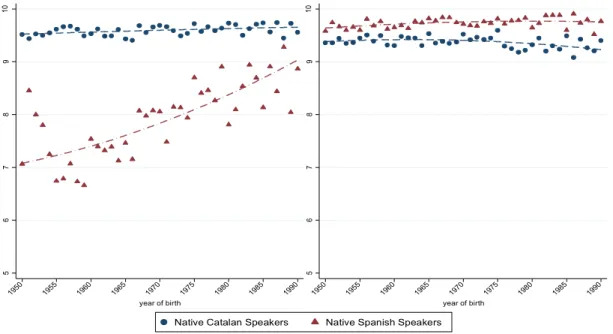
The language pro…ciency variables are coded with a 0–10 scale, with 0 being the lowest, and 10 the highest, level of pro…ciency. We claim that oral skills (and in particular, the ability to speak) are crucial in couple formation, whereas writing skills are much less important. Moreover, our empirical strategy can be more easily justi…ed if we restrict attention to oral skills. Figure 2 displays the average oral pro…ciency in Catalan and Spanish (and a quadratic …tted line) by year of birth, for both native Spanish speakers and native Catalan speakers. As expected, oral Catalan pro…ciency is uniformly high for native Catalan speakers (who acquired oral competency during childhood within the family), whereas successive cohorts of Spanish speakers exhibit a clear positive trend. Moreover, oral Spanish ‡uency is stable across the cohorts and ranges around 9.5 for both speech communities. Thus, native Catalan speakers are largely bilingual (with an excellent command of both languages), whereas earlier generations of native Spanish speakers had a limited command of Catalan, and younger generations are becoming increasingly bilingual, possibly due to the language-in-education reform.
For the sake of comparison, Figure 3a displays written Catalan skills. Note that written pro…ciency improves for the younger cohorts of both speech communities, with a more pronounced increase for native Spanish speakers. As in the case of oral skills, the level of written Spanish pro…ciency (Figure 3b) is uniformly high and virtually identical for both speech communities. Note that this evidence clearly identi…es Spanish as the strong language, as de…ned in the theoretical model: that is, the language shared by all speech communities.34
The partner’s language is also classi…ed into the same three categories as the respondent’s native language. In the baseline analysis, we de…ne a respondent’s partner as a Catalan speaker if either option (1) or (2), Catalan-only or Catalan and Spanish, is reported, which is consistent with the above de…nition of the re-spondents’native languages. Language use with the partner is instead coded with an ordinal scale (from 1 to 5): (1) only Catalan, (2) more Catalan than Spanish, (3) equal Catalan and Spanish, (4) more Spanish than Catalan, and (5) only Spanish.35 In the baseline analysis we choose a strict de…nition of the use of Catalan: we say a 34This evidence is also compatible with the results of the systematic tests mentioned in Section
3 conducted by the national educational authorities.
35The distribution of this variable is quite concentrated on the extreme options, (1) and (5):
respondent uses Catalan with the partner if option (1) has been reported: i.e., only Catalan. Once again, various robustness checks have been conducted.
Table 1 shows that Catalan society is noticeably fragmented along linguistic attributes. In particular, about two-thirds of native Spanish speakers have a part-ner who speaks only Spanish. Since we have assigned intermediate cases to the Catalan speaking community, the level of endogamy for native Catalan speakers is even higher (about three-quarters). An important observation is that endogamy is related to language skills. More speci…cally, native Spanish speakers with high oral pro…ciency in Catalan (with an index greater than or equal to 8) have a signi…cantly lower level of endogamy (about 7 percentage points less). Similarly, the fraction of native Spanish speakers that use only Catalan with their partner also increases by a similar amount when we condition on high pro…ciency in Catalan.
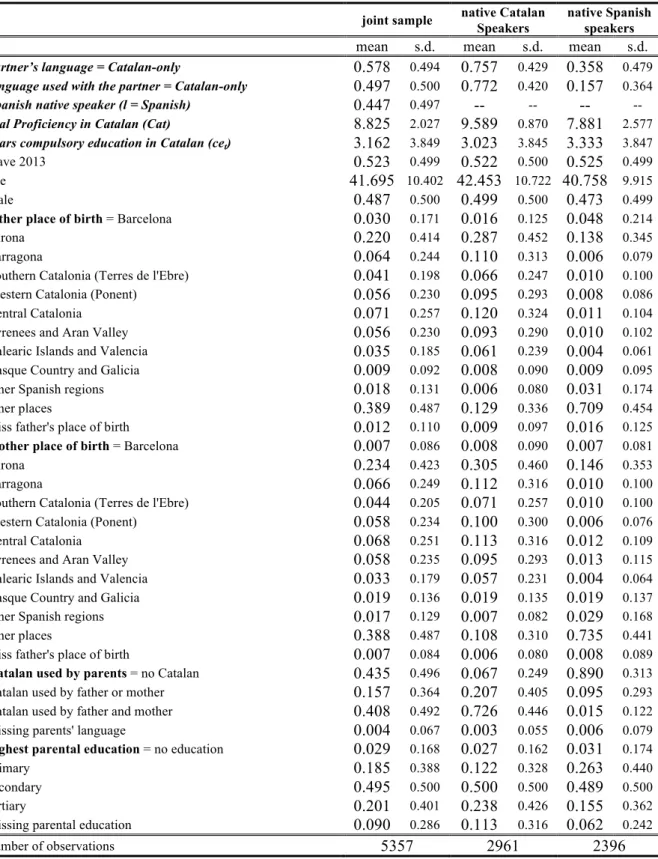
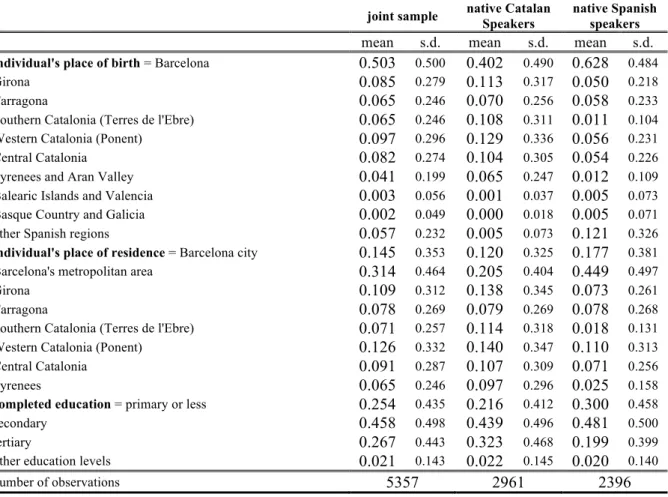
These results are compatible with the predictions of the theoretical model: there is a positive association between additional language skills that are redundant from the communicational viewpoint, and linguistic fragmentation in partnership forma-tion. In the rest of this paper we investigate in more detail the empirical relevance of the theoretical results. First, we present a simple regression setup in which we take into account the observable covariates and provide conditional correlations. Second, we apply an instrumental variable strategy that allows a causal interpre-tation of the results. Finally, we present several robustness checks and sensitivity analyses. The full set of control variables that are used in the rest of the paper is presented in Table 2, together with basic descriptive statistics by language group.
5
Descriptive evidence: OLS estimates
We consider two di¤erent left-hand-side variables: (i) an indicator that takes the value of 1 if individual i is matched with a Catalan-speaking partner, and zero otherwise, and (ii) an indicator that takes the value of 1 if individual i uses only Catalan with their partner, and zero otherwise. For each of the two outcomes, we specify a linear probability model (OLS):
Yit = + 0Xi+ Cati+ t+"it (1)
where the outcome Y of individual i born in year t depends on a set of controls,
X, oral pro…ciency in Catalan, Cat, year of birth …xed e¤ects, ; and a random disturbance, ". The coe¢ cient of interest is . We start with a parsimonious
speci…cation that includes as controls a dummy for wave, a gender indicator, and a cubic polynomial of age, which picks up age di¤erences that are not fully captured by cohort dummies.36
We next include several controls for parental background (parents’place of birth, education, habitual language) and for individual attributes (place of birth, place of residence, and completed education), in order to check whether the coe¢ cients that relate language skills with partnership formation and language use are robust to the inclusion of a more demanding set of controls.
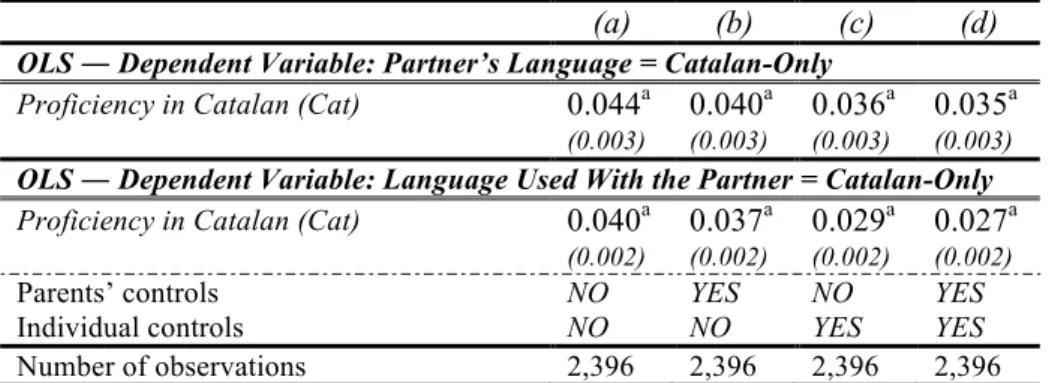
Given that the testable hypothesis refers to native speakers of the strong lan-guage, we start by presenting the results obtained for the subsample of native Spanish speakers. Selected estimates for the two outcomes are presented in Table 3 (the complete results can be found in Tables A1a and A1b in the Appendix). The estimates from the baseline speci…cation (column a) indicate that a marginal increase in oral pro…ciency in Catalan is associated with an increase by about 4:5
percentage points in the probability of having a Catalan-speaking partner. Simi-larly, better skills in the weak language on the part of native speakers of the strong language is associated, to a similar extent, with a higher likelihood of using only Catalan with the partner. These conditional correlations are similar, but slightly lower, when we control for parental and individual characteristics (columns b, c, and d).37
Essentially, the only statistically signi…cant parental characteristic seems to be the parents’ habitual language. Having at least one parent whose habitual lan-guage was Catalan is positively related to the two outcomes. Conditional on the parents’habitual language, their place of birth is not signi…cantly related with the probability of choosing a Catalan-speaking partner.
In contrast, several individual controls are signi…cantly correlated with the two outcomes. If the place of birth, and even more importantly, the place of residence, is an area with a relatively high fraction of Catalan speakers, the propensity to 36Notice that the use of two di¤erent cross-sections enables the simultaneous inclusion of age
and year of birth (since the sample contains individuals born in the same year but of di¤erent ages), which is especially useful for the identi…cation strategy discussed in the next section.
37We are aware of the fact that the above-mentioned controls are unlikely to represent
exoge-nous covariates. This is because some of the individual characteristics (like place of residence and education) are choice variables, potentially related to the error term of the outcome equation(s). Moreover, parental characteristics, as well as individual place of birth, could re‡ect unmeasured parental characteristics that are potentially endogenous with respect to the two outcomes. There-fore, the evidence regarding these control variables must be interpreted with caution.
choose a Catalan-speaking partner and/or to use only Catalan with the partner is higher. Having completed tertiary education is also positively related with both outcomes.
The results obtained by applying OLS to the subsample of native Spanish speak-ers are virtually identical to those obtained from the pooled sample of both Spanish and native Catalan speakers, as shown in Table 4. This means that most of the conditional correlations between oral pro…ciency in Catalan and the two outcomes are driven by the variation observed within the Spanish speaking community.
Overall, the evidence using observational data is consistent with the predictions of the theoretical model. Namely, in a bilingual territory where virtually every-one is fully pro…cient in the strong language, better skills in the weak language on the part of native speakers of the strong language is associated with a higher frequency of mixed couples and a more intensive use of the minority language with the partner. Nevertheless, these conditional correlations might not represent the causal mechanism portrayed by the theoretical model.
Indeed, using observational data to estimate the causal relation between lan-guage pro…ciency and couple formation, or lanlan-guage use, is challenging for three main reasons. First, partner choice/language use and language skills are likely to be correlated with common unobserved factors, opening the door to the typical omitted variable bias. Second, language competence is self-reported, and hence measurement error bias could also be an issue due to the systematic tendency to over-report language skills. Third, we observe language skills only at the time of the interview, but this variable itself is likely to be a¤ected by the linguistic character-istics of the partner. In other words, a native Spanish speaker is likely to improve their Catalan pro…ciency if matched with a Catalan speaker. This implies that reverse causality might also generate an additional source of inconsistency. Overall, OLS estimates of the relations between language pro…ciency and couple formation or language use are unlikely to re‡ect the causal parameters of interest. Therefore, in the next section we present the identi…cation strategy that enables us to obtain (plausibly) causal estimates, and hence a more powerful test of our theory.
6
Causal evidence: Identi…cation strategy and IV
estimates
6.1
Empirical framework
This section describes the empirical strategy to generate consistent estimates that can be interpreted as causal relations rather than conditional correlations. We exploit the change in the language of instruction that took place in Catalan schools after the implementation of the “Language Normalization Act” (LNA) of 1983. The LNA aimed speci…cally at turning the entire Catalan population bilingual, regardless of linguistic origins and family background. Hence, the exposure to the new language-in-education policy generated an exogenous improvement in the Catalan skills of younger cohorts, especially of native Spanish speakers.
Two important remarks are in order. First, oral skills in Catalan improved only for native Spanish speakers, since Catalan was in any case orally transmitted within Catalan-speaking families. Second, exposure to the language-in-education reform depends on the year of birth but also on the number of years of schooling. However, the second variable is endogenous. Therefore, in order to isolate the exogenous component we adopt the strategy followed by Clots-Figueras and Masella (2013), who restricted attention to exposure during compulsory education. They constructed a variable that measures the (potential) number of years of compulsory schooling under the linguistic regime introduced by the 1983 reform, which can be interpreted as an “Intention to Treat” variable.38 More speci…cally, Clots-Figueras and Masella (2013) assumed that individuals born in 1977 or after received all their compulsory schooling in Catalan, while those born between 1970 and 1976 were just partially exposed to the reform, with one year of exposure for the former cohort, up to seven years for the latter cohort. Individuals born before 1970 were never a¤ected. The length of compulsory education in Spain was eight years under the legal framework implemented in 1974 (“Ley General de Educación”) from ages 6 to 14. A new law passed in 1990 (LOGSE) extended the number of years of compulsory education to ten (from ages 6 to 16). This means that individuals born before 1983 38That is, the number of years of schooling in Catalan, assuming: a) no grade repetition, b)
perfect compliance with compulsory age of school attendance, and c) uniform use of Catalan as medium of instruction in the schools. The last assumption is the most restrictive, since in the early years of application of the reform, the use of Catalan for general teaching purposes was weaker in schools with a majority of native Spanish speakers. However, the focus of our analysis is precisely the e¤ect of the reform on native Spanish speakers (for whom the treatment was less
were subject to eight years of compulsory schooling, and those born in 1983 or after to ten years. 39
Thus, the variable capturing compulsory exposure to Catalan at school,cet, can
be conveniently expressed in the following way:
cet= 8 > > < > > : 10; if t 1983 8; if 1977 t <1983 t 1969; if 1970 t <1977 0; if t <1970 (2)
Notice that the variation in cet is only determined by the individual’s year of
birth, which is obviously not a choice variable. Indeed,cetseems to be an appealing
way to extract an exogenous component from the positive trend in oral language skills observed over the successive cohorts of native Spanish speakers. However, this variable itself is unlikely to be a valid exclusion restriction to identify the causal e¤ect of language pro…ciency on outcomes. In fact, cet could capture both
the language pro…ciency e¤ect of the LNA as well as other cohort e¤ects that potentially a¤ect directly the outcomes of interest (i.e., partnership formation and language use), through non-language-related channels.
In order to control for the direct (common) e¤ects of birth cohort on the out-comes of interest, we include native Catalan speakers in the analysis. This is in the spirit of the identi…cation strategy proposed by Bleakley & Chin (2004, 2008 and 2010). They estimate the (private and social) returns to English pro…ciency among US immigrants, exploiting the well-established fact of the existence of a “critical period” of language acquisition (i.e., immigrants who arrive in the host country at a very young age assimilate the language more easily). Their identifying variable is the interaction between age at arrival with a dummy that takes the value one if the immigrant comes from a non-English speaking country. Under the assumption that the non-language e¤ects of early migration are the same for immigrants arriving from English speaking countries as for those from non-English speaking countries, the di¤erential e¤ect of age at arrival for those who migrated from a non-English speaking country should be purged of non-language-related e¤ects and thus would represent a valid exclusion restriction.40
39The results are una¤ected by the change in the length of compulsory education, since we
obtained virtually the same results imputing eight years of exposure (instead of ten) also to individuals born after 1982.
40Basically the same strategy has been applied by Miranda and Zhu (2013a, 2013b), and by
In our case, we exploit the fact that oral language skills (the most relevant language attribute a¤ecting partnership formation) are also acquired within the family at an early age. Hence, the language-in-education reform did not exert any signi…cant e¤ect on the oral pro…ciency in Catalan of native Catalan speakers or the oral pro…ciency in Spanish of native Spanish speakers. Moreover, the Spanish skills of native Catalan speakers have remained very high and stable over cohorts.
Therefore, using the pooled sample of native Spanish speakers and native Cata-lan speakers, we use the interaction between exposure to CataCata-lan during compulsory schooling (cet) and the indicator that identi…es native Spanish speakers as an
exclu-sion restriction, controlling for (common) cohort e¤ects in the outcomes of interest. The underlying assumption of this identi…cation strategy is that both language communities were subject to the same general cohort e¤ects, except that we allow the treatment (compulsory policy exposure) to a¤ect (with increasing intensity) the oral pro…ciency in Catalan of the treated cohorts of native Spanish speakers. In other words, we assume that any speci…c e¤ect experienced by native Spanish speakers a¤ected by the policy change should be (plausibly) attributed to better language skills.
This identi…cation setup can be easily represented by a two-equation system, where the skills in oral Catalan (Cat) of individuali, born in cohortt and a native speaker of l (l = Spanish; Catalan) is the dependent variable of the …rst-stage equation, which contains as right-hand-side variables a set of controls (X), year of birth …xed-e¤ects ('t), an indicator for native Spanish speaker (l =Spanish), and
its interaction with cet (as identifying variable):
Catitl = + 0Xi+ I(l=Spanish) + I(l =Spanish) cet+'t+uitl (3)
The second-stage equation explains the two outcomes of interest (having a Catalan-speaking partner and language use with the partner) and includes pro-…ciency in oral Catalan as an endogenously determined covariate:
Yitl= + 0Xi+ I(l=Spanish) + IVCatitl+ t+"itl (4)
Under the validity of the identifying assumption, the 2SLS estimation of Equa-tions (3) and (4) should provide the causal e¤ect of oral ‡uency in Catalan on each of the outcomes ( IV) among native Spanish speakers who improved their language
pro…ciency due to exposure to the language in their compulsory schooling. This is because 2SLS provides an estimate of the endogenous right-hand-side variable that exploits only the variability of language skills that is produced by the instrument among the subpopulation of compliers (i.e., a “local” estimate of the treatment e¤ect).41
It is important to emphasize that the assumptions under which our identi…cation approach is valid are not trivial, which is the reason why in Section 7 we present a battery of robustness checks and falsi…cation analyses.
6.2
Estimation results
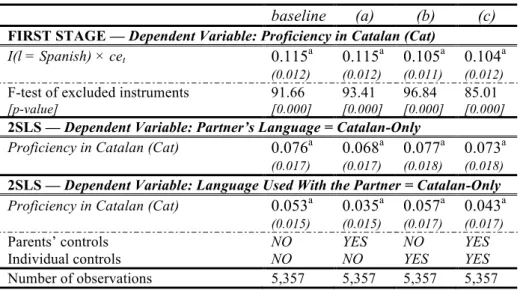
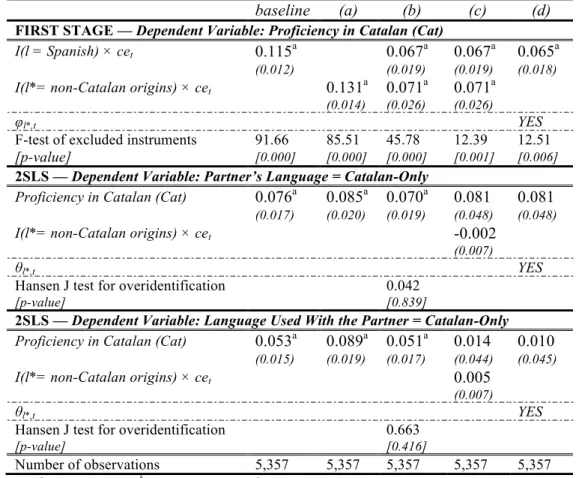
Selected 2SLS estimates of Equations (3) and (4) are displayed in Table 5 (the complete results of the …rst-stage regressions can be found in Table A2 in the Ap-pendix). Overall, the results obtained from our identi…cation strategy are in line with those obtained by OLS, and hence consistent with the theoretical predictions. More speci…cally, the causal e¤ect of better Catalan skills among Spanish speak-ers on the probability of having a Catalan-speaking partner is just slightly higher (but not statistically di¤erent) than the OLS estimate. Using the parsimonious set of controls, a unit increase in ‡uency in oral Catalan increases the likelihood of a mixed match by 7.6 percentage points (versus an OLS estimate of 4.5 percentage points for the joint sample). As we add parental controls, the point estimate drops slightly, but still remains positive and highly signi…cant. However, in contrast to the OLS strategy, including individual controls generates a modest increase in the coe¢ cient of interest, while controlling for both parental and individual characteris-tics provides virtually the same estimate as in the baseline speci…cation. Regarding the second outcome (the use of Catalan with the partner), our IV approach gener-ates estimgener-ates that are much more similar to those obtained by OLS. In particular, for the baseline speci…cation (column (a)), a one unit increase in ‡uency in oral Catalan increases the probability of speaking only Catalan with the partner by 5.3 percentage points, slightly above the OLS estimates of 4–4.3 percentage points.
The e¤ect of parental and individual covariates on the second outcome are anal-ogous to the …rst outcome case, and hence the results of the baseline speci…cation appear very robust. The di¤erence between the OLS and 2SLS estimates could be 41In the empirical analysis, we take into account clustering of the standard errors at the year of
due to the fact that the latter estimator exploits all the variation that is observed in the data, whereas the former is based only on the variation generated by the instrument among the treated cohort of the subsample of native Spanish speakers. Moreover, the presence of measurement error in self-reported language pro…ciency, which could cause a downward bias in the OLS estimate, could be an additional (and probably complementary) explanation for this divergence. It is important to note that the …rst-stage estimates corresponding to our identifying variable (the in-teraction between language exposure during compulsory schooling and the indicator for being a native Spanish speaker), presented in the upper panel of Table 4, has the expected sign and is strongly signi…cant. Thus, native Spanish speakers a¤ected by the language policy did improve their oral pro…ciency in Catalan. The correspond-ing estimates obtained uscorrespond-ing di¤erent speci…cations are quite stable. Moreover, the
F test for weak identi…cation indicates that the instrument is su¢ ciently strong in all speci…cations. Overall, the results obtained from the IV strategy provide empirical support for the causal predictions of the theoretical model. Thus, better pro…ciency in the weak language of native speakers of the strong language (gener-ated by a plausibly exogenous source of variation) fosters their propensity to form mixed partnerships and use the weak language more intensively. As mentioned above, some of the assumptions used in our estimation strategy require further scrutiny, especially because a causal nature depends on the overall validity of our identi…cation strategy. The next section presents the results of several robustness checks and falsi…cation analyses.
6.3
Sensitivity analyses
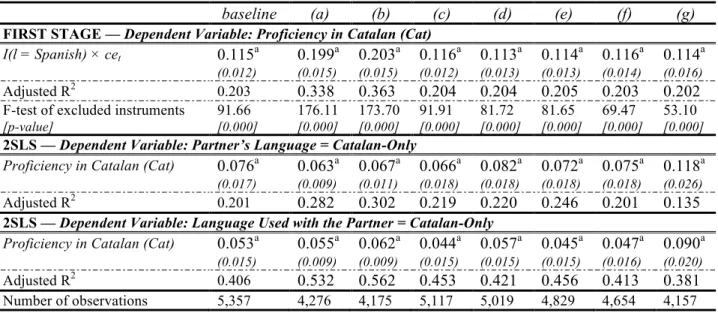
In this section we present several sensitivity analyses of our baseline speci…cation.
Gender. So far we have assumed that gender di¤erences in the outcomes of interest are well captured by a shift in the intercept, but it could be the case that language skills have a di¤erent e¤ect on partnership formation and language use by males and than by females. Therefore, we run separate estimations of Equations (3) and (4) for males and females, for each of the two outcomes. The results for partnership formation (second panel of Table A3 in the Appendix) reveal that the e¤ect of Catalan skills on the probability of …nding a Catalan-speaking partner is somewhat higher for females, albeit not statistically di¤erent from the males’coef-…cient. Females’Catalan use with their partner is also more sensitive to increased
pro…ciency due to language exposure, as shown in the third column of Table A3. However, for the male subsample the coe¢ cient of interest is imprecisely estimated.
Age polynomial. As mention above, the use of two repeated cross-sections
breaks the perfect collinearity between the year of birth (which is used to identify the cohorts that are a¤ected by the education reform) and age. Even so, a ‡exible functional form of the age e¤ect in both Catalan skills and partnership formation is important since it helps in partialling-out the impact of age-related confounders that are not fully picked up by year of birth …xed e¤ects. In the baseline speci…cation, we included a third-order polynomial of age, which was the best compromise between parsimony and strength of the identifying variable. Nevertheless, this choice is far from a¤ecting the results of our model. As shown in Table A4 in the Appendix, the results are insensitive to the choice of the age polynomials (ranging from a linear speci…cation to a fourth-order polynomial), and remain virtually unchanged even when we saturate the model with the full set of age dummies as control variables (column (d)).
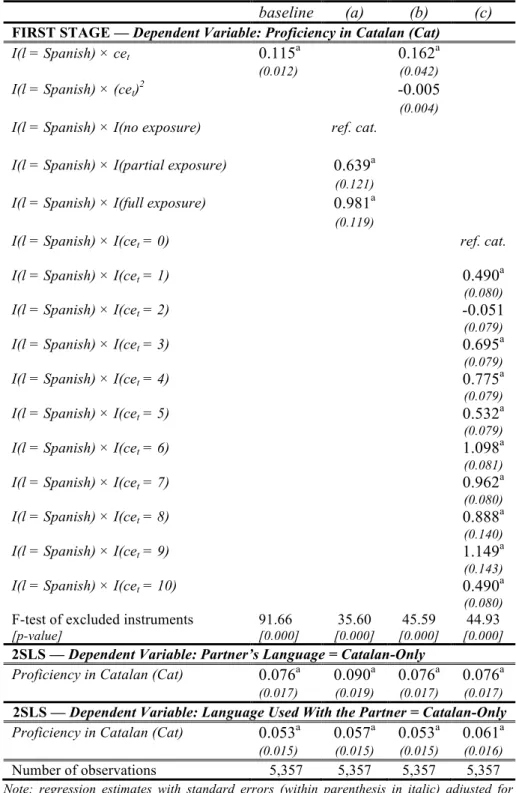
Language groups. One source of concern is the role of individual or group identity in explaining our baseline results. In the next section we discuss these issues in more detail. For now, it is su¢ cient to note that when we exclude from the sample respondents with Spanish as their native language and Catalan as their language of self-identi…cation (“language switchers”), then the main results (column (a)) are very similar to the baseline estimation (compare columns (a) and (b) in Table 6). In particular, the e¤ect of oral skills in Catalan on partnership formation is slightly smaller, and the e¤ect on the use of Catalan, slightly higher. Moreover, the instrument becomes much stronger and the coe¢ cients are estimated more precisely.
One delicate decision in the de…nition of linguistic communities is the alloca-tion of respondents and partners who appear to lie in the intersecalloca-tion: those that have both Spanish and Catalan as their native/habitual language. We check for robustness by excluding these intermediate responses. The results are presented in columns (c)–(e) of Table 6 and are in line with those obtained from the whole sample. If we exclude intermediate respondents, then we observe a small reduction in the e¤ect of Catalan pro…ciency on both outcomes, whereas dropping individuals having a partner who speaks both Catalan and Spanish barely a¤ects the results.