To appear inQuantitative Finance, Vol. 00, No. 00, Month 20XX, 1–20
Credibilistic Risk Aversion
Yuanyuan LIU†, Jian ZHOU†∗ and Athanasios A. PANTELOUS†‡
†School of Management, Shanghai University, Shanghai 200044, China
‡Department of Mathematical Sciences and Institute for Risk and Uncertainty, University of Liverpool, Peach Street, L697ZL, Liverpool United Kingdom
(Received: 15 December 2015, Accepted: 18 November 2016)
In the probabilistic risk aversion approach, risks are presumed as random variables with known proba-bility distributions. However, in some practical cases, for example, due to the absence of historical data, the inherent uncertain characteristic of risks or different subject judgements from the decision makers may be hard or not appropriate to be estimated with probability distributions. Therefore the traditional probabilistic risk aversion theory is ineffective. Thus, in order to deal with these cases, we suggest to measure those kinds of risks as fuzzy variables, and accordingly to present an alternative risk aversion approach by employing the credibility theory. In the present paper, first, the definition of credibilistic risk premium proposed by Georgescu and Kinnunen (2013) is revised by taking the initial wealth into con-sideration, and provide a general method to compute the credibilistic risk premium. Secondly, regarding the risks represented with the commonly used LR fuzzy intervals, a simple calculation formula for the local credibilistic risk premium is put forward. Finally, in a global sense, several equivalent propositions for the comparative risk aversion under the credibility measurement are provided. Illustrated examples are presented to show the applicability of the theoretical findings.
Keywords: Risk aversion, LR fuzzy interval, Credibility theory, Credibilistic risk premium JEL Classification: G1; D81; G12
1. Introduction
The expected utility theory, which has been proposed by von Neumann and Morgenstern (1944), is well acknowledged and accepted as a normative framework of decision making under risk when certain axioms of rational behaviour are applied for. Under this perspective, one of the basic mathematical assumptions is that the utility function, u(x), is strictly increasing and concave. This implies that when an individual confronts a certain income (or loss), and an uncertain profit (or risk), if the value of the certain one is equal to the expected value of the uncertain one, he would prefer the former. This kind of phenomenon is known asrisk aversion. Afterwards, on the foundation of the expected utility theory, the concept of risk premium was initially defined by Pratt (1964) and Arrow (1970), and since then, it is utilized to interpret (rational) behaviours in economics under different types of risks.
In the existing literature of finance, many theoretical studies have been confronted on the basis of risk aversion and expected utility theory. Just to mention some, Menezes and Hanson (1970) reveal the economic significance of the absolute, relative, and partial relative risk aversion functions when one of the wealth and risk parameters remains fixed, and the other varies. Loomes and Sugden (1982) consider that the expected utility theory provides a restrictive definition for rational
behaviours, and therefore they propose the regret theory as an alternative approach. Later, Bell (1985) and Gul (1991) with his axiomatic approach, explore the influence of the disappointment aversion, which is a related concept with regret, and they integrate it into the utility theory by comparing the actual benefits and prior expectations. Besides, Rabin (2000) gives an interesting discussion on the implications of theorems of risk aversion and expected utility theory. Furthermore, the risk aversion theory has been extensively applied in behavioural economics; just to mention a few applications: consider the theory of the firm (Sandmo 1971), the asset return and the consumption (Hansen and Singleton 1983), the optimal portfolio choice (Dow and da Costa Werlang 1992), the lottery choice (Holt et al. 2002), the tax evasion (Hashimzade et al. 2013), and the adoption of new technologies (Barhamet al.2014).
So far, the developments on risk aversion have been based on a standard probabilistic framework by expressing risks as random variables with known probability distributions, which are assumed to derive from observing the uncertain events or the historical data. However, the above mentioned conditions may not be always occur. For instance, it is hard to give a probability distribution for the pricing evaluation of an antique, or for a new stock, since there are no historical data to be used in order to get the exact probability distribution of the price. Let alone that the behavioural attitude of the investor, i.e., educational background, emotional factors, culture, etc., can give different estimates on the risk, and it can make a final reflection on the individual’s decision on the risk. Consequently, the traditional probability distribution might not be adaptable to deal with the uncertain information about the risk. Therefore, many researchers keep making efforts to conquer this aporia in risk aversion by other theories, likeprospect theory (Kahneman and Tversky 1979, Tversky and Kahneman 1992), possibility theory (Zadeh 1979, Georgescu 2009, 2012), and uncertainty theory (Liu 2002, Zhou et al. 2015). As it will be clearer in the next paragraphs, in the present paper, we focus our attention on the possibility and uncertainty theory. Thus, further discussion around the prospect theory is omitted.
Possibility theory is introduced by Zadeh (1979), as an alternative to probability theory, to deal with certain types of uncertainty. This approach has been accepted gradually and employed suc-cessfully to handle cases that the distribution of the uncertain events is unknown or the uncertainty is formed by human thoughts. By taking both the possibility and the necessity of a fuzzy set into consideration, the credibility theory was established by Liu (2002), and now it is a widely exploited approach to calculate the expected value and the variance of a fuzzy set owing to the property of self-dual of the credibility measure.
In this paper, we assume that the risk can not be expressed using a random variable, and thus, we suggest an alternative formulation under certain types of uncertainty. Thus, we utilize a fuzzy variable to represent the risk and proceed the subsequent studies on the basis of the credibility theory. To sum up the main innovations of our approach, first, we revise the concept of credibilistic risk premium presented initially by Georgescu and Kinnunen (2013), which overlook the influence of the initial assets on the attitude of the decision maker. Secondly, based on the operational law with respect to the commonly used LR1 fuzzy intervals, see Zhou and Zhao (2016), we are able to
calculate the local credibilistic risk premium. Furthermore, a comparative risk aversion in a global sense is also put forward.
The rest of this paper is organized as follows. Section 2 reviews the fundamental background on probabilistic risk aversion and necessary definitions on the credibility theory. Section 3 presents the main contributions of our work including the revised concept of credibilistic risk premium, a general calculation for the credibilistic risk premium, the simple calculation for the local credibilistic risk premium, and some results for the comparative risk aversion. Section 4 gives three illustrated examples to show the applicability of the theoretical results and the usefulness of our approach. Section 5 concludes the paper. Ideas for future research are also elaborated.
1i.e., They are L-R type fuzzy intervals with any left and right spreads. Initially, they have been introduced by Dubois and
2. Preliminaries
On the ground of the expected utility theory proposed by the seminal work of von Neumann and Morgenstern (1944), and implemented by Pratt (1964) and Arrow (1970), the risk aversion presuming the risk is a random variable, see also Laffont (1989). In this section, initially we review briefly some well known concepts and results with respect to the probabilistic risk aversion. Then, we introduce the possibility as well as the credibility theories which provide the foundation of risk aversion under the credibility measure.
2.1. Probabilistic risk premium
Assume that the decision maker has the asset, x, and its utility function is given by u(x). The concept of risk premium, π, initially proposed by Pratt (1964) is interpreted as the offset that makes the indifference between obtaining a risk ˜z assessed with the probability measurement and obtaining the exact amount E(˜z)−π, whereE(˜z) is the expected value of ˜z. Pratt (1964, 1992) gives the expression for this relationship of equivalence as follows,
u x+E(˜z)−π(x,z˜)
=E u(x+ ˜z)
, (1)
whereE(˜z)−π(x,z˜) denotes the cash equivalent of uncertain risk ˜z, and the form ofπ(x,z˜) shows that the risk premium depends on x and ˜z. Since the utility function, u(x), is always assumed strictly increasing, its inverse function,u−1(x), exists, and Eq. (1) can be converted into
π(x,z˜) =x+E(˜z)−u−1 E u(x+ ˜z)
, (2)
which is a general measure for the risk premium π(x,z˜). If for any x and ˜z,π(x,z˜) ≥0, then we call the utility function or the decision maker possessing it risk-aversion globally, which is actually equivalent with the concavity ofu(x), i.e.,u00(x)≤0. Subsequently, at the status of assetsx,π(x,z˜) for a small ˜z, where ”small” means that the variance of ˜z,σ2
z →0, is considered as the local risk premium at the pointxfor the decision maker. Then, through Taylor formula, a simple calculation for the local risk premium depending on the utility function, and the variance of uncertain risk can be provided, see Pratt (1964, 1992), as follows
π(x,z˜) =−1 2σ 2 z u00(x+E(˜z)) u0(x+E(˜z)) +o(σ 2 z) ≈ 1 2σ 2 zr x+E(˜z) , (3)
wherer(x) is the commonly used local risk aversion function in the utility theory, and
r(x) =−u
00(x)
u0(x). (4)
Indeed, the computational aspects for the calculation of the local risk premium are simple and straightforward, since they are based on the local risk aversion function,r(x). However, a compar-ative risk aversion globally can also be obtained. Particularly, let us assume thatu1(x) andu2(x) are utility functions of two decision makers. According to Eq. (4), the local risk aversion functions
r1(x) andr2(x) can derive immediately. For any x, if the two local risk aversion functions satisfy
r1(x)≥r2(x), Pratt (1964, 1992) proves the following theorem which illustrates that in that case, i.e., for every risk ˜z regardless of the value of its variance, the decision maker withu1(x) is globally
Theorem 1 (Pratt 1964) Letri(x) andπi(x,z˜) be the local risk aversions and risk premiums cor-responding to utility functionsui, i= 1,2, respectively. The following propositions are equivalent: (i)r1(x)≥r2(x) for any x;
(ii) π1(x,˜z)≥π2(x,z˜) for any xand ˜z;
(iii) u1(u−21(x)) is concave.
Regarding the decision makers whose local risk aversion functionr(x) is decreasing, an extended theorem is deduced directly as follows.
Theorem 2 (Pratt 1964) The following propositions are equivalent: (i0) r(x) decreases withx;
(ii0) π(x,z˜) decreases withx for any ˜z;
(iii0) u0(u−1(x)) is convex.
For the risk premium, π(x,z˜) that is decreasing with x for any ˜z, which means that with the increasing of the assets x, the decision maker is willing more to take the uncertain risk ˜z. Pratt (1964) names the corresponding utility function as adecreasing risk aversion globally.
2.2. Possibility theory
As it has been mentioned in the introduction, the possibility measure was initially proposed by Zadeh (1979), and it is used as a measurement for fuzzy sets. As a different approach of the probability theory, the possibility theory possesses its own distinctive adaptability and applicability in dealing with the uncertain problems that the distribution of the included uncertain event is tough to be given or the subjective thoughts make an influence on the estimation of that. In recent years, the possibility theory has greatly changed the way that ambiguity and imprecision were conventionally considered and got a notable development.
For the better understanding of what if follows, the following notation needs to be referred. Let a nonempty set Θ represent the sample space, andP(Θ) the power set of Θ. Assign to each event
Aa number Pos{A} indicating the possibility thatA will occur. Then, for any collection of events inP(Θ), we have that
Pos{∪iAi}= sup i
Pos{Ai}, (5)
which means that the possibility degree of a set of uncertain events is equal to the maximal possibility degree of all the uncertain events in that set.
On the other hand, the necessity Nec{A} is also a measurement of a fuzzy eventA, see Zadeh (1979), which is defined as the impossibility of the opposite set Ac, i.e.,
Nec{A}= 1−Pos{Ac}. (6)
Example 1: As a simple illustration of Eqs. (5) and (6), assume that there is an investment A, and its outcome after one month is uncertain, whose possible values and corresponding possibility degrees are provided in Table 1. Given the assumption that this investment will make profits, i.e., the set of collection of {A3, A4, A5}, and its possibility degree is equal to Pos{A3, A4, A5}.
Thus, according to Eq. (5), we have Pos{A3, A4, A5} = supi=3,4,5Pos{Ai} = 1. Similarly, from Eq. (6), the necessity degree of the uncertain event making profits is given by Nec{A3, A4, A5}=
1−Pos{A1, A2} = 1−supi=1,2Pos{Ai} = 1−0.7 = 0.3. Based on the possibility measure, the definition of the membership function is given, which is used to express a fuzzy variable directly. Definition 1 Let ξ be a fuzzy variable which is defined on the possibility space (Θ,P(Θ),Pos).
Table 1. Possibility distribution of the uncertain investmentA
i 1 2 3 4 5
Ai −100 −50 100 150 200 Pos{Ai} 0.5 0.7 1 0.6 0.2
Then, its membership function is derived from the possibility measure by
µ(x) = Pos{θ∈Θ|ξ(θ) =x}, x∈ <, (7) where<is the set of real numbers.
Afterwards, the well-known LR fuzzy interval is presented which is widely employed in real world applications, see for more details, Dubois and Prade (1981, 2013).
Definition 2 (Dubois and Prade 2013) A shape function L (or similarly for R) is a function from <+ →[0,1] such that
(1)L(0) = 1;
(2)L(x)<1, ∀x >0; (3)L(x)>0, ∀x <1;
(4)L(1) = 0 [or L(x)>0, ∀x and L(+∞) = 0];
(5)L(x) is decreasing on the open interval{x|0< L(x)<1}.
Definition 3 (Dubois and Prade 2013) A fuzzy interval Mf is of LR-type if there exist shape
functions L (for left), R (for right) and four parameters (m, m) ∈ <2S{−∞
,+∞}, α > 0, β > 0 with membership function
µ(x) = L m−x α , ifx < m 1, ifm≤x≤m R x−m β , ifx > m, (8)
and the fuzzy interval is denoted byMf= (m, m, α, β)LR.
2.3. Credibility theory
Considering the overestimate and the underestimate of the possibility and the necessity for uncer-tain events, their average is suggested to be the most reasonable measure, see Liu and Liu (2002), and it is defined to be the credibility measure, Cr. Then Cr{A} indicates the credibility that an uncertain eventAwill occur, i.e.,
Cr{A}= 1
2(Pos{A}+ Nec{A}). (9)
Consequently, the credibility distribution of a fuzzy variable is given by the following definition, see Liu (2002).
is defined by
Φ(x) = Cr{θ∈Θ|ξ(θ)≤x}. (10) Then, combining Eqs. (5)-10), the credibility distribution of a fuzzy variable is calculated by the use of its membership function as follows.
Theorem 3 (Liu and Gao 2007) Let ξ be one fuzzy variable with membership function µ. Its credibility distribution is calculated by
Φ(x) = 1 2 sup y≤x µ(y) + 1−sup y>x µ(y) , ∀x∈ <. (11)
From Eq. (11), and Theorem 3, it can be shown that the credibility distribution of one fuzzy vari-able is non-decreasing. Moreover, the definition of the independence of fuzzy varivari-ables is presented by Liu and Gao (2007), and it is related to the credibility measure as well as with an equivalent theorem. In more details, let us use the following definition.
Definition 5 (Liu and Gao 2007) The fuzzy variablesξ1, ξ2,· · · , ξn are said to be independent if
Cr ( n \ i=1 {ξi ∈Bi} ) = min 1≤i≤nCr{ξi ∈Bi}, (12) for any setsB1, B2,· · · , Bn of <.
Then, the following necessary and sufficient condition is provided by a known theorem.
Theorem 4 (Liu and Gao 2007) The fuzzy variablesξ1, ξ2,· · · , ξn are independent if and only if
Cr ( n [ i=1 {ξi ∈Bi} ) = max 1≤i≤nCr{ξi ∈Bi}, (13) for any setsB1, B2,· · ·, Bn of<.
Before, we proceed further, an illustrated example is provided for the better understanding of the notion of independence for the fuzzy variables.
Example 2: Assume that there are two uncertain investments ξ1 and ξ2, and both of them have three possible values. Their respective possibility distributions and their joint possibility distribution are listed in Table 2.
Table 2. Possibility distributions ofξ1, ξ2 and their joint possibility distribution
Pos{(ξ1, ξ2)} ξ11 ξ12 ξ31 Pos{ξ2=ξ2j} ξ1 2 0.3 0.4 0.7 0.8 ξ2 2 0.6 1.0 0.9 1.0 ξ3 2 0.4 0.5 0.3 0.6 Pos{ξ1 =ξi 1} 0.7 1.0 0.9 LetB1 ={ξ1 1}, B2 ={ξ21}. Then we know Cr{ξ11∩ξ12}= 1 2(Pos{ξ 1 1∩ξ21}+ Nec{ξ11∩ξ21}) = 0.15,
while Cr{ξ1
1} = 0.35 and Cr{ξ21} = 0.4, which means that there exists at least one set B1 such
that Cr{ξ1
1∩ξ21} 6= min{Cr{ξ11},Cr{ξ12}}. Thusξ1 and ξ2 are not independent.
Additionally, in this subsection, the notion of the inverse credibility distribution is given, see Zhou and Zhao (2016).
Definition 6 (Zhou and Zhao 2016) Let ξ = (m, m, α, β)LR be an LR fuzzy interval with the credibility distribution Φ. The inverse function Φ−1 with Φ−1(0.5) =a(∀a∈[m, m]),is called the
inverse credibility distribution ofξ.
Note that the inverse credibility distribution Φ−1 is well defined in the interval (0,1). If it is
required, it can extend its domain via the following expansion: Φ−1(0) = lim
α↓0Φ
−1(α) and Φ−1(1) = lim
α↑1Φ
−1(α). (14)
Furthermore, it should be mentioned here that Zhou and Zhao (2016) extend the study provided by Zhouet al. (2015) which gives an operational law for independent LR fuzzy intervals.
Theorem 5 (Zhou and Zhao 2016) Let ξ1, ξ2,· · · , ξn be independent LR fuzzy intervals with credibility distributions Φ1,Φ2,· · · ,Φn, respectively. If the functionf(x1, x2,· · · , xn) is strictly in-creasing with respect tox1, x2,· · ·, xm and strictly decreasing with respect toxm+1, xm+2,· · ·, xn, then
ξ =f(ξ1,· · ·, ξm, ξm+1,· · ·, ξn) (15) is an LR fuzzy interval with inverse credibility distribution
Ψ−1(α) =f(Φ−11(α),· · · ,Φ−m1(α),Φ−m1+1(1−α),· · ·,Φ−n1(1−α)). (16) Now, what is more, Liu and Liu (2002) put forward the general definition of the expected value operator for fuzzy variables on the basis of their credibility measure.
Definition 7 (Liu and Liu 2002) Letξ be a fuzzy variable. Then, the expected value ofξis defined by E[ξ] = Z +∞ 0 Cr{ξ ≥r}dr− Z 0 −∞ Cr{ξ≤r}dr, (17)
provided that at least one of the two integrals is finite.
Ifξ is an LR fuzzy interval with credibility distribution Φ, Eq. (17) is equivalent to
E[ξ] =
Z 1 0
Φ−1(α)dα, (18)
where Φ−1(α) is the inverse credibility distribution of ξ. Besides, let ξ and η be independent LR
fuzzy intervals with finite expected values, then∀a, b∈ <,
E[aξ+bη] =aE[ξ] +bE[η]. (19)
Moreover, for some special functions of fuzzy variables, e.g., convex functions, by just using the known Jensen’s inequality, Liu (2002) proves a related inequality.
Theorem 6 (Liu 2002) Let ξ be a fuzzy variable, and f a convex function. If E[ξ] and E[f(ξ)] exist and are finite, then
f(E[ξ])≤E[f(ξ)].
Accordingly, a very useful corollary can derive straightforwardly, which is used in the proof of the next section.
Corollary 1 Letξ be a fuzzy variable, andf a concave function. IfE[ξ] andE[f(ξ)] exist and are finite, then
f(E[ξ])≥E[f(ξ)].
In addition, the variance of a fuzzy variableξ is defined by Liu (2002).
Definition 8 (Liu and Liu 2002) Let ξ be a fuzzy variable with finite expected value E[ξ]. The variance ofξ is defined as
V[ξ] =E[(ξ−E[ξ])2]. (20) Finally, for an LR fuzzy intervalξ with credibility distribution Φ, and finite expected valueE[ξ], Zhou and Zhao (2016) prove that
V[ξ] = Z 1 0 (Φ−1(α)−E[ξ])2dα, (21) and V[aξ+b] =a2V[ξ], ∀a, b∈ <. (22)
3. Risk Aversion under Credibility Theory
In this section, we use the credibility theory for the analysis of risk aversion, and the credibilistic risk aversion is proposed as an alternative of the probabilistic risk aversion.
3.1. Credibilistic risk premium
In the literature of fuzzy sets and topics related to risk theory, Georgescu and Kinnunen (2013) gave a definition for the credibilistic risk premium without the consideration of the initial assets. In our approach, an amendment of their definition is provided. Assume that a decision maker with assets
x and a utility function u(x) faces an imprecise risk, the distribution of which is assumed to be the fuzzy variableξ. Then, the credibilistic risk premiumλ(x, ξ) might be interpreted as an offset that makes the imprecise riskξ and the certain amountE[ξ]−λto be indifferent. The credibilistic risk premium is a function of initial assets x and the credibility distribution of uncertain risk ξ. Definition 9 is useful in what it follows.
Definition 9 Thecredibilistic risk premium λ(x, ξ) of ξ with respect to the utility function u(x) is defined as
where x is the initial asset, ξ is a fuzzy variable representing the uncertain risk, and E[ξ] and
E[u(x+ξ)] are the expected values ofξandu(x+ξ) which are calculated by utilizing the credibility measurement, respectively.
Based on Eq. (23), the credibilistic risk premiumλ(x+a, ξ−a) with respect to assetsx+aand an imprecise riskξ−a, where ais a constant number, satisfies
u(x+a+E[ξ−a]−λ(x+a, ξ−a)) =E[u(x+a+ξ−a)]. (24) Since for any fuzzy variable,E[ξ−a] =E[ξ]−a, thus Eq. (24) is equal to
u(x+E[ξ]−λ(x+a, ξ−a)) =E[u(x+ξ)]. (25) Through Eqs. (23) and (25), we obtain
λ(x, ξ) =λ(x+a, ξ−a). (26) Besides, similar to the probabilistic risk premium, the credibilistic risk premium could also be derived directly through the operation of an inverse function ofu that is
λ(x, ξ) =x+E[ξ]−u−1 E[u(x+ξ)]
. (27)
Furthermore, lettingλa(x, ξ) =E[ξ]−λ(x, ξ),then Eq. (23) can be converted to
u(x+λa(x, ξ)) =E[u(x+ξ)], (28)
whereλa(x, ξ) can be seen as the cash equivalent of ξ, i.e., the smallest amount that the decision maker would like to sell ξ. From the perspective of buyer, letting λb(x, ξ) be the largest amount that he would like to buyξ, then the indifference in his mind can be interpreted as
u(x) =E[u(x−λb(x, ξ) +ξ)]. (29)
3.2. Local risk aversion under credibility measure
In theoretical studies as well as in applications of fuzzy sets theory, triangular and trapezoidal, and some other kinds of LR fuzzy intervals are the most commonly used fuzzy variables. In this part of the paper, we focus our attention on the family of risks which are denoted with the LR fuzzy intervals, and present a simple formula to calculate the local credibilistic risk premium.
We consider an actually neutral and small riskξ, i.e., E[ξ] = 0,V[ξ]→ 0, then Eq. (23) can be converted to
u(x−λ(x, ξ)) =E[u(x+ξ)]. (30) By applying the Taylor formula of the second degree, expandingu around x on both sides of Eq. (30), we obtain u(x−λ) =u(x)−λu0(x) +O(λ2) (31) and E[u(x+ξ)] =E[u(x) +ξu0(x) +1 2ξ 2u00 (x) +O(ξ3)]. (32)
It can be assumed that the utility functionu(x) is strictly increasing andξ is an LR fuzzy interval, thus based on Theorem 5, for anyα∈[0,1], the inverse credibility distribution ofu(x+ξ) in Eq. (32), which is defined by Ψ−1, can be derived from the inverse credibility distribution of ξ, and it
is denoted by Φ−1 as follows, Ψ−1(α) =u(x+ Φ−1(α)) =u(x) + Φ−1(α)u0(x) + u00(x) 2 (Φ −1(α))2+O (Φ−1(α))3 . (33)
Thus, considering Eqs. (18), (21), (31), and (33), the expected value of u(x+ξ) in Eq. (32) is calculated by the following expression.
E[u(x+ξ)] = Z 1 0 Ψ−1(α)dα = Z 1 0 u(x+ Φ−1(α))dα = Z 1 0 u(x) + Φ−1(α)u0(x) +u00(x) 2 (Φ −1(α))2+O (Φ−1(α))3 dα =u(x) +u0(x) Z 1 0 Φ−1(α)dα+u 00(x) 2 Z 1 0 (Φ−1(α))2dα+ Z 1 0 O (Φ−1(α))3 dα =u(x) +u0(x)E[ξ] +u 00(x) 2 V[ξ] +o(V[ξ]) =u(x) +u 00(x) 2 V[ξ] +o(V[ξ]). (34)
Here, it should be noted that O(·) means the terms of order at most and o(·) means the terms of order smaller than (·). Then, we can derive from combining the Eqs. (30), (31) and (34) that
λ(x, ξ) =−1 2
u00(x)
u0(x)V[ξ] +o(V[ξ]). (35)
IfV[ξ]→0, we can get straightforwardly that
λ(x, ξ)≈ −1 2
u00(x)
u0(x)V[ξ], (36)
which implies that
λ(x, ξ)≈ 1
2r(x)V[ξ]. (37)
For the other cases when the small risk ξ is not actually neutral with E[ξ] =a, then based on Eqs. (26), (37), and (22), we obtain that
λ(x, ξ) =λ(x+a, ξ−a)≈ 1
2r(x+E[ξ])V[ξ]. (38)
Finally, on the basis of the above deduction, the following proposition provides the conclusion of our discussion so far. The proof is omitted as rather straightforward (see also previous discussion). Proposition 1 Assume that the utility function u is twice differentiable, strictly concave and increasing, andξis an LR fuzzy interval. Then the crecibilistic risk premium can be approximately
calculated as
λ(x, ξ)≈ 1
2r(x+E[ξ])V[ξ], (39)
whereE[ξ] andV[ξ] are the expected value and the small variance of the uncertain riskξcalculated with credibility measurement, respectively.
3.3. Comparative risk aversion under credibility measure
In the field of risk aversion, beside of analysing the local risk aversion with respect to neutral and small risks, Pratt’s theorem characterizes the method that compares risk aversion between two agents globally, i.e., for any risks. In order to compare the risk averse attitudes between the agents under the provided credibility measure, we establish a credibilitic version of Pratt’s theorem which reveals the relations among local risk aversion functionsr(x), utility functionsu(x), and credibilistic risk premiums λ(x, ξ). The following theorem summarizes the main theoretical findings of our paper.
Theorem7 Letriandλi(x, ξ) be the local risk aversion function and the credibilistic risk premiums with respect to utility functionsui,i= 1,2, respectively, whereui,i= 1,2, are twice differentiable, strictly concave, and strictly increasing. The following propositions are equivalent:
(i)r1(x)≥r2(x) for any x; (ii) u1(u−21(x)) is concave;
(iii) λ1(x, ξ)≥λ2(x, ξ) for any x andξ.
Proof. (i)⇒(ii). It can be deduced from Pratt’s theorem directly.
(ii) ⇒ (iii). According to the definition of credibilistic risk premium (see Definition 9), for any given fuzzy variableξ, we have
λi(x, ξ) =x+E[ξ]−u−i 1(E[ui(x+ξ)]), i= 1,2. (40) Then, we take the difference
λ1(x, ξ)−λ2(x, ξ) =u−21(E[u2(x+ξ)])−u−11(E[u1(x+ξ)])
=u−21(E[η])−u1−1(E[u1(u−21(η))]), (41)
whereη=u2(x+ξ). In addition, sinceu1(u−21(x)) is concave, based on Corollary 1, we get
E[u1(u−21(η))]≤u1(u−21(E[η])). (42)
Substituting Eq. (42) into Eq. (41), the condition (iii) is obtained.
(iii) ⇒ (i). Assume that there exists a point x that satisfies r1(x) < r2(x), and some
small risks with V[ξ]> 0 and E[ξ] = 0. Then, for these uncertain risks, the local risk premium
λ1(x, ξ) > λ2(x, ξ) can be immediately obtained through Eq. (37), which violates the condition
(iii). Thus (iii)⇒(i) holds.
Furthermore, lettingu1(x) =u(x) andu2(x) =u(x+k) for arbitraryx andk >0, the Corollary 2 can be derived through Theorem 7 as follows. The proof follows the previous theorem proof, so it is omitted.
Corollary 2 The following propositions are equivalent. (i0) r(x) is decreasing;
(ii0) u0(u−1(x)) is convex;
(iii0) λ(x, ξ) decreases with xfor any ξ.
4. Numerical Examples
In order to be able to appreciate more the derived results, and to understand deeper the framework under which the proposed credibilistic risk aversion theory is proposed, and it can be used, the following three numerical examples are presented.
Example 3: Assume that there exist an antique collector with personal assets of 150 (thou-sands) US$, who wants to sell his antique vase. In order to have a better estimation for the potential value of the vase, he is consulting several antique experts. After a careful deliberation, the experts provide to him the possible selection of prices: 10, 15, 20, 25, 35 in (thousands)US$, together with their corresponding possibilities based on their experiences. The respective possibil-ities are given based on the principle that assigns 1 to the most possible price, and assigns others accordingly (see Fig. 1). In addition, assume that the utility function of the collector is given by
u(x) = 1−e−20x, x ∈ <, where the unit of measure for the assets x is 1 (thousand) US$. The
question is proposed to be: ”what is the smallest amount of money for the antique vase that the collector is willing to sell it?”
Expert1 Expert2 Expert3 Expert4 Expert5 Expert6 Expert7 … … … 10 15 20 25 35 0.5 1 0.7 0.6 0.3
Deliberation Process of Expert Group Estimates Possibility
Outcomes
Figure 1. Price estimates of the vase from the expert group
Now, let us denote the possible value of the antique vase as a set of fuzzy variable, which is a discrete one, and it is given by ξ = {(10,0.5),(15,1),(20,0.7),(25,0.3),(35,0.4)}. The value of
λa(x, ξ) in Eq. (28) is exactly what is needed to be calculated. Since the uncertain risk is a discrete fuzzy variable, and its variance is not small, the calculation for local risk premium is not available. Thus, we compute the value ofλa(x, ξ) through a general inverse function operation on Eq. (28), that is,λa(x, ξ) =u−1 E[u(x+ξ)]
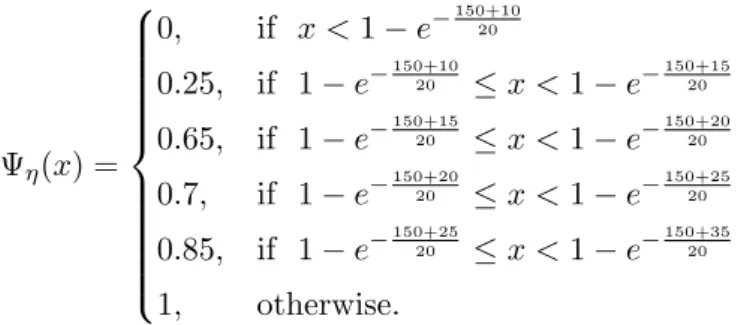
−x, which is similar with the computation ofλ(x, ξ) in Eq. (27). (1) First, denote η = u(x +ξ). Then η is also a discrete fuzzy variable. Based on the defi-nition of the credibility distribution of a fuzzy variable, the credibility distribution of η can be
deduced as Ψη(x) = 0, if x <1−e−150+1020 0.25, if 1−e−150+1020 ≤x <1−e− 150+15 20 0.65, if 1−e−150+1520 ≤x <1−e− 150+20 20 0.7, if 1−e−150+2020 ≤x <1−e− 150+25 20 0.85, if 1−e−150+2520 ≤x <1−e− 150+35 20 1, otherwise.
After that, according to Eq. (17), the expected value ofη can be obtained as 0.99976.
(2) Secondly, sinceu(x) = 1−e−20x, we get its inverse function u−1(x) =−20 ln(1−x), x <1.
(3) Finally,λa(x, ξ) =u−1 E[u(x+ξ)]
−x=−20 ln(1−0.99976)−150 = 166.9719−150 = 16.9719 (thousands) US$. λa(x, ξ) is exactly the cash equivalent for this antique vase, which means the lowest price that the antique collector is willing to sell the vase. Moreover, it can be easily deduced that the credibilistic risk premiumλ(x, ξ) =E[ξ]−λa(x, ξ) = 18.5−16.9719 = 1.5281.
Example 4: Assume an agent has 10 (thousands) US$ of idle funds and wants to invest them into the stock market. Assume that a stock has been selected. Besides, it is known that the present price of the selected stock is 4 US$ per share, and the price after a month is estimated to be a symmetrical triangular fuzzy variable ξ. Its membership function µξ is depicted in Fig. 2.
0
3.5
4
4.5
x
µ
⇠(
x
)
1
Figure 2. The membership function ofξin Example 2
Furthermore, except the idle funds, we assume that this investor owns 100 (thousands) US$ assets, and his utility function is also given byu(x) = 1−e−20x, x∈ <. Now, the question is: ”Does
he prefer to invest the idle funds on this stock or seek for other investment?” Denote the uncertain payment of the stock as η = 10
4 ξ. Then, we need to calculate the cash equivalent of the stock, and make a comparison with the initial fund, i.e. the 10 (thousands) US$. Noticing thatξ is an LR fuzzy interval, and the range of the fluctuate ofξ is relative small, we try to use the method we introduce in Section 3.2 to compute the approximate local risk premium for the stock, and then derive the corresponding cash equivalent. From Eq. (39), we need to obtain the expected value and the variance ofη, which is directly derived through the expected value, and the variance of ξ following Eqs. (19) and (22).
First, based on the membership function of ξ described in Fig. 2, and Eq. (11), its credibility distribution can derive directly as
Ψξ(x) = 0, if x <3.5 x−3.5, if 3.5≤x <4.5 1, otherwise,
which is depicted in Fig. 3.
x
⇠(
x
)
3.5
4
4.5
0
1
0.5
Figure 3. The credibility distribution ofξ
Secondly, through Eq. (17), the expected value of the stock priceξ can be calculated to be equal to 4. Next, we can derive the inverse credibility distribution ofξ as follows
Ψ−ξ1(x) = 3.5 +α, 0≤α≤1. (43) Then, the variance ofξ is obtained by Eqs. (21) and (43)
V[ξ] = Z 1 0 (Ψ−ξ1(α)−E[ξ])2dα = Z 1 0 (3.5 +α−4)2dα = 1 12.
Based on Eqs. (19) and (22), we know thatE[η] = 10
4 E[ξ] = 10 and V[η] = 10 4 2 V[ξ] = 25 48. Besides, it is known that the local risk aversion function r(x) = 1
(39), we have λ(x, η) = 1
2r(x+E[η])V[η] = 1 40 ×
25
48 ≈0.0130,and the cash equivalent λa(x, η) =
E[η]−λ(x, η)≈10−0.0130 = 9.9870 (thousands) US$.
From the outcomes, we can see that although the largest payment of investing on the stock is 10
4 ×4.5 = 11.25 (thousands) US$, which is much larger than the initial fund of 10 (thousands) US$, the expected value of the uncertain payment with respect to the stock is only 10 (thousands) US$, which is just equal to the initial investment. There is little chance that the agent can make profits from this investment. Due to the attitude of risk aversion of the agent, we can infer the agent will not invest the money on the stock without computing the value of the local risk premium. Example 5: Assume that the utility function of an agent with initial wealth 20 (thousands) US$ is u(x) = 1− 100
(x+ 10)2, which is a strictly concave function and the unit of measure for the
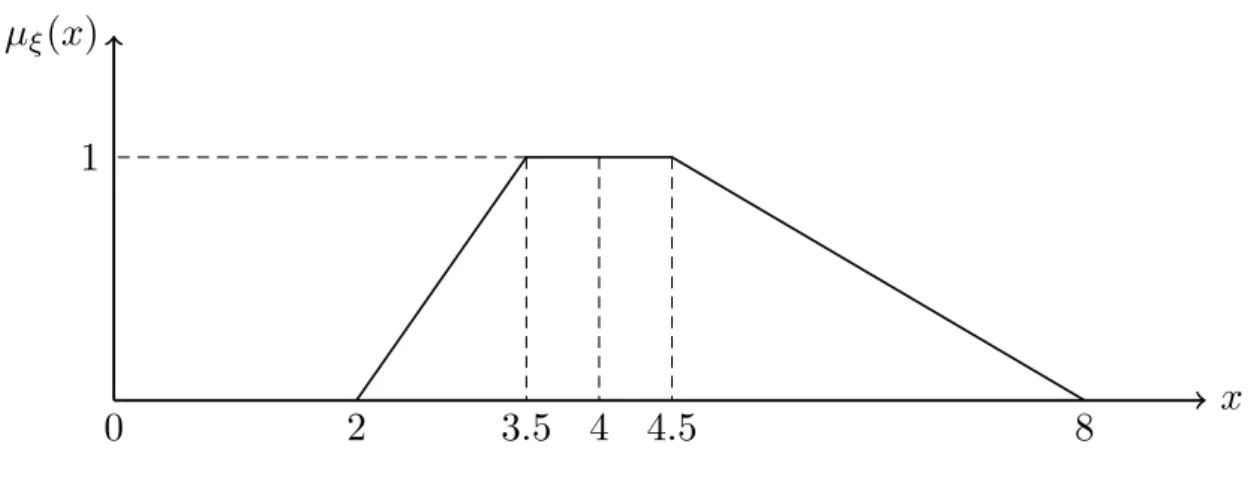
assets x is 1 (thousand) US$. He plans to invest the extra 10 (thousands) US$ (not included in the initial 20 (thousands) US$) into the stock or the bond market. Assume the present price of the stock he selects is 4 US$ per share, and the estimated price after one month is a trapezoidal fuzzy variable ξ with the membership function depicted in Fig. 4, while the bond would return back to him with a certain profit 500 US$. The questions are: (1) ”Will he prefer to invest the money on the stock or the bond?” (2) ”Will he change his decision when his wealth increases?”
0
2
8
1
x
µ
⇠(
x
)
4.5
3.5 4
Figure 4. The membership function ofξ
According to his estimation, he believes that the prospective price will fall into the interval [2,8]. And it is the most possible that the price fluctuates between 3.5 and 4.5. Furthermore, comparing with the range of fall, he deems that there is still a significant scope for the selected stock in the next month.
Similar with the problem in Example 4, we denote the uncertain payment in the case of investing the money on the stock asη = 10
4 ξ. But the fluctuated rang of the stock price is relative big, which will result in a big variance ofη too. Thus, we need to utilize the inverse function operation on the utility function in Eq. (28) to calculate the cash equivalent of the payment of investing the stock directly rather than employing the simple computation of the local risk premium.
In order to calculate λa(x, η), the expected value of η and u(x+η), i.e., E[η] and E[u(x+η)] and the inverse function of utility function, i.e.,u−1(x), need to be derived.
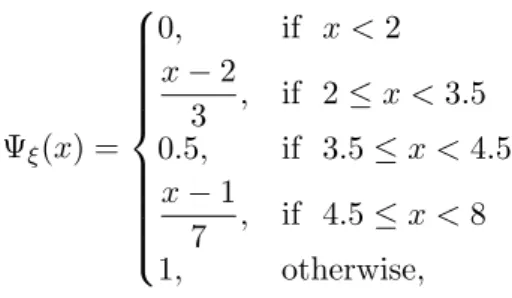
be derived directly as Ψξ(x) = 0, if x <2 x−2 3 , if 2≤x <3.5 0.5, if 3.5≤x <4.5 x−1 7 , if 4.5≤x <8 1, otherwise,
which is depicted in Fig. 5. Next, the expected value of the stock price ξ after one month is
x ⇠(x) 2 3.5 4.5 8 0 0.5 1
Figure 5. The credibility distribution ofξ
calculated as 9 2, and E[η] =E 10 4 ξ = 10 4 × 9 2 = 45 4 = 11.25.
Secondly, according to the definition of the inverse function for LR fuzzy intervals, the inverse credibility distribution ofξ can be deduced as
Ψ−ξ1(x) = 3α+ 2, if 0≤α <0.5 a, if α= 0.5 7α+ 1, if 0.5< x <1, (44)
whereais any value in the interval [3.5,4.5].
E[u(x+η)] can be calculated based on Eqs. (16) and (18) as E[u(x+η)] =E[u(x+ 10 4 ξ)] = Z 1 0 u(x+10 4 Ψ −1(α))dα = Z 0.5 0 u(x+10 4 Ψ −1 ξ (α))dα+ Z 1 0.5 u(x+10 4 Ψ −1 ξ (α))dα = Z 0.5 0 1− 100 (x+ 10 4(3α+ 2) + 10)2 dα+ Z 1 0.5 1− 100 (x+10 4 (7α+ 1) + 10)2 dα = 1− 200 (4x+ 75)(x+ 15) − 200 (4x+ 85)(x+ 30).
Next, we obtain the inverse of the utility function u, i.e.u−1(x) = r
100
1−x −10 for x <1.
Finally, the cash equivalent of the payment of investing the money on the stock is a function of his initial wealth as
λa(x, η)=u−1(E[u(x+η)])−x = r 100 1−E[u(x+η)] −10−x = r (4x+ 75)(x+ 15)(4x+ 85)(x+ 30) 16x2+ 680x+ 7350 −x−10. (45)
For the agent, in our example, whose initial wealth is 20 (thousands) US$, we can get the cash equivalent λa(x, η) = 10.4528 (thousands) US$, which is lower than the certain payment 10.5 (thousands) US$ from investing the money on bonds. Since the utility function of the agent is a strictly increasing function, that is the utility taking from the certain 10.5 (thousands) US$ is larger than a cash equivalent of 10.4528 (thousands) US$. Therefore, answering the first question, we can infer that he prefers to invest his money on the bond instead of the stock market.
Moreover, regarding the second question, a further analysis on the function of the cash equivalent ofη in Eq. (45) is needed. Recall that the utility function isu(x) = 1− 100
(x+ 10)2, and the local risk
aversion function isr(x) = 3
x+ 10, which is a decreasing function ofx. So, according to Corollary 2, the risk premium λ(x, η) is also a decreasing function of x for all η including the uncertain paymentη in our problem, which means with the increasing of the wealthxof the agent, the risk premium with respect to η decreases, and the cash equivalent of η increases that can also derive from the direct analysis of Eq. (45). When the cash equivalentλareaches up to the certain payment from the bond, the agent will change his decision. Through solving Eq. (45) withλa(x, η) = 10.5, we can get that the value ofx is equal to 22.7087 (thousands) US$. When the wealth of the agent is more than 22.7087 (thousands) US$, he is more willing to take the risk to invest his money on the stock rather than getting a certain earning from the bond.
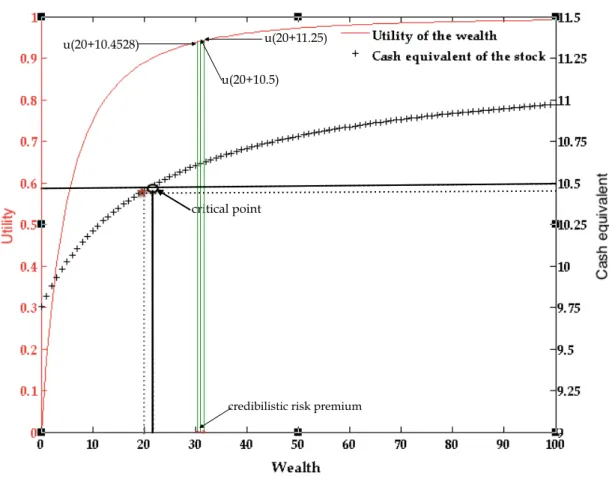
Subsequently, we depict the function ofλa(x, η) in Eq. (45) and the utility function ofx in Fig. 6, which could give an intuitive understanding for the case in our problem.
The solid line represents the utility function of x, and the line marked with ”+” represents the changes of the cash equivalent of η with the changes of x. It can be observed that both functions ofx are strictly increasing. At the critical point, the cash equivalent ofη is equal to the certain payment of the bond. The point labelled with ”?” indicates the present cash equivalent 10.4258 (thousands) US$ with the wealth of 20 (thousands) US$. If and only if the wealth is bigger than the value corresponding to the critical point, i.e., 22.7087 (thousands) US$, the cash
critical point u(20+10.4528)
u(20+10.5) u(20+11.25)
credibilistic risk premium
Figure 6. The utility function and the cash equivalent of the wealthx
equivalent of the stock is bigger than the certain payment from the bond. Besides, the utilities of 20 + 10.4528 = 30.4528 (thousands) US$ (initial wealth with the present cash equivalent of η), 20+10.5 (initial wealth with the certain earning from the bond), and 20+11.25 = 31.25 (thousands) US$ (initial wealth with the expected value of η) are labelled, respectively. And the credibilistic risk premium ofη can be obtained as the difference of the cash equivalent and the expected value ofη, i.e., 11.25−10.4528 = 0.7972 (thousands) US$.
Remark 1 It should be noted here that the above numerical examples are simple illustrations for the decision makers in order to appreciate the theoretical findings, to understand the cases that our proposed crecibilistic risk aversion approach can be applied for, and to solve and analyse the economic decision-makings. Both the utility function and the fuzzy variables representing the risks in our examples can be generalized according to the demand and the real world application.
5. Conclusion
The traditional probabilistic risk aversion approach can not deal with all the cases, for instance, when the distribution of the facing risk is tough to be measured or it varies with the decision makers’ own deliberation, an alternative credibilistic approach has been suggested instead in order to analyse the risk aversion problems. Thus, in this paper, we put forward the new concept of the credibilistic risk premium. Its relationship with the variance of the uncertain risk represented with a fuzzy variable, and the local risk aversion functionr(x) were provided. Subsequently, a comparative risk aversion was studied which can be used to interpret the different economic behaviours. We also enumerated three practical examples in which the probabilistic risk aversion is ineffective, and
we show how to utilize the proposed credibilistic risk aversion in order to calculate the credibilistic risk premium, and assist the agent to make the optimal strategy.
Finally, the proposed results can be further extended. As an ongoing project, by using different types of fuzzy variables to express the risk, it can be investigated how to make a decision when the agent confronts several uncertain risks or how to distinguish the utility function based on the economic behaviour of the agent or considering the risk is an multi-period one. For the new direction, research work is in progress.
Acknowledgements
The authors would like to acknowledge also the gracious support of this work by the Recruit-ment Program of High-end Foreign Experts (Grant No. GDW20163100009). The third author also acknowledges the EPSRC and ESRC Centre for Doctoral Training on Quantification and Manage-ment of Risk & Uncertainty in Complex Systems & EnvironManage-ments (EP/L015927/1).
References
Arrow, K.J.K.J.,Essays in the theory of risk-bearing, 1970, North-Holland Pub. Co.
Barham, B.L., Chavas, J.P., Fitz, D., Salas, V.R. and Schechter, L., The roles of risk and ambiguity in technology adoption.J Econ Behav Organ, 2014,97, 204–218.
Bell, D.E., Disappointment in decision making under uncertainty.Oper Res, 1985,33, 1–27.
Dow, J. and da Costa Werlang, S.R., Uncertainty aversion, risk aversion, and the optimal choice of portfolio. Econometrica, 1992, pp. 197–204.
Dubois, D. and Prade, H., Additions of interactive fuzzy numbers.IEEE Trans Automat Control, 1981,26, 926–936.
Dubois, D. and Prade, H.,Possibility theory: an approach to computerized processing of uncertainty, 2013, Plenun Press, New York, USA.
Georgescu, I., Acyclic rationality indicators of fuzzy choice functions.Fuzzy Sets Syst, 2009,160, 2673–2685. Georgescu, I.,Possibilistic risk aversion, Studies in Fuzziness and Soft Computing Vol. 274, , 2012,
Springer-Verlag Berlin Heidelberg, Germany.
Georgescu, I. and Kinnunen, J., A risk approach by credibility theory.Fuzzy Info Engin, 2013,5, 399–416. Gul, F., A Theory of disappointment aversion.Econometrica, 1991,59, 667–686.
Hansen, L.P. and Singleton, K.J., Stochastic consumption, risk aversion, and the temporal behavior of asset returns.J Polit Econ, 1983, pp. 249–265.
Hashimzade, N., Myles, G.D. and Tran-Nam, B., Applications of behavioural economics to tax evasion.J Econ Surv, 2013,27, 941–977.
Holt, C.A., Laury, S.K.et al., Risk aversion and incentive effects.Am Econ Rev, 2002,92, 1644–1655. Kahneman, D. and Tversky, A., Prospect theory: An analysis of decision under risk.Econometrica, 1979,
47, 263–291.
Laffont, J.J.,Economie de l’incertain et de l’information, 1989, MIT press.
Liu, B.,Theory and practice of uncertain programming, 2002, Springer-Verlag, Heidelberg, Germany. Liu, B. and Liu, Y.K., Expected value of fuzzy variable and fuzzy expected value models.IEEE Trans Fuzzy
Systems, 2002,10, 445–450.
Liu, Y.K. and Gao, J., The independence of fuzzy variables with applications to fuzzy random optimization. Int J Uncertain, Fuzziness Knowledge-Based Systems, 2007, 15, 1–20.
Loomes, G. and Sugden, R., Regret theory: An alternative theory of rational choice under uncertainty.Econ J, 1982,92, 805–824.
Menezes, C.F. and Hanson, D.L., On the theory of risk aversion.Inter Econ Rev, 1970, pp. 481–487. Pratt, J.W., Risk aversion in the large and in the small.Econometrica, 1964,32, 122–136.
Pratt, J.W., Risk aversion in the small and in the large. InFoundations of Insurance Economics, pp. 83–98, 1992, Springer.
Rabin, M., Risk aversion and expected-utility theory: A calibration theorem.Econometrica, 2000,68, 1281– 1292.
Sandmo, A., On the theory of the competitive firm under price uncertainty.Am Econ Rev, 1971,61, 65–73. Tversky, A. and Kahneman, D., Advances in prospect theory: Cumulative representation of uncertainty.J.
Risk Uncertainty, 1992,5, 297–323.
von Neumann, J. and Morgenstern, O.,Theory of games and economic behavior, Vol. 60, , 1944, Princeton University Press, USA.
Zadeh, L.A., A theory of approximate reasoning.Machine Intelligence, 1979,9, 149–194.
Zhou, J., Yang, F. and Wang, K., Fuzzy arithmetic on LR fuzzy numbers with applications to fuzzy pro-gramming.J. Intel Fuzzy Systems, 2015,30, 71–87.
Zhou, J. and Zhao, M., An operational law for LR fuzzy intervals with applications to fuzzy optimization. Technical Report, Shanghai University, 2016.