Created with the support of
European SRI Study
Eurosif MEMbEr AffiliAtEs
AG2R La Mondiale Amundi
Aviva Investors
AXA Investment Managers Bank Sarasin
Bloomberg LP BlueOrchard
BNP Paribas Asset Management CA Cheuvreux
Caisse des Dépôts Calvert
Carbon Disclosure Project CM-CIC Asset Management
CSSP- Center for Social and Sustainable Products DB Advisors / DWS Investments
Dexia Asset Management ECPI
Edmond de Rothschild Asset Management EIRIS
Ethix SRI Advisors AB Ethos
Etica Sgr FEBEA
Fédération des Experts Comptables Européens (FEE) Forética
FTSE Group
Fundación Ecología y Desarrollo (ECODES) Generali Investments Europe
Generation Investment Management LLP Groupama Asset Management
Henderson Global Investors
Hermes Equity Ownership Services Ltd. HSBC
Humanis - Inter Expansion
INOKS Capital Inrate AG KPMG
LGT Capital Management MACIF Gestion
Manifest Information Services Meeschaert Gestion Privée Mercer
MSCI
Natixis Asset Management Nordea Investment Funds S.A. oekom research
Oikocredit Oxfam
Pictet Asset Management S.A. Pioneer Investments
responsAbility Robeco
SAM Sustainable Asset Management Schroders
SNS Asset Management Sparinvest
Standard Life Investments Standard & Poor’s Indices Sustainalytics
Sustainable Business Institute Threadneedle Asset Management Triodos Bank Trucost UBS Union Investment Vigeo VINIS
NAtioNAl sifs iN EuropE
Belsif*, Belgium Dansif, Denmark Finsif, Finland
Forum Nachhaltige Geldanlagen* (FNG) e.V., Austria, Germany and Switzerland Forum per la Finanza Sostenibile* (FFS), Italy
Forum pour l’Investissement Responsable* (FIR), France Norsif, Norway
Spainsif*, Spain Swesif*, Sweden
UK Sustainable Investment and Finance Association* (UKSIF), UK
Vereniging van Beleggers voor Duurzame Ontwikkeling* (VBDO), the Netherlands * Member of Eurosif
table of contents
forewords from our sponsors ... 4
foreword from Eurosif ... 6
Executive summary ... 7
introduction ... 8
Historical Development of sri ... 8
survey Definitions and Methodology ... 9
European results by strategy ... 13
impact investing ... 21
summary of European results ... 25
Austria ... 27
belgium ... 29
Denmark ... 30
finland ... 32
france ... 34
Germany ... 39
italy ... 43
Netherlands ... 47
Norway ... 49
poland ... 51
spain ... 53
sweden ... 55
switzerland ... 57
united Kingdom ... 59
European Data table ... 63
Glossary ... 64
list of surveyed organisations ... 65
Credits ... 66
About Eurosif ... 67
The views in this document do not necessarily represent the views of all Eurosif member affiliates. This publication should not be taken as financial advice or seen as an endorsement of any particular company, organisation or individual. While we have sought to ensure that this information is correct at time of print, Eurosif does not accept liability for any errors. © Eurosif A.I.S.B.L.
All rights reserved. It is not permitted to reproduce this content (electronic, photocopy or other means) without the explicit and written permission of Eurosif.
With €62,2 billion3 of assets under SRI management,
Amun-di is the leader of the SRI French market and has a deep and long-held commitment to responsible investing. As early as 2000 Amundi was the first company in France to create a dedicated sustainability research team in charge of the analysis of environmental, social and governance (ESG). Amundi has been a signatory to the Principles for Responsi-ble Investment (PRI) since their inception in 2006.
Amundi firmly believes that the responsibility of an asset manager stretches beyond the purely financial matters. Amundi intends to be a factor of progress and evolution in its environment. Aware of the growing importance of environ-mental, social and governance (ESG) issues, Amundi chose to integrate them into its analysis process, investment de-cisions and its general voting policy. Therefore, it enforces strict rules that are the foundation of its responsible policy in all of its active management*.
About 2900 issuers are rigorously rated by an in-house team of 14 extra-financial analysts. All fund managers of the Group have access not only to corporate credit and financial ratings, but also to these extra-financial ratings.
Beside its ESG integration policy, Amundi favours the de-velopment of Socially Responsible Investing (SRI) known as “Best in Class”. This positive approach increases companies’ awareness of ESG issues and helps them developing and improving. Amundi is also developing an innovative impact investing funds range bringing benefits to society: profit-sharing, social business and development aid funds. For em-ployee savings schemes, Amundi manages a comprehensive range of SRI FCPEs.
Lastly, Amundi is also actively involved in the works of the market authorities on themes related to Corporate Governance, SRI and, more broadly, ESG. It also supports academic research.
Currently leader on the French SRI market, Amundi hence stretches beyond boundaries, conquesting the SRI Europe-an market. Therefore, it seemed natural for Amundi to spon-sor the Eurosif study.
pierre schereck
Head of Employee Saving Schemes Head of SRI Development
Amundi
Amundi ranks number 1 in France1, second in Europe2 and ninth worldwide2 among the
players in asset management with €692.9 billion under management3.
1. Open-ended funds domiciled in France - Source Europerformance NMO, June 2012 2. No. 2 in Europe and No. 9 worldwide - Total assets under management - Source IPE “Top 400 global asset managers active in the European marketplace” published in June 2012, based on figures as at December 2011 Ranking established from a questionnaire fulfilled by fund management companies total AUM as at December 2011 (open-end funds, dedicated funds, mandates). Ranking retreated of a double accounting of AUM. 3. Amundi Group figures as at 30 June 2012
* active management: except index-tracking UCITS and except ETFs
It comes as no surprise, given the diversity that spans Europe, that investors approach responsible investment in different ways. Part of our hope in sponsoring the Euro-sif study—the reference for the European SRI market—is to highlight this heterogeneity, to encourage investors to share best practices and to promote the practice of respon-sible investment.
From an asset manager’s perspective, it is crucial to embed global ESG research across all asset classes in order to be able to provide solutions that meet specific client require-ments. Doing so allows us to provide investors the opportu-nity to select the level of ESG integration that best fits their needs and objectives.
Investors, and in particular decision-makers such as trus-tees and investment committee members, will likely give more consideration to their asset managers’ handling of ESG issues in the future. Investors will need to be able to identify how their managers integrate ESG considerations into the investment process and stewardship activities. As a result, one of the biggest challenges facing the asset management industry is to demonstrate to asset own-ers that environmental, social and governance factors are genuinely being taken into account. At AXA Investment Managers, we strive to display our commitment to genuine ESG integration through actions such as bringing in an inde-pendent expert to verify that our pure RI funds fully comply with ESG principles, and by regularly publishing our proxy voting activities.
In the coming months and years, it is our expectation that studies such as this one will show responsible investment gaining further prominence, continuing to become a key fac-tor for invesfac-tors—not simply a ‘nice-to-have’ but an essen-tial component of investments. We are committed to sup-porting investors in this endeavour.
Matt Christensen
Global Head of Responsible Investment AXA Investment Managers
Nordea is the largest financial services group in the Nordic and Baltic Sea region with a market capitalisation of ap-proximately €28 billion and total assets of €694billion. Our commitment to being a responsible asset manager has deep roots in our corporate culture and business model. Asset management is all about value creation and we believe that responsible value creation is what makes the difference. Our responsible investment journey started in 2007 when we signed, as one of the first major banks in the Nordic mar-ket, the Principles for Responsible Investment. The founda-tion of our Responsible Investment strategy lies in in-depth environment, social and governance (ESG) analysis and en-gagement activities. A further step was taken in 2011, when we launched unique responsible investment funds where ESG is an integral part of the product’s DNA.
Nordea’s competency within this area is enhanced by our dedicated Responsible Investment and Governance team. All our Responsible Investment strategies are overseen by dedicated responsible investment committee, chaired by the CEO of Nordea Asset Management and which has representation from all businesses involved from invest-ment manageinvest-ment to sales and marketing and anything and everything in between bringing the responsible investment practices to everything that we do.
The results of this study confirm that Sustainable and Re-sponsible Investments have grown spectacularly and will continue in this direction going forward. The next chal-lenge ahead lies in providing clear communication towards retail investors so that they can benefit from investing with responsibility.
With this in mind, we applaud Eurosif for producing this study and with that, bringing clarity to our rapidly growing and ever changing industry. While we can all congratulate ourselves in bringing ESG closer to day to day life of all in-vestors, there is still plenty of room to grow for us all.
sasja beslik
Head of Responsible Investment & Governance Nordea
At Pictet, we define sustainability as economic activity that meets the needs of the present without compromising the ability of future generations to meet their own needs. Our sustainable vision arises from a 200-year history as a family-owned business that has grown by developing endur-ing relationships with clients and employees. Our ambition to be a leading wealth and asset management group worldwide is solidly grounded on sustainable business principles for the environment, for society and corporate governance.
It is this open, coherent and transparent approach that has enabled us to grow a successful sustainable investment fran-chise. At the end of July 2012, Pictet Asset Management had more than €6.5 billion of SRI assets under management. We began looking at diversified SRI portfolios in 1997 and have since developed a broad range of equity and bond prod-ucts. Our innovative investment process not only considers extra-financial factors but also a set of proprietary financial sustainability indicators - company-specific factors which we believe have a positive effect on companies’ long-term prosperity and, overall, contribute to the stability of finan-cial markets, and therefore ensure that the economy as a whole is better able to withstand shocks.
We also offer thematic investments funds which provide investors with a concentrated exposure to a selection of key environmental themes (water, clean energy, timber and agriculture). The water fund, launched in 2000, was the first-ever investment fund aimed at improving the way global wa-ter resources are managed, and is still the largest fund of its kind worldwide.
Our distinct competitive edge in SRI investing has earned us continued recognition in the industry. We recently won the SRI/ESG Provider of the Year award at the 2012 Profession-al Pensions’ UK Pensions Awards 2012. This follows a number of awards earned over the years including three consecutive years of winning the “SRI Provider of the Year” at the Global Pensions Awards.
Sustainability has become a legitimate investment choice for a growing number of private and institutional investors who take a long-term view. The financial crisis has stressed the need to shift to a more sustainable global growth model. The asset management industry has the potential to be a major catalyst for change in this process, and at Pictet we take that responsibility very seriously.
rémy best
Managing Partner Pictet & Cie
In 2011, Eurosif celebrated its tenth anniversary. In 2012, Eu-rosif celebrates its first year of operations out of Brussels, the Capital of Europe. But 2012 is also the tenth anniversary of the present biannual Study whose 5th edition Eurosif is pleased to present, together with the national SIFs who were instrumental in contributing to the research.
Over these years, the SRI industry has witnessed significant changes and our European Sustainable and Responsible In-vestment Study has constantly evolved to reflect these ad-justments and stay current with the industry developments. While finding a consensus around a single definition of SRI across Europe remains challenging, this Study aims to fur-ther inspire the debate and help the general public, as well as industry practitioners, policy makers and other commen-tators to gain insight to an increasingly sophisticated mar-ket. This is why this 5th European SRI Study brings with it a few changes as it, for instance, focuses on trends affecting individual responsible investment strategies and includes for the first time a brief review of the European impact investing market.
The European SRI industry and more broadly, the European economy, are faced with its biggest challenges for decades. Yet, as this new edition shows, most responsible investment strategies have proven to be resilient, if not demonstrating exemplary growth rates since the last Study of this kind was undertaken. As in every crisis there is an opportunity, this one is no exception. We strongly believe that current envi-ronment is providing numerous opportunities for SRI. First, as the economy continues to struggle, as inflation lurks, as market volatility leads to higher risk premium re-quirements, cost of and access to capital will worsen. This will impact both companies and investors. Investors, what-ever their motivation is, are bound to pay more and more
attention to factors affecting capital risks, including Envi-ronmental, Social and Governance factors, when assess-ing an investment in a particular company. Companies will subsequently need to carefully manage their cost of capital and address the growing concerns of investors around their sustainability, which entails a forward-looking view about how they manage ESG aspects. The background for this is an important body of academic research suggesting that a company’s strong ESG performance is positively correlated with lower cost of capital.1
Second, at a time when regulators are seeking ways to rec-oncile financial markets with “the real economy” and unlock the potential for long term investment and “smart, sustain-able and inclusive growth”2, SRI should be seen as a
com-plementary resource to realize that potential. In fact, it is interesting to note that respondents to the 2012 Study saw regulatory drivers as the second most important driver for the industry, after institutional investors.
Finally, Eurosif would like to especially thank the four sponsors who made this research again possible this year. Amundi, Axa Investment Managers, Nordea and Pictet have generously funded this undertaking and provided valuable comments and insights to the research. This research would not have been possible without their support. And once again, Eurosif would like to reiterate its recognition to the contribution of its Member Affiliate network and national SIF partners for their ongoing support and involvement in the Association’s development and mission to promote sus-tainability through financial markets.
We hope that this Study will help you better understand the state of the European SRI market and where it is heading. Happy reading,
1 See for example the meta-study by DB Climate Change Advisors, Sustainable Investing: Establishing Long-Term Value and Performance, 2012. 2 European Commission, COM(2010) 2020 final
françois passant
Executive Director
Giuseppe van der Helm
Executive summary
The European SRI Study 2012 shows that all responsible in-vestment strategies surveyed have outgrown the market, and four out of six have grown by more than 35% per an-num since 2009. The combined growth of all strategies at European level continues to outpace the overall investment market, demonstrating the continuous appetite by investors to take into account Environmental, Social and Governance factors, despite (or maybe due to) the ongoing economic and market turmoil.
Beyond the European averages, national markets continue to vary considerably in terms of growth, use of strategies, asset allocation and whether the investment is retail or in-stitutional. There is no homogenous market for SRI in Eu-rope. In fact, as Eurosif undertook a thorough review of SRI classifications and definitions to better reflect the innova-tive and evolving nature of the industry before launching the new survey, it became clear that the judgement of whether something is ‘SRI’ is very much coloured by the cultural and historical diversity of Europe. At this stage, no consensus on a unified definition of SRI exists within Europe, regardless of whether that definition focuses on the processes used, societal outcomes sought or the depth and quality of ESG analysis applied. For investors, in particular retail investors, this represents a challenge to understanding the various product offerings. For providers (asset managers), this also represents a challenge as different national markets may re-quire various product strategies to be deployed depending on local investor preferences.
The present Study therefore presents SRI strategies indi-vidually, rather than imposing SRI aggregates which may not suitlocalmarketconditions.Itcontinuestofocusexclusively on the self-reporting of asset managers and self-managing asset owners. It includes both retail and institutional assets. The methodology of the study has to the greatest extent possible been retained from previous years.
The seven strategies covered in this report are: • Sustainability themed investment
• Best-in-Class investment selection
• Norms-based screening
• Exclusion of holdings from investment universe • Integration of ESG factors in financial analysis • Engagement and voting on sustainability matters • Impact investment
The fastest growing strategy is Norms-based screening, closely followed by Exclusions and Best-in-Class. However, the growth is not uniform across the markets, and is typical-ly characterised by a small number of large asset owners or managers adopting a certain strategy for all or a significant portion of their assets. Nevertheless, experience shows that
a few large pioneers can have strong influence on the market and lead to a proliferation of certain strategies.
Looking at Exclusions, one notable finding of the Study is that, according to the responses, almost half of Europe’s total assets under management have policies in place which specify the exclusion of companies involved in the manu-facture certain types of weapons, the most common being those subject to the international Conventions on Cluster Munitions and Anti-Personnel Mines.. This remarkable re-sult shows that international conventions and treaties can have a real impact on the financing decisions of the industry, even if legislation is not in place.
Eurosif has for the first time included a separate section on Impact investing. This section focuses a lot of attention on definitional aspects since Impact investing currently is char-acterised more as an investment philosophy than a distinct process, and there are differing views in the market on how to balance financial and societal goals. This exciting way of targeting outcomes that benefit society through invest-ments has been the purview of few, but is now gaining atten-tion both in the instituatten-tional market and retail market and is the most talked about new investment strategy in the SRI industry. European policy-makers, as well as many national ones, have recently expressed strong interest in launching initiatives aimed at strengthening this emerging segment. Eurosif estimates the current European Impact investing market at €8.75 billion. As this is the first time that this seg-ment is measured no historic growth perspective is avail-able, however the market is undoubtedly poised for growth. With SRI growth showing no sign of slowing, it is clear that the European asset management industry is continuing to support sustainable investment in its various forms. One no-table exception is the retail market which, while growing in aggregate, is not growing as fast as the institutional market. Clearly communication and clarification is needed to make retail investors see the same value in SRI that professional investors do. Some of Eurosif’s initiatives such as the Euro-pean SRI Transparency Code contribute to this effort. Finally, the Study mentions at several occasion various leg-islative developments that have the potential to positively affect the industry. In an era when Europe is struggling to find a path towards economic growth, and as the European Commission seeks to achieve its European 2020 Agenda through a policy framework covering “smart, sustainable and inclusive growth”, improving investor and company dis-closure on ESG matters, and finally encouraging social en-trepreneurship, political reflections on how to support long term investing will no doubt feature high on the agenda. This should result in growing political attention to SRI in the com-ing years.
Eurosif AND EuropEAN sri MArKEt stuDy
Eurosif, the European Sustainable Investment Forum, is proud to present the fifth edition of the European Study on Sustainable and Responsible Investment (SRI). The Study has undergone many developments in the decade since it was first launched, a reflection of the growing acceptance of SRI and maturing of the SRI industry, but it remains true to its original design: to inform, educate and inspire the Eu-ropean public on SRI, and to use the knowledge to develop sustainability through European financial markets.
In this decade of producing SRI surveys, Eurosif and the na-tional Sustainable Investment Forums (SIFs) have evolved into important forums for sustainable investment. Activities vary across national borders, but include promoting and ad-vocating SRI though publications, events and advocacy, and educating investors on sustainability best practice. Argu-ably the biggest change is at Eurosif itself: our recent move from Paris to Brussels demonstrates the increased focus on policy work as we forge closer ties with European Union (EU) policy-makers and legislators. This Study adds to a signifi-cant body of research supporting that policy work.
However, as Europe languishes under the yoke of austerity and struggles to generate the growth needed to prosper, one may ask the question whether sustainability and responsibil-ity are luxuries best left for times of plenty. The answer to that is a resounding no: now more than ever, growth strate-gies need to be sustainable, green and responsible. This is also emphasised in EU policies for growth such as Europe 2020.3 The SRI industry, with its considerable financial muscle
and knowledge, plays a key role in getting Europe’s economy back on track. This Study highlights the strategies used and amounts invested in SRI, demonstrating the industry’s con-tribution to supporting sustainable and responsible growth.
sustAiNAblE AND rEspoNsiblE iNvEstMENt
Many readers will have heard the term SRI and formed their own opinion on what it is. This opinion reflects their values and judgements, norms and behaviour. This is also true for the SRI industry. History, culture, beliefs and motivation have a large impact on what an asset manager or asset owner will call SRI. The terms employed also vary with time, place and fashion. They include, but are not limited to: ‘ethi-cal’, ‘social’, ‘green’, ‘responsible’, ‘sustainable’, ‘societal’, ‘im-pact’ and ‘clean’.
The Study does not impose a specific definition of SRI. How-ever, in terms of scope and to ensure consistency with its previous editions, this Study covers any type of investment process that combines investors’ financial objectives with their concerns about Environmental, Social and Governance (ESG) issues.
This scope defines some important boundaries:
• The Study covers processes, measuring what
invest-ment managers do, not why or for what purpose. As such it does not make judgements on the depth, breadth or quality of the approach.
• The covered processes combine financial with extra-fi-nancial concerns, meaning that the investments have a profit motive and are therefore distinct from philanthro-py and charity.
While the scope of the Study has not changed, the classifi-cation of processes (strategies) has. Understandably, this creates challenges in comparing previous data with this year’s results, but it also reflects the dynamic and innova-tive nature of the industry. A more detailed discussion of the Eurosif classification and its evolution over time is provided after the following historical overview of SRI.
Ever since the concept of investment for capital return was conceived, investors have based their investment choices on a variety of criteria, including whether investments harm or benefit society. Investment choices evolve in parallel with so-cietal norms and values, so whereas slavery and child labour may have been commonplace in certain eras of human history, international norms now prohibit such practices. Similarly, as society addresses the causes and effects of climate change, investors increasingly incorporate such considerations into their investment choices.
The origins of responsible investment are found in religious organisations. The earliest concrete reference to invest-ment allocation based on extra-financial criteria is found in the Quaker movement, and their avoidance of investments in slavery in the 17th century. The first responsible investment fund, the US Pioneer Fund launched in 1928, was motivated by the prohibition era and excluded investments in alcohol and tobacco. From the 1960s onwards, many of Europe’s churches and religious organisations adopted ethical screens and launched ethical funds founded on their moral values.
Historical Development of sri
4
3 For more information about Europe 2020, the EU’s growth strategy, please visit http://ec.europa.eu/europe2020/index_en.htm. 4 This very brief overview and is based on:
Louche, C. and S. Lydenberg, “Dilemmas in Responsible Investment”, Greenleaf, London: 2011.
Louche, C. and S. Lydenberg, “Socially Responsible Investment: Differences between Europe and United States”, Vlerick LeuvenGent Working Paper Series 2006/22, 2006.
Louche, C., D. Arenas and K.C. van Cranenburgh , “From Preaching to Investing: Attitudes of Religious Organisations Towards Responsible Investment”, Springer Science and Business Media, 2011. Sparkes, R., “Socially Responsible Investment: A Global Revolution”, Wiley, New York: 2002.
In the 1960s and 70s, the US civil rights movement, the war in Vietnam, apartheid in South Africa and other events contrib-uted to increasing global social and political awareness that brought socially responsible investment to the attention of many secular investors. In this era, there was an increased focus on individual companies’ business choices and behav-iour as opposed to the avoidance of specific products. It also marks the emergence of the activist investor, especially in the US. In the 1980s and 90s, with increased attention on environmental issues, including the establishment of the United Nations World Commission on Environment and Development in 1983 and the 1992 Earth Summit, sustain-ability came to the forefront of society and hence also of investments. On the retail side, the first SRI index fund, the KLD 400 Social Index (now MSCI KLD 400 Social Index) was launched in 1990.
In the 2000s, investors combine the socially responsible aspect of investments with the concept of sustainable development, expanding the notion of SRI from Socially Responsible Investment to Sustainable and Responsible Investment. At the same time, with evidence mounting that extra-financial information has financial impact, the United
Nations backed Principles for Responsible Investments (PRI) were launched in 2006. While the proliferation of SRI is primarily institutional, as professional investors increas-ingly demand extra-financial information from companies and their investment managers, this period also sees a range of SRI products available for retail investors.
Today, SRI is an established industry, offering a variety of specialised and standardised products to both retail and institutional investors. The wide range of SRI and other re-sponsible investment strategies covered in this publication reflects the range of demand. Some investors will seek to avoid certain products, whereas some will evaluate compa-nies against a minimum standard. Some are motivated to incorporate ESG criteria by risk aversion, whereas some seek investments aimed at outperforming the market by capital-ising on the demand for sustainable products and solutions. Some investors seek environmental and/or social impact; some look for long-term (even intergenerational) stability of financial returns. Common to all is the consideration of Environmental, Social and Governance concerns in the in-vestment process.
survey Definitions and Methodology
5 For clarification, a strategy is a type of process (e.g. Best-in-Class). A definition details the characteristics of a strategy. 6 See Eurosif website for previous studies and other research: www.eurosif.org
ClAssifyiNG AND DEfiNiNG sri proCEssEs
The financial industry is highly innovative, and SRI asset managers are no exception. This makes it challenging for both researchers and the industry to agree on standards. The evolution over time of Eurosif’s classifications of indi-vidual strategies and the definition of SRI reflects this.5
The first Eurosif SRI study in 2003 defined SRI as Socially Responsible Investment as that was the most commonly used term at the time. The individual strategies measured were elaborate screening strategies (called Core SRI), sim-ple screening and engagement.6 The term Sustainable and
Responsible Investment was introduced in 2008, and by this time the screening strategies were sub-divided into positive and negative screening, and the strategies of Integration and Norms-based screening were added. As the industry has evolved, the focus of the Study has also moved from mainly
ethical concerns to the range of ESG issues that a sustain-able investor faces and the wide array of approaches avail-able to tackle these.
Following the publication of the 2010 SRI Study, the indus-try has continued to evolve and innovate, and feedback from readers (both within and outside of the industry) showed that a review of the classifications used and definitions em-ployed was needed for the 2012 Study.
In response to this, Eurosif set up a working group to con-struct a proposal for a new set of classifications and defini-tions for responsible investment processes. The group was pan-European and composed of industry experts nominated by the national SIFs. The findings of the group went through an extensive consultation process with the SIFs and the Eurosif board.
The seven distinct processes identified, referred to as strat-egies in this Study, are:
• Sustainability themed Investment • Best-in-Class investment selection
• Norms-based screening
• Exclusion of holdings from investment universe • Integration of ESG factors in financial analysis • Engagement and voting on sustainability matters • Impact investment
These seven processes represent the strategies used by asset managers that incorporate sustainability and respon-sibility into their investment decisions or take into account ESG criteria in various shapes and forms. The strategies are processes-oriented, showing what they do, not why they do it, the manner in which they do it or how thorough the process is.
Sustainability Themed Investment
Definition: Investment in themes or assets linked to the development of sustainability. Thematic funds focus on spe-cific or multiple issues related to ESG.
Comment: Sustainability themed investments inherently contribute to addressing social and/or environmental challenges such as climate change, eco-efficiency and health. Since 2008, funds are required to have an ESG analysis or screen of investments in order to be counted in this approach.
Best-in-Class Investment Selection
Definition: Approach where leading or best-performing in-vestments within a universe, category, or class are selected or weighted based on ESG criteria.
Comment: This approach involves the selection or weight-ing of the best performweight-ing or most improved companies or assets as identified by ESG analysis7, within a defined
investment universe. This approach includes Best-in-Class, best-in-universe, and best-effort.
Norms-based Screening
Definition: Screening of investments according to their compliance with international standards and norms.8 Comment: This approach involves the screening of invest-ments based on international norms or combinations of norms covering ESG factors. International norms on ESG are those defined by international bodies such as the United Nations (UN).
Exclusion of Holdings from Investment Universe Definition: An approach that excludes specific investments or classes of investment from the investible universe such as companies, sectors, or countries.
Comment: This approach systematically excludes compa-nies, sectors, or countries from the permissible investment universe if involved in certain activities based on specific cri-teria. Common criteria include weapons, pornography, tobac-co and animal testing. Exclusions can be applied at individual fund or mandate level, but increasingly also at asset manager or asset owner level, across the entire product range of as-sets. This approach is also referred to as ethical- or values-based exclusions, as exclusion criteria are typically values-based on the choices made by asset managers or asset owners.
Integration of ESG Factors in Financial Analysis Definition: The explicit inclusion by asset managers of ESG risks and opportunities into traditional financial analysis and investment decisions based on a systematic process and appropriate research sources.
Comment: This type covers explicit consideration of ESG fac-tors alongside financial facfac-tors in the mainstream analysis of investments. The integration process focuses on the poten-tial impact of ESG issues on company financials (positive and negative), which in turn may affect the investment decision.
Engagement and Voting on Sustainability Matters Definition: Engagement activities and active ownership through voting of shares and engagement with companies on ESG matters. This is a long-term process, seeking to in-fluence behaviour or increase disclosure.
Comment: Engagement and voting on corporate govern-ance only is necessary, but not sufficient to be counted in this strategy.
Impact Investment
Definition: Impact investments are investments made into companies, organizations and funds with the intention to gen-erate social and environmental impact alongside a financial return. Impact investments can be made in both emerging and developed markets, and target a range of returns from below market-to-market rate, depending upon the circumstances.9 Comment: Investments are often project-specific, and distinct from philanthropy, as the investor retains ownership of the as-set and expects a positive financial return. Impact investment includes microfinance, community investing, social business/ entrepreneurship funds and French fonds solidaires.
7 For clarification, there is normally also a financial selection either before, during or after the ESG selection process.
8 International norms based on ESG criteria such as those developed by the OECD, the UN and UN agencies (including Global Compact, ILO, UNICEF, UNHRC). 9 Global Impact Investing Network (GIIN), “What is Impact Investing?”, http://www.thegiin.org/cgi-bin/iowa/investing/index.html, 2012.
10 Comparisons are based on Eurosif’s impressions, and not verified by the PRI or EFAMA. Interested readers should consult the source documents to compare the detailed definitions. 11 PRI Reporting Framework Pilot Main Definitions, June 13, 2012.
12 EFAMA Guidance on RI information in the KIID & Post Investment Disclosure, Feb. 16, 2012.
13 “The UN Global Compact is a strategic policy initiative for businesses that are committed to aligning their operations and strategies with ten universally accepted principles in the
areas of human rights, labour, environment and anti-corruption. By doing so, business, as a primary driver of globalization, can help ensure that markets, commerce, technology and finance advance in ways that benefit economies and societies everywhere.” Source: http://www.unglobalcompact.org/AboutTheGC/, 2012.
CoMpArisoNs witH otHEr DEfiNitioNs
During the process of defining strategies, Eurosif researched and engaged with stakeholders, including other organisations that are involved in the industry. Two prominent organisations in field also published RI frameworks in 2012, the UN-backed Principles for Responsible Investment (PRI) and the European Fund and Asset Management Association (EFAMA). In the fol-lowing table, Eurosif has grouped similar strategies into the same rows for easy comparison, although the reader should note that the definitions underpinning each strategy differ10:
It is noteworthy that standards are converging, a sign that the industry is maturing and that processes are becoming stand-ardised. The main differences are that the PRI includes passive ESG tilted indices, Eurosif includes Impact investing, and EFAMA does not include Integration.
What is the difference between Exclusions and Norms-based screening? Exclusions, in simplified terms, is a process of avoiding investments in certain companies or projects based on the avoidance of certain products, services or activities. Typical examples include weapons production, production or marketing of alcohol or tobacco, or investments in food commodities such as wheat. The pro-cess involves an evaluation of how much company revenue, profit or other metric derives from the excluded product. If the threshold is breached, for example more than 5% of revenue derives from production of nuclear energy, the company is blacklisted and investment managers are not permitted to invest in company equity or debt. This evalu-ation may also extend to affiliated companies and joint ventures. Exclusions may also cover situations where a company engages in certain business practices that the as-set manager finds objectionable, but where these practices are not part of international norms covered below.
Norms-based screening involves the evaluation of a compa-ny, country or project against certain minimum standards of business conduct. Under the Eurosif definition, these stand-ards are based on international norms. These norms are gen-erally understood to be internationally recognised, even if not universally applied or adopted, and they are fluid. Once a screen has identified companies or assets that potentially
violate these norms or standards, a fund manager may take a number of actions. The most common action is divestment, but increasingly asset managers and owners may engage with the company before considering divestment.
A Norms-based screen of a company is generally more complex than an Exclusions screen. For example the most common norms-based screen is based on the United
Na-tions Global Compact Principles.13 Under this screen, each
investment is evaluated against the ten principles cover-ing environment, human rights, labour and anti-corruption. The key difference from avoidance of companies based on products or services is an evaluation of business practices based on certain norms. Rather than involvement in a spe-cific product or sector, the concern in a norms-based screen is how the company management behaves in relation to in-ternational business conduct norms.
Common to both strategies, and indeed to all other RI strat-egies, is that asset managers have differing methodologies and thresholds for determining breach of the responsible investment policy. For example, two asset managers both excluding producers of tobacco may use different thresh-olds in terms of revenue, leading to one excluding more companies than the other.
CAsE stuDy 1: Exclusions and Norms-based screening
Eurosif pri-equivalent11 EfAMA-equivalent12
Norms-based screens ESG Exclusions Norms-based approach
Best-in-Class selection ESG Positive screening and Best-in-Class Best-in-Class
Sustainability themes ESG -themed Investments Thematic approach
Exclusions ESG Exclusions Exclusion approach
ESG Integration ESG Integration
-Engagement and voting Engagements (three types) Engagement (voting)
Impact investing -
-- Passive ESG tilted indices
AGGrEGAtiNG sri strAtEGiEs
In previous studies Eurosif has added several strategies to produce aggregate figures, labelling them Core SRI and Broad SRI. During the development of the new classification of RI strategies in the context of this Study, the question of what SRI is and which strategies should be aggregated to pro-duce a figure for SRI was discussed. During these debates, it became clear that the decision of whether something is ‘SRI’ is very much coloured by the cultural and historical diversity of Europe and that the notions of Core and Broad were not relevant any more to reflect the increasing sophistication of the market and the increasing simultaneous use of multiple strategies. In addition, some countries and organisations have or are in the process of developing local legal frame-works for the use of ‘SRI’ or ‘Eco’ in relation to asset manage-ment and investmanage-ment funds. At this stage, no consensus on a unified definition of SRI exists within Europe, regardless of whether that definition focuses on processes used (referred to as strategies in this Study), the societal outcomes sought or the depth and quality of ESG analysis applied.
For some, the focus of SRI is on investment strategies that select investments based on their sustainability credentials. The motivation is to choose to fund companies and projects for their positive effect on society or expected outper-formance of other assets as the world’s consumption shifts to more sustainable products. The strategies aggregated according to this view would typically be Sustainability themed and Best-in-Class.
For others, SRI is the process of selecting or deselecting investments based on a screen or analysis incorporating en-vironmental, social and governance issues. The motivation is not only to select the best companies as above, but also to apply a screen to avoid companies that have bad business practices as defined by certain norms or standards. The strategies aggregates according to this view would typically be Sustainability themed, Best-in-Class and Norms-based screening, as they follow a structured, comparable and ex-ternally measurable process and incorporate a screening process covering the three ESG criteria.
Further, there are some who believe that any investment strategy that includes a focus on environmental, social and/ or governance issues should be counted as SRI. The motiva-tion is that one responsible investment strategy is not in-herently better than another, and therefore they should be treated as equals. According to this view, all strategies would be included in the aggregate.
The question of producing aggregate figures is relevant because, to give an example, one cannot take the figure for
Best-in-Class and add it to the figure for Exclusions because a significant portion of assets will be subject to both strate-gies. Adding the two figures thus leads to double counting of assets, which is especially pertinent considering that most of the assets in the Study are subjected to more than one RI strategy. If a fund with €3 million in assets reports both Best-in-Class and Exclusions, €3 million will be reported in each individual strategy. However, if Best-in-Class and Ex-clusions are added together, only €3 million should be re-ported in this aggregate not €6 million.
In this report, Eurosif takes the pragmatic approach by ac-knowledging that there is no universal definition of SRI. Re-sponsible investment strategies are therefore presented individually in the European and all the country sections. Readers who wish to group certain strategies together may refer to the Appendix for selected aggregate data removing double counting.
survEy MEtHoDoloGy
The methodology is consistent with previous studies; the main change is the adoption of amended classifications and definitions for Sustainable and Responsible Investment strategies. For reporting purposes, previous data has been recalculated using the new methodology where possible. The European fund management industry is highly inter-nationalised. Therefore, SRI funds can be domiciled in one country, managed in a second and sold in a third, either within Europe or overseas. As a result, defining national SRI markets is not straightforward. While fund managers are rather easy to locate, ultimate investors are not.
For this reason, and to remain consistent with the method-ology of previous studies, in the country sections Eurosif generally defines a national market by the country where the SRI assets are being managed (i.e. where the SRI as-set management team is located).14 As a consequence, the
Study measures the size of the SRI asset management mar-kets, rather than the SRI markets (supply not demand). The survey covers asset managers and asset owners based in Europe or managing European assets, and covers both institutional and retail SRI assets. Respondents respond to a questionnaire developed by Eurosif in collaboration with national SIFs. While responses have been verified to ensure their accuracy, the survey is based on self-reporting. The Study covers 14 distinct markets in detail:
Austria (AT), Belgium (BE), Denmark (DK), Finland (FI), France (FR), Germany (DE), Italy (IT), Netherlands (NL), Norway 14 For example, if a Swiss asset manager with an SRI team based in Switzerland is managing assets for a French asset owner, this is counted in the Swiss market. If the SRI team is
(NO), Poland (PL), Spain (ES), Sweden (SE), Switzerland (CH) and the United Kingdom (UK).
National Sustainable Investment Forums (SIFs) and sev-eral SRI practitioners helped revise the questionnaire in late 2011 and early 2012. Data was collected from fund managers and self-managing asset owners from April to July 2012. Re-spondents were asked to report data as of December 31, 2011. The questionnaire included both quantitative and qualita-tive questions. Qualitaqualita-tive questions dealt with practices, means used by fund managers and trends. Quantitative questions referred to SRI and other responsible investment assets under management according to:
• Different strategies used,
• Investment vehicles and allocations,
• Customer segmentation (e.g. institutional and retail).
Occasionally, questions were not understood and/or re-sponses were not consistent. Eurosif, national SIFs and oth-er survey contributors have exoth-ercised due diligence, used secondary information sources where relevant, and em-ployed their best judgement in order to ensure the answers are robust. Sometimes incomplete answers are provided if respondents are not able to provide the breakdown of their total amounts declared, for example for investment vehi-cles, customer segments or asset classes. In these cases, the use of percentages rather than actual volumes gives a fair idea of the market dynamics.
The Eurosif 2012 SRI Study is organised geographically, starting with Europe as a whole and then in alphabetical order for the 14 markets covered by the survey. As Impact investments are covered in the Study for the first time, they are discussed in a separate section.
This section details the results of the survey for each of the responsible investment strategies. Eurosif provides an overview of the growth of the strategy since measuring began using as comparable data as possible.
sustAiNAbility tHEMED iNvEstMENt
Sustainability Themed Investments focus on one or more themes directly related to sustainability. The themes gener-ally focus on either an environmental or social theme, but en-vironmental themes remain the most prevalent. Typical ex-amples include renewable energy, clean technology, climate change, water, forestry and ecological. The growth of this strategyfrom when it was first measured as a separate
strategy in 2005 is shown in Figure 1.
FIGURE 1: Growth of Sustainability Themed Investments in Europe
The survey shows that, having suffered a decline in 2009, thematic investments are once again on the rise. Readers following the retail market will know that many thematic funds, especially those investing in green and clean tech-nologies, have suffered outflows and losses in the last two years as investments have been affected by the financial cri-sis. On aggregate this has not transposed to the European market, however the figures collected by Eurosif show that the growth in Sustainability themed investments is mainly due to new institutional investments. The European country figures for 2011 and 2009 are shown in Table 1, and demon-strate that the main source of growth in absolute terms is found in the Netherlands. The Dutch growth is primarily due to a small number of new institutional mandates allocating assets to sustainable themes. Despite this unequal growth, it is worth celebrating that Sustainability themed invest-ments are now found in almost all countries in the sample as shown in Table 1.
European results by strategy
Source: Eurosif 0 10,000 20,000 30,000 40,000 50,000 60,000 2005 2007 2009 2011 € Million 48,090 25,361 26,468 6,914
TABLE 1: Growth of Sustainability Themed Investments by Country
Sustainability themed investments are subject to much de-bate, as they can sometimes be difficult to classify as truly sustainable. For example, a fund investing in companies that produce solar panels is inherently contributing to sus-tainable development by financing products that produce clean energy. However, the conduct of the company is also important to sustainability, as the company many violate environmental or social norms and standards in the produc-tion process. Eurosif therefore aims at only including Sus-tainability themed investments that also take ESG consid-erations into account in their investment selection process. This can sometimes be challenging to identify as not all funds disclose their processes. In addition, one could argue that all thematic funds with a sustainability theme should be included in this tally as they are financing products that contribute to sustainability. However, in order to stay true to the definition, Eurosif distinguishes between investments that combine financial and ESG concerns and those that are purely focused on financial return. Specifying an ESG screen is the most convenient way of achieving this.
This hurdle means that not all clean-tech or water funds, to name two themes, are included in the figures. It also means that most of the assets are institutional. For comparison, the audit firm KPMG has recently produced a European
Responsible Investing Fund Survey15 that focuses on retail
funds and classifies funds according to investment sector using a different methodology from Eurosif. In this study,
KPMG counts €30.49 billion in Environment themed funds and €6.71 billion in Social themed funds. This total of €37.2 billion is higher than the Eurosif retail figure for Sustainabil-ity themed funds. The reader should keep this in mind when considering the definitions of thematic funds and the size of the market for such funds.
bEst-iN-ClAss AND positivE sCrEENs
TABLE 2: Growth of Best-in-Class Investments by CountryThe strategy termed Best-in-Class encompasses all the positive screening classes. Positive screening entails the selection of the top investments in a category based on ESG and financial analysis. For example, within a universe defined as German equities a Best-in-Class strategy will se-lect a certain proportion of the top performers based on this analysis. Best-in-Class investments are typically thought of as equity portfolios, but fixed income also features in this category. The relative weight of ESG selection versus fi-nancial analysis varies between providers. According to the data provided by respondents, a Best-in-Class screen will typically reduce the initial investment universe by 40-60%, but behind this average lies great variability.
The growth of Best-in-Class in Europe is shown in Figure 2. Note that previous years’ data have been recalculated to reflect the new definition, as some of the previous studies reported Best-in-Class and other positive screens separate-ly. All positive screens are now part of this figure.
15 KPMG European Responsible Investing Fund Survey, 2012
€Mn best in Class/positive screens CAGr
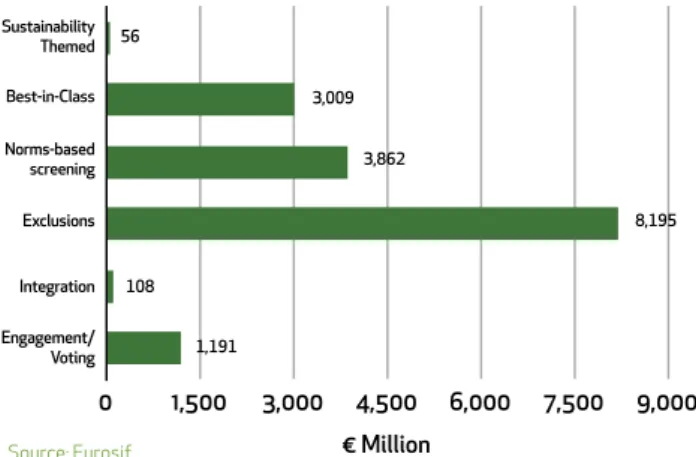
Country 2009 2011 2009-11 Austria € 1,314 € 3,009 51.3% belgium € 10,530 € 7,834 -13.7% Denmark € 3,335 € 127 -80.5% finland € 24,453 € 24,798 0.7% france € 49,406 € 115,309 52.8% Germany € 8,586 € 13,115 23.6% italy € 1,829 € 3,422 36.8% Netherlands € 1,046 € 1,120 3.5% Norway € 2,093 € 1,117 -27.0% poland € 0 € 13 nc spain € 1,100 € 1,558 19.0% sweden € 8,800 € 86,134 212.9% switzerland € 13,080 € 23,093 32.9% uK € 7,383 € 2,559 -41.1% Europe € 132,956 € 283,206 45.9%
€Mn sustainability themed CAGr
Country 2009 2011 2009-11 Austria € 129 € 56 -33.9% belgium € 595 € 367 -21.5% Denmark € 0 € 43 nc finland € 0 € 322 nc france € 3,279 € 623 -56.4% Germany € 2,995 € 4,523 22.9% italy € 987 € 1,051 3.2% Netherlands € 3,324 € 19,914 144.8% Norway € 0 € 676 nc poland € 0 € 0 nc spain € 0 € 107 nc sweden € 0 € 396 nc switzerland € 9,508 € 11,079 7.9% uK € 4,544 € 8,932 40.2% Europe € 25,361 € 48,090 37.7% Source: Eurosif Source: Eurosif
16 Norges Bank Investment Management, “Government Pension Fund Global Annual Report”, 2011,
http://www.nbim.no/Global/Reports/2011/Annual%20report%202011/Arsrap-port_11_ENG_web.pdf.”
17 Norwegian Ministry of Finance, “Companies Excluded from the Investment Universe”, http://www.regjeringen.no/en/dep/fin/Selected-topics/the-government-pension-fund/
re-sponsible-investments/companies-excluded-from-the-investment-u.html?id=447122, 2012
18 Novethic (2012) Norms-based exclusions. Available : http://www.novethic.fr/novethic/upload/etudes/Norm-based_exclusions_EN_20120306.pdf
FIGURE 2: Growth of Best-in-Class Investments in Europe
This strategy has experienced remarkably similar growth to the thematic category, stagnating in the years 2007-09, but then more than doubling to 2011. As shown in the coun-try Table 2, the main contributors to this growth are Sweden and France. In Sweden, the ten-fold increase is not a general trend, but is due to the conversion of assets to Best-in-Class by a small number of institutional investors.
NorMs-bAsED sCrEENiNG
Norms-based screening is a comparatively recent strat-egy that has its origins in the Nordic countries. Since it was first measured as a separate strategy in 2010, its adoption by asset managers has been explosive. The reason for this appears to be a desire by many asset managers and owners to avoid companies in breach of one or more internationally recognised norms covering ESG practices. A Norms-based screen is a relatively impartial way of identifying compa-nies whose practices are at odds with generally accepted good business behaviour. Once a company has been iden-tified as a poor performer, the information can be used to engage for change or avoid by divesting, depending on the preference of the asset manager or owner. In this way, the responsible investor can enforce a minimum standard with-out compromising the freedom of fund managers to pursue profit maximising investment opportunities. In order to be classified under this strategy, Eurosif requires a comprehen-sive screen based on international norms covering
Environ-mental and Social and Governance criteria. The evolution of Norms-based screening is shown in Figure 3.
FIGURE 3: Growth of Norms-based Screening Investments in Europe
This growth is primarily seen among asset managers or own-ers adopting a screen across all assets. While this strategy has been common in the Nordic countries for a number of years, evidence shows that it is now spreading to continen-tal Europe and the UK. The reader should note, however, that a Norms-based screen typically has a small effect on the portfolio of a large asset manager or owner. In this re-spect, it is similar to the Exclusions strategy. For example, the Norwegian Government Pension Fund Global, which manages €426 billion at the end of 2011 and was invested in 8,005 companies,16 excludes 55 companies17 from its
invest-ment universe at the time of writing, based on a combination of Exclusions and Norms-based screening. Further, while the most common Norms-based screen is in relation to UN Global Compact, there are differing methodologies to de-termine what constitutes a breach of the norm, and asset managers and research providers are not typically transpar-ent on the methodology. Novethic18, a French SRI research
centre finds that investors using the same norms-based ex-clusion framework do not always exclude the same compa-nies, and often, the name of excluded companies is not even disclosed. Nevertheless, Norms-based screening is being adopted by more and more asset managers. The growth of Norms-based screening by country is shown in Table 3 .
0 75,000 150,000 225,000 300,000 2005 2007 2009 2011 € Million 283,206 132,956 130,315 57,816 Source: Eurosif Source: Eurosif 0 750,000 1,500,000 2,250,000 3,000,000 2009 2011 € Million 2,346,308 988,756
TABLE 3: Growth of Norms-based Screening Investments by Country
Whilst the extraordinary growth in France and Italy espe-cially, is welcome, readers should note that this cannot yet be described as a general market trend, as it is due to a small number of very large asset managers or owners adopting this strategy. Nevertheless, indications are that this method of avoiding the worst performing companies, countries or projects in terms of good business practices is becoming more widespread and will continue to grow.
ExClusioNs
Exclusions of investments from the universe of possible investments on extra-financial grounds is the oldest and largest responsible investment strategy. While the origin of this strategy is founded on religious beliefs, its use has expanded to secular asset managers and asset owners. The motivation for this varies: some have reputational concerns, whereas others may be unwilling to finance the production and marketing of certain products. Figure 4 shows the evolu-tion of Exclusions over time. Note that previous years’ data have been recalculated to reflect a change in methodology. In most previous years, Eurosif used the term simple screen-ing for one or two exclusions and values-based screenscreen-ing for
three or more exclusions and reported these figures sepa-rately. These two classes have now been merged to produce Exclusions. In addition, Norms-based screening was previ-ously part of values-based exclusions. See Case Study 1 for a discussion on Exclusions versus Norms-based screening. It also bears noting that the figures only measure Exclusions beyond that required by law, so for example in Belgium and France exclusions on cluster-munitions only is not counted as these exclusions are required by law.
FIGURE 4: Growth of Exclusion Investments in Europe
Exclusions can be applied across all managed (or owned) as-sets, or to certain funds or mandates only. The former is often referred to as exclusion overlays. For example, an asset man-ager or an asset owner could have a policy to exclude produc-ers of cluster munitions from all investments, but then have specific funds or mandates with additional Exclusions such as producers of tobacco. In the Austrian, German and Swiss country reports, the fund specific and asset overlay Exclu-sions are treated separately, whereas in the figures in Table 4 below all Exclusions are reported. Applying Exclusions across all assets is becoming more common among asset owners and managers, and this asset overlay Exclusion represents most of the growth in this strategy. The most popular Ex-clusion overlay is weapons. However, within this category a number of differences exist, ranging from only those covered by international treaties such as cluster munitions and anti-personnel mines to all weapons. Other common Exclusions are tobacco, alcohol, gambling and nuclear weapons. Beyond these, asset managers and owners mention production of pork, animal testing, food commodities, genetically modified foods and stem-cell technology. Table 4 shows the growth by country from 2009 to 2011.
Source: Eurosif Source: Eurosif
€Mn Norms-based screening CAGr
Country 2009 2011 2009-11 Austria € 1,465 € 3,862 62.4% belgium € 23,478 € 19,744 -8.3% Denmark € 143,917 € 213,906 21.9% finland € 62,850 € 62,336 -0.4% france € 17,256 € 679,566 527.5% Germany € 6,616 € 11,255 30.4% italy € 2,352 € 314,248 1056.0% Netherlands € 125,264 € 166,359 15.2% Norway € 372,056 € 550,843 21.7% poland € 2 € 13 151.2% spain € 755 € 1,119 21.7% sweden € 214,435 € 259,346 10.0% switzerland nm € 192 nc uK € 18,310 € 63,520 86.3% Europe € 988,756 € 2,346,308 54.0% 0 1,000,000 2,000,000 3,000,000 4,000,000 2002 2005 2007 2009 2011 € Million 3,829,287 1,532,8651,749,432 335,544 184,000
TABLE 4: Growth of Exclusion Investments by Country
The growth in Exclusions, most notable in Germany, Swit-zerland and the Netherlands, is driven by a small number of large asset managers or owners having adopted Ex-clusions across all assets under management. However, there is also a trend to apply Exclusions among smaller asset managers or owners, so the growth is more cor-rectly identified as a market trend than is the case with Best-in-Class or Sustainability themed strategies. As the total assets under management by European as-set managers is estimated by EFAMA at €13.8 trillion at the end of 201119, Exclusions cover 27.7% of European
invested assets.
However, this is not the whole story. As mentioned, invest-ing in certain products banned by international
conven-tions such as cluster municonven-tions is prohibited in Belgium and France and therefore not counted in this figure. For these two countries alone, €2,9 trillion can be added to the above figure meaning that 48% of the industry is apply-ing exclusions, and most of this covers cluster munitions and anti-personnel mines. In addition there are many asset managers not included in this figure, for example in the UK and Switzerland, which are in the process of implementing a complete ban on investing in weapons covered by inter-national conventions. Certainly, some asset managers and owners are doing more than others, and some have only started the process, but already half of Europe’s invested assets have policies in place to exclude weapons banned by international conventions, and this figure is increasing. This must surely be heralded as a tremendous success for the in-ternational community and a validation of the work of many individuals to make it happen.20
iNtEGrAtioN
The process of integrating ESG criteria in financial analysis has received much attention in recent years, especially with the popularity of the UN-backed Principles for Responsible Investment (PRI). The 2010 Study documented substan-tial growth in this strategy, but concerns remain about the consistency and quality of the process adopted by asset managers and owners. In principle, an integration strategy will use ESG information to adjust the forward-looking fi-nancial projections for companies upon which fund man-agers base their investment decisions. In practice, it is dif-ficult to measure and validate the impact this strategy has on portfolio selection. Further, some may argue that the incorporation of extra-financial information in portfolio management is not an SRI strategy; it is simply part of good fund management. Nevertheless, this strategy is interest-ing from a philosophical point of view because it attempts to place a financial cost or benefit on ESG information. The growth of Integration is shown in Figure 5.
€Mn Exclusions CAGr Country 2009 2011 2009-11 Austria € 1,336 € 8,195 147.7% belgium € 125,027 € 96,736 -12.0% Denmark € 143,951 € 244,227 30.3% finland € 58,695 € 83,637 19.4% france € 16,716 € 15,975 -2.2% Germany € 8,893 € 618,248 733.8% italy € 308,628 € 446,790 20.3% Netherlands € 368,975 € 665,108 34.3% Norway € 378,059 € 550,843 20.7% poland € 1,076 € 1,174 4.5% spain € 27,611 € 56,226 42.7% sweden € 216,052 € 339,754 25.4% switzerland € 12,107 €429,194 495.4% uK € 82,307 € 273,180 82.2% Europe € 1,749,432 € 3,829,287 47.9% Source: Eurosif
19 EFAMA Asset Management in Europe, Facts and Figures, May 2012
FIGURE 5: Growth of ESG Integration in Europe
As seen above, the remarkable growth in Integration experi-enced from 2007 to 2009 has not been duplicated this time. The individual country growth is shown below.
TABLE 5: Growth of ESG Integration by Country
€Mn EsG integration CAGr
Country 2009 2011 2009-11 Austria € 0 € 108 nc belgium € 47,275 € 13,830 -45.9% Denmark € 83,583 € 40,027 -30.8% finland € 24,963 € 20,715 -8.9% france € 1,800,000 € 1,804,781 0.1% Germany € 0 € 11,424 nc italy € 317 € 446 18.5% Netherlands € 274,385 € 542,156 40.6% Norway € 32,400 € 23,206 -15.4% poland € 0 € 13 nc spain € 2,086 € 7,302 87.1% sweden € 83,512 € 34,897 -35.4% switzerland nm € 7,509 nc uK € 461,985 € 697,692 22.9% Europe € 2,810,506 € 3,204,107 6.8% Source: Eurosif Source: Eurosif 0 1,000,000 2,000,000 3,000,000 4,000,000 2005 2007 2009 2011 € Million 3,204,107 2,810,506 1,024,925 639,149
ENGAGEMENt AND votiNG
Responsible ownership through engagement with compa-nies and voting shares at general meetings is an important part of responsible investment and is a practice that has re-ceived much attention in connection with the debate around how shareholders make use (or fail to make use) of their power as owners of companies. The 2012 general meeting season was termed the ‘Shareholder Spring’ by many in the UK following a number of instances where investors voiced their displeasure with company management through vot-ing at general meetvot-ings. While shareholder activism is not new, it is arguably more vocal in the US, partly for cultural reasons and differences in corporate legislation. Indeed, in certain parts of Europe, corporate dialogue with sharehold-ers has been almost unheard of until recently. Eurosif provides a figure for Engagement in Figure 6, but the reader should note that, just like with Integration, Engagement is more about the quality of the interaction than quantity of assets it applies to.
FIGURE 6: Growth of Engagement and Voting Strategies in Europe
Nevertheless, the figures show an increased allocation to Engagement and voting, indicating that more asset manag-ers and ownmanag-ers are using this strategy to manage their port-folio in the post-investment stage. It is also worth noting that many asset managers and owners focus their attention on governance issues in the exercise of voting rights and en-gagement with companies. Environmental and social issues are gaining ground in the engagement process, but govern-ance (especially corporate governgovern-ance) remains a focus for investors. The country results are shown in Table 6.21
0 500,000 1,000,000 1,500,000 2,000,000 2,500,000 2002 2005 2007 2009 2011 € Million 1,950,406 1,668,473 1,351,303 728,837 118,000 Source: Eurosif
21 Figures are not reported for France because voting by asset managers is regulated by a comply-or-explain regime. Please see French country section for more detail. Swiss data is
The Co-operative Asset Management (TCAM) is a research-driven fund management company which identifies and exploits assets mispricing through analysis at three levels: company, industry and thematic. ESG issues are integrated into analysis at each level:
• Company level issues might include: new management,
improved governance, transformational mergers and ac-quisitions, strength in emissions or energy efficiency standards, or a unique franchise capable of sustaining a competitive advantage longer than the market is giving credit for.
• At an industry level, a fuller appreciation of the
com-petitive dynamics of an industry helps highlight medium and long-term trends not adequately captured in the current price.
• Finally, longer-term themes such as demographics,
en-ergy availability and climate change, may also result in mispricing – especially where the market is focused on shorter-term issues.
The ESG assessment includes scores on three indicators: the extent to which the company faces a headwind or tail-wind from ecological and social issues, the quality of the management in addressing the company’s ESG risks and opportunities, and finally whether its corporate governance structures and practices – including alignment of executive remuneration with valid corporate targets – are likely to en-hance or destroy value.
Further, for the more specialist ESG funds, called Sustain-able Trusts, TCAM has shifted from a “Best-in-Class on ESG” approach to selecting companies that through their products, services or standards, produce a “net benefit” for the environment and society, as well as meeting the exclu-sion criteria, such as tobacco and armaments manufacture. In short, this means seeking out companies that are more part of solutions for, than the problem with, unsustainable economic activity.
In order to evaluate whether this ESG analysis actually has an impact on stock selection, TCAM surveyed the 200 equi-ties actively covered or invested in financial year 2011/12. In over a quarter of cases, the ESG issues were explicit drivers or risks in determining the investment case. However, not all integration is equally impactful nor is it all equally measur-able. At most companies, ESG factors were part of a series of factors which affected outlook and valuation. In a few cases it was the dominant factor.
So far, TCAM has not attempted to quantify what contribu-tion ESG has made to beta or alpha performance, in part because few investment decisions are ever taken because of one factor alone. However, a number of companies were avoided because of grave ESG concerns that went on to underperform for those reasons, and many were identified that stand to profit from being on the right side of the sus-tainability agenda.
CAsE stuDy 2: EsG integration Case study: the Co-operative Asset Management22
22 This case study is based on: http://co-operativeassetmanagement.co.uk/downloads/TCAM-Responsible-Investment-Annual-Review-1112.pdf. Specific company examples are