INVESTIGATION OF THE EFFECT OF SCHOOL FEEDING PROGRAM ON PRIMARY SCHOOL PUPILS’ ENROLMENT, ATTENDANCE AND
ACADEMIC PERFORMANCE IN TANZANIA: THE CASE STUDY OF MUSOMA RURAL DISTRICT
BONIFACE ANDREA KAMNYUNGU
A DISSERTATION SUBMITTED IN PARTIAL FULFILMENT OF THE REQUIREMENTS FOR THE DEGREE OF MASTER OFARTS IN MONITORING AND EVALUATION OF THE OPEN UNIVERSITY OF
TANZANIA 2019
CERTIFICATION
The undersigned certifies that he has read and hereby recommends for acceptance by
the Open University of Tanzania, a dissertation titled; “An Investigation on the effect
of School Feeding Program on primary school pupils’ enrolment, attendance and performance in Musoma Rural District, Tanzania” in partial fulfillment of the
requirements for the degree of Master of Arts in Monitoring and Evaluation.
.………..………….. Dr. Hamidu Shungu
(Supervisor)
……… Date
COPYRIGHT
No part of this dissertation may be reproduced, stored in any retrieval system, or
transmitted in any form by any means, electronic, mechanical, photocopying,
recording or otherwise without prior written permission of the author or the Open
DECLARATION
I, Boniface Andrea Kamnyungu, do hereby declare that this thesis is my own
original work and that it has not been presented and will not be presented to any
other University or Institution for a similar or any other degree award.
……….………… Signature
………. Date
DEDICATION
I dedicate this work to my beloved daughter and son Victoria and Joshua for the
sacrifice, love, patience and understanding during the period of my studies. Indeed
their patience when I was away from them for long time allowed me to accomplish
this research in time. Their love, care, concern, support, encouragement and
enthusiasm inspired me to reach this goal.
To my friends and colleagues at The Open University Tanzania for their
encouragement and advice to strive to the end of the Master course (MAM&E).
Special dedication to my parents Mr. Andrea Kamnyungu (Father) and Mrs Paulina
Edward (mother) whose words of encouragement and blessings have made me
ACKNOWLEDGEMENT
This study was made possible with contribution of a number of people in one way or
the other. In this regard I wish to express my sincere gratitude to all whose
contribution has made this study possible. I wish to extend my special gratitude to
my supervisor Dr Hamidu Shungu for great support to me. His guidance,
encouragement, patience in reading, correcting, re- reading and refining this work is
commendable.
I am grateful to my family and friends for their continued encouragement and
prayers during the entire course period. Special thanks go to my children Victoria
and Joshua for their support, love and understanding during the course. Many thanks
should go to my parents, Mr. Andrea Kamnyungu and Mrs Paulina Edward for
implanting the seed of knowledge in me, and my entire family for their support.
Thanks to my colleagues at Buhare Community Development Training Institute for
their assistance of all kind, their support helped me greatly in pursuing the course.
Special appreciation goes to Mr. Paschal J. Mahinyila (my immediate boss) who
gave me permission to meet my supervisor when needs arose. I really appreciate the
assistance and cooperation I received from the head teachers, teachers, parents and
pupils in various schools I visited in Musoma Rural District.
Last but not least I wish to thank the Almighty God for his care and timely healing
when I was sick, indeed he becomes a true driver when I was on Safari up and down
ABSTRACT
The study sought to investigate the effect of school feeding program on students’ academic performance in Musoma Rural District. The study specifically sought to
determine the nature of school feeding program, the influence of school feeding
program on students’ enrolment, attendance and academic performance, identify
problems facing the implementation of school feeding program, identify
opportunities available to support school feeding program and the strategies to solve
the identified problems. The target population of this study was 108 primary schools
in Musoma Rural District from which a sample of 10 primary schools was drawn
with a total of 133 respondents. The correlation research design was used to carry
out the study. Both primary and secondary data were used. Data were collected using
questionnaires, interviews, observation and documentary review. Semi structured
questionnaires were administered to the respondents. Observation checklist was used
to help researcher to do a physical verification. A schedule was used to interview
parents and cooks. Reports related to students’ attendance and academic performance were collected to assist in comparing schools. The data tools which
were used are Statistical Package for Social Sciences and Microsoft Excel used to
summarize the data and find patterns. The study found that school feeding is a
catalyst for improving students’ attendance and academic performance. This was realized as attendance and good academic performance reflected in schools with
feeding program as compared to those schools without feeding program. The study
recommends that school feeding program should be enhanced in schools and to be
established in schools which do not have such program to ensure students’ enrolment, attendance and eventually good academic performance.
TABLE OF CONTENTS CERTIFICATION ... ii COPYRIGHT ... iii DECLARATION ... iv DEDICATION ... v ACKNOWLEDGEMENT ... vi ABSTRACT ... vii
TABLE OF CONTENTS ... viii
LIST OF TABLES ... xii
LIST OF FIGURES ... xiii
LIST OF ABBREVIATIONS ... xiv
CHAPTER ONE ... 1
INTRODUCTION ... 1
1.1. Background of the Study ... 1
1.2. Statement of the Problem ... 4
1.3. Objectives... 5
1.3.1. General Objective ... 5
1.3.2. Specific Objectives ... 5
1.4. Research Questions... 5
1.5. Scope of the Study ... 5
1.6. Significance of the Study ... 6
1.7. Organization of the Study ... 6
CHAPTER TWO ... 8
LITERATURE REVIEW ... 8
2.1 Introduction ... 8
2.2 Conceptualization of Terms ... 8
2.3 Theoretical Framework... 8
2.4 Maslows’ Hierarchy of Human Needs ... 9
2.5 Empirical Literature ... 11
2.5.2 Effect of School Feeding Programs on Academic Performance... 15
2.6 Conceptual Framework... 16 2.7 Research Gap ... 16 CHAPTER THREE ... 20 RESEARCH METHODOLOGY ... 20 3.1 Introduction ... 20 3.2 Research Design ... 20 3.3 Study Area ... 20 3.4 Study Population ... 21
3.4.1 Population Sample and Sample Size ... 21
3.4.2 Sampling Procedure... 22
3.4.3 Probability Sampling ... 22
3.4.4 Non Probability Sampling ... 23
3.5 Methods of Data Collection ... 23
3.5.1 Data Types and Sources of Data ... 24
3.5.2 Primary Data ... 24
3.5.4 Interview Method ... 25
3.5.5 Questionnaires ... 25
3.6 Data Processing ... 26
3.6.1 Data Analysis ... 26
CHAPTER FOUR ... 27
PRESENTATION, ANALYSIS AND DISCUSSION OF THE FINDINGS ... 27
4.1 Introduction ... 27
4.2 Demographic Information... 27
4.2.1 Head Teachers ... 27
4.2.2 Parents ... 28
4.2.3 Students... 29
4.2.4 School Feeding Program... 29
4.2.5 Motives for School Feeding Program... 31
4.2.6 Community Responsibilities towards School Feeding Program... 32
4.2.7 Types of Meal Offered in School ... 32
4.2.8 Sources of Water ... 32
4.2.9 Sources of Energy for Cooking ... 33
4.2.10 The Effect of School Feeding on Students’ Academic Performance ... 33
4.3 The Influence of School Feeding Program on Students Attendance ... 37
4.4 Factors that affect School Feeding Program ... 40
4.4.1 Problems Affecting School Feeding Program ... 40
4.4.2 Inadequate Community Contribution ... 41
4.4.3 Lack of Safe and Clean Water ... 43
4.5 Opportunities Available in Supporting School Feeding Program ... 44
4.5.1 Ways or Strategies to Address Problems Identified to Sustain School Feeding Program ... 46
CHAPTER FIVE ... 47
KEY FINDINGS, CONCLUSSIONS AND RECOMMENDATIONS ... 47
5.1 Introduction ... 47
5.2 Summary of Findings ... 47
5.3 Conclusion ... 50
5.4 Recommendations ... 52
5.5 Recommendation for Further Study ... 53
REFERENCES ... 54
LIST OF TABLES
Table 4.1: Age and Sex of Head Teachers ... 27
Table 4.2: Teaching Experience of Head Teachers and the Duration of
Service in the Present Station ... 28
Table 4.3: Student Sex and Age ... 29
Table 4.3: Records of Students’ Academic Performance in Schools with
Feeding Program ... 34
Table 4.4: Records of Students’ Academic Performance in Schools without
Feeding Program ... 35
Table 4.5: Records of Students’ Academic Performance in Schools with and
without Feeding Program ... 36
Table 4.6: Trend of Students ‘Attendance in Schools with feeding
Program Jan-July 2019 ... 38
Table 4.7: Trends of Students Attendance as from January –July 2018
LIST OF FIGURES
Figure 4.1: Present Schools with Feeding Program in Musoma Rural District ... 30
Figure 4.2: The Graph Indicate the Motives for School Feeding .... Error! Bookmark not defined.
Figure 4.3: Records of Students’ Academic Performance in Schools with and
without feeding Program ... 36
Figure 4.4: Present Attendance Average in Percentage ... 38
Figure 4.5: Present Attendance Average in Percentage ... Error! Bookmark not defined.
LIST OF ABBREVIATIONS
DED District Executive Director
FAO Food and Agricultural Organization
MACD Master of Arts in Community Development
MDGs Millennium Development Goals
NGO Non-Governmental Organization
PCI Project Concern International
SFP School Feeding Program
SPSS Statistical Package for Social Sciences
UK United Kingdom
UN United Nations
UPE Universal Primary Education
US United States
WFP World Food Program
CHAPTER ONE INTRODUCTION 1.1. Background of the Study
The basic concept of School Feeding Program (SFP) is to provide children in public
primary schools and kindergartens with nutritious meals per day. School Feeding
program is an initiative to fulfill on the Millennium Development Goals (MDGs)
goal number two and three, which respectively include the achievement of Universal
Primary Education (UPE), and the promotion of gender equality and women
empowerment. School Feeding Program (SFP) is said to play a major role in
supporting universal primary education policy (Government of Ghana, 2006). The
Millennium Development Goal Task Force report Birdsall, Levine and Ibrahim,
(2005) cites School Feeding Program as among of the way to attract children to
come to school.
Levinger (1989) says that School Feeding Program make a variance in enrollment
and attendance of children to school. The program also supports poor families by
giving their children a decent food daily and thus saving family diet. School Feeding
Program cannot be estimated to make a straight measurable input to fight against
malnutrition among school children but it makes a significant contribution towards
reduced malnutrition in school children. The focus is on school feeding role in
maximizing children’s learning capability through the relief of short term hunger and thus increasing performance.
The review conducted in the year 2007 on school feeding programs throughout the
educational outcomes and for helping to relieve short term and long term hunger as
well as nutritional deficiencies (Greenhalgh et al., 2009). School feeding is a tool
which today effectively enables hundreds of millions of poor children worldwide to
attend school in developed and developing countries alike. Support from World
Food Program through food for education program reached more than 21.6 million
children in the year 2005 (WFP, 2005).
Furthermore, there are often several unforeseen consequences of school feeding
program that necessitate continual evaluation of ongoing programs. It is against
these backdrops that the research seeks to assess the school meal program in
Musoma Rural District within Mara region. According to the 2007 Food and
Agriculture Organization’s (FAO) estimate, 923 million people in the world were chronically hungry, which was an increase of about 75 million people from the
2003-05 estimates (FAO, 2008). Many of these are children, and a vast majority of
them are in developing countries. These numbers suggest that the Millennium
Development Goals related to hunger and malnutrition may not be met by 2015
(FAO, 2008).
The persistence of hunger, malnutrition, and micronutrient deficiencies can have
long lasting effects on the health status and productivity. Jomaa, McDonnell and
Probart (2011) state that childhood under nutrition imposes significant economic
costs on individuals and nations, and that improving children’s diets and nutrition can have positive effects on their academic performance and behaviors at school.
Alderman, Hoddinott, and Kinsley (2006) found that malnutrition led to delayed
adults. The focus of the Millennium Development Goal (MDG) number two has
been to ensure Universal Education for all by the year 2015 the concept is enroll all
age going children and make sure they are retained in schools and complete their
primary levels of education as compared to 1990 (UN, 2005).
In Tanzania School feeding program is not new, the program was implemented
during Colonial era. Soon after Independence the first president the late Mwalimu
J.K. Nyerere identified three enemies of development in the country. The identified
enemies are Poverty, Diseases and Ignorance The government focus was enrolment
and attendance in government schools (at this time, private primary schools were not
permitted). Nyerere’s goal was for the majority of people to receive primary education, with a small minority going beyond that. In the year 1970s private
primary schools opened and a universal primary education (UPE) program was
introduced.
School fees were also eradicated resulting in a substantial increase in student
enrolment and attendance to influence their performance. Currently, School Feeding
Program can meet the national demand and those of Millennium Development Goals
by motivating children to come to school. School Feed Program is among of the
strategies to support boys and girls enjoy life at schools. School feeding program is
expensive to run hence, it calls for external support from other well-wishers to
supplement government efforts and strategies. It is from this background that Project
Concern International (PCI) Tanzania, an International Non-Governmental
School feeding Project in Mara region. Hence, it is the high time to make an
investigation on the effect of School feeding program and student performance.
In line with this, several studies were conducted worldwide, regional and national in
the direction of assess the impact of school feed program. However, few studies
were conducted in Tanzania, and no one was specifically done in Musoma Rural
district which is among of the implementation in Mara area. Therefore, this study
seeks to increase the inadequate literature on the effect of school feed program and
student’s school performance in Mara region and the nation at large.
1.2. Statement of the Problem
School feeding program implemented to some schools within Mara region with an
intention to improve learning environment whereby enrollments, school attendance,
performance and nutritional among disadvantaged children will be improved. Several
studies have addressed the rationale for Food for Education or empirical evidence of
their impact, including the results of expert seminar (WFP, 2006). The organization
encourages government and community members to contribute towards the achieving
its goals knowing that it cannot achieve them by acting alone.
It is from this background where research is designed to assess as to what extent Food
for Education program will improve learning environment through reducing drop out,
improving attendance, enrollments, performance and even nutrition to marginalized
group (children). How have school feeding program improved learning environment
in Musoma Rural district, Mara region in Tanzania? By so doing the study come out
with the evidence on how feeding program improved learning environment and also
opportunities identified and suggestions given out to rectify mistakes done during the
implementation of first phase of the project to ensure efficiency and extension of the
project.
1.3. Objectives
1.3.1. General Objective
To investigate the nature of School Feeding Program in schools, and its effect on
students’ enrolment, attendance and academic performance.
1.3.2. Specific Objectives
i. To find out the contribution of School Feeding Program to students’
enrolment, attendance and academic performance.
ii. To identify problems affecting School Feed Program.
iii. To identify available opportunities and strategies to solve problems identified
in sustaining school feeding program
1.4. Research Questions
i. How does School Feeding Program contribute to students’ enrolment,
attendance and academic performance?
ii. What are the problems affecting School Feed Program?
iii. What opportunities and strategies available to solve problems identified in
sustaining school feeding program?
1.5. Scope of the Study
was confined to ten Primary schools whereby Five Schools which had school
feeding program namely Mkirira A, Mkirira B, Majita A, Majita B and Nyakatende
primary schools. The other five schools without school feeding program under the
study are Murangi A, Murangi B, Kasoma A, Kasoma B and Lyasembe primary
schools. It was centered to investigate the effect of school feeding program which is
seen to be a tool for improving school learning environment. The study involved
Head Teachers, Teachers, parents, students, cooks and government officials in
Musoma Rural District.
1.6. Significance of the Study
The study is relevant as serve many purposes to improve School feeding program.
The findings from the study enabled the organization running this program to rectify
mistakes done during the implementation of the first phase. Enable the organization
overcome challenges facing the implantation of the program as noted from the field.
Furthermore, the school authorities understand the importance of school feeding
program and put more strategies to ensure its sustainability even after the end of
donor funding. The findings enabled the government to reveal the relevance of
school feeding in improving learning environment and establish the same program to
other schools. The findings also will be used in developing and modifying the
existing government policies in education sector.
1.7. Organization of the Study
The study is organized into six chapters, chapter one presents background of the
study, statement of the problem, research objectives and research question of the
theoretical and empirical literature review research gap, conceptual framework and
developed hypothesis. Chapter three presents methodology that used in the study. It
presents research methodology which is broken down into research paradigm,
research design strategies, study area, study population, data collection tools and
methods. Other parts of this chapter variables are measured, data analysis, validity
and reliability, and ethical Issues. And then the fourth chapter, it defines about the
findings of the study after data gathering and analysis. Followed by The discussion
chapter, finally, the conclusion and policy implication established in the sixth
chapter.
1.8. Ethical Issues and Consideration
A researcher observes research ethics and was honestly and maintains integrity.
Before going to the respective areas under study a message of introduction from
Open University Tanzania was sought introducing a researcher to the District
officials, Project Concern International (PCI) and other authorities. Assistance from
the district officials was requested to introduce him down to the wards, villages and
schools authority where data have been obtained. This research was done by
recognizing and protection of human rights. Rights of self-determination, anonymity,
and consent were highly observed. Furthermore, responses were used for the aim of
the study only. And, the researcher tells the respondents the earnings of the study as
well their partaker rights and protection with this sight respondents were chip in
willingly. Furthermore participants were educated on the reason of conduct a
CHAPTER TWO
LITERATURE REVIEW
2.1 IntroductionThis chapter intends to make assessment of documents on the topic linked to this
study. The review is related to the objectives of the study. The assessment focused
mainly on the effect of School Feeding Program on students’ enrolment, attendance
and academic performance at the global and regional perspectives. The review was
analyzed based on the empirical and theoretical literature.
2.2 Conceptualization of Terms
School Feeding: For the intention of this study School feeding means a prearranged action of food provision with balanced nutrients at school.
Performance: the word is referred the ability to do well in achievement of skills, understanding, and attitude as far as this study is concerned.
Enrollment: for the aim of this study enrollment means the total amount of children admitted in a school.
Nutrition: in this study refers to different components of diet that are required by the body in sufficient quantity and quality in order to develop and reproduce and lead a
normal healthy life.
Malnutrition: It is deficiency of nutritious diet leading to illness.
Menu: a list of food that is served to fit the needs of an individual
2.3 Theoretical Framework
Maslow. Regarding to this theory developed by Abraham Maslow (1943), humans
are motivated by a wish to attain certain life goals. Achieving goals supports them to
satisfy specific requirements and wants. Maslow classified wants into hierarchy of
needs, in which some needs have to be met before human moves to satisfy others
(Maslow, 1943). As it denotes the needs are hierarchical with lowest rank being most
important and must be met before moving up to the rank or ladder of needs. Human
actions are focused on collecting the needs in the last order, and from there will
move to higher ranks as needs are satisfied. Some least desires are crucial to cover
standard of life. These recognized as physiological needs, they comprise food,
clothing, shelter and health.
2.4 Maslows’ Hierarchy of Human Needs
According to Maslow’s hierarchy of needs it demonstrates that the first stage of physiological needs are the needs that any person them needs every day for existence
or life and comprises elementary needs that is food, cloth and shelter. Another level
of physiological needs is security. The third level is of communal needs that are a
need to fit to a kind group. This contains friendship, love and belonging. The fourth
level is that of self-esteem, which a sense of self-respect and self-motivation. It also
comprises how one can share to others. Last level in this theory is self-actualization,
whereby a person struggles to a viable capability and personal progress.
According to Maslow, human being goes following a hierarchy needs beginning
with physiological needs such as food, cloth and shelter to much higher needs such
and teachers should make sure that they offer food to students purposely to have
healthy growing. Students should be given food so as to ensure that they do better in
classes and as well as at home. Failure to that it will make unhappiness and
eventually affects students’ attendance and performance. According to Maslows’ hierarchy of needs, shows that students are usually joyful once want are met.
Learning goes on smoothly when food is provided to school and once the wants are
met there is happiness.
The model shows the merits of diet to human being. From a wider sight of
improvement, it means that countries must fight to offer basic needs for use by their
people. For developing countries include Tanzania, it meaning short term hunger
must be disallowed to students in schools by making basic needs like foods available
to all students. As human being cannot live without food, the government must work
out to decrease the problem of food, especially to vulnerable groups like children,
women and people with different physical disabilities.
The government should make sure diet assistance is offered in schools through
schools feed program. School Feeding is a planned activity of giving enough
nutrients and balanced diet to children at school. It is a program that is organized at
any level such as school, district, nation, and region and worldwide to facilitate the
feeding of students in school. This will stimulate good health, high academic
motivation such as students’ involvement, attention in class and will reduce short term hunger. This program needs to be monitored properly to ensure that all students
2.5 Empirical Literature
Children in poor health began school later in life or not at all. A study in Nepal
found that the possibility of attending school was 5% for stunted children versus
27% for children of normal nutritional status (Moock and Leslie, 1986). In Ghana
malnourished children entered school at a later age and completed fewer years of
school than better nourished children (Glewwe and Jacoby, 1994). Some of days that
a child appears school are linked to cognition and performance (Ceci, 1995; Jacoby,
Cueto and Pollitt, n.d.). School Feeding Programs can have a helpful result on rates
of enrollment and attendance (Joy Miller Del Rosso, June 1999:7) According to
(Moore, 1994), the assessment of an existing school feeding program in Burkina
Faso founded that school cafeterias were related with improved school enrollment,
regular attendance, constantly lower repeater rates, lower dropout rates in
underprivileged provinces, and higher achievement rates on national exams,
particularly between girls (Joy Miller Del Rosso, June 1999:7)
In 1996 a small pilot study on School Feeding Program in Malawi was assessed for
its outcome on enrollment and attendance. More than three month period there was a
5% rise in enrollment and up to 36% progress in attendance/absenteeism matched to
control schools over the same period (WFP, 1996). Niger takes one of the five
lowest school enrollment rates in the world; feeding program in school is planned to
improve attendance of migrant and transhumant families, mostly of girls.
Beneficiaries obtain the same of the total day-to-day suggested food intake
(2,079kcal) in three meals per day. In adding, as an incentive for girls’ involvement in schools, various families obtain an extra take-home ration.
Proof from past knowledge with the School Feed Program indicates that it
contributes to its objectives: when cafeterias have been shut, even conditionally, fast
and high absenteeism follows and children are quieting from school. In regions with
nomadic and transhumant populations, the school year cannot commence till food
stocks arrive (WFP, 1995; 1996). Though not feeding program in school is the
traditional sense, school-based food supply has been used effectively to increase
enrollment and attendance among school-age children, mostly girls (Joy Miller Del
Rosso, June 1999:7).
In Bangladesh school feeding program increased enrollment by 20% versus a 2%
decline in non-participating schools (Ahmed and Billah, 1994). In Pakistan, a
program offers an income allocation in the form of one or two tins of oil to families
whose girls appear to school for 20 days per month (Joy Miller Del Rosso, June
1999:7) The Louw, Bekker, and Wentzel-Viljoen 2001 evaluation (hereafter referred
to as Louw et al.) focused on evaluating the effectiveness and efficiency of providing
food to school in terms of particular execution and operational issues.
The viewpoint of this cluster of investigators was that if the school feed program
might be correctly designed and effectively executed, the benefits of providing food
to school outweigh the investment made by government (Louw et al., 2001: viii). To
support their view of school nutrition, Louw et al. (2001: 156 and 157) cited
international studies that record the helpful effect of provision of food to school in
attendance, public participation in schooling, and reduced malnutrition rates. Results
from their sample study also shown increases in areas of attention spans, punctuality,
Wildeman and Nobuntu Mbebetho dec. 2005:7)
It has been reported recently in Chad that the school meals programs increases
attendance and help children to learn. “This year 2015 School meals offer parents an incentives to send their daughter to school and keep them there (retain), this reducing
gender literacy gap” https://www.wfp.org/stories/school-meals-chad, (2015) Starving children are less possible to go to school and less able to learn if they do
appeared. Starvation and poverty straight relate to educational performance. The first
report of the Millennium Development Goals Task Force on Education and Gender
(2003) said; generally educational performance both enrollment and retention
connect very intensely with revenue within a country (Joy Miller Del Rosso, June
1999:7) “ In the end ; only about 20 percent of the poorest children and 50 percent of middle income children complete primary school, while nearly all of the children
from the better off households do” www.unep.org/training/programs, (2011).
Feeding children in school has constantly been confirmed effective by raising
enrollment and attendance and in sinking dropout rate between school age children.
According to the UNICEF report of 2002 about 60 percent of the 100 million of
school children in the world are girls. World Food Program studies of take home
ration programs which recompense the families of girls who enroll and attend school
frequently (usually a minimum of 22 days per month), show dramatic results. In one
province in Pakistan, girls enrollment enlarged by 247 percent among the time the
school feeding program initiated in 1994 and 1998, in some provinces the rise was
197 percent in the extreme north province of Cameroon, the program achieved in
In Tanzania, World Food Program Representative and Country Director Ronald
Sibanda reported that the program of providing food to schools helps to ease
temporary hunger to school children. “School meals encourage school enrolment and
attendance and improve learning through better concentration,” (www.ippmedia.
com/frontend, (2013). Findings from teachers informed that even the academic
performance in their schools had developed as an outcome of progresses recording in
the World Food Program School feed program. The program is together executed by
the WFP and the government of Tanzania under the Ministry of Education and
Vocational Training. Therefore, this study aimed to discovery out more evidence on
the relevance of school feeding and possible ways to sustain and extend the program
to other schools.
2.5.1 Effect of School Feeding Programs on Children Attendance
According to Feingold (1970), there is strong proof signifying that school feeding
programs can raise attendance rates. Some of the Millennium Development Goals
(MDGs) were to offer universal primary education by 2015. School Feeding
Program or carry off home ratios aid as encouragements for registering children in
school and boosting everyday attendance. Due to the fact that when children go
hungry they cannot be willing to stay in school and parents could not afford to
register their children when they understand that they will be able to cater for their
nutritional requirements.
According to Jensen (2010), School Feeding Program commonly takes place in the
perspective of broad national school reform programs. These improvements should
improvement, curriculum reforms and student valuation. National ministries or
managerial dealing with education must not be inspired to undertake School Feeding
Program at the expenditure of other educational responses as it is hard politically to
reject food assistance. According to Pediatre (2001), attendance and school
performance are critically boosted by school feed program. Several schools are now
fighting to achieve just about functional education systems and to adopt the extra
burden of food supply (Otieno, D 2014:9). Mungai (2004) in his study findings on
the role of School Feeding on education progress found that it is valued mechanism
for encouraging enrollment and nurturing attendance. Also it assists toward improve
learning performance due to the good attendance.
2.5.2 Effect of School Feeding Programs on Academic Performance
According to Bowlby (1988), food quantity and quality should be viewed into.
Children must be given right nutrients to improve their growth, progress and life in
the society. He also said that the rate of the meals have to be noted. Meal must be
aided frequently for schools to set good projects and programs to affect this. He also
said that there must be a plan or department concerning this matter within the school.
Offering proper nutrition and helping stimulation of a child’s brains are vital mechanisms of children in the sense that they improve the development and
organization of the brain (Otieno,D 2014:9).
According to Ann (1986), approves that human body functions best when
accompanied by the right varieties of diet in the right proportion. Food is a basic
requisite and a right for survival for all humanity particularly for children whose
education, C.R.C (1989). Food is a basic biological want, Maslow (1943) has
highlighted that human beings have a hierarchy of needs extending from lower level
needs of food for life and safety to higher needs. Hence this must be offered before
we can request the children to be encouraged to learn (Otieno,D 2014:9). According
to Pediatre (2001), attendance and school performance are critically improved by
feeding program to school. Feingold (1970), indicated that there is proof strongly
telling that feeding school program can rise attendance rates and performance
(Otieno,D 2014:9).
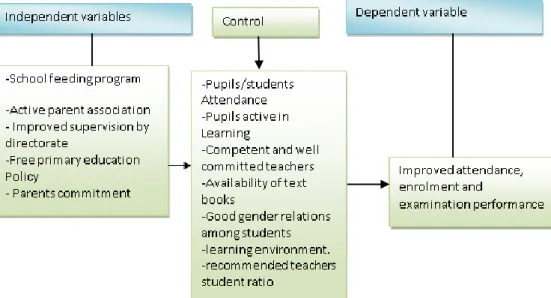
2.6 Conceptual Framework
Figure 2.1: The Conceptual Framework Source: Author’s Own Construction
2.7 Research Gap
Adekunle, D. Taylor1 & Christiana, O. Ogbogu1 (2016) doing a study on The
Effects of School Feeding Program on Enrolment and Performance of Public
Program is a beneficial intervention which has improved the enrolment and
performance of primary school learners in Osun State Nigeria and improved,
performance and completion of basic education. Mushi, Hilda (2017) also conducted
a study on The Effect of School feeding on Academic Enhancement in Arusha City
Community Primary Schools revealed that School Feeding Program boost learners
enrollment, classroom attendance and attention by the learners therefore boost of
academic progress.
Furthermore another study by Maijo, Shabani (2018) on the Impact of School Feed
Program on Learners’ Academic Performance in Mlunduzi Ward, Tanzania found progressive connection among schools with meal program in increased performance
of the students. The research was done in four primary schools in Mpwapwa district
in Dodoma Region Tanzania. The School Feeding Programs was funded by donors,
given the semi-aridity of the district it witnessed returning hunger which was
affecting Students education the respondents in this study also involved examination
candidates for the said years.
Another research conducted on School meal Program and Its Effect on Academic
Achievement in ECDE in Roret Division, Bureti District in Kenya (Chepkwony, B C
et al, 2013) revealed school feeding program remove temporary hunger among
leaners and increase their mental development and hence concentration in class and
better performance. This study compared community early childhood education and
private initial childhood education of children age 0-6. This is the most demanding
compromised the other suffer. When nutritional needs are not met, food is given for
survival and hence stunted growth and cognitive development retardation.
However the Nigerian and Kenyan education contexts are different from Tanzania
since primary education is state and county managed in Nigeria and Kenya
respectively giving these sub national levels of governance power and opportunity to
use locally devised systems of school feeding. The research done in these countries
has revealed that these school feeding programs are home grown, that is, funding is
by the parents and sub national governments. Hence these studies cannot give us a
clear picture on the contribution of school to students’ enrollments, attendance and performance.
Studies conducted in Tanzania (Mushi, 2017; Maijo, 2018) have shown a different
modality of funding and coordination but both studies concentrated on Primary
schools of two different regions and setting. Mushi (2017) concentrated in Arusha
City which is urban and its dwellers have improved living standards, their income
is a bit higher, the sample was bigger with ten schools and Maijo (2018) study
concentrated on rural setting with four schools, lower living standards of parents
and income.
The similarities of these programs are that they are donor funded. And yet these
studies could not be generalized to understand other school feeding programs in
Tanzania given different community settings and funding models of the school
feeding programs. As noted above many studies have been done to evaluate the
performance. Unfortunately, no investigation has been prepared to establish the
effect of school feeding program on students’ enrollment, attendance and academic performance funded by PCI in Mara region especially Musoma Rural District
The investigation was designed to examine on the effect of school meal program as
well as student’s academic performance in Musoma Rural District. In the conceptual framework the student attendance and performance depends on; School
feeding program, parents commitment, active parent association / committees,
competent and committed teachers, recommended teachers student ratio, free
primary education policy, Availability of text books, good gender relations among
CHAPTER THREE RESEARCH METHODOLOGY 3.1 Introduction
This chapter presents the research methodology. It is organized in the following
sections.
3.2 Research Design
The design of this study is based on non-experimental research category through
Correlation design. The design was employed to allow the collection of data and
make comparison among variables to draw conclusion. According to Kothari (2004)
says, research design is a plan, a roadmap and blueprint strategy of investigation
conceived so as to obtain answers to research questions. Through correlation design
the researcher use the analyzed data to determine if school feeding program and
academic performance are related or correlated. The researcher determined by
comparing those schools with feeding and those without. Researcher measured two
variables and then computes a statistical measurement called correlation coefficient
to identify the relationship between school feeding and academic performance.
3.3 Study Area
The study was carried out in Musoma Rural District within Mara region, the selected
area of study based on the fact that the district is one among three districts in Mara
region implementing school feeding program with support from the People of
United States of America through Project Concern International (PCI). The unit of
analysis was 108 primary schools in Musoma Rural District, whereby 73 primary
program. The study comprised of District officials, Head teachers, and teachers
responsible with feeding program, parents, students and cooks in the sampled
schools.
3.4 Study Population
Unit of the study was all 108 primary schools in Musoma Rural District, whereby 73
primary schools have a feeding program and 35 primary schools do not have feeding
program. The study population was 6573 students from 10 primary schools.
Furthermore, the study comprised of District officials, Head teachers, and teachers
responsible with feeding program, parents, students and cooks in the sampled
schools.
3.4.1 Population Sample and Sample Size
The information was collected from different representatives of different categories
so as to come up with relevant and required information. The researcher took sample
of 10 schools (05 schools with school feeding program and 05 schools without
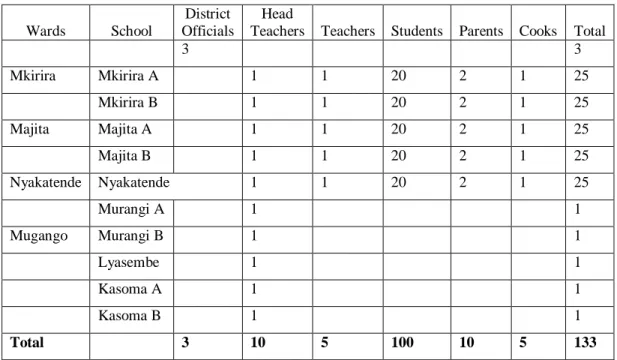
school feeding program) with a total of 133 respondents. The respondents’ were10
Head teachers, 05 Teachers responsible for feeding program in schools, 100
students, 10 parents, 05 Cooks and 03 District officials. Both male and female were
represented in the sample. Formula used to calculate sample size was from Kothari,
(2004):-
N- Sample frame
p - Proportion of schools with feeding program
q - Proportion of schools with none feeding program
e – Error
From the calculation the sample size was 100 students.
Table 3.1: Number fo Distribution of Sample Size Wards School
District Officials
Head
Teachers Teachers Students Parents Cooks Total
3 3 Mkirira Mkirira A 1 1 20 2 1 25 Mkirira B 1 1 20 2 1 25 Majita Majita A 1 1 20 2 1 25 Majita B 1 1 20 2 1 25 Nyakatende Nyakatende 1 1 20 2 1 25 Murangi A 1 1 Mugango Murangi B 1 1 Lyasembe 1 1 Kasoma A 1 1 Kasoma B 1 1 Total 3 10 5 100 10 5 133
Source: School Feeding Research, 2019
3.4.2 Sampling Procedure
Sampling is the process of selecting a number of individuals or objects from a
population such that the selected group contains elements representatives of the
characteristics found in the entire group, (Orodho and Kombo 2002). Hence, this
study employed both probability and non-probability sampling procedures.
3.4.3 Probability Sampling
The probability sampling was used in the study, Simple random techniques was used
primary schools, the researcher used simple random sampling technique to obtain 05
schools with feeding program and 05 schools without feeding program. In this
process the researcher wrote names of all wards in the District in pieces of paper and
separate wards with feeding program and those without.
The pieces of papers were mixed in a box; thereafter, 4 wards namely Nyakatende,
Majita, Mugango and Mkirira were drawn. The same procedures were observed in
selecting schools. The name of all schools in the selected wards were written into the
piece of papers and mixed in a box and 05 schools with feeding program
(Nyakatende, Majita A, Majita B, MkiriraA and Mkirira B) and other 05 schools
with none feeding program were drawn (Murangi A, Lyasembe, Kasoma A, Murangi
B and Kasoma B) In schools simple random techniques was used to obtain
respondents students. The total number of students was obtained to determine the nth
number. This method allowed researcher to draw 100 students.
3.4.4 Non Probability Sampling
Non probability sampling was used to those District officials, Head teachers,
teachers and Cooks who directly implement the program and other respondents
based on their position in the program.
3.5 Methods of Data Collection
During research process both primary and secondary data were collected. The
primary data were collected from the field at the first hand and secondary data were
schools attendance reports and District reports. The identified schools and
respondents were visited for the aim of gathering required information; data were
obtained through Interviews and questionnaires.
3.5.1 Data Types and Sources of Data
Both primary and secondary sources of data were used in the investigation. The
primary data were gained from interviews, whereas secondary data were obtained
from schools reports, records and District offices.
3.5.2 Primary Data
Primary data defined as the data collected from the ground. This method was used
by the researcher through visiting ten Schools in three wards with the purpose of
collecting data. Information on the outcome of school meal on students’ academic performance, students perception on feeding program, student attendance trends,
challenges facing sustainability of school feeding program, opportunities available to
sustain and establish school feeding programs and possible solutions to the identified
problems.
3.5.3 Secondary Data
Secondary data provide second hand information and include both raw data and
published once (Saunders et al, 2000) This study involved secondary data from
schools reports records, District report office, published report in the study area and
from library. Also, some data were obtained from different sources such as research
primary data; most of these data were concerned with the students’ academic reports.
3.5.4 Interview Method
Interview is the method of collecting data which involves presentation of oral or
verbal and reply in terms of oral or verbal responses. The researcher organized and
conducted face to face interviews with respondents to gather information for the
purpose of the study. This method was more appropriate as it provided instant
answers and both respondents and researcher had chance to secure clarity as need
arises. Schedules interview and structured interview were used in data collection.
Kvale (1996) says interview is the backbone of the studies, and Baker (1998)
interview formats vary along a continuum ranging from structured, unstructured to
semi-structured. This method enabled the researcher gather information from 20
parents, 100 students and 05 Cooks.
3.5.5 Questionnaires
A questionnaire is regarded as a series of questions, each one providing a number of
weighted means answers from which the respondents can choose. These methods of
data collection consist of number of questions printed in a definite order in a set of
forms. Questionnaires were administered to the 03 District Officials, 10 Head
teachers and 05 Teachers responsible for feeding program were given questionnaires
to fill. Through this method it was easier for the researcher to get information in a
wide geographical area. Mugenda (1999) says, questionnaires are commonly used to
obtain important information about the population. The method is cheap and
economically sound as compared to other methods and it is possible to the
3.6 Data Processing
The collected data were processed using a computer through Statistical Package for
Social Sciences (SPSS) v.20 program, Microsoft Excel, and manual. The data
process involved changing the data from hard copy to soft copy, to group and
compile data in accordance to their category, that enhance to reduce the
susceptibility of common errors hence simplify data analysis procedures.
3.6.1 Data Analysis
The collected quantitative and qualitative data were analyzed by Statistical Package
for Social Sciences (SPSS) v.20 computer program. Wallimann, (2001) writes that,
data analysis brings order, structure and meaning to the mass of data and it is a time
consuming, creative and fascinating process. The process facilitated the proper
recording and enables the researcher to discover the relevance of data collected in
consistence with objectives of this study. Quantitative data were analyzed using
statistical measures like percentages, mean scores, standard deviations. Qualitative
data were analyzed by content analysis.
Content analysis is the systematic qualitative description of the composition of the
objects or materials of the study (Mugenda and Mugenda, 1999). Comparative
analysis was used to compare the status of schools with feeding program and those
without School Feeding Program affecting students’ attendance and academic
performance. The findings were presented in forms of tables, graphs, figures,
CHAPTER FOUR
PRESENTATION, ANALYSIS AND DISCUSSION OF THE FINDINGS 4.1 Introduction
This chapter consists of data presentation, analysis and discussion. The research
topic was “An investigation of the effect of school feeding program on students’ Academic performance in Musoma Rural District.
4.2 Demographic Information
Here in part the researcher analyses the sex, familiarity, digit of years in the current
place of head teachers and teachers responsible for feeding program and students.
4.2.1 Head Teachers
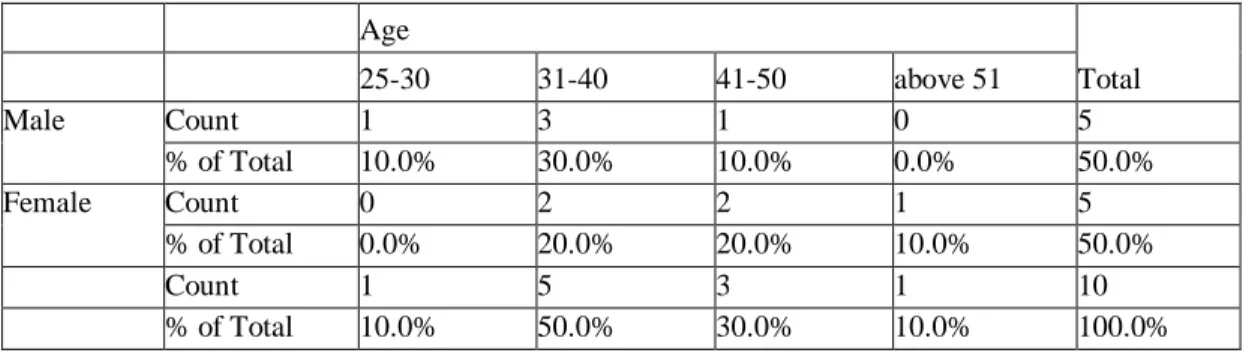
The researcher was interested in knowing the sex, age; teaching experience, number
of years in the present station for the head teachers. The researcher found that 05
teachers were males and 05 were females whose age was between 25 and 55 years
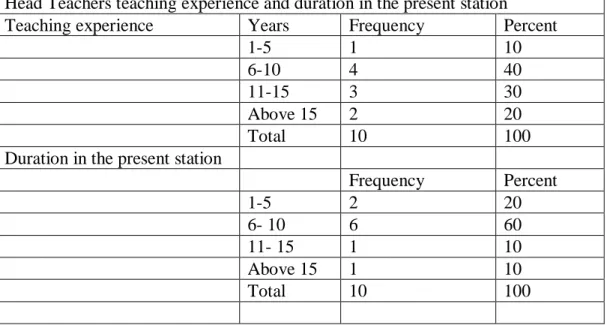
and majority being 31-40 years and above. 40% of all the respondents had teaching
experience of 6-10 years while 30% had a teaching experience of 11-15 years and
20% had teaching experience above 15 years and 10% had teaching experience of
1-5 years. Table gives work duration of head teachers at the current station.
Table 4.1: Age and Sex of Head Teachers Age Total 25-30 31-40 41-50 above 51 Male Count 1 3 1 0 5 % of Total 10.0% 30.0% 10.0% 0.0% 50.0% Female Count 0 2 2 1 5 % of Total 0.0% 20.0% 20.0% 10.0% 50.0% Count 1 5 3 1 10 % of Total 10.0% 50.0% 30.0% 10.0% 100.0% Source: School Feeding Research, 2019
Table 4.2: Teaching Experience of Head Teachers and the Duration of Service in the Present Station
Head Teachers teaching experience and duration in the present station
Teaching experience Years Frequency Percent
1-5 1 10
6-10 4 40
11-15 3 30
Above 15 2 20
Total 10 100
Duration in the present station
Frequency Percent 1-5 2 20 6- 10 6 60 11- 15 1 10 Above 15 1 10 Total 10 100
Source: School Feeding Research 2019
From the table many of the head teachers had been in the present station in 6-10
years. This is given by 60% of the total respondents. They were followed by 20% of
the respondents who had been in present station for 2-5 years. The least 10(%) had
been in the present station for 11-15 years and another 10% had been in the station
for above 15 years.
4.2.2 Parents
The researcher wanted to know sex, age, marital status, number of children, whether
the respondent children are going to school and if the children take their lunch in
school. From the result 40% of the respondent parents were male and 60% were
female. Out of all respondent parents 75% were married. The respondent parents
show they had at least one child with the highest of children noted to have four
guardian had maximum two children. All children went to school. From the findings
95% of the children took their lunch in school while 05% do not take their lunch at
school. It was well-known that no parent shows that their children criticized about
anything concerning the food.
4.2.3 Students
The researcher was concerned to know the sex and age of students’ respondents.
Respondents were chosen from class Four and Five whereby class four were 47%
and class five were 53% of the total student respondents. The researcher found that
54% were girls and 46% were boys whose majority where at the age of 10-14 years
account for 92% and 08% where at the age above 15 years. Table no. 4.3 illustrates
the same.
Table 4.3: Student Sex and Age
Sex Frequency Percent
Boys 46 46 Girls 54 54 Total 100 100 Age 0-14 92 92 Above 15 8 8 Total 100 100 Class 4 47 47 5 53 53 Total 100 100
Source: School Research 2019
4.2.4 School Feeding Program
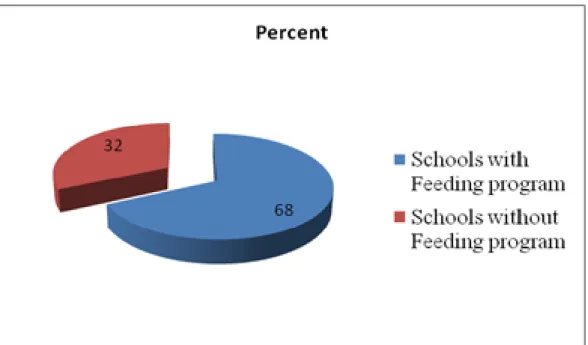
In this regard, the researcher found out that in Musoma Rural District 73 Schools
This implied that 68% of schools have feeding program supported / funded by a
private Donor (Project Concern International – PCI) an organization based in United
States of America. The organization provides food aid that means they import food
from United States of America to the selected schools in Musoma Rural District. The
figure Number 2 Illustrate the same.
Figure 4.1: Present Schools with Feeding Program in Musoma Rural District Source: School Feeding Research, 2019
Out of all respondent schools with feeding program 90% had the program for a
period of 07 years, while 10% had the program for a period of 4 year. This express
the plan of school feeding program was not used for long in Musoma Rural District.
The researcher was interested in knowing if Head teachers or teachers call parent
meetings to discuss issues related to school feeding program. All the head teachers
agreed that they had called parent meetings to make consciousness about school
feeding program. The responses revealed that parent’s do attend the meetings when called.
4.2.5 Motives for School Feeding Program
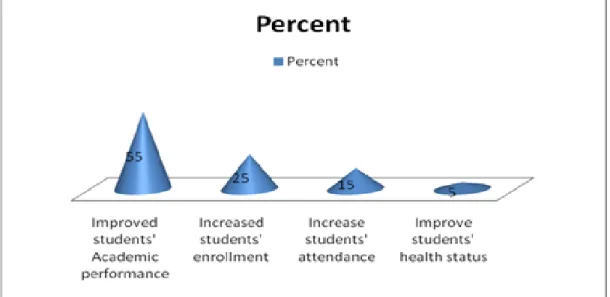
The researcher was eager in knowing what motivated people to initiate School feed
program in Musoma Rural District. Out of all respondents 55% indicated that the
school feed program was initiated to improve learner academic performance, 25% of
respondent indicated that the program was initiated to increase student enrollment,
and 15% claimed that the program initiated to improve student attendance and 05%
indicated that the program was initiated to improve student health status. This
implies that the idea of having school feed program was to develop education
through increasing enrollment, attendance, health and academic performance. This
concurs with Louw, et al. (2001: 156 and 157) who quoted international studies that
record the motives for school feeding one being school attendance, community
involvement in schooling, reduced malnutrition rates, gains in areas of concentration
spans, punctuality, school performance, and the alleviation of temporary hunger.
Figure 4.2: The Graph Indicate the Motives for School Feeding Source: School Feeding Research, 2019
4.2.6 Community Responsibilities towards School Feeding Program
The investigator was concerned to recognize the role or contribution of community
members on the success of School Feeding Program. From the research findings all
respondents confirmed that community members have a role to implement school
feeding program more successfully. From the five schools with feeding program
researcher asked head teachers, teachers as to whether community members do
contribute to the feeding program. The researcher found that community members
contribute money and labor only. Respondents did not mention if they play a role of
collecting firewood and water. This concurs with the baseline and follows up survey
carried out by WFP in 2001 to school feeding program in 19 countries where results
showed that 72% of parents were donating financial or in-kind to Worlds Food
Program (WFP) assisted school program.
4.2.7 Types of Meal Offered in School
In relation to types of meals offered the findings from respondent schools revealed
that all schools offered only lunch (rice and beans). From the findings and through
researcher own observation no school was found offering breakfast.
4.2.8 Sources of Water
The fact remains that no living organism can survive without water, water is life. In
this regard researcher was interested to know the sources of water used for cooking
food at schools. The findings revealed that no school is served with piped water;
hence they obtain water from different sources such as wells, lake and dams. The
findings revealed that water used in schools is not treated to prevent germs.
ready for use in schools. The idea was to know if there is a container for storing
water for use in schools. Through observation, researcher found that at most all
school visited had no container for water storage. Students bring water from the
identified sources and stored on their tin and buckets.
Researcher was interested to know who cook the food. The finding revealed that all
schools having school feeding program had a person or people who cooked the food
and is/are employed by the community members. The village government signed the
contract with cooks; they are paid based on the donation obtained from community
contribution. The researcher was interested to know who serves children with food.
Out of all respondent teachers and students 80 % revealed that cooks are responsible,
20% said students themselves are responsible. This means that majority of the school
cooks are responsible to serve children with food to ensure equal share is given to
each student. Researcher visited all school during lunch time, through researcher’s observation it was exposed that even though the reality that the respondent said that
cooks are responsible for serving children, all schools visited students were found
serving their fellows.
4.2.9 Sources of Energy for Cooking
The researcher sought to know the sources of energy used for cooking food at
schools. All responses from schools visited revealed that all schools are using
firewood.
4.2.10 The Effect of School Feeding on Students’ Academic Performance
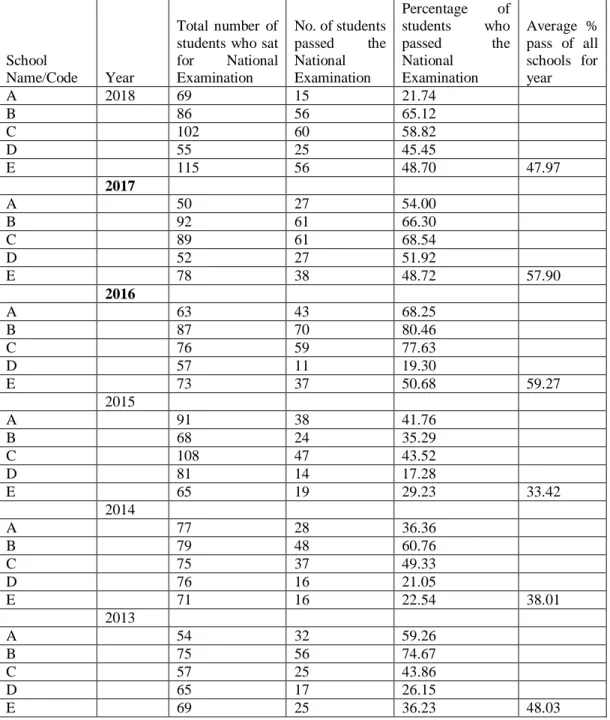
The investigator was interested to know as to whether school feeding had an effect
students’ academic performance within standard seven national examinations for the period between 2013and 2018. The data were collected from schools with feeding
and those without in order to make comparisons. The table below presents the
students’ academic trend.
Table 4.3: Records of Students’ Academic Performance in Schools with Feeding Program
School
Name/Code Year
Total number of students who sat for National Examination No. of students passed the National Examination Percentage of students who passed the National Examination Average % pass of all schools for year A 2018 69 15 21.74 B 86 56 65.12 C 102 60 58.82 D 55 25 45.45 E 115 56 48.70 47.97 2017 A 50 27 54.00 B 92 61 66.30 C 89 61 68.54 D 52 27 51.92 E 78 38 48.72 57.90 2016 A 63 43 68.25 B 87 70 80.46 C 76 59 77.63 D 57 11 19.30 E 73 37 50.68 59.27 2015 A 91 38 41.76 B 68 24 35.29 C 108 47 43.52 D 81 14 17.28 E 65 19 29.23 33.42 2014 A 77 28 36.36 B 79 48 60.76 C 75 37 49.33 D 76 16 21.05 E 71 16 22.54 38.01 2013 A 54 32 59.26 B 75 56 74.67 C 57 25 43.86 D 65 17 26.15 E 69 25 36.23 48.03
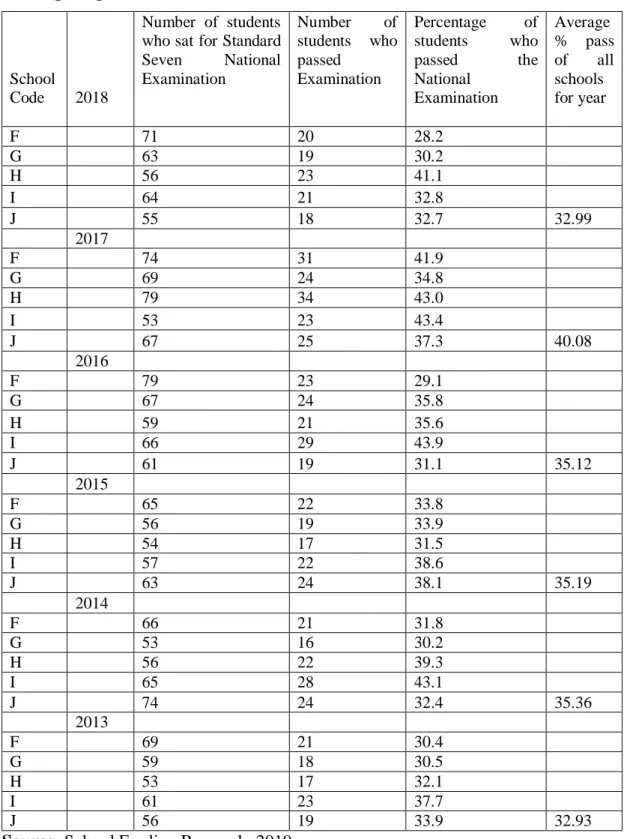
Table 4.4: Records of Students’ Academic Performance in Schools without Feeding Program
School
Code 2018
Number of students who sat for Standard Seven National Examination Number of students who passed Examination Percentage of students who passed the National Examination Average % pass of all schools for year F 71 20 28.2 G 63 19 30.2 H 56 23 41.1 I 64 21 32.8 J 55 18 32.7 32.99 2017 F 74 31 41.9 G 69 24 34.8 H 79 34 43.0 I 53 23 43.4 J 67 25 37.3 40.08 2016 F 79 23 29.1 G 67 24 35.8 H 59 21 35.6 I 66 29 43.9 J 61 19 31.1 35.12 2015 F 65 22 33.8 G 56 19 33.9 H 54 17 31.5 I 57 22 38.6 J 63 24 38.1 35.19 2014 F 66 21 31.8 G 53 16 30.2 H 56 22 39.3 I 65 28 43.1 J 74 24 32.4 35.36 2013 F 69 21 30.4 G 59 18 30.5 H 53 17 32.1 I 61 23 37.7 J 56 19 33.9 32.93
Table 4.5: Records of Students’ Academic Performance in Schools with and without Feeding Program
Years Average % Pass with Feeding
Program
Average % Pass without Feeding Program 2013 48 33 2014 38 35 2015 33 35 2016 59 35 2017 58 40 2018 48 33
Source: School Feeding Research, 2019
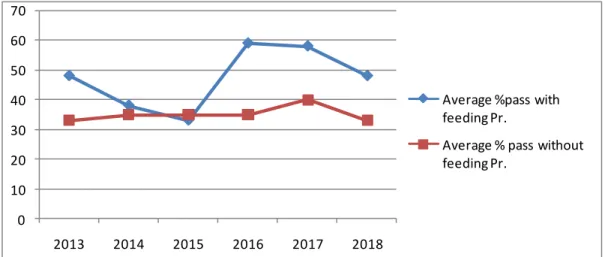
From the tables above, Schools in Musoma Rural District like others primary schools
in Tanzania do a standard seven National Examination in each academic year. Table
4.4 and figure 4.3 shows the results for standard seven obtained from schools with
feeding program coded A,B,C,D,E and those schools without feeding program coded
F,G,H,I,J. The research findings showed that those primary schools with feeding
program have performed superior as compared to those schools without feeding
program in school. The lowly stand for schools that have a feeding program as from
2013 to 2018 was 33.4 whereas the lowly stand for schools without feeding program
as from 2013 to 2018 was 33 percent.
0 10 20 30 40 50 60 70 2013 2014 2015 2016 2017 2018
Average %pass with feeding Pr.
Average % pass without feeding Pr.
Figure 1.3: Records of Students’ Academic Performance in Schools with and without Feeding Program
The findings revealed that the uppermost stand for the schools that had a feeding
program for the year 2013 to 2018 was 59.2, whereas the peak indicate for schools
without feeding program for the similar years was 40 percent. Furthermore, the
findings indicated that the increase was observed since 2012 when school feeding
started in schools. This concurs with findings of Pediatre (2001), that attendance and
school performance are greatly enhanced by school feeding program. Many schools
are already struggling to manage barely functional education systems and to assume
the additional burden of food distribution.
Mungai (2004) in his research findings on the role of School Feeding in education
development also found that it is valuable instrument for stimulating enrollment and
establishing attendance which help to improve education and student academic
performance for the reason that of the regular attendance. This obviously shows that
School feeding program was among the reasons that give to the students’ academic
performance. The reality is that a number of schools which do not have School
Feeding Program were recording almost the same performance with those that have
School Feeding Program this indicate that there were other factors that contributed in
maintaining their performance and not feeding program only.
4.3 The Influence of School Feeding Program on Students Attendance
The researcher was interested to know the trend of students’ attendance in schools
whereby records were drawn from those schools with feeding program and
compared to those schools without feeding program. The intention was to assess as