Annotated Corpora in the Cloud:
Free Storage and Free Delivery
Graham Wilcock
University of Helsinki [email protected]Abstract
The paper describes a technical strategy for implementing natural language processing applications in the cloud. Annotated corpora can be stored in the cloud and queried in normal web browsers via user interfaces implemented in the described framework. A key aim of the strategy is to exploit the free storage and processing that is available in the cloud, while avoiding lock-in to proprietary infrastructure. A half-million-word annotated corpus application is described as a working example of the strategy.
1.
Introduction
The paper describes a technical strategy for designing and implementing natural language processing applications in the cloud in such a way that annotated corpora can be queried and displayed in ordinary web browsers. There are many different strategies for cloud computing, but rather than giving a superficial review of a variety of alternatives, the paper focusses on describing one specific approach. This approach can be summarized as “open source front-end, proprietary (but free) back-end”.
The paper focusses exclusively on approaches that offer free storage of the corpora in the cloud, and free delivery of the corpora contents and annotations to the web browser. The example corpus application that demonstrates these ap-proaches does not currently support collaborative develop-ment of the annotations.
Like many other applications, corpus applications can be regarded as having three main parts. The “front-end” is the user interface, typically consisting of a set of web pages and ways to navigate between them. The “back-end” is where the data is stored, typically in a database. The application processing takes place somewhere “in the middle”. This division into three parts is well-known in computer science as the “model, view, controller” design pattern. Here, the back-end database is the model, the front-end user interface is the view, and the application processing in the middle is the controller.
In the case of a cloud computing application, the data is stored in some special kind of cloud data store and the pro-cessing is done in a special cloud run-time environment, but it is important that the user interface works in an ordinary web browser.
The component parts of the technical strategy are described in the next section. Section 3. then reviews related work. Section 4. describes an implemented example application, in which an annotated corpus is stored in the cloud and is queried from ordinary web browsers. Problems and solu-tions from this implementation are discussed in Section 5., and Section 6. presents conclusions.
2.
A Technical Strategy
This section sets out a technical strategy for design and im-plementation of cloud-based applications. A key aim of the
strategy is to take advantage of the free storage and pro-cessing quotas that are available in the cloud, while avoid-ing lock-in to one specific proprietary infrastructure. We believe that this can be achieved by appropriate choices of the front-end and back-end components.
The choices proposed in this technical strategy are Django, an open source web framework, and Google App Engine, a proprietary cloud computing platform. The strategy of “open source front-end, proprietary (but free) back-end” is therefore more specifically implemented as “Django front-end, Google App Engine back-end”.
2.1. The cloud computing framework
Google App Engine (http://code.google.com/ appengine) is a platform for running web apps in the cloud on Google’s infrastructure. One of the motivations for choosing App Engine as the preferred cloud computing framework is that Google currently allow applications to be run entirely free of charge, as long as they stay within certain quotas. The quotas apply to several dimensions: processing power, overall storage capacity, individual file sizes, response times. Significant applications can be im-plemented within the free quotas, and can be hosted on Google’s infrastructure with zero running costs.
Like other cloud frameworks, there are no maintenance costs for server hardware or server software. The Google architectures are massively scalable. If the quotas are ex-ceeded App Engine is no longer free, but this will only oc-cur if the applications are massively successful, which is a very desirable “problem”.
Even in this case, there is no obligation to pay for the ad-ditional resources required to meet the higher demand. The application can simply be restricted to the free quotas. The users will experience this as longer response times or re-duced service availability at times of high demand, but there will be no charges unless billing has been authorized. When selecting a framework that is currently free of charge, the danger of lock-in to the specific technology must be considered, in case charging is introduced at some time in the future. This important question is addressed in Sec-tion 5.3..
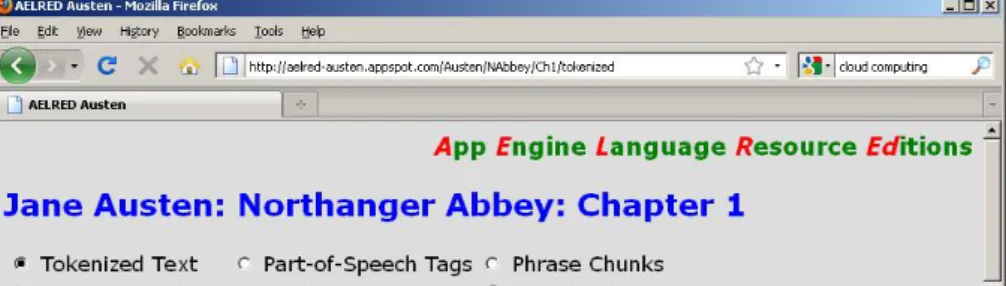
Figure 1: Example application: tokenized text.
2.2. The web app front-end
App Engine includes its own simple web app framework, but other standards-compliant front-end frameworks can be imported. Our strategy uses Django (http://www. djangoproject.com), a successful and widely-used open source Python web app framework (Holovaty and Kaplan-Moss, 2009).
Django provides a wide range of components that speed up web app development. One of the most important is the Django template engine, which supports dynamic genera-tion of HTML web pages. The template slots are filled-in with the relevant information from the specific context, us-ing appropriate filters, conditionals and loops.
Collections of templates can be managed by organizing them into template hierarchies, where more specific tem-plates inherit information from base temtem-plates. Inheritance can take place at several different levels.
Django also provides a clean way to manage the mapping between the application URLs and the processing code that handles the HTTP requests, and an object-relational map-ping (ORM) between the object-oriented Python process-ing code and the back-end relational database models. 2.3. The database back-end
Django is normally used with an SQL database. This can be a full-scale database system such as MySQL or a light database such as SQLite3. By contrast, App Engine is nor-mally used with its own non-relational datastore, which is based on Google’s BigTable technology.
The advantages of using the App Engine datastore are that its use is free within the quotas, while being massively scal-able if required. However, there are two main
disadvan-tages. First, the non-relational “NoSQL” architecture is less familiar to most developers than standard SQL databases. Second, there could be a danger of lock-in to Google’s pro-prietary technology.
The example application described in Section 4. originally used the App Engine datastore back-end together with the App Engine web app front-end. This version can be seen at
http://aelred-austen.appspot.com. The pro-totype has subsequently been re-implemented to make it portable, so that either a MySQL relational database or an App Engine non-relational datastore can be used.
It is possible to combine a Django front-end with an App Engine datastore back-end. This version of our example application can be seen at http://django-appeng. appspot.com.
It has recently become possible to use a MySQL database with App Engine in the Google Cloud SQL service (http: //code.google.com/p/googlecloudsql). An-other version of our example application, combining Django and MySQL with App Engine, can be seen at
http://django-mysql.appspot.com. 2.4. Application processing
In our strategy the application processing that connects the front-end user interface and the back-end database is writ-ten in Python. We use NLTK Natural Language Toolkit (Bird et al., 2009) for the language processing tasks, where possible, while organizing the user interaction within the Django framework.
NLTK (http://www.nltk.org) provides a set of tools and resources for natural language processing. Like Django, NLTK is a successful and widely-used open source
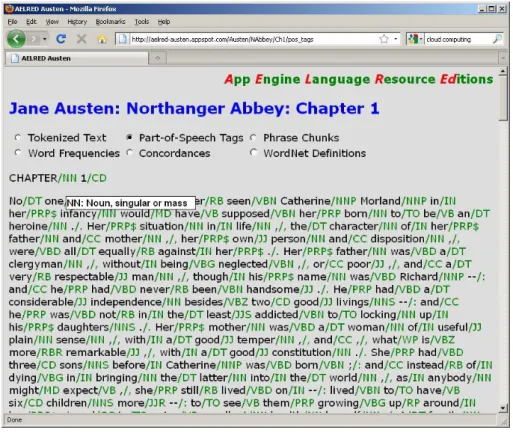
Figure 2: Example application: part-of-speech tags and a tooltip explanation.
Python toolkit.
The ready-made NLTK tools include a sentence bound-ary detector nltk.sent tokenize(), a word tok-enizernltk.word tokenize(), a part-of-speech tag-gernltk.pos tag()and a classifier-based named entity recognizernltk.ne chunker().
In addition, NLTK includes useful wordlists, such as lists of stopwords. NLTK also includes a complete version of WordNet, and a convenient Python-WordNet interface. However, there are some technical issues in using these tools with Google App Engine, which are discussed further in Section 5.2..
2.5. Annotation format
The most widely-used markup language for linguistic an-notation of texts is XML. While it is generally agreed that XML should be used for external interchange of linguistic annotations, as it is the global standard for data interchange, it is not necessarily the best choice for internal representa-tion of annotarepresenta-tions.
When working in Python it is more convenient to use JSON as an internal representation. Python objects can be serial-ized easily and quickly to JSON strings, and JSON strings can be deserialized easily and quickly to Python objects. Our strategy therefore recommends storing linguistic an-notations in JSON format in the back-end database. Typ-ically, complete chapters of novels can be stored as long text strings in the database, even when expanded by adding linguistic annotations.
3.
Related Work
Corpus linguistics is usually done with corpus tools such as WordSmith and AntConc. WordSmith (Scott, 2008) is a proprietary concordancing tool for Windows (http: //www.lexically.net/wordsmith). AntConc (Antony, 2005) is a freeware concordancing tool for Windows, Mac or Linux (http://www.antlab.sci. waseda.ac.jp/software.html). In both cases these tools are typically used on a PC with the corpus and the corpus tool locally installed. Their strong point is that users can easily collect their own corpora and process them with these tools.
A radically different approach enables corpus queries from ordinary web browsers. This has two major advantages: the user does not need to install special software, and the user does not need to store local copies of the corpora. A good example of a web-based interface to an annotated cor-pus is BNCweb (Hoffmann et al., 2008), a web interface for the British National Corpus. In BNCweb the front-end user interface runs in an orinary web browser and pro-vides extensive facilities for querying the corpus, viewing concordances, and other services. The back-end MySQL database contains the British National Corpus, converted from its original XML format and indexed for fast process-ing with MySQL. However, BNCweb runs on conventional web servers, not in the cloud.
In earlier work (Wilcock, 2010) we described a proto-type that demonstrated the use of language technology in a cloud computing environment. This version can be seen athttp://aelred-austen.appspot.com. It runs on Google App Engine and presents a web browser
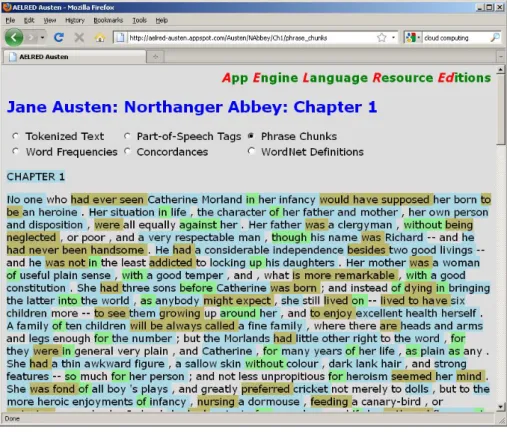
inter-Figure 3: Example application: NP, PP, VP phrase chunks.
face to an annotated corpus of Jane Austen novels. The browser displays different types of annotations, including part-of-speech tagging, phrase chunks, and word sense def-initions from WordNet. However, Wilcock (2010) did not address the problem of how to avoid lock-in to a proprietary framework. This is an important question that we discuss in Section 5.3..
4.
An Example Application
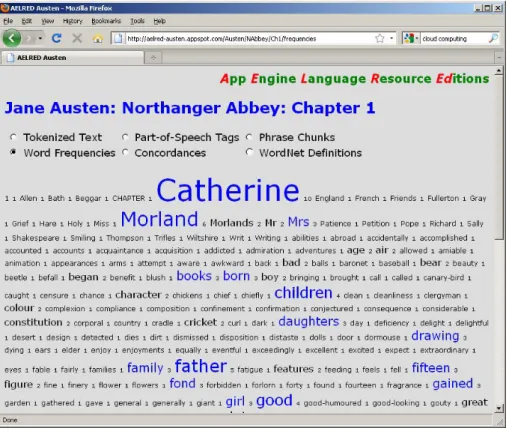
Screenshots from the example application with the half-million-word annotated corpus of Jane Austen texts are shown in Figures 1 to 6.
Although we use NLTK tools for language processing as much as possible, the example application does not use the NLTK tokenizernltk.word tokenize()because there are specific problems in tokenizing the Gutenberg texts of the Jane Austen novels. One problem is the use of a double hyphen (--) to represent a dash. Wilcock (2010) gives an example from the third sentence in Northanger Abbeywhich includes the stringRichard--and. This is tokenized as a single token by the standard NLTK tokenizer. Our example application therefore uses a regular expression tokenizer that splits this string correctly into three tokens. This can be seen in Figure 1.
The example application also does not use the NLTK part-of-speech taggernltk.pos tag()for the reasons given in Section 5.. The application uses an alternative pure Python tagger trained on the NLTK Treebank corpus, a sub-set of the full Penn Treebank corpus. The tagger is up-loaded into App Engine as apicklefile. An example of text with part-of-speech tags can be seen in Figure 2.
Phrase chunks for NPs, PPs, and VPs are identified using NLTK’s regular expression parser over POS tag sequences, and are annotated with IOB chunk labels. Phrase chunk-ing is displayed with colour-coded highlightchunk-ing as shown in Figure 3.
Simple word frequencies and concordances can also be dis-played, as shown in Figure 4 and Figure 5. These are both rather basic, and certainly do not match the sophisti-cation of dedicated concordance tools such as WordSmith, AntConc or BNCweb. The concordances are created using NLTK’s ConcordanceIndex()method, and show all occurrences of a word in a novel, not chapter by chapter. The offsets for the whole novel are calculated off-line and uploaded to datastore in a serialized JSON format.
Words are also annotated with word sense definitions using NLTK’s Python-WordNet interface. Words that have Word-Net definitions are highlighted, and the definition pops up in a tooltip when the mouse hovers over the word, as shown in Figure 6.
The range of possible definitions for each word is restricted by the part-of-speech tag already decided by the POS tag-ger. A simple form of word sense disambiguation is used to select one definition to be displayed. This is based on the simplified Lesk algorithm, with the most frequent WordNet sense as back-off.
5.
Technical Issues
This section discusses some potential problems relevant to our strategy and describes solutions. First, there are restric-tions imposed by Google App Engine in order to support scalability. Next there are some technical issues in using
Figure 4: Example application: simple word frequencies.
specific NLTK tools with App Engine. Finally, there is the danger of lock-in to Google’s proprietary framework. 5.1. Scalability and restrictions
When Google App Engine was designed, one of the key re-quirements was that it must allow massive scalability. As a result, small applications must be designed for scalability in the same way as large applications. To ensure scalability, various restrictions are imposed on all App Engine applica-tions. There are different types of restrictions, on the pro-gramming language, maximum number of files, maximum file size, and so on.
A major programming language restriction is that the code must be pure Python, not depending on modules imple-mented in other language such as C. This means that you cannot upload code that uses numpy, which is written in C. You cannot use cPickle, but you can use pure Python pickle. Up to now, the maximum file count in an App Engine appli-cation has been 3,000. If you bundle large packages (such as Django or NLTK) with your app, you could hit this limit. However, this problem can be avoided by using zipimport (Sanderson, 2008). In fact, recent versions of Django are included in recent versions of App Engine, so you do not need to bundle Django with your app, as (Sanderson, 2008) points out.
Up to now, the maximum file size allowed in App Engine has been 10 megabytes. In the NLTK version of WordNet, the file containing all the nouns is just over 15 megabytes, so the WordNet data cannot itself be uploaded into App Engine. Files can be annotated with WordNet definitions off-line, and the annotated files can be uploaded so long as they are less than 10 megabytes.
For the Jane Austen novels each chapter text fits easily within the maximum, and when annotations are added for part-of-speech tags and other small features, the file size is still less than the limit. However, when WordNet defi-nitions are added the file size increases drastically because the definition strings are quite long and many words have multiple definitions, so some chapters can exceed the limit. This problem is solved by doing word sense disambigua-tion, so that only one definition is used.
5.2. NLTK and App Engine
NLTK includes a wide range of components implemented by different people in different ways, and some of them use numpy or other C modules. This means that you cannot simple do ”import NLTK” in App Engine.
As (Wilcock, 2010) points out, there are two ways to use NLTK with App Engine. One way is to use NLTK off-line to create the required annotations. If the annotations are saved for example as JSON text files, these files can be included in the folders uploaded to the cloud as part of your App Engine app. This approach has the advantage that you can use all the NLTK components with no restrictions, even if they use C or numpy.
The other way is to make a stripped-down version of NLTK in a new folder, only including specific components that use pure Python. Then you can include this new NLTK folder in your app, and you can do ”import NLTK”.
In this approach, annotations are created by tools running inside the App Engine framework. As noted above, tools written in pure Python can be used in App Engine, but tools written in C cannot be used. Some of the NLTK tools are pure Python so they can be imported into App Engine
suc-Figure 5: Example application: a simple word concordance.
cessfully, but some cannot. Alternative pure Python tools should be used.
Further details of which NLTK tools can and cannot be used in App Engine are discussed in (Wilcock, 2010).
5.3. Avoiding lock-in
There has recently been controversy about changes in the pricing scheme for commercial applications in App Engine, but free quotas are still available and in some cases the quo-tas have even been increased. While it is very attractive to run natural language processing applications and linguistic corpora free of charge on Google’s infrastructure, there is always the possibility that charging might be introduced in the future. It is therefore advisable to beware of the danger of lock-in to one proprietary system, and even to have an exit strategy in case of need.
The danger of lock-in to Google’s framework can be largely avoided by taking two steps. The first step concerns the web app front-end. By using a well-designed and widely-used open source web framework like Django, it will be much easier to move the application away from Google in-frastructure to a more traditional server if that is desired in future, because standard servers can run standard Django web apps.
The second step concerns the back-end datastore. Although Django is normally used with standard SQL databases, Django’s ORM (object-relational mapping) maps Python objects (logical models) to relations (database tables). This allows an SQL database to be used from Python code with-out actually writing SQL statements.
The open source django-nonrel project (Kornewald and Wanschik, 2011) is an extension of standard Django
that maps Python objects at a higher level of abstraction, allowing either SQL databases or NoSQL databases to be used with the same models, provided the data models have not been designed around specific SQL-only or spe-cific NoSQL-only features. This makes Django web apps portable between SQL databases and the App Engine data-store, thereby avoiding the danger of lock-in (Wanschik et al., 2010).
However, django-nonrelis not included in standard Django and is not supported by the Django Software Foun-dation. If using django-nonrelis considered unsuit-able, there are two main alternatives.
One option is to keep the Django front-end and re-write the database back-end to use App Engine datastore explicitly. We did this for our example application and the conversion was very easy, as the ORM mappings for Django and App Engine are very similar. This version runs at http:// django-appeng.appspot.com.
The other alternative is to use Django with a MySQL database and not with App Engine datastore. This avoids re-writing any code, and there are possibilities for running the application in the cloud. One option is to use the Google Cloud SQL service, which combines App Engine with a MySQL database. The pricing for Google Cloud SQL is not yet known, but the preview service is free. A version of our example application with Django and MySQL runs on Google Cloud SQL at http://django-mysql. appspot.com.
6.
Conclusions and Future Work
The working example application shows that free storage and free delivery of annotated corpora can be achieved byFigure 6: Example application: a word sense definition in a tooltip.
the approach described. Care must be taken to avoid lock-in to one proprietary lock-infrastructure, but this risk can be minimized by adopting open source web frameworks like Django as basic components of the application.
Section 5.3. discussed approaches to avoiding lock-in. One option is to use Django with MySQL and not App Engine datastore, because MySQL can be used in a wide range of environments, either on cloud services or on conven-tional web servers. Using MySQL with the Google Cloud SQL service is currently free, but charging is expected later. There are other Platform-as-a-Service providers, such as Red Hat Cloud, offering free cloud services including Django and MySQL. We are currently setting up another MySQL-based instance of our example corpus applica-tion on Red Hat Cloud athttp://django-corpora. rhcloud.com.
As we use JSON format rather than XML for the anno-tations (as mentioned in Section 2.5.), we are currently investigating document-oriented databases that use JSON format directly. These include CouchDB and MongoDB (which uses binary JSON: BSON). We are setting up a MongoDB-based instance of our example corpus applica-tion on Red Hat Cloud athttp://mongo-corpora. rhcloud.com.
Future work will develop better methods for handling word frequency analysis and more sophisticated concordance queries, at least including multi-word phrases and part-of-speech tags. Several further corpora will be made available in the cloud, starting with the Brown Corpus which is nicely divided into small files ready for uploading and offers scope for genre-based concordance querying.
For this workshop, the most interesting future work would
be to combine cloud delivery with crowd sourcing. App En-gine has facilities for individual user authentication and for maintaining user-specific records in the datastore. If stand-off markup is used, updated annotations input by individual users could be stored as alternatives without damage to the exisiting annotations. Crowd sourcing algorithms could be deployed to decide which alternatives should be applied as updates to the displayed corpora. These possibilities await further work.
7.
References
Laurence Antony. 2005. AntCon: Design and develop-ment of a freeware corpus analysis toolkit for the tech-nical writing classroom. InProceedings of International Professional Communication Conference.
Steven Bird, Ewan Klein, and Edward Loper. 2009. Natu-ral Language Processing with Python. O’Reilly. Sebastian Hoffmann, Stefan Evert, Nicholas Smith, David
Leed, and Ylva Berglund Prytz. 2008. Corpus Lin-guistics with BNCweb - a Practical Guide. Peter Lang, Frankfurt am Main.
Adrian Holovaty and Jacob Kaplan-Moss. 2009. The Definitive Guide to Django (second edition). Apress. Waldemar Kornewald and Thomas Wanschik. 2011.
Django-nonrel - NoSQL support for Django.
http://www.allbuttonspressed.com/ projects/django-nonrel.
Dan Sanderson. 2008. Using Django 1.0 on App
En-gine with ZipImport. http://code.google.
com/appengine/articles/django10_ zipimport.html.
Mike Scott. 2008. WordSmith Tools version 5. Liverpool: Lexical Analysis Software.
Thomas Wanschik, Waldemar Kornewald, and Wes-ley Chun. 2010. Running Pure Django Projects on Google App Engine. http://code.google.com/ appengine/articles/django-nonrel.html. Graham Wilcock. 2010. Cloud computing for the hu-manities: Two approaches for language technology. In
Human Language Technologies - The Baltic Perspec-tive: Proceedings of the Fourth International Conference Baltic HLT 2010, Riga.