
Deriving Divide-and-Conquer Dynamic Programming
Algorithms using Solver-Aided Transformations
Shachar Itzhaky
Rohit Singh
Armando Solar-Lezama
Kuat Yessenov
Yongquan Lu
Charles
Leiserson
MIT, USARezaul Chowdhury
Stony Brook University, NY, USAAbstract
We introduce a framework allowing domain experts to ma-nipulate computational terms in the interest of deriving better, more efficient implementations. It employs deductive reason-ing to generate provably correct efficient implementations from a very high-level specification of an algorithm, and in-ductive constraint-based synthesis to improve automation. Semantic information is encoded into program terms through the use of refinement types.
In this paper, we develop the technique in the context of a system called Bellmania that uses solver-aided tactics to derive parallel divide-and-conquer implementations of dy-namic programming algorithms that have better locality and are significantly more efficient than traditional loop-based implementations. Bellmania includes a high-level language for specifying dynamic programming algorithms and a calcu-lus that facilitates gradual transformation of these specifica-tions into efficient implementaspecifica-tions. These transformaspecifica-tions formalize the divide-and-conquer technique; a visualization interface helps users to interactively guide the process, while an SMT-based back-end verifies each step and takes care of low-level reasoning required for parallelism.
We have used the system to generate provably correct implementations of several algorithms, including some im-portant algorithms from computational biology, and show that the performance is comparable to that of the best manually optimized code.
Categories and Subject Descriptors D.1.2 [Programming Techniques]: Automatic Programming
Algorithm 1A naïve loop implementation
fori= 1..ndo Gi(i+1):=xi . Initialize
fori= (n−2)..0do . Compute
forj= (i+ 2)..ndo Gij := min
i<k<jGik+Gkj+wikj
Keywords Divide-and-conquer, Dynamic Programming, Program Synthesis, Theorem Proving, Refinement Types, SMT
1.
Introduction
C o nsist ent *Complete*W ellD o cu m en ted *E asy to Re us e * * Ev alua ted * O O PS LA *Artifact*A ECSoftware synthesis aims to close the gap between descriptions of software components, such as algorithms and systems, and their implementations as computer programs. Dynamic Pro-gramming (DP) algorithms offer a prominent example of how large this gap can be. For instance, consider Algorithm 1, which correspond to the well known DP algorithm to compute the optimal parenthesization for a chain of matrix multiplica-tions.1The first loop fills the diagonal of an array with some
initial values, and the second loop computes off-diagonal elements by reading existing elements.
The algorithm computes ann×nregion of a DP tableG via a standard row-major order. This algorithm is simple, but a direct C implementation of it turns out to be about10×slower than the best manually optimized implementation (as we will see in Section 7.2). One reason for this poor performance is the high rate of cache misses incurred by reading the ranges GikandGkj, fori < k < j, repeatedly on every iteration of the loops overiandj. Memory reads dominate the running time of this algorithm, so high speedups can be gained by localizing memory access.
The state-of-the-art implementation uses a divide and conquerapproach both to improve memory performance and to increase the asymptotic degree of parallelism [32]. An excerpt of the pseudo-code for such an implementation is shown in Algorithm 2. In the optimized version, the
programmer has to determine a number of low-level details, including the correct order of calls—some of which can be run in parallel—as well as some rather involved index arithmetic. When implemented in C++, the full version is, in fact, more than ten times longer than the naïve one and considerably more complicated. It is also much more difficult to verify, since the programmer would have to provide invariants and contracts for a much larger set of loops and possibly recursive functions. Parallelism only adds to the complexity of this task.
In this paper, we present a new system called Bellma-nia2, which allows an expert to interactively generate parallel
divide-and-conquer implementations of dynamic program-ming algorithms, which are provably correct relative to a high-level specification of the code in Algorithm 1. We show that the resulting implementations are 1.4–46×faster than the original versions and within 2–60% of a high-performance hand crafted implementation. Their structure will also make themcache oblivious[18] andcache adaptive[4], just like the hand crafted implementations are.
Bellmania is a deductive synthesis system in the tradi-tion of systems like Kids [27], and more recently Fiat [14]. These systems derive an implementation from a specifica-tion in a correct-by-construcspecifica-tion manner by applying a se-quence of deductive reasoning steps. Thanks to the correct-by-construction approach, the potentially complex final artifact does not have to be independently verified, making the ap-proach ideal for potentially complex implementations like the ones we target.
Traditionally, the major shortcoming of deductive syn-thesis has been the effort required of the user in order to
2Named so as a tribute to Richard Bellman.
Algorithm 2An optimized divide-and-conquer version
A[1..n], where: (snippet)
procedureA[s..e]
ife−s < bthen
fori=e..sdo
forj= max{s, i}..edo
Gij:= min
i<k<jGik+Gkj+wikj
else A s..bs+e 2 c A bs+e 2 c+1..e B s..bs+e 2 c, b s+e 2 c+1..e
procedureB[s0..e0, s1..e1
]
ife−s < bthen. . . else B bs0+e0 2 c+1..e0, s1..b s1+e1 2 c C s0..bs0+2e0c, s1..bs1+2e1c, bs1+2e1c+1..e1 .. .
procedureC[s0..e0, s1..e1, s2..e2
]
.. .
guide the derivation process towards a correct solution. In this work, we reduce this effort using three core techniques. First, we show that a small number of domain specific tactics, combined with a new notation to jointly describe the spec-ification and the implementation, can enable the derivation to be described succinctly at a high-level of abstraction. Sec-ondly, we show the value of incorporating an SMT solver into the derivation process; in particular, we can afford to use tactics that are only correct when some side conditions hold, where these conditions are potentially complex logical assertions, without having to burden the user with proving those premises. Finally, we show that by incorporating solver-based inductive synthesis, which generalizes from concrete values and execution traces, into the derivation process, we can automate away many low-level decisions, allowing for shorter, simpler derivations. We use the termsolver-aided tacticsto refer to this combination of solver-based inductive synthesis and solver-checked premises within a tactic.
Overall, the paper makes the following contributions.
•A new formalism used to describe a wide class of dynamic programming algorithms, capable of bridging the gap between the high-level specification and the divide-and-conquer implementation of them.
•An interesting application of refinement types for tracking dependencies between sub-computations, making it pos-sible to automatically generate parallel implementations from it.
•The idea of usingsolver-aided tactics, demonstrating their applicability and utility in the derivation of divide-and-conquer dynamic programming implementations.
•A suite of solver-aided tactics for dynamic programming and an overview of the proofs of their soundness, assum-ing only the soundness of the underlyassum-ing SMT solver.
•A description of Bellmania, the first system capable of generating provably correct implementations of di-vide-and-conquer dynamic programming. Our evaluation shows that the code it generates is comparable to manually tuned implementations written by experts in terms of performance.
Dynamic Programming is central to many important do-mains ranging from logistics to computational biology — e.g., a recent textbook [15] lists 11 applications of DP in bioinformatics just in its introductory chapter, with many more in chapters that follow. Increasing performance and reli-ability of DP implementations can therefore have significant impact. More generally, we believe that this work serves as an important test case for a new approach to combining in-ductive and dein-ductive synthesis which could have an impact beyond this domain.
2.
Overview
Most readers are likely familiar with the Dynamic Program-ming (DP) technique of Richard Bellman [3] to construct an optimal solution to a problem by combining together opti-mal solutions to many overlapping sub-problems. The key to DP is to exploit the overlap and reuse computed values to explore exponential-sized solution spaces in polynomial time. Dynamic programs are usually described through recurrence relations that specify how to decompose sub-problems, and is typically implemented using a DP table where each cell holds the computed solution for one of these sub-problems. The table can be filled by visiting each cell once in some predetermined order, but recent research has shown that it is possible to achieve order-of-magnitude performance improve-ments over this standard implementation approach by de-velopingdivide-and-conquerimplementation strategies that recursively partition the space of subproblems into smaller subspaces [4, 8–11, 32].
Before delving into how Bellmania supports the process of generating such an implementation, it is useful to understand how a traditional iterative implementation works. For this, we will use the optimal parenthesization algorithm from the introduction (Algorithm 1). The problem description is as follows: given a sequence of factorsa0· · ·an−1, the goal is
to discover a minimal-cost placement of parentheses in the product expression assuming that multiplication is associative but not commutative. The cost of readingaiis given byxi, and that the cost for multiplyingΠ(ai..(k−1))byΠ(ak..(j−1))
is given bywikj. The specification of the algorithm is shown in Figure 1; the valuesxiandwikjare inputs to the algorithm, and the output is a tableG, where each elementGijis the lowest cost for parenthesizingai..(j−1), withG0nbeing the overall optimum.
Iterative Algorithm. Using the standard dynamic program-ming method, anyone who has read [13] would compute this recurrence with an iterative program by understanding the de-pendency pattern: to compute themini<k<j(· · ·)expression in Figure 1 the algorithm needs to enumeratekand gather information from all cells below and to the left ofGij. In par-ticular, each valueGijis computed from other valuesGi0j0
with higher row indexesi0 > iand lower column indexes j0< j. Therefore, consideringGas a two-dimensional array,
G j i Gij = xi i+1 =j min
i<k<jGik+Gkj+wikj i+1< j
base case dependencies empty
Figure 1. Recurrence equation and cell-level dependencies.
1
2
3
4
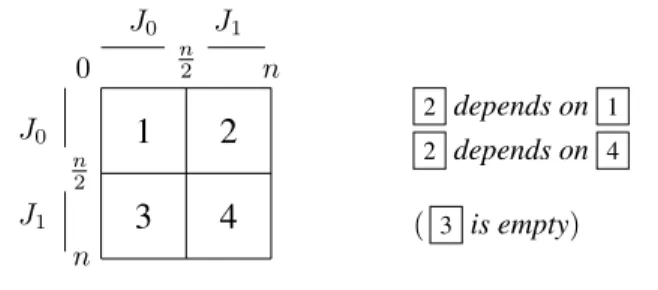
0 n2 n n 2 n J0 J1 J0 J1 2 depends on 1 2 depends on 4 ( 3 is empty)Figure 2. Dividing a two-dimensional array into quadrants; the dependencies for the case of the running example are shown on the right.
it can be filled in a single sweep from left to right and from bottom to top, as done in Algorithm 1.
Divide-and-Conquer Algorithm. To illustrate the main concepts underlying Bellmania and the key ideas in deriving divide-and-conquer implementations, we will walk through the first few steps that an algorithms expert — whom we will call Richard — would follow using Bellmania to generate a provably correct divide-and-conquer implementation of the optimal parenthesization algorithm.
In the Bellmania development model, Richard will start with the specification from Figure 1, and progressively ma-nipulate it to get the specification in a form that reflects the recursive structure of the divide-and-conquer implementa-tion. At any step in the transformation, Bellmania can gener-ate code from the partially transformed specification. Code generated from the initial specification will yield an imple-mentation like Algorithm 1, whereas generating code from the fully transformed specification will yield the divide-and-conquer implementation that we want. In the rest of the text, we will use the termprogramto refer to any of the partially transformed specifications.
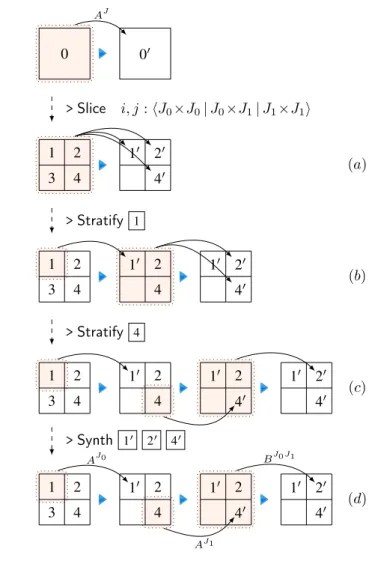
Figure 4 provides a visual description of the initial stages of the transformation process. The figure includes block diagrams illustrating how the program at a given stage in the transformation will compute its output table from its input. For example, the first row corresponds to the program before any transformations take place, i.e. the initial specification. At this stage, the program involves a single loop nest that reads from the entire array and writes to the entire array; solid arrows in the diagram denote data dependency. The transformation from one stage to the next, the dashed arrows, is performed by the application oftacticsthat represent a high-level refinement concept.
As a first step in the transformation, Richard would like to partition the two-dimensional arrayGinto quadrants, as illustrated in Figure 2. In Bellmania, the partition is accom-plished by applying theSlicetactic, illustrated graphically at the top of Figure 4. In order to escape the need to reason about concrete array indices, Bellmania provides an abstract view where the partitions are labeledJ0, J1. The effect ofSliceis
Slice i, j:hJ0×J0|J0×J1|J1×J1i (a) ∀i, j∈ 1 . Gij = min i<k<jGik+Gkj+wikj ∀i, j∈ 2 . Gij = min i<k<jGik+Gkj+wikj ∀i, j∈ 4 . Gij = min i<k<jGik+Gkj+wikj Stratify 1 (b) ∀i, j∈ 1 . G1 ij = min i<k<jG 1 ik+G 1 kj+wikj ∀i, j∈ 2 . Gij = min i<k<j(G 1 /G)ik+ (G 1 /G)kj+wikj ∀i, j∈ 4 . Gij = min i<k<j(G 1 /G)ik+ (G 1 /G)kj+wikj
Figure 3. The first two steps in the development, represented as logical specifications.
for succinctness by omitting the base case of the recurrence for now. Due to the structure of the problem, namelyi < j, the bottom-left quadrant (3 in Figure 2) is empty. Slicing therefore produces only three partitions.
The computation of 1 (the top-left quadrant) does not depend on any of the other computations, so Richard applies
theStratifytactic, which separates an independent
computa-tion step as a separate loop. This is equivalent to rewriting the specification as in Figure 3(b): the first computation is given a special nameG1, then the following computations read data either fromG1 (when the indices are in 1) or fromG (otherwise), which is denoted byG1/G. The “/” operator is part of the Bellmania language and will be defined formally in Section 3. Bellmania checks the data dependencies and verifies that the transformation is sound.
RepeatingStratifyresults in a three-step computation, as seen in Figure 4(c), from which Richard can obtain the pro-gram in Algorithm 3. This already gives some performance gain, since computations of 1 and 4 can now run in parallel. Bellmania is capable of sound reasoning about parallelism, using knowledge encoded via types of sub-terms, showing that two threads are race-free when they work on different regions of the table. This is handled automatically by the code generator.
At this point, Richard notices thatG1 is just a smaller version of the entire array G; he invokes another tactic calledSynth, which automatically synthesizes a recursive call A
G1
(presented using abstract index ranges asAJ0).
Similarly,G4
is also a smaller version ofG, this time with indices fromJ1.Synthfigures it out automatically as
well, synthesizing a call AG4. The remaining part,G2, is essentially different, so Richard gives it a new name, “B”, which becomes a new synthesis task.3
3Richard’s choice of names is consistent with the literature.
0 00 AJ >Slice i, j:hJ0×J0|J0×J1|J1×J1i (a) 1 2 3 4 10 20 40 >Stratify 1 (b) 1 2 3 4 10 2 4 10 20 40 >Stratify 4 (c) 1 2 3 4 10 2 4 10 2 40 10 20 40 >Synth 10 20 40 (d) 1 2 3 4 10 2 4 AJ0 10 2 40 AJ1 10 20 40 BJ0J1
Figure 4. Overview of tactic semantics in Bellmania.
Applying the same strategy will eventually lead Richard to further break down and transform the computation of B into multiple recursive sub-computations, further improving the locality of the resulting algorithm until a true divide-and-conquer solution is obtained. Bellmania generates code for all
Algorithm 3Parenthesis — Sliced and Stratified procedureA[G
]
fori= (n−2)..0∩J0do . Compute 1 forj= (i+2)..n∩J0do Gij := min i<k<jGik+Gkj+wikj fori= (n−2)..0∩J1do . Compute 4 forj= (i+2)..n∩J1do Gij := min i<k<jGik+Gkj+wikj fori= (n−2)..0∩J0do . Compute 2 forj= (i+2)..n∩J1do Gij := min i<k<jGik+Gkj+wikjprocedures encountered throughout the development. In this case, three recursive procedures are generated. The base case of the recursion is when the region becomes small enough to just run the loop version.4
As is well illustrated by the example, this line of reasoning can get quite complicated for most dynamic programming algorithms, and producing a correct divide-and-conquer al-gorithm for a given dynamic programming problem is con-sidered quite difficult even by the researchers who originally pioneered the technique. Fortunately, Bellmania is able to mechanize most of the technical details, allowing Richard and other algorithm designers to focus on their area of exper-tise, try different strategies, and eventually produce acertified implementation of the algorithm.
Overall, it took Richard only 4 steps to construct Algo-rithm 4, and a total of 30 steps to construct all three phases of the Parenthesis algorithm, comprising an implementation that is 46×faster than a parallel implementation of Algorithm 1 using a state-of-the-art parallelizing compiler. The user is greatly assisted by tactics likeSynth, which carries out the monotonic and error-prone task of choosing the right parame-ters for each recursive call; also, mistakes are identified early in the development thanks to automatic verification, saving hours of debugging later on. The resulting code is much eas-ier to maintain, because the artifact is not just the optimized C++ code, but also the Bellmania specification and the script that encodes the optimization strategy.
Once a divide-and-conquer algorithm is found, generating an optimal implementation still requires some additional work, such as finding the right point at which to switch to an iterative algorithm to leverage SIMD parallelism as well as low-level tuning and compiler optimization; these steps are performed by more traditional compiler optimization techniques as discussed in Section 6.
System Design
The design of the Bellmania system (Figure 5) contains a generic core — called theTactic Application Engine(TAE) — on top of which a library oftacticsspecific to dynamic programming is built. While it is possible to extend the library, it already contains enough tactics to successfully develop algorithms for a family of problems, so that the user
4The optimal base case size of the region can be found by auto-tuning (taken
as an input in the current version of the compiler)
Algorithm 4Parenthesis — Recursive Version procedureA[G
]
ifGis very smallthenrun iterative version else A G1 . Compute 1 A G4 . Compute 4 B G1, G4, G2 . Compute 2
Tactic Application Engine Divide-and-Conquer Tactic Library
Verifier (SMT) Compiler (C++, cilk) Frontend UI Exec. Code Figure 5. Overall design of Bellmania.
Slice (find (θ7→?)) (? hJ0×J0, J0×J1, J1×J1i)
Stratify "/" (fixee A) A ψ Stratify "/" (fixee A) A ψ
A B C 7→SynthAuto . ... ψ
Figure 6. Bellmania script used to generate Algorithm 4.
of the system only needs to apply existing tactics by issuing commands through a GUI and watching the program evolve. The TAE has a back-end that verifies conjectures, and is in charge of making sure that tactic applications represent valid rewritings of the program. Finally, the programs created this way are transferred to a compilation back-end, where some automatic static analysis is applied and then executable (C++) code is emitted.
The trusted core is small, comprising of: (a) a type checker (see Section 3.4), (b) a term substitution procedure (see Section 4), (c) a formula simplifier (see Section 5.1), (d) the SMT solver, and (e) the compiler (see Section 6). In its current version, Bellmania does not emit machine-checkable proofs; to the extent that SMT solvers can emit such proofs, these could be adapted to a proof of refinement (in the sense of [14]). The compiler has to be formally verified separately. These two tasks require considerable engineering effort and are left for the future.
An example for the concrete syntax is shown in Figure 6. A full listing of the scripts for our running examples, as well as screenshots of the UI, can be found in Appendix C.1. Interaction Model
The intended use pattern for Bellmania is by repeatedly issuing commands to apply tactics inside a REPL that keeps
Specification Program Term Derived Definition Implementation typecheck compile apply tactic
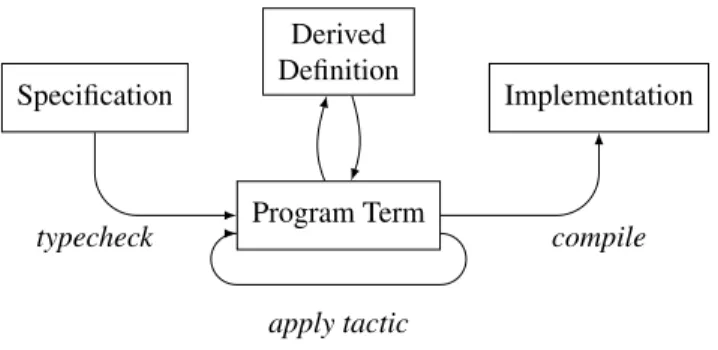
showing to the user the resultingprogram term(Figure 7). To begin the interaction, the user types in a specification written in the Bellmania language (as defined in Section 3), which is typechecked by the system, producing a term. This term then becomes the focus of the development, and further transformations apply to it; the user issues apply tacticcommands, one at a time, using a syntax similar to Figure 6. Tactic applications are also typechecked, as well as the resulting program, since type information can be refined by including the context (see Section 3.4). During the development, sub-computations may be discovered that require further drilling down (such as “B” in the last example). These result inderivedterms that take the focus until they, too, have been fully transformed. When the program and all its sub-computations are fully developed and expressed as a divide-and-conquer algorithm, the user invokes the compiler back-end that emits C++ code.
In the following sections, we describe the programming language and formally define the tactics that were used in the example above. We then show how to formalize the same intuition as we had there, using this new instrument.
3.
A Unified Language
For the purpose of manipulating programs and reasoning about them, we first set up a small language that can easily express our programs (that is, partially transformed specifi-cations), and can also be translated to executable code in a straightforward fashion. We choose a functional setting, with scalar types for array indices (i, j, k:Jin the example) and values stored in the arrays, typically real numbers (Gij :R
in the example). Arrays are encoded as functions, or arrow types, mapping indices to values (e.g.G : J2 →
R). We
want to have a notion of array elements that are uninitialized, so we assume every scalar type contains the special value⊥, corresponding to an undefined value.
Our language should be able to express operations such as
Slicefrom the previous section. To achieve this, we introduce
predicate abstractionover the index types, by extending the type system with subtyping andrefinement types. An index type J can be partitioned into subtypes hJ0|J1i (two or
more), meaning that we define predicatesJb0,Jb1 :J → B
(where B is the Boolean type) and the refinement types
J0={v:J|Jb0(v)}andJ1={v:J|Jb1(v)}, which become
subtypes ofJ. Usually, we can omit the “hat” and useJ0as
a synonym forJb0 when it is clear from the context that it
designates a type. We would then provide types for sub-arrays, e.g.G2 :J
0×J1→R.
To refer to a region of a given array, we define aguard operator, which is parameterized by subtypes of the indices, for exampleG2 = [G]
J0×J1. To combine computations on
different parts of the array, we use a lifting of the ternary
condition operator (known as?:) to functions, where the condition is implied by the operands; e.g. (Figure 2)
G=G1 G2 G4 =λij. Gij1 i, j∈J0 Gij2 i∈J0∧j∈J1 Gij4 i, j∈J1
Formal set-up The Bellmania language is based on the polymorphicλ-calculus, that is, simply typedλ-calculus with universally quantified type variables (also known asSystem F). The following subsections contain formal definitions for language constructs.
We write abstraction terms as (v : T) 7→ e, where
T is the type of the argument v and e is the body, in-stead of the traditional notationλ(v : T). e, mainly due to aesthetic reasons but also because we hope this will look more familiar to intended users. Curried functions (v1:T1) 7→ (v2:T2) 7→ · · · 7→ (vn:Tn) 7→ e are abbre-viated as(v1:T1)· · ·(vn:Tn)7→e. Argument types may be omitted when they can be inferred from the body.
The semantics differ slightly from that of traditional functional languages: arrow typesT1→ T2are interpreted asmappings from values of typeT1 to values of typeT2. Algebraically, interpretations of types,[[T1]],[[T2]], are sets, and interpretations of arrow-typed terms, f : T1 → T2, arepartial functions—[[f]] : [[T1]] * [[T2]]. This implies that a termt : T may have anundefinedvalue,[[t]] = ⊥T
(We would shorten it to[[t]] = ⊥when the type is either insignificant or understood from the context). For simplicity, we shall identify ⊥T1→T2 with the empty mapping (v : T1)7→ ⊥T2.
All functions are naturally extended, so thatf⊥=⊥. 3.1 Operators
The core language is augmented with the following intrinsic operators:
•A fixed point operatorfixf, with denotational semantics [[fixf]] = θ s.t. [[f]]θ=θ
we assume that recurrences given in specifications are well-defined, such that [[f]]has a single fixed point. In other words, we ignore nonterminating computations — we assume that the user provides only terminating
recurrences in specifications.
•A guard operator[ ]
, which comes in two flavors:
[x]cond= (
x cond
⊥ ¬cond
[f]P1×P2×···Pn=x7→[f x]VPi(xi)
wherex = x1· · ·xn. This second form can be used to refer to quadrants of an array; in this form, it always produces a term of type→ R, whereRis the domain off.
•A slash operator/:
For scalarsx, y:S x/y=
(
x ifx6=⊥
y ifx=⊥
Forf, g:T1→ T2 f /g= (v:T1)7→(f v)/(g v) This operator is typically used to combine computations done on parts of the array. For example,
ψ7→ f ψ I0 . g ψ I1
combines a result of f in the lower indices of a (one-dimensional) array with a result ofgin the higher indices (I0andI1, respectively, are the index subsets). Notice that
this does not limit the areas from whichf andgread; they are free to access the entire domain ofψ.
In our concrete syntax, function application andfixtake precedence over/, and the body of7→spans as far as possible (likeλvinλ-calculus).
3.2 Primitives
The standard library contains some common primitives:
•R, a type for real numbers;Nfor natural numbers;Bfor Boolean true/false.
•= :∀T.T → T →B, always interpreted as equality.
•+,−:∀T.T → T → T, polymorphic binary operators.
•<:∀T.T → T →B, a polymorphic order relation.
•cons:∀T.T →(N→T)→(N→T), nil:∀T.N→ T,
list constructors.
•min,max,Σ : ∀T S.(T → S)→ S, reduction (aggre-gation) operators on ordered/unordered collections. The collection is represented by a mappingf : T → S, so that e.g.
[[minf]] = min
[[f]]vv∈[[T]],[[f]]v6=⊥
The collections are assumed to be finite. 3.3 Additional Notation
We also adopt some syntactic sugar to make complex terms more manageable:
•x»f = f xfor application from the left.
•ht1,· · ·, tni= cons t1(cons· · ·(cons tn nil)· · ·)for fixed-length lists.
3.4 Types and Type Qualifiers
We extend the type system with predicate abstraction in the form of logically qualified data types (Liquid Types [25]). These are refinement types that provide a natural encoding of predicate abstraction by restricting refinements to set of abstraction predicates, calledqualifiers, which are defined
over the base types. Contrary to their general use, the purpose of these qualiiers in Bellmania is not to check a program for safety and reject ill-typed programs, but rather to serve as annotations for tactics, to convey information to the solver for use in proofs, and later to help the compiler properly emit memory access and parallelization primitives.
More specifically, typing f : {v : T1 | P(v)} → T2
would mean thatf xcan only be defined whereP(x)is true; otherwise,f x=⊥. Itdoes notmean that the compiler has to proveP(x)at the point where the termf xoccurs.
As such, we define a Bellmania program to be well-typed iff it is well-well-typed without the annotations (in itsraw form). Qualifiers are processed as a separate pass to properly annotate sub-terms.
Some qualifiers are built-in, and more can defined by the user. To keep the syntax simple, we somewhat limit the use of qualifiers, allowing only the following forms:
•{v:T |P(v)}, abbreviated asT ∩P. When the signature ofPis known (which is usually the case), it is enough to write the type asP.
•{v:T |P(v)∧Q(v)}, abbreviated asT ∩P∩Q, or just P∩Q. This extends to any number of conjuncts of the same form.
•(x : T1) → {v : T2 |R(x, v)} → T3, abbreviated as (T1× T2)∩R→ T3. The qualifier argumentxmustbe the preceding argument; this extends to predicates of any arity (that is, ak-ary predicate in a qualifier is applied to thekarguments to the left of it, including the one where it appears).
The type refinement constructors∩and×may be com-posed to createdroplets(tiny bits of liquid), using the abstract syntax in Figure 8. Note that the language does not include tuple types; hence all function types are implicitly curried, even when using×. Droplets can express conjunctions of qualifiers, as long as their argument sets are either disjoint or contained, but not overlapping; for example,
x:{v:T1|P(v)} → {v:T2|Q(v)∧R(x, v)} → T3
can be written as (P×Q)∩R
→ T3, but
x:T1→y:{v:T2|R(x, v)} → {v:T3|R(y, v)} → T4
cannot be represented as a droplet, except by extending the vocabulary of qualifiers.
Through the use of droplets, we manage to harness refine-ment types without being to cumbersome and requiring the user to write verbose annotations. To this end, we trade off some expressive power for succinctness.
Example
The specification of the Parenthesis problem (Figure 1) will be written as
d ::= e1 | ek →d
e1 ::= T for scalar typeT
ek+l ::= ek×el
ek ::= ek∩P fork-ary predicate symbolP
Figure 8. Syntax of type qualifiers (droplets).k,lare posi-tive integers that stand for dimension indexes.
x:J→R w:J3→R G = fix (θ:J2 <→R)i j7→ xi i+1=j . mink7→θik+θkj+wikj J2
< is used here as an abbreviation for(J×J)∩<. We
also usefxyas a more readable typographic alternative for
f x y, wheref is a function andx,yare its arguments. Note that the range forkinmink7→ · · ·is implicit, given the type ofθ:
θik6=⊥ ⇒i < k and θkj 6=⊥ ⇒k < j
Typing Rules
As mentioned earlier, annotations are ignored when type-checking a term. This gives a simple characterization of type safety without the need to explictly write any new typing rules. It also means that forf :T1→ T2,x:T3, we obtain f x:T2wheneverT1andT3have the sameshape(the raw type obtained by removing all qualifiers). This requires some explanation.
Considering a (partial) functionT → S to be a set of pairs of elements hx, yifrom its domain T and range S, respectively, it is clear to see that any function of typeT1→ S1, such that[[T1]]⊆[[T]],[[S1]]⊆[[S]], isalso, by definition, a function of typeT → S, since[[T1]]×[[S1]]⊆[[T]]×[[S]]. If we define subtyping as inclusion of the domains, i.e.T1<:T
whenever[[T1]]⊆[[T]], this translates into:
T1<:T ∧ S1<:S ⇒ (T1→ S1)<: (T → S) In this case, the type constructor→iscovariantin both arguments.5With this in mind, a functiong: (T → S)→ S2
can be called with an argumenta : T1 → S1, by regular subtyping rules, andg a:S2.
When the argument’s type is not a subtype of the expected type, but has the same shape, it iscoercedto the required type by restricting values to the desired proper subset.
Forh:T → S [[h a]] = [[h]] [[a]] ::T
Where::is defined as follows:
5This is different from classical view, and holds in this case because we
chose to interpret functions asmappings(see beginning of this section).
•For scalar (non-arrow) typeT,
x::T = ( x ifx∈[[T]] ⊥ ifx6∈[[T]] •f ::T → S = x7→ f(x::T) ::S
We extend our abstract syntax with an explicitcast opera-tort::T following this semantics. Notice that this is not the same ast:T, which is atype judgement.
Type Inference
Base types are inferred normally as in a classical Hindley-Milner type system [23]. The operators (Section 3.1) behave like polymorphic constants with the following types:
fix : ∀T. (T → T)→ T / : ∀T. T → T → T
(::T) : shape[T]→shape[T] As for[ ]
, for all typing purposes the first variant is a
no-op, and the second variant is just syntactic sugar for::→_ , where _ is a fresh type variable.
Any type variables occurring in type expressions are resolved at that stage through unification. In particular, it means that type variables are always assigned raw types.
Qualifiers are also inferred by propagating them up and down the syntax tree. Since the program already typechecks once the base types are in place, the problem is no longer one of findingvalidannotations, but rather oftighteningthem as much as possible without introducing semantics-changing coercions. For example, the term(f ::I→(I∩P))imay be assigned the typeI, but it can also be assignedI∩Pwithout changing its semantics.
Qualifiers are propagated by defining atype intersection operatoruthat takes two droplets of the same shapeT1,T2
and returns a droplet with a conjunction of all the qualifiers occuring in eitherT1orT2. The operator is defined in terms of the corresponding liquid types:
•IfT1={v:T |ϕ1}andT2={v:T |ϕ2},
T1u T2 = {v:T |ϕ1∧ϕ2}
•IfT1 =x:S1→ S2,T2 =x:S3 → S4(normalized so thatT1andT2use the same names for arguments),
T1u T2 = x: (S1u S3)→(S2u S4)
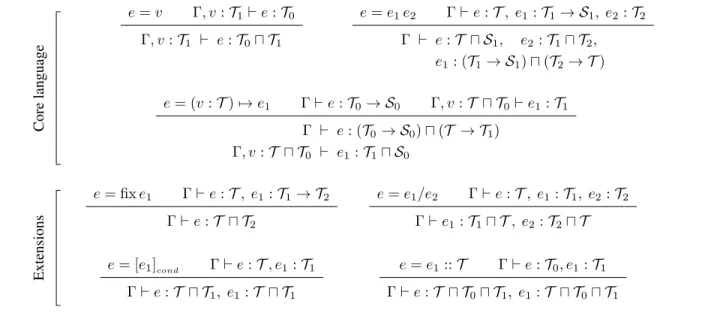
We then define thetype refinementsteps for terms. They are listed in Figure 9. These rules are applied continuously until a fixed point is reached. The resulting types are eventu-ally converted back to droplet form (expressed via∩and×); qualifiers that cannot be expressed in droplets are discarded. The top three rules apply to ordinary constructs of typed λ-calculus: the first rule propagates qualifiers from the en-vironment to leaf expressions that use a declared variable;
Core language e=v Γ, v:T1`e:T0 Γ, v:T1 ` e:T0u T1 e=e1e2 Γ`e:T, e1:T1→ S1, e2:T2 Γ ` e:T u S1, e2:T1u T2, e1: (T1→ S1)u(T2→ T) e= (v:T)7→e1 Γ`e:T0→ S0 Γ, v:T u T0`e1:T1 Γ ` e: (T0→ S0)u(T → T1) Γ, v:T u T0 ` e1:T1u S0 Extensions e= fixe1 Γ`e:T, e1:T1→ T2 Γ`e:T u T2 e=e1/e2 Γ`e:T, e1:T1, e2:T2 Γ`e1:T1u T, e2:T2u T e= [e1]cond Γ`e:T, e1:T1 Γ`e:T u T1, e1:T u T1 e=e1::T Γ`e:T0, e1:T1 Γ`e:T u T0u T1, e1:T u T0u T1
Figure 9. Type refinement rules, for inferring qualifiers in sub-expressions.
the next two rules propagate information across application and refinement terms. For an applicationf i, both the type ofiand the domain off can be refined via the other, e.g. iff : I0 → Randi : I, thenican be refined toI0;
sym-metrically, iff : I →Randi : I0, thenf can be refined
toI0→R. Similarly, the range off and the type off ican
refine each other. The rule for abstraction terms is analogous, except that information about the type of the argumentvis passed through the environment.
The bottom rules pertain to language extensions defined previously in this section. For/, qualifiers can safely seep down to sub-expressions (but not back up), e.g. ifx/y :I0, it
is safe to assertx:I0,y:I0without changing the semantics
of the expression. For casts,xandx::T are tied to have the same refinements, and those ofT are appended. A condition [x]
ties the sub-term type in the same way, but without
adding any qualifiers. The rule forfixis the only one that requires some thought: the type offixf cannot be forced down onf; but since, by definition,fixf =f(fixf)must hold, then any restrictions imposed by the range off can be asserted forfixf.
Note that two syntactically identical terms in different sub-trees may be assigned different types by this method. This is a desirable property, as (some) context information gets encoded in the type that way.
The interested reader can find an example of how type inference is applied in Appendix C.2.
4.
Tactics
We now define the method with which our framework trans-forms program terms, by means of tactics. A tactic is a scheme of equalities that can be used for rewriting. When applied to a program term, any occurrence of theleft-hand
sideis replaced by theright-hand side.6A valid application of a tactic is an instance of the scheme that is well-typed and logically valid (that is, the two sides have the same in-terpretation in any structure that interprets the free variables occurring in the equality).
The application of tactics yields a sequence of program terms, each of which is checked to be equivalent to the previ-ous one. We refer to this sequence by the namedevelopment. We associate with each tactic some proof obligations, listed after the wordObligationsin the following paragraphs. When applying a tactic instance, these obligations are also instantiated and given to an automated prover. If verified successfully, they entail the validity of the instance. In some cases, the obligations are strictly stronger than the validity of the rewrite, which means the TAE is not complete and may fail to apply a valid transformation. It is important to note that the user does not have to specify, or in fact be aware of, any proof obligations; they are defined as part of the tactic library.
The following are the major tactics provided by our framework. More tactic definitions are given in Appendix B.
Slice
f = f X1 . f X2 . · · · . f XrThis tactic partitions a mapping into sub-regions. EachXi may be a cross product (×) according to the arity off. For example,X1=J0×J0,X2=J0×J1,X3=J1×J1.
Obligations:just the equality above.
Informally, the recombination expression is equal tof whenX1..r“cover” all the defined points off (also known as thesupportoff).
Stratify
fix(f»g) = (fixf) » ψ7→fix(ψb»g)whereψbabbreviatesθ7→ψ, with fresh variableθ.
This tactic is used to break a long (recursive) computation into steps.ψis bound the result of the first computation (f), and then used as the input for the second step (g). Typically, we applyStratifyto a computation that has previously been
Sliced (although that does not have to be the case); to
understand the efficacy ofStratify, we present a minimal example.
Suppose the program fixθ7→ [t]I0
[t]I1
, where t = i 7→ θi−1 + 1. We would like to obtain a program that
computes the lower halfI0first, then the upper halfI1; that
is, fixθ7→[t]I0 [ψ]I1 » ψ7→fixθ7→[ψ]I0 [t]I1 . » fixθ7→[t]I0 [ψ]I1 ψ7→fixθ7→[ψ]I0 [t]I1
This can be obtained by choosingf =θ 7→[t]I0
[ψ]I1
andg=f θ7→[f θ]I0
[t]I1.
Notice how f θ is used as a placeholder for the sub-computation f in g. On the one hand, f»g = θ 7→
[t]I0 [ψ]I1 I0
[t]I1, which, modulo some simplification,
is equivalent to the original term θ 7→ [t]I0
[t]I1. On the
other hand, when instantiating Stratify, f θ becomes ψ θb ,
which is equivalent to ψ, giving the term for the second phase.
ψmay be fresh, or it may reuse a variable already occur-ring ing, rebinding those occurrences. This precisely encodes our intuition of computing the first fixed pointin situ, then the second one based on the result of the first.
Obligations:Leth=f»gandg0=ψ7→ψb»g. Letθ, ζbe
fresh variables; then,
f(g0ζ θ) = f ζ g0(f θ)θ = h θ (4.1)
Synth
fix h1 · · · hr = f1::T1 · · · fr::Tr This tactic is used to generate recursive calls to sub-programs. For i = 1..r,fi is one of the following:fixhi,hiψ, or t ψ, where ψ is some variable and t is a term corresponding to a previously defined subroutine (A,B,Cin the example). Bellmania chooses these values automatically (see Section 4.1), but the user may override it.
Obligations:Leth = h1/· · ·/hr, and let T → T be the shape ofh. For eachfi, depending on the form offi:
•Iffi ∼= fixf (for somef) —
h:: (T → Y) = h:: (Y → Y) =f :: (Y → T)for someYwhich is a subtype ofT and a supertype ofTi.
•Iffidoes not contain any “fix” terms —
h(h θ) ::Ti=fi ::Tifor a fresh variableθ.
∼
=denotes syntactic congruence up toβ-reduction. Theorem 4.1. Lets=s0be an instance of one of the tactics introduced in this section. letai=bi,i= 1..k, be the proof
obligations. If[[ai]] = [[bi]]for all interpretations of the free
variables ofaiandbi, then[[s]] = [[s0]]for all interpretations
of the free variables ofsands0. Proof is given in Appendix A.
Example
The naïve implementation of Algorithm 1 can be written as Ψ = i j7→[xi]i+1=j AJ = ψ7→fix(θ:J2 <→R) (i:J) (j :J) 7→ minhψij, min (k:J)7→θik+θkj+wikji (4.2)
As mentioned in Section 2, the first step Richard does is to applySliceto the program, thus introducing a partitioning into quadrants.
Slice
f = θ i j7→ · · ·
X1 = _×J0×J0 X2 = _×J0×J1
X3 = _×J1×J1
(each“_”is a fresh type variable)
AJ =ψ7→fix 1 2
4
(4.3)
1 = θ(i:J0) (j :J0)7→
minhψij,min (k:J)7→θik+θkj+wikji
2 = θ(i:J0) (j :J1)7→
minhψij,min (k:J)7→θik+θkj+wikji
4 = θ(i:J1) (j :J1)7→
minhψij,min (k:J)7→θik+θkj+wikji With repeated applications ofSlice, a program may grow to become quite large; to make large program terms easy to read and refer to, we provide boxed numerals 1 , 2 , etc. as labels for sub-terms, using them as abbreviations for these terms where they occur in the containing expression.
In addition, to allude to the reader’s intuition, expressions of the forma/b/c/dwill be written as a b
c d when the slices represent quadrants. The types of the quadrants should be clear from the context; here, their types are
1 :_×J0×J0→R, 2 :_×J0×J1→R, 4 :_×J1×J1→R
The type ofθin (4.3) is stillJ2
<→R. In order to avoid
a heuristic and only displays some of them. By hovering, the user can inspect types that are not shown.
The result is a functional representation of Figure 3(a); with the added termψij it allowsAto accept an input array as an argument and minimize values that are already stored in it; not quite crucial for this particular instance where the input is justΨ, but very useful in cases where it is necessary to split a minimization operation into several sub-ranges, to achieve the desired memory locality.
Stratify 1 f = 1 ψb b ψ ψb (recall that ψb=θ7→ψ) g = z7→ z 2 4 ψ=ψ AJ = ψ7→ fix 1 ψb b ψ ψb » ψ7→fix b ψ 2 4 1 2 4 as in(4.3) (4.4)
The reason for this particular choice of f and g is as explained in Section 4. Richard does not have to worry too much about them, because they are encoded in the tactic application engine, so that Bellmania knows how to build them automatically based on the term being stratified (1 in this case).
Notice that an existing variable ψ is reused, rebinding any occurrences within 2 , 4 . This effect is desirable, as it limits the context of the expression: the innerψshadows the outerψ, meaning 2 , 4 do not need to access the data that was input to 1 , only its output; therefore 1 can be computed in-place. The proof obligations forStratifymake sure this transition is valid.
At this point Richard can either do anotherStratifyor a
Synth. The order is insignificant, but to be consistent with
Figure 4, let us assume he chooses the former.
Stratify 1 f = 1 ψb b ψ ψb (recall that ψb=θ7→ψ) g = z7→ z 24 ψ=ψ AJ=ψ7→ fix 1 ψb b ψ ψb » ψ7→ fix b ψ 2 b ψ ψb » ψ7→fix ψb ψb 4 1 2 4 as in(4.3) (4.5) Synth 1 h1= 1 h2,3,4=ψb f1=A J0 ψ f2,3,4=ψ Y =J2 0 →R Synth 4 h1,2=ψb h3= 4 f1,2=ψ f3=A J1 ψ Y =J2 1 →R AJ=ψ7→ A J0 ψ ψ ψ ψ » ψ7→ fix b ψ 2 b ψ ψb » ψ7→ ψ ψ AJ1ψ 2 as in(4.3) (4.6)
For 2 , the situation is slightly more complicated because no instance of the routineAmatches the specification and there are no other routines to choose from. Richard defines a new routineBJ0J1 by carving the respective subexpression
from the developed program AJ. Notice that B has two parameters, because it depends not only on the index range, but also on the particular partitioning. Next, Richard will carry on developingBin a similar manner.
4.1 Synthesis-poweredSynthTactic
As mentioned in Sections 1 and 2, the user is assisted by automatic inference while applying tactics. In particular, the
Synthtactic requires the user to specify a subroutine to call
and parameters to call it with. In addition, the subtypeY
is required to complete the correctness proof. To automate this task, Bellmania employs Counterexample-guided Induc-tive Synthesis (CEGIS), a software synthesis technique im-plemented in the tool SKETCH[29]. The proof obligations, along with the possible space of parameter assignments taken from the set of sub-types defined duringSlice, are translated
to SKETCH. Since SKETCHuses bounded domains, the result
is then verified using full SMT.
In addition to considering explicitly defined sub-types, the synthesizer also tries small variations of them to cover corner cases. When index arithmetic is used, the range for a sub-call may have to be extended by a row or column on one or more sides. For each index sub-typeT ⊆J, Bellmania also tries
T ∪(T ±1)for filling in values of parameters:
T + 1 ={i+ 1|i∈ T } T −1 ={i−1|i∈ T }
While the number of combinations is not huge, it is usually hard for the user to figure out which exact call should be made. SinceSynthis used extensively throughout the development, This kind of automation greatly improves overall usability.
SKETCH times for the running example range 15–45
seconds. For comparison, covering the same search space for a typical invocation via exhaustive search in C++ took about 112hours.
5.
Automating Proofs
This section describes the encoding of proof obligations in (many-sorted) first-order logic, and the ways in which type information is used in discharging them.
Each base type is associated with a sort. The qualifiers are naturally encoded as predicate symbols with appropriate sorts. In the following paragraphs, we use a type and its associated sort interchangeably, and the meaning should be clear from the context.
Each free variable and each node in the formula syntax tree are assigned two symbols: a function symbol representing the values, and a predicate symbol representing the support, that is, the set of tuples for which there is a mapping. For example, a variablef :J →Rwill be assigned a function f1 :J →
Rand a predicate|f| :J → B. The superscript
indictes the function’s arity, and the vertical bars indicate the support.
For refinement-typed symbols, the first-order symbols are still defined in terms of the shape, and an assumption concerning the support is emitted. For example, for g : (J ∩P) → R, the symbols g1 : J → R,|g| : J → B
are defined, with the assumption∀α:J.|g|(α)⇒P(α). Assumptions are similarly created for nodes of the syntax tree of the formula to be verified. We define theenclosure of a node to be the ordered set of all the variables bound by ancestor abstraction nodes (v7→. . .). Since the interpretation of the node depends on the values of these variables, it is “skolemized”, i.e., its type is prefixed by the types of enclosing variables. For example, ife : T, then inside a term(v:S)7→ · · ·e· · · it would be treated as typeS → T. Typically, the goal is an equality between functionsf =g. This naturally translates to first-order logic as
∀α. |f|(α)⇔ |g|(α)
∧ |f|(α)⇒fk(α) =gk(α)
First-class functions. When a function is being used as an argument in an application term, we take its arrow type
T → Sand create afaux sortFT →S, an “apply” operator
@ :FT →S → T → S, and theextensionality axiom— ∀αα0. ∀β.@(α, β) = @(α0, β)⇒α=α0 (5.1) Then for each such function symbolfk :T → Sused as argument, we create itsreflectionf0:FT →Sdefined by
∀α. @(f0, α) =fk(α) (5.2)
5.1 Simplification
When f,g of the goal f = g, are abstraction terms, the above can be simplified by introducing k fresh variables, x=x1· · ·xk, and writing the goal asf x=g x. The types ofxare inferred from the types off andg(which should have the same shape). We can then applyβ-reduction as a simplification step. This dramatically reduces the number
of quantifiers in the first-order theory representing the goal, making SMT solving feasible.
Moreover, if the goal has the form f t1 = f t2 (e.g.
Stratify, Section 4) it may be worth trying to prove that
t1 ::T =t2 :: T, wheref :T → S. This trivially entails
the goal and is (usually) much easier to prove.
Another useful technique is common subexpression elim-ination, which is quite standard in compiler optimizations. Tactic applications tend to create copies of terms, so merging identical subexpressions into a single symbol can drastically reduce the size of the SMT encoding.
6.
Code Generation
We built a compiler for programs in Bellmania language that generates efficient C++ code parallelized with Intel Cilk constructs. The compiler uses type information from the development to improve the quality of generated code. From the types of sub-terms corresponding to array indices, the compiler extracts information about what region of the array is read by each computation, and from the types of λ-bound index variable it constructs loops that write to the appropriate regions. The compiler utilizes the SMT solver to infer dependency constraints as in [20], and figures out the direction of each loop (ascending or descending). In addition, inter-quadrant dependencies can be used to determine which computations can be run in parallel (at the granularity of function calls) based on a fork-join model; two calls are considered non-conflicting if each write region is disjoint from the others’ read and write regions. Type information is heavily utilized here: occurrences of array variables signify reads, so their types denote (an over-approximation of) the region being “read from”, whereas return types denote the region being “written to”. Disjointness can be decided using propositional logic through the predicate abstraction induced by type qualifiers.
The compiler also employs more traditional optimization techniques to further simplify the code and improve its run-ning time: (1) lifts conditionals to loop bounds via simple interval analysis, (2) eliminates redundant iterations and com-parisons that can be resolved at compile time, (3) identifies loops that read non-contiguous memory blocks and applies copy optimization [22] automatically to better utilize caches. Examples of generated code are included in the Bellmania repository [2], and (4) follows a simple heuristic that inserts loop vectorization directives.
7.
Empirical Evaluation
We implemented our technique and used it to generate ca-che-oblivious divide-and-conquer implementations of three algorithms that were used as benchmarks in [32], and a few others.
Parenthesis problem. Our running example; Compute an optimal placement of parentheses in a long chain of multipli-cation, e.g. of matrices, where the inputs are cost functions
wx: ((I×I)∩<)→J→ R wy: ((J×J)∩<)→I→ R G = fixθ i j7→ 0 i=j=0 . w0yj0 i=0 . wx 0i0 j=0 . min hθ(i−1)(j−1)+cij, minp7→θpj+wpijx , minq7→θiq+wqjiy i
Figure 10. Specifications for the Gap problem. xifor accessing thei-th element andwikj for multiplying elements[i, k)by elements[k, j).
Gap problem. A generalized minimal edit distance problem. Given two input stringsx = x1· · ·xmandy = y1· · ·yn, compute the cost of transformingxintoyby any combination of the following steps: (i) Replacingxiwithyj, at costcij, (ii) Deletingxp+1· · ·xq, at costwxpq, (iii) Insertingyp+1· · ·yq inx, at costwy
pq. The corresponding recurrence is shown in Figure 10.
Protein Accordion Folding problem. A protein can be viewed as a stringP1..nover an alphabet of amino acids. The protein folds itself in a way that minimizes potential energy. Some of the acids arehydrophobic; minimization of the total hydrophobic area exposed to water is a major driving force of the folding process. One possible model is packingP in a two-dimensional square lattice in a way that maximizes the number of pairs of hydrophobic elements, where the shape of the fold is anaccordion, alternating between going down and going up.
We also exercised our system on a number of textbook problems: the Longest Common Subsequence (LCS) prob-lem, the Knapsack probprob-lem, and the Bitonic Traveling Sales-man problem.
7.1 Implementation Details
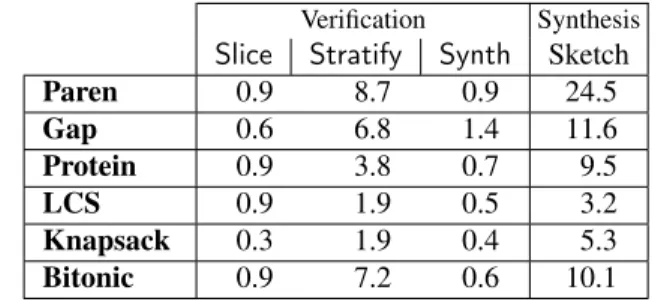
The tactic application engine is implemented in Scala. We implemented a prototype IDE using HTML5 and AngularJS, which communicates with the engine by sending and receiv-ing program terms serialized as JSON. Our system supports using either Z3 or CVC4 as the back-end SMT solver for discharging proof obligations required for soundness proofs. Synthesis of recursive calls is done by translating the pro-gram to SKETCH, which solves a correct assignment to type parameters. To argue for the feasibility of our system, we include SMT solver running time for the verification of the three most used tactics (figures are for CVC4), as well as time required for SKETCHsynthesis, in Table 1. We consider an average delay of ~10 seconds to be reasonable, even for an interactive environment such as Bellmania.
Tactics are implemented as small Scala classes. It is possible for the more advanced user to extend the library by writing such classes. To give an idea, on top of the generic TAE the Stratify tactic was coded in 12 lines of
Verification Synthesis
Slice Stratify Synth Sketch
Paren 0.9 8.7 0.9 24.5 Gap 0.6 6.8 1.4 11.6 Protein 0.9 3.8 0.7 9.5 LCS 0.9 1.9 0.5 3.2 Knapsack 0.3 1.9 0.4 5.3 Bitonic 0.9 7.2 0.6 10.1
Table 1. Average proof search time for proof obligations and average synthesis time forSynthparameters (seconds).
Speedup w.r.t parallel LOOPDP on 16 cores CPU (16 workers), B=64
N CO_Opt COZ AUTO
Parenthesis 16384 9.8x 11.4x 11.1x
Gap 16384 6.6x 8.4x 8.5x
Protein 16384 5.1x 5.5x 3.1x
LCS 45000 − − 3.9x
Bitonic 45000 − − 3.8x
Table 2. Performance of different C++ implementations
Scala, including the functionality that breaks a functionh into two functionsf andg.
The compiler back-end is implemented as another com-ponent in Scala, processing ASTs and generating C++ code containing Intel Cilk constructs for parallelization. It em-ploys a thin intermediate representation layer at which the optimizations of Section 6 are applied.
7.2 Experimental Results
Table 2 shows performance improvement for our auto-generated implementation (AUTO) on the state-of-the-art optimized parallel loop implementation (LOOPDP) that was used by [32]. It also compares AUTO with manually opti-mized recursive implementations CO_Opt and COZ for the three problems from [32]7. Our compiler automatically does
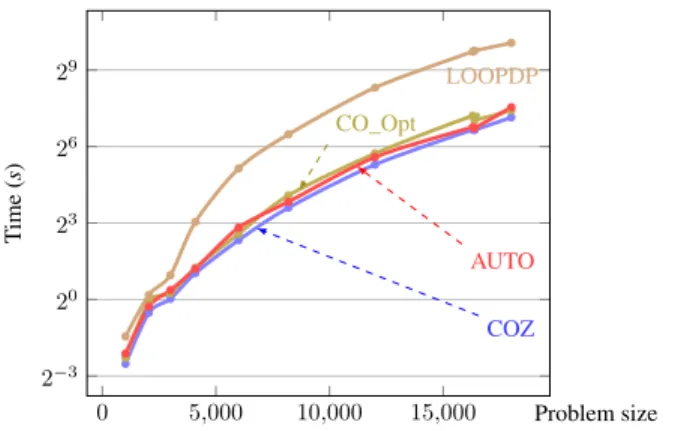
copy optimizationas done in CO_Opt and COZ. COZ also incorporates a low-level optimization of using Z-order layout of the array, which is out of scope for this paper.N is the problem size and B is the base case size for using loops instead of recursion. It can be seen from the table that our implementation performs close to the manually optimized code. Figure 11 depicts the performance of these implemen-tations on one sample instance as a function of problem size, and shows the scalability of the generated code.
7.2.1 Estimation of User Effort
Because Bellmania is an interactive system, we try to give a measure as to how much effort a typical user has to invest to complete a development for the DP algorithms that comprise
7Speedups in the table are lower than in [32]; this should be attributed to
0 5,000 10,000 15,000 2−3 20 23 26 29 LOOPDP T ime ( s ) CO_Opt AUTO COZ Problem size
Figure 11. Performance comparison for parallelized imple-mentations for Gap problem on 16-core Intel Xeon 2.4GHz CPU
Conceptual Bellmania
# phases # steps # tactics
Paren 3 22 30 Gap 3 27 53 Protein 4 28 47 LCS 1 5 5 Knapsack 2 16 49 Bitonic 3 16 32
Table 3. Sizes of synthesis scripts compared to conceptual problem size (see Section 7.2.1).
our test suite. To get an idea of how domain experts think about the problem, we consult [12], where descriptions are conveniently provided in the form of data-flow diagrams for each step of computation. An example for such a diagram, corresponding to our Algorithm 4, is shown in Figure 12; in this case, we count it as 4 steps.
Figure 12. An example diagram (from [12]) We compare the sizes of these
dia-grams, which we label “# steps”, with the number of tactic applications re-quired to derive the respective imple-mentation in Bellmania. The results of the comparison are given in Table 3, where “# phases” indicates how many recursive subroutines are included in the algorithm description (and in the respective development) and the two other columns give the sizes of the de-scription vs. that of the development. The development size is within2×of the diagrams’ size in most cases, peak-ing at3×.
Diagrams and complete Bellmania transcript for the running example are included in Appendix C.1.
Admittedly, the measured volume ratio provides a crude proxy for
usabil-ity. A controlled user study should be
run to provide true evidence, but that goes beyond the scope of this paper. Still, the results are reassuring since through the course of developing the tool we were able to reduce the number of reasoning steps from hundreds to a few dozens, and also make them high-level. We were also able to detect mistakes in existing (hand written) formulations of divide-and-conquer algorithms, that eluded discovery by experts. The additional examples in the appendix should furnish suffi-cient intuition to conceive a qualitative opinion on the efficacy of the approach and the prototype.
8.
Further Improvements
Overall usability can be greatly enhanced with some syntactic sugar for program terms and tactic application commands. The current syntax is part of a proof-of-concept UI. User experience can also be enriched with direct manipulation gestures, such as pointing to a sub-term in the program rather than using boxed literals to refer to them, and “carving” sub-computations from the current term by selecting and dragging.
The tactic library can be extended with a number of impor-tant optimization for this domain.Dimensionality reduction is a technique that allows to lower ann-dimensional DP prob-lem ton−1dimensions by computing layer by layer. This has an acute difference from merely buffering the most recent layer; without going too much into details, we point out that intermediate layers computed this way may differ from the corresponding projection of then-dimensional table, while the final layer is identical. This tactic can enable a whole sub-class of high dimension DP problems.
Some low-level tactics can boost performance as well: the Protein benchmark runs faster using the hand-coded version due to a subtle case splitting around the innermost loop, that reduces an expression of the formmin(k,2j −i+ 1) to just2j−i+ 1, allowing in turn to factor an addend out of the loop (kis the innermost loop variable). Doing the same optimization by hand on the code produced by Bellmania leads to the same speedup, but this boost cannot be claimed until it is automated.
Z-ordering of the array is also a general technique and can be automated as part of the compiler back-end. However, this and other optimizations (such as vectorization and copy opti-mization mentioned in Section 6) are delicate and sometimes even degrade performance, so they better be auto-tuned rather than applied heuristically.
9.
Related Work
Classical work by Smithet al.[26] presents rule-based trans-formation, stringing it tightly with program verification. This lay the foundation for semi-automatic programming [5, 6, 27]. Later, these concepts have been applied to divide-and-conquer in a disciplined way in [7, 31]; these address divide-and-conquer in the classical sense of [13] (Chapter 4), focusing
on parallelism. In Bellmania, more focus is put on re-ordering of array reads and writes, following and mechanizing tech-niques related to DP from [8, 9]. In fact, traditional paral-lelism is taking “for granted” for our aggregation operators, since they are associative and methods such as [17] apply rather trivially, and translated into the tacticsSlice,Assoc, and
Distrib. On top of these algebraic transformations, Bellmania
allows clever re-orderings, especially throughStratifyand
Let. (Some of the these tactics appear in the appendix.) More recently, a similar approach was introduced into Leon [21], leveraging deductive tools as a way to boostCEGIS, thereby covering more programs. Bellmania takes a dual approach, where automated techniques based on SMT are leveraged to support and improve deductive synthesis.
Inductive synthesis has been the focus of renewed in-terest thanks to the discovery of techniques that leverage SAT/SMT solvers to symbolically represent and search very large spaces of possible programs [19, 28, 33], and the use of counterexample-guided inductive synthesis (CEGIS), which allows one to leverage inductive techniques to find programs that satisfy more general specifications. Our work is also in-spired by the StreamBit project [30], which introduced the idea of transformation rules with missing details that can be inferred by a symbolic search procedure.
Fiat [14] is another recent system that admits stepwise transformation of specifications into programs via a refine-ment calculus. While Bellmania offloads proofs to SMT and
SKETCH, Fiat uses decision procedures in Coq, reling heavily
on deductive reasoning and uses Ltac scripts for automation. The intended users of Fiat is regular software developers who invoke pre-packaged scripts, whereas Bellmania targets do-main experts who exercise more control over the generated code.
Broadly speaking, the Bellmania system could have been implemented as a library on top of a framework such as Coq or Why3 [16] using binding to SMT solvers provided by these frameworks. The decision not to do so was merely a design choice, to facilitate easier integration with our UI and with SKETCH.
Autogen [12] is a most recent advance that employs dy-namic analysis to discover a program’s access pattern and learn a decomposition that can be used to generate a divide-and-conquer implementation. The two methods are comple-mentary, since Autogen does not provide correctness guar-antees: it works for a class of problems that obey a “small world assumption”, meaning that all possible behaviors are demonstrated by traces of bounded, known size. Crucially, in Autogen it is the user’s responsibility to determine whether the input problem falls within this category; if it does not, Autogen will not fail but instead generate an incorrect imple-mentation. This is a fundamental difference stemming from Autogen’s use of dynamic tracesvs.purely deductive reason-ing in Bellmania. Still, the user might be able to use insights
from Autogen to develop verified code in Bellmania, where size bounds are not required.
Puet al.[24] have shown that recurrences for DP can be generated automatically from a non-recursive specification of the optimization problem. This is orthogonal; in Bellma-nia, the recurrence is the input, and the output is an efficient divide-and-conquer implementation. Obviously, the recur-rence produced by [24] can be used as input to Bellmania, providing an even higher-level end-to-end reasoning.
10.
Conclusion
The examples in this paper show that a few well-placed tactics can cover a wide range of program transformations. The introduction of solver-aided tactics allowed us to make the library of tactics smaller, by enabling the design of higher-level, more generic tactics. Their small number gives the hope that end-users with some mathematical background will be able to use the system without the steep learning curve that is usually associated with proof assistants. This can be a valuable tool for algorithms research.
Moreover, limiting the number of tactics shrinks the space in which to search for programs, so that an additional level automation may be achieved via AI or ML methods. As more developments are done by humans and collected in a database, those algorithms would become more adept in predicting the next step of the construction.
In a broader outlook, the technique for formalizing trans-formation tactics is not particularly attached to divide-and-conquer algorithms and their implementations. In this work, we constructed a generic tactic application engine, on top of which the tactics required for our domain were easy to implement. This gives rise to the hope that, in the future, the same approach can be applied to other domains, in the interest of encoding domain knowledge, providing better DSLs that offer users the power to write high-level programs without sacrificing performance.
Acknowledgments
This work is supported by NSF Grants 1139056, CCF-1439084 and CNS-1553510. We thank Shoaib Kamil and Adobe research for their feedback and support.
References
[1] The Coq proof assistant, reference manual. https://coq.
inria.fr/refman.
[2] Bellmania repository on github. https://github.com/
corwin-of-amber/bellmaniac/.
[3] R. E. Bellman. Dynamic Programming. Dover Publications,
Incorporated, 2003.
[4] M. A. Bender, R. Ebrahimi, J. T. Fineman, G. Ghasemiesfeh, R. Johnson, and S. McCauley. Cache-adaptive algorithms. InProceedings of the Twenty-Fifth Annual ACM-SIAM Sym-posium on Discrete Algorithms, SODA ’14, pages 958–971, 2014.
[5] L. Blaine and A. Goldberg. DTRE — a semi-automatic
trans-formation system. InConstructing Programs from
Specifica-tions, pages 165–204. Elsevier, 1991.
[6] M. Butler and T. Långbacka. Program derivation using the
refinement calculator. InTheorem Proving in Higher Order
Logics, volume 1125 of Lecture Notes in Computer Science, pages 93–108. Springer Verlag, 1996.
[7] W.-N. Chin, J. Darlington, and Y. Guo. Parallelizing
condi-tional recurrences. InProceedings of the Second International
Euro-Par Conference on Parallel Processing - Volume I, Euro-Par ’96, pages 579–586, 1996.
[8] R. Chowdhury and V. Ramachandran. Cache-oblivious
dy-namic programming. InProceedings of the ACM-SIAM
Sym-posium on Discrete Algorithms, pages 591–600, 2006. [9] R. Chowdhury and V. Ramachandran. Cache-efficient dynamic
programming algorithms for multicores. In Proceedings
of the ACM Symposium on Parallelism in Algorithms and Architectures, pages 207–216, 2008.
[10] R. Chowdhury and V. Ramachandran. The cache-oblivious Gaussian elimination paradigm: theoretical framework,
paral-lelization and experimental evaluation.Theory of Computing
Systems, 47(4):878–919, 2010.
[11] R. Chowdhury, H.-S. Le, and V. Ramachandran.
Cache-oblivious dynamic programming for bioinformatics.
IEEE/ACM Transactions on Computational Biology and Bioinformatics, 7(3):495–510, 2010.
[12] R. Chowdhury, P. Ganapathi, J. J. Tithi, C. Bachmeier, B. C. Kuszmaul, C. E. Leiserson, A. Solar-Lezama, and Y. Tang. Autogen: Automatic discovery of cache-oblivious parallel
re-cursive algorithms for solving dynamic programs. In
Proceed-ings of the 21st ACM SIGPLAN Symposium on Principles and Practice of Parallel Programming, PPoPP ’16, page 10, 2016. [13] T. H. Cormen, C. E. Leiserson, R. L. Rivest, and C. Stein.
Introduction to Algorithms. The MIT Press, third edition, 2009. [14] B. Delaware, C. Pit-Claudel, J. Gross, and A. Chlipala. Fiat: Deductive synthesis of abstract data types in a proof assistant. InProceedings of the 42nd Annual ACM SIGPLAN-SIGACT Symposium on Principles of Programming Languages, POPL 2015, Mumbai, India, January 15-17, 2015, pages 689–700, 2015.
[15] R. Durbin, S. R. Eddy, A. Krogh, and G. J. Mitchison.
Biologi-cal Sequence Analysis: Probabilistic Models of Proteins and Nucleic Acids. Cambridge University Press, 1998.
[16] J.-C. Filliâtre and A. Paskevich. Why3 - where programs meet
provers. InESOP, Lecture Notes in Computer Science, pages
125–128. Springer, 2013.
[17] A. L. Fisher and A. M. Ghuloum. Parallelizing complex
scans and reductions. InProceedings of the ACM SIGPLAN
1994 Conference on Programming Language Design and Implementation, PLDI ’94, pages 135–146, 1994. ISBN 0-89791-662-X.
[18] M. Frigo, C. E. Leiserson, H. Prokop, and S. Ramachandran.
Cache-oblivious algorithms. InProceedings of the 40th Annual
Symposium on Foundations of Computer Science, FOCS ’99, pages 285–, 1999.
[19] S. Gulwani, S. Jha, A. Tiwari, and R. Venkatesan. Synthesis
of loop-free programs. InProceedings of the 32nd ACM
SIGPLAN Conference on Programming Language Design and Implementation, PLDI 2011, San Jose, CA, USA, June 4-8,
2011, pages 62–73, 2011.
[20] R. M. Karp, R. E. Miller, and S. Winograd. The organization
of computations for uniform recurrence equations.J. ACM, 14
(3):563–590, July 1967.
[21] E. Kneuss, V. Kuncak, I. Kuraj, and P. Suter. Synthesis modulo
recursive functions. InOOPSLA, 2013.
[22] M. D. Lam, E. E. Rothberg, and M. E. Wolf. The cache
perfor-mance and optimizations of blocked algorithms. In
Proceed-ings of the Fourth International Conference on Architectural Support for Programming Languages and Operating Systems, ASPLOS IV, pages 63–74, 1991.
[23] R. Milner. A theory of type polymorphism in programming.
Journal of Computer and System Sciences, 17:348–375, 1978. [24] Y. Pu, R. Bodík, and S. Srivastava. Synthesis of first-order
dynamic programming algorithms. InProceedings of the 26th
Annual ACM SIGPLAN Conference on Object-Oriented Pro-gramming, Systems, Languages, and Applications, OOPSLA 2011, part of SPLASH 2011, Portland, OR, USA, October 22–27, 2011, pages 83–98, 2011.
[25] P. M. Rondon, M. Kawaguci, and R. Jhala. Liquid types. In Proceedings of the 29th ACM SIGPLAN Conference on Programming Language Design and Implementation, PLDI ’08, pages 159–169, 2008.
[26] D. R. Smith. Top-down synthesis of divide-and-conquer
algorithms.Artificial Intelligence, 27(1):43–96, 1985.
[27] D. R. Smith. KIDS: A semiautomatic program development
system.IEEE Trans. Software Eng., 16(9):1024–1043, 1990.
[28] A. Solar-Lezama. The sketching approach to program
synthe-sis. InProgramming Languages and Systems, 7th Asian
Sym-posium, APLAS 2009, Seoul, Korea, December 14-16, 2009. Proceedings, pages 4–13, 2009.
[29] A. Solar-Lezama. Program sketching.STTT, 15(5-6):475–495,
2013.
[30] A. Solar-Lezama, R. Rabbah, R. Bodík, and K. Ebcio˘glu.
Pro-gramming by sketching for bit-streaming programs. In
Pro-ceedings of the 2005 ACM SIGPLAN Conference on Program-ming Language Design and Implementation, PLDI ’05, pages 281–294, 2005.
[31] Y. M. Teo, W.-N. Chin, and S. H. Tan. Deriving efficient
parallel programs for complex recurrences. InProceedings
of the Second International Symposium on Parallel Symbolic Computation, PASCO ’97, pages 101–110, 1997.
[32] J. J. Tithi, P. Ganapathi, A. Talati, S. Agarwal, and R. Chowd-hury. High-performance energy-efficient recursive dynamic programming using matrix-multiplication-like flexible kernels. In Proceedings of the IEEE International Parallel & Dis-tributed Processing Symposium, 2015.
[33] E. Torlak and R. Bodik. Growing solver-aided languages
with rosette. InProceedings of the 2013 ACM International
Symposium on New Ideas, New Paradigms, and Reflections on Programming & Software, Onward! 2013, pages 135–152, 2013.
![Figure 13. Development of subroutine A of the Parenthesis problem as conceptually described in [12] (top) and using Bellmania (bottom).](https://thumb-us.123doks.com/thumbv2/123dok_us/9322526.2810798/19.918.202.321.106.379/figure-development-subroutine-parenthesis-problem-conceptually-described-bellmania.webp)
