Contents lists available atSciVerse ScienceDirect
Artificial Intelligence
www.elsevier.com/locate/artintExploiting the category structure of Wikipedia for entity ranking
Rianne Kaptein
a,∗
,1
, Jaap Kamps
baOxyme, Cronenburg 150, 1081GN Amsterdam, The Netherlands
bUniversity of Amsterdam, Department of Media Studies, Turfdraagsterpad 9, 1012XT Amsterdam, The Netherlands
a r t i c l e
i n f o
a b s t r a c t
Article history:
Available online 19 June 2012
Keywords:
Wikipedia Entity ranking Category structure Link structure
The Web has not only grown in size, but also changed its character, due to collaborative content creation and an increasing amount of structure. Current Search Engines find Web pages rather than information or knowledge, and leave it to the searchers to locate the sought information within the Web page. A considerable fraction of Web searches contains named entities. We focus on how the Wikipedia structure can help rank relevant entities directly in response to a search request, rather than retrieve an unorganized list of Web pages with relevant but also potentially redundant information about these entities. Our results demonstrate the benefits of using topical and link structure over the use of shallow statistics.
Our main findings are the following. First, we examine whether Wikipedia category and link structure can be used to retrieve entities inside Wikipedia as is the goal of the INEX (Initiative for the Evaluation of XML retrieval) Entity Ranking task. Category information proves to be a highly effective source of information, leading to large and significant improvements in retrieval performance on all data sets. Secondly, we study how we can use category information to retrieve documents for ad hoc retrieval topics in Wikipedia. We study the differences between entity ranking and ad hoc retrieval in Wikipedia by analyzing the relevance assessments. Considering retrieval performance, also on ad hoc retrieval topics we achieve significantly better results by exploiting the category information. Finally, we examine whether we can automatically assign target categories to ad hoc and entity ranking queries. Guessed categories lead to performance improvements that are not as large as when the categories are assigned manually, but they are still significant. We conclude that the category information in Wikipedia is a useful source of information that can be used for entity ranking as well as other retrieval tasks.
©2012 Elsevier B.V. All rights reserved.
1. Introduction
The Web contains an unprecedented amount of information, and continues to grow, making shallow statistics so powerful that they can solve tasks that were assumed to require deep “intelligence” [14]. But apart from its size, the Web has also changed in character. First, there is an increasing amount of structure—topical structure, document structure, link structure, tag structure, et cetera—either imposed or evolving as a light-weight organization of information and knowledge. Second, Web users are no longer passive consumers, but are active contributors of information in Wikis, Blogs and online communities—in fact they can publish whatever they want to share with the rest of the world. This immediately prompts
*
Corresponding author.E-mail addresses:[email protected](R. Kaptein),[email protected](J. Kamps). 1 Work done while at the University of Amsterdam.
0004-3702/$ – see front matter ©2012 Elsevier B.V. All rights reserved. http://dx.doi.org/10.1016/j.artint.2012.06.003
the question how we can unleash the power of the Web’s structure and collaborative content, and what benefits this will bring over the use of shallow statistics.
Researchers in artificial intelligence (AI) have realized for long that “semantics” is key to realizing advanced applications like machine translation, question answering or sophisticated information retrieval (IR)[25]. Early on AI took the path of knowledge-rich symbolic rules, and IR took the path of knowledge-poor statistics, and the two fields effectively separated. With the advent of the Web, and the availability of large-scale text corpora, both strands of research are united again, and statistical methods prevail in both fields. Despite their great effectiveness, there are some dissatisfying aspects to the effectiveness of relatively shallow statistics and machine learning on large data volumes. First, they work remarkably well some tasks, where the data holds all required cues explicitly or implicitly. Yet they have difficulty in tasks that rely on common-sense or background knowledge, or on purposeful dialogue with a user. Admittedly this is a vague distinction that seems to be shifting over the years. Second, related to the product and process schools in AI, it seems unlikely that human cognition is modeled well by the statistical models. There are many benefits to be had if we were able to fruitfully combine our insights in statistics and machine learning with our insights in human cognition, if only as a second step to take input and feedback, and to communicate results more effectively to the users of AI systems. Third, and perhaps the main dissatisfaction, is that of our scientific understanding of the problems we study. We know how to “solve” a hard task by using statistics and machine learning on a massive amount of data—which is of clear value in itself—but we fail yet to truly understand the problem, nor its solution, nor why it is hard or easy, nor how we as human are capable of solving it. Hence, we have a particular interest in more informed methods that on the one hand exploit available statistics but on the other hand combine this with meaningful and interpretable semantic structure.
A resource that is large enough to generate meaningful statistics, and contains interpretable semantic structure is Wikipedia. In this paper we therefore investigate how we can exploit Wikipedia for an information retrieval task, that is to rank relevant entities in response to a search request. Current Search Engines find Web pages rather than information or knowledge directly, and leave it to the searchers to locate the sought information within the Web page. A considerable fraction of Web searches contains named entities [e.g., [30]]. Searchers looking for entities are better served by presenting a ranked list of entities directly, rather than an unorganized list of Web pages with relevant but also potentially redundant information about these entities. The goal of the entity ranking task is to return entities instead of documents or text as are returned for most common search tasks. Entities can be for example persons, organizations, books, or movies. We focus on Wikipedia, an important structured information resource on the Web. Wikipedia is a free encyclopedia that anyone can edit, consisting of millions of articles that adhere to a certain structure. Wikipedia is a highly structured resource and includes an extensive collection of categories that are used to categorize Wikipedia articles. Wikipedia being a structured resource is a great asset that can be exploited for many AI tasks such as word sense disambiguation[24], question answering[1]and information retrieval.
The nature and structure of Wikipedia presents new opportunities to solve problems that were thought to require deep understanding capabilities and where bottlenecks such as high cost and scalability where applicable in the past. Combining the benefits of the structured information and the large scale of Wikipedia, creating the opportunity to use probabilistic methods, we can now efficiently process all of the information contained in Wikipedia. Furthermore, the scale of Wikipedia offers the opportunity to go far beyond toy problems, and experiment with real-world problems and applications. In ad-dition, the information retrieval community has created test collections for different retrieval tasks using Wikipedia as a document collection. The advanced IR methodology helps us evaluate the quality of search results and compare different approaches in great detail.
The notion of “entity” is a complex one, yet Wikipedia provides a simple and effective solution to the problem of named entity extraction. Many Wikipedia pages are in fact entities, and by using the category information we can distinguish the entities from other types of documents. The titles of the Wiki-pages are the named entity identifiers. Using the redirects alternative entity identifiers can also be extracted. The Wikipedia categories can be associated with entity types, which makes it possible to extract entities where any Wiki-page belonging to a target entity type can be considered as an entity. This nicely illustrates the power of modern Web resources as Wikipedia, where human computing has already identified and classified entities in a way that is very similar to the intent of searchers.
An issue in all entity ranking tasks is how to represent entities, returning only the name of the entity is not enough. It has been shown for QA systems users generally prefer answers embedded in context, regardless of the perceived reliability of the source documents [22]. It can be assumed that for entity ranking the same holds, that is searchers like to see evidence, for example surrounding text, why an entity is relevant to their query. Since in this paper we rank entities in Wikipedia, we can exploit the structure of Wikipedia to represent entities, that is an entity is represented by its Wikipedia page and the page title is the entity identifier. Moreover, we can also take advantage of the encyclopedic structure of Wikipedia. The Web is highly redundant making it easy to find “some” relevant information but very hard to give complete and exact answers. Search results will be dominated by the most popular one or two entities on the Web, pushing down other relevant entities. Since Wikipedia has an encyclopedic structure, enforced by its millions of editors, each entity occurs in principle only once and we do not have to worry about redundant information. For ambiguous entity names there are special disambiguation pages, where the different meanings of the entity name are listed. These disambiguation pages are also an interesting source of information to return more diverse search results to a query[28].
One of the challenges in exploiting the category information is that Wikipedia categories are created and assigned by dif-ferent human editors, and are therefore less rigorous, coherent and consistent than usual ontologies. With 150,000 categories
to choose from it is a non-trivial task to assign the correct categories to a Wikipedia page. Some categories that should be assigned can be missing, and too general or too specific categories can be assigned to a page. A Wikipedia page is usually assigned to multiple categories. Wikipedia guidelines are to place articles only in the most specific categories they reason-ably fit in (a modern version of Cutter’s rule from library science[8]). Peer reviewing is employed to improve the quality of pages and categorizations. Given the noisy nature of any Web data, it is very well possible that relevant pages are not assigned to the designated target category. The category can either be a few steps away in the category graph, or similar categories can be relevant. Another issue is that some of the target categories provided in the entity ranking topics are redi-rected, e.g. “Category:Movies” is redirected to “Category:Films”. These categories in principle should not contain any pages, and are not included in the category graph. The entity ranking techniques that will be described in this paper, are robust enough to be able to deal with these issues.
In the typical Web search scenario the shallowness on the user side is a main bottleneck for delivering more accurate retrieval results. Users provide only two to three keywords on average to search in the complete Web. In an ideal situation the user only has to submit a short keyword query, and inspect the first few top results to fulfill his information need. We want to deliver a satisfactory answer to the user’s information need requiring the least effort possible from the user. We propose to overcome the shallowness of query and results by using context, either implicitly elicited from data or explicitly through user interaction. In this paper we study how we can use Wikipedia’s structure to add context in the form of category information to overcome the shallowness on the user side and retrieve information from Wikipedia. Entity ranking in Wikipedia can be an important stepping stone to ranking entities on the complete Web. Wikipedia can be used as a pivot to search Web entities by following the external links on the Wikipedia pages, or by searching the homepages of the entities identified in Wikipedia[21].
In this paper we address the following main research question:
•
How can we exploit the structure of Wikipedia to retrieve entities?We start by looking at how we can retrieve entities inside Wikipedia, which is also the task in the INEX entity ranking track. INEX2 is an information retrieval evaluation forum that provides an IR test collection to evaluate the task of entity ranking using Wikipedia as its document collection. Our first research question is:
1. How can we exploit category and link information for entity ranking in Wikipedia?
Since a requirement for a relevant result in entity ranking is to retrieve the correct entity type, category information is of great importance for entity ranking. Category information can also be regarded in a more general fashion, as extra context for your query, which could be exploited for ad hoc retrieval. Our second research question is therefore:
2. How can we use entity ranking techniques that use category information for ad hoc retrieval?
Since usually ad hoc queries do not have target categories assigned to them, and providing target categories for entity rank-ing is an extra burden for users, we also examine ways to assign target categories to queries. Our third research question is:
3. How can we automatically assign target categories to ad hoc and entity ranking queries?
This paper is organized as follows. Next, in Section2, we describe the Wikipedia test collection and topics we are using. In Section3we describe the models used to exploit category and link information, how information is combined and how categories are assigned automatically to topics. In Section4we describe our experiments. In Section5we describe related work and compare our performance to the state-of-the-art. Finally, in Section6we draw our conclusion.
2. Experimental data
In this section, we will discuss the Wikipedia, and the various sets of search requests and relevance judgments we will use to evaluate the effectiveness of our novel approach to entity ranking.
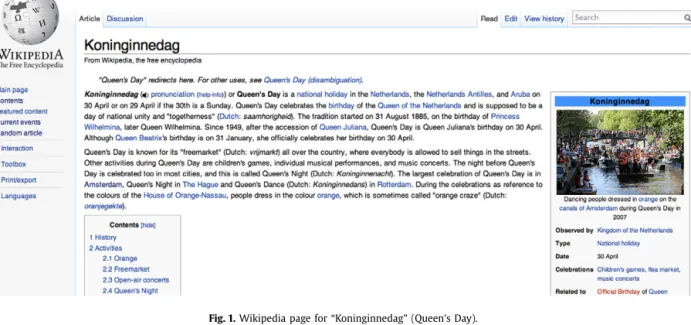
In this paper we make use of the 2006 and 2009 Wikipedia test collections created by INEX. Both document collections are a snapshot of the English Wikipedia. For the INEX tracks from 2006 to 2008 the Wikipedia collection of 2006 is used, which consists of a snapshot from Wikipedia from early 2006 containing 659,338 articles[13]. Since then Wikipedia has significantly grown, and for the 2009 INEX tracks a new snapshot of the collection is used. It is extracted in October 2008 and consists of 2.7 million articles[34]. An example of a Wikipedia page can be found in Fig.1.
Fig. 1.Wikipedia page for “Koninginnedag” (Queen’s Day).
Wikipedia distinguishes between the following types of categories3:
•
Content categories are intended as part of the encyclopedia, to help readers find articles, based on features of the subjects of those articles. Content categories can again be divided into two types of categories:– Topic categories are named after a topic, usually sharing the name with the main article on that topic, e.g. “Cate-gory:Netherlands” contains articles relating to the topic Netherlands.
– Set categoriesare named after a class, usually in the plural, e.g. “Category:Cities in the Netherlands” contains articles whose subjects are cities in the Netherlands.
•
Project categoriesare intended for use by editors or automated tools, based on features of the current state of articles, or used to categorize non-article pages, e.g. stubs, articles needing cleanup or lacking sources.The content categories can not only help readers to find articles, also retrieval systems can use the content categories to retrieve articles. The set categories correspond with the entity types or target categories that are essential for the entity ranking task. Both the topic and the set categories can be used in the ad hoc retrieval task as sources of query context.
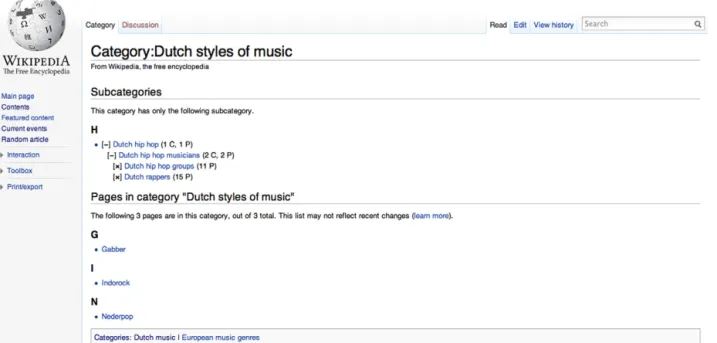
Wikipedia categories are organized in a loose hierarchy. Some cycles of linked categories exist, but the guideline is to avoid them. In Fig. 2a small part of the category hierarchy is shown. The category “Dutch styles in music” has one subcategory: “Dutch hiphop”, which in turn has again some subcategories. Three pages are assigned to the category, and it has two parent categories, listed at the bottom of the page: “Dutch music” and “European music genres”.
Wikipedia takes some measures to prevent that similar categories coexist. If two similar categories are discovered, one category is chosen and whenever people try to use the other category, they are redirected to the chosen category. For example if someone tries to assign or find “Category:Authors”, he is redirected to “Category:Writers”. Also if some different spelled versions of the same category exists, category redirects are used, i.e., “Ageing” redirects to “Aging”, and “Liv-ing People” redirects to “Liv“Liv-ing people”. This system is in use not only for categories, but also for pages. For example, the Wikipedia page in Fig. 1 is reached by going to the “Queen’s Day”, where you immediately get redirected to the “Koninginnedag” page (the Dutch translation). The redirect pages can thus also provide synonym and cross lingual in-formation. Wikipedia’s category information can provide valuable information when searching for entities or information, but we have to take into account that the data is noisy.
The difference between entity ranking and ad hoc retrieval in general is that instead of searching for relevant text, you are searching for ‘conceptual’ results that represent the relevant entities. Entities can be of different types. A popular type of entity ranking is people search, other entity types can be movies, books, cities, etc. One of the difficulties in entity ranking is how to represent entities. Some supporting evidence in addition to the entity id or name is needed to confirm that an entity is relevant. When we rank entities in Wikipedia, we simply use Wikipedia pages to represent entities and to provide the supportive evidence[42].
An entity ranking query topic consists of a keyword query and one or a few target categories which are the desired entity types. A description and narrative are added to clarify the query intent. A few relevant example entities are included in the topics for the list completion task, which we do not consider in this paper. For retrieval we only use the topic titles
Fig. 2.Wikipedia page for the category “Dutch styles of music”.
and the target categories of the entity ranking topics. An example entity ranking topic is given in Fig. 3. The structure of ad hoc topics is similar to the entity ranking topics, but they do not include target categories. An example ad hoc topic is given in Fig.4.
A main difference between the INEX entity ranking and ad hoc retrieval tasks lies in the assessments. In ad hoc retrieval, a document is judged relevant if any piece of the document is relevant. In the entity ranking track, a document can only be relevant if the document is of the correct entity type, resulting in far less relevant documents. The correct entity type is specified during topic creation as a target category.
We run our experiments on the following topic sets:
•
Ad hoc topics– AH07: Ad hoc topics 414–543, consisting of 99 assessed ad hoc topics.
* AH07a: 19 Ad hoc topics that have been used to create the entity ranking topics 30–59. * AH07b: The remaining 80 ad hoc topics.
•
Entity ranking topics– ER07a: Entity ranking topics 30–59, consisting of 19 assessed entity ranking topics derived from ad hoc topics of the 2007 track.
– ER07b: Entity ranking topics 60–100, consisting of 25 assessed genuine entity ranking topics of the 2007 track. – ER08: Entity ranking topics 101–149, consisting of 35 assessed genuine entity ranking topics of the 2008 track. – ER09: Entity ranking topics 60–149, a selection of 55 entity ranking topics from 2007 and 2008 to be used with the
2009 Wikipedia collection.
SetER07bconsists of genuine entity ranking topics, setAH07bconsists of genuine ad hoc topics. SetER07aand setAH07a
consist of the same topics, but with different relevance assessments, i.e., entity ranking assessments for setER07aand ad hoc assessments for setAH07a. These different topic sets allow us to explore the relations between ad hoc retrieval and entity ranking, which is the topic of the next section.
Now that we have found some indications that category information is indeed useful for entity ranking topics, and could also be useful for ad hoc topics, in the next section we describe how we can make use of the category information. 3. Retrieval model
In this section we describe our baseline retrieval model, how we use category information and link information for entity ranking, how we combine these sources of information, and how we assign categories to query topics automatically.
3.1. Baseline retrieval model
Our baseline retrieval model is a standard language model. For retrieval we make use of Indri[37], an open source search engine, which incorporates the language modeling approach. The baseline model uses Jelinek–Mercer smoothing to smooth
<inex_topic topic_id="79">
<title>Works by Charles Rennie Mackintosh</title>
<description>I am interested in works by Charles Rennie Mackintosh, especially buildings. </description>
<narrative>I have seen some of the Mackintosh’s pieces of furnitures, but not his buildings. I am interested in locating them as I plan a trip to Scotland.
</narrative> <categories>
<category>Buildings and structures</category> </categories>
<entities>
<entity id="433083">Glasgow School of Art</entity> <entity id="2981244">Queen"s Cross Church</entity> </entities>
</inex_topic>
Fig. 3.INEX entity ranking topic 79. <inex_topic topic_id="524">
<title>home heating solar panels</title>
<description>Find information about solar panels in relation to home heating. </description>
<narrative>Friends are planning to build a new house and have heard that using solar energy panels for heating can save a lot of money. Since they do not know anything about home heating and the issues involved, they have asked for your help. You are uncertain as well, and do some research to identify some issues that need to be considered in deciding between more conventional methods of home heating and solar panels.
</narrative> </inex_topic>
Fig. 4.INEX ad hoc topic 524.
the probability of a query term occurring in a document with the probability of the query term occurring in the background corpus as follows:
P
(
Q|
D)
=
t∈Qλ
P(
t|
D)
+
(1
−
λ)
P(
t|
B)
where Q is the query,D the document, andB the background collection.
The optimal value of
λ
depends on the type of query as well as the document collection. An optimal value ofλ
=
0.
15 is found in[15]in an experiment using the small Cranfield document collection consisting of 1398 abstracts on aerodynamics. Zhai and Lafferty [47] find optimal values around 0.7 for long queries, but also show that for short keyword queries the smoothing parameter has less impact and little smoothing is needed, leading to an optimal value ofλ
is large, around 0.9.4 From the TREC Terabyte tracks, it is also known that the .GOV2 collection requires little smoothing i.e., a value of 0.9 forλ
gives the best results[18]. In this paper we therefore use the valueλ
=
0.
9.3.2. Exploiting category information
Although for each entity ranking topic one or a few target categories are provided, relevant entities are not necessarily associated with these provided target categories. Relevant entities can also be associated with descendants of the target category or other similar categories. Therefore, simply filtering on the target categories is not sufficient. Also, since Wikipedia pages are usually assigned to multiple categories, not all categories of an answer entity will be similar to the target category. We calculate for each target category the distances to the categories assigned to the answer entity. To calculate the distance between two categories, we tried three options. The first option (binary distance) is a very simple method: the distance is 0 if two categories are the same, and 1 otherwise. The second option (contents distance) calculates distances according to the contents of each category, and the third option (title distance) calculates a distance according to the category titles. For the title and contents distance, we need to estimate the probability of a term occurring in a category. To avoid a division by zero, we smooth the probabilities of a term occurring in a category with the background collection:
P
(
t1, . . . ,
tn|
C)
=
ni=1
λ
P(
ti|
C)
+
(1
−
λ)
P(
ti|
B)
(1)whereC, the category, consists either of the category title to calculate title distance, or of the concatenated text of all pages belonging to that category to calculate contents distance. B is the entire Wikipedia document collection, which is used to estimate background probabilities.
4 In[47]λdetermines the weight of the term probability in the background collection P(t|B), instead of the weight of the term probability in the documentP(t|D). Therefore they report on an optimal value of 0.1.
Instead of using maximum likelihood estimation to estimate the probability P
(
t|
C)
, we estimate P(
t|
C)
with a parsi-monious model. The parsiparsi-monious language model overcomes some of the weaknesses of the standard language modeling approach. Instead of blindly modeling language use in a (relevant) document, we should model what language use distin-guishes a document from other documents. The exclusion of words that are common in general English, and words that occur only occasionally in documents, can improve the performance of language models and decrease the size of the models. This so-called parsimonious model was introduced in[36]and practically implemented in[16].The model is estimated usingExpectation–Maximization: E-step: et
=
t ft,C·
α
P(
t|
C)
α
P(
t|
C)
+
(1
−
α
)
P(
t|
B)
M-step: P(
t|
C)
=
ettet
,
i.e., normalize the modelIn the initial E-step, the maximum likelihood estimates are used to estimate P
(
t|
C)
. The E-step benefits terms that oc-cur relatively more frequent in the document as in the whole collection. The M-step normalizes the probabilities. After the M-step terms that receive a probability below a certain threshold are removed from the model. In the next iteration the probabilities of the remaining terms are again normalized. The iteration process stops after a fixed number of iterations.We use KL-divergence to calculate distances between categories, and calculate a category score that is high when the dis-tance is small, and the categories are similar as follows:
Scat
(
Cd|
Ct)
= −
DKL(
Cd|
Ct)
= −
t∈D P(
t|
Ct)
∗
log P(
t|
Ct)
P(
t|
Cd)
(2) wheredis a document, i.e., an answer entity,Ct is a target category andCda category assigned to a document. The score for an answer entity in relation to a target categoryS(
d|
Ct)
is the highest score, or shortest distance from any of the document categories to the target category.In contrast to[40], where a ratio of common categories between the categories associated with an answer entity and the provided target categories is calculated, we take for each target category only the shortest distance from any answer entity category to a target category. So if one of the categories of the document is exactly the target category, the distance and also the category score for that target category is 0, no matter what other categories are assigned to the document. Finally, the score for an answer entity in relation to a query topic S
(
d|
Q T)
is the sum of the scores of all target categories:Scat
(
d|
Q T)
=
Ct∈Q T arg max Cd∈d S(
Cd|
Ct)
(3)3.3. Exploiting link information
We implement two options to use the link information: relevance propagationand document link degree prior. For the document link degree prior we use the same approach as in[20]. The prior for a documentdis:
PLink
(
d)
=
1+
IndegreeLocal
(
d)
1+
IndegreeGlobal(
d)
(4) The local indegree is equal to the number of incoming links from within the top ranked documents retrieved for one topic. The global indegree is equal to the number of incoming links from the entire collection.
The second use of link information is through relevance propagation from initially retrieved entities, as was done in the 2007 entity ranking track by Tsikrika et al.[39].
P0
(
d)
=
P(
q|
d)
Pi(
d)
=
P(
q|
d)
Pi−1(
d)
+
d→d 1−
Pq|
dPd|
dPi−1 d (5)Probabilities P
(
d|
d)
are uniformly distributed among all outgoing links from the document. Documents are ranked using a weighted sum of probabilities at different steps:PLink
(
d)
=
μ
0P0(
d)
+
(1
−
μ
0)
K
i=1
μ
iPi(
d)
(6)ForK we take a value of 3, which was found to be the optimal value in[39]. We try different values of
μ
0and distributeμ
1· · ·
μ
K uniformly, i.e.,μ
1· · ·
μ
K=
1/
3.3.4. Combining information
Finally, we have to combine our different sources of information. We start with our baseline model which is a standard language model. We explore two possibilities to combine information. First, we make a linear combination of the document, link and category score. All scores and probabilities are calculated in the log space, and then a weighted addition is made.
Besides the category score, we also need a query score for each document. This score is calculated using a standard language model with Jelinek–Mercer smoothing without length prior:
P
(
q1, . . . ,
qn|
d)
=
ni=1
λ
P(
qi|
d)
+
(1
−
λ)
P(
qi|
B)
(7)Finally, to combine the query score and the category score, both scores are calculated in the log space, and then a weighted addition is made.
S
(
d|
Q T)
=
(1
−
μ
)
P(
q|
d)
+
μ
Scat(
d|
Q T)
(8)Link information is accounted for in a similar fashion:
S
(
d|
Q T)
=
(1
−
β)
P(
q|
d)
+
β
PLink(
d)
(9)We also combine both link category and link information with the query score as follows:
S
(
d|
Q T)
=
(1
−
μ
−
β)
P(
q|
d)
+
μ
Scat(
d|
Q T)
+
β
PLink(
d)
(10)Alternatively, we can use a two-step model. Relevance propagation takes as input initial probabilities as calculated by the baseline document model score. Instead of the baseline probability, we can use the scores of the run that combines the base-line score with the category information. Similarly, for the link degree prior we can use the top results of the basebase-line combined with the category information instead of the baseline ranking.
3.5. Target category assignment
Besides using the target categories provided with the entity ranking query topics, we also look at the possibility of automatically assigning target categories to entity ranking and ad hoc topics. Since the entity ranking topic assessments heavily depend on the target categories used during assessment, the automatically assigned categories will have to be suitably similar to the provided target categories in order to perform well. The advantage of automatically assigning target categories is that no effort from a user is required.
Furthermore, in the 2008 runs we found a discrepancy between the target categories assigned manually to the topics, and the categories assigned to the answer entities. The target categories are often more general, and can be found higher in the Wikipedia category hierarchy. For example, topic 102 with title ‘Existential films and novels’ has as target categories ‘films’ and ‘novels,’ but none of the example entities belong directly to one of these categories. Instead, they belong to lower level categories such as ‘1938 novels,’ ‘Philosophical novels,’ ‘Novels by Jean-Paul Sartre’ and ‘Existentialist works’ for the example entity ‘Nausea (Book).’ In this case the estimated category distance to the target category ‘novels’ will be small, because the term ‘novels’ occurs in the document category titles, but this is not always the case. In addition to the manually assigned target categories, we have therefore automatically created sets of target categories.
There are many ways to do automatic topic categorization, for example by using text categorization techniques. For now we keep it simple here and exploit the existing Wikipedia categorization of documents. From our baseline run we take the top N results, and look at the T most frequently occurring categories belonging to these documents, while requiring categories to occur at least twice. These categories are assigned as target categories to the query topic.
As stated in the introduction, a distinction betweentopic categories(named after a topic) andset categories(named after a class or entity type) can be made. Entity ranking topics look for a collection of pages belonging to the same set category or entity type, instead of just any type of document. Ad hoc topics look for any type of document as long as it belongs to the correct topic category.
The automatic assignment of categories is applied in the same way to entity ranking and ad hoc topics, but when we look at the automatically assigned categories for the entity ranking topics in almost all cases the category can be considered as a (usually low level) entity type. For the ad hoc topics still a considerable number of set categories are assigned, but topical categories occur regularly here as well. In order to compare manual and automatic assignment of categories on the ad hoc topics as well, we have manually assigned target categories to the ad hoc topics. These categories can be either topic or set categories, the category that seems closest to the query topic is selected, e.g. for the query “Steganography and its techniques” the category “Steganography” is assigned as target category.
4. Experiments
4.1. Experimental set-up
In this paper we experiment with two different tasks. First of all we experiment with the entity ranking task as defined by INEX. We will make runs on the topic sets from 2007 to 2009. The 2007 topic set is used to experiment with settings of different parameters, and these parameter settings are tested on the 2008 and 2009 topics. Secondly, we experiment with ad hoc retrieval using category information on the ad hoc topic sets from 2007, and provide an analysis of the relevance assessment sets of the ad hoc and the entity ranking topics. We compare automatic and manual category assignment for ad hoc and entity ranking topics.
For our experiments we use query topics from the ad hoc and entity ranking tracks. The goal of the INEX ad hoc track is to investigate the effect of structure in the query and the documents. Results consist of XML elements or document passages rather than Wikipedia pages. The ad hoc assessments are based on highlighted passages. Since we only do document retrieval and do not return document elements or passages, we have to modify the ad hoc assessments. In our experiments, a document is regarded as relevant if some part of the article is regarded as relevant, i.e., highlighted by the assessor[19], which is similar to the TREC guidelines for relevance in ad hoc retrieval. This way we can reuse the relevance assessments of the so-called “Relevant in Context Task” to calculate MAP and precision evaluation measures. Ad hoc topics consist of a title (short keyword query), an optional structured query, a one line description of the search request and a narrative with more details on the requested topic and the task context.
To create our baseline runs incorporating only the content score, we use Indri[37]. Our baseline is a language model using Jelinek–Mercer smoothing with
λ
=
0.
9. We apply pseudo-relevance feedback, using the top 50 terms from the top 10 documents. The category score is usually calculated for the top 500 documents of the baseline run. These documents are reranked to produce the run that combines content and category score. In one experiment we increase the number of documents to rerank to 2500. Only the top 500 results are taken into account when MAP is calculated. Since relevant pages could be found outside the initial top 500, by reranking 2500 pages more pages with relevant categories will be included in the top 500 results.In addition to the manually assigned topic categories during the topic creation, we automatically assign topic categories. For the automatically assigned categories, we have two parameters, N the number of top results to use, andT the number of target categories that is assigned for each topic. For the parameter
μ
, which determines the weight of the category score, we tried values from 0 to 1, with steps of 0.1. The best values ofμ
turned out to be on the low end of this spectrum, therefore we added two additional values ofμ
: 0.05 and 0.02.To evaluate our approach we use the following measures which are all standard measures in the Information Retrieval community.Mean Average Precision(MAP) provides a measure of the quality of the ranking across all recall levels. For a single information need, average precision is the average of the precision value obtained for the set of topk documents in the ranking after each relevant document is retrieved. MAP is the average of the average precision for a set of information needs. MAP is calculated as follows[23]:
MAP
=
1|
Q|
|Q| j=1 1 mj mj k=1 Precision(Rjk)
(11)where the set of relevant documents for an information needqj
∈
Q is{
d1, . . . ,
dmj}
and Rjk is the set of ranked retrieval results from the top result until you get to documentdk.For search tasks it is important to measure how many good results there are on the first result page, since this is all most users look at[17]. Precision (the fraction of retrieved documents that are relevant) is therefore measured at fixed low levels of retrieved results, i.e., precision at 10 documents (P10).
A relatively novel performance measure that handles graded relevance judgments to give more credit to highly relevant documents isDiscounted Cumulative Gain(DCG)[7]. The gain or usefulness of examining a document is accumulated starting at the top of the ranking and may be reduced or discounted at lower ranks. The DCG is the total gain accumulated at a particular rankkand is calculated as:
DCGk
=
rel1+
k i=2 reli log2i (12) where reli is the graded relevance level of the document retrieved at rank i. To facilitate averaging across queries with different numbers of relevant documents, DCG values can be normalized by comparing the DCG at each rank with the DCG value for the perfect or ideal ranking for that query. TheNormalized Discounted Cumulative Gain(NDCG) is defined as:NDCGk
=
DCGk IDCGk
(13) where IDCG is the ideal DCG value for that query. NDCG can be calculated at fixed cut-off values forksuch asNDCG5, or at
Table 1
ER07bresults using link information.
# docs for local indegree Weight link prior MAP P10
Baseline 0.1840 0.1920 50 0.6 0.1898 - 0.2040 -50 0.5 0.1876 - 0.2000 -100 0.7 0.1747 - 0.2000 -100 0.3 0.1909 - 0.1920 -500 0.5 0.1982◦ 0.2000 -500 0.3 0.1915 - 0.2040◦ 1000 0.5 0.1965 - 0.1960 -1000 0.4 0.1965◦ 0.2000
-Significance of increase or decrease over baseline according to t-test, one-tailed, at significance levels 0.05(◦), 0.01(•◦), and 0.001(•).
Table 2
ER07bresults using category information.
Category representation Weight MAP P10
Baseline 0.1840 0.1920 Binary 0.1 0.2145 - 0.1880 -Contents 0.1 0.2481•◦ 0.2320◦ Title 0.1 0.2509◦ 0.2360◦ Contents 0.05 0.2618•◦ 0.2480•◦ Title 0.05
4.2. Entity ranking results
We apply our entity ranking methods to the entity ranking tasks over the years to answer our first research question:
How can we exploit category and link information for entity ranking in Wikipedia?
4.2.1. Entity ranking 2007 topics
For our training data we use topic set ER07b which consists of the 25 genuine entity ranking test topics that were developed for the 2007 entity ranking track. For our baseline run and to get initial probabilities we use the language modeling approach with Jelinek–Mercer smoothing, Porter stemming and pseudo-relevance feedback. We tried different values for the smoothing
λ
. We foundλ
=
0.
9 gives the best results, with a MAP of 0.
1840 and a P10 of 0.
1920. Applying pseudo-relevance feedback has a positive effect on MAP. When no pseudo-relevance feedback is applied, results are not as good with a MAP of 0.
1638. Early precision is slightly better though when no pseudo-relevance feedback is applied, with a P10 of 0.
1929.Now that we have a baseline run, we experiment with the document link degree prior, the category information, and their combination. For the document link degree prior we have to set two parameters: the number of top docu-ments to use, and the weight of the document prior. For the number of top docudocu-ments to use, we try 50, 100, 500 and 1000 documents. For the weight of the prior we try all values from 0 to 1 with steps of 0.1. Only weights that give the best MAP and P10 are shown in Table 1. Unfortunately, applying a link degree prior does not lead to much improvement in the results. Most improvements are small and not significant. The best number of top documents to use is 500, here we find a significant improvement in MAP (from 0.1840 to 0.1982) for a weight of the document prior of 0.5, and a significant improvement in P10 (from 0.1920 to 0.2040) for a weight of 0.3 for the document prior.
The results of using category information are summarized in Table 2. The weight of the baseline score is 1
.
0 minus the weight of the category information. For all three distances, a weight of 0.
1 gives the best results. In addition to these combinations, we also made a run that combines the original score, the contents distance and the title distance. When a single distance is used, the title distance gives the best results. The combination of contents and title distance gives the best results overall.In our next experiment we combine all information we have, the baseline score, the category and the link information. Firstly, we combine all scores by making a linear combination of the scores and probabilities. Secondly, we combine the different sources of information by using the two-step model (see Table 3). Link information is mostly useful to improve early precision, depending on the desired results we can tune the parameters to get optimal P10, or optimal MAP. Relevance propagation performs better than the document link degree prior in both combinations.
4.2.2. Entity ranking 2008 topics
Next, we test our approach on the 35 entity ranking topics from 2008. We use the parameters that gave the best results on the ER07b topics, i.e., baseline with pseudo-relevance feedback and
λ
=
0.
9, weights of contents and title category information is 0.1, or 0.05 and 0.05 in the combination. For the link prior we use the top 100 results, and the two-stepTable 3
ER07bresults combining category and link information.
Link info Weight MAP P10
Linear combination Prior 0.3 0.2682•◦ 0.2640•◦ Prop. 0.1 0.2777•◦ 0.2720•◦ Two-step model Prior 0.5 0.2526•◦ 0.2600•◦ Prop. 0.2 0.2588•◦ 0.2960• Prop. 0.1 0.2767•◦ 0.2720•◦ Table 4
ER08results using category and link information.
# Results Category repr. Link info xinfAP P10
Baseline 0.1586 0.2257 500 Title 0.1 No 0.3059• 0.4171• Title 0.2 No 0.3164• 0.4400• Cont. 0.1 No 0.3031• 0.4086• Cont. 0.2 No 0.3088• 0.4200• Title 0.05 Cont. 0.05 No 0.3167• 0.4343• Title 0.1 Cont. 0.1 No 0.3189• 0.4400•
Title 0.05 Cont. 0.05 Prior 0.5 0.3196• 0.4371•
Title 0.05 Cont. 0.05 Prop. 0.1 0.3324• 0.4543•
2500 Title 0.1 No 0.3368• 0.4343•
Title 0.2 No 0.3504• 0.4514•
Title 0.2 Prop. 0.1 0.3519• 0.4629•
Table 5
ER09results using category information.
Category repr. Weight xinfAP NDCG
Baseline 0.171 0.441
Title 0.1 0.201• 0.456◦
Title, normalized 0.2 0.234• 0.501•
model is used to combine the information. In Table4our results on the 2008 topics are shown. Results are reported using an inferred AP (xinfAP), the official measure of the track, where the assessment pool is created by a stratified random sampling strategy [46], and P10. The behavior of the xinfAP measure is similar to the MAP measure. Using the category information leads to an improvement of 100% over the baseline, the score is doubled. Even when we rerank the top 500 results retrieved by the baseline using only the category information, the results are significantly better than the baseline, with a xinfAP of 0.2405. Since the category information is so important, it is likely that relevant pages can be found outside the top 500. Indeed, when we rerank the top 2500, but still evaluating the top 500, our results improve up to a xinfAP of 0.3519. Furthermore, we found that on the 2008 topics doubling the weights of the category information to 0.2 leads to slightly better results. Similar to the 2007 results, relevance propagation performs better than the link prior, and leads to small additional improvements over the runs using category information.
4.2.3. Entity ranking 2009 topics
A second testing round has been done using the 2009 entity ranking topics, which use the new Wikipedia’09 collection. We use the same parameters as for theER08topics, and rerank the top 2500 results using the category titles to compute the distances between categories. Since the link information only led to minor improvements, it is not considered. Also we only use the category titles and not the category contents to calculate distances between categories, which is faster and we do not have to go through the complete collection to create the language models of the contents of each category. The results of the runs can be found in Table 5. Results are reported here using the official measures of the track, i.e., an inferred AP (xinfAP) and NDCG. Only the best runs with the according weights are shown in the table. We see that using the category information still leads to significant improvements over the baseline, but the improvements are not as large as before. Besides testing our approach with the parameter settings fromER08, we created a new type of run where we apply score normalization. Scores are normalized using the min–max normalization method before they are combined. The normalization of scores does lead to additional improvement.
Table 6
Ad hoc vs. entity ranking results in MAP.
Set Query Category Comb. Best score
μ=0.0 μ=1.0 μ=0.1 μ ER07a 0.2804 0.2547 - 0.3848• 0.2 0.4039• ER07b 0.1840 0.1231 - 0.2481•◦ 0.1 0.2481•◦ AH07a 0.3653 0.2067◦ 0.4308•◦ 0.1 0.4308•◦ AH07b 0.3031 0.1761• 0.3297•◦ 0.05 0.3327• Table 7
Relevancy in judged pages for ad hoc and entity ranking topics.
Set AH07a AH07b ER07a ER07b ER08 ER09
Avg. # of pages in pool 611 612 83 485 394 314
Avg. % relevant pages 0.13 0.09 0.41 0.04 0.07 0.20
Pages with majority category of all pages:
all pages 0.066 0.059 0.316 0.163 0.252 0.254
relevant pages 0.200 0.200 0.426 0.313 0.363 0.344
non-relevant pages 0.045 0.048 0.167 0.154 0.241 0.225
Pages with majority category of relevant pages:
all pages 0.047 0.047 0.281 0.084 0.189 0.191
relevant pages 0.318 0.316 0.630 0.590 0.668 0.489
non-relevant pages 0.016 0.028 0.074 0.064 0.155 0.122
Pages with target category:
all pages 0.167 0.113 0.208 0.077
relevant pages 0.387 0.277 0.484 0.139
non-relevant pages 0.048 0.111 0.187 0.064
4.3. Ad hoc retrieval results
Besides using category information for entity ranking, we also experiment with using category information for ad hoc retrieval to answer our second research question:How can we use entity ranking techniques that use category information for ad hoc retrieval?
In these experiments we have manually assigned target categories to the ad hoc retrieval topics. For the entity ranking topics we use the target categories assigned during topic creation. Our results expressed in MAP are summarized in Table6. This table gives the query score, which we use as our baseline, the category score, the combined score using
μ
=
0.
9 and the best score of their combination with the corresponding value ofμ
, which is the weight of the category score.The baseline score on the entity ranking topics is quite low as expected. Using only the keyword query for article retrieval, and disregarding all category information, cannot lead to good results since the relevance assessments are based on the category information. For the ad hoc topics on the other hand, the baseline scores are much better.
The best value for
μ
differs per topic set, but for all setsμ
is quite close to 0. This does not mean however that the category scores are not important, which is also clear from the improvements achieved. The reason for the highμ
values is that the category scores are in a larger order of magnitude, because instead of scoring a few query terms, all the terms occurring in the language model of the category are scored. So even with small weights, the category score contributes significantly to the total score. Normalizing the scores, like we have done in the ER09track using min–max normalization, can give a more realistic estimation of the value of the category information. From the four topic sets, the baseline scores best on the two ad hoc topic setsAH07aandAH07b. There is quite a big difference between the two entity ranking topic sets, where the topics derived from the ad hoc topics are easier than the genuine entity ranking topics. The topics derived from the ad hoc topics are a selection of the complete ad hoc topic set, and mostly easy topics with a lot of relevant pages are selected. The genuine entity ranking topics are developed by the participants in the INEX entity ranking track who have less insight into topic difficulty.The entity ranking topics benefit greatly from using the category information with significant MAP increases of 44% and 35% for topic setsER07aandER07brespectively. When only the category score is used to rerank the top 1000 results, the scores are surprisingly good, for setER07aMAP only drops a little with no significant difference from 0.2804 to 0.2547. Apparently the category score really moves up relevant documents in the ranking. When we use the category information for the ad hoc topics with manually assigned categories improvements are smaller than the improvements on the entity ranking topics, but still significant with MAP increases of 18% and 10% for set AH07aandAH07brespectively. So, we have successfully applied entity ranking techniques to improve retrieval on ad hoc topics. The improvements are bigger on the ad hoc topics that are later converted into entity ranking topics, indicating that queries that can be labeled as entity ranking topics benefit the most from using category information.
We see that entity ranking topics profit more from the use of category information than ad hoc topics. In order to gain information on category distributions within the retrieval results, we analyze the relevance assessment sets. We show some statistics in Table7. The ad hoc topics contain more relevant pages. This was to be expected, since documents in the entity
ranking task, do not only have to contain relevant information on entities, but in addition the documents have to belong to a relevant category type. The relevance assessment set of topic setER07a, contains all relevant pages from topic setAH07a. Of these pages 41.4% are relevant for the entity ranking task.
For each topic we determine the most frequently occurring category in either all pages or only the relevant pages, we call this the majority category. The target category is the category that is manually assigned during the topic creation, e.g., the target category for the example topic in Fig.3is ‘Buildings and structures’. We calculate what percentages of pages are assigned to the majority category and the target category. For the ad hoc topic sets the categories are the most diverse, only around 6–7% of the pages belong to the same category. The categories in the entity ranking topic sets are more focused, with percentages ranging from 16.3% of pages in setER07b, to 31.6% of the pages in setER07abelonging to the majority category.
The majority categories in the relevant pages are quite large within these relevant pages, around 60% for the entity ranking topics, and still around 32% for the ad hoc topics. What is interesting for the entity ranking topics, is that this percentage is much higher than the percentage of relevant pages belonging to the target category. This means that there are categories other than the target category, which are good indicators of relevance. In many cases the majority category is more specific than the target category, e.g. to our example topic “Works by Charles Rennie Mackintosh’ target category “Buildings and structures” is assigned. The majority category in the relevant pages is “Charles Rennie Mackintosh buildings’. This category is far more specific, and using it probably leads to better results. For all topic sets we see that from the relevant pages a far higher percentage belongs to the majority category than non-relevant pages. This is in line with our findings, that category information is not only beneficial for entity ranking topics, but also ad hoc topic results can be improved if the right target categories can be found.
For the entity ranking topics we can also determine how many of the pages belong to one of the specified target categories. In fact, only 11.3% of setER07bpages and 16.7% of setER07apages belong to a target category. The runs used to create the pool for topic setER07aare ad hoc runs, so the target categories have not been taken into consideration here. In topic setER07bhowever the target categories were available, but here less pages belong to the target category indicating that target categories themselves are not treated as an important feature in the submitted runs. Considering that 11.1% of the non-relevant pages also belong to the target category, this is a good decision.
Over all kinds of pages, setER07ahas more focused categories than setER07b, the genuine entity ranking set. This can be explained by the fact that the pages in set ER07awere already assessed as relevant for the ad hoc topic, so at least topically they are more related. Comparing theER07bresults to theER08results, we see that the assessment statistics are quite similar, but that theER08results are a bit more focused on pages belonging to the target and majority categories and that a considerable higher percentage of the relevant pages belongs to the target category.
Comparing theER08results on the Wikipedia’06 collection to theER09results on the Wikipedia’09 collection, we see that a higher percentage of relevant pages is found. The number of pages belonging to the majority category stays roughly the same, but the percentage of pages belonging to the target category has gone down significantly. Not only have the systems returned less pages belonging to the target category, also a smaller part of the relevant pages belongs to the target category. This is probably caused by the fact that the categorization of Wikipedia pages has become more fine grained, while the target categories of the queries remained the same. Also less pages belong to the majority category of the relevant pages, which is another sign that the categories assigned to pages have become more diverse. The systems also evolved, and return less pages belonging to the target categories.
4.4. Manual vs. automatic category assignment
Our final set of experiments in this paper compares the performance of manually and automatically assigned target categories to answer our third research question:How can we automatically assign target categories to ad hoc and entity ranking topics?
We will first discuss the ad hoc results, and then study the entity ranking topics in more detail. Before we look at the results, we take a look at the categories assigned by the different methods. In Table8we show a few example topics from theER07track together with the categories as assigned by each method. As expected the pseudo-relevant target categories (PRF) are more specific than the manually assigned target categories. The number of common Wikipedia categories in the example entities (Examples) can in fact be quite long. More categories is in itself not a problem, but also non-relevant categories such as ‘1975 births’ and ‘Russian writers’ and very general categories such as ‘living people’ are added as target categories. Almost all categories extracted from the pages are ‘set categories’, what is coherent with the entity ranking topics where the target entity types correspond to one of more set categories.
For the automatic assignment of target categories, we have to set two parameters: the number of top ranked docu-ments N and the number of categoriesT. The retrieval results of our experiments on theAH07set, with different values of N and T, expressed in MAP are summarized in Table 9. This table gives the query score, which we use as our base-line, the category score, the combined score using a weight of
μ
=
0.
1 for the category score and the best score of their combination with the corresponding value ofμ
.When we use the category information for the ad hoc topics with manually assigned categories MAP improves signifi-cantly with an increase of 11.3%. Using the automatically assigned topics, almost the same results are achieved. The best au-tomatic run uses the top 50 documents and takes the top 3 categories, reaching a MAP of 0.3502, a significant improvement
Table 8
Example target categories.
Topic Olympic classes dinghy sailing
Neil Gaiman novels Chess world champions
Manual dinghies novels chess grandmasters
world chess champions PRF dinghies comics by Neil Gaiman chess grandmasters
sailing fantasy novels world chess champions
Examples dinghies fantasy novels chess grandmasters
sailing at the Olympics novels by Neil Gaiman chess writers
boat types living people
world chess champion Russian writers Russian chess players Russian chess writers 1975 births soviet chess players people from Saint Petersburg
Table 9
AH07results in MAP for manual and automatic cat. assignment.
Cats Category Comb. Best score
N T μ=1.0 μ=0.1 μ Baseline 0.3151 Manual 0.1821• 0.3508• 0.1 0.3508• Top 10 1 0.1640• 0.3334◦ 0.05 0.3368• Top 20 1 0.1793• 0.3306 - 0.05 0.3390• Top 50 1 0.1798• 0.3364◦ 0.05 0.3457• Top 10 2 0.1815• 0.3380•◦ 0.05 0.3436• Top 20 2 0.1919• 0.3326◦ 0.05 0.3471• Top 50 2 0.1912• 0.3323 - 0.05 0.3502• Top 10 3 0.1872• 0.3379•◦ 0.05 0.3445• Top 20 3 0.1950• 0.3265 - 0.05 0.3457• Top 50 3 0.1959• 0.3241 - 0.05 0.3459• Top 10 4 0.1873• 0.3370•◦ 0.05 0.3439• Top 20 4 0.1970• 0.3275 - 0.05 0.3477• Top 50 4 0.1932• 0.3172 - 0.02 0.3442• Table 10
ER07results in MAP for manual and automatic cat. assignment.
Query Category Comb. Best score
Assignment Set μ=0.0 μ=1.0 μ=0.1 μ
Manual ER07a 0.2804 0.2547 - 0.3848• 0.2 0.4039•
Manual ER07b 0.1840 0.1231 - 0.2481•◦ 0.1 0.2481•◦
Auto ER07a 0.2804 0.2671 - 0.3607•◦ 0.1 0.3607•◦ Auto ER07b 0.1840 0.1779 - 0.2308 - 0.2 0.2221◦
of 11.1%. Assigning one target category leads to the worst results. It is better to assign multiple categories to spread the risk of assigning a wrong category. Similarly, using more than the top 10 ranked documents leads to better results. Differences between using the top 20 and the top 50 ranked documents are small.
We continue with experiments on the entity ranking topics. We use N
=
10 andT=
2 for the remaining experiments in this section. Results of manual and automatic category assignment on the ER07data sets can be found in Table10. When we look at the category scores only, the automatically assigned topics perform even better than the manually assigned categories. Looking at the combined scores, the manually assigned target categories perform somewhat better than the au-tomatically assigned categories. However, for both topic sets using the auau-tomatically assigned categories leads to significant improvements over the baseline.During the automatic assignment we use the top 10 results of the baseline run as surrogates to represent relevant documents. So we would expect that if the precision at 10 is high, this would lead to good target categories. However, precision at 10 of the baseline for topic set ER07b, is only 0.2640, but the category score is almost as good as the query score (0.1840 and 0.1779 respectively).
The question remains why the combined scores of the automatically assigned categories are worse than the combined scores of the manually assigned categories while their category scores are higher. The automatically assigned categories may
Table 11
ER09results for manual and automatic cat. assignment.
Cats μ #Rel P10 MAP
Baseline 0 1042 0.2164 0.1674 Auto. 0.1 982 - 0.2509 - 0.2014•◦ Auto. 0.2 911◦ 0.2382 - 0.1993◦ Man. 0.1 1180• 0.2982• 0.2350• Man. 0.3 1178•◦ 0.3127• 0.2396• Man. 0.4 1171•◦ 0.3145• 0.2376•
find documents that are already high in the original ranking of the baseline run, since the categories are derived from the top 10 results. The manually assigned categories do not necessarily appear frequently in the top results of the baseline, so the category scores can move up relevant documents that were ranked low in the baseline run.
Finally, we take a look at the entity ranking results of 2009. Again we have manually and automatically assigned cate-gories, but this time the scores are normalized before combining the query and the category score. The results of the runs can be found in Table11. The run that uses the official categories assigned during topic creation performs best, and signif-icantly better than the baseline. Because we normalize the scores the weights of the category information go up, a weight of 0.4 even leads to the best P10. Here the category information proves to be almost as important as the query itself. The runs with automatically assigned entity types reach a performance close to the manually assigned topics. Although P10 is low in the baseline run, the 10 top ranked documents do provide helpful information on entity types. Most of the automatic assigned categories are very specific, for example ‘College athletics conferences’ and ‘American mystery writers’. For one topic the category exactly fits the query topic, the category ‘Jefferson Airplane members’ covers exactly query topic ‘Members of the band Jefferson Airplane’. Unsurprisingly, using this category boosts performance significantly. The category ‘Living people’ is assigned to several of the query topics that originally also were assigned entity type ‘Persons’. This category is one of the most frequently occurring categories in Wikipedia, and is assigned very consistently to pages about persons. In the collection there are more than 400,000 pages that belong to this category. This large number of occurrences however does not seem to make it a less useful category.
5. Related work
In this section, we will discuss related work on entity ranking, list questions in Question Answering (QA), exploiting the structure of Wikipedia and other knowledge sources, and the impact of topical structure on information access. We finish with comparing our work to other approaches in the INEX evaluation forum.
Entity ranking in Wikipedia is quite different from entity ranking on the general Web. By considering each page in Wikipedia as an entity, the problem of named entity recognition is avoided, and the entity ranking task becomes more similar to the document retrieval task on Wikipedia. Furthermore, we return the complete Wikipedia page as evidence for the relevance of the page. We do not consider the extraction of specific features of information about the entity, which is the topic of much related work and also the start of work on entity ranking approaches. Early named entity recognition systems were making use of handcrafted rule-based algorithms and supervised learning using extensive sets of manually labeled entities. More recent work used unsupervised entity extraction and resort to machine learning techniques. See[27]
for a survey of named entity recognition. Wikipedia and IMDB are used as a seed list of named entity-type pairs in[44]. Subsequently, the Web is searched for occurrences of the names of entities. Recurring patterns or templates in the text around the names are extracted and filtered, and then used to extract more entity mentions of the target type.
An interesting language modeling approach to entity ranking on the Web is presented in[29]. In this case, entities are scientific papers extracted from different Web sources such as Citeseer and DBLP. Instead of aggregating all information on an entity into a large bag of words, records from each data source have their own language model, and the information from the different datasources is weighted according to the accuracy of the extraction of the data from the Web source. Also they try to incorporate structural information in their model to weigh fields, corresponding to features of the entity, differently. Their methods outperform a bag-of-words representation of entities, and adding the structural information leads to additional improvements.
Related work can also be found in the Question Answering field. TREC (Text Retrieval Conference) ran a Question An-swering track until 2007 in which list questions were included, where list questions are requests for a set of instances of a specified type (person, organization, thing or event) [9]. This task is quite similar to our entity ranking task, but even more similar to the TREC related entity finding task[5]. Topics in both of these tasks include a target entity to which the answers or retrieved entities should be related.
Many QA systems answer questions by first extracting a large list of possible candidate answers, and then filtering or reranking these answers based on some criteria such as type information, which is similar to our approach where we also rerank initially retrieved documents according to their categories. Expected answer types of a question restrict the admissible answers to specific semantic classes such as river, country, or tourist attractions. Expected answer types are assigned using supervised machine learning techniques, while the types of candidate answers are extracted making use of