
Pushdown Reachability with Constant Treewidth
Krishnendu Chatterjeea, Georg OsangaaIST Austria (Institute of Science and Technology Austria) Klosterneuburg, Austria
Abstract
We consider the problem of reachability in pushdown graphs. We study the problem for pushdown graphs with constant treewidth. Even for pushdown graphs with treewidth 1, for the reachability problem we establish the following: (i) the problem is PTIME-complete, and (ii) any subcubic algorithm for the problem would contradict thek-clique conjecture and imply faster combinatorial algorithms for cliques in graphs.
Keywords: pushdown systems, reachability, constant tree-width graphs
1. Introduction
In this work we consider the problem of reachability in pushdown graphs with the restriction of constant treewidth. Our main results are negative results which shows that the restriction does not help to obtain better computational or algorithmic complexity. We first describe the notion of treewidth and its relevance.
Treewidth of graphs. A very well-known concept in graph theory is the notion oftreewidth of a graph, which is a measure of how similar a graph is to a tree (a graph has treewidth 1 precisely if it is a tree) [20]. The treewidth of a graph is defined based on a tree decomposition of the graph [15]. Beyond the mathematical elegance of the treewidth property for graphs, there are many classes of graphs which arise in practice and have constant treewidth. The most important example is that the control flow graphs of goto-free programs for many programming languages are of constant treewidth [21], and it was also shown in [14] that typically all Java programs have constant treewidth. For many other applications see the surveys [4, 5]. The constant treewidth property of graphs has also played an important role in logic and verification; for example, MSO (Monadic Second Order logic) queries can be solved in polynomial time [11] (also in log-space [12]) for constant-treewidth graphs; parity games on graphs with constant treewidth can be solved in polynomial time [19]; and there exist faster algorithms for probabilistic models (like Markov decision processes) [8]. Moreover, recently it has been shown that the constant treewidth property is also useful for interprocedural analysis [7] and intraprocedural analysis of concurrent programs [6].
The relevant questions. First, the constant treewidth property has played a significant role for finite graphs. For example, for the basic reachability problem, while for general graphs the complexity is NL-complete (non-deterministic log-space complete), for constant treewidth graphs the problem is in DLOGSPACE (deterministic log-space) [12]. Second, the constant treewidth property has been exploited to obtain faster algorithms for several problems in program analysis, such as [7, 6]. Since the control-flow graphs of a wide class of programs have constant treewidth, a very relevant question is whether for general pushdown graphs faster algorithms or better complexity results can be established with the assumption of constant treewidth. More precisely, we consider the reachability problem for pushdown graphs. In general, the problem is (i) PTIME-complete and (ii) can be solved in cubic time1. Our goal is to investigate whether the constant treewidth restriction can improve the algorithmic or computational complexity.
Our results. We establish the following negative results.
1. We show even for pushdown graphs with treewidth 1 the reachability problem is PTIME-complete. Thus in contrast to finite graphs, where the constant treewidth restriction decreases the complexity from non-deterministic to non-deterministic logspace, for pushdown graphs, the con-stant treewidth restriction does not help to improve the computational complexity for pushdown graphs.
2. We show that for pushdown graphs with treewidth 1 the reachability problem is k-clique hard, in the sense that any combinatorial sub-cubic algorithm would contradict thek-clique conjecture (i.e., a sub-cubic algo-rithm would imply a faster combinatorial algoalgo-rithm for findingk-cliques in graphs). Thus our results show that even for pushdown graphs with treewidth 1 obtaining better algorithms would require a major break-through.
2. Preliminaries
We shall start by introducing the above notions formally and the discuss relevant known results and conjectures.
2.1. Basic Definitions
Treewidth. Given a (directed or undirected) graph or a multi-graphG= (V, E), atree-decomposition is a tree Tree(G) = (VT, ET) whose verticesBi,1≤i≤m
are subsets ofV, called bags, such that the following holds: 1. S
B∈VT B=V.
2. For every edge (u, v)∈E there is a bagB∈VT with u, v∈B.
3. For eachv ∈V, the set {B:v ∈B}of bags containingv is connected in Tree(G).
The width of a tree decomposition is the size of the largest bag minus 1. The
tree-widthof a graphGis the lowest width achieved by a tree decomposition of G.
Note that given a multi-graphG, a tree-decomposition of its simplification (i.e. all loops removed and multiple edges replaced with single edges) is still a valid tree-decomposition for G. We call a graph path-like if its simplification is a path. Furthermore note that the tree-width of any tree is 1, and consequently the tree-width of any path-like graph is also 1.
Context-free grammars. A context-free grammar (CFG)Gis a tuple (V,Σ, P, S) where V is the set of non-terminal symbols, Σ is the set of terminal symbols (disjoint fromV),P ⊂V ×(V ∪Σ)∗ is the set of productions andS∈V is the
start symbol. If (N, u) is a production we also write N → u. For two words w, w0 over V
∪Σ we writew ⇒w0 if w0 can be obtained by replacing one of
its non-terminalsN with a stringu where N → uis a production. We write w⇒∗w0 ifw0 can be obtained fromwby a sequence of such replacements and
we sayw0 can be derived from w. The language generated by
G is defined as the set {w:S ⇒∗ w
} of words derivable from the start symbol and is denoted asL(G). The context-free membership problem is defined as follows:
Context-free membership problem (CFG membership).
Input: A context-free grammarG= (V,Σ, P, S) and a word w∈Σ∗.
Output: YES ifw∈L(G), NO otherwise.
Pushdown systems. A pushdown system (PDS) is a tuple (Q,Γ,∆, qs,$) where
Qis the set of states,qs∈Qis the start state, Γ is the stack alphabet, $∈Γ is
the initial stack symbol and ∆⊂(Q×Γ)×(Q×Γ∗) is the transition relation.
If ((q, γ),(q0, w0)) is a transition we also write (q, γ)
→(q0, w0). The associated
pushdown graph is the directed graph with vertex setQand for each transition (q, γ) → (q0, w0) an edge from q to q0. When talking about the tree-width of
a PDS or a PDS being path-like, we are referring to the associated pushdown graph. A configuration of a PDS is pairhq, wiof a state together with the stack content w ∈ Γ∗. Performing a transition (q, γ) → (q0, w0), when currently in
stateq with top of stack symbolγ means going into stateq0 and replacing the
top of stack symbol with the wordw0∈Γ∗.
We say a stateq0is reachable from another stateqif there is a series of transitions leading fromhq,$ito some configurationhq0, w0
ifor some arbitrary stack content w0. We say q0 is same-context reachable from q if w0 = $. This allows us to
Pushdown reachability problem.
Input: A pushdown systemP= (Q,Γ,∆, qs,$) and two statesq, q0 ∈Q.
Output: YES ifq0 is reachable from q, NO otherwise.
A clique is a graph such that there is an edge between every pair of vertices. We will need the following two problems whose complexity is related to CFG membership:
k-clique problem (k-clique).
Input: A graphGand a positive integerk.
Output: YES ifGcontains a clique onkvertices as subgraph, NO otherwise.
Boolean matrix multiplication problem (BMM).
Input: Two squaren×nmatricesA andB with boolean entries. Output: The productAB of the two matrices.
We define the boolean matrix multiplication exponentωto be the smallest value such that BMM for twon×nmatrices is inO(nω+ε) for all ε >0.
2.2. Known Results and Conjectures
It is known thatω <2.376 due to Coppersmith and Winograd [10]. While it is conjectured by some thatω= 2, there have been only very minor improvements on the upper bound during the last 25 years. Furthermore these algorithms tend to have large hidden constants and in practice “combinatorial” algorithms2are more widely used. None of these run significantly faster than cubic however [3], putting into question whether any significant improvement can be made:
Conjecture 2.1 (Combinatorial Boolean Matrix Multiplication Conjecture). There is no combinatorial algorithm for BMM for twon×nmatrices that runs inO(n3−ε)time for any ε >0.
A classical algorithm by Valiant [22] reduces CFG membership to BMM thus giving an algorithm for CFG membership in O(nω). Lee introduced in [17] a stronger version of CFG parsing called c-parsing where the parser has to provide some additional data about parsing substrings of the input string. She showed that BMM can be reduced to c-parsing such that c-parsing inO(gn3−ε) where
gis the size of the CFG andnthe length of the word to parse implies BMM in O(n3−ε/3) (for two n
×n matrices). A drawback of this reduction is that the grammar grows quadratically inn. Abboud, Backurs and Williams [1] provided
2The term “combinatorial” has no formal definition but see [3] for a brief discussion of the term.
a constant size CFG G and a scheme which for given k transforms a graphG on n nodes into a string of length O(k2nk+1) such that this string is in the language generated by G if and only if G has a 3k-clique. This implies the following theorem:
Theorem 2.2. If CFG membership can be solved in T(n) time, then the k -clique problem on any graph ofnnodes can be solved inO(T(nk/3+1))time, for any constantk≥3 divisible by 3.
The fastest known algorithm for k-clique runs in O(nkω/3) for k divisible by 3 [18]. The fastest known combinatorial algorithm known fork-clique runs in O(nk/logkn) and therefore is only better than the naive algorithm by a polylog
factor [23]. The lack of better algorithms, as mentioned in [1], motivates the following conjecture:
Conjecture 2.3 (k-clique Conjecture). Let G be a graph onn vertices and k
an integer.
There is no algorithm solvingk-clique running inO(nkω/3−ε)forε >0. There is no combinatorial algorithm solving k-clique running in O(nk−ε) for
ε >0.
Regarding the pushdown reachability problem, Finkel et al. showed that the set of reachable states in a PDS P from an initial state with a given initial stack content can be computed inO(|P|3) [13]. So in particular the pushdown reachability problem is solvable in cubic time. Alur et al. introduced in [2] the notion of recursive state machines (RSM). They showed that every PDS can be transformed into an equivalent RSM of the same asymptotic size and vice versa, and they provide a cubic time algorithm to compute reachability in RSMs.
3. Results
We will give a reduction from CFG membership to pushdown reachability where the resulting pushdown system is path-like. This reduction can be done in DLOGSPACE or in linear-time.
3.1. Reduction
The reduction is non-technical but has important implications about push-down reachability.
Theorem 3.1. For a context-free grammar G with |G| =O(1) and a word w
of length n, there is a path-like PDS P of size |P| =O(n) with start state qs and a designated state qf such that qs→qf if and only if w∈L(G). P can be constructed in timeO(n)or alternatively with working memoryO(logn). Proof. Let G = (V,Σ, P, S) be a context-free grammar. We shall henceforth assume that the size ofG is constant. We have a wordw∈Σ∗ of lengthnand
We will construct a path-like PDS P and show that there’s a state qf which
is only reachable from the start state qs if and only if S ⇒∗ w. Let P =
(Q,Γ,∆, qs,$) where Q = {q0, q1, . . . , qn} ∪ {qs, qf} is the set of states, qs is
the start state, Γ = Σ∪V ∪ {$}is the stack alphabet and $ is the initial stack symbol and ∆⊂(Q×Γ)×(Q×Γ∗) is the transition relation that we’ll define
in the following. For each production N → γ from P where γ is a word over V ∪Σ and for each state qi, 0≤i ≤n, we add a transition (qi, N)→ (qi, γ).
Furthermore, for each 0≤i < n we add a transition (qi, wi)→(qi+1, ε) where
wi is the ith character of w indexed from 0. Finally we add two transitions
(qs,$) → (q0, S$) and (qn,$) → (qf, ε). These transitions ensure that we can
transition into the final stateqf if and only if only the $ symbol is left on the
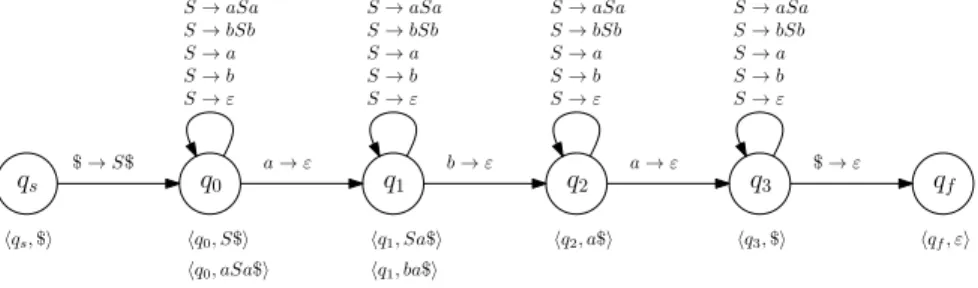
stack. The size of the resulting PDS isO(n) as G was of constant size, and its simplification is a path. See Figure 1 for an example.
qs q0 q1 q2 q3 qf $→S$ a→ε b→ε a→ε $→ε S→aSa S→bSb S→a S→b S→ε S→aSa S→bSb S→a S→b S→ε S→aSa S→bSb S→a S→b S→ε S→aSa S→bSb S→a S→b S→ε hqs,$i hq0, S$i hq0, aSa$i hq1, Sa$i hq1, ba$i hq2, a$i hq3,$i hqf, εi
Figure 1: Example of the reduction for the palindrome grammarS→aSa|bSb|a|b|εwith the wordabato test membership for. Transitions (q, γ)→(q0, w) are depicted as edges fromqto
q0with labelγ→w. At the bottom is a sequence of configurations of the PDS leading to an accepting state, read top to bottom, left to right.
Claim 1: qf is reachable from qs if and only ifw∈L(G).
Assume qf is reachable from qs, and we have a valid sequence of transitions
starting inqswith only $ on the stack and finishing inqf. After thejth
transi-tion, when in stateqifor some 0≤i≤n, we shall call the word consisting of the
firsticharacters ofwwith the current stack content appended to it and the final $ sign removed theinput-stack word and denote it asWj. We shall first show
by induction thatS ⇒∗ W
j for all j ≥1. We have thatW1 = S as after the
first transition we are inq0 and the stack only consists ofS. Now assume that S⇒∗ W
j. If we perfom a state-changing transition from some qi to qi+1, then
wi must be at the top of the stack and is removed during the transition. But as
we advance one state,wiis now the last of the firsti+1 characters ofwand thus
Wj+1=Wj. So we also get thatS ⇒∗Wj+1. Similarly, if we have a transition
remaining in the same state, then we’re replacing the non-terminal symbol at the top of the stack with a string in accordance to one of the production rules of G while leaving the rest unchanged. Therefore we have Wj ⇒ Wj+1 and thus together with the induction hypothesis it follows that S ⇒∗ W
j+1. Now
qf is only reachable if we can reach qn with only $ on the stack. But then the
input-stack word iswonce we reachqn, and thusS⇒∗wand w∈L(G).
w starting from S. In particular, as G is context-free we can reorder these productions such that always the first non-terminal is being replaced. Following this sequence of productions with their corresponding same-state transitions in the PDS, and using the state-changing transitions whenever a terminal symbol is at the top of the stack, we can reachqn in the PDS with nothing but the $
symbol left on the stack, and thus alsoqf is reachable.
Also note thatqf is reachable fromqsif and only ifqnis same-context reachable
fromqs.
Claim 2: This reduction can be done alternatively in DLOGSPACE or linear time.
We only need one pointer to the input tape, and one counting variable whose range isO(n), each of which takesO(logn) space.
Similarly, we can constructPby passing overwonly once and for each character ofwonly do a constant number of operations as|G|is constant.
3.2. Consequences
We will outline two implications of this result.
Recall that pushdown reachability can be solved in cubic time, and thus is in P. It is known that CFG-membership is P-complete under DLOGSPACE-reductions [16]. As we have just shown that CFG membership can be reduced to pushdown reachability in DLOGSPACE, it follows that pushdown reachability is alsoP-complete and we get the following corollary:
Corollary 3.2. Pushdown reachability is P-complete under DLOGSPACE-reductions, even if restricted to path-like PDSs.
Similarly, as our reduction is in linear time, an algorithm for pushdown reach-ability in running in T(n) time implies an algorithm for CFG membership in O(T(n)). Together with Theorem 2.2 we get that thek-clique problem on any graph ofn nodes can be solved inO(T(nk/3+1)) time, for any constantk
≥3 divisible by 3. If T(n) = O(n3−δ) for some δ, this in particular would imply
an algorithm for k-clique running in O(nk+(3−δ(k/3+1))) = O(nk−ε) for some
ε >0 ifk is chosen sufficiently large. Similarly,T(n) =O(nω−δ) would imply
an algorithm fork-clique running inO(nkω/3−ε) for some ε >0 if k is chosen
sufficiently large. With this observation we get the following result:
Corollary 3.3. If the k-clique conjecture holds, then there is no algorithm for push-down reachability running in O(nω−ε) for ε > 0, and no combinatorial algorithm for push-down reachability running inO(n3−ε)forε >0, even if the problem is restricted to path-like PDSs.
4. Conclusions
Unlike for a variety of other problems, our results imply that the treewidth restriction by itself cannot be exploited for faster reachability algorithms for
pushdown systems. An interesting direction for future work would be to consider other restrictions, along with the treewidth restriction, that arise in program analysis and can be exploited to develop faster algorithms for pushdown systems.
5. Acknowledgements
The research was partially supported by the Austrian Science Fund (FWF): P23499-N23, S11407-N23 (RiSE/SHiNE), and an ERC Start Grant (279307: Graph Games).
6. References
[1] Amir Abboud, Arturs Backurs, and Virginia V. Williams. If the current clique algorithms are optimal, so is Valiant’s parser. InIEEE 56th Annual Symposium on Foundations of Computer Science, FOCS 2015, Berkeley, CA, USA, 17-20 October, 2015, pages 98–117, 2015.
[2] Rajeev Alur, Michael Benedikt, Kousha Etessami, Patrice Godefroid, Thomas Reps, and Mihalis Yannakakis. Analysis of recursive state ma-chines. ACM Trans. Program. Lang. Syst., 27(4):786–818, July 2005. [3] Nikhil Bansal and Ryan Williams. Regularity lemmas and combinatorial
algorithms. In Foundations of Computer Science, 2009. FOCS’09. 50th Annual IEEE Symposium on, pages 745–754. IEEE, 2009.
[4] Hans L. Bodlaender. A tourist guide through treewidth. Acta Cybern., 1993.
[5] Hans L. Bodlaender. Discovering treewidth. In SOFSEM: Theory and Practice of Computer Science, LNCS. Springer, 2005.
[6] Krishnendu Chatterjee, Amir K. Goharshady, Rasmus Ibsen-Jensen, and Andreas Pavlogiannis. Algorithms for algebraic path properties in concur-rent systems of constant treewidth components. InPOPL, pages 733–747, 2016.
[7] Krishnendu Chatterjee, Rasmus Ibsen-Jensen, Andreas Pavlogiannis, and Prateesh Goyal. Faster algorithms for algebraic path properties in recursive state machines with constant treewidth. In Proceedings of the 42Nd An-nual ACM SIGPLAN-SIGACT Symposium on Principles of Programming Languages, POPL ’15, pages 97–109, New York, NY, USA, 2015. ACM. [8] Krishnendu Chatterjee and Jakub Lacki. Faster algorithms for Markov
decision processes with low treewidth. InCAV, LNCS. Springer, 2013. [9] Swarat Chaudhuri. Subcubic algorithms for recursive state machines. In
Proceedings of the 35th Annual ACM SIGPLAN-SIGACT Symposium on Principles of Programming Languages, POPL ’08, pages 159–169, New York, NY, USA, 2008. ACM.
[10] Don Coppersmith and Shmuel Winograd. Matrix multiplication via arith-metic progressions.Journal of Symbolic Computation, 9(3):251 – 280, 1990. Computational algebraic complexity editorial.
[11] Bruno Courcelle. The monadic second-order logic of graphs. i. recognizable sets of finite graphs. Inf. Comput., 1990.
[12] Michael Elberfeld, Andreas Jakoby, and Till Tantau. Logspace versions of the theorems of Bodlaender and Courcelle. In FOCS. IEEE Computer Society, 2010.
[13] Alain Finkel, Bernard Willems, and Pierre Wolper. A direct symbolic approach to model checking pushdown systems (extended abstract). Elec-tronic Notes in Theoretical Computer Science, 9:27 – 37, 1997. Infinity’97, Second International Workshop on Verification of Infinite State Systems. [14] Jens Gustedt, Ole A. Mæhle, and Jan A. Telle. The treewidth of Java
programs. In Algorithm Engineering and Experiments, LNCS. Springer, 2002.
[15] Rudolf Halin. S-functions for graphs. Journal of Geometry, 1976.
[16] Neil D. Jones and William T. Laaser. Complete problems for deterministic polynomial time. Theoretical Computer Science, 3(1):105 – 117, 1976. [17] Lillian Lee. Fast context-free grammar parsing requires fast boolean matrix
multiplication. J. ACM, 49(1):1–15, January 2002.
[18] Jaroslav Neˇsetˇril and Svatopluk Poljak. On the complexity of the sub-graph problem. Commentationes Mathematicae Universitatis Carolinae, 26(2):415–419, 1985.
[19] Jan Obdrz´alek. Fast mu-calculus model checking when tree-width is bounded. InCAV, LNCS. Springer, 2003.
[20] Neil Robertson and Paul D. Seymour. Graph minors. iii. planar tree-width.
Journal of Combinatorial Theory, Series B, 1984.
[21] Mikkel Thorup. All Structured Programs Have Small Tree Width and Good Register Allocation. Inf. Comput., 1998.
[22] Leslie G. Valiant. General context-free recognition in less than cubic time.
Journal of Computer and System Sciences, 10(2):308 – 315, 1975.
[23] Virginia V. Williams. Efficient algorithms for clique problems.Inf. Process. Lett., 109(4):254–257, 2009.
![Di μ aqua bis{triaqua[5 (1 oxopyridin 4 yl)tetrazol 1 ido]sodium}](data:image/gif;base64,R0lGODlhAQABAIAAAP///wAAACH5BAEAAAAALAAAAAABAAEAAAICRAEAOw==)