Towards Migrating Security Policies along with
Virtual Machines in Cloud
A Thesis in the Concordia Institute for Information Systems Engineering
Presented in Partial Fulfilment of the Requirements
for the Degree of Master of Applied Science in Information Systems Security at the Concordia Institute for Information Systems Engineering
Concordia University, Montr´eal, Qu´ebec, Canada
Sahba Sadri
December 2013
c
Concordia University
School of Graduate Studies
This is to certify that the thesis prepared
By: Sahba Sadri
Entitled: Towards Migrating Security Policies along with Virtual Machines in Cloud
and submitted in partial fulfilment of the requirements for the degree of
Master of Applied Science in Information Systems Security
complies with the regulations of this University and meets the accepted standards with respect to originality and quality.
Signed by the final examining committee:
Andrea Schiffauerova, Ph.D. Chair
Amr M. Youssef, Ph.D. Examiner
Yan Liu, Ph.D. Examiner
Mourad Debbabi, Ph.D. Supervisor
Lingyu Wang, Ph.D., P.Eng. Supervisor
Approved by
Chair of Department or Graduate Program Director 2013
Christopher Trueman, Ph.D., Dean
Abstract
Towards Migrating Security Policies along with Virtual Machines in Cloud Sahba Sadri
tenancy and elasticity are important characteristics of every cloud. Multi-tenancy can be economical; however, it raises some security concerns. For example, contender companies may have Virtual Machines (VM) on the same server and have access to the same resources. There is always the possibility that one of them tries to get access to the opponent’s data. In order to address these concerns, each tenant in the cloud should be secured separately and firewalls are one of the means that can help in that regard. Firewalls also protect virtual machines from the outside threats using access control lists and policies. On the other hand, virtual machines migrate frequently in an elastic cloud and this raises another apprehension about what happens to the security policies that are associated with the migrated virtual machine.
In this thesis, we primarily contribute by proposing a novel framework that coor-dinates the mobility of the associated security policies along with the virtual machine in Software-Defined Networks (SDN). We then design and develop a prototype appli-cation called Migration Appliappli-cation (MigApp), based on our framework that moves security policies and coordinates virtual machine and security policy migration. Mi-gApp runs on top of SDN controllers and uses a distributed messaging system in order
to interact with virtual machine monitor and other MigApp instances. We integrate MigApp with Floodlight controller and evaluate our work through simulations.
In addition, we prepare a test-bed for security testing in clouds that are based on traditional networks. We focus on virtual machine migration and use open-source utilities to equip this test-bed. We design an architecture based on GNS3 network emulator in order to provide a distributed testing environment. We then propose a virtual machine migration framework on Oracle VirtualBox; and finally, we enrich the security aspect of framework by adding firewall rule migration and security verification mechanisms into it.
Acknowledgments
I would like to sincerely thank my supervisors Dr. Mourad Debbabi and Dr. Lingyu Wang. They introduced me to interesting research projects on which I have enjoyed so much to work.
My appreciation also goes to Dr. Makan Pourzandi, for his guidance and advices which were helpful during some steps of this thesis.
I would also like to express my warmest gratitude to Dr. Yosr Jarraya and Arash Eghtesadi, my research mates in all of the projects.
Finally, I am thankful to all my colleagues in the department, particularly Gaby Dagher, Mert Kara and my mentor, Ashkan Rahimian who made a friendly environ-ment for me and I had great time working and studying with them.
To my parents who encouraged me from the beginning and without their support I was not able to complete this step of my life . . .
“If you’re not prepared to be wrong, you’ll never come up with anything original.”
Contents
List of Figures x
List of Tables xii
List of Acronyms xiii
1 Introduction 1 1.1 Motivation . . . 1 1.2 Objectives . . . 5 1.3 Contributions . . . 6 1.4 Thesis Organization . . . 7 2 Background 8 2.1 Cloud Computing . . . 8
2.1.1 Cloud Security and Security Appliances . . . 11
2.1.2 Virtualization . . . 14
2.1.3 VM Migration in clouds and Security Concerns . . . 16
2.2 Software-Defined Networking . . . 19
3 Towards Migrating Security Policies of Virtual Machines in
Software-Defined Networks 29
3.1 Overview . . . 30
3.2 Related Work . . . 33
3.3 Preliminaries . . . 36
3.3.1 SDN and Floodlight Controllers . . . 36
3.3.2 Distributed Messaging System . . . 39
3.4 Approach . . . 41 3.4.1 MigApp Design . . . 41 3.4.2 Implementation . . . 44 3.4.3 Deployment . . . 49 3.5 Experiments . . . 50 3.5.1 Setup Environment . . . 50 3.5.2 Running Scenario . . . 51 3.5.3 Experimental Results . . . 53 3.6 Summary . . . 56
4 Customized Test-bed for Testing Migration Security in Cloud 58 4.1 Overview . . . 58 4.2 Related Work . . . 62 4.3 Preliminaries . . . 64 4.3.1 GNS3 . . . 65 4.3.2 VirtualBox . . . 65 4.3.3 Wireshark . . . 65 4.3.4 TFTP/SFTP Server . . . 66
4.4 Test-Bed Description . . . 66
4.4.1 Test-bed Architecture . . . 66
4.4.2 Environment Setup and Network Design . . . 70
4.4.3 Optional software and useful tools . . . 71
4.5 Migration Framework . . . 74
4.6 A Case study and other Use Cases . . . 78
4.6.1 Case-Study: Firewall Rule Migration and Verification . . . 80
4.7 Limitations . . . 86
4.8 Summary . . . 88
5 Conclusion and Future Work 90
Bibliography 92
List of Figures
2.1 Cloud Computing Security Domains [54] . . . 13
2.2 Full-Virtualization Architectures . . . 15
2.3 Three Layers of SDN Architecture[85] . . . 20
2.4 Middleboxes . . . 23
2.5 Different Security Appliances [15] . . . 25
3.1 Architecture of SDN and Floodlight Controller with our MigApp . . . . 37
3.2 Deployment of the Proposed Solution . . . 48
3.3 Testing Environment (VM1 is the Migrating VM) . . . 51
3.4 Communications between the VMs Before Migration . . . 54
3.5 Communications between the VMs After Migration . . . 55
3.6 Time for Execution as a Function of the Number of Rules . . . 56
4.1 Test-bed Architecture . . . 69
4.2 Test-bed Topology . . . 72
4.3 VM Migration Framework . . . 77
4.4 Case Study Topology . . . 79
4.5 Percentage of Packets Received by Vi4, per Packet Type and per Source - Before Migration . . . 85
4.6 Percentage of Packets Received by Vi4, per Packet Type and per Source - After Correct Migration . . . 85
4.7 Percentage of Packets Received by Vi4, per Packet Type and per Source - the Erroneous Migration Scenario 2 . . . 86 4.8 VM and Firewall rules Migration Framework . . . 87
List of Tables
2.1 Cloud Security Domains [43] . . . 12
4.1 Comparison between Network Simulation,Emulation and Actual deploy-ment . . . 60
4.2 A Comparison of Network and Cloud Simulators . . . 64
4.3 Firewall Policy Before Migration . . . 82
4.4 Firewall Policy After Migration . . . 83
A.1 Firewall Paths Before and After Migration . . . 105
List of Acronyms
ACL Access Control List
API Application Programming Interface
ASIC Application-Specific Integrated Circuit
CIFS Common Internet File System
CSP Cloud Service Provider
GNS3 Graphical Network Simulator 3
GUI Graphical User Interface
IaaS Infrastructure as a Service
IDS Intrusion Detection System
IETF Internet Engineering Task Force
IPS Intrusion Prevention System
JSON JavaScript Object Notation
NAT Network Address Translation
NFS Network File System
NIC Network Interface Controller
NOS Network Operating System
OS Operating System
PaaS Platform as a Service
QoS Quality of Service
SaaS Software as a Service
SDN Software-Defined Network
SFTP Secure File Transfer Protocol
SMB Server Message Block
TFTP Trivial File Transfer Protocol
TLS Transport Layer Security
UTM Unified Threat Management
VM Virtual Machine
VMM Virtual Machine Monitor
Chapter 1
Introduction
1.1
Motivation
Cloud computing is currently known as one of the hottest topics not only in computer science, but also among recent technologies. Nowadays, many companies are adapted to cloud service model and others are aggressively starting to migrate their operations into this model. The market for public cloud computing services was $16 billion in 2008, went over $100 billion in 2012 and It is predicted that by 2016 it can exceed $206 billion [44].
Cloud computing paradigm is perhaps as old as the age of mainframes, when only big companies and academic centers had access to huge computing power. Over the time, processors got cheaper and faster which made it possible for many people around the world to have a personal computer. At the present time, various types of computers like laptops, tablets, smart phones and etc. with multiple processors are very common and popular. However, cloud computing also changed along with the computers during this evolution and turned into a service for companies and even home users. Fast improvements in computer networks infrastructure and emerging of virtualization, played the key role in this movement. Versatility of virtualization technologies and ubiquity of internet had the largest impact on maximizing the pop-ularity of cloud computing and encouraged companies for adoption. Today, many
applications, storage services and development environments are available online and are based on cloud; others are also rapidly joining to this trend and trying to adapt their services to cloud infrastructures. This cloud-based approach reduces many costs and leads to a vast spectrum of opportunities and possibilities and expels a lot of dif-ficulties and headaches from companies. In this approach, companies subscribe to a service that is offered by a cloud provider. To draw an analogy, a similar approach has been taken in most traditional utility services like water, electricity, telephony and etc. which end user (that can be an individual, a company or an organization) receives the service without concerning about how this service is hosted and provided to him. User consumes the service and pays a reasonable price for the amount of consumption. Normally, such a model is significantly cheaper and more convenient for the user than preparing or producing these by himself.
While, many companies are convinced that using this model has many advantages and benefits, some concerns and questions exist that need to be addressed by cloud providers. Like traditional utilities, there should be some standardized factors that ensure the quality of provided services. For example as users, we need to know that the water is safe to drink or the voltage of electricity power is always in the accepted range and doesn’t hurt our electrical devices. For example, multi-tenancy which is a feature in cloud computing that enables different users to share same resources, can cause some security and privacy problems, as illustrated below. Suppose two contender companies are using same resources in a data center; Here, Cloud Service Provider (CSP) should guarantee that customers’ data is confidential and has to show strong proof for each party that the opponent company cannot access their data. Generally, there is an agreement between the customer and the provider that indicates
the rights of each party and specifies fines for each of them, in case that they do not obey the contents of agreement. CSPs use Service Level Agreement (SLA) in order to define delivered services, performance measurements, customer responsibilities, compensations and reimbursement policies, security services and standards, disaster recovery and finally termination rules [102].
Recently, VM migration in cloud computing has been common within and between data centers. Basically, VM migration means moving a virtual machine from one host to another. It is an essential capability that supports service elasticity of a cloud. For example, it happens frequently that a VM has to move into another cluster within a data center due to load balancing issues or when a company decides to relocate its VMs into a larger data center. However, there is always a big concern on what happens to the security policy associated with the migrated machine. What should be done for a migrating VM in order to preserve its security and protect it from network attacks, after migration? This question highlights the importance of research on VM security during and after migration. In order to study VM migration and its related security concerns, an implementation of cloud migration is needed. Most of the current available simulators focus on performance and cost optimization and emulators that can imitate real services are normally owned by service providers. As a result, a customized testing environment that focuses on the security and provides possibility of migration can ease the mentioned research direction.
On the other hand, Software Defined network (SDN) has become one of the hottest topics in computer networking community lately and has drawn lots of attention from media and industry as well as academia because of the promising opportunities and undeniable benefits that it is offering. It is predicted that SDN market will grow
form $360 million in 2013 to $3.5 billion in 2015 and will exceed $25 billion by 2018 and as SDNcentral reported, the number of registered SDN companies grew from zero company in 2009 to 225 companies in April 2013 [80]. A significant number of vendors and famous companies like IBM, Cisco, Oracle and etc. are adapting to SDN and some others like NEC, Big Switch Networks and etc. started to produce products specifically for SDN. At the same time there is a big collaboration between academic institutions and industry leaders to redesign, adapt or invent network protocols in order to improve SDN and respond the huge demand from the market.
SDN introduces the physical separation of network data plane (aka forwarding plane) from control plane, and this separation gives possibility of managing multiple network devices by one controller [24]. SDN controller is directly programmable and the logic which is presented by the code inside the controller is responsible for managing the forwarding behavior of switches; therefore the network administrator can easily apply new changes on network based on business requirements without touching any switch which facilitates network management in a cost effective way. This approach enables the controller to manipulate switch flow tables by adding or removing flows and making a dynamic and flexible provision over data plane. Forwarding, dropping and modifying packets are examples of actions that flow entries can perform.
Now that we expressed the importance and significance of SDN and cloud com-puting, we need to find out whether they can have a synergic collaboration or not. Fortunately, there is a common concept between these two topics. Thanks to the virtualization technology, data centers have to deal with numerous VMs that need to be handled remotely. Sometimes for a better performance, VMs have to migrate
to other servers. Switches and routers have to be monitored all around the clock. This is not the whole story, middleboxes are another vital part of each data center that have to be maintained constantly. Diversity and dispersion of different com-ponents, introduce an immediate need for a central management unit that can take care of all elements. Fortunately, SDN is about decoupling control plane and data plane that steers the concentration of management into a central place rather than having one control unit per each device. This separation, simplifies the supervision over the network and brings more flexibility to a data center. The convergence of cloud computing needs and opportunities which are introduced by SDN, motivate CSPs to support SDN who are always thirsty to adapt new technologies in the field. Security concerns are always one of the most important deterrent factors that make CSPs hesitant to move on. As it has been mentioned earlier, multi-tenancy can raise security concerns. Firewalling between tenants could be a solution to solve this is-sue. However, when a VM migrates to another location, all security policies that are associated with that VM, remain in the first place. Therefore, a security solution that address this problem in SDN not only solves an issue in its own filed, but also eliminates a barrier for widespread adoption of SDN by CSPs.
1.2
Objectives
The purpose of this master thesis is first to study cloud computing concepts, security concern in clouds and data centers, Software-Defined Networks and its importance for cloud computing, role of firewalls in either domains with particular focus on VM migration and its security concerns. Then, design and implement of frameworks and prepare test-beds which their purpose is testing and evaluating VM migration
procedures as well as firewall rule migration. Finally, produce a framework that leverages combination of SDN functionalities and cloud computing in order to produce an effective way of network management, especially from security perspective.
1.3
Contributions
Security policy migration of VMs has been discussed in the literature [89]. Although, at the time of writing this thesis, there is no implementation of that for SDN. More-over, many physical devices in traditional networks are turned into software appli-cations in SDN context and reside on top of controller; therefore, a new design that is applicable for new context is needed. Our work presents a framework that offers a solution for a collaboration between hypervisor and controller application firewall to migrate security context and perform a safe VM migration for both source and destination data centers as well as the VM. We also prepared a cloud security test-bed for traditional networks in order to perform VM migration experiments. Therefore, our main contributions are as follows:
• Design of a novel framework that enables the mobility of security policies during VMs migration in order to support cloud computing elasticity with an SDN-based architecture. The framework enables an east-west communication be-tween management application within and across data centers.
• Implementation of the proposed framework in a prototype application inte-grated on the top of an existing OpenFlow controller, namely Floodlight.
• Test and validation of the security policy migration and evaluation of its per-formance using our framework deployed in a simulation and programming en-vironment.
• Design and deployment of an architecture that introduces the way to use GNS3 for simulating multiple data center on multiple host machines.
• Design and implementation of a framework for migrating VMs on the test-bed by improving the features in VirtualBox.
• Design and implementation of a framework to migrate firewall rules in the case of migration in context of traditional networks.
1.4
Thesis Organization
The remainder of this dissertation is organized as follows. In Chapter 2, we provide background information on cloud computing, Software Defined Networks and security issues in mentioned paradigms. In Chapter 3, we introduce our novel framework for migrating security context of virtual machines between SDN data centers and present our MigApp software. In chapter 4, we introduce and explain the customized test-bed and firewall rule migration framework in traditional networks, that we used for testing and verifying the reach-ability of VMs, before and after migration of VM and firewall rules. Finally in Chapter 5, we summarize the research and suggest future work directions.
Chapter 2
Background
This chapter covers some definition of main terms and reviews background knowledge for our research. We first discuss cloud computing and introduce its components and then describe security concerns in cloud. Then, we talk about SDN, its evolution and relation of SDN and cloud computing. We also give explanation about various controllers and describe the Floodlight [25] controller in detail. Finally, we explain different firewalls, particularly those who are applied in cloud computing and SDN.
2.1
Cloud Computing
Perhaps the evolving nature of cloud computing is the reason for not having a common and standard definition for that. However, when we search in the literature, the NIST definition of cloud computing is the first choice of most researchers. “Cloud computing is a model for enabling ubiquitous, convenient, on-demand network access to a shared pool of configurable computing resources (e.g., networks, servers, storage, applications, and services) that can be rapidly provisioned and released with minimal management effort or service provider interaction”[72].
In order to have a better understanding of this model, NIST described main characteristics of cloud computing and categorized it with deployment models and service models.
• On-demand self-service. Customer is able to manage resources remotely and automatically without the need to contact CSP.
• Broad network access. Customer access to capabilities through network and by standard mechanism. This feature has to be platform independent.
• Resource pooling. Sharing of the providers physical and virtual resources among multiple customers.
• Rapid elasticity. Described as an instant and on-demand possibility of scaling up and down the computing resources, by the customer.
• Measured service. This characteristic enables pay as you go feature with providing a complete report of resource usage for both provider and customer. One important characteristic that is missing in above definition is multi-tenancy
that enables coexistence of different customers’ data on the same storage medium. This might be implicitly deductible from resource pooling, but we would like to ex-press this characteristic separately, due to its importance from security perspective and our research path.
Cloud computing Deployment Models are described as following [72]:
• Private cloud. In this model, there is only one organization that uses and manages cloud infrastructure. However, it is possible to hand over the respon-sibility of management and maintenance to a third-party company. This model gives the highest level of control to organization, especially in terms of the security.
• Community cloud. In cases that organizations collaborate on projects or have shared data, the community model can be deployed to have a shared infrastructure between collaborative parties.
• Public cloud. An infrastructure that can be managed by any organization in order to provide services and host for general public consumers. Since this model is public, control over that is limited and sometimes is partially shifted to the users for their own security.
• Hybrid cloud. A combination of two or more aforementioned models can shape a hybrid infrastructure. This is the most complex method of infrastruc-ture deployment and needs extra effort to make sure there is no security breach or lack of provision in different parts of infrastructure.
And finally, services are delivered to consumers based on the following Service Models [72]:
• Software as a Service (SaaS). Customer can access applications that are running on cloud infrastructure with various interfaces. Microsoft Office Live and Google Docs are good examples of such services.
• Platform as a Service (PaaS).Provider prepares a development environment including programming languages, libraries and different tools for customer in order to develop applications. Examples can be Microsoft Azure and Google App Engine.
• Infrastructure as a Service (IaaS). In this model, customer is served by customizable desired resources as processors, memory, network or even security
appliances. Amazon Elastic Compute Cloud (EC2), Amazon Simple Storage Service (S3) and RackSpace Cloud servers are examples of this type of service. Our research is mostly in this scope since network related issues, falls under this category.
2.1.1
Cloud Security and Security Appliances
1In fact, cloud computing made an enhancement to the overall security. Concentration of infrastructure in one location and ease of management and control, separation of virtual infrastructures and isolation of VMs were major improvements in security although they were just remedies for mitigation of some attacks. Security is still an issue, because not only most of the traditional attacks are still applicable, but also some new specific attacks manifest. In this part, we strive to categorize cloud-related security concerns and explain most important ways to protect with special focus on security appliance’s role.
There is a rich literature on taxonomy of cloud computing security. Gartner [33], enumerates seven security risks as: 1. Privileged user access 2. Regulatory compliance 3. Data location 4. Data segregation 5. Recovery 6. Investigative support 7. Long-term viability. CSA [43], defines cloud security in fourteen domains and grouped them in three sections as illustrated in Table 2.1:
While classification of cloud security concerns looks like an endless effort, it seems that many of them are inspired from CSA. Eventually, Gonzalez et al. [54], divided
1
Note that, cloud computing security is different from cloud-based security services that are also know asSecurity as a Service.The latter, is out of the scope of this research.
i. Cloud Architecture Cloud Computing Architectural Framework Governance and Enterprise Risk Management Legal Issues: Contracts and Electronic Discovery ii. Governing in the Cloud Compliance and Audit Management
Information Management and Data Security Interoperability and Portability
Traditional Security, Business Continuity-and Disaster Recovery
Data Center Operations Incident Response iii. Operating in the Cloud Application Security
Encryption and Key Management
Identity, Entitlement, and Access Management Virtualization
Security as a Service
Table 2.1: Cloud Security Domains [43]
cloud security issues into seven categories and then grouped them in three main domains, with respect to the most important key references (See Figure 2.1).
In order to safeguard a cloud, security should be applied in different layers. Thus, all dimensions that are shown in Figure 2.1, have to be studied carefully. For instance, data security can be improved by using stronger encryption techniques, interface breaches can be mitigated by hardening the code, and compliance issues can be solved by revising SLAs.
Security appliances that are also known as security middleboxes, are intermediary network devices that are meant to filter and inspect packets. Firewalls and Intrusion Prevention System/Intrusion Detection System (IPS/IDS) are common examples of security appliances that are extensively used in data centers for protecting it at the network level. In this regard, what type of security appliance will be used in future of cloud? Physical or Virtual? and the answer based on [69], is a hybrid approach.
Cloud Security Taxonomy Privacy Architecture Compliance 5. Network Security 3. Virtualization 1. Data Security 2. Legal Issues 7. Service 4. Interfaces 6. Governance Cryptography Redundancy Disposal Data Location E-discovery Provider Privilege SLA Loss of Service Audit Data Control Security Control Lock-in Isolation Hyervisor Vulnerabilities Data Leakage VM Identification Cross-VM Attacks Transfer Security Firewalling Security Configurtation API Administrative Interface User Interface Authentication
Neither of them are sufficient alone because some virtual traffic is always invisible from hardware layers and vice versa.
Our goal in this thesis is to study firewalls and security policy migration when a VM travels from one data center to another. Hence, Figure 2.1 clearly shows how our work is positioned.
2.1.2
Virtualization
Virtualization refers to the method for simulating software and/or hardware, rather than using the actual instance. This is performed by creating a layer of abstrac-tion between layers of software and/or hardware, for the purpose of optimizaabstrac-tion, better organization and simplification of interaction between different elements. For instance, you can represent a single physical resource as multiple virtual (logical) resources and vice versa. This technique helps to eliminate many limitations in im-plantation and enables making use of resource in an efficient manner. For example, a company can put more load on its servers by using virtualization [84][31]. There are different forms of virtualization that VMware categorized them in five types as follows [17]: Server Virtualization, Network Virtualization, Desktop Virtualization,
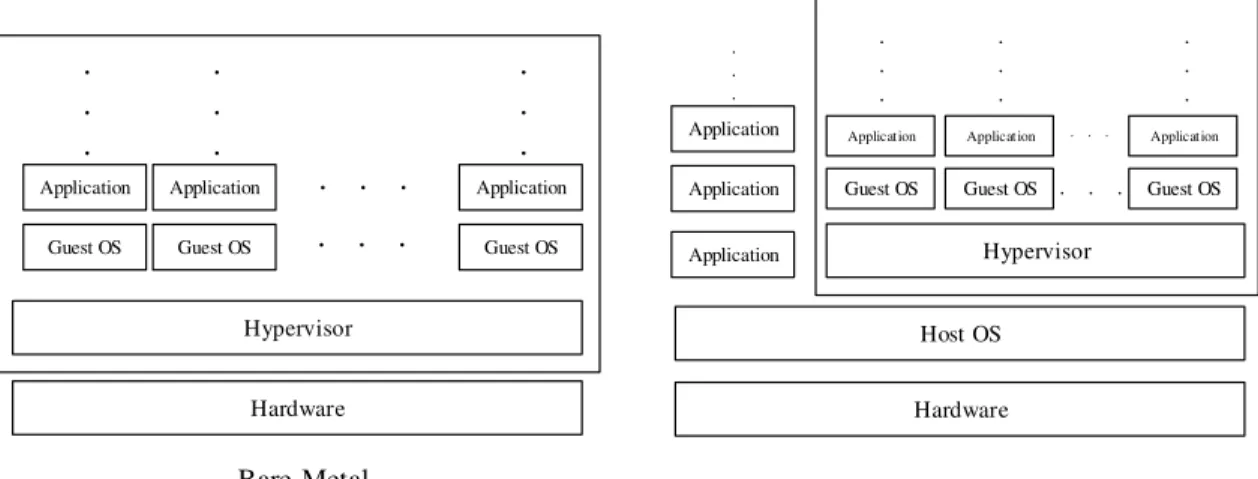
Storage Virtualization and Application Virtualization that all of them are applied in different layers of cloud computing. Since our research is about VM migration , we need to consider a type of virtualization that is calledfull virtualization. In this form, one or more OSs as well as the applications that are running on top it, shape Virtual Machine (VM). This OS, which is referred as aguest OS, runs on top virtual hardware that is provided by hypervisor and is controlled by Virtual Machine Monitor (VMM). In another word, full virtualization is a technique to simulate an entire hardware for
Hardware Hypervisor Hardware Hypervisor Guest OS Application Application Application Application Host OS . . . . . . Bare-Metal Hosted Guest OS Application . . . . . . Guest OS Application . . . . . . Guest OS Applicat ion . . . Guest OS Applicat ion . . . Guest OS Applicat ion . . . . . . . . .
Figure 2.2: Full-Virtualization Architectures
a guest OS and applications. Flows of the instructions that traverse among VMs are provisioned by VMM.
As demonstrated in Figure 2.2, there are two forms of full virtualization. Bare-metal(akanative) and Hosted. The first one is where the hypervisor layer is exactly on top of underlying hardware and mostly is using for server virtualization. The latter is when an OS layer called Host OS, placed between physical hardware and hypervisor; this approach is regularly applied in desktop virtualization [84]. Full virtualization imitates the characteristics of the virtual hardware as the physical one, to the applications; therefore, there is no need to modify applications in order to run them on a VM.
It is worth-mentioning that vulnerabilities in non-virtualized servers still remain after virtualization. Moreover, there is possibility of additional attacks that are specif-ically related to full virtualization characteristics. Hence, attack surface will increase; however, there are solutions to mitigate them; NIST grouped them as follows: Guest OS Isolation,Guest OS Monitoring and Image and Snapshot Management [84]. The
security, is also dependent on securing all the separate components such as physical hardware, hypervisor, host OS, guest OSs, storage units and applications which is out of the scope of this thesis. Our focus is on underlying network security, particularly firewall’s role in protecting VMs. It can be either a physical or virtual firewall. In the following section we briefly discuss about VM migration and motivations to migrate a VM, and finally we talk about security concerns and countermeasures that should be taken into consideration in VM migration process.
2.1.3
VM Migration in clouds and Security Concerns
As it was mentioned in Chapter 1, virtualization is a key element in cloud industry trend. Data centers that are also known as server farms, require a huge amount of hardware and infrastructure facilities. On the other hand, due to the fast growing technologies that data centers are hinged on and customers asking for them, Cloud Service Providers have to go under major upgrades in every few years. Therefore, data centers need to make the best use of their facilities and this is exactly where virtual-ization can inevitably help. Server consolidation is a great example of virtualvirtual-ization impact on data center efficiency improvement [61].
Hypervisors have different features and capabilities depending on their vendor. As it has been found in the literature, there are three main features, common be-tween most of them and according to VMware, which is the leader in virtualization technology, these features are High Availability (HA), Fault Tolerance (FT) andLive Migration. The first and the second features are dependent on the last one.
• High Availability. A technology that monitors all VMs constantly and in case of hardware failure, immediately restarts the VMs on another server. This feature does not transfer the current state of VM and only loads the VM from the stored image in storage unit [20].
• Fault Tolerance. This technology complements the previous feature. It runs identical copies of a VM in another place at the same time and in case of failure in origin location, duplicated VM will continue running without interruption. This feature is dependent on live migration of VM state [19].
• Live Migration. This feature provides the means, to transfer a VM and its running state from a server to another in real-time [21].
VM migration can be done in two ways; within a data center or across different data centers that sometimes are a located in different continents. In addition to the mentioned motivation for migration that complements other features of hypervisor, there are more incentives to migrate a VM. One of the main reasons and motivations for VM migration is load balancing between servers. Sometimes a task needs more processor power and there are not enough resources available in the server; in this sit-uation, a migration to another server can solve the problem. Periodical maintenance is another typical reason for VM migration. Reducing power consumption is always a desire for data centers. It happens once in a while that many severs have minimum load and it is possible to shut down or hibernate them while transferring some VMs to another servers; these migrations can significantly reduce power consumption and consequently data center cost.
• Inactive VMs. Normally VMs receive daily updates and security patches. VMs who are offline, are not able to receive those updates and become vulner-able when they go active. As a result, they turn into security threats for entire server.
• VM Awareness. All security solutions and appliances are not compatible with virtualized environment. The hypervisor security is also another concern that should be taken into consideration.
• VM Sprawl. VMs can be created with a click of a mouse. This is the key reason of rapid growth of virtualization; however, not only security cannot be achieved as easy as that, many security weaknesses can easily duplicate and spread all over the network. Each VM needs a special care and administrator cannot apply the same solution to all VMs.
• Inter-VM Traffic. Traffic between the VMs is not visible to traditional physi-cal layer security appliances. Hence, monitoring and management of that traffic can be performed by an appliance that is integrated into hypervisor.
• Migration. When a VM migrates from one cloud to another, the security policies that are associated with that VM, remains in the place of origin. Our contribution in this thesis, is exactly on the migration issue. We strive to address that by migrating also the security policies along with the migrating VM.
2.2
Software-Defined Networking
Software-defined network is a new paradigm in computer networks; however, the idea of programmable network has been around for a long time. Emergence of pro-grammable networks was due to the need of researchers to deploy new protocols and ideas into the core network which was monopolized by big network companies such as Cisco and Juniper. Before manifestation of programmable networks, control and forwarding layers were tightly coupled to each other and implementations of network hardware was mostly on Application-Specific Integrated Circuit(ASIC) chips. The main property of ASIC is ultimate speed but their drawback is non-programmability. Improvements in x86 processors and popularity of using commodity hardware, encour-aged network researchers to find a way to decouple control and forwarding layers, in order to deploy desired architectures and network control capabilities. To achieve this, various approaches have been taken. Active Network [90], OpenSig [37] and Juniper SDK [10] are examples of changing the routers in a way to make them pro-grammable [67]. Software routers and switches that are installed on servers as well as virtualization technologies, added more flexibility to network architecture; in ad-dition, test-beds enabled the researchers to perform experiments and verification on their own prototype environment [67]. Eventually, researchers came up with the idea of role abstraction in networking which led to emergence of SDN. SDN focuses on separation of control plane and data plane when the control unit is centralized and manageable by third party application. In order to program those applications, con-troller exposes an API; However, programmability in SDN is not limited only to
ap-plications and the main improvement is that the control units are also programmable by data plane exposed APIs.
Network Node A p p li ca ti o n C o n tr o ll e r In fr a st ru ct u re M a n a ge m e n t p la n e C o n tr o l p la n e D a ta p la n e NOS SDN Controller (Floodlight,POX,NOX,Ryu, Cisco ONE, …)
Southbound API e.g. OpenFlow, ForCES, NETCONF, ... Northbound API e.g. RESTful, FML, Procera, ...
Westbound API Eastbound API
Security (Firewall,IDS,...) Traffic Engineering (QoS, Load-balancing) Business Apps Mobility Management Energy Optimization Network Node NOS Network Node NOS Network Node NOS SDN Controller SDN Controller
Figure 2.3: Three Layers of SDN Architecture[85]
As it is illustrated in Figure 2.3, there are three tiers in SDN architecture: 1)
Data plane also known as forwarding plane, is the layers that infrastructure and particularly switches reside there. 2)Control plane is in the middle; controllers that
have a comprehensive view of the network and are able to control switches are placed there. 3)Management plane is on the top and applications which are replacements for many devices in traditional networks such as middleboxes, load-balancers and etc., as well as some new business and management applications are located on this layer. In order to make a connection between these layers, different APIs are used to provide programmable interface. As it is shown in the Figure 2.3, there are three types of API: 1)Southbound API is provided to make a link between control and forwarding layers. OpenFlow [71], NETCONF [46] and ForCES [45] are examples of southbound API. 2)Northbound API exposes an interface to application layer in order to interact with control plane. REST API is a common example for this type of programming interface; however, it completely depends on the choice of the vendor who develops the controller. 3)Eastbound-Westbound API is for making connections between elements in the same layer. ALTO [55] and Hyperflow [91] are examples of that.
SDN tries to simplify the network architecture and make a flat network with eliminating many middleboxes and shift their functionality to application layer. In SDN, switches have forwarding unit and a simple Network Operating System (NOS) that communicates with controller through API. Although the development of SDN is mainly due to the emergence of OpenFlow, it must be noted that the original idea is coming from Ethane [39] project and its predecessor SANE project [40]. These projects introduced a centralized controller and switches that contain flow tables and communicate with controller via a secure channel [73]. OpenFlow standardize the communication between data plane and control plane2
. Since OpenFlow is well supported by ONF, it gained momentum among all APIs and turned into a standard
2
OpenFlow uses Transport Layer Security (TLS) with mutual authentication to secure the con-nection between controller and switches.
for southbound communications; whereas there is not any commonly accepted API for northbound yet.
Like any new and evolving paradigm in computer world, there are some security breaches that are specific to that technology and have to be addressed even though it does not happen very quickly. Many shortages in design and vulnerabilities unveil after widespread deployment. Regarding to the shift of the middleboxes from physical layer to the application layer in SDN architecture, we believe that there is some space to have a contribution in security with focus on VM migration. In Chapter 3, we strive to investigate and address one of the security issues in SDN environment when a VM migration happens.
2.3
Firewalls in Cloud and SDN
As we discussed before and it is shown in Figure 2.1,network security that falls under architecture domain, can affect cloud security. Firewalling is one of the solutions that have significant impact on improving network security. Firewall is a security appliance that filter packets and control incoming and outgoing traffic. Still there is not enough information that gives us a clear view about firewall. Therefore, it is needed to go another level deeper and define what are main purposes and benefits of using these devices on which data centers invest huge amount money on them. Middleboxes are essential intermediary devices in the network that mainly optimize performance and security of the network. Some of them such as WAN optimizers and IDSs specifically focus on one issue; respectively performance and security, and others can be helpful in both directions (See Figure 2.4).
The term “middlebox” may mistakenly imply a physical existence of a separate device whereas, it can be a virtual appliance that is running on a commodity hardware along with another functionalities or even as a software solution [38]. The authors in [15] state that security appliances can be distinguished by their types (See Fig-ure 2.5). Active devices can filter and modify the traffic. Common examples of active devices are anti-virus, content-filtering device and firewalls. Passive devices basically monitor the network, make reports and alerts whenever they detect a suspicious activ-ity; like IDS. Another type of devices arePreventive ones such as IPS or vulnerability assessment tools that unveil threats before incident occurs. Finally, there are Unified Threat Management(UTM) devices that integrate multiple security features into one box.
Knowing the place of firewall among all middleboxes allows higher accuracy in giv-ing a definition of the firewall. As a result, firewalls are software or hardware compo-nents, that separate a network into different security levels by enforcing rules. These rules specify access level as well as limitations of each network entity or program. According to NIST [83], there are ten different firewall technologies for production networks and two types for individual hosts and home networks.
• Packet Filtering. Most basic feature on any firewall that specifies ACCEPT or DROP of a packet, based on information in the header.
• Stateful Inspection. Keep track of connection states in a table called state table and inspect packets by matching their state with connection state.
• Application Firewalls. Stateful protocol analysis, also known as deep packet inspection. Allow or deny based on application behavior on the network.
Security
Appliances
Firewall
Anti-virus
Firewall/
VPN
IPS
Firewall/IDS
Vulnerability
assessment
Content-filtering
IDS
Traffic
analyzers
UTM
Preventive
Active
Passive
• Application-Proxy Gateways. Another deep inspection method that act as a middleman between two hosts and prevents a direct connection.
• Dedicated Proxy Servers. Placed behind firewall because they have very limited firewalling features and act as an intermediary between firewall and internal network.
• Virtual Private Networking. Using additional protocols in order to encrypt and decrypt traffic between two gateways or a host and a gateway.
• Network Access Control. Granting access to a client based on its credential and health check result.
• Unified Threat Management. Combination of multiple features like fire-walling and intrusion detection into one system.
• Web Application Firewalls. A special type of application firewall for pro-tecting web servers.
• Firewalls for Virtual Infrastructure. Software firewalls that can monitor virtualized network traffic.
While firewalls usually protect network to some extent, still there are some attacks that can pass through firewall and reach the internal network. In order to protect the hosts in the network, there are firewalls designed to deploy particularly on host machines instead of network. Firewalls for individual hosts and home networks are as following [83]:
• Host-Based Firewalls and Personal Firewalls. Software firewalls that are installed on OS for servers and personal computers like Windows firewall. They
can have other capabilities such as logging, intrusion prevention and application based firewalling.
• Personal Firewall Appliances. Small hardware firewalls that are used in home or small offices. They have more advanced features than host-based fire-walls and add another layer of protection.
In a cloud environment there are high capacity storage devices that store cus-tomers’ information, plenty of high performance servers that handle different tasks and virtual machines that are running on top of servers. Virtual network inside servers and sophisticated physical network that connects data center to the world are assets that should be protected very carefully. Firewalls are always deployed on the front line of the network in order to safeguard the internal network. In a cloud, network can be extremely complicated due to the huge number of servers and also virtual machine which create a combination of virtual and physical traffic. Therefore, firewalling only on one layer, cannot properly protect all assets. Moreover, virtual traffic is not visible to physical firewall. Co-tenancy of different customers on the same sever is another matter of contention because they may be owned by contender companies. Generally, different VMs in cloud are not considered as trusted to each other and there is a need for firewalling via VMs. In addition, security demand vary between different customers and in some cases, customized security services is demanded depend on the importance of their VMs. Thus, firewalling has to be applied in different layers from outside of data center to inside by physical firewalls with sophisticated features and within the virtual instances inside servers by virtual firewalls (or firewall that comes with hypervisor as a component). In our work, we considered both physical and virtual firewalls since they share same concepts in terms of access control,
appli-cation filtering, stateful inspection and other technologies (their difference is mainly in implementation).
Firewalling in a pure SDN network is shifted to the application layer (See Fig-ure 2.3). SDN application3
firewalls are similar to virtual firewalls, from implemen-tation point of view, and are closer to physical firewalls, from the view scope and functionality perspective. In general, SDN firewalls can rule and protect the por-tion of the network that is controlled by SDN controller and they follow the main concepts of firewalling as traditional networks. However, it is very unlikely that we see a pure SDN data center in future; instead, it is more probable to have a hybrid architecture which is a combination of traditional network and SDN. Hence, virtual, physical and SDN firewalls will collaborate and protect the entire architecture. Our proposed framework in this thesis, focuses on SDN firewall policy migration when a VM migration happens.
3
Here “application” refers to the SDN firewall implementation as an application and should not be confused with firewalls that control applications
Chapter 3
Towards Migrating Security Policies of
Vir-tual Machines in Software-Defined Networks
Virtual machine migration is an essential capability that supports cloud service elas-ticity. However, there is always a big concern on what happens to the security policy associated with the migrated machine. Recently, Software-Defined Networking (SDN) has gained momentum in both research and industry. It has shown great potential to be used in cloud data centers, particularly for inter-domains migration of virtual machines. In a distributed settings, where more than one physical SDN controller is used, particularly in different network domains, coordinating security policies during migration is an important issue. In this chapter, we propose a novel framework, to be deployed in an SDN environment, that coordinates the mobility of the associ-ated security policy along with the migrassoci-ated virtual machine. We implemented our framework into a prototype application, called MigApp, that runs on top of SDN controllers. Our application interacts with the virtual machine monitor and other in-stance of MigApp through messaging system to achieve security migration. In order to evaluate our framework, we integrate our application with the Floodlight controller and use it with a simulation environment.
3.1
Overview
Virtualization technology has become a commonplace in cloud computing data cen-ters. Specifically, Virtual Machine (VM) technology has recently emerged as an es-sential building block for such an environment as it allows multiple tenants to share the same infrastructure. The capability of VM migration brings multiple benefits such as high performance, improved manageability, and fault tolerance. While this mobility represents a valuable asset to the cloud computing model, it may introduce critical security flaws or violate the tenants requirements, if the security policy does not follow the VM to the destination after migration. Manual reconfiguration of se-curity policies is not an acceptable solution as it is error prone and is inadequate for live VM migration. To the best of our knowledge, existing works on VM migration have not addressed security policy migration in SDN.
In this thesis, we address security policies mobility with VMs in IaaS cloud com-puting, and demonstrate how to solve security policy migration in SDN-based cloud. Software-Defined Networking (SDN) is an emerging networking paradigm that aims at separating the control and data planes while offering logically centralized network’s intelligence and state [76] that are connected to the forwarding elements at the data plane. This architecture allows for a dynamic and flexible provisioning over data plane and facilitates network management in a cost effective way. Particularly, the network administrator can program and manage multiple network devices based on business requirements without the need to deal with each network device separately. At the management plane, the administrator can specify various policies (e.g. quality of service, security, etc.) that are then used by a set of applications to program the
controller through a northbound API (e.g. REST API [81]). The controller, pro-grams the forwarding devices at the data plane through a southbound API. The most popular protocol that offers an implementation of such an API is OpenFlow [78], maintained by the Open Networking Foundation (ONF). SDN provides new ways to solve age-old problems in networking while simultaneously enabling the introduction of sophisticated capabilities. For instance, GoGrid [23] is an example of IaaS providers that have adopted an SDN approach to architecture the cloud. The configuration and control is put into customers’ hands so that they can design their own cloud plat-form with virtualized services such as firewalls and load balancers, managed using the management console or a public REST API. In order to deal with security groups, GoGrid implements security groups as global objects that are automatically synched across data centers [23]. A recent IDC study [59] projected that the SDN market will increase from $360 million in 2013 to $3.7 billion in 2016. There are several orga-nizations worldwide including Google [93], NDDI [96], and GENI [22] running and testing OpenFlow networks. A significant number of vendors such as HP [57], Cisco [41], and IBM [58] are contributing by manufacturing SDN-enabling products.
Research initiatives [89, 101, 56, 18] supported by industry acknowledge the chal-lenge and the importance of security context migration as a part of cloud elasticity mechanism. Many research initiatives have proposed to leverage the SDN paradigm to benefit cloud computing environments. Particularly, [70, 32] propose SDN strategy to enable live and offline migration of VM within and across multiple data centers. However, the reviewed solutions either circumvent the problem (e.g. using traffic tunneling techniques) or do not fully address it, if not at all. In this thesis, we de-sign and implement a framework for migrating security policies along with the VMs
within the same or between data centers based on SDN. Our solution, as opposed to vendor-specific ones, is meant to be open source, secure and interoperable with any SDN controller that provides a REST API and a virtual security appliance such as a firewall. To coordinate the migration, we propose to use a distributed messag-ing system, namely RabbitMQ. The latter is based on Advanced Message Queumessag-ing Protocol (AMQP), a highly scalable publish and subscribe message protocol that is increasingly used in cloud architectures (e.g. VMware vCenter Orchestrator1
). Thus, our main contributions are as follows:
• Design of a novel framework, namely MigApp, that enables the mobility of security policies during VMs migration in order to support cloud computing elasticity with an SDN-based architecture. The framework enables an east-west communication between management application within and across data centers.
• Implementation of the proposed framework in a prototype application inte-grated on the top of an existing OpenFlow controller, namely Floodlight.
• Test and validation of the security policy migration and evaluation of its per-formance using our framework deployed in a simulation and programming en-vironment.
This chapter is organized as follows: Section 3.2 briefly describes the most relevant research initiatives under the discussed topic. Section 3.3 elaborates on the prelimi-naries of our work notably by describing main SDN concepts and Floodlight controller as well as the foundation of messaging systems. Section 3.4 is dedicated to detail our
1
proposed approach. Therein, we present the design, implementation, and deployment of our prototype framework. In order to demonstrate the viability of our framework, Section 3.5 describes the experimental results that we obtained by deploying our framework using a simulation environment.
3.2
Related Work
In the context of VM migration in traditional data centers, Tavakoli et al. [89] proposed a mechanism for VM security context migration based on an extension made to the virtual machine monitor. However, the approach only deals with hypervisor-based firewalls and considers a non-SDN context. Recently, a number of research initiatives [32, 62, 70] have investigated VM migration based on SDN and OpenFlow. Boughzala et al. [32] proposed an OpenFlow-based infrastructure-as-a-services (IaaS) middleware solution to interconnect different data centers. This enables inter-domains VM migration, howbeit, only entries in the flow table of switches are transferred to re-establish the existing connectivity of the migrating VMs. Similar to us, they used mininet but for a different purpose which is to evaluate network setup and migration delay using their solution. Keller et al. [62] propose LIME, an SDN-based approach for live migration of a network consisting of a group of related VMs along with the data-plane state. The prototype was implemented on top of a Floodlight controller. LIME clones one or more switches, and then separately migrates each VM to the new location. Migrating openflow entries from the source switches and statically inserting them into the destination switches does not completely solve the problem for two reasons. First, static insertion of all flow entries contradicts an important SDN concept, which is to dynamically generate and insert the flow entries by the controller
at the reception of the first packet of a flow. Second, for the newly incoming flows, which are different from the static ones, the absence of the adequate policies (specified at the management plane) may lead the controller’s decisions to violate the security of these new flows. In contrast to LIME, which focus was solely on network forwarding state, we propose to migrate the security policy as specified by the VM administrator (or tenant). CrossRoads [70] is a framework for seamless live and offline VM mobility across multiple data centers based on SDN. It has been implemented as a module on top of NOX controller. In order to avoid firewall reconfiguration, CrossRoads uses a mechanism for tunneling the packets at layer 2. Ghorbani et al. [52] tackles a different problem than us as it considers the migration of a network of VMs while preserving some correctness conditions such as preserving bandwidth guarantees and loop-freedom. Their approach only entails the modification of the forwarding state using a set of generated OpenFlow instructions sent to the switches at the destination location.
Gember et al. [51] propose a Software-Defined MiddleBox Networking (SDMBN) framework, which applies SDN strategy to networks of middleboxes and thus allowing a fine-grained programmatic control over their states. This solution requires the mod-ification of middleboxes to expose programmatic interface (southbound API similar to OpenFlow), a middlebox controller with a northbound API to allow programming middleboxes, and scenario-specific control applications that orchestrate middlebox and network changes in tandem. Control applications, such as live migration and elastic scaling, are enabled by leveraging the proposed northbound API for MBs and OpenFlow. Koorevaar [64] proposes an approach for leveraging the SDN architecture for automatic security policy enforcement using (Elastic Enforcement
Layer)EEL-tags. These tags are added by the hypervisor into the flow of packets emitted by the VM. They allow identifying the security policies, which actually refer to a chain of middleboxes to be traversed by the secured traffic. However, the work assumes a trustful hypervisor and tenants’ traffic isolation, though isolation mechanism was left out of scope. Similarly, Fayazbakhsh et al. [48] highlight the importance of having flow tracking capability in order to ensure consistent policy enforcement for security middleboxes. They propose a SDN-based architecture called FlowTags where tags are embedded inside outgoing packets headers for policy enforcement. Works proposing insertion of tags within the packet for policy enforcement suffer from security prob-lems as they are prone to malicious packets injection and does not consider attacks against packets integrity or packet authenticity. Although tenants’ traffic isolation is proposed, the isolation mechanism was left out of scope.
Williams et al. [100] propose VirtualWire, a system that exposes to the cloud tenant an interface to create logical network topologies in which VMs can be live migrated within or between clouds. [87] propose an implementation of an elastic IP and security group service, similar to the Amazon EC2 services, using the OpenFlow protocol and the OpenNebula system. The implementation relies on the integration of an OpenFlow controller (NOX) with the EC2 server.
With respect to the related works, only few works consider security policy migra-tion in the cloud context that makes room for us to discuss more on this matter.
3.3
Preliminaries
In this section, we briefly describe the background by presenting the main SDN con-cept, the Floodlight controller and its architecture, and distributed messaging sys-tems, particularly RabbitMQ.
3.3.1
SDN and Floodlight Controllers
In an SDN architecture, control plane of network devices are brought “outside the boxes” and are logically centralized to facilitate configuration and management. Pro-gramming network devices is achieved by exchanging control messages between the controller and the switches. OpenFlow is an open standard network protocol that implements such control messages and provides a packet-forwarding abstraction to the controller for managing the behavior of network devices [71]. The controller in-structs the data plane on how to act on the incoming traffic flows. On the other side, switches inquire the controller’s decision about a new incoming flow, inform about the occurrence of network events, or send statistics about the received traffic. When switches on a given network path receive the controller’s decision as a set of flow rules, they update their flow tables with these entries in order to act on subsequent packets of the flow. In such a setting, security policies specified (programmed) at the management plane are applied by the controller at the switch level.
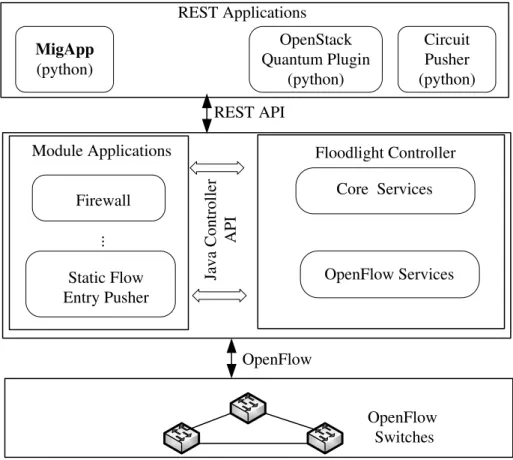
Floodlight [25] is a Java-based open source SDN controller initially developed by Big Switch Networks and currently supported by a community of developers. A number of module applications can be developed and compiled within Floodlight in order to perform additional functionalities. These modules make use of the
Flood-Ja va C ont ro ll er A P I MigApp (python) Circuit Pusher (python) OpenStack Quantum Plugin (python) Firewall REST Applications Floodlight Controller Core Services OpenFlow Services Module Applications Static Flow Entry Pusher ... OpenFlow REST API OpenFlow Switches
light API to communicate with the controller. An example of a module applications is the “Floodlight Firewall” [97]. Floodlight exposes its own REST API as well as the one of its modules for northbound communication with REST applications. REST stands for REpresentational State Transfer and it an architectural style for designing networked applications for distributed systems that runs over web. REST offers a general interface, scalable component interactions, and an independent components deployment while reducing latency, enforcing security and encapsulating legacy sys-tems. It allows developing applications in any programming language (Java, python, etc.) that communicate with the controller and its modules in a standard way. Figure 3.1 illustrates the SDN architecture composed of separated data and control planes as well as the management plane. It also shows the relationship among the Flood-light controller, the applications modules compiled with FloodFlood-light, and the REST applications. Once the controller is running, the modules running within it expose their REST API via a specific REST port to the management plane. Thus, any man-agement application can send HTTP REST commands through the listening REST port in order to retrieve information and invoke services from the controller or the supervised network. In this context, we built our MigApp as a REST application that uses REST API to retrieve and update information stored by the firewall mod-ule and to retrieve the network state. The firewall keeps the specified Access Control List (ACL) in a dedicated Floodlight storage that is consulted by the controller to take decisions on newly incoming flows. The rules conditions in the Floodlight fire-wall module matches a set of fields to their values, including switch id, the receiving switch port, the source and destination MAC and IP, the protocol with the source
and destination ports and a priority number. The matched ACL rule with the highest priority determines the action (allow/deny) to be taken on the flow.
3.3.2
Distributed Messaging System
In our solution, there is a need for a mechanism to coordinate the communication between the involved parties so that control messages and security policies can be exchanged. Constraints such as security, reliability, and performance have to be considered while selecting the right mechanism.
To this end, we opt for a distributed messaging system based on the Advanced Message Queuing Protocol (AMQP). Interesting features of the AMQP protocol are that all resources used for storing messages are dynamically created and destroyed by clients as they need them, there is no need for static pre-configuration, and there is a number of free client libraries available in various programming languages. We chose RabbitMQ [79], an open source broker implementation of the AMQP protocol. RabbitMQ is installed and used by clients on existing cloud services such as Amazon EC2 [28]. RabbitMQ is a message broker that basically accepts messages from a client program, called a producer, and store the messages in a queue that works as a mailbox inside the server. Other client programs, called consumers, wait to receive messages from the queue. The queue can store any number of messages and it is substantially an infinite buffer, which can run up to almost 30000 messages per second depending on the properties of the message. Many producers can send messages to one queue. On the other hand, many consumers can receive messages from one queue. A nice characteristic of such system is that the producer, consumer, and the broker do not
have to necessarily reside on the same machine. In fact, as distributed applications, they are scattered around different machines.
In RabbitMQ, the producer do not send messages directly to queues but to a specific entity called exchange, which receives and pushes them to queues. Thus, one needs to first create an exchange, then creates the queues, and finally binds the exchange to the queue. A binding is a relationship between an exchange and a queue which means that the queue is interested in messages from that particular exchange. The exchange must know what to do with a received message: either to append it to a specific or multiple queues, or even to discard it. The fate of a message is determined according to the exchange type, which can be direct, topic, headers or fanout. Moreover, among various messaging patterns, the Publish-and-Subscribe is one of the most used pattern in which messages can be received by multiple consumers with a fanout exchange that broadcasts produced messages to all subscribers. On the other hand, in some cases, the consumers are supposed to selectively receive some messages. It means that one message should be delivered to a specific consumer, whereas another message is destined for another consumer, and so on. In this scenario, the direct exchange will be used in addition to an extra routing key parameter that determines which consumer will receive which message. In our case, we use this latter exchange type so that any party only receives the messages intended to it.
With respect to server’s deployment, a RabbitMQ broker can be deployed in a centralized settings where multiple clients connect to the same server. However, it is also possible to use a distributed architecture, where multiple brokers are clustered and federated in order to ensure scalability and reliability of the messaging service
and to interconnect multiple administrative domains. Particularly, a shovel may be used to link multiple RabbitMQ brokers across the Internet and provide more control than federation. The latter deployment enables dealing with inter data center security rules migration. With respect to security, RabbitMQ supports encrypted SSL connection between the server and the client and has pluggable support for various authentication mechanisms. Thus, these specific features enable to strengthen the security of our framework by only allowing authorized MigApps and hypervisors to produce and consume messages and protecting the underlying communications. In the next section we discuss our approach in more details.
3.4
Approach
In this section, we describe our framework that enables security policies to accompany the corresponding virtual machines during their migration. We assume cloud data centers deployed according to the SDN strategy. In such a setting, an SDN controller (or multiple controllers such as in Onix [65] and HyperFlow [92]) is in charge of controlling and configuring a set of OpenFlow-enabled switches. In the following, we detail the design, implementation, and deployment of our framework.
3.4.1
MigApp Design
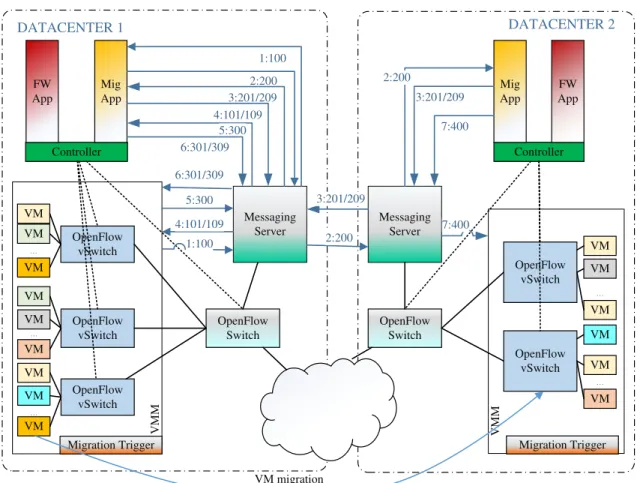
In order to address the need for security rules migration, we designed our solution as a distributed REST application that communicates with other MigApp instances and the hypervisor through a distributed messaging system, namely RabbitMQ. MigApp uses the REST API of Floodlight and its modules, particularly the firewall module,
in order to retrieve the matching ACL rules at the source of the migration or to update them at the destination. In our migration scenario, MigApp at the source of migration receives a request from hypervisor and starts a communication with the peer application that resides at the destination side. The source MigApp, identifies the rules whom correspond to the migrating VM, from the source firewall. Then, the two MigApps exchange the rules while coordinate the migration of VM through communication with hypervisors. This supervision ensures that the VM does not start running at the destination before the rules migration. At the end, the source MigApp deletes unnecessary rules and sends a message to the hypervisor in order to let the VM running at the destination place. As far as the communication through messaging is concerned, we designed various types of structured messages that contain the information needed for successfully coordinating the firewall rules migration. Each type of message is associated with a numerical identifier that identifies the message purpose. A message is structured as follows:
{ MsgType: <number>, Sender:<Sender_IP>, MigVM:<VM_IP>, Src:<MigApp_src_IP>, Dst:<MigApp_dst_IP>, Data:<Policies> }
such that “MsgType” is the type of message provided in numerical format, “Sender” is the sender of the message (could be the hypervisor or any MigApp instance), “MigVM” is the identification of the migrating VM (usually the IP), “Src” is the IP
![Table 2.1: Cloud Security Domains [43]](https://thumb-us.123doks.com/thumbv2/123dok_us/10216959.2925534/27.918.163.787.157.504/table-cloud-security-domains.webp)
![Figure 2.1: Cloud Computing Security Domains [54]](https://thumb-us.123doks.com/thumbv2/123dok_us/10216959.2925534/28.918.193.764.173.960/figure-cloud-computing-security-domains.webp)
![Figure 2.3: Three Layers of SDN Architecture[85]](https://thumb-us.123doks.com/thumbv2/123dok_us/10216959.2925534/35.918.180.795.254.866/figure-three-layers-of-sdn-architecture.webp)
![Figure 2.5: Different Security Appliances [15]](https://thumb-us.123doks.com/thumbv2/123dok_us/10216959.2925534/40.918.178.780.351.742/figure-different-security-appliances.webp)