Masters Theses Student Theses and Dissertations Spring 2018
Cloud transactions and caching for improved performance in
Cloud transactions and caching for improved performance in
clouds and DTNs
clouds and DTNs
Dileep MardhamFollow this and additional works at: https://scholarsmine.mst.edu/masters_theses Part of the Computer Sciences Commons
Department: Department:
Recommended Citation Recommended Citation
Mardham, Dileep, "Cloud transactions and caching for improved performance in clouds and DTNs" (2018). Masters Theses. 7769.
https://scholarsmine.mst.edu/masters_theses/7769
This thesis is brought to you by Scholars' Mine, a service of the Missouri S&T Library and Learning Resources. This work is protected by U. S. Copyright Law. Unauthorized use including reproduction for redistribution requires the permission of the copyright holder. For more information, please contact [email protected].
CLOUD TRANSACTIONS AND CACHING FOR IMPROVED PERFORMANCE IN CLOUDS AND DTNS
by
DILEEP KUMAR MARDHAM
A THESIS
Presented to the Faculty of the Graduate School of the MISSOURI UNIVERSITY OF SCIENCE AND TECHNOLOGY
In Partial Fulfillment of the Requirements for the Degree
MASTER OF SCIENCE IN COMPUTER SCIENCE
2018
Approved by
Dr. Sanjay Madria, Advisor Dr. Wei Jiang Dr. Fikret Ercal
2018 Dileep Mardham All Rights Reserved
PUBLICATION THESIS OPTION
This thesis consists of the following articles that has been published as follows: Paper I, Pages 21- 44 have been accepted to the 33rd ACM Symposium on Applied Computing (SAC), 2018.
Paper II, Pages 45 - 66 have been accepted to the 14th Wireless On-demand Network Systems and Services Conference (IEEE/IFIP WONS), 2018.
ABSTRACT
In distributed transactional systems deployed over some massively decentralized cloud servers, access policies are typically replicated. Interdependencies ad inconsistencies among policies need to be addressed as they can affect performance, throughput and accuracy. Several stringent levels of policy consistency constraints and enforcement approaches to guarantee the trustworthiness of transactions on cloud servers are proposed. We define a look-up table to store policy versions and the concept of “Tree-Based Consistency” approach to maintain a tree structure of the servers. By integrating look-up table and the consistency tree based approach, we propose an enhanced version of Two-phase validation commit (2PVC) protocol integrated with the Paxos commit protocol with reduced or almost the same performance overhead without affecting accuracy and precision.
A new caching scheme has been proposed which takes into consideration Military/Defense applications of Delay-tolerant Networks (DTNs) where data that need to be cached follows a whole different priority levels. In these applications, data popularity can be defined not only based on request frequency, but also based on the importance like who created and ranked point of interests in the data, when and where it was created; higher rank data belonging to some specific location may be more important though frequency of those may not be higher than more popular lower priority data. Thus, our caching scheme is designed by taking different requirements into consideration for DTN networks for defense applications. The performance evaluation shows that our caching scheme reduces the overall access latency, cache miss and usage of cache memory when compared to using caching schemes.
ACKNOWLEDGMENTS
I would like to convey gratefulness to all those who helped me on this thesis. I would like to thank my advisor Dr. Sanjay Kumar Madria, who gave me a wonderful opportunity to work on this research. His suggestions, feedback and encouragement carried me through strenuous times. His intellect and expertise in this field of research is unparalleled. Secondly, I would also like to express my gratitude to Dr. Wei Jiang Yin and Dr. Fikret Ercal for serving on my thesis committee and for taking time to review this work.
I am grateful to all my lab mates and friends for their professional help, inputs. This project is partially funded by the Air Force Research Laboratory (AFRL) in Rome, New York and I express my gratitude to them as well.
TABLE OF CONTENTS
Page
PUBLICATION THESIS OPTION ... iii
ABSTRACT ... iv
ACKNOWLEDGMENTS ... v
LIST OF ILLUSTRATIONS ... viii
LIST OF TABLES ... ix
SECTION 1. INTRODUCTION ... 1
1.1 INTRODUCTION AND MOTIVATION FOR CLOUD TRANSACTION ... 1
1.2 INTRODUCTION AND MOTIVATION FOR CACHING ... 3
2. RELATED WORK ... 5
2.1 RELATED WORK IN SECURE CLOUD TRANSACTIONS DOMAIN ... 5
2.2 RELATED WORK IN DTN OPPORTUNISTIC CACHING DOMAIN ... 12
PAPER I.CLOUD TRANSACTIONS ADHERE TO STRICT POLICY CONSISTENCY FOR IMPROVED PERFORMANCE ... 21
ABSTRACT ... 21
INTRODUCTION ... 22
LITERATURE REVIEW AND PRELIMINARIES ... 24
SYSTEM ASSUMPTIONS AND PROBLEM STATEMENT ... 26
3.1 SYSTEM MODEL... 26
3.2 PROBLEM MOTIVATION ... 28
OUR PROPOSED APPROACH ... 29
SIMULATION DESIGN AND EXPERIMENTS ... 37
CONCLUSION AND FUTURE WORK ... 43
REFERENCES ... 43
II.OPPORTUNISTIC DISTRIBUTED CACHING FOR MISSION-ORIENTED DELAY-TOLERANT NETWORKS ... 46
ABSTRACT ... 46
RELATED WORK ... 48
OUR MISSION-ORIENTED NETWORK MODEL ... 49
CACHING USING CONTENT CLASSIFICATION ... 51
CACHING ALGORITHM ... 56
5.1 INITIAL DISTRIBUTION OF CACHING DATA ... 56
5.2 CACHE REDISTRIBUTION UPON REQUESTS ... 58
5.3 CACHE REPLACEMENT ... 59
SIMULATION AND EXPERIMENT ... 60
RESULT ANALYSIS ... 63 CONCLUSION ... 66 REFERENCES ... 66 SECTION 3. CONCLUSION ... 68 REFERENCES ... 69 VITA. ... 71
LIST OF ILLUSTRATIONS
Figure Page
PAPER I
1. Interaction Among System Components ... 27
2. Consistency Tree Of Replica Servers ... 30
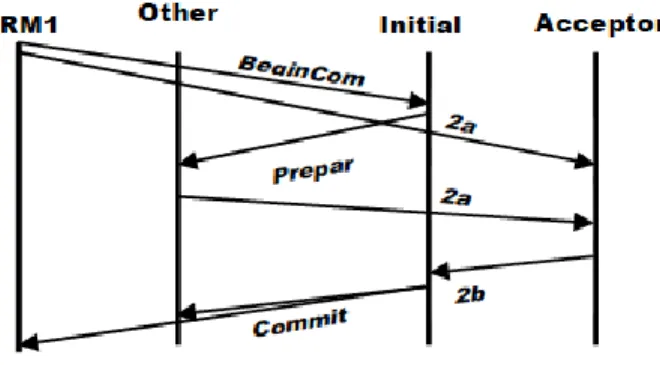
3. The Message Flow For Paxos Commit In The Normal Failure-Free Case... 35
4. Transaction Cost Without Consistency Tree And 2PC ... 41
5. Transaction Cost With Consistency Tree And Paxos Commit ... 42
6. Transaction Throughput Without Consistency Tree And 2PC ... 42
7. Transaction Throughput With Consistency Tree And Paxos Commit ... 42
8. Commit Ratio Without Consistency Tree And 2PC ... 42
9. Commit Ratio With Consistency Tree And Paxos Commit ... 42
PAPER II 1. Content Caches ... 50
2. Network Model ... 51
3. Cache Miss ... 64
LIST OF TABLES
Table Page
SECTION
2.1. Contrasting The Various Proofs Of Authorization ... 11 PAPER I
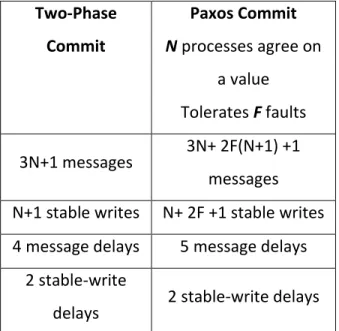
1. Tradeoff Between 2PC and Paxos ... 36 2. Fixed Parameters ... 40 PAPER II
1. Simulation Parameters ... 62 2. Access Latencies Across Different Algorithms For Different Node Counts ... 64 3. Cached Size Used Percentage ... 64
1. INTRODUCTION
1.1 INTRODUCTION AND MOTIVATION FOR CLOUD TRANSACTION
Cloud is a computing model that provides on-demand computing resources ranging from small – large scale applications to data centers over the internet on a pay for use basis. Cloud computing provides many features like elasticity, which is the ability of a system to automatically up-scale or down-scale the computing resources on demand as workload changes. Cloud based applications run on distant computers “in the cloud” that are owned and operated by others (Amazon, Google, Yahoo, Microsoft etc.,) and that connect to users’ computers via the Internet. It also provides cloud-based environment to support the complete life cycle of building and delivering web-based applications without the cost and complexity of buying and managing the underlying hardware, software, provisioning and hosting.
One of the most appealing aspects of cloud computing is its elasticity, which provides an illusion of infinite, on- demand resources [1] making it an attractive environment for highly-scalable, multi-tiered applications. However, this can create additional challenges for back-end, transactional database systems, which were designed without elasticity in mind. Despite the efforts of key-value stores like Amazon’s SimpleDB, Dynamo, and Google’s Bigtable to provide scalable access to huge amounts of data, transactional guarantees remain a bottleneck [2].
The most important aspects of cloud computing are elasticity and scalability, which catalyzed much of the recent interest in cloud computing, raises many complex issues for back-end, transactional database systems. Cloud services often make heavy use of replication to ensure consistent performance and availability. A common trait characterizing the new generation of cloud data platforms is the adoption of weak consistency models, such as eventual consistency, restricted transactional semantics and non-serializable isolation levels.
Eventual consistency allows data to be inconsistent among some replicas during the update process, but ensures that updates will eventually be propagated to all replicas. The major problem associated with this approach is the difficulty in maintaining the
ACID guarantees, in which Consistency is compromised to provide reasonable availability.
Authorization policies describes the conditions under which users should be permitted access to resources and describes the relationships between the system principals, as well as the certified credentials that users must provide to attest to their attributes. The transactional database system is deployed in a highly distributed and elastic system, policies are typically replicated among multiple servers following the eventual consistency model. It therefore becomes possible based on policy-based authorization system is prone to make unsafe decisions using stale policies.
Interesting consistency problems can arise as transactional database systems are deployed in cloud environments and use policy-based authorization systems to protect sensitive resources. In addition to handling consistency issues amongst database replicas, we must also handle two types of security inconsistency conditions. First, the system may suffer from policy inconsistencies during policy updates due to the relaxed consistency model underlying most cloud services. For example, it is possible for several versions of the policy to be observed at multiple sites within a single transaction, leading to inconsistent (and likely unsafe) access decisions during the transaction. Second, it is possible for external factors to cause user credential inconsistencies over the lifetime of a transaction [3]. For instance, a user’s login credentials could be invalidated or revoked after collection by the authorization server, but before the completion of the transaction. If the problems associated with policy consistency are not alleviated, the company or individual may face a potential risk. The company may leak information about customers and face harsh penalties and loss of credibility.
Cloud services are widely adopted by various organizations for resource sharing and elasticity. The vendors of cloud services generally lack consistency among the policies across all the servers. Due to this inconsistency, there is a possibility of transaction abort when a user tries to request with older policy. In this case, the user will not be able to access the data item as the policy doesn’t match with the newer policy. A user who earlier had access to the data item will not be able to perform any operations on the data item. Such situations should be avoided, and we present the below mechanism to resolve such issues.
In addition to handling consistency issues among database replicas, policy inconsistencies and user credential inconsistencies needs to be addressed for which possible solutions have been proposed. But there are performance and latency issues with these solutions and we address them in this paper.
1.2 INTRODUCTION AND MOTIVATION FOR CACHING
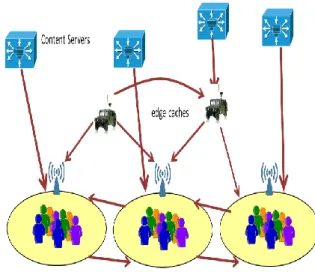
Caching data within DTNs is discovered as a means for both persisting data locally to make the data both more readily available in close proximity, and to reduce resource usage through a reduction in hops to the high priority data sources. Additionally, DTNs present an even more significant challenge for data persistence as they are, by nature generally isolated and disconnected from a larger network or the Internet. Therefore, DTNs must cache mission critical useful data to share within the network. Though local device caching of data is a useful method to accomplish data persistence and increase availability, it comes with its own set of challenges and problems in DTNs. Situations can arise where specific nodes within the network become over utilized by caching too many data points due to the uncertainty of data transmission, thus multiple data copies need to be cached at different locations to ensure higher data dissemination. The difficulty in coordinating multiple caching nodes due to the lack of persistence network connectivity makes it hard to optimize the trade-off between data accessibility and caching overhead. Thus, each node has to decide what data to be cached as nodes cannot design a cooperative caching schemes because of not knowing which other nodes they can reach. A situation may come where specific nodes become over burdened by caching too many important messages. This results in the storage space for that specific device becoming over utilized and the battery life being exhausted due to the device carrying a disproportionate amount of data and forwarding requests for the data it holds to each peer it meets. Caching in DTNs can create a situation where the data might not be proximate to the nodes that need it. This results in an increase in the energy utilization due to the need to disseminate the data across many peers. Caching can consider the location of the node, POIs and queries performed by the node and then predicting the caching needs at the next time instants.
DTN networks use caching as a technique to store some of the transferring files in order to satisfy the future requests reduced data access delay. Each Network Operating System (NOS) which uses DTNs requires a unique kind of caching method to fulfil its particular needs. From all the data caching methods we have studied, file popularity and cooperative caching have always been the main motivation behind the file selection for caching to satisfy future requests and how cache replacement should to be done. Although these methods are efficient in many general scenarios where users transfer picture or other kinds of media files in a busy network using mobile devices, there are some scenarios where these methods of caching entirely fail to address the requirement. In situations like Military networks, or any other defense data networks, the data need that need to be cached follows a whole different priority. Some files despite of low popularity should be cached with highest priority which is completely against the conventional caching methods that we use today. Some other classified data files even with the increasing demand the data replication should be restricted to a certain number of times in order to prevent data theft or other security issues. So, a new caching technique has to be designed which takes different requirements into consideration to fulfil this necessity in defense data networks.
The simplest solution would be to just cache everything we can on every device and update it as we make connections to other nodes in the network, the problem with this is twofold: collisions, and space/energy constraints, so this approach is unrealistic. Because of this we must make decisions in exactly how we are going to cache data around this network. If an item is too popular a single node may become overwhelmed with requests for that data, so it should probably be replicated. In addition, data that is not cached locally must be retrieved with one or more hops around the network. This adds latency to the system, and consumes more power with the requests and responses for the data, so exactly where to store the data is another dimension of concern. And some data may not be as popular, but latency to it may be such a concern that it must be accessible quickly. These three elements: location, latency, and popularity of the data will be the primary qualities we use to judge data in how exactly to cache it.
2. RELATED WORK
2.1 RELATED WORK IN SECURE CLOUD TRANSACTIONS DOMAIN
Cloud providers lack services that guarantee both data and access control policy consistency across multiple data centers. In the article [3], several policy and user credential consistency problems are identified, and policy based authorization systems are used to enforce access control. In previous papers [4], [5], the confluence of data, policy, and credential inconsistency problems that can emerge using transactional database systems are addressed. In doing so, the authors made the following contributions:
• Initially, formalization of the concept of trusted transactions is presented. Trusted transactions are those transactions that do not violate credential or policy inconsistencies over the lifetime of the transaction. The authors then presented a more general term, safe transactions, that is used to identify transactions that conform to the ACID properties of distributed database systems and are trusted in terms of the validity of the policy evaluation.
• Since achieving ACID properties in distributed transactional databases has been extensively studied [4], [5], they focused on how to achieve trusted transactions. Accordingly, they defined different levels of policy consistency constraints as well as different enforcement approaches to guarantee the trustworthiness of transactions executing on cloud servers.
• The authors also proposed a solution that involves an adaptation of the Two-Phase Commit (2PC) protocol to enforce trusted transactions, which we refer to as Two-Phase Validation Commit (2PVC) protocol. The protocol ensures that a transaction is safe, as it ensures policy and credential consistency as well as data consistency.
• The authors presented a performance analysis study of the proposed approaches. Proof of Authorization
We now present a formal definition of a proof of authorization. Let fsi = <qi, si, Psi(m(qi)), ti, c> denote the proof of authorization evaluated at server si, where qi is a query defined over a set of read/write requests submitted to that server. Psi denote the
proofs of authorizations enforced by server si and belonging to the same administrative domain A. Function m is a mapping such that m : Q → 2D, that is, m identifies the set of data items that are being touched by query q. Time ti is the time instance at which the proof of authorization is being evaluated, and finally c is a set of credentials presented by the user to complete the proof of authorization such that c ⊆ C which is the set of all credentials.
Let F denote the set of all proofs of authorizations, and the set TS contains all possible timestamps. The validity of each proof of authorization f ∈ F at time instance t is evaluated using the predicate eval(f, t) such that eval : F ×TS → B. The Boolean sign is true if the proof of authorization is valid. The validity of a proof of authorization is asserted in two cases:
1) Credentials are syntactically and semantically valid: According to the definitions in [4], a credential ckis syntactically valid if the following conditions hold: (i) it is formatted properly, (ii) it has a valid digital signature, (iii) the start time of each transaction α(ck) has passed, and (iv) the time at which the transaction finishes execution and is ready to commit β(ck) has not yet passed. A credential ck issued at time tiis semantically valid at time t if an online method of verifying ck’s status indicates that ckwas not revoked at time t′ and ti ≤ t′ ≤ t.
2) The inference rules are satisfying: A policy is a set of inference rules that are encoded by policy makers to capture system’s access control regulations. Given policy P, and user credentials C, if the inference rules of the policy can be satisfied using the user credentials, then the proof of authorization is said to be valid and the access is granted accordingly.
Consistency Levels
Since transactions are executed over time, the state information of the credentials and the policies enforced by different servers are subject to changes at any time instance, therefore it becomes important to introduce precise definitions for different consistency levels that could be achieved within transaction’s lifetime. These consistency models strengthen the notion of trusted transaction by defining the environment in which policy versions are consistent relative to the rest of the system. Before we do that, we define a
transaction’s view in terms of different proofs of authorizations evaluated during the lifetime of a transaction.
Two consistency models have been proposed to handle consistency within transactions:
• View Consistency: A view VT={<qi, si, Psi(m(qi)), ti, c>, . . . , <qn, sn, Psn(m(qn)), tn, c>} is view consistent, or Φ-consistent, if VTsatisfies a predicate Φ-consistent that places constraints on the versioning of the policies such that Φ-consistent(VT) ↔ ∀i, j : ver(Psi) = ver(Psj) for all policies belonging to the same administrator A, where function ver is defined as ver : P → N where P is set of all policies and N is the infinite set of natural numbers.
The policy versions should be internally consistent among all servers executing the transaction. With a view consistency model, the policy versions should be internally consistent across all servers executing the transaction. The view consistency model is weak in that the policy version agreed upon by the subset of servers within the transaction may not be the latest policy version v. It may be the case that a server outside S servers has a policy P that belongs to the same administrative domain A and with a version v′ > v. A more strict consistency model is the global consistency and is defined as follows.
• Global Consistency: A view VT ={<qi, si, Psi (m(qi)), ti, c>, . . . , <qn, sn, Psn (m(qn)), tn, c>} is global consistent, or Ψ-consistent, if VTsatisfies a predicate consistent that places constraints on the versioning of the policies such that Ψ-consistent(VT ) ↔ ∀i : ver(Psi) = ver(P) for all policies belonging to the same administrator A, and function ver follows the same aforementioned definition, while ver(P) refers to the latest policy version.
The policies used to evaluate the proofs of authorization during a transaction execution among S servers should match the latest policy version among the entire policy set P, for all policies enforced by the same administrator A.
Trusted Transactions
Trusted transactions are defined as transactions which do not fail to agree with the credential or policy inconsistencies during execution. Given a transaction T ={q1, q2, . . . ,
qn} and its corresponding view VT , T is trusted iff ∀fsi ∈VT : eval(fsi , t), at some time instance t : α(T) ≤ t ≤ β(T)∧(Φ-consistent(VT)∨Ψ-consistent(VT)).
Based on the consistency models, the term safe transaction is defined which is a trusted transaction and satisfies all data integrity constraints imposed by the database management system. In practical, a transaction will commit if it is safe and any unsafe transaction is forced to rollback.
Trusted Transactions Enforcement
A variety of light-weight proof enforcement and consistency models (Deferred, Punctual, Incremental, and Continuous models) have been proposed that enforced increasingly strong protections with minimal runtime overheads. A brief description of different proofs of authorization models is given below:
• Deferred proofs of authorization are evaluated simultaneously at commit time to decide whether the transaction is trusted. A transaction T and its corresponding view VT , T is trusted under the deferred proofs of authorization approach, iff at commit time α(T), ∀fsi ∈ VT: eval(fsi,β(T))∧(Φ-consistent(VT) ∨ Ψ-consistent(VT)). By employing deferred proofs of authorizations, transactions are most likely to execute faster but on the expense of risking a transaction to be forced to rollback after it has proceeded till the commit time in case of violation of the trusted transaction condition.
• Punctual proofs of authorization are evaluated instantaneously whenever a query is being handled by a server. This is a proactive approach and facilitates early detection of unsafe transactions, saving system from getting into costly undo operations. Proofs of authorization are re-evaluated at the commit time. Given a transaction T and its corresponding view VT, T is trusted under the Punctual proofs of authorization approach, iff at any time instance ti : α(T) ≤ti ≤ β(T) ∀ fsi ∈ VT: eval(fsi, ti) ∧eval(fsi, β(T)) ∧ (Φ-consistent(VT) ∨ Ψ-consistent(VT)).
Punctual proofs of authorization do not impose any restrictions on the freshness of the policies used by the servers to evaluate the proofs during the transaction execution. It is only at commit time when the proofs of authorization are re-evaluated while enforcing view consistency or global consistency. Hence, due to the weak consistency paradigm on which cloud servers operate, a server
might evaluate a proof based on an old version of a policy and in that case there is no guarantee that the decision made by that server is valid or invalid. Consequently, servers might have false negative decisions and deny access to queries, and on the other hand, false positive decisions could also be made.
• Incremental Punctual proofs of authorization doesn’t allow a transaction to proceed unless each server achieves the desired level of the policy consistency with all previous servers. All participating servers are forced to be in consistent view with the first executing server and if a newer policy version shows up at a later server, the transaction aborts. Given a transaction T and its corresponding view VT , T is trusted under the Incremental Punctual proofs of authorization approach, iff at any time instance ti : α(T) ≤ ti ≤ β(T), ∀fsi ∈VTti: eval(fsi, ti) ∧ (Φ-consistent(VTti) ∨ Ψ-consistent(VTti)).
If the first server s1 does not have the latest version, the proof of
authorization at that server is risked to be evaluated using an older policy. Note that in this scenario if any of the other servers has a newer policy version, the consistency condition will not be satisfied and the transaction will be forced to rollback, saving the transaction from doing any further untrusted authorizations.
• Continuous proofs of authorization are evaluated throughout a transaction’s lifetime and if a newer version of the policy is found at any of the participating server, all previous proofs have to be re-evaluated after updating policies on all inconsistent servers. A transaction T is declared trusted under the Continuous approach, iff ∀1≤i≤n∀1≤j≤i : eval(fsi, ti) = true ∧ eval(fsj, ti) = true ∧ (Φ-consistent(VTti) ∨ Ψ-consistent(VTti)) at any time instance t : α(T) ≤ t
i≤ β(T). In Continuous proofs of authorizations, at every time instance when an evaluation of a proof of authorization is being made, all previous proofs of authorizations are forced to be re-evaluated before the transaction can proceed. If any of the evaluations fail at any time instance, the entire transaction is forced to rollback.
Two-Phase Validate Commit Algorithm
A two-phase validation commit protocol (2PVC) is proposed which is an improvised version of the two-phase commit protocol (2PC) and the two phase validation
protocol (2PV). In 2PVC validation of the authorization policy and credentials are carried out compared to 2PC in which data integrity check is performed. 2PVC will evaluate the policies and authorizations within the voting phase. That is, when the TM sends out a Prepare-to-Commit message for a transaction, the participant server has three values to report: (1) the YES or NO reply for the satisfaction of integrity constraints as in 2PC, (2) the TRUE or FALSE reply for the satisfaction of the proofs of authorizations as in 2PV, and (3) the version number of the policies used to build the proofs (vi, pi) as in 2PV.
________________________________________________________________________ Algorithm: Two-Phase Validation Commit 2PVC
1 Send “Prepare-to-Commit” to all participants
2 Wait for all replies (Yes/No, True/False, and a set of policy versions for each unique policy)
3 If any participant replied No for integrity check 4 ABORT
5 Identify the largest version for all unique policies
6 If all participants utilize the largest version for each unique policy 7 If any responded False
8 ABORT 9 Otherwise 10 COMMIT
11 Otherwise, for participants with old policies
12 Send “Update” with the largest version number of each policy
13 Wait for all replies 14 Goto 5
The process given in Algorithm 2 is for the TM under view consistency. It is very similar to that of 2PV with the exception of handling the YES or NO reply for integrity constraint validation and having a decision of COMMIT rather than CONTINUE. The
TM enforces the same behaviour as 2PV in that it identifies policy inconsistency, sends Update messages to create consistency, and re-executes the first phase. The same changes to 2PV can be made here to provide global consistency. That is, the global 2PVC does not need to determine the latest version number from the participant votes. Instead, it simply asks some master server on the system which knows the latest policy version at Step 5.
Complexity
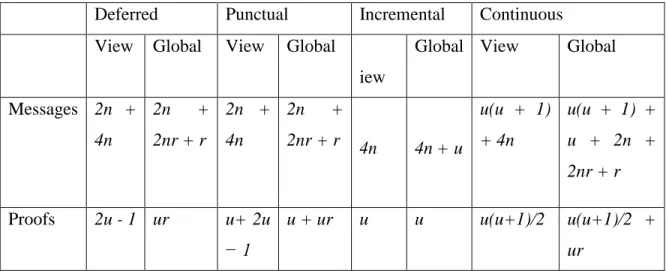
The cost of 2PC is typically measured in terms of log complexity (i.e., the number of times the protocol forcibly logs for recovery) and message complexity (i.e., the number of messages sent). We add another metric, namely the number of proof evaluations. These metrics are given with respect to the number of participants involved with the decision, n, the number of queries, u, and the number of voting rounds, r. The log complexity of 2PVC is no different than normal 2PC, which has a log complexity of 2n + 1 [4]. Table 2.1 shows the complexity—in terms of the maximum number of messages and proofs—for each proof of authorization scheme for both view and global consistency.
Simulated workloads have been used to experimentally evaluate implementations of the consistency models relative to three core metrics: transaction processing performance, accuracy and precision.
Table 2.1. Contrasting The Various Proofs Of Authorization Deferred Punctual Incremental Continuous View Global View Global V
iew
Global View Global
Messages 2n + 4n 2n + 2nr + r 2n + 4n 2n + 2nr + r 4n 4n + u u(u + 1) + 4n u(u + 1) + u + 2n + 2nr + r Proofs 2u - 1 ur u+ 2u − 1 u + ur u u u(u+1)/2 u(u+1)/2 + ur
2.2RELATED WORK IN DTN OPPORTUNISTIC CACHING DOMAIN
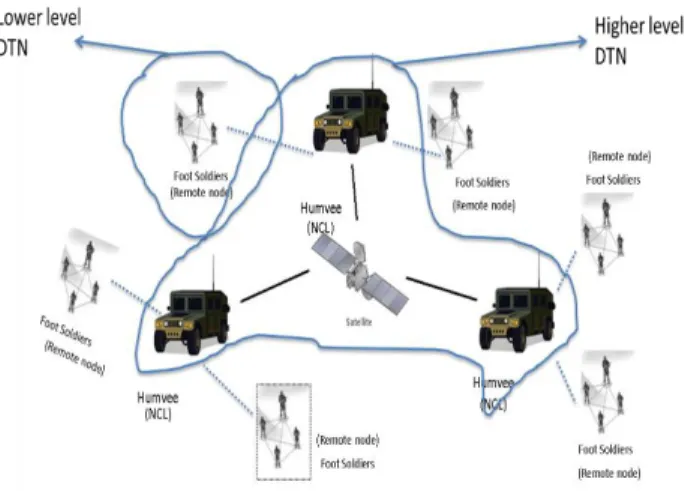
The paper [20] deals with improving the coordination between the multiple caching nodes in the delay tolerant networks (DTN's) to optimize the data accessibility and caching overhead. The main challenges that are dealt in this paper are how to select the nodes that are optimal to cache the data. How to overcome the limited buffer space in central nodes to improve the total caching limit, how to prioritize the data that need to be cached are all issues plagued by any research into this topic.
To select the Network Central Locations (NCL's) three types of NCL selection methods are used namely NCL selection metric, Trace-based validation and Practical NCL selection. In NCL selection metric the nodes which participate most in connecting all the nodes using the shortest path with less cost are selected and made as NCLs. In trace-based validation we select the nodes based on their popularity. The nodes are selected using realistic DTN traces. These traces are observed for a certain amount of time and each node popularity is decided on how well they are connected to the other nodes. In practical NCL selection we select 'K' best NCLs that are available in the network. In this method we use NCL selection metric that was used before, but we try to limit the NCL's to K number. Two ways to make this selection are global selection where the nodes are selected recursively to support the previous nodes until K nodes are selected and distributed selection where the k nodes are selected independent of the global network knowledge.
To expand the cache buffer space if all the NCLs cache is full then the nodes that are close to NCLs are selected and they are used to store the less popular data. To improve the coordination between the NCLs whenever two NCL’s encounter each other they compare and share their respective information to optimize the information. So, with the increase in time all the NCLs might encounter each other and the information they carry becomes optimized.
Coordination between different NCLs and optimization of data of every NCL can become an endless optimization cycle which consumes a lot of energy if the network is very big and can never be optimized. To overcome this drawback, we think the NCL optimization should be limited to certain range and the range depends on how diverse the nodes are and how big the network is. From this paper we can understand how NCL
placement in the network is critical for the efficient data transmission and how caching space limitations can be improved.
In the paper [21], we consider a delay-tolerant content sharing network built over a network of mobile users and wireless access points, where the users download content opportunistically from each other via short-range communications (e.g. Bluetooth or Wi-Fi). If the requested content is not found within the prescribed time, the users will download it through the more expensive 3G network.
This paper discusses the factors that contribute for caching in DTNs are Cache capacity within each node, User mobility, Density of the access points, how well the requests are distributed within the nodes to find the data and contact duration i.e. at least for long should the connection exist to transfer the complete file. The ultimate goal is to send the query request to all the nodes and retrieve the data back to requested node within a certain amount of time.
Cooperative caching is the method used in this paper and to achieve that cooperation between the nodes we use Zipf’s law. According to Zipf’s law every file has a certain probability of getting requested and the files with higher probability should be replicated more to improve the data retrieval time. Due to the additional time constraint i.e. to retrieve the data within a certain amount of time, four different pushing methods are used to flood the nodes with all the available data.
1) Random Pushing: Each mobile device randomly stores K files in their cache. 2) K-most Popular: The K files with highest probability of request are cached. 3) Optimal: Files are distributed according to optimal file distribution algorithm. 4) Pushing Algorithm: Files are distributed because of the above selective pushing
algorithm.
From the analysis, to improve the overall average hit ratio of the cache, the files which are popular should be replicated more and less popular files should be less replicated. By storing more copies of the popular files and less copies of the unpopular files, the overall hit rate could possibly improve. The miss ratio decreases exponentially with the patience time. Random push strategy has the highest miss ratio compared to others whereas k-most popular miss ratio didn’t change much with increase in file number. Optimal file pushing strategy got less miss ratio with the increase in file number.
One assumption made in this paper by authors is that all the nodes has the same amount of cache space and all the nodes are well and uniformly connected to each other. So, there is no discussion about the selection of NCLs in the network. This clearly is a drawback because in a practical situation no two nodes behave similarly and NCLs play a huge role in DTN caching data retrieval.
The main contribution of the paper [22] is to provide a formal framework for the characterization of the performance of optimal in-network caching in ICNs, as well as opportunistic in-network caching at the edge of ICNs—i.e., close to the end-users. The authors used Independent Reference Model (IRM), which assumes that the objects are equal sized whose references occur independently, to study the benefits of using universal caching compared to a simple policy of caching only at the edge of the network assuming a simple hierarchical caching structure.
The authors consider a hierarchy of LRU (Least Recently Used) caches in the form of a tree with its root acting as the content source. The paper assumes that the source stores permanent copies of all the information objects in the system. Alternatively, the source can be considered as a collection of all possible content hosts that are logically collapsed into one single entity as the root of the tree in our model. The tree comprises L + 2 levels. The content subscribers (i.e., users or information requesters) are at the 0th level, while the content source is at level L + 1. Subsequently, there exist L levels of nodes with caching capabilities between users and the content source which are sequentially labelled from bottom (level 1) to the top (level L).
The caching paradigm used to optimize is called “on-path caching” which works as follows. When a request for an object is raised at level 0, it is forwarded along the (unique) path of intermediate caches towards the root until a cache hit occurs. If all cache accesses are missed along the path, the request will be fulfilled by fetching a copy of the object directly from the source (root). Once located, the object is transferred on the reverse path back to the requester and a local copy is also stored on each and every node along the path.
The results using this model demonstrate that, while optimal caching naturally tends towards the edge with an increased caching budget, higher degrees of reference locality further accelerate this transition. The results indicate that the optimal caching
approach based on universal caching provides only marginal benefits over the simple policy of caching only at the edge routers of the ICN. The paper failed to take into consideration the following aspects:
• More realistic topologies and Develop model for random networks.
• Verify synthetic traces for locality of reference model with real traffic traces.
• New approaches to integrate routing with edge caching.
The paper [23] discusses about locating the Network Central Locations (NCL) within all the DTNs based on the node’s social levels and how well it is connected to other nodes. Selected data which has great popularity in a region is cached on a node at that location. Even though the most popular data of the network has many duplicate copies within the NCLs the popularity of the data is gradually decreased depending on that node’s distance from the node where that data has highest popularity. Caching space limitation is improved by utilizing the cache space of the other selective nodes near the NCLs. The cache of the NCLs is replaced periodically with new data based on the frequency of data usage, user requests and freshness of data access. To find the best nodes to be selected as NCLs within all DTNs K-Means Clustering algorithm is used.
This paper proposes a new method called social based forwarding approach for content retrieval. This method follows several steps which are as follows.
Compute Social-Tie Relationship: Two nodes are said to have a strong tie if they have met frequently in the recent past. We compute the social tie be1tween two nodes using the history of encounter events.
Compute centrality: Each node maintains a social-tie table that contains the social distances from the current node to all other encountered nodes. During the encounter period, the social-tie table is exchanged and merged into the other node’s social-tie table. Based on the social-tie table, a node can compute each other node’s centrality. We estimate the centrality by considering both the average social-tie values and their distribution. Namely, we favor nodes with high, uniformly distributed social ties to all other nodes.
Compute Social Level: Nodes that have similar centrality tend to have similar level of contacts with other nodes and thus similar knowledge on content providers. To reduce the forwarding cost of the content query phase, we propose to group together
nodes with similar centrality into the same cluster. Interest packets are only forwarded from one cluster to another cluster. There is no Interest forwarding within a cluster. Each cluster represents a social level in the network.
Content Name Digest Convergence: To facilitate content query, each content provider actively announces its content name digest (a list of names of contents a node owns) to nodes in higher centrality clusters. Each node maintains a local data structure called digest table (which maps the provider ID to the digest) to store the received digests from lower centrality nodes. Furthermore, when nodes encounter each other, the digest table will be sent to the node with the higher centrality. Throughout this process, the content name digests from each content provider are converged toward higher centrality nodes. Subsequently, higher centrality nodes have broad knowledge of which node owns which content in the network.
Interest Packet Forwarding: The Interest packet is carried by the requester and is forwarded to the first encountered node that has a higher social level than the requester itself. Subsequently, the requester keeps a copy of the Interest packet and forwards it to the next encountered node that has an even higher social level than the last relay node.
After a node receives an Interest packet from other nodes it encountered, it will first check its local digest table to see if there is any matched name. If no matched name is found, it will continue forwarding the Interest packet. Each relay node performs the same strategy; forwarding the Interest packet to the next relay node that has a higher social level than the last relay node. Following this strategy, the Interest packet is forwarded upward, level by level, toward the most popular node in the centrality hierarchy.
Data Packet Forwarding: After the Interest packet reaches the content provider, the content provider will social-tie route the data packet back to the requester. The content provider only responds once to the same Interest packet that originates from the same requester. Subsequent received duplicate Interest packets are ignored. The prominent issues faced during caching schema are what data is needed to be cached, where the data needed to be cached and how the cached data should be replaced when new data comes into play.
Cached Data Selection: Intuitively, popular data is a good candidate for caching. We compute the content popularity (relative to the current node) by considering both the frequency and freshness of content requests arriving at a node over a history of request arrivals.
Cache Location: If each node has unlimited cache space, then it is trivial to identify suitable caching locations, as data can be cached everywhere. Given that each node has limited space for caching, we follow a conservative approach and only cache data at nodes satisfying the following conditions:
1) Selected nodes are on the query forwarding paths. 2) They are traversed through by many common requests.
3) Caching in neighbors of central nodes, whose caches are heavily utilized, is another optimization implemented in this scheme.
Cache Replacement: When the cache buffer is full, existing data must be evicted from the cache, to accommodate new data. There are two related issues: 1) Determining the amount of data to evict. 2) Identifying particular data to evict. For the first issue, we need to evict as much data as the size of the new data. Regarding the second issue, we propose to remove data from the cache that is identified as least popular. That is, we consider both the frequency and freshness of data access.
Caching Protocol: Nodes periodically advertise their spare cache capacity to each other. This allows central nodes to opportunistically make decisions regarding which cached data to move to neighboring nodes so that central nodes have more space to cache new popular data.
Cooperative caching is the main key to find which data should be stored at which NCL so that the data retrieval is easier and query requests are processed efficiently. Since the file popularity decreases gradually the query search can be stopped after certain range from the NCL where the data was popular. From this paper we can understand how the file popularity helps to cache a file for a long time and how modifying this file popularity index for a file manually can improve a file’s life-time which has less requests but of high value for some users. This paper fails to address the following issues.
• Trying to update the social tie values and local digest table involving all the nodes increases the nodes power consumption.
• How to preserve the data which is less popular but very important for some set of users.
In paper [24] content distribution is defined as the task of providing requested data to the clients. Requests are constructed by the client and transmitted to a node capable of servicing them, usually a server or repository. This is different from caching, which ideally is used to provide the same data item to a large number of clients and thereby involves individual nodes keeping a copy of the data item so that they can fulfil requests just as well as the server. A mobile repository, sometimes called a data store or a throwbox, contains a large collection of related items, thus allowing the device to fulfil most requests.
In DTNs, social context can be used to improve the efficiency of certain tasks such as routing or caching. Clients’ content requests tend to be influenced by social patterns. In general, if a client’s contacts request a specific data item, that client has a greater probability of requesting the item as well. To take advantage of this tendency, a node first must identify the consistent contacts of a node. In a dynamic environment in which nodes are added and removed, the social structure must accommodate such changes.
The purpose of the Social Content Distribution (SCD) schema is to locate the optimal position for mobile repositories. This is accomplished by evaluating the existing social structure of the network, identifying which nodes and groups issue frequent content requests, and locating the devices most capable of fulfilling these requests. Initially, a node identifies its frequent contacts, forming small groups. These groups are merged, joined, and left by nodes to accurately reflect the network’s social structure. The end result is the positioning of repositories in close proximity to requests, increasing content availability and reducing the average delivery time.
If a set of nodes meet frequently, the algorithm will assume the nodes are in a group. The request predictions are based on historical patterns; if a node requests data from a throwboxes frequently or are in a social group whose members frequently request content, the throwboxes assumes it will do so in the future. Based on the nodes’ predicted content request, the throwboxes relocates itself to serve these requests quickly.
Grouping: In this context, a social group is a collection of nodes that have regular contact with each other. Nodes within a social group maintain group data, including group membership and the metrics of all group members. All nodes maintain their group list in one of following three ways:
i) Two nodes having regular contact with one another form a new social group: The first step in determining any groups formed by nodes is to establish a metric by which to measure the distance between two nodes. The SCD schema calculates the percentage of time spent in direct contact, using an exponential moving average formula to adjust the current estimate. With this information, a cumulative estimate of the contact strength is calculated and compared to a group formation threshold. When the contact strength exceeds a control threshold, the nodes are considered close enough to form a new group.
ii) Two social groups with similar members merge: By tracking the contact strength between nodes, a series of two-node social groups can be formed. The next step is to integrate these links into larger groups by merging similar groups. Nodes that are joint members of two groups will periodically review the group data for merges. If the joint node determines that the two groups are similar enough, then a SUGGEST message is sent to the group head of the smaller of the two groups. This message indicates that the node believes that merging the two groups is justifiable. Performing merges in this manner updates groups in a limited environment. The drawback is that it does not ensure that all nodes of the group are strongly connected to all members of the new group. To address this issue, nodes can resign from groups to which they no longer have a strong attachment.
iii) Nodes resign from groups in which they no longer participate: Periodically, nodes will review their group list to ensure that they are still participating. The average contact strength to all group members is calculated, and if it is beneath ψ, the node resigns from the group. To avoid fragmentation, the sending node will not remove any group data until the message has been confirmed.
Content Repository Positioning:
i) Request Frequency: To determine the optimal position for a repository, it is necessary to identify nodes which frequently request data items. Whenever a node makes
a user request, the update process estimates the average time between requests based on the previous estimate and the control variable threshold, which determines how much emphasis, is placed on historical data. This process allows nodes to maintain up to-date estimates adjusted to reflect their individual request patterns.
ii) Group Request Score: A node’s ranking depends on its own ability, as well as the ability of its contacts, to deliver a content item to requesting nodes. A node can calculate its Request with Group Score (RGS) which is the time required for a node or a neighboring node to serve a data request.
iii) Repository Position Ranking: At this stage of the process, nodes are aware of the frequency with which they contact other nodes (Request Frequency) and how often these nodes will request content, either on their own behalf or that of their neighbors (Group Request Score). The ranking algorithm establishes a metric, the Rank Position Score (RPS), which is the sum of another node’s chance of requesting the data times the chance of encountering node. If RPS of Node B is greater than RPS of Node A, this indicates that Node B is closer than Node A to other nodes that make more frequent requests. A message updating the data owner is sent, and the entire repository shifts.
This paper presented a social algorithm, identifying groups dynamically by measuring the contact intervals. It then used this data to accurately identify which nodes served as optimal positions for mobile repositories.
PAPER
I. CLOUD TRANSACTIONS ADHERE TO STRICT POLICY
CONSISTENCY FOR IMPROVED PERFORMANCE
Dileep Mardham1, Sanjay Madria1, James Milligan2 and Mark Linderman2
1Missouri University of Science and technology, Rolla, MO, USA 1Air Force Research Lab, Rome, NY, USA
ABSTRACT
In distributed transactional systems deployed over some massively decentralized cloud servers, access policies are typically replicated. Interdependencies and inconsistencies among policy version replicas can affect performance, throughput and accuracy, which can increase the transaction failure rate and cause long delays. Thus, policy and user credential inconsistencies need to be addressed. Several stringent levels of policy consistency constraints and enforcement approaches to guarantee the trustworthiness of transactions on cloud servers are proposed. However, there are performance issues associated with the policies proposed while retrieving the latest policy versions present in various cloud servers. In this paper, first, we define a look-up table in which the policy versions used for authorization is stored and updated on a regular basis and this information can be easily retrieved by the transaction manager. Next, we use the concept of “Tree-Based Consistency” approach to maintain a tree structure of the servers where a particular data item is replicated. By integrating look-up table for policy versions and the consistency tree based approach, finally, we propose an enhanced version of Two-phase validation commit (2PVC) protocol integrated with the Paxos commit protocol to increase the number of commits of transactions with reduced or almost the same performance overhead (transaction execution time) without affecting accuracy and precision, but reducing the number of transaction aborts in comparison with a most recent work.
INTRODUCTION
Cloud provides on-demand [1] resources for highly-scalable multi-tiered applications to reduce the latency, and provide resiliency as needed. However, this can create additional challenges for back-end transactional database systems, which were designed without elasticity. Despite the efforts of key-value stores like Dynamo [7] and Bigtable [8] to provide scalable access to huge amounts of data, transactional guarantees remain a bottleneck [2].
Cloud services make use of replication to ensure consistent performance and availability. A common trait characterizing the new generation of cloud data platforms is the adoption of weak consistency models, such as eventual consistency, restricted transactional semantics and non-serializable isolation levels. Eventual consistency allows data to be inconsistent among some replicas during the update process, but ensures that updates will eventually be propagated to all replicas. The major problem associated with this approach is the difficulty in maintaining the ACID guarantees, in which consistency is compromised to provide reasonable availability.
Authorization policies describe the conditions under which users should be permitted access to resources and describes the relationships between the system principals, as well as the certified credentials that users must provide to attest to their attributes. The transactional database system is deployed in a highly distributed and elastic system; policies are typically replicated among servers following the eventual consistency model. It therefore becomes possible, based on policy-based authorization system, to make unsafe decisions using stale policies.
Interesting consistency problems can arise as transactional database systems are deployed in cloud environments and use policy-based authorization systems to protect sensitive resources. In addition to handling consistency issues amongst database replicas, we must also handle two types of security inconsistency conditions. First, the system may suffer from policy inconsistencies during policy updates due to the relaxed consistency model underlying most cloud services. For example, it is possible for several versions of the policy to be observed at multiple sites within a single transaction, leading to inconsistent (and likely unsafe) access decisions during the transaction. Second, it is
possible for external factors to cause user credential inconsistencies over the lifetime of a transaction [3]. For instance, a user’s login credentials could be invalidated or revoked after collection by the authorization server, but before the completion of the transaction. If the problems associated with policy consistency are not alleviated, the company or individual may face a potential risk. The company may leak information about customers and face harsh penalties and loss of credibility.
Due to inconsistency among the policies across the servers, there is a possibility of transaction abort when a user tries to request with older policy. In this case, a user will not be able to access the data item as the policy doesn’t match with the newer policy. A user who earlier had access to the data item will not be able to perform any operation on the data item. Such situations should be avoided.
In addition to handling consistency issues among database replicas, policy inconsistencies and user credential inconsistencies need to be addressed for which possible solutions have been proposed [4,5]. These papers address the data, policy, and credential inconsistency problems in transactional database systems deployed in the cloud. The notion of trusted transactions when dealing with proofs of authorization is defined. Accordingly, it proposes several stringent levels of policy consistency constraints, and present different enforcement approaches to guarantee the trustworthiness of transactions executing on cloud servers. This work also formalized the concept of trusted transactions; transactions that do not violate credential or policy inconsistencies over the lifetime of the transaction. It defines several different levels of policy consistency constraints and corresponding enforcement approaches that guarantee the trustworthiness of transactions executing on cloud servers. The authors used Two-Phase Validation Commit (TPVC) protocol as a solution, which is a modified version of the traditional Two-Phase Commit protocol. It ensures that a transaction is safe by checking policy, credential, and data consistency during transaction execution. The previous work presented several approaches for checking and enforcing consistency during transaction execution. However, it never considered enforcing any level of consistency proactively into the system. The whole cloud system is based on Eventual Consistency and as a result, there is a high chance of rollbacks after spending a considerable time executing a transaction. These rollbacks increase significantly if either
the policy updates occur too frequently or the average transaction time is more. Another issue is that their proposed solution is based on traditional 2PC, which is not non-blocking, and thus, any failure in the system will result in a transaction abort.
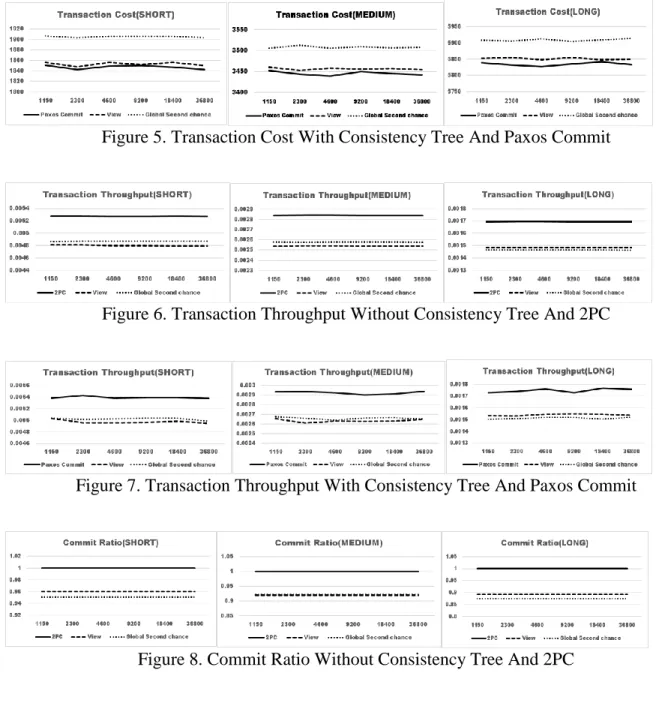
In our work proposed here, we use a look up table in which the policy versions of the different servers used for authorization is stored and updated on a regular basis, which can be easily retrieved by the transaction manager. To reduce the interdependency among replica servers and maintain strict policies, we integrate it with the concept of Tree-Based Consistency [6] to maintain a tree structure of the nodes where a data item is replicated. By making use of look-up table and the tree based approach, we propose an enhanced version of Two-phase validation commit protocol (TPVC) integrated with the Paxos commit protocol which ensures safety of the transaction by checking policy, credential and data consistency during transaction execution and reduces the performance overhead in case of failures without affecting accuracy and precision during transaction executions. The performance using simulation study shows an increase in transaction throughput and commit ratio compared with recent work [5] with update rate of 1150ms. This is due to increase in the number of commits and decrease in the number of aborts, which are generally caused by lack of consistency and fault tolerance in [5]. Stricter consistency reduces the number of aborts caused due to inconsistencies, and integration of Paxos makes sure that no transaction is aborted due to faults in the system. Thus, we are able to enforce strict-consistency with increased reduction in aborts, which can reduce latency and cost of overhead of acquiring resources and re-executing those distributed transactions again.
LITERATURE REVIEW AND PRELIMINARIES
Many database solutions have been proposed for the cloud environment like Dynamo [7], BigTable [8], and Cassandra [9]. Cloud providers lack services that guarantee both data and access control policy consistency across multiple data centers. Such consistency models add a new dimension to the complexity in the design of large-scale applications, and introduce a new set of consistency problems [11]. In [12], the authors presented a model that allows users to express consistency and concurrency
constraints on their queries that can be enforced by the DBMS at runtime. On the other hand, [13] introduces a dynamic consistency rationing mechanism, which automatically adapts the level of consistency at runtime. Our work focuses on attaining both data and policy consistency, while both of these works [12,13] and [10] focus on data consistency.
CloudTPS provides full ACID properties with a scalable transaction manager designed for a NoSQL environment [14]. However, CloudTPS is primarily concerned with providing consistency and isolation upon data without regard to considerations of authorization policies. In [19], it provides a cure, a causal consistency model for performance improvement.
The work in [15] proactively ensures that data stored at a particular site conforms to the policy stored at that site. If the policy is updated, the server will scan the data items and throw out any that would be denied based on the revised policy. It is obvious that this will lead to an eventually consistent state where data and policy conform, but this work only concerns itself with local consistency of a single node, not with transactions that span multiple nodes.
The consistency of distributed proofs of authorization has previously been studied, though not in a dynamic cloud environment (e.g., [3]). The authors develop protocols that enable various consistency guarantees to be enforced during the proof construction process to minimize these types of security issues. These consistency guarantees are similar to notions of safe transactions in [4]. However, our work addresses the case in which policies—in addition to credentials—may be altered or modified during a transaction.
In [4], several policy and user credential consistency problems are identified and policy based authorization systems are used to enforce access control. In [4, 5], the confluence of data, policy, and credential inconsistency problems that can emerge using transactional database systems are addressed. Since achieving ACID properties in distributed transactional databases has been extensively studied [3,16], they focused on how to achieve trusted transactions.
Two consistency models have been proposed to handle transactions. A transaction is said to be View Consistent if all the servers participating in transaction execution have the same policy version. A transaction is said to be globally Consistent if all the servers
participating in transaction execution have the same policy version as the latest policy in the entire cloud. Trusted transactions are defined as transactions which do not fail to agree with the credential or policy inconsistencies during execution. The term safe transaction is defined as a trusted transaction, which satisfies all data integrity constraints imposed by the database management system. In practical, a transaction will commit only if it is safe and any unsafe transaction is forced to rollback.
The authors proposed a solution involving an adaptation of the Two-Phase Commit (2PC) to enforce trusted transactions, which is referred to as Two-Phase Validation Commit (2PVC) protocol. The protocol ensures that a transaction is safe, as it ensures policy and credential consistency as well as data consistency. Authors introduced trusted transactions; that do not violate credential or policy inconsistencies over the lifetime of the transaction. The authors then presented a more general term, safe transactions, that is used to identify transactions that conform to the ACID properties of distributed database systems and are trusted in terms of the validity of the policy evaluation.
SYSTEM ASSUMPTIONS AND PROBLEM STATEMENT
3.1 SYSTEM MODEL
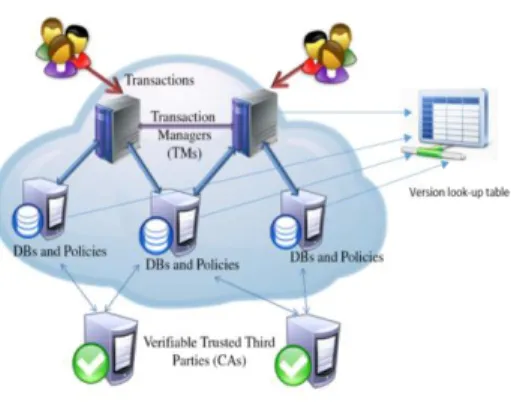
The cloud infrastructure assumed here consists of a set of Servers S, at least one Transaction Manager (TM) and an optional Master Policy Server. Each server is responsible for hosting a subset D of data items belonging to a specific application domain. The users interact with the system by submitting queries or update requests adhering to ACID properties. That is, each transaction T = q1, q2,…qn is a set of sequential queries/updates and each query qi ∈ Q (the set of queries ) will act on one or more data items. A TM is responsible for executing queries submitted by users.
TMs coordinate transaction execution across servers. In case of increase system workload, multiple TMs could be invoked for load balancing, but each transaction is handled by one TM. Each TM maintains a lookup table consists of version numbers pertaining to all the data items on a server. This is the major component of the system model introduced to implement strict consistency.