Programming Model and
Protocols for Reconfigurable
Distributed Systems
COSMIN IONEL ARAD
Doctoral Thesis in
Electronic and Computer Systems
Stockholm, Sweden 2013
Programming Model and Protocols
for Reconfigurable Distributed Systems
Programming Model and Protocols
for Reconfigurable Distributed Systems
COSMIN IONEL ARAD
Doctoral Thesis Stockholm, Sweden 2013
ISSN 1653-6363
ISRN KTH/ICT/ECS/AVH-13/07-SE ISBN 978-91-7501-694-8
School of Information and Communication Technology Electrum 229, SE-164 40 Kista, Sweden
SICS Dissertation Series 62 ISSN 1101-1335
ISRN SICS-D-62-SE
Swedish Institute of Computer Science Computer Systems Laboratory Box 1263, SE-164 29 Kista, Sweden
© Cosmin Ionel Arad, April 2013
Abstract
Distributed systems are everywhere. From large datacenters to mobile devices, an ever richer assortment of applications and services relies on distributed systems, infrastructure, and protocols. Despite their ubiquity, testing and debugging distributed systems remains notoriously hard. Moreover, aside from inherent design challenges posed by partial failure, concurrency, or asynchrony, there remain significant challenges in the implementation of distributed systems. These programming challenges stem from the increasing complexity of the concurrent activities and reactive behaviors in a distributed system on the one hand, and the need to effectively leverage the par-allelism offered by modern multi-core hardware, on the other hand.
This thesis contributes Kompics, a programming model designed to alleviate some of these challenges. Kompics is a component model and programming framework for building distributed systems by composing message-passing concurrent components. Systems built with Kompics leverage multi-core machines out of the box, and they can be dynamically reconfigured to support hot software upgrades. A simulation framework enables deterministic execution replay for debugging, testing, and reproducible behavior evaluation for large-scale Kompics distributed systems. The same system code is used for both simulation and production deployment, greatly simplifying the system development, testing, and debugging cycle.
We highlight the architectural patterns and abstractions facili-tated by Kompics through a case study of a non-trivial distributed key-value storage system. CATS is a scalable, fault-tolerant, elas-tic, and self-managing key-value store which trades off service avail-ability for guarantees of atomic data consistency and tolerance to network partitions. We present the composition architecture for the numerous protocols employed by the CATS system, as well as our methodology for testing the correctness of key CATS algorithms us-ing the Kompics simulation framework.
Results from a comprehensive performance evaluation attest that CATS achieves its claimed properties and delivers a level of perfor-mance competitive with similar systems which provide only weaker consistency guarantees. More importantly, this testifies that Kom-pics admits efficient system implementations. Its use as a teaching framework as well as its use for rapid prototyping, development, and evaluation of a myriad of scalable distributed systems, both within and outside our research group, confirm the practicality of Kompics.
Acknowledgements
I am truly honoured to have been a mentee of my advisor, Professor Seif Haridi. Seif’s inspiring enthusiasm and curiosity, his broad knowledge and ample technical expertise, his kind guidance, and his sound principles of deep understanding and systematic investigation, gladly shared every step of the way, have all made my PhD journey a fun and profound learning experience.Thank you, dear sir!
I am extremely grateful to Doctor Jim Dowling, who has been an early and tireless champion of this work. Jim’s phenomenal energy and helpful suggestions were a constant source of motivation and encouragement.Go raibh maith agat, Jim!
I was gratified by my fellow students who graciously volunteered to contribute enhancements and improvements to Kompics. Markus Kilås wrote a NetBeans IDE plug-in enabling point-and-click component design and code generation for an early, yet unnamed version of Kompics. Frej Drejhammar fixed a subtle scheduling bug and indulged in captivating discussions about intelligent software testing and many other exciting technical topics. Niklas Ekström ported Kompics to Python.
Tack så mycket till alla!Lars Kroll ported Kompics to Scala and wrote an elegant DSL; he also contributed a scheduling optimization and wrote an Eclipse IDE plug-in for static checking and browsing Kompics architectures.Danke schön!
I thank Tallat M. Shafaat for many happy shared enterprises during the PhD years, for pointing out good food, and especially for our excellent collaboration on CATS. Our work on CATS was extended by Muhammad Ehsan ul Haque, who added multiple data persistence engines, crash-recovery support, and efficient data transfers.Bahut shukriya! Hamidreza Afzali implemented range queries and Alexandru Ormeni¸san contributed a neat data indexing and query API.Merci!
I am much obliged to Professor Vladimir Vlassov for his valuable suggestions and constructive critiques of this work. I was so fortunate to have my education broadened by Professor Rassul Ayani in modeling and simulation, by Professor
Christian Schulte in constraint programming, and by Professor Dilian Gurov in formal methods. I got helpful input from Professor Johan Montelius and Professor Robert Rönngren. Many thanks to the head of the Software and Computer Systems department, Thomas Sjöland, and to the entire administrative staff for all the help they provided me with throughout my time at KTH.Tack så väldigt mycket!
I have had both the luck and the pleasure of many delightful and enlightening conversations with Per Brand, Lars Rasmusson, Karl-Filip Faxén, Sverker Janson, Roland Yap, Sameh El-Ansary, Erik Aurell, Joe Armstrong, György Dán, Ian Marsh, Šar ¯unas Girdzijauskas, Konstantin Popov, Martin Nilsson, Björn Grönvall, Mikael Nehlsen, Adam Dunkels, and Victoria Knopf, in the pleasant and resourceful ambiance at SICS. In particular, I thank Ali Ghodsi for his advice on research and writing, and for inspiring me with his rigor, clarity, and determination. Tusen tack!
I am thankful to all my colleagues and friends, who provided good company over the years, including Ahmad Al-Shishtawy, Amir Payberah, Fatemeh Rahimian, Mikael Högqvist, Roberto Roverso, John Ardelius, Joel Höglund, Martin Neumann, Raul Jimenez, Flutra Osmani, Daniela Bordencea, Hamid Mizani, Alex Averbuch, Shahab Mokarizadeh, Nima Dokoohaki, Ozair Kafray, and Salman Niazi.Cheers!
I gratefully acknowledge funding from the Swedish Research Council, who supported the Kompics work with grant 2009-4299, as well as funding from the European Commission within the SelfManand the EverGrowresearch projects. I was granted the privilege of refreshing context switches from my thesis work by Ken Goldman at Google and Mihai Budiu at Microsoft Research.Thanks a lot!
I am truly indebted to my earlier teachers and mentors who were largely responsible for launching me into the PhD orbit. Maria D˘ar˘aban¸t showed me the beauty of English. Maria Enache revealed the elegance of Mathematics and imparted me with her passion for problem solving. Octavian Purdil˘a shared his fascination for operating systems and computer networks, as well as his excellence, design taste, and curiosity for tinkering with software systems.Mul¸tumesc frumos!
I owe my deepest gratitude to my beloved Emma, who has been extremely supporting, unbelievably understanding, and relentlessly patient with my work-related investigations and my late-night coding and eager debugging excursions. I bow down to you my dearest friend, for being a wonderful companion through these academic adventures and onwards.Vilpittömällä rakkaudella ja kiitos paljon!
Finally, I want to convey my very special thanks to my parents, Viorica and Ionel, and to my sister Cristina, who have been expressing genuine interest in my progress on this dissertation. Thank you for your love and support, for giving me wings to embark on this journey, to carry on and bring it to fruition, and for instilling in me the conscience of a job well done. This work is dedicated to you.
V˘a mul¸tumesc cu drag!
CosminIonelArad Stockholm, April 2013
Contents
List of Figures xv
List of Source Code Listings xvii
1 Introduction 1 1.1 Motivation . . . 3 1.2 Design Philosophy . . . 4 1.3 Thesis Contributions . . . 5 1.4 Source Material . . . 8 1.5 Organization . . . 9
Part I Building Distributed Systems from Message-Passing Concurrent Components – Kompics 13 2 Component Model 15 2.1 Concepts in Kompics . . . 15 2.1.1 Events . . . 16 2.1.2 Ports . . . 16 2.1.3 Channels . . . 19 2.1.4 Event Handlers . . . 19 2.1.5 Subscriptions . . . 20 2.1.6 Components . . . 21 xi
2.2 Kompics Operations . . . 23
2.3 Publish-Subscribe Message Passing . . . 25
2.4 Channel Event Filtering . . . 27
2.5 Request-Response Interaction . . . 29
2.6 Component Initialization and Life Cycle . . . 30
2.7 Fault Management . . . 32
2.8 Non-blocking Receive . . . 33
2.9 Dynamic Reconfiguration . . . 35
3 Programming Patterns and Distributed Abstractions 37 3.1 Distributed Message Passing . . . 37
3.2 Event Interception . . . 39
3.3 Timer Management . . . 40
3.4 Remote Service Invocation . . . 41
3.5 Distributed Computing Abstractions . . . 41
3.5.1 Failure Detection . . . 42
3.5.2 Leader Election . . . 43
3.5.3 Broadcast . . . 43
3.5.4 Consensus . . . 45
3.5.5 Distributed Shared Memory . . . 46
3.5.6 State Machine Replication . . . 47
3.6 Peer-to-Peer Protocol Framework . . . 48
3.6.1 Random Overlays and Peer Sampling . . . 48
3.6.2 Structured Overlays and Distributed Hash Tables . . 49
3.6.3 Content Distribution Networks and NAT Traversal . 50 3.6.4 Peer-to-Peer Bootstrap and Monitoring . . . 51
4 Implementation Aspects and Development Cycle Support 53 4.1 Component Execution and Scheduling . . . 54
4.1.1 Multi-Core Work-Stealing Scheduler . . . 55
4.1.2 Discrete-Event Simulation Scheduler . . . 58
4.2 Scalable Network Communication . . . 59
4.3 Whole-System Repeatable Simulation Support . . . 60
4.3.1 Modeling Network Latency and Bandwidth . . . 62
CONTENTS xiii
4.4 Testing and Debugging Distributed Systems . . . 66
4.5 Interactive Stress Testing . . . 67
4.5.1 Scalability of Local Stress Testing . . . 68
4.5.2 Scalability of Distributed Stress Testing . . . 70
4.5.3 Analysis . . . 72
4.6 Incremental Development and Testing Support . . . 73
4.7 Implementation in Different Programming Languages . . . 78
4.7.1 Scala . . . 79
4.7.2 Python . . . 82
4.8 Programming in the Large . . . 84
5 Kompics Discussion and Comparison to Related Work 85 5.1 Message-Passing Concurrency and Actor Models . . . 86
5.2 Reconfigurable Component Models . . . 88
5.3 Software Architecture Description Languages . . . 89
5.4 Protocol Composition Frameworks . . . 89
5.5 Process Calculi and Other Concurrency Models . . . 90
5.6 Scalable Simulation and Replay Debugging . . . 91
Part II Scalable and Consistent Distributed Storage – CATS 93 6 Background, Motivation, and Problem Statement 95 6.1 Consistent Hashing and Distributed Hash Tables . . . 98
6.2 Consistency, Availability, and Partition Tolerance . . . 99
6.3 Linearizability and Sequential Consistency . . . 100
6.4 Quorum-Based Replication Systems . . . 101
6.5 Problem Statement . . . 102
7 Consistent Quorums 105 7.1 Group Reconfiguration using Consistent Quorums . . . 106
7.2 Linearizable Operations using Consistent Quorums . . . 113
7.3 Network Partitions and Inaccurate Failure Suspicions . . . . 117
7.4 Safety . . . 118
8 CATS System Architecture and Testing using Kompics 123
8.1 Protocol Components and System Design . . . 124
8.2 Distributed Production Deployment . . . 130
8.3 Whole-System Simulation and Local Interactive Testing . . . 133
8.4 Simulation-Based Correctness Tests . . . 135
9 Scalability, Elasticity, and Performance Evaluation 139 9.1 Benchmark and Experimental Setup . . . 140
9.2 Throughput and Latency . . . 141
9.3 Scalability . . . 143
9.4 Elasticity . . . 144
9.5 Overhead of Consistent Quorums . . . 145
9.6 Comparison with Cassandra . . . 148
10 CATS Discussion and Comparison to Related Work 151 10.1 Alternatives to Majority Quorums . . . 151
10.2 Sequential Consistency at Scale . . . 153
10.3 Scalable Key-Value Stores . . . 153
10.4 Reconfigurable Replication Systems . . . 154
10.5 Consistent Meta-Data Stores . . . 154
10.6 Scalable and Consistent Key-Value Stores . . . 155
10.7 Related Work on Consistency . . . 155
10.8 Fault-Tolerant Replicated Data Management . . . 156
11 Conclusions 157 11.1 Kompics Limitations and Lessons Learnt . . . 160
11.2 CATS Limitations and Lessons Learnt . . . 162
11.3 Future Work . . . 164
11.4 Final Remarks . . . 166
A Kompics Abstract Syntax 167
B Kompics Operational Semantics 171
Bibliography 179
List of Figures
2.1 An example of provided and required ports . . . 18
2.2 An example of channels connecting compatible ports . . . 19
2.3 An example of an event handler subscribed to a port . . . 21
2.4 An example of component encapsulation and nesting . . . 22
2.5 An example of an event handler triggering an event . . . 25
2.6 Publish-subscribe with multiple receipient components . . . 26
2.7 Publish-subscribe with a single receipient component . . . 26
2.8 Publish-subscribe with a single matching subscription . . . 27
2.9 Publish-subscribe with multiple matching subscriptions . . . . 27
2.10 Channel event filtering enbles virtual nodes support . . . 28
2.11 Control port and life cycle event handlers . . . 30
2.12 Component life cycle state diagram . . . 32
2.13 Software fault isolation and management . . . 33
3.1 A distributed message passing example . . . 38
3.2 An example of event interception to emulate message delays . 39 3.3 An example usage of theTimerservice abstraction . . . 41
3.4 An eventually perfect failure detector abstraction . . . 42
3.5 A Leader Election abstraction . . . 43
3.6 Broadcast abstractions . . . 44
3.7 A consensus abstraction . . . 45
3.8 A shared memory register abstraction . . . 46 xv
3.9 A replicated state machine abstraction . . . 47 3.10 Gossip-based protocols using uniform peer sampling . . . 48 3.11 Structured overlay networks and distributed hash tables . . . . 49 3.12 BitTorrent and video on demand protocols . . . 50 3.13 Peer-to-peer bootstrap and monitoring services . . . 51 4.1 Kompics vs. Erlang multi-core speedup in the Game of Life . . 57 4.2 Component architecture for whole-system simulation . . . 61 4.3 Architecture for whole-system interactive stress testing . . . 67 4.4 Event queuing time in a multi-core stress test experiment . . . 70 4.5 Event queuing time in a distributed stress test experiment . . . 72 4.6 Screenshot of local execution for quick incremental testing . . . 77 4.7 Screenshot of local execution with crash-recovery support . . . 79 6.1 Consistent hashing with successor-list replication . . . 103 6.2 Inaccurate failure suspicion in successor-list replication . . . 103 8.1 CATS architecture: protocol components of a single node . . . 124 8.2 CATS system architecture for production deployment . . . 130 8.3 Interactive web interface of the CATS bootstrap server . . . 131 8.4 Interactive web interface at one of the CATS peers . . . 132 8.5 PutandGetoperations executed through the web interface . . 133 8.6 CATS architecture for whole-system simulation/execution . . . 134 8.7 CATS global state snapshot immediately after a node joins . . . 135 8.8 CATS global state snapshot during reconfiguration . . . 136 8.9 CATS global state snapshot after reconfiguration completes . . 137 9.1 Throughput and latency for a read-intensive workload . . . 140 9.2 Throughput and latency for an update-intensive workload . . . 141 9.3 Scalability under a read-intensive (95% reads) workload . . . . 142 9.4 Scalability under an update-intensive (50% writes) workload . 143 9.5 Elasticity under a read-only workload . . . 144 9.6 Overhead of consistency under a read-intensive workload . . . 146 9.7 Overhead of consistency under an update-intensive workload . 147 9.8 CATS vs. Cassandra under a read-intensive workload . . . 148 9.9 CATS vs. Cassandra under an update-intensive workload . . . 149 B.1 The Kompics kernel language . . . 172
List of Source Code Listings
2.1 A simple event type . . . 16
2.2 A derived event type . . . 16
2.3 ANetworkport definition . . . 17
2.4 ATimerport definition . . . 17
2.5 A simple event handler . . . 20
2.6 A simple component definition . . . 21
2.7 A root component definition in an executable program . . . 23
2.8 Commands enabling dynamic reconfiguration . . . 24
2.9 An example component handling a single network message . . 24
2.10 Handling component initialization and life cycle events . . . 31
2.11 Triggering component initialization and life cycle events . . . . 31
3.1 Scheduling a timeout alarm . . . 40
3.2 Canceling a timeout . . . 40
4.1 Java interface of a network latency model . . . 62
4.2 Stochastic process for bootstrapping a peer-to-peer system . . . 64
4.3 Defining a simulation operation with one parameter . . . 64
4.4 Stochastic process regulating churn in a peer-to-peer system . . 64
4.5 Stochastic process regulating lookup operations . . . 65
4.6 Defining a simulation operation with two parameters . . . 65
4.7 A complete experiment scenario definition . . . 66 xvii
4.8 A simple topology for local interactive system execution . . . . 74
4.9 A simple local experiment scenario with two processes . . . 74
4.10 An experiment scenario for quick local interactive testing . . . 76
4.11 An experiment scenario supporting the crash-recovery model . 78 4.12 A simple event type definition in Scala . . . 80
4.13 A derived event type definition in Scala . . . 80
4.14 ANetworkport definition in Scala . . . 80
4.15 ATimerport definition in Scala . . . 80
4.16 A simple component definition in Scala . . . 81
4.17 A root component definition in a Scala executable program . . 81
4.18 Defining Kompics events in Python . . . 82
4.19 ANetworkport definition in Python . . . 82
4.20 ATimerport definition in Python . . . 82
4.21 A simple event handler in Python . . . 82
4.22 A simple component definition in Python . . . 83 4.23 A root component definition in a Python executable program . 83
Chapter 1
Introduction
A large and increasing fraction of the world’s computer systems are dis-tributed. Distribution is employed to achievescalability,fault-tolerance, or it is just an artifact of thegeographical separationbetween the system partici-pants. Distributed systems have become commonplace, operating across a wide variety of environments from large data-centers to mobile devices, and offering an ever richer combination of services and applications to more and more users.
All distributed systems share inherent challenges in their design and implementation. Often quoted challenges stem from concurrency, partial failure, node dynamism, or asynchrony. We argue that today, there is an underacknowledged challenge that restrains the development of distributed systems. Theincreasing complexityof the concurrent activities and reactive behaviors in a distributed system is unmanageable by today’s programming models and abstraction mechanisms.
Any first-year computer science student can quickly and correctly imple-ment a sorting algorithm in a general purpose programming language. At the same time, the implementation of a distributed consensus algorithm can be time consuming and error prone, even for an experienced programmer who has all the required expertise. Both sorting and distributed consensus
are basic building blocks for systems, so why do we witness this state of affairs? Because currently, programming distributed systems is done at a too low level of abstraction. Existing programming languages and models are well suited for programming local, sequential abstractions, like sorting. However, they are ill-equipped with mechanisms for programming high-level distributed abstractions, like consensus.
Testing and debugging distributed systems is also notoriously hard. De-spite previous work [97, 223] that focused on performance testing through scalable and accurate network emulation, correctness testing and debug-ging distributed systems is largely a still unsolved problem. The dire state of tool support for building and testing distributed systems, which leaves researchers and practitioners to face the complexity challenges head on, has been acknowledged by world-renowned experts in the field [47]. In describing the experience of building Chubby [45], Google’s lock service based on the Paxos [130, 131] consensus algorithm, Tushar D. Chandra, recipient of the Edsger W. Dijkstra Prize in Distributed Computing, writes:
The fault-tolerance computing community has not developed the tools to make it easy to implement their algorithms.
The fault-tolerance computing community has not paid enough attention to testing, a key ingredient for building fault-tolerant systems.
Having identified these shortcomings of the distributed computing field, the expert concludes with a call to action, asserting the importance of finding solutions to these challenging open problems:
It appears that the fault-tolerant distributed computing com-munity has not developed the tools and know-how to close the gaps between theory and practice with the same vigor as for instance the compiler community. Our experience suggests that these gaps are non-trivial and that they merit attention by the research community.
This lays the foundation for the motivation of this thesis. Our over-arching goal is to make it easy to implement distributed algorithms and systems, and to make it easy to test and debug them.
1.1. MOTIVATION 3
1.1
Motivation
Modern hardware isincreasingly parallel. In order to effectively leverage the hardware parallelism offered by modern multi-core processors, concurrent software is needed. There exist two major software concurrency models: shared-state concurrency and message-passing concurrency. (We view dataflow concurrency as a special case of message-passing concurrency where dataflow variables act as implicit communication channels.) It appears that there is broad consensus among concurrent programming researchers and practitioners, that the message-passing concurrency model is superior to the shared-state concurrency model.
Message-passing concurrency has proved not only to scale well on multi-core hardware architectures [31] but also to provide a simple and compositionalconcurrent programming model, free from the quirks and id-iosyncrasies of locks and threads. As demonstrated by the actor model [2], epitomized by programming languages like Erlang [20, 21], and message-passing frameworks like Kilim [206] or Akka [216], message-message-passing con-currency is both very easy to program and it makes it easy to reason about concurrent program correctness. Additionally, Erlang supports the con-struction of software that can be safely upgraded in place without stopping the system. This is a crucial prerequisite for enabling dynamic system evolution for mission-critical, always-on systems.
While Erlang and actor-based message-passing frameworks provide compositional concurrency, multi-core scalability, and actor isolation, they do little to help deal with increasing software complexity. The crux of the problem is that despite offering modular abstraction [169], these models do not restrict communication between processes to occur only through module interfaces. By allowing processes to communicate with any other processes in the software architecture, and not only with their architectural neighbors, these models violate the Law of Demeter [138, 137], and thus fail to realize its benefits of good software maintainability and adaptability. This proliferation of implicit process references leads to tight coupling between modules and, despite Erlang’s support for online code upgrades, it ends up becoming a hindrance to dynamic software reconfiguration.
Protocol composition frameworks like Horus [224, 225], Ensemble [101], Bast [84], or Appia [156], were specifically designed for building distributed
systems by layering modular protocols. Multilayered software architectures can systematically implement the Law of Demeter, and as such, they may enjoy the full benefits of loose coupling [34, 207]. This approach certainly simplifies the task of programming distributed systems, however, these frameworks are often designed with a particular protocol domain in mind, and enabling protocol composition solely by layering, limits their generality. As we show in this dissertation,nestedhierarchical composition enables richer, more useful architectural patterns.
More general programming abstractions, like nested hierarchical com-ponents, are supported by modern component models like OpenCom [63], Fractal [44], or Oz/K [139], which also provide dynamic system reconfigu-ration, an important feature for long-running or always-on, mission-critical systems, and for evolving or self-adaptive systems. However, the style of component interaction, based on synchronous interface invocation or atomic rendezvous, precludes compositional concurrency in these models, making them unfit for present-day multi-core hardware architectures.
To summarize, our motivation is to contribute models, techniques, and tools, to make it easy to implement, evaluate, and test distributed systems, in an attempt to bridge the gap between the theory and the practice of distributed computing. In an endeavour to accommodate the modern trends of increasing hardware parallelism and increasing software complexity, we seek to make modular distributed system implementations, tackling their complexity through hierarchical nested composition, and enabling them to effortlessly leverage multi-core processors for parallel execution, while being dynamically reconfigurable.
1.2
Design Philosophy
With Kompics we propose a message-passing, concurrent, and hierarchi-cally nested component model with support for dynamic reconfiguration. We also propose a systematic methodology for designing, programming, composing, deploying, testing, debugging, and evaluating distributed sys-tems. Our key principles in the design of Kompics are as follows:
• First, we tackle the increasing complexity of modern distributed systems throughmodular abstractionandnested hierarchical composition.
1.3. THESIS CONTRIBUTIONS 5
This facilitates modeling entire subsystems as first-class composite components, not only isolating them and hiding their implementation details [169], but also enabling distributed system designs based on the concept of virtual nodes [208], or, executing an entire distributed system within a single OS process, for testing and debugging. • Second, we choose a message-passing concurrency model.
Message-passing concurrency is preferable to shared-state concurrency because it scales better on multi-core processors; it makes it easier to reason about correctness; it simplifies programming, largely avoiding the inefficiencies and synchronization complexities of locks; and most importantly, because it is compositional.
• Third, we decouple components from each other to enable dynamic reconfiguration and system evolution for critical, always-on systems. Publish-subscribe component interaction enables both architectural decoupling (components are unaware of their communication coun-terparts) and temporal decoupling (asynchronous communication) as well as runtime dependency injection.
• Fourth, we decouple component code from its executor to enable dif-ferent execution modes. The same system code can then be executed indistributed production deployment, inlocal interactive testingenabling quick incremental development, and indeterministic repeatable simula-tion for correctness testing and replay debugging.
1.3
Thesis Contributions
This thesis aims to raise the level of abstraction in programming distributed systems. We provide constructs, mechanisms, architectural patterns, as well as programming, concurrency, and execution models that enable programmers to construct and compose reusable and modular distributed abstractions. We believe this is an important contribution because it lowers the cost and accelerates the development and evaluation of more reliable distributed systems.
With Kompics we contribute a programming model and a set of tech-niques designed to simplify the development of reconfigurable distributed
systems. The practicality of the Kompics programming model is under-scored by a number of salient features that follow naturally from its design philosophy. The Kompics framework supports a comprehensive set of methods for testing distributed systems: local interactive testing support, quick iterative and incremental development and testing support, local or distributed stress testing support, as well as protocol correctness testing through complex simulation experiment scenarios and safety and liveness predicates validation.
A remarkable characteristic enabled by this model is the ability to ex-ecute thesame system implementation in either production deployment mode or in repeatable simulation mode for testing and stepped debug-ging. In production deployment mode, Kompics systems are automati-cally executed in parallel on multi-core machines, seamlessly leveraging hardware parallelism and largely circumventing multi-core programming challenges [178, 52, 196]. Using the same system code for simulation and deployment avoids the need to maintain two different implementations, which would otherwise add both development overhead and potential for errors through divergence in the different code bases.
Kompics offers a systematic methodology for designing, programming, composing, deploying, testing, debugging, and evaluating distributed systems. These characteristics of the framework, together with a rich library of provided protocols and abstractions, ultimately led to its usage for prototyping, evaluating, and developing a plethora of distributed systems, both within and outside of our research group.
Some examples of distributed systems built with Kompics include a peer-to-peervideo-on-demandsystem [37], a secure and fault-tolerant dis-tributedstoragesystem [111], NAT-awarepeer-samplingprotocols [73, 172], peer-to-peerlive media streamingsystems [170, 174, 171, 173, 176], locality-aware scalablepublish-subscribesystems [187], scalableNAT-traversal proto-cols [164], distributed hash-tablereplication schemes[200], gossip protocols fordistribution estimation[175], anelasticity controller simulator [162, 161], studies of multi-consistency-modelkey-value stores[7, 41], mechanisms for robust self-management[6, 22], and areliable UDPprotocol [157]. The broad variety of these applications is a testament to the usefulness of Kompics.
Furthermore, for more than five years, Kompics has been successfully used as a teaching framework in two Master’s level courses on distributed
1.3. THESIS CONTRIBUTIONS 7
systems: a course on advanced distributed algorithms and abstractions, and a course on large-scale and dynamic peer-to-peer systems. Kompics enabled students to compose various distributed abstractions and to exper-iment with large-scale overlays and content-distribution networks, both in simulation and real distributed deployments. Students were able both to deliver running implementations of complex distributed systems, and to gain insights into the dynamic behavior of those systems.
Within this dissertation, we offer both a qualitative and a quantitative evaluation of Kompics. The qualitative evaluation focuses on the program-ming idioms, protocol composition patterns, and architectural designs that Kompics facilitates, and their implications on the development, testing, and debugging of distributed systems. The quantitative evaluation comprises a number of microbenchmarks of the Kompics runtime, as well as end-to-end performance measurements of CATS, a non-trivial distributed system that we built using Kompics. CATS is a scalable and consistent key-value store which trades off service availability for guarantees of atomic data consistency and tolerance to network partitions. We present CATS as a case study of using Kompics for building and testing distributed systems.
Within CATS, we introduceconsistent quorumsas an approach to guaran-tee linearizability [106] in a decentralized, self-organizing, dynamic system spontaneously reconfigured by consistent hashing [120], and prone to inaccurate failure suspicions [49] and network partitions [66].
We showcase consistent quorums in the design and implementation of CATS, a distributed key-value store where every data item is an atomic register [129] with linearizableputandgetoperations, and which is hosted by a dynamically reconfigurable replication group [56].
We evaluate the cost of consistent quorums and the cost of achieving atomic data consistency in CATS. We give evidence that consistent quorums admit system designs which are scalable, elastic, self-organizing, fault-tolerant, consistent, and partition-fault-tolerant, on the one hand, as well as system implementations with practical performance and modest overhead, on the other hand.
CATS delivers sub-millisecond operation latencies under light load, single-digit millisecond operation latencies at 50% load, and it sustains a throughput of one thousand operations per second, per server, while scaling linearly to hundreds of servers. This level of performance is competitive
with that of systems with a similar architecture but which provide only weaker consistency guarantees [125, 60].
1.4
Source Material
The material in this dissertation has been previously published in the following internationally peer-reviewed articles:
• Cosmin Arad, Jim Dowling, and Seif Haridi. Message-Passing Concur-rency for Scalable, Stateful, Reconfigurable Middleware. In Proceedings of the Thirteenth ACM/IFIP/USENIX International Conference on Middleware, volume 7662 of Lecture Notes in Computer Science, Springer [16]. Middleware 2012, Montreal, Canada, December 2012. • Cosmin Arad, Tallat M. Shafaat, and Seif Haridi. Brief Announcement: Atomic Consistency and Partition Tolerance in Scalable Key-Value Stores. In Proceedings of the Twenty-sixth International Symposium on Dis-tributed Computing, volume 7611 of Lecture Notes in Computer Science, Springer [17]. DISC 2012, Salvador, Brazil, October 2012. • Cosmin Arad, Jim Dowling, and Seif Haridi. Developing, Simulating,
and Deploying Peer-to-Peer Systems using the Kompics Component Model. In Proceedings of the Fourth International Conference on COMmuni-cation System softWAre and MiddlewaRE, ACM Digital Library [14]. COMSWARE 2009, Dublin, Ireland, June 2009.
• Cosmin Arad, Jim Dowling, and Seif Haridi. Building and Evaluating P2P Systems using the Kompics Component Framework. In Proceedings of the Ninth International Conference on Peer-to-Peer Computing, IEEE Communications Society [15]. P2P 2009, Seattle, WA, USA, September 2009.
• Cosmin Arad and Seif Haridi. Practical Protocol Composition, Encap-sulation and Sharing in Kompics. In Proceedings of the Second Inter-national Conference on Self-Adaptive and Self-Organizing Systems Workshops, IEEE Computer Society [13]. SASO Workshops 2008, Venice, Italy, October 2008.
1.5. ORGANIZATION 9
• Cosmin Arad, Tallat M. Shafaat, and Seif Haridi. CATS: Atomic Consistency and Partition Tolerance in Scalable and Self-Organizing Key-Value Stores. Currently under submission. Also available as SICS Technical Report T2012:04 [18].
The author of this dissertation was the main contributor to the design of Kompics as well as the principal developer of the reference Kompics implementation in Java. The open source code repository for the Kompics platform, as well as further documentation, videos, and tutorials, were made publicly available athttp://kompics.sics.se/.
The work on the design, implementation, and evaluation of CATS was partially done in collaboration with Tallat M. Shafaat, who contributed a partition-tolerant topology maintenance algorithm as well as a garbage collection mechanism, and he duly reported parts of the work and our results in his doctoral dissertation. The open source code repository for CATS, together with an interactive demonstration of the deployed system, was made publicly available athttp://cats.sics.se/.
1.5
Organization
This dissertation is structured in two parts. In Part I we introduce the Kompics component model and programming framework.
• Chapter 2 describes the first-class concepts in Kompics and the opera-tions upon these. It also presents the asynchronous publish-subscribe style of communication between components, as well as aspects per-taining to component initialization and life cycle management, fault isolation, and dynamic reconfiguration.
• Chapter 3 presents the basic distributed systems programming pat-terns enabled by Kompics and it illustrates how higher-level dis-tributed computing abstractions can be built from lower-level abstrac-tions. Finally, it shows a few examples of peer-to-peer protocols and services implemented in Kompics.
• Chapter 4 provides implementation details related to the component execution model and multi-core scheduling, scalable network
com-munication, and enabling deterministic single-threaded simulation. It also discusses the implementation of Kompics in various modern programming languages and aspects of programming in the large. • Chapter 5 compares Kompics to related work in the areas of
proto-col composition frameworks, concurrent programming models and process calculi, reconfigurable component models and software ar-chitecture description languages, and frameworks for simulation and replay debugging of large-scale distributed systems.
In Part II we present CATS, a non-trivial distributed system that we built using Kompics, in order to showcase the architectural patterns and the system development cycle support provided by the Kompics framework.
• Chapter 6 motivates the work on CATS by overviewing the landscape of existing scalable storage systems and arguing for the need for scalable and consistent fault-tolerant data stores for mission-critical applications. It also reviews the principal replicated data consistency models, quorum-based replication systems, and the impossibility of simultaneous consistency, availability, and partition tolerance. • Chapter 7 introduces consistent quorums, a novel technique which
enables distributed algorithms designed for a static group of processes and relying on majority quorums, to continue to operate correctly in process groups with dynamically reconfigurable group membership. This was instrumental in adapting a static atomic register protocol to operate at arbitrary large scales, within coherent dynamic groups. • Chapter 8 illustrates the software architecture of the CATS system as
a composition of protocols and service abstractions, and it discusses various system design choices. It also demonstrates the Kompics methodology of interactive testing, which supports incremental de-velopment, and protocol correctness testing and debugging based on whole-system repeatable simulation.
• Chapter 9 evaluates the performance of the CATS system imple-mented in Kompics Java, showing both that the component model
1.5. ORGANIZATION 11
admits efficient system implementations and that our consistent quo-rums technique achieves atomic consistency at modest overheads. • Chapter 10 discusses alternative consistency models that can be
eas-ily provided on CATS’ foundation of scalable reconfigurable group membership, as well as alternative efficient implementations of these models. It also compares CATS with related work in the areas of scalable key-value stores and consistent meta-data storage systems. Chapter 11 concludes this dissertation by highlighting the benefits and limitations of both Kompics and CATS, sharing the lessons learnt, and pointing to future research directions.
Part I
Building Distributed Systems
from Message-Passing
Concurrent Components
Chapter 2
Component Model
Kompics is a component model [211] targeted at building distributed sys-tems by composing protocols programmed as event-driven components. Kompics components are reactive state machines that execute concurrently and communicate by passing data-carrying typed events, through typed bidirectional ports which are connected by channels. This chapter intro-duces the conceptual entities of our component model and its programming constructs, its concurrent message-passing execution model and publish-subscribe component communication style, as well as constructs enabling dynamic reconfiguration, component life cycle and fault management.
2.1
Concepts in Kompics
The fundamental Kompics entities areevents,ports,components,event han-dlers,subscriptions, andchannels. We introduce them here and show exam-ples of their definitions with snippets of Java code. The Kompics component model is programming language independent, however, we use Java to illustrate a formal definition of its concepts. In Section 4.7 we show exam-ples of Kompics entities written in other programming languages like Scala and Python to which Kompics has been ported.
2.1.1 Events
Events are passive and immutable typed objects having any number of typed attributes. The type of an attribute can be any valid data type in the implementation programming language. New event types can be defined by sub-classing existing ones.
Code 2.1 illustrates a simple example event type definition in Java. For clarity, we omit the constructor, and any getters, setters, access modifiers, and import statements. TheMessageevent contains two attributes: a source and a destinationAddress, which is a data type containing an IP address, a TCP or UDP port number, and an integer virtual node identifier.
Code 2.1A simple event type
class Message extends Event {
Address source; Address destination; }
Code 2.2 shows an example of a derived event type. In our Java implementation of Kompics, all event types are descendants of a root type,
Event. We write DataMessage⊆Messageto denote that DataMessage is a subtype ofMessage. In diagrams, we represent an event using the Event graphical notation, whereEventis the event’s type, e.g.,Message.
Code 2.2A derived event type
class DataMessage extends Message { Data data;
int sequenceNumber; }
2.1.2 Ports
Ports arebidirectionalevent-based component interfaces. A port is a gate through which a component communicates asynchronously with other components in its environment, by sending and receiving events. A port allows a specific set of event types to pass in each direction. We label the two directions of a port aspositive(+) andnegative(−). Thetypeof a port
2.1. CONCEPTS IN KOMPICS 17
specifies the set of event types that can traverse the port in the positive direction and the set of event types that can traverse the port in the negative direction. Concretely, a port type definition consists of two sets of event types: a “positive” set and a “negative” set. We regard ports as service interfaces implemented or required by components, and conceptually, we view negative events as servicerequestevents and positive events as service indicationevents. There is no sub-typing relationship for port types.
Code 2.3 shows a simple example of a port type definition in Java. The code block in the inner braces represents an “instance initializer”. The positiveandnegativemethods populate the respective sets of event types. In our Java implementation, each port type is a singleton.
Code 2.3ANetworkport definition
class Network extends PortType {
{
positive(Message.class); // indication
negative(Message.class); // request
}
}
In this example we defined a Networkport type which allows events of type Message, or any subtype thereof, to pass in both (‘+’ and ‘−’) directions. TheTimerport type defined in Code 2.4 allows request events of typeScheduleTimeoutandCancelTimeoutto pass in the ‘−’ direction, and indication events of typeTimeoutto pass in the ‘+’ direction.
Code 2.4ATimerport definition
class Timer extends PortType {
{
indication(Timeout.class); // positive
request(ScheduleTimeout.class); // negative
request(CancelTimeout.class); // negative
}
}
Conceptually, a port type can be seen as a service or protocol abstraction with an event-based interface. It acceptsrequestevents and delivers
indica-FailureDetector
MyTimer
MyNetwork
Network + + Timer Timer + Network + ScheduleTimeout CancelTimeout Timeout + Message Message + Timer + Network + Figure 2.1.TheMyNetworkcomponent has aprovidedNetworkport. MyTimerhas a
providedTimerport. TheFailureDetectorhas arequiredNetworkport and arequired
Timerport. In diagrams, aprovidedport is figured on the top border, and arequired
port on the bottom border of a component.
tionorresponseevents. By convention, we associate requests with the ‘−’ direction and responses or indications with the ‘+’ direction. In the exam-ple of Code 2.3, aTimerabstraction acceptsScheduleTimeoutrequests and deliversTimeoutindications. Code 2.4 defines aNetworkabstraction which acceptsMessage events at a sending node (source) and delivers Message
events at a receiving node (destination) in a distributed system.
A component thatimplementsa protocol or service willprovidea port of the type that represents the implemented abstraction. Through this provided port, the component will receive the request events and it will trigger the indication events specified by the port’s type. In other words, for a provided port, the ‘−’ direction is incoming into the component and the ‘+’ direction is outgoing from the component.
In Figure 2.1, theMyNetworkcomponent provides aNetworkport and theMyTimercomponent provides aTimerport. In diagrams, we represent a port using the+− Port graphical notation, wherePortis the type of the port, e.g., Network. We represent components using the Component graphical notation. The right side of the figure contains a legend illustrating the request and indication events of theNetworkandTimerport types.
When a componentusesa lower level abstraction in its implementation, it willrequirea port of the type that represents the abstraction. Through a required port, a component sends out the request events and receives the indication/response events specified by the required port’s type. In other words, for required ports, the ‘−’ direction is outgoing from the component and the ‘+’ direction is incoming into the component.
2.1. CONCEPTS IN KOMPICS 19
FailureDetector
MyTimer
MyNetwork
Network + + Timer Timer + Network + channel1 channel2Figure 2.2.channel1connects the providedNetworkport of theMyNetwork
compo-nent with the requiredNetworkport of theFailureDetectorcomponent. channel2 connects the providedTimerport of theMyTimer component with the required Timerport of theFailureDetectorcomponent.
2.1.3 Channels
Channels are first-class bindings between component ports. A channel con-nects twocomplementaryports of thesametype. For example, in Figure 2.2, channel1connects the providedNetworkport of theMyNetwork component with the requiredNetworkport of theFailureDetectorcomponent. This al-lows,Messageevents sent by theFailureDetectorto be received and handled by theMyNetwork component.
Channels forward events in both directions in FIFO order, i.e., events are delivered at each destination component in the same order in which they were triggered at a source component. In diagrams, we represent channels using the channel graphical notation. We omit the channel name when it is not relevant.
Event filters can be associated with each direction of a channel, instruct-ing the channel to forward only particular events which match the filter. We discuss channel event filters in more detail in Section 2.4. To enable the dynamic reconfiguration of the software architecture, event forwarding through channels can be paused and resumed. We discuss these channel operations enabling dynamic reconfiguration in Section 2.9.
2.1.4 Event Handlers
An event handler is a first-class procedure of a component. A handler accepts events of a particular type, and any subtypes thereof, and it is executed reactively when the component receives such events. During
its execution, a handler may trigger new events and mutate the compo-nent’s local state. The Kompics execution model guarantees that the event handlers of one component instance aremutually exclusive, i.e., they are executed sequentially. This alleviates the need for synchronization between different event handlers of the same component accessing the component’s mutable state, which greatly simplifies their programming.
Code 2.5 illustrates an example event handler definition in Java. Upon receiving aMessageevent, thehandleMsgevent handler increments a local message counter and prints a message to the standard output console. Code 2.5A simple event handler
Handler<Message> handleMsg = new Handler<Message>() {
public void handle(Message message) {
messages++; // ← component-local state update
System.out.println("Received from " + message.source);
}
};
In diagrams, we use the hEvent graphical notation to represent an event handler, wherehis the handler’s name andEventis the type of events accepted by the handler, e.g.,Message.
2.1.5 Subscriptions
A subscription binds an event handler to a component port, enabling the event handler to handle events that arrive at the component on that port. A subscription is allowed only if the type of events accepted by the handler, sayE, is allowed to pass by the port’s type definition. In other words, ifE is the set of event types that the port allows to pass in the direction of the event handler, then eitherE∈ E, orEmust be a subtype of a member ofE. Figure 2.3 illustrates thehandleMsg event handler from our previous example, being subscribed to the component’s requiredNetworkport. In diagrams, we represent a subscription using the graphical notation.
In this example, the subscription of handleMsgto the Networkport is allowed becauseMessageis in the positive set ofNetwork. As a result of this subscription,handleMsgwill handle all events of type Messageor of any subtype ofMessage, received on thisNetworkport.
2.1. CONCEPTS IN KOMPICS 21
MyComponent
Network + handleMsg MessageFigure 2.3.ThehandleMsgevent handler issubscribedto the requiredNetworkport ofMyComponent. As a result,handleMsgwill be executed wheneverMyComponent receives aMessageevent on this port, taking the event as an argument.
2.1.6 Components
Components are event-driven state machines that executeconcurrentlyand communicateasynchronouslyby message passing. In the implementation programming language, components are objects consisting of any number of local state variables and event handlers. Components are modules that export and import event-based interfaces, i.e., provided and required ports. Each component is instantiated from a component definition.
Code 2.6 shows the Java component definition corresponding to the component illustrated in Figure 2.3. Line 2 specifies that the component
Code 2.6A simple component definition
class MyComponent extends ComponentDefinition {
Positive<Network> network = requires(Network.class);
int messages; // ← local state, -required port
public MyComponent() // ← component constructor
System.out.println("MyComponent created.");
messages = 0;
subscribe(handleMsg, network);
}
Handler<Message> handleMsg = new Handler<Message>() {
public void handle(Message msg) {
messages++; // ← component-local state update
System.out.println("Received from " + msg.source); }
}; }
Main
FailureDetector
MyTimer
MyNetwork
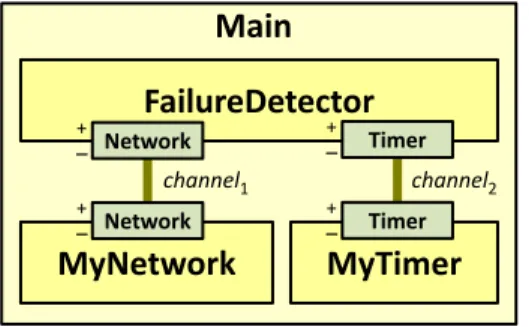
Network + + Timer Timer + Network + channel1 channel2Figure 2.4. The Main component encapsulates a FailureDetector component, a
MyNetworkcomponent, and aMyTimercomponent.
has a requiredNetwork port. Therequires method returns a reference to a required port,network, which is used in the constructor to subscribe the handleMsghandler to this port (see line 7). The type of the required port is
PositivehNetworkibecause, for required ports the positive direction is incom-ing into the component. Both a component’s ports and its event handlers are first-class entities which allows for their dynamic manipulation.
Components can encapsulate subcomponents to hide implementation details [169], reuse functionality, and manage system complexity. Compos-ite components enable the control and dynamic reconfiguration of entire component ensembles as if they were simple components. Composite components form a containment hierarchy rooted at aMain component. An example is shown in Figure 2.4. Mainis the first component created when the run-time system starts and it recursively creates all other subcom-ponents. Since there exist no components outside of it,Mainhas no ports.
Code 2.7 illustrates theMain component specification in Java. In our Java implementation of Kompics, theMaincomponent is also a Java main class; lines 13–15 show themainmethod. When executed, this will invoke the Kompics run-time system, instructing it to bootstrap, i.e., to instantiate the root component usingMainas a component specification (see line 14). In lines 5–7, Main creates its subcomponents and saves references to them. In line 8, it connects MyNetwork’s provided Network port to the requiredNetworkport of theFailureDetector. As a result,channel1is created and saved. Unless needed for dynamic reconfiguration (see Section 2.9), channel references need not be saved.
2.2. KOMPICS OPERATIONS 23
Code 2.7A root component definition in an executable program class Main extends ComponentDefinition {
Component net, timer, fd; // ← subcomponents Channel channel1, channel2; // ← channels public Main() { // . constructor net = create(MyNetwork.class);
timer = create(MyTimer.class); fd = create(FailureDetector.class);
channel1 = connect(net.provided(Network.class), fd.required(Network.class)); channel2 = connect(timer.provided(Timer.class), fd.required(Timer.class)); }
public static void main(String[] args) { Kompics.bootstrap(Main.class);
} }
Kompics components are loosely coupled[34]. A component does not know the type, availability, or identity of any components with which it communicates. Instead, a component only “communicates”, i.e., it subscribes its handlers and it triggers events on its own ports or the ports of its subcomponents. It is up to the component’s environment, i.e., its parent component, to wire up the communication channels.
Explicit component dependencies, in the form of required ports, enable dependency injection [83], which facilitates testing, and also contribute to facilitating the dynamic reconfiguration of the component architecture, a fundamental feature for evolving, long-lived systems. Because component communication occurs only through adjacent ports, Kompics satisfies archi-tectural integrity[8], an important prerequisite for dynamic reconfiguration.
2.2
Kompics Operations
While presenting the Kompics concepts we have already introduced some of the basic operations on these concepts, such as subscribe, create, and connect. These operations have counterparts that undo their actions, namely unsubscribe,destroy, anddisconnect, and these have the expected semantics.
Code 2.8Commands enabling dynamic reconfiguration class Main extends ComponentDefinition {
Component net, timer, fd; // ← subcomponents Channel channel1, channel2; // ← channels
public undo() { // . some method
disconnect(net.provided(Network.class),
fd.required(Network.class));
disconnect(timer.provided(Timer.class),
fd.required(Timer.class));
destroy(net); destroy(timer); destroy(fd); }
}
Code 2.8 illustrates thedestroyanddisconnectoperations in the context of our previous example. A fundamental command in Kompics istrigger, which is used to asynchronously send an event through a port. In the next example, illustrated in Code 2.9 and Figure 2.5,MyComponenthandles a
MyMessageevent due to its subscription to its requiredNetworkport. Upon handling the first message,MyComponenttriggers aMyMessagereply on itsNetworkport and then it unsubscribes itsmyMsgH event handler, thus handling no further messages. In diagrams, we denote that an event handler
Code 2.9An example component handling a single network message class MyComponent extends ComponentDefinition {
Positive<Network> network = requires(Network.class); public MyComponent() { // ← component constructor subscribe(myMsgH, network);
}
Handler<MyMessage> myMsgH = new Handler<MyMessage>() { public void handle(MyMessage m) {
trigger(new MyMessage(m.destination, m.source),
network);
unsubscribe(myMsgH, network); // ← reply only once }
}; }
2.3. PUBLISH-SUBSCRIBE MESSAGE PASSING 25
Figure 2.5.MyComponenthandles oneMyMessageevent and triggers aMyMessage
reply on its requiredNetworkport.
may trigger an event on a particular port, using the Event graphical notation. We discuss more Kompics operations in Sections 2.8 and 2.9.
2.3
Publish-Subscribe Message Passing
Components are unaware of other components in their environment. A component can communicate, i.e., handle received events and trigger events, only through the ports visible within its scope. The ports visible in a component’s scope are its own ports and the ports of its immediate sub-components. Ports and channels forward triggered events toward other connected components, as long as the types of events triggered are allowed to pass by the respective port type specifications. Therefore, component communication is constrained by the connections between components as configured by their respective enclosing parent components.
Communication between components works according to a message-passing publish-subscribe model. An event published on one side of a port is forwarded to all channels connected to other side the port. We illustrate the Kompics publish-subscribe component communication with some ex-amples. In Figure 2.6, everyMessageAevent triggered byMyNetworkon its providedNetworkport is delivered both atComponent1andComponent2, by
channel1 andchannel2. In Figure 2.7, however,MessageAevents triggered by
MyNetworkare only going to be delivered atComponent1whileMessageB
events triggered byMyNetworkare only going to be delivered at Compo-nent2. In Figure 2.8, wheneverMyNetworktriggers aMessageAevent on its
Networkport, this event is delivered toMyComponentwhere it is handled by handler1. Conversely, wheneverMyNetworktriggers aMessageBevent on its
Figure 2.6. WhenMyNetworktriggers aMessageAon its providedNetworkport, this event is forwarded by bothchannel1andchannel2to the requiredNetworkports ofComponent1andComponent2, respectively.
Figure 2.7.WhenMyNetworktriggers aMessageAevent on its providedNetwork
port, this event is forwarded only by channel1 to the required Network port of Component1. MessageBevents triggered byMyNetworkon its Networkport, are forwarded only bychannel2to theNetworkport ofComponent2.
Networkport, this event is delivered toMyComponentwhere it is handled byhandler2. An event triggered (published) on a port is forwarded to other components by all channels connected to the other side of the port as in Fig-ure 2.6. As an optimization, the run-time system should not forward events on channels that would not lead to any compatible subscribed handlers. An event received on a port is handled by all compatible handlers subscribed to that port as in Figure 2.9. Here, wheneverMyNetworktriggers aMessageA
event on itsNetworkport, this event is delivered toMyComponentwhere it is handled sequentially by bothhandler1andhandler2, in the same order in which these two handlers were subscribed to theNetworkport.
2.4. CHANNEL EVENT FILTERING 27
Figure 2.8. MessageA events triggered by MyNetwork on its Network port, are
delivered to theNetworkport ofMyComponentand handled byhandler1.MessageB events triggered byMyNetworkon itsNetworkport, are delivered to theNetwork port ofMyComponentand handled byhandler2.
Figure 2.9.WhenMyNetworktriggers aMessageAevent on itsNetworkport, this
event is delivered to the Network port of MyComponent and handled by both
handler1andhandler2, sequentially (figured with yellow diamonds), in the order in which the two handlers were subscribed to theNetworkport.
2.4
Channel Event Filtering
Component reusability means that a component implementation can be used in different contexts without being changed. Component reuse may take the form of either creating multiple instances of the same component definition, or sharing the services provided by one component instance, among multiple other components. Sharing may avoid duplication of work and thus increase efficiency. For example, a failure detection service may be
VN
1 Network + VN
n Network + MyNetwork
Network + channel1 channeln Message Message + Network + VN
2 Network + channel2…
Figure 2.10. Each channel filters events in the ‘+’ direction, only forwarding
messages with a destination address matching the corresponding virtual node.
used by multiple protocols. Using a shared failure detector implementation, rather than one for each protocol, would save network bandwidth when multiple protocols need to monitor the failure of the same remote nodes.
Another basic example of component sharing is when multiple protocols on the same node share a single network component, which is in charge of managing network connections to remote nodes and message serialization and deserialization. The shared network component publishes received messages on its providedNetworkport, and each protocol subscribes to the message types it needs to handle. This type-based publish-subscribe mechanism works fine in this context but it becomes problematic when we want to package the protocols of one distributed system node into a composite component and execute multiple nodes within the same OS process, which enables whole-system repeatable simulation.
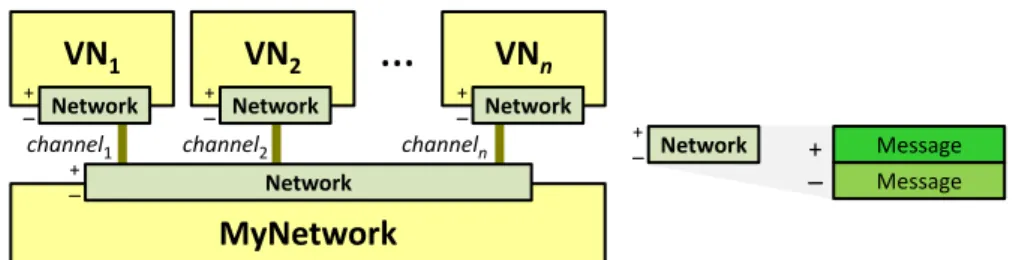
Similar to whole-system simulation is support for virtual nodes [208], whereby multiple nodes of the distributed system are executed on a single machine to facilitate load balancing and fast recovery [51]. An example is il-lustrated in Figure 2.10, where multiple virtual nodes, identical in structure but with different node identifiers, share the same network component and potentially the same IP address and port number. Destination addresses for different virtual nodes may differ only in their virtual node identifier.
In order to maintain the reusability of virtual node components, while at the same time avoiding the case where every virtual node handles every received message, we introduced channel filtering by event attributes.
Event attribute filters can be associated with a channel to instruct the channel to forward only events with certain attribute values in a particular direction. If channel x contains no filters, x forwards all events in both
2.5. REQUEST-RESPONSE INTERACTION 29
directions. If x contains some filters, then it only forwards the events matching the respective filters. In our virtual nodes example of Figure 2.10, each channel filters messages sent in the positive direction by their des-tination address virtual node identifier. Messages need not be filtered in the negative direction. The channel event filters are specified by the parent component upon connecting the respectiveNetworkports.
Attribute filtering enables complete component reusability by allowing the same component implementation to be used in different contexts and filtering its input events in its enclosing scope. This is quite appropriate given that this is precisely the scope in which the architect decides how the component is used. Attribute filtering also reduces the potential for errors by freeing the programmer from having to explicitly write code that rejects events that are not intended for a particular component. Withn components sharing the same service, this avoidsO(n)operations. In our reference implementation of Kompics, both type-based and attribute-based filtering are implemented using a constant-time hash table lookup, enabling event filtering inO(1)operations, and thus scalable publish-subscribe.
2.5
Request-Response Interaction
If we again consider the example of a failure detector service shared by multiple protocols, we notice that it is possible that different protocols may request the failure monitoring of different remote nodes. When a failure is detected and a corresponding notification is published on the provided service port, this is delivered to all client protocols, even to those that did not request de monitoring of the currently detected node.
More generally, given aservercomponent providing a service with an interface based on requests and responses (e.g.,Timer, Failure Detector), and multiple instances of aclientcomponent, using the service, given the publish-subscribe semantics described in Section 2.3, when one of the clients issues a request and the server handles it and issues a response, all clients receive the response. For this situation, Kompics provides two special types of events: RequestandResponse, which should be used in any port type definition which represents a request-response service potentially shared by multiple independent clients.
When a Request event is triggered by a client, as the event passes through different channels and ports in the architecture, it saves them on an internal stack. When the server component generates aResponseevent, it initializes it with the Request’s stack. As the Response event is passed through the architecture, the run-time system pops its stack one element at a time to see where to deliver it next. This mechanism, ensures that only the client which initiated aRequestwill receive the correspondingResponse.
2.6
Component Initialization and Life Cycle
Every component provides a special Controlport used for initialization, life cycle, and fault management. Figure 2.11 illustrates theControlport type and a component that declares an Init, a Start, and a Stop handler. Typically, for each component definition that requires state initialization, we define a specific initialization event, as a subtype ofInit, which contains component-specific configuration parameters.
MyComponent
Control + startH
Start stopHStop MyInitinitH Start
Stop Init Fault Started Stopped + Control + MyInit Init
Figure 2.11.Every Kompics component provides aControlport by default. To this
Controlport, the component can subscribeStart,Stop, andInithandlers. In general, we do not illustrate the control port in component diagrams.
AnInitevent is guaranteed to be the first event handled by a component. When a component subscribes anInitevent handler to itsControlport in its constructor, the run-time system will only schedule the component for execution upon receiving anInitevent.
StartandStopevents allow a component which handles them to take some actions when the component is activated or passivated. A component is createdpassive. In the passive state, a component can receive events but it will not execute them. (Received events are stored in a port queue.) When activated, a component will enter theactivestate executing any enqueued events. Handling life cycle events (illustrated in Code 2.10) is optional.