THESIS FOR THEDEGREE OFDOCTOR OFPHILOSOPHY
Throughput and energy efficiency of
lock-free data structures: Execution
Models and Analyses
A
RAS
A
TALAR
Division of Networks and Systems Department of Computer Science and Engineering
CHALMERSUNIVERSITY OFTECHNOLOGY Gothenburg, Sweden 2018
Throughput and energy efficiency of lock-free data structures: Execution Models and Analyses
Aras Atalar
Copyright cAras Atalar, 2018. ISBN: 978-91-7597-783-6
Doktorsavhandlingar vid Chalmers tekniska högskola Ny series nr 4464
ISSN: 0346-718X Technical report 161D
Department of Computer Science and Engineering Distributed Computing and Systems Group Division of Networks and Systems
Chalmers University of Technology SE-412 96 GOTHENBURG, Sweden Phone: +46 (0)31-772 10 00
Author e-mail:[email protected]
Printed by Chalmers Reproservice Gothenburg, Sweden 2018
Throughput and energy efficiency of lock-free data structures:
Execution Models and Analyses
Aras Atalar
Division of Networks and Systems, Chalmers University of Technology
ABSTRACT
Concurrent data structures are key program components to harness the avail-able parallelism in multi-core processors. Lock-free algorithmic implementa-tions of concurrent data structures offer high scalability and possess desirable properties such as immunity to deadlocks, convoying and priority inversion. In this thesis, we develop analytical tools to model and analyze the throughput and energy consumption of concurrent lock-free data structures. We start our study with a general class of lock-free data structures. Then, we target more special-ized designs for lock-free queues. Finally, we focus on the search data struc-tures that possess different characteristics compared to previously mentioned data structures.
Performance of lock-free data structures: This thesis contributes to the problem of making ends meet between theoretical bounds and actual measured throughput. As the first step, we consider a general class of lock-free data struc-tures and propose three analytical frameworks with different flavors. Analyses of this class also cover efficient implementations of a set of fundamental data structures that suffer from inherent sequential bottlenecks. We model the ex-ecutions and examine the impact of contention on the throughput of these al-gorithms. Our analyses lead to optimization methods on memory management and back-off strategies.
Performance and energy efficiency of lock-free queues: We take a step further to model the throughput of lock-free operations and their interaction. Considering shared queues, as a key paradigm for data sharing, operations (En-queue,Dequeue) access the opposite ends of a queue. Same type of operations might contend with each other on a non-empty queue. However, all types of operations are subject to interaction when the queue is empty. We first
decorre-ii
late the throughput of dequeuers’ and enqueuers’ into several uncorrelated basic throughputs, and reconstruct the main throughputs as a function of these basic throughputs. Besides, we model the power dissipation and integrate it with the throughput estimations to extract the energy consumption of applications that utilize lock-free queues.
Performance of lock-free search data structures: Lock-free designs that utilize fine-grained synchronization have produced efficient implementations of search data structures. These designs reveal different characteristics compared to the previous set of lock-free data structures with inherent sequential bottle-necks. We introduce a new way of modeling and analyzing the throughput of search data structures under stationary and memoryless access patterns.
Keywords:Concurrency, Lock-free, Data Structures, Parallel Computing, Performance, Throughput, Energy Efficiency, Modeling, Analysis
List of publications
This thesis is based on the work contained in the following publications and their extended versions. Result I, II, IV (that are presented in this thesis) are extended versions of the first, second, and fourth articles that are listed below, respectively. Result III is the work presented in the third article that is detailed below.
⊲ Aras Atalar, Paul Renaud-Goud and Philippas Tsigas, “Analyzing the Performance of Lock-Free Data Structures: A Conflict-Based Model”, In the Proceedings of 29thInternational Symposium on
Distributed Computing (DISC 2015), pages 341-355, Springer 2015.
⊲ Aras Atalar, Paul Renaud-Goud and Philippas Tsigas, “How Lock-free Data Structures Perform in Dynamic Environments: Mod-els and Analyses”, In the Proceedings of the 20th International
Conference on Principles of Distributed Systems (OPODIS 2016), pages 1-17, Schloss Dagstuhl - Leibniz-Zentrum fuer Informatik 2016.
⊲ Aras Atalar, Anders Gidenstam, Paul Renaud-Goud and Philip-pas Tsigas, “Modeling Energy Consumption of Lock-Free Queue Implementations”,In the Proceedings of29thIEEE International
Parallel and Distributed Processing Symposium (IPDPS 2015), pages 229-238, IEEE Press 2015.
iv LIST OF PUBLICATIONS
⊲ Aras Atalar, Paul Renaud-Goud and Philippas Tsigas, “Lock-Free Search Data Structures: Throughput Modeling with Poisson Pro-cesses”,Under Submission.
The following results have also been achieved during my PhD studies and they are not part of the thesis:
⊲ Christoph W. Kessler, Lu Li,Aras Atalarand Alin Dobre, “XPDL: Extensible Platform Description Language to Support Energy Mod-eling and Optimization”,In the Proceedings of44thInternational
Conference on Parallel Processing Workshops (ICPPW 2015), pages 51-60, IEEE Computer Society 2015.
⊲ Adones Rukondo,Aras Atalarand Philippas Tsigas, “2D-Stack: A scalable lock-free stack design that continuously relaxes seman-tics for better performance”,In the Proceedings of37thACM
Sym-posium on Principles of Distributed Computing (PODC, Brief An-nouncement), pages 407-409, ACM 2018.
Acknowledgments
First of all, I would like to thank my supervisor Philippas Tsigas for his encour-agement and guidance. This thesis would not have been possible without his support.
I thank the members of my graduate committee: Peter Demaschke, Agneta Nilsson, and Marina Papatriantafilou, for their kind support and help.
I am honored to have Guy Blelloch as my opponent and sincere thanks to the members of my grading committee: Dan Alistarh, Bengt Jonsson, Alessia Milani, Ioannis Sourdis.
I want to thank my former mentors and advisors: Etkin Abi, Cevdet Aykanat, Gokhan Erbay, Michael Gerndt, Michael Rauh, Isaias Urena and Paul Renaud-Goud.
I am grateful to the Swedish Research Council for funding me and to EX-CESS Project and its members from whom I have gained a lot.
I thank my friends that I had the chance to work with: Ivan, Anders, Fazeleh, Lazaros, Adones, Lu, Ali, and Paul. Thanks to my officemates: Vincenzo, Nasser, Hannah and special thanks to my roommate Thomas.
I would like to thank former and current members of the DCS group and de-partment for the excellent work environment: Babis, Eva, Marianne, Rebecca, Peter, Rolf, Magnus, Elad, Olaf, Tomas, Bapi, Valentin, Bashr, Thomas Jr., Iosif, Ioannis, Zhang, Nhan, Giorgos, Alijoscha, Bei, Elena, Boel, Evangelis, Stavros, Madhavan, Prajith, Stefano, Albin, Amir, Petros and Chloi and to all youngsters that have joined recently and to all experienced members.
Last but not least, I would like to thank my parents and my family for their v
vi ACKNOWLEDGMENTS
support, unconditional love and more.
Aras Atalar Göteborg, September 2018
Contents
Abstract i
List of publications iii
Acknowledgments v
I
INTRODUCTION
1
1 Introduction 3 1.1 Synchronization Techniques . . . 7 1.1.1 Blocking Synchronization . . . 7 1.1.2 Non-Blocking Synchronization . . . 8 1.1.3 Atomic Primitives . . . 9 1.2 Multi-core Architectures . . . 101.3 Lock-free Data Structures . . . 13
1.3.1 Design Techniques . . . 14
1.3.2 Throughput . . . 17
1.3.3 Energy Consumption . . . 20
1.3.4 Execution Models and Analyses . . . 22
1.4 Contributions . . . 24
Bibliography . . . 27 vii
viii CONTENTS
II
RESULTS
33
2 RESULT I - Analyzing the Performance of Lock-Free Data Struc-tures: A Conflict-Based Model 37
2.1 Introduction . . . 38
2.2 Related Work . . . 40
2.3 Problem Statement . . . 41
2.3.1 Running Program and Targeted Platform . . . 41
2.3.2 Examples and Issues . . . 44
2.4 Execution without hardware conflict . . . 47
2.4.1 Setting . . . 47
2.4.2 Cyclic Executions . . . 51
2.4.3 Throughput Bounds . . . 63
2.5 Expansion and Complete Throughput Estimation . . . 68
2.5.1 Expansion . . . 68
2.5.2 Throughput Estimate . . . 70
2.5.3 Several Retry Loops . . . 71
2.6 Experimental Evaluation . . . 74
2.6.1 Setting . . . 75
2.6.2 Synthetic Tests . . . 76
2.6.3 Treiber’s Stack . . . 79
2.6.4 Shared Counter . . . 80
2.6.5 DeleteMinin Priority List . . . 82
2.6.6 Enqueue-Dequeueon a Queue . . . 83
2.6.7 Discussion . . . 85
2.6.8 Back-Off Tuning . . . 87
2.7 Conclusion . . . 88
Bibliography . . . 89
3 RESULT II - How Lock-free Data Structures Perform in Dynamic Environments: Models and Analyses 93 3.1 Introduction . . . 94
CONTENTS ix 3.3 Preliminaries . . . 99 3.3.1 System Settings . . . 99 3.3.2 Execution Description . . . 101 3.3.3 Our Approaches . . . 102 3.4 Average-based Approach . . . 105 3.4.1 Contended System . . . 105 3.4.2 Non-contended System . . . 108 3.4.3 Unified Solving . . . 109 3.5 Constructive Approach . . . 112 3.5.1 Process . . . 112 3.5.2 Expansion . . . 113 3.5.3 Formalization . . . 116 3.6 Experiments . . . 128 3.6.1 Setting . . . 128
3.6.2 Basic Data Structures . . . 129
3.6.3 Towards Advanced Data Structure Designs . . . 133
3.6.4 Applications . . . 141
3.7 Conclusion . . . 147
Bibliography . . . 148
4 RESULT III - Modeling Energy Consumption of Lock-Free Queue Implementations 153 4.1 Introduction . . . 154
4.2 Related work . . . 157
4.3 Framework . . . 158
4.3.1 Synthetic Benchmark . . . 158
4.3.2 General Power Model . . . 159
4.3.3 Notations and Setting . . . 160
4.4 Throughput Estimation . . . 161
4.4.1 Throughput Decomposition Principles . . . 161
4.4.2 Basic Throughputs . . . 163
x CONTENTS
4.4.4 Instantiating the Throughput Model . . . 168
4.4.5 Results . . . 171
4.5 Power Estimation . . . 173
4.5.1 CPU Power . . . 173
4.5.2 Memory and Uncore Power . . . 175
4.5.3 Instantiating the Power Model . . . 176
4.5.4 Results . . . 177
4.6 Towards Realistic Applications . . . 178
4.6.1 Description of Mandelbrot Set Application . . . 178
4.6.2 Mandelbrot Prediction . . . 179
4.7 Conclusion . . . 182
Bibliography . . . 183
5 RESULT IV - Lock-Free Search Data Structures: Throughput Mod-eling with Poisson Processes 189 5.1 Introduction . . . 190
5.2 Related Work . . . 193
5.3 Problem Statement . . . 194
5.4 Framework . . . 195
5.4.1 Event Distributions . . . 195
5.4.2 Validity of Poisson Process Hypothesis . . . 197
5.4.3 Impacting Factors . . . 198
5.4.4 Solving Process . . . 200
5.5 Throughput Estimation . . . 201
5.5.1 Traversal Latency . . . 201
5.5.2 Latency vs. Throughput . . . 207
5.6 Instantiating the Throughput Model . . . 207
5.6.1 Linked List . . . 208 5.6.2 Hash Table . . . 209 5.6.3 Skip List . . . 210 5.6.4 Binary Tree . . . 213 5.7 Experimental Evaluation . . . 220 5.7.1 Setting . . . 220
CONTENTS xi
5.7.2 Search Data Structures . . . 221
5.8 Applications: to Pad or not to Pad . . . 240
5.9 Conclusion . . . 243
Bibliography . . . 246
III
CONCLUSION
249
List of Figures
1.1 Semantics of Atomic Primitives . . . 10
1.2 Memory access reordering . . . 12
1.3 Treiber Stack Push Operation . . . 16
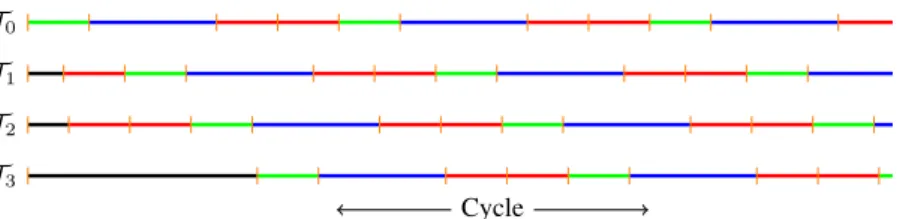
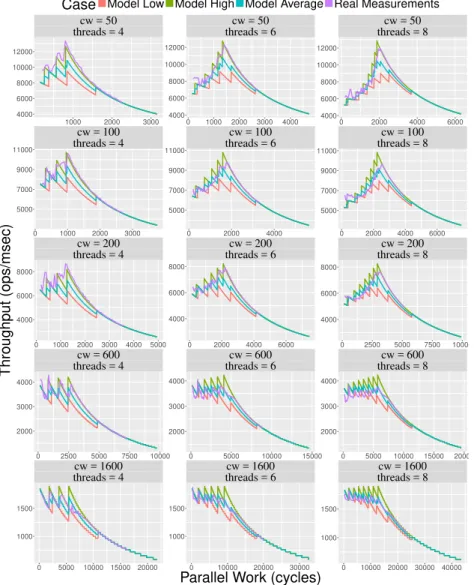
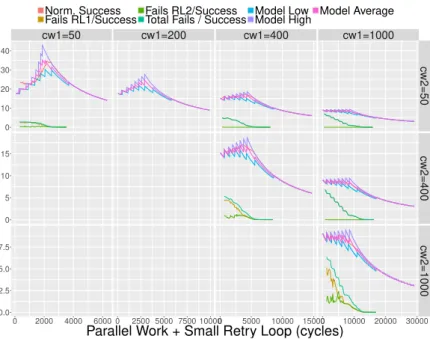
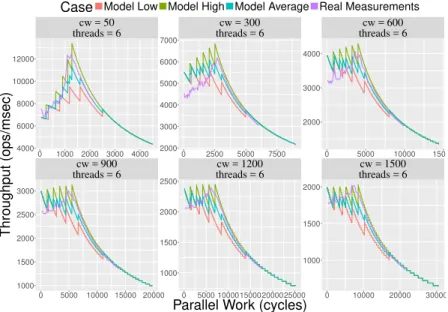
2.1 Thread procedure . . . 42
2.2 Execution with one wasted retry, and one inevitable failure . . 43
2.3 Execution with minimum number of failures . . . 43
2.4 Expansion . . . 45
2.5 Gaps . . . 50
2.6 Lemma 2 configuration . . . 51
2.7 Lemma 3 configuration . . . 56
2.8 Lemma 4 configuration . . . 61
2.9 Thread procedure with several retry loops . . . 72
2.10 Synthetic program . . . 77
2.11 Multiple retry loops with 8 threads . . . 78
2.12 Popon Treiber’s stack . . . 79
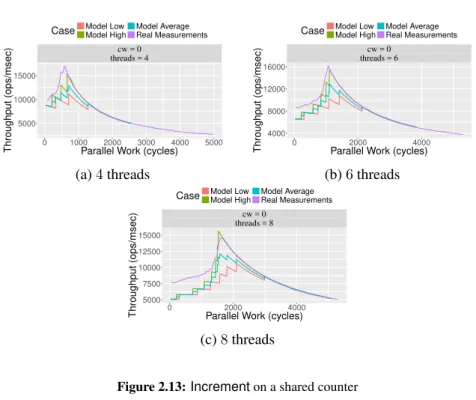
2.13 Incrementon a shared counter . . . 81
2.14 DeleteMinon a priority list . . . 82
2.15 Enqueue-Dequeueon Michael and Scott queues . . . 83
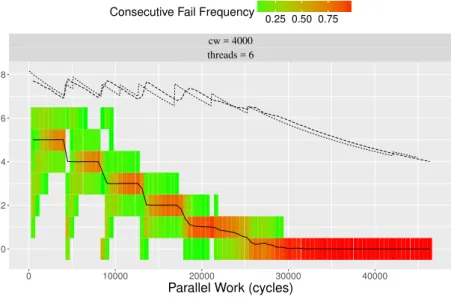
2.16 Consecutive Fails Frequency . . . 86
2.17 Comparison of back-off schemes for Poisson Distribution . . . 87
2.18 Comparison of back-off schemes for constantpw . . . 88 xiii
xiv LIST OF FIGURES
3.1 Thread procedure . . . 102
3.2 Success period . . . 102
3.3 Highly-contended execution . . . 114
3.4 Possible executions . . . 119
3.5 Synthetic program with exponentially distributed parallel work 130 3.6 Synthetic program with parallel work following Poisson . . . . 131
3.7 Synthetic program with Constant parallel work . . . 132
3.8 Treiber’s Stack . . . 134
3.9 Enqueue on MS Queue . . . 139
3.10 Operations on deque . . . 141
3.11 Performance impact of our back-off tunings . . . 142
3.12 Back-off Tuning on Treiber’s Stack . . . 143
3.13 Performance of memory management mechanisms . . . 145
3.14 Adaptive MM with varying meanpw . . . 146
4.1 Thread procedures . . . 158
4.2 Key legend of the graphs . . . 160
4.3 Cyclic execution under low intra-contention . . . 164
4.4 Intra-contention frontier . . . 164
4.5 Enqueue throughput withpwd= 7 . . . 172
4.6 Enqueue throughput withpwd= 50. . . 173
4.7 Dequeue throughput withpwd= 7 . . . 174
4.8 Dynamic memory power atf = 3.4 GHz. . . 177
4.9 Mandelbrot Execution Time . . . 182
5.1 Generic framework . . . 194
5.2 Poisson Process Modeling - Search Only . . . 198
5.3 Poisson Process Modeling - 50/50 Search/Update . . . 199
5.4 Skip List Events: Read Event Probability . . . 211
5.5 Skiplist Events:CASEvent Probability . . . 212
5.6 Binary Tree CAS Probability . . . 218
LIST OF FIGURES xv
5.8 LL Zipf distribution for key selection . . . 224 5.9 LL asymmetric update rates, uniform distribution for key
se-lection . . . 225 5.10 HT Uniform distribution for key selection, with load factor=2 . 227 5.11 HT Uniform distribution for key selection, with load factor=4 . 228 5.12 HT Uniform distribution for key selection, with load factor=8 . 229 5.13 HT Zipf distribution for key selection, with load factor=2 . . . 230 5.14 HT asymmetric update operations, Uniform distribution for
key selection, with load factor=4 . . . 231 5.15 Skiplist Uniform distribution for key selection . . . 233 5.16 Skiplist Zipf distribution for key selection . . . 234 5.17 Skiplist asymmetric update rates, uniform distribution for key
selection . . . 235 5.18 BST Uniform distribution for key selection . . . 237 5.19 BST Zipf distribution for key selection . . . 238 5.20 BST asymmetric update rates, uniform distribution for key
se-lection . . . 239 5.21 Packed nodes for Hash Table, with load factor=2 . . . 244 5.22 Packed nodes for Linked List . . . 245
Part I
1
Introduction
Moore’s Law [1] suggested an exponential growth in the number of transistors per unit area on the integrated circuits. Doubling the transistor density every year allowed vendors to implement more complicated designs that can switch state in shorter time periods. For almost 40 years, increasing the clock fre-quency of a processor was the way to improve the performance. However, it was unlikely to maintain this exponential growth in the longer term.
In the last two decades, we observed a shift from single-core chips to multi-core chips as it became infeasible to increase the clock frequency and com-plexity of a single core. The main triggers of this shift were the need to: (i) reduce power consumption and eliminate cooling-related issues; (ii) tolerate the high off-chip memory latency with concurrent accesses; (iii) decrease the circuit complexity of cores; (iv) expel some physical limitations regarding the
4 CHAPTER 1. INTRODUCTION
transistor size and the wire lengths.
Hardware vendors have changed their objective from increasing the core performance to increasing the chip performance [2]. They employ more and more cores on a single chip where individual cores might need to collaborate to exploit available computing power.
Naturally, these developments in hardware pose new challenges for applica-tions utilizing the hardware. Applicaapplica-tions have to be developed to harness the available computing power in an effective way which brought out the multi-core programming challenge. Today, multi-core processors are exploited by a broad spectrum of devices ranging from supercomputers to a vast number of smart-phones through almost all personal computers. Therefore, small improvements on the software might lead to significant outcomes.
Multi-core processors are composed of multiple computing units that we will refer to as processors (interchangeably cores). The execution entities that are running on processors will be referred to as processes (interchangeably threads) in the context of this thesis. Multiple processors can execute com-putations simultaneously which will be referred to as parallelism, and the over-lapping execution of processes introduces concurrency, where the execution of processes can interleave and influence the behavior of each other [3]. None of these concepts implies another. For example, the execution of a process can be interleaved by the other concurrent processes that are scheduled on the same sequential processor or multiple processors can run independent tasks in par-allel without the possibility of influencing each other. In this thesis, we study the performance of programs that are executed on multi-core shared memory system, in the settings with both parallelism and concurrency.
In the multi-core parallel programming model, multiple processes collabo-rate in order to complete tasks, each executing a program asynchronously [4] (i.e. the execution can be halted and the execution of instructions can be de-layed). The processes communicate, if needed, by accessing shared objects in the shared memory. In the course of a computation, processes access shared ob-jects in a sequence of atomic events in which some subsequence of the events might need to occur or look like they occur atomically. However, events from
5 multiple processes can interleave each other in concurrent executions. If not synchronized, some of these interleavings might lead to inconsistencies. Con-sider the case with two processes that want to increment a shared counter. A process reads the counter and writes back the incremented value. It can be ob-served that some interleavings of these four events would lead to an inconsistent state in which the counter seems to be incremented only once. To avoid this, some consistent order of the events on the shared objects can be enforced by synchronization.
Synchronization techniques define the way of accessing shared objects by adhering to some correctness (safety) and progress (liveness) guarantees. In simple terms, the correctness guarantee states that something bad does not hap-pen and the progress guarantee states that something good keeps haphap-pening [4]. In the sequential setting, operations on the object are defined by the pre- and post-conditions, that also constitute the intended behavior, namely the sequen-tial specification (correctness) of the object. Unsurprisingly, many correctness properties in the concurrent setting, where actions on the shared object from dif-ferent actors can be interleaved, are based on the equivalence to some sequential behavior of the object,e.g. Linearizability[5],Sequential Consistency[6]. In simplified terms, linearizability requires that there exists a legal sequential exe-cution (a legal total order with respect to sequential specification) that preserves the irreflexive partial order of the real concurrent execution. For each process, an invocation on the object is followed by the response. Letinv.opandres.op
denote the invocation and response times of an operationopin the concurrent execution, where every invocation has a corresponding response. The irreflex-ive partial order≺on the set of operationsOthat are executed by any process is given by: ∀(a, b) ∈ O2, a
≺ b ⇔ inv.b>res.a. Linearizability is widely adopted as a correctness guarantee for the concurrent data structures [4]. How-ever, the correctness guarantees are only meaningful if they come together with some progress guarantees as it is trivial to be correct without performing any action.
The progress guarantees can be split into two categories;blockingand non-blockingthat lead to blocking and non-blocking synchronization mechanism,
6 CHAPTER 1. INTRODUCTION
respectively. The distinction can be stated simply as follows: in blocking syn-chronization, a process can block another hence the delay of a process can delay others, whereas in non-blocking synchronization, the delay of a process cannot delay others [4]. We will provide technical information about the taxonomy and possible implementations of non-blocking and blocking synchronization mech-anisms in the following sections.
We can use an analogy with a conversation, where a shared conversation object evolves with the contribution of multiple agents. Due to the interleav-ing possibility, people indeed employ synchronization mechanisms generally to keep the shared object in a correct state (no misunderstandings) while allowing progress (some understanding should keep happening). The conventional way for this is to adopt a blocking approach. People talk one after the other, waiting for the talking person to finish and then ask for the token to continue. However, this approach might have some limitations. For example, a less important topic could be discussed while a more important one has to wait because it is blocked by the less important one. Alternatively, the phone of the talking person might ring, and others need to wait for the phone call to finish even though the orig-inal conversation has nothing to do with the phone call. On the other hand, optimistic people apply non-blocking approaches where people start and keep talking because they believe that their ideas will be understood eventually. In these cases, it could be quite tricky to satisfy the correctness and progress con-ditions, and other techniques have to be applied such as repetition. Although it is clear that non-blocking approaches eliminate the limitations of their block-ing counterparts, their efficiency is poorly understood. The efficiency of talkblock-ing styles could be evaluated according to different metrics,e.g. throughput (the number of expressed ideas in a unit of time) and total energy consumed during the discussion.
This thesis considers the throughput and energy consumption of the lock-free (non-blocking) synchronization mechanisms in shared memory multi-core systems, by focusing on the concurrent data structures. The thesis is organized into three parts: Introduction, Results and Conclusion. We provide background information in the first part. Section 1.1 examines the basics of the blocking
1.1. SYNCHRONIZATION TECHNIQUES 7
and non-blocking synchronization mechanisms, also discusses the atomic prim-itives that are needed to build such mechanisms. Section 1.2 briefly explains the relevant architectural features of modern multi-core processors. Section 1.3 dis-cusses the lock-free data structures: design techniques, important performance metrics, performance models and analyses. Lastly, the contributions of this the-sis are addressed in Section 1.4. Research articles are presented in the second part of the thesis and we conclude with the conclusion and future work.
1.1
Synchronization Techniques
1.1.1
Blocking Synchronization
A common way to implement synchronization is to use blocking approaches that are based on the notion of critical section. Critical sections are often imple-mented with the help of locks that mark the code blocks that need to possess the property: mutual exclusion. The mutual exclusion property ensures the correct-ness of the shared objects, by guaranteeing that the owner of the lock will not be disturbed by other lock-seekers. To implement a synchronization mechanism, it should be coupled at least with the deadlock-freedom property to satisfy some progress guarantees. The definitions of mutual exclusion and deadlock freedom property are given below:
• Mutual Exclusion [4]: at most one process can execute the concerned code block at a time.
• Deadlock Freedom[7]: if there exists a process that tries forever to en-ter its critical section execution, then there exists an infinite number of critical section executions.
Generally speaking, the blocking approaches are relatively more straight-forward to implement. However, they have some inherent limitations mainly originating from the dependency of lock-seeker processes to the lock-owner. A crucial drawback is that blocking approaches cannot tolerate the failure of a sin-gle process. If a process fails while holding a lock, it might inhibit the system
8 CHAPTER 1. INTRODUCTION
progress by blocking the other processes that request to execute the correspond-ing critical section. Another undesired effect is priority inversion where a low priority task holds a lock that a high priority task needs. Think of the following situation. The high priority task yields its quanta to the low priority task so that it can finish its critical section and release the lock. Then, a medium priority task comes, preempts the low priority task and executes before the high prior-ity task. Finally, the deadlock possibilprior-ity should be considered when multiple locks are used. This could be painful especially during the integration of differ-ent compondiffer-ents of large-scale software. Therefore, non-blocking approaches might be preferable.
1.1.2
Non-Blocking Synchronization
The synchronization mechanism regulates the accesses to the shared object and the termnon-blockingreflects the nature of an attempt to access the shared ob-ject. It states that an attempt to access or modify the shared object cannot block or be blocked by another process, regardless of the state of the system. How-ever, it does not specify the outcome of the attempt. Non-blocking mechanisms can be classified according to the progress guarantees that they provide, as fol-lows:
• Wait-Free Synchronization[8]: A synchronization technique is wait-free if it ensures that every process will continue to make progress in the face of arbitrary delay (or even failure) of other processes.
• Lock-Free Synchronization[9]: A synchronization technique is lock-free if it ensures only that some process always makes progress.
• Obstruction-free Synchronization[10]: A synchronization technique is obstruction-free if it guarantees progress for any process that eventually executes in isolation.
The stronger the progress guarantee, the more complex the synchroniza-tion mechanism gets. Wait-free solusynchroniza-tions are generally computasynchroniza-tionally costly.
1.1. SYNCHRONIZATION TECHNIQUES 9
Obstruction-free solutions are weak concerning the guarantees in a concurrent environment. Roughly speaking, lock-freedom is located around the sweet spot of this trade-off, which explains the attention it has received in the industrial applications, e.g. Intel’s Threading Building Blocks Framework [11], Java concurrency package[12],Microsoft .NET Framework[13].
1.1.3
Atomic Primitives
Implementing a synchronization mechanism (in the asynchronous multi-core systems) based on only atomic reads and writes are either impractical (because of space and time complexity,e.g. Bakery algorithm [14]) or even impossible for many types of synchronization [4]. To overcome these limitations, multi-core architectures often provide atomic primitives that atomically conduct a set of operations, i.e. such that an intermediate state during the execution of the instruction cannot be observed. These primitives can be used to synchronize processes efficiently.
Atomic primitives can be classified according to their consensus number [8], which is as a measure of their power. The consensus number specifies the max-imum number of processes for which the primitive (together with read/write registers) can solve the wait-free consensus problem, where each process must agree on an input value after a finite number of its own steps [15]. Wait-free consensus is critical because it allows processes, that are communicating asyn-chronously, to keep a consistent view of the shared objects. Atomic instructions, with a large enough consensus number, can be used to modify the shared object by having a wait-free consensus on each step of the progress. The semantics of some widely used atomic instructions are provided in Figure 1.1.
In [8], it has been shown that a primitive cannot be implemented by other primitives with lower consensus numbers. Compare-And-Swaphas an infinite consensus number, and it can be used to construct wait-free implementation of any abstract data type. Although it is very convenient for implementing non-blocking synchronization mechanisms, it should still be used with care since its redundant usage can lead to performance degradations. Another limitation
10 CHAPTER 1. INTRODUCTION
Compare-And-Swap(var,old,new) ifvar=oldthen
var←new returntrue else returnfalse Test-And-Set(var) ifvar= 0then var←1 returntrue else returnfalse Fetch-And-Add(var,value)
old←var
var←var+value
returnold
Figure 1.1:Semantics of Atomic Primitives
is that it suffers from the ABAproblem. A variable value was read to beA and was given as the old value parameter to theCompare-And-Swap. Then, the value is changed toBand then back toAagain by concurrent operations. Compare-And-Swapcannot distinguish this configuration from a configuration without any modification by concurrent operations. Consequently, the success-fulCompare-And-Swap might lead to a state that is not intended by design. This limitation is often overcome throughmemory managementschemes in the context of concurrent data structures.
1.2
Multi-core Architectures
Multi-core processors are composed of multiple independent computational processors (cores), each of them can execute a program asynchronously and communicate with the other cores through the shared memory. To obtain better performance, shared memory is often organized in a hierarchy where the main memory, residing at the top, is supported by a set of shared and/or private caches that are located closer to the cores for faster access. Modern multi-core
proces-1.2. MULTI-CORE ARCHITECTURES 11
sors show a great variety in the organization and properties of these components in terms of the size of memory/caches modules, memory hierarchy depth, ac-cess policies, number of cores, number of sockets, number of memory modules and the access latencies of these modules by different cores (could be uniform or non-uniform),etc.. Here, two critical issues need to be addressed from the synchronization perspective.
The first one is thecache coherency protocol (e.g. MESIF [16]) that as-sures the consistency of the copies of the data (in the unit of cache lines) in the multiple partially shared and private caches. In many cases, the protocol is represented with a state machine where each copy of the cache line is assigned to a state. The cache coherency protocol plays the lead role in the implementa-tion, hence the latency of the atomic primitives. It enforcesexclusive ownership of the target cache line by the core (through invalidation of the other copies if needed) during the execution of the atomic primitive. Therefore, the latency of the atomic primitives is determined based on the state of the target cache line copies and their locations in the memory hierarchy [17]. AssumeCore0has a cache line in exclusive state in its private cache. Then, it would be cheaper forCore0to execute an atomic primitive on the cache line compared toCore1 becauseCore1first needs to fetch and invalidate the copy inCore0’s private cache to bring the cache line to exclusive state in its private cache. The latency of this cache coherency communication between local caches of Core0 and Core1 depends on the location of the Core0 andCore 1. For instance, this latency is higher for the cores that reside in different sockets compared to the ones that reside in the same socket in a NUMA architecture. It is possible to build cost models for many architectures which is necessary for our purposes because the cost of the memory events have a direct impact on the throughput and the energy consumption of lock-free data structures.
The second issue is thememory consistency modelof the multi-core pro-cessor. Sequential consistency [6] is a natural option since the memory access ordering strictly follows the program order for each core. Nevertheless, for per-formance reasons, it is common to relax this model and allow reordering of some memory accesses, only if they are referencing to different locations in the
12 CHAPTER 1. INTRODUCTION
memory. Total Store Order (TSO) memory model allows loads to be moved ahead of stores. As explained in [18], this can be done by employing store buffers. For example, a store operation that experiences a huge stall time (e.g. due to the state of the cache line, the data needs to be fetched from a remote location), can be recorded to the store buffer and the execution can continue with the next read access that completes in a short time interval. Later on, when the cache line arrives, the data can be copied from the store buffer to the cache line. In this way, one can take advantage of the reordering to overlap the stall with other operations. This optimization does not create any problem for the sequential programs but might lead to undesirable behavior for the concurrent ones. We consider the program in Figure 1.2: if no reordering can take place, two zeros cannot be observed in the output. By contradiction, if this happens, then “print a” should occur before “a←1”, meaning that “b←1” occurred be-fore “print b”, which is impossible. However, this situation might happen with the reordering of memory accesses: Process 0 waits forb, and in the meantime, printsa, and Process 1 printsbwhile waiting fora.
a,b←0 Process 0 b←1 print a Process 1 a←1 print b Figure 1.2:Memory access reordering
Memory fence instructions are provided by multi-core processors to ensure the completion of the pending memory accesses for a core before the initiation of the following accesses. While implementing synchronization mechanisms, these memory fences can be used to overcome the reordering issue together with the consideration of the memory consistency model. In return, memory fences could decrease significantly performance as they do eliminate optimiza-tion possibilities. But the behavior of the program becomes more evident with them, which facilitates the performance predictions.
1.3. LOCK-FREE DATA STRUCTURES 13
1.3
Lock-free Data Structures
Data structures organize the data in a way to allow efficient access. Concur-rent ones also allow multiple processes to share data and communicate asyn-chronously. For some applications, this type of communication can be use-ful. For example, it allows for overlapping the communication and computation phases of different processes which might reduce the communication overhead if the overhead is a function of the number of processes that are communicating simultaneously. Also, it can help parallel applications to dynamically distribute and balance the load by eliminating the need to wait for the slowest process (e.g. work stealing with deques [19], producer/consumer design pattern with concurrent queues [20]).
Concurrent data structure operations are designed by employing synchro-nization mechanisms which determines the associated correctness and progress properties. As mentioned before, an operation can be classified as blocking or non-blocking based on the progress guarantees that it provides.
Lock-based operations are blocking, and they rely on the mutual exclusion property for correctness. Critical sections mark the code blocks that need to be executed atomically and traditionally are protected by locks. There are two main approaches to implement lock-based concurrent data structures. As a coarse-grained approach, a process can lock the whole data structure to operate in isolation. However, this approach might block some concurrent operations unnecessarily. A coarse-grained lock can delay the progress of concurrent op-erations even if they operate on disjoint parts of the data structure or serialize some steps of the operations that do not need to be executed in isolation. Fine-grained approaches avoid this wastefulness by locking possibly the minimum amount of shared resources for the minimum amount of time. Hence, they lead to more efficient data structure designs. Although it is easier to implement and reason about lock-based data structures compared to non-blocking data struc-tures, lock-based approaches suffer from the limitations that are mentioned in Section 1.1.
14 CHAPTER 1. INTRODUCTION
the level of established progress guarantees. Obstruction-free designs provide progress guarantees that are insufficient for a concurrent environment. On the other end of the spectrum, wait-free designs might exhibit insufficient perfor-mance metrics to satisfy strong progress guarantees. Lock-free data structures designs are generally efficient and scalable. Also, lock-free algorithms often exhibit wait-free progress guarantees in practice [21]. These facts highlight the convenience of lock-free data structures for practical usage.
1.3.1
Design Techniques
Lock-free implementations employ optimistic conflict control and guarantee system-wide progress. In contrast to pessimistic lock-based approaches, pro-cesses do not signal their presence before the operation, work independently and check at the end whether their independent work is invalidated. As a result, delays occur only if there is an actual conflict between concurrent processes. For example, an inactive preempted process cannot delay another process which is possible when one relies on mutual exclusion.
Three steps form the basic block to design a lock-free data structure oper-ation: accessing the concurrent data structure to determine its state, preparing the desired changes to the concurrent data structure locally and trying to ap-ply them to the shared state in an atomic way (thanks to an atomic primitive). When included in a retry loop, the basic block can be repeated until the desired changes are applied to the concurrent data structure.
Similar to the coarse- and fine-grained locking approaches, lock-free data structures are designed in many different ways. Universal constructionsare design techniques that can transform any sequential object into a safe concurrent object. As a coarse-grained approach, one can always rely on the universal construction described by Herlihy in [9], where it is shown that any abstract data type can get a lock-free implementation based on a single retry loop that applies the whole operation with a single successful atomic primitive.
In simple terms, the construction is realized in three steps: a process (i) accesses (via a shared pointer) to the object; (ii) copies the object and applies
1.3. LOCK-FREE DATA STRUCTURES 15
the sequential operation to the copied object; (iii) tries to apply the changes to the shared state by updating the shared pointer to the updated copy with an atomic primitive, and repeats the three steps until the third step is successful which happens only if the shared pointer is not updated by another process between step one and three. This approach introduces two problems for the large objects. It is inefficient to copy a large object, and the potential parallelism might be inhibited because the updates can conflict even if they modify the disjoint parts of the copied object (i.e.the implementation is not disjoint-access parallel [22]). Although this construction emphasizes mostly the computability aspect in asynchronous concurrent environments, it can be used as a basis to design efficient implementations of some fundamental abstract data types that have inherent sequential bottlenecks. This can be done by updating only a small portion (memory words that host the bottleneck) of the data structure while the old and new versions are sharing the untouched portion of the data structure.
A popular example is Treiber’s lock-free stack [23]. Its operations (push and pop) are realized with a single retry loop, both following a very similar structure. Figure 1.3 provides the structure of the push operation of Treiber’s stack. The stack is formed of a linked list of nodes where the top variable points to the first node. A push operation takes a new node as its parameter and appends it to the top of the stack. One can observe the three steps: (i) read the top pointer to determine the first element of the stack; (ii) prepare the new desired state locally by setting next field of the new node to the address of the first element; (iii) try to commit this state as the new state of the data structure with aCompare-And-Swap(CAS) on the top pointer to update it with the address of the new element. These steps are repeated in a retry loop until a successful CAS, whose failure would imply the existence of another successful concurrent operation.
For some other abstract data types, more practical designs apply the basic block in multiple, finer steps that gradually carry the data structure to the de-sired state. As in the fine-grained locking, this reduces the conflicts between different operations and provide better performance. However, it is harder to obtain the lock-free progress guarantee property when the operations are
com-16 CHAPTER 1. INTRODUCTION
Push(newNode) while(!success)
oldNode←top
newNode.next←oldNode
success ←CAS(top,oldNode,newNode) Figure 1.3:Treiber Stack Push Operation
pleted in multiple steps. The strategy here is to leave a sign to the other pro-cesses regarding the state of the operation after each step so that they can take action accordingly in order to guarantee the system-wide progress. Having en-countered an incomplete operation a process might (i) ignore and start its own operation, if possible; (ii) try to help (often not a selfless type of help) the in-complete operation before executing its own operation; (iii) try to merge the incomplete operation with its own operation at hand.
For example, one can think of Delete operation on the lock-free skip list [24]. This operation might require updates on multiple pointers in order to entirely detach the deleted element from the skip list. All these updates are not applied atomically but gradually each leaving a sign regarding the state of the opera-tion. First, the element is logically deleted with a mark. This mark leaves a sign to other processes so that they can determine the state of the incomplete operation in case they are operating in the vicinity of the deleted element. This knowledge allows them to avoid modifications that would lead to inconsistent states and take action (help for the next steps of the incomplete delete operation or ignore if possible) accordingly. In the same vein, the remaining steps of the operation are gradually executed until the element is completely detached from the skip list.
Loosely speaking, helping might create focal contention points, and ignor-ing might introduce additional work [25]. Some combination of these tech-niques is often used to design efficient lock-free data structure operations de-pending on the data structure type or the usage context. There are numerous lock-free implementations of various abstract data types with different design
1.3. LOCK-FREE DATA STRUCTURES 17
choices: skip lists [24, 26], binary trees [27, 28], stacks [23, 29, 30], queues [20, 31–34], vectors [35], bags [36], deques [37, 38], priority queues [39, 40], hash tables [41, 42], linked lists [43, 44]. This variety complicates the gathering of lock-free data structures under a unified generic design.
1.3.2
Throughput
A common metric for measuring the performance of lock-free data structure is throughput, defined as the number of successful operations per unit of time. For generic lock-free algorithms, the execution time of a single operation can-not be bounded. It is then more natural to consider sequences of operations instead, since all the operations in the sequence will not encounter bad exe-cutions. In this context, the performance is often measured with the average system throughput over a sequence of operations.
We are interested in the throughput of concurrent lock-free data structures, and the underlying impacting factors that drives this throughput. These impact-ing factors are viable for the performance ofalllock-free data structures that we consider in this thesis, but the significance of these impacting factors differs based on the characteristics of the data structure and on the context they are used in.
Retry loop and hardware conflicts: Lock-free operations cannot be blocked but some parts of an operation can be repeated due to the existence of conflict-ing concurrent operations within the retry loops. Under high contention,retry loop conflictsoccur, and this retry loop conflicts might lead to a second type of conflict, that we refer to ashardware conflicts. Retry loops contain atomic prim-itives that can stall other memory accesses (atomic primprim-itives, read/write that access the same memory word) while getting executed. When multiple atomic primitives are issued in the same time interval, they serialize (the latency of memory accesses expands due to stall time) and this leads to significant perfor-mance degradation.
Under high contention but in the absence of hardware conflicts, failing retry loop iterations introduce additional useless work to the failing (repeating)
pro-18 CHAPTER 1. INTRODUCTION
cess but theyoftendo not decrease the system performance. This is because two successful retry loop iterations cannot overlap in time and the successful one cannot be obstructed by failing retry loop iterations if there are no hard-ware conflicts. Therefore, increasing the number of processes in the retry loop would merely increase the number of failed retry loop iterations, but would not harm the system performance. However, hardware conflicts do not only intro-duce useless work (through waiting time) to the failing process but also harm the system performance. Think of a sequence of serializedCompare-And-Swap instructions: while a process will operate a successfulCompare-And-Swap(due to the progress guarantee), the rest of the processes in the retry loop are doomed to failure. If they are scheduled to execute theirCompare-And-Swapwhen the possibly successful one is pending, the system performance is reduced. Failing Compare-And-Swaps do not change the content of the memory word but only obstruct the successful one. This impact can escalate with the increase in the number of processes in the retry loop. It gets harder to get out of the retry loop for a successful process (i.e.the ratio failing/successfulCompare-And-Swap in-creases), and the additional delay of the successful operation leaves more space for new processes to arrive at the retry loop, that increases the contention fur-ther. This interplay might createhot spots.
In such cases,back-off strategies can be used to convert this harmful work (failingCompare-And-Swap) to a harmless but useless one. Failing processes can back-off, instead of retrying, to let the others succeed with less blockage. The back-off would increase the system performance, but its amount should be tuned since a small amount might be ineffective and large amount might lead to an underutilization of the resources.
Lock-free data structures that have inherent sequential bottlenecks are more prone to retry loop conflicts, thus to hardware conflicts. For such data struc-tures, accesses are concentrated on a small number of memory words. For example, a plain stack is accessed via its top pointer by all of its operations—in the same way, queue operations access either the head or the tail of the queue. Regardless of the size of the stack (the number of elements inside), all operation accesses the top pointer. This characteristic might lead to contention in the form
1.3. LOCK-FREE DATA STRUCTURES 19
of hot spots whose severity is determined by the number and access rate of the processes that are performing the operations.
Number of Loads/Stores and Cache Misses: Previously mentioned fac-tors (retry loop conflictsandhardware conflicts) are specific to use cases with high concurrency. There are also performance impacting factors that are not related to concurrency and appear both in sequential and concurrent executions. For example, consider a binary tree (or a skip list, a hash table) that might lead to accesses on a large number of different memory words over a sequence of operations. Even in the absence of concurrency-related conflicts, one needs to estimatethe number of memory word accesses per operationand connected to this, in the practical domain, thecache capacity misses. This estimation might not be trivial for some data structures like a binary tree, in contrast to simpler data structures such as stacks or queues.
On the bright side, this characteristic (accesses arenot concentrated on a small number memory words) might turn out to be an advantage in the concur-rent executions (i.e.leading to a good scalability) because the processes might spread to different shared memory words (for example to the different branches of a binary tree); this reduces the possibility of retry loop and hardware con-flicts, and in turn, the possibility of hot spots. If we assume that the num-ber of memory words is much bigger than the numnum-ber of processes (excluding extremely imbalanced access patterns), the retry loops and hardware conflicts would have anegligibleimpact on the performance of such data structures.
This does not mean that these data structures are immune to contention since every modification still requires a consensus. This consensus leads, on the logi-cal side, to a consistent view of the lock-free data structure that is accessed and modified by multiple processes concurrently in a non-blocking manner. On the practical side, achieving this consensus and spreading the information during and after its achievement impacts performance of all processes in the system. This impact is merely small compared to the other mentioned impacts.
The struggle of processes executing the same retry loop is often viewed as the major source of contention when they try to propose different values for the same consensus object within the same time frame (which leads to retry
20 CHAPTER 1. INTRODUCTION
loop conflicts and hardware conflicts). The impact of contention on the learn-ers (the processes that read the modified memory word) is less apparent since the contenting events may not occur close in time. More clearly, consider two consecutive accesses to a memory wordjby a processithat happen at timet0
andt1, respectively. For the access att1, processiwould experience a
coher-ence cache missif memory wordj is modified by another process in between
t0 and t1. Search data structures, e.g. hash tables, skip lists, trees, contain
multiple consensus objects (nodes), and this characteristic leverages the impact of the retry loop contention against thecoherence contention on the learners dramatically.
Through this thesis, we address these performance impacting factors in var-ious configurations. We focus on theretry loop conflicts(and their subsequent performance impactorhardware conflicts) for data structures that have sequen-tial bottlenecks (e.g. stack, queue, priority queue, counter). We set parameters for our models to analyze the congestion points so as to cover a large set of possible lock-free data structure designs, contention levels, and use cases. For search data structures, we focus on the main impacting factors, the most sig-nificant of which arethe number of memory accesses,capacityandcoherency cache misses. We construct a model based on these impacting factors and show that it can be initiated with different abstract data types (e.g. skip list, hash table, binary tree).
1.3.3
Energy Consumption
Energy consumption has recently become a vital optimization criterion, for sev-eral reasons [45]. For example, the electricity cost for the operation and the cooling of data centers has reached to a significant amount. Fixed battery ca-pacity is a constraint for mobile devices. Moreover, ecological footprints of data centers, supercomputers, personal and mobile devices necessitate a balance be-tween low energy use and high performance.
Energy consumption is obtained by the time-integral of power consumption that is classically split into two parts;staticanddynamic. The switching activity
1.3. LOCK-FREE DATA STRUCTURES 21
of the transistors, based on the characteristics of the executed program, leads to the dynamic part of the power dissipation. On the other hand, the static part originates from the leakage effects that also exist when the transistors do not change state, hence it is independent of the executed program.
At the hardware level, modern multi-core processors employ several low power techniques to reduce the energy consumption. When the system is idle, the dynamic part of the power is negligible.Power gatingtechnique can be used to minimize the static leakage part of the power. Computing units can be put to power saving states (sleep states) and can beactivatedback when needed. For an active system, computing units can be put into different operation states by changing the clock frequency.Dynamic Voltage and Frequency Scaling(DVFS) is the main technique to reduce the power dissipation of active systems. The convexity of the dynamic power curve with respect to clock frequency suggests that one can obtain better energy efficiency by reducing the frequency (coupled with the voltage) of the hardware components with a sacrifice from the execu-tion time. Thus, a null clock frequency and infinite execuexecu-tion time would be the most energy efficient configuration when the dynamic part of the power is considered. However, the static part of the power eliminates this option as it might cancel out the gains with the extended execution time.
Time complexity models have facilitated the design of efficient algorithms. Similarly, power models can be a crucial step towards energy efficient algo-rithms for multi-core systems. Combined with the performance models, they can also shed light on the previously mentioned optimization problems.
In this thesis, we present a power model for multi-core systems and show how to integrate it with our throughput model to obtain energy efficiency (en-ergy consumption per operation) of lock-free queue designs. Also, we have validated the power model with a more extensive set of lock-free data structures but these results [46–49] are not included in the thesis.
22 CHAPTER 1. INTRODUCTION
1.3.4
Execution Models and Analyses
It is common to model asynchronous executions by assuming an adversarial scheduler whose capabilities can vary depending on the context of study. This approach is convenient for the impossibility results and reasoning about the correctness properties of algorithms [4], but it leads to worst case bounds when the contention, connected to this performance, is analyzed. In the literature, complexity models have been proposed for contention in asynchronous shared memory systems. In [50], stall time, that is induced by memory operations that access to the same memory location at the same time interval (harware con-flicts), is analyzed by assuming an adversarial scheduler. Both retry loop and hardware conflicts are considered in [51]. To capture the cost of contention, the total amount of work is bounded for an n-process lock-free update proto-col where a process successfully updates a location once and returns from the protocol. In this study, the impact of exponential back-off is also analyzed.
In addition, amortized analysis techniques have been exploited [27, 43] to address the concurrency-related issues since the execution time of an individual lock-free operation cannot be bounded by definition. The failed attempts in the retry loops can be amortized by the successful ones, due to the fundamental property which states that a failed retry implies a successful concurrent retry. These analysis parameters can be set with a measure of contention to bound the average time complexity of the successful operations. Some common con-tention measures are:
• Point Contention[52]: maximum number of operations that are executed concurrently at any point during the execution interval of the operation • Interval Contention[53]: number of operations whose execution interval
overlaps with the execution interval of a given operation
The contention measure (that frames retry loop and hardware conflicts un-der a single contention cost) is often bounded by consiun-dering the worst case. However, the worst-case behavior is not enough to express the performance that we observe in practice. A tighter estimate of contention is needed because
1.3. LOCK-FREE DATA STRUCTURES 23
the worst case is reached only if the concurrent operations access the same part of the data structure at the same time.
Close to the practical domain, the expected system and individual opera-tion latencies are analyzed for a general class of lock-free algorithms under a uniform stochastic scheduler [21].
These theoretical analyses for the time complexity of lock-free data struc-tures target the asymptotic behaviors in terms of number of processes. Also, empirical studies [54, 55] have been conducted to understand the throughput and energy efficiency. These empirical studies help to grasp the complicated in-teraction between software and hardware. However, there is a lack of analytical results that target the performance of lock-free data structures, that is observed in practice, with the consideration of the underlying hardware. This thesis aims to bridge the gap between theoretical bounds and actual measured performance. In this thesis, we model and analyze the performance and energy efficiency of lock-free data structures on top of real hardware platforms. The modeling phase transforms the system, that constitutes lock-free program and machine, into an execution model, and the analysis of the model yields numeric values for the metrics of interest (e.g. throughput, cache misses, energy efficiency). This process is iterated throughout this thesis to tackle different types of lock-free data structures and different use cases, in which impacting factors might vary.
We start the process with the abstractions of the lock-free program and the machine that are characterized by a set of parameters. Then, the system is mapped to an execution model (e.g.cyclic pattern, Markov chain, Poisson pro-cess, queueing model in steady states under low and high contention, a system of mathematical equations) which retains the initial parameters. Both of these steps are aligned with the identified, significant performance impacting factors because we aim at representing the actual behavior of the system under a reason-able model complexity. During this process, we might ignore memory manage-ment calls if they are not costly, some type of hardware or algorithmic conflicts, and events when they are improbable. We collect the evidence regarding the insignificance of these details through empirical observations (benchmarking, performance counters). In a second phase, we analyze the execution model to
24 CHAPTER 1. INTRODUCTION
estimate (or sometimes bound) the main performance metrics: throughput and power consumption, that can be merged to obtain the energy efficiency. Finally, we validate our models with both synthetic tests and examples picked from ap-plication domains, for a range of lock-free data structures. To the best of our knowledge, we attempt for the first time to model and analyze the performance of lock-free data structures on such a broad domain and obtain estimates that are close to what is observed in practice.
An analytical framework can be useful in many ways. In the first place, it can explain observations and provide an understanding of the phenomena that drive the performance of lock-free data structures. It can identify the issues and bottlenecks in a design which in turn facilitates design decisions.
Secondly, it can be used to rank alternative lock-free data structure designs. We have mentioned in the previous sections that a vast variety of lock-free data structure designs exist. Different lock-free data structure designs can outper-form each other in different configurations, which makes it difficult to conduct a fair comparison. Sometimes strengths or limitations of the data structures are hidden, thus unnoticeable even by their creators because they only appear in some configurations of the domain that it is often not possible to sufficiently cover empirically. An analytical framework can reveal the merits of data struc-tures and provide a fair comparison by covering the whole configuration do-main.
Last but not least, it can help the tuning process of the data structure related parameters. On this last point, lock-free data structures come with specific pa-rameters,e.g.back-off, padding, and memory management related parameters, and become competitive only after picking carefully their values, which often involves a costly brute force approach. This can be replaced, or at least driven, by an analytical estimation of the performance.
1.4
Contributions
This thesis proposes analytical approaches to model and analyze the throughput and energy consumption of concurrent lock-free data structures. The
contribu-1.4. CONTRIBUTIONS 25
tions of this thesis to the field of concurrent lock-free data structures can be summarized under three headers:
Performance of a general class of lock-free data structures (Paper I and II): We present new ways of modeling and analyzing the performance of a gen-eral class of lock-free algorithms. We rely on the universal construction [9] and use this basic structure that is based on a single retry loop to model the lock-free data structures. A sequence of operations that are interleaved by ap-plication specific code abstracts the usage pattern of a lock-free data structure, by a thread. In this context, the performance metric (throughput) is defined as the average number of successful operations on the data structure per unit of time, by any thread.
We emphasize two impacting factors that rule the performance: (i)stall time due to the serialization of atomic primitives; (ii)number of failed retry loop it-erations. We analyze these factors through a set of hardware and algorithmic parameters, and the impact of the latency of application specific work (which regulates the access frequency of the threads to the data structure) is under-lined. We propose three analytical frameworks. We first target the cases where the latency of application specific code is a constant and we address it with a deterministic model (Paper I). The last two frameworks are based on stochastic models (Paper II). On the one hand, we address accurately cases where the la-tency is instantiated with exponential distribution through an execution model relying on Markov chains. On the other hand, we provide a generic approach that can be used for any latency distribution thanks to an approach based on queueing theory results. In addition, we exploit our frameworks to design a new back-off mechanism, to optimize memory management related parame-ters and to compare different lock-free data structures while covering the whole contention domain.
Performance and Energy Efficiency of Lock-Free Queues (Paper III): Our main contribution is to provide a generic high-level model for the perfor-mance and power dissipation of applications that rely heavily on the utilization of concurrent queues.
trans-26 CHAPTER 1. INTRODUCTION
formed into a lock-free linearizable concurrent data structure based on a single retry loop that applies the whole operation with a single successful atomic prim-itive. However, this approach might be far from being practical for some data structures. Due to performance concerns, lock-free data structure operations often possess more intricate designs. In this study, we want to have a broader relevance when dealing with these intricate operation designs and when threads are allowed to execute these different types of operations concurrently. We rely on an abstract model and calibrate it with samples from the solution space. This approach contrasts with the previously mentioned studies (Paper I and II) in which the execution models are more refined, and no samples from the solu-tion space are used. We study lock-free queues and examine the interference between operations through the state of the queue (mostly empty or not empty). Based on their local and global interaction, we model the dequeuers’ throughput and enqueuers’ throughput focusing on the possible steady-state behaviors.
To model power dissipation, we first split the total power intostatic, acti-vationanddynamicparts, the latter only depending on the actual instructions being executed. We further decompose these parts according to the hardware components (memory, CPU, uncore) and characterize their power consumption based on the rate of hardware events.
We instantiate our models using a very limited amount of application spe-cific information, thanks to our performance model. Finally, we validate our models using several lock-free queue implementations through both synthetic tests and code from the application domain.
Performance of Lock-Free Search Data Structures (Paper IV): We study the throughput performance of concurrent lock-free search data structures. Search data structures possess different characteristics compared to the set of data structures that we studied formerly. In this study, we target the use cases where search data structures are utilized through a sequence of operations which are generated with a memoryless and stationary access pattern (i.e. for each oper-ation in the sequence, the probability of selecting a specific key and a specific type are constants).
BIBLIOGRAPHY 27
to each other in a way that provides efficient operations. Each thread executes a sequence of operations, and each operation triggersreadandmodifyevents on a subset of blocks. Hence, the throughput is ruled by the number of events in an operation and the latencies of these events.
The primary challenge in predicting throughput is that the latency of each event mainly depends on the state of the caches at the time when it is triggered. The state of caches is changing due to events that are triggered by the opera-tions of multiple threads. Accordingly, the latency of an event is determined by the ordering of the events on the timeline. Considering a given block, two point distributions define the location of the events on the timeline. For each block, we use Poisson processes to model these point distributions relying on the properties of our access pattern and the rareness of events. Superposition and thinning properties of Poisson processes help us to deal with the interaction of threads. Knowing the probabilistic ordering of the events from single and multiple threads, we are able to estimate the throughput.
The validation of our model is conducted through several fundamental lock-free search data structures such as a hash table, linked list, skip list and binary tree. We rely then on this performance modeling to achieve performance opti-mization by analyzing the influence of possible memory alignment strategies. By aligning blocks to cache lines, the false sharing possibility can be eliminated at the expense of increasing the memory footprint of the search data structure. In this study, we also shed light on this trade-off in the context of search data structures.
Bibliography
[1] Gordon Earle Moore, “Cramming more components onto integrated circuits,” Pro-ceedings of the IEEE, vol. 86, pp. 82–85, 1998.
[2] Geoff Lowney, “Why intel is designing multi-core processors,” inProceedings of the ACM Symposium on Parallelism in Algorithms and Architectures (SPAA). 2006, p. 113, ACM.