Open Archive TOULOUSE Archive Ouverte (OATAO)
OATAO is an open access repository that collects the work of Toulouse researchers and
makes it freely available over the web where possible.
This is an author-deposited version published in :
http://oatao.univ-toulouse.fr/
Eprints ID : 13202
To cite this version
: Drougard, Nicolas and Teichteil-Königsbuch,
Florent and Farges, Jean-Loup and Dubois, Didier
Structured
Possibilistic Planning Using Decision Diagrams
.
(2014) In:
Conference on Artificial Intelligence - AAAI 2014, 27 July 2014 - 31
July 2014 (Québec, Canada).
Any correspondance concerning this service should be sent to the repository
administrator:
[email protected]
Structured Possibilistic Planning Using Decision Diagrams
Nicolas Drougard, Florent Teichteil-K¨onigsbuch
Jean-Loup Farges
Onera – The French Aerospace Lab 2 avenue Edouard Belin 31055 Toulouse Cedex 4, France
Didier Dubois
IRIT – Paul Sabatier University 118 route de Narbonne 31062 Toulouse Cedex 4, France
Abstract
Qualitative Possibilistic Mixed-Observable MDPs (π
-MOMDPs), generalizingπ-MDPs andπ-POMDPs, are
well-suited models to planning under uncertainty with mixed-observability when transition, observation and reward functions are not precisely known and can be qualitatively described. Functions defining the model as well as intermediate calculations are valued in a finite possibilistic scaleL, which induces afinitebelief state space under partial observability contrary to its proba-bilistic counterpart. In this paper, we propose the first study of factoredπ-MOMDP models in order to solve
large structured planning problems under qualitative un-certainty, or considered as qualitative approximations of probabilistic problems. Building upon the SPUDD algorithm for solving factored (probabilistic) MDPs, we conceived a symbolic algorithm named PPUDD for solving factoredπ-MOMDPs. Whereas SPUDD’s
deci-sion diagrams’ leaves may be as large as the state space since their values are real numbers aggregated through additions and multiplications, PPUDD’s ones always re-main in the finite scaleLviaminandmaxoperations only. Our experiments show that PPUDD’s computation time is much lower than SPUDD, Symbolic-HSVI and APPL for possibilistic and probabilistic versions of the same benchmarks under either total or mixed observ-ability, while still providing high-quality policies.
Introduction
Many sequential decision-making problems under uncer-tainty can be easily expressed in terms of Markov Deci-sion Processes (MDPs) (Bellman 1957). Partially Observ-able MDPs (POMDPs) (Smallwood and Sondik 1973) take into account situations where the system’s state is not totally visible to the agent. Finally, the Mixed Observable MDP (MOMDP) framework (Ong et al. 2010; Araya-L´opez et al. 2010) generalizes both previous ones by considering that states can be expressed in terms of two parts, one visible and the other hidden to the agent, which reduces the dimen-sion of the infinite belief space. With regard to POMDPs, ex-act dynamic programming algorithms like incremental prun-ing (Cassandra, Littman, and Zhang 1997) can only solve very small problems: many approximation algorithms have
been proposed to speed up computations while controlling the quality of the resulting policies (Pineau, Gordon, and Thrun 2003; Smith and Simmons 2004; Kurniawati, Hsu, and Lee 2008). In this paper, we proceed quite differently: we start with an approximatedqualitativemodel that we ex-actly solve.
Qualitative possibilistic MDPs (π-MDPs), POMDPs (π -POMDPs) and more broadly MOMDPs (π-MOMDPs) were introduced in (Sabbadin 2001; Sabbadin, Fargier, and Lang 1998; Sabbadin 1999; Drougard et al. 2013). These pos-sibilistic counterparts of probabilistic models are based on Possibility Theory (Dubois and Prade 1988) and more specifically on Qualitative Decision Theory (Dubois, Prade, and Sabbadin 2001; Dubois and Prade 1995). A possibil-ity distribution, classically models imprecision or lack of knowledge about the model. Links between probabilities and possibilities are theoretically well-understood: possibil-ities and probabilpossibil-ities have similar behaviors for problems with low entropy probability distributions (Dubois et al. 2004). Using Possibility Theory instead of Probability The-ory in MOMDPs necessarily leads to an approximation of the initial probabilistic model (Sabbadin 2000), where prob-abilities and rewards are replaced by qualitative statements that lie in a finite scale (as opposed to continuous ranges in the probabilistic framework), which results in simpler com-putations. Furthermore, in presence of partial observability, this approach benefits from computations on finite belief state spaces, whereas probabilistic MOMDPs tackleinfinite
ones. It means that the same algorithmic techniques can be used to solveπ-MDPs,π-POMDPs orπ-MOMDPs. What is lost in precision of the uncertainty model is saved in com-putational complexity.
Nevertheless, existing works onπ-(MO)MDPs do not to-tally take advantage of the problem structure, i.e. visible or hidden parts of the state can be themselves factored into many state variables, which are flattened by current possi-bilistic approaches. In probapossi-bilistic settings, factored MDPs and Symbolic Dynamic Programming (SDP) frameworks (Boutilier, Dearden, and Goldszmidt 2000; Hoey et al. 1999) have been extensively studied in order to reason directly at the level of state variables rather than state space in exten-sion. However, factored probabilistic MOMDPs have not yet been proposed to the best of our knowledge, probably be-cause of the intricacy of reasoning with a mixture of a finite
state subspace and an infinite belief state subspace due to the probabilistic model – contrary to the possibilistic case where both subspaces are finite. The famous algorithm SPUDD (Hoey et al. 1999) solves factored probabilistic MDPs by us-ing symbolic functional representations of value functions and policies in the form of Algebraic Decision Diagrams (ADDs) (Bahar et al. 1997), which compactly encode real-valued functions of Boolean variables: ADDs are directed acyclic graphs whose nodes represent state variables and leaves are the function’s values. Instead of updating states individually at each iteration of the algorithm, states are ag-gregated within ADDs and operations are symbolically and directly performed on ADDs over many states at once. How-ever, SPUDD suffers from manipulation of potentially huge ADDs in the worst case: for instance, expectation involves additions and multiplications of real values (probabilities and rewards), creating other values in-between, in such a way that the number of ADD leaves may equal the size of the state space, which is exponential in the number of state vari-ables. Therefore, the work presented here is motivated by the simple observation thatsymbolic operations with possi-bilisticMDPs would necessarily limit the size of ADDs: in-deed, this formalism operates over afinitepossibilistic scale
Lwith onlymaxandminoperations involved, which im-plies that all manipulated values remain inL.
This paper begins with a presentation of theπ-MOMDP framework. Then we present our first contribution: a Sym-bolic Dynamic Programming algorithm for solving factored
π-MOMDPs named Possibilistic Planning Using Decision Diagram (PPUDD). This contribution alone is insufficient, since it relies on abelief-state variable whose number of values is exponential in the size of the state space. There-fore, our second contribution is a theorem to factorize the belief state itself in many variables under some assumptions about dependence relationships between state and observa-tion variables of aπ-MOMDP, which makes our algorithm more tractable while still exact and optimal. Finally, we ex-perimentally assess our approach on possibilistic and proba-bilistic versions of the same benchmarks: PPUDD against SPUDD and APRICODD (St-aubin, Hoey, and Boutilier 2000) under total observability to demonstrate that gener-ality of our approximate approach does not penalize perfor-mances on restrictive submodels; PPUDD against symbolic HSVI (Sim et al. 2008) and APPL (Kurniawati, Hsu, and Lee 2008; Ong et al. 2010) under mixed-observability.
Qualitative Possibilistic MOMDPs
Qualitative Possibilistic Mixed-Observable MDPs (π -MOMDPs) have been first formulated in (Drougard et al. 2013). Let us defineL={0,k1, . . . ,k−1k ,1}, the fixed pos-sibilistic scale (k ∈N∗). Apossibility distributionover the
state spaceSis a functionπ:S→Lwhich verifies the pos-sibilistic normalization:maxs∈Sπ(s) = 1. This distribution
ranks plausibilities of events:π(s)< π(s′)means thatsis less plausible thans′. Aπ-MOMDP is defined by a tuple
#S=Sv×Sh,A,L, Tπ,O,Ωπ, µ%where:
• S=Sv×Shis a finite set of states composed of states in
Svvisible to the agent and states inShhidden to it;
• Ais a finite set of actions;
• Tπ:S×A×S&→Lis a possibility transition function
s.t.Tπ(s, a, s′) =π(s′| s, a)is thepossibility degreeof
reaching states′when applying actionain states;
• Ois a finite set of observations;
• Ωπ : S×A×O &→ Lis an observation function s.t.
Ωπ(s′, a, o′) = π(o′| s′, a)is thepossibility degreeof
observingo′when applying actionain states′;
• µ:S&→Lis a preference distribution that models quali-tativeagent’s goals, i.e.µ(s)< µ(s′)means thatsis less
preferable thans′.
The influence diagram of aπ-MOMDP is depicted in Fig-ure 1. This framework includes totally and partially observ-able problems:π-MDPs areπ-MOMDPs withS=Sv(state
is entirely visible to the agent);π-POMDPs areπ-MOMDPs withS=Sh(state is entirely hidden).
The state’s hidden part may initially not be entirely known: an estimation can be however available, expressed in terms of a possibility distributionβ0 : Sh → Lcalled initial possibilistic belief state. For instance, if∀sh ∈ Sh,
β0(sh) = 1, the initial hidden state is completely unknown;
if∃sh ∈ Sh such that∀sh ∈ Sh,β0(sh) = δsh,sh
(Kro-necker delta), the initial hidden state is known to be sh.
Let us use the prime notation to label the symbols at the next time of the process (e.g. β′ for the next belief) and
the unprime one at the current time (e.g.afor the current action). By using the possibilistic version of Bayes’ rule (Dubois and Prade 1990), the belief state’s update under mixed-observability is (Drougard et al. 2013)∀s′
h ∈ Sh: β′(s′h) = ! 1ifs′h∈argmax s′ h∈Sh π(o′, s′v, sh′ | sv,β, a)>0 π(o′, s′ v, s′h| sv,β, a) otherwise, (1) denoted byβ′ = U(β, a, s
v, s′v, o′). The set of all beliefs
over Sh is denoted byBπ.Note thatBπ is finite of size
#L#Sh−(#L−1)#Shunlike continuous probabilistic
be-lief spacesB![0,1]Sh. It yields a belief finite-stateπ-MDP
overSv×Bπ, named state space accessible to the agent,
whose transitions are (Drougard et al. 2013):
π(s′v,β′| sv,β, a) = max s′ h∈Sh o′ |β′ =U(β,a,sv,s ′ v,o ′ ) π(o′, s′v, sh′ | sv,β, a).
Finally, preference over (sv,β) is defined such that this
paired state is considered as good if it is necessary (accord-ing to β) that the system is in a good state: µ(sv,β) =
min
sh∈Shmax{µ(sv, sh),1−β(sh)}.
Astationary policyis defined as a functionδ:Sv×Bπ→
Aand the set of such policies is denoted by∆. Fort ∈N,
s
ts
t+1 π(st+1|st, at) π(ot|st, at−1) π(ot+1|st+1, at) sv,t sv,t+1 sh,t sh,t+1 at at−1 ot ot+1the set oft-length trajectories starting in statex= (sv,β)∈
Sv×Bπby following policyδ is denoted byTtδ(x). For a
trajectoryτ ∈Tδ
t (x),τ(t′)is the state visited at time step t′ ! tand its quality is defined as the preference of its
ter-minal state:µ(τ) =µ(τ(t)). Thevalue (or utility) function
of a policyδin a statex= (sv,β)∈Sv×Bπis defined as
the optimistic quality of trajectories starting inx:
Vδ(x) =max+∞
t=0 τ∈Tmax(δ)
t (x)
min{π(τ |x0=x,δ), µ(τ(t))}
By replacing max by "
and min by×, one can easily draw a parallel with probabilistic MDPs’ expected criterion with terminal rewards. The optimal value function is defined as:V∗(x) = max
δ∈∆Vδ(x), x = (sv,β) ∈ Sv×Bπ.
As proved in (Drougard et al. 2013), there exists an opti-mal stationary policy δ∗ ∈ ∆, which is optimal over all
history-dependent policies and independent from the ini-tial state, which can be found by dynamic programmingif
there exists an action a such that π(s′
v,β′| sv,β, a) =
δ(sv,β),(s′
v,β′) (Kronecker delta). This assumption is
satis-fied if π(s′| s, a) = δ
s,s′ (state does not change) and
π(o′| s′, a) = 1 ∀s′, o′ (agent does not observe). Action ais similar to the discount factor in probabilistic MOMDPs; it allows the following dynamic programming equation to converge in at most#Sv×#Bπiterations to the optimal
value functionV∗: Vt+1∗ (x) = max
a∈Ax′∈Sv×Bmax πmin{π(x
′
|x, a), Vt∗(x′)}, (2)
with initialization V0∗(x) = µ(x). This hypothesis is yet not a constraint in practice: in the returned optimal policy
δ∗, action ais only used for goals whose preference
de-gree is greater than possibility dede-gree of transition to better goals. For a given actionaand states, we note qa(x) = maxx′∈Sv×Bπmin{π(x′ | x, a), Vt∗(x′)} which is known as theQ-value function.
This framework does not considersv norβ to be
them-selves factored into variables, meaning that it does not tackle
factored π-MOMDPs. In the next section, we present our first contribution: the first symbolic algorithm to solve fac-tored possibilistic decision-making problems.
Solving factored
π
-MOMDPs using symbolic
dynamic programming
Factored MDPs (Hoey et al. 1999) have been used to ef-ficiently solve structured sequential decision problems un-der probabilistic uncertainty, by symbolically reasoning on functions of states via decision diagrams rather than on in-dividual states. Inspired by this work this section sets up a symbolic resolution of factored π-MOMDPs, which as-sumes thatSv,ShandOare each cartesian products of
vari-ables. According to the previous section, it boils down to solving a finite-state beliefπ-MDP whose state space is in the form ofSv,1×· · ·×Sv,m×Bπ, where each of those
state variable spaces is finite. We will see in the next section howBπ can be further factorized thanks to the
factoriza-tion ofShandO. While probabilistic belief factorization in
(Boyen and Koller 1999; Shani et al. 2008) is approximate,
t
t
+ 1
X1 X2 .. . X′ 1 X′ 2 .. . at at−1 Ta,1 Ta,2 Figure 2: DBN of a factoredπ-MDPthe one presented here relies on some assumptions but is ex-act. For now, as finite state variable spaces of sizeK can be themselves factored into⌈log2K⌉binary-variable spaces
(see (Hoey et al. 1999)), we can assume that we are reason-ing about a factored belief-stateπ-MDP whose state space isX= (X1, . . . , Xn), n∈N∗and∀i,#Xi= 2.
Dynamic Bayesian Networks (DBNs) (Dean and Kanazawa 1989) are a useful graphical representation of process transitions, as depicted in Figure 2. In DBN seman-tics,parents(X′
i)is the set of state variables on whichXi′
depends. We assume thatparents(X′
i)⊂ X, but methods
are discussed in the literature to circumvent this restrictive assumption (Boutilier 1997). In the possibilistic settings, this assumption allows us to compute the joint possibility transition as π(s′v,β′| sv,β, a) = π(X′| X, a) =
minn
i=1π(Xi′| parents(X ′
i), a). Thus, a factored π
-MOMDP can be defined with transition functionsTa,i =
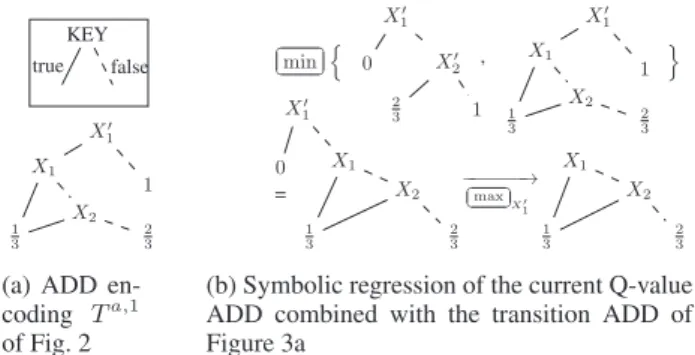
π(Xi′| parents(Xi′), a)for each actionaand variableXi′. Each transition function can be compactly encoded in an Algebraic Decision Diagram (ADD) (Bahar et al. 1997). An ADD, as illustrated in Figure 3a, is a directed acyclic graph which compactly represents a real-valued function of binary variables, whose identical sub-graphs are merged and zero-valued leaves are not memorized. The possibilistic update of dynamic programming, i.e. Equation 2, can be rewritten in a symbolic form, so that states are now globally updated at once instead of individually ; the Q-value of an action a ∈ A can be decomposed into independent computations thanks to the following proposition:
Proposition 1. Consider the current value functionV∗
t :
{0,1}p→L. For a given actiona∈A, let us define: -qa 0=Vt∗(X1′,· · ·, Xn′), -qa i = maxX′ i∈{0,1}min # (Xi′| parents(Xi′), a), qa i−1 $ , Then, the possibilistic Q-value of actionais:qa =qa
n. Proof. qa= max (s′ v ,β′)∈Sv×Bπmin{π(s ′ v,β ′ |sv,β, a), V ∗ t(s ′ v,β ′ )} = max X′ ∈Sv×Bπ min!minn i=1π " Xi′# # parents(X ′ i), a $ , Vt∗(X′ )% = max X′ n∈{0,1}min ! π"X′ n # # parents(X ′ n), a $, · · · max X′ 2∈{0,1} min&π"X′ 2 # # parents(X ′ 2), a $, max X′ 1∈{0,1} min{π"X′ 1 # #parents(X ′ 1), a $,V∗ t(X ′ )}' · · ·%
where the last equation is due to the fact that, for any vari-ablesx, y∈X,Yfinite spaces, and any functionsϕ:X →
Landψ:Y→L, we have: max
y∈Ymin{ϕ(x),ψ(y)}= min{ϕ(x),maxy∈Yψ(y)}
The Q-value of actiona, represented as an ADD, can be then iteratively regressed over successive post-action state
KEY true false X′ 1 1 X1 X2 1 3 2 3
(a) ADD en-coding Ta,1 of Fig. 2 ✄ ✂ # ✁ min% X′ 1 X′ 2 0 2 3 1 , X′ 1 1 X1 X2 1 3 2 3 & = X′ 1 X1 X2 1 3 2 3 0 −−−−−−→ ✄ ✂ # ✁ max X′ 1 X1 X2 1 3 2 3
(b) Symbolic regression of the current Q-value ADD combined with the transition ADD of Figure 3a
Figure 3: Algebraic Decision Diagrams for PPUDD variablesX′
i,1!i!n. The following notations are used to
make it explicit that we are working with symbolic functions encoded as ADDs: -✄ ✂ # ✁
min {f, g}wheref andgare 2 ADDs; -✄ ✂ # ✁ maxXif=✄ ✂ # ✁ max # fXi=0, fXi=1$
, which can be easily computed because ADDs are constructed on the basis of the Shannon expansion:f = Xi·fXi=0+Xi·fXi=1where fXi=1andfXi=0are sub-ADDs representing the positive
and negative Shannon cofactors (see Fig. 3a).
Figure 3b illustrates the possibilistic regression of the Q-value of an action for the first state variableX1 and leads
to the intuition that ADDs should be far smaller in practice under possibilistic settings, since their leaves lie inLinstead ofR, thus yielding more sub-graph simplifications.
Algorithm 1 is a symbolic version of the π-MOMDP Value Iteration Algorithm (Drougard et al. 2013), which re-lies on the regression scheme defined in Proposition 1. In-spired by SPUDD (Hoey et al. 1999), PPUDD means Possi-bilistic Planning Using Decision Diagrams. As for SPUDD, it needs to swap unprimed state variables to primed ones in the ADD encoding the current value function before com-puting the Q-value of an actiona(see Line 5 of Algorithm 1 and Figure 3b). This operation is required to differentiate the next state represented by primed variables from the current one when operating on ADDs.
We mentioned at the beginning of this section that be-lief variableBπcould be transformed into⌈log
2K⌉binary
variables whereK = #L#Sh−(#L−1)#Sh. However,
Algorithm 1:PPUDD
1 V∗←0;Vc←µ;δ←a; 2 whileV∗.=Vcdo
3 V∗←Vc;
4 fora∈A do
5 qa←swap eachXivariable inV∗withXi′;
6 for1!i!ndo 7 qa← ✄ ✂ # ✁ min{qa,π(X′ i| parents(Xi′), a)}; 8 qa← ✄ ✂ # ✁ maxX′ i qa; 9 Vc← ✄ ✂ # ✁ max {qa, Vc};
10 updateδtoawhereqa=VcandVc> V∗; 11 return(V∗,δ);
thisK can be very large so we propose in the next section a method to exploit the factorization ofSh andOin order
to factorizeBπ itself into small belief subvariables, which
will decompose the possibilistic transition ADD into an ag-gregation of smaller ADDs. Note that PPUDD can solveπ -MOMDPs even if this belief factorization is not feasible, but it will manipulate bigger ADDs.
π
-MOMDP belief factorization
Factorizing the belief variable requires three structural as-sumptions on theπ-MOMDP’s DBN, which are illustrated by the Rocksample benchmark (Smith and Simmons 2004).
Motivating example. A rover navigating in aN×Ngrid has to collect scientific samples from interesting (“good”) rocks amongRones and then to reach the exit. It is fitted with a noisy long-range sensor that can be used to determine if a rock is “good” or not:
-Svconsists of all the possible locations of the rover in
ad-dition to the exit (#Sv=N2+ 1),
-Shconsists of all the possible natures of the rocks (Sh=
Sh,1×. . .×Sh,Rwith∀1!i!R,Sh,i={good, bad}),
-Acontains the (deterministic) moves in the 4directions, checking rocki∀1!i!Rand sampling the current rock, -O = {ogood, obad}are the possible sensor’s answers for
the current rock.
The more the rover is close to the checked rock, the better it observes its nature. The rover gets the reward+10(resp.
−10) for each good (resp. bad) sampled rock, and+10when it reaches the exit.
In the possibilistic model, the observation function is ap-proximated using a critical distance d > 0beyond which checking a rock is uninformative: π(o′
i| s′i, a, sv) = 1 ∀o′
i ∈Oi. The possibility degree of erroneous observation
becomes zero if it stands at the checked rock, and lowest non zero possibility degree otherwise. Finally, as possibilistic se-mantics does not allow sums of rewards, an additional visi-ble state variavisi-blesv,2∈{1, . . . , R}which counts the
num-ber of checked rocks is introduced. Preferenceµ(s)equals qualitative dislike of samplingR+2−sv,2
R+2 if all rocks are bad
and location is terminal, zero otherwise. The location of the rover is finally denoted bysv,1 ∈Sv,1and the visible state
is thensv= (sv,1, sv,2)∈Sv,1×Sv,2=Sv.
Observations {ogood, obad} for the current rock can be
equivalently modeled as a cartesian product of observations
{ogood1, obad1}×· · ·×{ogoodR, obadR}for each rock. By
using this equivalent modeling, state and observation spaces are both respectively factored asSv,1×. . .×Sv,m×Sh,1×
. . .×Sh,landO= O1×. . .×Ol, and we can now map
each observation variableoj ∈ Oj to its hidden state
vari-ablesh,j ∈ Sh,j. It allows us to reason about DBNs in the
form of Figure 4, which expresses three important assump-tions that will help us factorize the belief state itself: 1. all state variables sv,1, sv,2, . . . , sh,1, sh,2, . . . are
inde-pendent post-action variables (no arrow between two state variables at the same time step, e.g.sv,2andsh,1);
hid-t
t
+ 1
sv,1 sv,2 .. . s′ v,1 s′ v,2 .. . sh,1 sh,2 .. . s′ h,1 s′ h,2 .. . at at−1 o1 o2 o′ 1 o′ 2Figure 4: DBN of a factored belief-independentπ-MOMDP den variables: the nature of a rock is independent from the previous nature of other rocks (e.g. no arrow fromsh,1to s′
h,2);
3. an observation variable is available for each hidden state variable. It does not depend on other hidden state variables nor current visible ones, but on previous visible state vari-ables and action (e.g. no arrow betweens′h,1ando′2, nor be-tweens′
v,1ando′1). Each observation variable is indeed only
related to the nature of the corresponding rock.
Formalization. To formally demonstrate how the three previous independence assumptions can be used to factor-izeBπ, let us recursively define the history(h
t)t!0of aπ
-MOMDP as:h0={β0, sv,0}and for each time stept"1, ht={ot, sv,t, at−1, ht−1}. We first prove in the next
theo-rem that the current belief can be decomposed into marginal beliefs dependent on historyhtvia theminaggregation:
Theorem 1. Ifsh,1, . . . , sh,lare initially independent, then at each time stept >0the belief over hidden states can be written asβt =
l
min
j=1βj,twith∀sh,j ∈ Sh,j,βj,t(sh,j) =
π(sh,j| ht)the belief overSh,j.
Proof. First sh,1, . . . , sh,l are initially independent, then ∃(β0,j)lj=1such that β0(sh) =
l
min
j=1β0,j(sh,j). The
inde-pendence between hidden variables conditioned on the his-tory can be shown using thed-separationrelationship (Pearl 1988) used for example in (Witwicki et al. 2013). In fact, as shown in Figure 4, given 1 ! i < j ! l,s′
h,i and
s′
h,j are d-separated by the evidenceht+1recursively
rep-resented by the light-gray nodes. Thus π(s′h| ht+1) = l min j=1π ' s′h,j ( ( ht+1) i.e. βt(s′h) = l min j=1βj,t(s ′ h,j). Note
however that it would not be true if the same observation variableowould have concerned two different hidden state variablessh,pandsh,q: asois part of the history, there would
be a convergent (towardso) relationship betweensh,p and sh,qand the hidden state variable would have been
depen-dent (because d-connected) conditioned on history. More-over if hidden state variables′h,pcould depend on previous hidden state variable sh,q, then s′h,p ands′h,q would have
been dependent conditioned on history because d-connected throughsh,q.
Thanks to the previous theorem, the state space acces-sible to the agent can now be rewritten as Sv,1 ×. . .×
Sv,m×B1π×· · ·×BlπwithBjπ!LSh,j. The size ofBjπis
#L#Sh,j−(#L−1)#Sh,j. If all state variables are binary,
#Bπ
j = 2#L−1for all1 !i !l, so that#Sv×Bπ =
2m(2#L−1)l: contrary to probabilistic settings,hidden
state variables and visible ones have a similar impact on the solving complexity, i.e. both singly-exponential in the number of state variables. In the general case, by noting
κ = max{max1"i"m#Sv,i,max1"j"l#Sh,j}, there are
O(κm(#L)(κ−1)l)flattened belief states, which is indeed
exponential in the arity of state variables too.
It remains to prove that sv,1, . . . , sv,m,β1, . . . ,βl
are independent post-action variables. This result is based on Lemma 1, which shows how marginal be-liefs are actually updated. For this purpose, we re-cursively define the history concerning hidden
vari-able sh,j: hj,0 = {βj,0} and ∀t " 0, hj,t+1 = {oj,t+1, sv,t, at, hj,t}. We note π * o′j, s′h,j ( ( ( sv,βj, a + = max sh,jmin # π' o′j((s′h,j, sv, a ) ,π' s′h,j((sv, sh,j, a ) ,βj(sh,j) $ :
Lemma 1. If the agent is at timetin visible statesv, with a belief overjthhidden stateβ
j,t, executes actionaand then gets observationo′
j, the update of the belief state overSh,j is:βj,t+1(s′h,j) = 1ifs′h,j∈argmax s′ h,j∈Sh,j π' o′j, s′h,j( ( sv,βj,t, a ) >0 π*o′ j, s′h,j ( ( ( sv,βj,t, a + otherwise. (3)
Proof. First note that sh,j and {om,s}s"t,m'=j ∪{sv,t}
are d-separated by hj,t then sh,j is independent
on {om,s}s"t,m'=j ∪ {sv,t} conditioned on hj,t:
π(sh,j| ht) = π(sh,j| hj,t). Then, possibilistic Bayes’
rule as in Equation 1 yields the intended result.
Finally, Theorem 2 relies on Lemma 1 to ensure indepen-dence of all post-action state variables of the beliefπ-MDP, which allows us to write the possibilistic transition function of the belief-stateπ-MDP in a factored form:
Theorem 2. ∀β,β′ ∈B,∀s v, s′v∈Sv,∀a∈A, π(s′ v,β′| sv,β, a) = min / m min i=1π ' s′v,i(( sv,β, a ) ,minl j=1π ' βj′(( sv,βj, a ) 0
Proof. Observation variables are independent given the past (d-separation again). Moreover, we proved in Lemma 1 that updates of each marginal belief can be performed indepen-dently on other marginal beliefs, but depends on the cor-responding observation only. Thus, we conclude that the marginal belief state variables are independent given the past. Finally ass′
vando′are independent given the past,
π(s′v,β′| sv,β, a) = max o′|β′=U(β,a,sv,o′)π(s ′ v, o ′ | sv,β, a) = min / π(s′v| sv,β, a), max o′|β′=U(β,a,s v,o′) π(o′| sv,β, a) 0 = min{π(s′ v| sv,β, a),π(β′| sv,β, a)} which
0.01 0.1 1 10 100 1000 10000 100000 1 2 3 4 5 6 7 8 computation time
size of the navigation problem SPUDD PPUDD M1 PPUDD M2
(a) Computation time
10 100 1000 10000 100000 1e+06 1 2 3 4 5 6 7 8
max size of value function ADD
size of the navigation problem SPUDD PPUDD M1 PUDD M2
(b) Size of ADD value function
0 0.2 0.4 0.6 0.8 1 1 2 3 4 5 6 7 8
goal reached frequency
size of the navigation problem SPUDD PPUDD M1 PUDD M2
(c) Goal reached frequency 4 6 8 10 12 14 16 18 20 22 1 2 3 4 5 6 7 8
time to reach the goal
size of the navigation problem SPUDD PPUDD M1 PPUDD M2
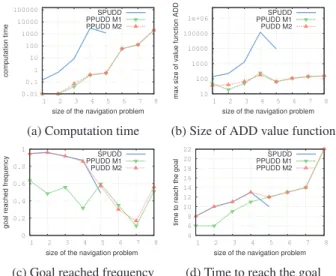
(d) Time to reach the goal Figure 5: PPUDD vs. SPUDD on the navigation domain
Experimental results
In this section, we compare our approach against proba-bilistic solvers in order to answer the following question: what is the efficacy/quality tradeoff achieved by reasoning about an approximate model but with an exact efficient al-gorithm? Despite radically different methods, possibilistic policies and probabilistic ones are both represented as ADDs that are directly comparable and statistically evaluated under identical settingsi.e.transition and reward functions defined by the probabilistic model.
We first assessed PPUDD performances on totally ob-servable factored problems since PPUDD is also the first algorithm to solve factored π-MDPs (by inclusion in π -MOMDPs). To this end, we compared PPUDD against SPUDD on thenavigation domainused in planning com-petitions (Sanner 2011). In this domain, a robot navigates in a grid where it must reach some goal location most re-liably. It can apply actions going north, east, south, west and stay which all cost 1 except on the goal. When mov-ing, it can suddenly disappear with some probability defined as a Bernoulli distribution. This probabilistic model is ap-proximated by two possibilistic ones where: the preference of reaching the goal is 1; in the first model (M1) the high-est probability of each Bernoulli distribution is replaced by 1 (for possibility normalization reasons) and the same value for the lowest probability is kept; for the second model (M2), the probability of disappearing is replaced by 1 and the other one is kept. Figure 5a shows that SPUDD runs out of mem-ory from the 6thproblem, and PPUDD computation’s time outperforms SPUDD’s one by many orders of magnitude for the two models. Intuitively, this result comes from the fact that PPUDD’s ADDs should be smaller because their leaves’ values are in the finite scaleLrather thanR, which is
in-deed demonstrated in Figure 5b. Performances were evalu-ated with two relevant criteria: frequency of runs where the policy reaches the goal (see Figure 5c), and average length of execution runs that reach the goal (see Figure 5d), that are both functions of the problem’s instance. As expected,
0 200 400 600 800 1000 1200 1400 2 4 6 8 10 12 14
computation time (sec)
size of the RockSample Problem APPL symb HSVI PPUDD
(a) Computation time
10 20 30 40 50 60 70 80 2 4 6 8 10 12 14
Expected Total Reward
size of the RockSample problem APPL
PPUDD
(b) Expected total reward Figure 6: PPUDD vs. APPL and symb HSVI (RS) model (M2) is more cautious than model (M1) and gets a better goal-reached frequency (similar to SPUDD’s one for the instances it can solve). The later is more optimistic and gets a better average length of execution runs than model (M2) due to its dangerous behavior. For fairness reasons, we also compared ourselves against APRICODD, which is an approximate algorithm for factored MDPs: parameters impacting the approximation are hard to tune (either huge computation times, or zero qualities) and it is largely out-performed by PPUDD in both time and quality whatever the parameters (curves are not shown since uninformative).
Finally, we compared PPUDD on theRocksample prob-lem(RS) against a recent probabilistic MOMDP planner, APPL (Ong et al. 2010), and a POMDP planner using ADDs, symbolic HSVI (Sim et al. 2008). Both algorithms are approximate and anytime, so we decided to stop them when they reach a precision of1. Figure 6a, where problem instances increase with grid size and number of rocks, shows that APPL runs out of memory at the8thproblem instance,
symbolic HSVI at the7th one, while PPUDD outperforms
them by many orders of magnitude.
Instead of precision, computation time of APPL can be fixed at PPUDD’s computation time in order to compare their expected total rewards after they consumed the same CPU time. Surprisingly, Figure 6b shows that rewards gath-ered are higher with PPUDD than with APPL. The reason is that APPL is in fact an approximate probabilistic planner, which shows that our approach consisting in exactly solv-ing an approximate model can outperform algorithms that approximately solve an exact model.
Conclusion
We presented PPUDD, the first algorithm to the best of our knowledge that solves factored possibilistic (MO)MDPs with symbolic calculations. In our opinion, possibilistic models are a good tradeoff between non-deterministic ones, whose uncertainties are not at all quantified yielding a very approximate model, and probabilistic ones, where uncertain-ties are fully specified. Moreover,π-MOMDPs reason about finite values in a qualitative scale Lwhereas probabilistic MOMDPs deal with values inR, which implies larger ADDs
for symbolic algorithms. Also, the former reduce to finite-state beliefπ-MDPs contrary to the latter that yield contin-uous-state belief MDPs of significantly higher complexity. Our experimental results highlight that using an exact algo-rithm (PPUDD) for an approximate model (π-MDPs) can bring significantly faster computations than reasoning about exact models, while providing better policies than
approxi-mate algorithms (APPL) for exact models. In the future, we would like to generalize our possibilistic belief factorization theory to probabilistic settings.
References
Araya-L´opez, M.; Thomas, V.; Buffet, O.; and Charpillet, F. 2010. A closer look at MOMDPs. In Proceedings of the Twenty-Second IEEE International Conference on Tools with Artificial Intelligence (ICTAI-10).
Bahar, R. I.; Frohm, E. A.; Gaona, C. M.; Hachtel, G. D.; Macii, E.; Pardo, A.; and Somenzi, F. 1997. Algebric de-cision diagrams and their applications. Form. Methods Syst. Des.10(2-3):171–206.
Bellman, R. 1957. A Markovian Decision Process. Indiana Univ. Math. J.6:679–684.
Boutilier, C.; Dearden, R.; and Goldszmidt, M. 2000. Stochas-tic dynamic programming with factored representations.Artif. Intell.121(1-2):49–107.
Boutilier, C. 1997. Correlated action effects in decision theo-retic regression. InUAI, 30–37.
Boyen, X., and Koller, D. 1999. Exploiting the architecture of dynamic systems. In Hendler, J., and Subramanian, D., eds.,
AAAI/IAAI, 313–320. AAAI Press / The MIT Press.
Cassandra, A.; Littman, M. L.; and Zhang, N. L. 1997. In-cremental pruning: A simple, fast, exact method for partially observable markov decision processes. InIn Proceedings of the Thirteenth Conference on Uncertainty in Artificial Intelli-gence, 54–61. Morgan Kaufmann Publishers.
Dean, T., and Kanazawa, K. 1989. A model for reasoning about persistence and causation. Comput. Intell. 5(3):142– 150.
Drougard, N.; Teichteil-Konigsbuch, F.; Farges, J.-L.; and Dubois, D. 2013. Qualitative Possibilistic Mixed-Observable MDPs. In Proceedings of the Twenty-Ninth Conference Annual Conference on Uncertainty in Artificial Intelligence (UAI-13), 192–201. Corvallis, Oregon: AUAI Press.
Dubois, D., and Prade, H. 1988. Possibility Theory: An Ap-proach to Computerized Processing of Uncertainty (traduc-tion revue et augment´ee de ”Th´eorie des Possibilit´es”). New York: Plenum Press.
Dubois, D., and Prade, H. 1990. The logical view of condi-tioning and its application to possibility and evidence theories.
International Journal of Approximate Reasoning4(1):23 – 46. Dubois, D., and Prade, H. 1995. Possibility theory as a basis for qualitative decision theory. InIJCAI, 1924–1930. Morgan Kaufmann.
Dubois, D.; Foulloy, L.; Mauris, G.; and Prade, H. 2004. Probability-possibility transformations, triangular fuzzy sets and probabilistic inequalities.Reliable Computing10:2004. Dubois, D.; Prade, H.; and Sabbadin, R. 2001. Decision-theoretic foundations of qualitative possibility theory. Euro-pean Journal of Operational Research128(3):459–478. Hoey, J.; St-aubin, R.; Hu, A.; and Boutilier, C. 1999. Spudd: Stochastic planning using decision diagrams. InIn Proceed-ings of the Fifteenth Conference on Uncertainty in Artificial Intelligence, 279–288. Morgan Kaufmann.
Kurniawati, H.; Hsu, D.; and Lee, W. S. 2008. SARSOP: Efficient point-based POMDP planning by approximating op-timally reachable belief spaces. InProceedings of Robotics: Science and Systems IV.
Ong, S. C. W.; Png, S. W.; Hsu, D.; and Lee, W. S. 2010. Planning under uncertainty for robotic tasks with mixed ob-servability.Int. J. Rob. Res.29(8):1053–1068.
Pearl, J. 1988.Probabilistic reasoning in intelligent systems: networks of plausible inference. San Francisco, CA, USA: Morgan Kaufmann Publishers Inc.
Pineau, J.; Gordon, G.; and Thrun, S. 2003. Point-based value iteration: An anytime algorithm for pomdps. In Inter-national Joint Conference on Artificial Intelligence (IJCAI), 1025 – 1032.
Sabbadin, R.; Fargier, H.; and Lang, J. 1998. Towards qualita-tive approaches to multi-stage decision making.Int. J. Approx. Reasoning19(3-4):441–471.
Sabbadin, R. 1999. A possibilistic model for qualitative se-quential decision problems under uncertainty in partially ob-servable environments. InProceedings of the Fifteenth con-ference on Uncertainty in artificial intelligence, UAI’99, 567– 574. San Francisco, CA, USA: Morgan Kaufmann Publishers Inc.
Sabbadin, R. 2000. Empirical comparison of probabilistic and possibilistic markov decision processes algorithms. In Horn, W., ed.,ECAI, 586–590. IOS Press.
Sabbadin, R. 2001. Possibilistic markov decision processes.
Engineering Applications of Artificial Intelligence14(3):287 – 300. Soft Computing for Planning and Scheduling. Sanner, S. 2011. Probabilistic track of the 2011 international planning competition. http://users.cecs.anu.edu.au/∼ssanner/IPPC 2011.
Shani, G.; Poupart, P.; Brafman, R. I.; and Shimony, S. E. 2008. Efficient add operations for point-based algorithms. In Rintanen, J.; Nebel, B.; Beck, J. C.; and Hansen, E. A., eds.,
ICAPS, 330–337. AAAI.
Sim, H. S.; Kim, K.-E.; Kim, J. H.; Chang, D.-S.; and Koo, M.-W. 2008. Symbolic heuristic search value iteration for factored pomdps. InProceedings of the 23rd National Con-ference on Artificial Intelligence - Volume 2, AAAI’08, 1088– 1093. AAAI Press.
Smallwood, R. D., and Sondik, E. J. 1973.The Optimal Con-trol of Partially Observable Markov Processes Over a Finite Horizon, volume 21. INFORMS.
Smith, T., and Simmons, R. 2004. Heuristic search value iteration for pomdps. InProceedings of the 20th conference on Uncertainty in artificial intelligence, UAI ’04, 520–527. Arlington, Virginia, United States: AUAI Press.
St-aubin, R.; Hoey, J.; and Boutilier, C. 2000. Apricodd: Ap-proximate policy construction using decision diagrams. InIn Proceedings of Conference on Neural Information Processing Systems, 1089–1095.
Witwicki, S. J.; Melo, F. S.; Capitan, J.; and Spaan, M. T. J. 2013. A flexible approach to modeling unpredictable events in mdps. In Borrajo, D.; Kambhampati, S.; Oddi, A.; and Fratini, S., eds.,ICAPS. AAAI.