Full Terms & Conditions of access and use can be found at
http://www.tandfonline.com/action/journalInformation?journalCode=tpsp20
Perspectives: Policy and Practice in Higher Education
ISSN: 1360-3108 (Print) 1460-7018 (Online) Journal homepage: http://www.tandfonline.com/loi/tpsp20
Is contextualised admission the answer to the
access challenge?
Anna Mountford-Zimdars, Joanne Moore & Janet Graham
To cite this article: Anna Mountford-Zimdars, Joanne Moore & Janet Graham (2016) Is
contextualised admission the answer to the access challenge?, Perspectives: Policy and Practice in Higher Education, 20:4, 143-150, DOI: 10.1080/13603108.2016.1203369
To link to this article: https://doi.org/10.1080/13603108.2016.1203369
© 2016 The Author(s). Published by Informa UK Limited, trading as Taylor & Francis Group
Published online: 02 Aug 2016.
Submit your article to this journal
Article views: 714
View related articles
Is contextualised admission the answer to the access challenge?
Anna Mountford-Zimdarsa, Joanne Mooreband Janet Grahamc a
King’s Learning Institute, King’s College London, London, UK;bAimhigher Research and Consultancy Network, Manchester, UK;cSupporting Professionalism in Admissions, Cheltenham, UK
ABSTRACT
This article reviews the idea of contextualising applicants to higher education in order to widen access. First, the meaning of contextualised admissions (CAs) is discussed before laying out the rationale for contextualising applicants and the beneficiaries of the policy. Thefinal sections discuss key critiques of CA and conclude by arguing that CA does go some way to addressing the access challenge. To fully realise its potential as a policy intervention though, it is most helpfully part of integrated support for students throughout university and is mindful of the role of universities in wider society to create more equal progression trajectories for young people from a range of backgrounds.
ARTICLE HISTORY Received 6 June 2016 Accepted 15 June 2016 KEYWORDS Widening participation; outreach; inequality; disadvantage; undergraduate admission; Russell Group; selection
Introduction
Fair access to higher education for different social groups is a key challenge and is part of the wider focus in the UK on the contribution of higher education to social mobility and labour market entry and returns. There are differential transition rates into higher edu-cation for disadvantaged groups across all industrial-ised and emerging economies. The primary barriers for some social groups not transitioning into higher education concern the unequal distribution of oppor-tunities to complete and attain highly in secondary education; the ability and willingness to pay for cation; the geographic accessibility of higher edu-cation; differences in cultural and social capitals to navigate educational systems and curricula; differences in access to information, advice, and guidance as well as embedded familiar, cultural, and social expectations. It is therefore right that public policies to facilitate greater equality in progression into and through higher education should primarily focus on addressing and overcoming these key barriers.
However, secondary challenges to equality of par-ticipation in higher education are that some students do not apply to the most prestigious universities they might gain admission to or that they are not admitted once they have applied. This article explores whether for those applicants contextualised admission (CA) might be able to increase transition rates into higher education.
Wefirst consider the challenges CA seeks to address and discusses the rationale for using CA. There is a description of how CA works in practice as well as a
discussion of the criticisms of CA. We root our discus-sion primarily in a UK perspective but draw on some examples from other countries to illustrate that alter-native approaches to increasing enrolment of under-represented groups are available. We also consider which issues CA is equipped to address and which ones are beyond its scope.
In conclusion the article argues that CA can enhance higher education access, in particular to selective higher education, for some disadvantaged student groups. To realise its full potential as an intervention, however, CA needs to be part of an integrated approach that encompasses support and outreach prior to higher education and continues throughout the student lifecycle or student progression within higher education into further study and employment.
The meaning of contextual admissions
In stratified hierarchical university systems like the UK, some universities and courses admit only a fraction of their applicants. A key driver in admissions’decisions is applicants’ previous academic attainment. This imperfect measure is key to unlocking the proverbial university gate and subsequent graduate labour market opportunities for which the prestige marker of the university attended is important. However, there is controversy as to the extent to which prior ability can measure potential rather than only ability. The basic idea of CA then is that it enables higher education institutions to consider other factors than prior grades as part of their admissions process and to admit
© 2016 The Author(s). Published by Informa UK Limited, trading as Taylor & Francis Group
This is an Open Access article distributed under the terms of the Creative Commons Attribution-NonCommercial-NoDerivatives License ( http://creativecommons.org/licenses/by-nc-nd/4.0/), which permits non-commercial re-use, distribution, and reproduction in any medium, provided the original work is properly cited, and is not altered, transformed, or built upon in any way.
CONTACT Anna Mountford-Zimdars [email protected] VOL. 20, NO. 4, 143–150
applicants with the potential to succeed despite perhaps slightly lower grades than some other applicants.
There are three key features to UK CA: Contextual data, contextual information and contextual outreach. Contextual data are either taken from the actual cation or derived from linking information in the appli-cation to other sources of information. Disadvantaged applicants are then ‘flagged’ for particular consider-ation. Contextual information is available through information about applicants’ background from, for example, their personal statement, school references and sometimes also additional admissions question-naires or local knowledge of schools and colleges. A third stream is contextualisation through participation in outreach activities. Here, the targeting for partici-pation in itself signals that an applicant was identified as disadvantaged before applying to higher education as they met the criteria for inclusion in targeted out-reach (Bridger, Shaw, and Moore2012, 15).
CA in the UK means contextualising primarily the academic attainment of an applicant for higher edu-cation admission. This helps selectors to evaluate whether applicants’ prior attainment reflects their true potential for academic success in higher edu-cation. This contrasts with other countries like, for example, the USA or Germany, where other contextual factors like having overcome adversity (the USA) or dis-ability and caring responsibility (Germany) might be considered.
While the idea of CA has potential merits for a wide range of universities and colleges ranging from the highly selective with ‘traditional’ qualifications to those seeking to expand their pool of students by giving credit to a wider range of experiences, the CA movement in the UK was initially associated with selec-tive universities in a context where demand for places vastly exceeds available places for study. Recently, a wider range of providers have adopted the policy and CA might be used, for example, looking for stu-dents without traditional entry qualifications (SPA 2015).
The idea of contextualising the prior academic attainment of applicants to higher education is not in itself new and can be traced back to at least the 1960s and 1970s. For example, an academic at the Uni-versity of Oxford described in 2005 how contextual considerations had been taken into account for decades:
I remember years ago–in the early 70s, the…Ancient Philosophy tutor…used to say‘Oh, yes, but for some-body from that, comprehensive, or secondary [school], or whatever it was then–this is a very good perform-ance!’ –So, I think Oxford has always looked at that sort of thing. The question now is that given the data avail-ability should we be using it more formally? (Zimdars 2007, 234)
The term CAs, however, is a much more recent term that has only really taken off in England in the twenty-first century. Prominent in mainstreaming the term was the recommendation in the Schwartz Report (2004) that contextual admissions should be used as part of fair admissions. Targets agreed between universities and the Office for Fair Access to achieve a higher representation of disadvantaged stu-dents in higher education have further driven the con-textual admission agenda.
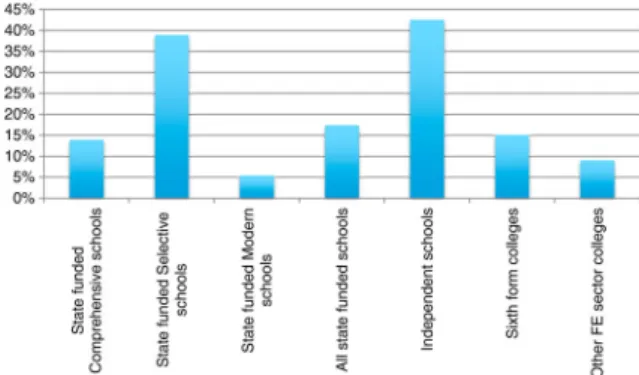
This is because of the continued relationship between attainment and socio-economic background, meaning that the most advantaged students, however measured, will usually have higher grades than their less advantaged peers. Figure 1shows the differences in the English school-leaving examination, the A levels, by the type of secondary school attended for 2013/14, showing that those in fee-paying schools and academically selected state schools have the highest attainment. Other analyses have found how the ‘gap’ in progression to higher education at age 19 between pupils who aged 15 had Free School Meal eligibility status and other state school pupils was 18 percentage points (BIS 2011). The estimated progression rate for state school and college pupils to the most selective Higher Education Institutions was 26% in 2008/09, compared to 62% for fee-paying school and college pupils (BIS 2011). Such findings suggest that attainment captures socio-economic differences between communities as well as the effects of qualitative differences between schools.
CA is an attempt to make sure some relatively high achieving students who may be educationally and socio-economically at a disadvantage to other appli-cants remain eligible for places at selective universities.
Figure 1.Percentage of A level cohort achieving grades AAB* or better by institution type in 2013/14 (any subjects). Notes: *A level or applied single/double award A level. Modern schools and comprehensives admit pupils of any ability. Sec-ondary modern schools will have grammar schools in their area which admit most local high ability pupils and may there-fore have a different intake compared to comprehensive schools which are not in grammar school areas. Source: Depart-ment for Education, Statistical First Release 03/2015. https:// www.gov.uk/government/statistics/a-level-and-other-level-3-results-2013-to-2014-revised.
Thefirst university to systematically adopt an official CAs policy was the University of Edinburgh in 2004 (2015, 4). The use has since spread across the Russell Group1 and other higher education providers. The development of contextual admissions policies in indi-vidual universities has been supported through central resources, especially the organisation Supporting Pro-fessionalism in Admissions (SPA, established 2006) and the national central admissions service used by all full-time applicants for the UK undergraduate degrees, UCAS. SPA and UCAS developed a‘basket of data’that provides a range of additional background information such as area information about applicants to higher education (SPA2013). There have now been national reports and research into CA (Bridger, Shaw, and Moore 2012; Moore, Mountford-Zimdars, and Wiggans2013) and contextual admission is referenced in recent policy documents (OFFA 2013; QAA 2013; Scottish Funding Council Guidance on Outcome Agree-ments2013).
Overall, the UK experience shows that sourcing, accessing and using data on the educational and socio-economic background of individual higher edu-cation applicants greatly helps the practical develop-ment of contextual admissions policies.
Why use CAs
A range of conceptual rationales and arguments can be marshalled in support of CA. These can be divided into social justice, diversity, civicness, economic and social mobility, and practical rationales. These are now dis-cussed in turn.
For some supporters of CA, the primary driver is rooted in social justice considerations and that contex-tualising applicants is the right thing to do in itself (Weber [1922] 2013). For example, the Universities of Edinburgh and Manchester, both early adopters and leaders in the CA landscape, are comfortable describ-ing their CAs policy in detail on their websites and with reference to social justice considerations. However, not all universities are equally comfortable using this narrative in their description of CAs policies. A related argument concerns how holistic admission allows for admitting a more diverse student body com-pared with attainment-only based admissions system. This enables a diverse learning environment thus pre-paring students for being effective members of diverse societies. This argument is not generally used in the UK although it is frequently used to support hol-istic admission in the US context where civic engage-ment achieveengage-ments and potential for ‘social returns’ also feature (see, e.g. Bowen and Bok2000).
The idea of social returns leads into a more econ-omic argument that not admitting students into (elite) higher education who have particular potential to contribute to university life and later on, to society,
employment, and to the economy, is a waste of talent and human resources. Closely entwined with the argument of wasting talent is the social mobility argument.
Economic and social mobility based arguments enjoy cross-party political support in the UK and are thus the dominant way of framing the use of CA in British public discourses. Crucial senior support for this agenda came from the Conservative Minister of State for Universities and Science (2010–14), David Will-etts; Alan Milburn’s Social Mobility and Child Poverty commission and the 2015 Green Paper. Indeed, some universities and individual advocates for contextual admissionfind it advantageous that the social mobility and economic argument can bypass more politically divisive discussions regarding fairness, life-chances, and the structural roots of inequality. For example, a university leader explained that while he personally had a more left-leaning world view and was passionate about tackling social inequities contextual data tried to address, this was ‘politically the most contentious thing…on my governing body it’s a very difficult issue’ (Mountford-Zimdars 2016, 180). It can thus be crucial for someone in this position to demonstrate the instrumentally derived value or economic and social mobility reasoning for using contextual data. There is also research empirically supporting the argu-ment that those admitted to Russell Group institutions from schools where the average attainment was below the national average attain more highly at university than those admitted with the same grades from schools where all students attain highly (HEFCE2003; Ogg, Zimdars, and Heath 2009; Hoare and Johnston 2011; Taylor et al. 2013; Lasselle, McDougall-Bagnall, and Smith 2014; but see Parks 2011; Partington, Carroll, and Chetwynd 2011; Chetwynd 2011). These
findings are then used as an argument for considering those with good, but not excellent grades from less good schools to have equipotential for high achieve-ment at university compared with high attaining stu-dents from schools that perform higher than the national average.2
Contextual admission then uses a discourse of selecting the best students and finding academic excellence in context in order to achieve the best out-comes. By having a professional admissions process and a transparent and systematic contextual admission approach to evaluating applicants, a greater pool of talented students from disadvantaged backgrounds is expected to apply to selective universities and thus a greater number are expected to be admitted and to gain graduate employment thus advancing social mobility.
Finally, there is a practice-based rationale for using CA. UK Universities engage in a range of outreach activities that encourage and support disadvantaged students to consider and apply to selective higher
education institutions. A challenge in outreach work has been that it is not always linked to university admission. This can create a situation where plenty of effort and resources go into working with children and adolescents to make them aware of higher edu-cation and to support them in applying to elite univer-sities. However, when these young people are ultimately not admitted to their preferred university, disappointment sets in and some argue that the aim of outreach is not realised. By giving special consider-ation to students who have already participated in out-reach activities, CA then offers a way to allow institutions to translate outreach efforts into a higher chance of admission for participating students. Such outreach students, in turn, are more likely to take up their offer for a place and enjoy higher retention in higher education than similar applicants who were not part of outreach schemes (Bridger, Shaw, and Moore2012).
In sum, key drivers for contextual admission in the UK are national policy drivers linked to social justice and universities’corporate responsibility, but also prac-tical requirements related to monitoring requirements and targets in widening participation such as the per-centage of state school students.
Who benefits from CA?
Overall, there is an unfortunate paucity of robust evalu-ations on who benefits from CA in the UK, but the evi-dence that does exists suggests that institutions take into account geographic considerations such as being from an area with poor progression into higher edu-cation or deprivation, personal factors such as having been in foster-care, and participation in outreach (Moore, Mountford-Zimdars, and Wiggans2013). Flag-ging applicants for special consideration through CA is usually based on a framework of considerations that includes social background, educational, geo-graphic/geodemographic, and personal circumstances. Contextualising attainment by school type results in
‘adjustment sponsorship’ (Mountford-Zimdars 2015) or enhanced admissions chances for those who went to state as opposed to private schools.
The following example shows how CA works in practice:
Shamina is 17 and has always been in state sector schooling. Most of the students in her school do not continue their education into university. She is a very high attaining student within her school context. Because her school and the area where she lives have low progression to higher education, she has applied and been selected to participate in an outreach scheme run by a Russell Group university. She has par-ticipated in various workshops and a summer school and received help with her university application. She has now applied to a Russell Group university as well
as four other universities to study Economics and Management.
The admission office at the Russell Group University has a CAs policy. The policy considers educational, geo-demographic, and personal factors. The consideration of educational factors mean that the admission office looks at the school where Shamina took her examin-ations at age 16 (GCSEs: General Certificate of Second-ary Education) at age 17 (AS [Advanced SubsidiSecond-ary] levels) and age 18 (A levels). They find that national data shows the school’s performance for both examin-ations has been below the national average for the past three years. Shamina’s application isflagged to indicate that her excellent grades were achieved in a below average achieving school, thus highlighting her par-ticular achievement to the selectors – Shamina is a bigfish in a small pond.
The selector then looks at Shamina’s home-post-code against a national classification of wealth such as an Index of Deprivation or against a classification that shows how many young people from the area typi-cally participate in higher education. The postcode data indicates that Shamina lives in an area with high disad-vantage. In the personal circumstances section, the admissions officerflags that Shamina has participated in an outreach programme run by the University. The selector does not consider Shamina’s race, her parents’ occupations–indeed this information is not available at the point of selection – gender or whether the school she attended was a state or private school. The admissions officer notes there are three or more factors that may indicate disadvantage, triangulation of information is important when using proxies for individual disadvantage.
The admissions office now offers a place for study to Shamina that requires her to achieve slightly lower entry grades than peers who applied without trigger-ing contextual admissions flags. Shamina will still have to meet the minimum academic requirements that the university deems necessary to successfully graduate in Economics and Management, but she does not have to meet the very highest grades one could possibly achieve in school-leaving examinations. The University will also now consider Shamina for a needs-based bursary to help towards the cost of study-ing at university and other support that could be pro-vided to aid her transition into higher education.
The example of how an admission would be con-sidered under a CAs policy is loosely based on the guidelines for the use of contextual data at the Univer-sity of Edinburgh (2015). Edinburgh has found that the use of contextualflagging has
Alongside innovative and sector-leading outreach pro-jects such as Pathways to the Professions, and needs-based bursaries, the University’s use of contextual data has enabled a gradual increase in the diversity 146 A. MOUNTFORD-ZIMDARS ET AL.
of educational and socio-economic backgrounds from which students come to Edinburgh. (5)
Overall, there is no single way in which universities in the UK use contextual admission, just as there is no uni-versal way of making admissions decisions. In some universities, full-time admissions professionals assess applications and make admissions decisions on individ-ual applicants (to criteria agreed by academic teams) whereas it is academic faculty who assess applications and make decisions in an–albeit shrinking–minority of other universities (SPA2014), some universities and subjects use admissions interviews and/or additional tests whereas many universities and subjects make decisions based solely on the application data they receive through UCAS. Some universities use contex-tual data to help with shortlisting for admissions inter-view, others use it to give additional consideration to applicants and some use contextual data as the basis for making differentiated offers to applicants for admission.
Most institutions use a range of different contextual indicators, commonly related to educational back-ground, socio-geographic context, and personal con-sideration like having been in care or a refugee. Having the applicationflagged can mean special con-sideration, being invited for interviews (where appli-cable) when an applicant would not be otherwise and being offered a place for study with lower grades than more advantaged applicants. A more detailed dis-cussion of different approaches to contextual admis-sion is provided in Moore, Mountford-Zimdars, and Wiggans (2013) and a comparative overview of US and English admission is provided in Mountford-Zimdars (2016).
On aggregate, many universities find that their overall representation of disadvantaged students has increased year-on-year since introducing contextual admissions flags. It remains a research challenge, however, to evaluate how many individual students have been admitted through contextual admission who may not have been admitted without it in light of the complex factors impacting on admissions and transition to higher education.
Critique of CA
Perhaps the greatest criticism levied of CA is that it could be used as a smokescreen to hide the continued association between social origin and grades in school (Machin 2006). The sociologist Turner has described that this link means liberal democracies are then merely ‘surface’ rather than ‘deep’ democracies (Turner 1966). By allowing some flexibility in admis-sion–especially for elite universities–CA may confer legitimacy to a system of elite and non-elite institutions and focus attention away from the fact that most
disadvantaged students participate in the lower pres-tige forms of education in any stratified higher edu-cation system (e.g. Brint and Karabel 1989; Chowdry et al.2013; Croxford and Raffe2013). By giving excep-tional adolescents who have succeeded against the odds opportunities for elite higher education, CA also risks creaming off the few and creating an illusion of social mobility for the many, thus potentially again reinforcing structural inequalities and further legitimis-ing such inequalities in the process. The counterargu-ment is that not doing anything at all will certainly not enhance the situation.
A related criticism is that CA–especially at selective universities – may not be ‘widening’ participation to those who would not participate in higher education otherwise. Instead, there is an element of‘shifting’ par-ticipation meaning that those who are admitted through CA at highly selective universities would have been very likely to secure a place at alternative institutions in higher education. The argument here is that CA at selective universities may not make the difference between whether or not someone partici-pates in higher education per se but only where they participate. A counterargument is that diversifying the student body at elite higher education could be considered a good thing in itself and with more individ-ual social mobility and perhaps societal benefits: because of differential returns to different types of higher education, increasing access to elite institutions matters.
Another criticism is that research and discourses on CA–perhaps surprisingly–do not generally consider the effect of not being admitted into selective higher education on disadvantaged students who were sup-ported and encouraged to apply and who then miss out on a place for their preferred university.
Criticism of CA has also come from within the prac-titioner community in admission and outreach and often concerns disagreement over the implications of data use for offer making or concern regarding thefl ag-ging of some but not other groups. For example, the issue of taking into account whether or not someone has successfully completed an outreach programme can be controversial. On the one hand, it does not seem right to raise aspirations among those targeted for outreach to then disappoint them in the admissions process. On the other hand, one could argue that those who participate in outreach already enjoy enhanced support and other applicants who may have been eli-gible to participate in outreach but did not have the opportunity to, are then extra-disadvantaged. An example of disagreement was observed in a training meeting for admissions tutors where one selector argued:‘Why should I give an advantage to someone from a bad school from inner London? How is that more worthy than considering the educational disad-vantage experienced by a rural white British boy from
the North of England?’(Zimdars 2007, 235 – inciden-tally, this group has since moved into public conscious-ness). The US holistic admissions approaches are more
flexible with regards to the complex individual circum-stances than data-driven contextual flagging used in the UK. The blunter instrument offlagging, however, allows for relatively low cost implementation and can provide some consistency and transparency.
There is also a criticism that CA does not go far enough and that genuinely taking into account prior differences in opportunities, means changing the uni-versity experience and curricula. King’s College London was thefirst university in 2000 to develop an
‘Extended medicine’ programme where not only admission but the entire first three years of the medical degree programme are contextualised (King’s College 2015). Students admitted to the programme enjoy additional study support and a lighter work-load as the first three years of a medical degree are taught over four years. This education model has recently been widened to an enhanced support dentis-try programme at King’s College.
Discussion, summary, conclusion
To summarise, CA is a way to acknowledge that treat-ing all applicants the same may not provide equality of opportunity in university admission. CA contextua-lises applicants’ academic attainment and personal circumstances with a view to increase participation in – especially selective – higher education of pre-viously under-represented groups. CA improve in some marginal way equality of access for beneficiaries of the policy.
Arguably, CA is only relevant in marketised higher education systems with elite institutions and selective admissions based on prior attainment. It is therefore perhaps not surprising that interest in the use of CA comes from other countries with stratified higher edu-cation systems. Ireland has recently developed itsfirst pilot project to complement grade-based admission with contextual considerations (Geoghegan 2014) and there is interest in Australia to think about CA.
In other countries, there is arguably less of a need for such policies as the higher education systems are more accessible in the way they are structure. For example, in the German higher education model students have the right to participate in higher education as long as they pass their school-leaving examination Abitur. Few sub-jects have enrolment restrictions and there are no tuition fees. There is thus a general ‘open access’ policy to higher education for the vast majority of stu-dents. Extra advantages in enrolment are given to students who need to live locally due to family commit-ment or disability and students who have taken time out since school. The Danish and Scandinavian approach is to pay all students to participate in
higher education with the stipend eliminating family economic resources as a predictor of who participates (e.g. Thomsen2012).
Even when countries face situations where there are more potentially eligible students than there are higher education places, CA is not the only possible response. For example, the Dutch medical lottery gives a weighted chance of being admitted to study medicine for students within different bandings of school-leaving grades (Stone 2014). Reasoning, good and bad, is thus eliminated from decisions. Instead of context the CA context-conscious approach, lotteries are context blind.
Who is disadvantaged is arguably an essentially con-tested concept (Gallie 1956). There can be cross-national differences in which groups or individuals are considered worthy of special or additional consider-ation. Where CA is used, there are vivid debates as to the virtue of extending the logic of CA to less selective institutions. Here, the objective would be tofind stu-dents whose prior qualifications might not easily make them traditional applicants for higher education, but whose experiences show potential to stay and succeed in higher education. Integrated support during the application period and during higher edu-cation for those admitted with non-traditional qualifi -cations would have to be an integral part for the success of such policies.
Different approaches to taking into account the context of applicants to higher education, inevitably, have different advantages and drawbacks. Open access policies are, for example, fairer at the point of entry in allowing everyone who wishes to do so to enrol. However, when there is a high drop-out as it occurs in Germany, some UK higher education provi-ders or Community Colleges in the USA, such access opportunities do not lead to enhanced outcomes for those benefitting from them. At the same time, contex-tual admission tends to apply at the margins and is essentially a‘top down’approach based on the criteria decided institutionally so cannot come close to over-coming the structural barriers to higher education facing the most marginalised groups, unlike the
‘bottom-up’ open access approaches in the other countries which gives everyone a chance in higher education.
This article posed the question whether CA is the answer to the widening access challenge. The answer here has to be that, even when this is used as the most appropriate way to take into account the different contexts of applicants, it can only be a partial answer to the access challenge although CA is well placed to be an answer to the fair admissions challenge. For CA to work, it needs to be part of an integrated student life cycle or progression approach that not only allows students to come through the gates of a university but that facilitates students’ 148 A. MOUNTFORD-ZIMDARS ET AL.
success within higher education. Retention rates are high–in the high 90%–for the most selective univer-sities that use CA, whether it be Oxford in the UK or Harvard in the USA. However, some differences in terms of attainment within universities as well as labour market outcomes can remain. The test for whether CA has ultimately worked is then about success within and after higher education.
To conclude, CA and other admissions policies can only ever be part of the answer to the access challenge. To create a more socially just higher education system, an integrated approach is needed that joins up out-reach and early year works with admission and support at university and into employment or further study. As part of such an integrated approach, CA can play a crucial part in making educational journeys that little bit fairer. At the same time, while working towards continuously enhancing the possibilities of CA, practitioners and scholars need to be mindful that CA is an interim measure that would be obsolete if societies succeeded in creating greater opportunities for all regardless of the accident of educational, geo-graphic, and personal contexts.
Notes
1. The Russell Group is a group of twenty-four universities that focuses on research excellence and teaching. The Russell Group has a strong focus on postgraduate as well as undergraduate education and award the majority of doctorates in the UK.
2. The way schooling is operationalised in different research projects can vary. Some previous academic research has categorises schools as either private (fee-paying) or state-funded. However, UK university policy makers generallyfind that dividing schools into those that perform above and those that perform below the national average can bypass charges of ‘reverse dis-crimination’against private schools.
Disclosure statement
No potential conflict of interest was reported by the authors.
Funding
This work was supported by Supporting Professionalism in Admissions.
Notes on contributors
Dr Anna Mountford-Zimdars is a Senior Lecturer in Higher Education and Head of Research at King’s Learn-ing Institute, KLearn-ing’s College London. She has previously worked at the Uni-versities of Manchester and Oxford.
Joanne Moore, Director, ARC Network, is a social researcher with an interest in the education and training sectors, whose research areas have pursued a social justice angle particularly from the perspective of education policy
and practice. Her varied career
includes positions in the public and private sector, and latterly in university posts.
Janet Graham was appointed as the first Director of Supporting Profession-alism in Admissions in 2006. She pre-viously worked at the Universities of Cambridge and Leicester. In 1994,
she was a Fulbright Fellow at
Western Michigan University, USA.
References
BIS.2011.Analysis of Progression Rates for Young People in
England by Free School Meal Receipt and School Type.
London: Department for Business, Innovation and Skills. https://www.gov.uk/government/uploads/system/uploads/ attachment_data/fi le/32585/11-1082-widening-participation-higher-education-aug-2011-v3.pdf.
Bowen, W., and D. Bok.2000.The Shape of the River. Princeton, NJ: Princeton University Press.
Bridger, K., J. Shaw, and J. Moore.2012.Fair Admissions to Higher Education Research to Describe the Use of Contextual Data in Admissions at a Sample of Universities
and Colleges in the UK. Final Report for Supporting
Professionalism in Admissions (SPA) Programme,
Cheltenham: SPA.
Brint, S. G., and J. Karabel. 1989. The Diverted Dream: Community Colleges and the Promise of Educational
Opportunity in America, 1900–1985. New York: Oxford
University Press.
Chetwynd, P. 2011. A* at A-level as a Predictor of Tripos
Performance: An Initial Analysis. Cambridge: University of
Cambridge.
Chowdry, H., C. Crawford, L. Dearden, A. Goodman, and A. Vignoles. 2013. “Widening Participation in Higher Education: Analysis Using Linked Administrative Data.” Journal of the Royal Statistical Society: Series A (Statistics in
Society)176: 431–457.
Croxford, L., and D. Raffe. 2013.“Differentiation and Social Segregation of UK Higher Education, 1996–2010.”Oxford
Review of Education39 (2): 172–192.
Gallie, W. B. 1956. “IX.—Essentially Contested Concepts.”
Proceedings of the Aristotelian Society56: 167–198.
Geoghegan, P. M.2014.“The Irish Experiment: Undergraduate Admissions for the 21st Century.”International Perspectives
on Higher Education Admission Policy: A Reader 2014:
39–47.
HEFCE. 2003. “Schooling Effects on Higher Education Achievement HEFCE 2003/32.” www.hefce.ac.uk/pubs/ hefce/2003/03_32.htm.
Hoare, A., and R. Johnston. 2011. “Widening Participation through Admissions Policy – A British Case Study of School and University Performance.” Studies in Higher
Education36 (1): 21–41.
King’s College. 2015. Extended Medical Degree Programme. Accessed September 5, 2015. http://www.kcl.ac.uk/ prospectus/undergraduate/emdp/details.
Lasselle, L., J. McDougall-Bagnall, and I. Smith.2014.“School
Grades, School Context and University Degree
Performance: Evidence from an Elite Scottish Institution.”
Oxford Review of Education40 (3): 293–314.
Machin, S. 2006. Social Disadvantage and Education
Experiences. OECD Social Employment and Migration
Working Papers no. 32.
Moore, J., A. Mountford-Zimdars, and J. Wiggans. 2013.
Contextualised Admissions: Examining the Evidence
Report of Research into the Evidence Base for the Use of Contextual Information and Data in Admissions of
UK Students to Undergraduate Courses in the UK.
Report to Supporting Professionalism in Admissions August 2013.
Mountford-Zimdars, A. 2015. “Contest and Adjustment Sponsorship in the Selection of elites: Re-visiting Turner’s Mobility Modes for England through an Analysis of Undergraduate Admissions at Oxford University.” Revue
Sociologie6 (2): 157–176.
Mountford-Zimdars, A.2016.Meritocracy and the University:
Selective Admission in England and the U.S. London:
Bloomsbury.
Office for Fair Access (OFFA). 2013. “How to Produce an Access Agreement for 2014–15.” Accessed September 5, 2015. http://www.offa.org.uk/wp-content/uploads/ 2013/01/How-to-produce-an-access-agreement-for-2014-15. pdf.
Ogg, T., A. Zimdars, and A. Heath.2009.“Schooling Effects on Degree Performance: A Comparison of the Predictive Validity of Aptitude Testing and Secondary School Grades at Oxford University.”British Educational Research Journal35 (5): 781–807.
Parks, G. 2011. Academic Performance of Undergraduate
Students at Cambridge by School /College Background.
Cambridge: University of Cambridge.
Partington, R., D. Carroll, and P. Chetwynd.2011.“Predictive Effectiveness of Metrics in Admission to the University of Cambridge.”University of Cambridge.http://www.admin. cam.ac.uk/offices/admissions/research/a_levels.html. Quality Assurance Agency (QAA). 2013. UK Quality Code
for Higher Education– Chapter B2: Recruitment, Selection
and Admission to Higher Education. Gloucester: Quality
Assurance Agency. Accessed September 5, 2015. http:// www.qaa.ac.uk/publications/information-and-guidance/uk- quality-code-for-higher-education-chapter-b2-recruitment-selection-and-admission-to-higher-education#.VgUw1d9Viko. Scottish Funding Council Guidance.2013.University Outcome
Agreement Guidance for AY 2014–15. Edinburgh: SFC.
Accessed September 5, 2015. http://www.sfc.ac.uk/web/ FILES/GuidanceOA1415/University_Outcome_Agreement_ Guidance_2014-15.pdf.
Stone, P.2014.“Access to Higher Education by the Luck of the Draw.”InFair Access to Higher Education: Global Perspectives, edited by A. Mountford-Zimdars, D. Sabbagh, and D. Post (2015), 248–270. Chicago, IL: University of Chicago Press. Supporting Professionalism in Admissions (SPA).2013.Basket
of Contextual Data and Information Available for HE
Providers via UCAS. Accessed September 5, 2015. http://
www.spa.ac.uk/documents/ContextualData/UCASbasket_ data_otherinformationviaUCAS.docx.
Supporting Professionalism in Admissions (SPA). 2014.
Newsletter, Autumn 2014. Cheltenham: SPA.
Supporting Professionalism in Admissions (SPA).2015.SPA’s Use of Contextualised Admissions Survey Report 2015 (with
HEDIIP). Cheltenham: SPA.
Taylor, T., G. Rees, L. Sloan, and R. Davies.2013.“Creating an Inclusive Higher Education System? Progression and Out-comes of Students from Low Participation Neighbourhoods at a Welsh University.”Contemporary Wales26: 138–161. Thomsen, J. P.2012.“Exploring the Heterogeneity of Class in
Higher Education: Social and Cultural Differentiation in Danish University Programmes.” British Journal of
Sociology of Education33 (4): 565–585.
Turner, R. H.1966.“Acceptance of Irregular Mobility in Britain and the United States.”Sociometry29: 334–352.
University of Edinburgh. 2015. Student Recruitment &
Admissions Briefing: Contextual Data in Undergraduate
Admissions at the University of Edinburgh.http://www.ed.ac.
uk/files/atoms/files/201512_contextual_data_briefing.pdf. Weber, M. [1922] 2013. Economy and Society. Berkeley:
University of California Press.
Zimdars, A. 2007. “Challenges to Meritocracy? A Study of the Social Mechanisms in Student Selection and Attainment at the University of Oxford.”DPhil thesis. University of Oxford. 150 A. MOUNTFORD-ZIMDARS ET AL.