
Extensions and Interfaces
by
Michael Homer
A thesis
submitted to the Victoria University of Wellington in fulfilment of the
requirements for the degree of Doctor of Philosophy Victoria University of Wellington
Grace is a programming language under development aimed at ed-ucation. Grace is object-oriented, imperative, and block-structured, and intended for use in first- and second-year object-oriented programming courses. We present a number of language features we have designed for Grace and implemented in our self-hosted compiler. We describe the design of a pattern-matching system with object-oriented structure and minimal extension to the language. We give a design for an object-based module system, which we use to build dialects, a means of extending and restricting the language available to the programmer, and of implementing domain-specific languages. We show a visual programming interface that melds visual editing (à la Scratch) with textual editing, and that uses our dialect system, and we give the results of a user experiment we performed to evaluate the usability of our interface.
The author wishes to acknowledge:
• James Noble and David Pearce, his supervisors;
• Andrew P. Black and Kim B. Bruce, the other designers of Grace; • Timothy Jones, a coauthor on a paper forming part of this thesis and
contributor to Minigrace;
• Amy Ruskin, Richard Yannow, and Jameson McCowan, coauthors on other papers;
• Daniel Gibbs, Jan Larres, Scott Weston, Bart Jacobs, Charlie Paucard, and Alex Sandilands, other contributors to Minigrace;
• Gilad Bracha, Matthias Felleisen, and the other (anonymous) review-ers of papreview-ers forming part of this thesis;
• the participants in his user study;
• David Streader, John Grundy, and Laurence Tratt, examiners of the thesis;
• and Alexandra Donnison, Amy Chard, Juanri Barnard, Roma Kla-paukh, and Timothy Jones, for providing feedback on drafts of this thesis.
1 Introduction 1
2 Related Work 5
2.1 Programming language education . . . 5
2.1.1 Educational psychology . . . 6 2.1.2 Programming pedagogy . . . 8 2.1.3 Educational languages . . . 11 2.2 Pattern matching . . . 15 2.2.1 Scala . . . 17 2.2.2 Newspeak . . . 19
2.2.3 Other object-oriented languages . . . 21
2.2.4 Functional languages . . . 23
2.3 Modules . . . 27
2.3.1 Classes and objects as modules . . . 27
2.3.2 Packages . . . 30
2.3.3 Foreign objects . . . 33
2.4 Dialects and domain-specific languages . . . 34
2.4.1 Racket . . . 35 2.4.2 Scala . . . 37 2.4.3 Ruby . . . 38 2.4.4 Haskell . . . 40 2.4.5 Cedalion . . . 41 2.4.6 Converge . . . 41 2.4.7 Wyvern . . . 42
2.4.8 Protean operators . . . 43
2.4.9 External domain-specific languages . . . 43
2.4.10 Pluggable checkers. . . 46
2.5 Visual interfaces for novices . . . 46
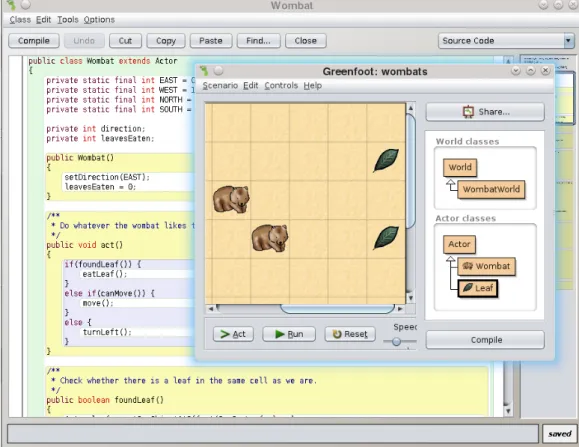
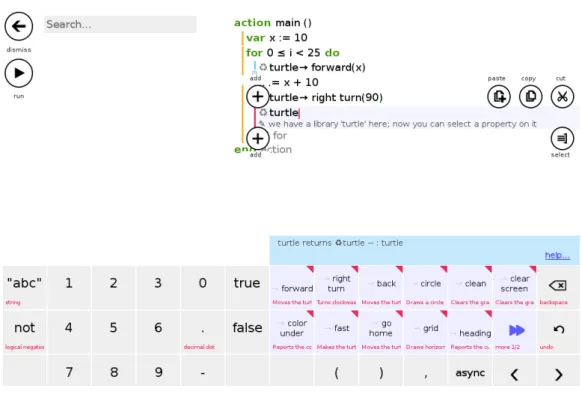
2.5.1 Scratch . . . 47 2.5.2 Blockly . . . 48 2.5.3 Codemancer . . . 49 2.5.4 Lego Mindstorms . . . 49 2.5.5 Calico . . . 50 2.5.6 Alice . . . 51 2.5.7 Greenfoot . . . 52 2.5.8 TouchDevelop . . . 52 2.5.9 Droplet . . . 54
2.5.10 Graphical overlays on programs . . . 54
3 The Grace Language 57 3.1 Goals of Grace . . . 57
3.2 Variables and literals . . . 58
3.3 Objects in Grace are closer than they appear . . . 60
3.4 Methods . . . 61
3.4.1 Operators . . . 61
3.4.2 Field accesses . . . 63
3.4.3 Multi-part method names . . . 63
3.4.4 Visibility . . . 64 3.5 Blocks . . . 65 3.6 Classes . . . 67 3.7 Inheritance . . . 67 3.7.1 Chained inheritance . . . 68 3.8 Types . . . 69 3.8.1 Generic types . . . 71 3.9 Pattern matching . . . 72
3.10 Modules . . . 72 3.11 Dialects . . . 72 4 Patterns as Objects 73 4.1 Introduction . . . 73 4.2 Conceptual model . . . 75 4.3 Graceful patterns . . . 76 4.3.1 match()case()...case . . . 76 4.3.2 Matching blocks . . . 77 4.3.3 Literal patterns . . . 78 4.3.4 Type patterns . . . 78 4.3.5 Variable patterns . . . 78 4.3.6 Wildcard pattern . . . 79 4.3.7 Combinators . . . 79 4.3.8 Destructuring . . . 80 4.3.9 Predicates . . . 81
4.3.10 Using arbitrary expressions to obtain patterns . . . . 82
4.4 Patterns as objects . . . 83
4.4.1 Patterns as an object framework . . . 83
4.4.2 Irrefutable patterns . . . 84 4.4.3 Combinators . . . 87 4.4.4 Types . . . 89 4.4.5 Autozygotic patterns . . . 90 4.4.6 Destructuring patterns . . . 91 4.4.7 Destructuring types . . . 94
4.4.8 Lambda patterns and match...case . . . 96
4.5 Types and patterns . . . 97
4.5.1 Pattern and MatchResult . . . 98
4.5.2 Destructuring . . . 99
4.5.3 Combinators . . . 100
4.6 Generalising patterns . . . 102
4.7 Discussion and comparison with related work . . . 103
4.7.1 Scala . . . 105
4.7.2 Newspeak . . . 108
4.7.3 Racket . . . 112
4.7.4 Gradual and optional typing . . . 113
4.7.5 Matching as monads . . . 114
4.7.6 Future work . . . 114
4.7.7 Alternative approaches . . . 115
4.7.8 Application . . . 121
4.8 Conclusion . . . 122
5 Modules as Gradually-Typed Objects 123 5.1 Introduction . . . 123
5.1.1 What is a module? . . . 124
5.2 Modules as objects . . . 125
5.2.1 Importing modules . . . 126
5.2.2 Gradual typing of modules . . . 127
5.2.3 Recursive module imports . . . 130
5.3 Design rationale . . . 131 5.4 Package management . . . 132 5.4.1 Identifying packages . . . 132 5.4.2 Finding packages . . . 134 5.4.3 Installing packages . . . 134 5.4.4 Publishing packages . . . 134
5.5 Extensions and future work . . . 135
5.5.1 Foreign objects . . . 136
5.5.2 External data . . . 138
5.5.3 Resource imports . . . 138
5.6 Comparison with related work . . . 141
5.6.2 Newspeak . . . 144 5.6.3 Go . . . 145 5.7 Conclusion . . . 147 6 Dialects 149 6.1 What is a dialect? . . . 151 6.1.1 Structure . . . 151 6.1.2 Pluggable checkers . . . 153 6.1.3 Run-time protocol . . . 154
6.2 Case studies of dialects . . . 155
6.2.1 Logo-like turtle graphics . . . 155
6.2.2 Design by contract . . . 158
6.2.3 Dialect for writing dialects . . . 160
6.2.4 Requiring type annotations . . . 163
6.2.5 Literal blocks . . . 166
6.2.6 Ownership types . . . 167
6.2.7 Type checking . . . 173
6.2.8 Relations . . . 175
6.2.9 Finite state machines . . . 176
6.2.10 GrAPL . . . 177 6.2.11 GPGPU parallelism . . . 178 6.3 Discussion . . . 181 6.3.1 Inheritance . . . 181 6.3.2 Delegation . . . 183 6.3.3 Macros . . . 184 6.3.4 Local dialects . . . 186 6.3.5 Default methods . . . 187 6.4 Implementation . . . 188 6.4.1 Lexical scoping . . . 188
6.4.2 Executing checkers statically . . . 189
6.4.4 Security concerns . . . 192
6.5 Comparison with related work . . . 192
6.5.1 Racket . . . 192 6.5.2 Scala . . . 195 6.5.3 Ruby . . . 195 6.5.4 Wyvern . . . 196 6.5.5 Cedalion . . . 196 6.5.6 Haskell . . . 197 6.5.7 Xtext . . . 198 6.6 Conclusion . . . 201 7 Tiled Grace 203 7.1 Tiled Grace . . . 204 7.1.1 Implementation . . . 207 7.2 Motivation . . . 210 7.3 Functionality . . . 212 7.3.1 Handling errors . . . 213 7.3.2 Overlays . . . 215 7.3.3 Dialects . . . 216 7.3.4 Type checking . . . 219 7.3.5 Hints . . . 221 7.4 Experiment . . . 222 7.4.1 Research questions . . . 223 7.4.2 Participation . . . 224 7.4.3 Instruments . . . 224 7.4.4 Protocol . . . 224 7.4.5 Data collection . . . 227 7.5 Results . . . 236 7.5.1 Demographics . . . 236 7.5.2 Programming experience . . . 237 7.5.3 Technologies used . . . 239
7.5.4 Engagement . . . 241 7.5.5 Error handling . . . 247 7.5.6 View switching . . . 247 7.5.7 Freeform responses . . . 259 7.5.8 Threats to validity . . . 271 7.5.9 Summary . . . 272
7.6 Comparison with related work . . . 273
7.6.1 Scratch . . . 273 7.6.2 Blockly . . . 275 7.6.3 Alice . . . 275 7.6.4 Droplet . . . 276 7.6.5 Calico Jigsaw . . . 277 7.7 Future work . . . 278 7.8 Conclusion . . . 279 8 Implementation 281 8.1 Overview . . . 281
8.1.1 Extensions and limitations . . . 282
8.2 Architecture . . . 283
8.2.1 Lexer . . . 284
8.2.2 Parser . . . 285
8.2.3 Identifier resolution . . . 286
8.2.4 Code generation: C . . . 288
8.2.5 Code generation: ECMAScript . . . 290
8.3 History . . . 292 8.3.1 Parrot to LLVM . . . 292 8.3.2 Self-hosting with LLVM . . . 293 8.3.3 Unicode . . . 295 8.3.4 Generating ECMAScript . . . 296 8.3.5 Generating C . . . 297 8.3.6 Garbage collection . . . 297
8.4 External libraries . . . 298 8.4.1 Grace-GTK . . . 298 8.4.2 Grace-CUDA . . . 300 8.5 Outside contributions . . . 301 9 Conclusions 303 9.1 Future work . . . 305 A Auxiliary data 309 B Extended examples 311 B.1 Scala matching . . . 312 B.2 F]matching . . . 313
C Package Manager Example 315
D Tiled Grace Experiment 317
Introduction
Grace is an object-oriented imperative programming language in develop-ment intended for education. Grace aims to be used in introductory com-puter science courses and to incorporate accumulated knowledge about teaching while avoiding pitfalls found in contemporary languages com-monly used for these courses.
In this thesis we investigate extensions to the Grace language allowing the programmer to express their intentions in a manner suitable to their understanding of the task at hand. For novice programmers complex ideas can be presented simply and departures from the expected actions restricted. For more experienced programmers these extensions provide power within a concise structure. We do not focus on Grace’s educational claims, but instead aim to design features of general utility that meet the goals of the language.
The contributions of this thesis are:
• An object-oriented pattern-matching system embedded into the lan-guage with minimal syntactic and semantic change. This system includes both a concise and readable syntax for writing pattern-matching expressions and a fully object-oriented design for patterns themselves, incorporating both those patterns built into the language
and user-defined patterns. This contribution was published in the 2012 Dynamic Language Symposium [74].
• A module system based on objects, providing the desirable attributes of modules by building on existing common language semantics. This contribution was published in a paper presented at DYLA 2013 [70]. • A system ofdialects, language variants able to provide extensions and restrictions of the base language to the user, built using our module system and pattern matching. We show how this system supports both pedagogical sublanguages and powerful domain-specific lan-guages within a single language, and present case studies to evaluate its breadth and power. This contribution was published in a paper at ECOOP 2014 [71].
• A novel editing environment integrating both drag-and-drop visual editing and conventional textual editing of code in one, with bidi-rectional transition between the two and supporting multiple user-defined dialects. We present the results of a user experiment evaluat-ing our design. This contribution was published in VISSOFT 2013 [72] and 2014 [73].
While the papers cited above have additional authors, the principal work and authorship was by the author of this thesis.
The structure of this thesis is as follows. The next chapter describes related work in all of the contribution areas and programming pedagogy generally. Chapter 3 introduces the Grace language overall. Chapter 4 describes our pattern-matching system and Chapter5our module design. Chapter 6 presents our dialect design and a variety of case studies to evaluate it. Chapter7shows our visual-textual editing environment and the results of our experiment evaluating the system. Chapter8describes Minigrace, our self-hosted compiler for Grace, and Chapter 9concludes. Within each of the contribution chapters separate sections (Sect.4.7, Sect.5.6,
Sect.6.5, and Sect. 7.6) explicitly contrast and position our work among related work.
For ease of reference the author will use the royal pronouns throughout this thesis.
Related Work
In this chapter we describe other work related to the contributions of this thesis. This chapter will provide an overview of the related work; each contribution chapter includes a section explicitly contrasting our work with others’. The next section gives an overview of programming education research generally, and the following sections address work in the areas of our contributions. Section2.2discusses pattern-matching systems, Sec-tion2.3describes module systems, Section2.4notes research on language variants and domain-specific languages, and Section 2.5 presents other visual programming interfaces.
2.1
Programming language education
Although we do not make claims about Grace’s educational suitability, we must be mindful of the nature of the language in our contributions, and place them in the corect context. Here we summarise relevant educa-tional literature and describe past educaeduca-tional programming languages. A broader overview of work on programming languages or tools for novices in general is given in the work of Pearset al.[148], while Robins, Rountree, and Rountree provide an overview of work on learning programming [166] and Carteret al.[23] summarise work on programming students’
motiva-tion and programme structure.
The most common report of research on teaching programming to novices is that they perform unusually poorly compared to other pro-grammes in the university, often in combination with an unusually high rate of top grades in the same course (a bimodal distribution) [107, 165]. The second most common is that the authors have found a miracle cure by using/not using static types, objects, classes, graphics, arithmetic, Java, Python, C++, their new language, or their new tool, and that everyone should immediately switch to this approach; this part of the literature is backed up by anecdotes and limited quantitative studies.
The remainder of this section is broken into three parts: the next ad-dresses research in educational psychology with relevance to programming education, while Section2.1.2describes pedagogical approaches, and Sec-tion2.1.3educational programming languages.
2.1.1
Educational psychology
Educational psychology studies human learning and cognition. Much work has been done in the area with children and undergraduate students in particular, although relatively little on programming language education in itself. Much research in the area has application to teaching in general, including teaching programming, but some concepts in particular stand out as important for programming education: transfer of learningis the application of skill learnt in one area to learning another related skill [150, 164], while the distinction between expert and novice problem-solvers is also instructive.
Transfer can be divided along multiple lines [164]. A key division is the distance of transfer: near transferapplies learning about one domain to a domain whose essential stimuli are similar to the first, andfar ordistant transfer applies concepts to a domain much different than the original. In the context of programming education, moving from one language to
another is likely to be near transfer [142], but the division is contextual. Another division is betweenlow roadtransfer, where skills are applied in the new domain without effort because the skill has been developed to a very high level, andhigh roadtransfer where explicit connections must be made between concepts [150].
An expert in a domain has substantial experience in that area and is able to conceptualise it at a high level, while anovicedoes not have this experience, and is likely to view problems in the domain at a low level, with many small problems they must solve individually. An expert is able to achieve low-road near transfer, and high-road distant transfer; a novice struggles to achieve any transfer at all. Becoming a genuine expert is thought to require thousands of hours of experience, but other plateaus are thought to exist, and in particular novices can reach the point of competence and begin to achieve easy near transfer with several hundred hours of experience with careful teaching [35,150]. Early in learning, however, a novice will experience no transfer at all, and sees no benefit from having learnt even a closely related skill to a low level.
For learners to achieve transfer they must be taught the concepts in a fashion that facilitates transfer [150]. Without such teaching the knowledge tends to beinert: it can be applied within its original context, but learners will not generalise from that context to apply their knowledge elsewhere. Perkins and Martin found that students learning to program would learn language constructs inertly, and so had difficulty applying their knowledge to the act of programming, notwithstanding that the distance of transfer is minimal in this case [149], while Dyck and Mayer found that without transfer-focused teaching learners of BASIC would master the syntax of the language, but struggle more with semantics than those taught with trans-fer [41]. An assumption in much teaching is that (near) transfer will occur automatically by the low road, but research has not borne this assumption out in practice [150], instead finding that instruction must be tailored to assist high-road transfer; in the literature, this tailoring to target high-road
transfer is calledbridging[41].
In the context of teaching programming, the first domain may be a single programming language and the second a different language; they may also be different ways of working within the same language, or even the syntax and semantics of a single language. To transfer their skills from one domain to the other students will need a combination of sufficient experience and bridging instruction, or else there will be no transfer and the second domain will need to be taught essentially from scratch. This finding has implications for the design of educational languages: because an educational language explicitly expects learners to move on to other languages afterwards, the language must support the learner for long enough to allow them to build sufficient competence that they can successfully transfer their skills to another language.
2.1.2
Programming pedagogy
Papert [143] proposed a discovery learning format for teaching program-ming based on Piaget’s theory of cognitive development [153,154,155,156]. In Papert’s model, students learn a programming language in a similar conceptual fashion to how children learn natural languages. In the dis-covery format learning is almost entirely self-directed and learners are provided with an interactive system (the Logo language and environment) to work with where changes can be readily perceived. A student learns by experimentation, gradually forming a mental model of the programming environment based on their observations of the effects of their actions; proponents claim that this approach leads to both programming compe-tence and general problem-solving ability that can be applied to other domains (including non-programming domains and mathematics). Exper-imental teaching did not show the results predicted by Papert [101,35], although some contemporary work found that an approach with more explicit bridging showed more success [38,27]. After much work on
teach-ing mathematics with Logo failed to bear results, interest waned in the late 1980s. Little work on programming education with a true educational psychology focus has occurred since; the computer science education litera-ture of the 1990s and 2000s to date has largely been filled with designers, authors, and fans proposing that their language or approach is best, and experience reports that do not account for confounding factors [187,108, any SIGCSE proceedings]. Nonetheless, some interesting results have been presented in recent years, and we will discuss these now before moving into discussion of proposed educational languages.
Garneret al.[57] report on the prevalence of different errors in novice code in Java. The most common error in their categorisation was “basic mechanics” (largely typographical in nature – omitted brackets, misnamed variables or classes, and similar). The next most common problems all dealt with high-level understanding of the task at hand, and misunderstandings and misapplications of procedural constructs followed. Mechanical errors dominated for students at all levels. The authors suggest targeted interven-tions aimed at the common errors and using the distribution of errors to guide the length of instruction on particular topics.
Cardell-Oliver [21] suggests using automated metrics to diagnose stu-dent code, and to report results and suggestions from those metrics to students as formative feedback to help them improve. Well-known metrics can measure program size, efficiency, correctness, and style automatically, and outlying results can be reported to the student with guidance on how they might improve their programs. The same metrics can guide course design by determining where students are actually having problems, which may differ from the instructor’s supposition. The author also identifies limitations in past studies using single quantitative measures of perfor-mance, and of grading models in common use that may cause the bimodal distribution sometimes found in programming courses; in both cases, the author proposes the use of objective software metrics instead.
of dependent concepts in computer science causes student performance to diverge: either the student understands early concepts, and continues to perform, or encounters difficulty at some point and is unable to catch up; the author proposes that the dense dependency chain of learning program-ming concepts is unique. Thislearning edge momentumis a rich-get-richer model: a student who is performing well at a given point in the course will likely attain competence at the next concept introduced, while one who has not understood the last concept will likely not understand the next. This effect compounds during the course, leading to a bimodal distribution. Robins proposes this model as an explanation for the high rate of high grades that often accompanies the high failure rate, and provides citations from other educational work to substantiate the model as a reasonable explanation of observed facts, as well as to counter the alternative explana-tion that there are distinct populaexplana-tions a priori able or unable to program. The author notes that the model suggests an especial effort and focus be applied at the start of a programming course to put as many students as possible on the positive path.
Murphy and Thomas [129] note implications of psychological research on self-conception of intelligence for computer science education: in partic-ular, views on whether applied intelligence is fixed or malleable and able to grow. The authors note that experimental results in psychology may in particular provide partial explanations for the tendency of some students to stop completely when faced with difficulty, as well as the observed gender disparity in the field, and suggest an approach for changing students’ views so that all have agrowthmindset to achieve more effective instruction. They also note that the views of the instructor may also have an effect.
Caspersen and Bennedsen [24] propose a design for an introductory object-oriented programming course based on educational theory. Their approach is based on explicitly forming patterns for programming activities through structured repetition, using worked examples in particular as a focus of the course content. The authors note providing multiple such
examples as beneficial, along with varying the surface structure of the examples and having students describe the programs to themselves. The authors report success in running the course they describe, but have only anecdotal evidence for that success at this point.
The ACM and IEEE have collaborated on curriculum guidelines for computer science, programming, and software engineering programs since 1968 [2]. The latest edition, CS2013 [88], requires that students be prepared to work in multiple paradigms and multiple disciplines, and provides specific guidance for introductory courses. The guidelines note explicitly that “it is important that students do not perceive computer science as only learning the specifics of particular programming languages” [88, p41]: stu-dents must learn the base concepts through programming, and be prepared to apply those concepts in other languages or contexts. The report also notes the explicit trade-off that must be made for an introductory language:
The use of a language or environment designed for intro-ductory pedagogy can facilitate student learning, but may be of limited use beyond CS1. Conversely, a language or environ-ment commonly used professionally may expose students to too much complexity too soon.
A language or tool designed for introductory courses will need to tread this line carefully, supporting learners to the point that they are able to use their knowledge in other contexts.
2.1.3
Educational languages
Many educational programming languages and systems have been de-signed, and some have achieved wide currency for a time. BASIC [93] was a language originally designed for beginners, but not necessarily for programming education; the designers’ goal was to open up programming to users in non-computing fields. BASIC was originally unstructured, but
later gained procedures, and was widely used in various forms for teaching for many decades. Early versions of the language included only GOTO-based control flow and two-letter variable names. BASIC in particular was often scorned as a poor choice of introductory language despite its popu-larity, with claims that its use led to poor programmers. Many different implementations with slightly different syntax, semantics, and features became widespread with the rise in minicomputers, and Microsoft’s Visual Basic is still a popular language for real-world programming today [180].
Pascal [195,87] was one of the most successful educational languages, in widespread use for teaching from the 1970s through 2000s. Pascal is an imperative, statically-typed, procedural programming language, with one of the key goals being to teach structured programming, a then-recent development. The original working Pascal compiler was written in Pascal itself, and the needs of that compiler also influenced the language design. While Pascal was explicitly intended for education, it also gained use outside of teaching. This use was controversial both with the designer and others, who found the simplifying limitations of Pascal unsuitable for real-world programming [94].
SP/k [67] is a family of languages designed to teach structured pro-gramming: there are several subset languages SP/1 through SP/8, each of which introduces new constructs building on the previous subset. SP/k was designed as a subset of PL/I and achieved some use in the 1970s and 1980s.
Lisp [121] was not built as an educational language, but rather simply as a practical notation for writing programs for limited machines. Lisp is an impure functional language, with all control flow by prefix function calls. Lisp is a homoiconic language: its representation of data structures and code are the same, built ofs-expressionswritten in parentheses; this ho-moiconicity led to advanced macro systems that manipulate program code. Many variants of Lisp have existed and continue in use today. Lisp has been proposed for educational use because of its syntactic simplicity [49]:
there is only one syntactic form, only one kind of bracketing construct, and only one kind of control flow. The argument is that by having only one form to learn students are less confused and make fewer errors, freeing them to focus on the essential components of learning.
Logo [143] is a Lisp derivative explicitly aimed at education. Logo’s design has roots in mathematics and psychology research, and pioneered in particular the “turtle graphics” paradigm, where an on-screen image or tangible robot follows instructions to move around the world, leaving a trail behind itself. Logo is one of the few proposed educational languages with genuine educational research behind it, which was discussed earlier. Racket [49,182] is another Lisp derivative explicitly proposed for teach-ing. Racket is integrated with DrRacket, a specialised integrated develop-ment environdevelop-ment for teaching. DrRacket includes a number of features to help novices, including a stepping debugger, various metadata overlays, and educational language variants. Racket supports a system of language variants that allow giving students at different stages of learning access to different functionality and different error messages, and includes a pro-posed sequence of variants to use for teaching.
Scratch [162] is a visual language for teaching aimed at children. All editing in Scratch is by drag-and-drop: the programmer drags a jigsaw-piece tile out of the toolbox and puts it onto the work area or into a space in an existing tile. The language is integrated with the editor and a persis-tent microworld where different sprites can be placed and given code to control their movements, dimensions, and actions. Scratch is an impera-tive language with some structured components, and inherently supports concurrency. Research has shown some success in drawing children to en-gage with computers [53,17,115], but has also seen difficulties in learners moving on to other languages [123,124].
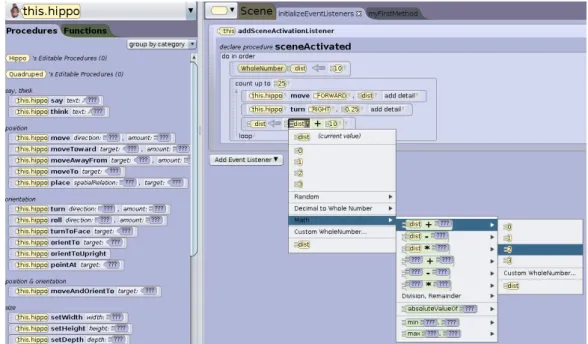
Alice [36] is another visual language for teaching, aimed at a slightly older audience than Scratch. Alice includes a graphical microworld filled with three-dimensional sprites, which can be manipulated and moved in a
three-dimensional space. As in Scratch, code editing is by drag-and-drop, although with a larger number of menus than Scratch. Alice is primarily an event-driven programming system, where code executes in response to a condition being true within the microworld, but it includes most common structured-programming features as well.
SOLA [120,119] is a simplistic objects-first prototype-based imperative programming language intended to teach the concepts of object orientation to novices, drawing from principles set out by McIver and Conway [130] for their GRAIL language. SOLA is a textual language fully integrated with an editor, and is structured so that a user can interrogate the structure of their objects at any time. The authors propose that by limiting learners to only the basics of object orientation they will be forced to learn those concepts well without being distracted by accidental complexities of the language, and present a small study [119] to support this claim; this study separates out reading, writing, and modifying code, which has not been commonly done in the recent literature.
Stefik and Siebert [173] describe Quorum, an “empirically-designed” introductory language, and perform empirical studies to compare novice accuracy in their language, a “randomly-generated” language called Ran-domo of their own design, and several other languages. The authors study keywords and constructs for “intuitiveness” with novices, and select the most intuitive terms to incorporate into Quorum. Randomo replaces the keywords of Quorum with random non-alphanumeric symbols from the ASCII table. The authors also investigated readability of larger program constructs, finding that Quorum performed best at this task. Finally, they conducted an experiment where they presented students with the same programs in Quorum, Perl, Randomo, Java, Python, and Ruby, along with a textual description, in order that participants would learn the syntax and semantics of the language; they then asked participants to produce pro-grams performing particular tasks in that language. The authors reported that users in Java and Perl performed no better than in the
randomly-generated language, while users of Quorum, Ruby, and Python performed comparably and better than random. These studies did not involve any structured instruction of participants and so are not directly comparable to real teaching, rather representing untrained readability with targeted reproduction.
2.2
Pattern matching
A pattern matching system is a structured way of categorising at runtime data entities in a program based on some characteristic, and branching on the basis of that category [181]. In an object-oriented language, that entity being matched will be an object, but pattern matching is most common in functional languages where some combination of records, types, and primitive values can be involved in matching. The syntax, semantics, and role of pattern matching differ significantly between languages.
Matching is the basis of entire models of program organisation [85]. Where in object-oriented code dynamic dispatch on the receiver allows executing different code for different kinds of data by placing the code in the object, a language with strong pattern-matching facilities allows the program to be structured in the opposite manner: code dealing with different types of data is placed outside the entity in question, after the fact, and potentially with all the related cases together. These different models of organisation are usually found in different languages; our work (in Chapter4) is on permitting both models within a single (object-oriented) language, so we will discuss both functional and object-oriented related work here with a particular focus on how they enable (or hinder) these models.
We define two broad approaches to pattern matching that influence both the syntax and semantics of the resulting system: matching can be what we will term inherent, meaning that patterns are a special built-in construct functioning in predetermined ways, orexherent, meaning that the
precise behaviour of matching is user-defined, with the language providing a structure.
In an inherent matching system, such as in Scala [46], OCaml [102], or Haskell [117], specfic matching syntax can be provided that expresses the full range of possible patterns. These patterns are embedded deeply in the language. The semantics of matching is generally determined by what leads to (perceived) good syntax that appears naturally in the language. Patterns are not first-class entities in themselves.
In an exherent matching system, such as in Newspeak [58], OMeta [192], and F# [176], patterns are first-class entities and can have arbitrarily com-plex behaviour. As a result of this flexibility, however, a fully-integrated syntax is more complex or impossible. The semantics of patterns align with the rest of the language.
In an exherent matching system the programmer can write code that is polymorphic in patterns, such as a method or function that accepts patterns and retains them to be applied later. With an inherent system this polymorphism is not generally possible, as patterns are not first-class entities. The programmer can, however, often build a first-class object or function that simulates this behaviour, in effect building an exherent system on top of the inherent system of the language. The reverse behaviour, building an inherent system on top of an exherent one, is not generally possible as inherent systems innately depend on language syntax support. In this way an inherent system has some additional flexibility that an exherent system does not, albeit the flexibility to simulate an exherent system.
Languages using both inherent and exherent approaches exist, although inherent matching is more common and precedes exherent techniques, existing in very early functional languages. Some languages integrate aspects of both approaches.
Pattern-matching systems often draw from mathematics the concepts of partial and piecewise functions, particularly in functional languages. A
partial function is a function that is defined only for some inputs; the set of inputs for which the function is defined is called itsdomain. Apiecewise functionis one with different bodies (implementations) defined for different sub-domains. Piecewise functions can be seen as combinations of multiple partial functions, one for each constituent domain. In mathematics, the domain is a set, but in programming languages how a domain is defined, what it means, and how it affects the program varies dramatically.
Our pattern-matching design draws from Scala [46] (principally an inherent matching system) and Newspeak [58] (principally an exherent matching system), so we first focus particularly on these languages. We outline the design of these and other pattern-matching systems here, and contrast them with our approach in Section4.7.
2.2.1
Scala
Scala includes a powerful inherent pattern-matching system, with explicit syntactic extensions supporting it [46]. The syntax of patterns is a distin-guished sub-language, designed to make for concise patterns.
Scala matching is primarily based around the match-case construct:1
xmatch{
case1=>"one" case"two"=>2
casey : Int=>"scala.Int"
case(a, b, c)=>"A triple: "+a+","+b+","+c }
The match-case construct defines a series of partial functions, combin-ing them into a piecewise function. Each instance of the case keyword introduces a partial function definition with the domain determined by the constraints that immediately follow: “1”, “y : Int”, etc; the behaviour of
1As with many Scala programs, the typechecking of this example is
perhaps-unexpectedly context-dependent. A complete program incorporating the example verba-tim is included in AppendixB.1.
each pattern is built into the language. These definitions are valid within thematchblock only, which is a special parsing context. A block of cases returning values can also be provided to methods taking single-argument (first-class) functions as arguments; these cases must cover every possible input. The matching syntax also permits “guards”: additional boolean tests that must pass for a case to succeed. Guards are written afterifand before the=>of the case block.
Scala supports user-defined “case classes” with additional matching functionality. A case class is an ordinary class whose parameters are re-tained and publicly-available. Case classes are explicitly declared as such and can be both instantiated and used in pattern matching:
case classPoint(x, y) ...
xmatch{
casePoint(0, y)=>"On the y axis at "+y casePoint(x, 0)=>"On the x axis at "+x
casePoint(x, y)=>"On neither axis at "+x+","+y }
The constructor parameters of case class instances can be decomposed, matched against, and accessed during pattern matching. Like other classes, case classes can inherit, and instances of case classes can have additional methods and fields. Case classes as patterns are distinguished by always having parentheses after their names; if there are no constructor parameters to match, the case name is followed by empty parentheses: caseNil()=>" nil".
“Extractor objects” are a generalisation of case classes, allowing any object to permit matching and decomposition. Extractor objects are first-class objects and allow some exherent matching behaviour. An extractor object has a method “unapply” which returns either a list of decomposed values from a successful match, or a Boolean indicating success or failure with no decomposed values. Extractor objects can have arbitrary semantics
for determining whether to match or not, and what values to extract; they have no fixed relationship to other extractor objects. Using an extractor object has the same syntax as a case class, including parentheses.
We contrast our design with Scala explicitly in Section4.7.1.
2.2.2
Newspeak
Newspeak [58] includes an object-oriented pattern-matching system de-signed around message passing (also known as method calls). In contrast with Scala, Newspeak’s is a fully exherent matching system: patterns and classes are objects, and matching does not involve distinguished syntax or altered semantics but rather ordinary method invocation. All patterns implementdoesMatch:else:and all matchable objectscase:otherwise:2.
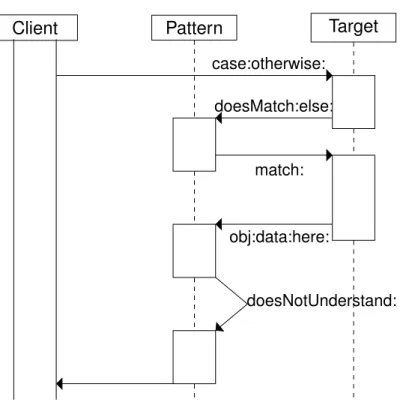
To perform a match the programmer sends acase:otherwise:message to the target object they wish to match. The first argument tocase:otherwise: is a pattern object, and the second is a block of code to execute if the match fails. The target object double-dispatches to the pattern object’s doesMatch:else:method, passing itself and that same block.
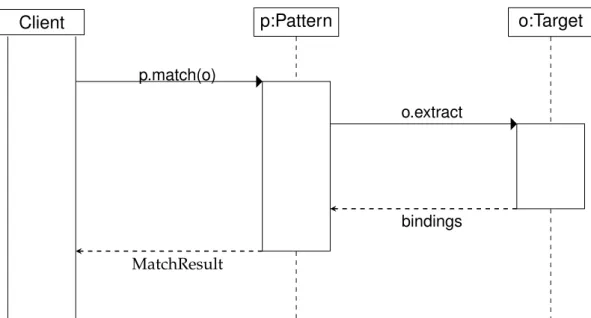
In the ordinary case the pattern then asks the target to match: the pattern, and the target responds by sending a type-specific message back with some state that it wishes to be recognised by; for example, a point could respond by sending thex:y: message, while a string would simply send itself in the string: message. A pattern implements the messages sent by the objects it wishes to match, or handles all messages through the defaultdoesNotUnderstand: protocol. Any unhandled message causes a “not understood” exception, which is interpreted as a failure. The matching
protocol is shown in Figure2.1.
At any of these points either a target object or a pattern can deviate from the protocol. An object that does not wish to be matched at all can reject the initialcase:otherwise: message and opt out of pattern-matching altogether.
Client Pattern Target case:otherwise: doesMatch:else: match: obj:data:here: doesNotUnderstand:
Figure 2.1: Matching sequence in Newspeak. Theobj:data:here:message is target-type-dependent, whiledoesNotUnderstand: is optional.
Complex patterns are built using object composition, including nested decomposition of object state. A pattern with any desired semantics can be written by implementing a suitable doesMatch:else: method, but a library of suitable combinators and pattern components is included in the system. There is no distinguished syntax for patterns; as an exherent system, Newspeak relies on its (relatively flexible) syntax for building pattern objects, and method invocation for performing the match. As a result, some patterns in Newspeak are more verbose than they might be in an inherent matching system such as Scala’s. The compensation is that the full power of Newspeak’s language is available for defining what should and should not match, and that patterns can be used in any of the ways that other first-class objects can.
2.2.3
Other object-oriented languages
Inherent matching
Thorn [11,12] makes heavy use of pattern matching, with extensive inher-ent syntax supporting matches as part of many of the language constructs, including the control structures and clausal function definitions. Thorn offers a wide array of built in data types, each with corresponding matching destructors, and a set of algebraic pattern combinators. A Thorn class’s formal parameters are used to initialise instance objects, and they can also be extracted if an object is matched against. Thorn includes special patterns (and syntax) for matching with regular expressions, arrays, bitpatterns, and XML.
Fortress [170], another large and flexible language, has a relatively modest range of pattern matching features, including destructuring of objects and tuples. Fortress matching is also primarily inherent, although patterns may be lifted to objects. Like Thorn, patterns in Fortress may be used freely in definitions, rather than solely in matching constructs.
OCaml includes an inherent pattern-matching system through special syntax [102]. The programmer can match against any object, but the only available patterns are algebraic data types. Matching is based on the imple-mentation site of the target object: matching is a slight generalisation of a standard instance-of check supported in many languages.
Machete [66] (a forerunner to Thorn) is an extension to Java introducing pattern matching in a conventional inherent way: adding a match statement, a rich library of built-in patterns, and a separate type of “deconstructor” declaration for objects that extract values when matching. While Machete is primarily an inherent system, and pattern semantics are embedded in the language, as part of its embedding into Java it does permit limited exherent extensions through these deconstructors. As in Thorn, Machete includes special patterns for matching XML, regular expressions, and arrays.
pattern matching inherently into Java, providing clausal function defini-tions and multi-methods. OOMatch semantics are a dramatic departure from those of Java, although most Java programs are upwardly compatible.
Exherent matching
OMeta [192] is an object-oriented language for pattern matching based on Parsing Expression Grammars (PEGs) [51]. PEGs by nature are an exherent approach to pattern matching; pattern elements are first-class and are combined together to build larger patterns, including through aliasing and nesting. A program in OMeta is a PEG that recognises a given class of inputs and optionally decomposes an input into a structured result, or rejects the input. OMeta models grammars as traditional object-oriented classes and productions as methods. A particular goal of the language is to permit extending existing grammars in a structured fashion. OMeta extends PEGs to support matching arbitrary data, but many of its features remain aimed at conventional text parsing.
Lua includes an exherent text pattern-matching library with composi-tional first-class patterns built on PEGs [81]. Patterns can be sequenced, combined, disjoined, and negated through object composition. The library requires no additional syntactic support, but is geared specifically towards matching text, not arbitrary objects.
MatchO [189] is another extension to Java that provides a flexible pattern library but does not need (or provide) any specialised syntax above that of Java — although syntax can be supplied by invoking a generated parser inline. MatchO is an exherent system, but is able to obtain some benefits of an inherent system through this parsing approach, albeit with a very stark delineation between code in the base language and in a pattern. In MatchO, patterns are necessarily first-class, given that they are implemented as a normal Java library, but MatchO does not generalise patterns to pattern combinators.
2.2.4
Functional languages
Many if not most functional languages include substantial pattern-matching functionality, and are often based around matching as a mechanism for program organisation [85]. In most cases matching is principally on the type (or implementation) of an entity, and may be in the form of partial function definitions.
Most commonly, functional languages support inherent matching. These languages frequently borrow from mathematics the concept of partial func-tions and use that as the basis of the language. Haskell is a representative example of this approach which we discuss in the next subsection.
Some functional languages support exherent matching, either in addi-tion or instead of inherent matching. We will discuss F#’s and Racket’s interesting approaches to leveraging the existing nature of functional lan-guages to support first-class patterns and matching below.
Haskell
Haskell, in common with most other functional languages, provides ex-cellent syntactic and semantic support for patterns [117]. This pattern matching follows an inherent approach and is built in to the language: patterns are not first-class elements that can be operated on. Patterns are either embedded deeply into the language, like the historicaln + kpatterns, or correspond exactly to matching data type definitions.
All functions in Haskell can be partial or defined piecewise using pattern matching:
fib ::Int−>Int fib 0 = 1 fib 1 = 1
fib (n+1) = (fib (n−1))+fib n
−−Alternatively:
This function returns an element of the Fibonacci sequence [157]:1if the argument is0 or1, and for any other argument the sum of the previous two elements.
Numeric patterns are built in to the language, but user-defined data types can also be matched against:
data Lista = Nil | Cons a (Lista) length::Lista−>Int
lengthNil = 0
length(Cons x xs) = 1+(lengthxs)
This function computes the length of a linked list recursively, withNilas the terminator. Matching here is exactly on the definition site of the target: only aConsarising from this definition will be matched.
Special cases for some common data constructors are built in, like the “:” constructor for the built-in list type and “()” for tuples. The syntax is quite concise and allows specifying, in particular, recursive function definitions easily. Recursive functions are a very common occurrence in Haskell code, so the pattern matching system optimises for them.
Piecewise function definitions are in fact syntactic sugar for a single function containing a use of the built-incase...ofsyntax, which performs pattern matching in exactly the same way. In either case, the pattern speci-fies which values or types should be matched and optionally destructures them, and finally a value must be returned. A pattern cannot be passed as an argument to another function or stored in a variable.
Proposals to add reified patterns to Haskell have come from both Tullsen [184] and Reinke [161]. Tullsen represents patterns as reified partial functions, and then pattern combinators are function combinators; larger structures such as case statements and clausal function definitions are then built on top of these. Reinke’s “lambda-match” proposal extends this approach to combine individual cases into whole match statements with combinators. Wadler proposed “Views” [191] as a way to support programmer-defined matching and destructuring of abstract types in
func-tional languages, which Peyton Jones made more concrete in proposing view patterns for Haskell [152]. A view pattern is a function that matches an abstract value and returns a concrete data type that can be further matched-against [152]. None of these proposals became part of the overall Haskell language.
F#
The F# language supports exherent matching against abstract structures via active patterns [176], as well as the conventional inherent matching common to functional languages. An active pattern is a function with a structured name where that name indicates one or more alternative cases. Active patterns support first class patterns in this way, as F# has first-class functions. The language also provides a range of pattern combinators, which in this case are specialised function combinators. F# builds in support for the common cases most functional languages include in their inherent matching systems.
Although they can support partial matching, active patterns support exhaustive matching particularly well, because a single succinct pattern function matches and destructures every alternative, returning a result indicating which case of the pattern is matched. In contrast, Scala and Newspeak require individual matching and extract functions for each case. An example total pattern match (adapted from the cited paper) is:
let(|Cons|Nil|) l =
ifnonempty lthenCons(hd l, tl l) elseNil
This function definition defines two patternsConsandNil. When matching against one of F#’s built-in lists and suitable definitions, these patterns are total, with the matching behaviour defined by the code in the body of the definition and what it returns. These patterns could be used to compute the length of a list recursively:
let reclength l = match lwith | Cons(x, xs)−> 1+length xs | Nil−> 0
This definition follows the example given for Haskell above exactly, but the patterns are defined by user code and are first-class entities. A complete program incorporating these definitions is given in AppendixB.2.
Racket
The Racket Scheme dialect also includes an extensible exherent pattern-matching facility [181]. Uniquely amongst all the designs presented here, Racket’s powerful macros enable the language to be extended without any changes to its core implementation.
Also uniquely amongst the functional languages we have discussed, Racket makes full use of its functional nature in its pattern system. Patterns are represented entirely by ordinary functions that examine and classify their arguments, and these functions are addressed using the ordinary mechanisms of the language for accessing its first-class functions. Most patterns desugar to application of a single function with surrounding boil-erplate code. Syntax for user-defined patterns is written in the same macro format as built-in patterns, so even these built-in patterns are not privi-leged in any way. Racket’s system is thus fully exherent, in contrast to other functional languages.
We discuss Racket further and contrast its system with ours in Sec-tion4.7.3.
2.3
Modules
A module system provides a way of organising code at a high level, where different modules have a degree of conceptual independence from each other. For example, different modules may have their own namespaces, be in separate files, or represent a barrier against access to code.
While most languages support some sort of module system, they vary dramatically in how they do so. In particular, some languages represent modules as first-class entities of the language, while in others they are a grouping of components that are less than first class. We term the latter “packages”; packages provide less power than first-class modules, as a package cannot (for example) be aliased at run time, but are more common. In most cases module systems are something of an afterthought in the design of a language, and so are often special cases with behaviour different than other aspects of the language, and semantics that must be learned separately.
Our module design in Chapter5is inspired particularly by aspects of Python’s and Go’s module systems [159,60]. We outline the design of these and other module systems here, and contrast them with our approach in Section5.6. We will first examine systems where modules equate in some fashion to first-class objects, and then look at package systems. Finally, we give a brief overview of work on obtaining access to other systems through a module system.
2.3.1
Classes and objects as modules
Python
Python [159] supports modules with separate compilation, which become objects at run time. All top-level definitions in a source file are attributes of the module object. Python’s import statement includes the qualified name of the module as a sequence of dot-separated identifiers, which are
mapped onto a filesystem path: importx.y.zresolves to a filez.pyinside the directory x/y. The source file is loaded at runtime and the resulting singleton object is bound to the imported name. This is the only way that a Python object can be created without a class. Theimportstatement may include an optionalas clause, which gives a local name to the imported module.
When the qualified name of a module includes multiple levels, as above, each intermediate layer is itself a module. The module x is defined in the filex/__init__.py. When a module’s qualified name includes a dot all modules along the chain are imported from left to right, and the leftmost component of the name is by default bound in the local scope so that the same qualified name used to import the module can be used to access it. To make that name available, each intermediate module has a new field added referring to the next in the chain: afterimportx.y.z xhas a yfield, andx.y has azfield; these changes are globally visible. This mutation is necessary for the design to work, and possible because Python objects are mutable by default. The module object is a real object that can be aliased and passed to other code.
As Python is dynamically typed, there is no type information present in Python modules. Python only enforces encapsulation by metaprogram-ming.
We contrast Python’s approach with ours in more detail in Section5.6.1, including discussion of some drawbacks of this approach we seek to avoid.
Newspeak
Brachaet al.[15] describe modules as classes in Newspeak. In this language a module definition is a top-level class, whose instances are termed “mod-ules” and are immutable. Classes can be nested, and the code in a class can access external state in three ways: lexically, from an outer scope; from an argument provided at instantiation-time, or from a superclass. A module definition has no lexically-surrounding class and so must be passed all
modules it will use encapsulated in a “platform” object, or else obtain them through inheritance.
Dependencies are not bound statically in the module source; instead, the dependencies of a module can depend on instantiation-time arguments, so a module may be provided a different implementation of a dependency in different programs, or in different parts of the same program. A module can pass on the dependency mapping it was given, or create its own. Every module can have multiple instances and can be inherited from. We contrast Newspeak’s approach with ours in more detail in Section5.6.2.
Explicit module construction
Ungar and Smith [186] describe how the Self language can support modular behaviour by prototype-based object inheritance. Self does not include a distinguished “module” concept; rather, everything is an object and some objects may be used as modules. Like other objects, these module objects must be accessed by sending a message to another object or by creating them locally. Any object may both inherit and be inherited from, and inheritance of environment objects subsumes the role of lexical scope, allowing an object to present a customised picture of the world to code defined within. The Self system as a whole works in terms of “worlds”, where objects are created and continue to exist in the world until destroyed, even persisting when the program or programs are not running. There is no inbuilt concept of a module. To move (or copy) objects between these worlds, a “transporter” [185] is used. The transporter does have a concept of a module, which it uses to produce the correct behaviour. The programmer annotates individual slots (fields or methods) with the module they belong to, and potentially with instructions for how each should be treated. An entire module, spanning many living objects, may then be moved to another world to be used there, permitting code reuse. Any object can be used as the basis for module.
loaded by asking a “namespace object” for them, which maps directly onto the filesystem according to a configuration set up earlier. Module import implicitly creates delegation methods when required, allowing modules to be imported into a local scope belonging to any object in the system. Importing a module can occur at any point in the code by calling a method on the namespace object.
Kang and Ryu [90] formally describe a proposed module system for JavaScript. JavaScript itself does not have any support for modules, but they are often simulated by objects or functions in the global scope, which can lead to naming conflicts. Kang and Ryu’s module system extends the language with an explicitmoduledeclaration, creating a new namespace and binding a reference to it, which may be traversed to obtain explicitly-exported properties defined in the module. They show that their system safely isolates private state, but allows both nesting and mutual recursion. The view of a module presented to the outside is an object, although the im-plementation of the “module” declaration desugars to multiple objects and closures to give effect to encapsulation rules. The semantics are complicated by JavaScript’s idiosyncratic scoping and visibility rules.
2.3.2
Packages
In contrast to the above languages, in which modules are first-class and have a run-time existence, we now look at some designs that provide what we call “packages”: grouping of components that are less than first-class or which do not exist at runtime at all. We present Go in particular as a package system we will draw on in our design, and then present the development of important package systems chronologically.
In the Go language [60], a package may comprise several files, all of which explicitly declare themselves part of the same package. The defi-nitions in these files are combined and may be accessed by clients using Go’s import statement. Once imported, the module’s public interface is
available through a dotted name, as in Python, but the module itself has no run-time existence. Go’s import syntax uses opaque strings, which in practice are interpreted as filesystem paths. Associated tools are able to interpret import paths as URLs and use them to fetch and install modules from remote locations when required. Our approach draws from Go in some respects, and we contrast Go’s approach with ours in more detail in Section5.6.3.
Alphard [197] incorporates an early explicit module system aimed at enabling program verification. Implementation and interface are separated, so that verification needs only to confirm that the implementation behaves in accordance with the specification.
CLU [106] includes modules that encapsulate the implementation of a desired behaviour. These modules may interact with each other through public interfaces, which fully characterise the module. A module may be replaced by another implementation with the same abstract interface. A language construct permits collecting operations together into an abstract interface.
Standard ML [114] includes a module system built around functors. ML modules make heavy use of static types to achieve their goals. Modules bind environments, types, and functions together, and may have multiple different instantiations. A module gives a single name to a combination of behaviours and state. The module system is powerful but includes many constructs with subtle interactions. In particular, modules can have almost arbitrary type-dependent behaviour giving different effects at different points where the module is used.
The BETA language itself does not include a module system, instead sup-porting modularisation through an integrated programming system [96]. Programmers can split their programs however they wish, because sub-trees of the abstract syntax tree can be maintained and compiled separately, and then combined. Modules are not first-class entities in BETA, but the modularisation of any arbitrarily complex component is possible.
Modules in Modular Smalltalk manage the visibility and accessibility of names [194]. Modules are not objects and do not exist at runtime. Instead they define a set of bindings between names and objects. They can be used to group collaborating classes, and provide a local namespace for their own code to refer to while making only the module itself globally accessible.
Modula-3 [22] includes both “interfaces” and “modules”. An interface is a group of declarations without bodies; a module may export implemen-tations of part of an interface, and may import an interface to gain access to its elements. A module may provide definitions of some, all, or none of the elements of the interfaces it exports, but will have unqualified access to definitions made elsewhere. A single interface may have its implementa-tion spread across multiple separate modules. Only the interface needs to be referenced or understood by other code.
Scala [138] includes the concept of “packages”, which can contain classes, traits, and objects, but not any other definitions, and are imported by their qualified name. Scala also has “package objects”, which are spe-cialised objects that can be declared inside a package to augment it with other definitions, such as methods. Definitions from another package can be imported directly into a scope or be accessed through a qualified name.
Java also includes “packages”, which are weaker than those in Scala; they serve to subdivide the namespace of classes, as well as providing a level of visibility between public and private. Strnišaet al.[174] propose and formally describe a module system for Java in which a module is an encapsulation boundary outside these namespace packages. A module is able to define the interface available to the outside world and to import other modules into scope with their interfaces. These modules also allow combining otherwise-incompatible components in separate areas of the program by enforcing a hierarchy on access.
Racket [182] supports packaging multiple functions into a single unit, which it calls a module. Racket modules are imported using therequire function, which takes a string as input (generally interpreted as a relative
file path). Modules are defined either explicitly using themoduleform or implicitly by the variant of the language a file is written in. Typed Racket includes arequire/typedfunction, which assigns local types to the functions and structures imported from the module. These types are enforced as contracts. The module itself does not have any run-time existence; instead requiresimply makes its contents available to the importing code.
Szyperski [177] argues that both modules and classes are essential com-ponents for structuring object-oriented programs. He defines a module as a “statically-instantiated singleton capsule containing definitions of other items (objects, methods, types, classes) in the language, capable of exposing some, all, or none of its contents to the outside and providing unrestricted access to the contents internally”. A class is a template for constructing objects, which may inherit from other classes and have many instances. While class instances (objects) exist at run-time, a module is a purely static abstraction serving to separate code. One module may import another, obtaining access to the public contents of the other module through a qual-ified name. This mechanism is separate from both the inheritance and instantiation mechanisms supported by classes, but accurately reflects the intention of the programmers of both modules. Because modules have no run-time existence, however, it is not possible to parameterise code with them, and an additional language mechanism is required to define and import them. Szyperski argues that modules as he describes them are bene-ficial for program design because they enhance encapsulation and structure, and for programming practice because they allow separate compilation.
2.3.3
Foreign objects
One role that module systems sometimes play is mediating access to outside resources, such as code written in other languages. The module system in that case provides a barrier beyond which lies the “outside” world where the language semantics may not hold entirely, as well as a way of
representing what from the outside should be accessed. We will aim to enable some of these behaviours, and so present relevant related work here.
F# accesses external data sources with “type providers” [175]. A type provider defines a way of accessing a data source outside the program — like a database or web service — and integrating it with the program as though it were an integral part of the system. Type providers are fully integrated with the IDE: when accessing a web service, for example, auto-complete menus will appear with the different actions or sub-fields avail-able from that service in that particular context. The F# compiler statically generates binding code according to the definitions in the type provider and what is obtained from the external source, and ensures that type infor-mation from the remote source is fully propagated into the program.
Newspeak’s foreign function interface defines “alien” objects [127], which come from outside Newspeak code but appear to their clients exactly like ordinary Newspeak objects. The implementation of an alien object is unknown and undefined, but it understands and responds to messages sent to it, and knows how to use its own representation to implement its own behaviour. These alien objects are not necessarily obtained through the module system.
Major dynamic languages, such as Python [159], Ruby [168], Perl [151], and Lua [82], allow dynamically-loaded code using the implementation’s internal API to provide methods or objects. The foreign function inter-faces of some statically-typed languages permit accessing code written in other languages, such as with the Java Native Interface [105] and Haskell’s FFI [117].
2.4
Dialects and domain-specific languages
Dialects are extensions or restrictions of the language available to a pro-grammer. A dialect may be a domain-specific language, a subset of a larger language, or a modification of the behaviour of particular program source.
Domain-specific languages(DSLs) are special-purpose languages using the vocabulary of a particular application domain to represent logic or data from that domain. Domain-specific languages can be contrasted with general-purpose languages, which intend to allow working in any domain.
Domain-specific languages can themselves be divided into internal domain-specific languages, which are embedded in a host language to some extent, andexternaldomain-specific languages, which are indepen-dent of other languages [112]. An external DSL is completely unrestricted in the syntax and semantics it can admit, while an internal DSL must com-promise with the host language. Internal DSLs, however, get some degree of interoperability with general-purpose code for no or little cost. These characterisations are not absolute, and some systems blur the distinction between the two. Our focus is on internal DSLs, but we will also describe notable external DSL systems (Section2.4.9).
The dialect design we present in Chapter6builds on our module design and shares goals with Racket. We outline the design of Racket and other systems for language subsets and domain-specific languages here, and contrast them with our approach in Section6.5.
2.4.1
Racket
Tobin-Hochstadtet al. [182] describe “languages as libraries” in Racket. Racket supports multiple language definitions through the use of the lan-guage’s “Advanced Macrology” [33] to translate the input source text down to core Racket, adding new functionality, or even replacing the language syntax and semantics along the way. These language variations can be used in the manner of a library.
Racket (then DrScheme) reintroduced the concept of using multiple “language levels” for teaching [50], which was originally from SP/k [67].
Racket’s levels are intended to be moved through in sequence with grad-ually increasing power: earlier levels restrict functionality that novices
![Figure 4.6: (a) A simple Racket pattern-match invocation and its macro expansion [181]](https://thumb-us.123doks.com/thumbv2/123dok_us/10206105.2923610/126.892.156.708.123.425/figure-simple-racket-pattern-match-invocation-macro-expansion.webp)
