This
is a postprint version of the following
published
document
:
Malandrino, F., Casetti, C., Chiasserini, C.-F., Landi,
G. (2018).
Optimization-in-the-Loop for
Energy-Efficient 5G.
In
2018 IEEE 19th International
Symposium on "A World of Wireless, Mobile and
Multimedia Networks" (WoWMoM).
©
20
18
IEEE. Personal use of this material is permitted. Permission from
IEEE must be obtained for all other uses, in any current or future
media,
including reprinting/republishing this material for advertising or
promotional purposes, creating new collective works, for resale or
redistribution to servers or lists, or reuse of any copyrighted
component
of this work in other works.
Optimization-in-the-Loop for Energy-Efficient 5G
F. Malandrino
∗, C. Casetti
∗, C.-F. Chiasserini
∗, G. Landi
†∗
: Politecnico di Torino, Torino, Italy –
†
: Nextworks s.r.l., Pisa, Italy
Abstract—We consider the problem of energy-efficient network management in 5G systems, where backhaul and fronthaul nodes have both networking and computational capabilities. We devise an optimization model accounting for the main features of 5G backhaul and fronthaul, and jointly solve the problems of (i) node switch on/off, (ii) VNF placement, and (iii) traffic routing. We implement an optimization module within an application on top of an SDN controller and NFV orchestrator, thus enabling swift, high-quality decisions based on current network conditions. Finally, we validate and test our scheme with real-world power consumption, network topology and traffic demand, assessing its performance as well as the relative importance of the main contributions to the total power consumption of the system.
I. INTRODUCTION
The traditional distinction between computational facilities (e.g., servers) and networking equipment (e.g., switches) be-comes blurred in 5G systems, where nodes can have both switching and computational capabilities. 5G backhaul and fronthaul nodes (hereinafter referred to as B/F nodes) can be seen as a pool of computational, storage and networking resources capable of running a set of virtual network functions (VNFs). The concatenation of VNFs, represented as a graph, defines services that are made available to higher layers or third parties.
In this context, applications are needed for monitoring the network traffic and energy consumption, as well as making and implementing complex decisions about: (i) which B/F nodes and links to activate, in order to reduce energy consumption; (ii) how many instances of each VNF are needed, and on which of the active B/F nodes they should run; (iii) how traffic should be routed between them. In traditional architectures, these problems could be studied separately: one could decide where to place servers (and which to activate in order to handle the incoming traffic load), under the assumption that the network infrastructure is given and immutable. Similarly, traditional network optimization typically takes as an input a traffic matrix, summarizing how much data has to be transferred between any two network nodes. These approaches are no longer effective, and sometimes not even viable, in 5G networks, where such decisions as activating or deactivating
a B/F node impact both the traffic processing and routing
capabilities of the network.
The situation is further complicated by the nature of traffic 5G networks are expected to serve. As exemplified in Fig. 1,
traffic flows have to traverse a logical graph made up of
multiple processing steps, each corresponding to a VNF. Such graph can be fairly complex and connected in a mesh-like fashion, and our task is to match it with the physical graph made of B/F nodes and links. In doing so, we need to account
RRH 1 eNB 1 P/S-GW
MME
0.3 0.2
HSS 0.5
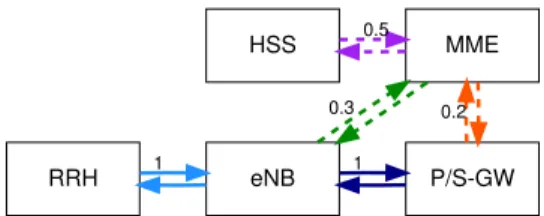
Fig. 1. Logical graph for vEPC. Solid lines correspond to user traffic, dashed lines to control traffic.
for the fact that traffic flows can trigger additional flows as they traverse VNFs. A typical example of a logical graph is the one implementing the virtual Evolved Packet Core (vEPC). Fig. 1 depicts user traffic captured by the Remote Radio Head (RRH), traversing the eNodeB (eNB) and going to the Packet/Service Gateway (P/S-GW). On its way, it generates additional traffic from the eNB to the Home Subscriber Server (HSS), through the Mobility Management Entity (MME). The result is that traditional flow conservation laws do not hold in 5G networks, as flows of different types get transformed into one another and then served individually.
On the positive side, the software-defined nature of 5G networks affords us a significant opportunity to make their management more effective; indeed, to literallyoptimizethem. Optimization is traditionally regarded as a useful technique to design networks, but of little use for their real-time manage-ment. In this paper, we depart from this vision and leverage the software-defined nature of 5G networks to make
opti-mizers interact with SDN controllers and NFV orchestrators
(NFVOs). These entities are indeed in a perfect position to swiftly implement real-time, high-quality decisions based on the outcome of optimization problems.
To achieve this goal, our paper provides the following main contributions:
• a modelaccounting for the complexity of both 5G net-works and the traffic they have to serve;
• aproblem formulationallowing us to make joint decisions on (i) B/F node activation, (ii) number and placement of the VNF instances we need, and (iii) traffic routing;
• asolution strategy, called OptiLoop, that uses optimiza-tionin the loopthus providing near-optimal decisions in real-time;
• an implementation of our solution in an
OpenDay-light/OpenStack testbed as well as in an emulated testbed. The remainder of this paper is organized as follows. We review related work in Sec. II. Next, we present our system model and problem formulation in Sec. III, and detail the OptiLoop solution strategy in Sec. IV. We then describe our testbeds’ architecture, reference scenario and benchmarks in
Sec. V, present numerical results in Sec. VI, and conclude the paper in Sec. VII.
II. RELATED WORK
Many works on VNF placement and traffic routing,
in-cluding [1]–[3], take the approach of matching VNF and
physical topology graphs, also proposing efficient solution strategies for the ensuing MILP problems. The optimization objectives are: minimizing network usage in [1], minimizing VNF deployment cost in [2], minimizing CAPEX and OPEX in [3]. The later work [4] takes an iterative approach, making VNF placement and routing decisions when a request arrives. [5] takes the VNF placement as given and focuses on schedul-ing and routschedul-ing.
Other works focus on the interaction between mobile op-erators and third parties using their services. As an example, [6] considers a market where operators bid to serve incoming demands. Among energy-aware works, [7] seeks to optimize VNF placement and job scheduling in order to minimize energy consumption. However, the algorithm presented in [7] optimizes the server utilization but neglects the energy con-sumed by network elements such as B/F nodes.
Among the services that can be provided through
SDN/NFV-based networks, a prominent example is the EPC. As suggested by the survey in [8], ILP and MILP are the most popular modeling tools, and heuristic algorithms the most popular solution strategy. A common theme [9]–[11] is splitting EPC elements, e.g., the Packet Gateway (P-GW) and Service Gateway (S-GW), into separate sub-elements, one dealing with control traffic and the other with user traffic. [12] finds that such an approach reduces the total cost of ownership. Interestingly, other works, e.g., [13], [14], take the opposite approach and merge P-GW and S-GW in a single entity (the P/S-GW). [13] focuses on the MME and proposes to implement it through four separate VNFs, whose number can vary so as to accommodate traffic fluctuations. Closer to our own effort is the recent work in [15], which studies the problem of placing the VNFs implementing the main EPC network functions – S-GW, P-GW and MME – across the available physical machines, subject to limits on their power and link capacity.
A. Novelty
Our approach is novel with respect to the above works in several important ways:
1) first and foremost, the scope of our work: we jointly account for (i) the number and placement of VNF instances, (ii) traffic routing, and (iii) network manage-ment, e.g., activating/deactivating B/F nodes and links; 2) at the modeling level: accounting for the complexity of
5G traffic, with requests that originate at a network end-point and traverse multiple VNFs, triggering additional requests as they do so (hence the quantity of traffic changes across processing steps);
3) as far as objectives are concerned: adopting energy-saving as our priority and using detailed and realistic energy models, instead of proxy metrics as in [7]; 4) from a solution strategy viewpoint: optimizing in the
loop, i.e., using optimization as a tool rather than a mere analysis technique;
5) at implementation level: validating and testing our ap-proach through a testbed based on OpenDaylight and OpenStack.
III. SYSTEM MODEL
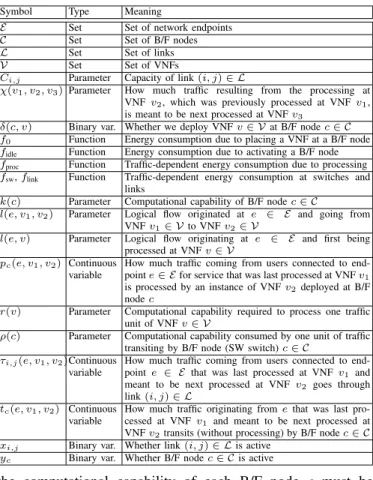
Our model is based on two graphs, a logical one and a physical one. For simplicity, we describe it with reference to unidirectional traffic; notice however that our model and our results also account for bidirectional traffic. Tab. I summarizes all the notation we introduce below.
A. The logical graph
The logical graph, exemplified in Fig. 1, describes where, i.e., which endpoint, the traffic comes from, and how it is processed. Its vertices are eitherendpointse∈ EorVNFsv∈
V. With reference to Fig. 1, we have E ={RRH}, and V =
{eNB,P/S-GW,MME,HSS}.
On the logical graph, we have logical flows l(e, v1, v2)
representing data originating from endpointeand going from VNFv1 to VNF v2. Additionally, with an abuse of notation,
we indicate with l(e, v) flows that start from endpointe and
are first processed at VNFv, e.g., from the RRH to the eNB
in Fig. 1. Note that keeping track of the endpoint at which flows originate, i.e., having aneindex in our variables, serves a manifold purpose. First, it allows our model to account for the fact that different types of traffic (i.e., originating from different endpoints) may need different processing, i.e., traverse different VNF graphs. Furthermore, such VNF graphs may overlap; in this case, keeping track of the origin of the flows makes it possible to distinguish them even if they traverse the same VNF. Finally, it allows routing each flow in a different way, in both the logical and the physical graph. Notice that different traffic flows coming from the same physical endpoint can be distinguished by associating them to differentlogical endpoints.
Another important aspect of the system is that there is no flow conservation in the logical graph. As an example, in
Fig. 1 we see a user flow of 1 traffic unit going from the
RRH to eNB and thence to the gateway, which triggers some additional control traffic from the eNB and the gateway to the MME. Indeed, the followinggeneralized flow conservation law holds for each endpointeand VNFsv2, v3:
l(e, v2, v3)=
X
v1∈V
l(e, v1, v2)χ(v1, v2, v3)+l(e, v2)χ(e, v2, v3).
The above expression represents the logical flow originated
at endpoint e, outgoing from VNF v2 and directed to
VNF v3. Such a quantity is equal to the sum between
RRH
eNB PGW
SGW
MME HSS
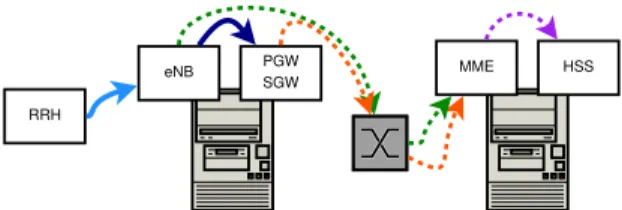
Fig. 2. Example implementation of the logical graph in Fig. 1 over a physical network. Each line corresponds to a physical flow, i.e., to aτ-variable; their color and style match the logical flows in Fig. 1.
endpoint e itself, multiplied by a factor χ. In
particu-lar, χ(v1, v2, v3) is used to quantify the amount of logical
flow directed to v3 that is generated when traffic
com-ing from v1 is processed at VNF v2. With reference to
the eNB in Fig. 1, we have χ(RRH,eNB,P/S-GW) = 1,
while χ(RRH,eNB,MME) = 0.3. Similarly, for the
gate-way, we have χ(eNB,P/S-GW,MME) = 0.2. At the MME
we have flow conservation, i.e., χ(eNB,MME,HSS) =
χ(P/S-GW,MME,HSS) = 1. In χ(e, v2, v3), we abuse the
notation and allow the first index of χ to be an endpoint
instead of a VNF. We remark thatχ-values lower than one can also represent, e.g., a firewall dropping some of the incoming traffic. Also notice thatχ-values different from one can happen for both control traffic (e.g., the eNB in Fig. 1) and user traffic (as in the case of the firewall).
B. The physical graph
In the physical graph, vertices correspond to the end-pointse∈ E and the B/F nodes c∈ C. In general, B/F nodes have computational capabilities k(c); B/F nodes that cannot host any VNF (e.g., switches) have k(c) = 0. Fig. 2 presents a possible implementation of the logical VNF graph in Fig. 1, where VNFs are placed on each of the two B/F nodes with processing capabilities. For simplicity, we present our model with reference to the case where multiple VNF instances can be deployed across different nodes, but at most one instance of each VNF can be deployed at each B/F node.
Physical links (i, j)∈ L ⊆(C ∪ E)2 have a capacity C
i,j, corresponding to the maximum amount of traffic that can go from B/F node i to B/F nodej. Traffic traversing link (i, j)
is also subject to a network delay Di,j.
Our main variable is represented by physical
flows τi,j(e, v1, v2), representing the amount of traffic
that was originated from endpointe, last visited VNFv1, will
next visit VNFv2, and is now traveling on link(i, j). Recall
that we have to keep track of the flow originating endopint, in order to model traffic routing. If the flow has never been processed, i.e., it is going from e∈ E to its first VNF v∈ V, we will conventionally setv1=v2=vand writeτi,j(e, v, v).
Given a B/F node c ∈ C, we denote by tc(e, v1, v2) the
amount of traffic that is just transiting by c (i.e., it is not processed atc) and it was originated ate, last visited VNFv1
and will next visit VNFv2. Similarly,pc(e, v1, v2)is the traffic
thatis processedat B/F nodec, it was originated ate, and last visited VNF v1. Note that pc(e, v1, v2) > 0 implies that an
instance of VNFv2 is deployed atc.
Traffic being processed at VNFvis subject to a delayD(v). Normally, processing delay is linked to the amount of re-sources (e.g., CPU) allocated to each VNF, and such an amount depends on the other VNFs deployed at the same B/F node. In our case, however, energy is the main metric of interest, and we can therefore assume that no VNF will be allocated more resources than the minimum amount required by the VNF itself.
A first constraint we need to impose is that, given a generic VNF v2, the traffic originated at e, that has been processed
through VNF v1 and is entering B/F node c, is either (i)
processed at an instance of v2 located inc, or (ii) transiting
by c while being routed toward an instance of v2. Thus, for
any c, e, v1, v2, we have:
X
(i,c)∈L
τi,c(e, v1, v2) =tc(e, v1, v2) +pc(e, v1, v2). (1)
A similar constraint concerns the traffic outgoing fromc. For any c, endpoint eand VNFsv2, v3, we have:
X (c,j)∈L τc,j(e, v2, v3)=tc(e, v2, v3)+ X v1∈V pc(e, v1, v2)χ(v1, v2, v3) (2) where v2 is the last VNF that traffic visited, either before
arriving at c (if traffic just transits by c) or at c itself (if v2
is deployed therein, i.e., pc(e, v1, v2) >0). v3 instead is the
VNF that traffic will visit next. In other words, (1)–(2) enforce ordinary flow conservation for the traffic that is transiting atc, i.e., usingc as a traditional switch, andgeneralizedflow conservation for the traffic that is processed atc.
Next, we need to ensure that we only use active B/F nodes and links, and their capacity is not exceeded. We define two sets of binary variables, xi,j andyc, indicating whether link(i, j)and B/F nodec are active or not.
For links, we need to impose:
xi,j≤min{yi, yj}, ∀(i, j)∈ L, (3) i.e., no link can be active if either of its ends is off, and
X
e∈E
X
v1,v2∈V
τi,j(e, v1, v2)≤xi,jCi,j, ∀(i, j)∈ L. (4)
With regard to processing, inactive B/F nodes cannot host
any VNF. We track this through a binary variable δ(c, v)
expressing whether an instance of VNFv is deployed at B/F
nodec, and impose:
δ(c, v)≤yc, ∀c∈ C, v∈ V. (5)
Additionally, no processing can be done for VNFs that are not deployed at a given B/F node:
pc(e, v1, v2)≤δ(c, v2)k(c), ∀c∈ C, e∈ E, v1, v2∈ V. (6)
Finally, each traffic unit processed by VNF v requires r(v)
computational capability, and, assumingcis a software switch, each unit of traffic switched bycconsumesρ(c)CPU. Clearly,
TABLE I NOTATION
Symbol Type Meaning
E Set Set of network endpoints
C Set Set of B/F nodes
L Set Set of links
V Set Set of VNFs
Ci,j Parameter Capacity of link(i, j)∈ L
χ(v1, v2, v3)Parameter How much traffic resulting from the processing at VNFv2, which was previously processed at VNFv1, is meant to be next processed at VNFv3
δ(c, v) Binary var. Whether we deploy VNFv∈ Vat B/F nodec∈ C
f0 Function Energy consumption due to placing a VNF at a B/F node
fidle Function Energy consumption due to activating a B/F node
fproc Function Traffic-dependent energy consumption due to processing
fsw,flink Function Traffic-dependent energy consumption at switches and
links
k(c) Parameter Computational capability of B/F nodec∈ C
l(e, v1, v2) Parameter Logical flow originated at e ∈ E and going from
VNFv1∈ Vto VNFv2∈ V
l(e, v) Parameter Logical flow originating at e ∈ E and first being
processed at VNFv∈ V
pc(e, v1, v2) Continuous variable
How much traffic coming from users connected to end-pointe∈ Efor service that was last processed at VNFv1 is processed by an instance of VNFv2deployed at B/F nodec
r(v) Parameter Computational capability required to process one traffic
unit of VNFv∈ V
ρ(c) Parameter Computational capability consumed by one unit of traffic
transiting by B/F node (SW switch)c∈ C
τi,j(e, v1, v2)Continuous variable
How much traffic coming from users connected to
end-pointe ∈ E that was last processed at VNFv1 and
meant to be next processed at VNF v2 goes through
link(i, j)∈ L
tc(e, v1, v2) Continuous variable
How much traffic originating fromethat was last
pro-cessed at VNF v1 and meant to be next processed at
VNFv2transits (without processing) by B/F nodec∈ C
xi,j Binary var. Whether link(i, j)∈ Lis active
yc Binary var. Whether B/F nodec∈ Cis active
the computational capability of each B/F node c must be
sufficient for both, i.e., for any B/F node c, X e∈E X v1∈V X v2∈V " r(v2)pc(e, v1, v2)+ +ρ(c) X (c,j)∈L τc,j(e, v1, v2) # ≤k(c), (7) whereρ(c)multiplies the total traffic outgoing from c.
Next, we ensure that the delay of the traffic originated at any endpoint edoes not exceed a thresholdDmax(e):
P i,j∈L P v1,v2∈VDi,jτi,j(e, v1, v2) P v∈Vl(e, v) + + P v1,v2∈V P c∈CD(v2)pc(e, v1, v2) P v∈Vl(e, v) ≤Dmax(e). (8) The two terms on the left hand side of (8) correspond to the network and processing delay, respectively.
At last, logical and physical flows have to match. To this end, it is sufficient to impose that, for each logical flowl(e, v)
going from endpoint e to VNF v, there are corresponding
physical flows of the type τe,j(e, v, v), such that: l(e, v) = X
(e,j)∈L
τe,j(e, v, v), ∀e∈ E, v∈ V. (9) Eq. (9) ensures that the traffic injected from endpoints to B/F nodes on the physical graph matches the logical traffic going
Initial solution fixProblems procedure saveEnergy procedure wait
traffic demand changes...
Fig. 3. The OptiLoop strategy. We begin by obtaining an initial feasible solution, as described in Sec. IV-A. After that, we periodically check the current solution for problems (procedurefixProblems, described in Alg. 1) and for opportunities to deactivate some B/F nodes and/or links (procedure
saveEnergy, described in Alg. 2).
from endpoints to VNFs. Thanks to the flow conservation con-straints (1)–(2), this also implies that such traffic is processed and transformed as dictated by theχ-parameters, i.e., that all physical flows match their logical counterpart.
C. Energy and objective
There are five contributions to the overall energy consump-tion we are interested in tracking:
• activating a B/F node, resulting in a consumption offidle;
• placing a VNF on a B/F node, resulting in a
consump-tionf0due to, e.g., virtual machines (VMs) or containers
overhead;
• using said VNF, resulting in a consumption of fproc
depending on the computational resources used;
• switching traffic at a B/F node, resulting in a consumption
of fsw depending on the traffic switched by the node;
• having traffic going through links, resulting in a
consump-tion offlink depending on the traffic over each link. The total energy consumption due to the above four com-ponents is as follows: Eidle=X c∈C fidle(yc) ; E0= X c∈C X v2∈V f0(δ(c, v2)) ; Eproc=X c∈C fproc X v2∈V r(v)X e∈E X v1∈V pc(e, v1, v2) ! ; Esw= X c∈C fsw X e∈E X v1,v2∈V τc,j(e, v1, v2) ; Elink = X (i,j)∈L flink X e∈E X v1,v2∈V τi,j(e, v1, v2) .
Given all this, our objective can be written as:
min
x,y E=E0+Eproc+Eidle+Esw+Elink. (10)
IV. THEOPTILOOP STRATEGY
The problem stated in Sec. III falls into the MILP category, and is thus impractical to solve in real time. We can however solve its relaxed version, where binary variables are allowed to take any value in [0,1]. Optimal solutions to the relaxed models cannot be directly used to manage (or plan) a network; however, they can provide useful guidelines.
Our basic idea of is to leverage the software-defined nature
of our network to make an optimizer interact with SDN
network management strategy. Our solution strategy is called OptiLoop (for Optimization in the Loop) and it includes the following steps, as outlined in Fig. 3:
1) we initialize the system with a feasible (albeit potentially suboptimal) solution, as detailed in Sec. IV-A;
2) after that, we periodically:
a) check that the network configuration is adequate to the current (and/or predicted) demand;
b) if not so, activate additional VNFs, B/F nodes, and/or links as needed;
c) check whether there are B/F nodes and/or links that can be deactivated in order to save energy; d) if so, update the current network configuration
accordingly.
Sec. IV-A explains how we obtain the initial solution, i.e., Item 1 above. Items (a)–(b) and (c)–(d) correspond to the
fixProblems and saveEnergy procedures respectively, which are described in Sec. IV-B and Sec. IV-C.
It is worth pointing out that the fixProblems and
saveEnergy procedures are designed to take no action if no action is warranted, and therefore there is no harm in
cascading them. As an example, fixProblems will never
take any action the first time it is executed after an initial solution is generated, as that solution is guaranteed to be feasible. Similarly,saveEnergyis unlikely to find elements
to deactivate if fixProblemsjust had to activate some.
A. Initial solution
The initial solution used to initialize OptiLoop has to be feasible, but does not have to be optimal. It can come from one of the heuristics we reviewed in Sec. II, or it can be obtained by solving a version of our problem where:
1) all B/F nodes and links are active, i.e., yc = 1,∀c∈ C
andxi,j= 1,∀(i, j)∈ L;
2) there is an instance of all VNFs deployed at each B/F node, i.e.,δ(c, v) = 1,∀c∈ C, v∈ V.
The resulting solution will be highly suboptimal, as we are likely to needlessly activate B/F nodes and/or links and to place useless VNF instances, all of which increase the power consumption. On the plus side, the problem is LP, as all binary variables are fixed; furthermore, the following property holds. Property 1: If a problem instance is feasible, then there is at least one feasible solution where the x, y and δ variables are all set to 1.
Please refer to [16] for the proof.
In other words, setting all binary variables to one is an easy way to obtain a feasible solution to our problem to start with. This solution can be vastly improved, as discussed next.
B. ThefixProblemsprocedure
The high-level goal of thefixProblemsprocedure is to
check whether the current network configuration can cope with the current (and projected) traffic demand. If this is not the case, then we take one or more of the following actions: (i) activating additional B/F nodes; (ii) activating additional links; (iii) deploying additional VNF instances.
Algorithm 1 ThefixProblemsprocedure.
Require: Scurr
1: P ←newproblem()
2: P.fix(xi,j ←xcurri,j, ∀(i, j)∈ L)
3: P.fix(yc←ycurrc , ∀c∈ C)
4: P.fix(δ(c, v)←δcurr(c, v), ∀c∈ C, v∈ V) 5: solve(P)
6: if P.is feasiblethen
7: return
8: if (4)∈ P.IIS then
9: P.relax(xi,j:xcurri,j = 0) 10: P.relax(yc:ycurrc = 0) 11: x,˜ y˜←solve(P)
12: (i?, j?)←choosefrom Lwith prob. xi,j˜
13: P.fix(xi?,j? ←1) 14: P.fix(yi ←1;yj ←1) 15: gotoLine 5 16: if (7)∈ P.IIS then 17: P.relax(y(c) :ycurr(c) = 0) 18: P.relax(δ(c, v) :δcurr(c, v) = 0) 19: ˜δ←solve(P)
20: c?, v?←choose fromC × V with prob.δ˜(c, v)
21: P.fix(y(c?)←1) 22: P.fix(δ(c?, v?)←1)
23: gotoLine 5
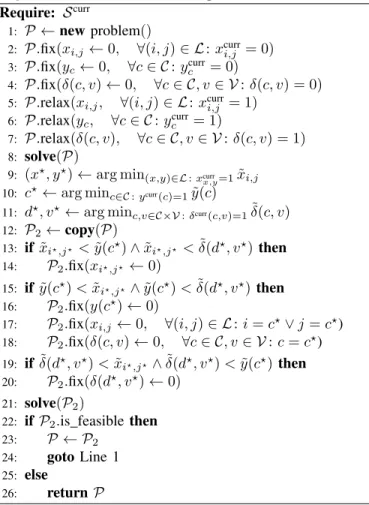
Specifically, as detailed in Alg. 1, we take as an input the current solution Scurr. We then proceed, in Line 1–Line 4,
to create a new instanceP of the problem, where all binary
variables are fixed to their values in Scurr. In Line 5, we solve such a problem: if it is feasible, then no action is required and the algorithm exits (Line 7). Otherwise, we look at why the problem is unfeasible, by inspecting itsirreducible inconsistent subsystem(IIS), i.e., the subset of constraints such that removing any of them would make the problem feasible. This set allows us to discriminate between the different reasons that can make the network unable to operate properly (hence, the problem unfeasible).
If constraint (4) (mandating that no link is used for more than its capacity) is in the IIS, then we need to activate some more links and/or B/F nodes. To decide which ones, we relax all x- and y-variables related to B/F nodes and links that
were inactive in Scurr (Line 9–Line 10) and solve the new
problem (Line 11). We then choose one link to activate, with a probability proportional to its relaxedxi,j˜ value, and fix to 1
the corresponding x-value and the y-values of its endpoints
(Line 12–Line 14). We then go back to Line 5 and test the new solution (Line 15). If it is still infeasible, we will activate further network elements until feasibility is achieved.
We proceed in a similar way if constraint (7) is in the IIS, i.e., if we have a computational capability issue. We relax variablesyandδ, allowing for more B/F nodes to be activated and VNFs to be deployed if needed, and solve the new problem
have to decide which VNF to place and where. We do so by
selecting a B/F node c? and a VNF v? at random, with a
probability proportional to the relaxed values δ˜(c, v), and fix
the corresponding y and δ-variable to 1 (Line 20–Line 22).
Finally, we go back to testing the new solution (Line 23). Note that all problems we solve in Alg. 1 are LP: in Line 5, Line 11 and Line 19 all binary variables are either fixed or relaxed. Such problems can be therefore solved in polynomial
time (embedded[17] optimization on low-power hardware is
now commonplace in several application domains).
C. ThesaveEnergy procedure
We can think of thesaveEnergyprocedure as the dual of
fixProblems. Our aim is to identify B/F nodes and/or links that can be deactivated, as well as VNF instances that can be removed from the B/F nodes they run into. The objective is to reduce our power consumption without impairing our ability to serve the traffic, i.e., without making the problem infeasible.
As in the fixProblems procedure, we solve a sequence
of LP problems with fixed or relaxed variables, obtaining guidance on the decisions we should make and their effects.
In Alg. 2, we take the current solutionScurras an input. We
then create an instance P of the problem where the binary
variables that in the current solution have value 0 are fixed to 0 (Line 2–Line 4), and those that have currently value 1 are relaxed (Line 5–Line 7). This is because we are not looking for new nodes/links to activate, but for elements to deactivate.
We do so by solving the problem instance P (Line 8); note
that all binary variables therein are fixed or relaxed, so the problem is LP.
In Line 9–Line 11 we identify the link, B/F node, and pair of B/F node and VNF that are active in the current solution and have the lowest value of the associated relaxed variable (respectivelyxi,j,˜ y˜(c), and˜δ(c, v)). Intuitively, these are the elements that most likely can be deactivated without impairing network functionality. We check this by creating a copy of problem instanceP and fixing to0the binary variable associated to the element with the lowest value of the relaxed variables (Line 12–Line 20). If that element is a B/F node, we also need to deactivate the links using it and the VNF instances it hosts (Line 17–Line 18).
The difference between P and P2 is that exactly one
element that was active in P is deactivated in P2, hence P2
is also LP. In Line 21, we solveP2and check if it is feasible.
If that is the case, then we use P2 as our new solution, and
try to further enhance it (Line 23–Line 24). Otherwise, the algorithm returns P, the last feasible solution we tried.
In summary, Alg. 2 deactivates zero or more elements, i.e., B/F nodes, links, or VNF instances. The element to deactivate is chosen based on the value taken by the corresponding relaxed variable, and after each change we check that the resulting configuration can serve its load, i.e., the problem instance is feasible.
V. TESTBEDS,SCENARIO AND BENCHMARKS
We validate and evaluate OptiLoop through two testbeds. We study the interaction between OptiLoop, the SDN
con-Algorithm 2 ThesaveEnergyprocedure.
Require: Scurr
1: P ←newproblem()
2: P.fix(xi,j ←0, ∀(i, j)∈ L:xcurri,j = 0)
3: P.fix(yc←0, ∀c∈ C:yccurr= 0)
4: P.fix(δ(c, v)←0, ∀c∈ C, v∈ V:δ(c, v) = 0) 5: P.relax(xi,j, ∀(i, j)∈ L:xcurri,j = 1)
6: P.relax(yc, ∀c∈ C:ycurrc = 1) 7: P.relax(δ(c, v), ∀c∈ C, v∈ V:δ(c, v) = 1) 8: solve(P) 9: (x?, y?)←arg min (x,y)∈L:xcurr x,y=1xi,j˜
10: c?←arg minc∈C:ycurr(c)=1y˜(c)
11: d?, v?←arg minc,v∈C×V:δcurr(c,v)=1δ˜(c, v)
12: P2←copy(P) 13: if x˜i?,j? <y˜(c?)∧x˜i?,j? <δ˜(d?, v?)then 14: P2.fix(xi?,j? ←0) 15: if y˜(c?)<xi˜?,j?∧y˜(c?)<δ˜(d?, v?)then 16: P2.fix(y(c?)←0) 17: P2.fix(xi,j←0, ∀(i, j)∈ L:i=c?∨j=c?) 18: P2.fix(δ(c, v)←0, ∀c∈ C, v∈ V:c=c?) 19: if ˜δ(d?, v?)<xi˜ ?,j?∧δ˜(d?, v?)<y˜(c?)then 20: P2.fix(δ(d?, v?)←0) 21: solve(P2)
22: if P2.is feasiblethen
23: P ← P2
24: gotoLine 1
25: else
26: returnP
troller, and the NFVO in a small-scale testbed with real hard-ware, described in Sec. V-A. For our performance evaluation we instead use a larger, emulated testbed based on the real-world topology of a mobile operator, as detailed in Sec. V-B. A. OpenDaylight/OpenStack testbed
The architecture of our testbed is summarized in Fig. 4(left). OpenDaylight (Beryllium version) and OpenStack (Mitaka version) are used to control a network made of three Lagopus
Fig. 4. Architecture of our testbeds: real hardware (left) and emulated (right). In both testbeds, OptiLoop is implemented as standalone application. In the real testbed, it controls a network composed of three software switches running Lagopus and three B/F nodesn1. . . n3. In the emulated testbed, it controls a
software switches (with DPDK support enabled for faster switching) and three physical servers. The OpenDaylight SDN controller configures the data plane, by activating/deactivating links and switches via SNMP protocol and configuring the forwarding rules via OpenFlow 1.3 protocol. A custom-built NFVO – integrated with the VNFM (VNF manager) and VIM (Virtual Interface Manager) OpenStack modules – manages the VMs that run the VNFs. We adopt the OpenAirInterface [14] vEPC implementation, including the four VNFs in Fig. 1.
OptiLoop is implemented as a standalone application, writ-ten in Java and including two main components, devoted to monitoring and decision-making. OptiLoop interacts with both OpenDaylight and the NFVO through their REST APIs, gathering up-to-date information on the status of switches, links, physical servers and VNFs. When a decision is made, it communicates it to OpenDaylight (if the decision concerns link activation/deactivation) or the NFVO (if the decision concerns VNF deployment or server activation/deactivation). The decision-making component essentially implements Alg. 1 and Alg. 2, using the Gurobi solver for optimization. Since Gurobi features Java bindings, using it within the OptiLoop application is as simple as importing a library.
B. Emulated testbed
Our performance evaluation is carried out through an emu-lated testbed based on Mininet, the de factostandard solution to study SDN-based networks. Its architecture is summarized in Fig. 4(right): similarly to the previous case, OptiLoop interacts with the OpenDaylight controller for network man-agement, and directly with Mininet via its Python API to turn servers and switches on and off. Notice that the actual VNFs arenotimplemented in Mininet; the traffic they serve is
emulated viaiperfand the energy consumption is estimated
via realistic models, as detailed in Sec. V-B2.
The switches and servers emulated by Mininet reproduce the real-world topology of a major mobile operator, as detailed in Sec. V-B1. Links and servers are implemented through theTCLinkandCPULimitedHostMininet classes, which allow us to assign them bandwidth, delay and computational capability matching those of their real-world counterparts. All
iperf-generated traffic is based on the real-world traffic figures we have access to.
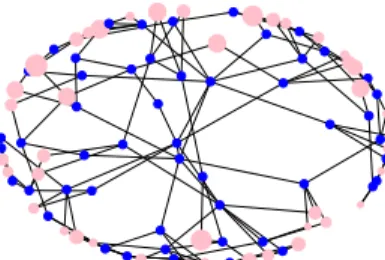
1) Network topology and traffic: Our reference topology, displayed in Fig. 5, represents the real-world topology of a major mobile network operator. It includes 42 endpoints and 51 B/F nodes, with each endpoint connected to exactly two B/F nodes. A total of 1,497 antennas are connected to the endpoints. Accounting for the expected future traffic growth [18], we have an aggregate traffic varying between
74 Mbit/sand473 Mbit/sper endpoint, with a 82:18 down-link/uplink proportion. The dataset we use only represents a snapshot of the network conditions, i.e., traffic demand does not change over time.
Based on the real-world vEPC implementation [14] we consider a total of four VNFs, namely eNB, MME, HSS, and a gateway implementing both the P-GW and S-GW functions.
Fig. 5. Reference topology. Blue dots indicate B/F nodes, pink ones indicate endpoints. The size of pink dots is proportional to the traffic they generate. Notice that in [14] no VNF is split into user- and control-plane sub-entities. We set ourχ-values, expressing how traffic gets transformed as it travels between VNFs, leveraging the anal-ysis in [10]; in particular, the fraction of control traffic going to the MME is given byχ(eNB,P/S-GW,MME) = 0.32.
Still based on [10], we set the link bandwidth Ci,j to
10 Gbit/sfor endpoint-to-node links and100 Gbit/sfor node-to-node ones. Based on [10] and [19], we assume that each B/F node can process100 Gbitof traffic every second. Since our scenario is constrained by B/F node and link capacity, we ignore network and processing delays.
2) Power consumption figures: Idle power is the power
consumed by any active B/N node, no matter how much it is used; in our model, it is indicated asfidle. Based on [20], we set that power to65 W. Upon deploying a VNF at a B/F node, we might expect to incur anallocation energycost due to, for example, the overhead of the VM or container. However, the measurements [20] show that such overhead is negligible, i.e., we can setf0= 0.
Assuming a software switch running Lagopus,
switch-ing40 Gbit/s fully utilizes an Intel Xeon E5-2680 processor
[19], which has a 130 W thermal design power. This gives
us a figure of fsw(c) = 3.25 nJ/bit·Pe,v1,v2tc(e, v1, v2). flink, instead, can be neglected [20]. Using the computational capability figures from [10] and assuming a high-end, 32-core processor, we setfproc(c) = 48 nJ/bit·Pe,v1,v2pc(e, v1, v2). It is worth stressing that all these energy consumption figures are subject to rapid change as technology evolves, and that they represent only an input to our problem.
3) Benchmark solutions: We compare OptiLoop with two
alternatives: what is done in current real-world systems, i.e., keeping all network elements active regardless of traffic con-ditions, and state-of-the-art approaches from the literature.
Among the VNF placement schemes reviewed in Sec. II, we select the popular approach ofconsolidation(used, e.g., in [7]) as our benchmark. The consolidation procedure consists of three-stage decision process. For every flow, it first looks for an already-deployed VNF to serve the flow; if none can be found, it deploys a new instance of the VNF at an already active B/F node. If no suitable node is found, it activates a new one. Also, the procedure activates any additional B/F nodes needed to ensure connectivity between endpoints and the serving B/F nodes.
VI. RESULTS
We start this section by summarizing our validation results from the OpenDaylight/OpenStack testbed, in Sec. VI-A.
0.5 1.0 1.5 2.0 2.5 3.0 Traffic multiplier 0 10 20 30 40 E n e rg y s a v in g s [ % ] Consolidation OptiLoop Optimal 0.5 1.0 1.5 2.0 2.5 3.0 Traffic multiplier 0 1000 2000 3000 4000 U n u s e d C C A T [ G B y te /s ] Consolidation OptiLoop Optimal 0.5 1.0 1.5 2.0 2.5 3.0 Traffic multiplier 0 1 2 3 4 5 6 7 A v e ra g e d a ta p a th [ h o p s ] Consolidation OptiLoop Optimal
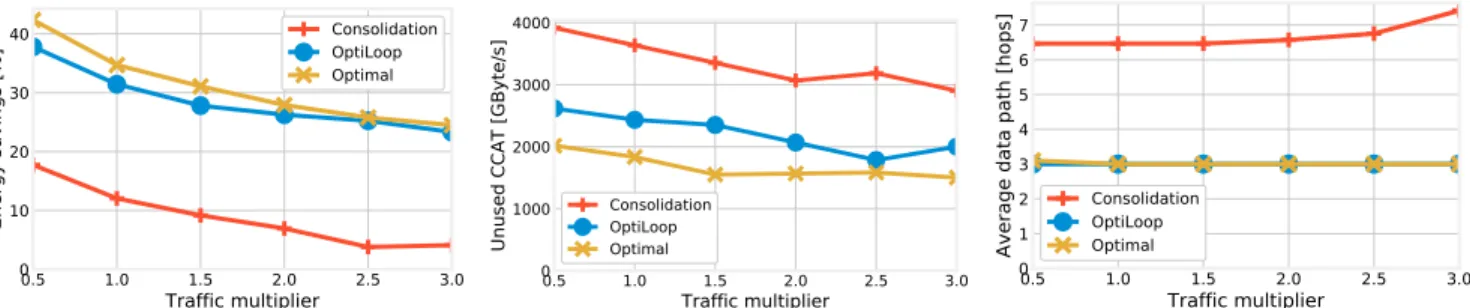
Fig. 6. Energy savings obtained as a function of traffic (left); spare computational capabilities of the active topology (CCAT) (center); number of hops traveled by requests (right). Cons. OL Opt. Cons. OL Opt. Cons. OL Opt. Traffic multiplier 0 20 40 60 80 100 120 140 P o w e r c o n s u m p ti o n [ M J] 1 2 3 Processing Networking Idle
Fig. 7. Breakdown of energy consumption for the consolidation-based (“Cons.”), OptiLoop (“OL”), and optimal (“Opt.”) strategies.
We then present, in Sec. VI-B, a performance evaluation of OptiLoop carried out by emulating a real-world topology in Mininet, as described in Sec. V-B.
A. Validation results
Our validation has a twofold purpose. The first is to ensure that the interaction between OptiLoop, OpenStack and Open-Daylight – both information retrieval and decision enacting
– works as intended. The second is measuring the delay
resulting from OptiLoop’s decisions. As we can see from Tab. VI-B, the delays of powering on/off servers and switches and activating/deactivating links are quite low. Conversely, instantiating a new VNF can require over a minute, mainly due to the time it takes to start a new VM.
It is however interesting to note that the time to instantiate the full service, i.e., all four VNFs, is only slightly higher than the time to instantiate one VNF, as the NFVO can handle multiple VNFs in parallel. This suggests that our system can scale to complex services requiring many VNFs. Also, the delays in Tab. VI-B suggest that containers could represent an attractive alternative to VMs, due to their shorter setup times. B. Emulation-based performance evaluation
The first answer we seek from the performance evaluation carried out through the emulated testbed concerns the mag-nitude of possible energy savings. In Fig. 6(left), we vary the traffic demand between 0.5 and 3 times the real-world amount, and study how much energy we can save compared to what is done today, i.e., leaving all B/F nodes and links active. We can observe that OptiLoop yields dramatic savings, consistently very close to the optimum, while consolidation
TABLE II
DRIVING REAL HARDWARE:INCURRED DELAYS[S]
Component Maximum Minimum Average
Server power on 0.021 0.010 0.016
Switch power on 0.039 0.019 0.026
Link activation 4.246 3.556 3.786
VNF instantiation 60.442 40.222 54.559
Service instantiation 82.066 62.356 64.710
does not perform as well. An intuitive reason is that OptiLoop accounts for all the three main contributions to energy con-sumption (processing, idle power, and networking), while the consolidation-based approach focuses on keeping the number of active B/F nodes low.
Fig. 6(center) shows the spare computational capability of the active topology (CCAT); intuitively, this is a measure of how much power is being wasted, i.e., how inefficient the network management strategy is. The consolidation algorithm has the highest spare CCAT, because of the higher number of B/F nodes that have to be activated in order to guarantee con-nectivity. The spare CCAT yielded by OptiLoop is much lower, and very close to the optimum. It is interesting to remark that even the optimum leaves substantial spare CCAT. This is due to the fact that some B/F nodes have to be active in order to keep the topology connected, even if they do not have to host any VNF. Fig. 6(right) depicts how many hops data travels across the network. OptiLoop again matches the optimum, while the consolidation strategy results in substantially longer paths, due to the fact that VNF placement decisions are made without accounting for connectivity.
Fig. 7 breaks the total energy consumption into its main components, namely, processing, networking, and idle power. Note that these components have comparable magnitude, i.e., none of them dominates the overall consumption. It follows that network management strategies have to account for them all. We can also see that the processing component never changes across strategies, since the amount of traffic to process is always the same. The difference between the strategies lies mostly in the networking component (longer paths in Fig. 6(right) correspond to higher consumption) and, to a lesser extent, in the idle energy. In other words, it is important to place VNFs close to the traffic they have to serve, while at the same time activating as few B/F nodes as possible.
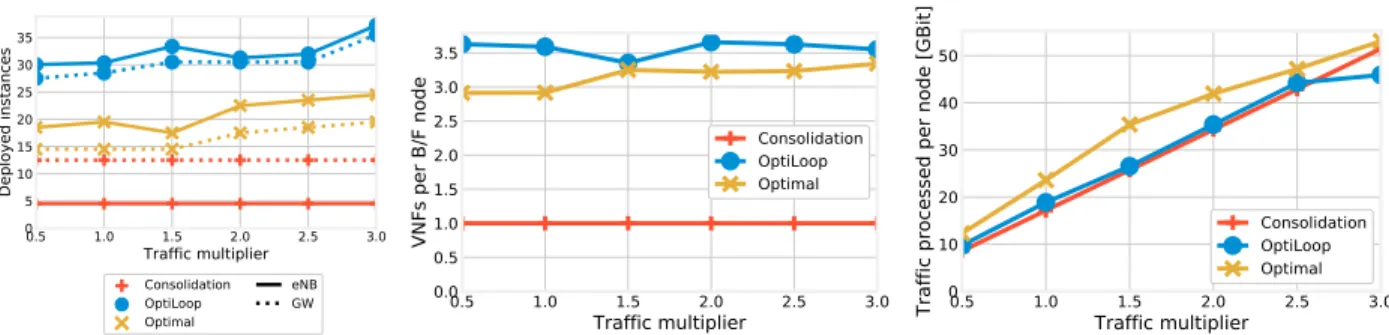
Fig. 8(left) and Fig. 8(center) show that placing VNFs
close to the traffic they serve also means placing many of
0.5 1.0 1.5 2.0 2.5 3.0 Traffic multiplier 0 5 10 15 20 25 30 35 D e p lo y e d i n s ta n c e s Consolidation OptiLoop Optimal eNB GW 0.5 1.0 1.5 2.0 2.5 3.0 Traffic multiplier 0.0 0.5 1.0 1.5 2.0 2.5 3.0 3.5 V N F s p e r B /F n o d e Consolidation OptiLoop Optimal 0.5 1.0 1.5 2.0 2.5 3.0 Traffic multiplier 0 10 20 30 40 50 T ra ff ic p ro c e s s e d p e r n o d e [ G B it ] Consolidation OptiLoop Optimal
Fig. 8. Number of deployed instances for the eNB and P/S-GW VNFs (left); average number of VNFs deployed in each B/F node (center); average traffic processed at each B/F node (right).
only the strictly required number of elements, and it is a direct consequence of the features of modern, software-based networks. As discussed in Sec. V-B2, there is little or no penalty for placing an underutilized VNF instance on an already active B/F node, while there is a significant energy cost for transferring even modest amounts of data between B/F nodes. Indeed, we can say that OptiLoop outperforms state-of-the-art alternativesbecauseit properly accounts for the unique features of 5G, thus being more aggressive in deploying VNFs. Comparing Fig. 8(left) to Fig. 8(center), we can see that OptiLoop deploys more VNFs than the optimum, but the number of VNFs per B/F node is similar. This is because OptiLoop activates slightly more B/F nodes than the optimum, as confirmed by Fig. 8(right) showing that the average amount of traffic processed per B/F node is slightly lower in OptiLoop.
VII. CONCLUSIONS
We considered 5G networks where nodes may have both networking and computation capabilities. We addressed the problem of the energy-efficient management of such networks, requiring to decide (i) which B/F nodes and links to activate, (ii) how many instances to deploy for each VNF, and how to place them across the active B/F nodes, and (iii) how to route traffic between them. We proposed an optimization model accounting for the unique features of 5G traffic, and used it to formulate OptiLoop: a real-time, efficient network management strategy based on repeatedly solving relaxed optimization problems.
We validated OptiLoop through a testbed including the OpenDaylight SDN controller and the OpenStack virtualiza-tion infrastructure. We then evaluated its performance through network emulation, with both the network topology and the traffic demand coming from a real-world dataset provided by a major network operator. We found that OptiLoop outperforms state-of-the-art alternatives and performs very close to the optimum, mainly thanks to its ability to account for all the main sources of energy consumption that characterize 5G systems.
ACKNOWLEDGEMENT
This work was supported by the EU project “5G- Crosshaul: The 5G Integrated fronthaul/backhaul” (grant no. 671598) within the H2020 programme.
REFERENCES
[1] N. Gazit, F. Malandrino, and D. Hay, “Coopetition between network operators and content providers in SDN/NFV core networks,” inIEEE INFOCOM SWFAN Workshop, 2016.
[2] R. Cohen, L. Lewin-Eytan, J. S. Naor, and D. Raz, “Near optimal placement of virtual network functions,” inIEEE INFOCOM, 2015. [3] L. Wang, Z. Lu, X. Wen, R. Knopp, and R. Gupta, “Joint Optimization
of Service Function Chaining and Resource Allocation in Network Function Virtualization,”IEEE Access, 2016.
[4] T.-W. Kuo, B.-H. Liou, K. C.-J. Lin, and M.-J. Tsai, “Deploying chains of virtual network functions: On the relation between link and server usage,” inIEEE INFOCOM, 2016.
[5] L. Qu, C. Assi, and K. Shaban, “Delay-aware scheduling and resource optimization with network function virtualization,” IEEE Trans. on Communications, 2016.
[6] X. Zhang, Z. Huang, C. Wu, Z. Li, and F. C. Lau, “An Online Stochastic Buy-Sell Mechanism for VNF chains in the NFV market,”IEEE Journal on Selected Areas in Communications, 2017.
[7] N. El Khoury, S. Ayoubi, and C. Assi, “Energy-Aware Placement and Scheduling of Network Traffic Flows with Deadlines on Virtual Network Functions,” inIEEE CloudNet, 2016.
[8] V. G. Nguyen, A. Brunstrom, K. J. Grinnemo, and J. Taheri, “SDN/NFV-based Mobile Packet Core Network Architectures: A Survey,” IEEE Communications Surveys Tutorials, 2017.
[9] A. Baumgartner, V. S. Reddy, and T. Bauschert, “Mobile core network virtualization: A model for combined virtual core network function placement and topology optimization,” inIEEE NetSoft, 2015. [10] G. Hasegawa and M. Murata, “Joint Bearer Aggregation and
Control-Data Plane Separation in LTE EPC for Increasing M2M Communication Capacity,” inIEEE GLOBECOM, 2015.
[11] S. Khairi, M. Bellafkih, and B. Raouyane, “QoS management SDN-based for LTE/EPC with QoE evaluation: IMS use case,” inSDS, 2017. [12] X. An, W. Kiess, J. Varga, J. Prade, H.-J. Morper, and K. Hoffmann, “SDN-based vs. software-only EPC gateways: A cost analysis,” inIEEE NetSoft, 2016.
[13] J. Prados-Garzon, J. J. Ramos-Munoz, P. Ameigeiras, P. Andres-Maldonado, and J. M. Lopez-Soler, “Modeling and Dimensioning of a Virtualized MME for 5G Mobile Networks,” IEEE Trans. on Veh. Tech., 2017.
[14] OpenAirInterface: 5G software alliance for democratising wireless in-novation. http://www.openairinterface.org.
[15] D. Dietrich, C. Papagianni, P. Papadimitriou, and J. S. Baras, “Network function placement on virtualized cellular cores,” inCOMSNETS, 2017. [16] Proof. https://1drv.ms/b/s!AlVUQf67dIbfabNZ3elEmtkVlXg.
[17] J. Mattingley and S. Boyd, “Cvxgen: A code generator for embedded convex optimization,”Optimization and Engineering, 2012.
[18] Cisco, “Cisco Visual Networking Index,” 2017.
[19] Lagopus Project. It’s kind of fun to do the
impos-sible with DPDK. https://www.slideshare.net/lagopus/
dpdk-summit-2015-its-kind-of-fun-to-do-the-impossible-with-dpdk. [20] S. S. Tadesse, C. E. Casetti, C.-F. Chiasserini, and G. Landi,
“Energy-efficient Traffic Allocation in SDN-based Backhaul Networks: Theory and Implementation,” inIEEE CCNC, 2017.