Potential Hazard Task Environment
How might harm occur? Who might be harmed? Control Measures
Spread of COVID-19 as a consequence of: • Retail areas • Back of house operations
•
Use of colleague facilitiesInhalation of airborne viral particles through proximity to someone with COVID-19 symptoms
Not maintaining sufficient social distancing. • Colleagues • Vulnerable groups including: o Pregnant workers o Colleagues with underlying health issues
Coronavirus notices are displayed prominently in colleague rooms detailing the symptoms and the action to take if any colleague suspects that they have COVID-19 or that they live in the same household with someone who is confirmed as having COVID-19.
Colleague showing symptoms of COVID-19
If a colleague becomes unwell with a new continuous cough or a high temperature or have a loss of, or change to, their sense of smell or taste, they are instructed to stay at home or, if in work, sent home and told to order a test and self-isolate for 10 days. They are to follow the “stay at home”
government guidance (guidancedisplayed in the colleague room or sent via email on request). The General Manager or
Line Manager will maintain regular contact with the colleague during this time.
Summary
The safety of our colleagues and customers remain our main priority and continues to be the primary consideration when making any changes to our retail or restaurant environments. Feedback has been sought from colleagues working in our garden centres whenever control measures have been introduced or where changes are made to our Health and Safety Policy and procedures.
This risk assessment identifies the hazards, risks and control measures associated with COVID-19 for colleagues working in our Garden Centres and supports the procedures detailed in our retail and restaurant guidance documents.
The risk assessment is written following consideration of guidance issued by the government and the Chief Medical Officer and has been compiled to ensure, so far as is reasonably practicable, the significant risks associated with our Garden Centre operations have been considered and suitable and sufficient control measures implemented.
The risk assessment will be reviewed on a regular basis, particularly following revised guidance issued by government or where existing procedures or control measures require further refinement.
Social distancing measures (vulnerable groups)
Any colleague with underlying health issues likely to make them more susceptible to severe consequences of contracting COVID-19 are encouraged to speak to their General Manager or Line Manager.
Those colleagues notified by their GP as being extremely vulnerable and therefore at particularly high risk must advise their General Manager or Line Manager that they must self-isolate.
Social distancing measures (colleagues)
Covid-19 secure guidance documents and information videos provides for the maintenance of social distancing between colleagues including arranging colleague rooms and welfare facilities to maintain social distancing. Where this is not possible, such as when colleagues are carrying out manual handling tasks, work patterns will be organised to ensure that social distancing guidelines can be followed for example limiting the amount of time working together.
Colleagues in indoor customer facing areas wear face coverings including alongside other mitigation such as Perspex screens to separate cashiers from customers. Colleagues working in outdoor areas or back areas (planteria, open covered areas, kitchen) can wear face
shields/visors.
Measures have been put in place in the offices and storerooms in the garden centres and at the support centre to ensure that social distancing may be maintained. The number of colleagues working in the offices at any one time is restricted. Meeting and training rooms have been made available for administration tasks or additional colleague rest room.
Layout changes have been made in the colleague room to allow for social distancing to be adhered to. Break times are staggered to maintain low numbers of colleagues using these areas at any one time.
Spread of COVID-19 as a consequence of:
• Sales floor
• Back of house
operations
Inhalation of airborne viral particles through proximity to someone with COVID-19 symptoms
• Colleagues
• Vulnerable groups including:
o Pregnant workers
Social distancing measures (customers)
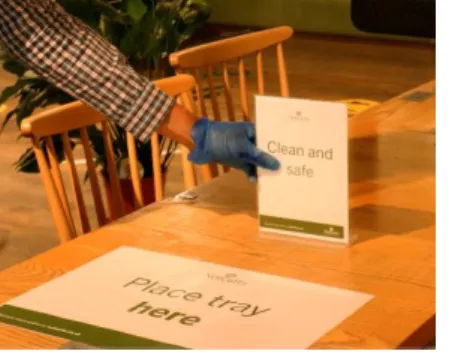
Advice about the measures that have been adopted to encourage social distancing whilst shopping in retail areas or dining in the restaurant are displayed using prominent public notices. (Examples shown below)
•
Use of colleague facilitiesNot maintaining sufficient social distancing. o Colleagues with underlying health issues • Customers
So far as is reasonably practicable, to maintain social distancing between customers, access to the garden centre will be through a queue line system monitoring by a Queue Marshal during busy trading times.
The queue line system is set-up outside the main garden centre entrance where customers are required to queue, during busy training times, to gain access. Floor markings are used to help customers determine the appropriate social distance. Barriers or fixtures are used to manage customer flow.
Separate garden centre entrances and exits are in place to prevent people crossing-over.
During busy training times the General Manager or Duty Manager will ensure that there is a colleague delegated as the Queue Marshal and additional colleagues (social distancing champions)available. Their role will be to monitor all aspects of COVID-19 controls including:
• Store occupancy numbers
• External queuing controls
• Maintenance of hand-sanitiser stations
• Checking customer toilets
• Maintenance of cleaning regime to the equipment and contact surfaces identified as being subject to frequent contact (see touch-point checklist)
Reasonable adjustments will be made to accommodate the needs of disabled customers whilst also giving consideration to the control measures required to mitigate against the spread of COVID-19.
Subject to the garden centre size and internal arrangements, customer flow has been
organised to maintain social distancing through the use of posters and floor signage displayed throughout the customer journey and in prominent locations.
Particular attention has been paid to controls to maintain social distancing at pinch-point locations in the garden centre where customers are likely to gather e.g. book department, gift department, checkouts.
Colleagues serving customers have been instructed on how to do this safely whilst adhering to the social distancing requirements. The plant advice centres are closed to customers.
Spread of COVID-19 as a consequence of:
• Sales floor
operations
Inhalation of airborne viral particles through proximity to someone with COVID-19 symptoms
Not maintaining sufficient social distancing. • Colleagues • Vulnerable groups including: o Pregnant workers o Colleagues with underlying health issues • Customers
There are no one way systems in operation but main pathways are kept clear to allow for social distancing.
The use of floor decals and signage is used throughout retail areas to provide guidance to customers to encourage social distancing in areas where queuing is likely, notably at checkouts and the entrance to the restaurant.
To maximise the opportunity for customers to navigate the garden centre, stock replenishment tasks are carried out outside trading hours wherever possible. If replenishment tasks are to take place during trading hours then the number of stock trolleys (Danish trolley, roll cages) and colleagues carrying out the task will be kept to a minimum.
Safety arrangements where social distancing might be compromised
Bio screens have been installed at checkouts to provide physical separation between colleagues and the customers being served.
To further support the safety of colleagues and customers, changes to normal customer service procedures have been introduced, namely:
• A queue line system is in place in the lead up to the checkouts. Managed, during busy trading times by a Queue Marshal, directing customers to available checkouts.
• Card payments will be encouraged in preference to cash transactions.
• To further reduce colleagues /customer interactions customers will be required to leave their trolley in a designated area next to the checkout counter and stand back whilst the cashier scans the customer’s purchases.
Explanatory notices are displayed in prominent locations to advise customers of the payment arrangements.
Spread of COVID-19 as a consequence of:
• Food and Beverage
operations
• Use of colleague
facilities
Inhalation of airborne viral particles through proximity to someone with COVID-19 symptoms
Not maintaining sufficient social distancing. • Colleagues • Vulnerable groups including: o Pregnant workers o Colleagues with underlying health issues
Restaurant and kitchen
To maintain social distancing customer access to the restaurant will be through a queue line system subject to ongoing monitoring by a Queue Marshal. Floor markings are used to help customers in determining the appropriate social distance.
Customers
Subject to the restaurant size and internal arrangements, customer flow has been organised to maintain social distancing through the use of posters and floor signage.
Particular attention is given to the controls to maintain social distancing at pinch-point locations in the restaurants.
NB Reasonable adjustments will be made to accommodate the needs of disabled customers whilst also giving consideration to the control measures required to mitigate against the spread of COVID-19.
Signage is displayed throughout the restaurant facility reminding customers of social distancing and hygiene. Posters are also displayed advising on groups of people that can be seated together as provided by current government guidance. Regional lockdown adjustments to restaurant service and seating arrangements are implemented as required.
To minimise transmission of the virus there is no self-service at the servery. The servery has bio screens and Perspex screens in place. Card payments will be encouraged in preference to cash transactions. Explanatory notices will be displayed in prominent locations to advise customers of the payment arrangements.
Table lay-outs have been re-designed to ensure social distancing is maintained. Dining tables, chairs both indoors and outdoors, are sanitised after each use.
A touch-point cleaning plan has been produced and is implemented daily.
Sufficient supplies of hand-sanitiser solution is available at all times for the benefit of colleagues and customers.
Sanitise points are located at the customer toilets, restaurant entrance and restaurant exit.
A Test and Trace system is in operation and maintained. Customer contact details kept secure for 21 days. Customer contact details will be made available to NHS test and trace on request.
NHS QR code posters are displayed prominently at the entrance to the restaurants, till points and on dining tables. Customers can scan the QR code with the NHS Covid-19 app (on their smartphone) to register their presence.
Access to the kitchen by non-catering colleagues or visitors is restricted.
Posters promoting the importance of maintaining hand hygiene have been displayed in the kitchen, servery and toilet facilities.
Colleague numbers have been restricted in confined spaces, such as walk in fridges, freezers, colleague facilities and offices.
Spread of COVID-19 as a consequence of: • Retail operations • Back areas • Use of colleague facilities
Inhalation of airborne viral particles through proximity to someone with COVID-19 symptoms
Not maintaining sufficient social distancing
Contact with surfaces/ objects which could become contaminated with COVID-19
Inadequately equipped welfare facilities
Poor hygiene practices adopted
• Colleagues
• Contractors and visitors
Arrangements for managing deliveries, contractors and visitors
Social distancing measures are in place in the goods inwards areas including signage to remind delivery drivers about social distancing. Usual practices for the off-loading of delivery vehicles and signing of delivery paperwork have been amended to allow for social distancing. All relevant colleagues have received training on this.
Notices are displayed at delivery goods inwards and at the contractor/visitor reception point. These communicate the expectation that all delivery drivers, contractors and visitors follow local site rules.
Visiting contractors are restricted to planned, preventative maintenance or emergency repair work only.
Sales and merchandising representative visits is by appointment only and kept to a minimum.
Where maintenance and construction projects are planned, contractor risk assessments / method statements must detail the control measures to be adopted to ensure COVID-19 mitigation measures are maintained.
Contractors and visitors must provide any PPE they have assessed as necessary to mitigate the spread of COVID-19 for use by its own employees.
Although handwashing facilities are available for contractors and visits, they must provide their own hand-sanitiser resources.
Spread of COVID-19 as a consequence of: • Retail operations • Back areas • Use of colleague facilities
Contact with surfaces / objects which could become contaminated with COVID-19 particles
Inadequately equipped welfare facilities
Poor hygiene practices adopted • Colleagues • Vulnerable groups including: o Pregnant workers o Colleagues with underlying health issues • Customers
From the outset of the pandemic a key message has been the importance of good hygiene practices particularly with regard to maintaining hand hygiene through regular and thorough hand washing using soap and hot water or alternatively the use of an alcohol-based hand sanitiser.
Personal hygiene
Colleagues are instructed to wash their hands thoroughly with soap and water for at least 20 seconds regularly throughout the day. Hand sanitiser may also be used where hand washing is not possible. Hand sanitiser is available throughout the garden centres, colleague facility areas and in the offices.
Colleagues are instructed to avoid touching their noses or mouths. Tissues should be used for coughs and sneezes and these must be disposed of after use.
Posters promoting the importance of maintaining hand hygiene have been displayed at the entrances and in colleague toilet facilities, offices and colleague rooms.
Sufficient supplies of hand-sanitiser solution has been made available at all times for the benefit of colleagues and customers.
Specific sanitise points are location at the garden centre main entrance, restaurant entrance/exit and customer toilet area for the benefit of customers.
Hand-sanitisation stations are subject to ongoing supervision and maintenance to ensure the units remain clean and sufficiently equipped.
Wheelchairs are thoroughly sanitised after use and before they are re-issued.
Face coverings are always available for colleagues.
Colleagues are made aware that the use of face coverings does not mean that other control measures such as social distancing or hand washing/sanitising may be ignored.
Spread of COVID-19 as a consequence of: • Retail and restaurant operations • Back areas • Use of colleague facilities
Inhalation of airborne viral particles through proximity to someone with COVID-19 symptoms
Not maintaining sufficient social distancing • Colleagues • Vulnerable groups including: o Pregnant workers o Colleagues with underlying health issues
Cleaning and waste disposal
In addition to the normal cleaning routines, regular touch-point cleaning is in place for surfaces and equipment subject to frequent contact.
General Managers or Duty Managers have conducted local touch-point cleaning checklists. This will aid the determination of priority of cleaning. Typically, this will involve using a contact sanitiser and disposable blue paper towels or anti-bacterial wipes for sensitive electronic equipment such as PDQs, tills and laptops.
All waste generated in the process of cleaning e.g. blue roll, cleaning cloths, discarded anti- bacterial wipes etc. can be included with the normal waste.
Spread of COVID-19 as a consequence of: • Retail and restaurant operations • Back areas • Use of colleague facilities • Inhalation of airborne viral particles through proximity to someone with COVID-19 symptoms • Not maintaining sufficient social distancing
• Contact with surfaces / objects previously contaminated with COVID-19 • Inadequately equipped welfare facilities
• Poor hygiene practices adopted • Colleagues • Vulnerable groups including: o Pregnant workers o Colleagues with underlying health issues
Information, instruction, supervision and training:
Colleagues returning to work are issued with a copy of the ‘re-opening retail and/or restaurant re-opening health and safety guidelines’ documents and video. In addition, colleagues will be
issued with a familiarisation induction in the Garden Centres to explain the measures put in place regarding preventing the transmission of the virus.
All colleagues are reminded of their obligation not to attend work and to self-isolate for the recommended period where:
• They have, or suspect they have, the symptoms of COVID-19
• A member of their immediate household has or is suspected of having COVID-19 All colleagues are provided with information (during daily briefings and updates) and training on the measures that have been introduced by the company to mitigate the spread of COVID-19. The training will reinforce the key government messages on:
• The importance of social distancing and the specific measures that have been put in place in their Garden Centre to maintain this for colleagues and customers
• The changes to standard procedures regarding customer transactions introduced to maintain social distancing
• The importance of hand hygiene and the facilities provided in their Garden Centre for the benefit of colleagues and customers
• Face coverings and how they should be worn / cleaned etc.
Management Actions:
The General Manager, so far as is reasonably practicable, is responsible for the measures to control and manage customer numbers in the Garden Centre and restaurant to ensure social distancing is maintained.
The General Manager and Department Managers will continually monitor the workplace environment and reinforce best practice behaviours by colleagues as they relate to the measures detailed in this risk assessment and guidance documents relevant to their Garden Centre operations. A record of this is recorded weekly in the Garden Centre compliance logbook.
Internal communication channels and cascading messages relating to procedures connected with COVID-19 will be conducted via General Managers and Line Managers as frequently as necessary and whenever changes are to be implemented.