Diskussionspapiere
Discussion Papers
Discussion Paper No. 231
Erosion of Monopoly Power due
to the Emergence of Linux
by
Jürgen Bitzer
Berlin, November 2000
Deutsches Institut für Wirtschaftsforschung, Berlin
Königin-Luise-Str. 5, 14195 Berlin
Phone: +49-30-89789- 0
Fax:
+49-30-89789- 200
Internet: http://www.diw.de
emergence of Linux
Jurgen Bitzer
November 20, 2000
Abstract
The emergence and market success of Linux in recent years has beenimpressive. Contrary to common belief, commercial enterprises areactiveonlyintheprovisionofservices (includingdistribution) re-lated to Linux. The emergence of this service market has paved the wayforLinuxto become alow-costproductand aseriouscompetitor in formerly monopolisticmarket segments. This paper demonstrates that there is no a priori reason why the incumbents should neces-sarily survive in these segments. Their exit would, in fact, lead to these segments' collapse. A simple model is used to show that the emerging price pressure on the former monopolists depends on the extent ofthe current heterogeneity betweenLinux and theoperating systems of the incumbentsand thus ultimately on customers' prefer-ences. The absenceof development costs forLinuxdistributorsleads to cost advantages on the part of the entrants. This could lead the incumbentsto stop development of theiroperatingsystems when the extent of product dierentiation supported by the market no longer permits coverage of the their average costs. This in turn would re-sultinthecollapseoftherespectivemarketsegments,asnewentrants wouldoer onlyservices relatedto Linux.
German Institute for Economic Research (DIW). The author would like to thank Wolfram Schrettl for important contributions, Matthias Bahr for research assistance, Mechthild Schrooten for very helpful comments, SuSE GmbH, Nuremberg, for provid-inghelpful informationandDeborahAnne Bowenforproofreadingthepaper. Theusual disclaimer applies. Linux is aregistered trademark of Linus Torvalds. XFree86 (tm) is a registeredtrademark of The XFree86 Project, Inc. MS-DOS, Windows, Windows 95, Windows98,andWindowsNTareregisteredtrademarksofMicrosoftCorporation. UNIX isaregisteredtrademarkofX/OpenCompanyLimited. Othertrademarksandregistered trademarksare: AIXandDB2ofIBM,SolarisandSparcofSUN.Alltradenamesareused without theguarantee fortheir free useand are possibly registeredtrade marks. Other productsmentionedinthis papermaybetrademarksoftherespectivemanufacturer.
In thesetimesof theanti-trustcase againstMicrosoftand the highdegreeof softwarepiracy,academicandpublicdiscussionoftenemphasizestheneedfor monopolyrentscompensatingresearchanddevelopment(R&D)expenditures as anincentivefor progress in innovation. But this discussion often neglects the fact that in recent years, the highly innovative open-source operating system Linux has emerged in the shadow of Microsoft and the other huge commercial software producers, and is presently developing and spreading faster than any ofitscompetitors. The hypothesisput forward inthis paper is that the emergence of Linux is leading to the erosion of monopoly power in formerlynon-contestablemarket segments.
The paper is structured in the following way. Section two describes the emergence and development of Linux in the last several years. In the third section,theparticipationofcommercialenterprisesintherecentdevelopment of Linuxisexaminedmore closely. In sectionfour,the marketstructures ex-isting before Linux's entry are described in brief. Section ve introduces a Launhardt-Hotelling oligopolymodeland with its help analyzes the current conditionsontheformerlymonopolisticmarkets. Sectionsixdiscusses possi-ble future developments of the operatingsystem marketsegments. The last section concludes.
2 The short history of Linux
Linux 1
was an outsider among operating systems for quite some time. The open source operating system is being developed constantly by many pro-grammers world-wide via the Internet and is also available via the Internet for free. After spending the last few years as a niche product intended for advanced users, Linux has established itselfinthe software market, particu-larlyin themarket forserver operatingsystems. Linux
2
was born inAugust 1991 when LinusBenedict Torvalds
3
,a then 21year oldstudent atthe Uni-versity of Helsinki in Finland, made his Linux kernel 0.01 available on the Internet. Torvalds started developingLinuxwith the aimof creatingan op-erating system for his AT-386 PC; he was inspired by Mimix, a smallUnix system developed by Andy S. Tanenbaum. From the beginning, Torvalds
1
Linux isa registeredtrademarkof Linus Torvalds(German trademark 2088936and EU RegisteredTrademark000851246,aswellasintheUSA).
2
Theterm\Linux"refersonlyto thekernel,i.e. thebasisoftheoperatingsystem. 3
Linus Torvalds oÆcial homepage can be found at [www.cs.helsinki./u/torvalds/]. Furtherbackgroundinformationdirectly fromTorvaldscanbefoundin Torvalds(1999).
communitywhichsupportedthedevelopmentofLinux. Whereasin1991the kernelwasverylimitedinitsuse (e.g. nooppy driveravailable),inJanuary 1992,version0.12wasalreadyastable,smoothlyfunctioningkerneltowhich importantprogrammingtoolsand utilitiessuchastheGNUC-Compilerand the bash
4
had already been ported. 5
In March 1994, the rst \oÆcial" ver-sion 1.0 of Linux was announced by Torvalds.
6
Due to the huge number of freely available utilities of the Free Software Foundation (FSF)
7
, for which an operating system kernel did not exist, Linux was quickly equipped with the necessary tools. The current version of the kernel is 2.2.14, with the release ofversion 2.4planned forthe end of2000.
8
The followingtable shows the rapiddevelopmentof Linuxinterms ofestimatedusers andwrittenlines of codes.
Table 1: Developmentof Linux1991-2000
Year Version Users Lines of code
1991 0.01 1 10,000 1992 0.96 1,000 40,000 1993 0.99 20,000 100,000 1994 1.0 100,000 170,000 1995 1.2 500,000 250,000 1996 2.0.xx 1,500,000 400,000 1997 2.0.2x 3,500,000 800,000 1998 2.0.3x 7,500,000 1,500,000 1999 2.2 12,000,000 2,300,000 2000 2.4 18,000,000 2,800,000
Source: McHugh (1998),informationfrom SuSE, own enquiries.
TherecentannouncementsofbigITcompaniessuchasIBM,SAP,Oracle, Siemens, etc. tooerprofessionalsupportforLinuxshowthatithasreached
4
Acommand interpreter. 5
Cf. Moody(1997). 6
The history of Linux's development can be found at the following Internet sites: [www.linux.org]and[www.linuxinfo.de].
7
TheInternetwebpagefortheFreeSoftwareFoundationcanbefoundat[www.fsf.org]. ThekerneloftheFSFiscalledHURD.
8
Cf. [www.linuxhq.de], [www.kernel.org] and [www.kernelnotes.org]. Stable kernels receiveevenversionnumbers. Versions still in development, such asthe current 2.3.99-pre3,aredesignatedwithoddnumbers.
AccordingtotheInternationalDataCorporation(IDC),Linuxhasconquered second place, behind Microsoft's Windows NT, in the market segment for server operating systems.
9
Linux overtook Novell's Netware from 1998 to 1999, and in 1999 had a marketshare of25%. This meansthat thenumberofLinuxcopiessold dou-bled within a year. However, the market study analyzed only the number of copies sold. The 1999 sales gures for Linux were given as 1.35 million copies. Windows NT saw sales of 2.1 million units, i.e. a 38% share in the marketforserveroperatingsystems. However, suchmarketstudiesintoopen source software, and in particular Linux, may be misleadingbecause many Linux customers obtain their versions via the Internet for free, rather than via distributors. Furthermore, incontrast to commercialoperating systems, one copy of Linux, which would count as a single unit statistically, can be installed legally on a number of computers for numerous users. Therefore, determining the actual usage and therefore market share based onsales g-ures appearstobemisleading. However, given thatsales ofLinuxunits have grown almost four times, this alone is an impressive indicator of the rapid spread of the open-source operatingsystem. Sales of Linux clientoperating systems, whichare used by typicaldesktopand laptop computers,have also increased according to the IDC. With a market share of 4%, which equals around 3.9 million desktop installations, Linux is just behind MacOS with 5%. Microsoft still maintains its dominant position of around 90% market share with its Windows range of operatingsystems.
Table 2: Marketshare for server operatingsystems, units sold in%
Operating system 1998 1999 WindowsNT 38 38 Linux 16 25 Netware 23 19 Unix 19 15 Other 4 3
Source: International Data Corporation (URL: www.idc.com).
However, the nancial dimension of system market shares should also be taken into account. Although Linux holds a strong second place be-hind Microsoft with 1.35 million units sold, the prots of the distributors
9
amounted to US$ 1.7 billion in 1999, Linux distributors in the same period recorded onlyUS$32 million. The commercial Unixvariants,infourth place with respect tomarketshare, earned53%ofthe marketvalueofUS$5.7 bil-lion. Commercial Unix computers are more likely to be found in expensive and complex installations, insteadof the typicalNT orLinux servers.
Various sources 10
indicatethat there might be 10-12 million Linux users world-wide, witheightmillionmachinesrunningLinux. Theincreasing com-mitment in the commercial sphere suggests that these gures, which have been the result of Linux's self-assertion in the software market and of the support of developers, are now creating interest among companies, who for along time regarded theterms 'open-sourcecode'and 'freesoftware' as sus-pect.
3 Business in connection with Linux
The successful non-commercialdevelopment of Linux and the fact that the GNU General Public License
11
(GNU GPL) guarantees free access to and use ofLinux'ssourcecode andfreedistributionofLinuxtoanyoneinterested has created aneedfornew businessmodels. Currently,roughlytwodierent models can be identied. On the one hand, there are the enterprises which use Linuxforproduct dierentiation, and onthe other,there are enterprises which oer services in connection with Linux. A market for the product Linux does not exist.
3.1 Diversication through Linux
The overwhelming majority of the recent announcementsmade by large IT-enterprises inconnectionwithLinuxwere ofplanstostartsupportingLinux. This basically means that they intend to expand their product range to includeLinux. Therearetwodierentwaysofdoingso. Hardwareproducers useLinuxforadiversicationoftheirproducts. Thus,isitnowpossibletoget aNetnityserverfromIBMwiththeLinuxoperatingsystem,whichcertainly leads tolowercosts of theserver. The sameistrue forthe main competitors
10
Cf. [www.linux.de]. Howmany usersactually use theLinux programsavailable via the Internet and how many machines use Linux as their operating system is unknown becauseof theopen-sourcecharacter oftheproduct. An attemptto determinethetotal numberof machinesand usersworld-widecanbefoundat [counter.li.org]. However,the guresarebasedonvoluntaryregistrationovertheInternet.
11
The exactwordingofthe GNU GPL canbefound at [www.linux.de/linx/gnu.html] orthepagesoftheFreeSoftwareFoundationat[www.fsf.org/copyleft/gpl.html].
has beenintroducedbytheserverproducerseventhoughitcompetesagainst their own developed proprietary operating systems. In the long term, this developmentcouldbringproductionoftheirownoperatingsystemstoahalt, which on the other hand would omit the immense development costs. The result of this growing support by hardware producers is that Linux is now already available fora large number of hardware platforms (see table 3).
Table 3: Linux supported hardware platforms
Manufacturer Processor
Intel i386, i486, Pentium series, Celeron, IA-64
AMD K5, K6, Athlon
Cyrix 386, 486, 6x86
IDT IDT C6
Sun SPARC,UltraSPARC
Compaq Alpha AXP
Macintosh PowerPC
IBM PowerPC, RS65 SMP III
MIPS Technologies MIPS family
Motorola PowerPC, Motorola68000 (AtariST, Amiga)
ARM ARM Thumbfamily
Hitachi SuperH
Hewlett Packard PA-RISC
Source: Information on(URL: www.kernel.org).
In the case of supporting software enterprises, the situation is slightly dierent. Here it should be noted that Linux is supported by application software producers who extend their product range to the new open-source operating system. Furthermore, the transfer of a software programwritten forUNIXtoLinuxismucheasierthan onewrittenforWindows. Thus, SAP announced at the CeBIT two years ago that it was going to begin oering its business software R/3 for Linux. Only one year later, the supply of products cateringtothe open-source operatingsystem ismushrooming. For example, the data banks DB 2, Oracle8iand Informix, by IBM, Oracle and Informix respectively, are available, as well as Wordperfect 8, QuattroPro and CorelPresentations by Corel and StarOÆce from Sun. Even Microsoft seems to be startinginitialattempts to portits OÆceSuite to Linux.
12
12
it on their hardware platforms, and the investments have to be shared with the whole Linux community, the support of application software producers only requires investments in their own proprietary software products. IBM has started an internal Linux initiative, which aims at supporting the de-velopment of Linux with 200 programmers, i.e. upgrading Linux to achieve compatibility with all IBM hardware platforms from laptops to supercom-puters.
13
3.2 Services: the core business with Linux
Given that Linux itself cannot generate revenues the way normal products do, enterprises have foundprotopportunities inprovidingsupportservices. The expansionof the market for services for Linux is pushed further by the increasing acceptance of Linux and its market diusion. Very early on, a handful of small enterprises had recognized the opportunities of this service market segment and set up specialized enterprises which exclusively oer services for Linux. At present, the most important of these rms are: Red Hat (Durham, USA), SuSE (Nuremberg, Germany), Caldera (Orem,USA), Debian (Boston, USA) and Slackware (Concord, USA). The following con-sultants should also be mentioned: VA Linux Systems (Sunnyvale, USA), Linuxcare (San Francisco, USA) and TurboLinux (Brisbane, USA), ID-Pro (Bonn,Germany),Innominate(Bonn,Germany)andLinuxInformation Sys-tems AG (Berlin,Munich,Germany).
14
The services provided for Linux users comprise installation and cong-uration assistance along with the compilation and development of current open-source software and solutions for Linux, in addition to the delivery of commercial software products. Advice and support is also available, and can rangefrom24-hourhotlinestoremotemonitoringand traininginLinux. Among theseservice activities,distribution-whichincludesinstallationand conguration activities - is still the largest part of the business.
15
A closer lookattheGNUGPL,underwhichLinuxwassetup, makesitclearthatthe
13
IBMtookoveraleadingroleinthesupportofLinux. ThiscanbeexplainedbyIBM's verybroadbusiness range, which includes hardware, middleware and technical services. IBMexpectsto boostthesalesofitsclassicalproductsbymakingthem compatiblewith Linux,thusoeringentrancetootherhardwareplatforms. Cf. website[www.ibm.com].
14
Attheendof1999, over1,200Linux serviceprovidersinGerman-speakingcountries wereregisteredwiththeISIS databank,in comparisontojust over100at thebeginning of1999. See[www.nomia.de/news/index.htm].
15
SuSE made 70% of itsrevenues in 1999 with the sale of distributions. 10% of that camefrom programmingandconsultingservices,10%from thesaleofcompletesolutions includinghardwareandsoftwareand10%from miscellaneousactivities.
acknowledged that the distributors oer only a service and not a product. As a result of the GNU GPL, the distributors charge a fee for compiling a software selection, programming an open-source installation tool and of-fering an installationsupport hotline. However, these service providers are able tointroduce Linux toprofessional customers becausethey oer profes-sional support. In the model which will be introduced later, they are the new entrants tothe operatingsystem markets.
3.3 Competition in the market segment for Linux dis-tributions
The business of Linux distributors consists of nothing more than compiling selectedLinuxcomponentswhichenabletheuserstosetupaLinuxsystemon their computers. Today there are about 57dierentEnglish-languageLinux distributions available.
16
Dueto the \public good" character of Linux 17
, in-vestmentbydistributorsinthe furtherdevelopmentof Linuxisvery limited. As the GNU GPL permits charging a fee for the physical act of duplicating the software, distributors use this opportunity to set up their business. As all these distributors oer the same basic product, and since entry barriers to this market - in terms of development costs - do not exist, the market structure comes close to perfect competition. Both because the duplication ofLinuxcanbecarriedoutbytheusersthemselvesandbecausethemarketis highlycontestable, pricescannotstay far fromthe marginalcosts of copying Linux.
18
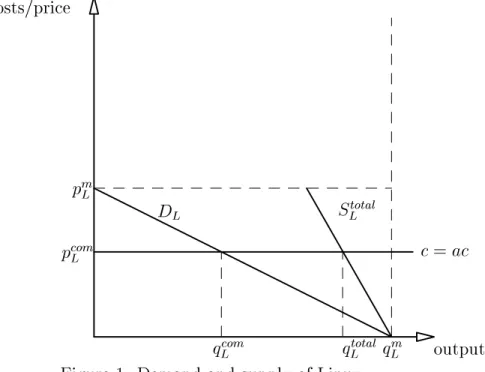
With zero xed costs, the cost function is simply cx, where x is the number of copies and c are the marginal costs, which equalthe average costs (ac). The supply curvefor Linux is therefore horizontal.
The demand curve has the usual downward-sloping form. q m L
represents the maximum number of users if Linux were to be given away for free. The intersection of the demand and the supply curve determines the equilibrium price and quantity for commercially-providedLinux distributions. But note that the marketdoesnot providethe entire quantity ofLinux. Additionally, in contrast to usual product markets, a provision of the good through self-production ispossible and reasonable for a signicantnumberof customers. Thus, with rising prices, some of the customers will produce Linux on their own (q total L q com L ). 19
The rest are nolonger willingtobuyorproduce Linux and drop out of demand (p
m L
q total L
). Thus, the total provided quantity of 16
Cf. [www.linux.org]. 17
ThepublicgoodcharacterofLinuxwillbediscussedinanotherpaperbytheauthor. 18
Cf. Hetze(1999). 19
Linux (q L
) exceeds the quantity traded on the commercial market (q L
). Figure 1illustratesthis graphically.
costs/price output D L S total L c=ac p com L q com L q m L q total L p m L
Figure1: Demand and supply of Linux
4 Market structure before the entry of Linux
The production of software roughly consists of the development and the du-plication of the software. The development of software is a labor-intensive business with lowcapital intensity. The immense development costs for the completionofsoftwareprogramsmakethesoftwarebusinessaxed-cost busi-nessinwhichthevariablecostsarevirtuallyzero.
20
Thevariablecostsconsist of the costs for the duplication of the software (e.g. pressing CDs, printing the manuals, packing the boxes, etc.) whereas the xed costs are the devel-opment costs. The marginal costs can be assumed to be constant and the average costs - though decreasing -exceed the marginalcosts permanently.
Therefore, the market segments for server operating systems have the form of a naturalmonopoly. Usuallythe enterprises can charge a monopoly price which includes per-unit-prots amounting to the dierence between
costs for the customers. They can consist of download costs, costs for documentation, opportunity costsfor aquick (automated) installation, installation support, the costsof borrowingtheinstallationCDsfromsomeoneandso on.
20
exist in the form of cost and technology advantages. In particular, the high developmentcostshampertheentryofcompetitorsintothemarketsegments, i.e. already-established producershave,duetodecreasing per-unit-costs, ab-solutecostadvantagesvis-a-visnewentrants. Furthermore,thedevelopment costs are sunk costs inthe case of unsuccessful introductions tothe market. The second importantentry barrierconsists inthe technologicaladvantages that established producers of operating software possess. These advantages result mainlyfrom the close access to the proprietary computer technology for which the software is developed. Due to the fact that operating system software is hardware-oriented, i.e. precise knowledge of the hardware is re-quiredtodevelopfaultlessandpowerfuloperatingsystemsoftware,hardware producers attain advantages through the development of suchsoftware.
21 Thesetheoretical reectionsare conrmed by the marketstructures that were in place before the emergence of Linux. For every hardware platform (e.g. Intel, MIPS,Sparc),asingle dominatingenterpriseused toprovidethe requiredoperatingsystem. Inmostsegments,thehardwareproducerandthe software developerwere identical (e.g. IBM:RS,AIX; SUN:Sparc, Solaris). The only exceptionisthe market segmentfor Intel-based computers,where, asiswidely known, Microsoft hasbeendeveloping thedominatingoperating system WindowsNT/2000. In recent years there have been some rare and unsuccessful attempts to enter one of these various market segments (e.g. OS/2 for Intel-based platformsand WindowsNT for DEC'sAlpha processor platform). In particular, the cost advantages of the established operating systemproducershaveledtothesituationinwhichthemarketsforoperating system software are non-contestable.
21
of Linux
As already stated, the production characteristics of complex operating sys-temsoftwareimplyatendency towardstheemergenceofnaturalmonopolies. With the emergence of the multi-platform operating system Linux, the sit-uation changed fundamentally. Due to the no-cost development of Linux by voluntary programmers, the crucial entry barrier became ineective. In all of the market segments mentioned, a second competitor - Linux distrib-utors - emerged and the existing market structure changed from a natural monopolyto an oligopoly with a smallnumber of competitors,strong entry barriers remainingfor commercial software developers, and a large number of buyers.
22
Within each market segment for operating systems, the former monop-olist is now competing with the distributors and \self-producers" of Linux, and the latter two have signicantly lower costs.
23
At the same time, the simple fact that Microsoft and the other operating system developers are still able to sell their products indicates that the goods oered are to some extent heterogeneous. Furthermore, due to the emergence of an additional competitor in the single market segments, prices play a more active role in competition. Whereas customers had to buy the AIX server operating sys-tem automatically when they chose IBM hardware, today they can choose between AIX and Linux. Prices become even more important as products becomemore homogenous.
Linux is most successful in market segments of other UNIXes. This can beexplainedby the relativehomogeneity ofthe dierent UNIXvariantsand Linux. Inmarketsegmentswheretheoperatingsystem iscloselylinked with agraphicalusersurface,suchasWindows98/NT/2000orMacOS,thesuccess of Linux is much lower. Furthermore it can be observed that enterprises developing UNIX are increasingly active in providing Linux support, which seems logical in the light of the model to be discussed below. Ultimately this mayresultinthe terminationofthe developmentoftheir ownoperating systems. The recent activitiesof IBM seem topointto this conclusion.
The current situation in the dierent market segments for server oper-ating systems can be neatly analyzed in the framework of the
oligopolis-22
Cf. marketstructurepatternofStackelberg(1934). 23
Self-producersdonotappearexplicitly ascompetitorsonthemarket,butincreasing pricesofthecommercialsuppliersleadtoanincreasingnumberofself-producersandthus to shrinkingmarkets. Collusionisthereforeonlypossibleinalimitedrange.
tic Launhardt-Hotelling competition model. Within this model, the oligopolists oer heterogeneous products so that prices can dier to some extent without the lowest-price supplier taking the whole market. Never-theless the products are substitutes for each other and therefore the sales volumes are not only functions of their own prices, but also of the prices of the competing goods. To apply the model to Linux and its competitors and to derive more concrete ndings we restrict the analysis to a duopoly withcompetitoronebeingtheformermonopolistandcompetitortwobeinga representativeLinuxprovider. Thefollowingdemand functionsare assumed:
y 1 =y 1 (p 1 ;p 2 )= 1 + 1 p 2 1 p 1 (1) y 2 =y 2 (p 1 ;p 2 )= 2 + 2 p 1 2 p 2 (2) Where y 1
represents demand for the product of the incumbent, y 2
the demand for the entrant (Linux);
i ,
i
are the marginalchanges of demand with respect to prices p
1 , p 2 . It is assumed that i ; i ; i > 0. Demand for a product reacts positively to a price increase of the competitor's product and negatively to an increase in its own price.
25 Furthermore, 1 6= 2 and 2 6= 1
is due to the fact that y 1
and y 2
reproduce only the commercial demand. The self-production of Linux is not included. Therefore, the total market size (y = y
1 +y
2
) can vary with price changes. It is assumed that each competitor is able to sell some of its products even if the competitor gives its product away for free: y
i = i i p i for some p i > 0 and p j = 0. The preferences of the customers include all characteristics of the product whichinuencethepurchasedecision,suchastransactioncosts(e.g. through network eects), ease of use/installation,quality,available programs for the operating system, and so on.
Asupplieris abletoattractthe entire marketonlyif the competitor sets its prohibitive pricep.^
0= 1 + 1 p 2 1 ^ p 1 ,p^ 1 = 1 1 + 1 1 p 2 (3) 0= 2 + 2 p 1 2 ^ p 2 ,p^ 2 = 2 2 + 2 2 p 1 (4)
Note that the prohibitive price varies with the price of the competing product.
24
Cf. Launhardt (1885),Hotelling (1929). 25
It is assumedthat the reactiononown pricechanges is strongerthan onchangesof thepriceofthecompetitor:
1 > 1 and 2 > 2 .
i
olist include development costs as xed costs C F 1
. Furthermore, we assume constant marginalcosts c
v i
as anapproximationfor the software duplication process. 26 Thus, 1 =p 1 y 1 (p 1 ;p 2 ) C 1 (y 1 (p 1 ;p 2 )) (5) 2 =p 2 y 2 (p 1 ;p 2 ) C 2 (y 1 (p 1 ;p 2 )) (6) with: C 1 =C F 1 +c v 1 y 1 (p 1 ;p 2 ) C 2 =c v 2 y 2 (p 1 ;p 2 )
Inserting the corresponding cost and demand functions and taking the price of the competing product as given, each suppliermaximizes prots by pricing itsproduct such that:
@ 1 @p 1 = 1 + 1 p 2 2 1 p 1 + 1 c v 1 =0 (7) @ 2 @p 2 = 2 + 2 p 1 2 2 p 2 + 2 c v 2 =0 (8)
This yieldsthe reaction functions:
p 1 = 1 2 1 p 2 + 1 2 1 + 1 2 c v 1 (9) p 2 = 2 2 2 p 1 + 2 2 2 + 1 2 c v 2 (10)
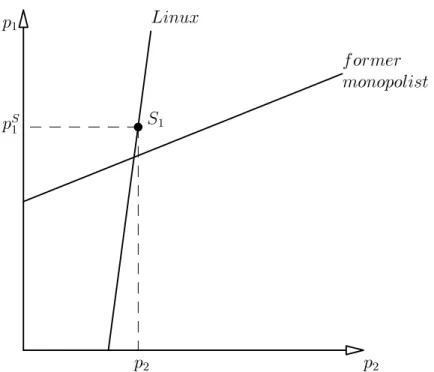
The price set by each duopolistdepends on the price of the competitor, on the marginalcosts, and in obvious ways on the various coeÆcients. The pointofintersection ofthe two reactionfunctionsrepresentsthe stable Nash Equilibrium.
26
As already mentioned consists the software duplication process mainly of pressing CDs, printingmanualsandpackingtheboxes. Cf. Houghton(1992)orQuintas(1994).
p 1 p 2 S 1 p S 1 p 2 former monopolist
Figure 2: Reactionfunctions of former monopolistand Linux supplier
It may be more realistic to assume that the former monopolist, because of its experience in the market, is unilaterally able to take intoaccount the reaction functionof the Linux distributor, i. e. toact as Stackelberg leader. Considering the reaction function of the Linux distributor it maximizes its protsandsets itspricetop
S 1
. TheLinuxdistributortakesthispriceasgiven and setsitspricep
2
followingitsreactionfunction. Thecompetitionleads to threemainoutcomes: rst,theequilibriumpricep
S 1
oftheformermonopolist is located on the reaction function of the Linux distributor (see gure 2S
1 ) and is higher than in the Nash case.
27
Second, the price of the entrant is alsohigherthaninthe Nashcase. Third,the protsofbothcompetitorsare higher inthe Stackelberg case than inthe Nash case.
However, inthelong run,the price ofthe formermonopolisthas tocover the total average costs so that it does not make losses. But whether the former monopolistis able toget aprice above the average costs depends on the preferences of the customers for its product, i.e. on the extent of the price dierentiation permitted by them. It is by nomeans assured that the product heterogeneity and, as a result, price dierentiation will be strong enough toallowthe permanent survival of the former monopolist.
28
Summinguptheresultsoftheformalanalysis,itturnsoutthatthe price-settingandtheprotabilityinthemarketsegmentdependonthepreferences
27
Cf. appendixfortheformalderivationofthatresult. 28
i i i
the heterogeneity of the products. Heterogeneity enablesthe former monop-oliststostayinthemarketduetothe possibilityofcharginghigherpricesfor their products than for Linux. Thus, the survival of former monopolists de-pendson the maintenance of the product'sheterogeneity. This, of course,is inuenced by the technologicaldevelopment ofthe twocompetingproducts.
6 Expected strategies and future market
de-velopments
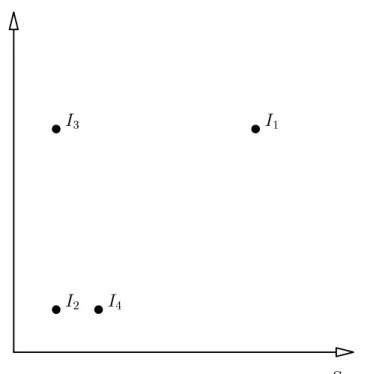
The previous conclusions provide the basis for a short, non-rigorous discus-sion at the level of plausibility of expected strategies of the market partic-ipants and the future development of the market segments. The available strategies forthe incumbentdependstronglyonthecurrentextentof hetero-geneityofitsoperatingsystemtoLinuxandthe importanceoftheoperating system for itsoverall business. As the previouschapter has shown, the prof-itability of the incumbent's operating system depends on the heterogeneity of its product to Linux. This of course inuences the investment decision on further development of itsown product. Furthermore the decision about a continuation of itsown proprietary operating system is inuenced by how much the business contributes to the total prots of the incumbent, or in other words, how much the incumbent would lose by terminating its own proprietary operating system. The following gure illustrates this heuristi-cally. Theverticalaxisshows theheterogeneity oftheincumbent'soperating system to Linux (H), and the horizontal axis shows the importance of the business with the operating system (S), e.g. the share of the incumbent's operating system business inits overall prots.
S I 1 I 2 I 3 I 4
Figure3: Startingpoints forthe incumbent's decisionproblem
Theclosertheincumbentislocatedtotheorigin,thehigherthelikelihood that it will terminate its own product development and engage in support-ing Linux. The four cases marked in the gure present dierent starting points for the decision to either go ahead or terminate the development of the business's own operatingsystem.
Thedecisionforincumbentone(I 1
)isstraightforward. Thecurrent prod-uct'sheterogeneityisstillgreatenoughfortheincumbenttocoveritsaverage costs and the operating system accounts for an important share of its busi-ness. Therefore, it will go ahead with the development of its proprietary operating system, keeping in mind that the heterogeneity between its own product and Linuxwillhave tobemaintained.
29 The situationforincumbenttwo(I
2
)shows the otherextreme, but leads toasimilarlyeasydecision. Theheterogeneity of itsproduct toLinuxislow and thesame istrueforthe contributionof theoperatingsystem business to itstotalbusiness.
30
Itisthereforemostlikelythatthis incumbentwill termi-nate development of its own proprietary product, leading inevitably to this
29
Addingsoftwarecomponentsorinterlaceapplicationsoftwarewiththeoperating sys-temtobenetfrom networkeectsisanoften-usedstrategytoincreaseproduct dieren-tiation. Microsoft'sstrategypointsinthisdirection.
30
An exampleof anincumbentinthis situationisIBM,whichisdevelopingits propri-etaryUNIXAIX,asystemwhichhasalowheterogeneitytoLinuxandaccountsonlyfor averysmallshareofIBM'stotalIT business.
so. First,this supportguarantees participationinthe supportservices busi-ness aroundLinux. Thus, if the marketforthe incumbent'sown proprietary product collapses,the enterprisecould keep earningmoneywith the remain-ing service business. Due to the fact that the support of the new operating system requires specic knowledgewhichhas tobeaccumulatedinadvance, the incumbent will start this accumulation process even while its own op-erating system is still being sold. Second, if the incumbent is at the same time ahardware producer,supportingLinux guaranteesthe reliabilityof the computer systems itoers. Inparticular, ifcomplete computernetworks are delivered, the common maintenance contracts require that the enterprises oer the customer a high availability of the system, which is dependent on software and hardware working together faultlessly.
31
Incumbent three occupies the most comfortable position (I 3
). This in-cumbentisdevelopinganoperatingsystemwhichisverydierentfromLinux and does notaccount for animportantshare of itstotal business. Examples of such enterprises are producers of supercomputers. They develop single unit productionoperatingsystems whichaccount, incomparison tothe cost of the hardware, only for a very smallpart. The continuation of the devel-opment is therefore possible and likely in this case. But even if the future development of Linux does reduce the heterogeneity between the products, the harm tothe incumbent willbe limiteddue tothe small share of the op-erating system business. The decision will then be the same as in the case of incumbent two.
Incumbent four (I 4
), which faces low heterogeneity between its product and Linux and a signicant importance of its business with its operating system, isinthemost diÆcultsituation. Furtherdevelopmentofitsproduct willgenerateadditionalsunk costsand bearthe riskthat theincumbentwill not be able to retrieve the pay-o. Termination of the development of its ownoperatingsystem willleadtothe lossofasignicantpartofitsbusiness. Mostofthe currentincumbentsfallintocasestwoandfour. Asdescribed above, most developers of operating systems are alsoproducers of the hard-ware. Thereforetheimportanceoftheoperatingsystemincomparisontothe total business is usually not very high. Furthermorethe majority of the op-erating systems developed by incumbentsare proprietary variantsof UNIX. They are, due to the fact that Linux is also avariant of UNIX, very similar to Linux (e.g. same commands). Thus, the already-mentioned increasing support of Linux by huge IT enterprises which develop a proprietary UNIX operating system and at the same time oer proprietary computer systems
31
of their operating system market segments.
Microsoft, as the exception in the operating system business, is repre-sented by case one ingure 3. The refusal to supportLinuxis logicalin the lightoftheanalysisabove. Microsoft wouldlosealargepartofitsbusiness if Linux were widely established. Furthermore, any support of Linux whatso-ever would furthermore decrease the heterogeneity between Microsoft's op-erating systems and Linux.
In the years to come, the increasing support of Linux by the huge IT enterprises will also have a signicant impact on the business of the Linux distributors. Thedistributors willfaceincreasing competitionfromthehuge IT enterprises intheir main business eld, the support services for Linux.
7 Conclusions
The paper has shown that the emergence of Linux may potentially bring about signicantchangesinthe marketstructurefor operatingsystems with far-reaching eects onthe former monopolistic incumbents.
Even if Linux as a good cannot be traded and a market for it does not exist,theoerofrelatedprofessionalservicesallowstheintroductionofLinux to professional customers. As a result, former monopolistic non-contestable markets turn oligopolisticwiththe foreseeable consequences, e.g. decreasing prots. In addition this change in the market structure even threatens the entire business of the former monopolistin itsmarket segment. The reason for this can be found in the no-cost development of Linux, which leads to considerable cost advantages on the side of the entrants. In the case of low productheterogeneityoftheincumbents'andentrants'products,theirprices approachmarginalcosts andthe incumbentswilltherefore nolonger beable tocovertheirxed costs,whichare theirdevelopmentcosts. In thelongrun, this can lead tothe incumbents stoppingthe developmentof theiroperating systems. But when this happens, the product market segment vanishes as well,duetotheabove-mentionedfactthatthenewentrantsoeronlyservices inconnectionwithLinux. Thereforeinthemostextremescenario,themarket for operating systems could totally collapse and only support services in connection with Linux would remain as a source of business income. The recent support announcementsofformer monopolistscouldbeinterpretedas preparations inanticipationof this scenario.
Bitzer, Jurgen (1997a): The Computer Industry in East and West: Do EasternEuropeanCountriesNeedaSpecicScienceandTechnologyPolicy?; in: DIWDiscussion Papers; No. 148; Berlin.
Bitzer, Jurgen (1997b): TheComputer Software Industry inEast and West: Do Eastern European Countries Need a Specic Science and Technology Policy?;in: DIWDiscussion Papers; No. 149; Berlin.
Blackburn, Joseph D.; Scudder, Gary; Wassenhove, Luk N. van (1996): Improving Speed and Productivity of Software Development a Survey of European Software Developers; Insead Working Papers 96/11/TM; Insead; Fontainebleau.
Hetze, Sebastian (1999): Wirtschaftliche Aspekte von Freier Software und OpenSource, in: heise onlinepublications, [www.heise.de] date: 09.08.1999.
Hotelling, Harold (1929): Stability in competition, in: Economic Journal, vol. 39, pp. 41-57.
Houghton,JohnW.(1992): PricingandMarketCharacteristicsofComputer Software; in: Centre for International Research on Communication and Information Technologies; PolicyResearch PaperNo. 27.
Launhardt, Wilhelm (1885): Mathematische Begrundung der V olk-swirtschaftslehre, Leipzig.
McHugh, Josh (1998): Linux: the making of a global hack, URL: http://www.forbes.com/forbes/98/0810/6203094s1.htm[10August 1998].
Moody, Glyn (1997): The Greatest OS That (N)ever Was, Online in Inter-net: URL: [www.wired.com/wired/5.08/linux pr.html] [date: 04/13/2000].
Quintas, Paul (1994): Paths of Innovation in Software and Systems De-velopment Practice, in: R. Mansell (ed.): Emerging Patterns of Control: The Management ofInformation and CommunicationTechnologies, ASLIB, London.
Linux, in: Paul Thurrott's WinInfo, [URL: www.wininformant.com], date 08/17/2000.
Torvalds, Linus (1999): The Linux Edge, in: C.DiBona,S. Ockman and M. Stone (eds.): Open Sources: Voices from the Open Source Revolution, pp. 101-111, Sebastopol, CA:O'Reilly& Associates.
Proof that the Stackelberg price is higherthan the Nash price
The followingderivations showthat the use of aStackelberg strategy by the former monopolist in the applied model leads to higher prices and higher prots for both competitors. The Stackelberg leader will take the reaction function of the entrant into consideration when maximizing its prots. Its prot function and the associatedrst-order-conditiontherefore has the fol-lowing form. 32 S 1 =(p 1 c v 1 )( 1 + 1 ( 2 2 2 p 1 + 2 2 2 + 1 2 c v 2 ) 1 p 1 ) C F 1 @ S 1 @p 1 = 1 + 1 2 2 p 1 1 2 c v 1 2 2 + 1 2 2 2 + 1 c v 2 2 2 1 p 1 + 1 c v 1 =0 Solving for p 1
results in the Stackelberg price p S 1
. This is now compared with the Nash equilibrium price p
N 1
to show that the Stackelberg price is higher than the Nash price.
p S 1 = 1 4 1 2 2 1 2 (2 2 1 + 1 2 + 1 2 c v 2 +2 1 2 c v 1 | {z } 1 2 c v 1 ) p N 1 = 1 4 1 2 1 2 (2 2 1 + 1 2 + 1 2 c v 2 +2 1 2 c v 1 ) | {z } Forp S 1 >p N 1
it must betrue that,
p S 1 p N 1 = 4 1 2 2 1 2 4 1 2 1 2 1 2 c v 1 >1 = 1 1 2 c v 1 1 12 4 1 2 1 2 >1 or 32 The second-order-condition 1 2 < 2 1 2
is obviously satised for 1 < 1 and 2 < 2 . Cf. assumptionsinfootnote25.
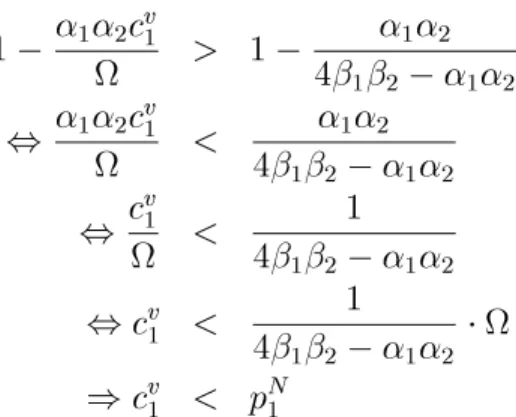
1 1 2 c 1 > 1 1 2 4 1 2 1 2 , 1 2 c v 1 < 1 2 4 1 2 1 2 , c v 1 < 1 4 1 2 1 2 ,c v 1 < 1 4 1 2 1 2 )c v 1 < p N 1
Thus, if the price p N 1
exceeds the variable costs c v 1 the Stackelberg-price p S 1
is higherthan the Nash-pricep N 1
.
Illustration of the long-term protability problem of the former monopolist
DuetothefactthatthexedcostsarenotconsideredintheShort-termprot maximization, the dierence between the former monopolistand the Linux distributor does not enter into the model. A statement on the protability of the former monopolisthas tobederived fromanotherobservation. In the long term, the price of the former monopolisthas tocover the total average costs sothatthe enterprisedoesnotmakelosses. Whetherornotthe former monopolistwillbeabletoget apriceabovethe averagecosts depends inthe end onthe preferences of the customers for itsproduct.
1 = p 1 y 1 (p 1 ;p 2 ) C F 1 c v 1 y 1 (p 1 ;p 2 )0 , (p 1 c v 1 )( 1 + 1 p 2 1 p 1 )C F 1 , ( 1 + 1 p 2 +c v 1 ) | {z } p 1 c v 1 ( 1 + 1 p 2 ) | {z } C F 1 + 1 p 2 1 ) p 1 C F 1 + 1 p 2 1
Figure4shows thatthe formermonopolistisonlyable tomakeprotsas longasthepriceliesbetweenp
1
andp 1
. Furthermoreitcanbeseenthatwith adecreasingpreferenceforitsproduct(
1
#)and/oranincreasingpreference for Linux (
1
") the straight line p 1
rotates to the right (negative intersection and slope decreases). In addition, with a decreasing preference
1 C F 1 + 1 p 2 1 p 1 p 1 C F 1 + 1 p 2 1 p 1 C F 1 p 1
Figure 4: Protable price area for the former monopolist
for the product of the former monopolist, it is likely that 1
will increase and with it the slopeof the quadraticfunction C
F 1 + 1 p 2 1
willincrease. The result is that the protable price area p
1
to p 1
decreases and could even vanish completely.