C O M P O S I T I O N A L L A N G U A G E P R O C E S S I N G F O R M U LT I L I N G U A L S E N T I M E N T A N A LY S I S
d av i d v i l a r e s c a lv o
Doctoral Thesis
Compositional language processing for
multilingual sentiment analysis
d av i d v i l a r e s
Doctoral Thesis /
2017
Advisors:
miguel a
.
alonso
carlos gómez
-
rodríguez
miguel ángel alonso pardo, Associate Professor at Departamento de Computación at Universidade da Coruña,
carlos gómez-rodríguez, Associate Professor at Departamento de Computación at Universidade da Coruña,
hereby certify
that the dissertation entitledCompositional Language Processing for Mul-tilingual Sentiment Analysis, submitted to Universidade da Coruña by david vilares calvo, has been carried out under our supervision and meets all the requirements for the award of Ph. D. degree with International Mention.
miguel ángel alonso pardo carlos gómez-rodríguez
Main advisor Second advisor
Opinion is the medium between knowledge and ignorance. — Plato
A C K N O W L E D G M E N T S
It has been a long trip, with hills and valleys, but in all of them I was lucky enough to meet people that have contributed to this thesis, and to whom I would like to show my gratitude.
Miguel A. Alonso and Carlos Gómez-Rodríguez were both bright mentors. Miguel introduced me to natural language processing and science, and gave me to read Pang and Lee (2008), which was later the inception of the topic of this thesis. His commitment, dedication, and always fast and accurate feedback have made possible this disserta-tion coming to an end. He has been an unbelievable advisor. With Car-los I have shared uncountable avid discussions from which I always could learn many interesting things about natural language process-ing, research and many other subjects of life. He is one of the most talented nlp scientists I know, and I consider myself very fortunate to have been advised by him during these years.
I am also grateful to the members of the lysgroup for their tech-nical and administrative support, and specially to Yerai Doval, for creating an enjoyable working atmosphere at Lab0.1.
A very special mention is reserved to Mike Thelwall, Erik Cambria and Yulan He, which hosted and advised me during my stays at for-eign universities. They spent time with me sharing their knowledge and led me into new fields of research, helping me grow up profes-sionally, for which I always will be grateful.
On a personal note, the biggest thank you of this thesis goes to my beloved ones. To my parents, for fully supporting me and make me understand the importance of studying and working hard since I started school. To Silvia, who always is there where I need it. To Suso and Mónica, for keeping the door of their home open for me. And to my grandparents, for sharing their data as nobody else do, giving priceless advises.
Also, friends make difficult moments fly away fast. Thank you for being there to share a drink, a meal or simply a good conversation to make me forget about Ph. D. (and other) problems.
Last, this research was possible thanks to the economical support of: Plani2cof Xunta de Galicia,mecd(Grant FPU13/01180), Inditex-udc 2014 & 2016 grants for visits, fpu 2015 grants for short visits, minecoandfeder(Grants TIN2010-18552-C03-02, FFI2014-51978-C2 -02) and Xunta de Galicia (Grants CN2012/008, CN2012/319, R2014/ 034).
A B S T R A C T
This dissertation presents new approaches in the field of sentiment analysisandpolarity classification, oriented towards obtaining the sen-timent of a phrase, sentence or document from a natural language processing point of view. It makes a special emphasis on methods to handle semantic composionality, i. e. the ability to compound the sentiment of multiword phrases, where the global sentiment might be different or even opposite to the one coming from each of their their individual components; and the application of these methods to multilingual scenarios.
On the one hand, we introduce knowledge-based approaches to cal-culate the semantic orientation at the sentence level, that can handle different phenomena for the purpose at hand (e. g. negation, intensi-fication or adversative subordinate clauses).
On the other hand, we describe how to build machine learning models to perform polarity classification from a different perspec-tive, combining linguistic (lexical, syntactic and semantic) knowledge, with an emphasis in noisy and micro-texts.
Experiments on standard corpora and international evaluation cam-paigns show the competitiveness of the methods here proposed, in monolingual, multilingual and code-switching scenarios.
The contributions presented in the thesis have potential applica-tions in the era of the Web2.0and social media, such as being able to determine what is the view of society about products, celebrities or events, identify their strengths and weaknesses or monitor how these opinions evolve over time. We also show how some of the proposed models can be useful for other data analysis tasks.
R E S U M E N
Esta tesis presenta nuevas técnicas en el ámbito del análisis del senti-miento y laclasificación de polaridad, centradas en obtener el sentimien-to de una frase, oración o documensentimien-to siguiendo enfoques basados en procesamiento del lenguaje natural. En concreto, nos centramos en desarrollar métodos capaces de manejar la semántica composicional, es decir, con la capacidad de componer el sentimiento de oraciones donde la polaridad global puede ser distinta, o incluso opuesta, de la que se obtendría individualmente para cada uno de sus términos; y cómo dichos métodos pueden ser aplicados en entornos multilingües. En la primera parte de este trabajo, introducimos aproximaciones basadas en conocimiento para calcular la orientación semántica a ni-vel de oración, teniendo en cuenta construcciones lingüísticas relevan-tes en el ámbito que nos ocupa (por ejemplo, la negación, intensifica-ción, o las oraciones subordinadas adversativas).
En la segunda parte, describimos cómo construir clasificadores de polaridad basados en aprendizaje automático que combinan informa-ción léxica, sintáctica y semántica; centrándonos en su aplicainforma-ción so-bre textos cortos y de poso-bre calidad gramatical.
Los experimentos realizados sobre colecciones estándar y competi-ciones de evaluación internacionales muestran la efectividad de los métodos aquí propuestos en entornos monolingües, multilingües y decode-switching.
Las contribuciones presentadas en esta tesis tienen diversas aplica-ciones en la era de la Web2.0y las redes sociales, como determinar la opinión que la sociedad tiene sobre un producto, celebridad o evento; identificar sus puntos fuertes y débiles o monitorizar cómo estas opi-niones evolucionan a lo largo del tiempo. Por último, también mos-tramos cómo algunos de los modelos propuestos pueden ser útiles para otras tareas de análisis de datos.
R E S U M O
Esta tese presenta novas técnicas no ámbito da análise do sentimento
e da clasificación da polaridade, orientadas a obter o sentimento dun-ha frase, oración ou documento seguindo aproximacións baseadas no procesamento da linguaxe natural. En particular, centrámosnos en métodos capaces de manexar a semántica composicional: métodos coa habilidade para compor o sentimento de oracións onde o senti-mento global pode ser distinto, ou incluso oposto, do que se obtería individualmente para cada un dos seus términos; e como ditos méto-dos poden ser aplicaméto-dos en entornos multilingües.
Na primeira parte da tese, introducimos aproximacións baseadas en coñecemento; para calcular a orientación semántica a nivel de ora-ción, tendo en conta construccións lingüísticas importantes no ámbito que nos ocupa (por exemplo, a negación, a intensificación ou as ora-cións subordinadas adversativas).
Na segunda parte, describimos como podemos construir clasifica-dores de polaridade baseados en aprendizaxe automática e que com-binan información léxica, sintáctica e semántica, centrándonos en tex-tos curtex-tos e de pobre calidade gramatical.
Os experimentos levados a cabo sobre coleccións estándar e com-peticións de avaliación internacionais mostran a efectividade dos mé-todos aquí propostos, en entornos monolingües, multilingües e de
code-switching.
As contribucións presentadas nesta tese teñen diversas aplicacións na era da Web2.0e das redes sociais, como determinar a opinión que a sociedade ten sobre un produto, celebridade ou evento; identificar os seus puntos fortes e febles ou monitorizar como esas opinións evolucionan o largo do tempo. Como punto final, tamén amosamos como algúns dos modelos aquí propostos poden ser útiles para outras tarefas de análise de datos.
A C R O N Y M S
c n n Convolutional Neural Network l a s Labeled Attachment Score m l Machine Learning
n l p Natural Language Processing p Precision
p o s Part-of-speech r Recall
s a Sentiment Analysis s o Semantic Orientation s v m Support Vector Machines
t f-i d f Term Frequency - Inverse Document Frequency ua s Unlabeled Attachment Score
C O N T E N T S List of Figures xxv List of Tables xxvii
i i n t r o d u c t i o n a n d p r e l i m i na r i e s 1 1 Introduction 3
1.1 Motivation 3 1.2 Background 4
1.2.1 Early history 4
1.2.2 The rise of sentiment analysis 5 1.2.3 Compositional sentiment analysis 6 1.2.4 Multilingual sentiment analysis 8 1.3 Contributions 10
1.4 Structure of the thesis 11 1.5 Publications 13
1.6 Software and resources 15 2 Preliminaries 17 2.1 Preprocessing 17 2.2 Part-of-speech tagging 19 2.3 Dependency parsing 21 2.4 Multilingual parsing 25 2.4.1 Code-switching parsing 30
2.5 Evaluation metrics for sentiment analysis 33
ii k n o w l e d g e-b a s e d c o m p o s i t i o na l s t r at e g i e s 35 3 A lexical, unsupervised, knowledge-based approach 37
3.1 Description 37
3.1.1 Sentiment dictionary 38 3.1.2 Additional sentiment files 39 3.2 Experiments 40
3.2.1 Dataset 40 3.2.2 Evaluation 40 3.3 Conclusion 43
4 A syntactic, knowledge-based approach for monolingualsa 45 4.1 Description 45
4.1.1 Baseline 46 4.1.2 Intensification 47
4.1.3 Subordinate adversative clauses 49 4.1.4 Negation 50
4.1.5 Adding lexical functionalities 53 4.2 Domain adaptation 54
4.3 Experiments 55 4.3.1 Datasets 55
4.3.2 Evaluation 57 4.4 Conclusion 62
5 A proposal for universal, unsupervised, syntax-basedsa 63 5.1 Description 64
5.1.1 Compositional operations 64
5.1.2 An algorithm for compositional computation 67 5.2 From theory to practice 67
5.2.1 NLP tools for universal unsupervised sentiment analysis 69
5.2.2 Practical compositional operations 69 5.2.3 Practical computation 72
5.3 Experiments sharing compositional operations 76 5.3.1 Datasets 77
5.3.2 Evaluation 78
5.4 Experiments sharing lexica, parsing models and com-postional operations 80
5.4.1 Datasets 81
5.4.2 Multilingual subjectivity lexica 82
5.4.3 Multilingual PoS tagging and dependency
pars-ing 84
5.4.4 Evaluation 84 5.5 Conclusion 86
iii m a c h i n e-l e a r n i n g c o m p o s i t i o na l s t r at e g i e s 89 6 A monolingual supervised model based on generalization 91
6.1 Description 91
6.1.1 Generalized dependency triplets 92
6.1.2 Generalized dependency triplets for sentiment analysis 93 6.1.3 Classifier 96 6.1.4 Features 96 6.2 Experiments 97 6.2.1 Dataset 97 6.2.2 Evaluation 98
6.2.3 Discussion of the features 104 6.3 Conclusion 110
7 A proposal for multilingual supervisedsa 111 7.1 Description 111 7.2 Code-switching 112 7.3 Experiments 116 7.3.1 Datasets 116 7.3.2 Evaluation 116 7.4 Conclusion 120 iv a p p l i c at i o n s 123 8 Topic classification 125 8.1 Description 125
Contents xxiii 8.2 Experiments 127 8.2.1 Dataset 127 8.2.2 Evaluation 127 8.3 Conclusion 131 9 Political analysis 135 9.1 Description 135
9.2 Politics in social media 136
9.2.1 Twitter as a tool for political analysis in Spain 138 9.3 Materials and methods 139
9.4 Experiments 140 9.5 Conclusion 145 10 Online reputation 149
10.1 Description 149
10.1.1 Task1: Reputation Dimensions Categorization 149 10.1.2 Task2.2: Author ranking 151
10.2 Conclusion 154
11 SemEval & sentiment analysis in Twitter 155 11.1 Description 155
11.1.1 Convolutional neural network and deep features 155 11.1.2 Classifier 158 11.1.3 Dataset 158 11.1.4 Experimental results 158 11.2 Conclusion 161 v c o n c l u s i o n 163 12 Conclusion 165 12.1 Future work 168 Appendices 169
a Polled politicians sampled in Chapter9 171
b Statistics of the topic classification training set used in Chap-ter8 173
c Statistics of the topic classification test set used in Chapter
8 177
d Long summary in Spanish/Resumen largo en castellano 179 d.1 Motivación 179
d.2 Contenido de la tesis 181 d.3 Contribuciones 186 b i b l i o g r a p h y 189
L I S T O F F I G U R E S
Figure1 A valid dependency tree for a sentence 22 Figure2 Display of the reorganization of subordinate
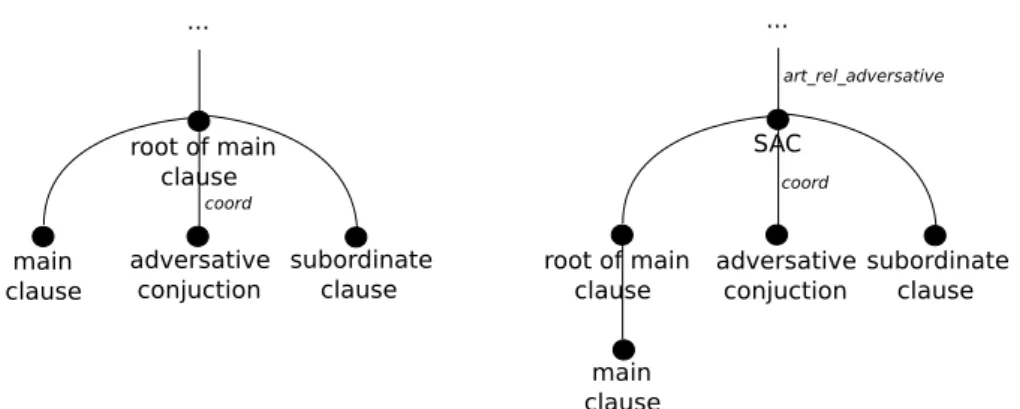
adversative clauses on Ancora trees to be pro-cessed bysssa 49
Figure3 Display of the heuristic rules used by sssa to identify the scope of negating terms 53 Figure4 Accuracy on CorpusCine increasing negative
word weighting 62
Figure5 Graphical representation of the proposed set of influence scopes S 67
Figure6 Skeleton for intensification compositional op-erations illustrated with examples 71 Figure7 Skeleton for ‘but’ compositional operation
il-lustrated with one example 72
Figure8 Skeleton for negation compositional operations illustrated together with one example 73 Figure9 Performance following the from large to small
setup for different models, using incremental pieces of the training collection to build them 109 Figure10 Variation of positive and negative perception
of Iñigo Errejón during the period of polling 145 Figure11 Topology of our cnn from where we will
ex-tract the neural activation values 156
L I S T O F TA B L E S
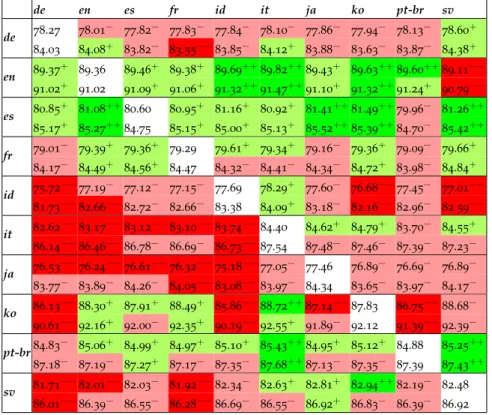
Table 1 las/uasperformance on the Universal Depen-dency Treebanks v2.0 test sets by the mono and bilingual parsers 27
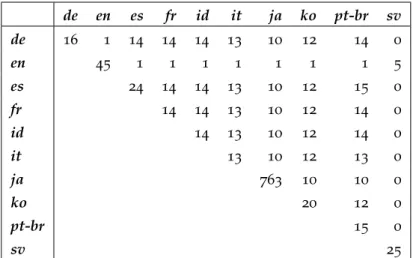
Table 2 Shared language-specific tags between pairs of languages on the Universal Dependency Tree-banks v2.0 29
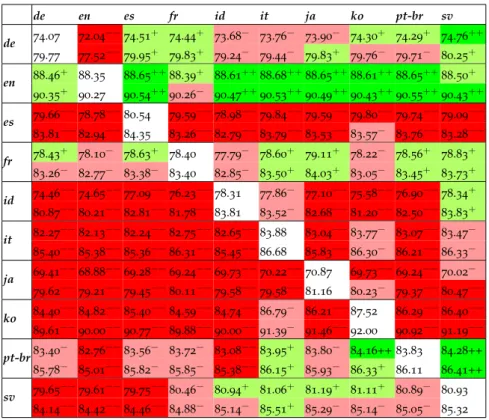
Table 3 Performance on the Universal Dependency Tree-banks v2.0test sets using the goldcpostag in-formation 30
Table 4 las/uasperformance on a code-switching Uni-versal Dependency treebank composed of 10 sentences 32
Table 5 Spanish SentiStrength performance under the default setup 41
Table 6 Spanish SentiStrength performance with a va-riety of options individually disabled 42 Table 7 Weights of restrictive and exclusive
conjunc-tions 49
Table 8 Top5discriminative tokens in the CorpusCine (film domain) according to information gain 56 Table 9 Generic vs. adaptedso’s to the film domain 56 Table 10 Performance of sssa on the SFU Spanish
Re-view Corpus with a variety of options enabled 57 Table 11 Performance of sssaper category on the SFU
Spanish Review Corpus 58
Table 12 Performance on the SFU Spanish Reviews cor-pus (sssavs. other methods) 59
Table 13 Performance on the HOpinion corpus (sssavs. various methods) 59
Table 14 Performance on the CorpusCine corpus (sssa vs. various methods) 60
Table 15 Accuracy per star score on the CorpusCine cor-pus forsssawith generic and adapted seman-tic orientation lexica 60
Table 16 Accuracy on the Taboada and Grieve (2004) corpus (uuusavs. other methods) 78 Table 17 Accuracy on the Pang and Lee (2004) test set
(uuusavs. other methods) 79
Table 18 Accuracy on the Spanish Brooke, Tofiloski, and Taboada (2009) test set with a variety of op-tions enabled for various methods 79
Table19 Accuracy on different corpora for Socher et al. (2013) vs. uuusa 81
Table20 Size of the Brooke, Tofiloski, and Taboada (2009) (single words) lexica after being translated 83 Table21 Size of the resulting Cruz et al. (2014a) lexica
after processing. 83
Table22 Size of the final lexica used bysisa. 83 Table23 Results ofsisaand different configurations vs
LKiton different test sets of Iberian languages 85 Table24 Impact of the operations with mono and
mul-tilingual lexica 86
Table25 Frequency statistics of thetasscorpus 98 Table26 Performance of the Spanish supervised model
and the basic sets of features on the tass cor-pus, following thefrom small to largesetup 100 Table27 Performance of the Spanish supervised model
on combining sets of lexical features on the tass corpus, following the from small to large setup 100
Table28 Performance of the Spanish supervised model on incorporating generalized dependency fea-tures on the tass corpus, following the from
small to largesetup 101
Table29 Performance of the Spanish supervised model and the basic sets of features on the tass cor-pus, following thefrom large to smallsetup 102 Table30 Performance of the Spanish supervised model
on combining sets of lexical features on the tass corpus, following the from large to small setup 103
Table31 Performance of the Spanish supervised model on incorporating generalized dependency fea-tures on the tass corpus, following the from
large to smallsetup 103
Table32 Performance of some supervised models on thetasscorpus, obtained from thefrom small to
largesetup, evaluated over4categories 104 Table33 Performance of some supervised models on
thetasscorpus, obtained from thefrom small to
largesetup, evaluated over6categories 104 Table34 Performance of some supervised models on
thetasscorpus, obtained from thefrom large to
smallsetup, evaluated over4categories 104 Table35 Performance of some relevant models obtained
from the from large to small setup, evaluated over6categories 105
LIST OF TABLES xxix
Table 36 Top5discriminative features for the basic sets of features from the tass training corpus, ac-cording to information gain and following the
from small to largesetup 106
Table 37 Top5discriminative fine-grained part-of-speech tags, according to information gain following thefrom small to largesetup 107
Table 38 Relevant discriminative features at lexical level following thefrom large to smallsetup 107 Table 39 Relevant generalized dependency features for
the best performing model, according to in-formation gain and following thefrom large to
smallsetup 109
Table 40 Frequency distribution of thesentistrengthscores on theen-es-cs corpus 114
Table 41 Word statistics by language on the en-es-cs corpus 114
Table 42 Occurrences of some of the most common sub-jective terms for English and Spanish in theen -es-cscorpus 115
Table 43 Performance on the SemEval 2014 test set by the monolingual, language-detection and mul-tilingual models 117
Table 44 Performance on thetasstest sets by the mono-lingual, language-detection and multilingual mod-els 118
Table 45 Performance on the multilingual test set by the monolingual, language-detection and multilin-gual models 119
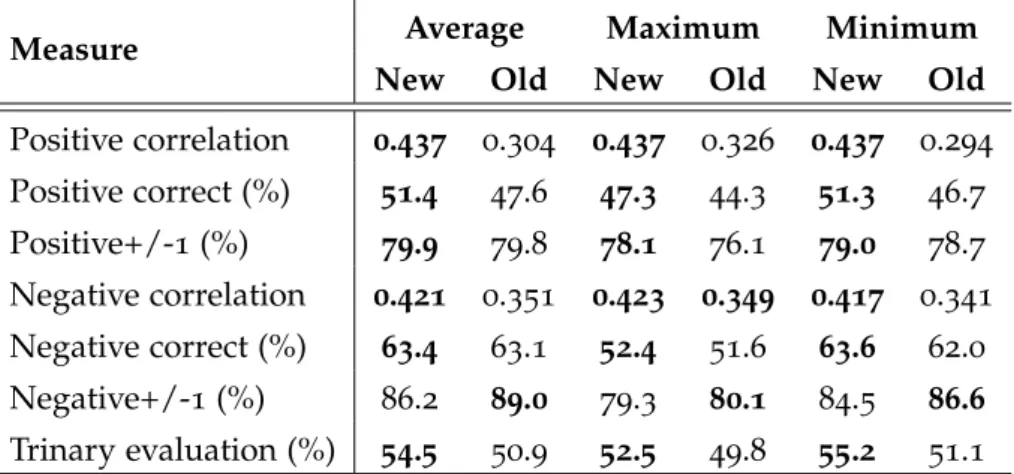
Table 46 Performance on the code-switching set by the monolingual, language-detection and multilin-gual models 120
Table 47 Performance for basic feature models on the tasstopic classification corpus. 130
Table 48 Performance on combining lexical, syntactic, psychometric and semantic knowledge on the tasstopic classification corpus 131
Table 49 Performance on improving the best model, ac-cording to the em metric, by means of gener-alized dependency triplets, on the tass topic classification corpus 132
Table 50 Performance on improving the best model, ac-cording to the lba metric, by means of gener-alized dependency triplets, on the tass topic classification corpus 132
Table51 Detailed performance per categories both for the best syntactic model and the bag-of-words approach 133
Table52 Averagesentistrength scores vs. national Span-ish poll scores 142
Table53 Predicted and gold standard rankings compared to Hamming-loss distance and out-of-place mea-sure. 142
Table54 Mann-Whitney U test, at a confidence level of 95%. (p < 0.05) for Albert Rivera and Pedro Sánchez against the main Spanish political lead-ers. 143
Table55 Average positive and negative sentistrength in tweets mentioning the main Spanish political parties. 144
Table56 Positive and negative sentiment ranking from SentiStrength for the tweets mentioning the politi-cians analyzed. 146
Table57 Ranking for task1at RepLab2014: Reputation Dimensions Categorization 151
Table58 Detailed performance for our best run on the reputation dimensions categorization task 152 Table59 Ranking for task 2.2 at RepLab 2014: Author
ranking 153
Table60 Classification into two classesusing the SemEval 2106development test set 159
Table61 Classification into three classesusing both the Se-mEval 2016 development test set and the Se-mEval2013development set 160
Table62 Classification into five classesusing the SemEval 2016development test set 160
Table63 Statistics of the training set used for the topic classification tasks (Chapter8) 175
Table64 Statistics of the training set used for the topic classification tasks (Chapter8) 178
Part I
1
I N T R O D U C T I O N
This dissertation presents different approaches to addresspolarity clas-sification forsentiment analysis(Pang and Lee, 2008), i.e. determining if the sentiment of a piece of text (it could be a phrase, a sentence or a whole document) reflects a positive, negative or neutral opinion.
First, we introduce sentiment analysis and also present natural lan-guage processing techniques and resources that will be used through-out the chapters of this book.
Second, we present different knowledge-based methods to calcu-late the semantic orientation at the sentence level, proposing mod-els that can handle phenomena such as intensification or negation, among others.
Third, we describe how we build machine-learning methods for the purpose at hand, combining linguistic (lexical, syntactic and se-mantic) features, which work under monolingual, multilingual and code-switching environments.
Finally, the fourth part of this dissertation contains additional re-search results, obtained by some of the proposed methods, when they are applied to competitive evaluation campaigns, additional corpora and real time analysis tasks related not just to sentiment analysis, but also to data analysis in general.
1.1 m o t i vat i o n
Analyzing and comprehending subjective information expressed in social media by users of different countries, cultures and ages has be-come a key asset in order to monitor public opinion about products, events or public figures. This is observable in people’s day-to-day life. From film forums such as FilmAffinity, it is possible to see what viewers think about different aspects of a movie, and make a decision about what to watch based on their personal preferences. From travel forums such as TripAdvisor, it is feasible to find out a large number of views about the accommodation where someone is planning to spend their next vacations. From modern social networks such as Facebook, Twitter or Instagram, we can infer from the comments of users what is their point of view with respect to news, trends or pictures, among others. From all of them, humans can process information and trans-form it into knowledge to answer questions like: ‘How is the acting of Edward Norton in American History X?’,‘I mostly care about bed comfort and cleanliness, should I book this room?’ or‘How is people’s opinion evolv-ing about Samsung Electronics after the Samsung Galaxy Note7issue?’.
Before the appearance of the Web 2.0, a common solution for ob-taining information about questions like these and many others was using surveys and polls. However, these strategies were typically ex-pensive, had a limited scope and were only valid for a short period of time. Currently, social media could provide an effective way to poll users (Wang et al., 2012), plan business strategies (Li and Li, 2013) and make marketing decisions (Bae and Lee,2012). However, human monitoring of web reviews and opinions presents important obstacles. The vast amount of opinions expressed every day in blogs, forums or social media makes manual observation unfeasible. Moreover, the application of corpus-based techniques to extract good sentiment fea-tures presents some advantages with respect to relying on intuitions, such as exhaustiveness of the resulting list of subjective words and the capacity to capture implicitly subjective constructions (Pang, Lee, and Vaithyanathan,2002).
In this context,sentiment analysis (sa) has arisen as a research field ofnatural language processing(nlp) that deals with the automatic anal-ysis of subjective content. Many subtasks can be located within this field of research. The primary one consists in classifying the senti-ment or polarity of a text as positive or negative, although it is also common to include additional categories to distinguish purely infor-mative texts, and to differentiate the strength of the opinions.
This dissertation focuses on how to obtain the sentiment of a phrase, sentence or document from a computational linguistic point of view. In particular, we make a special emphasis on methods to handle se-mantic composionality, i.e. the ability to compound the sentiment of multiword phrases, where their global sentiment might be different or even opposite to the one coming from their individual components. For example, in the sentence ‘He is not very handsome, but he has some-thing that I really like’, we want to design algorithms with the ability to infer that the word ‘very’ emphasizes ‘handsome’, ‘not’ affects the whole expression‘very handsome’, and‘but’decreases the relevance of
‘He is not very handsome’and increases the one of‘he has something that I really like’. We also pay special attention to adapting these methods to multilingual environments.
1.2 b a c k g r o u n d 1.2.1 Early history
Francis Ysidro Edgeworth hypothesized in 1881 the hedonometer, a machine with the necessary psychological capacities to continuously monitor the level of happiness or pleasure of an individual. This is one of the earliest formal mentions to the automatic computation of feelings and emotions shared by people. Even before, Bentham (1789) posed that the pleasure caused by an action could be estimated by
1.2 b a c k g r o u n d 5
an algorithm, latter referred to ashedonic calculus, based on variables such as intensity or duration; and how this could be used, for exam-ple, with legislative purposes.
From Edgeworth’s hedonometer initial idea, few scientists tried to formalize and address this problem from a computational linguis-tic point of view during the 20th century, as detailed in Pang and Lee (2008).1 Carbonell (1979) posed in his thesis that modeling un-derstanding of natural languages requires a model of the processes underlying human thought. He proposed a theory of subjective lan-guage understanding and implemented it on the domain of politics, developing a system that can model liberal and conservative ideolog-ical reasoning in natural language. Wilks and Bien (1983) described how to model a structure to keep not just an individual’s beliefs about aspects of the world, but also about beliefs that other individuals might have; about those and other aspects of the world. Already in the 90’s some authors started to other problems more related to the current definition of sentiment analysis. For example, Wiebe, Bruce, and O’Hara (1999) described how to develop a gold-standard dataset for subjective classification and how to handle disagrements between annotators, a common problem in sentiment analysis, due to differ-ent personal beliefs that differdiffer-ent people might have; and Wiebe and Bruce (2001) described work in developing a probabilistic model able to split a text into segments, where each segment is composed of a number of subjective sentences that share the same point of view and come from the same agent.
1.2.2 The rise of sentiment analysis
The rise of sentiment analysis came in the early21st century, partially pushed by the success of the Web2.0 and the first social media, that allowed users to generate and share their own content easily. Turney (2002) introduced an unsupervised algorithm to compute the seman-tic orientation2
(so) of texts, based on a dictionary approach. Such polarity is computed as a combination of the so’s of the individual words. To calculate thesoof adjective and adverb phrases, the author usespmi-ir3(Turney, 2001), which measures the mutual information of a phrase with respect to the words ‘excellent’ and ‘poor’. Alterna-tively, Pang, Lee, and Vaithyanathan (2002) introduced how to train supervised learning samodels, e.g. naïve Bayes, Maximum Entropy classifiers or Support Vector Machines (svm), using features such as unigrams, bigrams or part-of-speech tags.
1 Check Pang and Lee (2008) §1.4for a more exhaustive bibliography of early senti-ment analysis.
2 Semantic orientation: A value indicating the positive or negative strength of a word. Usually positive values represent positive words and negative ones indicate negative words.
These two complementary approaches are often used to illustrate the two main angles to tackle polarity classification: the lexicon-based and machine learning perspectives, respectively. The latter has been widely explored in the recent years, starting from bag-of-words mod-els. Gamon (2004) evaluated the role of linguistic features such as part-of-speech tag tri-grams and constituent structure of phrases in sentiment classification. Empirical results showed that, although fea-tures of this kind obtain a low performance by themselves, they con-tribute positively to accuracy when they are included in word n-gram models. As labeling data might be expensive, Pak and Paroubek (2010) explored how to crawl Twitter using happy and sad emoti-cons and build an automatically labeled corpus based on them. They also illustrated how some part-of-speech tags are prone to be used in certain type of texts (e. g. they point out that superlative adverbs and possessive endings may indicate positive opinions). Paltoglou and Thelwall (2010) explored the use of information retrieval weight-ing schemes for sentiment analysis such as the classic tf-idf (term frequency - inverse document frequency) (Salton and McGill, 1986)4, evaluating them in different data sets. Martínez Cámara et al. (2011) evaluated the performance of an svm and a naïve Bayes classifier on classifying the polarity of a film corpus using different weight schemes (e. g. binary occurrence or tf-idf). It is also common to in-clude some linguistic-related processing for preparing features (Bak-liwal et al., 2012; Montejo-Ráez et al., 2012), such as lemmatization, stemming or stop word removal.
With respect to lexicon-based models, early efforts focused on the development of subjectivity resources. In addition to Turney (2002), Kanayama and Nasukawa (2006) proposed an additional unsuper-vised method for the detection of polar clauses on domain-oriented sentiment analysis. Esuli and Sebastiani (2006) released SentiWord-Net, a lexical resource where each synset from Wordnet (Miller,1995) is assigned three scores (s,p) with p∈{positive,negative,neutral}
ands∈[0.0,1.0].
1.2.3 Compositional sentiment analysis
Although popular, traditional bag-of-words models and subjectivity lexica on its own cannot correctly interpret the semantic composition-ality of multiword phrases, at least not in a scalable way. In this re-spect, approaches tackling this challenge have gained attention from thenlpresearch community.
4 In some way, weighting schemes such astf-idfcan be considered as a way of taking the context into account.
1.2 b a c k g r o u n d 7
Composition in machine learning SA systems
As introduced above, a naïve approach to emulate the comprehension of the meaning of multiword phrases forsaconsists in using n-grams of words, with n > 1(this was already pointed out in Pang, Lee, and Vaithyanathan,2002). This approach is limited by the curse of dimen-sionality, although crawling data from the target domain can help to reduce that problem (Kiritchenko, Zhu, and Mohammad,2014). In re-cent years, different approaches have tackled this problem in different ways.
Joshi and Penstein-Rosé (2009) proposed generalized dependency triplets as features for subjectivity detection, capturing non-local re-lations. Greene and Resnik (2009) introduced observable proxies for underlying semantics to approximate the relevant semantic proper-ties automatically as features in a supervised learning setting, on the basis that the connection between structure and implicit sentiment is mediated by semantic properties characterizing the interface between syntax and lexical semantics. However, their experiments are not di-rectly comparable to conventional labeling for opinionated tests. Wu et al. (2009) defined a phrase-based dependency parsing approach and proposed a tree-kernel based svm as a model for polarity clas-sification. Nakagawa, Inui, and Kurohashi (2010) also employed de-pendency trees for sentiment classification, representing the polarity of each dependency subtree by a hidden variable and performing sentiment classification by means of Conditional Random Fields to fi-nally compute the polarity of the whole sentence. Socher et al. (2012) modeled a recursive neural network that learns compositional vec-tor representations for phrases and sentences of arbitrary syntactic type and length. Socher et al. (2013) presented an improved recur-sive deep model for sa over dependency trees, and trained it on a sentiment treebank tagged using Amazon Mechanical Turk, pushing the state of the art up to 85.4% on the Pang and Lee (2005) dataset. Kalchbrenner, Grefenstette, and Blunsom (2014) showed how convo-lutional neural networks (cnn) can be used for semantic modeling of sentences. The model implicitly captures local and non-local relations without the need of a parse tree. It can be adapted for any language, as long as enough data is available. Severyn and Moschitti (2015) showed the effectiveness of a cnn in a SemEval sentiment analysis shared task (Nakov et al., 2016a), although crawling tens of millions of messages was first required to achieve state-of-the-art results. With a different purpose, Poria, Cambria, and Gelbukh (2016) presented a deep learning approach for aspect extraction in opinion mining, classifying the terms of a sentence as aspect or non-aspect. The sys-tem was then enriched with linguistic patterns specifically defined for aspect-detection tasks, which helps improve the overall perfor-mance and shows the utility of combining supervised and rule-based approaches.
In spite of being powerful and accurate, supervised approaches like these also present drawbacks. Firstly, they behave as a black box. Sec-ondly, they do not perform so well on domain transfer applications (Aue and Gamon, 2005; Pang and Lee, 2008). Finally, feature and hyper-parameter engineering can be time and resource costly tasks.
Composition in knowledge-based SA systems
When the said limitations of machine learning models need to be ad-dressed, unsupervised approaches are useful. Taboada et al. (2011) presented a lexical rule-based approach to handle relevant linguistic phenomena such as intensification, negation, ‘but’ clauses and irre-alis. Thelwall, Buckley, and Paltoglou (2012) released SentiStrength, a multilingual unsupervised system for micro-texts that handles nega-tion and intensificanega-tion, among other web linguistic phenomena. It is limited to window-based and word-matching rules, since no nlp phases such as part-of-speech tagging or parsing are applied. Regard-ing syntax-based approaches, the few described in the literature are language-dependent. Jia, Yu, and Meng (2009) defined a set of syntax-based rules for handling negation in English. Cambria, Olsher, and Dheeraj (2014) released SenticNet v3, a resource for performing sen-timent analysis in English texts at the semantic level rather than at the syntactic level, by combining existing resources such as Concept-Net (Liu and Singh, 2004) and AffectiveSpace (Cambria et al., 2009). By exploiting artificial intelligence, semantic web technologies and dimensionality reduction techniques it computes the polarity of mul-tiword common-sense concepts (e. g. ‘buy Christmas present’). With a different goal, Liu et al. (2016) automatically selected syntactic rules for an unsupervised aspect extraction approach, showing the utility of rule-based systems on opinion mining tasks.
1.2.4 Multilingual sentiment analysis
Monolingual sentiment analysis systems have been created for lan-guages belonging to a variety of language families, such as Afro-Asiatic (Aldayel and Azmi,2016), Indo-European (Ghorbel and Jacot, 2011; Habernal, Ptáˇcek, and Steinberger, 2014; Medagoda, Shanmu-ganathan, and Whalley, 2013; Neri et al., 2012; Scholz and Conrad, 2013), Japonic (Arakawa et al., 2014), Sino-Tibetan (Vinodhini and Chandrasekaran, 2012; Zhang et al., 2009) and Tai-Kadai (Inrak and Sinthupinyo,2010), among others.
The performance of a given approach for sentiment analysis varies from language to language. In the case of supervised systems, the size of the training set is a relevant factor (Cheng and Zhulyn, 2012; Demirtas and Pechenizkiy, 2013), but performance is also affected by linguistic particularities (Boiy and Moens, 2009; Wan, 2009) and the availability of language processing tools (Klinger and Cimiano,
1.2 b a c k g r o u n d 9
2014) and resources (Severyn et al., 2016). With respect to the latter point, sentiment lexica are scarce for languages other than English, and therefore a great deal of effort has been dedicated to building lexical resources for sentiment analysis (Chen and Skiena,2014; Cruz et al., 2014b; Gao et al., 2013; Hogenboom et al., 2014; Kim et al., 2009; Volkova, Wilson, and Yarowsky, 2013). A common approach for obtaining a lexicon for a new language consists in translating pre-existent English lexica (Brooke, Tofiloski, and Taboada, 2009), but it was found that even if the translation is correct, two parallel words do not always share the same semantic orientation across languages due to differences in common usage (Ghorbel and Jacot,2011).
Another approach for building a monolingualsasystem for a new language is based on the use of machine translation (mt) in order to translate the text into English automatically, to then apply a polarity classifier for English, yielding as a result a kind of cross-language sentiment analysis system (Balahur and Turchi, 2012b; Martínez Cá-mara et al., 2014; Perea-Ortega et al.,2013; Wan, 2009). It was found that text with more sentiment is harder to translate than text with less sentiment (Chen and Zhu, 2014) and that translation errors pro-duce an increase in the sparseness of features, a fact that degrades performance (Balahur and Turchi, 2012a, 2014). To deal with this is-sue, several methods have been proposed to reduce translation errors, such as applying both directions of translation simultaneously (Haj-mohammadi, Ibrahim, and Selamat,2014) or enriching themtsystem with sentiment patterns (Hiroshi, Tetsuya, and Hideo, 2004). In the case of supervised systems, self-training and co-training techniques have also been explored to improve performance (Gui et al., 2013, 2014).
Few multilingual systems for sa tasks have been described in the literature. Banea, Mihalcea, and Wiebe (2010) and Banea, Mihalceaa, and Wiebe (2014) described a system for detecting subjectivity (i. e. determining if a text contains subjective or objective information) in English and Romanian texts, finding that 90% of word senses main-tained their subjectivity content across both languages. Xiao and Guo (2012) confirm on the same dataset that boosting on several languages improves performance for subjectivity classification with respect to monolingual methods.
Regarding the few multilingual polarity classification systems de-scribed in the literature, they are based on a supervised setting. In this respect, Yan et al. (2014) described a supervised multilingual sys-tem for sa working on previously tokenized Chinese and English texts. Some approaches rely onmtto deal with multi-linguality. Bal-ahur et al. (2014) built a supervised multilingualsa system by trans-lating the English SemEval 2013 Twitter dataset (Chowdhury et al., 2013) into other languages by means of mt, which improves on the results of monolingual systems due to the fact that, when multiple
languages are used to build the classifier, the features that are rele-vant are automatically selected.
Other approaches advocate the use of language-independent in-dicators of sentiment, such as emoticons (Davies and Ghahramani, 2011), for building language-independent sa systems, although the accuracy of a system built following this approach is worse than the combined accuracy of monolingual systems (Narr, Hülfenhaus, and Alnayrak, 2012). The use of other language-independent indi-cators, such as character and punctuation repetitions, results in low recall (Cui et al., 2011).
1.3 c o n t r i b u t i o n s
In this context, the work reported in this dissertation has contributed to the effective advancement of the state of the art in saand related text-mining application by means of the formal definition of tech-niques for text processing, their implementation into practical tools and the construction of language resources.
In what follows, we list the main contributions of the thesis: 1. A set of pre-trained of bilingual and multilingual parsers that
can be used to perform multilingual sentiment analysis.
2. A Spanish version for SentiStrength, a widely used multilingual lexicon-based system for sa, specially on micro-text scenarios (e. g. Twitter or Youtube) and a SentiStrength Spanish Twitter corpus annotated with sentiment information.
3. A Spanish syntax-based system for sa on long reviews. The system works for Spanish using trees annotated under Ancora (Taulé, Martí, and Recasens,2008) guidelines.
4. A formalism for compositional operations, allowing the cre-ation of arbitrarily complex rules to tackle relevant phenomena for sa, for any language and syntactic dependency annotation. We implement and evaluate a set of practical universal opera-tions defined using part-of-speech (PoS) tags and dependency types under the universal guidelines of Petrov, Das, and Mc-Donald (2011), McDonald et al. (2013) and Nivre et al. (2016): universal annotation criteria that can be used to represent the morphology and syntax of any language in a uniform way. 5. Novel methods for classifying the polarity of Spanish tweets by
using linguistic knowledge. The main contribution consists in building models which combine lexical, syntactic, psychometric and semantic knowledge to illustrate the performance that lin-guistic perspectives can achieve, ranging from shallow to deep knowledge, on monolingual, multilingual and code-switching scenarios.
1.4 s t r u c t u r e o f t h e t h e s i s 11
6. The first English-Spanish code-switching corpus for sa anno-tated according to the SentiStrength and trinary (positive, nega-tive and neutral) scales.
7. A real time analysis of Spanish politicians based on what the public says about them in Twitter.
1.4 s t r u c t u r e o f t h e t h e s i s
This dissertation is structured in four parts. This first part is intro-ductory: it self-contains this chapter, where we also list the publi-cations derived from our work. Additionally, it describes different nlptechniques used throughout the thesis. The second part presents knowledge-based approaches to handle semantic composionality at the sentence and document levels. The third part describes a machine-learning approach for polarity classification and shows its robustness on monolingual, multilingual and code-switching environments. The fourth and last part is devoted to the applications of the previous chapters in evaluation campaigns and other data analysis tasks.
A chapter-by-chapter breakdown of each of the parts follows: part i:
chapter 2introduces core nlp tasks, such as preprocessing, part-of-speech tagging and dependency parsing. Those represent the core techniques and algorithms that we will be using throughout this dis-sertation to tackle sentiment analysis.
part ii:
chapter 3 presents Spanish SentiStrength, a Spanish version of the widely used lexicon-based method SentiStrength (Thelwall et al., 2010). Additionally, we introduce a Spanish sentiment corpus anno-tated according to the dual score used by SentiStrength (i. e. each text, receives both a positive and negative score) and explore the influence of different phenomena on determining the sentiment of tweets.
chapter 4describes a Spanish syntax-based system to determine the semantic orientation on long reviews coming from forums. We propose a prefixed set of syntactic rules applicable to trees annotated according to Ancora guidelines (Taulé, Martí, and Recasens,2008), in-dicating its scope and desired behavior. We explore the impact of dif-ferent rules and finally show how creating domain-dependent dictio-naries significantly increases the performance on specific-dependent datasets.
chapter 5introduces a theoretical formalism that allows to create arbitrarily complex rules to tackle relevant phenomena forsa, for any language and syntactic dependency annotation. We implement and evaluate a set of practical universal operations defined using part-of-speech tags and dependency types under the Universal Treebanks (McDonald et al., 2013) and Universal Dependencies (Nivre et al., 2016). The system is compared against existing approaches on differ-ent languages.
part iii:
chapter 6 proposes different linguistic features for supervisedsa on Spanish tweets, including lexical, psychometric and syntactic fea-tures in the form of enriched generalized dependency triplets, and explores their impact on determining the polarity of Spanish tweets.
chapter 7applies the features and models described in Chapter6 to monolingual, multilingual and code-witching settings, comparing them with language-dependent pipelines.
part iv:
chapter 8applies the model proposed in Chapter 6to a different task: multi-label topic classification, and draws which features are more relevant for the purpose at hand.
chapter 9 applies Spanish SentiStrength to real-time analysis of political tweets. It shows how the sentiment expressed about politi-cians on Twitter is similar to the one reported by polls, but this does not translate to an accurate prediction of election results.
chapter 10 summarizes the performance of some of the models described in previous chapters on RepLab 2014 (Amigó et al.,2014), an evaluation campaign to monitor reputation classification of enti-ties and also to distinguish influential from non-infuential authors in Twitter.
chapter 11 describes our participation at SemEval 2016 (Nakov et al., 2016a) and briefly introduces a deep learning model based on convolutional neural networks and the use of deep features.
part v:
chapter 12 summarizes the work presented in this thesis, draws our conclusion, and presents future lines of research.
1.5 p u b l i c at i o n s 13
1.5 p u b l i c at i o n s
Part of the research presented in this dissertation has been published in peer-reviewed conference and workshop proceedings, as well as indexed journals. A list of these publications follows:
journals:
• David Vilares, Carlos Gómez-Rodríguez, and Miguel A. Alonso (2017a). “Supervised Sentiment Analysis in Multilingual Envi-ronments.” In: Information Processing & Management53, pp.595– 607
• David Vilares, Carlos Gómez-Rodríguez, and Miguel A. Alonso (2017b). “Universal, unsupervised (rule-based), uncovered sen-timent analysis.” In: Knowledge-Based Systems118, pp.45–55 • David Vilares and Miguel Alonso (2016). “A review on
polit-ical analysis and social media.” In: Procesamiento del Lenguaje Natural56, pp.13–24
• David Vilares, Miguel A. Alonso, and Carlos Gómez-Rodríguez (2015b). “On the usefulness of lexical and syntactic processing in polarity classification of Twitter messages.” In: Journal of the Association for Information Science and Technology 66.9, pp. 1799– 1816
• David Vilares, Mike Thelwall, and Miguel A. Alonso (2015). “The megaphone of the people? Spanish SentiStrength for real-time analysis of political tweets.” In: Journal of Information Sci-ence 41.6, pp.799–813
• David Vilares, Miguel A. Alonso, and Carlos Gómez-Rodríguez (2015a). “A syntactic approach for opinion mining on Spanish reviews.” In: Natural Language Engineering21.01, pp.139–163 • David Vilares, Miguel A. Alonso, and Carlos Gómez-Rodríiguez
(2013). “Una aproximación supervisada para la minería de opin-iones sobre tuits en español en base a conocimiento lingüístico.” In: Procesamiento del lenguaje natural51, pp.127–134. issn: 1135 -5948
• David Vilares, Miguel A. Alonso, and Carlos Gómez-Rodríguez (2013). “Clasificación de polaridad en textos con opiniones en español mediante análisis sintáctico de dependencias.” In: Proce-samiento de Lenguaje Natural50, pp.13–20
• David Vilares, Carlos Gómez-Rodríguez, and Miguel A. Alonso (2016). “One model, two languages: training bilingual parsers with harmonized treebanks.” In: Proceedings of the54th Annual Meeting of the Association for Computational Linguistics (Volume2: Short Papers). Berlin, Germany: Association for Computational Linguistics, pp.425–431
• David Vilares, Yerai Doval, Miguel A. Alonso, and Carlos Gómez-Rodríguez (2016). “LyS at SemEval-2016Task4: Exploiting Neu-ral Activation Values for Twitter Sentiment Classification and Quantification.” In: Proceedings of the 10th International Work-shop on Semantic Evaluation (SemEval-2016). San Diego, Califor-nia: Association for Computational Linguistics, pp.79–84 • David Vilares, Miguel A. Alonso, and Carlos Gómez-Rodríguez
(2016). “EN-ES-CS: An English-Spanish Code-Switching Twitter Corpus for Multilingual Sentiment Analysis.” In: Proceedings of the Tenth International Conference on Language Resources and
Eval-uation (LREC 2016). Portorož, Slovenia: European Language
Resources Association (ELRA), pp.4149–4153
• David Vilares, Miguel A. Alonso, and Carlos Gómez-Rodríguez (2015). “Sentiment Analysis on Monolingual, Multilingual and Code-Switching Twitter Corpora.” In: Proceedings of the 6th Workshop on Computational Approaches to Subjectivity, Sentiment and Social Media Analysis. Lisboa, Portugal: Association for Computational Linguistics, pp.2–8
• David Vilares, Miguel Hermo, Miguel A. Alonso, Carlos Gómez-Rodríguez, and Yerai Doval (2014a). “LyS: Porting a Twitter Sentiment Analysis Approach from Spanish to English.” In: Pro-ceedings og The8th International Workshop on Semantic Evaluation (SemEval2014), pp.411–415
• David Vilares, Miguel Hermo, Miguel A. Alonso, Carlos Gómez-Rodríguez, and Jesús Vilares (2014b). “LyS at CLEF RepLab 2014: Creating the state of the art in author influence ranking and reputation classification on Twitter.” In: Proceedings of the Fifth International Conference of the CLEF initiative, pp.1468–1478 • David Vilares, Yerai Doval, Miguel A. Alonso, and Carlos
Gómez-Rodrıguez (2014c). “Lys at TASS2014: A prototype for extract-ing and analysextract-ing aspects from Spanish tweets.” In: Proceedings of the TASS workshop at SEPLN
• David Vilares, Miguel A. Alonso, and Carlos Gómez-Rodríguez (2013). “Supervised polarity classification of Spanish tweets based on linguistic knowledge.” In: DocEng’13. Proceedings of
the 13th ACM Symposium on Document Engineering. ACM.
1.6 s o f t wa r e a n d r e s o u r c e s 15
• David Vilares, Miguel A. Alonso, and Carlos Gómez-Rodríguez (2013). “LyS at TASS2013: Analysing Spanish tweets by means of dependency parsing, semantic-oriented lexicons and psycho-metric word-properties.” In: Proc. of the TASS workshop at SE-PLN2013. IV Congreso Español de Informática, pp.179–186
• Miguel A. Alonso, Carlos Gómez-Rodríguez, David Vilares, Yerai Doval, and Jesús Vilares (2015). “Seguimiento y análisis au-tomático de contenidos en redes sociales.” In:Actas: III Congreso
Nacional de i+d en Defensa y Seguridad, DESEi+d 2015. Marín,
Spain: Centro Universitario de la Defensa de Marín, pp. 899– 906
1.6 s o f t wa r e a n d r e s o u r c e s
As results of this dissertation, different resources and software have been made available for the research community:
• Spanish SentiStrength can be tried at this website.5
The needed data to make it work, can be downloaded from this link.6
To obtain a research version of the SentiStrength code, contact either David Vilares ([email protected]) or Mike Thelwall ([email protected]).
• Universal, Unsupervised (rule-based), Uncovered sa (uuusa), corresponding to the implementation of the formalism intro-duced in Chapter5, can be downloaded at this link.7
• Mineria de Opiniones mediante Inteligencia Artificial (miopia) can be downloaded here8
, which includes functionalities to try the enriched generalized dependency triplets and lexical-based features explained in Chapter 6 and also includes a version of the system introduced in Chapter4.
• A Spanish corpus annotated according to the SentiStrength cri-teria can be obtained here.9
• An English-Spanish code-switching corpus annotated accord-ing to the SentiStrength and trinary scale criteria can be down-loaded from this link.10
• A set of pretrained bilingual parsers can be found at this web-site.11 5 http://sentistrength.wlv.ac.uk/#Non-English 6 http://sentistrength.wlv.ac.uk/SpanishSentiDataDavidVilares.zip 7 http://grupolys.org/software/UUUSA/ 8 http://grupolys.org/software/MIOPIA/ 9 http://sentistrength.wlv.ac.uk/SpanishTweetsTestAnd DevelopmentSetsDavidVilares.zip 10 http://grupolys.org/software/CS-CORPORA/ 11 https://github.com/aghie/pretrained-multilingual-parsers
2
P R E L I M I N A R I E S
In this chapter we introduce natural language processing techniques that will be used throughout this dissertation.
2.1 p r e p r o c e s s i n g
Gargabe in, garbage out is a common problem in computer science,
and in particular in data mining, that refers to the undesired outputs produced by the systems when they have to deal with input data of poor quality. In the context of sentiment analysis, this translates into users that write using typos, misspelled words or ungrammatical sentences when sharing their views, that will serve as the input to the systems. To counteract this, a preprocessing pipeline is applied to the data sets that we will be using in this dissertation. This includes:
• Normalization of punctuation marks. Not respecting punctuation
rules in forums or social networks is a handicap for the rest of pro-cessing, especially tokenization. To resolve this, all punctuation mark representation will be modified by adding blanks when required. See Example1.
Example 1(Normalization of punctuation marks). Given the sentence
‘I like it,but it is too expensive’the preprocessing pipeline will transform it into ‘I like it, but it is too expensive’.
• Laughs normalization. The irregular ways to express laughs are
translated to hxhx, where x ∈ {a,e,i,o,u}, so as to be able to treat laughs in an unified way (see Example 2). A list of regular expres-sions is used to match the most common ways to simulate laughs in web texts. Interjections such as‘ha’or ‘hah’are skipped, because it is hypothesized they do not represent actual laughs, being often part of sarcasms or complaints.
Example 2 (Laughs normalization). Given the irregular laughs
‘hh-haaha’ or ‘hEhhhhE’, the preprocessing pipeline will transform them into ‘haha’or ‘hehe’. In the case of other languages, such as Spanish, laughs are expressed differently (e. g. ‘jajaja’ ‘hahaha’), and it can be also handled by the pipeline.
• Unification of compound expressions. There are many compound ex-pressions, that must usually be interpreted as single units of meaning.
To find them, a dictionary of compound expressions is used1
. If the preprocessing pipeline identifies a group of these words, they are pre-processed as in Example3.
Example 3(Unification of compound expressions). Given the Spanish compound expression‘sin embargo’(‘however’) or ‘en absoluto’(‘not at all’), the pipeline will unify them into a single token (e. g.‘sin embargo’
becomes‘sin_embargo’and‘en absoluto’becomes‘en_absoluto’).
In addition, when preprocessing Twitter, we must take into account the use of a very informal language combined with specific Twitter elements that do not appear in other social networks:
• Emoticon preprocessing. Emoticons are a combination of characters that somehow represent a human face sharing an emotion. In sa handling this phenomenon is relevant, especially at sentence-level polarity classification. In Chapters 4, 6 and 7 we deal with emoti-cons by preprocessing them, as indicated in Example 4, meanwhile in others we are using techniques (Gimpel et al., 2011; Thelwall, Buckley, and Paltoglou, 2012) that are able to keep them as a sin-gle unit of meaning after tokenizing the text (Chapters 3 or 5). In the former case, the preprocessing algorithm replaces the form of the emoticon by a string which represents the class, relying on emoti-con lists (Agarwal et al., 2011) that distinguish five classes of emoti-cons: emoticon-strong-positive, emoticon-positive, emoticon-neutral, emoticon-negative, and emoticon-strong-negative. When they are not preprocessed, the list provided by SentiStrength (Thelwall, Buckley, and Paltoglou,2012) is used to assign a semantic orientation to each emoticon, handling them as a single unit of meaning.
Example 4(Emoticon normalization). Given the sentence‘I am happy
:)’, the pipeline will transform it into ‘I am happy. Emoticon-positive.’, according to Agarwal et al. (2011) list, in order not to interfere with the subsequent tagging and parsing steps, when texts are tokenized using standard tools2
.
• Treatment of Twitter special symbols (‘@’ and‘#’). The use of Twitter special symbols is an important issue, not only for text analytics, but also for segmentation and tokenization, as they can affect the perfor-mance of these processes. In the case of user mentions the‘@’symbol is removed and the first letter is capitalized, because we hypothesize that user mentions usually refer to a proper name. An effective treat-ment of hashtags (‘#’) is more complex. A hashtag can be formed by a 1 In the case of Spanish those are extracted from the Ancora corpus (Taulé, Martí, and
Recasens,2008)
2 Stantard tokenization tools such as some of the ones provided by NLTK or Stanford CoreNLP, for example.
2.2 pa r t-o f-s p e e c h ta g g i n g 19
concatenation of multiple words, and often it refers to a very specific event and includes unknown words. In this case, a simple strategy can be followed: If the hashtag appears at the beginning or the end of the tweet, just remove it completely: we suppose that, in these cases, users only want to label their tweets. Otherwise, delete the
‘#’, because we hypothesize that the rest of the hashtag contributes to syntactic information. Example5illustrates it.
Example 5(Normalization of Twitter nicknames and hashtags). Given the hypothetical tweet ‘@user you are so #good man, #goodblessyou’ the pipeline will preprocess it as‘User you are so good man,’. The pipeline used in this dissertation cannot properly handle composite hashtags, such as ‘#word1_word2’ or ‘#word1word2’, which will be taken as a unique token during the whole preprocessing of the tweet.
• URL normalization: Web addresses that appear in tweets are identi-fied and changed to a normalized string.
2.2 pa r t-o f-s p e e c h ta g g i n g
Part-of-speech (PoS) tagging is the process of marking up a word in a text as corresponding to a part of speech, based on both its definition and its context. Part-of-speech tags can be coarse-grained (when they only represent the grammatical category: noun, verb, adjective, etc.) or fine-grained (when they include additional morpho-syntactic infor-mation such as gender, number, tense, etc.). Definition 1 introduces tagging from a formal point of view.
Definition 1. Let w=w1, ...,wn be a sentence, where each word oc-currence wi ∈ W, with W being the vocabulary, and let pi ∈ P a
part-of-speech tag indicating a grammatical category (e.g. noun, verb or adjective), atagged sentenceis a list of tuples(wi,pi)where each
wiis assigned a part-of-speech tag,pi.
PoS tagging is a core process in natural language processing that has been addressed for decades (Brants, 2000; Brill, 1992; Giménez and Marquez,2004; Ratnaparkhi et al.,1996; Søgaard,2011; Toutanova and Manning, 2000). Example 6 illustrates the task with a valid part-of-speech-tagging output for a sentence. One of the main chal-lenges of PoS tagging comes from homonyms, and in particular in written language from homographs, since the same word form can play different roles depending on the context, as shown in Example7. Another common challenge involves classifying new and unknown words, that have not been seen in the dataset used to build the tagger. In both cases, context is crucial, and taggers try to learn such context in order to correctly predict the tag for the word at hand.
Example 6 (A part-of-speech tagging of a sentence). A valid PoS-tagging output for the sentence ‘He is not very handsome, but he has something that I really like’.
He is not very handsome , but he has
pron verb adv adv adj punct conj pron verb
something that I really like
adv adp pron adv verb
The example uses the universal tagset proposed by Petrov, Das, and McDonald (2011). It includes tags (among others) for: pronoun (pron), verb (verb), adverb (adv), adjective (adj), punctuation mark (punct), conjunction (conj) and prepositions and postpositions (adp).
Example 7 (Part-of-speech tagging and homonym). Given the two sentences:
‘Today there is a match between Barcelona and Real Madrid at19:45pm.’
(‘match’is anoun)
‘These two colors match perfectly.’ (‘match’is averb)
The word‘match’ is a case of homonym, which only can be solved by looking at the neighbors, e. g. if the previous word is a determiner it is likely that‘match’will be a noun, meanwhile if the previous word is a noun the probability of being a verb increases.
For informal texts, such as those used in social media, there are dif-ferent approaches able to tackle their particularities, although mainly focused on English texts (Foster et al.,2011; Gimpel et al.,2011). For languages different from English, e. g. Spanish, PoS tagging in web environments must deal with absence of acute accents on sentences, that might have influence in the accuracy. To counteract this, a simple but effective solution consists in expandingthe training set: each sen-tence is duplicated and all acute accents are removed from the copy. Although removing accents increases ambiguity, it keeps a state-of-the-art performance of the tagger and at the same time it is possible to handle homonyms based on neighbor words. This is shown in Ex-ample8, where we can compare the output of a regular tagger and a tagger that learns from the expanded set.
Example 8(PoS tagging of a Spanish sentence with homonyms when acute accents are missing). We show the output provided by a Span-ish tagger trained on the expanded Ancora training set3
(that we will 3 For clarity reasons we are illustrating it using the universal tagset of Petrov, Das, and McDonald (2011), although the real output corresponds to Ancora tags (Taulé, Martí, and Recasens,2008) and was first introduced in Vilares, Alonso, and Gómez-Rodríguez (2015a).
2.3 d e p e n d e n c y pa r s i n g 21
be using later in Chapter 4), compared to the one trained on the reg-ular training set, when analyzing the sentence ‘No he tenido tiempo de escribir sobre el y ya esta estropeado’, which is not correctly written. The correct Spanish sentence would be‘No he tenido tiempo de escribir sobre él y ya está estropeado’(‘I had no time to write about it and it is already bro-ken’). The issue is that Spanish language uses these diacritical accents to distinguish the meaning of‘el’(‘the’, determiner) from‘él’(‘it’, pro-noun), and the meaning of ‘esta’ (‘this’, determiner) from ‘está’ (‘is’, verb) by marking the stressed syllable in the last word. As we can see, the regular tagger fails on these words, but the expanded one is able to tag them satisfactorily.
No he tenido tiempo de escribir sobre el y not have had time of to write about it and
expanded adv verb verb noun adp verb adp pron conj regular adv verb verb noun adp verb adp det conj
ya esta estropeado already is broken
expanded adv verb verb regular adv det verb
To evaluate PoS taggers, accuracy (number of correctly predicted tags divided by the total number of tags in the test set) is commonly the most used metric. The accuracy obtained on the unknown words in the test set (words that did not occur in the training set) is also reported by some systems (e.g. Toutanova and Manning (2000)). As the state-of-the-art performance of taggers for language such as En-glish is above 97% and improvements can be measured in terms of tenths or even hundredths of percentage points, reporting the error reduction percentage is also common.
Tools to build PoS taggers
There are a number of available implementations to train PoS taggers. To name a few available systems: maximum-entropy (Toutanova and Manning, 2000), rule-based (Brill, 1992), statistical (Brants, 2000) or neural network taggers (Plank, Søgaard, and Goldberg,2016; Schmid, 1994). In this book we are mainly relying on the Brill (Chapters4and 6) and Toutanova and Manning,2000taggers (Chapters5and7). 2.3 d e p e n d e n c y pa r s i n g
Dependency parsing is the process of obtaining a representation of the syntactic structure of a sentence, consisting of a set of oriented
binary relations between words. Each dependency has a label which denotes the existing syntactic relation between a pair of words. A formal definition of dependency parse can be consulted in Definition 2.
Definition 2. Adependency treefor a sentencewis an edge-labeled directed tree T = (V,E) where V = {0,1,2,. . .,n} is the set of nodes and E = V×D×V is the set of labeled arcs. Each arc, of the form
(i,d,j), corresponds to a syntacticdependencybetween the wordswi
and wj; where i is the index of thehead word, j is the index of the
child word and d is the dependency type representing the kind of syntactic relation between them. Following standard practice, we use node 0 as a dummy root node that acts as the head of the syntactic root(s) of the sentence.
Parsing is another core problem in natural language processing, with many potential applications given its ability to obtain the syn-tactic structure of a piece of text. Traditionally, the nlp community addressed this challenge mainly from a constituent parsing approach (Collins, 1997; Miller, 1995; Titov and Henderson, 2007), but in the last decade dependency parsing has gained increased interest (An-dor et al., 2016; Chen and Manning, 2014; Dyer et al., 2015; Gómez-Rodríguez, Sartorio, and Satta, 2014; McDonald et al., 2013; McDon-ald et al., 2005; Nivre,2003; Nivre et al.,2007). In the particular case of sentiment analysis, representing texts as dependency trees is more convenient, since it is possible to capture dependency relations like:
‘to which word is affecting this adjective’,‘what is the scope of this negation’
or ‘which two sentences is relating this adversative subordinate clause?’. Example 9draws a valid dependency tree for our running example, where we can see that ‘very’ is intensifying the adjective ‘handsome’.
‘Very handsome’is being negated and‘he has something that I really like’
is an adversative subordinate clause.
Example 9(A dependency tree). Figure1 shows a valid dependency tree for our running example.
He not is very handsome , but he has
something that I really like nsubj neg acomp
advmod
p cc conj
nsubj dobj
ccomp
mark nsubj advmod
Figure1: Example of a valid dependency tree for the running example: ‘He is not very handsome, but he has something that I really like’, following the McDonald et al. (2013) guidelines. For simplicity, we omit the
2.3 d e p e n d e n c y pa r s i n g 23
We will writei−→d j as shorthand for(i,d,j) ∈Eand we will omit the dependency types when they are not relevant.
The two most used metrics to measure the performance of parsers are:
• Labeled Attachment Score (las): Percentage of words that have their head and their dependency type correctly assigned. • Unlabeled Attachment Score(uas): Percentage of words that have
their head correctly assigned.
CoNLL-X representation
The conll format (Buchholz and Marsi, 2006) for dependency pars-ing is a standard tabular representation to create the corpora used to train dependency parsers. Each token occupies a line and the content of the columns is as follows:
1. id: The position in the sentence. The id=0 is reserved for the dummy root.
2. form: The token itself.
3. lemma: The canonical word of the token. 4. cpostag: The coarse PoS tag.
5. postag: The fine-grained PoS tag.
6. feats: Additional morphological and syntactic information. 7. head: The head of the token.
8. deprel: The dependency type between the token and its head. Example 10 illustrates the graph showed in Example 9 in conll -2006format.
Example 10 (A dependency tree in conllformat). A tabular output for the dependency tree drawn in Figure 1 according to the conll format.