2019
Graph-based security and privacy analytics via collective
Graph-based security and privacy analytics via collective
classification
classification
Binghui Wang Iowa State UniversityFollow this and additional works at: https://lib.dr.iastate.edu/etd Part of the Computer Engineering Commons
Recommended Citation Recommended Citation
Wang, Binghui, "Graph-based security and privacy analytics via collective classification" (2019). Graduate Theses and Dissertations. 17599.
https://lib.dr.iastate.edu/etd/17599
This Dissertation is brought to you for free and open access by the Iowa State University Capstones, Theses and Dissertations at Iowa State University Digital Repository. It has been accepted for inclusion in Graduate Theses and Dissertations by an authorized administrator of Iowa State University Digital Repository. For more information, please contact [email protected].
by
Binghui Wang
A dissertation submitted to the graduate faculty in partial fulfillment of the requirements for the degree of
DOCTOR OF PHILOSOPHY
Major: Computer Engineering
Program of Study Committee: Neil Zhenqiang Gong, Major Professor
Doug Jacobson Daji Qiao Yong Guan
Jin Tian
The student author, whose presentation of the scholarship herein was approved by the program of study committee, is solely responsible for the content of this dissertation. The Graduate College will ensure this dissertation is globally accessible and will not permit alterations after a degree is
conferred.
Iowa State University Ames, Iowa
2019
DEDICATION
TABLE OF CONTENTS
Page
LIST OF TABLES . . . vi
LIST OF FIGURES . . . vii
ACKNOWLEDGEMENTS . . . ix ABSTRACT . . . x CHAPTER 1. OVERVIEW . . . 1 1.1 Collective Classification . . . 1 1.1.1 RW-based methods . . . 1 1.1.2 LBP-based methods . . . 3
1.2 Modeling Security/Privacy Problems As Collective Classification . . . 4
1.3 Pros and Cons of Existing Collective Classification Methods . . . 7
1.4 Organization of The Dissertation . . . 8
CHAPTER 2. COLLECTIVE CLASSIFICATION UNDER A LOCAL RULE-BASED FRAME-WORK . . . 10
2.1 Our Local Rule-based Framework . . . 10
2.1.1 Additive Local Rule of RW-based Methods . . . 11
2.1.2 Multiplicative Local Rule of LBP-based Methods . . . 11
2.1.3 Comparing Additive Local Rule with Multiplicative Local Rule . . . 12
CHAPTER 3. COLLECTIVE CLASSIFICATION ON UNDIRECTED GRAPHS FOR SYBIL DETECTION IN SOCIAL NETWORKS . . . 13
3.1 Introduction . . . 13
3.2 Problem Definition . . . 15
3.2.1 Undirected Graph-based Sybil Detection . . . 15
3.2.2 Design Goals . . . 15
3.2.3 Threat Model . . . 16
3.3 Design of SybilSCAR . . . 18
3.3.1 Our New Local Rule . . . 18
3.3.2 SybilSCAR Algorithm . . . 20 3.4 Theoretical Analysis . . . 22 3.4.1 Convergence Condition . . . 22 3.4.2 Security Guarantee . . . 24 3.4.3 Complexity Analysis . . . 26 3.5 Empirical Evaluations . . . 27
3.5.1 Dataset Description . . . 27
3.5.2 Compared Methods . . . 29
3.5.3 Results on Social Networks with Synthesized Sybils . . . 30
3.5.4 Results on the Large-scale Twitter Dataset . . . 31
3.5.5 Robustness to label noise . . . 32
3.5.6 Scalability . . . 34
3.5.7 Convergence . . . 36
3.5.8 Impact of the Parameterθ. . . 36
3.6 Summary . . . 37
CHAPTER 4. COLLECTIVE CLASSIFICATION ON DIRECTED GRAPHS FOR SYBIL DETECTION IN SOCIAL NETWORKS . . . 38
4.1 Introduction . . . 38
4.2 Problem Definition . . . 40
4.2.1 Directed Graph-based Sybil Detection . . . 40
4.2.2 Design Goals . . . 40
4.3 Design of GANG . . . 42
4.3.1 Intuitions . . . 42
4.3.2 A Novel Pairwise Markov Random Field . . . 44
4.3.3 Detecting Sybils . . . 46
4.4 Optimizing GANG . . . 47
4.4.1 Eliminating Message Maintenance . . . 47
4.4.2 Approximating GANG with a Matrix Form . . . 48
4.5 Convergence Analysis . . . 50 4.6 Evaluations . . . 51 4.6.1 Experimental Setup . . . 51 4.6.2 Ranking Results . . . 53 4.6.3 Convergence . . . 55 4.6.4 Scalability . . . 55
4.6.5 Case Study on Sina Weibo . . . 57
4.7 Summary . . . 59
CHAPTER 5. COLLECTIVE CLASSIFICATION WITH JOINT WEIGHT LEARNING AND PROPAGATION . . . 60 5.1 Introduction . . . 60 5.2 Problem Definition . . . 63 5.2.1 Collective Classification . . . 63 5.2.2 Evaluation Metrics . . . 63 5.3 Our Framework . . . 65 5.3.1 Background . . . 65
5.3.2 Learning Edge Weights as An Optimization Problem . . . 67
5.3.3 Joint Weight Learning and Propagation . . . 69
5.4 Evaluation . . . 72
5.4.1 Experimental Setup . . . 72
5.4.2 Accuracy (AUC) . . . 76
5.4.4 Robustness to Label Noise . . . 82
5.4.5 Case Study on Sina Weibo . . . 83
5.5 Discussion and Limitation . . . 85
5.6 Summary . . . 87
CHAPTER 6. CONCLUSION AND FUTURE WORK . . . 88
6.1 Conclusion . . . 88
6.2 Future Work . . . 89
6.2.1 Collective Classification under Adversarial Settings . . . 89
6.2.2 Incorporating Problem-Specific Characteristics . . . 89
6.2.3 Generalizing Our Methods to Other Application Domains . . . 90
BIBLIOGRAPHY . . . 91
LIST OF TABLES
Page Table 1.1 Representative methods developed for different security and privacy
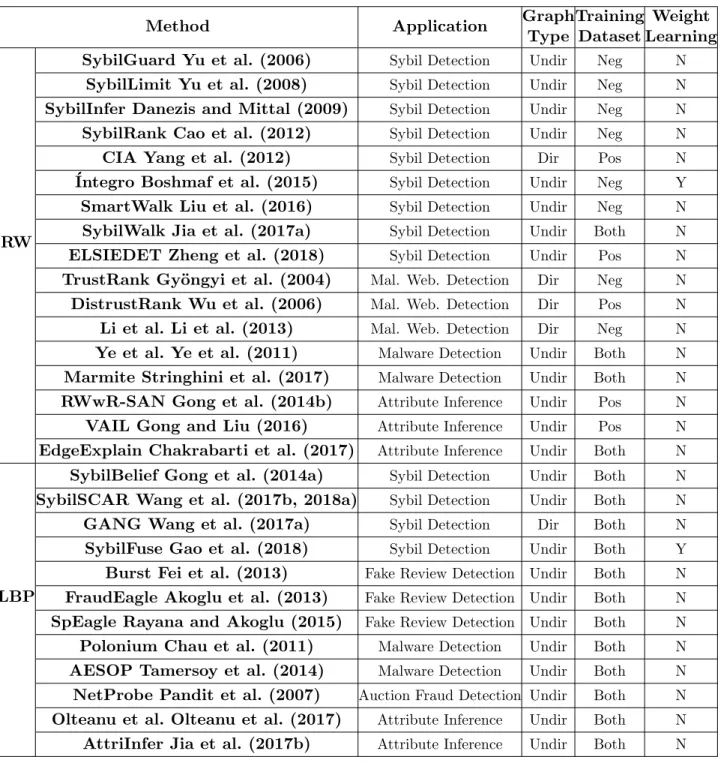
appli-cations. Graph Type: “Undir” and “Dir” respectively indicate a collective classification method uses an undirected graph or a directed graph. Training Dataset: “Neg”, “Pos”, or “Both” means that a method leverages labeled negative nodes, labeled positive nodes, or both to assign prior reputation scores. Weight Learning: “Y” or “N” means that a method learns edge weights or does not. We note that all these methods assign edge weights
and fix them in Step II. . . 5
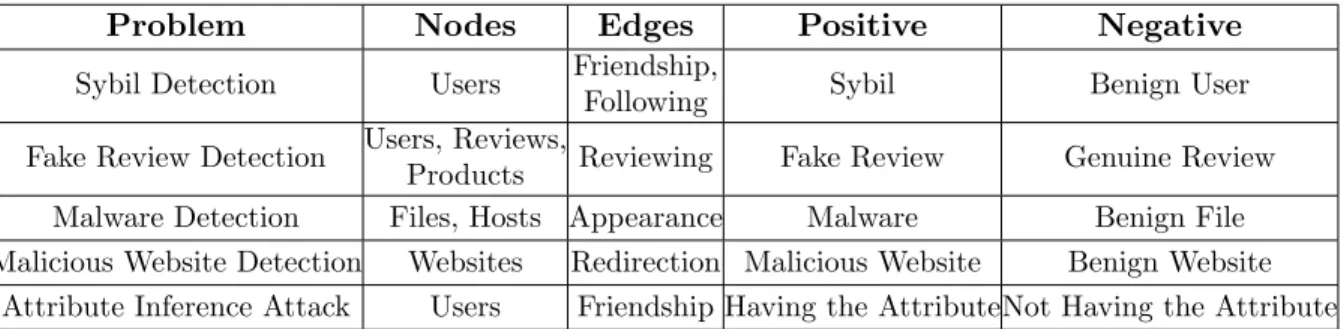
Table 1.2 Possible meanings of nodes, edges, positive, and negative in example security and privacy application scenarios. . . 6
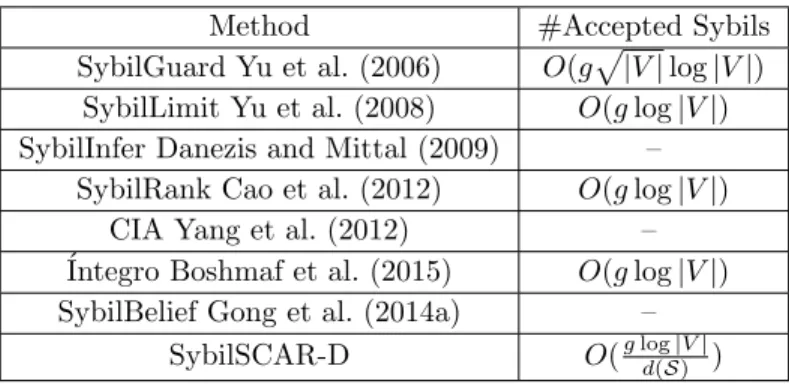
Table 3.1 Summary of theoretical guarantees of various collective classification meth-ods. g is the number of attack edges (sum of weights on the attack edge for ´Integro) andd(B)min is the minimum node degree in the benign region. SybilGuard requires g = o(p|V|/log|V|). “–” means the corresponding bound is unknown. . . 24
Table 3.2 Dataset statistics. . . 27
Table 4.1 Dataset statistics. . . 51
Table 4.2 AUCs of compared methods. . . 53
Table 4.3 Labeling results of the 1K nodes that are sampled from the top-ranked 100K nodes for Sina Weibo. . . 57
Table 5.1 Dataset statistics. . . 72
Table 5.2 AUCs of undirected methods. . . 76
Table 5.3 AUCs of directed methods. . . 77
Table 5.4 Composition of the manually labeled 1,000 randomly sampled users. . . 84
LIST OF FIGURES
Page Figure 1.1 Illustration of collective classification. . . 2
2.1 Our proposed framework to unify state-of-the-art RW-based and LBP-based Sybil detection methods. . . 11
Figure 3.1 Benign region, Sybil region, and attack edges. . . 17
Figure 3.2 Residual posterior probabilities of unlabeled benign nodes. . . 26
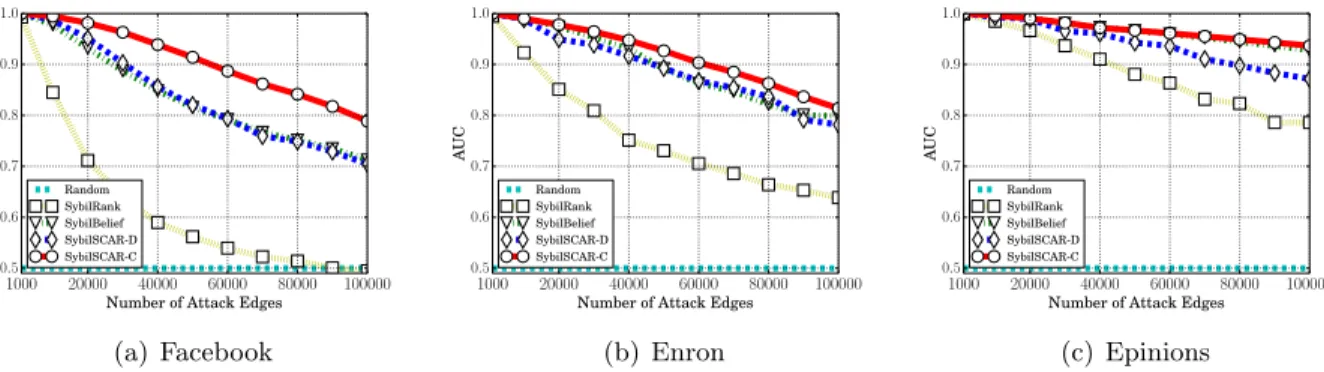
Figure 3.3 AUCs of compared methods as the number of attack edges becomes large. SybilSCAR-C and SybilSCAR-D are substantially more accurate than Sybil-Rank, and SybilSCAR-C is slightly more accurate than SybilBelief and SybilSCAR-D, when the number of attack edges is large. . . 30
Figure 3.4 Fraction of Sybils in top ranked intervals on the Twitter dataset. SybilSCAR-C performs better than SybilBelief and SybilSSybilSCAR-CAR-D, while SybilSSybilSCAR-CAR-D and SybilBelief perform much better than SybilRank. . . 32
Figure 3.5 AUCs of SybilRank, SybilBelief, SybilSCAR-D, and SybilSCAR-C vs. level of label noise. SybilSCAR-C is slightly better than SybilSCAR-D and Sybil-Belief, while they are much more robust to label noise than SybilRank. Note that SybilBelief and SybilSCAR-C overlap in (a). . . 33
Figure 3.6 Space and time efficiency of SybilRank, SybilBelief, and SybilSCAR-C (SybilSCAR-D has the same space and time efficiency with SybilSCAR-C), vs. number of edges. SybilSCAR-C and SybilRank have almost the same space and time efficiency, while SybilSCAR-C is several times more space efficient and one order of magnitude more time efficient than SybilBelief. . . 34
Figure 3.7 Relative errors of SybilRank, SybilBelief, SybilSCAR-D, and SybilSCAR-C vs. the number of iterations on Facebook with 1,000 attack edges. Sybil-Rank, SybilSCAR-D, and SybilSCAR-C can converge, but SybilBelief cannot. 35
Figure 3.8 AUCs of (a) SybilSCAR-D and (b) SybilSCAR-C for different levels of label noise and different values for the parameterθ. . . 36
Figure 4.1 Illustration of three types of neighbors. v1,v2, andv3 arebidirectional, uni-directional incoming, and unidirectional outgoing neighbors ofu, respectively. 41
Figure 4.2 Fraction of Sybils in each top ranked interval on Twitter. . . 54
Figure 4.3 GANG’s relative errors of residual posterior beliefs vs. number of iterations. GANG converges. . . 55
Figure 4.4 Running time of directed graph based methods on synthesized graphs with increasing number of edges. DistrustRank and CIA have almost identical results with TrustRank, and thus we omit their results for conciseness. . . . 56
Figure 4.5 (a) A user performing periodic tweeting. (b) Search results of one of the user’s tweet on Baidu. . . 58
Figure 5.1 Jointly learning edge weights and updating posterior reputation scores. . . . 69
Figure 5.2 Average weight learnt by (a) LBP-JWP-U and (b) LBP-JWP-D of edges be-tween positive nodes and negative nodes, edges bebe-tween positive nodes, and edges between negative nodes on Twitter, as the number of iterations in-creases. We observe that on both methods, the average weights of edges be-tween positive nodes and negative nodes decrease, while the average weights of edges between negative (or positive) nodes increase ast increases. . . 78
Figure 5.3 Impact of (a) the regularization parameter λ and (b) the learning rate γ. Asλandγ increase, AUCs of our methods first increase, then stabilize, and finally decrease. . . 79
Figure 5.4 Impact of the number of iterations on the AUCs of our methods. We observe that AUCs first gradually increase as we perform more iterations and then stabilize. . . 80
Figure 5.5 Running time on synthesized graphs with increasing number of edges. (a) Methods for undirected graphs. (b) Methods for directed graphs. . . 81
Figure 5.6 Impact of label noise on Twitter. (a) RW-based methods for undirected graphs; (b) LBP-based methods for undirected graphs; (c) Methods for directed graphs. . . 82
Figure 5.7 Fraction of Sybils in the sampled 100 users in each of the top-10 10K-user intervals for LBP-JWP-D on the Sina Weibo dataset. . . 84
ACKNOWLEDGEMENTS
I would like to express my sincere gratitude to my supervisor, Prof. Neil Zhenqiang Gong, for his continuous support for my Ph.D. study and research. His guidance and encourgement helped me all the time when I was stuck and depressed. His research enthusiasm and research style have influenced me profoundly on my research career.
In addition, I would like to thank my committee members, including Prof. Daji Qiao, Prof. Yong Guan, Prof. Doug Jacobson, and Prof. Jin Tian, for their insightful comments and suggestions that have broadened my research horizon from different perspectives. A specical thanks goes to Prof. Daji Qiao. Without his help, I would have no chance to get to know my supervisor.
I also want to thank my collaborators. During my Ph.D. study, I have collaborated with Yinzhi Cao, Yiu-ming Cheung, Hao Fu, Peng Gao, Neil Gong, Jinyuan Jia, Sanjeev Kulkarni, Song Li, Chuang Lin, Risheng Liu, Prateek Mittal, Luke Myers, Meng Pang, Daji Qiao, Kurt Thomas, Le Zhang, and Tianchen Zhou. I have benefited a lot from my collaborators.
I would additionally like to thank my friends: Xiaoyu Cao, Xiaoyi Dou, Yesta Izenov, Jinyuan Jia, Yueyi Jiao, Siyao Li, Zhonghao Liao, Zhaoyu Liu, Liqun Ma, Shou Tang, Pengyuan Wang, Ling Xiang, Songzhe Xu, Bo Yang, Shuo Yang, Anji Yu, Le Zhang, and Zhikun Zhong. I have spent a wonderful time with them at Iowa State University.
Last but not least, I am so grateful to my wife Yun Dong and my parents for their endless love and support.
ABSTRACT
Graphs are a powerful tool to represent complex interactions between various entities. A par-ticular family of graph-based machine learning techniques calledcollective classification have been applied to various security and privacy problems, e.g., malware detection, Sybil detection in social networks, fake review detection, malicious website detection, auction fraud detection, APT infec-tion detecinfec-tion, attribute inference attacks, etc.. Moreover, some collective classificainfec-tion methods have been deployed in industry, e.g., Symantec deployed collective classification to detect malware; Tuenti, the largest social network in Spain, deployed collective classification to detect Sybils.
In this dissertation, we aim to systematically study graph-based security and privacy problems that are modeled via collective classification. In particular, we focus on collective classification methods that leverage random walk (RW) or loopy belief propagation (LBP).
First, we propose a local rule-based framework to unify existing RW-based and LBP-based methods. Under our framework, existing methods can be viewed as iteratively applying a different local rule to every node in the graph. know about the node.
Second, we design a novel local rule for undirected graphs. Based on our local rule, we propose a collective classification method that can maintain the advantages and overcome the disadvantages of state-of-the-art undirected graph-based collective classification methods for Sybil detection.
Third, many security and privacy problems are modeled using directed graphs. Directed based security and privacy problems have their unique characteristics. Existing undirected graph-based collective classification methods (e.g., LBP-graph-based methods) cannot be applied to directed graphs and existing directed graph-based methods (e.g., RW-based methods) cannot make full use of the labeled training set. To address the issue, we develop a novel local rule for directed graph-based Sybil detection and propose a collective classification method that captures unique characteristics of directed graph-based Sybil detection.
Finally, one key issue of all collective classification methods is that they either assign small weights to a large number of edges whose two corresponding nodes have the same label or/and assign large weights to a large number of edges whose two corresponding nodes have different labels. Although collective classification has been studied and applied for security and privacy problems for more than a decade, it is still challenging to assign edge weights such that an edge has a large weight if the two corresponding nodes have the same label, and a small weight otherwise. We develop a novel collective classification framework to address this long-standing challenge. Specifically, we first formulate learning edge weights as an optimization problem, which, however, is computationally challenging to solve. Then, we relax the optimization problem and design an efficient joint weight learning and propagation algorithm to solve this approximate optimization problem.
CHAPTER 1. OVERVIEW
1.1 Collective Classification
Graphs are a powerful tool to represent complex interactions between various entities. A par-ticular family of graph-based machine learning techniques called collective classification Sen et al. (2008) have been studied from multiple communities such as security, data mining, and network-ing. Figure1.1illustrates the setting of collective classification for binary classes: given 1) a graph, which can be either undirected or directed, and 2) a training dataset, which consists of some la-beled positive nodes (+) and/or lala-beled negative nodes (-), collective classification is to classify the remaining unlabeled nodes (?) to be positive or negative simultaneously.
State-of-the-art collective classification methods Gy¨ongyi et al. (2004); Wu et al. (2006); Li et al. (2013); Pandit et al. (2007); Chau et al. (2011); Mohaisen et al. (2011); Cao et al. (2012); Gong et al. (2014a); Tamersoy et al. (2014); Akoglu et al. (2013); Li et al. (2014); Rayana and Akoglu (2015); Stringhini et al. (2017); Wang et al. (2017b); Jia et al. (2017a); Wang et al. (2017a); Boshmaf et al. (2015); Wang et al. (2018a); Gao et al. (2018) have three key steps. In Step I, they assign a prior reputation score to every node in the graph based on the training dataset. In Step II, they assign weights to edges in the graph, where a large weight of an edge (u, v) indicates that u and v are likely to have the same label. In Step III, they iteratively propagate the prior reputation scores among the weighted graph to obtain a posterior reputation score for every node. The posterior reputation scores are used to classify or rank nodes. The details of one or more of the three steps could be different for different collective classification methods. For instance, some methods leverage random walks for propagation in Step III, while some methods leverage loopy belief propagation in Step III, which we call random walk (RW)-based methods and loopy belief propagation (LBP)-based methods, respectively.
Figure 1.1 Illustration of collective classification.
1.1.1 RW-based methods
Depending on which labeled nodes in the training dataset are used to assign the prior reputation scores in Step I, we classify RW-based methods into three categories, i.e., RW that only leverages labeled negative nodes (RW-N), RW that only leverages positive nodes (RW-P), and RW that leverages both labeled positive nodes and labeled negative nodes (RW-B). RW-N Wu et al. (2006); Gy¨ongyi et al. (2004); Cao et al. (2012); Li et al. (2013); Boshmaf et al. (2015); Gong and Liu (2016) leverages labeled negative nodes to assign prior reputation scores, e.g., every labeled negative node in the training dataset has a prior reputation score of -1 (the absolute value of the reputation score does not matter since these RW-based methods rely on relative reputation scores) and the remaining nodes have prior reputation scores of 0. RW-P Wu et al. (2006); Yang et al. (2012) leverages labeled positive nodes to assign prior reputation scores, e.g., every labeled positive node has a prior reputation score of 1 and the remaining nodes have prior reputation scores of 0. RW-B Zhu et al. (2003); Ye et al. (2011); Jia et al. (2017a) leverages both labeled positive nodes and labeled negative nodes to assign prior reputation scores, e.g., labeled positive nodes, labeled negative nodes, and unlabeled nodes have prior reputation scores of 1, -1, and 0, respectively.
In Step II, most RW-based methods simply set a constant weight to all edges. ´Integro Boshmaf et al. (2015), developed under the context of Sybil detection in social networks, learns edge weights using features extracted from nodes. Specifically, ´Integro first trains a node classifier based on
nodes’ features to predict the probability that a node is a victim (a victim is a negative node connecting to at least one positive node). Then, ´Integro assigns small weights to all edges of the nodes that are predicted to be victims. For notation convenience, we denote ´Integro as RW-FLW (Fixed Learnt Weights) since it learns the edge weights and fixes them in Step II.
In Step III, different methods use different random walks to propagate the reputation scores. For instance, on an undirected graph, RW-N, RW-P, and RW-FLW iteratively distribute a node’s current reputation score to its neighbors and a node sums the reputation scores distributed from its neighbors as its new reputation score. In particular, a nodeu shares a fraction of its reputation score to a neighbor v, where the fraction is the edge weight divided by the weighted degree of u. On a directed graph, RW-N Gy¨ongyi et al. (2004) (or RW-P Wu et al. (2006); Yang et al. (2011)) shares a fraction of node u’s current reputation score to each outgoing (or incoming) neighbor, where the fraction is the edge weight divided by the total weights of u’s outgoing (or incoming) edges. RW-B is applicable to undirected graphs and uses a different random walk to propagate reputation scores. Specifically, the fraction is the edge weight divided by the weighted degree ofv
instead ofu when ushares its reputation score to a neighbor v.
1.1.2 LBP-based methods
These methods Pandit et al. (2007); Chau et al. (2011); Gong et al. (2014a); Tamersoy et al. (2014); Akoglu et al. (2013); Li et al. (2014); Rayana and Akoglu (2015); Wang et al. (2017b,a); Gao et al. (2018); Wang et al. (2018a) leverage both labeled positive nodes and labeled negative nodes in the training dataset to assign prior reputation scores in Step I, e.g., labeled positive nodes, labeled negative nodes, and unlabeled nodes have prior reputation scores of 1, -1, and 0, respectively. In Step II, most LBP-based methods simply set a constant weight to all edges in the graph. SybilFuse Gao et al. (2018), developed under the context of Sybil detection, learns edge weights using features extracted from the graph structure. Specifically, SybilFuse first trains a node classifier using structure-based node features (e.g., local clustering coefficient) to predict the prior reputation score for each node. Then, SybilFuse uses the prior reputation scores to assign edge
weights in a way that a larger edge weight is assigned if the two corresponding nodes are more likely to have the same label based on the prior reputation scores. We note that SybilFuse can also extract structure-based edge features (e.g., common neighbors between two nodes) to train an edge classifier to assign the edge weights. To stress the fact that SybilFuse learns edge weights and fixes them in Step II, we denote it as LBP-FLW.
In Step III, these LBP-based methods Pandit et al. (2007); Chau et al. (2011); Gong et al. (2014a); Tamersoy et al. (2014); Akoglu et al. (2013); Li et al. (2014); Rayana and Akoglu (2015) leverage either a standard LBP Pearl (1988) or an optimized LBP Gatterbauer et al. (2015); Wang et al. (2017b,a); Gatterbauer (2017); Wang et al. (2018a) to propagate the reputation scores among the weighted graph. The optimized LBP is an order of magnitude more efficient than the standard LBP. On an undirected graph, the optimized LBP shares a fraction of a node u’s reputation score to its neighbor v, where the fraction is simply the edge weight, and a node sums its prior reputation score and the reputation scores shared from its neighbors as its new reputation score in each iteration. On a directed graph, the optimized LBP shares a node u’s reputation score to its neighborv like on an undirected graph if both the directed edges (u, v) and (v, u) exist. However, whenuconnectsvwith only an outgoing edge, the optimized LBP sharesu’s reputation score with
v like on an undirected graph only if u’s current reputation score is negative. When u connects
v with only an incoming edge, the optimized LBP shares u’s reputation score with v only if u’s current reputation score is positive.
1.2 Modeling Security/Privacy Problems As Collective Classification
Studies from multiple communities–such as security, data mining, and networking–have shown that various security and privacy problems can be modeled as collective classification on graphs. Such security and privac problems include malware detection Chau et al. (2011); Ye et al. (2011); Rajab et al. (2013); Tamersoy et al. (2014); Stringhini et al. (2017), Sybil detection in social networks Yu et al. (2006, 2008); Danezis and Mittal (2009); Viswanath et al. (2010); Mohaisen et al. (2011); Yang et al. (2011); Cao et al. (2012); Boshmaf et al. (2015); Gong et al. (2014a); Fu
Table 1.1 Representative methods developed for different security and privacy applica-tions. Graph Type: “Undir” and “Dir” respectively indicate a collective classifi-cation method uses an undirected graph or a directed graph. Training Dataset: “Neg”, “Pos”, or “Both” means that a method leverages labeled negative nodes, labeled positive nodes, or both to assign prior reputation scores. Weight Learn-ing: “Y” or “N” means that a method learns edge weights or does not. We note that all these methods assign edge weights and fix them in Step II.
Method Application Graph
Type Training Dataset Weight Learning RW
SybilGuard Yu et al. (2006) Sybil Detection Undir Neg N
SybilLimit Yu et al. (2008) Sybil Detection Undir Neg N
SybilInfer Danezis and Mittal (2009) Sybil Detection Undir Neg N
SybilRank Cao et al. (2012) Sybil Detection Undir Neg N
CIA Yang et al. (2012) Sybil Detection Dir Pos N
´Integro Boshmaf et al. (2015) Sybil Detection Undir Neg Y
SmartWalk Liu et al. (2016) Sybil Detection Undir Neg N
SybilWalk Jia et al. (2017a) Sybil Detection Undir Both N
ELSIEDET Zheng et al. (2018) Sybil Detection Undir Pos N
TrustRank Gy¨ongyi et al. (2004) Mal. Web. Detection Dir Neg N
DistrustRank Wu et al. (2006) Mal. Web. Detection Dir Pos N
Li et al. Li et al. (2013) Mal. Web. Detection Dir Neg N
Ye et al. Ye et al. (2011) Malware Detection Undir Both N
Marmite Stringhini et al. (2017) Malware Detection Undir Both N
RWwR-SAN Gong et al. (2014b) Attribute Inference Undir Pos N
VAIL Gong and Liu (2016) Attribute Inference Undir Pos N
EdgeExplain Chakrabarti et al. (2017) Attribute Inference Undir Both N
LBP
SybilBelief Gong et al. (2014a) Sybil Detection Undir Both N
SybilSCAR Wang et al. (2017b, 2018a) Sybil Detection Undir Both N
GANG Wang et al. (2017a) Sybil Detection Dir Both N
SybilFuse Gao et al. (2018) Sybil Detection Undir Both Y
Burst Fei et al. (2013) Fake Review Detection Undir Both N
FraudEagle Akoglu et al. (2013) Fake Review Detection Undir Both N
SpEagle Rayana and Akoglu (2015) Fake Review Detection Undir Both N
Polonium Chau et al. (2011) Malware Detection Undir Both N
AESOP Tamersoy et al. (2014) Malware Detection Undir Both N
NetProbe Pandit et al. (2007) Auction Fraud Detection Undir Both N
Olteanu et al. Olteanu et al. (2017) Attribute Inference Undir Both N
Table 1.2 Possible meanings of nodes, edges, positive, and negative in example security and privacy application scenarios.
Problem Nodes Edges Positive Negative
Sybil Detection Users Friendship,
Following Sybil Benign User
Fake Review Detection Users, Reviews,
Products Reviewing Fake Review Genuine Review
Malware Detection Files, Hosts Appearance Malware Benign File
Malicious Website Detection Websites Redirection Malicious Website Benign Website
Attribute Inference Attack Users Friendship Having the AttributeNot Having the Attribute
et al. (2017); Wang et al. (2017b, 2018a); Jia et al. (2017a); Wang et al. (2017a); Zheng et al. (2018); Gao et al. (2018), fake review detection Akoglu et al. (2013); Li et al. (2014); Rayana and Akoglu (2015), malicious website detection Gy¨ongyi et al. (2004); Wu et al. (2006); Li et al. (2013), auction fraud detection Pandit et al. (2007), APT infection detection Oprea et al. (2015), and attribute inference attacks Zheleva and Getoor (2009); Gong et al. (2014b); Chaabane et al. (2012); Gong and Liu (2016); Jia et al. (2017b); Olteanu et al. (2017); Gong and Liu (2018). Moreover, some collective classification methods have been deployed in industry, e.g., Symantec deployed collective classification to detect malware Tamersoy et al. (2014) and Tuenti, the largest social network in Spain, deployed collective classification to detect Sybils Cao et al. (2012); Boshmaf et al. (2015).
For different graph-based security and privacy applications, nodes represent different entities, edges represent different relationships, and the labels “positive” and “negative” have different semantic meanings. Table 1.1 list representative methods developed for different security and privacy applications. Table 1.2 summarizes several security and privacy problems that can be modeled as collective classification on graphs. We note that some security problems Kwon et al. (2015); Feng et al. (2016); Xu et al. (2017) can be modeled as graph analytics other than collective classification. However, we focus on collective classification based security/privacy analytics.
• Sybil detection in social networks. Social networks (e.g., Facebook, Twitter, Sina Weibo) are fundamentally vulnerable to an attack called Sybil attack, in which an attacker manages a large number of malicious users (also called Sybils). An attacker can use these Sybils perform various malicious activities such as disrupting democratic election Hacking Election.
(2016), influencing financial market Hacking Financial Market. (2016), distributing spams and phishing attacks Thomas et al. (2011), as well as harvesting private user data Bilge et al. (2009). Therefore, detecting Sybils in social networks is a fundamental security research problem. Various graph-based collective classification methods Gong et al. (2014a); Gao et al. (2015); Wang et al. (2017b); Jia et al. (2017a); Fu et al. (2017); Pandit et al. (2007); Danezis and Mittal (2009); Cao et al. (2012); Rayana and Akoglu (2015); Gy¨ongyi et al. (2004); Wu et al. (2006); Yang et al. (2012); Boshmaf et al. (2015) have been proposed to detect Sybils on social graphs. An example graph-based method called SybilRank Cao et al. (2012) and its enhanced version called Integro Boshmaf et al. (2015) have been deployed by Tuenti, the largest social network in Spain, to detect a large amount of Sybils. In a social graph, nodes are users and edges represent friendships or following relationships between users; a positive node means a Sybil and a negative node means a benign user.
• Malware detection. Imagine many end hosts have installed a certain antivirus software from a certain security company (e.g., Symantec). The security company has access to the executable files on all these hosts. Therefore, the security company can construct a host-file graph to represent the relationships between hosts and executable files. Specifically, in this graph, a node is a host or an executable file; an edge between a host and an executable file means that the file is on the host.
In malware detection, a host-file graph is constructed to represent the relationships between hosts and executable files Chau et al. (2011); Ye et al. (2011); Rajab et al. (2013); Tamersoy et al. (2014); Stringhini et al. (2017). Specifically, in this graph, a node is a host or an executable file; an edge between a host and an executable file means that the file appears on the host; a positive node means a malware or compromised host, while a negative node means a benign file or normal host.
• Fake review detection. Online reviews capture the testimonials of “real” people and help shape the decisions of other consumers. Financial incentives associated with reviews, however, have created a market of (often paid) users to fabricate fake reviews to either
un-justly hype (for promotion) or defame (under competition) a product or business. Therefore, detecting fake reviews in social graphs is important. In fake review detection, a user–review– product graph is constructed to represent the relationships between users, reviews, and prod-ucts Rayana and Akoglu (2015). In this graph, a node is a user, a review, or a product; an edge between a user and a review means that the user writes the review; an edge between a review and a product means that the review is for the product; a positive node means a fake review while a negative node means a genuine review.
• Attribute inference attacks in social networks. Attribute inference has serious impli-cations for Internet privacy as well as appliimpli-cations for targeted advertisements and personal-ized recommendation. Therefore, various parties (e.g., cyber criminal, online social network provider, advertiser, data broker, and surveillance agency) are motivated to perform attribute inference. In the attribute inference attack, an attacker aims to infer users’ private attributes (e.g., locations, sexual orientation, and interests) using their public data (e.g., page likes on Facebook and friend list) in social networks. The graph is the social graph between users; a node is positive if the node has a given attribute (e.g., republican), otherwise the node is negative.
1.3 Pros and Cons of Existing Collective Classification Methods
RW-based methods have the following pros: 1) they are scalable; 2) they can guarantee to converge; 3) they have theoretically guaranteed performance; and 4) they are applicable to both undirected and directed graphs. However, they suffer from several key limitations: 1) they are not robust to label noise in the training dataset. The label of a user is noisy if the label is incorrect. Label noise often exists in practice due to human mistakes when manually labeling users Thomas et al. (2011); 2) they have limited performance in graphs with weak homophily. Strong homophily means that two connected nodes are likely to share the same label with high probability. LBP-based methods can 1) leverage both labeled positive nodes and labeled negative nodes; 2) be robust to label noise; and 3) tolerate graphs with a relative weak homophily. However, 1) they
cannot guarantee convergence on real-world graphs; 2) they are not scalable; 3) they do not have theoretically guaranteed performance; and 4) they cannot be directly applied to directed graphs. Furthermore, a common limitation of both RW-based methods and LBP-based methods is that they assign edge weights inappropriately.
1.4 Organization of The Dissertation
The focus of this dissertation is to study security and privacy problems that are modeled via collective classification, and address the limitations of existing RW-based and LBP-based collective classification methods.
In Chapter 2, we develop a local rule-based framework to unify existing RW-based and LBP-based methods. Under our framework, different collective classification methods reduce to designing different local rules.
In Chapter3, we design a novel local rule forundirected graph-based Sybil detection and propose a method that integrates advantages of existing RW-based and LBP-based Sybil detection methods, while overcoming their limitations. For instance, our method can guarantee to converge and has theoretically guaranteed performance.
In Chapter4, we design a novel local rule fordirected graph-based Sybil detection. In contrast to undirected graphs, directed graph-based Sybil detection has its unique characteristics. We propose a customized pairwise Markov Random Field model to capture these unique characteristics, and infer the model via LBP. Furthermore, we optimize our method to make it scalable and convergent. In Chapter 5, we design an edge weight learning framework for graph-based collective classifi-cation methods. Our framework formulates learning edge weights as an optimization problem and learns edge weights such that an edge has a large weight if the two corresponding nodes have the same label, and a small weight otherwise.
CHAPTER 2. COLLECTIVE CLASSIFICATION UNDER A LOCAL RULE-BASED FRAMEWORK
2.1 Our Local Rule-based Framework
State-of-the-art collective classification methods Gy¨ongyi et al. (2004); Wu et al. (2006); Li et al. (2013); Pandit et al. (2007); Chau et al. (2011); Mohaisen et al. (2011); Cao et al. (2012); Gong et al. (2014a); Tamersoy et al. (2014); Akoglu et al. (2013); Li et al. (2014); Rayana and Akoglu (2015); Stringhini et al. (2017); Wang et al. (2017b); Jia et al. (2017a); Wang et al. (2017a); Boshmaf et al. (2015); Wang et al. (2018a); Gao et al. (2018) in social graphs can be grouped into Random Walk (RW)-based methods and Loop Belief Propagation (LBP)-based methods. Given a training dataset, these methods iteratively propagate label information among the social graph to predict labels for users. RW-based methods implement the propagation using random walks, while LBP-based methods implement the propagation using Loopy Belief Propagation Pearl (1988).
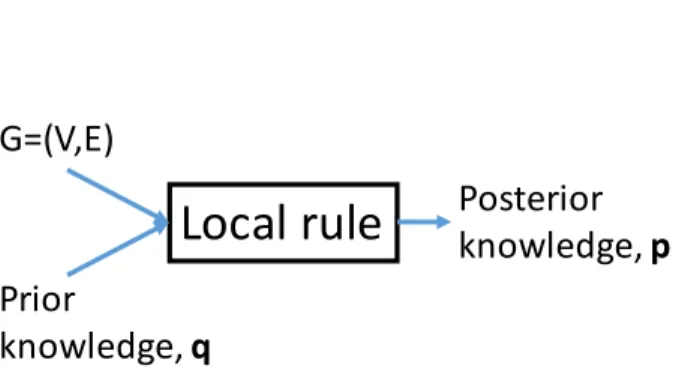
We can unify existing RW-based methods Mohaisen et al. (2011); Cao et al. (2012); Yang et al. (2012); Boshmaf et al. (2015); Liu et al. (2016) and LBP-based methods Gong et al. (2014a); Gao et al. (2018) into a local rule-based framework, although RW-based methods and LBP-based meth-ods use very different mathematical foundations (i.e., RW vs. LBP). Specifically, these methmeth-ods first assign the prior knowledge of all nodes using a training dataset. Then, they propagate the prior knowledge among the social network to obtain theposterior knowledge via iteratively apply-ing their local rules to every node. A local rule is to update the posterior knowledge of a node by combining the influences from its neighbors with its prior knowledge. We call the influence from a neighbor neighbor influence. Figure 2.1 shows our unified framework. Under our framework, designing a new collective classification method is reduced to designing a new local rule.
Notations: We denote bywuvthe weight of the edge (u, v), Γuthe set of neighbors of nodeu, and du the total weights of edges linked to u, i.e., du =Pv∈Γuwuv. In RW-based methods Mohaisen
Prior
knowledge,
q
Local rule
G=(V,E)
Posterior
knowledge,
p
Figure 2.1 Our proposed framework to unify state-of-the-art RW-based and LBP-based Sybil detection methods.
et al. (2011); Yang et al. (2012); Boshmaf et al. (2015), edge weights model the relative importance (e.g., level of trust) of edges. In LBP-based method Gong et al. (2014a), an edge weightwuvmodels
the tendency thatu andv share the same label. We denote byqu and pu the prior knowledge and
posterior knowledge of the node u, respectively. In RW-based methods, qu and pu are the prior
and posterior reputation scores of u, respectively, and they represent relative benignness of nodes. In LBP-based methods,qu and pu are the prior and posterior probabilities that node u is a Sybil,
respectively.
2.1.1 Additive Local Rule of RW-based Methods
State-of-the-art RW-based methods Mohaisen et al. (2011); Cao et al. (2012); Yang et al. (2012); Boshmaf et al. (2015) first assign prior reputation scores for every node using a training dataset. Then they iteratively apply the following local rule to every node:
pu = (1−α) X v∈Γu pv wuv dv | {z } neighbor influence +α qu |{z} prior knowledge , (2.1)
whereα∈[0,1] is called a restart probability of the random walk. We note that SybilRank uses a restart probability of 0 and normalizes the final reputation scores by node degrees.
We have two observations for the additive local rule. First, the neighbor influence from a neighbor v to u is a fraction of v’s current reputation score pv, and the fraction is proportional
to the edge weight wuv. Second, this local rule combines the prior knowledge and the neighbor
2.1.2 Multiplicative Local Rule of LBP-based Methods
SybilBelief Gong et al. (2014a), a LBP-based method, associates a binary random variable xu
with each nodeu, wherexu= 1 indicates thatu is Sybil whilexu =−1 indicates thatuis benign.
Then,qu andpu are the prior and posterior probabilities thatxu = 1, respectively. SybilBelief first
assigns the prior probabilities for nodes using a set of labeled benign nodes and/or a set of labeled Sybils, and then it iteratively applies the following local rule Gong et al. (2014a):
mvu(xu) | {z } neighbor influence =X xv φv(xv)ϕvu(xv, xu) Y z∈Γv/u mzv(xv) (2.2) pu= prior knowledge z}|{ qu Qv∈Γumvu(1) quQv∈Γumvu(1) + (1−qu) Q v∈Γumvu(−1) , (2.3)
where node potential φv(xv) and edge potentialϕvu(xv, xu) are defined as follows:
φv(xv) := qv ifxv = 1 1−qv ifxv =−1, ϕvu(xv, xu) := wvu ifxuxv = 1 1−wvu ifxuxv =−1.
We also have two observations for the multiplicative local rule. First, this local rule explicitly models neighbor influences. Specifically, the neighbor influence from a neighborvtou(i.e.,mvu(xu))
is defined in Equation 2.2. To compute the neighbor influence mvu(xu), u’s neighbor v needs to
multiply the neighbor influences from all its neighbors exceptu. Second, according to Equation2.3, this local rule combines the neighbor influences with the prior probabilitynonlinearly.
2.1.3 Comparing Additive Local Rule with Multiplicative Local Rule
LBP-based multiplicative local rule can tolerate a relatively larger fraction of label noise because of its nonlinearity Gong et al. (2014a), and it can leverage both labeled benign nodes and labeled Sybils. However, LBP-based multiplicative local rule is space and time inefficient because it requires a large amount of space and time to maintain the neighbor influences associated with every edge, and methods using this local rule are not guaranteed to converge.
CHAPTER 3. COLLECTIVE CLASSIFICATION ON UNDIRECTED GRAPHS FOR SYBIL DETECTION IN SOCIAL NETWORKS
3.1 Introduction
Most collective classification methods Yu et al. (2006, 2008); Danezis and Mittal (2009); Mo-haisen et al. (2011); Cao et al. (2012); Yang et al. (2012); Boshmaf et al. (2015); Liu et al. (2016); Jia et al. (2017a); Zhang et al. (2016); Gong et al. (2014a); Gao et al. (2018); Fu et al. (2017); Wang et al. (2017a) for Sybil detection can be grouped into Random Walk (RW)-based methods and Loop Belief Propagation (LBP)-based methods. RW-based methods Yu et al. (2006, 2008); Danezis and Mittal (2009); Mohaisen et al. (2011); Cao et al. (2012); Yang et al. (2012); Boshmaf et al. (2015); Liu et al. (2016); Jia et al. (2017a) suffer from the major limitations: 1) they can only leverage either labeled benign users or labeled Sybils in the training dataset, but not both, which limits their detection accuracies; and 2) they are not robust to label noise in the training dataset. The label of a user is noisy if the label is incorrect. Label noise often exists in practice due to human mistakes when manually labeling users Thomas et al. (2011); Wang et al. (2013). LBP-based methods Gong et al. (2014a); Gao et al. (2018); Fu et al. (2017) suffer from the major limitations: 1) they cannot guarantee convergence on real-world social networks; 2) they are not scalable; and 3) they do not have theoretically guaranteed performance. The first limitation makes LBP-based methods sensitive to the number of iterations that the methods run.
Our work: We propose a novel collective classification method, called SybilSCAR, to perform Sybil detection in undirected social networks. SybilSCAR combines the advantages of existing RW-based methods and LBP-based methods, while overcoming their limitations. Specifically, SybilSCAR isScalable,Convergent, Accurate, andRobust to label noise.
First, we design a novel local rule that integrates the advantages of both RW-based methods and LBP-based methods, while overcoming their limitations. SybilSCAR iteratively applies our local
rule to every user. Our local rule, like RW-based methods and LBP-based methods, leverages the homophily property of social networks. Homophily means that two linked users share the same label with a high probability. In our local rule, we associate a weight with each edge, which represents the probability that the two corresponding users have the same label. For a neighbor v ofu, our local rule models v’s influence (we call it neighbor influence) to u’s label as the probability thatu is a Sybil, givenv’s information alone. Our local rule combines neighbor influences and prior knowledge about a user in a multiplicative way to update knowledge about the user’s label. Moreover, we linearize the multiplicative local rule in order to make SybilSCAR convergent.
Second, we evaluate SybilSCAR and compare it with state-of-the-art RW-based methods and LBP-based methods both theoretically and empirically. Theoretically, we derive a bound on the number of Sybils that are accepted into a social network for SybilSCAR. Our bound is tighter than those of the existing methods. Moreover, we analyze the condition when SybilSCAR is guaranteed to converge. Empirically, we compare SybilSCAR with SybilRank Cao et al. (2012), a state-of-the-art RW-based method, and SybilBelief Gong et al. (2014a), a state-state-of-the-art LBP-based method, using 1) three real-world social networks with synthesized Sybils and 2) a large-scale Twit-ter dataset (41.7M users and 1.2B edges) with real Sybils. Our empirical results demonstrate that 1) SybilSCAR achieves better detection accuracies than SybilRank and SybilBelief, 2) SybilSCAR is robust to larger label noise than SybilRank, and is as robust as SybilBelief; 3) SybilSCAR is as space and time efficient as SybilRank, but is several times more space efficient and one order of magnitude more time efficient than SybilBelief; 4) SybilSCAR and SybilRank are convergent, but SybilBelief is not. For instance, in the large Twitter dataset, among the top-10K users that are predicted to be most likely Sybils by SybilRank, SybilBelief, and SybilSCAR, 0.33%, 77.5%, and 95.8% of them are real Sybils, respectively.
In summary, our key contributions are as follows:
• We design a novel local rule for undirected graphs and develop a novel collective clas-sification method, called SybilSCAR, to detect Sybils in social networks. SybilSCAR is convergent, scalable, robust to label noise, and more accurate than existing methods.
• We evaluate SybilSCAR both theoretically and empirically, and compare it with a state-of-the-art RW-based method and a state-state-of-the-art LBP-based method. Our theoretical results show that our method has a tighter bound on the number of Sybils that are falsely accepted into a social network than existing methods. Our empirical results on multi-ple social network datasets demonstrate that SybilSCAR significantly outperforms the state-of-the-art RW-based method in terms of accuracy and robustness to label noise, and that SybilSCAR outperforms the state-of-the-art LBP-based method in terms of accuracy, scalability, and convergence.
3.2 Problem Definition
We formally define our undirected graph-based Sybil detection problem in social networks, introduce our design goals, and describe the threat model we consider in the paper.
3.2.1 Undirected Graph-based Sybil Detection
Suppose we are given an undirected social network G= (V, E), where a node v∈V represents a user and an edge (u, v) ∈E indicates a (mutual) relationship between u and v. |V|and |E|are number of nodes and edges, respectively. For instance, on Facebook, an edge (u, v) could mean that u is in v’s friend list and vice versa. On Twitter, an edge (u, v) could mean thatu follows v. Our purpose is to design the local rule defined on the social networks to perform Sybil detection. Accordingly, we call this problem local rule-based Sybil detection.
Definition 1 (Undirect Graph-based Sybil Detection). Suppose we are given an undirected social network and a training dataset consisting of some labeled Sybils and labeled benign nodes. Undirect graph-based Sybil detection is to predict the label of each unlabeled node by leveraging the graph structure of the undirected social network.
3.2.2 Design Goals
1) Leveraging both labeled benign users and Sybils: Social network service providers often have a set of labeled benign users and labeled Sybils. For instance, verified users on Twitter or Facebook can be treated as labeled benign users; users spreading spam or malware can be treated as labeled Sybils, which can be obtained through manual inspection Cao et al. (2012) or crowdsourcing Wang et al. (2013). Our method should be able to leverage both labeled benign users and labeled Sybils to enhance detection accuracy.
2) Robust to label noise: A given label of a user is noisy if it does not match the user’s true label. Labeled users may have noisy labels. For instance, an adversary could compromise a labeled benign user or make a Sybil whitelisted as a benign user. In addition, labels obtained through manual inspection, especially crowdsourcing, often contain noises due to human mistakes Wang et al. (2013). We target a method that is robust to a minority fraction of incorrect labels.
3) Scalable: Real-world social networks often have hundreds of millions of users and edges. Therefore, our method should be scalable and easily parallelizable.
4) Convergent: Existing methods and our method are iterative methods. Convergence makes it easy to determine when to stop an iterative method. It is hard to set the best number of iterations for an iterative method that is not convergent. Therefore, our method should be convergent. 5) Theoretical guarantee: Our method should have a theoretical guarantee on the number of Sybils that can be falsely accepted into a social network. This theoretical guarantee is important for security-critical applications that leverage social networks, e.g., social network based Sybil defense in peer-to-peer and distributed systems Yu et al. (2006), and social network based anonymous communications Danezis et al. (2010).
Existing RW-based SybilGuard Yu et al. (2006) and SybilLimit Yu et al. (2008) do not satisfy 1), 2), and 3); SybilInfer Danezis and Mittal (2009) only satisfies the requirement 4); SybilRank Cao et al. (2012) and ´Integro Boshmaf et al. (2015) do not satisfy 1) and 2); CIA Yang et al. (2012) does not satisfy 1), 2), and 5). Existing LBP-based SybilBelief Gong et al. (2014a) and SybilFuse Gao et al. (2018) do not satisfy 3), 4), and 5).
Benign Region Sybil Region
Attack edges
Figure 3.1 Benign region, Sybil region, and attack edges.
3.2.3 Threat Model
We call the subgraph containing all benign nodes and edges between them the benign region, and call the subgraph containing all Sybil nodes and edges between them the Sybil region. Edges between the two regions are called attack edges. Figure3.1 illustrates these concepts.
One basic assumption under structure-based Sybil detection methods is that the benign region and the Sybil region are sparsely connected (i.e., the number of attack edges is relatively small), compared with the edges among the two regions. In other words, most benign users would not establish trust relationships with Sybils. We note that this assumption is equivalent to requiring that the social network followshomophily, i.e., two linked nodes share the same label with a high probability. For an extreme example, if the benign region and the Sybil region are separated from each other, then the social network has a perfect homophily, i.e., every two linked nodes have the same label. Note that, it is of great importance to obtain social networks that satisfy this assumption, otherwise the detection accuracies of collective classification methods are limited. For instance, Yang et al. Yang et al. (2014) showed that RenRen friendship social network does not satisfy this assumption, and thus the performance of collective classification methods are unsatis-factory. However, Cao et al. Cao et al. (2012) found that Tuenti, the largest online social network in Spain, satisfies the homophily assumption, and thus SybilRank can detect a large amount of Sybils in Tuenti.
Generally speaking, there are two ways for service providers to construct a social network that satisfies homophily. One way is to approximately obtain trust relationships between users by looking into user interactions Wilson et al. (2009), predicting tie strength Gilbert and Karahalios (2009), asking users to rate their social contacts Wei et al. (2012), etc. The other way is to preprocess the network structure so that collective classification methods are suitable to be applied. Specifically, analysts could detect and remove compromised benign nodes (e.g., front peers) Wang and Nakao (2010), or employ feature-based classifier to filter Sybils, so as to decrease the number of attack edges and enhance the homophily. For instance, Alvisi et al. Alvisi et al. (2013) showed that if the attack edges are established randomly, simple feature-based classifiers are sufficient to enforce Sybils to be suitable for structure-based Sybil detection. We note that the reason why the RenRen friendship social network did not satisfy homophily in the study of Yang et al. is that RenRen even didn’t deploy simple feature-based classifiers at that time Yang et al. (2014).
Formally, we measure homophily as the fraction of edges in the social network that are not attack edges. For the same benign region and Sybil region, more attack edges indicate weaker homophily. As we will demonstrate in our empirical evaluations, our SybilSCAR can tolerate weaker homophily than existing methods.
When analyzing the theoretical bound on the falsely accepted Sybils, SybilSCAR further as-sumes that the iterative process of SybilSCAR converges fast in the benign region, which is similar to the fast mixing assumption of RW-based methods.
3.3 Design of SybilSCAR
Under our local rule-based framework in Chapter 2, we know that designing a new Sybil de-tection method is reduced to designing a new local rule. Therefore, we aim to design a novel local rule in this Section. Then, we describe how we design SybilSCAR based on the new local rule.
3.3.1 Our New Local Rule
We aim to design a local rule that integrates the advantages of both RW-based and LBP-based local rules, while overcoming their limitations. Roughly speaking, our idea is to leverage the multiplicativeness like LBP-based local rule to be robust to label noise, while avoiding maintaining neighbor influences to be as space and time efficient as RW-based local rule. Next, we show how we model neighbor influences and combine neighbor influences with prior knowledge.
Neighbor influence: We denote wvu, which ranges from 0 to 1, as the homophily strength of
the edge (u, v). wuv >0.5 means that u and v are in a homogeneous relationship, i.e., they tend
to share the same label; wuv < 0.5 means that u and v are in a heterogeneous relationship, i.e.,
they tend to have the opposite labels; and wuv = 0.5 means thatu and v are not correlated. We
associate a binary random variable xu with a node u, where xu = 1 and xu = −1 mean that u
is a Sybil and benign node, respectively. We denote by fvu the neighbor influence from v to u,
wherev is a neighbor ofu. We modelfvu as the influence v has onu’s label, given v’s status and wvu. Specifically, fvu >0.5 means that v has a positive influence on u (i.e.,v tends to makeu to
be positive); fvu <0.5 means that v has a negative influence on u (i.e., v tends to make u to be
negative);fvu <0.5 means thatv has no influence on u (i.e.,v cannot decideus label).
Based on the homophily property, fvu should meet the following constraints:
pv = 0.5 orwvu= 0.5 =⇒fvu= 0.5 (3.1)
pv >0.5 andwvu>0.5 =⇒fvu>0.5 (3.2) pv <0.5 andwvu>0.5 =⇒fvu<0.5 (3.3) pv >0.5 andwvu<0.5 =⇒fvu<0.5 (3.4) pv <0.5 andwvu<0.5 =⇒fvu>0.5, (3.5)
where Equation3.1means that we cannot learn anything aboutu’s label ifv’s label is undecidable (i.e., pv = 0.5) or u and v are uncorrelated (i.e., wvu = 0.5); Equations 3.2 and 3.3 mean that u
and v tend to share the same label if they are in a homogeneous relationship; and Equations 3.4
To satisfy all the above constraints in Equations 3.1-3.5, we modelfvu as follows:
fvu=pvwvu+ (1−pv)(1−wvu). (3.6)
We can verify that fvu in Equation 3.6 indeed satisfies the above constraints. Another way to
interpret our model offvu is thatwvu is the probability that u and v have the same label andfvu
is the probability that u is a Sybil conditioned onwvu and pv. In our model, it is straightforward
to compute a neighbor influence fvu.
Combining neighbor influences with prior: In our local rule, a node’s posterior probability of being Sybil is updated by combining its neighbor influences with its prior probability of being Sybil. In order to tolerate label noise, we leverage the multiplicative local rule in LBP-based methods. Specifically, we have: pu = quQv∈Γufvu quQv∈Γufvu+ (1−qu) Q v∈Γu(1−fvu) . (3.7)
However, methods that iteratively apply the above multiplicative local rule to every user are not guaranteed to converge. Therefore we further linearize Equation 3.7. We first define two concepts residual variable and residual vector.
Definition 2(Residual Variable and Vector). We define the residual of a variabley asyˆ=y−0.5; and we define the residual vector yˆ of y as yˆ = [y1−0.5, y2−0.5,· · ·].
With above definition, we denote ˆwvuas the residual homophily strength. Moreover, by
substi-tuting variables in Equation3.6 with their corresponding residuals, we have the residual neighbor influence ˆfvu as follows:
ˆ
fvu = 2ˆpvwˆvu. (3.8)
Based on the approximations ln(1 +x) ≈x and ln(1−x) ≈ −x when x is small, we have the following theorem, which linearizes Equation 3.7.
Theorem 3. The residual posterior probability of being Sybil for a node u can be linearized as: ˆ pu = ˆqu+ X v∈Γ(u) ˆ fvu. (3.9)
Proof. See Appendix .
By combining Equation4.16 and Equation.23, we obtain our new local rule as follows: Our local rule: pˆu = ˆqu+ 2
X
v∈Γ(u) ˆ
pvwˆvu. (3.10)
3.3.2 SybilSCAR Algorithm
Our SybilSCAR iteratively applies our local rule to every node to compute the posterior prob-abilities. Suppose we are given a set of labeled Sybils which we denote as Ls and a set of labeled
benign nodes which we denote asLb. SybilSCAR first utilizesLsandLb to assign a prior probability
of being a Sybil for all nodes. Specifically,
qu= 0.5 +θ ifu∈Ls 0.5−θ ifu∈Lb 0.5 otherwise, (3.11)
where θ >0 indicates that we assign a higher prior probability of being a Sybil to labeled Sybils. Considering that the labels might have noise, we will setθto be smaller than 0.5. In practice, these prior probabilities can also be obtained from feature-based methods. Specifically, for each user we can leverage a binary classifier, trained using user’s local features, to produce the probability of being a Sybil, which can then be treated as the user’s prior probability. With such prior proba-bilities, SybilSCAR iteratively applies our local rule in Equation 3.10to update residual posterior probabilities of all nodes.
Representing SybilSCAR as a matrix form: For convenience, we denote by a vector q the prior probability of being a Sybil for all nodes, i.e., q= [q1;q2;· · · ;q|V|]. Similarly, we denote by a vector p the posterior probability of all nodes, i.e., p = [p1;p2;· · · ;p|V|]. Moreover, we denote ˆ
q and ˆp as the residual prior probability vector and residual posterior probability vector of all nodes, respectively. We denote A ∈ R|V|×|V| as the adjacency matrix of the social graph, where
the uth row represents the neighbors of u. Formally, if there exists an edge (u, v) between nodes
the corresponding residual homophily strength matrix , where ˆwvu = 0 if Avu = 0. With these
notations, we can represent our SybilSCAR as iteratively applying the following equation: ˆ
p(t)= ˆq+ 2 ˆWpˆ(t−1), (3.12)
where ˆp(t)is the residual posterior probability vector in thetth iteration. Initially, we set ˆp(0)= ˆq. We stop running SybilSCAR when the relative errors of residual posterior probabilities between two consecutive iterations is smaller than some threshold δ or it reaches the predefined number of maximum iterations T. After SybilSCAR halts, we predict u to be a Sybil if pu >0.5, otherwise
we predict uto be benign.
In this paper, we consider the following two cases for the homophily strength ˆW. Although we study these two settings, we believe that learning the homophily strength for each edge would be a valuable future work.
SybilSCAR-C: In this variant, we use a constant homophily strength for all edges, i.e., ˆwvu= ˆw. SybilSCAR-D: In this variant, we use a degree-normalized homophily strength for each edge, i.e.,
ˆ
wvu= 2d1u, whereduis the degree of nodeu. The intuition is that when a node has many neighbors,
each neighbor has a small influence on the node. In this variant, a node’s residual posterior probability is the sum of its residual prior probability and the average residual posterior probability of its neighbors. We note that SybilSCAR-D essentially uses the RW-based neighbor influence proposed by SybilWalk Jia et al. (2017a). The differences with SybilWalk include 1) SybilWalk resets the residual posterior probabilities of labeled nodes to their residual prior probabilities in each iteration, and 2) SybilWalk does not consider prior probabilities of unlabeled nodes.
3.4 Theoretical Analysis
We first analyze the convergence condition of SybilSCAR. Then we analyze its peformance bound. Finally, we analyze its computational complexity.
3.4.1 Convergence Condition
Lemma 4 (Sufficient and Necessary Convergence Condition for a Linear System Saad (2003)). Suppose we are given an iterative linear process: y(t) ←c+My(t−1). The linear process converges with any initial choicey(0)if and only if the spectral radius1 ofMis smaller than 1, i.e.,ρ(M)<1. Proof. See Saad (2003).
Based on Equation 4.17 and Lemma 4, we are able to analyze the convergence condition of SybilSCAR.
Theorem 5 (Sufficient and Necessary Convergence Condition of SybilSCAR). The sufficient and necessary condition that makes SybilSCAR converge is equivalent to
ρ( ˆW)< 1
2. (3.13)
Proof. By directly using Lemma 4in Equation 4.17.
Theorem5 provides a strong sufficient and necessary convergence condition. However, in prac-tice using Theorem 5 is computationally expensive, as it involves computing the largest eigen-value with respect to spectral radius of ˆW. Hence, we instead derive a sufficient condition for SybilSCAR’s convergence, which enables us to set ˆwwith cheap computation. Specifically, our suf-ficient condition is based on the fact that any norm is an upper bound of the spectral radius Derzko and Pfeffer (1965), i.e., ρ(M) ≤ kMk, where k · k indicates some matrix norm. In particular, we use the inducedl∞ matrix normk · k∞ 2. In this way, our sufficient condition for convergence is as follows:
Theorem 6 (Sufficient Convergence Condition of SybilSCAR). A sufficient condition that makes SybilSCAR converge is
kWˆ k∞< 1
2. (3.14)
Proof. As ρ( ˆW)≤ kWˆ k∞, we achieve the sufficient condition by enforcing 2kWˆ k∞<1, and thus
kWˆ k∞< 12.
1The spectral radius of a square matrix is the maximum of the absolute values of its eigenvalues. 2k
Table 3.1 Summary of theoretical guarantees of various collective classification methods. gis the number of attack edges (sum of weights on the attack edge for ´Integro) andd(B)min is the minimum
node degree in the benign region. SybilGuard requiresg = o(p|V|/log|V|). “–” means the corresponding bound is unknown.
Method #Accepted Sybils
SybilGuard Yu et al. (2006) O(gp|V|log|V|)
SybilLimit Yu et al. (2008) O(glog|V|)
SybilInfer Danezis and Mittal (2009) –
SybilRank Cao et al. (2012) O(glog|V|)
CIA Yang et al. (2012) –
´Integro Boshmaf et al. (2015) O(glog|V|)
SybilBelief Gong et al. (2014a) –
SybilSCAR-D O(glogd(S|)V|)
Theorem 6 provides a guideline for us to set ˆw, i.e., if ˆw is smaller than the inverse of 2 times of the maximum node degree, SybilSCAR converges. In practice, however, some nodes (e.g., celebrities) could have orders of magnitude bigger degrees than the others (e.g., ordinary people), and such nodes make ˆwvery small. In our experiments, we note that SybilSCAR can still converge when replacing the maximum node degree with the average node degree.
Next, we derive the sufficient convergence condition for SybilSCAR-C and SybilSCAR-D, re-spectively.
SybilSCAR-C: By applying Theorem 6, we have the sufficient condition for SybilSCAR-C to converge as ˆw < 2kA1k
∞ = 1
2 maxu∈Vdu. Note that our result provides a guideline to set ˆw, i.e., once
ˆ
wis smaller than the inverse of 2 times of the maximum node degree, SybilSCAR-C is guaranteed to converge. In practice, however, some nodes (e.g., celebrities) could have orders of magnitude bigger degrees than the others (e.g., ordinary people), and such nodes make ˆw very small. In our experiments, we found that SybilSCAR-C can still converge when replacing the maximum node degree with the average node degree.
SybilSCAR-D: In this case, the summation of each row of ˆW has a fixed value 12. Therefore,
kWk∞ = 12. In practice, it is often ρ( ˆW) < kWˆ k∞, which implies that ρ( ˆW) < 12. Therefore, SybilSCAR-D is also convergent.
3.4.2 Security Guarantee
Existing RW-based methods: Some existing RW-based Sybil detection methods Yu et al. (2006, 2008); Danezis and Mittal (2009); Cao et al. (2012); Boshmaf et al. (2015) have theoretical guarantees on the number of Sybils that are falsely accepted into a social network. For instance, Table3.1 shows the theoretical guarantees of some representative methods. These guarantees are achieved based on the assumption that the benign region of the social network isfast-mixing Levin et al. (2009). Roughly speaking, a graph is fast mixing if a random walk on the graph converges to its stationary distribution inO(log|V|) iterations.
SybilSCAR: We will derive security guarantee for a “weaker” version of SybilSCAR-D. In SybilSCAR-D, in each iteration, a node’s residual posterior probability is the sum of its resid-ual prior probability and the average residresid-ual posterior probability of its neighbors. In other words, in each iteration, a node’s prior probability is injected to influence the dynamics of nodes’ residual posterior probabilities, which makes it harder to analyze the dynamics of residual posterior prob-abilities. Therefore, we consider a weaker version of SybilSCAR-D, in which the nodes’ residual prior probabilities are only injected in the initialization step. In other words, we have
ˆ p(0)= ˆq (3.15) ˆ p(ut+1)= X v∈Γ(u) ˆ p(vt) du . (3.16)
This version of SybilSCAR-D has a converged solution that every node has the same residual posterior probability, i.e., ˆpu = π for every node u is a solution for SybilSCAR-D. We have the
following security guarantee for this version of SybilSCAR-D:
Theorem 7. Suppose SybilSCAR-D only leverages the nodes’ prior probabilities in the initialization step, residual posterior probabilities in the benign region converge in O(log|V|)) iterations (this is similar to the fast mixing assumption of RW-based methods), the attacker randomly establishes g
attack edges, and we are only given some labeled benign nodes. Then, the total number of Sybils whose residual posterior probabilities of being Sybil are lower than those of certain benign nodes is bounded by O(glogd(S|)V|), where d(S) is the average node degree in the Sybil region.
0 200 400 600 800 1000 Benign node index
−0.4 −0.3 −0.2 −0.1 0.0 Residual posterior probability (a) ER model 0 200 400 600 800 1000
Benign node index
−0.4 −0.3 −0.2 −0.1 0.0 Residual posterior probability (b) PA model
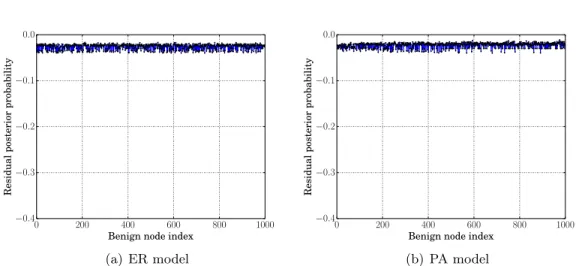
Figure 3.2 Residual posterior probabilities of unlabeled benign nodes.
Proof. See Appendix .
Theorem7implies that when Sybils are more densely connected among themselves (i.e., the av-erage degreed(S) is larger), it is easier for SybilSCAR to detect them. An intuitional explanation is that, when the Sybil region is more dense, a larger proportion of the residual posterior probabilities would be propagated among the Sybil region. Table 3.1 summarizes the theoretical performance bound of existing collective classification methods. For SybilRank, ´Integro, and CIA, the metric #accepted Sybils means the number of Sybils that are ranked lower than certain benign nodes. For the rest of methods, #accepted Sybils means the number of Sybils that are classified as benign. As we can see, our SybilSCAR achieves the tightest bound on the number of falsely accepted Sybils. We note that deriving security guarantee for SybilSCAR-C is still an open challenge. However, as we will demonstrate in our experiments, SybilSCAR-C outperforms SybilSCAR-D.
One key assumption of Theorem 7 is that residual posterior probabilities in the benign region converge afterO(log|V|)) iterations. In other words, nodes in the benign region have similar residual posterior probabilities after O(log|V|)) iterations. We validate this assumption via simulations. Specifically, we synthesize a benign region and a Sybil region with 1,000 nodes and an average degree of 40 via the Erdos–Renyi (ER) model Erdos and R´enyi (1960) or the Preferential Attachment (PA) model Barab´asi and Albert (1999); we randomly add 1,000 attack edges between the two regions;
and we randomly label 10 benign nodes as the training set. Figure3.2shows the residual posterior probabilities of unlabeled benign nodes after log|V|iterations. We observe that unlabeled benign nodes have similar residual posterior probabilities.
3.4.3 Complexity Analysis
SybilSCAR (both SybilSCAR-C and SybilSCAR-D), state-of-the-art RW-based methods Mo-haisen et al. (2011); Cao et al. (2012); Yang et al. (2012), and LBP-based method Gong et al. (2014a) have the same space complexity, i.e.,O(|E|), and their time complexity isO(t|E|), wheret
is the number of iterations. Although SybilSCAR and SybilBelief (a LBP-based method) have the same asymptotic space and time complexity, SybilSCAR is several times more space efficient and significantly more time efficient than SybilBelief in practice, as we demonstrate in our experiments. This is because SybilBelief needs to store neighbor influences (i.e., mvu(xu)) in both directions of
every edge and update them in every iteration.
Parallel implementation: SybilSCAR, state-of-the-art RW-based methods Mohaisen et al. (2011); Cao et al. (2012); Yang et al. (2012), and LBP-based methods Gong et al. (2014a); Gao et al. (2018) can be implemented in parallel. Specifically, we can divide nodes into groups, and a thread or computer applies the corresponding local rule to a group of nodes iteratively.
3.5 Empirical Evaluations
We compare our SybilSCAR-C and SybilSCAR-D with SybilRank Cao et al. (2012), a state-of-the-art RW-based method, and SybilBelief Gong et al. (2014a), a state-state-of-the-art LBP-based method, in terms of accuracy, robustness to label noise, scalability, and convergence.
3.5.1 Dataset Description
We use 1) three real-world social networks with synthesized Sybils and 2) a large-scale Twitter dataset with real Sybils for evaluations. Table 3.2shows some basic statistics about our datasets.