Boxes and
Diamonds
An Open Introduction to
Modal Logic
The Open Logic Project
Instigator
Richard Zach,University of Calgary
Editorial Board
Aldo Antonelli,†University of California, Davis
Andrew Arana,Université Paris I Panthénon–Sorbonne
Jeremy Avigad,Carnegie Mellon University
Tim Button,University College London
Walter Dean,University of Warwick
Gillian Russell,University of North Carolina
Nicole Wyatt,University of Calgary
Audrey Yap,University of Victoria
Contributors
Samara Burns,University of Calgary
Dana Hägg,University of Calgary
Boxes and Diamonds
An Open Introduction to Modal Logic
Remixed by Richard Zach
The Open Logic Project would like to acknowledge the gener-ous support of theTaylor Institute of Teaching and Learning of the University of Calgary, and theAlberta Open Educational Re-sources (ABOER) Initiative, which is made possible through an investment from the Alberta government.
Cover illustrations by Matthew Leadbeater, used under a Cre-ative Commons Attribution-NonCommercial 4.0 International Li-cense.
Typeset in Baskervald X and Nimbus Sans by LATEX.
This version ofBoxes and Diamondsis revision 4de392d
(2020-01-26), with content generated fromOpen Logic Textrevision 6035a83
(2020-01-16). Free download at:
https://bd.openlogicproject.org/
Boxes and DiamondsbyRichard Zachis licensed under aCreative Commons At-tribution 4.0 International License. It is based onThe Open Logic Textby the Open Logic Project, used under a Cre-ative Commons Attribution 4.0 Interna-tional License.
Contents
Preface xi
Introduction xii
I Normal Modal Logics 1
1 Syntax and Semantics 2
1.1 Introduction . . . 2
1.2 The Language of Basic Modal Logic. . . 4
1.3 Simultaneous Substitution . . . 5 1.4 Relational Models . . . 7 1.5 Truth at a World . . . 8 1.6 Truth in a Model . . . 10 1.7 Validity . . . 11 1.8 Tautological Instances. . . 12
1.9 Schemas and Validity . . . 14
1.10 Entailment . . . 17
Problems . . . 18
2 Frame Definability 22 2.1 Introduction . . . 22
2.2 Properties of Accessibility Relations . . . 23
2.3 Frames . . . 26
2.4 Frame Definability . . . 27 v
vi CONTENTS
2.5 First-order Definability . . . 30
2.6 Equivalence Relations andS5 . . . 31
2.7 Second-order Definability . . . 34
Problems . . . 37
3 Axiomatic Derivations 39 3.1 Introduction . . . 39
3.2 Normal Modal Logics . . . 41
3.3 Derivations and Modal Systems . . . 43
3.4 Proofs inK . . . 45
3.5 Derived Rules . . . 48
3.6 More Proofs inK . . . 51
3.7 Dual Formulas . . . 52
3.8 Proofs in Modal Systems . . . 53
3.9 Soundness . . . 55
3.10 Showing Systems are Distinct. . . 56
3.11 Derivability from a Set of Formulas . . . 58
3.12 Properties of Derivability . . . 58
3.13 Consistency . . . 59
Problems . . . 60
4 Completeness and Canonical Models 62 4.1 Introduction . . . 62
4.2 Complete Σ-Consistent Sets . . . 64
4.3 Lindenbaum’s Lemma. . . 65
4.4 Modalities and Complete Consistent Sets . . . 67
4.5 Canonical Models . . . 70
4.6 The Truth Lemma . . . 70
4.7 Determination and Completeness forK . . . 72
4.8 Frame Completeness . . . 73
Problems . . . 76
5 Filtrations and Decidability 78 5.1 Introduction . . . 78
5.2 Preliminaries . . . 81
vii CONTENTS
5.4 Examples of Filtrations . . . 85
5.5 Filtrations are Finite . . . 87
5.6 KandS5have the Finite Model Property. . . 88
5.7 S5is Decidable . . . 89
5.8 Filtrations and Properties of Accessibility . . . 90
5.9 Filtrations of Euclidean Models . . . 92
Problems . . . 94 6 Modal Tableaux 96 6.1 Introduction . . . 96 6.2 Rules for K . . . 97 6.3 Tableaux forK. . . 100 6.4 Soundness forK . . . 101
6.5 Rules for Other Accessibility Relations . . . 105
6.6 Soundness for Additional Rules . . . 106
6.7 Simple Tableaux forS5 . . . 109
6.8 Completeness forK . . . 110
6.9 Countermodels from Tableaux . . . 113
Problems . . . 116
II Intuitionistic Logic 118 7 Introduction 119 7.1 Constructive Reasoning . . . 119
7.2 Syntax of Intuitionistic Logic. . . 121
7.3 The Brouwer-Heyting-Kolmogorov Interpretation. 122 7.4 Natural Deduction. . . 126 7.5 Axiomatic Derivations . . . 129 Problems . . . 131 8 Semantics 132 8.1 Introduction . . . 132 8.2 Relational models . . . 133 8.3 Semantic Notions . . . 135 8.4 Topological Semantics . . . 135
viii CONTENTS
Problems . . . 137
9 Soundness and Completeness 138 9.1 Soundness of Axiomatic Derivations. . . 138
9.2 Soundness of Natural Deduction . . . 139
9.3 Lindenbaum’s Lemma. . . 141
9.4 The Canonical Model . . . 143
9.5 The Truth Lemma . . . 144
9.6 The Completeness Theorem . . . 145
Problems . . . 145
III Counterfactuals 146 10 Introduction 147 10.1 The Material Conditional . . . 147
10.2 Paradoxes of the Material Conditional . . . 149
10.3 The Strict Conditional . . . 150
10.4 Counterfactuals . . . 152
Problems . . . 153
11 Minimal Change Semantics 155 11.1 Introduction . . . 155
11.2 Sphere Models . . . 157
11.3 Truth and Falsity of Counterfactuals . . . 159
11.4 Antecedent Strengthenng . . . 160 11.5 Transitivity . . . 162 11.6 Contraposition . . . 164 Problems . . . 164 IV Appendices 166 A Sets 167 A.1 Extensionality . . . 167
A.2 Subsets and Power Sets . . . 169
ix CONTENTS
A.4 Unions and Intersections . . . 172
A.5 Pairs, Tuples, Cartesian Products . . . 176
A.6 Russell’s Paradox . . . 178
Problems . . . 179
B Relations 181 B.1 Relations as Sets . . . 181
B.2 Special Properties of Relations . . . 183
B.3 Equivalence Relations . . . 185
B.4 Orders . . . 186
B.5 Graphs . . . 190
B.6 Operations on Relations . . . 192
Problems . . . 193
C Syntax and Semantics 194 C.1 Introduction . . . 194
C.2 Propositional Formulas . . . 196
C.3 Preliminaries . . . 198
C.4 Valuations and Satisfaction . . . 200
C.5 Semantic Notions . . . 202
Problems . . . 203
D Axiomatic Derivations 204 D.1 Introduction . . . 204
D.2 Axiomatic Derivations . . . 206
D.3 Rules and Derivations . . . 208
D.4 Axiom and Rules for the Propositional Connectives210 D.5 Examples of Derivations . . . 211
D.6 Proof-Theoretic Notions . . . 213
D.7 The Deduction Theorem . . . 215
D.8 Derivability and Consistency . . . 217
D.9 Derivability and the Propositional Connectives . . 218
D.10 Soundness . . . 219
Problems . . . 220
x CONTENTS
E.1 Tableaux . . . 222
E.2 Rules and Tableaux . . . 224
E.3 Propositional Rules . . . 225
E.4 Tableaux . . . 226
E.5 Examples of Tableaux . . . 227
E.6 Proof-Theoretic Notions . . . 232
E.7 Derivability and Consistency . . . 235
E.8 Derivability and the Propositional Connectives . . 238
E.9 Soundness . . . 241
Problems . . . 244
F The Completeness Theorem 245 F.1 Introduction . . . 245
F.2 Outline of the Proof . . . 247
F.3 Complete Consistent Sets of Sentences . . . 248
F.4 Lindenbaum’s Lemma. . . 250
F.5 Construction of a Model . . . 251
F.6 The Completeness Theorem . . . 252
Problems . . . 253
Preface
This is an introductory textbook on modal logic. I use it as the main text when I teach Philosophy 579.2 (Modal Logic) at the University of Calgary. It is based on material from the Open Logic Project.
The main text assumes familiarity with some elementary set theory and the basics of (propositional) logic. This material is part of a prerequisite for my course, Logic II. The textbook for that course, Sets, Logic, Computation, is also based on the OLP,
and so is available for free. The required material is included as appendices in this book, however. I assign these appendices for background reading whenever I teach the material.
Part I is originally based in part on Aldo Antonelli’s lec-ture notes on “Classical Correspondence Theory for Basic Modal Logic,” which he contributed to the OLP before his untimely death in 2015. I heavily revised and expanded these notes, e.g., the material on frame definability and tableaux is new.
Introduction
Modal logics are extensions of classical logic by the operators □ (“box”) and♢ (“diamond”), which attach to formulas. Intu-itively, □ may be read as “necessarily” and ♢ as “possibly,” so □p is “p is necessarily true” and ♢p is “p is possibly true.” As
necessity and possibility are fundamental metaphysical notions, modal logic is obviously of great philosophical interest. It allows the formalization of metaphysical principles such as “□p→p” (if p is necessary, it is true) or “♢p →□♢p” (if p is possible, it is
necessarily possible).
The operators □ and ♢ are intensional. This means that
whether□Aor♢Ahold does not just depend on whetherAholds
or doesn’t. An operator which is not intensional is extensional.
Negation is extensional: ¬Aholds iffAdoes not; so whether ¬A
holds only depends on whetherAholds or doesn’t. □and ♢are
not like that: whether□Aor♢Aholds depends also on the
mean-ing ofA. While ordinary truth-functional semantics is enough to
deal with extensional operators, intensional operators like□and ♢require a different kind of semantics. One such semantics which takes center stage in this book is relational semantics (also called possible-worlds semantics or Kripke semantics).
For the logic which corresponds to the interpretation of□as “necessarily,” this semantics is relatively simple: instead of assign-ing truth values to propositional variables, an interpretation M assigns a set of “worlds” to them—intuitively, those worldsw at
whichp is interpreted as true. On the basis of such an
xiii
tation, we can define a satisfaction relation. The definition of this satisfaction relation makes□Asatisfied at a worldw iffAis
satisfied atall worlds: M,w ⊩ □A iffM,v ⊩A for all worldsv.
This corresponds to Leibniz’s idea that what’s necessarily true is what’s true in every possible world.
“Necessarily” is not the only way to interpret the□operator, but it is the standard one—“necessarily” and “possibly” are the so-called alethic modalities. Other interpretations read □ as “it
is known (by some personA) that,” as “some personA believes
that,” “it ought to be the case that,” or “it will always be true that.” These are epistemic, doxastic, deontic, and temporal modalities, respectively. Different interpretations of□will make different for-mulas logically true, and pronounce different inferences as valid. For instance, everything necessary and everything known is true, so□A→Ais a logical truth on the alethic and epistemic
inter-pretations. By contrast, not everything believed nor everything that ought to be the case actually is the case, so□A→Ais not a
logical truth on the doxastic or deontic interpretations.
In order to deal with different interpretations of the modal op-erators, the semantics is extended by a relation between worlds, the so-called accessibility relation. ThenM,w ⊩ □Aif M,v ⊩A
for all worlds v which are accessible from w. The resulting
se-mantics is very versatile and powerful, and the basic idea can be used to provide semantic interpretations for logics based on other intensional operators. One such logic is intuitionistic logic, a con-structive logic based on L. E. J. Brouwer’s branch of concon-structive mathematics. Intuitionistic logic is philosophically interesting for this reason—it plays an important role in constructive accounts of mathematics—but was also proposed as a logic superior to classi-cal logic by the influential English philosopher Michael Dummett in the 20th century. Another application of relational models is as a semantics for subjunctive, or counterfactual, conditionals, an approach pioneered by Robert Stalnaker and David K. Lewis. This book is an introduction to the syntax, semantics, and proof theory of intensional logics. It only deals with proposi-tional logics, although future editions will also treat predicate
log-xiv INTRODUCTION ics. The material is divided into three parts: The first part deals with normal modal logics. These are logics with the operators□ and♢. We discuss their syntax, relational models and semantic notions based on them (such as validity and consequence) and proof systems (both axiomatic systems and tableaux). We estab-lish some basic results about these logics, such as the soundness and completeness of the proof systems considered, and discuss some model-theoretic constructions such as filtrations. The sec-ond part deals with intuitionistic logic. Here we discuss natural deduction and axiomatic derivations, relational and topological semantics, and soundness and completeness of the proof systems. The third part deals with the Lewis-Stalnaker semantics of coun-terfactual conditionals. The appendices discusses some ideas and results from set theory and the theory of relations that’s crucial to the relational semantics, and reviews syntax, semantics, and proof theory of classical propositional logic.
PART I
Normal
Modal
Logics
CHAPTER 1
Syntax and
Semantics
1.1
Introduction
Modal Logic deals withmodal propositions and the entailment
re-lations among them. Examples of modal propositions are the following:
1. It is necessary that 2+2=4.
2. It is necessarily possible that it will rain tomorrow.
3. If it is necessarily possible thatAthen it is possible thatA.
Possibility and necessity are not the only modalities: other unary connectives are also classified as modalities, for instance, “it ought to be the case thatA,” “It will be the case thatA,” “Dana
knows thatA,” or “Dana believes thatA.”
Modal logic makes its first appearance in Aristotle’sDe Inter-pretatione: he was the first to notice that necessity implies
possi-bility, but not vice versa; that possibility and necessity are inter-definable; that If A∧B is possibly true thenA is possibly true
andB is possibly true, but not conversely; and that ifA→B is
necessary, then ifAis necessary, so isB.
3 1.1. INTRODUCTION The first modern approach to modal logic was the work of C. I. Lewis, culminating with Lewis and Langford,Symbolic Logic
(1932). Lewis & Langford were unhappy with the representation of implication by means of the material conditional: A→B is
a poor substitute for “A impliesB.” Instead, they proposed to
characterize implication as “Necessarily, ifAthenB,” symbolized
asA ⥽B. In trying to sort out the different properties, Lewis
indentified five different modal systems,S1, . . . ,S4, S5, the last two of which are still in use.
The approach of Lewis and Langford was purelysyntactical:
they identified reasonable axioms and rules and investigated what was provable with those means. A semantic approach remained elusive for a long time, until a first attempt was made by Rudolf Carnap inMeaning and Necessity(1947) using the notion of astate description, i.e., a collection of atomic sentences (those that are
“true” in that state description). After lifting the truth definition to arbitrary sentencesA, Carnap definesA to be necessarily true
if it is true in all state descriptions. Carnap’s approach could not handleiteratedmodalities, in that sentences of the form
“Pos-sibly necessarily . . . pos“Pos-sibly A” always reduce to the innermost
modality.
The major breakthrough in modal semantics came with Saul Kripke’s article “A Completeness Theorem in Modal Logic” ( JSL 1959). Kripke based his work on Leibniz’s idea that a statement is necessarily true if it is true “at all possible worlds.” This idea, though, suffers from the same drawbacks as Carnap’s, in that the truth of statement at a worldw (or a state descriptions) does not
depend onw at all. So Kripke assumed that worlds are related
by an accessibility relation R, and that a statement of the form
“NecessarilyA” is true at a worldw if and only ifAis true at all
worldsw′accessible from w. Semantics that provide some version
of this approach are called Kripke semantics and made possible the tumultuous development of modal logics (in the plural).
When interpreted by the Kripke semantics, modal logic shows us what relational structures look like “from the inside.” A
4 CHAPTER 1. SYNTAX AND SEMANTICS instance, the set of students in the class ordered by their social security number is a relational structure). But in fact relational structures come in all sorts of domains: besides relative possibil-ity of states of the world, we can have epistemic states of some agent related by epistemic possibility, or states of a dynamical system with their state transitions, etc. Modal logic can be used to model all of these: the first give us ordinary, alethic, modal logic; the others give us epistemic logic, dynamic logic, etc.
We focus on one particular angle, known to modal logicians as “correspondence theory.” One of the most significant early discoveries of Kripke’s is that many properties of the accessibil-ity relation R (whether it is transitive, symmetric, etc.) can be
characterized in the modal language itself by means of
appropri-ate “modal schemas.” Modal logicians say, for instance, that the reflexivity of R “corresponds” to the schema “If necessarily A,
thenA”. We explore mainly the correspondence theory of a
num-ber of classical systems of modal logic (e.g.,S4andS5) obtained by a combination of the schemas D, T, B, 4, and 5.
1.2
The Language of Basic Modal Logic
Definition 1.1. The basic language of modal logic contains 1. The propositional constant for falsity⊥.
2. A countably infinite set of propositional variables: p0, p1, p2, . . .
3. The propositional connectives: ¬ (negation), ∧ (conjunc-tion),∨(disjunction),→(conditional).
4. The modal operator□. 5. The modal operator♢.
5 1.3. SIMULTANEOUS SUBSTITUTION
Definition 1.2. Formulasof the basic modal language are
induc-tively defined as follows: 1. ⊥is an atomic formula.
2. Every propositional variablepi is an (atomic) formula. 3. IfAis a formula, then¬Ais a formula.
4. IfAandB are formulas, then(A∧B)is a formula.
5. IfAandB are formulas, then(A∨B)is a formula.
6. IfAandB are formulas, then(A→B)is a formula.
7. IfAis a formula, then□Ais a formula.
8. IfAis a formula, then♢Ais a formula.
9. Nothing else is a formula.
Definition 1.3. Formulas constructed using the defined opera-tors are to be understood as follows:
1. ⊤abbreviates¬⊥.
2. A↔B abbreviates(A→B) ∧ (B→A).
If a formulaAdoes not contain□or♢, we say it ismodal-free.
1.3
Simultaneous Substitution
Aninstanceof a formulaAis the result of replacing all occurrences
of a propositional variable inAby some other formula. We will
refer to instances of formulas often, both when discussing validity and when discussing derivability. It therefore is useful to define the notion precisely.
6 CHAPTER 1. SYNTAX AND SEMANTICS
Definition 1.4. WhereAis a modal formula all of whose
propo-sitional variables are amongp1, . . . ,pn, andD1, . . . ,Dn are also
modal formulas, we define A[D1/p1, . . . ,Dn/pn] as the result of
simultaneously substituting eachDi forpi inA. Formally, this is
a definition by induction onA: 1. A≡ ⊥: A[D1/p1, . . . ,Dn/pn] is⊥. 2. A≡q: A[D1/p1, . . . ,Dn/pn]isq, providedq ̸≡pi fori =1, . . . ,n. 3. A≡pi: A[D1/p1, . . . ,Dn/pn]isDi. 4. A≡ ¬B: A[D1/p1, . . . ,Dn/pn]is¬B[D1/p1, . . . ,Dn/pn]. 5. A≡ (B ∧C): A[D1/p1, . . . ,Dn/pn]is (B[D1/p1, . . . ,Dn/pn] ∧C[D1/p1, . . . ,Dn/pn]). 6. A≡ (B ∨C): A[D1/p1, . . . ,Dn/pn]is (B[D1/p1, . . . ,Dn/pn] ∨C[D1/p1, . . . ,Dn/pn]). 7. A≡ (B →C): A[D1/p1, . . . ,Dn/pn]is (B[D1/p1, . . . ,Dn/pn] →C[D1/p1, . . . ,Dn/pn]). 8. A≡ (B ↔C): A[D1/p1, . . . ,Dn/pn]is (B[D1/p1, . . . ,Dn/pn] ↔C[D1/p1, . . . ,Dn/pn]). 9. A≡□B: A[D1/p1, . . . ,Dn/pn]is□B[D1/p1, . . . ,Dn/pn]. 10. A≡♢B: A[D1/p1, . . . ,Dn/pn]is♢B[D1/p1, . . . ,Dn/pn].
The formulaA[D1/p1, . . . ,Dn/pn] is called asubstitution instance
7 1.4. RELATIONAL MODELS Example 1.5. SupposeA is p1 →□(p1∧p2), D1 is ♢(p2 →p3) andD2 is¬□p1. ThenA[D1/p1,D2/p2]is ♢(p2→p3) →□(♢(p2→p3) ∧ ¬□p1) whileA[D2/p1,D1/p2] is ¬□p1→□(¬□p1∧♢(p2→p3))
Note that simultaneous substitution is in general not the same as iterated substitution, e.g., compare A[D1/p1,D2/p2] above with
(A[D1/p1])[D2/p2], which is: ♢(p2→p3) →□(♢(p2→p3) ∧p2)[¬□p1/p2], i.e., ♢(¬□p1→p3) →□(♢(¬□p1→p3) ∧ ¬□p1) and with(A[D2/p2])[D1/p1]: p1→□(p1∧ ¬□p1)[♢(p2→p3)/p1], i.e., ♢(p2→p3) →□(♢(p2→p3) ∧ ¬□♢(p2→p3)).
1.4
Relational Models
The basic concept of semantics for normal modal logics is that of arelational model. It consists of a set of worlds, which are related
by a binary “accessibility relation,” together with an assignment which determines which propositional variables count as “true” at which worlds.
Definition 1.6. Amodel for the basic modal language is a triple
M= ⟨W,R,V⟩, where
1. W is a nonempty set of “worlds,”
2. R is a binary accessibility relation onW, and
3. V is a function assigning to each propositional variablep
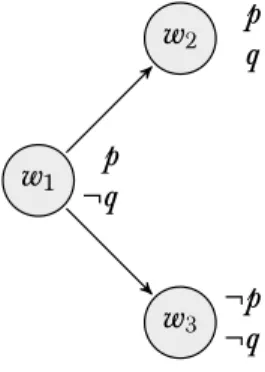
8 CHAPTER 1. SYNTAX AND SEMANTICS w1 ¬p q w2 p q w3 ¬p ¬q
Figure 1.1:A simple model.
When Rww′ holds, we say that w′ is accessible from w. When w ∈V(p) we sayp istrue at w.
The great advantage of relational semantics is that mod-els can be represented by means of simple diagrams, such as the one in Figure 1.1. Worlds are represented by nodes, and worldw′ is accessible fromw precisely when there is an arrow
fromw to w′. Moreover, we label a node (world) by p when w ∈V(p), and otherwise by ¬p. Figure 1.1represents the model
withW ={w1,w2,w3},R ={⟨w1,w2⟩,⟨w1,w3⟩},V(p)= {w1,w2},
andV(q)={w2}.
1.5
Truth at a World
Every modal model determines which modal formulas count as true at which worlds in it. The relation “model M makes for-mulaA true at worldw” is the basic notion of relational
seman-tics. The relation is defined inductively and coincides with the usual characterization using truth tables for the non-modal oper-ators.
9 1.5. TRUTH AT A WORLD
Definition 1.7. Truth of a formula A at w in a M, in symbols:
M,w ⊩A, is defined inductively as follows:
1. A≡ ⊥: NeverM,w ⊩⊥. 2. M,w ⊩p iffw ∈V(p) 3. A≡ ¬B: M,w ⊩AiffM,w ⊮B. 4. A≡ (B ∧C): M,w ⊩A iffM,w ⊩B andM,w ⊩C. 5. A ≡ (B ∨C): M,w ⊩ A iff M,w ⊩ B or M,w ⊩ C (or both). 6. A≡ (B →C): M,w ⊩AiffM,w ⊮B orM,w ⊩C.
7. A ≡ □B: M,w ⊩ A iff M,w′ ⊩ B for allw′ ∈ W with Rww′
8. A ≡ ♢B: M,w ⊩A iffM,w′ ⊩B for at least onew′ ∈W
withRww′
Note that by clause (7), a formula□B is true atw whenever
there are now′ withwRw′. In such a case□B isvacuously true
atw. Also,□B may be satisfied atw even ifB is not. The truth
ofB atw does not guarantee the truth of ♢B atw. This holds,
however, ifRww, e.g., ifR is reflexive. If there is now′such that Rww′, thenM,w ⊮♢A, for anyA.
Proposition 1.8. 1. M,w ⊩ □A iffM,w ⊩¬♢¬A. 2. M,w ⊩ ♢A iffM,w ⊩¬□¬A.
Proof. 1. M,w ⊩¬♢¬AiffM ⊮♢¬Aby definition ofM,w ⊩.
M,w ⊩ ♢¬A iff for some w′ with Rww′, M,w′ ⊩ ¬A.
Hence,M,w ⊮♢¬Aiff for allw′ withRww′, M,w′ ⊮¬A.
We also haveM,w′⊮¬AiffM,w′⊩A. Together we have
M,w ⊩ ¬♢¬A iff for allw′ withRww′, M,w′ ⊩A. Again
10 CHAPTER 1. SYNTAX AND SEMANTICS
2. Exercise. □
1.6
Truth in a Model
Sometimes we are interested which formulas are true at every world in a given model. Let’s introduce a notation for this.
Definition 1.9. A formula A is true in a model M = ⟨W,R,V⟩,
writtenM⊩A, if and only ifM,w ⊩Afor everyw ∈W.
Proposition 1.10. 1. If M ⊩ A then M ⊮ ¬A, but not vice-versa.
2. IfM ⊩A→B thenM ⊩A only ifM ⊩B , butnotvice-versa. Proof. 1. IfM ⊩AthenAis true at all worlds inW, and since W ≠ ∅, it can’t be that M ⊩ ¬A, or else A would have to
be both true and false at some world.
On the other hand, ifM ⊮¬AthenAis true at some world w ∈W. It does not follow thatM,w ⊩Aforevery w ∈W.
For instance, in the model ofFigure 1.1,M ⊮¬p, and also
M⊮p.
2. AssumeM⊩A→B andM ⊩A; to showM ⊩B letw ∈W
be an arbitrary world. ThenM,w ⊩A→B andM,w ⊩A,
soM,w ⊩B, and sincew was arbitrary, M⊩B.
To show that the converse fails, we need to find a model M such that M ⊩ A only if M ⊩ B, but M ⊮ A→B.
Consider again the model ofFigure 1.1: M ⊮p and hence
(vacuously)M ⊩ p only ifM ⊩q. However, M ⊮p →q,
11 1.7. VALIDITY
1.7
Validity
Formulas that are true in all models, i.e., true at every world in every model, are particularly interesting. They represent those modal propositions which are true regardless of how□and♢are interpreted, as long as the interpretation is “normal” in the sense that it is generated by some accessibility relation on possible worlds. We call such formulasvalid. For instance,□(p∧q) →□p
is valid. Some formulas one might expect to be valid on the basis of the alethic interpretation of□, such as□p→p, are not valid,
however. Part of the interest of relational models is that different interpretations of□and♢can be captured by different kinds of accessibility relations. This suggests that we should define valid-ity not just relative toall models, but relative to all models of a certain kind. It will turn out, e.g., that□p→p is true in all
mod-els where every world is accessible from itself, i.e.,R is reflexive.
Defining validity relative to classes of models enables us to for-mulate this succinctly: □p →p is valid in the class of reflexive
models.
Definition 1.11. A formulaAisvalid in a class Cof models if
it is true in every model in C(i.e., true at every world in every model in C). IfA is valid in C, we write C⊨ A, and we write
⊨AifAis valid in the class ofall models.
Proposition 1.12. If A is valid in Cit is also valid in each class C′⊆ C.
Proposition 1.13. If A is valid, then so is□A.
Proof. Assume⊨A. To show⊨ □AletM =⟨W,R,V⟩be a model
andw ∈W. IfRww′ then M,w′ ⊩ A, since A is valid, and so
12 CHAPTER 1. SYNTAX AND SEMANTICS
1.8
Tautological Instances
A modal-free formula is a tautology if it is true under every truth-value assignment. Clearly, every tautology is true at every world in every model. But for formulas involving□and ♢, the notion of tautology is not defined. Is it the case, e.g., that□p∨ ¬□p—
an instance of the principle of excluded middle—is valid? The notion of atautological instance helps: a formula that is a
substi-tution instance of a (non-modal) tautology. It is not surprising, but still requires proof, that every tautological instance is valid.
Definition 1.14. A modal formula B is a tautological instance
if and only if there is a modal-free tautology A with
proposi-tional variables p1, . . . , pn and formulas D1, . . . , Dn such that
B ≡A[D1/p1, . . . ,Dn/pn].
Lemma 1.15. Suppose A is a modal-free formula whose propositional variables are p1, . . . , pn, and let D1, . . . , Dn be modal formulas. Then
for any assignmentv, any modelM = ⟨W,R,V⟩, and any w ∈W such thatv(pi) = Tif and only ifM,w ⊩Di we have that v⊨ A if and
only ifM,w ⊩A[D1/p1, . . . ,Dn/pn]. Proof. By induction onA. 1. A≡ ⊥: Bothv⊭⊥andM,w ⊮⊥. 2. A≡pi: v⊨pi ⇔v(pi)=T by definition ofv⊨pi ⇔M,w ⊩Di by assumption ⇔M,w ⊩pi[D1/p1, . . . ,Dn/pn] sincepi[D1/p1, . . . ,Dn/pn] ≡Di.
13 1.8. TAUTOLOGICAL INSTANCES 3. A≡ ¬B: v⊨¬B ⇔v⊭B by definition ofv⊨; ⇔M,w ⊮B[D1/p1, . . . ,Dn/pn] by induction hypothesis ⇔M,w ⊩¬B[D1/p1, . . . ,Dn/pn] by definition ofv⊨. 4. A≡ (B ∧C): v⊨B ∧C ⇔v⊨B andv⊨C by definition ofv⊨ ⇔M,w ⊩B[D1/p1, . . . ,Dn/pn]and M,w ⊩C[D1/p1, . . . ,Dn/pn] by induction hypothesis ⇔M,w ⊩(B ∧C)[D1/p1, . . . ,Dn/pn] by definition ofM,w ⊩. 5. A≡ (B ∨C): v⊨B ∨C ⇔v⊨B orv⊨C by definition ofv⊨; ⇔M,w ⊩B[D1/p1, . . . ,Dn/pn]or M,w ⊩C[D1/p1, . . . ,Dn/pn] by induction hypothesis ⇔M,w ⊩(B ∨C)[D1/p1, . . . ,Dn/pn] by definition ofM,w ⊩. 6. A≡ (B →C): v⊨B →C ⇔v⊭B orv⊨C by definition ofv⊨
14 CHAPTER 1. SYNTAX AND SEMANTICS ⇔M,w ⊮B[D1/p1, . . . ,Dn/pn]or M,w ⊩C[D1/p1, . . . ,Dn/pn] by induction hypothesis ⇔M,w ⊩(B →C)[D1/p1, . . . ,Dn/pn] by definition ofM,w ⊩. □
Proposition 1.16. All tautological instances are valid.
Proof. Contrapositively, suppose A is such that M,w ⊮
A[D1/p1, . . . ,Dn/pn], for some model M and world w. Define
an assignment v such that v(pi) = T if and only if M,w ⊩ Di
(and v assigns arbitrary values to q ∉ {p1, . . . ,pn}). Then by
Lemma 1.15,v⊭A, soAis not a tautology. □
1.9
Schemas and Validity
Definition 1.17. Aschemais a set of formulas comprising all and
only the substitution instances of some modal formulaC, i.e.,
{B :∃D1, . . . ,∃Dn (︁
B =C[D1/p1, . . . ,Dn/pn]
)︁ }.
The formulaC is called thecharacteristic formula of the schema,
and it is unique up to a renaming of the propositional variables. A formulaA is an instance of a schema if it is a member of the
set.
It is convenient to denote a schema by the meta-linguistic expression obtained by substituting ‘A’, ‘B’, . . . , for the atomic
components ofC. So, for instance, the following denote schemas:
‘A’, ‘A→□A’, ‘A→(B→A)’. They correspond to the characteristic
formulasp, p →□p, p → (q →p). The schema ‘A’ denotes the
15 1.9. SCHEMAS AND VALIDITY
Definition 1.18. A schema istruein a model if and only if all of
its instances are; and a schema isvalid if and only if it is true in
every model.
Proposition 1.19. The following schemaKis valid
□(A→B) → (□A→□B). (K)
Proof. We need to show that all instances of the schema are true
at every world in every model. So letM= ⟨W,R,V⟩ andw ∈W
be arbitrary. To show that a conditional is true at a world we assume the antecedent is true to show that consequent is true as well. In this case, let M,w ⊩ □(A→B) and M,w ⊩ □A. We
need to show M ⊩ □B. So let w′ be arbitrary such thatRww′.
Then by the first assumptionM,w′ ⊩A→B and by the second
assumptionM,w′ ⊩A. It follows thatM,w′ ⊩B. Sincew′ was
arbitrary,M,w ⊩ □B. □
Proposition 1.20. The following schema dual is valid
♢A↔ ¬□¬A. (dual)
Proof. Exercise. □
Proposition 1.21. If A and A→B are true at a world in a model then so is B . Hence, the valid formulas are closed under modus ponens.
16 CHAPTER 1. SYNTAX AND SEMANTICS
Valid Schemas Invalid Schemas
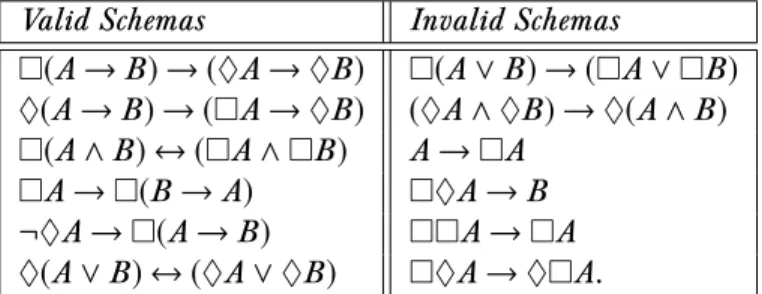
□(A→B) → (♢A→♢B) □(A∨B) → (□A∨□B) ♢(A→B) → (□A→♢B) (♢A∧♢B) →♢(A∧B) □(A∧B) ↔ (□A∧□B) A→□A □A→□(B →A) □♢A→B ¬♢A→□(A→B) □□A→□A ♢(A∨B) ↔ (♢A∨♢B) □♢A→♢□A.
Table 1.1:Valid and (or?) invalid schemas.
Proposition 1.22. A formula A is valid iff all its substitution in-stances are. In other words, a schema is valid iff its characteristic for-mula is.
Proof. The “if” direction is obvious, since Ais a substitution
in-stance of itself.
To prove the “only if” direction, we show the follow-ing: Suppose M = ⟨W,R,V⟩ is a modal model, and B ≡ A[D1/p1, . . . ,Dn/pn]is a substitution instance ofA. DefineM
′ = ⟨W,R,V′⟩ byV(pi) = {w : M,w ⊩ Di}. Then M,w ⊩ B iff
M′,w ⊩A, for anyw ∈W. (We leave the proof as an exercise.)
Now suppose that A was valid, but some substitution instance B of A was not valid. Then for some M = ⟨W,R,V⟩ and some w ∈W, M,w ⊮B. But then M′,w ⊮A by the claim, and A is
not valid, a contradiction. □
Note, however, that it is not true that a schema is true in a model iff its characteristic formula is. Of course, the “only if” direction holds: if every instance ofA is true in M, A itself is
true in M. But it may happen that A is true in M but some
instance of A is false at some world in M. For a very simple
counterexample consider p in a model with only one world w
andV(p)={w}, so thatp is true atw. But⊥is an instance ofp,
17 1.10. ENTAILMENT
1.10
Entailment
With the definition of truth at a world, we can define an entail-ment relation between formulas. A formulaB entailsAiff,
when-everB is true, A is true as well. Here, “whenever” means both
“whichever model we consider” as well as “whichever world in that model we consider.”
Definition 1.23. IfΓ is a set of formulas andAa formula, then
Γ entails A, in symbols: Γ ⊨ A, if and only if for every model
M = ⟨W,R,V⟩ and worldw ∈W, if M,w ⊩B for every B ∈ Γ,
thenM,w ⊩A. If Γ contains a single formulaB, then we write B ⊨A.
Example 1.24. To show that a formula entails another, we have to reason about all models, using the definition of M,w ⊩. For
instance, to show p →♢p ⊨ □¬p → ¬p, we might argue as
fol-lows: Consider a modelM= ⟨W,R,V⟩andw ∈W, and suppose
M,w ⊩p→♢p. We have to show thatM,w ⊩ □¬p → ¬p.
Sup-pose not. ThenM,w ⊩ □¬p and M,w ⊮¬p. Since M,w ⊮¬p,
M,w ⊩p. By assumption, M,w ⊩p→♢p, henceM,w ⊩ ♢p. By
definition of M,w ⊩ ♢p, there is some w′ with Rww′ such that
M,w′⊩p. Since alsoM,w ⊩ □¬p,M,w′⊩¬p, a contradiction.
To show that a formulaB does not entail anotherA, we have
to give a counterexample, i.e., a modelM = ⟨W,R,V⟩where we show that at some worldw ∈W, M,w ⊩B butM,w ⊮A. Let’s
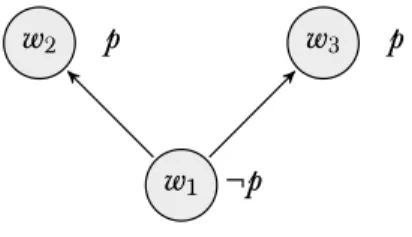
show thatp→♢p ⊭ □p →p. Consider the model in Figure 1.2.
We haveM,w1 ⊩ ♢p and henceM,w1⊩p→♢p. However, since
M,w1⊩ □p butM,w1 ⊮p, we haveM,w1 ⊮□p→p.
Often very simple counterexamples suffice. The modelM′ = {W′,R′,V′} withW′ = {w}, R′ = ∅, andV′(p) = ∅ is also a
counterexample: SinceM′,w ⊮p,M′,w ⊩p→♢p. As no worlds
are accessible from w, we have M′,w ⊩ □p, and so M′,w ⊮ □p→p.
18 CHAPTER 1. SYNTAX AND SEMANTICS
w1 ¬p
w2 p w3 p
Figure 1.2:Counterexample top→♢p⊨ □p→p.
Problems
Problem 1.1. Consider the model of Figure 1.1. Which of the following hold? 1. M,w1⊩q; 2. M,w3⊩¬q; 3. M,w1⊩p∨q; 4. M,w1⊩ □(p∨q); 5. M,w3⊩ □q; 6. M,w3⊩ □⊥; 7. M,w1⊩ ♢q; 8. M,w1⊩ □q; 9. M,w1⊩¬□□¬q.
Problem 1.2. Complete the proof of Proposition 1.8.
Problem 1.3. Let M = ⟨W,R,V⟩ be a model, and suppose
w1,w2 ∈W are such that:
1. w1 ∈V(p) if and only ifw2 ∈V(p); and
19 1.10. ENTAILMENT Using induction on formulas, show that for all formulas A:
M,w1⊩A if and only ifM,w2⊩A.
Problem 1.4. LetM = ⟨M,R,V⟩. Show thatM,w ⊩¬♢Aif and
only ifM,w ⊩ □¬A.
Problem 1.5. Consider the following modelM for the language comprisingp1, p2, p3as the only propositional variables:
w1 p1 ¬p2 ¬p3 w2 p1 p2 ¬p3 w3 p1 p2 p3
Are the following formulas and schemas true in the model M, i.e., true at every world inM? Explain.
1. p→♢p (forp atomic); 2. A→♢A(forAarbitrary); 3. □p→p (forp atomic); 4. ¬p →♢□p (forp atomic); 5. ♢□A(forA arbitrary); 6. □♢p (forp atomic).
Problem 1.6. Show that the following are valid: 1. ⊨ □p→□(q→p);
2. ⊨ □¬⊥;
20 CHAPTER 1. SYNTAX AND SEMANTICS
Problem 1.7. Show thatA→□Ais valid in the class Cof models
M= ⟨W,R,V⟩whereW ={w}. Similarly, show thatB→□Aand
♢A→B are valid in the class of models M = ⟨W,R,V⟩ where R = ∅.
Problem 1.8. ProveProposition 1.20.
Problem 1.9. Prove the claim in the “only if” part of the proof ofProposition 1.22. (Hint: use induction onA.)
Problem 1.10. Show that none of the following formulas are valid: D: □p→♢p; T: □p→p; B: p→□♢p; 4: □p→□□p; 5: ♢p→□♢p.
Problem 1.11. Prove that the schemas in the first column of ta-ble 1.1are valid and those in the second column are not valid.
Problem 1.12. Decide whether the following schemas are valid or invalid:
1. (♢A→□B) → (□A→□B); 2. ♢(A→B) ∨□(B→A).
Problem 1.13. For each of the following schemas find a model M such that every instance of the formula is true inM:
1. p→♢♢p;
21 1.10. ENTAILMENT
Problem 1.14. Show that□(A∧B)⊨ □A.
Problem 1.15. Show that □(p →q) ⊭ p →□q and p →□q ⊭ □(p→q).
CHAPTER 2
Frame
Definability
2.1
Introduction
One question that interests modal logicians is the relationship be-tween the accessibility relation and the truth of certain formulas in models with that accessibility relation. For instance, suppose the accessibility relation is reflexive, i.e., for everyw ∈W,Rww.
In other words, every world is accessible from itself. That means that when□Ais true at a worldw,witself is among the accessible
worlds at whichAmust therefore be true. So, if the accessibility
relationR of M is reflexive, then whatever worldw and formula Awe take,□A→Awill be true there (in other words, the schema
□p→p and all its substitution instances are true inM).
The converse, however, is false. It’s not the case, e.g., that if □p→p is true inM, thenR is reflexive. For we can easily find a
non-reflexive modelM where □p→p is true at all worlds: take
the model with a single worldw, not accessible from itself, but
withw ∈V(p). By picking the truth value of p suitably, we can
make□A→Atrue in a model that is not reflexive.
The solution is to remove the variable assignmentV from the
equation. If we require that□p →p is true at all worlds in M,
regardless of which worlds are inV(p), then it is necessary that
23 2.2. PROPERTIES OF ACCESSIBILITY RELATIONS
R is reflexive. For in any non-reflexive model, there will be at
least one worldw such that notRww. If we setV(p)=W \ {w},
thenp will be true at all worlds other thanw, and so at all worlds
accessible from w (since w is guaranteed not to be accessible
fromw, andw is the only world wherep is false). On the other
hand,p is false atw, so□p →p is false atw.
This suggests that we should introduce a notation for model structures without a valuation: we call these frames. A frame
F is simply a pair ⟨W,R⟩ consisting of a set of worlds with an accessibility relation. Every model ⟨W,R,V⟩ is then, as we say,
based on the frame ⟨W,R⟩. Conversely, a frame determines the
class of models based on it; and a class of frames determines the class of models which are based on any frame in the class. And we can define F ⊨ A, the notion of a formula being valid in a
frame as: M⊩Afor all M based onF.
With this notation, we can establish correspondence relations between formulas and classes of frames: e.g.,F⊨ □p→p if, and
only if,Fis reflexive.
2.2
Properties of Accessibility Relations
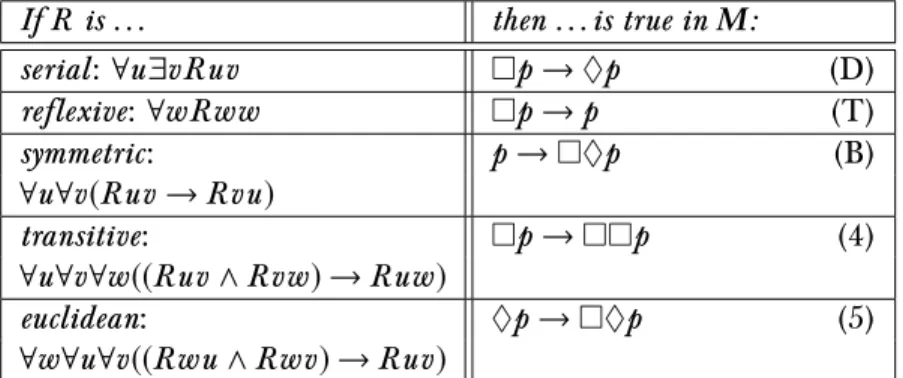
Many modal formulas turn out to be characteristic of simple, and even familiar, properties of the accessibility relation. In one direc-tion, that means that any model that has a given property makes a corresponding formula (and all its substitution instances) true. We begin with five classical examples of kinds of accessibility relations and the formulas the truth of which they guarantee.Theorem 2.1. LetM= ⟨W,R,V⟩be a model. If R has the property on the left side oftable 2.1, every instance of the formula on the right side is true inM.
Proof. Here is the case for B: to show that the schema is true in
a model we need to show that all of its instances are true at all worlds in the model. So letA→□♢A be a given instance of B,
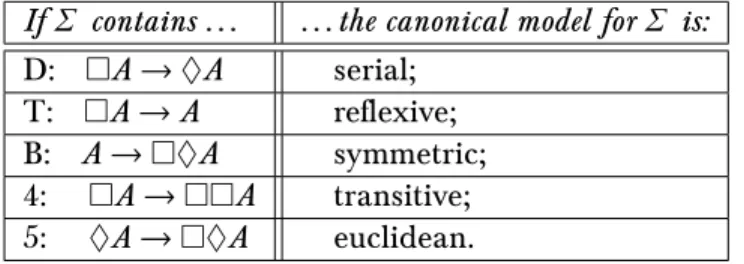
24 CHAPTER 2. FRAME DEFINABILITY If R is . . . then . . . is true inM: serial:∀u∃v Ruv □p→♢p (D) reflexive: ∀wRww □p→p (T) symmetric: p→□♢p (B) ∀u∀v(Ruv→Rv u) transitive: □p→□□p (4) ∀u∀v∀w((Ruv∧Rvw) →Ruw) euclidean: ♢p→□♢p (5) ∀w∀u∀v((Rwu∧Rwv) →Ruv)
Table 2.1:Five correspondence facts.
w
⊩A
⊩ □♢A
w′
⊩ ♢A
Figure 2.1:The argument from symmetry.
and letw ∈W be an arbitrary world. Suppose the antecedentA
is true atw, in order to show that□♢Ais true atw. So we need to
show that♢Ais true at allw′accessible fromw. Now, for anyw′
such thatRww′ we have, using the hypothesis of symmetry, that
alsoRw′w (see Figure 2.1). Since M,w ⊩ A, we have M,w′ ⊩
♢A. Sincew′ was an arbitrary world such that Rww′, we have
M,w ⊩ □♢A.
We leave the other cases as exercises. □
Notice that the converse implications ofTheorem 2.1do not hold: it’s not true that if a model verifies a schema, then the ac-cessibility relation of that model has the corresponding property. In the case of T and reflexive models, it is easy to give an exam-ple of a model in which T itself fails: letW = {w}andV(p)=∅.
ThenR is not reflexive, butM,w ⊩ □p andM,w ⊮p. But here
25 2.2. PROPERTIES OF ACCESSIBILITY RELATIONS e.g.,□¬p→ ¬pare true. It is harder to give examples whereevery substitution instanceof T is true inM andM is not reflexive. But
there are such models, too:
Proposition 2.2. Let M = ⟨W,R,V⟩ be a model such that W =
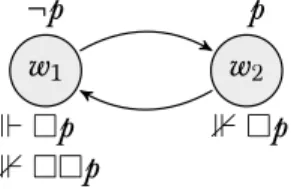
{u,v}, where worlds u and v are related by R: i.e., both Ruv and Rv u.
Suppose that for all p: u ∈V(p) ⇔v ∈V(p). Then:
1. For all A: M,u ⊩A if and only if M,v ⊩A (use induction on A).
2. Every instance ofTis true inM.
SinceM is not reflexive (it is, in fact,irreflexive), the converse of The-orem 2.1 fails in the case of T (similar arguments can be given for some—though not all—the other schemas mentioned inTheorem 2.1).
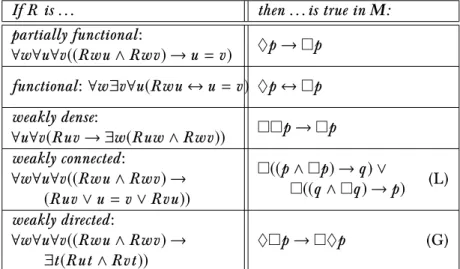
Although we will focus on the five classical formulas D, T, B, 4, and 5, we record intable 2.2a few more properties of accessibil-ity relations. The accessibilaccessibil-ity relationRis partially functional, if
from every world at most one world is accessible. If it is the case that from every world exactly one world is accessible, we call it functional. (Thus the functional relations are precisely those that are both serial and partially functional). They are called “func-tional” because the accessibility relation operates like a (partial) function. A relation is weakly dense if wheneverRuv, there is aw
“between”u andv. So weakly dense relations are in a sense the
opposite of transitive relations: in a transitive relation, whenever you can reachv fromu by a detour viaw, you can reachv from u directly; in a weakly dense relation, whenever you can reach v fromu directly, you can also reach it by a detour via somew.
A relation is weakly directed if whenever you can reach worldsu
andv from some worldw, you can reach a single worldt from
bothu andv—this is sometimes called the “diamond property”
26 CHAPTER 2. FRAME DEFINABILITY If R is . . . then . . . is true inM: partially functional: ♢p→□p ∀w∀u∀v((Rwu∧Rwv) →u =v) functional:∀w∃v∀u(Rwu↔u =v) ♢p↔□p weakly dense: □□p→□p ∀u∀v(Ruv→ ∃w(Ruw ∧Rwv)) weakly connected: □((p ∧□p) →q) ∨ □((q∧□q) →p) (L) ∀w∀u∀v((Rwu∧Rwv) → (Ruv∨u =v∨Rv u)) weakly directed: ♢□p →□♢p (G) ∀w∀u∀v((Rwu∧Rwv) → ∃t(Rut ∧Rv t))
Table 2.2:Five more correspondence facts.
2.3
Frames
Definition 2.3. Aframe is a pairF = ⟨W,R⟩ whereW is a
non-empty set of worlds andR a binary relation onW. A modelM
isbased on a frameF = ⟨W,R⟩ if and only ifM = ⟨W,R,V⟩ for
some valuationV.
Definition 2.4. IfFis a frame, we say thatAisvalid inF,F⊨A,
ifM ⊩Afor every modelM based onF.
If Fis a class of frames, we say A is valid in F, F⊨ A, iff
F⊨Afor every frame F∈F.
The reason frames are interesting is that correspondence be-tween schemas and properties of the accessibility relationR is
at the level of frames, not of models. For instance, although T is
true in all reflexive models, not every model in which T is true is reflexive. However, it is true that not only is T valid on all
27 2.4. FRAME DEFINABILITY
Remark 1. Validity in a class of frames is a special case of the
notion of validity in a class of models: F⊨Aiff C⊨Awhere C
is the class of all models based on a frame inF.
Obviously, if a formula or a schema is valid, i.e., valid with respect to the class ofall models, it is also valid with respect to
any class Fof frames.
2.4
Frame Definability
Even though the converse implications ofTheorem 2.1fail, they hold if we replace “model” by “frame”: for the properties con-sidered inTheorem 2.1, it is true that if a formula is valid in a frame then the accessibility relation of that frame has the
corre-sponding property. So, the formulas considereddefinethe classes
of frames that have the corresponding property.
Definition 2.5. If Cis a class of frames, we sayA defines Ciff
F⊨Afor all and only frames F∈ C.
We now proceed to establish the full definability results for frames.
Theorem 2.6. If the formula on the right side oftable 2.1is valid in a frameF, thenFhas the property on the left side.
Proof. 1. Suppose D is valid inF= ⟨W,R⟩, i.e.,F ⊨ □p→♢p.
LetM =⟨W,R,V⟩be a model based onF, andw ∈W. We
have to show that there is av such thatRwv. Suppose not:
then bothM ⊩ □AandM,w ⊮♢Afor anyA, includingp.
But thenM,w ⊮ □p →♢p, contradicting the assumption
thatF⊨ □p →♢p.
2. Suppose T is valid in F, i.e., F ⊨ □p →p. Let w ∈W be
an arbitrary world; we need to showRww. Letu ∈V(p) if
and only ifRwu (whenq is other thanp,V(q)is arbitrary,
28 CHAPTER 2. FRAME DEFINABILITY
u such thatRwu: M,u ⊩p, and hence M,w ⊩ □p. But by
hypothesis □p →p is true atw, so that M,w ⊩ p, but by
definition ofV this is possible only ifRww.
3. We prove the contrapositive: Suppose F is not symmetric, we show that B, i.e.,p→□♢pis not valid inF =⟨W,R⟩. IfF
is not symmetric, there areu,v ∈W such thatRuv but not Rv u. DefineV such thatw ∈V(p) if and only if not Rvw
(andV is arbitrary otherwise). Let M = ⟨W,R,V⟩. Now,
by definition ofV, M,w ⊩ p for allw such that notRvw,
in particular,M,u ⊩p since not Rv u. Also, since Rvw iff w ∉V(p), there is now such thatRvw and M,w ⊩p, and
henceM,v ⊮♢p. SinceRuv, alsoM,u ⊮□♢p. It follows
thatM,u ⊮p→□♢p, and so B is not valid inF.
4. Suppose 4 is valid in F = ⟨W,R⟩, i.e., F ⊨ □p →□□p,
and let u, v, w ∈ W be arbitrary worlds such that Ruv
andRvw; we need to show that Ruw. DefineV such that z ∈V(p)if and only ifRuz (andV is arbitrary otherwise).
Let M = ⟨W,R,V⟩. By definition ofV, M,z ⊩ p for all z
such thatRuz, and henceM,u ⊩ □p. But by hypothesis 4,
□p→□□p, is true atu, so that M,u ⊩ □□p. SinceRuv
andRvw, we haveM,w ⊩p, but by definition ofV this is
possible only ifRuw, as desired.
5. We proceed contrapositively, assuming that the frame F = ⟨W,R⟩ is not euclidean, and show that it falsifies 5, i.e., F⊭♢p→□♢p. Suppose there are worldsu,v,w ∈W such
thatRwu andRwv but notRuv. DefineV such that for all
worldsz,z ∈V(p)if and only if it isnot the case thatRuz.
LetM = ⟨W,R,V⟩. Then by hypothesisM,v ⊩p and since Rwv alsoM,w ⊩ ♢p. However, there is no world y such
thatRuy andM,y ⊩p soM,u ⊮♢p. SinceRwu, it follows
thatM,w ⊮□♢p, so that 5,♢p→□♢p, fails atw. □
You’ll notice a difference between the proof for D and the other cases: no mention was made of the valuationV. In effect,
29 2.4. FRAME DEFINABILITY we proved that ifM ⊩D thenM is serial. So D defines the class of serialmodels, not just frames.
Corollary 2.7. Any model whereDis true is serial.
Corollary 2.8. Each formula on the right side oftable 2.1defines the class of frames which have the property on the left side.
Proof. InTheorem 2.1, we proved that if a model has the property
on the left, the formula on the right is true in it. Thus, if a frameF has the property on the left, the formula on the right is valid inF. InTheorem 2.6, we proved the converse implications: if a formula on the right is valid inF, Fhas the property on the left. □ Theorem 2.6also shows that the properties can be combined: for instance if both B and 4 are valid inFthen the frame is both symmetric and transitive, etc. Many important modal logics are characterized as the set of formulas valid in all frames that com-bine some frame properties, and so we can characterize them as the set of formulas valid in all frames in which the correspond-ing defincorrespond-ing formulas are valid. For instance, the classical system
S4 is the set of all formulas valid in all reflexive and transitive frames, i.e., in all those where both T and 4 are valid. S5is the set of all formulas valid in all reflexive, symmetric, and euclidean frames, i.e., all those where all of T, B, and 5 are valid.
Logical relationships between properties ofR in general
cor-respond to relationships between the corcor-responding defining for-mulas. For instance, every reflexive relation is serial; hence, whenever T is valid in a frame, so is D. (Note that this rela-tionship isnot that of entailment. It is not the case that whenever
M,w ⊩T thenM,w ⊩D.) We record some such relationships.
Proposition 2.9. Let R be a binary relation on a set W ; then: 1. If R is reflexive, then it is serial.
30 CHAPTER 2. FRAME DEFINABILITY
2. If R is symmetric, then it is transitive if and only if it is euclidean.
3. If R is symmetric or euclidean then it is weakly directed (it has the “diamond property”).
4. If R is euclidean then it is weakly connected.
5. If R is functional then it is serial.
2.5
First-order Definability
We’ve seen that a number of properties of accessibility relations of frames can be defined by modal formulas. For instance, sym-metry of frames can be defined by the formula B, p →□♢p.
The conditions we’ve encountered so far can all be expressed by first-order formulas in a language involving a single two-place predicate symbol. For instance, symmetry is defined by ∀x∀y(Q(x,y) →Q(y,x))in the sense that a first-order structureM with |M| =W andQM = R satisfies the preceding formula iffR
is symmetric. This suggests the following definition:
Definition 2.10. A class C of frames is first-order definable if
there is a sentenceAin the first-order language with a single
two-place predicate symbolQ such thatF =⟨W,R⟩ ∈ CiffM ⊨A in
the first-order structureM with |M|=W andQM =R.
It turns out that the properties and modal formulas that define them considered so far are exceptional. Not every formula defines a first-order definable class of frames, and not every first-order definable class of frames is definable by a modal formula.
A counterexample to the first is given by the Löb formula: □(□p→p) →□p. (W) W defines the class of transitive and converse well-founded frames. A relation is well-founded if there is no infinite sequence
31 2.6. EQUIVALENCE RELATIONS ANDS5
w1,w2, . . . such thatRw2w1, Rw3w2, . . . . For instance, the
rela-tion<onNis well-founded, whereas the relation<onZis not. A
relation is converse well-founded iff its converse is well-founded. So converse well-founded relations are those where there is no infinite sequencew1,w2, . . . such thatRw1w2,Rw2w3, . . . .
There is, however, no first-order formula defining transitive converse well-founded relations. For supposeM ⊨F iffR =QM
is transitive converse well-founded. LetAn be the formula
(Q(a1,a2) ∧ · · · ∧Q(an−1,an))
Now consider the set of formulas
Γ = {F,A1,A2, . . .}.
Every finite subset ofΓis satisfiable: Letkbe largest such thatAk
is in the subset, |Mk| = {1, . . . ,k},aiMk = i, and PMk =<. Since
< on{1, . . . ,k}is transitive and converse well-founded,Mk ⊨F.
Mk ⊨ Ai by construction, for all i ≤ k. By the Compactness
Theorem for first-order logic,Γis satisfiable in some structureM. By hypothesis, since M ⊨ F, the relationQM is converse
well-founded. But clearly,aM1 ,a2M, . . . would form an infinite sequence
of the kind ruled out by converse well-foundedness.
A counterexample to the second claim is given by the prop-erty of universality: for everyu andv,Ruv. Universal frames are
first-order definable by the formula ∀x∀y Q(x,y). However, no modal formula is valid in all and only the universal frames. This is a consequence of a result that is independently interesting: the formulas valid in universal frames are exactly the same as those valid in reflexive, symmetric, and transitive frames. There are re-flexive, symmetric, and transitive frames that are not universal, hence every formula valid in all universal frames is also valid in some non-universal frames.
2.6
Equivalence Relations and S5
The modal logicS5is characterized as the set of formulas valid on all universal frames, i.e., every world is accessible from every
32 CHAPTER 2. FRAME DEFINABILITY world, including itself. In such a scenario,□corresponds to ne-cessity and♢to possibility:□Ais true ifAis true ateveryworld,
and ♢A is true if A is true at some world. It turns out that S5
can also be characterized as the formulas valid on all reflexive, symmetric, and transitive frames, i.e., on allequivalence relations.
Definition 2.11. A binary relationR onW is anequivalence re-lation if and only if it is reflexive, symmetric and transitive. A
relationR onW isuniversalif and only ifRuv for allu,v ∈W.
Since T, B, and 4 characterize the reflexive, symmetric, and transitive frames, the frames where the accessibility relation is an equivalence relation are exactly those in which all three for-mulas are valid. It turns out that the equivalence relations can also be characterized by other combinations of formulas, since the conditions with which we’ve defined equivalence relations are equivalent to combinations of other familiar conditions onR.
Proposition 2.12. The following are equivalent: 1. R is an equivalence relation;
2. R is reflexive and euclidean;
3. R is serial, symmetric, and euclidean;
4. R is serial, symmetric, and transitive.
Proof. Exercise. □
Proposition 2.12 is the semantic counterpart to Proposi-tion 3.29, in that it gives an equivalent characterizaProposi-tion of the modal logic of frames over which R is an equivalence relation
(the logic traditionally referred to asS5).
What is the relationship between universal and equivalence relations? Although every universal relation is an equivalence
33 2.6. EQUIVALENCE RELATIONS ANDS5 relation, clearly not every equivalence relation is universal. How-ever, the formulas valid on all universal relations are exactly the same as those valid on all equivalence relations.
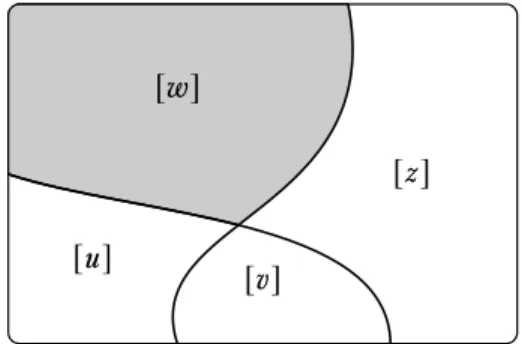
Proposition 2.13. Let R be an equivalence relation, and for each w ∈W define theequivalence classof w as the set[w]={w′∈W : Rww′}. Then:
1. w ∈ [w];
2. R is universal on each equivalence class[w];
3. The collection of equivalence classes partitions W into mutually exclusive and jointly exhaustive subsets.
Proposition 2.14. A formula A is valid in all frames F = ⟨W,R⟩ where R is an equivalence relation, if and only if it is valid in all framesF = ⟨W,R⟩ where R is universal. Hence, the logic of universal frames is justS5.
Proof. It’s immediate to verify that a universal relation R onW
is an equivalence. Hence, ifA is valid in all frames whereR is
an equivalence it is valid in all universal frames. For the other direction, we argue contrapositively: supposeB is a formula that
fails at a worldw in a model M = ⟨W,R,V⟩ based on a frame
⟨W,R⟩, whereR is an equivalence onW. So M,w ⊮B. Define a
modelM′=⟨
W′,R′,V′⟩as follows:
1. W′ =[w];
2. R′ is universal onW′;
3. V′(p)=V(p) ∩W′.
(So the setW′of worlds inM′is represented by the shaded area
inFigure 2.2.) It is easy to see thatR andR′agree onW′. Then
one can show by induction on formulas that for all w′ ∈ W′:
34 CHAPTER 2. FRAME DEFINABILITY
[w]
[u]
[v]
[z]
Figure 2.2:A partition ofW in equivalence classes.
sinceW′ ⊆W). In particular,M′,w ⊮B, andB fails in a model
based on a universal frame. □
2.7
Second-order Definability
Not every frame property definable by modal formulas is first-order definable. However, if we allow quantification over one-place predicates (i.e., monadic second-order quantification), we define all modally definable frame properties. The trick is to exploit a systematic way in which the conditions under which a modal formula is true at a world are related to first-order formu-las. This is the so-called standard translation of modal formulas into first-order formulas in a language containing not just a two-place predicate symbolQ for the accessibility relation, but also a
one-place predicate symbolPi for the propositional variablespi
occurring inA.
Definition 2.15. The standard translation STx(A) is inductively
defined as follows:
1. A≡ ⊥: STx(A)=⊥.
35 2.7. SECOND-ORDER DEFINABILITY 3. A≡ ¬B: STx(A)=¬STx(B). 4. A≡ (B ∧C): STx(A)=(STx(B) ∧STx(C)). 5. A≡ (B ∨C): STx(A)=(STx(B) ∨STx(C)). 6. A≡ (B →C): STx(A)=(STx(B) →STx(C)). 7. A≡□B: STx(A)=∀y(Q(x,y) →STy(B)). 8. A≡♢B: STx(A)=∃y(Q(x,y) ∧STy(B)).
For instance, STx(□p→p)is∀y(Q(x,y) →P(y)) →P(x). Any structure for the language of STx(A) requires a domain, a
two-place relation assigned toQ, and subsets of the domain assigned
to the one-place predicate symbolsPi. In other words, the
com-ponents of such a structure are exactly those of a model forA: the
domain is the set of worlds, the two-place relation assigned toQ
is the accessibility relation, and the subsets assigned to Pi are
just the assignmentsV(pi). It won’t surprise that satisfaction of
Ain a modal model and of STx(A)in the corresponding structure
agree:
Proposition 2.16. Let M = ⟨W,R,V⟩, M′ be the first-order struc-ture with |M′| =W , QM ′ = R, and PM ′ i = V(pi), and s(x) = w . Then M,w ⊩A iffM′,s ⊨STx(A) Proof. By induction onA. □
Proposition 2.17. Suppose A is a modal formula andF= ⟨W,R⟩is a frame. LetF′be the first-order structure with|F′| =W and QF
′ =R, and let A′be the second-order formula
36 CHAPTER 2. FRAME DEFINABILITY
where P1, . . . , Pn are all one-place predicate symbols inSTx(A). Then
F⊨A iffF′⊨A′
Proof. F′ ⊨ A′ iff for every structure M′ where PM
′
i ⊆ W for
i = 1, . . . , n, and for everys withs(x) ∈W, M′,s ⊨STx(A). By
Proposition 2.16, that is the case iff for all modelsM based onF and every worldw ∈W,M,w ⊩A, i.e.,F⊨A. □
Definition 2.18. A class Cof frames is second-order definable if
there is a sentenceA in the second-order language with a single
two-place predicate symbolP and quantifiers only over monadic
set variables such that F = ⟨W,R⟩ ∈ Ciff M ⊨ A in the
struc-tureM with |M| =W andPM =R.
Corollary 2.19. If a class of frames is definable by a formula A, the corresponding class of accessibility relations is definable by a monadic second-order sentence.
Proof. The monadic second-order sentence A′ of the preceding
proof has the required property. □
As an example, consider again the formula □p →p. It
de-fines reflexivity. Reflexivity is of course first-order definable by the sentence ∀x Q(x,x). But it is also definable by the monadic second-order sentence
∀X ∀x(∀y(Q(x,y) →X(y)) →X(x)).
This means, of course, that the two sentences are equivalent. Here’s how you might convince yourself of this directly: First suppose the second-order sentence is true in a structureM. Since
x and X are universally quantified, the remainder must hold for
anyx ∈W and setX ⊆W, e.g., the set{z :Rx z}whereR=QM.