Inaugural-Dissertation
zur Erlangung des Doktorgrades der Philosophie an der Ludwig-Maximilians-Universität München
vorgelegt von Alena Moiseeva
aus Moskau, Russische Föderation München2019
1.Korreferent: Prof. Dr. Alexander M. Fraser 2.Korreferent: Prof. Dr. Rudolf Seiler
Nowadays, digitization is transforming the way businesses work. Re-cently, Artificial Intelligence (AI) techniques became an essential part
of the automation of business processes: In addition to cost advan-tages, these techniques offer fast processing times and higher cus-tomer satisfaction rates, thus ultimately increasing sales. One of the intelligent approaches for accelerating digital transformation in com-panies is the Robotic Process Automation (RPA). A RPA-system is a software tool that robotizes routine and time-consuming responsibil-ities such as email assessment, various calculations, or creation of documents and reports (Mohanty and Vyas,2018). Its main objective is to organize a smart workflow and therethrough to assist employees by offering them more scope for cognitively demanding and engag-ing work.
Intelligent Process Automation (IPA) offers all these advantages as well; however, it goes beyond the RPA by adding AI components such as Machine- and Deep Learning techniques to conventional au-tomation solutions. Previously, IPA approaches were primarily em-ployed within the computer vision domain. However, in recent times, Natural Language Processing (NLP) became one of the potential appli-cations for IPAas well due to its ability to understand and interpret human language. Usually, NLP methods are used to analyze large amounts of unstructured textual data and to respond to various in-quiries. However, one of the central applications ofNLPwithin theIPA
domain – are conversational interfaces (e.g., chatbots, virtual agents) that are used to enable human-to-machine communication. Nowa-days, conversational agents gain enormous demand due to their abil-ity to support a large number of users simultaneously while com-municating in a natural language. The implementation of a conver-sational agent comprises multiple stages and involves diverse types of NLPsub-tasks, starting with natural language understanding (e.g., intent recognition, named entity extraction) and going towards dia-logue management (i.e., determining the next possible bots action) and response generation. Typical dialogue system for IPA purposes undertakes straightforward customer support requests (e.g., FAQs), allowing human workers to focus on more complicated inquiries.
In this thesis, we are addressing two potential Intelligent Process Automation (IPA) applications and employing statistical Natural Lan-guage Processing (NLP) methods for their implementation.
The first block of this thesis (Chapter 2 – Chapter 4) deals with the development of a conversational agentforIPApurposes within the e-learning domain. As already mentioned, chatbots are one of the central applications for the IPAdomain since they can effectively per-form time-consuming tasks while communicating in a natural
lan-that takes care of routine and time-consuming tasks regularly per-formed by human tutors of an online mathematical course. This bot is deployed in a real-world setting within the OMB+
mathemat-ical platform. Conducting experiments for this part, we observed two possibilities to build the conversational agent in industrial set-tings – first, with purely rule-based methods, considering the miss-ing trainmiss-ing data and individual aspects of the target domain (i.e., e-learning). Second, we re-implemented two of the main system com-ponents (i.e., Natural Language Understanding (NLU) and Dialogue
Manager (DM) units) using the current state-of-the-art deep-learning architecture (i.e., Bidirectional Encoder Representations from Trans-formers (BERT)) and investigated their performance and potential use
as a part of a hybrid model (i.e., containing both rule-based and ma-chine learning methods).
The second part of the thesis (Chapter5– Chapter6) considers an
IPA subproblem within the predictive analytics domain and addresses the task of scientific trend forecasting. Predictive analytics forecasts future outcomes based on historical and current data. Therefore, us-ing the benefits of advanced analytics models, an organization can, for instance, reliably determine trends and emerging topics and then manipulate it while making significant business decisions (i.e., invest-ments). In this work, we dealt with the trend detection task – specif-ically, we addressed the lack of publicly available benchmarks for evaluating trend detection algorithms. We assembled the benchmark for the detection of both scientific trendsand downtrends (i.e., topics that become less frequent overtime). To the best of our knowledge, the task of downtrend detection has not been addressed before. The resulting benchmark is based on a collection of more than one mil-lion documents, which is among the largest that has been used for trend detection before, and therefore, offers a realistic setting for the development of trend detection algorithms.
Robotergesteuerte Prozessautomatisierung (RPA) ist eine Art von Soft-ware-Bots, die manuelle menschliche Tätigkeiten wie die Eingabe von Daten in das System, die Anmeldung in Benutzerkonten oder die Ausführung einfacher, aber sich wiederholender Arbeitsabläufe nachahmt (Mohanty and Vyas, 2018). Einer der Hauptvorteile und gleichzeitig Nachteil der RPA-bots ist jedoch deren Fähigkeit, die ge-stellte Aufgabe punktgenau zu erfüllen. Einerseits ist ein solches Sys-tem in der Lage, die Aufgabe akkurat, sorgfältig und schnell auszu-führen. Andererseits ist es sehr anfällig für Veränderungen in definier-ten Szenarien. Da derRPA-Bot für eine bestimmte Aufgabe konzipiert ist, ist es oft nicht möglich, ihn an andere Domänen oder sogar für einfache Änderungen in einem Arbeitsablauf anzupassen (Mohanty and Vyas, 2018). Diese Unfähigkeit, sich an veränderte Bedingungen anzupassen, führte zu einem weiteren Verbesserungsbereich fürRPA -bots – den Intelligenten Prozessautomatisierungssystemen (IPA).
IPA-Bots kombinierenRPAmit Künstlicher Intelligenz (AI) und kön-nen komplexe und kognitiv anspruchsvollere Aufgaben erfüllen, die u.A. Schlussfolgerungen und natürliches Sprachverständnis erfordern. Diese Systeme übernehmen zeitaufwändige und routinemäßige Auf-gaben, ermöglichen somit einen intelligenten Arbeitsablauf und be-freien Fachkräfte für die Durchführung komplizierterer Aufgaben. Bisher wurden die IPA-Techniken hauptsächlich im Bereich der Bild-verarbeitung eingesetzt. In der letzten Zeit wurde die natürliche Sprachverarbeitung (NLP) jedoch auch zu einem der potenziellen An-wendungen fürIPA, und zwar aufgrund von der Fähigkeit, die mensch-liche Sprache zu interpretieren. NLP-Methoden werden eingesetzt, um große Mengen an Textdaten zu analysieren und auf verschiedene Anfragen zu reagieren. Auch wenn die verfügbaren Daten unstruk-turiert sind oder kein vordefiniertes Format haben (z.B. E-Mails), oder wenn die in einem variablen Format vorliegen (z.B. Rechnungen, ju-ristische Dokumente), dann werden ebenfalls die NLPTechniken an-gewendet, um die relevanten Informationen zu extrahieren, die dann zur Lösung verschiedener Probleme verwendet werden können.
NLPim Rahmen vonIPAbeschränkt sich jedoch nicht auf die Extrak-tion relevanter Daten aus Textdokumenten. Eine der zentralen An-wendungen von IPA sind Konversationsagenten, die zur Interaktion zwischen Mensch und Maschine eingesetzt werden. Konversations-agenten erfahren enorme Nachfrage, da sie in der Lage sind, eine große Anzahl von Benutzern gleichzeitig zu unterstützen, und dabei in einer natürlichen Sprache kommunizieren. Die Implementierung eines Chatsystems umfasst verschiedene Arten vonNLP-Teilaufgaben, beginnend mit dem Verständnis der natürlichen Sprache (z.B. Ab-sichtserkennung, Extraktion von Entitäten) über das
Dialogmanage-Response-Generierung. Ein typisches Dialogsystem für IPA-Zwecke übernimmt in der Regel unkomplizierte Kundendienstanfragen (z.B. Beantwortung von FAQs), so dass sich die Mitarbeiter auf komplexere Anfragen konzentrieren können.
Diese Dissertation umfasst zwei Bereiche, die durch das breitere Thema vereint sind, nämlich die Intelligente Prozessautomatisierung (IPA) unter Verwendung statistischer Methoden der natürlichen Sprach-verarbeitung (NLP).
Der erste Block dieser Arbeit (Kapitel 2 – Kapitel 4) befasst sich mit der Impementierung eines Konversationsagenten für IPA-Zwecke innerhalb der E-Learning-Domäne. Wie bereits erwähnt, sind Chat-bots eine der zentralen Anwendungen für die IPA-Domäne, da sie zeitaufwändige Aufgaben in einer natürlichen Sprache effektiv aus-führen können. Der IPA-Kommunikationsbot, der in dieser Arbeit realisiert wurde, kümmert sich ebenfalls um routinemäßige und zeit-aufwändige Aufgaben, die sonst von Tutoren in einem Online-Mathe-matikkurs in deutscher Sprache durchgeführt werden. Dieser Bot ist in der täglichen Anwendung innerhalb der mathematischen Platt-form OMB+eingesetzt. Bei der Durchführung von Experimenten be-obachteten wir zwei Möglichkeiten, den Konversationsagenten im in-dustriellen Umfeld zu entwickeln – zunächst mit rein regelbasierten Methoden, unter Bedingungen der fehlenden Trainingsdaten und be-sonderer Aspekte der Zieldomäne (d.h. E-Learning). Zweitens haben wir zwei der Hauptsystemkomponenten (Sprachverständnismodul, Dialog-Manager) mit dem derzeit fortschrittlichsten Deep Learning Algorithmus reimplementiert und die Performanz dieser Komponen-ten untersucht.
Der zweite Teil der Doktorarbeit (Kapitel5 – Kapitel 6) betrachtet ein IPA-Problem innerhalb des Vorhersageanalytik-Bereichs. Vorher-sageanalytik zielt darauf ab, Prognosen über zukünftige Ergebnisse auf der Grundlage von historischen und aktuellen Daten zu erstellen. Daher kann ein Unternehmen mit Hilfe der Vorhersagesysteme z.B. die Trends oder neu entstehende Themen zuverlässig bestimmen und diese Informationen dann bei wichtigen Geschäftsentscheidungen (z.B. Investitionen) einsetzen. In diesem Teil der Arbeit beschäftigen wir uns mit dem Teilproblem der Trendprognose – insbesondere mit dem Fehlen öffentlich zugänglicher Benchmarks für die Evaluierung von Trenderkennungsalgorithmen. Wir haben den Benchmark zusammen-gestellt und veröffentlicht, um sowohl Trends als auchAbwärtstrends zu erkennen. Nach unserem besten Wissen ist die Aufgabe der Ab-wärtstrenderkennung bisher nicht adressiert worden. Der resultie-rende Benchmark basiert auf einer Sammlung von mehr als einer Million Dokumente, der zu den größten gehört, die bisher für die Trenderkennung verwendet wurden, und somit einen realistischen Rahmen für die Entwicklung von Trenddetektionsalgorithmen bietet.
This thesis was possible due to several people who contributed signif-icantly to my work. I owe my gratitude to each of them for guidance, encouragement, and inspiration during my doctoral study.
First of all, I would like to thank my advisor, Prof. Dr. Hinrich Schütze, for his mentorship, support, and thoughtful guidance. My special gratitude goes forProf. Dr. Ruedi Seilerand his fantastic team at Integral-Learning GmbH. I am thankful for your valuable input, interest in our collaborative work, and for your continuous support. I would also like to show gratitude to Prof. Dr. Alexander Fraser for co-advising, support and helpful feedback.
Finally, none of this would be possible without my family’s sup-port: there are no words to express the depth of gratitude I feel for them. My earnest appreciation goes to my husband, Dietrich: thank you for all the time you were by my side and for the encouragement you provided me through these years. I am very grateful to my par-ents for their understanding and backing at any moment. I appreciate the love of my grandparents: it is hard to realize how significant their care is for me. Besides that, I am also grateful to my sister Alexan-dra, elder brother Denis, and parents-in-law, for merely being always there for me.
List of Figures XI
List of Tables XII
Acronyms XIII 1 i n t r o d u c t i o n 1 1.1 Outline . . . 3 i e-l e a r n i n g c o n v e r s at i o na l a s s i s ta n t 5 2 f o u n d at i o n s 7 2.1 Introduction . . . 7 2.2 Conversational Assistants . . . 9 2.2.1 Taxonomy . . . 9 2.2.2 Conventional Architecture . . . 12 2.2.3 Existing Approaches . . . 15
2.3 Target Domain & Task Definition . . . 18
2.4 Summary . . . 19
3 m u lt i p u r p o s e i pa v i a c o n v e r s at i o na l a s s i s ta n t 21 3.1 Introduction . . . 21
3.1.1 Outline and Contributions . . . 22
3.2 Model . . . 23
3.2.1 OMB+ Design . . . 23
3.2.2 Preprocessing . . . 23
3.2.3 Natural Language Understanding . . . 25
3.2.4 Dialogue Manager . . . 26
3.2.5 Meta Policy . . . 30
3.2.6 Response Generation . . . 32
3.3 Evaluation . . . 37
3.3.1 Automated Evaluation . . . 37
3.3.2 Human Evaluation & Error Analysis . . . 37
3.4 Structured Dialogue Acquisition . . . 39
3.5 Summary . . . 39
3.6 Future Work . . . 40
4 d e e p l e a r n i n g r e-i m p l e m e n tat i o n o f u n i t s 41 4.1 Introduction . . . 41
4.1.1 Outline and Contributions . . . 42
4.2 Related Work . . . 43
4.3 BERT: Bidirectional Encoder Representations from Trans-formers . . . 44
4.4 Data & Descriptive Statistics . . . 46
4.5 Named Entity Recognition . . . 48
4.5.1 Model Settings . . . 49
4.6 Next Action Prediction . . . 49
4.6.1 Model Settings . . . 49
4.7 Evaluation and Results . . . 50
4.9 Summary . . . 58
4.10 Future Work . . . 59
ii c l u s t e r i n g-b a s e d t r e n d a na ly z e r 61 5 f o u n d at i o n s 63 5.1 Motivation and Challenges . . . 63
5.2 Detection of Emerging Research Trends . . . 64
5.2.1 Methods for Topic Modeling . . . 65
5.2.2 Topic Evolution of Scientific Publications . . . . 67
5.3 Summary . . . 68
6 b e n c h m a r k f o r s c i e n t i f i c t r e n d d e t e c t i o n 71 6.1 Motivation . . . 71
6.1.1 Outline and Contributions . . . 72
6.2 Corpus Creation . . . 73
6.2.1 Underlying Data . . . 73
6.2.2 Stratification . . . 73
6.2.3 Document representations & Clustering . . . 74
6.2.4 Trend & Downtrend Estimation . . . 75
6.2.5 (Down)trend Candidates Validation . . . 75
6.3 Benchmark Annotation . . . 77
6.3.1 Inter-annotator Agreement . . . 77
6.3.2 Gold Trends . . . 78
6.4 Evaluation Measure for Trend Detection . . . 79
6.5 Trend Detection Baselines . . . 80
6.5.1 Configurations . . . 81
6.5.2 Experimental Setup and Results . . . 81
6.6 Benchmark Description . . . 82
6.7 Summary . . . 83
6.8 Future Work . . . 83 7 d i s c u s s i o n a n d f u t u r e w o r k 85
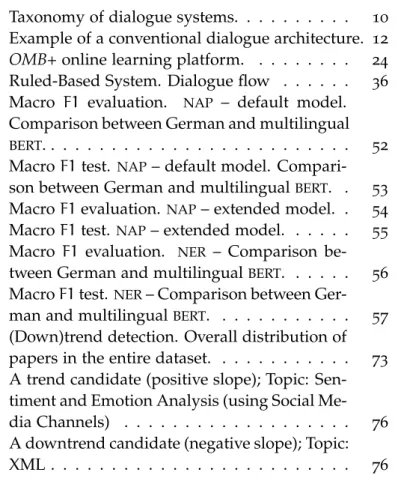
Figure1 Taxonomy of dialogue systems. . . 10 Figure2 Example of a conventional dialogue architecture. 12 Figure3 OMB+online learning platform. . . 24 Figure4 Ruled-Based System. Dialogue flow . . . 36 Figure5 Macro F1 evaluation. NAP – default model.
Comparison between German and multilingual
BERT. . . 52 Figure6 MacroF1 test. NAP– default model.
Compari-son between German and multilingualBERT. . 53 Figure7 MacroF1evaluation. NAP– extended model. . 54 Figure8 MacroF1test. NAP– extended model. . . 55 Figure9 Macro F1 evaluation. NER – Comparison
be-tween German and multilingualBERT. . . 56 Figure10 MacroF1test.NER– Comparison between
Ger-man and multilingualBERT. . . 57 Figure11 (Down)trend detection. Overall distribution of
papers in the entire dataset. . . 73 Figure12 A trend candidate (positive slope); Topic:
Sen-timent and Emotion Analysis (using Social Me-dia Channels) . . . 76 Figure13 A downtrend candidate (negative slope); Topic:
Table1 Natural language representation of a sentence. 13
Table2 Rule1: Admissible configurations. . . 27
Table3 Rule2: Admissible configurations. . . 27
Table4 Rule3: Admissible configurations. . . 27
Table5 Rule4: Admissible configurations. . . 28
Table6 Rule5: Admissible configurations. . . 28
Table7 Case1: ID completeness. . . 31
Table8 Case2: ID completeness. . . 31
Table9 Showcase1: Short flow. . . 33
Table10 Showcase2: Organisational question. . . 33
Table11 Showcase3: Fallback and human-request poli-cies. . . 34
Table12 Showcase4: Contextual question. . . 34
Table13 Showcase5: Long flow. . . 35
Table14 General statistics for conversational dataset. . . 46
Table15 Detailed statistics on possible systems actions in conversational dataset. . . 48
Table16 Detailed statistics on possible named entities in conversational dataset. . . 48
Table17 F1-results for the Named Entity Recognition task. 51 Table18 F1-results for the Next Action Prediction task. 51 Table19 Average dialogue accuracy computed for the Next Action Prediction task. . . 51
Table20 Trend detection. List of gold trends. . . 79
Table21 Trend detection. Example of MAP evaluation. 80 Table22 Trend detection. Ablation results. . . 82
AI Artificial Intelligence
API Application Programming Interface
BERT Bidirectional Encoder Representations from Transformers
BiLSTM Bidirectional Long Short Term Memory
CRF Conditional Random Fields
DM Dialogue Manager
DST Dialogue State Tracker
DSTC Dialogue State Tracking Challenge
EC Equivalence Classes
ES ElasticSearch
GM Gaussian Models
IAA Inter Annotator Agreement
ID Informational Dictionary
IPA Intelligent Process Automation
ITS Intelligent Tutoring System
LDA Latent Dirichlet Allocation
LSA Latent Semantic Analysis
LSTM Long Short Term Memory
MAP Mean Average Precision
MER Mutually Exclusive Rules
NAP Next Action Prediction NER Named Entity Recognition
NLG Natural Language Generation
NLP Natural Language Processing
NLU Natural Language Understanding
OMB+ Online Mathematik Brückenkurs
PL Policy Learning
pLSA probabilistic Latent Semantic Analysis
REST Representational State Transfer
RNN Recurrent Neural Network
RPA Robotic Process Automation RegEx Regular Expressions
TL Transfer Learning
1
I N T R O D U C T I O N
Robotic Process Automation (RPA) is a type of software bots that im-itates manual human activities like entering data into a system, log-ging into accounts, or executing simple but repetitive workflows (Mo-hanty and Vyas, 2018). In other words, RPA-systems allow business applications to work without human involvement by replicating hu-man worker activities. A further benefit of RPA-bots is that they are much cheaper compared to the employment of a human worker, and they are also able to work around-the-clock. Overall advantages of software bots are hugely appealing and include cost savings, accuracy and compliance while executing processes, improved responsiveness (i.e., bots are faster than human workers), and finally, such bots are usually agile and multi-skilled (Ivanˇci´c, Vugec, and Vukši´c,2019).
However, one of the main benefits and at the same time – draw-backs of the RPA-systems, is their ability to precisely fulfill the as-signed task. On the one hand, the bot can carry out the task accu-rately and diligently. On the other hand, it is highly susceptible to changes in defined scenarios. Being designed for a particular task, the RPA-bot is often not adaptable to other domains or even simple changes in a workflow (Mohanty and Vyas, 2018). This inability to adapt to changing conditions gave rise to a further area of improve-ment forRPA-bots – Intelligent Process Automation (IPA) systems.
IPA-bots combine Robotic Process Automation (RPA) with Artificial Intelligence (AI) and thus can perform complex and more cognitively demanding tasks that require reasoning and language understand-ing. Hence,IPA-bots went beyond automating simple “click tasks” (as in RPA) and can accomplish jobs more intelligently – employing ma-chine learning algorithms and advanced analytics. Such IPA-systems undertake time-consuming and routine tasks, and thus enable smart workflows and free up skilled workers to accomplish higher-value activities.
Previously,IPAtechniques were primarily employed within the com-puter vision domain. Starting with the automation of simple display click-tasks and going towards sophisticated self-driving cars with their ability to interpret a stream of situational data obtained from sensors and cameras. However, in recent times, Natural Language Processing (NLP) became one of the potential applications for IPAas
well due to its ability to understand and interpret human language.
NLP methods are used to analyze large amounts of textual data and to respond to various inquiries. Furthermore, if the available data is unstructured and does not have any predefined format (i.e., cus-tomer emails), or if it is available in a variable format (i.e., invoices,
legal documents), then the Natural Language Processing (NLP) tech-niques are applied to extract the multiple relevant information. This data then can be utilized to solve distinct problems (i.e., natural lan-guage understanding, predictive analytics) (Mohanty and Vyas,2018). For instance, in the case of predictive analytics, such a bot would make forecasts about the future using current and historical data and therethrough assist with sales or investments.
However,NLPin the context of Intelligent Process Automation (IPA) is not limited to the extraction of relevant data and insights from tex-tual documents. One of the central applications ofNLPwithin theIPA
domain – are conversational interfaces (e.g., chatbots) that are used to enable human-to-machine interaction. This type of software is com-monly used for customer support or within recommendation- and booking systems. Conversational agents gain enormous demand due to their ability to simultaneously support a large number of users while communicating in a natural language. In a conventional chat-bot system, a user provides input in a natural language, the chat-bot then processes this query to extract potentially useful information and re-sponds with a relevant reply. This process comprises multiple stages and involves different types of NLP subtasks, starting with Natural Language Understanding (NLU) (e.g., intent recognition, named en-tity extraction) and going towards dialogue management (i.e., deter-mining the next possible bots action, considering the dialogue his-tory) and response generation (e.g., converting the semantic repre-sentation of next bots action to a natural language utterance). Typical dialogue system for Intelligent Process Automation (IPA) purposes usually undertakes shallow customer support requests (e.g., answer-ing of FAQs), allowanswer-ing human workers to focus on more sophisticated inquiries.
Natural Language Processing (NLP) techniques may also be used indirectly forIPApurposes. There are attempts to automatically iden-tify and classify tasks extracted from textual process descriptions as manual, user, or automated. The goal of such an NLP application is to reduce the effort required to identify suitable candidates for fur-ther robotic process automation (Friedrich, Mendling, and Puhlmann, 2011; Leopold, Aa, and Reijers,2018).
Intelligent Process Automation (IPA) is an emerging technology and evolves mainly due to the recognized potential benefit of combining Robotic Process Automation (RPA) and Artificial Intelligence (AI) tech-niques to solve industrial problems (Ivanˇci´c, Vugec, and Vukši´c,2019; Mohanty and Vyas, 2018). Industries are typically interested in be-ing responsive to customers and markets (Mohanty and Vyas, 2018). Thus, most customer support applications need to be real-time active and highly robust to achieve higher client satisfaction rates. The man-ual accomplishment of such tasks is often time-consuming, expensive and error-prone. Furthermore, due to the massive amounts of textual data available for analysis, it seems not to be feasible to process this data entirely by human means.
1.1 o u t l i n e
This thesis covers two topics united by the broader theme, which is Intelligent Process Automation (IPA) utilizing statistical Natural Lan-guage Processing (NLP) methods.
t h e f i r s t b l o c k o f t h e t h e s i s (Chapter2– Chapter4) addresses the challenge of implementing a conversational agent for Intelli-gent Process Automation (IPA) purposes within the e-learning field. As mentioned above, chatbots are one of the central ap-plications of theIPAdomain, since they can effectively perform time-consuming tasks requiring natural language understand-ing, allowing human workers to concentrate on more valuable tasks. The IPAconversational bot that was realized within this thesis takes care of routine and time-consuming tasks performed by human tutors within an online mathematical course. This bot is deployed in a real-world setting and interact with stu-dents within the OMB+mathematical platform. Conducting ex-periments, we observed two possibilities to build the conversa-tional agent in industrial settings – first, with purely rule-based methods, considering the missing training data and individual aspects of the target domain (i.e., e-learning). Second, we re-implemented two of the main system components (i.e., Natu-ral Language Understanding (NLU) and Dialogue Manager (DM) units) using the current state-of-the-art deep-learning algorithm (i.e., Bidirectional Encoder Representations from Transformers (BERT)) and investigated their performance and potential use as
a part of a hybrid model (i.e., containing both rule-based and machine learning methods).
t h e s e c o n d b l o c k o f t h e t h e s i s (Chapter 5 – Chapter 6) con-siders an Intelligent Process Automation (IPA) problem within the predictive analytics domain and addresses the task of scien-tific trend detection. Predictive analytics makes forecasts about future outcomes based on historical and current data. Hence, organizations can benefit through the advanced analytics mod-els by detecting trends and their behaviors, and then employ-ing this information while makemploy-ing crucial business decisions (i.e., investments). In this work, we deal with the subproblem of trend detection task – specifically, we address the lack of publicly available benchmarks for the evaluation of trend de-tection algorithms. Therefore, we assembled the benchmark for bothtrendsanddowntrends(i.e., topics that become less frequent overtime) detection. To the best of our knowledge, the task of downtrend detection has not been well addressed before. Fur-thermore, the resulting benchmark is based on a collection of more than one million documents, which is among the largest that has been used for trend detection before and therefore of-fers a realistic setting for developing trend detection algorithms.
All main chapters contain their specific introduction, contribution list, related work section, and summary.
2
F O U N D AT I O N S
In this block, we address the challenge of designing and implement-ing a conversational assistant for Intelligent Process Automation (IPA) purposes within the e-learning domain. The system aims to support human tutors of the Online Mathematik Brückenkurs (OMB+) plat-form during the tutoring round by undertaking routine and time-consuming responsibilities. Specifically, the system intelligently auto-mates the process of information accumulation and validation, that precede every conversation. Therethrough, theIPA-bot frees up tutors and allows them to concentrate on more complicated and cognitively demanding tasks.
In this chapter, we introduce the fundamental concepts required by the topic of the first part of the thesis. We begin with the foundations to conversational assistants in Section2.2, where we present the taxon-omy of existing dialogue systems in Section2.2.1, give an overview of the conventional dialogue architecture in Section 2.2.2, with its most essential components, and describe the existing approaches for build-ing a conversational agent in Section 2.2.3. We finally introduce the target domain for our experiments in Section2.3.
2.1 i n t r o d u c t i o n
Conversational Assistants - a type of software that interacts with peo-ple via written or spoken natural language, have become widely pop-ularized in recent times. Today’s conversational assistants support a broad range of everyday skills, including, but not limited to, creating a reminder, answering factoid questions, and controlling smart home devices.
Initially, the notion of artificial companion capable of conversing in a natural language was anticipated by Alan Turing in 1949 (Tur-ing, 1949). Still, the first significant step in this direction was done in1966with the appearance of Weizenbaums systemELIZA (Weizen-baum, 1966). Its successor was the A.L.I.C.E. (Artificial Linguistic Internet Computer Entity) – a natural language processing dialogue system that conversed with a human by applying heuristical pattern matching rules. Despite being remarkably popular and technologi-cally advanced for their days, both systems were unable to pass the Turing test (Alan, 1950). Following a long silent period, the next wave of growth of intelligent agents was caused by the advances in Natural Language Processing (NLP). This was enabled by access to low-cost memory, higher processing speed, vast amounts of available
data, and sophisticated machine learning algorithms. Hence, one of the most notable leaps in the history of conversational agents began in the year 2011 with intelligent personal assistants. In that time Ap-ples Siri, followed by Microsofts Cortana and Amazons Alexa in 2014, and thenGoogle Assistantin 2016, came to the scene. The main focus of these agents was not to mimic humans, as in ELIZA or A.L.I.C.E, but to assist a human by answering simple factoid questions and set-ting notification tasks across a broad range of content. Another type of conversational agent, called Task-oriented Dialogue System (ToDS), became a focus of industries in the year2016. For the most part, these bots aimed to support customer service (Cui et al.,2017) and respond to Frequently Asked Questions (Liao et al., 2018). Their conversa-tional style provided more depth than those of personal assistants, but a narrower range, since they were patterned for task solving and not for open-domain discussions.
One of the central advantages of conversational agents and the rea-son why they are attracting considerable interest is their ability to give attention to several users simultaneously while supporting nat-ural language communication. Due to this, conversational assistants gain momentum in numerous kinds of practical support applications (i.e., customer support), where a high number of users are involved at the same time. Classical engagement of human assistants is very cost-efficient, and such support is usually not full-time accessible. There-fore, to automate human assistance is desirable but also an ambi-tious task. Due to the lack of solid Natural Language Understand-ing (NLU), advancing beyond primary tasks is still challenging (Luger and Sellen, 2016), and even the most prosperous dialogue systems often fail to meet user’s expectations (Jain et al., 2018). Significant challenges involved in the design and implementation of a conversa-tional agent varying from domain engineering to Natural Language Understanding (NLU), and designing of an adaptive domain-specific conversational flow. The quintessential problems and "how-to" ques-tions while building conversational assistants include:
• How to deal withvariability andflexibilityof language? • How to get high-qualityin-domain data?
• How to buildmeaningful representations?
• How to integratecommonsenseanddomain knowledge? • How to build arobustsystem?
Besides that, current Natural Language Processing (NLP) and Ar-tificial Intelligence (AI) techniques have weaknesses when applied to domain-specific task-oriented problems, especially if underlying data comes from an industrial source. As machine learning techniques heavily rely on structured and cleaned training data to deliver consis-tent performance, typically noisy real-world data without access to additional knowledge databases negatively impacts the classification accuracy.
Despite that, conversational agents could be successfully employed to solve less cognitive but still highly relevant tasks. In this case, a dialogue agent could be operated as a part of the Intelligent Process Automation (IPA) system, where it takes care of straightforward but
routine and time-consuming functions performed in a natural lan-guage while allowing a human worker to focus on more cognitive demanding processes.
2.2 c o n v e r s at i o na l a s s i s ta n t s
Development and design of a particular dialogue system usually vary by its objectives, among the most fundamental are:
• Purpose: Should it be an open-ended dialogue system (e.g., chit-chat), task-oriented system (e.g., customer support) or a personal assistant (e.g., Google Assistant)?;
• Skills: What kind of behavior should a system demonstrate? • Data: Which data is required to develop (resp. train) specific
blocks and how could it be assembled and curated?
• Deployment: Will the final system be integrated into a partic-ular software platform? What are the challenges in choosing suitable tools? How will the deployment happen?
• Implementation: Should it be a rule-based, information-retrieval, machine-learning, or a hybrid system?
In the following chapter, we will take a look at the most common taxonomies of dialogue systems, and different design and implemen-tation strategies.
2.2.1 Taxonomy
According to thegoals, conversational agents could be classified into two main categories: task-oriented systems(e.g., for customer support), and social bots (e.g., for chit-chat purposes). Furthermore, systems also vary regarding their implementation characteristics. Below we provide a detailed overview of the most common variations.
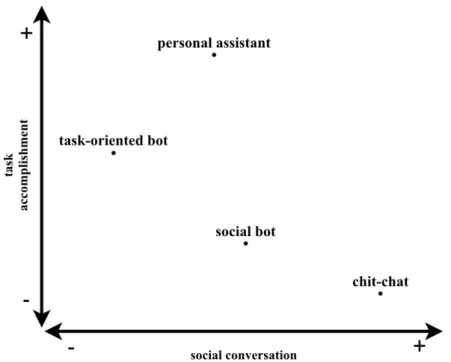
ta s k-o r i e n t e d d i a l o g u e s y s t e m s are famous for their ability to lead a dialogue with the ultimate goal of solving a user’s problem (see Figure1). A customer support agent or a flight/restaurant book-ing system exemplify this class of conversational assistants. Such systems are more meaningful and useful as those with an entirely so-cial goal; however, they usually affect more complications during the implementation stage. Since Task-oriented Dialogue System (ToDS) re-quire a precise understanding of the user’s intent (i.e., goal), the Natu-ral Language Understanding (NLU) segment must perform flawlessly.
Besides that, if applied in an industrial setting, ToDSare usually built modular, which means they mostly rely on handcrafted rules and pre-defined templates, and are restricted in their abilities. Personal assis-tants(i.e., Google Assistant) are members of the task-oriented family as well. Though, compared to standard agents, they involve more so-cial conversation and could be used for entertainment purposes (e.g., “Ok Google, tell me a joke!”). The latter is typically not available in
conventional task-oriented systems.
s o c i a l b o t s a n d c h i t-c h at s y s t e m s in contrast, regularly do not hold any specific goal and are designed for small-talk and enter-tainment conversations (see Figure1). Those agents are usually end-to-end trainable and highly data-driven, which means they require large amounts of training data. However, due to entirely learnable training, such systems often produce inappropriate responses, mak-ing them extremely unreliable for practical applications. Alike chit-chat systems,social botsare rich in social conversation; however, they possess an ability to solve uncomplicated user requests and conduct a more meaningful dialogue (Fang et al., 2018). Those requests are not the same, as in task-oriented systems and are mostly pointed to answer simple factoid questions.
Figure1: Taxonomy of dialogue systems according to the measure of their task accomplishment and social contribution. Figure originates from Fang et al.,2018.
The aforementioned system types could be decomposed farther ac-cording to the implementation characteristics:
o p e n d o m a i n & c l o s e d d o m a i n: A Task-oriented Dialogue Sys-tem (ToDS) is typically built within a closed domainsetting. The space of potential inputs and outputs is restricted since the sys-tem atsys-tempts to achieve a specific goal. Customer support or shopping assistants are cases of closed domain problems (Wen et al.,2016). These systems do not need to be able to talk about off-site topics, but they have to fulfill their particular tasks as efficiently as possible.
Whereas, chit-chat systems do not assume a well-defined goal or intention and thus, could be built within an open domain. This means the conversation can progress in any direction and without any or minimal functional purpose (Serban et al.,2016). However, the infinite number of various topics and the fact that a certain amount of commonsense is required to create reason-able responses makes an open-domain setting a hard problem. c o n t e n t-d r i v e n & u s e r-c e n t r i c: Social bots and chit-chat
sys-tems are typically utilizing a content-driven dialogue manner. That means that their responses are based on the large and dy-namic content derived from the daily web mining and knowl-edge graphs. This approach builds a dialogue based on trendy content from diverse sources, and thus, it is an ideal way for social bots to catch users’ attention and bring a user into the dialogue.
User-centric approaches, in turn, assume precise language un-derstanding to detect the sentiment of users’ statements. Ac-cording to the sentiment, the dialogue manager learns users’ personalities, handles rapid topic changes, and tracks engage-ment. In this case, the dialogue builds on specific user interests. l o n g & s h o r t c o n v e r s at i o n s Models with a short conversation
style attempt to create a single response to a single input (e.g., weather forecast). In the case with along conversation, a system has to go through multiple turns and to keep track of what has been said before (i.e., dialogue history). The longer the conver-sation, the more challenging it is to train a system. Customer support conversations are typically long conversational threads with multiple questions.
r e s p o n s e g e n e r at i o n One of the essential elements of a dialogue system is a response generation. This could be either done in a retrieval-basedmanner or by usinggenerative models(i.e., Natural Language Generation (NLG)).
The former usually utilizes predefined responses and heuristics to select a relevant response based on the input and context. The heuristic could be a rule-based expression match (i.e., Regular Expressions (RegEx)) or an ensemble of machine learning
clas-sifiers (e.g., entity extraction, prediction of next action). Such systems do not generate any original text; instead, they select a response from a fixed set of predefined candidates. These mod-els are usually used in an industrial setting, where the system must show high robustness, performance and interpretability of the outcomes.
The latter, in contrast, do not rely on predefined replies. Since such models are typically based on (deep-) machine learning techniques, they attempt to generate new responses from scratch. This is, however, a complicated task, and is mostly used for vanilla chit-chat systems or in a research domain, where the structured training data is available.
2.2.2 Conventional Architecture
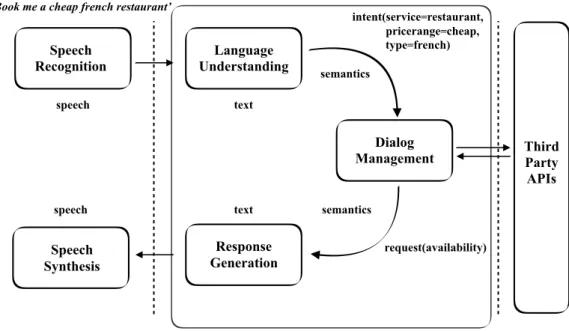
In this and the following subsection, we review the pipeline and meth-ods for Task-oriented Dialogue System (ToDS). Such agents are
typi-cally composed of several components (Figure2) addressing diverse tasks required to facilitate a natural language dialogue (Williams, Raux, and Henderson,2016).
Figure2: Example of a conventional dialogue architecture with its main components in the bounding box: Language Understanding (NLU), Dialogue Manager (DM), Response Generation (NLG). Figure origi-nates from NAACL2018Tutorial, Su et al.,2018.
A conventional dialogue architecture implements this with the fol-lowing components:
nat u r a l l a n g ua g e u n d e r s ta n d i n g u n i t has the following ob-jectives: it parses the user input, classifies the domain (i.e., cus-tomer support, restaurant booking; not required for a single domain systems) and intent(i.e., find-flight, book-taxi), and ex-tractsentities(i.e., Italian food, Berlin).
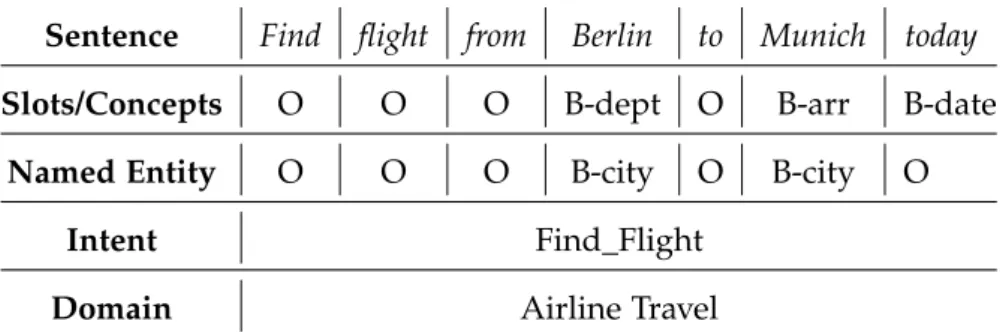
Generally, NLU unit maps every user utterance into semantic frames, that are predefined according to different scenarios. Ta-ble 1 illustrates an example of sentence representation, where the departure-location (Berlin) and the arrival-location (Munich) are specified as slot values, and the domain (airline travel) and intent (find-flight) are specified as well. Typically, there are two kinds of possible representations. The first one is the utterance category, represented in the form of the user’s intent. The sec-ond could be the word-level information extraction in the form of Named Entity Recognition (NER) or Slot Filling tasks.
Sentence Find flight from Berlin to Munich today
Slots/Concepts O O O B-dept O B-arr B-date
Named Entity O O O B-city O B-city O
Intent Find_Flight
Domain Airline Travel
Table1: An illustrative example of a sentence representation1.
A dialog act classification sub-module, also known asintent clas-sification, is dedicated to detecting the primary user’s goal at every dialogue state. It labels each user’s utterance with one of the predefined intents. Deep neural networks can be directly applied to this conventional classification problem (Khanpour, Guntakandla, and Nielsen,2016; Lee and Dernoncourt,2016). Slot filling is another sub-module for language understanding. Unlike intent detection (i.e., classification problem), slot filling is defined as a sequence labeling problem, where words in the sequence are labeled with semantic tags. The input is a se-quence of words, and the output is a sese-quence of slots, one for every word. Variations of Recurrent Neural Network (RNN) architectures (LSTM,BiLSTM) (Deoras et al.,2015) and (attention-based) encoder-decoder architectures (Kurata et al., 2016) have been employed for this task.
d i a l o g u e m a na g e r u n i t is subdivided into two components – first, is a Dialogue State Tracker (DST), that holds the conver-sational state, and second, is a Policy Learning (PL), that defines the systemsnext action.
Dialogue State Tracker (DST) is the core component to guarantee a robust dialogue flow since it manages the user’s intent at ev-ery turn. The conventional methods, which are broadly applied in commercial implementations, often adopt handcrafted rules to pick the most probable candidate (Goddeau et al.,1996; Wang and Lemon, 2013) among the predefined. Though, a variety of statistical approaches have emerged since the Dialogue State Tracking Challenge (DSTC)2
was arranged by Jason D. Williams in year 2013. Among the deep-learning based approaches is theBelief Trackerproposed by Henderson, Thomson, and Young (2013). It employs a sliding window to produce a sequence of probability distributions over an arbitrary number of possible values (Chen et al.,2017). In the work of Mrkši´c et al. (2016) au-thors introduced aNeural Belief Trackerto identify the slot-value pairs. The system used the user intents preceding the user in-put, the user utterance itself, and a candidate slot-value pair which it needs to decide about, as the input. Then the system iterated overall candidate slot-value pairs to determine which ones have just been expressed by the user (Chen et al., 2017). Finally, Vodolán, Kadlec, and Kleindienst proposed aHybrid Di-alog State Tracker, that achieved the state-of-the-art performance forDSTC2shared task. Their model used a separate-learned de-coder coupled with a rule-based system.
Based on the state representation from the Dialogue State Tracker (DST), the PL unit generates the next system action, that is then
decoded by the Natural Language Generation (NLG) module. Usually, a rule-based agent is used to initialize the system (Yan et al., 2017) and then, supervised learning is applied to the actions generated by these rules. Alternatively, the dialogue policy can be trained end-to-end with reinforcement learning to manage the system making policies toward the final perfor-mance (Cuayáhuitl, Keizer, and Lemon,2015).
nat u r a l l a n g ua g e g e n e r at i o n u n i t transforms thenext action into a natural language response. Conventional approaches to Natural Language Generation (NLG) typically adopt a template-based style, where a set of rules is defined to map every next action to a predefined natural language response. Such ap-proaches are simple, generally error-free and easy to control; however, their implementation is time-consuming, and the style is repetitive and hardly scalable.
Among the deep learning techniques is the work by Wen et al. (2015), that introduced neural network-based approaches to
NLG with an LSTM-based structure. Later, Zhou and Huang 2
(2016) adopted this model along with the question informa-tion, semantic slot values, and dialogue act types to generate more precise answers. Finally, Wu, Socher, and Xiong (2019) proposedGlobal to Local Memory Pointer Networks (GLMP) – an architecture that incorporates knowledge bases directly into a learning framework (due to the Memory Networks component) and is able to re-use information from the user input (due to thePointer Networkscomponent).
In particular cases, dialogue flow can include speech recognition and speech synthesis units (if managing a spoken natural language system) and connection to third-party APIs to request information stored in external databases (e.g., weather forecast) (as depicted in Figure2).
2.2.3 Existing Approaches
As stated above, a conventional task-oriented dialogue system is im-plemented in a pipeline manner. That means that once the system receives a user query, it interprets it and acts according to the dia-logue state and the corresponding policy. Additionally, based on un-derstanding, it may access the knowledge base to find the demanded information there. Finally, a system transforms a system’s next ac-tion (and if given, an extracted informaac-tion) into its surface form as a natural language response (Monostori et al.,1996).
Individual components (i.e., Natural Language Understanding (NLU),
Dialogue Manager (DM), Natural Language Generation (NLG)) of a particular conversational system could be implemented using differ-ent approaches, starting with differ-entirely rule- and template-based meth-ods, and going towardshybrid approaches(using learnable components along with handcrafted units) andend-to-endtrainable machine learn-ing methods.
r u l e-b a s e d a p p r oa c h e s: Though many of the latest research approaches handle Natural Language Understanding (NLU) and Nat-ural Language Generation (NLG) units by using statistical Natural Language Processing (NLP) models (Bocklisch et al., 2017; Burtsev et al., 2018; Honnibal and Montani, 2017), most of the industrially deployed dialogue systems still utilise handcrafted features and rules for the state tracking, action prediction, intent recognition, and slot filling tasks (Chen et al., 2017; Ultes et al., 2017). So, most of the PyDial3
framework modules offer rule-based implementations using Regular Expressions (RegEx), rule-based dialogue trackers (Hender-son, Thom(Hender-son, and Williams, 2014), and handcrafted policies. Also, in order to map the next action to text, Ultes et al. (2017) suggest rules along with a template-based response generation.
3
The rule-based approach ensures robustness and stable performance that is crucial for industrial systems that communicate with a large number of users simultaneously. However, it is highly expensive and time-consuming to deploy a real dialogue system built in that man-ner. The major disadvantage is that the usage of handcrafted systems is restricted to a specific domain, and possible adaptation requires extensive manual engineering.
e n d-t o-e n d l e a r n i n g a p p r oa c h e s: Due to the recent advance of end-to-end neural generative models (Collobert et al.,2011), many efforts have been made to build an end-to-end trainable architecture for conversational agents. Rather than using the traditional pipeline (see Figure2), the end-to-end model is conceived as a single module (Chen et al.,2017).
Wen et al. (2016), followed by Bordes, Boureau, and Weston (2016) were among the pioneers who adapted an end-to-end trainable ap-proach for conversational systems. Their apap-proach was, to treat dia-logue learning as the problem of learning a mapping from diadia-logue histories to system responses, and to apply an encoder-decoder model (Sutskever, Vinyals, and Le,2014) to train the entire system. The pro-posed model still had its significant limitations (Glasmachers, 2017), such as missing policies to learn a dialogue flow and the inability to incorporate additional knowledge that is especially crucial for train-ing a task-oriented agent. To overcome the first problem, Dhtrain-ingra et al. (2016) introduced an end-to-endreinforcement learningapproach that jointly trains dialogue state tracker and policy learning units. The second weakness was addressed by Eric and Manning (2017), who augmented existing recurrent network architectures with a dif-ferentiable attention-based key-value retrieval mechanism over the entries of a knowledge base. This approach was inspired by Key-Value Memory Networks (Miller et al., 2016). Later on, Wu, Socher, and Xiong (2019) proposed Global to Local Memory Pointer Networks (GLMP) where the authors incorporated knowledge bases directly into a learning framework. In their model, a global memory encoder and a local memory decoder are employed to share external knowl-edge. The encoder encodes dialogue history, modifies global con-textual representation, and generates a global memory pointer. The decoder first produces a sketch response with empty slots. Next, it transfers the global memory pointer to filter the external knowledge for relevant information and then instantiates the slots via the local memory pointers.
Despite having better adaptability compared to any rule-based sys-tem and being simpler to train, end-to-end approaches remain unattain-able for commercial conversational agents, that operating on real-world data. A well and carefully constructed task-oriented dialogue system in an observed domain using handcrafted rules (in NLU and
end-to-end systems due to its robustness (Glasmachers, 2017; Wu, Socher, and Xiong,2019).
h y b r i d a p p r oa c h e s: Though end-to-end learning is an attrac-tive solution for conversational systems, current techniques are data-intensive and require large amounts of dialogues to learn simple be-haviors. To overcome this barrier, Williams, Asadi, and Zweig (2017) introduce Hybrid Code Networks (HCNs), which is an ensemble of retrieval and trainable units. System utilizes an Recurrent Neural Network (RNN) for Natural Language Understanding (NLU) block, domain-specific knowledge that are encoded as software (i.e., API
calls), and custom action templates used for Natural Language Gen-eration (NLG) unit. Compared to existing end-to-end methods, the authors report that their approach considerably reduces the amount of data required for training (Williams, Asadi, and Zweig, 2017). Ac-cording to the authors,HCNsachieve state-of-the-art performance on the bAbI dialog dataset (Bordes, Boureau, and Weston,2016) and out-perform two commercial customer dialogue systems4
.
Along with this work, Wen et al. (2016) propose a neural network-based model that is end-to-end trainable but still modularly con-nected. In their work, authors treat dialogue as a sequence to se-quence mapping problem (Sutskever, Vinyals, and Le, 2014) aug-mented with the dialogue history and the current database search outcome (Wen et al.,2016). The authors explain the learning process as follows: At every turn, the system takes a user input represented as a sequence of tokens and converts it into two internal represen-tations: a distributed representation of the intent and a probability distribution over slot-value pairs called the belief state (Young et al., 2013). The database operator then picks the most probable values in the belief state to form the search result. At the same time, the intent representation and the belief state are transformed and combined by a Policy Learning (PL) unit to form a single vector representing the
next system action. This system action is then used to generate a sketch response token by the token. The final system response is composed by substituting the actual values of the database entries into the sketch sentence structure (Wen et al.,2016).
Hybrid models appear to replace the established rule- and template-based approaches currently utilized in an industrial setting. The per-formance of the most Natural Language Understanding (NLU) com-ponents (i.e., Named Entity Recognition (NER), domain and intent classification) is reasonably high to apply them for the development of commercial conversational agents. Whereas the Natural Language Generation (NLG) unit could still be realized as a template-based so-lution by employing predefined response candidates and predicting the next system action, employing deep learning systems.
4
Internal Microsoft Research datasets in customer support and troubleshooting domains were employed for training and evaluation.
2.3 ta r g e t d o m a i n & ta s k d e f i n i t i o n
MUMIE5
is an open-source e-learning platform for studying and teach-ing mathematics and computer science. Online Mathematik Brück-enkurs (OMB+) is one of the projects powered by MUMIE. Specifically, Online Mathematik Brückenkurs (OMB+)6
is a German online learning platform that assists students who are preparing for an engineering or computer science study at a university.
The course’s central purpose is to assist students in reviving their mathematical skills so that they can follow the upcoming university courses. This online course is thematically segmented into 13 parts and includes free mathematical classes with theoretical and practi-cal content. Every chapter begins with an overview of its sections and consists of explanatory texts with built-in videos, examples, and quick checks of understanding. Furthermore, various examination modes to practice the content (i.e., training, exercises) and to check the understanding of the theory (i.e., quiz) are available. Besides that, OMB+provides a possibility to get assistance from a human tu-tor. Usually, the students and tutors interact via a chat interface in written form. The language of communication is German.
The current dilemma of the OMB+platform is that the number of
students grows significantly every year, but it is challenging to find qualified tutors – and it is expensive to hire more human tutors. This results in a longer waiting period for students until their problems can be considered and processed. In general, all student questions can be grouped into three main categories: Organizational questions (i.e., course certificate),contextual questions(i.e., content, theorem) and mathematical questions (exercises, solutions). To assist a student with a mathematical question, a tutor has to know the following regular information: What kind oftopic(orsubtopic) a student has a problem with. At whichexamination mode(quiz, chapter level training or exer-cise, section level training or exerexer-cise, or final examination) a student is working right now. And finally, theexact question numberandexact problem formulation. This means that a tutor has to ask the same on-boarding questions every time a new conversation starts. This is, how-ever, very time-consuming and could be successfully solved within an Intelligent Process Automation (IPA) system.
The work presented in Chapter3and Chapter4was enabled by the collaboration withMUMIEand Online Mathematik Brückenkurs (OMB+) team, and addresses the abovementioned problem. Within Chapter3, we implemented an Intelligent Process Automation (IPA) dialogue sys-tem with rule- and retrieval-based algorithms that interacts with stu-dents and performs the onboarding. This system is multipurpose: on the one hand, it eases the assistance process for human tutors by reducing repetitive and time-consuming activities and, therefore, al-lows workers to focus on more challenging tasks. Second, interacting
5
Mumie:https://www.mumie.net
6
with students, it augments the resources with structured and labeled training data. The latter, in turn, allowed us to re-train specific sys-tem components utilizing machine and deep learning methods. We describe this procedure in Chapter4.
We report that the earlier collected human-to-human data from the
OMB+platform could not be used for training a machine learning sys-tem since it is highly unstructured and contains no direct question-answer matching, which is crucial for trainable conversational algo-rithms. We analyzed these conversations to get insight from them that we used to define the dialogue flow.
We also do not consider the automatization of mathematical ques-tions in this work since this task would require not only precise language understanding and extensive commonsense knowledge but also the accurate perception of mathematical notations. The tutor-ing process at OMB+ differentiates a lot from the standard tutoring methods. Here, instructors attempt to navigate students by giving hints and tips instead of providing an out-of-the-box solution. Exist-ing human-to-human dialogues revealed that such kind of task could be even challenging for human tutors, since it is not always directly perceptible, what precisely the student does not understand or has difficulties with. Furthermore, dialogues containing mathematical ex-planations could last for a long time, and the topic (i.e., intent and final goal) can shift multiple times during the conversation.
To our knowledge, this task would not be feasible to sufficiently solve with current machine learning algorithms, especially consider-ing the missconsider-ing trainconsider-ing data. A rule-based system would not be the right solution for this purpose as well due to a large number of complex rules which would need to be defined. Thus, in this work, we focus on the automatization of less cognitively demanding tasks, which are still relevant and must be solved in the first instance to ease the tutoring process for instructors.
2.4 s u m m a r y
Conversational agents are a highly demanding solution for indus-tries, due to their potential ability to support a large number of users multi-threaded while performing a flawless natural language conver-sation. Many messenger platforms are created, and custom chatbots in various constellations emerge daily. Unfortunately, most of the current conversational agents are often disappointing to use due to the lack of substantial natural language understanding and reason-ing. Furthermore, Natural Language Processing (NLP) and Artificial
Intelligence (AI) techniques have limitations when applied to domain-specific and task-oriented problems, especially if no structured train-ing data is available.
Despite that, conversational agents could be successfully applied to solve less cognitive but still highly relevant tasks – that is, within the
Intelligent Process Automation (IPA) domain. Such IPA-bots would undertake tedious and time-consuming responsibilities to free up the knowledge worker for more complex and intricate tasks. IPA-bots could be seen as a member of goal-oriented dialogue family and are, for the most part, performed either in a rule-based manner or through hybrid models when it comes to a real-world setting.
3
M U LT I P U R P O S E I PA V I A C O N V E R S AT I O N A L A S S I S TA N T
This chapter partially covers work already published at in-ternational peer-reviewed conferences. The relevant pub-lication is Moiseeva et al., 2020. The research described in this chapter was carried out in its entirety by the au-thor of this thesis. The other auau-thors of the publication acted as advisers. At the time of writing this thesis, the system described in this work was deployed at the Online Mathematik Brückenkurs (OMB+) platform.
As we outlined in the introduction, Intelligent Process Automa-tion (IPA) is an emerging technology with the primary goal of assist-ing the knowledge worker by takassist-ing care of repetitive, routine and low-cognitive tasks. Conversational assistants that interact with users in a natural language are a potential application for the IPAdomain. Such smart virtual agents can support the user by responding to var-ious inquiries and performing routine tasks carried out in a natural language (i.e., customer support).
In this work, we tackle the challenge of implementing anIPA con-versational agent in a real-world industrial context and conditions of missing training data. Our system has two meaningful benefits: First, it decreases monotonous and time-consuming tasks and, hence, lets workers concentrate on more intellectual processes. Second, interact-ing with users, it augments the resources with structured and labeled training data. The latter, in turn, can be used to retrain a system utilizing machine and deep learning methods.
3.1 i n t r o d u c t i o n
Conversational dialogue systems can give attention to several users simultaneously while supporting natural communication. They are thus, exceptionally needed for practical assistance applications where a high number of users are involved at the same time. Regularly, di-alogue agents require a lot of natural language understanding and commonsense knowledge to hold a conversation reasonably and in-telligently. Therefore, nowadays, it is still challenging to substitute human assistance with an intelligent agent completely. However, a dialogue system could be successfully employed as a part of the In-telligent Process Automation (IPA) application. In this case, it would take care of simple, but routine and time-consuming tasks performed
in a natural language while allowing a human worker to focus on more cognitive demanding processes.
Recent research in the dialogue generation domain is conducted by employing Artificial Intelligence (AI) techniques like machine- and deep learning (Lowe et al., 2017; Wen et al., 2016). However, those methods require high-quality data for training that is often not di-rectly available for domain-specific and industrial problems. Even though companies gather and store vast volumes of data, it is of-ten low-quality with regards to machine learning approaches (Daniel, 2015). Especially if it concerns dialogue data, which has to be prop-erly structured as well annotated. Whereas, if trained on artificially created datasets (which is often the case in the research setting), the systems can solve only specific problems and are hardly adaptable to other domains. Hence, despite the popularity of deep learning end-to-end models, one still needs to rely on traditional pipelines in practical dialogue engineering, mainly while introducing a new do-main.
3.1.1 Outline and Contributions
This work addresses the challenge of implementing a dialogue system forIPApurposes within the practical e-learning domain under condi-tions of missing training data. The chapter is structured as follows: In Section 3.2, we introduce our method and describe the design of the rule-based dialogue architecture with its main components, such as Natural Language Understanding (NLU), Dialogue Manager (DM), and Natural Language Generation (NLG) units. In Section 3.3, we present the results of our dual-focused evaluation, and Section3.4 de-scribes the format of collected structured data. Finally, we conclude in Section3.5.
Our contributions within this work are as follows:
• We implemented a robust conversational system for IPA pur-poses within a practical e-learning domain and under the con-ditions ofmissing training (i.e., dialogue) data.
• The system has two main objectives:
– First, it reduces repetitive and time-consuming activities and allows workers of the e-learning platform to focus solely on mathematical inquiries;
– Second, by interacting with users, it augments the resources with structured and partially labeled training data for fur-ther implementation of trainable dialogue components;
3.2 m o d e l
The central purpose of the introduced system is to interact with stu-dents at the beginning of every chat conversation and gather informa-tion on the topic (and sub-topic), examination mode and level, question number andexact problem formulation. Such onboarding process saves time for human tutors and allows them to handle mathematical ques-tions solely. Furthermore, the system is realized in a way such that it accumulates labeled and structured dialogues in the background.
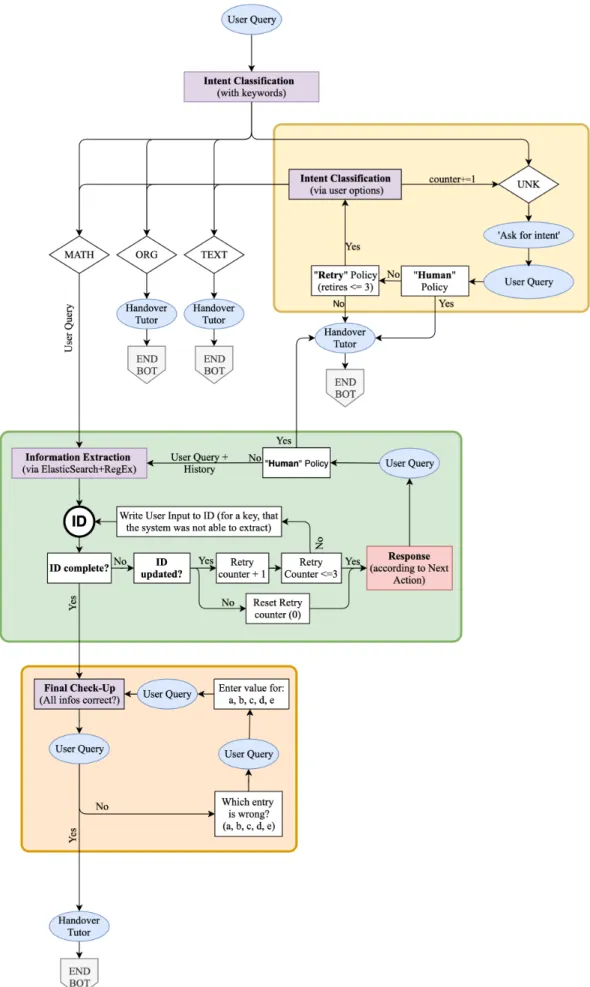
Figure 4 displays the intact conversation flow. After the system accepts user input, it analyzes it at different levels and extracts infor-mation, if such is provided. If some of the information required for tutoring, is missing, the system asks the student to provide it. When all the information points are collected, they are automatically vali-dated and forwarded to a human tutor. The latter can then directly proceed with the assistance process. In the following, we explain the key components of the system.
3.2.1 OMB+ Design
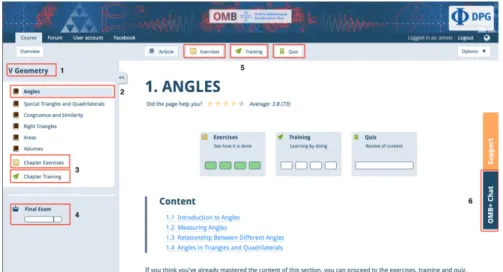
Figure3illustrates the internal structure and design of theOMB+ plat-form. It has topicsand sub-topics, as well as four variousexamination modes. Eachtopic(Figure3, tag1) correspond to a chapter level and al-ways hassub-topics(Figure3, tag2), that correspond to a section level. Examination modestrainingandexerciseare ambiguous, because they correspond to either a chapter (Figure 3, tag3) or a section(Figure 3, tag 5) level, and it is important to differentiate between them, since they contain different types of content. The mode final examination (Figure 3, tag 4) always corresponds to a chapter level, whereasquiz (Figure 3, tag5) can belong only to a section level. According to the design of theOMB+platform, there are several ways of how a possible dialogue flow can proceed.
3.2.2 Preprocessing
In a natural language conversation, one may respond in various forms, making the extraction of data from user-generated text challenging due to potential misspellings or confusable spellings (i.e.,Aufgabe1.a, Aufgabe1(a)). Hence, to facilitate a substantial recognition of intents and extraction of entities, we normalize (e.g., correct misspellings, detect synonyms) and preprocess every user input before moving for-ward to the Natural Language Understanding (NLU) module.
Figure3:OMB+ Online Learning Platform, where 1 is the Topic (corre-sponds to achapter level), 2 is aSub-Topic(corresponds to asection
level), 3 ischapter levelexamination mode, 4 is theFinal
Exam-ination Mode (available only forchapter level), 5 are the
Examina-tion Modes: Exercise, Training (available atsection levels) and Quiz
(available only atsection level), and 6 is theOMB+ Chat.
We perform both linguistic and domain-specific preprocessing, which include the following steps:
• lowercasing and stemming of words in the input query; • removal of stop words and punctuation;
• all mentions ofXin mathematical formulations are removed to avoid confusion with roman number10(“X”);
• in a combination of the type: word “Kapitel/Aufgabe” + digit written as a word (i.e “eins”, “zweites”, etc), word is replaced with a digit (“Kapitel eins”→“Kapitel1”;“im fünften Kapitel”→
“im Kapitel5”), roman numbers are replaced with a digit as well (“Kapitel IV”→ “Kapitel4”).
• detected ambiguities are normalized (e.g.,“Trainingsaufgabe”→
“Training”);
• recognized misspellings resp. type errors are corrected (e.g., “Difeernzialrechnung”→“Differentialrechnung”)
• permalinks are parsed and analyzed. From each permalink it is possible to extract topic, examination mode and question num-ber;
3.2.3 Natural Language Understanding
We implement the Natural Language Understanding (NLU) unit uti-lizing handcrafted rules, Regular Expressions (RegEx) and Elasctic-search1
API.
i n t e n t c l a s s i f i c at i o n: According to the design of the OMB+ platform, all student questions can be classified into three cate-gories: organizational questions(i.e., course certificate),contextual questions(i.e., content, theorem) andmathematical questions (exer-cises, solutions). To classify the input query by itsintent(i.e., cat-egory), we employ weighted key-word information in the form of handcrafted rules. We assume that specific words are explic-itly associated with a corresponding intent (e.g., theoremor root denote the mathematical question, feedback or certificate denote organizational inquire). If no intent could be ordered, then it is assumed that the NLU unit was not capable of understand-ing, and the intent is unknown. In this case, the virtual agent requests the user to provide an intent manually by picking one from the mentioned three options. The queries from organiza-tional and theoretical categories are directly handed over to a human tutor, while mathematical questions are analyzed by the automated agent for further information extraction.
e n t i t y e x t r a c t i o n: On the next step, the system retrieves the en-tities from a user message. We specify five following prerequi-site entities, which have to be collected before the dialogue can be handed over to a human tutor: topic, sub-topic, examina-tion mode and level, and quesexamina-tion number. This part is imple-mented using ElasticSearch (ES) andRegEx. To facilitate the use of ES, we indexed the OMB+ web-page to an internal database. Besides indexing the titles of topics and sub-topics, we also pro-vided supplementary information on possible synonyms and writing styles. We additionally filed OMB+ permalinks, which direct to the site pages. To query the resulting database, we em-ploy the internal Elasticsearch multi match function and set the minimum should match parameter to 20%. This parameter spec-ifies the number of terms that must match for a document to be considered relevant. Besides that, we adoptedfuzzinesswith the maximum edit distance set to2characters. The fuzzy query uses similarity based on Levenshtein edit distance (Levenshtein, 1966). Finally, the system produces a ranked list of potential matching entries found in the database within the predefined relevance threshold (we set it to θ=1.5). We then pick the most probable entry as the right one and select the corresponding entity from the user input.
Overall, the Natural Language Understanding (NLU) module re-ceives the user input as a preprocessed text and examines it across all
1