Abteilung Neuroinformatik Universit¨at Ulm
Prof. Dr. G¨unther Palm
Advanced Software Concepts
and Technologies for
Autonomous Mobile Robotics
Dissertationzur Erlangung des Doktorgrades Dr. rer. nat.
der Fakult¨at f¨ur Informatik der Universit¨at Ulm
Hans Heinrich Utz aus Heidelberg 2005
iii
Dekan: Prof. Dr. Helmuth Partsch Gutachter: Prof. Dr. G¨unther Palm Gutachter: Prof. Dr. Helmuth Partsch Gutachter: Prof. Dr. Davide Brugali T ag der P romotion: 2. November 2005
Contents
1 Introduction 1 1.1 Motivation . . . 2 1.2 The Problem . . . 3 1.3 Solution Approach . . . 4 1.4 Major Results . . . 51.5 Overview of the Thesis . . . 6
2 Robotics Software Development 7 2.1 Autonomous Mobile Robots . . . 7
2.2 Robotic Scenarios . . . 8
2.2.1 Office Robotics . . . 9
2.2.2 Robot Soccer . . . 10
2.3 Challenges of the Application Domain . . . 11
2.4 Environments for Robot Software Development . . . 13
2.4.1 Commercial Vendor System . . . 13
2.4.2 Research Architectures . . . 14
2.5 Assessment of Robot Software Development . . . 17
3 Miro Architecture and Design 19 3.1 Requirements and Design Goals . . . 20
3.2 Middleware . . . 22 3.3 Architectural Layers . . . 23 3.3.1 Hardware Abstraction . . . 23 3.3.2 Infrastructure . . . 24 3.3.3 Services . . . 24 v
vi CONTENTS
3.3.4 Extensible Frameworks . . . 25
3.4 Miro Support for Real-time Processing . . . 25
3.5 Miro Support for Development . . . 27
3.5.1 Assessment, Adaptation and Learning . . . 27
3.6 Summary . . . 28
4 Miro Infrastructure Layer 29 4.1 Communication Infrastructure . . . 30
4.1.1 Distributed Systems Technology . . . 30
4.1.2 Service Interfaces . . . 31
4.1.3 CORBA Communications Technology . . . 32
4.1.4 CORBA Services . . . 33
4.1.5 Group Communication . . . 35
4.2 Configuration and Parameter Management . . . 37
4.2.1 Related Work . . . 37
4.2.2 Design Constraints . . . 38
4.2.3 Parameter Descriptions . . . 39
4.3 Cross Platform Toolkits . . . 40
4.3.1 Adaptive Communications Environment (ACE) . . . 40
4.3.2 The ACE ORB (TAO) . . . 41
4.3.3 Qt . . . 41 4.4 Summary . . . 41 5 Miro Services 43 5.1 Actuator Services . . . 44 5.1.1 Design Principles . . . 44 5.1.2 Requested Functionality . . . 45
5.1.3 Actuator Service Example: Motion . . . 46
5.1.4 Service Implementation . . . 48
5.1.5 Other Services, Interfaces and Possible Extensions . . . . 49
5.2 Sensor Services . . . 50
CONTENTS vii
5.2.2 Requested Functionality . . . 52
5.2.3 Sensor Interface Example: RangeSensor . . . 52
5.2.4 Service Implementation . . . 54
5.2.5 Other Interfaces and Possible Extensions . . . 55
5.3 Related Work on Sensor-Actuator Interfaces . . . 55
5.4 Logging Service . . . 56
5.4.1 Data Acquisition in Distributed Mobile Systems . . . 57
5.4.2 Technical Solution . . . 58
5.4.3 Logging Configurations . . . 59
5.4.4 Related Work On Data Acquisition . . . 61
5.5 Summary . . . 62
6 Extensible Frameworks 63 6.1 Video Filter Framework . . . 65
6.1.1 Image Processing on Autonomous Mobile Robots . . . 65
6.1.2 Solution Approach . . . 68
6.1.3 Example Configuration . . . 70
6.1.4 Possible Extensions . . . 71
6.2 BAP Framework . . . 71
6.2.1 Desired Functionality . . . 72
6.2.2 A Formal View on Modeling Reactive Control . . . 74
6.2.3 Behaviors . . . 75 6.2.4 Arbiters . . . 75 6.2.5 Guards . . . 76 6.2.6 Action Patterns . . . 77 6.2.7 Transitions . . . 78 6.2.8 Flat Policies . . . 79 6.2.9 Hierarchical Policies . . . 81 6.2.10 Implementation . . . 81 6.2.11 Configuration Management . . . 83 6.2.12 Possible Extensions . . . 84 6.2.13 Related Work . . . 84 6.3 Summary . . . 87
viii CONTENTS
7 Tool Support 89
7.1 Configuration Management . . . 90
7.2 Graphical Policy Programming . . . 91
7.3 Log file Management and Replay . . . 93
7.4 Data Visualization . . . 93
7.5 Summary . . . 95
8 Experimental Evaluation 97 8.1 Communication Overhead . . . 97
8.1.1 Device Latencies and Inter-Process Communication . . . 98
8.1.2 CORBA Performance Considerations . . . 99
8.2 Group Communication in Robot Teams . . . 100
8.3 Efficient Data Acquisition . . . 102
8.3.1 Runtime Performance . . . 103
8.3.2 Memory Footprint . . . 104
8.4 Prioritized Video Image Processing . . . 105
8.5 Conclusions from Experimentation . . . 108
9 Results and Applications 109 9.1 Ensuring Software Quality . . . 109
9.2 Available Platforms . . . 110
9.3 Behavior Engineering . . . 112
9.3.1 Reusable Components . . . 112
9.3.2 Specifying Complex Tasks with BAP . . . 112
9.4 Advanced Image Processing . . . 113
9.5 Logging Applications . . . 114
9.5.1 Learning-Data Acquisition . . . 114
9.5.2 Multirobot Debugging . . . 114
9.5.3 Performance Comparison . . . 115
9.6 Multirobot Teams Spanning Multiple Labs . . . 116
CONTENTS ix
10 Conclusions 121
10.1 Contributions . . . 121
10.2 Open Problems . . . 122
10.2.1 Extended Service Meta-Information . . . 123
10.2.2 Specification of Team Behavior . . . 123
10.3 Future Work . . . 124
10.4 Outlook . . . 125
Abstract (German) 127
List of Abbreviations 131
Abstract
Research on autonomous mobile robots and robot teams has gained signifi-cant momentum over the last ten years and robotics application scenarios are becoming increasingly ambitious. But developing software for mobile robot applications is a tedious and error-prone task. Modern mobile robot systems are distributed systems and their designs exhibit large heterogeneity in terms of hardware and have to deal with soft real-time constraints as well as the tight coupling of the software solutions to the physical properties of the robot. Most of today’s robot software environments provide little conceptual support to structure and encapsulate these domain characteristics and to foster the development of reusable solutions of robotics software.
This thesis introduces research into the application of advanced software meth-ods and technologies within the field of autonomous mobile robots to make the development of mobile robot applications easier and faster and to foster reusability and scalability of robot software. The conceptual solutions iden-tified during this research process are exemplified in the design of the Miro
software architecture. It provides extensive support for the management of the domain-specific difficulties by addressing them in the form of a middleware-oriented architecture.
The architecture is divided into four layers that lie between the operating sys-tem and the robotics application. The device layer encapsulates the communi-cation with the low-level controller boards. The infrastructure layer provides standard-based communication facilities and support for configuration and pa-rameter management. On the service layer, the robots sensor and actuator devices are modeled as abstract services with network transparent, generalized interfaces. On top, the framework layer provides semi-complete solutions for often encounter robotics problems such as behavior-based reactive control or robot vision in form of scalable, user extensible frameworks.
Miro has been carefully assessed and is successfully applied on various robot platform, in different scenarios, and in multiple research projects. It is also used for robotics software development at other laboratories.
Acknowledgments
The work described in this thesis was partially funded by the German Science Foundation (DFG) under a multi-year grant for the project Adaptivity and Learning in Teams of Cooperating Mobile Robotswithin the focal program SPP-1125. The University of Ulm provided additional funding for enabling the students of the autonomous mobile robots lab to participate at national and international RoboCup tournaments, which were a valuable testbed for the work discussed in this thesis.
Among the many people that supported me through the years of work on this thesis, I want to especially thank the following people:
Prof. Dr. G¨unther Palm enabled my work at his department and always showed a large confidence in my research. He also managed to provide funding to satisfy the constant needs of the robots for new motors, servos or other spare parts.
Prof. Dr. Gerhard Kraetzschmardid a lot of pioneering work for the autonomous mobile robotics and especiallyRoboCupat the University of Ulm. Despite his very packed time table he managed to devote time for supporting me in my research with many discussions and provided valuable advice.
Prof. Dr. Helmuth Partsch I want to thank for supporting our RoboCup ac-tivities, for providing feedback on my thesis, and for serving on my thesis com-mittee.
My former and current fellow PhD students in the robtics lab,Stefan Sablatn¨og, Stefan Enderle, Gerd Mayer, Ulrich Kaufmann and Guillem Pages Gassull
facilitated me to work in a creative, open atmosphere and together we explored many ideas on robot software and hardware design. Especially I want to thank
Gerd Mayer for the many fruitful discussions, which often lasted long after working hours until late at night.
The students of theThe Ulm Sparrows RoboCupteam always devoted lots of their spare time to the development of the robots’ software and hardware. They impressed me with their team spirit during the tournaments and never stopped with challenging my beliefs on autonomous mobile robots in general and in RoboCupenvironments in particular.
Last, but not least I am most grateful to my parents, my family, and my girlfriend Yiman, who endured many work-through weekends beforeRoboCup tournaments, and provided moral support whenever it was needed.
Chapter 1
Introduction
Research on autonomous mobile robots and robot teams has gained significant momentum over the last ten years. With the necessary computational power and wireless networking technology becoming available for mobile platforms, also robotics application scenarios are becoming increasingly ambitious. Mod-ern autonomous mobile robots are equipped with a comprehensive set of sensors and actuators, and teams of robots are expected to share their sensory obser-vations and to cooperate in the execution of tasks. Because of this growth in complexity, the problem set addressed by autonomous mobile robot research is large and will become even more all-encompassing in the near future. There-fore, more and more disciplines of computer science such as distributed systems, computer vision, or neural information processing and learning will have to be incorporated into robotics applications in order to meet the growing challenges of modern autonomous mobile robots.
Because of its innate characteristics, the application domain of autonomous mobile robots holds huge challenges for software development. It features a heterogeneous set of hardware devices, the need for concurrent and distributed information processing, a tight coupling of algorithmic solutions to the physical properties of the robot and its environment, the stochastic properties of the physical world, as well as time and resource constraints. Moreover, all these features need to be addressed simultaneously when developing solutions in the field of autonomous mobile robots.
Most of today’s software architectures for this domain provide little conceptual support for the application programmer to structure and encapsulate these do-main characteristics. An additional problem is the severe lack of research in the robotics community to address the integration challenge posed by the diverse methods and technologies applied within this domain. Many of the robotics applications spend most of their time managing the domain’s elementary prob-lems instead of solving the targeted ones. This hinders the implementation of portable, reusable and interoperable generalized solutions that form building blocks for subsequent robot applications. In consequence, software development for autonomous mobile robots is tedious and error-prone, which, in turn, limits
2 CHAPTER 1. INTRODUCTION research, the exchange of scientific results and jeopardizes commercialization. This thesis introduces research into the application of advanced software meth-ods and technologies within the field of autonomous mobile robots in order to address the intrinsic software development challenges of this application do-main. The conceptual solutions identified during this research process are ex-emplified in the design of the Miro software architecture, the “middleware for robots” [140]. The basic idea of Miro is to provide extensive support for the management of the domain-specific difficulties by addressing them in the form of a middleware-oriented architecture.
1.1
Motivation
There is a growing interest within the robotics community to address the various software quality issues in autonomous mobile robot applications. The goal is to enhance the non-functional aspects of software for autonomous mobile robots such as stability, maintainability, or scalability to form building blocks of robot software functionality that can be reused by subsequent robotic applications. Currently, hardly any sophisticated toolkits for the engineering of autonomous mobile robot applications exist. Even the direct reuse of existing solutions in different subsequent research projects is rarely seen. Difficulties often arise even within one single laboratory for various reasons. For instance, robot plat-forms become outdated and are often replaced between projects. But robots from different manufacturers usually come with different, incompatible soft-ware environments. Also, senior students and PhD students often leave the university after successful completion of their research. Research prototypes of robotics software especially are notoriously undocumented. But new robotic systems usually encompass and extend the functionality provided by preceed-ing projects. Therefore, the ability to reuse existpreceed-ing developments in robotics research is crucial for the success of a robotics project.
Reusability is closely related to scalability in two different dimensions: the manageable growth of project size and the manageable load related to system runtime performance. While the first depends heavily on a clear and natural structuring of the application, the second is usually dependent on the ability to identify and resolve hot-spots in the runtime environment. Both these aspects can be enhanced tremendously by the underlying software architecture.
Adaptivity is another key feature for reusable components especially with au-tonomous mobile robots. As the correct algorithmic solution of a robotic task is usually heavily dependent on the physical aspects of the robot and its envi-ronment, it is inevitable to adapt these parameters when applying a solution to another robot or environment. The infrastructure can support this adaptation process in two ways: firstly by making known physical properties of the robot accessible to the application, and secondly by providing tools that facilitate the application of technologies for learning and adaptation such as neural networks.
1.2. THE PROBLEM 3 Scalability can be improved by using properly debugged and assessed high qual-ity components. For this purpose roboticists need conceptual support in the development of robotic applications. Specialized tools that support developers in solving the specific problems of the robotics domain could therefore help to raise the software quality in this respect.
To successfully manage the growth in size and complexity of robotic applica-tions, research into and development of autonomous mobile robots could be helped tremendously if supported by a solid software infrastructure, i.e. toolk-its, frameworks and libraries that provide portable solutions usable for vari-ous robotics applications. Additionally, progress in this domain will facilitate the broader application and evaluation of proposed research solutions and will therefore help to raise the scientific standards within this particular research community.
1.2
The Problem
To foster reusability, scalability and adaptivity in robotic applications, various problems have to be addressed on different levels of an individual autonomous mobile robot application.
On the lowest level, the sensors and actuators of a robot are usually controlled by microcontroller boards that are attached to one or more PCs, which perform all higher-level processing. Due to the diversity of the available controller boards and communication links, there is little potential for reusable standardization of the communication on this level. Therefore, applications that directly interface with the robotics sensors and actuators on this level are hardly portable between robot platforms.
Another set of problems arises due to the fact that robotic applications are inherently distributed. The sensors and actuators often reside on multiple con-troller boards and higher-level processing of an autonomous mobile robot is fre-quently distributed over multiple PCs. Additionally, researchers usually super-vise their robots from workstations in the laboratory. For multirobot scenarios, the scenarios themselves already imply the distributedness of the application. Such heavily distributed systems introduce their own intriguing problem set, ranging from inherent concurrency and latency within the application to the failure or temporary breakdown of communication links or entire sub-systems. Reusability could be facilitated by defining generalizations for similar sensors and actuators of different robot platforms. But the properties of the different devices available from different manufacturers vary especially in crucial aspects such as the order and frequency in which e.g. ultra-sonic range sensors can be queried. So in practice, even similar devices from the same category often confront the application developer with widely varying interfaces.
Generalizing robotics solutions in order to make them work flexibly on different versions of sensor and actuator modalities makes it necessary to deal with the
4 CHAPTER 1. INTRODUCTION variance in properties such as the reliability and precision of the sensor read-ings or the velocity and accelerations of motors. This is a major challenge, as even small differences can change the overall requirements of a subsystem sig-nificantly. Lower deceleration capabilities, for instance, require to scan a wider area for the task of obstacle avoidance. This might in turn alter the evaluation of range sensor scans or even the focus of attention control. Thus, the capabili-ties of every sensor and actuator are tightly related to the overall performance of the entire system and have to be individually weighted in different application scenarios.
Because robots are intended for use in the real world, they also need to be able to cope with real-time requirements at least to some extent. Hard real time, that is maximum response times of only a few µsec, is usually only required for small subsystems, that mostly reside on their own microcontroller boards. Nevertheless, timeliness and reliable response times are also an issue for the PC-based higher-level services. So the design of priorities in sensor processing and actuator control also need to be added to the problem set.
With autonomous mobile robots becoming a wide spread and mature technol-ogy, the need to systematically assess and benchmark new and existing methods is becoming mandatory. The stochastic nature of natural environments how-ever, requires an empirical, statistical evaluation, preferably based on series of experiments in the actual application environment. Apart from the many un-solved methodological problems, there is also a lack of readily available methods and tools for acquiring the relevant data on individual robots and multirobot teams in an effective and efficient manner.
It is obvious that many of the problems sketched above cannot be solved once and for all by means of one fixed solution. Instead, many approaches need calibration and adaption of their parameters in order to cope with changes in environment or the robot itself, like lightning conditions or the dynamics of the robot when holding another object. These require the use of adaptive technol-ogy and learning algorithms. While such abilities are usually associated with higher-level services, that are beyond the scope of a generic robot architecture, they have to be considered in the design of the lower-level services. Otherwise it can become significantly more complicated to embody learning and adaptive behavior on the higher levels of the entire robot application.
1.3
Solution Approach
This thesis discusses and evaluates solutions for the problem set described above for modern autonomous mobile robot software development. The research un-dertaken focused on three main topics: (1) the applicability of standard dis-tributed systems technology for robotics, (2) the design of suitable abstractions for robotic devices and (3) providing support for the non-functional aspects such as scalability and reactivity in the development of robotics applications. The proposed solutions are exemplified in the Miro architecture: the Middleware
1.4. MAJOR RESULTS 5 for Robots [140].
The inherent distributedness of robotic applications is addressed inMiro by the application and customization of a CORBA-based communication infrastruc-ture. Miro supports both the classical method-call-oriented client/server model as well as a message-based publisher/subscriber protocol. Special precautions are taken to address the needs of group communication in teams of robots using WLAN technology.
The different sensor and actuator devices in their various flavors are wrapped by generalized interfaces and implemented as network transparent services. In-heritance is used to make the individual features of the devices available. Higher-level robotic functionality is supported by specialized frameworks that are used to build customizable high-level services. These have been carefully assessed for their applicability in real-time-constrained environments. By in-verting the control flow of time-critical tasks like image processing or reactive control, the timeliness of information processing can be managed and controlled centrally by the middleware itself. For performance assessment the user is pro-vided with sophisticated instruments for monitoring and logging.
1.4
Major Results
The scientific contributions of this thesis lie in the identification and appli-cation of supportive technology as well as the design and exemplifiappli-cation of services and frameworks for high-level robotic applications to be used in up-coming application scenarios. These are bundled in the concise design of a middleware-oriented, flexible, scalable and portable distributed software archi-tecture for autonomous mobile robots. The discussed implementation could prove its applicability in various successful applications for different scenarios.
Communication: Within this architecture, distributed systems technology has been carefully assessed for its applicability to autonomous mobile robots, especially with respect to highly dynamic environments. Bot-tlenecks, e.g. in event-based team communication, were identified and successfully resolved by transparent extensions [141].
Data acquisition: The design and the performance of an efficient service for generic data acquisition in distributed multirobot scenarios, as required for various means in autonomous mobile systems such as debugging, em-pirical evaluation and learning was discussed [137].
Service design: A design for service-oriented abstraction of sensory and ac-tuatory devices was proposed and successfully applied to the devices of various robot platforms [140]. The services and higher-level frameworks did independently prove their applicability.
6 CHAPTER 1. INTRODUCTION Video image processing: The benefits of the middleware-oriented approach in addressing the intrinsic difficulties of robotics applications could be clearly demonstrated in the design and performance of a framework for video image processing in retime constrained robotic scenarios. It al-lows to define priorization and synchronization of image evaluations that are both sensor triggered as well as demand driven [135]. It success-fully fosters code reuse for different scenarios such as robot soccer and biomimetic learning.
Behavior-based reactive control: The proposed formally specified model for behavior-based reactive control provides a scalable way for specifying rich sets of emergent, reactive behavior in a reusable way. The integration with the middleware, especially the use of device abstractions, proliferates the development of flexible behavior implementations that are reusable on various robot platforms in different scenarios [136]. In the RoboCup scenarios it proved itself as a sustainable foundation for the development of a rich set of reactive repertoire.
Miro has been actively developed and maintained for several years and was successfully applied in such different scenarios as robot soccer [70] or biologically motivated neural learning [29]. The architecture was also ported by external research groups that use Miro for their robots [125], contributing additional interfaces, services and device implementations [142, 71] that adhere to the proposed design.
1.5
Overview of the Thesis
The remainder of this thesis is organized as follows. In the following chap-ter an overview of the challenges of robot software development as reflected in the literature is given and work related to this thesis is discussed. Chapter 3 then introduces the Miro architecture and its design principles, showing how it helps to overcome the problems identified earlier. The chapters following there-after discuss the different layers of the Miro architecture. Chapter 4 describes the infrastructure provided for communication and configuration, Chapter 5 discusses the main features of the service layer, while Chapter 6 presents dif-ferent higher-level frameworks for robotics application development. After a short chapter on the tools that were developed to support robotics software development withMiro, various aspects of the implementation are evaluated in Chapter 8. Thereafter, successful applications and further results are described in Chapter 9. The thesis ends with conclusions and indications for possible future work in chapter 10.
Chapter 2
Robotics Software
Development
Developing software for mobile robot applications is a tedious and error-prone task. Modern mobile robots are usually composed of heterogeneous sets of hardware components which are connected using different networking technolo-gies and communication protocols with widely varying bandwidths. A large number of different methods for processing sensor information and controlling actuators, for performing computer vision and cognitive tasks like planning and navigation, and also user interactions must be integrated into a well-engineered piece of software. All these issues contribute to the enormous complexity of the mobile robot software development task. There is growing concern in the robotics community about programming environments provided by manufac-turers not keeping pace with recent developments in software technology. Also, their closed, platform-bound design does not meet the requirements of today’s mobile robot application scenarios [76, 38].
In order to assess the requirements of today’s robot software architectures, a more detailed view on robot software and application development needs to be taken. Therefore, an overview of current and upcoming autonomous mo-bile robots, autonomous momo-bile robot application scenarios and the challenging characteristics of autonomous mobile robotics as an application domain will be given here. This overview will be followed by a discussion of related robot software architectures and projects that address challenges of robotics software development.
2.1
Autonomous Mobile Robots
Today, mobile robots come in various different shapes and sizes that can be divided roughly into three main categories based on the computational hardware infrastructure provided:
8 CHAPTER 2. ROBOTICS SOFTWARE DEVELOPMENT
a) b) c)
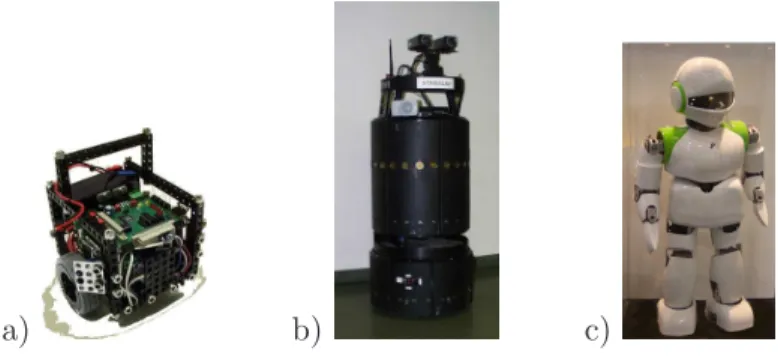
Figure 2.1: Different categories of autonomous mobile robots: A Tetrixx robot, the B21 platform and the Pino
1. Miniature robots with limited computational power like the Lego Mind-storms, the Khepera robots or the Tetrixx robot kit [27]. These are pre-dominantly used for educational purposes and usually only provide an embedded micro-controller for the control of various analog and digital I/O-ports (Figure 2.1a).
2. Mid-size PC-based platforms which nowadays are the standard robots used for research in autonomous mobile systems. There are various com-mercial platforms available for indoor and outdoor use, like the B21 or the Pioneer series and many custom-built robots populate the laboratories (Figure 2.1b).
3. Legged and humanoid robots equipped with specialized high-end embed-ded systems, like the Sony AIBO or the Curio platform. Those are not generally available and usually bring their own proprietary operating sys-tem (Figure 2.1c).
In this thesis the focus lies on the PC-based research platforms, which usually come with a wheeled locomotion system. The results presented also apply to the other two categories, but the limited computational resources on the one side and the specialized hardware and non-standard operating systems on the other make a direct transfer somewhat cumbersome.
2.2
Robotic Scenarios
In the robotics community research is usually centered around a scenario, in which results are demonstrated and evaluated. Many application scenarios are actually market-driven, but the main value of a scenario is to provide the community with a common ground on which different solutions can be more easily compared against each other.
Robotic scenarios define general system properties that often impose challenges for the robots’ software architecture. These also imply requirements from
non-2.2. ROBOTIC SCENARIOS 9 functional aspects of a robot’s application such as reliability, fault tolerance and responsiveness. Newly upcoming scenarios usually feature a more complex set of research challenges that mark the progress in robotics research. Different robotic scenarios are also designed to stress different aspects of advanced future robot applications and robotics solution should therefore be flexible enough to be applicable to different scenarios. Thus, robot software architecture needs to support robot platforms with solutions for these different research challenges and address their different demands.
Robotic scenarios today range from artificial toy robot scenarios such as “trash can cleaning”, which are used for educational purposes, to autonomous driving on highways or on unpaved terrain. The research undertaken for this thesis mainly focused on two scenarios popular with the robotics community. These two scenarios stress fairly different system properties of an autonomous mobile robot. On the one side there is the classical office scenario, and on the other the more and more popular environment of robot soccer. While the architectural issues addressed within these scenario most probably will be too complex for educational toy robot scenarios, they also cover many aspects of other upcoming robotics research such as robot companions that can also operate outdoors.
2.2.1 Office Robotics
The office scenario addresses
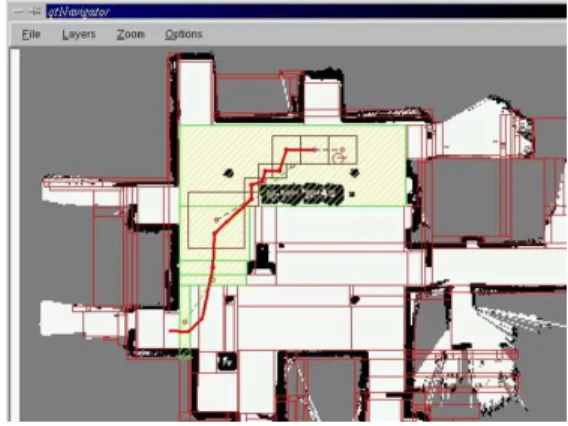
is-Figure 2.2: Robot navigating in an au-tonomously built map.
sues such as simultaneous local-ization and mapping (SLAM) [24], navigation or simple interactive tasks within an office environment [69]. Figure 2.2 is a screenshot taken from a visualization tool for such a scenario. It shows a 2-D map drawn up with a laser scan-ner. The red rectangles and green squares visualize different granu-larities of a hierarchical path plan-ner. The red line denotes the path actually taken and the red circle denotes the current position of the
robot. Robots operate at moderate speed and feature higher-level cognitive capabilities such as task scheduling or deliberative planning. Human-robot in-teraction, web-based user interfaces [35] as well as adaptivity and learning [29] are popular research topics. Cooperation among multiple robots is also becom-ing of greater interest within this scenario. The multirobot SLAM, for example, was evaluated in the CentiBOTS project with a fleet of a hundred robots [63]. A major feature of research platforms designed for these scenarios is their rich set of sensory and actuator devices for perceiving and manipulating the natural environment. Often special purpose sensors are installed for extracting
task-10 CHAPTER 2. ROBOTICS SOFTWARE DEVELOPMENT relevant information such as landmarks and maps, static and moving obstacles, stairs or tables. Apart from the robot’s locomotion system, actuators usually include simple grippers and multiple-degrees of freedom robot arms. The appli-cations integrate a comprehensive set of methodologies for sensory, actuatory and cognitive purposes. The different focus of future research projects in this domain makes adaptations and modifications to previously developed solutions or even complete rearrangements of functional subsystems necessary.
The difficulties of this scenario from a robot software architecture point of view lie in the diversity of the robot’s sensors and actuators as well as the number of modules and their complexity within typical applications. A robot software architecture can support application development in such a domain in the area of management and interfacing of sensory and actuatory devices, by providing domain-specific frameworks that facilitate the implementation of subsystems such as localization or reactive execution, by supporting a proper modularization and by keeping the overall application manageable.
2.2.2 Robot Soccer
Since 1997 theRoboCupscenario
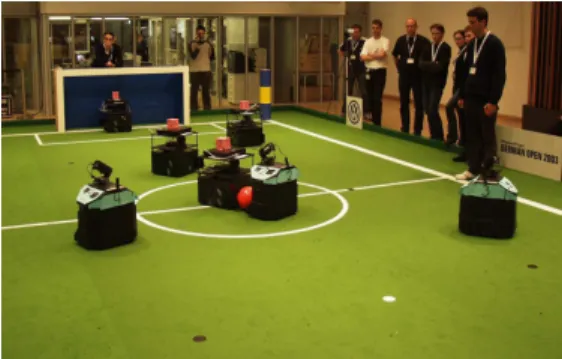
Figure 2.3: Kickoff at a RoboCup game in the medium-size robot league.
has been putting autonomous mo-bile robots in a highly dynamic environment, introducing robot teams as well as competition be-tween robots [7, 144]. There are several leagues for robot soccer, ranging from simple 2-D simula-tion to humanoid robots. The team of the robotics lab at the University of Ulm, the The Ulm Sparrows, has been participating in the medium-size robot league since 1999. In this league, teams of 4 to 6 robots with a maximum size of 50 x 50 cm compete on a field of 12 x 8 m (see Figure 2.3). The most interest-ing aspect of the scenario is that the problem can not be ‘solved’ as such, but rather promotes an evolutionary process, where new solutions compete with the existing state of the art [74].
The high dynamics of the scenario impose tight timeliness constraints and pro-mote the reactive capabilities of the system. The multirobot teams make the distributed nature of robotic applications explicit. Also, vision is the dominant sensor within this scenario, since the autonomous, robust detection and classifi-cation of various objects in real time (ball, goal, opponents, team mates) is the dominant cognitive problem [81, 82, 79]. On the other hand, the higher-level deliberative capabilities of such robots are usually rather limited.
A robot software architecture can contribute to the development of robot soccer applications by managing the difficulties of the distributed systems, the assess-ment of the timing characteristics of the different subsystems and by providing
2.3. CHALLENGES OF THE APPLICATION DOMAIN 11 scalable support for the deployment of a rich set of reactive behavior.
2.3
Challenges of the Application Domain
Apart from the different domain specific emphasis, the above described two application scenarios feature a set of difficulties that are prominent in almost every non-trivial application of autonomous mobile robots and which are all individually considered difficult. These characteristics need to be addressed in parallel to the actual robotics application. They are often underestimated and form a major obstacle for the successful integration of solved research problems into a running application.
Extreme heterogeneity of hardware components. A huge variety of sen-sors and actuators are available for use on autonomous mobile robots. As a consequence, almost every robot has its individual sensor suite and actu-atory capabilities. It would be desirable to build logical groups of similar sensor and actuator devices that are accessible by a generalized interface. But even very similar devices offer different capabilities such as maximum sensor sampling rates, different sensing range and accuracy etc. that need to be taken into account when writing software targeted for use on more than one individual robot.
Inherent concurrency. An autonomous mobile system has to process sev-eral tasks at the same time. Various sensory and cognitive processing procedures as well as the control of multiple actuators need to take place in parallel and on different time scales. The computational power of dual-processor boards, hyper-threading technologies and the upcoming multi-core CPUs can only be fully exploited when these processes are also implemented as parallel processing threads.
Developing multi-threaded applications is considered difficult and devel-opment support for parallel processes is sparse in most programming lan-guages and development environments. Race conditions between different processing threads are hard to achieve by classical single-step debugging and provoke non-deterministic system failure. The necessity to synchro-nize concurrent data access can also introduce subtle performance bottle-necks.
Inherent distribution. Multi-robot scenarios make the distributed nature of robotics applications apparent. But also a single robot often delegates computationally expensive tasks to remote workstations to overcome com-putational bottlenecks and receives input from web-based user interfaces. Teleoperation also requires network transparent access to the robots’ in-terfaces. Additionally the monitoring and visualization of task execution is usually performed from a remote workstation. Some robots are also equipped with multiple PCs to provide extended computational power. Thus, the problematic characteristics of distributed systems are an
in-12 CHAPTER 2. ROBOTICS SOFTWARE DEVELOPMENT tegral part of the challenges associated with autonomous mobile robot applications.
Device and environment dependency. Algorithmic solutions for robotic problems are heavily dependent on the properties of the physical devices that are controlled or deliver sensory information. An algorithm for obsta-cle avoidance reliably working on a robot running at 1m/sand accelerat-ing/decelerating with 1.5m/s2 is unlikely to work with 2m/sand 0.5m/s2 deceleration without major adjustments on the sensory side. This could even include adaptations of the visual attention control to recognize ob-stacles earlier. Algorithmic solutions therefore not only need to precisely model their physical dependencies for their flexible application. The sys-tem as a whole also needs to be flexibly adapted to the requirements of and interdependencies between its various modules.
Stochastic properties of the physical world. Robot experiments and ap-plications in the physical world have to deal with its stochastic properties that make it impossible to guarantee a deterministic outcome. Robot sensor data is noisy and for instance lighting conditions are not control-lable in an outdoor scenario. Additionally, many important parameters of the environment vary over time. This has various implications for the design, implementation and evaluation of software within this domain, as the gathering and processing of sensory information has to model its stochastic nature and the experimental evaluation needs to take the non-deterministic properties into account.
Real-time constraints. A robot acting in the physical world needs determin-istic response times of various subsystems in order not to endanger others or himself. The admissible response times and jitter do not usually lie in the area of hard real-time performance. Nevertheless, tasks like obstacle avoidance require the system to satisfy at least soft real-time capabilities. In such reactive control tasks, the right answer delivered too late becomes the wrong answer, and most of these control loops run with a pace of 5Hz to 50Hz.
Resource constraints. Apart from the usual constraints on a computer’s re-sources such as the available processing power or physical memory, a robot has additional resource limitations. Actuators can only have one physical state, so concurrent requests from multiple modules of the system need to be arbitrated. And while sensory information can easily be replicated for use by multiple sub-systems, these systems still have a maximum fre-quency at which new sensor readings can be sampled.
A software architecture that does not provide sufficient support for the man-agement of the intrinsic difficulties of the robotics domain force the application programmer to cope with these problems in the limited scope of the program domain. This leads to a limited generality of the solutions, a frequent ad-hoc
2.4. ENVIRONMENTS FOR ROBOT SOFTWARE DEVELOPMENT 13 reinvention of the wheel, the heavy use of heuristic solutions and proliferation of inadequate evaluation and assessment, especially of the resulting solutions. This thesis covers research on how to address these domain characteristics on the level of a system architecture. This form of central management will make it possible to solve the general difficulties inherent in the domain from other aspects of the application.
2.4
Environments for Robot Software Development
Various architectures for programming robot applications currently exist. Most commercial robots come within their own proprietary robot and control pro-gramming environment. In the last five years various projects have been started that address the challenge of providing more sophisticated cross-platform envi-ronment in order to resolve different issues like portability and real-time control. In this section an overview of the most relevant projects in this area will be given.
2.4.1 Commercial Vendor System
A typical commercial robot software environment supports only the robots from one manufacturer. Two prominent typical representatives of such environments will be covered in this section.
Saphira
Saphira [1, 62] is the software development environment delivered with the Pi-oneer mobile robot family. Its core is a C library for accessing the controller board. By using the Saphira library, the programmer implicitly imports el-ements of a particular robot control architecture, including mechanisms like state reflection (a kind of implicit communication between client programs and server), data structures like a Local Perceptual Space (LPS) and a Global Per-ceptual Space (GPS), a fuzzy control-based behavior specification language, and Colbert, a language for reactive control [64]. Saphira lacks location trans-parency, and when integrating hardware from other manufacturers (vision sys-tems, manipulators), the programmer must carefully synchronize the communi-cation of client programs with add-on hardware with the basic Saphira control loop.
Mobility
Mobility is a distributed, object-oriented software development framework for the B21r/B14r family of robots by RWI [98]. It scales well with respect to user
14 CHAPTER 2. ROBOTICS SOFTWARE DEVELOPMENT interaction, client libraries for visualization and remote access of sensory infor-mation. Client libraries are available in C++ as well as in Java. On the other hand, Mobility lacks conceptual support for robot control. As a manufacturer-provided package, it is only available for mobile platforms manufacturer-provided by its man-ufacturer. Since not even our old B21 robot was supported by Mobility it could only be evaluated by investigating its documentation and header files.
Mobility also exposes another problem of vendor-supported robot libraries: even though RWI followed a rather liberal policy in opening up their source for scientific researchers, Mobility vanished with the buyout of RWI by Evolution Robotics in 2002.
2.4.2 Research Architectures
Due to the limitations of vendor-provided environments, some groups of re-searchers started to invent their own architectures. The most successful of these are actually an Open Source community project. These robot software architectures usually support robot platforms from several different manufac-turers and are designed to address different aspects of the application domain’s problem set.
Player/Stage
The Player/Stage project was started in 1999 and aims to provide standard APIs for autonomous mobile robots, the Player Abstract Device Interfaces (APDI) [36]. The project consists of two components. One is the Player soft-ware, which provides client/server interfaces for robot devices [143]. It supports several commercial robot platforms such as the RWI B21r robot and the Active Media Pioneer series. The other component is Second Stage, a 2D simulator able to provide virtual robots offering Player interfaces for multirobot systems research [37]. A 3D simulator named Gazebo is also under development. The Player project probably has the biggest user base of the projects discussed here. The Player project omits OO-techniques and middleware technology for the sake of simplicity. The device abstraction model is based on the simple se-rial device API of read/write/ioctl [31] and does not reflect the inherent asyn-chronicity of message-based low-level controller communication. It does not even support event-demultiplexing based on the UNIX select() function. The servers provide TCP/IP based socket interfaces, lacking the type safety and scalability of modern middleware technology and missing all possible optimiza-tion opportunities for colocated clients and servers. They also lack support for sensor-driven event-based communication as the architecture is targeted to-wards robotic applications with moderate timing constraints. But this tends to introduce unnecessary and avoidable latencies to a core system design. Add-on libraries provide object-oriented wrappers for the low-level communication links on the client side.
2.4. ENVIRONMENTS FOR ROBOT SOFTWARE DEVELOPMENT 15 OROCOS
The acronym OROCOS actually stands for two related projects, both for the “Open Robot Control Software” and for “Open Real-time Control Services”. The OROCOS project was also started in 1999 and pursued similar goals as the Player project, but it was targeted at real-time-oriented robot control [16]. Thus, it provides a real-time kernel for low-level control for devices ranging from PID servo controllers to robot arms [17] and a software framework for robotic control software development.
The integration of a middleware-based communication infrastructure for higher-level autonomous mobile robot control is a stated project goal, but all attempts to do so led to different, non-interoperable projects, which will be discussed in the next two subsections.
SmartSOFT and OROCOS::SmartSOFT
SmartSOFT is an early attempt to introduce modern software technology such as object orientation and component-ware into robotics application develop-ment. It provided object-oriented interfaces for the sensors and actuators of the B21 robot and templates for the implementation of typical communication patterns identified in robotic applications [107, 105]. The software framework was structured after the classical 3T architecture and also provides modules for task decomposition and localization [106]. SmartSOFT was developed further in the OROCOS project and became OROCOS::SmartSOFT.
The project was based upon the original B21 control software BeeSoft and its message-based proprietary communications infrastructure TCX [30]. Later ver-sions also use CORBA as their communications infrastructure. As most of the identified communication patterns such as one-way communication (commands in their terminology), synchronous and asynchronous queries and publisher/-subscriber protocols are not exclusive to robotic applications, they have recently become available in modern standardized communication middleware architec-tures. CORBA, for instance, offers specialized communication technologies with an advanced feature set for all patterns listed above: reliable one-ways [116], synchronous and asynchronous method invocation [23], and the Notification Service [41].
OROCOS@KTH and Orca
Orca, previously called OROCOS@KTH, is a component framework for au-tonomous mobile robots [92, 12]. Components are software entities with a suf-ficiently strict definition of interfaces and their semantics, which allow for their flexible use and interchangeability. A component framework provides the neces-sary support to deploy, configure and initialize components within a system and link their communication ports to form a modular, highly configurable system.
16 CHAPTER 2. ROBOTICS SOFTWARE DEVELOPMENT Orca uses an XML-based specification language to describe the configuration and initialization of such a component system.
Component approaches are a highly relevant concept for improving the modu-larity of robotics software. Several component models such as Enterprise Java Beans, the .NET architecture, or the CORBA Component Model (CCM) are currently available. However, there are several unsolved challenges as regards defining generalizations that could be implemented as interchangeable com-ponents. Additionally, Orca refrains from committing itself to any concrete transport protocol, thereby aiming to provide additional flexibility. This means that the communication needs to be implemented by hand instead of being generated automatically from the interface definitions.
Distributed Robotics Framework
The robotics research group at the department of electrical and computer en-gineering at the University of Auckland, New Zealand also conducted research in the area of robot software architectures. Their distributed robotics frame-work features a CORBA-based design similar to the Miro system. Woo et al proposed a three-tier software infrastructure based on CORBA and designed around the CORBA Trader Service [150].
Lately, these researchers have been focusing on the application of real-time features of CORBA to improve the reactivity and predictability of the response times of autonomous mobile systems. Kuo and MacDonald proposed using RT-CORBA features to ensure predictable response times for high-priority tasks within a distributed robot control architecture. In [73] they show how the proper prioritization of system tasks can ensure the end to end quality of service (QoS) requirements in a distributed robotic application.
CLARAty
The Coupled Layered Architecture for Robotic Autonomy (CLARAty) is being developed at the Jet Propulsion Laboratory (JPL) and the Carnegie Mellon University (CMU) as a common platform for controlling rover platforms as used in space missions to Mars [91]. They revert the classical 3T architecture consisting of a functional, an executive and a planner layer, in favor of a two layer architecture which divides a robot application into a functional and a decision layer. Additionally, a set of functional components for mobile robot systems are provided [146]. A major challenge addressed on the functional layer is the design of a locomotion system that generalizes the different steering capabilities of the different planetary rover platforms.
The architecture is implemented in C++ for the real-time operating system VxWorks and for Linux. It uses a client/server approach for separating the decision and the functional layer, but no higher-level standard communications infrastructure is used.
2.5. ASSESSMENT OF ROBOT SOFTWARE DEVELOPMENT 17 Marie
Marie is a fairly new project that addresses rapid prototyping for autonomous mobile robot applications [21]. On the system level, its developers propose the mediator pattern for integrating complete software modules. On the higher level they illustrate how graphical tools like the RobotFlow/FlowDesigner, a flow control tool originated in the DSP domain, can facilitate the programming of robot software applications.
The attempt to integrate existing implemented solutions directly instead of proposing yet another architecture for integrating components for complex au-tonomous mobile robot applications is very promising, but also exhibits limited applicability for various application scenarios. The communications adapter, for instance, might introduce additional latencies to the sensor processing, which severely limits the quality of available sensory information in highly dynamic environments. A centralized adapter also represents a potential bottleneck in the inherently distributed environment of robotics applications. The high-level tools discussed here primarily rely on a synchronous data processing model, driven by the pull model of querying sensor information. This concept is fairly limited when it comes to handling the complexities of the various concurrently executing sensory, cognitive and actuatory processes that run on the different modules and components of a complex autonomous mobile robot application.
LAAS robot software repository
In [3], Alami et al document the task of integrating a demonstration from scratch on a newly obtained mobile platform within 40 days. They utilize their LAAS architecture [2] for an office navigation scenario. Even though most of the tools’ functionalities are located on a higher control level as currently provided within Miro, this work nicely documents the potential for generalization and code reuse within the mobile robotics domain. The LAAS laboratory also tries to open up their sources for reuse by the community. But due to the original closed source design of their projects, there are significant difficulties involved in the process and the different libraries and APIs currently present themselves as unrelated modules.
2.5
Assessment of Robot Software Development
Over the last two decades, significant progress has been made in the field of software engineering with respect to mastering the challenges of modern ap-plication development. Autonomous mobile robot apap-plications impose severe difficulties which exceed those in many other application domains. Nevertheless, most available software environments for robotic application development show significant deficiencies when it comes to modern programming abstractions and programming paradigms.
18 CHAPTER 2. ROBOTICS SOFTWARE DEVELOPMENT
Multi-
Availa-Platform Comm. RT bility High Level Features
Saphira - - - com.1 control language
Mobility - CORBA - com./-2
-Player X proprietary - OS3 obstacle avoidance, navigation
OROCOS X - X OS RT control
SmartSoft X prop./CORBA - OS communication patterns
Orca X(?) open - OS component framework
Aukland X/ - CORBA - /X - RT communication
CLARAty X4 proprietary X -5 task control mission planning
Marie - open - OS interoperability
LAAS X - - OS6 deliberative planning
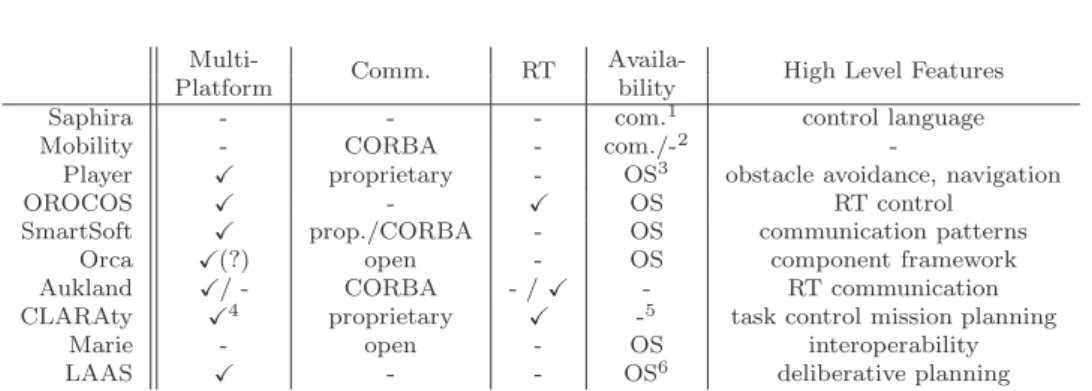
Table 2.1: Properties of commercial and research software architectures for autonomous mobile robot programming.
This has become a bottleneck in the development of autonomous mobile robot applications and hinders both the integration of further research disciplines and the use of new technologies that are needed to master the challenges of future robot application scenarios. Thus, robotic software tends to scale badly in the areas of project growth, performance, reliability and maintenance.
The growing number of projects on robot libraries and robot device servers shows the community’s increasing awareness of urgent need to address defi-ciencies in current robot software development. As summarized in Table 2.1, the related work discussed in the last section features some common capabil-ities, but they diverge in the provided higher-level features. Research in this area covers very different aspects such as generic low-level control, real-time-related research, large scale system integration and higher-level control. The software architectures partly differ due to the targeted application domain, for instance RT control targeted by OROCOS vs. indoor navigation targeted by Player. Others deliberately provide different approaches for addressing similar higher-level robot applications such as the closely coupled two-tiered approach of CLARAty vs. the classical deliberative 3T architecture of LAAS.
Currently, not a single standard software architecture for autonomous mobile robots exists. There is also still no consensus on how exactly such an archi-tecture should look. One reason for this certainly is the fact that the field of autonomous mobile robots is still evolving too rapidly to be able to define the requirements of tomorrow’s robot applications precisely enough. Therefore, identifying the concepts and technologies which provide most valuable benefit for autonomous mobile robot software architectures and evaluating their appli-cability are still unsolved research problems.
1Commercial
2No longer available due to buyout 3Open Source
4Proprietary research platforms and planetary rovers from various labs 5Announced for open source release
Chapter 3
Miro Architecture and Design
This thesis discusses the design and application of a distributed object-oriented robot software architecture. The fundamental design goal of such an architec-ture is to make the development of mobile robot applications easier and faster, and to foster the modularity, portability, reusability, scalability, and maintain-ability of robotics applications. The core idea of the design of Miro is to ad-dress the challenges of autonomous mobile robotics as an application domain by means of a flexible and scalable middleware-oriented software architecture. Therefore, the requirements for this software architecture are twofold. On the one hand, it needs to be portable, reusable, scalable, and maintainable in order to provide a solid infrastructure for software development. On the other hand, the design of the architecture needs to address the reusability and scalability challenges associated with robotics applications that use this architecture. The research on this topic is exemplified and evaluated in the Miro project.Miro generically supports robotic applications with the peculiarities of the ap-plication domain and separates them from other research problems targeted by roboticists. Instead of providing another complete model for autonomous mo-bile robot control, we follow a middleware-oriented design, providing extensible abstractions for robotics software development. The architecture is therefore organized into four interdependent layers that reside between the bare operating system and the application. The thesis especially focuses on how the proposed architecture provides support in mastering the aforementioned challenges of robotics as an application domain.
In this chapter, the design of the Miro architecture will be introduced. First, the basic requirements as well as the design principles of the architecture will be discussed. Afterwards, the general idea of middleware technology, as well as the actual design decisions of layering will be sketched and design aspects that target specific issues of robotic software development will be highlighted.
20 CHAPTER 3. MIRO ARCHITECTURE AND DESIGN
3.1
Requirements and Design Goals
From the related work covered in Section 2.4, a number of basic requirements for a robot software architecture can be derived. They address the applicability of the architecture for different scenarios as well as its portability and reusability. The superset of requirements identified by the majority of related research projects as listed in Table 2.1 reflects the consolidating design issues of robotics software architectures, but does not address the second question of how to propagate the reusability and scalability into the actual robotics applications. Distributed systems design. The software architecture should provide a
care-fully designed set of interfaces for communication between objects and for communications transparency, i.e. the programmer should not need to worry much about where objects are actually allocated and which com-munications protocol he needs to apply. Single robot and multi-robot applications should be treated equally.
We suggest to adopt a client/server view at least for larger modules of a robot control architecture: the modules, implemented as objects, provide services to other modules (objects) through a set of interfaces. Most modules of an application fulfill both the client and the server role, albeit for different subsystems, using the services of sensor objects as clients and providing services to actuator objects as servers.
Multi-platform support and interoperability. The applied software tech-nologies should be available on a wide range of hardware platforms and common operating systems. The use of different programming languages for implementing different modules should be supported without requiring much extra overhead cost for integration.
Real-time orientation. Even though classical robot scenarios like indoor nav-igation typically have very lax timing constraints, the reactivity and de-terministic response times become an important issue in highly dynamic environments and have to be solved for robotic applications that need to perform safely in natural environments.
Open development model. Considering the immense spectrum of different hardware and software components used in mobile robot systems, adopt-ing an open architecture approach includadopt-ing availability of all source code seems indispensable. Only if applications programmers can access, mod-ify and fine-tune all components of the software environment can the integration of a heterogeneous set of hardware and software components be successfully accomplished. Also, integration of new hardware devel-opments and new computational methods developed in ongoing research usually can be achieved much more easily and quickly, if all source code is available for inspection, reuse and debugging purposes.
Modularity, reusability, stability and efficiency are major building blocks for scalable, maintainable high-quality software applications. In order to achieve
3.1. REQUIREMENTS AND DESIGN GOALS 21 this in robotics, it is necessary to apply, extend and exploit the software tech-nologies and concepts that target software development for large-scale applica-tions. Such technologies are currently missing in commercially available robotic software architectures. The approach taken in this thesis is to provide generic support in the form of a robotics middleware for such non-functional aspects of robotics applications. This goal is reflected in the design principles ofMiro. Object-Oriented Design: The software architecture should be designed
us-ing thoroughly the object-oriented paradigm. Object-oriented concepts like information hiding, name spaces to prevent naming ambiguities when using multiple mutually independent libraries, exception handling to sep-arate normal program control flow from error recovery, abstraction, type polymorphism, and inheritance can all significantly contribute to improve the design and implementation of mobile robot software when applied deliberately and consistently.
Suitable abstractions: A major goal for a successful design is to define suit-able abstractions for the different (physical) devices of the various robots. They need to precisely model their properties while at the same time provide generalizations that allow for their abstract usage by client appli-cations.
The object-oriented paradigm permits a clean abstraction of sensor and actuator subsystems as well as low-level system services like communi-cations, and provides a uniform interface design. A suitable level of ab-straction from low-level system details may be a key element in attaining a better understanding of how to integrate a significant number of different hardware devices and computational methods.
Employment of existing technologies: Reusability and scalability of soft-ware is often enhanced by actually reusing existing solutions. Therefore, the application of existing software technology is favored over the rein-vention of functionality specialized for the target domain. Necessary cus-tomizations for the target domain actually provide valuable feedback for the development of such base technologies.
Actively targeting the integration of additional methods: Autonomous mobile robot applications require the integration of solutions from vari-ous other research disciplines such as computer vision or neuroinformatics. But the robotics domain, in turn, imposes severe additional constraints on solutions from other research disciplines. Therefore, the application of such methods requires active support from the infrastructure of the application domain in order to actually become applicable.
Generalization and scaling of existing robotic core functionality: Various solutions for many of the classical robotics problems such as reactive control or localization do actually exist. It is not the goal of the proposed design to select one apparently best suited solution for exclusive application. Instead, the goal is to provide an infrastructure
22 CHAPTER 3. MIRO ARCHITECTURE AND DESIGN that supports a generalized, common view on the problem domain and is applicable to different solution approaches. The design on such generalizations should be focused on improving the scalability and reusability of applied solutions.
Flexible Integration of User Interfaces: A commonly underestimated problem in mobile robot research is the development and use of suitable user interfaces for various tasks. The task-oriented user interface for end users interacting with the robot requires careful design in order to avoid compromising the robot’s autonomy and integrity. People operating and supervising the robots need interfaces for monitoring its operational state, while programmers may need even further internal state information for debugging purposes. These user interfaces might be activated only occasionally or under special circumstances. Nevertheless, their effect on the runtime performance should be limited, and the architecture should support the programmer in meeting this goal.
3.2
Middleware
The acronym Miro, which denotes the software project implementing the so-lutions identified and discussed in this thesis, stands for “The Middleware for Robots”. Instead of providing a complete model for a robot control architec-ture, we propose a middleware-oriented design, that provides abstract, flexible services and required functionality for the robotics domain without restricting roboticists in their choice of solutions for the various sub-domains of an appli-cation. The term middleware mostly denotes a software layer between the bare operating system and the applications that provides application-independent functionalities beyond what a usual operating system (OS) would support. Wikipedia defines middleware as follows:
In computing, middleware consists of software agents acting as an intermediary between different application components. It is used most often to support complex, distributed applications. The software agents involved may be one or many. [148].
The term middleware is often used as a synonym for distributed systems mid-dleware as defined by the ‘Internet 2’ architecture. But apart from distributed systems middleware other application domains also establish their own middle-ware frameworks. A central goal of middlemiddle-ware is to hide the intrinsic complex-ities of the necessary infrastructure from the applications [148]. There is also growing interest in the integration of non-functional properties such as fault tol-erance, response times, security and scalability into middleware technologies. It has become evident that support for these characteristics of an application relating to “Quality of Service” (QoS) can often be efficiently managed by a middleware layer.
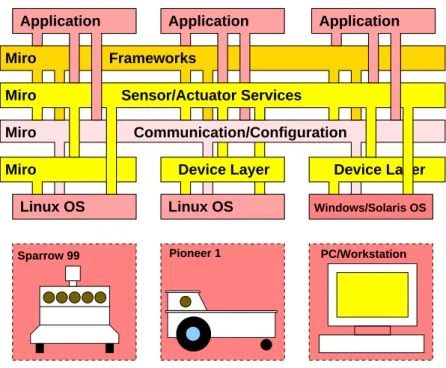
3.3. ARCHITECTURAL LAYERS 23 Device Layer PC/Workstation Sparrow 99 Pioneer 1 Frameworks Application Application
Linux OS Linux OS Windows/Solaris OS
Application Miro
Miro Miro
Miro Device Layer
Communication/Configuration Sensor/Actuator Services
Figure 3.1: TheMiro architecture. TheMiro device layer provides abstract in-terfaces for specific platforms. The Communication and Service layers achieve platform-independence, network and location transparency. The Miro frame-works provides reusable designs for generic robot control functionality.
3.3
Architectural Layers
To further structure the various aspects of functionality required from a robotics middleware, Miro is structured into four interwoven architectural layers that reside between the bare OS and the robotics applications (see Figure 3.1). As illustrated in the figure, robotic applications only interact with the two upper layers and can also use the infrastructure provided by the communication and configuration layer, but the low-level details of the robot’s sensor and actuator devices are hidden from the application programmer in the device layer. The four layers address different problems of the application domain that were iden-tified in Section 2.3 for meeting the requirements and design goals defined at the beginning of this chapter.
3.3.1 Hardware Abstraction
The Device Layer addresses the problem of the extreme heterogeneity in the hardware of robotics devices by providing object-oriented interface abstractions for all sensory and actuatory facilities of a robot. This is the platform-dependent part of Miro. As the reuse of code is difficult in a programming environment tightly bound to the individual hardware, conceptual reuse on this layer is prop-agated by a pattern-oriented approach. This device layer-wraps the message or