Does cognitive load moderate the seductive details effect? A multimedia study
Babette Park
a,⇑, Roxana Moreno
b, Tina Seufert
c, Roland Brünken
aa
Saarland University, Germany b
University of New Mexico, Educational Psychology Program, Simpson Hall 123, Albuquerque, NM 87131, United States c
University of Ulm, Institute of Psychology and Education, 89069 Ulm, Germany
a r t i c l e
i n f o
Article history:
Available online 15 September 2010
Keywords: Cognitive load Modality Seductive details Multimedia learning Motivation Redundancy
a b s t r a c t
Several studies have shown that adding seductive details to instructional materials has a detrimental effect on learning. However, other studies have shown non-significant findings. The present study uses cognitive load theory as a theoretical framework to explain these controversial results in seductive details research. Using a 22 experimental design we asked a group of high-school students (N= 100) to learn about biology with a multimedia environment that manipulated the presence of seductive details (with vs. without) and the modality of the verbal information (high load, on-screen text vs. low load, nar-ration). The findings showed that students’ learning performance was significantly higher when seduc-tive details were presented under the low load condition (narration) as compared to all other conditions. The theoretical implications for understanding the effects of non-redundant and interesting, but irrelevant learning material are discussed and future research directions are presented.
Ó2010 Elsevier Ltd. All rights reserved.
1. Introduction
Until now, research on the effect of seductive details has fo-cused on seductive text passages or seductive illustrations in text comprehension studies. Several studies have shown the detrimen-tal effect of seductive details (Garner, Gillingham, & White, 1989; Harp & Maslich, 2005; Harp & Mayer, 1998; Lehman, Schraw, McCrudden, & Hartley, 2007), whereas others have shown non-sig-nificant seductive detail effects (Garner & Gillingham, 1991; Hidi & Baird, 1988; Mayer, Bove, Bryman, Mars, & Tapangco, 1996; Mayer, Griffith, Jurkowitz, & Rothman, 2008; Schraw, 1998). The present study uses cognitive load theory (CLT) as a theoretical framework to explain the conflicting results of the seductive detail research by testing the seductive details effect in a multimedia instructional environment. Until now, seductive details research only tested the effect of seductive details on text or listening comprehension sep-arately, by introducing seductive text passages presented as text (Garner et al., 1989; Lehman et al., 2007), in a lesson presented by a disc player (Harp & Maslich, 2005), or in a multimedia envi-ronment that uses narration (Mayer, Heiser, & Lonn, 2001). How-ever, to our knowledge, the simultaneous manipulation of seductive details and verbal modality in a multimedia instructional program has never been examined.
What happens when the on-screen explanations of an instruc-tional multimedia program that includes seductive details (i.e., a high load design) are replaced by identical narrated explanations (i.e., a low load design)? CLT predicts that the seductive details ef-fect will occur under a high cognitive load condition but not under low cognitive load conditions. The goal of this study was to test this hypothesis by manipulating the introduction of seductive de-tails in a multimedia instructional program that either includes on-screen text or narrated verbal explanations. We argue that the findings of this research bear the potential to explain the contro-versial results in past seductive details research.
1.1. Theoretical framework and predictions
Cognitive load theory (Paas, Renkl, & Sweller, 2003) assumes that knowledge acquisition depends on the efficiency of the use of available (limited) cognitive resources. In addition, the extent of cognitive load is determined by three components. First,intrinsic
cognitive load depends on the number of elements that must be
simultaneously processed in working memory to learn the mate-rial that is being taught; the larger the number of elements of the material that needs to be learned, the higher intrinsic cognitive load. Second,extraneous cognitive loadis caused by the unnecessary cognitive demands imposed by instructional design. Finally,
ger-mane cognitive loadis the load that results from engaging in
learn-ing activities that foster schema acquisition. Whereas extraneous sources of load hinder learning, intrinsic sources of load reflect the complexity of the given learning task in relation to the learners’
0747-5632/$ - see front matterÓ2010 Elsevier Ltd. All rights reserved.
doi:10.1016/j.chb.2010.05.006
⇑Corresponding author. Address: Saarland University, Department of Education, Campus A 4.2, D-66123 Saarbrücken, Germany. Tel.: +49 681 302 2340; fax: +49 681 302 4373.
E-mail address:[email protected](B. Park).
Contents lists available atScienceDirect
Computers in Human Behavior
level of expertise, and germane sources of load promote learning by helping students engage in the process of schema formation and automation. A basic assumption of CLT is that the total cogni-tive load experienced during learning is addicogni-tively composed of these three load types, the so-called additivity hypothesis. If that total cognitive load is excessive, learning and problem solving will be inhibited (Sweller, 1993).
According to CLT, when visual representations (e.g., pictures, diagrams, animations) are combined with simultaneous visual explanations (i.e., text), they force students to split their visual attention during learning, therefore producing a detrimental effect on learning performance (Sweller & Chandler, 1994). The learning benefits of replacing visual explanations with auditory explana-tions (i.e., the modality effect), is quite robust (Ginns, 2005; Rum-mer, Schweppe, Fürstenberg, Seufert, & Brünken, 2010). The modality effect is determined by the superiority of audiovisual in contrast to visual-only presentations of verbal and pictorial infor-mation in multimedia learning (Brünken & Leutner, 2001; Brünken, Plass, & Leutner, 2004; Mayer, 2001; Mayer & Moreno, 1998; Moreno & Mayer, 1999, 2002). This effect is explained by the the-oretical argumentation that visual-only material requires splitting the available limited capacity of the visual part of the working memory, the visuospatial sketchpad (Baddeley, 1992), therefore creating a high load learning condition. In contrast, audio–visual presentations of learning material have the advantage of distribut-ing the processdistribut-ing of visual and verbal information through the vis-uospatial sketchpad and the phonological loop, respectively (Baddeley, 1992), therefore creating a low load learning condition by increasing effective working memory capacity. According to CLT, the modality effects found in the past suggest that forcing stu-dents to split their visual attention between the text and the pic-tures creates an extraneous source of cognitive load (Sweller, 2005; Sweller, van Merriënboer, & Paas, 1998).
The second extraneous load factor to be examined in the pres-ent study is the presence of seductive details. The term ‘‘seductive details” was first introduced byGarner et al. (1989)to refer to the addition of interesting but irrelevant information to text which re-duce the recall or learning of ‘‘non-seductive”, relevant text ideas. More recently, the seductive detail research has led to the agreed-upon definition that seductive details are instructional materials that meet the following two necessary conditions: (1) the materi-als are interesting and (2) the materimateri-als provide additional infor-mation that is irrelevant to accomplish the learning objectives of a lesson (Lehman et al., 2007). Several studies have shown that adding seductive details to instructional materials has a detrimen-tal effect on learning (Garner et al., 1989; Harp & Maslich, 2005; Harp & Mayer, 1998; Lehman et al., 2007). Furthermore, the likeli-hood of overestimating the relevance of interesting, but goal-irrel-evant details increases when learners have low knowledge in a domain (Garner, Brown, Sanders, & Menke, 1992).
The goal of the present study is to find out how this extraneous load factor interacts with another extraneous load factor, namely, the modality of the verbal information. More specifically, in terms of CLT, we investigated whether the seductive details effect can be moderated by another extraneous load factor, which is the modal-ity. To this end, using a 22 experimental design we tested this hypothesis by asking a group of high-school students (N= 100) to learn about the structure and function of a cellular molecule responsible for the synthesis of adenosine triphosphate (ATP) with the help of an instructional program. The program was designed in multimedia format with 11 screens including pictorial learning material accompanied by verbal explanations. The experiment combined the seductive details factor (i.e., with vs. without) with the modality factor (i.e., high load, on-screen text vs. low load, nar-ration). Learning success and students’ subjective ratings of cogni-tive load (Paas, 1992) served as dependent variables.
Using identical multimedia materials, two preliminary studies that independently manipulated the presence of seductive details and the modality of the verbal information, showed the seductive details effect under the high load on-screen text condition as well as the modality effect, respectively. In the first preliminary study (N= 78), students learned better when presented with narration rather than on-screen text in the learning environment, F(1, 76) = 2.94, p< .05,
g
2p= .04 (Seufert, Schütze, & Brünken, 2009). In the second preliminary study (N= 30), students learned better when the learning environment excluded the seductive de-tails used in the present study, F(1, 29) = 2.92, p< .05,
g
2p= .10 (Koch, Seufert, & Brünken, 2008b). In addition, we found that learn-ers who learned with seductive details in the self-paced learning program spent significantly more time (M= 13.87 min, SD= 3.13 min), F(1, 29) = 5.27, p< .05 than those who learned without seductive details (M= 8.56 min,SD= 2.33 min).
What are the learning and cognitive load effects of combining these two extraneous load sources? Based on CLT, we hypothesize that the seductive details effect will only occur under the high load on-screen text condition, but not under the low load narration con-dition. Students who learn with seductive details should show sig-nificantly lower learning success as compared to those who learn without seductive details under the on-screen text condition but not under the narration condition. In addition, based on CLT, we predicted that the highest cognitive load ratings would occur un-der the high load on-screen text condition with seductive details, whereas the lowest cognitive load ratings would occur under the low load narration condition without seductive details.
1.2. Seductive details and cognitive load
The seductive detail construct has not been investigated in cog-nitive load research yet. Nevertheless, we would like to relate the definition of seductive details to that of redundant instructional materials, which have been the topic of investigation in redun-dancy effect studies (Chandler & Sweller, 1991; Lee & Kalyuga, 2011; Schmidt-Weigand & Scheiter, 2011; Sweller & Chandler, 1994), and which in our view is related to seductive details in some respect. For instance,Chandler and Sweller (1996), p. 153note that information sources are redundant that contain information, which is ‘‘not only intelligible in isolation but provides all of the informa-tion required”. A diagram illustrating a learning text for example can be redundant, if it contains all information of the given learn-ing text, belearn-ing an adequate visualization of complex information. The crucial point of this idea is the term ‘‘required”, which does not refer to the information per se but to its relation to the learning goal. However, music or cartoons accompanying a learning text usually are intelligible in isolation but do not provide any of the information required for the learning goal and are therefore seduc-tive, but non-redundant. Therefore, we further classify instruc-tional materials into relevant and irrelevant with respect to the learning goal. We believe that this sub-classification we offer is a nice contribution to the cognitive load field that can generate new research paradigms. Non-redundant, but relevant additional materials promote better learning because they are designed to facilitate or enable cognitive processing that is necessary to achieve the learning objectives of the lesson. In contrast, non-redundant, but irrelevant additional materials (which are seduc-tive details by definition), have a detrimental effect on learning (Garner et al., 1989; Harp & Maslich, 2005; Harp & Mayer, 1998; Lehman et al., 2007). Although the study of seductive details has not received attention among cognitive load researchers yet, CLT clearly argues that information that is not necessary to make a les-son intelligible should be eliminated (Bobis, Sweller, & Cooper, 1993; Chandler & Sweller, 1991). If the irrelevant information is not eliminated (resulting in poorer instructional design), it will
increase extraneous cognitive load and decrease learning. Thus, seductive details impose an extraneous cognitive load during learning by forcing students to spend their limited resources in processing materials that are not conducive to learning. As for all cognitive load effects, this is especially the case, if the given learn-ing task is complex and requires the learners to use their full cog-nitive resources to successfully process all relevant information. If a task does not require the learners to use their full cognitive re-sources, for instance if a task is of low complexity, irrelevant infor-mation is not likely to have a negative effect. Moreover, CLT proposes the introduction of instructional design features that facilitate effective learning (i.e., impose a germane cognitive load) to foster learners to use their available limited resources for pro-cessing relevant instead of irrelevant information.
2. Method and data sources 2.1. Participants
The participants were 100 high-school students (76% female, 23% male) with an average age of 18.14 years (SD= 1.26). Modality of the verbal explanation (i.e., high load on-screen text vs. low load narration) and seductive details (i.e., with vs. without) were varied in a 22 factorial design, leading to four learning conditions: text–seductive details; text–no seductive details; narration–seduc-tive details; narration–no seducnarration–seduc-tive details. Participants were ran-domly assigned to one of the four experimental groups and paid for their participation.
2.2. Materials
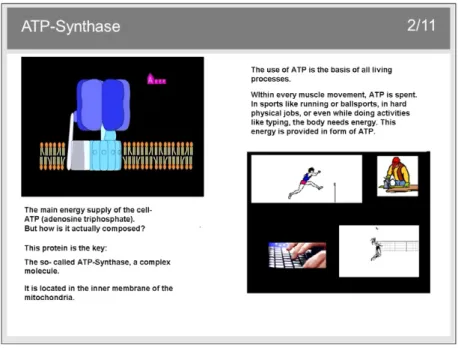
The learning environment used in this study consisted of a self-paced multimedia environment about the structure and function of a cellular molecule responsible for the synthesis of ATP. It included 11 screens, each one with static pictures and corresponding verbal explanations. The objective of the learning task was to understand the complex structure and function of the molecule by integrating the verbal representations (seeFig. 1, below left) with the corre-sponding pictorial representations (seeFig. 1, top left). This learn-ing objective was explicitly stated durlearn-ing the introductory portion
of the program that was common to all treatment conditions. In contrast, understanding the usefulness of ATP was not part of the objectives of the learning task, which is the reason why we chose to show examples of the usefulness of ATP in different areas (e.g., sports, work, etc.) to the participants in the seductive detail condi-tions. Furthermore, we already had empirically established that presenting these interesting but irrelevant examples hindered stu-dents’ learning in one of our preliminary studies (Koch, Seufert, & Brünken, 2008a) using only the on-screen text version of the material.
The extraneous load factor of modality was varied by replacing the visual explanations with identical narrated explanations in the form of a male voice and participants had the option to replay the narration. Thus, the self-pacing of the text and the narration were comparable in the sense that students could reread or replay the explanations. Indeed, the majority of learners in the narration con-ditions used the replay function (62% replayed more than once, on average; only 8% never used the replay function). For both seduc-tive detail conditions, additional text (seeFig. 1, top right) and ani-mated pictures (seeFig. 1, below right) were presented on four of the 11 screens.
The additional information was rated to be significantly more interesting than the rest of the learning material,t(11) = 12.50, p< .001, in a previous study (Koch et al., 2008a). In addition, as ex-plained before, our operationalization of seductive details included additional information that was not relevant to achieve the learn-ing objectives of the lesson. Therefore, our seductive details met the criteria of interesting but unimportant information (Lehman et al., 2007; Wade & Adams, 1990). In CLT terms, the seductive de-tails presented on four of the 11 learning screens can be catego-rized as non-redundant (intelligible in isolation), but irrelevant and therefore an extraneous cognitive load source for learning the objectives of the lesson (Chandler & Sweller, 1991; Sweller & Chandler, 1994).
2.3. Measures
We used three control measures: prior knowledge, measured with a questionnaire (Cronbachs’
a
= 0.70) that included five multi-ple-choice (e.g., ‘‘Which main function does ATP have?”) and eightFig. 1.A screenshot of the learning environment used in the text–seductive detail condition showing the on-screen text (lower left corner), corresponding picture (top left corner), and seductive details (additional text and animated pictures on the right side); original version in German, translated by the authors.
open-ended questions (e.g., ‘‘Do you know the term ‘ATP’? If yes, then please write down its meaning! (catchwords)”); spatial abil-ity, measured by a standardized paper-folding and card-rotation test (Ekstrom, French, & Harmann, 1976); and time-on-task, which was automatically recorded by the computer.
Learning success was assessed with a post-test including one problem solving task in open-response format (e.g., ‘‘What hap-pens with the sub elements Alpha and Beta during the rotation of the axis?”), two transfer tasks, and two retention items. One of the transfer tasks was presented in open-response format and the other one in a multiple-choice format (e.g., ‘‘Which cells do fea-ture the highest number of mitochondrions?”). The first retention item was also presented in open-response format (e.g., ‘‘Which task does the F0-Complex of the ATP-Synthase perform?”) and the second retention item was introduced in matching format, in which learners needed to identify corresponding verbal and picto-rial elements such as those for the composition of the molecule. These items were not identical to the 13-item prior knowledge test described above, which was used as a covariate of students’ learn-ing performance test. Total cognitive load was measured by subjec-tive ratings of mental effort (Paas, 1992), in which learners rated their perceived cognitive load during learning in the middle of the lesson (after screen 4/11) and immediately after the lesson was over on a seven-point Likert scale. At each one of these points in time, learners were asked to subjectively estimate their total cognitive load by clicking on the rating that best completed the fol-lowing statement ‘‘While working on the learning material my mental effort was. . .” with the ratings ranging from ‘‘very low”, ‘‘low”, ‘‘rather low”, ‘‘neither low nor high”, ‘‘rather high”, ‘‘high” to ‘‘very high”.
2.4. Procedure
The study was conducted in one session lasting about 75 min. First, students were tested for spatial ability. Then, the self-paced session started with the 13-item prior knowledge test, which was followed by the multimedia learning program. Once the instructional program was over, students completed the learning performance test.
3. Results and conclusion
Table 1shows the means and standard deviations of all vari-ables for the four treatment conditions. Despite of the differences in the descriptive values, no statistical significant between-group differences were detected in any of the three control variables, prior knowledge, F(3, 99) = 2.27, p> .05,
g
2p= .07, spatial ability, F< 1, and time-on-task,F(3, 99) = 2.13, p> .05,
g
2p= .06. But with respect to its high inter-individual variance, we used prior knowl-edge as a covariate in the following analyses of covariance. How-ever, results and conclusions are the same, when running only ANOVAs.
3.1. Learning success and cognitive load
We conducted separate analyses of covariance (ANCOVAs) with the covariate prior knowledge using experimental condition as be-tween-subject factor and the learning performance score and cog-nitive load ratings, respectively, as dependent variables, to test the learning and total cognitive load effects predicted by the cognitive load hypothesis that the seductive details effect only occurs under high load learning conditions, in our case under the on-screen text condition.
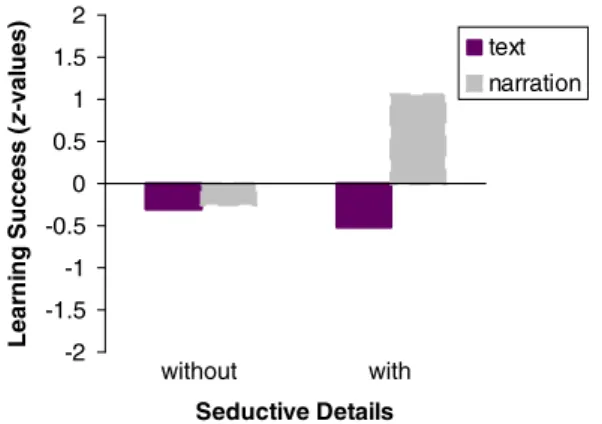
The first ANCOVA showed a main effect of modality, F(1, 99) = 6.27, p< .05,
g
2p= .06, and no main effect of seductive details,F(1, 99) = 2.80,p> .05,
g
2p= .03. However, we found a signif-icant interaction between the two factors,F(1, 99) = 5.47, p< .05,
g
2p= .05, and therefore chose to ignore the main effect in favor of the interpretation of the interaction. Follow-up tests showed that learners reached the highest learning success under the narra-tion–seductive detail condition (i.e., narranarra-tion–seductive details vs. narration–no seductive details:DM= 1.46,p< .01; narration– seductive details vs. text–seductive details:DM= 1.64,p< .01; nar-ration–seductive details vs. text–no seductive details:DM= 1.48, p< .01; seeFig. 2).
The second ANCOVA showed a main modality effect, F(1, 99) = 7.45,p< .05,
g
2p= .07. Learners gave higher cognitive load ratings under the narration condition, indicating that the positive learning effect of the narration versions was accompanied by high-er levels of self-reported effort (seeFig. 3). However, we found no main effect of seductive details (F< 1) and no interaction between the two factors,F(1, 99) = 1.81 ns.
In sum, the results suggest that seductive details may foster learning under a low load condition. Adding extraneous load in the form of seductive details fostered learning under the narration condition but not under the on-screen text conditions. A possible interpretation of this finding is that seductive details may have a beneficial learning effect only under conditions of low cognitive load. This interpretation is supported by the higher self-reported effort of the narration groups. On the other hand, contrary to what we expected, the on-screen text plus seductive details condition only underperformed the narration plus seductive details condi-tion and did not show the highest ratings of cognitive load. These findings run counter to prior seductive details studies (including our own preliminary study), in which adding interesting but con-ceptually irrelevant materials produced a detrimental effect on students’ learning. The cognitive load rating findings also run counter to CLT’s predictions. This group did not produce signifi-cantly higher cognitive load ratings as compared to the group that learned with on-screen text and no seductive details.
An explanation for this controversial result can be found when taking students’ prior knowledge into consideration: Learners in the preliminary study had significantly lower prior knowledge (15%) than learners in the present study (30%), t(128) = 4.04, p< .05. Likewise, other prior seductive detail studies are also fo-cused on novice learners (Mayer et al., 2001). Thus, the missing
Table 1
Means and standard deviations of all variables for four conditions.
Text–seductive detailsn= 25 Text–no seductive detailsn= 25 Narration–seductive details
n= 25
Narration–no seductive detailsn= 25
M (SD) M (SD) M (SD) M (SD)
Spatial ability (%) 71.22 16.35 61.36 20.08 70.68 20.62 65.32 22.48
Prior knowledge (%) 33.54 16.26 29.69 16.15 39.23 22.04 26.92 15.50
Time-on-task (min) 10.62 3.44 10.04 3.29 12.38 3.82 12.21 5.06
Learning success (%) 40.57 22.56 42.29 17.97 63.43 20.13 42.57 24.53
Total cognitive load (%) 60.57 12.56 55.43 19.92 64.00 17.07 68.57 12. 37 Note: M= mean,SD= standard deviation.
seductive details effect under the high load on-screen text version in the present study could be due to learners‘ higher prior knowl-edge, which may diminish the negative effects that result from imposing an additional source of extraneous load. This explana-tion, however, has to be investigated in real expertise studies com-paring experts with novices of a learning domain with or without seductive details. An expertise reversal effect of seductive details could be assumed in the way we can find it for many other instruc-tional methods (Kalyuga, 2007; Kalyuga, Ayres, Chandler, & Swel-ler, 2003; Koch et al., 2008b; Spanjers, Wouters, van Gog, & van Merriënboer, 2011).
Taken together, these findings suggest that the cognitive pro-cesses of selecting relevant information and organizing this infor-mation into a coherent mental model can be affected not only in a negative way by seductive details, but also in a positive way if learners have enough resources free to use this non-redundant and interesting, but irrelevant learning material. Further research using other instructional materials is needed to confirm this rever-sal effect of seductive details by examining whether and under which conditions cognitive load may moderate the seductive de-tails effect. In addition, the pattern in cognitive load ratings did not show the pattern predicted by CLT. Therefore, other methods for measuring cognitive load should be used in further research to get insight into the potential moderating effect of cognitive load on the seductive details effect. However, the present cognitive load pattern could be interpreted in the way that learners had enough free cognitive capacity under the low extraneous load learning conditions (i.e., narration instead of on-screen text) and, therefore, invested more cognitive resources in germane activities. Support for this interpretation was found in a recent study in which learn-ers with high levels of working memory capacity reached higher
learning performance in a lesson that included background music (seductive detail) as compared to learners with medium levels of memory capacity, who learned significantly better under the mu-sic-free condition (Park, Seufert, & Brünken, 2009). Nevertheless, this interpretation needs to be confirmed with reliable and valid measures that differentiate between the three cognitive load types, which at the present time are not available (Brünken, Plass, & Moreno, 2010).
Nevertheless, freeing working memory capacity by designing low load learning environments or having higher levels of working memory capacity do not necessarily lead to spending the available resources in productive ways, that is, in germane learning activities such as the prior knowledge activating strategy ‘perspective taking’ (Wetzels, Kester, & van Merriënboer, 2011). Students need to be-come motivated to make full use of their cognitive resources dur-ing learndur-ing (Moreno, 2006). Therefore, the motivational or arousing role of seductive details should not be dismissed. Accord-ing to a Cognitive Affective Theory of LearnAccord-ing with Media ( Moren-o, 2005, 2006, 2007, 2009), affect and motivational factors mediate learning by increasing or decreasing the amount of cognitive re-sources that students invest on the learning task at hand. Students need to be motivated to learn or (in lieu of motivation) use their self-regulation to allocate sufficient cognitive resources to the task at hand (Moreno, 2009). Thus, a possible explanation for our find-ings is that the seductive details used in our study increased stu-dents’ cognitive engagement. The higher investment of cognitive resources fostered by the interestingness of the additional infor-mation combined with the lower cognitive demands imposed by a mixed modality learning environment led to the optimal use of students’ limited working memory resources.
Finally, it is noteworthy that our findings run counter to one of the main assumptions of CLT, namely, the additivity hypothesis. The additivity hypothesis predicts the highest levels of total cogni-tive load and lowest levels of learning performance when multime-dia instruction combines written verbal explanations with seductive details and the lowest levels of total cognitive load and highest levels of learning performance when multimedia instruc-tion includes auditory verbal explanainstruc-tions and no seductive de-tails. The results of the present study suggest that the combined effects of extraneous load factors are not necessarily additive, at least with respect to subjective cognitive load ratings. Future re-search should extend this study by examining the learning and cognitive load consequences of asking students of different prior knowledge levels to learn in conditions where intrinsic, extrane-ous, and germane sources of load are added.
Acknowledgements
This research was supported by the Deutsche Forschungsge-meinschaft (German Research Foundation; Grant Br 2082/6-1). The authors wish to thank Antje Zindler, Martin Klein, and Tobias Gall, who were very engaged to realize the present study by pro-gramming the learning material and managing the recruitment and instruction of participants. We also thank the guest editors Gemma Corbalan, Lisbeth Kester, and Femke Kirschner as well as all anonymous reviewers for their very helpful comments.
References
Baddeley, A. (1992). Working memory.Science, 255, 556–559.
Bobis, J., Sweller, J., & Cooper, M. (1993). Cognitive load effects in a primary-school geometry task.Learning and Instruction, 3, 1–21.
Brünken, R., & Leutner, D. (2001). Aufmerksamkeitsverteilung oder Aufmerksamkeitsfokussierung? Empirische Ergebnisse zur ‘‘split-attention-hypothese” beim Lernen mit multimedia [Distribution or focus of attention? Empirical results for the split-attention hypothesis in multimedia learning.].
Unterrichtswissenschaft, Zeitschrift für Lernforschung, 29, 357–366.
-2 -1.5 -1 -0.5 0 0.5 1 1.5 2 without with Seductive Details Le ar ni ng Suc c e s s ( z -v a lu e s ) text narration
Fig. 2.Learning success for four conditions (estimated mean values with covariate prior knowledge). -1 -0.8 -0.6 -0.4 -0.2 0 0.2 0.4 0.6 0.8 1 without with Seductive Details
Total Cognitive Load (
z
-values)
text narration
Fig. 3.Cognitive load ratings for four conditions (estimated mean values with covariate prior knowledge).
Brünken, R., Plass, J. L., & Leutner, D. (2004). Assessment of cognitive load in multimedia learning with dual-task methodology: Auditory load and modality effects.Instructional Science, 32, 115–132.
Brünken, R., Plass, J., & Moreno, R. (2010). Current issues and open questions in cognitive load research. In J. Plass, R. Moreno, & R. Brünken (Eds.),Cognitive load: Theory and application(pp. 253–272). New York: Cambridge University Press.
Chandler, P., & Sweller, J. (1991). Cognitive theory and the format of instruction.
Cognition and Instruction, 8, 293–332.
Chandler, P., & Sweller, J. (1996). Cognitive load while learning to use a computer program.Applied Cognitive Psychology, 10, 151–170.
Ekstrom, R. B., French, J. W., & Harmann, H. H. (1976).Manual for kit of factor-referenced cognitive tests. Princeton, NJ: Educational Testing Service. Garner, R., Brown, R., Sanders, S., & Menke, D. J. (1992). ‘‘Seductive details” and
learning from text. In K. A. Renninger (Ed.),The role of interest in learning and development(pp. 239–254). Hillsdale: Erlbaum.
Garner, R., & Gillingham, M. (1991). Topic knowledge, cognitive interest, and text recall: A microanalysis.Journal of Experimental Education, 59, 310–319. Garner, R., Gillingham, M. G., & White, C. S. (1989). Effects of ‘‘seductive details” on
macroprocessing and microprocessing in adults and children.Cognition and Instruction, 6, 41–57.
Ginns, P. (2005). Meta-analysis of the modality effect.Learning and Instruction, 15, 313–331.
Harp, S. F., & Maslich, A. A. (2005). The consequences of including seductive details during lecture.Teaching of Psychology, 32, 100–103.
Harp, S. F., & Mayer, R. E. (1998). How seductive details do their damage: A theory of cognitive interest in science learning.Journal of Educational Psychology, 90, 414–434.
Hidi, S., & Baird, W. (1988). Strategies for increasing text-based interest and students’ recall of expository texts.Reading Research Quarterly, 23, 465–483. Kalyuga, S. (2007). Expertise reversal effect and its implications for learner-tailored
instruction.Educational Psychological Review, 19, 509–539.
Kalyuga, S., Ayres, P., Chandler, P., & Sweller, J. (2003). The expertise reversal effect.
Educational Psychologist, 38(1), 23–31.
Koch, B., Seufert, T., & Brünken, R. (2008).Didaktische Reduktion in Multimedialen Lernumgebungen: Ist die Fokussierte Verarbeitung External Steuerbar?[Didactic reduction in multimedia instruction: Is focused processing externally controllable?] 71. Tagung der Arbeitsgruppe für Empirische Pädagogische Forschung (AEPF), August 25–27, Kiel, Germany.
Koch, B., Seufert, T., & Brünken, R. (2008b). One more expertise reversal effect in an instructional design to foster coherence formation. In J. Zumbach, N. Schwartz, T. Seufert, & L. Kester (Eds.), Beyond knowledge: The legacy of competence. Meaningful computer-based learning environments (pp. 207–215). Berlin: Springer.
Lee, C. H., & Kalyuga, S. (2011). Effectiveness of on-screen pinyin in learning Chinese: An expertise reversal for multimedia redundancy effect.Computers in Human Behavior, 27, 11–15.
Lehman, S., Schraw, G., McCrudden, M. T., & Hartley, K. (2007). Processing and recall of seductive details in scientific text.Contemporary Educational Psychology, 32, 569–587.
Mayer, R. E. (2001).The Cambridge handbook of multimedia learning. Cambridge: University Press.
Mayer, R., Bove, W., Bryman, A., Mars, R., & Tapangco, L. (1996). When less is more: Meaningful learning from visual and verbal summaries of science textbook lessons.Journal of Educational Psychology, 88, 64–73.
Mayer, R., Griffith, E., Jurkowitz, I., & Rothman, D. (2008). Increased interestingness of extraneous details in a multimedia science presentation leads to decreased learning.Journal of Experimental Psychology: Applied, 14, 329–339.
Mayer, R. E., Heiser, J., & Lonn, S. (2001). Cognitive constraints on multimedia learning: When presenting more material results in less understanding.Journal of Educational Psychology, 93, 187–198.
Mayer, R. E., & Moreno, R. (1998). A split-attention effect in multimedia learning: Evidence for dual processing systems in working memory.Journal of Educational Psychology, 90, 312–320.
Moreno, R. (2005). Instructional technology: Promise and pitfalls. In L. PytlikZillig, M. Bodvarsson, & R. Bruning (Eds.), Technology-based education: Bringing researchers and practitioners together(pp. 1–19). Greenwich, CT: Information Age Publishing.
Moreno, R. (2006). Does the modality principle hold for different media? A test of the method-affects-learning hypothesis.Journal of Computer Assisted Learning, 22, 149–158.
Moreno, R. (2007). Optimizing learning from animations by minimizing cognitive load: Cognitive and affective consequences of signaling and segmentation methods.Applied Cognitive Psychology, 21, 765–781.
Moreno, R. (2009). Learning from animated classroom exemplars: The case for guiding student teachers’ observations with metacognitive prompts.Journal of Educational Research and Evaluation, 15, 487–501.
Moreno, R., & Mayer, R. E. (1999). Cognitive principles of multimedia learning: The role of modality and contiguity. Journal of Educational Psychology, 91, 358–368.
Moreno, R., & Mayer, R. E. (2002). Learning science in virtual reality multimedia environments: Role of methods and media.Journal of Educational Psychology, 94, 598–610.
Paas, F. (1992). Training strategies for attaining transfer of problem-solving skill in statistics: A cognitive-load approach. Journal of Educational Psychology, 84, 429–434.
Paas, F., Renkl, A., & Sweller, J. (2003). Cognitive load theory and instructional design: Recent developments.Educational Psychologist, 38, 1–4.
Park, B., Seufert, T., & Brünken, R. (2009).Seductive details in multimedia learning: Interference effect or arousal effect? The influence of learners’ memory skills. Paper presented on 13th biennial conference of the European association of research on learning and instruction, August 25–29, Amsterdam, The Netherlands. Rummer, R., Schweppe, J., Fürstenberg, A., Seufert, T., & Brünken, R. (2010). Working
memory interference during processing texts and pictures: Implications for the explanation of the modality effect. Applied Cognitive Psychology, 24, 164–176.
Schmidt-Weigand, F., & Scheiter, K. (2011). The role of spatial descriptions in learning from multimedia.Computers in Human Behavior, 27, 22–28. Schraw, G. (1998). Processing and recall differences among seductive details.Journal
of Educational Psychology, 90, 3–12.
Seufert, T., Schütze, M., & Brünken, R. (2009). Memory characteristics and modality in multimedia learning: An aptitude–treatment-interaction study.Learning and Instruction, 19, 28–42.
Spanjers, I. A. E., Wouters, P., van Gog, T., & van Merriënboer, J. J. G. (2011). An expertise reversal effect of segmentation in learning from animated worked-out examples.Computers in Human Behavior, 27, 46–52.
Sweller, J. (1993). Some cognitive processes and their consequences for the organisation and presentation of information.Australian Journal of Educational Psychology, 45, 1–8.
Sweller, J. (2005). Implications of cognitive load theory for multimedia learning. In R. E. Mayer (Ed.),The Cambridge handbook of multimedia learning(pp. 19–30). Cambridge: University Press.
Sweller, J., & Chandler, P. (1994). Why some material is difficult to learn.Cognition and Instruction, 12, 185–233.
Sweller, J., van Merriënboer, J. J. G., & Paas, F. G. W. C. (1998). Cognitive architecture and instructional design.Educational Psychology Review, 10, 251–296. Wade, S. E., & Adams, R. B. (1990). Effects of importance and interest on recall of
biographical text.Journal of Reading Behaviour, 22, 331–353.
Wetzels, S. A. J., Kester, L., & van Merriënboer, J. J. G. (2011). Adapting prior knowledge activation: Mobilisation, perspective taking, and learners’ prior knowledge.Computers in Human Behavior, 27, 16–21.