Defence Analysis SE-172 90 Stockholm FOI-R--1278--SE
February 2004 ISSN 1650-1942 Base data report
Delivering Network Enabled Capability:
Industrial, Procurement & Policy Challenges for the UK
Andrew D. James
University of Manchester, UK
The
FIND
ProgrammeSWEDISH DEFENCE RESEARCH AGENCY FOI-R--1278--SE February 2004 ISSN 1650-1942 Defence Analysis
SE-172 90 Stockholm
Base data report
Delivering Network Enabled Capability:
Industrial, Procurement & Policy Challenges for the UK
Andrew D. James
Issuing organization Report number, ISRN Report type
FOI – Swedish Defence Research Agency FOI-R--1278--SE Base data report Research area code
1. Defence and Security Policy
Month year Project no.
February 2004 A1143 Customers code
1. Policy Support to the Government Sub area code
Defence Analysis SE-172 90 Stockholm
11 Policy Support to the Government (Defence)
Author/s (editor/s) Project manager
Andrew D. James Martin Lundmark
Approved by
E. Anders Eriksson
Sponsoring agency Swedish Ministry of Defence
Scientifically and technically responsible Report title
Delivering Network Enabled Capability: Industrial, Procurement & Policy Challenges for the UK Abstract (not more than 200 words)
The New Chapter of the Strategic Defence Review (SDR NC) published in July 2002 and the Defence White Paper published in December 2003 reinforced the growing importance of Network Enabled Capability (NEC) to the way the United Kingdom will choose to conduct future military operations. A great deal of attention has been paid to the implications of these developments for operational concepts, doctrine and coalition war fighting but there is a growing recognition that the delivery of NEC may also have significant implications for the supporting defence industrial and procurement infrastructure. NEC comprises three core elements: sensors, a network; and, strike assets. This report describes the main UK investments in the NEC vision, current and anticipated procurement programmes and the principal contractors; considers the defence industrial issues arising from the pursuit of NEC; assesses the procurement challenges presented by NEC; discusses some of the broader policy issues faced by the UK government as it seeks to develop NEC; and, considers the progress the UK has made towards its vision of NEC and the implications of the UK experience for Sweden.
Keywords
Network Centric Warfare; Network Enabled Capabilities; NEC; procurement; defence industrial policy; defence technology; United Kingdom
Further bibliographic information Language English
ISSN 1650-1942 Pages 44 p.
Utgivare Rapportnummer, ISRN Klassificering Totalförsvarets Forskningsinstitut - FOI FOI-R--1278--SE Underlagsrapport
Forskningsområde
1. Försvar- och säkerhetspolitik
Månad, år Projektnummer
Februari 2004 A1143 Verksamhetsgren
1. Forskning för regeringens behov Delområde
Försvarsanalys 172 90 Stockholm
11 Försvarsforskning för regeringens behov Författare/redaktör Projektledare
Andrew D. James Martin Lundmark
Godkänd av
E. Anders Eriksson
Uppdragsgivare/kundbeteckning
Försvarsdepartementet Tekniskt och/eller vetenskapligt ansvarig Rapportens titel (i översättning)
Att skapa nätverksbaserad förmåga: brittiska utmaningar för industri, upphandling och policy Sammanfattning (högst 200 ord)
The New Chapter of the Strategic Defence Review (SDR NC) som publicerades i juli 2002 och the Defence White Paper som publicerades i december 2003 underströk den ökande betydelsen av nätverksbaserad förmåga (Network Enabled Capability (NEC)) för hur Storbritannien kommer välja att utföra framtida militära operationer. Stor uppmärksamhet ägnas åt implikationerna av dessa utvecklingar för operativa koncept, doktrin och koalitionskrigföring. Det finns en ökande insikt att skapandet av NEC också kan få betydande inverkan på den underliggande infrastrukturen inom försvarsindustrin och för upphandling. NEC omfattar tre grundläggande element: sensorer, ett nätverk och verkanssystem. Rapporten beskriver de viktigaste brittiska investeringarna i nätverk, nuvarande och förväntade program samt de viktigaste industriella aktörerna; analyserar försvarsindustriella frågor som utfaller ur sökandet efter NEC; sammanställer upphandlingsutmaningar till följd av NEC; diskuterar några av de bredare policyfrågor som den brittiska regeringen har att bemöta relaterat till skapandet av NEC; överväger vilken utveckling Storbritannien har åstadkommit i riktning mot sin vision för NEC, samt konsekvenserna av de brittiska erfarenheterna för Sverige.
Nyckelord
Nätverkscentrisk krigföring; nätverksbaserat försvar; NBF; NEC; upphandling; försvarsindustripolitik; försvarsteknologi; Storbritannien
Övriga bibliografiska uppgifter Språk Engelska
ISSN 1650-1942 Antal sidor: 44 s.
Distribution enligt missiv Pris: Enligt prislista
FOI1004 Utgåva 1 1 2 002.0 2 www.si gnon.se Sig n On A B
Preface
The FOI Defence Industry Programme, FIND, has since 1990 studied defence industry transformation processes and corporate strategies in Western Europe and the U.S. for the Swedish Ministry of Defence.
The issue of network-related concepts in military solutions has become one of the major challenges for the future of warfare. It also sends dramatic repercussions through industry. It questions established patterns of cooperation and innovation, among several other issues. Different nations have addressed the issue of network–related concepts in different ways. The UK is the European nation with the highest defence budget and – together with France – clearly stands out in Europe as having the highest ambition regarding defence matters. This report addresses the British approach to network–related concepts: Network-enabled capabilities – NEC.
Andrew James is a Senior Research Fellow at PREST (Policy Research in Engineering, Science & Technology), a research institute of the University of Manchester, UK. His research focuses on four broad and complementary themes: transatlantic defence industrial and technological relationships; consolidation and globalization in the aerospace and defence industry; the industrial, procurement and budgetary challenges of military modernization; and, defence science and technology policy and management. He has previously published three reports in the FIND report series: Post-merger strategies of the leading US defence aerospace companies (1998), Medium Sized Defence Electronics Companies and US Defence Industry Restructuring (2000) and The Defence Industry & Globalisation – Challenging Traditional Structures (with Mattias Axelson, 2000).Andrew James is the author of
numerous papers, book chapters and reports. The author wishes to thank all those people who so willingly gave their time to be interviewed and without whom this study would have been impossible.
Since 2001 the FIND Programme has studied industrial aspects of the development of network defence in the USA and Europe. In 2002 a report was published by Mattias Axelson and E. Anders Eriksson: Towards an Industry for Network Based Defence? In 2003 Mattias Axelson, Roland Heickerö and Peter Wickberg presented a report in Swedish –
Nätverksbaserat försvar och industriella trender (in english Network Based Defence and Industrial Trends). The report by Andrew James contributes to the FIND Programme’s ambition to explore and analyse the present industrial development related to defence transformations.
Further information about the FIND programme and its previous and present research is presented at www.foi.se/find.
Andrew James Martin Lundmark
Senior Research Fellow Programme manager
University of Manchester1
[email protected] [email protected]
1 Contact details: Andrew James, PREST, University of Manchester, Harold Hankins Building, Oxford
Content
1. Introduction ...9
1.1 Delivering Network Enabled Capability...9
1.2 The objectives of this report...10
1.3 Summary of findings...11
2. The SDR New Chapter and Network Enabled Capability...12
2.1 What is Network Enabled Capability?...12
2.2. Why is the UK pursuing NEC?...12
2.3 Network Enabled Capability vs. Network Centric Warfare...13
3. Acquiring the Network ...15
3.1 Communications assets...15
3.2 Command support and information systems...16
3.3 Future systems...17
4. Industrial Issues...19
4.1 Shape of the supplier base...19
4.2 Prime contractor strategies...21
4.3 Transforming the defence industrial base?...23
5. Challenges for the Procurement Process ...25
5.1 From platform-centric to network-centric procurement...25
5.2 Maintaining coherence across acquisition programmes...25
5.3 Managing programmes...26
5.4 Technology exploitation...26
5.5. Managing risk...27
6. Government Policy Challenges ...31
6.1 Balance of investment between NEC and platforms...31
6.2 Defence industrial policy and technology strategy...32
6.3 Managing transatlantic and European technology gaps...33
7. Conclusions ...34
7.1 Delivering Network Enabled Capability – the progress to date...34
7.2 The implications for Sweden...35
Delivering Network Enabled Capability: Industrial,
Procurement & Policy Challenges for the UK
1. Introduction
The New Chapter of the Strategic Defence Review (SDR NC) published in July 2002 and the Defence White Paper published in December 2003 reinforced the growing importance of Network Enabled Capability (NEC) to the way the United Kingdom will choose to conduct future military operations.2 The aim of NEC is to enhance military capability by the better exploitation of information: “Linking sensors, decision makers and weapon systems so that information can be translated into synchronised and overwhelming military effect at optimum tempo".3 To its advocates,
NEC has the power to fundamentally change the way in which the United Kingdom military forces conduct their operations. This stems from the ability of Information Technology, carefully applied, to enable inter-working between individuals, teams and systems to an unprecedented degree promoting Jointness between the UK armed services and interoperability with coalition allies.4
1.1 Delivering Network Enabled Capability
Within NATO Europe, the United Kingdom has moved furthest in investing in the capabilities necessary to embrace the so-called “Revolution in Military Affairs”. This concept emerged in the 1991 Gulf conflict, which demonstrated how distributed sensor and precision weapons, linked into a “system of systems” by command, control, communication and computer assets could detect, target and attack adversary forces and other assets with enhanced speed and accuracy. However, the gap between the United States and Europe continues to grow. For many commentators, one of the key lessons of the Kosovo conflict was the gap between the United States and Europe in the application of these new forms of advanced technology warfare.5 The pace of change, led by the U.S., has continued to accelerate and was graphically demonstrated during Operation Enduring Freedom in Afghanistan and Operation Iraqi Freedom. The Bush Administration’s frustration with the growing technology gap between the U.S. and Europe and the failure of Europeans to pursue this “transformational” agenda is well known. Advocates of the NATO Reaction Force see it as a means of transforming European capabilities and the creation of the new NATO post of Supreme Allied Commander for Transformation will give further impetus to the process.
Considerable attention has been paid to the implications of these developments for operational concepts, doctrine and coalition war fighting but there is a growing
2The Strategic Defence Review: A New Chapter, Ministry of Defence, Cm 5566 Vol.1, July 2002,
London: The Stationery Office; Delivering Security in a Changing World, Defence White Paper, Presented to Parliament by the Secretary of State for Defence, Cm 6041-I, December 2003, London: The Stationery Office.
3Network Enabled Capability: The UK's programme to enhance military capability by better
exploitation of information, downloaded 24 April 2003 from http://www.mod.uk/issues/nec/
4 Lt.Col. Merfyn Lloyd, “Command considerations for UK network enabled forces: a speculative
view”, paper presented to the 7th International Command and Control Research and Technology
Symposium, Quebec City, downloaded 24 April 2003 from
http://www.dodccrp.org/Activities/Symposia/7thICCRTS /Tracks/pdf/152.PDF
5 Robert P. Grant, The RMA – Europe Can Keep in Step, Occasional Papers No.15, The Institute for
awareness that they may also have significant implications for the supporting defence industrial and procurement infrastructure. In the United Kingdom, there is recognition that the industrial, procurement and policy challenges of delivering the Government’s aspirations for NEC may be considerable. Indeed, the 1998 Strategic Defence Review argued that the Revolution in Military Affairs raised difficult long-term questions for the UK government. These included matters of doctrine but went further:
“How much should we invest in improving ‘enabling’ technologies at the expense of weapon numbers? How can our equipment plans keep up with the pace of change? How do we and our Allies retain interoperability with US forces given the radical changes they envisage?”6
Within the U.S. Department of Defense there are those who argue that these developments require a transformation of the defence industrial base.7 To effectively support “effects-based operations” they argue requires that DOD business practices also become effects-based. Rather than thinking in terms of platforms, the defence industrial base should be viewed as being composed of operational effects-based sectors. Decision processes within the acquisition system should be organised to optimise operational effects rather than programmes, platforms or weapons systems. At the same time, investment and sourcing of transformational technologies may require the DOD to look beyond its traditional suppliers to commercial companies and start-ups in sectors as diverse as robotics, information technology and pharmaceuticals.
1.2 The objectives of this report
Andrew James, a Senior Research Fellow at PREST, University of Manchester, UK was asked by FOI to conduct a study of “the system of systems integration industry within the UK defence context”, including both government and corporate perspectives on the emerging markets for system of systems integration. Important developments in the United Kingdom – not least the publication of the New Chapter of the Strategic Defence Review and the Defence White Paper, the letting of several important procurement contracts and developments in corporate strategies within the sector - have led to a broadening of the study to consider procurement and policy issues as well as the industrial concerns of the original work specification.
Reflecting these important developments, this report:
1. Describes the main UK investments in the network (communications assets and command support and information systems), current and anticipated procurement programmes and the principal contractors;
2. Considers the defence industrial issues arising from the pursuit of NEC; 3. Assesses the procurement challenges presented by NEC;
4. Discusses some of the broader policy issues faced by the UK government as it seeks to develop NEC;
5. Considers the progress the UK has made towards its vision of NEC, the challenges it faces and the implications of the UK experience for Sweden.
6 Para. 33, The Strategic Defence Review, Ministry of Defence, Cm 3999, July 1998, London: The
Stationery Office.
7Transforming the Defense Industrial Base: A Roadmap, Office of the Deputy Under Secretary of
Defense (Industrial Policy), Department of Defense, Washington DC February 2003 http://www.acq.osd.mil/ip
1.3 Summary of findings
The findings of the study can be summarised as follows:
• The UK is making significant investments in the network in support of its aspirations for Network Enabled Capability. Important programmes include Skynet 5 and Bowman, the Joint Command System Initiative and CIP.
• Established defence companies remain the prime contractors on all current and emerging programmes. Commercial companies – whilst interested in the business opportunities emerging – remain subcontractors and suppliers. This is likely to remain the pattern for the foreseeable future.
• Defence companies have pursued a variety of strategies to establish themselves within the UK market for communication assets and command support and information systems. General Dynamics UK has established itself at the centre of the land tactical element of NEC development based on its ability to offer the transfer of proven technologies to meet UK requirements. EADS has used acquisition to establish a leading position on UK communications programmes. BAE Systems is emphasising the importance of C4ISR as a niche growth opportunity and has begun a reorientation away from its traditional platform-centric business focus.8
• NEC is presenting challenges to Smart Acquisition and the UK government is still in the process of developing requirements processes and procurement systems appropriate to the demands of the new environment. The UK government’s approach to procurement is heavily influenced by the costly mistakes and delays that characterised the initial Bowman procurement and this means that there is a heavy emphasis on risk-reduction. Against this background, the transfer of relatively mature and tested technologies from overseas has played an important part in procurement strategy. Investment in the “NITEworks” experimental network integration facility shows the importance of de-risking and fast technology pull-through to the development of NEC.
• NEC is presenting significant policy challenges to the UK government. The appropriate balance of investment between NEC and platforms is a question of considerable debate. Equally, the UK faces a number of technological and political dilemmas as it seeks to achieve interoperability with the United States not least how to retain independent capability whilst ensuring interoperability.
8 C4ISR - Command & Control, Communications, Computing, Intelligence, Surveillance and
Reconnaissance. Reference is also made at various points during this report to C4ISTAR particularly in the context of the FOAS programme – C4ISTAR combines C4ISR with targeting and acquisition technologies thus linking C4ISR assets to the actual delivery of weapons to targets.
2. The SDR New Chapter and Network Enabled
Capability
2.1 What is Network Enabled Capability?
The New Chapter to the Strategic Defence Review (SDR NC) published in July 2002 reinforced the growing importance of Network Enabled Capability (NEC) to the way the United Kingdom will choose to conduct future military operations. The aim of NEC is to enhance military capability by the better exploitation of information. The working definition of NEC used by the MOD is: “Linking sensors, decision makers and weapon systems so that information can be translated into synchronised and overwhelming military effect at optimum tempo".9 Network Enabled Capability
comprises three core elements: sensors to gather information; a network to fuse, communicate and exploit the information; and, strike assets - to deliver military effect. The achievement of information superiority is at the core of NEC and the aim is to achieve battle space integration of information. The key to NEC is the ability to collect, fuse and disseminate accurate, timely and relevant information with much greater rapidity to help provide a common understanding among commanders at all levels.
2.2. Why is the UK pursuing NEC?
The UK is pursing NEC both because exploitation of these technologies holds out the prospect of significant improvements in military capability but also in recognition that such investments are necessary to allow the UK to fight alongside the United States in future coalition operations. NEC is seen as a force multiplier that will be crucial to retaining an operational advantage over potential adversaries.
NEC is seen as capable of delivering improved combat effectiveness and force protection in terms of: greater precision in the control of operations; greater precision in the application of force, resulting from better targeting information and the ability to update and disseminate it in near real time; greater rapidity of effect, through shortening the time required to assimilate information, take decisions, and act upon them; and, greater force protection, resulting from better “situational awareness” as well as from specific defensive measures.10
NEC is also seen as an important means of facilitating truly joint operations at all levels. Since the SDR, the UK has pursued a series of initiatives to better co-ordinate the activities of the three Services and pool their expertise not least through the development of joint rapid reaction forces. The SDR set out this vision of Joint Service network centric warfare in the following terms:
“By 2015, the Review expects further major changes in methods of warfare. Operations will no longer be characterised as land, sea or air. There will instead by a single battlespace in which land, maritime and air forces will be directed, targeted and supplemented by a new generation of intelligence, surveillance, information and communications systems offering a step change in military capability”.11
9Network Enabled Capability, op cit, note 2.
10Network Enabled Capability, ibid.
NEC is also seen as a key enabler of fully interoperable coalition warfare that is vital if UK forces are to work effectively in multi-national operations, including NATO’s combined joint task forces, UN missions and ad hoc coalitions.12 UK thinking on NEC has been dominated by the need to retain interoperability with the United States. As the Government argued in the SDR:
“If Britain and other Allies can successfully tap into these developments, the result will be more effective coalition operations. Conversely, there is potential for multinational operations to become more difficult if compatible capabilities are not preserved. This could lead to political as well as military problems. Our priority must therefore be to ensure that we maintain the ability to make a high quality contribution to multinational operations and to operate closely with US forces throughout the spectrum of potential operations”.13 The boldest statement yet of this desire to retain interoperability with the United States is contained in the Defence White Paper published in December 2003. The White Paper says:
“The most demanding expeditionary operations, involving intervention against state adversaries, can only plausibly be conducted if US forces are engaged, either leading a coalition or in NATO… our Armed Forces will need to be interoperable with US command and control structures, match the US operational tempo and provide those capabilities that deliver the greatest impact when operating alongside the US”.14
2.3 Network Enabled Capability vs. Network Centric Warfare
The U.S. vision of Network Centric Warfare (NCW) has had a profound effect on UK thinking about the future shape of warfare. NCW has been defined by its leading exponents as:
“an information superiority-enabled concept of operations that generates increased combat power by networking sensors, decision-makers, and shooters to achieve shared awareness, increased speed of command, higher tempo of operations, greater lethality, increased survivability, and a degree of self-syncronization”.15
Although NEC clearly shares the same tenets as NCW, the MOD stresses that there are also some differences in the UK approach.16 Firstly, NEC does not seek to place the network at the centre of capability in the same doctrinal way as NCW. The UK approach is more pragmatic and starts with its existing weapons, command centres, sensors and so forth and considers how they might be most effectively linked in ways
12Network Enabled Capability, op cit, note 2.
13TheStrategic Defence Review, “Supporting Essay Three: The Impact of Technology”, Ministry of
Defence, Cm.3999, July 1998, London: The Stationery Office.
14Delivering Security in a Changing World, Defence White Paper, Presented to Parliament by the
Secretary of State for Defence, Cm 6041-I, December 2003, HMSO (London).
15 David S. Alberts, John J. Gartska and Frederick P. Stein, Network Centric Warfare: Developing and
Leveraging Information Superiority (Washington DC: DoD C4ISR Cooperative Research Program,
1999).
16 These similarities and differences between the UK concept of NEC and the US concept of NCW are
that make operational sense.17 Secondly, the MOD emphasises that NEC only has value when set in an operational context and when it enables the work of others.Thus, the focus of UK thinking is on enhancing military effect rather than creating the network for its own sake. Thirdly, NEC is concerned with evolving capability through pragmatic steps towards a coherent framework to link sensors, decision makers, units and weapon systems. The aim is to realise an ability to implement more effectively a range of military effects such as prevention, deterrence, coercion, disruption and destruction.18
The US NCW is much more visionary and depends on huge investments in senor grids, shooter grids and the like. These subtle differences in terminology reflect differences in approach and investment. The differences in emphasis reflect UK concerns about the enormous potential cost of pursuing the US vision of NCW. Equally, they reflect a degree of scepticism within the MOD about the potential of technology to provide a solution to all problems. The more pragmatic and incremental approach that characterises NEC has important implications for procurement policy that will be discussed in later sections.
17 Mr Bill Robins, Director, Advanced Concepts C4ISR Group, BAE Systems, oral evidence to House
of Commons Defence Committee, 28 January 2003 downloaded 12 February 2003 from
http://www.parliament.the-stationery-office.co.uk/pa/cm200203/cmselect/cmdfence/93/3012801.htm
18 Memorandum from the Ministry of Defence (30 September 2002), Minutes of Evidence, taken
3. Acquiring the Network
Network Enabled Capability comprises three core elements: sensors (to gather information); a network (to fuse, communicate and exploit the information); and, strike assets (to deliver military effect). The focus here will be on UK government investments in the network in terms of communication assets and command support and information systems. In addition, several future programmes will be discussed as illustrations of the significant impact that NEC may have on the specification and procurement of future systems.
3.1 Communications assets
The UK is engaged in a significant modernisation of its communications assets at the tactical and strategic levels. These programmes are critical to the UK government’s vision of NEC because they provide the infrastructure around which a wide variety of future digital applications will be built. Indeed, the delays in the Bowman tactical communications programme have had a significant impact on the pace of modernisation of UK land forces. The principal programmes are as follows:
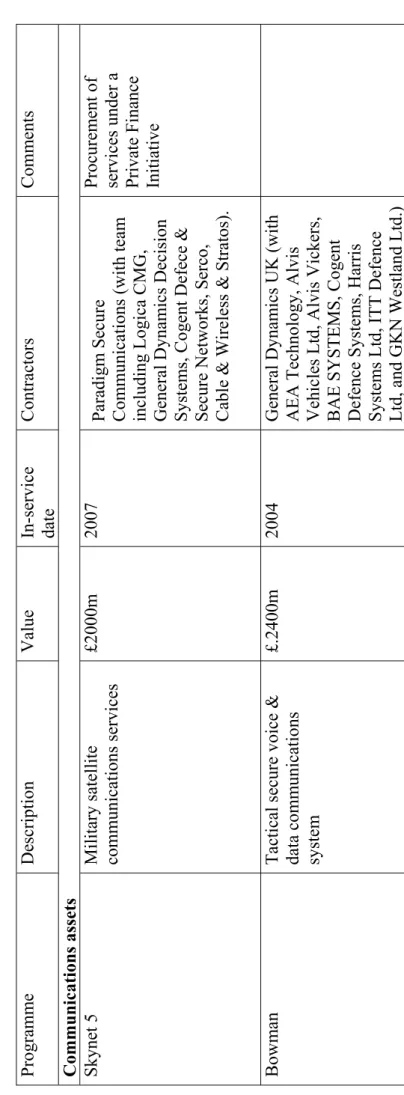
• Skynet 5 will provide military satellite communications services to all three Services of the Armed Forces and will eventually replace the UK’s Skynet 4 military satellite communications system that was established in the late 1980s. The programme is estimated to be worth £2 billion. MOD is taking this opportunity to pursue the procurement of services under a Private Finance Initiative and this is the first time that such an approach has been undertaken for providing military satellite communication services. In February 2002, Paradigm Secure Communications was selected as preferred bidder for Skynet 5. Paradigm Secure Communications led a team including LogicaCMG, General Dynamics Decision Systems, Cognet Defence and Security Networks, Serco, Cable & Wireless and Stratos.19 The competing Rosetta Global Communications team comprised Lockheed Martin, BAE Systems and British Telecom. A contract was placed with Paradigm Secure Communication during 2003.
• Bowman will provide a tactical, secure, voice and data communications system for all three Services in support of land and littoral operations, until at least 2026. The £2.4 billion programme will include 47,000 man-portable radios (supplemented by non-secure 'Personal Role Radios' that are now entering service) and 26,000 terminals for vehicles, helicopters and warships, to provide a network for communications and situational awareness for tactical level mobile operations. In June 2000, and in response to on-going delays, the MOD decided to terminate its contract with its previously preferred supplier Archer Communications Systems and seek new bids from three alternative firms (CDC Systems UK, a subsidiary of US company General Dynamics; the US company TRW and Racal/Thales).20 In July 2001, the MOD announced
19 Paradigm Secure Communications was formed by Astrium in 1999. Astrium was a joint venture
between the European Aeronautic Defence and Space Company (EADS) and BAE Systems. In May 2003, EADS completed the acquisition of the BAE Systems stake in Astrium and full control of Paradigm Secure Communications was transferred to EADS.
20 The MOD cited a lack of confidence in Archer’s ability to deliver a communications system that
meets the technical requirements on schedule or within budget. The UK’s decision to re-compete Bowman came after it had already spent £212 million on the Bowman programme and in the face of past and projected delays of 9 years. Archer Communications Systems was a joint venture comprising BAE SYSTEMS, ITT Industries, Inc. and Racal Defence Electronics.
that the new competition had been won by CDC Systems UK which was subsequently renamed General Dynamics UK. The General Dynamics team for the project includes AEA Technology, Alvis Vehicles Ltd, Alvis Vickers, BAE SYSTEMS, Cogent Defence and Security Networks, Harris Systems Ltd, ITT Defence Ltd, and GKN Westland Ltd.
• Falcon is a secure tactical wide area communications system to serve both the UK and the Allied Command Europe Rapid Reaction Corps. It is anticipated that the system will be acquired in four stages, each of which could be subject to a separate competition. At each stage greater capability will be added to the system. The total acquisition cost for the first three stages is an estimated £430 million. In 2002, Assessment Phase contracts were awarded to BAE Systems (leading a team comprising CISCO Systems; Dytechna Ltd; CHR Design; and Flagship Training Ltd.) and Marconi Mobile (leading a team comprising Lockheed Martin Mission Systems; Anteon UK; and Harrington Generators). A final decision is expected in 2004 with delivery of equipment expected to begin in July 2006.
• Cormorant is a Theatre Wide Area Communications network for the UK Joint Rapid Reaction Force. The prime contractor for the programme is Cogent Defence & Security Networks (a UK subsidiary of EADS Telecom) with Bucher Duro of Switzerland as the supplier of vehicles and Marshalls of Cambridge, UK as the supplier of shelters. Cormorant uses Commercial Off The Shelf (COTS) technology adapted for military use. As the prime contractor for Cormorant, Cogent Defence & Security Networks is responsible for delivering a fully integrated communications capacity within each vehicle, allowing the effective deployment of a wide area communications network to support the UK's Joint Rapid Reaction Force (JRRF) during peacekeeping and warfighting operations. The total value to Cogent Defence and Security Networks is around £90 million and the in-service date is 2004.
3.2 Command support and information systems
The MOD emphasises the importance of information systems applications that collate, fuse, analyse and control the distribution of information. Command support and information systems are being introduced to optimise decision support in areas from crisis management to operations in theatre. They include:
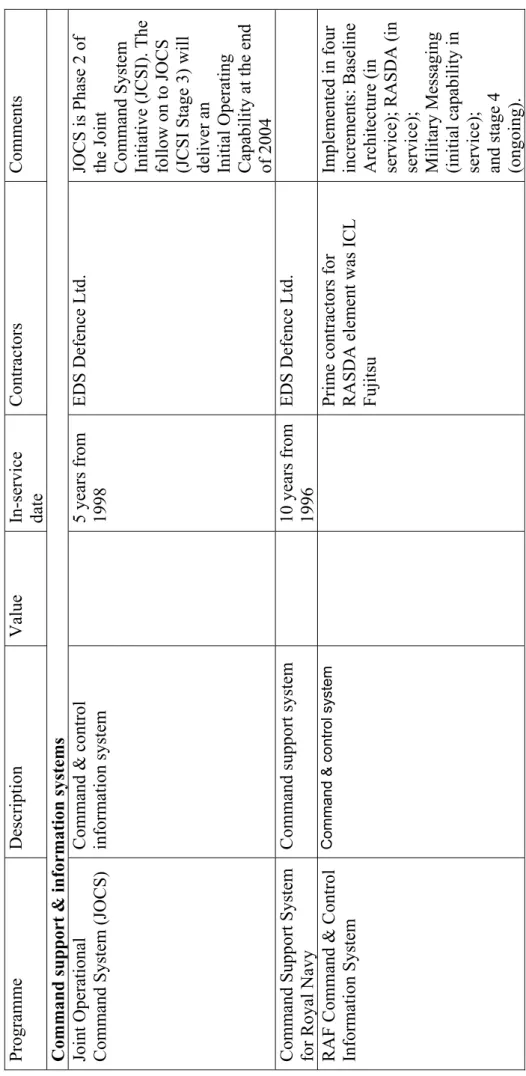
• Joint Operational Command System (JOCS) is one element of the Joint Command Systems Initiative (JCSI). JCSI aims to create a framework of cost-effective and efficient integrated global communications and information systems to support military operations and provide information from the front line through operational headquarters to the Ministry of Defence Head Office. In January 1998, EDS Defence Ltd won the five-year programme to introduce JOCS.
• The Command Support System for the Royal Navy is currently being introduced into service and provides for enhanced information systems and management functions between ships, submarines and shore headquarters. The CSS is to be fitted throughout the Royal Navy fleet and also in some operational land-based headquarters. The contract was awarded to EDS Defence Ltd in May 1996 and was expected to run for ten years.
• The RAF Command and Control Information System is currently being implemented and will provide for the command and control of air assets from
operational stations to headquarters. The system is being implemented through a programme of migration from the legacy bespoke systems to a secure and resilient system based upon commercial products such as Microsoft's Windows NT. The programme is being implemented in four increments: Baseline Architecture (in service); RASDA (in service); Military Messaging (initial capability in service); and stage 4 (ongoing). Prime contractors include Fujitsu Services.
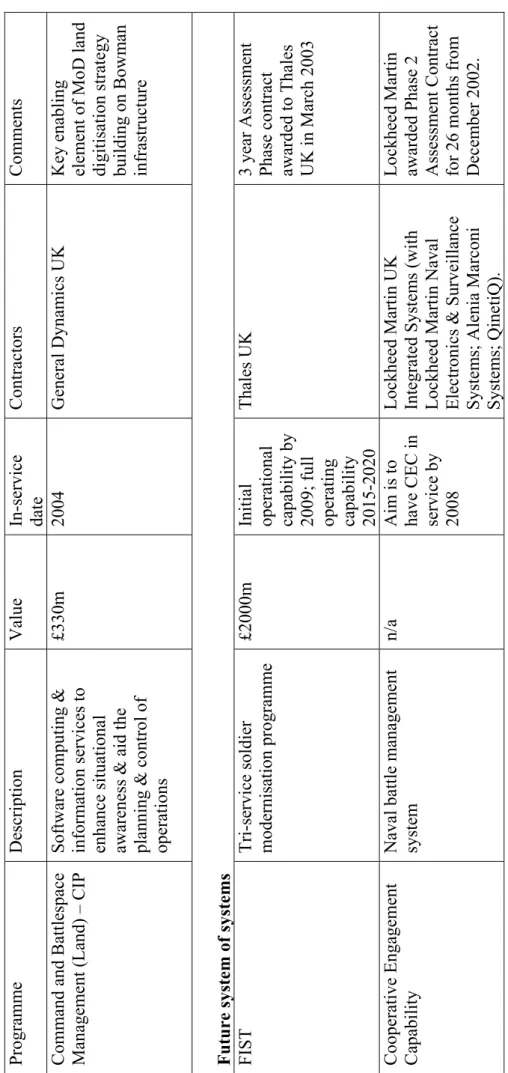
• Command and Battlespace Management (Land) CIP comprises three interrelated projects: ComBAT is a set of common software tools that will enhance situational awareness at all levels and aid the planning and control of operations. Infrastructure will build on the Bowman foundation to provide the additional hardware and software computing and information services to enable the concurrent operation of other battlefield information software applications (BISAs). Platform BISA will provide dedicated terminals for the use of ComBAT by commanders of Armoured Fighting Vehicles. The three projects are to be procured as a single entity from General Dynamics UK in a programme estimated to be worth £330 million. In-service date is 2004.
3.3 Future systems
There are also a number of programmes under consideration that illustrate how NEC is changing the way that the MOD is conceptualising future warfare.
• Future Integrated Soldier Technology (FIST) is the British Army’s soldier modernisation programme. FIST is a tri-Service project that aims to provide an integrated fighting system to troops that have to fight on foot at close quarters with the enemy, a role which is now termed “dismounted close combat”. FIST aims to bring the soldier into the network enabled environment. The whole force will benefit through enhanced situational awareness and a clearer logistic picture by integrating advances in C4I, target acquisition, navigation, survivability and lethality.21 In March 2003, Thales UK was selected by the MOD to undertake the three-year Assessment Phase for the programme.
• Cooperative Engagement Capability (CEC) is a US Navy programme that began in the mid-1980s. A US/UK memorandum of understanding signed in July 2000 formally confirmed UK participation in the CEC programme – the first time that the US government had been prepared to release the technology to an overseas ally.22 Advocates of CEC see it as enabling a wholesale shift from a platform-centric to a network-centric concept of naval operations linking shipborne, airborne and land based radars to create a single integrated air picture across its network. In February 2003, Lockheed Martin was selected as prime contractor to conduct Assessment Phase 2 to explore the integration of CEC into the Royal Navy’s surface fleet. Earlier parallel one-year first-stage Assessment Phase studies had been awarded to Lockheed Martin and Raytheon. During Phase One, Lockheed Martin UK Integrated Systems put together a team that included Lockheed Martin Naval Electronics and Surveillance Systems - Surface Systems,
21 Stuart McGhie, “Digital soldier in command”, Jane’s Defence Weekly, 10 October 2001: pp.38-43. 22 The UK’s participation in the US CEC programme stems from studies begun in the mid-1990s to
identify key technologies to improve situational awareness for UK maritime forces. The analysis concluded that the capability required by the UK was essentially similar to the CEC concept already in development for the US Navy. Adopting CEC is seen as a more cost-effective means of acquiring that capability and also offers the benefit of maintaining high-level interoperability between Royal Navy and US Navy warships in future coalition operations (Richard Scott, “UK plots course into the net”,
Alenia Marconi Systems and QinetiQ. The total cost of the UK CEC programme (including acquisition, integration and life-cycle support) as currently envisaged is around £400 million.23
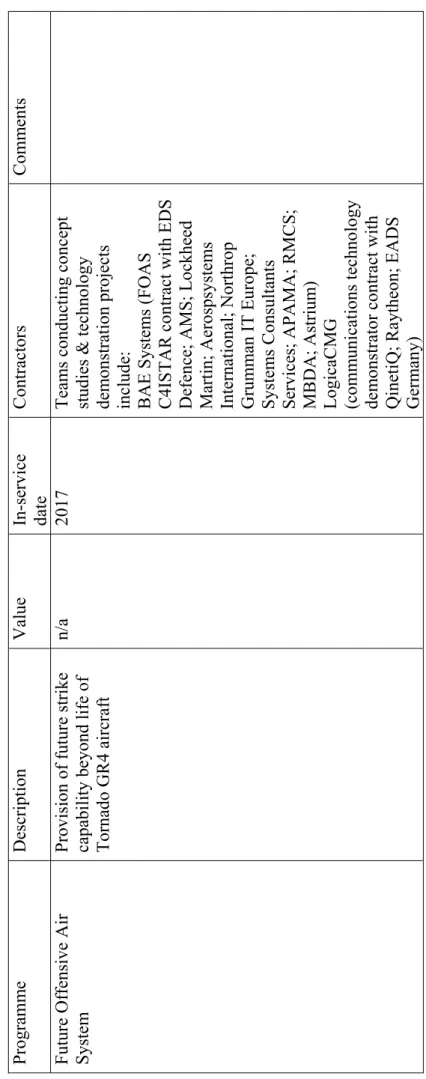
• The Future Offensive Air System (FOAS) is the name given to a number of concept options being examined for the MOD’s requirement to replace the capabilities provided by the Tornado GR4 aircraft. The FOAS concept has evolved away from being merely a manned bomber and towards a “system of systems” with the MOD looking not so much for a Tornado replacement but a “strike capability”. Increasingly, it appears as if FOAS may well be provided through a mix of legacy systems and new technologies pulled together under a network-centric command-and-control architecture.24 The FOAS programme currently consists of system of systems concept studies and technology demonstration projects. BAE Systems is examining the best combined force mix, comprising manned aircraft, uninhabited air vehicles (UAVS) and conventional air-launched cruise missiles (CALCMs). In September 2002, BAE Systems was also awarded a contract to examine C4ISTAR for FOAS (with EDS Defence; AMS; Lockheed Martin; Aerosystems International; Northrop Grumman IT Europe; Systems Consultants Services; APAMA; RMCS; MBDA; Astrium).25 In May 2003, LogicaCMG was awarded a communications technology demonstrator contract (with QinetiQ; Raytheon; EADS Germany). The in-service date has been set at 2017 although individual system components could have different ISDs.
23 Richard Scott, “UK plots course into the net”, ibid.
24 Nick Cook, “UK confirms incremental plans for FOAS”, Jane’s Defence Weekly, 10 October 2001,
p.45.
25 C4ISTAR - Command, Control, Communications, Computers, Information/Intelligence,
4. Industrial Issues
Commercial technologies may be at the heart of the network but established defence companies remain the prime contractors on all current and emerging communications and network infrastructure programmes. In most cases, commercial companies – whilst interested in the business opportunities emerging – remain subcontractors and suppliers and this is likely to remain the pattern for the foreseeable future.
4.1 Shape of the supplier base
Leading companies in the sectorWinning the Bowman contract has placed General Dynamics UK at the very centre of the development of the land tactical element of UK NEC. The contract itself is substantial but it is also strategic in that it underpins efforts for full digitisation of UK land forces and provides the architecture for system-of-systems efforts in the land battle space. The result has been that General Dynamics UK has been well placed to win the £330 million Command and Battlespace Management (Land) – CIP programme that builds on the Bowman infrastructure.
Equally significant is the position of the European Aeronautics Defence & Space Co. (EADS) in the provision of UK military communications assets. EADS is now prime contractor for Skynet 5 having taken full control of Paradigm Secure Communications Ltd. after acquiring the share of Astrium formerly held by BAE Systems. Equally, Cogent Defence and Security Networks (the UK business unit of EADS Telecom) has a strong position in the communications sector. Cogent won the contract for the Cormorant theatre wide area communications network for the UK Joint Rapid Reaction Force. Cogent was also part of the winning Paradigm team for the Skynet 5 programme and is a subcontractor on the Bowman programme.
The other company that has established itself at the heart of the network is EDS Defence Ltd. The company is the UK defence business of the US EDS Corporation, a leading information technology services company with 137,000 employees in 60 countries. EDS has been active in the delivery of systems and services to the UK defence community for more than 25 years and is prime contractor for two key command support and information systems. In 1998, EDS Defence won the contract for the Joint Operations Command System (JOCS) following-up on its success in winning the contract for the Command Support System for the Royal Navy in 1998. Other large defence contractors
In contrast, many large defence contractors have so far failed to establish strong positions for themselves. BAE Systems has had limited success in this market segment. The Rosetta Global Communications team that included BAE Systems failed to win the contract for Skynet 5. Archer Communications Systems – a joint venture comprising BAE Systems, ITT Industries and Racal Defence Electronics – was replaced by General Dynamics UK on the Bowman programme much reducing the role of BAE Systems in that programme. The hopes of BAE Systems now ride on Falcon where it is leading a team awarded one of two Assessment Phase contracts. However, BAE Systems has been selected as lead contractor for the MOD’s Network
Integration Test & Experimentation (“NITEworks”) facility. NITEworks will be discussed in a later section but here it is sufficient to say that it is seen as important by BAE Systems and the company believes that it reflects the Defence Procurement Agency’s view of the potential of its capabilities in this field.
Surprisingly, Thales UK has failed to make any significant in-roads into this market and has failed to establish a significant presence on any of the UK’s major communications programmes. Thales lost the competition for the Cormorant theatre wide area communications network to Cogent Defence & Security Networks; the Personal Role Radio contract to Harris; and, the Falcon secure tactical wide area communications system where it failed to be selected for one of the two Assessment Phase contracts. Critically, Thales UK failed to win the Bowman competition in 2001 and this led to almost 500 job losses at the company.
Significantly, the provision of the communications and network infrastructure is not an area that has seen a great deal of penetration by U.S. companies such as Lockheed Martin and Raytheon. If we were to look at the other aspects of Network Enabled Capability – namely sensors and precision strike – then it is the case that both companies are highly active in these areas. Thus, Lockheed Martin UK Integrated Systems is undertaking the WATCHKEEPER programme Assessment Stage 1 studies and has also been awarded contracts by the MOD for SOOTHSAYER. Lockheed Martin UK Integrated Systems has also been awarded the Phase 2 Assessment contract for the integration of the Cooperative Engagement Capability into the Royal Navy. Raytheon is prime contractor for the ASTOR airborne stand-off radar programme and is supplying its Paveway laser guided munitions to the UK. In the provision of communications assets, Lockheed Martin is teamed with Marconi Mobile for the Falcon secure tactical wide area communications system but was part of the unsuccessful Rosetta Global Communications team that bid for Skynet 5.
Niche suppliers and new entrants
There are also a range of niche suppliers who play important roles ranging from the supply of sub-systems to system engineering consultancy. LogicaCMG is a systems integration house and IT consultancy that has acted as both prime contractor, sub-contractor and team member on a range of information technology programmes. LogicaCMG is part of the Paradigm Secure Communications team that won the Skynet 5 contract. The company has worked on a range of battle space information management projects for the Army. In May 2003, LogicaCMG was awarded a contract to analyse and design the C4ISTAR architecture for FOAS.
Another important supplier of research and technology services in battlefield information and communications is QinetiQ.26 Under DERA, the scientific and technological capabilities now held by QinetiQ played a significant role in providing specialist research services to the MOD and companies in the areas of battlefield information management, systems integration and so forth. QinetiQ is part of the
26 Established in July 2001, QinetiQ comprises the greater part of DERA, the Defence Research and
Evaluation Agency. Under a Private Public Partnership arrangement, QinetiQ is now jointly owned by the Government and the US equity company the Carlyle Group with the objective of the Government’s shareholding being floated on the stock market within 3 years.
Lockheed Martin team evaluating CEC and part of the LogicaCMG team on FOAS C4ISTAR.
In addition, there are a number of companies that are seeking to enter the UK market. In the UK, Cisco Systems is part of the BAE Systems team for the Assessment Phase for the Falcon secure tactical wide area communications system. Cisco technology underpins much of the defence command and control information system infrastructure in Europe and the United States. SAIC (Science Applications International Corporation) is also seeking to establish itself in the UK market. The company is a major US defence contractor with considerable experience in C4ISTAR programmes with over 41,000 employees worldwide. Since 1998, it has been increasing its presence in the UK and is seeking to leverage its US capabilities into projects with the MOD and UK industry.
4.2 Prime contractor strategies
Companies are pursuing a variety of strategies to establish their position as prime contractors on communications and command support and information systems programmes.
BAE Systems: developing a network-centric business model?
The growing emphasis on Network Enabled Capability provides a particular challenge to traditional platform-centric defence contractors such as BAE Systems. In response, BAE Systems has begun to emphasise a change in its strategy with a greater focus on niche growth opportunities and in particular C4ISR.
BAE Systems’ C4ISR strategy is seeking to address key programmes in the UK, US and the rest of the world by building on capabilities in BAE North America (not least in the areas of Electronic Warfare and Information Dominance) and focusing across the organisation to exploit opportunities. The old GEC Marconi was heavily focused on electronics whilst the old British Aerospace was primarily a platform company. The approach to C4ISR is to provide capabilities at the information levelling and build opportunities in areas such as FOAS. The fact that BAE Systems has been selected as lead contractor on NITEworks can be seen as an important step for the company’s strategy.
The company has made clear that it will consider partnering or acquisition as a means of filling capability gaps.27 Thus, in 2003, BAE Systems announced that together with Italy's Finmeccanica it was to form a new defence electronics partnership, to be called Eurosystems, that will oversee joint ventures in the areas of systems integration and C4ISR business, communications systems and avionics. BAE Systems is also the lead UK company under the UK-Sweden Memorandum of Understanding on network centric capabilities/FOAS. SAAB is the lead Swedish company. At the same time, however, BAE Systems stresses that platforms are necessary to generate access to large programmes during the transition phase. Equally, the emerging system of systems architectures are seen as likely to have a growing influence over future platform procurement making it important that BAE Systems is involved in this process. A good example is its leading role in the FOAS C4ISTAR contract.
27 BAE Systems presentation by John Weston, Chief Executive at the CSFB/Aviation Week Aerospace
Finance Conference, New York, 15 May 2001 downloaded 24 April 2003 from http//:www.production.investis.com/baesystems/bae_irpresentations/ csfbwebcast/2.pdf
BAE Systems is investing considerable effort in the development of its C4ISR sector strategy and the re-orientation of the company away from its traditional platform-centric focus has already required some painful changes. Thus, the company’s corporate R&D function has seen the loss of around 100 engineers and technologists in the platform area in favour of the appointment of new staff with skill sets more appropriate to the capabilities that the company will need to compete for future network-centric programmes. However, this emphasis on “platforms today –system of systems tomorrow” has been met with scepticism by some MOD officials as well as the company’s competitors. The sceptics argue that BAE Systems is a long-way from developing a network-centric business model and that the company retains a platform-centric mindset. There is little doubt that considerable cultural change is required not least because the vast majority of the company’s revenues are generated from platform programmes.
EADS: positioning through acquisition
Like BAE Systems, the European Aeronautic Defence & Space Company (EADS) is seeking to focus on growth areas of the global defence market such as UAVs, C4ISR and avionics. However, it starts from a weaker position with a relatively small defence electronics business and limited global presence outside its home markets of France, Germany and Spain. Nevertheless, EADS has established a significant position on UK communications programmes through two important acquisitions. In July 2001, EADS acquired Cogent Defence & Security Networks from Nortel Networks establishing EADS Telecom with an important role in the communications sector as prime contractor for Cormorant, part of the winning Paradigm team for Skynet 5 and a subcontractor on the Bowman programme. In May 2003, EADS completed the acquisition of the BAE System share in the Astrium space joint venture and with it took full control of Paradigm Secure Communications making EADS the prime contractor for the Skynet 5 programme.
However, Thales has found acquisition less satisfactory as a means of accessing UK communications programmes. One of the motives of Thomson-CSF/Thales in acquiring Racal Electronics was to position the company to win UK military communications contracts by establishing itself as the UK's leading communications supplier.28 Nevertheless, Thales UK has failed to win any of the recent major UK communications procurement contracts and has in effect been pushed out of the sector by rivals such as General Dynamics UK and Cogent Defence & Secure Communications. The acquisition of Racal Electronics successfully positioned Thales as the second largest defence contractor in the UK and has led to successes on the CVF Future Carrier and the FIST programmes. However, it has failed to position Thales as a major player in the communications segment.
General Dynamics: the promise of technology transfer
In winning the Bowman contract, General Dynamics UK has placed itself at the centre of the land tactical element of UK NEC development. The General Dynamics strategy has centred on its ability to transfer proven technologies to meet UK requirements. There is little doubt that the clinching factor in the success of its bid for Bowman was the fact that General Dynamics Canada had recently integrated and
28 Ben Moores, “Thales UK: Where to next?”, Frost & Sullivan, 5 July 2001 downloaded 24 April
fielded a system of comparable scope and complexity to that required by the Bowman programme. As a result of its experience as prime contractor and prime systems integrator for the Canadian Tactical Command Control and Communications System, the company was able to offer a pool of personnel with the domain knowledge required to deliver the Bowman programme. In turn, it has been able to leverage its prime contractor status on Bowman to win the contract for Command and Battlespace Management (Land) CIP.
The ability to offer proven capabilities in the integration of highly complex systems of this kind is clearly a significant factor in the MOD’s procurement decisions and reflects – as a later section will discuss - the desire of the MOD (and the prime contractors themselves) to minimise the costs and risks associated with the development of complex systems. Thus, in the case of the down select for the UK CEC programme, both Lockheed Martin and Raytheon emphasised their extensive experience with similar technologies and integration issues in other situations and stressed that they were drawing heavily on the expertise and experience of their corporate parents in the United States.
Teaming: the common theme
A common feature of the strategies of all the prime contractors is a recognition that teaming is vital to successful projects. There are few – if any companies – that have the breadth of technological capabilities to address complex NEC projects on their own. Thus, most – if not all – projects to date have been based around teams of companies with complementary skills and capabilities.
4.3 Transforming the defence industrial base?
What is striking is that it is defence contractors rather than commercial companies that are acting as prime contractors on these programmes and that relatively few commercial companies have played a prominent role in the programme teams.
The MoD sees considerable advantages in integrating companies from the commercial sector into current and future programmes. This is seen as providing a means of spinning-in their technologies and the systems engineering experience that they have gained from working on large private sector projects in the financial sector and elsewhere. Equally, enabling companies across the supply chain to exploit civil technologies at the component level is seen as a means of reducing risk and fostering innovation.29 The Secretary of State for Defence has held out the prospect that as the MoD introduces new technologies, it may be that innovation will become a more significant factor, allowing smaller, more flexible firms to win business from further down the traditional supply chain.30
The traditional defence contractors may not be the sources of the key technologies that are driving NEC but there is little doubt that they will play an absolutely critical role in applying and integrating that technology for defence applications. Non-defence contractors such as Cisco Systems, Sun Microsystems and so forth are paying more attention to the defence market. However, it will remain a relatively small market for them and they have tended to be unwilling to engage with what they see as the
29Defence Industrial Policy, Paper No.5, Ministry of Defence Policy Papers, October 2002, London:
Ministry of Defence.
30 Geoff Hoon, “The New Chapter: A blueprint for reform”, Speech to Royal United Services Institute
complex and bureaucratic processes of defence procurement. Thus, there is a growing view that the defence contractors will have a crucial role acting as intermediaries integrating technologies developed in the commercial sector and translating them into military applications.31 The Cormorant programme is a good example of this model with Cogent integrating COTS products into a system with military application. The MOD is seeking a similar approach for the Falcon communications programme. However, there is a strong sense that defence contractors have by-and-large not been particularly good at maximising the benefits of working with commercial companies. Fixed-price procurement contracts have made it difficult for them to develop true partnerships and they have tended not to use the systems engineering and integration experience of commercial IT companies because the day-rates of engineers in commercial companies tend to be regarded as relatively expensive. In part this is because the commercial companies can gain high rates working for clients in the financial services sector but it is also because they also tend to quote risk-adjusted prices. Instead, the role of commercial companies has been primarily as the suppliers of “black box” sub-systems rather than systems integrators. The MOD is trying to address these issues through the Smart Procurement initiative as well as informal pressure on defence prime contractors to improve their performance.
31 David Gompert, RAND, oral evidence to House of Commons Defence Committee, 28 January 2003
downloaded 12 February 2003 from http://www.parliament.the-stationery-office.co.uk/pa/cm200203/cmselect/cmdfence/93/3012801.htm
5. Challenges for the Procurement Process
Delivering NEC also presents new challenges for the procurement process and there is a growing recognition that this requires the development of new capabilities within the acquisition community. A more responsive acquisition process is necessary that is capable of co-ordinating NEC requirements across a range of programmes and quickly exploiting emerging technologies.32
5.1 From platform-centric to network-centric procurement
The UK's acquisition system has been overhauled over the last few years with the introduction of Smart Acquisition. This has focused defence acquisition on the capabilities required rather than the type of system to be purchased, and has placed value for money at the centre of decision making. Within the context of Smart Acquisition, systems are acquired by independent projects and managed by Integrated Project Teams (IPTs) to meet their own set of user requirements within established time and funding limits.
NEC poses a challenge for Smart Acquisition because the delivery of NEC requires very different acquisition practices to those used for platform-centric procurement. NEC requires the MOD to articulate requirements for NEC and the experience has been that the specification of such capabilities can be very difficult. NEC spills across traditional project boundaries and will require a more co-ordinated approach to equipment capability design and requirements definition. The aspirations for NEC will only be met through the combined effects of independently specified and procured systems and a key challenge is how to specify NEC requirements on each of the contributing systems that ensures they exhibit the desired NEC capability when brought together as a system of systems.33 NEC crosses Integrated Project Teams boundaries and has implications for both operational and non-operational areas. This means that that IPTs that have been structured around platforms, or specific equipment, have had to review their methods of working and have needed to develop means of coordinating their decisions where they impact the development of NEC.
5.2 Maintaining coherence across acquisition programmes
The delivery of NEC is a task that is too large (and too expensive) to achieve immediately and this means that NEC will emerge incrementally. The elements that will combine to create a system of systems will be developed and deployed at different times by a wide range of different acquisition programmes and systems, against a background of developing requirements and rapidly advancing technology.34 The range of programmes involved in NEC creates an unprecedented problem in maintaining coherence. Each of the programmes will have their own independent (and in some cases conflicting) timescales, requirements, challenges, funding and priorities. In many cases they will have a different "customer" in the Ministry of
32 Richard Ellis “Acquisition issues for Network Enabled Capability”, paper presented to the 7th
International Command and Control Research and Technology Symposium, Quebec City, downloaded 24 April 2003 from http://www.dodccrp.org/Activities/Symposia/ 7thICCRTS/Tracks/pdf/151.PDF
33Anthony Alston, “UK NEC and Capability Development”, paper presented to the 7th International
Command and Control Research and Technology Symposium, Quebec City, downloaded 24 April 2003 from http://www.dodccrp.org/Activities/Symposia/7thICCRTS/Tracks/Track_8.htm
Defence, as their principal support is for a different military domain, or different operational or non-operational organisation.
This problem of coordination across different projects and programmes means that the Integration Authority in the DPA will play a pivotal role in the implementation of NEC. The Integration Authority was established in April 2000 to ensure the achievement and maintenance of interoperability and integration between equipment projects. The role of the Integration Authority is to provide expert and authoritative services for the whole MOD community for the integration of information, equipment and services required to deliver and sustain defence capability. The Integration Authority seeks to do so by having an overview of all projects, providing advice to IPTs and scrutinising procurement proposals. The Integration Authority is also developing “systems of systems” processes for capability managers and other MOD customers and by creating architectural links between the Services and programmes.35
5.3 Managing programmes
The management of NEC programmes may also present major challenges to the principles of Smart Acquisition. Continuous and unavoidable change in technology, requirements and interoperability constraints are likely to characterise NEC programmes. In many core NEC related acquisitions it will be impossible to accurately predict the cost of providing a specified capability further than perhaps four years ahead. The interrelated nature of many NEC capabilities means that minor changes in one area may have a significant impact on the cost/capability calculations in another. In the view of one leading analyst the cost of NEC programmes may be difficult to accurately forecast.36
5.4 Technology exploitation
The ability to take advantage of new technologies as they emerge is deemed crucial to the success of NEC and this places pressure on the procurement process to become more flexible and responsive. A great deal more attention is being paid to the early phases of the acquisition cycle and particularly the Concept and Assessment phases. These early phases are increasingly being recognised as critical to the delivery of NEC because they are when risks can be most effectively assessed and simulation and modelling can judge its impact on the design of the system of systems as well as its implications for other programmes.
Critics argue that there is little evidence yet of the dramatic change in the speed and flexibility of acquisition processes that are needed to match the rate of change of commercial technologies. The “Smart Acquisition” bureaucracy is still judged by some observers to be rather too slow and heavy. However, important changes are being put in place that may begin to have an impact. Thus, the DPA is seeking quicker pull through of technology into the supply chain through the use of Integrated Technology Acquisition Plans (ITAP) that plan for technology insertion at the earliest opportunity. In ITAPs, technology development and concept demonstration are linked. The benefits are that this process – at the early stage of the acquisition cycle – allows the early identification of critical long lead time technologies and improves links with the MOD research programme. ITAPs provide confidence that, by the
35 Further information on the Integration Authority can be found at:
http://www.ams.mod.uk/ams/content/docs/ia/pages/about_ia/about_ia.htm
major programme decision point, sufficient technology maturity can be achieved and that key user requirements can be met at manageable risk. This increases the likelihood of transition through to the demonstration phase with manageable risk.37 Equally, one of the objectives of NITEworks is to drive faster implementation of emerging technologies and more rapid technology insertion to upgrade established platforms and systems.
5.5. Managing risk
The management of risk is a key concern for the MOD and a major influence on its approach to delivering NEC. NEC presents new procurement, financial, technological and operational risks. The experience of the Bowman programme (and a series of government IT programmes over the years) means that the MOD is highly sensitive to the risks associated with large-scale, complex and technologically sophisticated projects. Thus, considerable emphasis is being placed on methods to predict problems, minimise the risks and manage change better.38
The use of technology transferred from overseas programmes has been seen by the MOD as one means of mitigating some of the risks associated with these complex programmes and is seen as a means of benefiting from the research and development programmes of other governments. The MOD is also emphasising the importance of co-ordinated experimentation, involving research demonstrators, fielded systems and industry prototypes as a means of reducing costs and risks and accelerating the development of requirements and delivery of capability.39 Indeed, Smart Acquisition calls for a greater proportion of the defence equipment budget to be spent during the earliest phases of projects, in order to reduce technical risk before the main investment decision is made.
There is little doubt that the procurement and technological risks are considerable. However, there is concern in some quarters that too little attention is being paid to the operational risks associated with NEC. NEC has potentially profound implications for tactics, doctrine and warfighting. Thus, an important role for NITEworks will be to provide the operational customer, whether Fleet, Land or Strike (“Customer 2” in the terminology of Smart Acquisition), an opportunity to better understand the potential operational implications of new systems and thus allow them a stronger input into the procurement process.
With these ends in mind, the MOD has announced that it will establish a Network Integration Test & Experimentation (“NITEworks”) facility to develop and support the modelling of NEC and strengthen the Concept and Assessment “front-end” of the acquisition process. NITEworks is described as: “A MoD/Industry partnership providing an experimental environment which allows our customer community to assess the benefits of NEC and the options for its effective and timely delivery”.40 NITEworks was previously known as the Experimental Network Integration Facility and is a federated facility involving the DPA, DSTL (Defence Science & Technology Laboratory) and industry. BAE Systems will act as industry lead and it is expected
37 Presentation by Mr David Gould, Deputy Chief Executive, Defence Procurement Agency to a
conference on European Defence R&D at John Hopkins University, Washington DC, 6 June 2003.
38 Geoff Hoon, “The New Chapter: A blueprint for reform”, op cit, note 26.
39Network Enabled Capability, op cit, note 2.
that a large number of companies will be involved, including QinetiQ, Alenia Marconi Systems, Thales, General Dynamics UK, Raytheon and LogicaCMG.41
The following is taken directly from the NITEworks website (http://niteworks.net) in February 2004 and describes its history and organisation:
NITEworks (standing for Network Integration Test and Experimentation Works) is the name for an enterprise which delivers NEC evidenced capability options. The MOD has approached BAE SYSTEMS and its partners to both assist it explore and mature capability concepts, and help deliver the engagement of the wider industry base in NEC options analysis. Ultimately, the aim is to deliver a step change in MOD NEC growth.
Progress to date
Progress has been rapid. BAE SYSTEMS and the MOD signed a contract 16 December 2002 to scope and price NITEworks (at that time called ENIF). The Scoping Study was executed by a joint industry and MOD team, working closely together to deliver a report, and Kill-Chain Development pilot project. A large number of companies participated during the Scoping Study including QinetiQ (the lead BAE SYSTEMS partner), General Dynamic UK, Thales UK, EDS, AMS and LogicaCMG.
Since the Scoping Study, several milestones have been reached, including:
• Successful completion of the NITEworks Industry Day 4 March 2003,
attended by some 100 individuals from ~30 companies,
• Formal opening of the Battlespace Management Evaluation Capability (BME Capability) 26 March 2003 by Sir Jock Stirrup, Deputy Chief of the Defence Staff (Equipment Capability),
• Occupation by a joint MOD/BAE SYSTEMS/QinetiQ team of purpose built NITEworks facilities on the ground floor of Brennan House Farnborough 28 April 2003,
• BAE SYSTEMS and MoD signed the NITEworks contract 21 July 2003, and
• The Minister for Defence Procurment Lord Bach officially launched
NITEworks on 28 August 2003.
How NITEworks will work
NITEworks will be a MOD-directed, but Industry-managed enterprise. It will be modestly sized (~60 full-time equivalents), with personnel drawn from the civilian and military sides of MOD, and from a number of industrial partners.
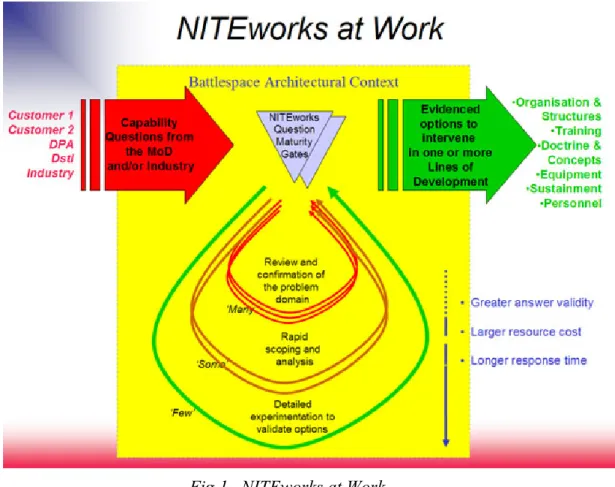
One of the key deliverables emanating from the Scoping Study has been a description of how NITEworks will actually conducting its business, we call this NITEworks at Work.
This description is facilitated by Figure 1 below.
41 Douglas Barrie, “British battle lab – UK looks to explore and exploit networked warfare”, Aviation
Week & Space Technology, June 16 2003: pp.80-1 and presentation by Mr David Gould, Deputy Chief