A Framework for Model-Driven
Development of Mobile Applications
with Context Support
Steffen Vaupel
Philipps-Universit¨at Marburg, Deutschland
Fachbereich Mathematik und Informatik
2018
Model-driven development (MDD) of software systems has been a serious trend in
dif-ferent application domains over the last 15 years. While technologies, platforms, and
architectural paradigms have changed several times since model-driven development
pro-cesses were first introduced, their applicability and usefulness are discussed every time
a new technological trend appears. Looking at the rapid market penetration of
smart-phones, software engineers are curious about how model-driven development technologies
can deal with this novel and emergent domain of software engineering (SE).
Indeed, software engineering of mobile applications provides many challenges that
model-driven development can address. Model-model-driven development uses a platform independent
model as a crucial artifact. Such a model usually follows a domain-specific modeling
language and separates the business concerns from the technical concerns. These
platform-independent models can be reused for generating native program code for several mobile
software platforms. However, a major drawback of model-driven development is that
infrastructure developers must provide a fairly sophisticated model-driven development
infrastructure before mobile application developers can create mobile applications in a
model-driven way.
Hence, the first part of this thesis deals with designing a model-driven development
in-frastructure for mobile applications. We will follow a rigorous design process comprising
a domain analysis, the design of a domain-specific modeling language, and the
develop-ment of the corresponding model editors. To ensure that the code generators produce
high-quality application code and the resulting mobile applications follow a proper
archi-tectural design, we will analyze several representative reference applications beforehand.
Thus, the reader will get an insight into both the features of mobile applications and the
steps that are required to design and implement a model-driven development
infrastruc-ture.
As a result of the domain analysis and the analysis of the reference applications, we
identified context-awareness as a further important feature of mobile applications.
Cur-rent software engineering tools do not sufficiently support designing and implementing of
context-aware mobile applications. Although these tools (e.g., middleware approaches)
support the definition and the collection of contextual information, the adaptation of the
mobile application must often be implemented by hand at a low abstraction level by the
mobile application developers.
Thus, the second part of this thesis demonstrates how context-aware mobile applications
can be designed more easily by using a model-driven development approach. Techniques
such as model transformation and model interpretation are used to adapt mobile
appli-cations to different contexts at design time or runtime. Moreover, model analysis and
model-based simulation help mobile application developers to evaluate a designed mobile
application (i.e., app model) prior to its generation and deployment with respected to
certain contexts.
We demonstrate the usefulness and applicability of the model-driven development
in-frastructure we developed by seven case examples. These showcases demonstrate the
designing of mobile applications in different domains. We demonstrate the scalability of
our model-driven development infrastructure with several performance tests, focusing on
the generation time of mobile applications, as well as their runtime performance.
More-over, the usability was successfully evaluated during several hands-on training sessions by
real mobile application developers with different skill levels.
A
F
ramew
ork
for
Mo
del-Driv
en
Dev
elopmen
t
of
Mobile
Applications
with
Con
tex
t
Supp
ort
•
Steffen
V
aup
el
P
HILIPPS
-U
NIVERSITÄT
M
ARBURG
D
ISSERTATION
A Framework for Model-Driven
Development of Mobile Applications
with Context Support
vorgelegt von Steffen VAUPEL, M.Sc. geboren am 12. Oktober 1984
in Marburg a. d. Lahn.
Vom Fachbereich Mathematik und Informatik der Philipps-Universität Marburg zur Erlangung des akademischen Grades
Doktor der Naturwissenschaften Dr. rer. nat.
genehmigte Dissertation.
Gutachter:
Prof. Dr. Gabriele Taentzer, Philipps-Universität Marburg Prof. Dr. Michael Goedicke, Universität Duisburg-Essen
Prüfungskommission:
Prof. Dr. Thorsten Thormählen, Vorsitzender Prof. Dr. Gabriele Taentzer,
Prof. Dr. Michael Goedicke, Prof. Dr. Bernhard Seeger, Prof. Dr. Christoph Bockisch
als Dissertation eingereicht am: 26.10.2017 Tag der mündlichen Prüfung: 20.12.2017
erschienen: Philipps-Universität Marburg, Deutschland, 2018 Hochschulkennziffer 1180
Dissertation, Philipps-Universität Marburg (1180), 2018. Steffen Vaupel
Curriculum vitae
2011, Master of Science (Informatik), Philipps-Universität Marburg. Philipps-Universität Marburg, Deutschland
Fachbereich Mathematik und Informatik (FB12) Arbeitsgruppe Softwaretechnik
Hans-Meerwein-Straße 6 35032 Marburg a. d. Lahn [email protected]
https://www.uni-marburg.de/fb12/arbeitsgruppen/swt
Copyright/Urheberrecht: Steffen Vaupel, 2018 Cover Design/Umschlaggestaltung: S. Vaupel Typesetting/Satz: S. Vaupel
Rendering date/Erstellungsdatum: 2018-07-13 Production/Druck: sedruck.de
Edition (Print run)/Ausgabe (Auflage): 1. (5)
1-330Pages with 151 Figures (including 110 in color), 60 Tables 1-330Seiten mit 151 Abbildungen (davon 110 in Farbe), 60 Tabellen Printed on acid-free paper/Gedruckt auf säurefreiem Papier Printed in Germany/Gedruckt in Deutschland
The electronic version of this document complies with the standard PDF/A-1b:2005. Die elektronische Fassung dieses Dokuments erfüllt den Standard PDF/A-1b:2005. All rights, also regarding the reprinting of extracts, the photomechanical reproduc-tion, the translation and the storage and processing in electronic media and systems, are reserved.
Alle Rechte, auch die des Nachdrucks von Auszügen, der fotomechanischen Wieder-gabe, der Übersetzung und der Speicherung und Verarbeitung in elektronischen Medien und Systemen, vorbehalten.
Reproductions of common names, brand names, trademarks etc. in this document are not subject to the acceptance that these names could be regarded as free or could be used by anyone, even without particular marking, in the sense of the trademark and brand protection legislation.
Die Wiedergabe von Gebrauchsnamen, Handelsnamen, Warenzeichen usw. in diesem Dokument berechtigt auch ohne besondere Kennzeichnung nicht zu der Annahme, dass solche Namen im Sinne der Warenzeichen- und Markenschutz-Gesetzgebung als frei zu betrachten wären und daher von jedermann benutzt werden dürfen.
v
Contents
Abstract 1 Kurzfassung 3 Acknowledgements 5 1 Introduction 7 1.1 Motivation . . . 9 1.2 Challenges . . . 111.3 Goals of This Work . . . 13
1.4 Approach. . . 13
1.5 Contributions . . . 16
1.6 Thesis-Related List of Publications . . . 17
1.7 Outline . . . 19
I
Model-Driven Development of Mobile Applications
21
2 MDD and SE of Mobile Applications – Foundations and Definitions 23 2.1 Model-Driven Development . . . 232.2 Design of Model-Driven Development Infrastructures. . . 26
2.3 Software Engineering of Mobile Applications . . . 31
2.4 Mobile Software Platforms. . . 33
3 Agile Bottom-Up Development of IDEs for MDD 39 3.1 Agile Bottom-Up IDE Development Process . . . 40
3.2 Three-Tier Agile Process Model . . . 43
3.3 Demonstration. . . 43
4 Requirements for MDD of Mobile Applications 47 4.1 Modeling Language Requirements . . . 47
4.1.1 Detailed Data Modeling . . . 48
4.1.2 Abstract and Detailed Behavior Modeling. . . 48
4.1.3 Abstract Graphical User Interface Modeling . . . 49
4.1.4 Well-Formedness of the App Model . . . 49
4.1.5 Model Quality Assurance . . . 50
4.2 Architectural Requirements . . . 50
4.2.1 Data-Driven Mobile Applications . . . 50
4.2.2 Single User System with Back-End Access . . . 50
4.3 Tool Requirements . . . 51
4.3.1 Graphical Model Editor . . . 51
4.3.2 Code Generator . . . 51
4.4 Discussion . . . 52
5 Domain Analysis (MDD and SE of Mobile Applications) 55 5.1 Sources of Domain Knowledge . . . 56
5.2 Feature Identification and Definition . . . 56
5.4 Focused Features . . . 60
5.5 Evaluation . . . 61
6 Domain-Specific Modeling Language and Model Editors 63 6.1 Design Decisions . . . 63
6.2 Eclipse Modeling Framework (EMF) . . . 66
6.3 Domain-Specific Modeling Language Definition . . . 66
6.3.1 Data Model . . . 67
6.3.2 Graphical User Interface (GUI) Model . . . 69
6.3.3 Process Model. . . 70
6.3.4 Provider Model . . . 73
6.3.5 Well-Formedness Rules . . . 74
6.4 Domain-Specific Modeling Language Implementation . . . 75
6.5 Graphical Modeling Framework (GMF) . . . 76
6.6 Graphical Concrete Syntax and Edit Operations . . . 78
6.6.1 Graphical Concrete Syntax for the Data Model . . . 79
6.6.2 Graphical Concrete Syntax for the GUI Model . . . 79
6.6.3 Graphical Concrete Syntax for the Process Model . . . 84
6.7 Combining Textual and Graphical Editing . . . 92
6.8 Graphical Model Editor Implementation. . . 94
6.9 Further EMF-Based Tools and Frameworks . . . 95
6.10 Evaluation . . . 97
7 Reference Applications, Code Generators, and Prototypes 101 7.1 Reverse Engineering of Reference Applications . . . 102
7.2 Forward Engineering of Reference Applications . . . 105
7.3 Construction of Code Generators . . . 109
7.3.1 Initialization of the IDEs . . . 109
7.3.2 Preprocessing an App Model . . . 110
7.3.3 Processing an App Model . . . 111
7.3.4 Processing a Provider Model . . . 117
7.3.5 Injection of Custom Code . . . 118
7.3.6 Code Generator Implementation . . . 120
7.4 Evaluation . . . 122
8 Related Work: MDD of Mobile Applications 137 8.1 MDD vs. Non-MDD Cross-Platform Approaches. . . 137
8.2 Comparison Criteria for MDD Approaches . . . 138
8.3 Comparison with Related Approaches . . . 139
II
Context Support
143
9 Context Support – Foundations and Definitions 145 9.1 Context and Context-Awareness . . . 1459.2 Mobility . . . 146
9.3 Platform-, Device-, and User Context Support. . . 147
9.4 System Context Support . . . 148
10 Requirements for Context Support 163 10.1 Architectural Requirements . . . 163
10.1.1 Support of User Roles (User Context) . . . 163
10.1.2 Heterogeneous Device Support (Device Context) . . . 164
10.1.3 Interoperable, Multi-User Systems . . . 164
10.1.4 Online and Offline Capability (System Context) . . . 164
10.2 Modeling Language Requirements . . . 166
10.2.1 Declaration of Online- and Offline-Capable Data. . . 166
10.3 Tool Requirements . . . 166
vii
10.3.2 Simulation System . . . 167
10.4 Discussion . . . 167
11 Domain Analysis (Mobile Contexts) 169 11.1 Feature Identification and Definition . . . 169
11.2 Feature Model . . . 169
11.3 Focused Features . . . 172
12 User Contexts 173 12.1 Design Time Instantiation . . . 173
12.2 Runtime Instantiation. . . 176
12.3 Demonstration. . . 177
13 Device Contexts 187 13.1 Design Time Adaptation . . . 188
13.2 Runtime Adaptation . . . 192
13.3 Demonstration. . . 195
14 System Contexts 199 14.1 Design Process Overview . . . 200
14.2 Model-Based Analysis . . . 203
14.2.1 Conflict Definition and Conflict Levels . . . 204
14.2.2 Explicating Data Object Access . . . 205
14.2.3 Running the Model-Based Conflict Analysis . . . 206
14.3 Model-Based Simulation . . . 208
14.3.1 Dynamic Conflict Analysis by Simulation . . . 208
14.3.2 Running the Model-Based Simulation . . . 209
14.3.3 Restricting Data Object Access . . . 210
14.3.4 Design and Implementation of the Simulation System. . . 211
14.4 Model-Driven Generation . . . 211
14.4.1 Introducing Online and Offline Capability . . . 212
14.5 Evaluation . . . 213
15 Related Work: MDD of Context-Aware Mobile Applications 225 15.1 Middleware-Based Context-Aware Systems . . . 225
15.2 MDD Techniques for Context-Aware System Design . . . 227
15.3 MDD Frameworks for Context-Aware System Creation . . . 229
16 Summary and Outlook 233 16.1 Summary. . . 233
A Well-Formedness Rules 241
A.1 Constraints for the Data Model . . . 241
A.2 Constraints for the Process Model. . . 241
A.3 Constraints for the GUI Model . . . 243
B App Models 245 B.1 Phone Book App Model . . . 245
B.1.1 Data Model . . . 245
B.1.2 GUI Model. . . 246
B.1.3 Process Model. . . 247
B.2 Conference App Model. . . 252
B.2.1 Data Model . . . 252
B.2.2 GUI Model. . . 253
B.2.3 Process Model. . . 254
B.3 Word Trainer App Model . . . 259
B.3.1 Data Model . . . 259
B.3.2 GUI Model. . . 260
B.3.3 Process Model. . . 261
C Tutorial 271 D Miscellaneous 291 D.1 The Research ProjectPIMAR. . . 291
D.2 The Mobile Applicationkey2guide . . . 292
D.3 The Mobile Applicationkey2operate . . . 293
Bibliography 295
ix
List of Figures
1.1 Web-based mobile banking application . . . 11
1.2 Model-driven development approaches and their contextual coverage 12 1.3 Two-level modeling approach . . . 14
1.4 Extended client-server architecture vs. client-server architecture . . 15
2.1 Four-layer metamodel architecture . . . 24
2.2 Common usage of software models in an MDD process . . . 25
2.3 The classAddress . . . 29
2.4 GUI model (showing aProcessSelectorPageandStyleSettings) . . . 30
2.5 Android software stack . . . 34
2.6 iOS software stack . . . 35
2.7 Architecture of an Apache Cordova application running on Android 37 3.1 Agile MDD process in action: fine-grained evolution steps. . . 41
3.2 eLearning application for a safety instruction . . . 42
3.3 Three-tier agile software development process model. . . 43
3.4 Continuous language, IDE, and prototype extensions. . . 44
5.1 Domain analysis with input and output artifacts . . . 56
5.2 Feature model (Pt. I/III). . . 57
5.3 Feature model (Pt. II/III) . . . 58
5.4 Feature composition rules (Pt. I/II) . . . 59
6.1 Detailed multi-level modeling approach . . . 64
6.2 Screenshots of the simple phone book application. . . 67
6.3 Ecore metamodel (excerpt) used for data structures . . . 68
6.4 Data model of the simple phone book application (excerpt) . . . 68
6.5 Ecore model for defining the graphical user interface . . . 69
6.6 GUI model of the simple phone book application . . . 70
6.7 Ecore metamodel for defining the behavior (Pt. I/II) . . . 71
6.8 Process model of the simple phone book application (excerpt). . . . 72
6.9 Provider models of the simple phone book application . . . 73
6.10 Standard model editors generated by EMF (showing the GUI model) 75 6.11 EMF/GMF process overview and involved models . . . 77
6.12 The mapping between EMF, GMF, and GEF . . . 78
6.13 The graphical concrete syntax for the model elementCreate . . . 79
6.14 The extended process model (showing extension only) . . . 85
6.15 Ecore metamodel for defining the behavior (Pt. II/II) . . . 92
6.16 A textual entered condition of anIFelement . . . 93
6.17 The parsed conditional expression. . . 93
6.18 Expression editor for conditions and assignments (rhs). . . 94
6.19 Graphical model editor for app models (Process model being edited) 95 6.20 Detection of model smells. . . 96
7.1 Forward-engineered mobile application variants (Android/iOS) . . 107
7.2 Web-based model editor for runtime models (editing a GUI model) 108 7.3 System architectures of the generated mobile applications . . . 112
7.5 The generated GUI of the processCRUDPerson . . . 116
7.6 Architecture of generated iOS applications . . . 116
7.7 Different GUIs for viewing aPersonobject . . . 120
7.8 Caesar’s ciphered text “Knack den Code” (Break the code) . . . 125
7.9 Traveling Salesman Problem “Deutschlandtour” (Germany Tour). . 125
7.10 πApproximation “PI-Kreis” (PI-Circle) . . . 126
7.11 The mobile applicationSmartPlug . . . 127
7.12 The mobile applicationTV Reminder. . . 127
7.13 Sitemaps of the processCRUDPerson . . . 131
7.14 Scalability of the code generators . . . 133
7.15 Scalability of Android runtime models . . . 134
9.1 Considered contexts of mobile applications . . . 146
9.2 Mobility of different subjects and objects . . . 147
9.3 Extended client-server architecture . . . 152
9.4 Working model of a local transaction manager. . . 152
9.5 Generic extended client-server architecture. . . 155
9.6 Keypool replication and synchronization . . . 156
9.7 Escrow replication and synchronization . . . 157
9.8 Modified working model of a local transaction manager . . . 158
9.9 Data model of the payment app . . . 159
9.10 Data model of the course booking app . . . 159
11.1 Feature model (Pt. III/III). . . 170
11.2 Feature composition rules (Pt. II/II) . . . 171
12.1 Actors and use cases of the company phone book application . . . . 174
12.2 Modified process model of the company phone book application . . 175
12.3 Resulting variants of the company phone book application . . . 175
12.4 Main processes of the conference application . . . 178
12.5 Conference Administratorsview of the mobile application . . . 179
12.6 Conference Participantsview of the mobile application . . . 181
12.7 Architecture and roles of the mobile learning application . . . 182
12.8 Main processes of the word trainer application . . . 183
12.9 Teacherscreate a word object starting from the main menu . . . 183
12.10 Learnersview of the mobile application . . . 186
13.1 Rule #1 – Move containing class to container (rules and sub-rules) . 189 13.2 Rule #2 – Introduce search criteria pages before read tasks . . . 190
13.3 Tablet/Notebook version of the phone book application . . . 191
13.4 Non-GPS variant of the processNearToMe . . . 192
13.5 Device-specific variants of the processNearToMe . . . 193
13.6 Style model of the simple phone book application. . . 194
13.7 Device-specific runtime adaptation of the mobile application’s style 194 13.8 Device-specific variant of the processCreatePicture . . . 196
13.9 eBook variant of the word trainer application . . . 196
13.10 Using device-specific styles to avoid ghosting effects on eBooks. . . 197
14.1 Design process of online- and offline-capable mobile applications . 201 14.2 App model of a simple payment application . . . 202
14.3 The simple payment application working online-only . . . 203
14.4 Access modes of the classAccount . . . 206
14.5 The generated online- and offline-capable payment application . . . 207
14.6 Throughput of the payment application (Configuration 1) . . . 209
14.7 Throughput of the payment application (Configuration 2) . . . 210
14.8 Access modes and restrictions of the classAccount . . . 211
14.9 Air quality applicationWeSense . . . 215
14.10 Data model of the air quality application (without class methods) . 216 14.11 Air quality application process structure and CRUD processes . . . 217
xi
14.12 ProcessShowMap. . . 218
14.13 ProcessCreateComment . . . 219
14.14 ProcessInit . . . 219
14.15 Pages and style of the air quality application (without attributes) . . 220
14.16 Generic extended client-server architecture with custom back end . 220 14.17 Re-engineered air quality application (Part I/II) . . . 221
14.18 Re-engineered air quality application (Part II/II) . . . 222
14.19 Transactional throughput of the application versions . . . 222
15.1 The abstract layered architecture for context-aware applications . . 226
15.2 Comparison of the approaches . . . 228
B.1 Data model of the simple phone book application. . . 245
B.2 GUI model of the simple phone book application . . . 246
B.3 ProcessMain . . . 247 B.4 ProcessViewPerson . . . 247 B.5 ProcessCreatePerson . . . 248 B.6 ProcessEditPerson . . . 248 B.7 ProcessDeletePerson . . . 248 B.8 ProcessAllPersons . . . 249 B.9 ProcessCRUDPerson. . . 249 B.10 ProcessSearchPerson . . . 249 B.11 ProcessCallPerson . . . 250 B.12 ProcessSelectAndShowPersonAddressOnMap . . . 250 B.13 ProcessPersonsWithAddress . . . 251 B.14 ProcessShowPersonAddressOnMap . . . 251 B.15 ProcessNearToMe . . . 251
B.16 Data model of the conference application. . . 252
B.17 GUI model of the conference application . . . 253
B.18 ProcessMain . . . 254
B.19 ProcessFavorites . . . 254
B.20 Standard CRUD processes . . . 255
B.21 Standard reading processes . . . 255
B.22 ProcessRRoom . . . 256 B.23 ProcessRVenue . . . 256 B.24 ProcessAddFavorite . . . 257 B.25 ProcessRemoveFavorite . . . 257 B.26 ProcessSearchPaper . . . 258 B.27 ProcessSearchPerson . . . 258
B.28 Data model of word trainer application (excerpt) . . . 259
B.29 GUI model of word trainer application (excerpt) . . . 260
B.30 ProcessMain . . . 261
B.31 ProcessSearchreferring to the search processes . . . 261
B.32 Generic process structureJobs . . . 262
B.33 Standard reading processes . . . 263
B.34 ProcessCreatePicture . . . 263 B.35 ProcessCreateAudio . . . 264 B.36 ProcessCAnswer . . . 264 B.37 ProcessCWord . . . 265 B.38 ProcessSearchWord. . . 266 B.39 ProcessViewWord . . . 266 B.40 ProcessDeleteWord . . . 267 B.41 ProcessLearnAndTest . . . 268
B.42 ProcessFavoritesMyWordsand sub-processes . . . 269
D.1 key2guidefront-end variants and shared back end (CMS) . . . 292
List of Tables
4.1 Requirements of the MDD framework for mobile applications . . . . 52
5.1 Mapping of the focused feature groups to the requirements (Pt. I/II) 60 6.1 First set of plugins shaping the MDD infrastructure . . . 75
6.2 Mapping of the abstract syntax elementPageContainer . . . 79
6.3 Mapping of the abstract syntax elementStyleSetting . . . 80
6.4 Mapping of the abstract syntax elementRGBColor . . . 80
6.5 Mapping of the abstract syntax elementListStyleSettings. . . 80
6.6 Mapping of the abstract syntax elementMenuStyleSettings . . . 81
6.7 Mapping of the abstract syntax elementSelectionStyleSettings . . . 81
6.8 Mapping of the abstract syntax elementPageStyleSettings . . . 81
6.9 Mapping of the abstract syntax elementsPage. . . 82
6.10 Mapping of the abstract syntax elementMenu. . . 82
6.11 Mapping of the abstract syntax elementMenuablePage . . . 83
6.12 Mapping of the abstract syntax elementListablePage . . . 83
6.13 Mapping of the abstract syntax elementProcessContainer . . . 86
6.14 Mapping of the abstract syntax elementProcess . . . 86
6.15 Mapping of the abstract syntax elementVariable . . . 87
6.16 Mapping of the abstract syntax elementProcessSelector. . . 87
6.17 Mapping of the abstract syntax elementCreate . . . 87
6.18 Mapping of the abstract syntax elementRead . . . 88
6.19 Mapping of the abstract syntax elementDelete . . . 88
6.20 Mapping of the abstract syntax elementAssign . . . 88
6.21 Mapping of the abstract syntax elementInvokeOperation . . . 89
6.22 Mapping of the abstract syntax elementInvokeGUI . . . 89
6.23 Mapping of the abstract syntax elementInvokeProcess . . . 90
6.24 Mapping of the abstract syntax elementCRUDGui . . . 90
6.25 Mapping of the abstract syntax elementPermission . . . 90
6.26 Mapping of the abstract syntax elementsRefTrueandRefFalse. . . 91
6.27 Mapping of the abstract syntax elementsIf1 . . . 91
6.28 Mapping of the abstract syntax elementsIfElse1. . . 91
6.29 Mapping of the abstract syntax elementsWhile1 . . . 92
6.30 Second set of plugins shaping the MDD infrastructure. . . 94
6.31 Third set of plugins shaping the MDD infrastructure. . . 97
7.1 Focused features and mobile application features. . . 105
7.2 Mapping the model elements to platform-specific constructs . . . 114
7.3 Fourth set of plugins shaping the MDD infrastructure . . . 120
7.4 Packages and content of the iOS code generator . . . 121
7.5 Packages and content of the Android code generator. . . 122
7.6 Focused features and coverage by the MDD infrastructure . . . 124
7.7 Observation made during the user experience evaluation . . . 130
8.1 Model-driven approaches to the development of mobile applications 142 9.1 Conflicts in the payment application . . . 160
xiii
11.1 Mapping of the focused feature groups to the requirements (Pt. II/II)172
12.1 Number of processes and LoC of the mobile application variants . . 175
12.2 Use cases for the conference administrators (Providing User) . . . 178
12.3 Use cases for the conference participants (Mobile end user) . . . 180
12.4 Use cases for the teachers (Providing User) . . . 184
12.5 Use cases for the learners (Mobile end user) . . . 185
13.1 Number of adapted elements at modeling and implementation level 191 14.1 Conflict matrix (C1, C2, C3) . . . 206
14.2 C3 configuration variants . . . 206
14.3 Independent simulation variables. . . 208
14.4 Dependent simulation variables. . . 209
14.5 Fifth set of plugins shaping the MDD infrastructure . . . 211
14.6 Key data of considered mobile applications . . . 213
14.7 Analysis results of considered mobile applications . . . 214
14.8 Simulation results of considered mobile applications. . . 214
15.1 Model-driven approaches for context-aware mobile applications. . . 232
xv
Listings
2.1 Template for POJO generation . . . 28
2.2 The compiled objectAddress(of type class) . . . 29
2.3 The compiled objectProcessesOverview(excerpt) . . . 30
2.4 The partly compiled objectProcessesOverview(excerpt) . . . 30
6.1 Injection of custom code (MethodcallMobileNumber()) . . . 68
6.2 Output constraints forListablePage(Output) . . . 74
6.3 Input constraints forSelectableListPage(Input). . . 74
6.4 Parser rules for an expression . . . 93
6.5 Metric functionCVD_min . . . 96
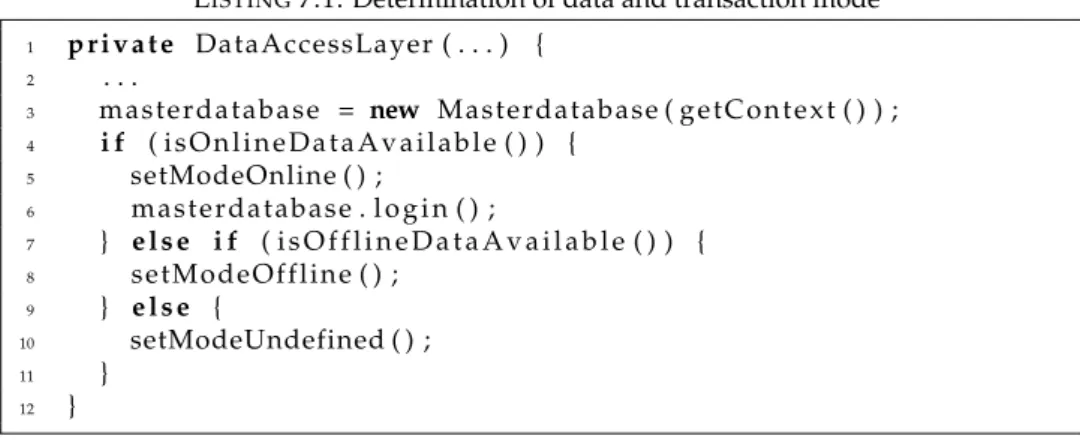
7.1 Determination of data and transaction mode . . . 113
7.2 Layout annotation of a custom page (excerpt) . . . 119
14.1 Operationwithdraw() . . . 206
xvii
List of Abbreviations
ACID Atomicity, Consistency, Isolation, Durability ANTLR ANother Tool for Language Recognition API Application Programming Interface APK Android Application Package
AR Augmented Reality
ARM Advanced RISC Machine
AS Abstract Syntax
ATM Automated Teller Machine BIS Business Information System
BPEL Business Process Execution Language BPMN Business Process Model and Notation BSD Berkeley Software Distribution CAA Context-Aware Application CIM Computation-Independent Model CMS Content Management System COM Context Ontology Model
CPIM Context Platform-Independent model CRUD Create, Read, Update, Delete
CSCW Computer-supported Cooperative Work CSS(3) Cascading Style Sheets (Level 3)
DAO Data Access Object
DB Database
DBMS Database Management System dp Device-Independent Point
DSML Domain-specific Modeling Language DVM Dalvik Virtual Machine
EBNF Extended Backus-Naur Form EMF Eclipse Modeling Framework EMOF Essential Meta Object Facility FODA Feature Oriented Domain Analysis GCS Graphical Concrete Syntax
GEF Graphical Editing Framework
GI German Association of Computer Science GMP Graphical Modeling Framework
GPL General Purpose Language
GPML General Purpose Modeling Language GPS Global Positioning System
GUI Graphical User Interface HCI Human Computer Interface
HTML(5) Hypertext Markup Language (Version 5) HUTN Human-Usable Textual Notation
IDE Integrated Development Environment J2ME Java Platform 2 Micro Edition
JEE Java Platform Enterprise Edition JPA Java Persistence API
JSE Java Platform Standard Edition JSON JavaScript Object Notation JVM Java Virtual Machine
M2M Model-to-Model (transformation) M2T Model-to-Text (transformation) MDA Model-Driven Architecture
MDBMS Mobile Database Management System MDD Model-Driven Development
MDIA Model-Driven Integration Architecture
MMW My Mobile Web
MOF Meta Object Facility
MPIS Manufacturing and Production Information System MTM Mobile Transaction Model
MVC Model-Controller-View NFC Near Field Communication NIB NeXT Interface Builder OCL Object Constraint Language OLTP Online Transaction Processing OMG Object Management Group
OpenGL/ES Graphics Library for Embedded Systems ORM Object-Relational Mapping
OWL Web Ontology Language PervML Pervasive Modeling Language PIM Platform-Independent Model
PIMAR Platform-Independent Mobile Augmented Reality POJO Plain Old Java Object
PSM Platform-specific Model RGB Red, Green, and Blue
RISC Reduced Instruction Set Computer RTE Round-Trip-Engineering
SCXML State Chart XML
SAP Systeme, Anwendungen und Produkte in der Datenverarbeitung (Systems, Applications & Products in Data Processing)
SDK Software Development Kit SE Software Engineering SGL Skia Graphics Library SQL Structured Query Language SSL Secure Sockets Layer SVG Scalable Vector Graphics SysML Systems Modeling Language TM Transaction manager
UAT User Acceptance Tests UML Unified Modeling Language VPN Virtual Private Network VR Virtual Reality
W3C World Wide Web Consortium WAI Web Accessibility Initiative
WCAG Web Content Accessibility Guidelines WebML Web Modeling Language
XMI XML Metadata Interchange XML EXtensible Markup Language
1
Abstract
Model-driven development (MDD) of software systems has been a serious trend in different application domains over the last 15 years. While technologies, plat-forms, and architectural paradigms have changed several times since model-driven development processes were first introduced, their applicability and usefulness are discussed every time a new technological trend appears. Looking at the rapid market penetration of smartphones, software engineers are curious about how model-driven development technologies can deal with this novel and emergent domain of software engineering (SE).
Indeed, software engineering of mobile applications provides many challenges that model-driven development can address. Model-driven development uses a platform independent model as a crucial artifact. Such a model usually follows a domain-specific modeling language and separates the business concerns from the technical concerns. These platform-independent models can be reused for generating native program code for several mobile software platforms. However, a major drawback of model-driven development is that infrastructure developers must provide a fairly sophisticated model-driven development infrastructure before mobile application developers can create mobile applications in a model-driven way.
Hence, the first part of this thesis deals with designing a model-driven development infrastructure for mobile applications. We will follow a rigorous design process comprising a domain analysis, the design of a domain-specific modeling language, and the development of the corresponding model editors. To ensure that the code generators produce high-quality application code and the resulting mobile applica-tions follow a proper architectural design, we will analyze several representative reference applications beforehand. Thus, the reader will get an insight into both the features of mobile applications and the steps that are required to design and implement a model-driven development infrastructure.
As a result of the domain analysis and the analysis of the reference applications, we identified context-awareness as a further important feature of mobile applica-tions. Current software engineering tools do not sufficiently support designing and implementing of context-aware mobile applications. Although these tools (e.g., middleware approaches) support the definition and the collection of contextual information, the adaptation of the mobile application must often be implemented by hand at a low abstraction level by the mobile application developers.
Thus, the second part of this thesis demonstrates how context-aware mobile applica-tions can be designed more easily by using a model-driven development approach. Techniques such as model transformation and model interpretation are used to adapt mobile applications to different contexts at design time or runtime. Moreover, model analysis and model-based simulation help mobile application developers to evaluate a designed mobile application (i.e., app model) prior to its generation and deployment with respected to certain contexts.
We demonstrate the usefulness and applicability of the model-driven development infrastructure we developed by seven case examples. These showcases demonstrate the designing of mobile applications in different domains. We demonstrate the scalability of our model-driven development infrastructure with several perfor-mance tests, focusing on the generation time of mobile applications, as well as their runtime performance. Moreover, the usability was successfully evaluated
during several hands-on training sessions by real mobile application developers with different skill levels.
3
Kurzfassung
Die modellgetriebene Entwicklung von Softwaresystemen (MDD) ist in den let-zten 15 Jahren in verschiedenen Domänen zu einem ernstzunehmenden Trend geworden. Da sich Technologien, Plattformen und Architekturparadigmen seit der Einführung des modellgetriebenen Ansatzes oftmals verändert haben, wird dessen Anwendbarkeit und Nützlichkeit erneut für jeden neuen technologischen Trend diskutiert. In Hinblick auf die zügige Marktdurchdringung von Smartphones fragen Softwareentwickler, wie modellgetriebene Entwicklungstechniken in diesem neuen und aufstrebenden Bereich der Softwareentwicklung (SE) eingesetzt werden können.
Der modellgetriebene Ansatz deckt tatsächlich viele Herausforderungen ab, welche die Softwareentwicklung von mobilen Anwendungen mit sich bringt. Elementarer Bestandteil der modellgetriebenen Entwicklung ist ein plattformunabhängiges Modell. Solch ein Modell folgt gewöhnlich einer domänenspezifischen Model-lierungssprache und trennt die fachlichen Belange der Anwendung von den tech-nischen Belangen. Das plattformunabhängige Modell wird bei der Generierung von Programmcode für diverse mobile Plattformen wiederverwendet. Ein großer Nachteil der modellgetriebenen Entwicklung ist allerdings die Notwendigkeit, eine relativ ausgereifte modellgetriebene Infrastruktur durch Infrastrukturentwick-ler bereitzustellen, bevor EntwickInfrastrukturentwick-ler von mobilen Anwendungen diese modell-getrieben erstellen können.
Daher widmet sich der erste Teil dieser Arbeit dem Entwurf einer modellgetriebe-nen Infrastruktur für mobile Anwendungen. Der konsequente Entwurfsprozess beinhaltet eine Domänenanalyse, den Entwurf einer domänenspezifischen Mod-ellierungssprache sowie entsprechender Modelleditoren. Zur Sicherstellung der Codequalität und einer angemessen Architektur der durch die Codegeneratoren erzeugten mobilen Anwendungen werden zuvor einige repräsentative Referenzan-wendungen analysiert. Dadurch erhalten die Leser sowohl Einblick darin, welche Schritte zum Entwurf und der Realisierung einer modellgetriebenen Infrastruk-tur notwendig sind, als auch in die Merkmale und Anforderungen von mobilen Anwendungen.
Die Domänenanalyse und die Analyse der Referenzanwendung zeigen, dass die Erkennung von Kontexten ein weiteres wichtiges Merkmal von mobilen Anwendun-gen ist. GeAnwendun-genwärtige Softwareentwicklungswerkzeuge unterstützen den Entwurf und die Realisierung von kontextabhängigem Verhalten nur unzureichend. Ob-wohl diese Werkzeuge (z.B. Middlewarebibliotheken) die Definition und Sammlung kontextrelevanter Informationen unterstützen, muss die Anpassung der mobilen Anwendung üblicherweise manuell und auf einer niedrigen Abstraktionsschicht programmiert werden.
Daher zeigt der zweite Teil dieser Arbeit, wie kontextabhängige mobile Anwen-dungen mit dem modellgetriebenen Ansatz einfacher erstellt werden können. Es werden Techniken wie Modeltransformation und Modelinterpretation benutzt, um mobile Anwendungen zur Entwurfszeit oder Laufzeit anzupassen. Darüber hin-aus hilft eine Modellanalyse und eine modellbasierte Simulation, eine erstellte mobile Anwendung (d.h., ein Anwendungsmodell) vor der Generierung oder der Bereitstellung zu beurteilen.
Die Nützlichkeit und Anwendbarkeit der entworfenen modellgetriebenen En-twicklungsinfrastruktur wird in sieben Beispielszenarien demonstriert, welche
den Entwurf von mobilen Anwendungen in verschiedenen Domänen zeigen. Die Skalierbarkeit wird durch Lasttests demonstriert, welche auf die Generierungs- und Ausführungszeit der generierten Anwendungen abzielen. Darüber hinaus ist die Bedienbarkeit innerhalb verschiedener praktischer Schulungen mit authentischen Anwendern verschiedener Kenntnisstufen erfolgreich erprobt worden.
5
Acknowledgements
This work would have been impossible without the aid of many people, who contributed to it in many ways.
First of all, I am very thankful to my supervisor, Prof. Dr. Gabriele Taentzer, who helped me structure and organize my sometimes curious ideas. Her knowledge and experience helped a lot in improving my working methods and to get to this point in my academic career. Furthermore, I thank Prof. Dr. Michael Goedicke for agreeing to be the second reviewer of this thesis. His suggestions helped me improve its details.
Many thanks also to the members of the PIMAR research project team and the colleagues and students who implemented parts of the model-driven develop-ment infrastructure and/or carried out other valuable preliminary work. I would like to thank (in no special order) Tillmann Heigel, Christian Konrad, Michael Bernhardt, Tobias Zülch, Konstantin Jäger, Manuel Wolf, Alexander Eifler (Do-main Analysis, Reverse Engineering, and Forward Engineering), Jan Peer Harries, Samuel Becker (Android code generator), Kevin Kaiser, Felix Pape, Patrick Hof-mann, Cui Xiaolin (Forward engineering and iOS code generator), Raphael Stroh, Parisa Moosavinezhad (Model editors), Jonas Kelbert (Model quality), Manuel Fleischer (Model-based simulation), Damian Wlochowitz, Stefan Schulz, Anneke Walter (Android code generator/case examples), Katharina Muth, Maria Wilfing, and Bilal Belafkir (Reverse Engineering, Test, and Assessment). Without their work, the system would not have been operational, and I thank them for their engagement. Prof. Dr. Michael Guckert and René Gerlach helped me with the coordination of the many students who were involved in this project.
The work carried out in this thesis is partly funded by the LOEWE - State Offensive for the Development of Scientific and Economic Excellence (funding line 3: promot-ing SME collaborative projects) and by the German Research Council (Deutsche Forschungsgemeinschaft – DFG). I would like to thank both organizations for their financial support.
During the practical assessment of the model-driven development infrastructure within the word trainer case study, Susanne Krauß and Kirill Dorofeev provided many helpful suggestions and helped me improve the usability of the model-driven development infrastructure.
I want to thank our research partners in Norway, Prof. Yngve Lamo, Prof. Lars Michael Kristensen, Dr. Volker Stolz, and Dr. Florian Mantz, for their hospitality during our visits at theHøgskolen i Bergen, Norway in 2014 and 2015.
Several discussions with Dennis Priefer, Wolf Rost, and Dieudonne Timma Mey-atchie of the iCampus/JooMDD team (Technische Hochschule Mittelhessen – THM) helped me to position my work regarding the general design principles of model-driven development infrastructures.
My colleagues in the software engineering group, Dr. Daniel Strüber, Kristopher Born, Stefan John, Nebras Nassar, and Felix Rieger, participated in the evolution of this work, and I thank them for their encouragement and their critique. Additionally, I would like to thank the anonymous reviewers of the published work related to this thesis. Many of their useful suggestions were adopted in this thesis.
Felix Rieger read an earlier version of the thesis, and supported me in improving my English. But, of course, he is not responsible for all the errors and weak constructions I introduced afterward.
Finally, I would like to thank my family and friends, who showed amazing patience and understanding while I was writing this thesis.
Marburg, 2018-07-13
7
Chapter 1
Introduction
The market penetration of smartphones is one of the fastest in technological history. 1.1 In the U.S. market, the maturation (time from 10% to 40% market penetration) of
smartphones was two times faster than other technologies such as the introduction of personal Internet access. In 2011, the U.S. market for smartphones could be considered as matured [27]. This phenomenon of rapid smartphone adoption could be observed globally. The Ericsson mobility report of 2016 [Eri16] estimates a world market penetration of 5.1 billion devices and expects an increase to 6.1 billion devices in 2022. Top adopters in 2016 were consumers in South Korea (88%) and Australia (77%) [Pou16].
Moreover, the software market volume for these kinds of devices and hardware is 1.2 even much higher. In 2013, an average smartphone user has installed 26 mobile
applications [49]. Thus, we calculate an overall market penetration of over 112 billion [Eri13] installed mobile applications in 2013. Besides, the research company
StatCounter[48] reports that in October 2016, for the first time in history, the majority (51.3%) of website requests were done through mobile devices. This indicates that a lot of web-based applications are used by mobile clients (e.g., web browsers).
A special feature of smartphones is their ability to detect contexts (e.g., location), 1.3 which also drives the popularity of mobile applications [Tan08, Chap. 8.2]. While
most smartphone users always carry their devices with them (or wear them), mobile applications could detect contexts of different kinds and act in a situation-dependent way. Such context-aware mobile applications may provide information tailored to the user and situation context, which is generally known as smartbehavior. Novel device features (e.g., sensors) support the sensing of contexts. Context-awareness allows a lot of new mobile applications in industrial, health-care, and social application scenarios. Unfortunately, technical context changes (e.g., loss of connection) may affect the reliably of mobile applications in a negative way.
To sum up, mobile devices and mobile applications nowadays are just as important 1.4 as traditional personal computer systems and standalone applications. In the
near future, they will be the primary personal and professional computer systems. Context-awareness gives rise to new business cases. Lack of context-awareness can cause negative effects during mobile application operation. Hence, context-awareness of mobile applications is an important and relevant area for academic research.
The rapid evolution of mobile computing creates a heterogeneous landscape of 1.5 software and hardware platforms, versions [Gro+14], and architectural designs.
Considering the market shares of the different software and hardware platforms over the years, no software platform or vendor has such a majority that the remain-ing platforms can be ignored. The consensus is that multiple platforms and devices need to be considered further while developing a mobile application.
After selecting a platform (e.g., Android), the heterogeneity continues. For exam- 1.6 ple, to reach at least 90% of Android users currently requires creating a mobile
application supporting versions of the Android platform spanning from version 4.2 (API 17) to version 7.1 (API 25) [11]. In addition, individual device features are
very heterogeneous. Sensor availability and screen sizes may further reduce the potential user group. For example, the previously mentioned share of 90% Android users will be reduced to approximately 11% when requiring a large or extra-large screen for the developed mobile application. Additionally, current software engi-neering approaches do not provide the automatic adaptation or translation of a platform-specific implementation (e.g., Java used by Android) to another platform (e.g., Objective-C/Swift used by iOS). Hence, software engineering technology and development processes of mobile applications are not yet able to keep pace with the sudden rise of mobile platforms and the related heterogeneity.
Thus, developing mobile applications requires a development process that is dif-1.7
ferent in many ways from the development process of traditional client-server applications or rich-client applications running on a single workstation. This de-velopment process, especially the labor-intensive implementation tasks, must be repeated for multiple software platforms (e.g., Android, iOS) to cover different user groups acceptably. For example, approximately 60% of the mobile applications were developed across different platforms [Joo+13]. Additionally, the test efforts will also increase for any additionally supported platform, version, or device (if tested at all). To mitigate or avoid these multiple native implementations, cross-platform solutions are often used.
Many existing frameworks and tools for mobile application development focus on 1.8
cross-platform development as opposed to native application development. A na-tive application has a single codebase that is written for one specific target platform and device type while using a software development kit (SDK). The codebase is translated by the appropriate target compiler and the resulting binaries run only on devices having the target platform. Requiring additional device-specific sensors limits the distribution of the application to devices of the same type. Developers must create and maintain multiple codebases to support diverse software platforms or device types. Thus, an obvious approach is to reuse a single codebase as a speci-fication of the software system for different platforms [Hei+12]. This approach is known ascross-platform development. Heitkötter et al. distinguish three approaches for implementing cross-platform development: (i) runtime-based approaches, (ii) cross-compiling approaches, and (iii) model-driven development approaches (cf. Allen et al. [All+10]).
First, runtime-based approaches use a runtime environment to execute platform-1.9
independent program code or translated programs. For example, the Java Vir-tual Machine (JVM) is a well-known runtime environment executing compiled programs, while web browsers are good examples of program interpreters, e.g., JavaScript/HTML (Hypertext Markup Language.)1
Cross-compiling approachesuse a cross compiler in order to translate platform-inde-1.10
pendent program code into a platform-specific or native code. Usually, they do not translate Java (favored in Android) into Objective-C (favored in iOS) or vice versa (except [Pud10]), but rather use source languages allowing program specifications in a more declarative way. This approach requires cross compilers for each of the desired software platforms. Additionally, there is often no or little abstraction between the source language and the native target language.
The last approach is themodel-driven development approach. The model-driven de-1.11
velopment approach translates domain-specific models with high abstraction into platform-specific native program code. This approach also requires a model com-piler (M2C), i.e. code generator, for each of the desired software platforms.
Web-based applications are a very popular example forruntime-basedcross-platform 1.12
development. Web-based and native applications follow opposing architectural ap-proaches: web-based applications follow the traditional client-server paradigm and are multi-platform capable (e.g., Android, iOS). They provide good transactional
1.1. Motivation 9
support based on the underlying database management systems, but they generally lack offline capability and cannot fully access the devices’ sensors/hardware.
Although web-based mobile applications are multi-platform capable, their devel- 1.13 opment approach could not be considered as platform-independent. The issue
with web-based mobile applications is that functionality (if any) is located mostly on the server-side. Thus, mobile web-based applications could be considered as mobile services rather than autonomous mobile applications. In contrast, native applications can work autonomously and exploit device features (e.g., sensors, memory) very well. They usually lack platform portability due to their nativeness and platform- and device-tailored implementation. In case that native applications act as interoperable mobile clients of a multi-user system, conflict-free operation cannot be guaranteed. Different system contexts (e.g., loss of connection) cause problems in conflict detection while mobile clients are offline.
Apparently, it is a problem to combine the advantages of the architectural designs 1.14 and get rid of the disadvantages. While initiating a mobile application development
project, teams often have to make an architectural and software platform choice (e.g., heading either towards a native and standalone mobile application architecture in Android/iOS or a platform-independent web-based mobile application) [Puv+16] [Bre+14], which thereafter dominates or limits the development process. Hence, software vendors and mobile application developers are increasingly asking for a development process and tools that help them to tackle the problem of the software platform and device heterogeneity and unleash the domain-specific opportunities of mobile computing (e.g., context-awareness) at the same time. Their goal is to roll out native mobile applications of high quality on the one hand, but avoid the development and test effort for all desired software platforms on the other hand. The mobile applications to be developed should additionally support different contexts, which is a specific requirement of the mobile computing domain.
This leads to several general questions that are addressed in this thesis: 1.15
• What are the features of mobile applications and the different platforms?
• What is supported by current (platform-independent) development approach-es for mobile applications? What is missing?
• How do a development approach and tooling that covers missing parts look like?
• How can mobile applications support different contexts and how can a devel-opment approach support this aim?
• Which architectures of mobile applications are appropriate with respect to the domain-specific requirements (e.g., context-awareness)?
In the following, we provide the motivation for this work. Then we point out 1.16 the challenges of mobile application development. Subsequently, the goals, the
approach, and the contributions of this work are presented. This contains references to already published work. Finally, the remainder of this thesis is outlined.
1.1
Motivation
As sketched in the preceding section, the main problem faced while developing 1.17 mobile applications is the heterogeneity of platforms. Hence, platform-independent
development approaches for mobile application development are generally useful to tackle this problem.
This thesis builds on the model-driven development approach. “Model-driven 1.18 development is simply the notion that we can construct a model of a system that
mobile applications development, a model describes several aspects of a mobile application in an abstract manner, whereas the transformation creates a concrete implementation. This approach has many advantages (cf. den Haan [21] and Selic [Sel03]) compared to a traditional development process and fits well into the domain of mobile application development:
The model-driven development approach uses a (domain-specific) modeling lan-1.19
guage, expressing software systems on a higher abstraction level compared to the codebase; the development might be faster and thus more cost-effective. A model-ing element might be transformed into several lines of code or other artifacts. In the same time span, modeling allows expressing more functionality than writing code traditionally. Moreover, in case that the model-driven development toolset contains multiple code generators for different platforms, the leverage effect will be even stronger.
Another advantage of the model-driven development approach is its focus on 1.20
business aspects as opposed to technical aspects. A model-driven development process can potentially be applied by domain experts rather than only by technical experts. This separation of concerns and skills empowers domain experts while technical experts focus on the needed toolset for model-driven development. An increased quality of the resulting mobile application could be ensured by the 1.21
model-driven development approach. The quality of traditionally developed mo-bile applications depends on the overall and architectural design, the skills, and discipline of the mobile application developers, and the used test and review pro-cess. Model-driven development frameworks provide automatic model validation and model quality analysis. Generated native program code follows established design patterns and has a high quality by design.
The model-driven development approach also resonates well with the high market 1.22
pressure in the mobile sector. Technical changes between platform versions (plat-form evolution) can be concealed by the code generators. Migration of existing mobile applications, i.e., models, to a higher version of the software platform is well supported. In particular, beginners with less experience in mobile application development have a lot of trouble to find adequate architectural designs which meet their requirements. In the worst-case scenario, the selected architectural design is contradictory to the requirement specification. The model-driven development approach relieves the mobile application developers at this point and provides an adequate architecture. Besides, the model-driven development approach enables changes in an agile way because the application model can be improved and refined during the development process.
Finally, the model-driven development approach supports many use cases related 1.23
to software engineering. For example, complex and error-prone program analysis tasks (e.g., concurrency problems such as deadlocks) on the level of code could be lifted to the model level [Sho+08]. Ideally, domain-specific model-driven develop-ment tools support mobile application developers while inspecting a problem of interest. With this support a manual review of the whole codebase to extract the relevant information will no longer be necessary.
To sum up, the model-driven development approach seems to be a promising 1.24
approach in the domain of mobile application engineering, not only driven by the argument of multi-platform support. Although the model-driven development approach meets many software engineering requirements for mobile applications, a closer look at the different model-driven development approaches will reveal that there are further challenges.
1.2. Challenges 11
1.2
Challenges
Several frameworks and tools that support model-driven development of mobile 1.25 applications, such as Applause [Beh10] [05], MD2[Hei+13], JUSE4Android [SA14b],
[SA14a], [Sil+14], Modagile [08], and Mobl [HV11b] [HV11a], have been presented in the literature. Their features will be discussed in detail later. With respect to these solutions, one might ask: why do we need an additional framework for the model-driven development of mobile applications?
The answer is related to the genesis of mobile application development. The genesis 1.26 of mobile application started with web-based applications that are executed on
mobile devices. Web application developers usually deal neither with heteroge-neous sets of platforms and devices nor with system contexts such as network interruptions. They assume a standardized platform (e.g., a web browser) without high variability of hardware or sensors and a stable network connection to the server. Accordingly, the mobile clients are minimal in terms of architectural design, while the servers are full-featured. Current model-driven development approaches for mobile applications adopt this concept: most frameworks and tools generate mobile applications that follow a client-server architecture. Without certain exten-sions, this architecture is generally insufficient to deal with changing system or device contexts. A look at the landscape of existing web-based mobile applications shows that the loss of network connection (system context) very often stops mobile applications unexpectedly. Additionally, the web-based mobile applications do not always provide an appropriate graphical user interface for the particular mobile device used (device context).
(A) Login page (B) Insufficient scaling (transfer order templates)
(C) Error message (transfer order) FIGURE1.1: Web-based mobile banking application
Example(Web-based banking software). Since online banking is the most popular 1.27 way to make bank transactions, an increasing number of banking customers use
mobile devices to access online banking services. Figure 1.1 shows a banking transaction order and the typical problems that may occur while using a web-based mobile application. A customer starts a banking session by entering the credentials at an initial login page (Figure1.1a). S/he may have a list of transfer order templates from which one can be selected to make a money transfer. The first issue of this web-based mobile application is the inappropriate presentation of this data on the chosen device. Due to different device types, the web browser scales the graphical user interface to the devices’s display size or density. As shown in Figure1.1b, the text could thus be truncated. Besides, text may exceed the space inside the scaled
widget elements. Hence, different device contexts are not fully supported by the shown web-based mobile application. Second, if the customer starts a transaction and meanwhile the network connection to the server is interrupted, the transaction will fail (Figure1.1c). Even short interruptions will stop the transaction permanently because customers are usually required to log in again after every interruption of the network connection. A restart of the transaction is often not possible due to security reasons. Thus, web-based mobile applications support system contexts
such as the connection context insufficiently.
Dehlinger and Dixon [DD11] identified context-awareness as one of the major re-1.28
search directions for mobile applications software engineering. Consequently, a challenge of today’s research in model-driven development for mobile applications lies in dealing with contexts. A context is the interrelation of a mobile application to other objects/subjects. These interrelated objects/subjects can be theplatform
on which the mobile application is deployed, thedeviceon which the platform is operated, the mobileuserwhich uses the mobile application, the differentsystem
environments (e.g., available/interrupted network service), and many others. Fig-ure1.2shows the two main model-driven development approaches (Web-based approach and native approach) and the level of context-awareness they can reach within different contextual dimensions.
Model-driven development approaches: System context Platform context User context Device context Web-based (Client-Server) Native (Rich-Client) Ideal
FIGURE1.2: Model-driven development approaches and their contextual coverage
Web-basedapproaches are generally suitable for covering platform contexts. They 1.29
also partly provide access to the features of a device. In turn, web-based approaches support system contexts such as the connection context poorly.
Nativeimplementations cover device and system contexts in a better way. It should 1.30
be noted that native approaches completely cover web-based approaches in terms of the contextual evaluation, but the effort to implement a native approach is much higher.
Web-based model-driven development approaches usually require one code gener-1.31
ator, whereas a native model-driven development approach needs a code generator for every desired native platform. Hence, web-based model-driven development approaches also seem justified regarding development costs.
The advantages and disadvantages of native and web-based target languages are 1.32
still subject of discussion [CL11].
Book et al. [Boo+05] discuss how the degree of mobility (which causes different 1.33
1.3. Goals of This Work 13
architectural design of a mobile application enables context-awareness, particu-larly with respect to different system contexts. Several model-driven development frameworks do in fact support the generation of native program code; however, they follow a rich-client architecture (Applause [Beh10] [05]) or a client-server architecture (Modagile [08]). Thus, they are either only offline-capable or only online-capable.
To sum up, we face the challenge of context-awareness and propose a model-driven 1.34 development approach to create mobile applications that can deal with different
contextual dimensions.
1.3
Goals of This Work
A fundamental goal of this work is to show that model-driven development can 1.35 deal with the novel and emergent domain of mobile application development.
Domain experts should be able to develop mobile applications quickly and easily with a model-driven development approach. Moreover, since the model-driven development approach is usually understood and implemented as a one-level approach, i.e., using only a design model to generate a static implementation, this work will demonstrate that a two-level approach comprising a design model and a runtime model is more flexible in terms of different contextual dimensions. Our generated native mobile applications contain both a static part and a part for interpreting runtime models. Hence, these mobile applications are no longer only static but can also be configured at runtime using runtime information. This hybrid architecture of the generated mobile applications supports different contexts, as demonstrated by four selected contextual dimensions, i.e.,platform,device,user, and
system context. The generated mobile applications are context-aware because the two-level model-driven development approach can handle these contexts very well.
Moreover, an additional goal of this work is to provide architectural flexibility of 1.36 the generated mobile applications depending on the type of mobile application.
Using existing model-driven development frameworks for mobile applications, de-velopers cannot change the architecture of the mobile application. The architecture is prescribed by the code generators of the used frameworks. Hence, the generated mobile application may not always meet the requirements (e.g., not online- and offline-capable, not interoperable with a back end system). Thus, an additional goal of this work is to provide different architectural designs, i.e., variants, for sup-porting different connection contexts, which are in turn part of thesystem context. These architectural variants enable different operation modes (only offline-capable, only online-capable, and online- and offline-capable) of the mobile applications. Additionally, a model-based simulation system (cf. [Bal+04]) supports mobile ap-plication modelers at design time to evaluate their design models by estimating the transactional throughput (number of successful transactions) for a particular architecture.
1.4
Approach
Regarding Figure1.2, we address the first three dimensions –platform,device, and 1.37
user context– using a two-level model-driven development approach. This approach uses design-time models for code generation and runtime models to adapt already generated mobile applications at runtime. The approach is based on the generation of native mobile applications, as web-based solutions are generally unable to work offline and limited in hardware access.
Supporting differentsystem contexts(e.g., connection context) requires additional 1.38 architectural features (cf. Book et al. [Boo+05]) as part of the generated mobile
applications. However, mobile application modelers should not be involved in specifying the detailed architecture of the resulting mobile applications because we cannot assume that they are technical experts. Thus, mobile application modelers just declare the kind of the architecture (e.g., online- and capable, only offline-capable, only online-capable), and the code generators configure the architectural components depending on the given requirements. The general architectural design is based on a generic extended client-server architecture supporting context-aware data and transaction management for mobile applications.
This overall approach has three major advantages. First, the model-driven de-1.39
velopment approach covers the platform context very well since different code generators can be used to generate platform-specific implementations from the platform-independent design models. Second, the flexibility of design models (e.g., through model transformation) allows the generation ofdevice- anduser context -specific versions of the mobile application. Moreover, runtime models enable some of this flexibility even during runtime. Finally, the approach makes domain experts capable of creatingsystem context-aware mobile applications without requiring a special expertise in architectural design and the technical requirements. These advantages are evaluated by several case examples.
1.4.1
Design Models and Runtime Models
In order to supportplatform,device, andusercontexts better, we propose a two-level 1.40
modeling approach as a first fundamental difference from the existing one-level modeling approaches. iOS project Android project Provider model (M0) App model (M1) single deploy (2) Co m p ile t im e R u n tim e
Android platform iOS platform
instance of interpreted in (3) generated to (1) generated to (1) interpreted in (3) single deploy (2)
FIGURE1.3: Two-level modeling approach
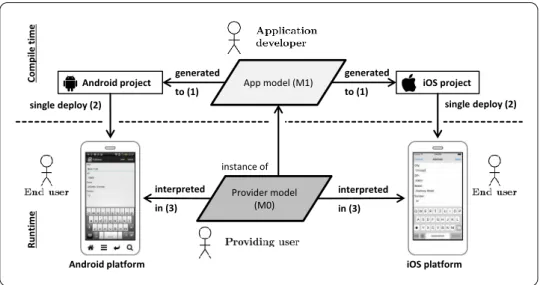
Figure1.3shows this novel approach in detail. A mobileapplication developer(not 1.41
necessarily a technical expert) creates anapp model. Theapp modelconforms to a domain-specific modeling language (DSML) for mobile applications, which is developed during the course of this work. The mobileapplication developercan generate mobile application projects including source code and further artifacts (e.g., platform-specific graphical user interface descriptions, external libraries) for different platforms (Step 1). This already covers theplatformcontext. After compil-ing these projects, a mobile application can be deployed to the mobile device of the respective platform (Step 2).
Using a traditional model-driven development approach, the deployed applications 1.42
1.4. Approach 15
again in order to realize the modification. They could not provide many configu-rations for different user groups or platform types at the same time. Hence, our approach uses a second modeling level. Aproviding usermay create one or more
provider models. A configuration given through thisprovider modelis interpreted at runtime by the deployed mobile applications (Step 3). Hence, redeployment is not necessary. Theprovider modelmay modify the appearance, behavior, or data used in the mobile applications. This architecture implements a hybrid approach because runtime models are used as well as static application code [Ben+11]. The resulting applications provide runtime adaptability [Flo+06] but are not solely interpreted. This providesuseranddevicecontexts in an appropriate way, as shown later in detail by several case examples.
1.4.2
Extended Client-Server Architecture
As a second fundamental difference, we abandon the strict client-server and rich- 1.43 client paradigm used by many existing model-driven development approaches.
Based on the work of Satyamaran [Sat96] (cf. also Fuchß [Fuc09]), we follow an architectural paradigm calledblurred roles.Blurred rolesdenote a relaxation of the commonly used client-server architecture. Parts of the server are duplicated on the client-side.
Extended Client (EC) Application GUI Application logic Local transaction manager (TM) Replication manager Synchronization/Re-integration manager Log offline online Local DBMS DB Client (C) Application GUI Application logic Server (S) Central transaction manager (TM) DB Central DBMS
FIGURE1.4: Extended client-server architecture vs. client-server architecture
A mobile application that follows the traditional client-server architecture, as is 1.44 shown on the right-hand side of Figure1.4, cannot operate when the connection of
the clientCand the serverSis interrupted: required services, such as the database (DB), are no longer available. In turn, an extended clientEC(left-hand side of Figure1.4) can provide replicated data and transaction logging as part of a local transaction manager (T M). These facilities can be used while the extended client (EC) is disconnected from the serverS. Moreover, the architecture of the extended client exploits a particularmobile transaction model(affects the implementation of the gray colored areas in the figure). Suchmobile transaction modelsare required to avoid and resolve conflicts in multi-user environments. As we see later, the generated architecture of the mobile application plays an important role in increasing the transactional throughput of mobile applications.