the Respiratory Therapist in 2015 and Beyond
Robert M Kacmarek PhD RRT FAARC
Introduction
Respiratory Care in 2015 and Beyond The Mechanical Ventilator
Application of Mechanical Ventilation Modes of Ventilation
Initiation and Adjustment of Mechanical Ventilation Disease-Specific Management
Analysis of Ventilator Waveforms
Monitoring of Mechanical Ventilation and Airway Management Pharmacologic Agents and Laboratory Data
Communication and Teamwork
Adjuncts and Nonconventional Approaches Understanding the Evidence
Certifications Being a Consultant
Evidence Supporting This Role Summary
The evolution of critical care and mechanical ventilation has been dramatic and rapid over the last 10 years and can be expected to continue at this pace into the future. As a result, the competencies of the respiratory therapist regarding mechanical ventilation in 2015 and beyond are expected to also markedly increase. Respiratory therapists are expected to be the experts on the mechanical ventilator and all aspects of the application of mechanical ventilation. They will be considered consultants on all aspect of ventilatory support. This requires an expanded education in a number of areas. To achieve these levels of competency, as recommended by the third “2015 and Beyond” conference, the entry level education of the respiratory therapist of the future must be at the baccalaureate level.Key words: respiratory care; respiratory therapist; manpower; education compe-tencies; protocols. [Respir Care 2013;58(6):1087–1092. © 2013 Daedalus Enterprises]
Dr Kacmarek is affiliated with the Department of Anesthesiology, Har-vard Medical School, and the Department of Respiratory Care, Massa-chusetts General Hospital, Boston MassaMassa-chusetts.
Dr Kacmarek presented a version of this paper at the 51st RESPIRATORY
CAREJournal Conference, “Adult Mechanical Ventilation in Acute Care: Issues and Controversies,” held September 7 and 8, 2012, in St Peters-burg, Florida.
Dr Kacmarek has disclosed relationships with Covidien, Hamilton, Ma-quet, Kimberly-Clark, Newport, KCI, and Bayer.
Correspondence: Robert M Kacmarek PhD RRT FAARC, Respiratory Care, Warren 1225, Massachusetts General Hospital, 55 Fruit Street, Boston MA 01460. E-mail: [email protected].
Introduction
The profession of respiratory therapy emerged in the 1940s and 1950s. At that time the competencies required of a respiratory therapist (RT) were very different from those required today.1In fact, the title then used to refer to
these individuals, oxygen technicians, reflects to a great extent the primary role of these clinicians. Most of the activities of these early RTs revolved around the delivery of oxygen therapy; moving oxygen cylinders, setting up oxygen tents and nasal oxygen “catheters.” In addition, oxygen technicians administered aerosolized pharmaco-logic agents, performed pulmonary function tests, and per-formed blood gas analysis. Only on occasion were they involved in the provision of ventilatory support, but this was usually technical support. Over the years the role of the RT evolved in parallel with the development of med-icine, in particular critical care. Most specifically, the ma-turing of the profession of respiratory care can be linked to the development of the mechanical ventilator and the ap-plication of mechanical ventilation.2Today the
competen-cies required of the RT in the area of mechanical ventila-tion far exceed those of the oxygen technician of the past, and the competencies expected of the RT will continue to expand as we approach 2015.3 In this paper the specific
competencies required of the RT in 2015 and beyond will be addressed.
Respiratory Care in 2015 and Beyond
Over the last few years the American Association for Respiratory Care, through its “2015 and Beyond” task force, has addressed how the profession of respiratory care needs to evolve in order to meet the clinical demands that are being placed on the practicing RT. Though a series of conferences and subsequent reports this task force defined the changing role of the RT and the competencies needed by the RT.1,2,4The outcomes of these conferences define
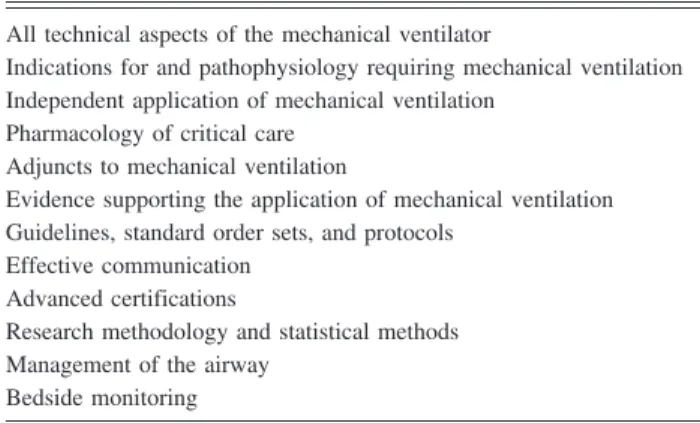
an RT who is educated at the baccalaureate level, who is the expert in respiratory care in all care settings, is an individual who is capable of educating others on the pro-vision of respiratory care, and is viewed by the medical community as a consultant. This individual, as a result, must be highly competent in a number of areas (Table 1). First of all, they must be experts on the mechanical ven-tilator and the indications and pathophysiologies that lead to the need for mechanical ventilation. They must also be able to interpret laboratory data that affect the care of the mechanically ventilated patient and the pharmacology used to manage these patients, regardless of route of adminis-tration. They must be competent in the application of ad-juncts to mechanical ventilation: aerosolized pulmonary vasodilators, prone positioning, and non-conventional forms of ventilatory support. In addition, they require a
working knowledge of extracorporeal life support tech-niques. They must be knowledgeable of the evidence sup-porting the application of mechanical ventilation and ca-pable of developing and implementing guidelines and protocols for the application of mechanical ventilation. They must be able to effectively communicate with all levels of clinicians. Depending on their specific practice, they must be basic life support, advanced life support, pediatric advanced life support, or neonatal life support certified and be able to manage artificial airways and per-form those bedside monitoring techniques required of me-chanically ventilated patients.
The Mechanical Ventilator
The RT of 2015 and beyond must be a technical expert on every aspect of the mechanical ventilator. They should be able to discuss all of the technical nuances of the me-chanical ventilator. They should be able to compare the capabilities of one ventilator to the other. They should be able to discuss in detail the mechanism of action of all of the modes and adjuncts that exist on the mechanical ven-tilator. They should be able to discuss the monitoring avail-able on the ventilator and the trending of data. The RT of 2015 and beyond should be able to address any question related to the technical capabilities of the mechanical ven-tilator. They should be the individual whom all other pro-fessions seek out when questions in this area arise.
Application of Mechanical Ventilation
The RT should be the individual consulted regarding all questions on the application of mechanical ventilation (Table 2).
Modes of Ventilation
Mechanical ventilators are no longer simple devices with only few approaches to ventilatory support. Today
venti-Table 1. Essential Areas Where Competencies Are Required in 2015 and Beyond
All technical aspects of the mechanical ventilator
Indications for and pathophysiology requiring mechanical ventilation Independent application of mechanical ventilation
Pharmacology of critical care Adjuncts to mechanical ventilation
Evidence supporting the application of mechanical ventilation Guidelines, standard order sets, and protocols
Effective communication Advanced certifications
Research methodology and statistical methods Management of the airway
lators may have 10 to 15 unique modes of ventilation.2
The RT of 2015 and beyond should be capable of defining the operational differences between each of these modes. They should also be capable of defining situations where each mode of ventilation is indicated and be able to ref-erence the literature supporting the application of each mode of ventilation. Many of these modes will be closed-loop controllers of ventilatory support, each potentially approaching ventilatory support from a unique perspec-tive. Understanding how modes such as Proportional As-sist Ventilation, Neurally Adjusted Ventilatory AsAs-sist, and Intellivent differ, and their individual advantages and dis-advantages will be essential competencies of the RT.5,6
Because of the increasing complexity of future mechanical ventilators, the RT will be expected to be the individual capable of addressing questions regarding modes during daily rounds.
Initiation and Adjustment of Mechanical Ventilation Increasingly, ICUs are implementing standard order sets, guidelines, and protocols for the management of mechan-ical ventilation that empower the RT to select the mode of ventilation and determine how specifically mechanical ven-tilation is applied.7,8 This empowerment requires that the
RT is knowledgeable of the pulmonary and cardiovascular implications of the particular approach and have the ability to rapidly indentify problems or lack of efficiency and make the appropriate adjustments. This independence in the application of ventilatory support requires the highest level of competency of the RT.
Disease-Specific Management
The independent management of ventilatory support by protocols, guidelines, or standard order sets requires that the RT be competent in managing patients presenting with varying pathophysiologies. Specifically, they should be able to adjust ventilatory support to match the unique re-quirements of patients who present with the ARDS, COPD, and asthma, as well as the routine postoperative and trauma patient or patients with pulmonary or surface burns and the patient overdosing on a pharmacologic agent. In order to
do this they must have an in-depth understanding of the evidence that supports the application of mechanical ven-tilation in these specific settings.
Analysis of Ventilator Waveforms
Every ICU ventilator on the market displays waveforms of pressure, flow, and volume. The primary reason for these waveforms is to determine if the patient is ventilat-ing in synchrony with the ventilator9,10and if the
applica-tion of ventilatory support is within the physiologic limits that will minimize the likelihood of developing ventilator-induced lung injury. The RT has to be knowledgeable of the limits of ventilatory support and competent in identi-fying, via waveform analysis, patient-ventilator asyn-chrony, since asynchrony has been associated with patient outcome.11,12 In addition, the RT should be capable of
modifying ventilatory support such that auto-PEEP is lim-ited, flow asynchrony is minimized, and trigger and cycle asynchrony is eliminated, and to determine when mode asynchrony is present and which modes are appropriate alternatives.
Monitoring of Mechanical Ventilation and Airway Management
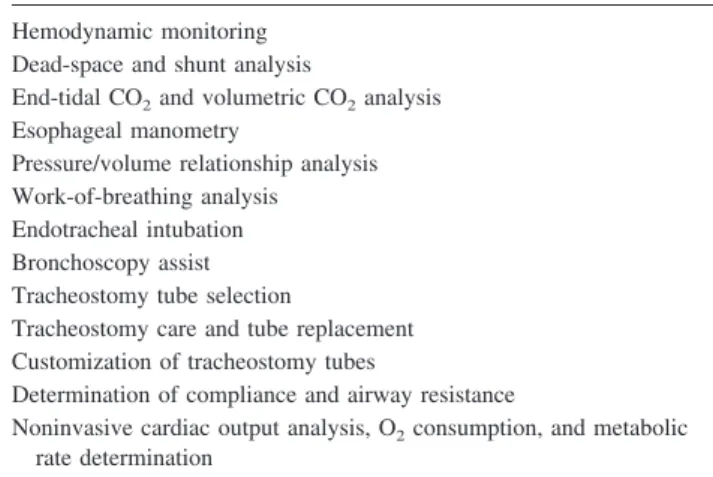
Since all mechanically ventilated patients have the po-tential of developing hemodynamic instability, the RT must have a detailed understanding of the expected response when mechanical ventilation is applied, and of the ap-proaches used to maintain hemodynamic stability (Table 3). Monitoring of respiratory and ventilatory function of crit-ically ill patients has expanded greatly in the last decade. Not only must the RT be competent in the analysis and interpretation of blood gases, but they should be able to analyze and interpret dead space and shunting as well as exhaled CO2. Competency in both end-tidal and
volumet-Table 2. Competency Areas During the Application of Mechanical Ventilation
Modes of mechanical ventilation Disease specific management approaches
Effects of application on the cardiopulmonary system Waveform analysis
Identification and correction of asynchrony Provision of lung-protective ventilation
Table 3. Competency Areas Regarding Monitoring and Airway Care Hemodynamic monitoring
Dead-space and shunt analysis
End-tidal CO2and volumetric CO2analysis
Esophageal manometry
Pressure/volume relationship analysis Work-of-breathing analysis Endotracheal intubation Bronchoscopy assist Tracheostomy tube selection
Tracheostomy care and tube replacement Customization of tracheostomy tubes
Determination of compliance and airway resistance
Noninvasive cardiac output analysis, O2consumption, and metabolic
ric CO2 analysis is a must. Bedside assessment of
com-pliance and resistance is expected in all ventilated patients, but in addition the RT must be competent in esophageal manometry, and assessment of work of breathing, pressure volume curves, oxygen consumption, metabolic rate, and noninvasive techniques to assess cardiac output. The abil-ity to perform endotracheal intubation, insert arterial lines, and provide bronchoscopy assist are key competencies of the RT. The RTs of 2015 and beyond must also be com-petent in the management of both endotracheal tubes and tracheostomies. They should be able to select tracheos-tomy tubes specific for a given patient and be able to replace and manage the variety of tubes that are commer-cially available, as well as determine when speaking valves are indicated and tracheostomy tubes can be removed.
Pharmacologic Agents and Laboratory Data All critically ill patients receive a variety of pharmaco-logic agents. Since many of these agents directly or indi-rectly affect respiratory function, the RT must have an in-depth understanding of these interrelationships. They must understand the effect sedatives and narcotics have on ventilatory function and appreciate the impact that these drugs have on the development of delirium and outcome of critically ill patients.
RTs must be able to assess the need for the various categories of agents administered by aerosol and be com-petent in all of the new administration technology. Critical care RTs must also understand the results of various lab-oratory analyses and the impact of abnormal findings on respiratory and ventilatory function. RTs should also be able to perform basic interpretation of chest x-rays.
Communication and Teamwork
The key to collaborative function of any clinician in critical care is effective communication and teamwork. The RT is a primary component in the management of critically ill patients. As such they need to actively com-municate with all caregivers in this setting. The RT should be presenting the respiratory/ventilatory status of the pa-tient during rounding. They should be an integral part of establishing the daily care plan for patients. The RT should be able to effectively argue for a specific approach to ventilatory support and always function as a patient advo-cate. Communication is an essential competency of the RT in the management of the mechanically ventilated patient. Understanding what is expected of a team member and being able to function as a team leader are also key com-petencies of the RT in critical care. Today’s critical care unit is run by a team, each member having a unique area of contribution to the function of the team. Decisions should normally be made only after each member of the team
presents their specific perspective and the pro and cons of specific topics are discussed in detail. RTs are also ex-pected to be team leaders regarding certain aspects of pa-tient care, coordinating weaning of a difficult papa-tient, man-agement of a difficult airway, and selection of a new mode of ventilatory support for a specific patient. Competencies in the area of teamwork and collaboration are key to the optimal function of the RT in the management of mechan-ically ventilated patients.
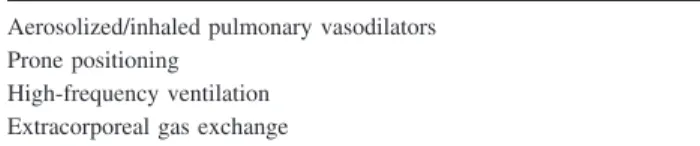
Adjuncts and Nonconventional Approaches Adjuncts to mechanical ventilation have had varying levels of success. However, all are still being actively researched because of the high mortality of subgroups of patients requiring ventilatory support (Table 4). As a re-sult, the RT must be competent in the areas of aerosolized/ inhaled pharmacologic agents affecting the pulmonary vas-culature, the use of prone positioning, and the various forms of high-frequency ventilation. Numerous drugs ad-ministered via the respiratory system affecting the pulmo-nary vasculature are now available. These drugs were first used in ARDS but now are increasingly used in patients with cardiac disease, especially during the postoperative period.13,14 The RT must be competent in the pros and
cons of use of individual drugs as well as the various approaches to administering these drugs.
Prone positioning has been promoted in the manage-ment of ARDS and recent meta-analyses indicate that prone positioning affects outcome in very severe ARDS.15Thus,
the RT must be competent in the selection of patients potentially benefiting from this approach and the actual positioning of patients.
The use of high-frequency ventilation techniques for the management of severe respiratory failure is highly contro-versial.16-18 However, since this is a hotly debated
ap-proach to ventilatory care, the RT must be knowledgeable of the pros and cons associated with its application and the results of randomized controlled trials. They also should be competent in the technical/clinical application of high-frequency ventilation if used in their institution.
Extracorporeal life support (ECMO) is also a hotly de-bated approach to the management of the patient with ARDS,19,20but ECMO is increasingly being used in
pa-tients with various forms of heart failure, papa-tients awaiting
Table 4. Competency Areas Regarding Adjuncts and Nonconventional Approaches to Ventilatory Support Aerosolized/inhaled pulmonary vasodilators
Prone positioning High-frequency ventilation Extracorporeal gas exchange
lung transplantation, and patients with COPD.21 The RT
should be knowledgeable of the potential indications and contraindications for ECMO and, if utilized in their insti-tution, competent in the application and management of the patient receiving ECMO.
Understanding the Evidence
In order for the RT to function in the role described, they must be capable of understanding and critiquing the increasing volume of evidence published regarding me-chanical ventilation. In order to do this they must have a general understanding of research techniques and statisti-cal methodology. Ongoing clinistatisti-cal forums discussing new literature should be available for all therapists. During rounds the RT should be able to discuss the nuances of newly published literature regarding mechanical ventila-tion.
Certifications
Certification is available at many levels, and increas-ingly clinicians are being expected to demonstrate their competency by becoming certified. Specifically, all RTs who work in an ICU should be both basic life support and advanced life support certified. If working in a neonatal or pediatric ICU, neonatal life support and/or pediatric life support certification is a must. In addition, the RTs in 2015 and beyond will be expected to demonstrate their compe-tencies in critical care by being certified as neonatal/pedi-atric or adult critical care specialists by the National Board for Respiratory Care.
Being a Consultant
The expectation of RTs providing ventilatory support in 2015 and beyond is that they will function as consultants. They will be considered the experts in mechanical venti-lation and should be regularly asked their opinion on how to manage the ventilatory aspects of patient care. Essen-tially, the expectation will be that if no one is interested in your opinion, you will be considered unnecessary. The RT should be considered by all as the expert in mechanical ventilation and regularly asked at rounds and team meet-ings to state their opinion on how care should be provided.
Evidence Supporting This Role
As part of the third 2015 and Beyond conference, ques-tionnaires were sent to directors of respiratory therapy educational programs22 and directors of departments of
respiratory therapy.23The results of these surveys support
the described role of the RT in mechanical ventilation. However, not all programs provide education in all of the
areas described or at a level to ensure competency. The time available in the typical associate degree program is simply insufficient to ensure that all graduates have ob-tained these competencies. It is because of the expecta-tions of the medical community and the limited time for education at the associate degree level that the 2015 and Beyond task force recommended that all educational pro-grams in respiratory care be transitioned to baccalaureate degree granting programs by the year 2020.
A very disappointing aspect of the entire 2015 and Be-yond process was the response of the directors of respira-tory therapy departments to the surveys. Surveys were sent on multiple occasions to the American Association for Respiratory Care members list of directors and managers of respiratory therapy departments, and the response rate from this group was 28%, compared to a response rate of 80% from directors of respiratory therapy educational pro-grams.
Summary
The role of the RT and, as a result, the competencies of the RT in all aspects of patient care, but especially me-chanical ventilation, is expected to expand in 2015 and beyond. This expanded role can be best defined as an expert consultant in the provision of mechanical ventila-tion. In order for the profession to be able to train the new generation of RTs for this role, the educational programs in respiratory care need to expand to the baccalaureate level, as recommended by the third 2015 and Beyond con-ference.4
REFERENCES
1. Kacmarek RM, Durbin CG Jr, Barnes TA, Kageler WV, Walton JR, O’Neil EH. Creating a vision for respiratory care in 2015 and be-yond. Respir Care 2009;54(3):375-389.
2. Kacmarek RM. The mechanical ventilator: past, present, and future. Respir Care 2011;56(8):1170-1180.
3. Barnes TA, Gale DD, Kacmarek RM, Kageler WV. Competencies needed by graduate RTs in 2015 and beyond. Respir Care 2010; 55(5):601-616.
4. Barnes TA, Kacmarek RM, Kageler WV, Morris MJ, Durbin CG Jr. Transitioning the respiratory therapy workforce for 2015 and be-yond. Respir Care 2011;56(5):681-690.
5. Kacmarek RM. Proportional assist ventilation and neurally-adjusted ventilatory assist. Respir Care 2011;56(1):140-148.
6. Sulemanji D, Marchese A, Wysocki M, Kacmarek RM. Adaptive sup-port ventilation with and without end-tidal CO2closed loop control vs
conventional ventilation. Intensive Care Medicine 2013;39(4):703-710. 7. Haas CF, Loik PS. Ventilator discontinuation protocols. Respir Care
2012;57(10):1649-1662.
8. Ellis SM, Dainty KN, Munro G, Scales DC. The use of mechanical ventilation protocols in the intensive care unit: a survey of current practice. Crit Care 2012;27(6):556-563.
9. Murias G, Villagra A, Blanch L. Patient ventilator synchrony during assisted invasive mechanical ventilation. Minerva Anestesiol 2013; 79(4):434-444.
et al. Optimization of ventilator setting by flow and pressure wave-forms analysis during noninvasive ventilation for acute exacerba-tions of COPD: a multicentric randomized controlled trial. Crit Care 2011;15(6):R283-R288.
11. Thille AW, Rodriquez P, Cabello B, Lellouche F, Brochard L. Pa-tient ventilator synchrony during assisted mechanical ventilation. Intensive Care Med 2006;32(10):1515-1521.
12. de Wit M, Miller KB, Green DA, Ostman HE, Gennings C, Epstein SK. Ineffective triggering predicts increased duration of mechanical ventilation. Crit Care Med 2009;37(10):2740-2745.
13. Khan TA, Schnickel G, Ross D, Bastani S, Laks H, Esmailian F, et al. A prospective, randomized, crossover pilot study of inhaled nitric oxide versus inhaled prostacyclin in heart transplant and lung trans-plant. J Thorac Cardiovasc Surg 2009;138(6):1417-1424. 14. Antoniou T, Prokakis C, Athanasopoulos G, Thanopoulos A, Rellia
P, Zarkalis D, et al. Inhaled nitric oxide plus iloprost in the setting of post-left assist device right heart dysfunction. Ann Thorac Surg 2012; 94(3):792-798.
15. Sud S, Friedrich JO, Taccone P, Polli F, Adhikari NK, Latini R, et al. Prone ventilation reduces mortality in patients with acute respi-ratory failure and severe hypoxemia: systematic review and meta-analysis. Intensive Care Med 2010;36(4):585-599.
16. Derdak S, Mehta S, Stewart TE, Smith T, Rogers M, Buchman TG, et al; Multicenter Oscillatory Ventilation For Acute Respiratory Dis-tress Syndrome Trial (MOAT) Study Investigators. High-frequency oscillatory ventilation for acute respiratory distress syndrome in adults: a randomized, controlled trial. Am J Respir Crit Care Med 2002;166(6):801-808.
17. Ferguson ND, Cook DJ, Guyatt GH, Mehta S, Hand L, Austin P, et al; OSCILLATE Trial Investigators; Canadian Critical Care Trials Group. High frequency oscillation in early acute respiratory distress syndrome. N Engl J Med 2013;368(9):795-805.
18. Young D, Lamb SE, Shah S, MacKenzie I, Tunnicliffe W, Lall R, et al; OSCAR Study Group. High frequency oscillation for the acute respiratory distress syndrome. N Engl J Med 2013;368(9): 806-813.
19. Ta`i Pham T, Combes A, Roze´ H, Chevret S, Mercat A, Roch A, et al; for the REVA Research Network. Extracorporeal membrane ox-ygenation for pandemic influenza A (H1N1): induced respiratory distress syndrome: a cohort study and prospective matched analysis. Am J Respir Crit Care Med 2013;187(3):276-285.
20. Peek GJ, Mugford M, Tiruvoipati R, Wilson A, Allen E, Thalanany MM, et al; for the CESAR trial collaboration. Efficacy and economic assessment of conventional ventilatory support versus extracorporeal membrane oxygenation for severe adult respiratory failure (CESAR): a multicentre randomised controlled trial. Lancet 2009;374(6):1351-1363.
21. Diaz-Guzman E, Hoopes CW, Zwischenberger JB. The evolution of extracorporeal life support as a bridge to transplantation. ASAIO J 2013;59(1):3-10.
22. Barnes TA, Kacmarek RM, Durbin CG Jr. Survey of respiratory therapy education program directors in the United States. Respir Care 2011;56(12):1906-1915.
23. Kacmarek RM, Barnes TA, Durbin CG Jr. Survey of directors of respiratory therapy departments regarding the future education and credentialing of respiratory care students and staff. Respir Care 2012; 57(5):710-720.
Discussion
Branson: I’ve worked in the depart-ment of surgery since 1985. I don’t work in the respiratory therapy depart-ment, and I don’t supervise respira-tory therapists [RTs] at the bedside, but I like everything you said. At pres-ent, where are we falling down? Is it the abilities of students and getting good applicants to the schools? Is it at the schools? Is it at the hospitals? Where is the next generation of RTs who will lead the science and the pro-fession coming from?
Kacmarek: I don’t know if that’s true. You know, the older we get, the more we think we know and the less we think new graduates know. The reality is that the new graduate today knows a lot more than we did when we entered the profession. And 20 or
30 years ago, when a similar group sat here, they probably said the same thing: “There’s nobody coming after us to take our place, and where are all the young people?” There are people out there, but I don’t think there are enough of them. I don’t think we al-ways attract the right individuals into respiratory care, and that’s partly be-cause of the entry-level academic cre-dential of the profession.
When you talk to your children about their future profession, is respi-ratory therapy ever a part of the dis-cussion? When I talk to my children, my expectation is that they will get at least a baccalaureate degree. With a profession that has as its entry level an associate degree, it eliminates a lot of students whose goal is a profession that requires a baccalaureate degree. You don’t see school guidance coun-selors even talking about respiratory
care, because it does not require a bac-calaureate at the entry level.
I believe we have problems at the respiratory therapy department level, and I’ll say it, since I’m one of that group, many respiratory therapy de-partment directors are not as interested in improving the quality of care as they are in maintaining the fiscal vi-ability of their departments. They’re not focused on quality; they’re only focused on financial issues. Now, ob-viously, that’s a generalization that doesn’t fit across the board, but only 27% of the directors of respiratory therapy programs provided input into a very important survey that will help determine the future of respiratory care. What happened to the other 73% who chose not to even participate in that process?
I think we have problems at multi-ple levels. I think we have problems
with the educational entry level that eliminates good people, and we clearly have problems in our current leader-ship at the hospital level, and that needs to be improved.
Branson: Chris Blakeman has worked with me now in the depart-ment of surgery for the past 5 years, but up until Chris, all the people I worked with closely—and I would consider some people I mentored—all of them either work for industry, went into medical school, or became PAs [physician assistants], perfusionists, or CRNAs [certified registered nurse anesthetists]. That’s part of what the educators seem to be fighting: how important it is to have a bachelor’s degree and create an advanced degree, because we lose a lot of the best peo-ple due to just financial reasons. There are just so many academic jobs that provide a reasonable living, and I think that’s really important and gets lost. We lose so many people from the pro-fession because the only upward ca-reer pathway is into administration. There are no advanced practice RTs. Kacmarek: One of the problems with salaries is those we are compared to! I’m frequently sitting next to phys-ical therapists with PhDs at entry level, occupational therapists with master’s degrees at entry level, or speech/lan-guage pathologists with master’s de-grees or PhDs at entry level. All those people have a much higher academic entry point than RTs. As a result, we’re at the end of the line.
MacIntyre: Let me switch from the entry level to the top. I think that the profession as it’s constructed right now has a ceiling above which you can’t go without leaving the profession and doing something else. But at Duke we’ve built a huge new bed tower with a bunch of new ICU beds and we’re running around like chickens with our heads cut off trying to figure out how to staff it.
An obvious staffing model would be a PA-RRT. I can think of no better entry level for a PA than the RRT to move into an ICU and be an indepen-dent practitioner. It seems to me the next step for the respiratory care pro-fession is to create independent prac-titioner licensure by the states, just like the physical therapists, occupational therapists, PAs, and CRNAs to pro-vide independent care. Rather than count somebody who goes to school for PA as lost to the profession, in-stead somehow make it possible that they’re still within the profession. I know there are a bunch of RTs who would love to see independent licen-sure for advanced level RTs.
I think it’s a terrific idea, but it’s going to be a huge uphill battle to get state legislatures and all the things that need to go into place to get licensure for independent practice. Why not somehow partner with the PA system that’s already in place, already grants a master’s degree, and in all 50 states can get a license? Rather than con-sider them lost RTs, concon-sider them RTs who have broken through the ceiling and can provide independent exper-tise. In my ICUs I have about 10 RTs who’d be terrific if I could get them to be independent practitioners.
Kacmarek: You could retire! MacIntyre: With a PA licensure they could damn near run my ICUs. Kacmarek: The problem is that too few individuals are entering the pro-fession with the capability of moving in the direction Rich described, be-cause our entry-level requirement im-mediately makes them choose another profession.
MacIntyre: Oh, I realize it will be few.
Kacmarek: Because of the current entry-level criteria. One of the argu-ments against requiring a baccalaure-ate degree is that we’ll have nobody
applying to respiratory therapy pro-grams. I disagree with that entirely; a baccalaureate entry opens up a broad spectrum of high school graduates who would never have considered respira-tory care because of its associate’s de-gree entry, as opposed to a baccalau-reate. Today we have 54 baccalaureate level respiratory care programs and 3 quasi-master’s respiratory care pro-grams. They’re master’s programs that provide a degree, but they’re not clin-ically oriented.
MacIntyre: I’m not arguing with you on the entry-level part of it. It just seems to me that the respiratory care profession would have more attraction if our superstars had an avenue to pro-ceed through that ceiling.
Kacmarek: No question. We can even look at the fact that if we had baccalaureate entry, why couldn’t we have advanced level RTs with mas-ter’s degrees, like nurses do? They’re your PAs by virtue of their educational level. It opens up the opportunity for upward mobility to a much greater ex-tent. I agree with Rich that, unless you move into education or management, the profession doesn’t have a mecha-nism for upward advancement. MacIntyre: One last pitch for the American Respiratory Care Founda-tion here. One of the topics on their agenda is focusing the scholarship pro-gram away from associate level schol-arships and consolidating them into really meaningful advanced degree scholarships. I think the advanced de-gree scholarships should have licen-sure attached, to allow breaking through that ceiling and into a clinical leadership role.
Kacmarek: Agreed.
Kallet: I would like to offer a coun-ter viewpoint or a cautionary view-point on this. These discussions are extremely important, and I have a tre-mendous amount of sympathy for
what’s been said. However, in the con-text of a shrinking middle class, I think back to my own roots. I entered re-spiratory therapy as a teenager in Syr-acuse, New York, during the deep eco-nomic recession of the 1970s, when my dad was unemployed. An associ-ate’s degree was something doable and attainable. The model at Upstate Med-ical Center was extremely good: it was a “two-plus-two” program. You got in, you got great associate’s degree level training, and then the upper di-vision course work was advanced re-spiratory care. There was the option of supporting yourself while working towards a bachelor’s degree.
Parenthetically, in northern Califor-nia, the RT graduates we’ve hired from our community college programs have been great. They’re bright, well pre-pared, and a joy to work with. They’re ready for us to train them into the much more advanced role we need them to take on. But a lot of them do not have the economic means to go through 4 years of college in one bite. They’re not from upper middle class or solid middle class families. They’re kids, a lot of them from immigrant families, working to get into the middle class. While I totally understand where the profession needs to go, and if we try we can get the profession to where it needs to be, but to move it to a bac-calaureate program where all you’re doing is saying the kids need 2 years of basic college education, then they get the associate’s program core courses in the last 2 years . . . Kacmarek: You said that: I didn’t say that.
Kallet: OK, but in a lot of the bac-calaureate programs I’m aware of it’s not really advanced respiratory care. The training I went through when I went back and got a baccalaureate was advanced respiratory care, advanced biology and chemistry—subjects that made me a better professional: educa-tion, management, and research. If it goes that way, fine, but I think if the
idea is to get this up to a level where all we’re really doing is saying, “Go to a community college for 2 years and do the basic science and liberal arts, and then do 2 years of core re-spiratory care curriculum that’s basi-cally an associate’s level degree,” we’re going to limit a lot of very bright young people who could enter the mid-dle class and the profession without appreciably advancing their knowl-edge base.
Kacmarek: We are going to change the demographics of who enters the profession, there’s no question. But the creativity associated with devel-oping a baccalaureate program is un-limited. Nobody is proposing a restric-tion that will make it all private 4-year colleges that offer baccalaureate pro-grams at $50,000 a year. Many states will allow associate-degree-granting community colleges to develop a bac-calaureate degree.
Florida has several schools that are in the process of moving from asso-ciate programs to baccalaureate pro-grams. You can structure it any way you want. But we need to “bite the bullet” and accept that by some date we must start requiring baccalaureate degrees. And that at some later date all the associate degree programs have to become baccalaureate programs. Nobody is saying this is going to be done overnight; it has to be a reason-able transition. I have sympathy for what you’re saying, but I also agree with Rich Branson that we need a bet-ter quality individual who is motivated to the levels he referred to; otherwise, the profession will not grow and de-velop: it will eventually die.
Kallet: I agree with that. I think it’s a matter of how it’s done. And I think the idea of still allowing people to come into respiratory therapy with an associate’s degree, but with a contract expectation that, once they can earn money, they will continue their edu-cation and get a bachelor’s degree . . .
Kacmarek: There has to be a point in time where we have to “bite the bullet.” We have to grow as a profes-sion. Eventually, we have to say it has to change and everybody entering re-spiratory care has to be educated at a higher level.
Turner: Another issue is the im-portance of collaborative interdisci-plinary education. I think that more and more we’re moving towards try-ing to get all trainees to learn together earlier in their training. As an exam-ple, we have our pediatric critical care fellows shadow the RTs and the nurses early in their fellowships, to foster an interdisciplinary approach to their ed-ucation. With improved collaboration, both education and patient care are enhanced, which is particularly impor-tant in the ICU environment, where teamwork is crucial.
Kacmarek: I agree. I think the ICU does it better than any other aspect of in-patient care, because of the nature of the work and the type of profes-sionals who are there. There’s a more collaborative attitude in most ICUs, so we can be the model for collabor-ative education in other parts of the institution.
Branson: I understand that the real issue is that we need to develop these educational constructs for people to grow within the system. Is there any advantage in funding internships? An internship at Massachusetts General Hospital for 6 months or a year? An internship at San Francisco General for a year? The question is, what kind of piece of paper do you get when you’re done? Ideally, you’d get this wealth of experience and we’d be pushing these people out of the nest to hopefully fly to other places and cre-ate similar programs at other hospi-tals.
Kacmarek: You could do that. But it takes a long time for somebody to get acclimated to an insane asylum
like our place. By the time you’re ac-climated, you’re half way through the internship. I would be more in favor of funding other institutions who have the capability of moving to the level that we, and Duke, and the Mayo Clinic, and other places are, to assist them so that their departments become what our departments are.
Marini: Bob, do you agree with this historical perspective? One of the big reasons people aren’t considering re-spiratory care is not only that energy has been sapped out of it by the busi-ness interests of the hospitals, but also that the doctors are no longer at the bedside. The mentors I learned from, Hudson and Pierson, were excited about physiology, which is no longer very well taught to our medical stu-dents.
The physiological intrigue of being an RT seems to have dissipated some, too. A lot of our RTs seem to have limited interest or encounter trouble with the waveforms, the interpreta-tions, the reasons behind why the pa-tient fails. They’ll have an opinion as to why a patient failed a weaning trial or need support, but the physiological understanding has eroded because the medical profession has allowed phys-iology to take a back seat to statistics and evidence-based medicine. And doctors are more interested in getting on with their next patient than in men-toring someone who is not really well prepared to receive the information.
The whole field of medicine has changed radically, and not always for the better, in my opinion. You still have to use physiology to extricate the information and unravel the knot that most patients present. I think we have a great and dedicated group of RTs at my hospital, but even our RTs are of-ten too busy applying treatments and documenting observations to ponder what might be happening underneath it all, and their high workload makes them eager to move on to the next patient. They cannot be with us on rounds much of the time. We try to
educate them, but the culture has changed.
Kacmarek: A certain culture in the respiratory therapy department has to be promoted to allow that to happen. If I went into any ICU and asked the RTs if they are on rounds 100% of the time, the answer would be no, because they may have 6 or 7 patients, and this patient’s tube needs to be re-taped, this is happening here, and that’s happen-ing there, so they get pulled away from rounds. They’re not 100% on rounds because it’s impossible, because of critical problems. But I agree that physiology is not taught to the level it should be. And the kids coming out of respiratory care schools do not under-stand physiology to the level they should.
But it’s also important to remember the difference in our expectations of an associate degree graduate 20 years ago, compared to today. We expect that person to know a lot more than we did 20 years ago, but we haven’t expanded the time and opportunity for them to learn it, so I can’t expect them to come as prepared as I would like. We spend 3 months with them. Dean and I do one-on-one lecturing; Dean does workshops with them on how to start NIV. We do a lot of one-on-one education to train them to be the RTs we want at the bedside.
Branson: I agree with both of you. I grow tired of bedside caregivers tell-ing me they made a change because they felt like the patient would do bet-ter—with no physiologic evidence or basis in the literature. I hear things such as, “I felt like ATC [automatic tube compensation] was a good idea on this patient during the spontaneous breathing trial, because he has a smaller tube.” I don’t know where the problems reside, and so I don’t know how to fix them. I think this is a great opportunity for the profession, but I’m not sure how we move forward.
Giordano:* I agree with everything
that’s been said, but eventually we have to put our feet on the ground and not be floating 30 feet in the air. I offer a couple things to think about. First, I think there’s an inevitable move toward requiring RTs to get at least a baccalaureate degree. We already have over 50% of our members with at least a bachelor’s degree. Could this be be-cause they found that with an associ-ate’s degree their education was want-ing?
I think a critical event that will shift this paradigm is the bill1we’re
push-ing to get RRTs who have baccalau-reate degrees to work under Medicare Part B, as employees of physician prac-tices. They will not bill independent-ly; they’ll be salaried by the practice. But they’ll be able to see patients with chronic lung diseases and provide dis-ease management in the physician’s office without having to make an ap-pointment with the physician. That will push even more people to acquire those grounding communication skills. It will happen, and it will drive change. Regarding capacity, the RT profes-sion has a burn rate of approximately 8,000 people per year, so we have to graduate that many per year. As you mentioned, we have approximately 55 baccalaureate degree programs and 3 graduate programs, but they’re not fill-ing up their classes. Another survey we conducted as part of the 2015 and Beyond initiative was to ask allied health teams whether they have what they need to develop respiratory care baccalaureate programs. We had only one positive response. That survey will be repeated with a predicate of this baccalaureate requirement to work in offices, and I think that will change then.
What it comes down to is the mar-ket. Bob mentioned this in regards to Florida, which I believe a couple of years ago changed its laws to allow
* Sam P Giordano MBA RRT FAARC, Pub-lisher, RESPIRATORYCARE, Irving, Texas.
community colleges to offer baccalau-reate degrees. This was done not be-cause the educators and professions got together: it was because, across all occupations and professions, the em-ployers said to the education system that the graduates are not adequately educated and you need to step it up. Everything is market-driven. Until ev-ery department head has a baccalau-reate degree as a prerequisite, you will not necessarily have everybody with a baccalaureate degree.
Case in point: nursing has been ad-vocating for baccalaureate-trained nurses for at least 3 decades, but over 50% of nurses in the workforce are associate-degree prepared, because that’s what the marketplace accepts. When we change the marketplace— and many of the things that were dis-cussed at this conference will feed into that—we will see this change, this evo-lution. We’ll then be able to show that it’s a sound business model for edu-cators and universities to create bac-calaureate programs.
One final point: a bit of a caution is indicated from the experience of our friends the physical therapists. A funny thing happened on the way to doctoral degrees, which is that all of a sudden there developed a physical therapy as-sistant, and guess where they’re get-ting educated? At community colleges, and getting associate’s degrees. So,
whereas once there was, especially in hospitals, a team of, say, 20 physical therapists, now there may be 5 phys-ical therapists and 15 physphys-ical thera-pist assistants. I don’t know whether this will boomerang on us in a similar way, just because of the higher criti-cal thinking that’s going to be de-manded in the future, but I would not necessarily hold that up as a road we want to go down. Certainly it’s a de-sign we’ve learned from.
Kacmarek: We’re not asking for PhD entry, we’re asking for baccalau-reate entry. And if you allow the mar-ket to drive itself, we will all be dead before any change is made. It seems to me that we can do what’s necessary to make change occur without dam-aging the workforce or entry into the workforce. Nobody has asked for this to happen tomorrow; what we are ask-ing for is to start settask-ing solid dead-lines for things to change.
In Massachusetts we’re working with 2 community colleges, and we believe we’ll be able to go to bacca-laureate degrees in community col-leges in Massachusetts, like they have in Florida. Increasingly, I think we’ll see that same thing happening in mul-tiple states, because, as you said, it seems to be the right thing to do to properly educate people for various professions. Why can’t we say that,
10 years from now, you can’t develop a new respiratory therapy program un-less it’s at the baccalaureate level, and 20 years from now that all associate degree programs have to change to baccalaureate? That’s easily enough time for the profession to acclimate to the changes that are being demanded of us to survive.
Giordano: I agree, but we have to make sure there’s enough education capacity out there. We’ve got some university deans to talk to.
Kacmarek: Sure, but I also think that we make a bigger deal about the manpower issues than is real. In the northeast we have many RTs who don’t have jobs. This year’s graduates from respiratory therapy programs in Massachusetts, Rhode Island, Ver-mont, New Hampshire, Connecticut, and Maine can’t find jobs. I’ve had 50-70 applicants for just a couple open-ings. We have lists of people who can-not find work in respiratory care in the northeast. I realize there are pock-ets throughout the United States where there are deficiencies, but I’ll bet that, globally, recently that’s changed a lot and that we have an excess of RTs.
REFERENCE
1. Medicare Respiratory Therapy Initiative Act of 2011. H.R.941. 112th Congress, first session.