
Brand Value, Preference and Customer Value Effects of Non-conventional Utility Products: An Experimental Analysis in Mexican Market
23
0
0
Full text
(2) Contact. Dr. Rajagopal, Ph.D. Professor, Department of Marketing Business Division, Institute of Technology and Higher Education, ITESM 222, Calle del Puente, Tlalpan Mexico DF 14380 E-mail : [email protected] Personal Home page: http://www.geocities.com/prof_rajagopal/homepage.html Institution’s Home page: http://www.ccm.itesm.mx/micampus/. Acknowledgement. Author sincerely acknowledges the support provided by Ananya Rajagopal, Graduate student of Industrial and Systems Engineering of ITESM, Mexico City Campus in computing the data and developing Tables in this paper.. 2.
(3) Abstract. The role of customer value has been largely recognized over time by the firms as an instrument towards stimulating market share and profit optimization. The customer values for innovative products and unfamiliar brands of firm in competitive markets are determined largely by habits, reinforcement effects, and situational influences than strongly-held attitudes. Marketing organic cosmetics is a recent phenomenon in the business and it is largely being encouraged by the growing environmental consciousness among the customers. Many multinational companies have entered the market of organic cosmetics and toiletries (OCT) in the global marketplace. However, there has been little awareness among the elite customers in Latin American markets about the harmful effects of synthetic cosmetics on prolonged usage. This study attempts to discuss the impact of economic and relational variables on customer and brand values in reference to OCT products in Mexico through empirical investigation in selected departmental stores that attract high profile customers.. 3.
(4) Use of organic cosmetics and toiletries (OCT) manufactured from herbs and plant extracts has been popular in many developed countries. The organic constituents in the cosmetics categorically place them as ecological products and the process of marketing such products may be explained as green marketing. Marketing organic cosmetics is relatively recent outgrowth in the business and it is largely being encouraged by the growing environmental consciousness on the part of citizens and a growing market for cosmetics and toiletries, several global and local companies have entered developing countries like Mexico. An international company, The Body Shop, and General Nutrition Centre (GNC) have employed green marketing strategies to build their customer base in the Mexican market. In response to customer demand for products with natural origins and anti-aging functions, some of the multinational firms in Asia have developed herbal medicinal cosmetic after years of scientific research on capturing the pharmacological essence of the ingredients used in traditional medicine (Hwang, 2004). However, it has been observed that the organic cosmetics are yet not familiar brands in the Mexican market. An increase in customer value may be attributed mainly to an increase in the perceived values of brands in the market, while the price effect measures value change caused by adding unfamiliar brands like GNC in OCT products to the existing brands. The customer value seemed to decrease as the prices of the familiar brands increased in a large proportion and the price increase was most pronounced among the users of OCT products.. In the markets of developed countries like USA and Europe, organic products related to diet, cosmetics and general health medicines are tightly regulated and mandatory labeling laws are imposed. Although regulations are strictly adhered to, customer groups have pushed for comprehensive information on the process and nutritional values of such organic products. There have been many research studies providing empirical estimates of customer demand for synthetic 4.
(5) cosmetics (e.g., Noussair et al., 2004; Lusk et al., 2005) whereas other studies have offered theoretical models to explain the value effects of biotechnology (e.g., Giannakas and Fulton, 2002). The value effects of biotechnology on various customer products have been investigated by few macro level studies, which discuss the customer preferences and value parameters in reference to genetically modified food (e.g., Nielsen et al., 2003). There has been little awareness among the elite customers in Latin American markets about the harmful effects of synthetic cosmetics on prolonged usage. It has been observed that such customer knowledge has generated willingness to buy OCT products with a price advantage and other benefits, compared with organic and ordinary types of foods, employing a robust experimental method. The customer preference to the organic cosmetics has been increasing as customer fears surrounding perceived risk decrease and customer benefits are communicated (Mather et.al, 2005).. This study focuses on measuring the impact of economic and relational variables on building customer and brand values in Mexico through empirical investigation in selected departmental stores that attract high profile customers. The study discusses the extent of influence of various factors affecting the brand value and customer behavior towards innovative products and unfamiliar brands of the firms in a given market. The value effects of OCT products in selected departmental stores which attract high profile customers have also been discussed in the study.. Theoretical Motivation According to the customer choice model of Giannakas and Fulton (2002), individuals are assumed to consume optimum one unit of the product of their interest within a given time. The construct of the model of customer behavior, assumes that prior to choice of OCT product,. 5.
(6) customer i derives perceived use value, for t non-OCT or synthetic products having U vi willingness to pay for the non-OCT product on the perceived used value of customer i at price p. In order to explain the customer preference to the product and estimating the brand value in reference to this study it may be derived that customer obtains the perceived use value (U vi − p t ) from consuming non-OCT product. The customer also exercises his option of buying a high value substitute (OCT products) at an alternate price p a where. (p. a. ). ≥ p t . Hence without. availability of OCT products, the customer value Cs may be derives as:. [(. )] (. )(. Cs it = lim 0− ∞ U vi − p t , U vi − p a = U vi − p t. ). (i). Following the scenario when the customers get access to the OCT products in the market, customers enhance the perceived use value of the OCT product by factor E vi . This parameter is subjective to the customer decision in view of their preferences towards consuming organic products. However, due to lack of awareness, advertising and sales promotions, many customers may not be able to establish their preferences explicitly towards the synthetic and non-OCT products. If α represents the market segment for the OCT products, the customers would access the products and perceive its value by (αEvi ) . Accordingly, the customer value after the OCT products are made available in the market segment may be described as:. [(. ). (. ). Cs iAP = lim 0− ∞ U vi − p t − αE vi , U vi − p a , Bivg. ]. (ii). 6.
(7) Wherein, the expression Cs iAP denotes the enhancement of customer value for OCT products in reference to the advertising and promotion strategies of the firms and Bivg represents the brand value of OCT products perceived by the customers. Further, CsiAP may be understood as a function of interpersonal communication. (Cs )comprising IP i. word of mouth and referrals,. commercials (Cs ima ) and point of sales promotions (Cs ips ). Hence, the factors influencing the enhancement of customer value may be expressed as:. (. Cs iAP = f Cs iIP , Cs ima , Cs ips. ). lim 0 − ∞. (iii). Motivational forces are commonly accepted to have a key influencing role in the explanation of shopping behavior. Personal shopping motives, values and perceived shopping alternatives are often considered independent inputs into a choice model. It is argued that shopping motives influence the perception of retail store attributes as well as the attitude towards retail stores (Morschett et.al, 2005). The liberal environment of the self-service stores for merchandise decisions, service quality and learning about competitive brands are the major attributes of retail self-service stores (Babakus et.al, 2004). The retail self-service stores offer an environment of three distinct dimensions of emotions e.g. pleasantness, arousal and dominance. The change in the customer value observed among the synthetic and OCT products in reference to advertising and promotional strategies used by the firms, may be described as:. Cs iAP −t = Cs tAP − Cs it. (iv). 7.
(8) The model assumes that if N rs number of customers in a given retail store has preferred to use OCT products, the change in the customer value may be derived as:. ∆Cs iAP −t =. Nrs1 ... Nrsn. ∑ ∆Cs. AP −t i. (v). i =1. The customer value across different retail locations and brands in Mexico as exhibited in Table 1 has been investigated in the study. Customers choose the product which offers maximum utility in reference to the price, awareness and promotional advantage over other non-OCT products. Hence, the customer value for OCT products may be expressed as:. (. Evi − t Evi ∆C Nrs − Cs it =1 = α C i. ). (vi). Where, C Evi represents the customer value in total derived by all factors. Value and pricing models have been developed for many different products, services and assets. Some of them are extensions and refinements of convention models on value driven pricing theories (Gamrowski and Rachev, 1999; Pedersen, 2000). There have also been some models that are developed and calibrated addressing specific issues such as model for household assets demand (Perraudin and Sorensen, 2000). The key marketing variables such as price, brand name, and product attributes affect customers' judgment processes and derive inference on its quality dimensions leading to customer satisfaction. The experimental study conducted indicates that customers use price and brand name differently to judge the quality dimensions and measure the degree of satisfaction (Brucks et.al., 2000). The value of corporate brand endorsement across different products and. 8.
(9) product lines, and at lower levels of the brand hierarchy also needs to be assessed as a customer value driver. Use of corporate brand endorsement either as a name identifier or logo identifies the product with the company, and provides reassurance for the customer (Rajagopal and Sanchez, 2004).. The cost of acquiring OCT products would be the difference in traditional good price, variation in the perceived use value and search cost as indicated by (C isc ) for each customer. Hence the appreciation of customer value to obtain OCT products may be expressed as:. [(. ). ∆C iKrs −t = α E vi + p a + C isc − Cs it. ]. (vii). Where, CiKrs represents the cost of acquiring the OCT products from a given retail store. The competitive advantage of a firm is also measurable from the perspective of product attractiveness to generate new customers.. Given the scope of retail networks, a feasible value structure for. customers may be reflected in repeat buying behavior ( R̂ ) that explains the relationship of the customer value with the product and associated marketing strategies. The impact of such customer value attributes in a given situation may be described as:. n. ∑ Cs. AP i. = Rˆ = C Evi. (viii). Nsr =1. The repeat buying behavior of customers is largely determined by the values acquired on the product. The attributes, awareness, trial, availability and repeat (AATAR) factors influence the. 9.
(10) customers towards making re-buying decisions in reference to the marketing strategies of the firm. The decision of customers on repeat buying is also affected by the level of satisfaction derived on the products and number of customers attracted towards buying the same product, as a behavioral determinant (Rajagopal, 2005).. The new product attractiveness may comprise the product features including improved attributes, use of advance technology, innovativeness, extended product applications, brand augmentation, perceived use value, competitive advantages, corporate image, product advertisements, sales and services policies associated therewith, which contribute in building sustainable customer values towards making buying decisions on the new products (Rajagopal, 2006a). The attributes of the new products lead to the satisfaction to the customers and is reflected through the product attractiveness ( Fx ). It has been observed that the OCT products have been considered as new and experimental products in Mexico by a significant number of consumers. Hence product attractiveness (Fx ) may be explained along the associated variables in the following equation as:. [. (. Fx = ∏ αE vi Cs tAP , q, Z xi , p a. )]. t. (ix). Wherein, q denotes quality of the product and Z xi represents the services offered by the retailers towards prospecting and retaining customers who intend to buy the OCT products. The customer value may also be negative or low if the attributes are not built into the new product to maximize the customer value as per the estimation of the firm. The perceived use value of customers by market segments αEvi is a function of advertising and promotion Cs iAP , and price appreciation. 10.
(11) p a and retailer services Z xi in a given time t. Hence. ∏. has been used as a multiplication. operator in the above equation. The quality of the product and volume are closely associated with the customer values.. The introduction of new technological products makes it important for marketers to understand how innovators or first adopters respond to persuasion cues. It has been observed in a study that the innovativeness and perceived product newness which are one of the constituents of new product attractiveness were independent constructs that had independent effects on customer's attitude toward the brand and purchase intent for the new product (Lafferty and Goldsmith, 2004).. Hypotheses. The customer values are governed by the perception on economic and relational variables conceived by the buyers on the products. The organizational values and customer relationship approaches of the company also influences the customers to acquire higher values. The measure of customer value as the product efficiency may be viewed from the customer’s perspective towards a ratio of outputs (e.g., perceived use value, resale value, reliability, safety, comfort) that customers obtain from a product relative to inputs (price, running costs) that customers have to deliver in exchange. The efficiency value derived can be understood as the return on the customer’s investment. Products offering a maximum customer value relative to all other alternatives in the market are characterized as efficient. Different efficient products may create value in different ways using different strategies (output-input combinations). Each efficient. 11.
(12) product can be viewed as a benchmark for a distinct sub-market. Jointly, these products form the efficient frontier, which serves as a reference function for the inefficient products (Bauer et.al, 2004).Accordingly, it has been hypothesized as:. H1: Higher perceived value acquired by the customers help consumers to determine. their buying decisions on the non-conventional products of unfamiliar brands in the market.. The equations (i) and (iii) which describe the impact of customer preference on measuring the customer value factors and role of technology in shifting the customer values respectively support the above hypothesis and have been used as the basis of analysis to test the hypothesis.. H2: The brand value of the products is enhanced by deploying the communication. tools effectively by the firm which help augment the customer value by marginalizing the gap between consumer perceptions and product attributes.. The equations (iii), (iv) and (v) describe the value drivers associated in determining the customer knowledge, perceptions and use value on the products through the public communications on the brand as disseminated by the firm. These equations have been taken as the basis for deriving the analysis from the relevant variable to justify the hypothesis H2. The design standards and attributes of the new products offered, build the product attractiveness and the customer driven products help in acquiring higher level of satisfaction.. 12.
(13) The success of non-conventional product pricing practices refer to the use of information on customer value, competition, and costs(Ingenbleek et.al., 2003). An experimental study conducted indicates that customers use price and brand name differently to judge the quality dimensions and measure the degree of satisfaction (Brucks et.al., 2000). The value of corporate brand endorsement across different products and product lines, and at lower levels of the brand hierarchy, also needs to be assessed as a customer value driver. Use of corporate brand endorsement either as a name identifier or logo identifies the product with the company, and provides reassurance for the customer (Rajagopal and Sanchez, 2004). Some of the marketplace and experimental studies show that consumers are more sensitive to changes in price than to innovation and new products introduced by the firm (Gourville and Koehler, 2004). There are some critical issues associated to the price sensitive consumer behavior, whether customers are equally price-sensitive while purchasing products for functional (e.g. purchasing frozen vegetables, toiletries or paper towels) versus hedonic (e.g. purchasing a high technology computer or a video camera) consumption situations and whether perceived value derived during consuming the product influences price sensitivity. It may also be stated that higher price volatility makes consumers more sensitive to gains and less sensitive to losses, while intense price promotion by competing brands makes consumers more sensitive to losses but does not influence consumers’ sensitivity to gains (Han et.al, 2001). The companies may involve the customers in the product designing process and incorporate their preferences in order to optimize the application derived customer values. So, the hypothesis may be framed as:. H3: The brand value, quality of the product, competitive advantages and price along. with other relational variables determine the customer value for the non-conventional products of unfamiliar brands in the market. 13.
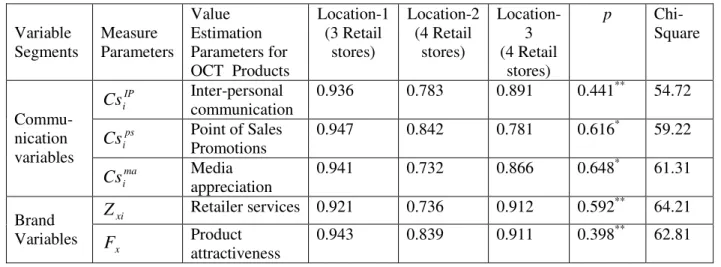
(14) The factors associated with the customer value in reference to brand value, pricing and competitive advantages the have been envisaged in the equation (ii), (vi) and (vii) derived through interdependent variables. These equations on one hand support the hypothesis H3 conceptually and also help in deriving the framework for analysis on the other.. The customer values are created towards the new products through individual perceptions, and organizational and relational competence (Johanson et.al., 2001). The firms need to ascertain a continuous organizational learning process with respect to the value creation chain and measure performance of the new products introduced in the market. In the growing competitive markets the large and reputed firms are developing strategies to move into the provision of innovative combinations of products and services as 'high-value integrated solutions' tailored to each customer's needs than simply 'moving downstream' into services (Davies, 2004). The product attractiveness may comprise the product features including improved attributes, use of advance technology, innovativeness, extended product applications, brand augmentation, perceived use value, competitive advantages, corporate image, product advertisements, sales and services policies associated therewith which contribute in building sustainable customer values towards making buying decisions on the new products (Lafferty and Goldsmith, 2004). The attractiveness of new products is one of the key factors affecting the decision making of customers and in turn is related to market growth and sales. The higher the positive reactions of the customers towards the new products in view of their attractiveness, higher the growth in sales and so in market. Hence the hypothesis may be described as:. 14.
(15) H4: The product attractiveness combined with the effective informational sharing and. retailing services for the non-conventional products and unfamiliar brands help augmenting by providing competitive advantage.. The equations (viii) and (ix) describe the integrated effects of communication variables and retailing services in developing product attractiveness and the customer value towards the nonconventional products and unfamiliar brands in order to test the hypothesis H4. The product and brand loyalty is built through an augmented and sustainable customer value.. Study Design. In order to measure the customer value for the OCT products on the above discussed parameters through the model a preliminary investigation has been conducted in 11 retail self-service stores in Mexico City including 4 departmental stores spread over 3 locations in Mexico. Data has been collected from 400 respondents purposively selected, who were involved in shopping at chosen retail self-service stores in Mexico City administering a semi-structured questionnaire. The data of 31 respondents were omitted from the data analysis due to paucity of information. The respondents involved in buying the OCT products have been stratifies brand-wise for the OCT products of The Body Shop, Aubrey Organics, GNC, Procter and Gamble and Natural Solutions. In all, the data of 369 observations were analyzed in the study. The data was collected on the variables closely related towards influencing the customer values. These variables include various perspectives of customer satisfaction and marketing strategies applied in reference to the positioning, attaining high brand value and improving the market share of the OCT products for gaining optimal market share and aggregate returns on consumptions. 15.
(16) Results and Discussion. The values of Cs it , CsiAP , Bivg C iKrs , αE vi and p a have been determined in the study based on the existing market response to the OCT products in the selected retail outlets. The OCT products were available in the retail stores along with other non-OCT products which provided opportunity for the customers to determine their preferences on the criterion discussed above. The results on the analysis of the above variables refer to the short term customer values associated with the new products introduced in the retail market by the firms for competitive gains. The relational and economic variables selected for the study are illustrated in Table 1. The results presented in the above Table reveal that strategic product positioning and effective retailing augment the customer perceptions and help building the long-run customer values towards the non-conventional products owning unfamiliar brands. Hence, the hypotheses H1 and H2 framed for the study get established.. //Table 1 about here//. The analysis in the Table reveals that customers derived higher perceived use value, price tags and acceptable cost involved in acquiring the product for the OCT products while satisfaction over the non-OCT products has been found lower in two locations as compare to the other one comprising 3 retails stores under study. The customer values are reflected in their competitive gains, perceived use values, volume of buying and level of quintessence with the customer relationship management services of the organization. If these variables do not measure significantly, the attitude reversal among the customers to the conventional products may be. 16.
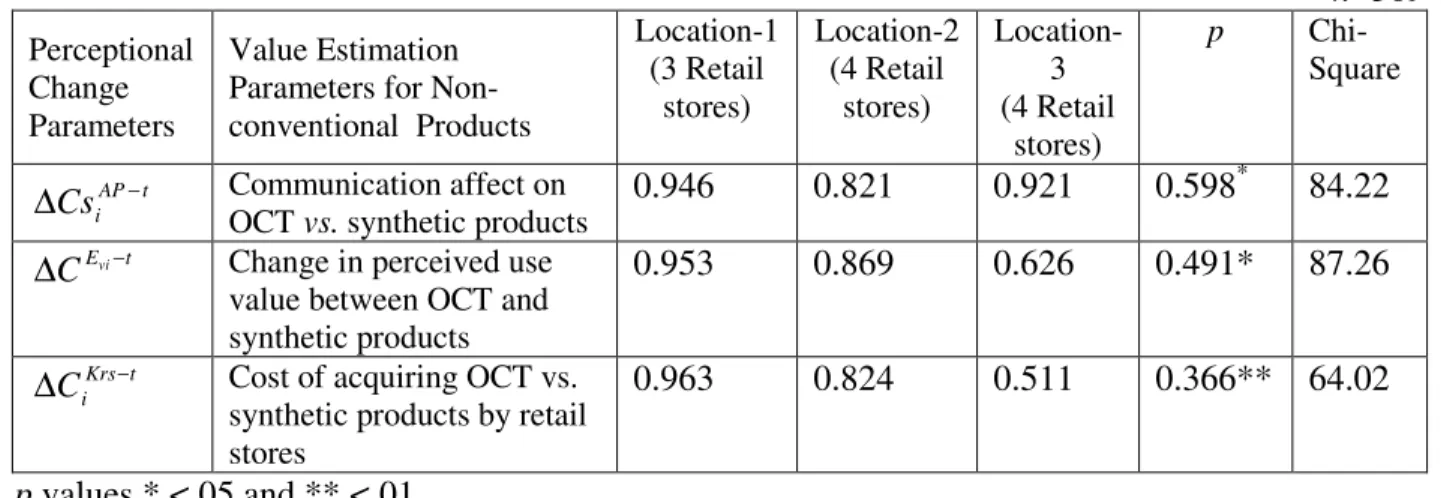
(17) emerging. However, the study revealed that advertising and promotional strategies of the OCT brands helped customers review their preferences against the synthetic cosmetics and toiletries which appreciated the brand value for the OCT products of the companies in Mexican market.. //Table 2 about here//. The Table 2 exhibits the degree of appreciation of customer value generated through the advertising and promotional strategies of the firms towards enhancing the OCT product brands. The value appreciation on the OCT brands by the customers also influences the process of making buying decisions. The analysis of the data presented in the above table reveals that there is a close association among the variables of communication, organizational dimensions and the perceived values of the customers towards new products. The data reveals marginal gaps among these variables which lead to enhance the customer values. The results exhibited in Table 2, hence establish the hypotheses H3 and H4 framed for the study.. //Table 3 about here//. It may be observed from significant values of the change factor ∆C Evi −t representing the perceived use value from the Table 3 that the appropriate product positioning strategies associated with the quality, pricing and communication for the OCT products augments the customer value over the traditional or synthetic cosmetics and toiletries across the retail locations covered under the study. The level of satisfaction derived through the retails stores and personal selling may be seen from the retailing change factor ∆CiKrs −t , which largely keeps the brand value. 17.
(18) of the OCT products high in the retail stores in location 1 and 2 as compared to retailers in location 3. It may also be seen from the data exhibited in the Table through the change factor ∆CsiAP −t. that the OCT products enjoy higher influence of interpersonal communication,. advertising and point of sales promotions over the traditional products in all the retail stores except in those located in location 3. This may be due to the lower level of involvement of the customers towards the point of sales promotions in these retail stores. The results presented in Table 3 endorse the hypotheses H2 and H4.. One of the prominent features emerged during the study is that the customer perception is largely governed by the marketing communications. The word-of–mouth, referrals and commercials issued by the firm drive the decision factors of customers towards the new products. The significance of the different variables associated with the product attractiveness which affect the customer value is exhibited in the correlation matrix discussed in Table 4.. //Table 4 about here//. It may be observed from the analysis that perceived use value ( Evi ) of the customer is largely affected by the point of sales promotions, advertising and promotional strategies propagated as by the firm in media and brand value associated with the products. The data analysis also infers that a good retailing practice ( Z xi ) coupled with strong media appreciation help generating favorable inter-personal communication. Inference may also be drawn from the correlation matrix presented in the Table that the brand value for the OCT products is largely contributed by the point of sales promotions as compared to the media appreciation on the brand.. 18.
(19) Conclusion and Managerial Implications. The customer value in terms of satisfaction, use value, retailing practices, price, quality and media appreciation is one of the indicators for building brand value for the non-conventional products and unfamiliar brands of a firm. The customer value concepts may be applied by the firms to evaluate the product performance of an innovative product like OCT in the given market and determine the approach for gaining competitive advantage over the traditional products. In order to gain the returns in the long run on the aggregate customer value, firms may need to methodically estimate the profitability associated thereof in terms of product attractiveness, volume of buying and market share, while introducing the new products in a competitive market environment (Rajagopal, 2006a). The study proposes framework for future research in measuring the customer value in specific reference to the non-conventional products.. The model discussed in this paper provides a holistic view of the customer value by proposing ways to measure the different variable associated with it viz perceived use value, product attractiveness, cost of product acquisition, communication and point-of-sales promotions offered to the customers. The analysis of these variables would help the managers develop appropriate strategies to enhance the customer value for the new products and optimize the profit of the firm. Managers of a firm may consider the measurement of customer value with the advent of one-toone marketing media, e.g. targeted direct mail or internet marketing; the opportunities to develop customer relationship management campaigns are enhanced in such a way that it is now both organizationally and economically feasible to support a substantially larger number of marketing segments in a profitable manner.. 19.
(20) References. Babakus Emin, Bienstock Carol C and Van Scotter James R (2004), Linking Perceived Quality and Customer Satisfaction to Store Traffic and Revenue Growth, Decision Sciences, 35 (4), 713-737 Bauer Hans H, Hammerschmidt Maik and Staat Matthias (2004), Analyzing Product Efficiency: A Customer Oriented Approach, University of Mannheim, and February Brucks Merrie, Zeithaml Valarie A and Naylor Gilian (2000): price and Brand Name as Indicators of Quality Dimensions of Customer Durables, Journal of Academy of Marketing Science, 28 (3), pp 359-374 Davies Andrew (2004), Moving Base into High-value Integrated Solutions: A Value Stream Approach, Industrial and Corporate Change, 13 (5), October, 727-756. Gamrowski B and Rachev ST (1999): A Testable Version of the Pareto-Stable CAPM, Mathematical and Computer Modeling, Vol. 29, pp 61-81. Giannakas G and Fulton M (2002), Consumption Effects of Genetic Modification: What if Consumers are Right? Agricultural Economics, 27, 97-109 Gourville, John T and Koehler, Jonathan J (2004), Downsizing Price Increases: A Greater Sensitivity to Price than Quantity in Consumer Markets, HBS Marketing Research Paper No. 04-01, January Han Sangran, Gupta Sunil and Lehmann Donald R (2001), Consumer price sensitivity and price thresholds, Journal of Retailing, 77 (4), Winter, 435-456 Hwang A S (2004), Integrating Technology, Marketing and Management Innovation, ResearchTechnology Management, 47 (4), July, 27-31 Ingenbleek Paul, Debruyne Marion, Frambach Ruud T and Verhallen Theo (2003), Successful New Product Pricing Practices: A Contingency Approach, Marketing letters, 14 (4), December, 289-305 Johnson Ulf, Martensson Maria and Skoog Matti (2001), Measuring to Understand intangible Performance Drivers, European Accounting Review, 10 (3), September, 407-437 Lafferty BA and Goldsmith R E (2004), How Influential are Corporate Credibility and Endorser Attractiveness when Innovators React to Advertisement for a New High Technology Product? Corporate Reputation Review, 7 (1), Spring, 24-26 Lusk J L, Jamal M, Kurlander L, Roucan M and Taulman L (2005), A Meta-analysis of Genetically Modified Food Valuation Studies, Journal of Agricultural and Resource Economics, 30, 28-44. 20.
(21) Mather Damien, Knight John and Holdsworth David (2005), Pricing Differentials for Organic, Ordinary and Genetically Modified Food, Journal of Product and Brand Management, 14 (6), June, 387-392 Morschett, Dirk; Swoboda, Bernhard and Foscht, Thomas (2005), Perception of store attributes and overall attitude towards grocery retailers: The role of shopping motives, The International Review of Retail, Distribution and Consumer Research, 15 (4), 423-447 Nielsen C P, Thierfelder K and Robinson S (2003), Consumer Preferences and Trade in Genetically Modified Foods, Journal of Policy Modeling, 25, 777-794 Noussair C, Robitn S and Ruffieux B (2004), Do Consumers Really Refuse to buy Genetically Modified Food? The Economic Journal, 114, 102-120 Pedersen Christian S (2000), Sparsing Risk and Return in CAPM- A General Utility Based Model, European Journal of Operational Research, Vol. 123 (3), pp 628-639. Perraudin William R M and Sorensen B E (2000), The Demand of Risky Assets: Sample Selection and Household Portfolios, Journal of Econometrics, Vol. 97, pp 117-144. Rajagopal and Sanchez R (2004), Conceptual Analysis of Brand Architecture and Relations within Product Categories, The Journal of Brand Management, 11 (3), 233-247 Rajagopal (2006)a, “Measuring Customer Value and Market Dynamics for New Products of a Firm: An Analytical Construct for Gaining Competitive Advantage”, Global Business and Economics Review, September, 2006 (Forthcoming) Rajagopal (2006)b, “Measuring Customer Value Gaps: An Empirical Study in Mexican Retail Markets”, Economic Issues, March 2006 (Forthcoming). 21.
(22) Table 1 Customer Value Estimations: Brand, Preferences and Degree of Satisfaction. n=369 Variable Segments. Value Estimation Measure Parameters for New Parameters Products. pa. Economic variables. C. Krs i. E vi Cs it. Relational variables. Cs iAP Bivg. Satisfaction over price Value appreciation in reference to cost of acquiring OCT products Satisfaction on application Satisfaction over non-OCT products Appreciation in customer value due to advertising and promotion Brand value of the OCT products. Location- Location- Locationp 1 2 3 (3 Retail (4 Retail (4 Retail stores) stores) stores) 0.741 0.722 0.679 0.283*. ChiSquare. 0.949. 0.866. 0.859. 0.462. 59.12. 0.862. 0.715. 0.656. 0.382*. 84.22. 0.930. 0.748. 0.721. 0.694** 87.26. 0.946. 0.771. 0.836. 0.672** 64.02. 0.953. 0.961. 0.910. 0.759** 52.86. 53.60. p values * <.05 and ** <.01. Table 2 Customer Value Appreciation through Effective Communication. n=369 Variable Segments. Measure Parameters. Cs iIP Communication variables. Cs ips Cs ima. Brand Variables. Z xi Fx. Value Estimation Parameters for OCT Products Inter-personal communication Point of Sales Promotions Media appreciation Retailer services Product attractiveness. Location-1 (3 Retail stores). Location-2 (4 Retail stores). 0.936. 0.783. Locationp 3 (4 Retail stores) 0.891 0.441**. 0.947. 0.842. 0.781. 0.616*. 59.22. 0.941. 0.732. 0.866. 0.648*. 61.31. 0.921. 0.736. 0.912. 0.592**. 64.21. 0.911. **. 62.81. 0.943. 0.839. 0.398. ChiSquare. 54.72. p values *<.05 and **<.01. 22.
(23) Table 3: Sensitivity Analysis for the Variables affecting Customer Value towards Nonconventional Products of Unfamiliar Brands n=369 Perceptional Change Parameters. Value Estimation Parameters for Nonconventional Products. ∆CsiAP − t. Communication affect on OCT vs. synthetic products Change in perceived use value between OCT and synthetic products Cost of acquiring OCT vs. synthetic products by retail stores. ∆C Evi −t ∆C iKrs −t. Location-1 (3 Retail stores). Location-2 (4 Retail stores). Location3 (4 Retail stores). 0.946. 0.821. 0.921. 0.598*. 84.22. 0.953. 0.869. 0.626. 0.491*. 87.26. 0.963. 0.824. 0.511. 0.366**. 64.02. p. ChiSquare. p values * <.05 and ** <.01. Table 4: Correlation among the Variables Associated with Product Attractiveness and Influencing the Customer Value for the OCT Products Measure Parameter. CiKrs. E vi. CsiAP. Bivg. CsiIP. Csips. Csima. CiKrs. 1.0000. Evi. 0.9776*. 1.0000. CsiAP. 0.9021. 0.7912. 1.0000. Bivg. 0.4324. 0.6123. 0.0010. 1.0000. CsiIP. 0.6771***. 0.5072. 0.9283. -0.3706. 1.0000. Csips. 0.9548. 0.9959. 0.7330. 0.6808***. 0.4277. 1.0000. Csima. 0.7281**. 0.5678. 0.9526*. -0.3038. 0.9974*. 0.4915. 1.0000. 0.4766 0.2811 0.8093 -0.5865 Z xi * ** *** p values <.05, <0.01 and <0.001 (one-tailed). 0.9696**. 0.1937. 0.9495. **. Z xi. 1.0000. 23.
(24)
Figure
Related documents
A β : Amyloid beta; AD: Alzheimer ’ s disease; ALS: Amyotrophic lateral sclerosis; CB: Coiled body; CERAD: Consortium to Establish a Registry for Alzheimer ’ s disease; CTE:
Podcasting is not only a converged medium (bringing together audio, the web and portable media devices) but also a disruptive technology and one that has already forced some in
Systematic discussion of cloud computing paradigm, technology model, programming framework, and unintended consequence Use Windows Azure to demonstrate the commercial use of cloud
Instead of investing equity capital, physicians may be able to provide debt capital, real estate leasing, equipment leasing, and certain types of management services while
In the SVAR we treat the asset prices similar to the exchange rate in the base model, except for the contemporaneous impact of the housing and equity prices on real credit.. Moreover
In the order dated 20th April, 2004, noticing that despite lapse of nearly 3-1/2 years, the order dated 28th November, 2001 was not being fully implemented in all States and
The rate of extreme poverty in rural areas has fallen from 250 million to 14.79 million people, while public goods and services such as universal primary education, public and
The benthic community is often an important element of aquatic system condition, supporting a diverse flora and fauna that plays a role in the physical, chemical, and
