WORKING PAPER SERIES
NO 1255 / OCTOBER 2010
PREDICTING
RECESSION
PROBABILITIES
WITH FINANCIAL
VARIABLES OVER
MULTIPLE
HORIZONS
MACROPRUDENTIAL RESEARCH NETWORKWORKING PAPER SERIES
NO 1255 / OCTOBER 2010
In 2010 all ECB publications feature a motif taken from the €500 banknote.
PREDICTING RECESSION
PROBABILITIES WITH
FINANCIAL VARIABLES
OVER MULTIPLE HORIZONS
1by Fabio Fornari
2and Wolfgang Lemke
31 We would like to thank participants of the ECB Workshop ‘Forecasting the International Environment of the Euro Area: Global and Regional Spillovers’, 10-11 March 2008, and of the Conference ‘The Euro Area, the Euro and the World
This paper can be downloaded without charge from http://www.ecb.europa.eu or from the Social Science Research Network electronic library at http://ssrn.com/abstract_id=1685168.
NOTE: This Working Paper should not be reported as representing the views of the European Central Bank (ECB). The views expressed are those of the authors and do not necessarily reflect those of the ECB.
MACROPRUDENTIAL RESEARCH NETWORK
© European Central Bank, 2010 Address
Kaiserstrasse 29
60311 Frankfurt am Main, Germany
Postal address
Postfach 16 03 19
60066 Frankfurt am Main, Germany
Telephone +49 69 1344 0 Internet http://www.ecb.europa.eu Fax +49 69 1344 6000
All rights reserved.
Any reproduction, publication and reprint in the form of a different publication, whether printed or produced electronically, in whole or in part, is permitted only with the explicit written authorisation of the ECB or the authors.
Information on all of the papers published in the ECB Working Paper Series can be found on the ECB’s website, http://www.
Macroprudential Research Network
This paper presents research conducted within the Macroprudential Research Network (MaRs). The network is composed of econo-mists from the European System of Central Banks (ESCB), i.e. the 27 national central banks of the European Union (EU) and the Euro-pean Central Bank. The objective of MaRs is to develop core conceptual frameworks, models and/or tools supporting macro-prudential supervision in the EU.
The research is carried out in three work streams:
1. Macro-fi nancial models linking fi nancial stability and the performance of the economy; 2. Early warning systems and systemic risk indicators;
3. Assessing contagion risks.
MaRs is chaired by Philipp Hartmann (ECB). Paolo Angelini (Banca d’Italia), Laurent Clerc (Banque de France), Carsten Detken (ECB) and Katerina Šmídková (Czech National Bank) are workstream coordinators. Xavier Freixas (Universitat Pompeu Fabra) acts as external consultant and Angela Maddaloni (ECB) as Secretary.
The refereeing process of this paper has been coordinated by a team composed of Cornelia Holthausen, Kalin Nikolov and Bernd Schwaab (all ECB).
The paper is released in order to make the research of MaRs generally available, in preliminary form, to encourage comments and sug-gestions prior to fi nal publication. The views expressed in the paper are the ones of the author(s) and do not necessarily refl ect those of the ECB or of the ESCB.
Abstract 4
Non-technical summary 5
1 Introduction 7
2 ProbVAR: a VAR-augmented probit model 10 2.1 Model structure and estimation 11 2.2 Representing the model
with a single state vector 12 2.3 Computing probabilities at the h-period
horizon 13
2.4 Impulse response analysis 14 3 Recession probabilities for the United States,
Germany and Japan 15
3.1 Data on recessions
and explanatory variables 15
3.2 Model specifi cation 16
3.3 Goodness of fi t 17
3.4 Comparison to survey forecasts (US only) 22 3.5 Zooming in on the last two
recession periods 23
4 Illustrating impulse response analysis 28
5 Conclusion 30
References 33
Tables and fi gures 35
Abstract
We forecast recession probabilities for the United States, Germany and Japan. The predictions are based on the widely-used probit approach, but the dynamics of regressors are endogenized using a VAR. The combined model is called a ‘ProbVAR’. At any point in time, the ProbVAR allows to generate conditional recession prob-abilities for any sequence of forecast horizons. At the same time, the ProbVAR is as easy to implement as traditional probit regressions. The slope of the yield curve turns out to be a successful predictor, but forecasts can be markedly improved by adding other financial variables such as the short-term interest rate, stock returns or corporate bond spreads. The forecasting performance is very good for the United States: for the out-of-sample exercise (1995 to 2009), the best ProbVAR specification correctly identifies the ex-post classification of recessions and non-recessions 95% of the time for the one-quarter forecast horizon and 87% of the time for the four-quarter horizon. Moreover, the ProbVAR turns out to significantly improve upon survey fore-casts. Relative to the good performance reached for the United States, the ProbVAR forecasts are slightly worse for Germany, but considerably inferior for Japan.
JEL classification: C25, C32, E32, E37.
Non-technical summary
The expected future level of economic activity is an essential piece of information for policy institutions, such as central banks or financial system surveillance authorities, but also for private-sector decision makers, such as commercial banks or investment funds. Accordingly, there is a vital interest in tools for forecasting the ups and downs of the business cycle. The literature on forecasting economic activity can be broadly divided into two strands: one dealing with forecasting the growth rates of GDP or industrial production, the other trying to predict recession and expansion phases or turning points.
This paper belongs to the second strand as it presents an approach to quantify recession probabilities. In the literature, so-called probit models are the major tool for computing the probability of a recession prevailing at a given point in the future. Among the choice of predictors, the slope of the yield curve has gained particular prominence: an inverted yield curve (long-term interest rate below short-term rate) in the current quarter implies a high probability of recession in the future, typically in one year’s time. Using additional predictors (financial variables, commodity prices, surveys or macroeconomic variables) has been found to increase the forecasting power relative to slope-only probit models. The main characteristic of all such models, however, is that they are usually specified for one specific forecast horizon. Put differently, one needs to estimate a separate model for each forecast horizon of interest.
The model proposed in this paper, in contrast, can be employed to derive the complete set of recession probabilities for all coming quarters. That is, based on a set of observed predictors, it generates a complete ‘term structure of recession probabilities’. This is accomplished by combining the standard probit model with a vector autoregressive model for the regressors. The combined model is called ProbVAR. Unlike similar models in the literature, it is easy to implement and does not rely on computationally-intensive estimation techniques.
Concerning the choice of predictors, we feed the ProbVAR with a number of financial variables. In addition to the term spread, we consider the level of the short-term interest rate, the corporate bond spread and stock returns. We constrain ourselves to financial variables as they are timely indicators that do not suffer from real-time problems.
We estimate the ProbVAR for the United States, Germany and Japan, using quarterly data from 1960Q1 to 2009Q4. The in-sample and out-of-sample fit are satisfactory for Germany and especially for the United States, but less so for Japan. In the out-of-sample exercise (1995 to 2009) for the United States, the best ProbVAR specification correctly identifies 95% of the quarters to be recessions or non-recessions for the one-quarter forecast horizon, and 87% for the four-quarter horizon; for Germany 91% and 76% of the examined quarters are correctly identified for the one- and four-quarter horizon,
respectively. The relatively poor out-of-sample results for Japan are possibly related to the particular pattern with which Japanese recessions occurred, i.e. with long durations and concentrated in the second half of the sample. For the United States, we find in addition that the ProbVAR forecasts are clearly superior to the forecasts of the Survey of Professional Forecasters.
For all countries considered, including additional regressors besides the slope of the yield curve improves the predictive ability over all horizons. For the United States, the best-performing models include the short-term interest rate and the international average of corporate bond spreads as additional predictors; for Germany, the short-term interest rate and the corporate bond spread enter besides the term spread; for Japan, the slope of the yield curve is accompanied by the short-term interest rate and the stock return.
We show that the ProbVAR is well-suited for providing a ‘term structure of recession probabilities’, i.e. the sequence of such probabilities from one to any future quarter ahead. This is not only helpful in gauging the length of a potentially forthcoming recession, but also for tracing the probability of exiting a recession in a future period, when a recession is already prevailing. Taking the US example, the ProbVAR anticipates the profile of the 2001 recession very well. Regarding the most recent recessionary period, associated with the financial turmoil that started in summer 2007, some model specifications correctly detected it, but they initially predicted this recession to be rather short-lived. This is related to the fact that the slope of the yield curve is still a prominent predictor in our ProbVAR models: due to the swift and strong monetary policy response to the crisis, the yield curve recorded a quick steepening thus leading the model to take a strong stance against recession, given the historical relationships between the term spread and business cycle turning points. In this occasion, the relevance of other financial variables (in this case the corporate bond spread), which could counteract this effect, became apparent.
Overall, the ProbVAR model appears to be a useful tool in various fields of applications. For instance, from a macro-prudential perspective, it can help to identify risks of recession in a consistent fashion across short- and medium-term horizons. The information needed to produce such recession probability forecasts is quickly updatable as regressors are financial variables, which are available in real time. For central banks and other policy institutions, the ProbVAR can likewise help to identify and predict periods of economic slack, but it also provides information on the expected remaining duration of a recession, once it has actually begun.
1
Introduction
Business cycle forecasting has attracted a great deal of applied econometric work. This comes as no surprise, as the expected future level of economic activity is an essential piece of information for policy institutions, such as central banks or financial system surveillance authorities, but also for private-sector decision makers, such as banks or investment funds. The literature on forecasting economic activity can be broadly divided into two strands, one dealing with forecasting the growth rates of GDP or industrial production, the other trying to predict recession and expansion phases or turning points in the business cy-cle. Most approaches to forecasting growth rates are based on linear models (such as linear VARs or FAVARs), but several nonlinear alternatives (such as threshold or regime-switching models) have been also put forward in the literature. Econometric approaches aimed to forecast recessions are instead inherently nonlinear and usually employ discrete choice (e.g. probit) models: the probability of recession prevailing at a given future horizon is modeled as a linear combination of selected predictors. Among these, the slope of the yield curve (long-term minus short-term interest rate) has turned out to be particularly successful, see Estrella, Rodrigues, and Schich (2003), Estrella and Hardouvelis (1991), Estrella and Mishkin (1997), and Estrella (2007) among others.
Besides specifications based on the term spread alone, other variables have been found to be useful predictors in probit models of recessions, possibly accompanying the slope of the yield curve. As shown by King, Levin, and Perli (2007), the corporate bond spread also carries predictive power, especially when combined with the term spread. Dovern and Ziegler (2008) use a large set of variables (survey indicators, composite indices, measures of real economic activity and financial indicators) to forecast both economic growth and recession phases in the United States. They evidence that all these indicators improve the forecasting performance of growth rates at short horizons, although they do not necessarily improve the forecasts of recession probabilities. Similarly, Haltmaier (2008) finds that the oil price, a leading indicator of economic activity and a stock price index are significant predictors besides the term spread in a simple probit model for US recessions; the same (apart from the oil price) holds for Germany and Japan. However, false signals are a serious problem when considering out-of-sample predictions. Bellego and Ferrara (2009) draw principal components from a set of several indicators, ending up with three factors representing term spread variables, stock market variables and commodities, respectively, which they use to forecast euro-area recessions. Engemann, Kliesen, and Owyang (2010) find that oil prices have considerable predictive power for US recessions.1 Finally, Wright (2006) shows that probit models that use both the level of the federal funds rate and the term spread predict US recessions and expansions better than models which are based on the term spread only. Besides domestic financial variables, regressors capturing the
1
international environment have been found to be useful predictors for economic activity as well. In a recent application based on probit models, Nyberg (2010) finds that stock market returns and the foreign term spread have additional predictive power to forecast recessions in the United States and Germany beyond the domestic term spread.
Discrete choice models for quantifying recession probabilities have been usually spec-ified for one particular forecast horizon. Hence, if one sets out to predict recession prob-abilities over various, say H, horizons, one would need to estimate H different models. The main drawback of such an approach is that theHseparate models do not account for the tight relationship between economic activity prevailing in the contiguous H forecast horizons and as such they possibly produce non-smooth swings in recession probabilities along the time horizon spanned by H. This is not a desirable model outcome, as it would stand in contrast to the evidence that recessionary months or quarters are clustered in time.
This paper presents an econometric approach that allows to predict recession probabili-ties for any set of horizons from one single model. At the same time, it is as straightforward to implement as the traditional fixed-forecast-horizon probit model. The model consists of two components. The first one is a standard probit relation linking a set of regressors to the recession probability in the subsequent quarter. With this component alone, we would be able to predict recession odds for the one-quarter-ahead horizon only. In order to allow for multi-period forecasts, the probit equation is linked to a VAR – the second component – which endogenizes the dynamics of the selected regressors. The combined model is referred to as a ProbVAR. At each point in time, the conditional probability of the economy being in recession h quarters ahead is obtained in closed-form from the ProbVAR. Forecasts for different horizons are consistent with one another, as they arise from one single model.
Concerning the choice of predictors, we feed the ProbVAR with a number of financial variables. Besides the term spread, we consider the level of the short-term interest rate, the corporate bond spread and stock returns. We constrain ourselves to financial variables as they are timely indicators that do not suffer from real-time problems.2 Corporate bond spreads and stock returns belong either to the country for which recession probabilities are computed or they are averages over the G7 countries.
We estimate the ProbVAR for the United States, Germany and Japan, using quarterly data from 1960Q1 to 2009Q4. The in-sample and out-of-sample fit are satisfactory for Germany and especially for the United States, but less so for Japan. In the out-of-sample exercise (1995 to 2009) for the United States, the best ProbVAR specification correctly identifies 95% of the quarters to be recessions or non-recessions based on their
2
Survey forecasts of economic activity would not be affected by real-term problems, either. However, they are available at a lower frequency than financial variables, and they may suffer from a publication lag.
ex-post classification for the one-quarter forecast horizon, and 87% for the four-quarter horizon; for Germany 91% and 76% of the quarters are correctly identified for the one-and four-quarter horizon, respectively; for Japan, the proportions of correctly identified quarters drop to 82% and 55%, respectively. The relatively poor out-of-sample results for Japan are possibly related to the particular pattern with which Japanese recessions occurred, i.e. with long durations and concentrated in the second half of the sample. For the United States we also find that the ProbVAR forecasts are clearly superior to the forecasts provided by the Survey of Professional Forecasters.
For the three countries considered, including additional regressors besides the slope of the yield curve improves the predictive ability over all horizons. For the United States, the best-performing models include the short-term interest rate and the international average of corporate bond spreads as additional predictors; for Germany, the short-term interest rate and the corporate bond spread are worth including beyond the term spread; for Japan the forecasting performance can be improved by using the short-term interest rate and the stock return as additional predictors besides the slope of the yield curve.
We show that the ProbVAR is well-suited for providing a ‘term structure of recession probabilities’, i.e. the sequence of such probabilities from one to any future quarter ahead. This is not only helpful in gauging the length of a potentially forthcoming recession, but also for tracing the probability of exiting a recession in a future period, when a recession has already begun. For the United States, the ProbVAR anticipates the profile of the 2001 recession very well. Regarding the most recent recessionary period, associated with the financial turmoil that started in summer 2007, some model specifications correctly detect it, but they initially predict this recession to be rather short-lived. This is related to the fact that the slope of the yield curve is still a prominent predictor in our ProbVAR models: due to the swift and strong monetary policy response to the crisis, the yield curve recorded a quick steepening thus leading the model to take a stance against recession, given the historical relationships between the term spread and business cycle turning points. In this occasion, the relevance of other financial variables (corporate spreads and stock returns) became apparent as they managed to counteract the signal stemming from the term spread. Finally, we show that the ProbVAR is a useful device to derive impulse responses of recession probabilities to shocks in selected financial variables. As an illustration, we quantify the changes in recession probabilities following a shock to the term spread. Unlike with plain linear VARs, impulse responses in the ProbVAR depend on initial conditions and are not scaling proportionally with the size of shocks. For instance, for the United States, we find that a decrease in the slope of the yield curve by one percentage point leads to a rise of US recession probabilities: it peaks after four quarters, reaching a 25 percentage points increase over baseline. However, this effect is conditional on the assumption that the shock materializes in a situation where regressors are at their sample averages. Tracing the same shock for a situation where the initial yield curve is steeper leads to a much more
subdued response.
In our ProbVAR model, we do not include information contained in past values of the recession indicator (the dychotomic 0/1 variables) as done by Kauppi and Saikkonen (2008)3, or lagged values of the latent business cycle indicator as in the Qual-VAR model by Dueker (2005), which nests our ProbVAR specification. Hence, unlike these papers we are excluding direct feedback from the lagged business cycle variable itself, thereby omitting the information related to whether and since how long the economy has already been in recession. However, compared to the Dueker (2005) specification, ours comes with the advantage that estimation and forecasting is straightforward, not requiring any computationally-intensive methods, while the Qual-VAR rests on simulation-based infer-ence. Whether the simpler model that we propose leads to an economically significant loss in forecasting ability is largely an empirical question. At least for the out-of-sample fore-cast of the 2001 recession in the United States, for which a direct comparison is feasible, the two approaches give rise to similar results.
The paper is organized as follows. The next section presents the ProbVar model, its estimation and the derivation of recession probabilities over arbitrary horizons. We also explain the calculation of nonlinear impulse responses. The third section presents an application of the model to forecasting recession probabilities in the three countries and evaluates both the in-sample and the out-of-sample forecasting performance; for the United States, we also compare the ProbVAR forecasting performance to that of survey forecasts; finally, we analyze how well the models capture the time profiles of the recessions in the two most recent episodes. The fourth section shows an application of ProbVAR-based impulse response analysis. The last section concludes.
2
ProbVAR: a VAR-augmented probit model
The standard probit specification to quantifying recession probabilities for a fixed forecast horizon of kperiods is of the form
P(yt+k= 1|Xt) = Φ(β0+βXt), (2.1)
whereyt+k is a binary variable equal to one if a recession prevails at time t+k and zero
otherwise;Xt is a vector containing predictors observed att (i.e. possibly including
vari-ables lagged further);β0 and β are a scalar and a vector of parameters, respectively; and Φ(·) denotes the cumulative distribution function of a standard normal. Given estimated (β0, β) and observedXt, (2.1) delivers the conditional recession probability for timet+k.
However, in order to obtain recession probabilities for other forecast horizons h =k, the above equation has to be re-estimated for the specific horizon h. Noteworthy, the
matedβ0 andβ would vary freely across the different horizons, so there is no ‘smoothness constraint’ on the set of probability forecasts as a function of h.
In the following, we propose a model, that produces recession probabilities for an arbitrary set of forecast horizons with a single set of parameters. This is achieved by endogenizing the dynamics of the explanatory variables Xtusing a VAR.
2.1 Model structure and estimation
The first ingredient of the model we propose is a VAR(p) for the dynamics of the regressors. Let xt denote an N ×1 vector of variables that are potentially useful in explaining the
future recession probability. The evolution of xt is assumed to follow a homoscedastic
Gaussian VAR(p) with serially uncorrelated errors,
xt=c0+A1xt−1+. . . Apxt−p+vt, vt∼N(0, S). (2.2)
For the following, it is convenient to work with some arbitrary factorization of the residual covariance matrix: vt:= Σut, with ΣΣ =S and ut∼N(0, I). As usual, we can represent
the VAR(p) (2.2) in companion form,
Xt(p−1) =c+BXt(−p−11)+Rut, (2.3)
where here and in the following Xt(n) ≡ (xt, . . . , xt−n) and with obvious definitions of c,
B and R.
The second ingredient of the model is the standard probit relation, in which a latent variable y∗t is specified as a linear function of explanatory variables:
y∗t =β0+βXt(−l)k+t, t∼N(0,1), and t, us independent for alls,t, (2.4)
where Xt(−l)k = (xt−k, xt−k−1, . . . , xt−k−l) withk >0, l≥0.
In (2.4),kdefines at which point in the past the vector of predictors is positioned, and l determines the number of lags relative to k. For example, with k= 2 andl= 2,y∗t will be dependent on xt−2,xt−3 andxt−4, while fork= 2 andl= 0,y∗t will be dependent only
on xt−2.
Finally, a recession prevails att if the binary indicator variableytequals unity, which
is in turn the case if the latent yt∗ is positive:
yt= 1, ify∗t >0, and yt= 0, otherwise. (2.5)
The complete model comprises the VAR relation (2.3), the linear relation between the latent recession variable and the regressors (2.4), and the mapping (2.5) of yt∗ into the observable binary indicator yt. The system will be referred to as a ProbVAR(p, k, l)
As each parameter of the ProbVAR system either appears only in (2.3) or only in (2.4) and the innovations and u are assumed to be independent, the parameters can be estimated consistently by separately estimating the VAR part (e.g. by OLS) and the probit part (by Maximum Likelihood).
2.2 Representing the model with a single state vector
The vector Xt(p−1) of the VAR in companion form can differ in length from Xt(−l)k used in the probit relation. For instance, it may be the case that there are no further lags beyond k in the probit relation, while the VAR comprises several lags, hence making Xt(p−1) longer than Xt(−l)k. Likewise, there may be several lags required in (2.4) while in the VAR only one lag may suffice. However, for the derivation of recession probabilities over different horizons (see next subsection) it is convenient that Xt(p−1) and Xt(−l)k have the same length. We now describe how to represent both the probit regressors and their (Markovian) dynamics using the same state vector.
There are three cases to consider. Ifl=p−1, thenXt(p−1)in the VAR companion form andXt(−l)k in the probit relation have the same length and the same relative lag structure.
If p−1 > l, then the X vector in the VAR companion form is larger. To represent
the system in terms of this vector, the vectorβ in (2.4) has to be augmented with zeros. That is, we re-write (2.4) as
yt∗ =β0+ ˜βXt(−p−k1)+t (2.6)
where ˜β = (β,0N·(p−1−l)).
If p−1 < l, the probit relation makes use of a richer lag structure than the VAR. In
this case, a VAR(1) representation of this longer state vector will be employed. Denote the number of additional lags to be accommodated byp∆=l−(p−1), then the dynamics ofXt(l)= (Xt(p−1), Xt(−p∆p−1)) are given by4 Xt(p−1) Xt(−p∆p−1) = c 0(N·p∆)×1 + ⎛ ⎝ [B | 0(N·p)×(N·p∆)] 0(N·p∆)×(N·(p−1)) | IN·p∆ | 0(N·p∆)×N ⎞ ⎠ Xt(−p−11) Xt(−p∆p−−11) + R 0(N·p∆)×N ut (2.7)
Unless otherwise noted, we will always work with the canonical state vectorXt(without
superscript) defined asXt≡Xt(max{l,p−1}), so that writing
Xt=c+BXt−1+Rut, (2.8)
4Ifp= 1, the sub-matrix 0
for the VAR dynamics of regressors, we won’t distinguish explicitly, for instance, whether B is just the companion-form matrix of the VAR(p) in (2.3) or the augmented version appearing in (2.7).
2.3 Computing probabilities at the h-period horizon
Given the parameters (c, B, R, β0, β) of the ProbVAR, the objective is to compute probabil-ities of a recession occurringhperiods ahead of a given time periodt, i.e. P r(yt+h = 1|Xt).
Forh=k, this is simply
P r(yt+k= 1|Xt) = Φ(β0+βXt).
Forh > k, the conditional probability is given by
P r(yt+h = 1|Xt) =P r(yt∗+h>0|Xt) =P r(β0+βXt+h−k>0|Xt).
In order to compute this, the VAR dynamics has to be employed. Let d≡h−k. From (2.8) it follows that
Xt+d=BdXt+ (I+B+. . .+Bd−1)c+
d i=1
Bd−iRut+i
The distribution ofXt+d conditional onXtis normal with conditional expectation
µd(Xt) =BdXt+ (I+B+. . .+Bd−1)c (2.9)
and conditional variance-covariance matrix
Vd=
d i=1
Bd−iRR(Bd−i). (2.10)
Thus, the distribution ofyt∗+hconditional onXtis also normal with conditional expectation
md(Xt) =β0+βµd(Xt)
and conditional variance
v2d=βVdβ+ 1.
Accordingly, the probability of interest is given by5
Pr(yt+h= 1|Xt) = 1−Φ(0;md(Xt), vd) = Φ md(Xt) vd . (2.11)
Before examining the empirical performance of the ProbVAR model, it is worth noting that the ‘Qual VAR’ model by Dueker (2005) – briefly described in the introduction – is
5The function Φ(x) denotes the cdf of a standard normal evaluated atx, and the function Φ(x;a, b) is the cdf ofN(a, b2) evaluated atx.
of a similar nature. However, it is more general than the ProbVAR, as it directly specifies the joint dynamics of y∗t and Xtas a VAR.6 Hence, compared to our recursive approach,
where lagged values ofyt∗ do not influence currentyt∗ andXt, it allows for richer dynamics
as such feedback is allowed. As the latent variable enters the VAR, estimating the model and computing predictions has to rely on simulation-based filtering techniques, whereas both tasks are less computationally demanding for the ProbVAR model that we propose. Whether the additional complexity of the Dueker approach adds value for a given forecast exercise remains largely an empirical issue.
2.4 Impulse response analysis
Similar to a linear VAR, the ProbVAR can be used to trace the effect of an unexpected change in one state variable at time t on the time profile of subsequent recession proba-bilities. Formally, we can define an impulse response function as
IR(h;Xt, δ) := Pr(yt+h= 1|Xt+δ)−Pr(yt+h = 1|Xt). (2.12)
As a crucial difference to standard VAR analysis, the sequence of probability responses will not only depend on the shock vector δ but also on the current state Xt. This is an
immediate implication of the probabilities being a non-linear function of the state vector
Xt.
In choosing δ we are faced with the same considerations as with shock identification in linear VAR analyses. In the empirical analysis below, we do not attempt to provide a structural shock identification and use the concept of generalized impulse responses as in Pesaran and Shin (1998). That is, we fix the size of the shock to theith equation in (2.2), sayδi, and set the complete shock vector as the conditional expectation of shocks, given
theith shock, taking into account the covariance matrix of the errors:
(δ1, . . . , δN) =E(vt|vi,t =δi).
In practice, the computation of the conditional expectation employs the normality as-sumptionvt∼N(0, S) in (2.2), where S is replaced by its OLS estimate ˆS.7
6Yet another alternative would consist of deriving recession probabilities directly from a VAR with
observable GDP growth and other variables. Under the assumption of Gaussian innovations, an estimated linear VAR would also provide at each point in time the conditional probability of GDP growth being
negative for at least two quarters from some timet+h henceforth. To our knowledge, a comparison of
such an approach and those based on latent business cycle indicators (Probit, Qual VAR, ProbVAR) has not yet been conducted in the literature.
7The remaining elements ofδare filled with zeros such that it complies with the overall length of the canonical state vectorXt in (2.8).
3
Recession probabilities for the United States, Germany
and Japan
We apply ProbVAR models to estimate recession probabilities in the United States, Ger-many and Japan since the 1960s. We first describe the dependent variables, i.e. the binary recession indicators, and the pool of potential regressors. Thereafter, we report the in- and out-of-sample forecasting performance of selected specifications. For the United States, we also compare the recession forecasts generated by the ProbVAR to those from surveys. For each country, we also conduct an in-depth analysis of the most recent recession and the preceding one.
3.1 Data on recessions and explanatory variables
The data set consists of time series of recession indicators and financial variables, which serve as potential predictors. Data are quarterly and span the period from 1960Q1 to 2009Q4.
The business cycle dating for the United States is taken from the NBER, while the recession classifications for Germany and Japan are from the Economic Cycle Research Institute (ECRI).8 A given quarter is considered as a recession if at least one month in that quarter was identified to be a recession.
We consider the following group of potential regressors: the slope of the yield curve (ten-year government bond yield minus short-term interest rate),sl, the short-term interest rate itself, i, the year-on-year log return of a broad composite stock price index, sr, and the corporate bond spread, cs. All these time series are taken from Global Financial Data. For the stock return we try both the domestic values of the variables and the average value of that variable for the G7 countries (indicated by the superscript G7av). Similarly, we compute the average of the corporate bond spread (also indicated by the superscript G7av), using the data series from Canada, Germany, the United Kingdom and the United States. The other countries are not used for constructing the average as either no series (France) or no reliable series (Italy, Japan) for corporate bond spreads were available. The international (G7 average) counterpart of the domestic stock returns and corporate bond spreads is taken into account because several papers evidence that commonalities are present in the business cycles of main economic areas. Therefore, to the aim of forecasting the probability of recession in one country, variables that point to the simultaneous occurrence of a brightening or deteriorating international environment potentially matter beyond domestic indicators.
3.2 Model specification
To the aim of forecasting recession probabilities in the three countries, we run the Prob-VAR model with different combinations of regressors and different lag specifications. For comparison, we also estimate sets of simple probit models by employing equation (2.1) for each specific horizon. Recall that in contrast to the ProbVAR models, the simple probit models have to be estimated separately for each forecast horizonh.
For both model types (ProbVAR and simple probit), we consider specifications with one to three regressors. We always include the slopeslof the domestic yield curve since this variable has been shown to be key in forecasting recessions in the literature. Besides the slope-only specification, we consider specifications with one or two additional regressors from the following pool of five variables: {i,sr,srG7av,cs,csG7av}. To restrict the total number of examined combinations we do not consider set-ups that containsrtogether with srG7av, orcstogether withcsG7av, leaving us with a total set of 14 regressor combinations. Concerning the lag structure of the ProbVAR, we fix the lag k in the probit relation (2.4) to one, in order to have one quarter as the shortest forecast horizon. As additional lags in the probit relation (2.4), we consider l = 0, i.e. no additional lags beyond one, and l = 3, i.e. the probit relation contains regressors lagged by one to four quarters. The lag structure of the VAR is chosen to be either one or four. Hence, using the termi-nology introduced in section 2.1, we consider four dynamic specifications for each set of regressors: a ProbVAR(p = 1,k = 1,l = 0), a ProbVAR(1,1,3), a ProbVAR(4,1,0) and a ProbVAR(4,1,3). For example, the ProbVAR(1,1,3) features a VAR(1) for the regressors xt while the lagsxt−1,xt−2,xt−3 andxt−4 enter the probit relation.
When dealing with the simple probit models, the lag length of the regressor is de-termined by the forecast horizon. Thus, for instance, to the aim of forecasting reces-sions six quarters ahead via the slope of the yield curve, the simple probit model has to be estimated on data pairs (yt, slt−6) possibly enhanced with additional lags, i.e.
(yt, slt−6, slt−6−1, . . . , slt−6−l). In analogy to the ProbVAR case we consider the cases
l= 0 and l= 3.
We compare models by looking at recession forecasts between one and six quarters ahead. We consider in-sample and out-of-sample forecasts. For the in-sample version, the parameters of the ProbVAR and simple probit models are estimated on data going from 1960Q1 to 2009Q4.9 For the out-of-sample exercises, the models are estimated on
9More precisely, the first data tuple used for estimation always includes the recession indicator of
1962Q2. This is done in order to guarantee that all specifications will provide forecasts for the same sequence of quarters. For instance, for the simple probit model withl= 0 and a forecast horizon of six quarters, the probability of recession in 1961Q3 could be forecast with variables dated 1960Q1, but for the specification withl= 3 (richer lag structure of probit), the required regressors lie before the beginning of
the data set. For the richest specifications (simple probit withl = 3, and ProbVAR with l= 3 and/or
expanding windows of data. The first window ends inT0∗= 1994Q4, meaning that the last yt in this window is recorded at that quarter. Given the estimated parameters based on
this window, the respective state vector is plugged into the estimated model and recession probability forecasts for times T0∗+h,h= 1,2,3, . . . are computed and stored. Then the model is estimated on a window expanded by one quarter, and so forth.
3.3 Goodness of fit
Tables 1 to 12 show the fit of the 14 (identifying the regressor combination) times 4 (identifying the lag specifications) different ProbVAR models and the 14 times 2 simple probit models for the United States, Germany and Japan, respectively. For each country and model type, we present in-sample and out-of-sample results.10
The upper part of the tables shows the mean absolute forecast error (MAE), given by the mean absolute difference between the model-implied probabilities and the actual outcome of the binary recession variable, i.e.
MAE= 1 T T t=1 y t−Pr(yt= 1) . (3.13)
The bottom part of the tables reports the so-called R2count measure of fit, i.e. the weighted sum of fractions of correctly identified recession and non-recession periods,
R2count = n11 n1 · n1 n + n00 n0 · n0 n = n11+n00 n , (3.14)
where n is the number of quarters for which forecasts have been computed, n1 is the number of recessions, n0 = n−n1 is the number of non-recession quarters, n11 is the number of correctly identified recessions and n00 is the number of correctly identified non-recessions.
It is important to note that the R2count fit measure as well as the single ‘hit ratios’ of correctly identified recessions, n11
n1 , or correctly identified non-recessions,
n00
n0 , are all
relying on a conversion of the model-implied recession probabilities into a binary variable. That is, given an estimated probability of recessionPr( yt= 1) for some timet, a mapping
D : [0,1] → {0,1}, ˆyt =D
Pr(yt= 1)
, has to be applied to convert probabilities into alleged recessions or non-recessions. Usually, such a decision rule depends on a threshold Pr∗ such that ˆyt = 1, ifPr( yt = 1) > Pr∗ and ˆyt = 0 otherwise. Hence, the choice of
horizon.
10For our model comparisons, we assume that the same model specification is used across time.
Alter-natively, the out-of-sample exercises could be based on recursively choosing the best model specifications (for instance, based on information criteria). Our approach of looking at the models separately, yields a more clear-cut result on the individual models’ performances. However, it could in fact be the case that the best forecasting model changes over time, so that our best specification could be improved upon in terms of forecast accuracy. We leave such an analysis for future research.
the threshold Pr∗ is key. Setting Pr∗ = 0.5 is often too conservative a criterion, especially when the overall fraction of recessions in the sample is relatively small.11 A natural choice is to set Pr∗ equal to the frequency of recessions measured over a long period. We set Pr∗ = 0.20 for the United States and Japan and Pr∗ = 0.25 for Germany.12 While in the out-of-sample exercises, this threshold could be adjusted period by period, we treat it as constant so that results are independent of such time variation.
For the United States, variable specifications 6,7,11,14 could not be estimated for at least one lag combination (or at least one horizon for the simple probit models) and at least one sub-sample in the out-of-sample forecasting exercise. As is well-known in the standard probit literature, this problem arises when the regressor and lag structure is too rich, so that it would provide a perfect fit.13 Therefore, the corresponding lines are left blank in the result tables for the United States14 Finally, for Japan, there are blank lines for all specifications that include the domestic corporate bond spread, since this is not available for Japan as discussed in section 3.1.
3.3.1 United States
What should be considered the preferred specification for the United States? Looking at both the in- and the out-of-sample performance, at both the M AE and R2count measure of fit, and at both ProbVAR and simple probit models (Tables 1 - 4), the model specifica-tions containing the term spreadsl, the short-term interest rate i, and the international average of corporate bond spreads csG7av appears to dominate, but the specification in-cluding the term spread sl, the domestic stock return sr, and the international average of corporate bond spreadscsG7av also performs very well. These specifications will there-fore be used for the more in-depth analyses of the model performance in the remainder of the paper. Regarding the lag specification, the richer probit equation is preferred (i.e. four lags rather than one) while for the ProbVAR models, where also the VAR lags have to be determined, the more parsimonious model is selected. That is, we consider Prob-VAR(1,1,3) specifications (1 lag in the VAR, probit relation including variables fromt−1 tot−4.).
In the out-of-sample exercise, considering the average forecasting performance between one and six quarters ahead, the (sl, i,csG7av)-ProbVAR(1,1,3) correctly predicts 83% of the forecast quarters to have been recessions or non-recessions, respectively. For the one-quarter horizon this fraction even amounts to 95%, while standing at 85% for the
11See the discussion in the chapter on discrete choice models in Greene (2003).
12Computed over the whole sample, the fraction of recessions amounts to 0.20 for the United States, to 0.28 for Germany, and to 0.21 for Japan.
13See the discussion in Greene (2003), p. 683-4.
14For reasons of consistency the corresponding lines are also left blank in the tables with in-sample results.
four-quarter horizon. This is markedly higher compared to the slope-only specification with the same lag structure, for which the R2count measures for forecast horizons of one and four quarters only amount to 71% and 69% respectively.
Comparing the best out-of-sample performances of the simple probit specifications with those of the ProbVAR models (table 4 vs. table 3), it turns out that there are no sizeable differences, a result that holds with respect to both fit measures, M AE and Rcount2 . Hence, the ProbVAR specifications, for which forecasts for all horizons come from the same model, do neither appear superior nor inferior compared to the simple probit specifications, which have to be estimated separately for each forecast horizon. However, the ProbVAR comes with some other advantages as will be discussed below.
Figures 1 - 2 show the in-sample fit of the ProbVAR and the simple probit models, respectively. The figures contain the fit from the slope-only specification as well as the fit from the (sl,i,csG7av)-specification. Apparently, the richer specification outperforms the slope-only counterpart because it assigns higher probability to recession periods as well as because it reduces the number of ‘false signals’, i.e. recessionary signals when in fact the respective quarter would not turn out to be a recession.
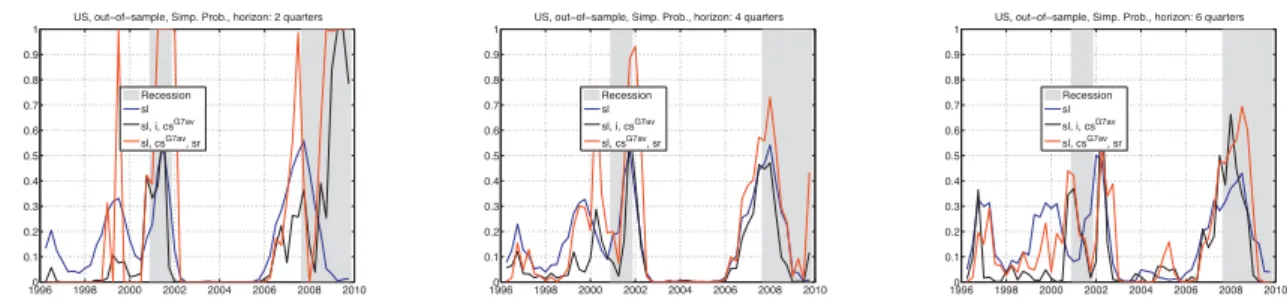
Figure 3 displays the results for the out-of-sample analysis with ProbVAR specifications including also the (sl, csG7av, sr)-specification. It turns out that the superiority of the (sl,i,csG7av)-specification over the slope-only specification is mainly due to the fact that the former produces fewer false signals. The other specification, (sl, csG7av, sr), despite assigning even higher probabilities to recession periods tends to generate false probability spikes, on account of the relatively more volatile stock-return regressor that it features.
Concerning the most recent recession, none of the considered specifications is able to stand out. On the one hand, the (sl, csG7av, sr) and slope-only version have been
falsely signaling high recession probabilities for more than one year before the start of the recession, while the (sl, i,csG7av)-specification has not. The false signals are emitted mainly on account of the slope of the yield curve, which was flat or even negative during the period. The (sl,i,csG7av) specification, in contrast, manage to counteract this effect on account of the relatively low level of the short-term interest rate, which by itself gave a signal against recession.
On the other hand, the (sl,i,csG7av) and the slope-only specification do not manage
to clearly recognize (in the sense of two- and four-quarter predictions) the latest recession episode when it had already started. The reason is that monetary policy reacted very quickly and strongly at the onset of the financial crisis, which led to a steep yield curve and a low short rate - both being signals against the occurrence of a recession based on historical data patterns. The (sl, sr, csG7av)-specification fares better as it takes into
consideration the strong stock market losses and the high corporate bond spreads, thus counteracting the signal coming from the slope of the yield curve. A more detailed analysis on how well the ProbVAR models manage to trace the time profile of the last two recessions
is conducted in sub-section 3.5.
Turning to the simple-probit models, the out-of-sample results in figure 4 are broadly similar to the respective ProbVAR counterparts, although with some noteworthy differ-ences. For instance, for the two-quarter horizon, the simple probit version with the (sl, sr, csG7av)-specification features a major false probability spike in the late 1990s, which
is less sharp in the corresponding ProbVAR version. By contrast, the latter model sends a wrong signal in 2003, which does not occur for the simple probit version. For the most recent recession, the probability assessments are roughly similar, but at the four-quarter horizon the ProbVAR (sl, sr, csG7av)-specification appears to perform better than its simple-probit counterpart. Overall, while the quantitative measures of forecasting perfor-mance do not see a clear advantage in using the ProbVAR over the simple probit or the other way round, the graphical results do not evidence clear dominance of one of the two model types either.
3.3.2 Germany
Compared to the encouraging outcomes for the United States, the results of the German specifications are somewhat inferior across all forecast horizons, which holds for both in-and out-of-sample forecast exercises in-and for both ProbVAR in-and simple probit models. Nonetheless, the lowest average M AE and highest average R2count measures for the out-of-sample results from the ProbVAR, which stand at 0.27 and 0.75, respectively, are high enough to consider the behavior of the model as overall satisfactory. The best performing specification includes the slope of the yield curve, the level of the short-term interest rate and the corporate bond spread, (sl,i, cs). The specification that replaces the corporate spread by the stock return does only marginally worse.
Again, as already observed for the United States, the preferred model specification greatly improves over the standard slope-only specification. The latter reaches an M AE of 0.42 and an average R2count of 0.38 only. Looking also at the (sl, i)-specification, one observes that including the short-term interest rate in addition to the slope already improves the forecasting performance, but the additional inclusion of the corporate bond spread (or stock return) leads to a further improvement. For the in-sample results (table 5), the relative improvement over the slope-only specification is not as strong as in the out-of-sample case, but it is nonetheless remarkable.
The three panels of figure 5 show the in-sample fit of the ProbVAR models with the preferred (sl,i,cs) specification and the slope-only specification. The former is obviously better at discriminating between recession and non-recession periods, a result that holds for all of the chosen forecast horizons. The simple-probit versions of these specifications (figure 6) give a similar pattern.
specification. For each forecast horizon, the latter does not generate enough variability in the probability forecasts, so that it attributes very small probabilities of recessions to periods which were actually recessions. Furthermore it provides a fairly large number of ‘wrong signals’ (for the recession probability threshold of 0.25). The preferred (sl, i, cs)-specification reduces the number of false signals, which is the main reason for its better overall fit measures. However the model does not manage to predict the beginning of the two recessions during the period considered. A similar pattern emerges for the simple-probit version (figure 8).
As we did for the United States, we also include in figures 7 and 8 the out-of-sample performance of the (sl, csG7av, sr) specification. This specification does not include the short-term interest rate as regressor. Compared to the (sl, i, cs)-specification with the highestR2count and lowest M AE, the (sl,csG7av, sr)-model recognizes the two recessions
earlier. It also manages to keep near-term recession probabilities in 2005 and 2006 lower than the slope-only version does, but overall produces more false signals than the preferred (sl,i,cs) specification. The graphical comparison between the ProbVAR models and their simple-probit counterparts shows similar patterns, which is in line with the fact that the goodness-of-fit measures also gave similar magnitudes.
3.3.3 Japan
Figure 9 highlights that the Japanese economy has exhibited a pattern of recession periods significantly different from the US and German experience. From the beginning of our sample in 1960 to 1991 only one recession has been recorded, namely between 1973Q4 and 1975Q1. From 1992 until the end of the sample, in contrast, Japan has experienced a recession for about 50% of the time. This odd distribution of recession periods obviously poses a challenge for any forecast model.15
According to the M AE and R2count measures, the in-sample performance of both the best ProbVAR and the best simple probit specifications for Japan (tables 9 and 10) do not differ much from the results obtained for Germany. However, when judging the out-of-sample performance of the model (tables 11 and 12) , there is a significant deterioration relative to the results obtained for the other two countries.
Based on both in-sample and out-of-sample results, the preferred specification contains the slope, the short-term interest rate and the stock return as regressors. Again, this improves upon the slope-only specification, but not as sizably as was the case for the best specifications of the other two countries. As for the US and Germany, we also include a
15Based on a sample from 1978 to 1997, Hirata and Ueda (1998) find that the term spread has some
predictive power for Japanese recessions, but it is by far not as strong as in the case of the United States. They also find some predictive content of stock market data for longer forecast horizons, but this predictor produces fairly noisy signals.
third specification that does not contain the short-term interest rate, but which contains the international average of corporate bond spreads
In the out-of-sample forecast exercises (figures 11 and 12), neither of the model specifi-cations manage to predict the beginnings of the first two recessions (1997Q1 and 2000Q3) for the considered time period. The preferred specification only recognizes the start of the 2000Q3 recession for the one-period forecast horizon (not shown in the picture). For the most current recession, however, the preferred (sl,i,sr)-specification manages to forecast it at the two-quarter horizon. The (sl, csG7av, sr)-specification is also able to do so and additionally manages to emit fewer false signals during the time between the last two recessions.
Finally, comparing the results from the ProbVAR specifications to the corresponding simple probit models, the forecasting quality appears to be similar.
3.4 Comparison to survey forecasts (US only)
For the United States we are also able to compare the forecasting performance of the ProbVAR to results from a survey. In the Survey of Professional Forecasters (SPF), par-ticipants are asked to state the probability of a decline in US GDP in each of the four subsequent quarters. For the one-quarter horizon, the resulting series of probabilities has been ‘nicknamed’ as the ‘anxious’ index. Although the survey question does not directly ask whether the economy will be in recession, we nevertheless treat the respective prob-ability responses as comparable to subjective recession probabilities. Figure 13 compares the recession probabilities from the survey for the one- and four-quarter horizon with the out-of-sample predictions from the two ProbVAR(1,1,3) specifications, (sl,i,csG7av) and (sl, csG7av, sr), for the quarters between 1996 and 2009. It turns out that the range of recession probabilities announced during this time is smaller for the surveys than for the ProbVAR. In particular, for the four-quarter horizon, the survey-based probabilities range between 9% and 28%, while those from the models range from zero to around 100%. A visual inspection suggests that the two ProbVAR specifications are superior to the SPF forecasts. In fact, the upper panel of table 13 shows that the two considered ProbVAR models, but also almost all other ProbVAR specifications, give rise to smaller mean ab-solute forecast errors than the survey. Moreover, the difference in MAEs between the preferred (sl, i, csG7av)- and (sl, csG7av, sr)-model-based probabilities and the proba-bilities stemming from the surveys is also statistically significant (see the lower panel of table 13), as is the case as well for a few other specfications. Notably, there are only two ProbVAR specifications (‘slope only’ and ‘slope with corporate bond spread’) that do significantly worse than the survey for the one-quarter horizon.
3.5 Zooming in on the last two recession periods
As argued above, the ProbVAR model is ideally suited to generate at a given point in time the whole sequence of recession probabilities for the coming quarters. Such a ‘term structure of recession probabilities’ can likewise be generated with a set of simple probit models. However, a separate set of parameters has to be estimated for each horizon, which lacks the consistency imposed by the ProbVAR. In the following subsections we discuss these model-implied time profiles of recession probabilities for the most recent recession and the previous one in the three countries.
3.5.1 United States
In order to see to what extent the ProbVAR model traces the recession profile of the US 2001 recession, we estimate the model parameters (both the VAR part and the probit part) using data up to and including 2000Q3, i.e. we use only information dated two quarters before the start of the recession. We then use the regressors and their required lags prevailing at that date to compute the recession probability for 2000Q4, 2001Q1, ..., 2003Q3. We employ the same model specifications as discussed in section 3.3.1: the slope sl as only regressor; the preferred specification with the slope, the short-term interest rate and the international corporate bonds spread (sl, i, csG7av) as regressors; and the specification with the slope, the average corporate bond spread, but the short-term interest rate replaced by the stock return, (sl,csG7av,sr).
The left panel of figure 14 plots the three term structures of recession probabilities between 2000Q4 and 2003Q3 based on 2000Q3 information. The slope-only and the (sl, i,csG7av)-specification trace the time path of the recession very well. They initially assign a small recession probability (well below 20%, the chosen threshold as discussed in subsection 3.3) to the subsequent quarter (2000Q4), in which the recession in fact did not occur, to then fit the time profile of the unfolding recession. The slope-only specification produces probabilities of 35%, 43%, 51% and 41 %, for the four recession quarters, the preferred (sl, i,csG7av)-specification provides somewhat lower probabilities of 21%, 44%, 40% and 26%,
which nevertheless exceed the 20% threshold. Moreover, the preferred specification also manages to assign probabilities of below 20% for the quarters beyond the recession’s end. In this sense, the model provides an accurate forecast of the length of the recession, when the econometrician stood two quarters before the beginning of the recession. The slope-only model also produces declining recession probabilities, but the decline takes place at a lower speed. The (sl,csG7av,sr)-specification manages to produce very high probabilities for the recession quarters (88%, 84%, 68% and 45%) as well as a quick decay of such probabilities thereafter. However, it wrongly predicts the recession to start one quarter earlier than it actually did.
that this model is more general as our ProbVAR since it also allows for feedback from the lagged latent business cycle indicatoryt∗−lto the currentyt∗and regressorsXt. In Dueker’s
study, Xt comprises real quarterly GDP growth, quarterly CPI inflation, the slope of the
yield curve as well as the federal funds rate. He claims that “a recession probability above 50% for 2001:Q3 and 2001:Q4 is a rather strong signal of recession. This is especially true in light of the difficulties that professional forecasters and the leading indicators had in anticipating the 2001 recession.” Against this background, the ProbVAR specifications do very well in this exercise and turn out to be similarly discriminative as the probabilities obtained by Dueker. As a difference, his recession probability for 2001Q1 is somewhat lower than all our ProbVAR specification. However, as the begin of the recession is dated as March 2001 (i.e. only the last third of 2001Q1 was in recession), it is not clear which of the results should be considered superior for this quarter. In the last recession quarter 2001Q4, in contrast, our probabilities are somewhat lower than Dueker’s, but still indicative of a recession. For the subsequent out-of-recession quarters, our recession probabilities turn out to be superior as they show a quicker decay than Dueker’s.
How do our ProbVAR results compare to the application of twelve (the number of horizons) simple probit models? The left panel of figure 15 shows that the corresponding sequences of probabilities do not match the recession profile as nicely as the different spec-ifications of the ProbVAR do. The simple probit specspec-ifications do capture the beginning of the recession in a similar fashion as their ProbVAR counterparts. However, the recession probabilities stay high for too long (slope-only specification) or go down too early (the two richer specification). Moreover, using the information set dated 2000Q3, the simple probit specifications forecast the start of another recession in 2003Q1. This points to another advantage of the ProbVAR versions of the model, namely that recession probabilities tend to revert to their unconditional means when considering long forecast horizons.
Another exercise to assess a model’s ability at fitting recession probabilities is to look at how well it predicts the exit from a recession given that the forecaster stands within the recession. With the same set of parameters as before, but using state variables dated 2001Q3, i.e. standing in the third recession quarter, we produced again the recession prob-abilities for the twelve subsequent quarters. As shown by the right panel of figure 14, the sl- and (sl,i,csG7av)-ProbVAR models do a very good job in assigning a high probability
of recession to the following quarter (which was the last recession quarter), while dropping below 10% thereafter (when recession in fact was over) to finally slowly converge towards the long-run recession frequency. The (sl, csG7av,sr)-specification essentially also shows the correct time profile but forecasts the length of the recession as one or two quarters longer than it actually turned out to be. The simple probit models performed similarly well in this experiment (right panel of figure 15), but produce an undesirable increase of recession probabilities towards the more distant forecast horizons.
recession, which the NBER dated to have started in December 2007. The out-of-sample forecasting exercise is based on parameters estimated on data up to 2007Q2 and on state variables up to 2007Q4. Through these ingredients we produce recession probabilities for the twelve quarters after 2007Q4. Figure 16, left panel, plots the results for our three ProbVAR model specifications. The slope-only specification and the (sl,i,csG7av
)-specification correctly assign a high recession probability for 2008Q1 but they foresee a swift decay of these probabilities thereafter. The (sl,csG7av,sr)-specification, in contrast, does not see a recession in 2008Q1, but implies high probabilities for the US economy to be in recession between 2008Q2 and 2009Q1.
The exercise is repeated with the forecaster standing in 2008Q3 (i.e. the quarter including the Lehman Brothers’ collapse), but still keeping the parameters fixed at the values based on estimating the model up to 2007Q2. The slope-only specification does not recognize a recession for the following quarters at all. The preferred (sl, i, csG7av )-specification assigns a high recession probability for 2008Q4 but predicts the recession to end thereafter. The (sl,csG7av,sr)-specification, in contrast, adequately implies very high recession probabilities for the four subsequent quarters (2008Q4 to 2009Q3), after which the probabilities quickly decline.
Why do thesland (sl,i,csG7av) specifications fail to see a protracted recession, given the intensity of the financial turmoil? The reason most likely has to be found in the very strong reaction of US monetary policy, which led to a sudden rise of the slope of the yield curve as the short term interest rate was aggressively lowered since the start of the crisis. In fact, the slope of the yield curve turned from being negative in the first quarter of 2007, to a positive value of more than two percentage points by the end of 2008. Given the estimated historical regularities, the slope-only model could not avoid interpreting this as a strong signal against recession. Specification (sl, i, csG7av) counteracts the effect coming from the slope through the inclusion of the corporate bond spread, which widened during the crisis, thereby contributing to increasing the model-implied recession probability. However, the specification also includes the short-term interest rate, which reached historical lows during the crisis, thus contributing to decreasing the model-implied recession probability again. The successful third specification, in contrast, compensated the falsely comforting signal from the term spread by including both the corporate bond spread and stock returns.
Finally, the simple probit versions of the slope-only and the (sl,i,csG7av)-specifications (figure 17) disappointed similarly to their ProbVAR counterparts during the most current recession. The (sl,csG7av,sr)- specification, that performed well in its ProbVAR version, produces markedly inferior results when the forecasts are based on separately estimated simple probit models.