A
PRIL
2003
Analysis of short tandem repeat (STR)
polymorphisms by the powerplex 16 system
and capillary electrophoresis: application to
forensic practice.
Osamu Okamoto
∗Yuji Yamamoto
†Sachiyo Inagaki
‡Kei Yoshitome
∗∗Takaki ishikawa
††Kiyomi Imabayashi
‡‡Satoru Miyaishi
§Hideo Ishizu
¶∗Okayama University, †Okayama University, ‡Okayama University, ∗∗Okayama University, ††Okayama University, ‡‡Okayama University, §Okayama University, ¶Okayama University,
and capillary electrophoresis: application to
forensic practice.
∗
Osamu Okamoto, Yuji Yamamoto, Sachiyo Inagaki, Kei Yoshitome, Takaki
ishikawa, Kiyomi Imabayashi, Satoru Miyaishi, and Hideo Ishizu
Abstract
Allele and genotype frequencies for 15 short tandem repeat (STR) polymorphisms–D3S1358, TH01, D21S11, D18S51, Penta E, D5S818, D13S317, D7S820, D16S539, CSF1PO, Penta D, vWA, D8S1179, TPOX and FGA–in a Japanese population were estimated. No deviations of the observed allele frequency from Hardy-Weinberg equilibrium expectations were found for any of the systems studied. Between 2 new pentanucleotide STR loci, Penta E and Penta D, for which there is only limited data regarding the allelic distribution in Japanese, the Penta E locus was found to be highly polymorphic and exhibited a tri- or tetra-modal distribution pattern having allelic peaks with 5, 11, 15 and 20 repeats. The distribution was significantly different from that of the other ethnic groups. Statistical parameters of forensic importance, the power of discrimination (PD), observed and expected heterozygosity values (H), polymorphism information content (PIC), power of discrimination (PD), matching probability (pM), power of exclusion (PE), and typical paternity index (PI), were calculated for the loci. These parameters indicated the usefulness of the loci in forensic personal identification and paternity testing among Japanese. The systems Penta E, FGA, D18S51 and D8S1179 were the most informative. This method was successfully applied to forensic personal identification and paternity testing among Japanese, thereby confirming its efficacy for forensic practice.
KEYWORDS:population data, DNA typing, short tandem repests, personal identification, pater-nity testing
∗PMID: 12866745 [PubMed - indexed for MEDLINE]
Analysis of Short Tandem Repeat (STR) Polymorphisms by
the PowerPlex 16 System and Capillary Electrophoresis:
Application to Forensic Practice
Osamu Okamoto, Yuji Yamamoto , Sachiyo Inagaki, Kei Yoshitome, Takaki Ishikawa, Kiyomi Imabayashi, Satoru Miyaishi, and Hideo Ishizu
Department of Legal Medicine, Okayama University Graduate School of Medicine and Dentistry, Okayama 700-8558, Japan
Allele and genotype frequencies for 15 short tandem repeat (STR)polymorphisms D3S1358, TH01,
D21S11, D18S51, Penta E, D5S818, D13S317, D7S820, D16S539, CSF1PO, Penta D, vWA,
D8S1179, TPOX and FGA in a Japanese population were estimated. No deviations of the observed
allele frequency from Hardy-Weinberg equilibrium expectations were found for any of the systems studied. Between 2 new pentanucleotide STR loci, Penta E and Penta D, for which there is only limited data regarding the allelic distribution in Japanese, the Penta E locus was found to be highly polymorphic and exhibited a tri-or tetra-modal distribution pattern having allelic peaks with 5, 11, 15 and 20 repeats. The distribution was significantly different from that of the other ethnic groups. Statistical parameters of forensic importance, the power of discrimination (PD), observed and expected heterozygosity values(H), polymorphism information content (PIC), power of discrimina-tion (PD), matching probability (pM), power of exclusion (PE), and typical paternity index (PI), were calculated for the loci. These parameters indicated the usefulness of the loci in forensic personal identification and paternity testing among Japanese. The systems Penta E, FGA, D18S51 and D8S1179 were the most informative. This method was successfully applied to forensic personal identification and paternity testing among Japanese, thereby confirming its efficacy for forensic practice.
Key words:population data, DNA typing, short tandem repeats, personal identification, paternity testing
T
he short tandem repeats (STRs)are a rich source of highly polymorphic markers in the human genome, are relatively small in size, and can be studied with the polymerase chain reaction(PCR)in a multiplexed fashion[1]. Thus the STR polymorphisms are highly useful tools for personal identification and paternity testing in forensic practice[2-6]. The use of multiplexamplification of many STR loci in conjunction with semi-automated fluorescent typing has proven highly efficient and informative[5, 6]. In this study, we used a commercially available multiplex STR typing kit to study 15 STR systems (D3S1358, TH01, D21S11, D18S51, Penta E, D5S818, D13S317, D7S820, D16S539, CSF1PO, Penta D, vWA, D8S1179, TPOX, and FGA)in a Japanese population, and estimated the allele and genotype frequencies. These 15 STR loci include 2 new pentanucleotide repeat STR loci, Penta E and Penta D, for which there is only limited data in regard to the
Received August 30, 2002; accepted October 30, 2002.
Corresponding author.Phone:+81-86-223-7151;Fax:+81-86-235-7201 E-mail:y-yamamo@md.okayama-u.ac.jp (Y. Yamamoto)
http://www.lib.okayama-u.ac.jp/www/acta/
Acta Med. Okayama, 2003 Vol. 57, No. 2, pp. 59-71
Original Article
allelic distribution in Japanese. In addition, we evaluated the usefulness of these 15 STR systems in forensic investigations and paternity testing by calculating several statistical parameters of forensic interest and by examin-ing materials in 20 paternity, 1 zygosity diagnosis, and 2 criminal cases.
Materials and Methods
Peripheral blood samples were taken after obtaining informed consent from 125 unrelated Japanese student or staffvolunteers in 1999 and 2000 and from 52 subjects requesting paternity tests from 1997 to 2000. Peripheral blood samples were also obtained from 20 trios (60 Japanese subjects)requesting paternity tests and from a pair of twins in a zygosity test. Two criminal cases were also investigated. In the first, a cardiac blood sample from an infant corpse, a blood clot on the maternal side of the placenta, a piece of the umbilical cord attached to the placenta, and a peripheral blood sample of a woman suspected to be the mother of the infant were used for forensic identity tests. In the second, a tooth taken from the skeletonized remains of a 30-50 year old man and a peripheral blood sample taken from a man who was thought to be the father of the deceased were also tested.
The peripheral blood samples, tissue sample and blood clot were treated with SDS and
proteinase K, and DNAs were recovered by isopropanol precipitation after phenol-chloroform extraction. The hard tooth tissue was fragmented and pulverized, then decalcified with 0.5 M EDTA (pH 8.0)for 2 days. DNA was extracted in the manner described above, dissolved in TE buffer(10 mM Tris-HCl, 1 mM EDTA pH 8.0), and stored at 4°C or-20°C until use.
Multiplexed PCR amplification of 15 STR loci, D3S1358, TH01, D21S11, D18S51, Penta E, D5S818, D13S317, D7S820, D16S539, CSF1PO, Penta D, vWA, D8S1179, TPOX and FGA, was performed using the PowerPlex 16 System (Promega Corporation, Madi-son, WI, USA). The characteristics of the 15 STR loci are shown in Table 1[7]. PCR was carried out in a 25
μl volume using 0.5-5 ng template DNA, 2.5μl of 10X reaction buffer, 4 units of AmpliTaq Gold DNA polymer-ase (Applied Biosystems, Foster City, CA, USA), 5
μg of bovine serum albumin and 2.5μl of 10X primer pair mix following the procedure recommended by the manufacturer with slight modifications[7]. PCR was performed using a PC-700 thermal cycler(Astec, Fukuo-ka, Japan)with the following amplification conditions: an initial incubation at 95°C for 11 min and 96°C for 2 min; 10 cycles of 94°C for 1 min, 60°C for 1 min, and 70°C for 1.5 min; and 23 cycles of 90°C for 1 min, 60°C for 1 min, 70°C for 1.5 min; and a final extension of 60°C for 25 min.
Okamoto et al. Acta Med. Okayama Vol. 57, No. 2 60
Table 1 The characteristics of the fifteen STR loci examined in this study
STR locus Chromosomelocation Repeat motif (Accession number)GenBank locus or Primerlabel D3S1358 3p TCTA complex (AC066584) FL
TH01 11p15.5 AATG HUMTH01 FL
D21S11 21q11-21 TCTA complex HUMD21LOC FL D18S51 18q21.3 AGAA HUMUT574 FL Penta E 15q AAAGA (AC027004) FL D5S818 5q23.3-32 AGAT (G08446) JOE D13S317 13q22-31 TATC (G09017) JOE D7S820 7q11.21-22 GATA (G08616) JOE D16S539 16q24-qter GATA (G07925) JOE CSF1PO 5q33.3-34 AGAT HUMCSF1PO JOE Penta D 21q AAAGA (AP001752) JOE vWA 12p12-pter TCTA complex HUMVWFA31 TMR D8S1179 8q TCTA complex (G08710) TMR TPOX 2p23-pter AATG HUMTPOX TMR FGA 4q28 TTTC complex HUMFIBRA TMR FL, fluorescein; JOE, 6-carboxy-4,5-dichloro-2,7-dimethoxyfluorescein; TMR, carboxy-tetramethylrhodamine.
PCR-amplified frag-ments were analyzed with an ABI PRISM 310 Genetic Analyzer (Applied Biosystems). Electrophoresis was performed using a 50μm inner diameter, 47 cm length capillary and Performance Optimized Polymer 4(POP 4) (Applied Biosystems)at 15 kV for 30 min at 60°C. Then the fragments were typed based on allelic ladders contained in the kit described above and GeneScan Analysis Software(version 2.1; Applied Biosystems).
After electrophoresing the amplified PCR products of the respective samples on 5 polyacrylamide gels, the targeted DNA bands were eluted from the gel, and the eluted DNAs were reamplified by PCR. After purification, the DNAs were subjected to sequence reaction with a BigDye Terminator Kit(Applied Biosystems). After terminating the reaction, nucleotide sequences were determined using the ABI PRISM 310 Genetic Analyzer and Sequence Analysis software (ver-sion 3.0; Applied Biosystems).
Possible divergence from Hardy-Weinberg equilibrium(HWE)was tested using the chi-square test, homozygosity test[8]and G-Ts exact test[9]. When applying the chi-square test, alleles were pooled so that each allelic event could be under the rule of five[10]. For the exact test, alleles were also pooled with adjacent alleles in some loci so that no alleles would have less than 5 events[11]when the P-value based on the test without allele grouping was less than 0.05. To estimate the probability of the exact test, we used GENEPOP ON THE WEB software (Markov chain parameters: batchs=100, iteration per batch=1000)
[12]. The allele frequencies calculated in this study were compared with those of Caucasian Americans and African Americans[13, 14]using the chi-square test after grouping of adjacent alleles so that no alleles would have less than 5 events. The allele frequencies other than that for the Penta D locus were also compared with those of a Japanese population living in Miyagi[6], a prefecture in the northeastern part of Japan, and the allele fre-quencies other than those for the Penta E and Penta D loci were compared with those of Chinese populations from Macau[16]on the southeastern coast of China, Shenyang[17]in the northeastern part of China, and Taiwan[18]using the chi-square test after grouping in the manner described above.
Population statistics for the loci, measures of the informativeness of genetic markers, the heterozygosity value(H)[19]and the polymorphism information content
(PIC)[20]were calculated. From a forensic point of view, measures of the discriminatory power of genetic markers, the power of discrimination(PD)[21]and the matching probability or probability of match(pM)[22], a probability of random match of DNA types of 2 individ-uals, were computed. In addition, the power of exclusion (PE)[23], which is a measure of the ability of a genetic test to exclude non-fathers from paternity, and the typical paternity index (PIt)[23], which is a measure of the genetic odds in favor of paternity given the genotypes for the mother, child and alleged father, were calculated. Finally, the probability of paternity, a conditional proba-bility of whether an alleged father is the actual father of a child, was calculated based on Essen-Mollors equation, and the paternity index was determined followed by Brenner and Morris[23].
Results
1. Population studies
Table 2 shows the estimated allele frequencies at the 15 STR loci in a Japanese population. Four of the alleles observed in the present study allele 25 at the D18S51 locus, allele 25.2 at the FGA locus, and alleles 23 and 24 at the Penta E locus were not observed in the Caucasian American or African American populations in previous studies[13-15, 24]. The sequence struc-tures of these rare alleles were confirmed by sequencing. In the genotypic distribution of the 15 STR loci, a slight deviation from the HWE proportion was noted only in the D21S11 locus (P=0.0439, SE=0.0099)based on the
exact test without allele grouping, but the test after grouping of alleles exhibited no deviations from HWE proportion (P=0.3548, SE=0.0380)(Table 3).
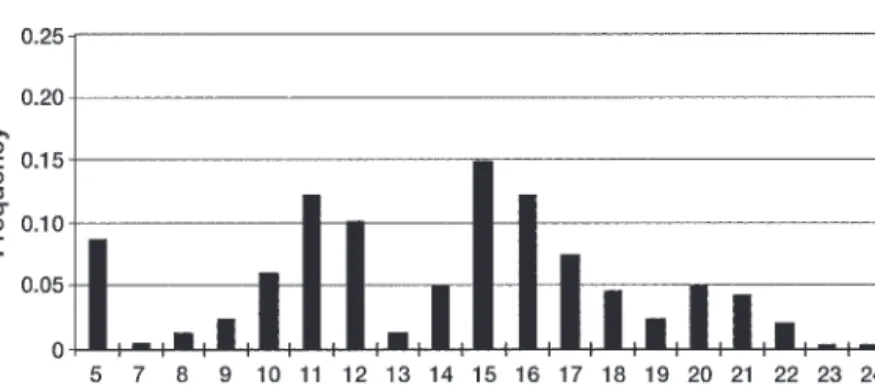
The Penta E locus on chromosome 15, one of the new pentanucleotide STR loci examined in this study, was highly polymorphic, and 19 alleles were found in this Japanese population. As shown in Fig. 1, the allele frequency of this locus displays a tri-or tetra-modal distribution having allelic peaks with 5, 11, 15 and 20 repeats, and the allele 15 was most frequent(0.150). The distribution was significantly different from those reported in the Caucasian American and African American popula-tions[14, 15, 24]. As mentioned above, alleles 23 and 24, which had not been detected in Caucasians and Africans, were found in the present Japanese population. Allele 8, which is most frequent in African Americans
Analysis of STR Polymorphisms
Table 2 Allele frequencies for 15 STR loci in 177 unrelated Japanese
Allele D3S1358 TH01 D21S11 D18S51 PentaE D5S818 D13S317 D7S820 D16S539 CSF1PO PentaD vWA D8S1179 TPOX FGA
5 0.088 6 0.198 7 0.285 0.003 0.003 0.003 0.011 0.003 8 0.034 0.011 0.014 0.243 0.127 0.006 0.020 0.483 9 0.415 0.023 0.082 0.161 0.073 0.280 0.068 0.297 0.150 9.3 0.054 10 0.014 0.059 0.172 0.121 0.229 0.172 0.184 0.220 0.116 0.017 11 0.003 0.121 0.319 0.243 0.316 0.243 0.203 0.167 0.110 0.308 12 0.003 0.028 0.102 0.254 0.175 0.212 0.192 0.427 0.141 0.073 0.042 13 0.195 0.011 0.144 0.042 0.037 0.099 0.073 0.110 0.251 14 0.042 0.218 0.051 0.008 0.014 0.003 0.008 0.023 0.034 0.206 0.195 15 0.384 0.181 0.150 0.003 0.011 0.003 0.031 0.147 16 0.305 0.153 0.121 0.175 0.088 17 0.189 0.085 0.073 0.006 0.277 0.017 0.008 18 0.071 0.056 0.045 0.209 0.003 0.023 19 0.006 0.025 0.023 0.085 0.085 20 0.014 0.051 0.014 0.099 21 0.014 0.042 0.003 0.096 22 0.017 0.020 0.240 22.2 0.006 23 0.003 0.003 0.147 23.2 0.003 24 0.003 0.003 0.178 24.2 0.003 25 0.006 0.071 25.2 0.003 26 0.006 0.034 27 0.006 28 0.042 29 0.226 29.2 0.008 30 0.384 30.2 0.006 31 0.082 31.2 0.079 32 0.023 32.2 0.116 33 0.008 33.2 0.020 H 0.7345 0.6893 0.7401 0.8362 0.9040 0.7514 0.7966 0.7740 0.8136 0.7458 0.7684 0.7966 0.8757 0.6780 0.8249 H 0.7167 0.7028 0.7720 0.8462 0.9105 0.7760 0.8086 0.7797 0.7863 0.7322 0.8020 0.7981 0.8383 0.6474 0.8561 PIC 0.6682 0.6524 0.7447 0.8279 0.9036 0.7418 0.7808 0.7463 0.7526 0.6965 0.7742 0.7679 0.8185 0.5869 0.8405 PD 0.8711 0.8597 0.9168 0.9552 0.9807 0.9181 0.9312 0.9132 0.9108 0.8891 0.9322 0.9252 0.9454 0.8000 0.9607 pM 0.1289 0.1403 0.0832 0.0448 0.0193 0.0819 0.0688 0.0868 0.0892 0.1109 0.0678 0.0748 0.0546 0.2000 0.0393 PE 0.4836 0.4119 0.4930 0.6678 0.8035 0.5122 0.5928 0.5517 0.6244 0.5025 0.5417 0.5928 0.7461 0.3950 0.6460 PIt 1.8830 1.6091 1.9239 3.0517 5.2059 2.0114 2.4583 2.2125 2.6818 1.9667 2.1585 2.4583 4.0227 1.5526 2.8548 Hobs, observed heterozygosity; Hexp, expected heterozygosity; PIC, polymorphism information content; PD, power of discrimination; pM, matching probability; PE, power of exclusion; PIt, typical paternity index.
Okamoto et al. Acta Med. Okayama Vol. 57, No. 2 62
(0.14-0.18)but very rare in Caucasians and Mongoloids, including Japanese[6, 14, 15, 24, 25], was found in 3 subjects of the present population. Sequence analysis of the samples typed as having this allele, i.e.,types 8/14, 8/16 and 8/17, revealed that the amplified fragments of allele 8 in these samples had the same repeat structures as those reported previously on the STRbase web site (http://www.cstl.nist.gov/biotech/strbase/str pene.
htm). Another new pentanucleotide STR locus, Penta D on chromosome 21, showed a unimodal allelic distribu-tion, and allele 9 was the most frequent at 0.297(Fig. 2).
The allelic distributions for 14 STR loci were compar-ed between 2 Japanese populations,i.e., the inhabitants of Okayama in western Japan(present data), and those of Miyagi[6]in northeastern Japan (Table 4). Significant differences were noted in the TH01, CSF1PO,
Table 3 Tests for Hardy-Weinberg equilibrium
Locus Homozygosity test P-value Observed homozygosity Expected homozygosity χtest After allele grouping
P-value
G-Ts Exact test No allele grouping
P-value±SE
After allele grouping
P-value±SE D3S1358 0.5125 0.2655 0.2833 0.9292 (3) 0.8097±0.0132 TH01 0.6161 0.3107 0.2972 0.5869 (4) 0.9328±0.0067 D21S11 0.2017 0.2599 0.2280 0.8865 (4) 0.0439±0.0099 0.3548±0.0380 (6) D18S51 0.6781 0.1638 0.1538 0.7038 (4) 0.6778±0.0292 Penta E 0.7461 0.0960 0.0895 0.9533 (5) 0.6010±0.0315 D5S818 0.3538 0.2486 0.2240 0.8754 (4) 0.7254±0.0195 D13S317 0.6448 0.2034 0.1914 0.8180 (4) 0.4051±0.0156 D7S820 0.8286 0.2260 0.2203 0.7218 (4) 0.3332±0.0194 D16S539 0.3086 0.1864 0.2137 0.2915 (5) 0.0873±0.0099 CSF1PO 0.5996 0.2542 0.2678 0.9573 (3) 0.5987±0.0178 Penta D 0.1926 0.2316 0.1980 0.6530 (4) 0.2575±0.0236 vWA 0.9545 0.2034 0.2019 0.7238 (5) 0.2949±0.0173 D8S1179 0.1286 0.1243 0.1617 0.1184 (4) 0.0533±0.0085 TPOX 0.2511 0.3220 0.3526 0.3957 (3) 0.3385±0.0118 FGA 0.1840 0.1751 011439 0.7613 (4) 0.2721±0.0280
, Alleles were pooled so that the expected values of all genotypes are more than one, and that the number of the genotypes of which the expected value are less than 5 should be less than 20% ( rule of five ). The figure in the brackets indicates the number of the allele groups after grouping. , Alleles containing less than 5 entries were pooled with adjacent alleles so that no alleles have less than 5 entries. The figure in the brackets indicates the number of the allele groups after grouping. , Significant departures from HWE,P<0.05.
Fig. 1 Allele frequency distribution at the Penta E locus. 177 Japanese individuals were examined by the present method.
63 Analysis of STR Polymorphisms April 2003
D8S1179, TPOX and FGA loci; however, the differences were not highly significant in the CSF1PO and TPOX loci(0.01<P<0.05). The allele frequencies
for the 15 STR loci were also compared with those for Caucasian Americans and African Americans (data not shown). Significant differences were noted in all 15 loci (P<0.01). The allele frequencies for 13 out of 15 STR loci were compared with those of Chinese populations, and significant differences were noted in the TH01, D18S51, D7S820, CSF1PO, TPOX and FGA loci (Table 5).
Several statistical parameters of forensic importance, such as the observed allele numbers, expect-ed and observexpect-ed heterozygosity(H), polymorphism infor-mation content (PIC), power of discrimination (PD), matching probability(pM), power of exclusion(PE), and typical paternity index(Plt)values of the 15 STR loci are shown in Table 2. The Penta E locus had the highest number of alleles(19)and the TPOX locus had the lowest number of alleles (5). The observed H was highest in Penta E (0.904)and lowest in TPOX(0.678). Moreover, the PIC and PD were also highest in Penta E (PIC=
0.9036; PD=0.9807) and lowest in TPOX, while the pM was highest in TPOX and lowest in Penta E. The 15 loci showed a combined pM of 1.3729×10 and a combined PD of 1-1.3729×10 . The cumulative power of exclusion and the typical paternity index values of the 15 loci were very high at 0.9999983 and 505,587.8, respectively.
2. Paternity cases and zygosity diagnosis We next applied the present method of STR typing to 20 paternity cases. The results were consistent with the conclusion obtained from conventional blood group systems (ABO,
MNSs, Rh-Hr, P, Kidd, Duffy, Diego, Se blood
systems, a PGM1 red cell isozyme, Tf, Hp, Gc, alpha-2-HS glycoprotein serum types, and/or Acp, EsD
Fig. 2 Allele frequency distribution at the Penta D locus. 177 Japanese individuals were examined by the present method.
Table 4 χtests for allele frequencies of 14 STR loci between 2 Japanese populations
Locus
No. of individuals Okayama
(present data) Miyagi
P-value χ df D3S1358 177 323 0.0776 8.412 4 TH01 177 594 <0.001 25.639 4 D21S11 177 215 0.2314 9.306 7 D18S51 177 207 0.1223 14.001 9 Penta E 177 197 0.0908 20.179 13 D5S818 177 451 0.3215 4.682 4 D13S317 177 451 0.3036 6.027 5 D7S820 177 450 0.4176 4.986 5 D16S539 177 350 0.0946 7.918 4 CSF1PO 177 375 0.0157 13.990 5 vWA 177 589 0.9746 0.838 5 D8S1179 177 205 0.0036 19.335 6 TPOX 177 583 0.0204 11.617 4 FGA 177 306 <0.001 90.230 7 , Significant difference was noted,P<0.01. , Significant differ-ence was noted, 0.01<P<0.05.
Table 5 χ tests for allele freqencies of 13 STR loci between Japanese and Chinese populations
Locus
No. of individuals Okayama
(present data)Chinese Reference
P-value χ df D3S1358 177 500 18) 0.2714 5.158 4 TH01 177 500 18) <0.001 54.293 5 D21S11 177 87 16) 0.0526 9.365 4 D18S51 177 87 16) 0.0180 16.914 7 D5S818 177 500 18) 0.6455 3.355 5 D13S317 177 500 18) 0.0593 10.627 5 D7S820 177 500 18) 0.0041 17.196 5 D16S539 177 100 17) 0.2833 5.039 4 CSF1PO 177 500 18) <0.001 32.447 5 vWA 177 500 18) 0.6683 3.988 6 D8S1179 177 87 16) 0.5690 4.805 6 TPOX 177 500 18) 0.0167 12.083 4 FGA 177 500 18) <0.001 31.273 8 , Significant difference was noted,P<0.01. , Signifcant difference was noted, 0.01<P<0.05.
Okamoto et al. Acta Med. Okayama Vol. 57, No. 2 64
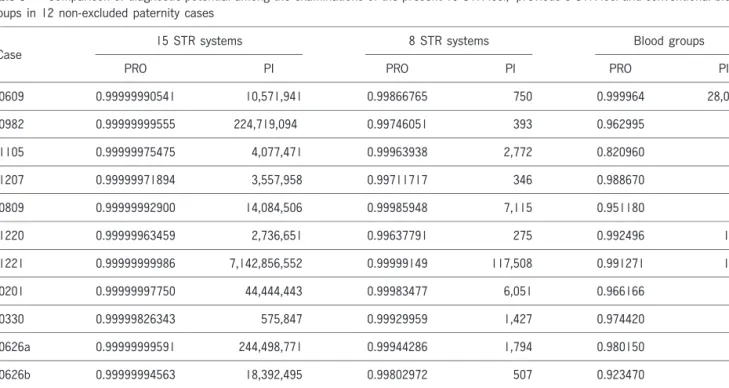
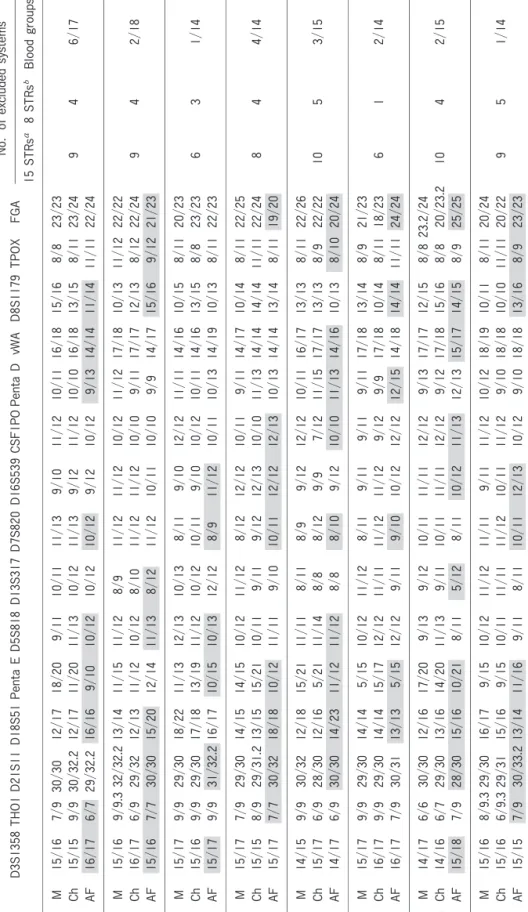
red cell isozymes, HLA-A, B, C and/or an X-linked Xg blood system), and 8 conventional STR systems (TH01, D5S818, D13S317, D7S820, D16S539, CSF1PO, vWA and TPOX). In the 12 non-excluded cases, the combined paternity index (PI)for the 15 STR systems ranged from 575,847 to 7,142,856,552, and these values were far superior to those obtained by the conventional systems(Table 6). In the 8 excluded cases, paternity was excluded in 6 to 10 of the present 15 STR loci, but in only 1 to 5 of the 8 conventional STR loci and in 1 to 6 of the conventional blood group systems (Table 7).
Fig.3 shows the results of electrophoretic analysis of a non-excluded paternity case. In this case, no genetic discrepancy for the father-child relationship was observed in any of the 15 systems, and the probability of paternity and the paternity index were calculated to be 0.999999973 and 37,313,432.0, respectively. Fig.4 shows the results for an excluded paternity case. In this case, genetic discrepancies for the father-child relationship were observ-ed in 9 out of 15 STR loci, and the paternity was excluded decisively.
The STR typing of twin sisters was
perform-ed for a zygosity determination (Fig.5). Both twins had the same STR types in all 15 systems, and the probability of monozygosity[26]was calculated to be 99.9996 . We could thus conclude that the sisters were mono-zygotic.
3. Criminal cases
An infant corpse abandoned in a plastic container was discovered at a vacant lot beside a national road in September 199X. The infant was found to have been mature and alive at birth by autopsy. The umbilical cord was cut sharply. A placenta in a corrugated cardboard box was discovered near the infant. STR typing from blood of the infant and a piece of the umbilical cord attached to the placenta revealed the identity of the infant and the placenta, and moreover the STR types of a suspected mother were obtained from a putrefied blood clot on the maternal side of the placenta. After several days, a woman suspected to be the mother of the infant was investigated and her blood was taken for DNA typing. As shown in Fig. 6, all of the STR types of the woman were identical to those obtained from the blood
Table 6 Comparison of diagnostic potential among the examinations of the present 15 STR loci, previous 8 STR loci and conventional blood groups in 12 non-excluded paternity cases
Case 15 STR systems PRO PI 8 STR systems PRO PI Blood groups PRO PI 090609 0.99999990541 10,571,941 0.99866765 750 0.999964 28,089 090982 0.99999999555 224,719,094 0.99746051 393 0.962995 26 091105 0.99999975475 4,077,471 0.99963938 2,772 0.820960 5 101207 0.99999971894 3,557,958 0.99711717 346 0.988670 87 110809 0.99999992900 14,084,506 0.99985948 7,115 0.951180 19 111220 0.99999963459 2,736,651 0.99637791 275 0.992496 132 111221 0.99999999986 7,142,856,552 0.99999149 117,508 0.991271 114 120201 0.99999997750 44,444,443 0.99983477 6,051 0.966166 29 120330 0.99999826343 575,847 0.99929959 1,427 0.974420 38 120626a 0.99999999591 244,498,771 0.99944286 1,794 0.980150 49 120626b 0.99999994563 18,392,495 0.99802972 507 0.923470 12 130213 0.99999997320 37,313,432 0.99948924 1,957 0.977788 44 PRO, probability of paternity; PI, paternity index.
65 Analysis of STR Polymorphisms April 2003
T ab le 7 S T R ty pi ng i n th e sa m pl es o f 8 ex cl ud ed p at er ni ty c as es a nd c om pa ri so n of t he n um be r of e xc lu de d lo ci o r sy st em s C as e D 3S 13 58 T H O 1 D 21 S 11 D 18 S 51 P en ta E D 5S 81 8 D 13 S 31 7 D 7S 82 0 D 16 S 53 9 C S F 1P O P en ta D vW A D 8S 11 79 T P O X F G A N o. of e xc lu de d sy st em s 15 S T R s 8 S T R s B lo od g ro up s M 15 /16 7 /9 30 /30 12 /17 18 /20 9 /11 10 /11 11 /13 9 /10 11 /12 10 /11 16 /18 15 /16 8 /8 23 /23 09 07 07 C h 15 /15 9 /9 30 /32 .2 12 /17 11 /20 11 /13 10 /12 11 /13 9 /12 11 /12 10 /10 16 /18 13 /15 8 /11 23 /24 9 4 6 /17 A F 16 /17 6 /7 29 /32 .2 16 /16 9 /10 10 /12 10 /12 10 /12 9 /12 10 /12 9 /13 14 /14 11 /14 11 /11 22 /24 M 15 /16 9 /9. 3 32 /32 .2 1 3 /14 11 /15 11 /12 8 /9 11 /12 11 /12 10 /12 11 /12 17 /18 10 /13 11 /12 22 /22 09 06 11 C h 16 /17 6 /9 29 /32 12 /13 11 /12 10 /12 8 /10 11 /12 11 /12 10 /10 9 /11 17 /17 12 /13 8 /12 22 /24 9 4 2 /18 A F 15 /16 7 /7 30 /30 15 /20 12 /14 11 /13 8 /12 11 /12 10 /11 10 /10 9 /9 14 /17 15 /16 9 /12 21 /23 M 15 /17 9 /9 29 /30 18 /22 11 /13 12 /13 10 /13 8 /11 9 /10 12 /12 11 /11 14 /16 10 /15 8 /11 20 /23 10 06 30 C h 15 /16 9 /9 29 /30 17 /18 13 /19 11 /12 10 /12 10 /11 9 /10 10 /12 10 /11 14 /16 13 /15 8 /8 23 /23 6 3 1 /14 A F 15 /17 9 /9 31 /32 .2 1 6 /17 10 /15 10 /13 12 /12 8 /9 11 /12 10 /11 10 /13 14 /19 10 /13 8 /11 22 /23 M 15 /17 7 /9 29 /30 14 /15 14 /15 10 /12 11 /12 8 /12 12 /12 10 /11 9 /11 14 /17 10 /14 8 /11 22 /25 11 08 24 C h 15 /15 8 /9 29 /31 .2 1 3 /15 15 /21 10 /11 9 /11 9 /12 12 /13 10 /10 11 /13 14 /14 14 /14 11 /11 22 /24 8 4 4 /14 A F 15 /17 7 /7 30 /32 18 /18 10 /12 11 /11 9 /10 10 /11 12 /12 12 /13 10 /13 14 /14 13 /14 8 /11 19 /20 M 14 /15 9 /9 30 /32 12 /18 15 /21 11 /11 8 /11 8 /9 9 /12 12 /12 10 /11 16 /17 13 /13 8 /11 22 /26 11 12 14 C h 15 /17 6 /9 28 /30 12 /16 5 /21 11 /14 8 /8 8 /12 9 /9 7 /12 11 /15 17 /17 13 /13 8 /9 22 /22 10 5 3 /15 A F 14 /17 6 /9 30 /30 14 /23 11 /12 11 /12 8 /8 8 /10 9 /12 10 /10 11 /13 14 /16 10 /13 8 /10 20 /24 M 15 /17 9 /9 29 /30 14 /14 5 /15 10 /12 11 /12 8 /11 9 /11 9 /11 9 /11 17 /18 13 /14 8 /9 21 /23 12 04 24 C h 16 /17 9 /9 29 /30 14 /14 15 /17 12 /12 11 /11 11 /12 11 /12 9 /12 9 /9 17 /18 10 /14 8 /11 18 /23 6 1 2 /14 A F 16 / 17 7 / 9 30 / 31 13 / 13 5 / 15 12 / 12 9 / 11 9 / 10 10 / 12 12 / 12 12 / 15 14 / 18 14 / 14 11 / 11 24 / 24 M 14 /17 6 /6 30 /30 12 /16 17 /20 9 /13 9 /12 10 /11 11 /11 12 /12 9 /13 17 /17 12 /15 8 /8 23 .2 /24 12 06 26 C h 14 /16 6 /7 29 /30 13 /16 14 /20 11 /13 9 /11 10 /11 11 /11 12 /12 9 /12 17 /18 15 /16 8 /8 20 /23 .2 10 4 2 /15 A F 15 /18 7 /9 28 /30 15 /16 10 /21 8 /11 5 /12 8 /11 10 /12 11 /13 12 /13 15 /17 14 /15 8 /9 25 /25 M 15 / 16 8 / 9. 3 29 / 30 16 / 17 9 / 15 10 / 12 11 / 12 11 / 11 9 / 11 11 / 12 10 / 12 18 / 19 10 / 11 8 / 11 20 / 24 12 10 31 C h 15 / 16 6 / 9. 3 29 / 31 15 / 16 9 / 15 10 / 11 11 / 11 11 / 12 10 / 11 11 / 12 9 / 10 18 / 18 10 / 10 11 / 11 20 / 22 9 5 1 / 14 A F 15 / 15 7 / 9 30 / 33 .2 1 3 / 14 11 / 16 9 / 11 8 / 11 10 / 11 12 / 13 10 / 12 9 / 10 18 / 18 13 / 16 8 / 9 23 / 23 S ha do w ed b ox s ho w s th e ty pi ng r es ul t w hi ch i nd ic at es t he p at er ni ty e xc lu si on . M , m ot he r; C h, ch ild ; A F , al le ge d fa th er . , N um be r of e xc lu de d lo ci in t he p re se nt 1 5 S T R s. , N um be r of e xc lu de d lo ci i n th e pr ev io us 8 S T R s. , N um be r of e xc lu de d sy st em s pe r nu m be r of t es t sy st em s in t he c on ve nt io na l bl oo d gr ou p sy st em s.
Okamoto et al. Acta Med. Okayama Vol. 57, No. 2 66
Mother Child Alleged father 120 160 200 240 280 320 360 400 440 480 1800 900 0 1800 900 0 1800 900 0 31:F10-H13.2.13MA x100/ 31:F10-H13.2.13MA x100/ 33:F12-H13.2.13Ch x30/ 33:F12-H13.2.13Ch x30/ 35:G1-H13.2.13 AF x80/ 35:G1-H13.2.13 AF x80/ 31:F10-H13.2.13MA x100/ 31:F10-H13.2.13MA x100/ 31:F12-H13.2.13Ch x30/ 31:F12-H13.2.13Ch x30/ 35:G1-H13.2.13 AF x80/ 35:G1-H13.2.13 AF x80/ D3S1358 TH01 D21S11 D18S51 Penta E Penta D FGA CSF1P0 TPOX D16S539 D7S820 D8S1179 vWA Amel. D5S818 D13S317 Mother Child Alleged father 120 160 200 240 280 320 360 400 440 1800 900 0 1800 900 0 1800 900 0 D3S1358 TH01 D21S11 D18S51 Penta E Penta D FGA CSF1P0 TPOX D16S539 D7S820 D8S1179 vWA Amel. D5S818 D13S317 34:F6-193/ 34:F6-193/ 34:F6-193/ 34:F6-193/ 35:F8-194/ 35:F8-194/ 35:F8-194/ 35:F8-194/ 36:F10-195/ 36:F10-195/ 36:F10-195/ 36:F10-195/
D3S1358 TH01 D21S11 D18S51 Penta E Penta D FGA CSF1P0 TPOX D16S539 D7S820 D8S1179 vWA Amel. D5S818 D13S317 120 160 200 240 280 320 360 400 440 480 1800 900 0 1800 900 0 8:B4-H8-Twin-Mass2x100/ 8:B4-H8-Twin-Mass2x100/ 8:B4-H8-Twin-Mass2x100/ 8:B4-H8-Twin-Mass2x100/ 10:B6-H8-Twin-Eiko2x50/ 10:B6-H8-Twin-Eiko2x50/ 10:B6-H8-Twin-Eiko2x50/ 10:B6-H8-Twin-Eiko2x50/ Elder sister sister Younger D3S1358 TH01 D21S11 D18S51 Penta E Penta D FGA CSF1P0 TPOX D16S539 D7S820 D8S1179 vWA Amel. D5S818 D13S317 480 440 400 360 320 280 240 200 160 120 2700 1800 900 0 2400 1200 0 4:A11-H8.8.31 Kouke-D'x200/ 4:A11-H8.8.31 Kouke-D'x200/ 4:A11-H8.8.31 Kouke-D'x200/ 4:A11-H8.8.31 Kouke-D'x200/ 5:B2-H8.8.31 Ma-H x20/ 5:B2-H8.8.31 Ma-H x20/ 5:B2-H8.8.31 Ma-H x20/ 5:B2-H8.8.31 Ma-H x20/ Putrefied blood clot from the maternal side of a placenta Blood of a suspected mother
D3S1358 TH01 D21S11 D18S51 Penta E Penta D FGA CSF1P0 TPOX D16S539 D7S820 D8S1179 vWA Amel. D5S818 D13S317 420 390 360 330 300 270 240 210 180 150 120 90 3000 2000 1000 0 2700 1800 900 0 13:A5-1/3H8.9.6ha6x1-2/ 13:A5-1/3H8.9.6ha6x1-2/ 13:A5-1/3H8.9.6ha6x1-2/ 13:A5-1/3H8.9.6ha6x1-2/ 18:A7-1/3H8.9.6Fa5x10-3/ 18:A7-1/3H8.9.6Fa5x10-3/ 18:A7-1/3H8.9.6Fa5x10-3/ 18:A7-1/3H8.9.6Fa5x10-3/ Skull Father ?
[6]. From these findings, it was considered that in paternity and identity testing the allele frequency database obtained from the population to which the person in question belongs should be used in the calculations for forensic evaluations.
Statistical parameters such as the observed and expected heterozygosity values (H , H ), the polymorphism information content (PIC), the power of discrimination (PD), and the matching probability(pM), which are of importance in applying the DNA typing method to forensic identity testing, demonstrated the usefulness of the present method in forensic practice. The most informative locus among the 15 STR systems was Penta E (PD=0.980), while the least informative was TPOX (PD=0.800). The systems FGA, D18S51 and D8S1179 were also highly informative. The 15 loci showed a combined PD of 1-1.3729×10 and a
combined pM of 1.3729×10 . Practically, this means no other individuals with the same types for all 15 loci exist in the world, except the monozygote multiples or the same clone. Moreover, both the cumulative power of exclusion and the paternity index values of the 15 loci, which are measures of diagnostic potential for paternity testing by this method, were high enough to obtain practically conclusive results.
This method was applied to the samples of paternity tests, and no deviations were detected among the diag-noses obtained by this method, those obtained by the previous 8 STR systems, and those obtained by the conventional blood groups in any of the 12 non-excluded or 8 excluded cases. Moreover, the calculated probability of paternity and the paternity index values calculated, which are of importance in applying the DNA typing method to parentage testing, were extremely high in the tests with the present 15 loci compared to the tests with the previous 8 STR systems and the conventional blood groups, and more conclusive scientific evidence was obtained by the present method.
In criminal cases, the STR analysis was also very useful for personal identification, because of its high discriminatory power. Moreover, the STR loci detected by the present method are relatively small in size (100
-450 bp), and can easily be amplified by PCR even in a multiplex PCR fashion. This is an advantage when analyzing forensic specimens, which often contain severe-ly damaged and minute DNA. We applied this method to forensic personal identification from putrefied specimens and skeletal remains. In the case of an abandoned infant
and placenta, the specimens were putrefied to some extent, but DNA which could serve as the template for PCR could be recovered, and all 15 STR types of the specimens could be detected by this method. Moreover, in an examination of a skull immersed in water for one year, the soft tissues were almost completely decayed and lost, but the STR types could be detected from DNA extracted from a molar in the skull. This may have been because the DNA contained in the tooth was protected from degradation by the hard tooth tissue, and intact DNA fragments available as a template for PCR detection of the 15 STR loci remained even under these wet conditions. In conclusion, analysis of the 15 STR loci by the present multiplex PCR method was shown to be highly discriminating, and could detect STR types even from degraded specimens, suggesting it would be very useful in forensic practice.
Part of this work was presented at the 85th Congress of the Japanese Society of Legal Medicine in Kurume, April 2001, and at the 7th Indo Pacific Congress on Legal Medicine and Forensic Sciences (INPALMS-2001)in Melbourne, September 2001.
References
1. Edwards A, Civitello A, Hammond HA and Caskey CT: DNA typing and genetic mapping with trimeric and tetrameric tandem repeats. Am J Hum Genet (1991)49: 746-756.
2. Edwards A, Hammond HA, Jin L, Caskey CT and Chakraborty R: Genetic variation at five trimeric and tetrameric tandem repeat loci in four human population groups. Genomics (1992)12: 241-253. 3. Hammond HA, Jin L, Zhong Y, Caskey CT and Chakraborty R:
Evaluation of 13 short tandem repeat loci for use in personal identification applications. Am J Hum Genet (1994)55: 175-189. 4. Santos SM, Budowle B, Smerick JB, Keys KM and Moretti TR:
Portuguese population data on the six short tandem repeat loci-CSF1PO, TPOX, THO1, D3S1358, VWA and FGA. Forensic Sci Int (1996)83: 229-235.
5. Sparkes R, Kimpton C, Gilbard S, Carne P, Andersen J, Oldroyd N, Thomas D, Urquhart A and Gill P: The validation of a 7-locus multiplex STR test for use in forensic casework. (II), Artefacts, casework studies and success rates. Int J Legal Med (1996)109: 195-204. 6. Hashiyada M: Short tandem repeat analysis in Japanese population.
Electrophoresis (2000)21: 347-350.
7. Technical manual of the PowerPlexTM 16 System. Promega Corpora-tion, Madison (2001).
8. Weir BS: Independence of VNTR alleles defined as floating bins. Am J Hum Genet (1992)51: 992-997.
9. Guo SW and Thompson EA: Performing the exact test of Hardy-Weinberg proportion for multiple alleles. Biometrics (1992)48: 361
-372.
10. Cochran WG: Some methods for strengthening the common chi 2 test. Biometrics (1954)110: 417-451.
11. National Research Council II Report: The Evaluation of Forensic DNA Evidence, Statistical issues -Alleles with low frequency; in National
Okamoto et al. Acta Med. Okayama Vol. 57, No. 2 70
Research Council ed, National Academy Press, Washington DC(1996) pp 148.
12. Raymond M and Rousset F: GENEPOP (version 1.2): population genetics software for exact tests and ecumenicism. J Heredity(1995) 86: 248-249.
13. Technical manual of the GenePrint R
PowerPlex TM 1.2 System. Promega Corporation, Madison (1998).
14. Technical manual of the GenePrint R
PowerPlex TM 2.1 System. Promega Corporation, Madison (1999).
15. Budowle B and Sprecher CJ: Concordance study on population database samples using the PowerPlexTM 16 kit and AmpFlSTR Profiler Plus kit and AmpFlSTR COfiler kit. J Forensic Sci(2001)46: 637-641. 16. Gusmao L, Prata MJ, Sanchez-Diz P, Lareu MV, Carracedo A, Alves C, Martins N and Amorim A: STR data for the AmpFlSTR profiler plus loci from Macau (China). Forensic Sci Int (2001)123: 74-75. 17. Wang B, Pang H, Koda Y, Soejima M and Kimura H: Polymorphisms
of eight STR loci in Chinese and African(Xhosa)populations. Forensic Sci Int (2002)125: 279-280.
18. Pu CE, Wu FC, Cheng CL, Wu KC, Chao CH and Li JM: DNA short tandem repeat profiling of Chinese population in Taiwan determined by using an automated sequencer. Forensic Sci Int (1998)97: 47-51. 19. Nei M: Estimation of average heterozygosity and genetic distance
from a small number of individuals. Genetics (1978)89: 583-590. 20. Botstein D, White RL, Skolnick M and Davis RW: Construction of a
genetic linkage map in man using restriction fragment length polymor-phisms. Am J Hum Genet (1980)32: 314-331.
21. Fisher RA: Standard calculations for evaluating a blood-group system.
Heredity(1951)5: 95-102.
22. Jones DA: Bloodsamples: Probability of discrimination. J Forensic Sci Soc(1972)12: 355-359.
23. Brenner C and Morris JW: Paternity index calculations in single locus hypervariable DNA probes: varidetion and other studies; in Proceed-ings from the International Symposium on Human Identification 1989, Promega Corporation ed, Promega Corporation, Wisconsin (1990)pp 21-53.
24. Levadokou EN, Freeman DA, Budzynski MJ, Early BE, McElfresh KC, Schumm JW, Amin AS, Kim YK, Sprecher CJ, Krenke BE, Silva DA, McIntosh TM, Grubb JC, Johnston LJ, Sailus JS, Ban JD, Crouse CA and Nelson MS: Allele frequencies for fourteen STR loci of the PowerPlex 1.1 and 2.1 multiplex systems and Penta D locus in Caucasians, African-Americans, Hispanics, and other populations of the United States of America and Brazil. J Forensic Sci Soc(2001)46: 736-761.
25. Budowle B, Masibay A, Anderson SJ, Barna C, Biega L, Brenneke S, Brown BL, Cramer J, DeGroot GA, Douglas D, Duceman B, Eastman A, Giles R, Hamill J, Haase DJ, Janssen DW, Kupferschmid TD, Lawton T, Lemire C, Llewellyn B, Moretti T, Neves J, Palaski C, Schueler S, Sgueglia J, Sprecher C, Tomsey C and Yet D: STR primer concordance study. Forensic Sci Int (2001)124: 47-54. 26. Akane A, Matsubara K, Shiono H, Yamada M and Nakagome Y:
Diagnosis of twin zygosity by hypervariable RFLP markers. Am J Med Genet (1991)41: 96-98.
71 Analysis of STR Polymorphisms April 2003