See discussions, stats, and author profiles for this publication at: https://www.researchgate.net/publication/289175393
Influence of the Cortical Midline Structures on
Moral Emotion and Motivation in Moral
Decision-Making
Article in Behavioural Brain Research · January 2016
DOI: 10.1016/j.bbr.2016.01.001 CITATIONS 6 READS 174 4 authors, including:
Some of the authors of this publication are also working on these related projects:
Predicting long-term outcomes of interventions using machine learning and computational simulation
View project
Purpose, Morality, Prosociality, and Positive Youth DevelopmentView project Hyemin Han University of Alabama 28PUBLICATIONS 82CITATIONS SEE PROFILE Jingyuan E. Chen Stanford University 8PUBLICATIONS 51CITATIONS SEE PROFILE Changwoo Jeong
Seoul National University
15PUBLICATIONS 45CITATIONS SEE PROFILE
Influence of the Cortical Midline Structures on Moral Emotion and Motivation in Moral1 Decision-Making
Hyemin Han1,#, Jingyuan Chen2, Changwoo Jeong3, Gary H. Glover4
Author affiliations: 1Stanford Graduate School of Education, Stanford University, California, USA, 2Department of Electrical Engineering, School of Engineering, Stanford University, California, USA, 3Department of Ethics Education, College of Education, Seoul National University, Seoul, Korea, and 4Department of Radiology, School of Medicine, Stanford University, California, USA.
Highlights:
The cortical midline structures (CMS) are activated under moral task conditions.
The CMS interact with other regions under moral task conditions.
Seed regions in the CMS influence the insula under the moral-personal condition.
Word Count: Paper: 8,740 words Abstract: 241 words References: 151
Running Header: Cortical Midline Structures and Moral Functioning
1 This is the postprint of the accepted manuscript, which was finally accepted by editors. The final version
Disclosure: The authors report no conflicts of interest.
# Address correspondence to:
Hyemin Han,
Stanford Graduate School of Education, Stanford University,
485 Lasuen Mall, Stanford CA, 94305 USA.
Abstract
The present study aims to examine the relationship between the cortical midline
structures (CMS), which have been regarded to be associated with selfhood, and moral decision making processes at the neural level. Traditional moral psychological studies have suggested the role of moral self as the moderator of moral cognition, so activity of moral self would present at the neural level. The present study examined the interaction between the CMS and other moral-related regions by conducting psycho-physiological interaction analysis of functional images acquired while 16 subjects were solving moral dilemmas. Furthermore, we performed Granger causality analysis to demonstrate the direction of influences between activities in the regions in moral decision-making. We first demonstrate there are significant positive interactions between two central CMS seed regions—i.e., the medial prefrontal cortex (MPFC) and posterior cingulate cortex (PCC)—and brain regions associated with moral functioning including the cerebellum, brainstem, midbrain, dorsolateral prefrontal cortex, orbitofrontal cortex and anterior insula (AI); on the other hand, the posterior insula (PI) showed significant negative interaction with the seed regions. Second, several significant Granger causality was found from CMS to insula regions particularly under the moral-personal condition. Furthermore, significant dominant influence from the AI to PI was reported. Moral psychological implications of these findings are discussed. The present study demonstrated the significant interaction and influence between the CMS and morality-related regions while subject were solving moral dilemmas. Given that, activity in the CMS is significantly involved in human moral functioning.
Keywords: Functional MRI, Psychophysiological interaction, Granger causality, Moral judgment, Cortical midline structures
1. Introduction
Contemporary moral psychologists have studied the integrative model of human morality that can well explain the mechanism of moral motivation and actual moral behavior. Before the beginning of the 21st century, the mainstream paradigm in moral psychology was the
Kohlbergian model, which attempted to explain the generation of moral behavioral motivation from a cognitive vantage point [1,2]. However, this model has been criticized by proponents of the role of moral emotion [3] and intuition [4,5]; those scholars have argued that the previous model was not able to successfully bridge the gap between moral reasoning and moral behavior [6]. Thus, to address this issue, contemporary moral psychologists have proposed an integrative model of human morality, which embraces the cognitive, affective and behavioral aspects. For instance, Neo-Kohlbergians, the contemporary moral psychologists who proposed integrative model of moral functioning (e.g., [7–9]), suggested the functional components of moral sensibility, moral motivation and moral personality on top of moral judgment [7]. In addition, character educators, who have sought to develop a new model of moral psychology that is suitable to educational practice, have underscored the integration of moral cognition, emotion and behavior [10,11].
Then, what is the core or foundation of the integrative model? Which psychological construct does orchestrates activity of individual aspects of human morality and regulate the generation of motivational force for moral behavior? Several moral psychologists have suggested moral self as a candidate [12–14]. According to their theory, moral self is a psychological
construct constituted by the perception of a person’s self as a moral person, which originates from moral identity [15]. Although a person might have developed sophisticated moral reasoning, he/she does not necessarily implement the result of his/her moral judgment into action if he/she
does not possess a strong sense of moral self because he/she does not prioritize moral values over other self-oriented values [13,16]. In fact, social psychological experiments have confirmed that the strength of moral self significantly moderated the relationship between the result of moral judgment [17,18], perceived socio-moral emotional valence [19] and actual moral behavioral outcome. The formation and development of moral self occurs through reflection upon and deliberation of beliefs, values and previous life experience, and continued commitment to moral behavior [20]. During adolescence and even beyond, a person’s moral self is being consolidated by integrating moral values into his/her self-identity [14,21].
Neuroimaging methods will facilitate this kind of research investigating the nature of human morality [22,23]. Neuroimaging studies have contributed significantly to our
understanding of human morality because they enable us to investigate the internal processes of moral functions that underlie overt human behaviors, which have not been measured by non-biological traditional methodologies [23,24]. These studies also aim to avoid the potential social and desirable biases of self-reporting methods that have been problematic in traditional moral psychological studies [22].
Based on the previous studies, the present study aims to examine the relationship between the cortical midline structures (CMS), which have been regarded to be associated with selfhood, and moral decision making processes at the neural level. Previous fMRI studies in the field of cognitive and social neurosciences have examined the neural correlates of human morality. For instance, diverse dimensions of morality including, but not limited to, moral judgment [25,26], moral sensibility [27–29], moral competence [30] and moral elevation [31,32] have been demonstrated. Furthermore, several social neuroscientists have proposed the presence of the
co-during the processing of moral tasks. The CMS include the dorsal- and ventral-medial prefrontal cortices (MPFC) and cingulate cortex, [33,34]. Recent meta-analyses [35,36] and fMRI studies [37,38] have also demonstrated that the processing of self-related and familiar contexts is associated with activity in the CMS regions, including the MPFC, PCC and anterior cingulate cortex (ACC). However, some studies have shown that in certain instances, activity in the posterior medial cortices (PMC) in the CMS was not stronger in “self” conditions compared to “others” conditions; more specifically, the region showed significantly stronger activity in the distant-others condition compared to the self condition in general [36,37]. Given these studies, it would be possible to say that the MPFC is commonly associated with selfhood-related processes, but the PMC is particularly associated with autobiographical memory processing rather than selfhood-related processes in general [37]. In studies related to morality, neuroimaging studies have also shown the relationship between the CMS regions and morality-related task conditions. In the previous fMRI studies, activity in the CMS regions was commonly associated with moral task conditions [39–41]. In addition, self-agency related to moral functioning shared neural substrates with the CMS [42]. Given these previous studies, we expect that there is significant relationship between the neural correlates of moral functioning and selfhood-related processes. The present study uses the general linear model (GLM) method to conduct the whole-brain tests; this method enables us to conduct “a diverse interrogation of functional imaging data using statistical parametric maps (p. 202)” and a diverse statistical analysis from a t-test to ANCOVA [43].
Given these studies in social neuroscience demonstrating the activation of the CMS regions in morality-related task conditions, we can expect a significant overlap between the brain circuitries associated with moral functioning and selfhood-related psychological processes.
Moreover, the nature of moral dilemmas would cause increased activity in such regions compared to non-moral dilemmas. Usually, moral dilemmas are regarded as problem sets that deal directly with “what we have to do” or “what we ought to do,” while non-moral dilemmas are in the realm of fact, instead of value [44]. Particularly, moral-personal dilemmas (e.g., Footbridge dilemma) are closely associated with the possible violation to concrete human lives; on the other hand, moral-impersonal dilemmas (e.g., Trolley dilemma) do not directly request subjects to make decisions affecting concrete human lives, but are similar to mathematical calculation problems [25,26,45]. Since moral dilemmas are more likely to urge us to deliberate upon our moral beliefs and values, they would induce stronger activity in the CMS regions compared to non-moral dilemmas.
Furthermore, although traditional moral psychologists did not use neuroimaging methods, their social psychological [13,17,18,46] and developmental psychological studies [14,20] have shown the moderating and monitoring role of moral self in moral functioning. Thus, we may also expect that brain activity in the CMS associated with selfhood moderates or even influences that in other regions associated with moral functioning. However, the previous studies that have shown the overlap between those two brain circuitries did not utilize analytic methods that enable us to see the interaction between or causal relationship between brain regions, such as the psycho-physiological interaction (PPI) analysis [47] and Granger causality analysis [48]. The problem of reverse inference occurs if we try to interpret findings without the application of proper experimental and analysis methods [49,50]. Therefore, the present study aims to
investigate such possible moderating and causal relationship between the CMS and other regions associated with moral functioning in morality-related task conditions, using the PPI analysis and GCA methods when subjects are making moral decisions to address moral problems.
The present study hypothesizes that first, the whole-brain tests will demonstrate that brain regions associated with emotional processes will show greater activity in the moral-personal condition compared to the moral-impersonal condition. This hypothesis originates from previous neuroimaging studies utilizing similar dilemma task conditions [25,26,51]. Moral-personal dilemmas are more likely to induce significant activity in regions associated with emotion (e.g., MPFC, orbitofrontal cortex (OFC), superior-temporal sulcus (STS), insula [42,51–55]) compared to moral-impersonal dilemmas, because the former strongly induce negative immediate
emotional responses among subjects. On the other hand, previous studies have shown that in the moral-impersonal condition, regions associated with cognition, such as mental calculation (e.g., parietal lobule), will show significantly increased activity [25,26,51,56].
Second, activity in the CMS regions significantly moderates activity in other brain regions associated with moral emotion and motivation (e.g., midbrain including the ventral
tegmental area, ventral striatum, insula, OFC [57–61]) while subjects are solving moral problems. Given previous neuroimaging studies showing the overlap between the two regions, and
traditional moral psychological studies suggesting the role of moral self, the present study will be able to find significant PPI between CMS and other regions associated with morality in the moral-task condition. Particularly, the present study focuses on the MPFC and posterior
cingulate cortex (PPC) in the CMS. First, the MPFC is associated with referencing and self-evaluation [62–64], which are fundamental to moral decision making processes. These selfhood-related psychological processes enable people to consider and reflect upon their moral belief and value and to make a decision based on them [14,20,65]; moral decision making also would be moderated by these processes. Second, the present study also focuses on the PCC, because this region is associated with the processing of autobiographical memory, including self-referencing
[33,37,66–69]. Of course, although the PCC would not be strongly associated with selfhood-related processes in general, because this region is associated with the autobiographical memory processing [36,37], the core self-related process involved in moral decision making, the present uses this region as a seed region. Because moral judgment cannot be independent from and is influenced by the deliberation upon previous lifelong experience [14,20,70], autobiographical memory processes inevitably would be involved in moral judgment, as the proponents of moral self and moral identity suggest [71,72]. Given these, the present study focuses on the MPFC and PPC, which are closely associated with selfhood-related psychological processes.
Third, given the role of moral self proposed by traditional moral psychologists, the present study expects causal influence from activity in the CMS to that in other brain regions associated with moral emotion and motivation. The GCA will demonstrate significant causal influence from the MPFC and PPC to brain regions associated with moral emotion and motivation. More specifically, among all brain regions associated with morality, the present study concentrates on the insula regions, including both the anterior (AI) and posterior insula (AI). First, previous experiments have demonstrated that the PI is the core of the immediate processing of affective responses and the induction of subjective feelings [73,74], particularly negative emotions (e.g., pain and disgust) [73–77], that play fundamental roles in moral cognition [42,53]. Moreover, the AI is closely associated with the integration of cognition and emotion [78–82], conscious and interceptive awareness, monitoring of aroused emotional responses [28,83,84], and finally, the modulation of motivational force [60,61,85]. Given these previous works, the present study chooses the AI and PI as the regions of interest for the GCA.
2. Materials and Methods 2.1 Subjects
The present study recruited sixteen subjects at a college located in Northern California, using university mailing lists and Facebook. Only healthy right-handed subjects were included to control for any possible compounding effect originated from a history of physical or mental illness and handedness. Subjects’ physical and mental health condition (e.g., allergies, kidney problems, seizures, claustrophobia) was tested using a standard self-reporting questionnaire developed by The Richard M. Lucas Center for Imaging at Stanford University. Subjects’ age ranged from 21 to 34 (mean (±SD) age 28.59 ± 3.18 years). Because the present study recruited both male and female, and Korean and American subjects, we equalized the number of each gender and ethnicity group (4 male and 4 female subjects in each ethnicity group). All subjects were originally born in the country of their nationality. Further details regarding each subject’s demographics were presented in Table S1. We provided subjects with a written consent form initially approved by the Institutional Review Board. The subjects were debriefed and
compensated for their participation ($60).
2.2 Dilemma Task
The present study utilized a set of moral dilemma questions initially developed by [25,26] and used by [51]. A total of sixty dilemma questions were included in the set. This moral
dilemma set consisted of three different types of dilemmas: moral-personal, moral-impersonal and non-moral. First, moral-personal dilemmas were involved in serious bodily harm of a particular person or set of person, and they were designed to provoke severe negative affective responses from subjects [26]. On the other hand, moral-impersonal dilemmas also required
subjects to be involved in socio-moral value judgment, but they did not evoke any severe negative affective responses [25]. Finally, non-moral dilemmas were used for the control condition. These non-moral dilemmas were purely arithmetic and did not require any value judgment [25]. The number of dilemmas in each category was 22, 18 and 20, respectively. The overall experimental paradigm is presented in Figure 1.
<Place Figure 1 about here>
Each dilemma trial presented an option to address a given problem. For instance, in the case of moral-personal dilemma, the subjects were asked whether or not it is morally appropriate to push a person on a foot bridge to stop a train and save five people. In both moral-personal and moral-impersonal categories, an “appropriate” answer is presumed to represent a utilitarian decision, while an answer “inappropriate” is presumed to represent a deontological decision [25,26]. Subject used a button box to answer dilemma questions. The subjects had 44 seconds to read a dilemma question and make a decision for each trial; this was followed by a 16-second fixation period. Each scan consisted of 5 trials and an inter-block interval period (a 16-second fixation period), and the whole scanning session was constituted with 12 scans (63 minutes 12 seconds). The order of dilemma presentation was randomized to prevent adaptation to a specific type of dilemma. Each dilemma was presented in three separate slides. Subjects were able to move to the next page of each dilemma text on their own pace after they fully understood the meaning of the text. In fact, all subjects were able to make decisions for at least 99.8% of all presented dilemmas within the given time frame. In addition, there was not any significant difference in the mean response time between two nationality groups at p < .05. Given that there was not any statistically significant difference in the mean response rate and time between two
ethnicity groups, we assume that both Korean and American subjects equally well understood the presented dilemma materials.
2.3 Image Acquisition
Imaging data were obtained at 3T (GE Healthcare Signa 750) with an 8-channel birdcage head coil. Subjects’ head movements were minimized using foam paddings. First, we acquired high resolution T2-weighted fast spin echo structural images for alignment. A total of 31 oblique axial slices were obtained parallel to the AC-PC with 4-mm slice thickness, 1-mm inter-slice skip. Functional images were acquired with a spiral in and out sequence (TR = 2000ms, TE = 30ms, flip angle = 90o) [86]. 31 thick axial slices were obtained with 4-mm slice thickness and resolution of 3.75 x 3.75 mm (FOV = 240mm, 64 x 64 matrix) covering the whole brain for a total of 157 TRs per scan. An automated high-order shimming procedure using spiral scans was applied to reduce B0 heterogeneity [87]. Finally, a high resolution volume image (132 slices, 1.2-mm slice thickness) was acquired using 3D FSPGR sequence for T1 contrast (TR = 5.8ms, TE = 1.8ms, flip angle = 11 o) for anatomical reference. Respiration and cardiac (pulse oximetry) responses were recorded using a respiratory belt and pulse-ox sensor attached to a finger. Image data used in the present study included functional images acquired by Han et al. (2014).
2.4 Image Data Analysis
The acquired images were analyzed using SPM 8 and MATLAB. First, we used the RETROICOR and RVHRCOR methods to minimize artifacts related to respiratory and cardiac activities [88,89]. Moreover, we conducted slice time correction, scan drift correction, motion
correction, co-registration, normalization (into SPM8’s standard MNI space (79 x 95 x 68, 2 x 2 x 2mm3 voxels)), and spatial smoothing (Gaussian FWHM = 8mm).
For the statistical analysis, regressors for the corresponding dilemma category blocks were modeled as a boxcar function convolved with the canonical Hemodynamic Response Function. For each trial, the boxcar function was defined by the duration between the onset of the slide requesting decision-making (about 8 seconds before each response) and the response. For the first order (single-subject level) analysis, we treated each voxel according to SPM 8’s GLM. In addition, we conducted a second-order (group-level) analysis to identify regions showing significantly different activity across dilemma conditions. For this analysis, a whole-brain t-test was utilized. In this analysis, statistical maps of voxelwise t-statistics were thresholded for both significance (p < .05 False Discovery Rate (FDR) corrected) and cluster size (k ≥ 25 voxels) to minimize false positive probability while maintaining statistical power. This cluster size was determined from the finding of a previous simulation [90]; given the simulation, a 25-voxel cluster is needed to realize a corrected threshold of p < .01 or p < .005 for multiple comparisons with an initial threshold p < .05 that is not family-wise error (FWE) corrected when a total of 180,000 voxel-wise comparisons are conducted. Of course, the FDR-corrected threshold per se is more lenient than the FWE-corrected threshold and more susceptible to a false positive problem. However, when a cluster-based thresholding is applied, the FDR-applied threshold can become more stringent while maintaining the relatively lower possibility of type I error [90–92]. For further psychophysical interaction (PPI) and causality analyses, we focused on these two contrasts: moral-personal versus control and moral-impersonal versus control. Demographic variables (ethnicity, age, gender) were included in the statistical model as covariates.
In addition to the whole-brain voxelwise t-tests, PPI analysis was performed based on two seed regions within the CMS (4-mm-radius sphere)—i.e., the PCC and MPFC—to investigate which other regions showed significant interaction the CMS. The present study particularly focused on these two seed regions among various CMS regions, because of
following regions: first, these regions showed significant activity under moral task conditions in the previous neuroimaging studies [39,40] as well as the present study; second, these regions are associated with self-evaluation [62,93] and particularly autobiographical memory processing [36,37] that constitute the basis of the moral belief system, moral identity, and finally moral self [33]. These seed regions were selected based on the peak voxel coordinate information as the result of the whole-brain voxelwise t-tests (described above) and the brain atlas obtained by previous functional connectivity studies [94,95]. The main purpose of PPI analysis is to investigate how regions possibly related to selfhood functions interact with other brain regions during the process of moral judgment. We utilized the PPI analysis method implemented in SPM 8 [47]. This analysis examined how functional coupling or interaction between a certain seed region and other regions changed across different psychological factors—i.e., diverse task conditions—in this experiment. We conducted this PPI analysis for two functional contrasts: moral-personal versus control and moral-impersonal versus control. First, we extracted the deconvolved time series from a 4mm radius sphere around the defined coordinates of the two seed regions for each subject. Then, we examined the effect of the interaction term using the contrast [1 0 0] in SPM8; the first column “1” in the contrast vector means the interaction term in this analysis. The result represents the effect of interaction term between the time series of the seed regions and a block vector representing the tasks of our interest (moral-personal vs. control and moral-impersonal vs. control). The present study identified regions that showed significant
interaction with the seed regions for both positive and negative directions. These contrast images from the first-order analysis were used for the group-level analysis. We performed a series of second-order t-tests for each task contrast. Significant clusters showing PPI-related coupling with seed regions were identified with a threshold of p < .05 (FDR corrected) and minimal cluster size of 25 voxels.
Finally, additional GCA focusing on a region displaying significant PPI results was conducted using The MVGC Multivariate Granger Causality Toolbox [96]. Particularly, we concentrated on the region showed mixed PPI results; we paid attention to a certain region if its subpart showed positive PPI while another subpart showed negative PPI. Because it is
theoretically impossible to identify the direction of influence between two regions from the result of PPI analysis per se, we conducted this causality analysis. Furthermore, by investigating the direction of causality, we will be able to clarify how the mixed PPI results can appear in one region. Moreover, we considered whether candidate regions are closely associated with motivational processes inducing behavior to make a moral decision based on previous
neuroimaging and moral psychological studies. The basic idea of this analysis is that when a time series significantly predicts another given the result of lagged correlational analysis, there is said to be a significant Granger causality between those two time series and the direction of causality is thereby identified [48]. Thus, we performed this analysis to illuminate the direction of
causality between the two CMS seed regions and other target regions that showed mixed PPI results, particularly associated with moral emotion and motivation. First, we extracted a time series in the regions of interests for each trial; a total of 16 seconds (7-seconds before, 2 during, and 7 after the time point of response) were selected. Second, we entered the extracted time series to the MVGC tool; in this process, we controlled for the main effects of task conditions by
detrending linear element and removing the temporal mean [97]. Third, the MVGC tool calculated the Granger causality value for each pair between two particular regions, and the calculated values were entered to the second-order analysis. We tested whether the calculated causality value between two regions was significantly greater than zero using a t-test for each functional contrast [98]. However, there has been a methodological concern regarding the application of the GCA to neuroimaging studies; this method can be utilized only when we can assume that the Hemodynamic response functions (HRFs) remain unchanged across conditions [99]. Given that conditions have similar psychometric properties (i.e., similar task difficulty identified by the insignificant difference in the reaction time between conditions [100], identical structure of dilemma tasks in three conditions [25,26]), the present study assumed that the HRFs are not significantly different across conditions and the GCA was applicable. A Bonferroni FWE correction was applied to address the multiple-comparison problem; the corrected p-value
applied for the tests was .05. For an exploratory purpose, we calculated correlational coefficients between the significant Granger causality scores and subjects’ behavioral responses—i.e., mean response time, ratio of utilitarian decisions. The corrected p-value applied for the correlational analyses was also .05. Furthermore, we tested whether there is significant dominant influence from one region to another region (x y > y x) at p < .05.
3. Results 3.1 Whole Brain Analyses
We conducted whole-brain t-tests to examine whether the present experiment replicated well previous studies that used a similar dilemma set. Two contrasts (i.e., moral-personal versus control and moral-impersonal versus control) applied to the analyses. Furthermore, we also
compared brain activity between those two dilemma types. The results are summarized in Table S2 and displayed in Figure 2. These results demonstrated that the MPFC and ACC showed significantly great activity under the moral-personal condition, while (to a much weaker extent) the superior parietal lobule (SPL) and inferior parietal lobule (IPL) showed significantly stronger activity under the moral-impersonal condition compared to the counterpart.
<Place Figure 2 about here>
3.2 PPI Analyses
Based on the results of the whole-brain t-tests for each dilemma condition (Figure 2), we extracted seed regions for both the PCC and MPFC that showed common activity under both conditions (see Figure 3). Local peak points that intersected with the anatomic atlas [95,101] as well as previous functional neuroimaging studies examining the activation foci of
autobiographical memory processing [36,102,103] were then selected. As a result, we set the centroid of each 4 mm radius sphere-shaped seed region as follows: the PCC (MNI [0, -54, 28]) and MPFC (MNI [0, 54, 12]). The radius of the spheres was 4mm. Two individual PPI analyses (moral-personal versus control and moral-impersonal versus control) were performed for each seed region (PCC and MPFC). The results are presented in Table 1-5 and Figure 4.
<Place Figure 3 about here> <Place Figure 4 about here>
3.2.1 Moral-personal versus Control Condition—PCC
There were significant coupling between the seed region and the cerebellum, brainstem, midbrain, bilateral dorsolateral prefrontal cortex (DLFPC) and OFC under the contrast of
moral-personal versus control conditions. In the case of the AI, only the left AI showed positive
significant interaction. Interestingly, bilateral PI showed significant negative interaction with the PCC (See Table 1).
<Place Table 1 about here>
3.2.2 Moral-personal versus Control Condition—MPFC
Similar to the case of the interaction between the PCC and other regions, the MPFC showed significant positive interactions with the cerebellum, brainstem, midbrain, bilateral DLPFC, OFC and AI. The bilateral PI also showed significant negative interaction with the seed region (See Table2).
<Place Table 2 about here>
3.2.3 Moral-impersonal versus Control Condition—PCC
The overall result was also similar to the previous cases. The PCC showed significant coupling with the cerebellum, brainstem, midbrain, bilateral DLPFC, OFC and AI under this contrast. Although this seed region showed significant negative interaction with the PI, it was lateralized in the left hemisphere (See Table 3).
<Place Table 3 about here>
3.2.4 Moral-impersonal versus Control Condition—MPFC
Although the overall result was similar to the previous cases, we identified notable differences in this case. The MPFC showed significant positive interaction with the cerebellum,
brainstem, midbrain, bilateral OFC and AI; however, it did not significantly interact with the DLPFC. The bilateral PI significantly negatively interacted with this seed region (See Table 4).
<Place Table 4 about here> <Place Table 5 about here>
3.3 Granger Causality Analyses
We concentrated on a region that showed mixed interactions and is closely associated with core moral functions. Given the results of the PPI analyses, we chose the insula cortex as it showed positive as well as negative interactions. More specifically, the anterior part of the insula positively interacted with the CMS seed regions, while its posterior part showed negative
interactions. Thus, we selected the local peak in each part that commonly showed significant interactions in all of four individual PPI analyses. As a result, we defined two centroids as
follows: the left AI (MNI [-36, 18, 2]) and left PI (MNI [-44, 2, -10]). We extracted and analyzed the time series of BOLD signal change in a 4-mm sphere around each centroid.
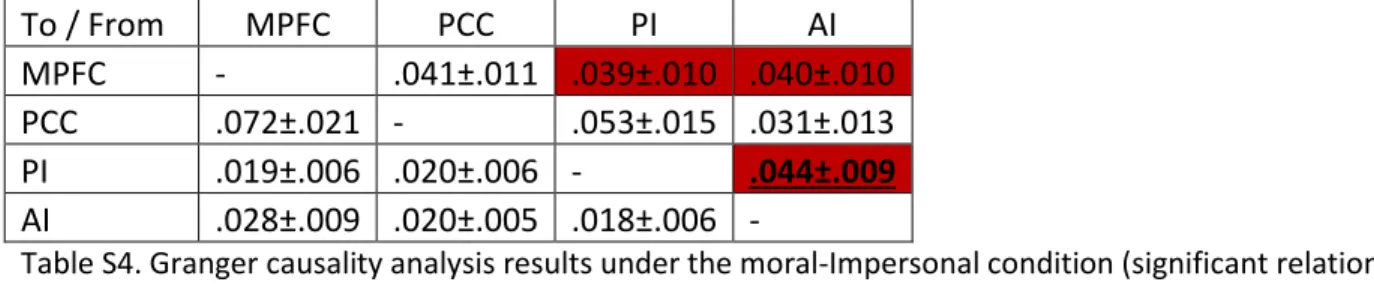
First, we were able to discover significant causal relations between seed and insula regions under both conditions. Under the moral-personal condition, there are MPFC PI and AI, PCC PI and AI, PI PCC and AI, and AI PI. In the case of moral-impersonal condition, these are MPFC PI and AI, PCC MPFC and AI, PI AI, and AI MPFC. Second, in the case of the dominant influence analysis, only AI PI reported significant dominant influence under the moral-personal condition. Under the moral-impersonal condition, there was not any significant dominant influence reported by the present analysis. Granger causality values are presented in Tables S3 and S4.
<Place Figure 5 about here>
Furthermore, there was a significant positive correlation between the mean score of the Granger causality from the MPFC to PI and mean response time under the moral-personal condition (r (14) = .57, p < .05, corrected). Other Granger causality scores did not show significant correlation with other behavioral responses—i.e., mean response time, ration of utilitarian decisions—under the moral-personal condition. There were not any other significant correlations found under the moral-impersonal condition.
4. Discussion
First, the present study compared the neural-level activity under the moral-personal, moral-impersonal and control conditions through whole-brain t-tests. The comparison showed that the MPFC was particularly activated under the moral-personal condition, while the parietal lobule regions were significantly activated under the moral-impersonal condition. These whole-brain t-tests successfully replicated previous fMRI investigations that utilized similar moral dilemmas [25,26,51]. Second, we conducted PPI analyses by setting two seed regions in the CMS, i.e., the MPFC and PCC. The analyses reported that these seed regions significantly interacted with other brain regions associated with moral emotion and motivation (e.g., the OFC, insula, midbrain) under the moral task conditions. Finally, the present study performed Granger Causality analyses to examine the causal influence between activity in seed regions and other brain regions associated with moral emotion and motivation; particularly, we focused on the anterior and posterior insula. The results showed that the activity in the seed regions in the CMS significantly influenced on that in the insula regions under the moral-personal condition. In addition, the activity in the anterior insula significantly and dominantly influenced on that in the posterior insula under the both conditions.
4.1 Whole-brain T-tests
First, in the case of the whole-brain t-tests, the present study successfully replicated the previous neuroimaging investigations using similar experimental paradigms. When we compared brain activity between two conditions, we were able to replicate previous experiments [25,26]. In the case of the moral-personal condition, the VMPFC and ACC were more activated compared to the moral-impersonal condition. First, the VMPFC is associated with processes of moral judgment associated with emotions [28,104–106]. In addition, the activity in the ACC is associated with conflict monitoring and solving [107–109] and complicated socio-moral dilemma solution [51]. In fact, the moral-personal condition was basically designed to induce strong negative and intuitive responses among subjects; thus, we expected to see strong activity in the VMPFC while subjects were solving such dilemmas. Furthermore, because the moral-personal dilemmas were more difficult to solve compared to moral-immoral-personal dilemmas not related to concrete human life, as reflected in the significantly longer mean response time [25,51], the ACC would be more activated under this condition.
On the other hand, the moral-impersonal dilemmas induced relatively stronger activity in the SPL and IPL comparing to the moral-personal condition. Previous neuroscientific studies have shown that these regions are associated with numerical and mathematical processing [56,110] and mathematical cognition [111,112]. Because the moral-impersonal dilemmas were more similar to simple arithmetical problems without the involvement of emotional elements than were moral-personal dilemmas [25], it is plausible that the activity in PL regions were stronger under this condition.
Given these results, we conclude that we were able to successfully demonstrate the general pattern of neural activity while subjects were solving moral philosophical dilemmas similar to those in the previous studies. Generally, subjects showed increased activity in the CMS, including the MPFC and PCC, in both the moral-personal and moral-impersonal conditions. The overlap between the activated regions in the present study and CMS regions would be interpreted by considering the nature of the dilemma task used in the present study. Basically, moral-personal and moral-impersonal dilemmas used in the present study required subjects to make decisions against presented dilemmatic situations. Previous neuroimaging studies that have demonstrated significant activity in the CMS while subjects were performing evaluations and selfhood, particularly autobiographical memory, and evaluation activity are inseparable from each other at the neural level [37,113,114]. Moreover, those evaluation tasks used in the previous studies usually entailed decision making aspects similar to the moral-personal and moral-immoral-personal dilemma tasks used in the present study; in fact, these decision making tasks were inevitably related to value judgment and evaluation [115,116]. Given these, it would be difficult to disambiguate the neural circuitry of selfhood from that of moral decision making. This aspect would be revealed by the significant overlap between the regions showing significant activity in moral-task conditions in the present study and CMS regions.
4.2 Interaction between CMS and other Regions
The result of the PPI analysis indicated that there were significant interaction between the PCC and MPFC, which constitute the core of the CMS, and other brain regions associated with moral emotion, cognition and motivation. Particularly, positive interactions were discovered between both the PCC and MPFC, and cerebellum, midbrain, brainstem, AI, OFC and DLPFC. The overall finding was in line with a previous neuroimaging study examining the interaction
between the MPFC, PCC and other brain regions when subjects were evaluating moral sensibility issues associated with justice or care ethics [117].
Previous studies have shown that cerebellum, midbrain and brainstem are associated with various affective and emotional processes, such as moral emotional processing [42,118], socio-moral motivation [119] and attachment [120]. In addition to those regions basically associated with primary emotion [118], the AI is associated with the integration of primary emotion and cognition [83,121] and motivational processes [60,122]. The OFC has been regarded as the locus of motivational processes [123–126]. Finally, previous neuroimaging studies have proven that the DLPFC is closely associated with cognitive control under and inhibition of impulse various task conditions related to socio-moral issues [25,26,51,127,128]. However, significant negative interaction was found between the seed regions and PI. Unlike the case of the AI, which is associated with cognitive and interoceptive awareness of emotions [78–82] and emotional anticipation [128], the PI is specifically related to the primary and intuitive perception of negative emotions and somatosensory pain and disgust [73–77].
In the context of these previous studies, the present PPI results suggest that selfhood-related processes associated with the seed regions and other general moral functions including moral emotion, cognition and motivation significantly interact with each other while solving presented moral dilemmas. In fact, this interaction would correspond to the previous moral psychological explanation regarding the mechanism of moral self and identity. According to previous moral psychological studies, moral self and moral identity have been regarded as psychological constructs playing a fundamental role in the generation of moral motivation and actual moral behavior [12,13]. These studies have proven that the psychological constructs
finally significantly contribute to the decision of behavioral direction and generation of
motivation towards such direction [18,46]. For instance, a subject who showed strong integration between moral beliefs and selfhood was more likely to choose the morally appropriate
behavioral option even under circumstances hindering moral behavior comparing to his/her counterparts [17,129]. Thus, our result that shows positive interaction between the regions supports the explanation of the role of moral self and moral identity proposed by previous moral psychological studies at the neural-level.
The PI showed negative interaction with seed regions under both conditions, and the absolute value of the strength of the interaction was significantly greater under the moral-personal condition (refer to Table 5). In the case of the interaction with PI, the reason for the negative interaction can be understood by considering the nature of dilemma tasks. Previous studies have indicated that negative emotional responses, such as disgust and pain, are functionally mapped to the PI [73,75–77]. Moral dilemmas included in the dilemma set were designed basically to induce negative emotional responses, such as disgust and reluctance, at the first phase of the dilemma solving process; it was the initial intention of the inventors of the dilemma set and proved by their experiments [25,26]. However, because the degree of negative emotions possibly induced by dilemmas was much stronger under the moral-personal condition comparing to the moral-impersonal condition [25,26], the negative interaction between the seed regions and PI was also stronger under the moral-personal condition. Given the analysis and previous studies, the present study suggests that there is significant negative association between activity in selfhood-related processes associated with the seed regions and negative emotional responses associated with the PI during the process of moral dilemma solving. This negative interaction would be resulted from subjects’ effort to make a more deliberated moral-decision
while they were solving complicated moral-personal dilemmas. Although intuitive and immediate emotional responses strongly influence the initial phase of moral decision-making [4,130], the final outcome of the decision-making process is also significantly affective by the control of reasoning and deliberative processes [131,132], particularly in case of solving complicated and high-conflict moral dilemmas [133,134]. Thus, CMS regions associated with moral self, which would be the moderator of moral deliberation and the monitor of moral emotion, showed negative interaction with the PI, which possibly represents the conscious control over intuitive and negative emotional responses as a part of efforts to make a more deliberated moral decision. Furthermore, this negative interaction was significantly stronger under the moral-personal condition (see Table 5), because the nature of the condition is basically more complicated and conflicting, so it would more strongly induce the involvement of
deliberative and monitoring processes. However, because the PPI method cannot determine the direction of influence between regions, we cannot determine whether selfhood-related processes down-regulate control negative affective responses or vice versa. However the Granger causality results clarified the information flow.
4.3 Granger Causality between CMS and Insula Regions
We were able to discover several significant causal relations between seed and insula regions from the findings of Granger causality analysis particularly under the moral-personal condition that are coherent with our moral psychological vantage point. The findings reported that CMS regions significantly influenced insula regions. The CMS regions particularly the MPFC and PCC selected in the present study and constitute the cortical midline structures, which significantly influenced insula regions, are regarded to be the loci of selfhood, or at least the autobiographical processing that is deemed to be the core selfhood-related process associated
with moral functioning in case of the PCC [36,37], at the neural level (Damasio, 2010; Northoff and Bermpohl, 2004). Previous neuropsychological studies have demonstrated that the activity in the MPFC region as a part of the CMS are closely associated with self-evaluation of a belief system and morality [29,42,62,93,135,136]; even socio-moral emotions are also modulated by this self-evaluative mechanism [137]. Furthermore, the PCC region is associated with other important self-related processes, particularly self-referencing and autobiographical memory processing [33,66–69]; although some recent studies have shown that this region might not be associated with selfhood-related processes in general, it is closely associated with the
autobiographical memory processing [36,37]. The influenced regions, the PI and AI, also play important roles in moral decision-making. They mainly deal with the processing of moral emotion and the generation for motivation for moral decision-making. First, activity in the PI region is basically associated with primary and somatosensory affective responses, which seem to occur intuitively and immediately after presented task stimuli. Previous studies have proposed that the PI is related to the initial affective responses to external stimuli and induces subjective feeling [73,74]. Moreover, activity in the AI is associated with secondary, conscious and interoceptive awareness of aroused affective responses [78–82] and their modulation in motivational processes [60,61,85]. This region is associated with post-processing of aroused initial affective responses to relay the affective information to cognitive processes, and finally produce behavioral motivation based on judgment [28,83,84]. This emotional and motivational processes are also associated with socio-moral processes (e.g., empathy), that is, the main
interest of the present study [138]. Particularly, the left AI, which was the ROI of this analysis in the present study, is associated with these conscious emotional and motivational processes,
especially positive emotional and motivational processes, while the RI is more closely related to negative arousing to the body (e.g., pain) [79].
Thus, we discovered at least partially the significant engagement of selfhood-related processes in the processing of primary moral emotion and generation of motivation for moral-decision. More specifically, autobiographical memory processing and self-evaluation based on a belief system influenced the processing and integration of primary emotion and motivation generation in moral decision-making. In fact, this neural-level evidence is consistent with the point of view of scholars underscoring the role of moral self and identity in human morality. They have proposed that the presence of moral self and moral identity based on personal morals and beliefs plays a regulatory rule in moral cognition, moral emotion and finally the generation of behavioral motivation [12,13,18,139]. Furthermore, although the intuitive mechanism would be initially activated, actual motivational and behavioral outcome is not directly produced by that mechanism, but moral self, which is based on autobiographical memory formulated by long-term experience, commitment and reflection [14,140], significantly influences that outcome [20,65]. Initially aroused moral emotions are also regulated by the moral self-related factors during the course of moral decision-making and moral behavior. As revealed by the causal relations in the present study, thus, moral emotion and motivational processes would be significantly influenced by processes of selfhood and moral identity, such as referencing of autobiographical memory as a part of moral identity and self-evaluation of moral beliefs and value system, during moral judgment as proposed by moral psychologists. However, because there were not any significant dominant influences from CMS to insula regions, we should be cautious while interpreting the findings. We should be aware of the possible presence of influences from insula regions to CMS regions, although these influences were not significant in our model. Future experiments with
more subjects or a meta-analysis based on accumulated data-set would possibly improve the statistical power of causality analysis and detect more dominant influences, which have not been proved to be significant in the present study due to the type II error issue but would really exist.
We should take into account the fact that the significant Granger causality from CMS to insula regions appeared only under the moral-personal condition and that no such significant causal relation was found under the moral-impersonal condition. This discrepancy can be well explained by the nature of each task condition. In the case of the moral-personal condition, dilemma tasks strongly evoke subjects’ gut-level responses, because they demonstrate concrete and vivid scenes, which are involved in potentially severe physical and mental harm to people in the dilemmatic situations [25,26]. As a result, psychological processes dealing with intuitive emotional responses would be intensively activated under this condition [141], so the regulatory activity associated with the self-related regions would also be intensified while processing emotional responses and making a final moral decision under this task condition. According to moral psychologists, moral self is supposed to monitor and moderate moral emotion and
cognition, and finally significantly contribute to the generation of motivation for moral decision-making and behavior [12,13,17,46,142]. Thus, the significant influence from CMS regions, which are supposed to be associated with moral self in the present study, to insula regions dealing with moral emotion and motivation possibly under the moral-personal condition
represent the regulation of emotional and motivational processes by moral self in moral decision-making in complicated and conflicting situations at the neural level. Furthermore, because the value conflicts embedded in this type of dilemmas are basically much fiercer compared to those embedded in moral-impersonal dilemmas, they are more likely to request subjects to refer to and reflect upon their moral beliefs and value system based on their autobiographical self while
solving dilemmas [71,72], and it would be indicated by the increased activity in CMS regions as demonstrated by the whole-brain comparison [33–35]. This process was also be indicated by the increased interaction between CMS and other morality-related regions under the moral-personal condition in the PPI analysis. Thus, subjects were more likely to refer to and reflect on their moral beliefs and value system when they were solving intensively conflicting moral-personal dilemmas, and the reflection and reference possibly regulated the processes of moral emotion and motivation as indicated by the significant Granger causality from CMS to insula regions under the moral-personal condition. On the other hand, moral-impersonal dilemmas are more similar to value-neutral mathematical or working memory tasks compared to the moral-personal dilemmas [25], therefore the involvement of self-related processes would become weaker. Under this condition, subjects do not have to consider their moral beliefs and self-identity to solve problems; instead, they are only requested to use their general cognitive skills, which are
independent from selfhood-related processes. As a result, the differences between moral-personal and moral-impersonal conditions should result in different Granger causality in these conditions.
Meanwhile, we discovered the dominant significant influence from the AI to PI. Given the previous studies that have proposed that the PI is associate with primary intuitive emotional arousal, particularly negative emotion [73,74], we may conclude that the initial arousal of negative emotional responses against moral dilemmas are regulated by activity in the AI. We may apply this discussion to the consideration of the importance of moral deliberation and cognition in moral decision-making. Some psychologists argue that the mechanism of intuitive and affective processes occurring at the earliest stage of moral judgment significantly determine further moral judgment [5]. For instance, particularly, negative emotions, such as disgusting, are significantly in the process of further value evaluation, and finally, motivation for a certain
behavioral outcome [4,130]. However, the presence of the dominant influence from the AI to PI can support another moral psychological vantage point that underscores the role of conscious regulation over intuitive emotional responses in moral decision-making particularly while
solving moral problems [70,142], such as moral dilemmas in the present study, which is coherent with the view point of the proponents of moral self and identity [12,143].
In addition, the significant correlation between the causality score from the MPFC to PI and mean response time under the moral-personal condition is also interesting. We interpret the interaction of MPFC on PI to represent the influence of self-evaluative processes [62,63] on intuitive and emotional responses [73,74,77] to moral dilemmas. Moreover, this causal direction suggests deliberative processes based on the autobiographic self and moral belief system exert control over affective processes while solving moral dilemmas. In fact, a previous study demonstrated that activity in the PI is negatively correlated with mean response time under the moral-personal condition [51]. Therefore, increased activity in the PI, which is related to the stronger arousal of intuitive emotional responses, is perhaps associated with faster responses towards dilemmas. Thus, the influence from the MPFC to PI might be the indicator of the request for reflection and deliberation on intuitive emotional responses from selfhood and might slow down the overall decision-making process. This significant correlation was found only under the moral-personal condition. Likewise, our general discussion about the different Granger causality patterns between two conditions, also suggests that self-evaluative processes were not required to influence affective processes under the moral-impersonal condition, because dilemmas in this condition did not significantly provoke subjects’ negative emotional responses [25,26]. This result is in line with a previous study that has demonstrated positive correlation between the degree of the involvement of moral deliberation and mean response time particularly when
subjects were requested to solve highly conflicting moral problems, which are similar to moral-personal dilemmas [144].
4.4 Limitations and Future Directions
There are several limitations in the present study. First, the present study utilized hypothetical dilemmas instead of real life situations [145]. Due to this reason, the present study would not be able to explain the actual psychological processes linked to moral dilemma solving and moral behavior in one’s everyday life. Previous non-fMRI studies of moral judgment have also been criticized for this reason. For instance, there have been continuous controversies regarding the gap between the moral judgment score calculated using hypothetical dilemmas and actual moral behavioral outcome [6,146]. In short, because the hypothetical dilemmas are
basically conceptual, abstract and philosophical, and cannot completely depict situations in our real lives, they would not be appropriate to measure subjects’ moral motivation in the real world. Second, the present study did not use any survey or questionnaire measuring the strength of each subject’s moral identity or moral self. Thus, it would be difficult to directly associate the brain activity in moral task conditions and moral self solely based on the findings from the present study. Future studies using such measurements (e.g., moral identity development interview [14], self-importance of morality measure [18]) should be conducted in order to clearly identify the neural-level mechanism of moral self. Third, the relatively small sample size (N = 16) and number of trials (60 per subject) provided only modest statistical power because of the relatively subtle difference in neural activity between socio-moral task conditions [147]. Because, the present study controlled for demographic variables (i.e., ethnicity, age, gender, ethnicity) by setting them as covariates, the lack of subjects would contribute to the further decrease of statistical power. This potentially insufficient statistical power can result in Type II errors that
hinder detection of any subtle but true neural-level activity of interest [148]. Fourth, because the present study investigated multi-cultural subjects, variances originating from the cultural factor would matter. When we tested the effect of the cultural background, we were not able to discover any brain region showed the significant cultural effect at the threshold of p < .05 (FDR) and k ≥ 25. Also, the main effect of gender was not statistically significant. These results may imply that the moderating role of selfhood in moral decision making processes is universal across cultures and genders; however, due to the lack of statistical power of the present study, the validity of this interpretation would be limited. Fifth, emotional impacts originating from moral dilemmas would influence the subjects’ decision-making process, but the degree of emotional arousal was not measured. Negative emotional arousal would be stronger in the moral-personal condition and influence the decision making [25,26,51], but future experiments should collect emotional data to test this prediction. Sixth, although the results showed that regions associated with self-related processes were significantly involved in moral functioning, it is impossible to unequivocally conclude that moral self is the only self-related process activated under the moral task conditions in the present experiment. Instead, there might be many other self-related processes, which are not directly associated with morality or moral functioning, involved in the dilemma solving and it can be revealed by the neural activity in the default mode network.
Thus, future studies should carefully consider several points to address these limitations. First, the development of more realistic moral dilemmas is a possible way to address the first limitation. Although the environment in MR scanners makes it difficult to employ truly
naturalistic experimental stimuli, several scholars have suggested text-based materials using real-life socio-moral stories [149,150] and attempted to apply them to an fMRI experiment [151]; however, the experiment did not examine the involvement of self-related processes or CMS
regions. Future fMRI experiments would utilize the realistic moral dilemma set and investigate the interaction and causal relation between CMS and other moral-related regions to demonstrate the neural-level mechanism of moral self in everyday lives. Second, the statistical power can be increased by replicating the experiment and interaction and causality analyses in future fMRI studies, to the extent finances permit. Finally, future studies should design more sophisticated experiments to illuminate the neural correlates of moral self that can be distinguished from other general self-related processes at the neural level. The studies may be able to develop dilemmas or task conditions that are involved in moral self-related problems (e.g., reflecting upon one’s moral beliefs) and general self-related problems (e.g., recalling previous personal experience from autobiographical memory) and to compare brain and network activity between these two conditions.
5. Conclusion
The present study demonstrates significant interactions developed between the CMS (PCC and MPFC) and other moral-related regions including AI and PI while subjects are solving moral dilemmas. These results can support the moral psychological accounts regarding the role of moral self in moral decision-making processes. Particularly, motivational processes for moral decision-making is coupled with activity in CMS regions, which is regarded as an indicator of the involvement of selfhood-related processes. The findings from the Granger causality propose that activity in CMS regions influence that in insula regions while moral decision-making. The causality between the indicated regions supports the influence of self-evaluation of beliefs and values based on self-referencing and autobiographical memory on the processing of moral emotion and generation of motivation for the final decision-making procedure (MPFC, PPC
PI, AI), although the influence in that direction were not dominant. This is consistent with the involvement of moral self and identity in moral judgment that has been proposed by moral psychologists who have attempted to better explain the source of moral motivation and actual moral behavior. Furthermore, the significant dominant influence from the AI to PI under the moral-personal condition is also interesting, because it shows us that the initially and intuitively aroused negative emotional responses are regulated by psychological processes associated with conscious and interoceptive awareness of emotions while solving complicated and conflicting moral dilemmas as moral psychologists have proposed. These findings from the interaction and Granger causality analyses in the present study can provide researchers in the field of moral psychology and social neuroscience with useful insights about how to approach the research topics regarding psychological processes and neural correlates of human morality. In particular, the present study demonstrates the importance of activity in the CMS associated with selfhood during the process of moral judgment to be accounted for in their future studies.
References
[1] L. Kohlberg, The philosophy of moral development: Moral stages and the idea of justice, Harper & Row, San Francisco, 1981.
[2] L. Kohlberg, The psychology of moral development: the nature and validity of moral stages, Harper & Row, San Francisco, 1984.
[3] M.L. Hoffman, Empathy and Moral Development: Implications for Caring and Justice, Cambridge University Press, Cambridge, UK, 2000.
[4] J. Haidt, The emotional dog and its rational tail: A social intuitionist approach to moral judgment, Psychol. Rev. 108 (2001) 814–834. <Go to ISI>://000171840100008.
[5] J.A. Bargh, K.L. Schwader, S.E. Hailey, R.L. Dyer, E.J. Boothby, Automaticity in social-cognitive processes., Trends Cogn. Sci. 16 (2012) 593–605. doi:10.1016/j.tics.2012.10.002.
[6] J.R. Rest, D. Narvaez, M.J. Bebeau, S.J. Thoma, Postconventional Moral Thinking: A Neo-Kohlbergian Approach, Lawrence Erlbaum Associates, Publishers, Mahwah, NJ, 1999.
[7] J.R. Rest, D. Narvaez, Moral Development in the Professions: Psychology and Applied Ethics, Lawrence Erlbaum Associates, Inc, Mahwah, NJ, 1994.
[8] S.J. Thoma, J.R. Rest, The Relationship between Moral Decision Making and Patterns of
Consolidation and Transition in Moral Judgment Development, Dev. Psychol. 35 (1999) 323–334. [9] M.J. Bebeau, The defining issues test and the four component model: contributions to professional
education., J. Moral Educ. 31 (2002) 271–295. doi:10.1080/0305724022000008115.
[10] T. Lickona, Eleven Principles of Effective Character Education, J. Moral Educ. 25 (1996) 93–100. doi:10.1080/0305724960250110.
[11] M.W. Berkowitz, J.H. Grych, Early Character Development and Education, Early Educ. Dev. 11 (2000) 55–72. doi:10.1207/s15566935eed1101_4.
[12] S.A. Hardy, G. Carlo, Identity as a Source of Moral Motivation, Hum. Dev. 48 (2005) 232–256. doi:10.1159/000086859.
[13] A. Blasi, Moral identity: Its role in moral functioning, in: W.M. Kurtines, J.L. Gewirtz (Eds.), Morality, Moral Behav. Moral Dev., John Wiley & Sons, New York, NY, 1984: pp. 128–139. [14] W. Damon, Self-understanding and moral development from childhood to adolescence, in: W.M.
Kurtines, J.L. Gewirtz (Eds.), Morality, Moral Behav. Moral Dev., John Wiley & Sons, New York, NY, 1984: pp. 109–127.
[15] J.E. Stets, M.J. Carter, The Moral Self: Applying Identity Theory, Soc. Psychol. Q. 74 (2011) 192–215. doi:10.1177/0190272511407621.
[16] A. Blasi, Moral character: A psychological approach, in: D.K. Lapsley, F.C. Power (Eds.), Character Psychol. Character Educ., University of Notre Dame Press, Notre Dame, IN, 2005: pp. 67–100.
[17] A. Reed, K. Aquino, E. Levy, Moral Identity and Judgments of Charitable Behaviors, J. Mark. 71 (2007) 178–193. doi:10.1509/jmkg.71.1.178.
[18] K. Aquino, A. Reed, The self-importance of moral identity, J. Pers. Soc. Psychol. 83 (2002) 1423– 1440. doi:10.1037/0022-3514.83.6.1423.
[19] P. Conway, J. Peetz, When Does Feeling Moral Actually Make You a Better Person? Conceptual Abstraction Moderates Whether Past Moral Deeds Motivate Consistency or Compensatory Behavior, Personal. Soc. Psychol. Bull. 38 (2012) 907–919. doi:10.1177/0146167212442394. [20] A. Colby, W. Damon, Some do care : contemporary lives of moral commitment, Free Press, New
York, NY, 1992.
[21] A. Colby, W. Damon, The uniting of self and morality in the development of extraordinary moral commitment, in: G.G. Noam, T.E. Wren (Eds.), Moral Self, MIT Press, Cambridge, MA, 1993: pp. 149–174.
[22] T.A. Ito, J.T. Cacioppo, Attitudes as Mental and Neural States of Readiness: Using Physiological Measures to Study Implicit Attitudes, in: B.W.N. Schwarz (Ed.), Implicit Meas. Attitudes,
Guilford Press, New York, NY, US, 2007: pp. 125–158.
[23] K. Kristjánsson, Measuring self-respect, J. Theory Soc. Behav. 37 (2007) 225–242. doi:10.1111/j.1468-5914.2007.00339.x.
[24] K. Kristjánsson, Virtues and Vices in Positive Psychology: A Philosophical Critique, Cambridge University Press, New York, NY, 2013.
[25] J.D. Greene, R.B. Sommerville, L.E. Nystrom, J.M. Darley, J.D. Cohen, An fMRI investigation of emotional engagement in moral judgment, Science (80-. ). 293 (2001) 2105–2108.
doi:10.1126/science.1062872.
[26] J.D. Greene, L.E. Nystrom, A.D. Engell, J.M. Darley, J.D. Cohen, The neural bases of cognitive conflict and control in moral judgment, Neuron. 44 (2004) 389–400.
doi:10.1016/j.neuron.2004.09.027.
[27] D. Robertson, J. Snarey, O. Ousley, K. Harenski, E.D. Bowman, R. Gilkey, et al., The neural processing of moral sensitivity to issues of justice and care, Neuropsychologia. 45 (2007) 755– 766. doi:10.1016/j.neuropsychologia.2006.08.014.
[28] J. Decety, K.J. Michalska, K.D. Kinzler, The contribution of emotion and cognition to moral sensitivity: A neurodevelopmental study, Cereb. Cortex. 22 (2012) 209–220.
doi:10.1093/cercor/bhr111.
[29] J. Moll, R. de Oliveira-Souza, P.J. Eslinger, I.E. Bramati, J. Mourao-Miranda, P.A. Andreiuolo, et al., The neural correlates of moral sensitivity: A functional magnetic resonance imaging
investigation of basic and moral emotions, J. Neurosci. 22 (2002) 2730–2736.
[30] K. Prehn, I. Wartenburger, K. Meriau, C. Scheibe, O.R. Goodenough, A. Villringer, et al., Individual differences in moral judgment competence influence neural correlates of socio-normative judgments, Soc. Cogn. Affect. Neurosci. 3 (2008) 33–46. doi:10.1093/Scan/Nsm037. [31] M.H. Immordino-Yang, A. McColl, H. Damasio, A. Damasio, Neural correlates of admiration and
compassion, Proc. Natl. Acad. Sci. 106 (2009) 8021–8026. doi:10.1073/pnas.0810363106. [32] Z.A. Englander, J. Haidt, J.P. Morris, Neural Basis of Moral Elevation Demonstrated through
Inter-Subject Synchronization of Cortical Activity during Free-Viewing, PLoS One. 7 (2012) e39384. doi:10.1371/journal.pone.0039384.
[33] A. Damasio, Self Comes to Mind: Constructing the Conscious Brain, Vintage Books, New York, NY, 2010.
[34] G. Northoff, F. Bermpohl, Cortical midline structures and the self, Trends Cogn. Sci. 8 (2004) 102–107. doi:10.1016/j.tics.2004.01.004.
[35] P. Qin, G. Northoff, How is our self related to midline regions and the default-mode network?, Neuroimage. 57 (2011) 1221–1233. doi:10.1016/j.neuroimage.2011.05.028.
[36] H.F. Araujo, J. Kaplan, A. Damasio, Cortical Midline Structures and Autobiographical-Self Processes: An Activation-Likelihood Estimation Meta-Analysis, Front. Hum. Neurosci. 7 (2013). doi:10.3389/fnhum.2013.00548.