Received July 1, 2016; Revised September 15, 2016; Accepted October 18, 2016
Based Learning through
6WXGHQWV¶ 6HOI
-Regulated Learning. Journal of Education
and Learning. Vol.10 (4) pp. 405-410.
The Effectiveness of Collaborative Academic Online Based
Learning through
6WXGHQWV¶ 6HOI
-Regulated Learning
Erfan Priyambodo*
Department of Chemistry Education, Yogyakarta State University
Abstract
Nowdays, learning through e-learning is going rapidly, including the application BeSmart UNY. This application is providing collaborative method in teaching and learning. The aim of this study was to determine the effectiveness of the Collaborative Academic Online Based Learning method in teaching and learning toward
VWXGHQWV¶ Self-Regulated Learning (SRL) on Vocational School Chemistry courses. This study was quasi-experimental research method with one group pre-test post-test design. Instruments used in this study were
OHVVRQ SODQ DQG TXHVWLRQQDLUH RI VWXGHQWV¶ 65/ 7KLV TXHVWLRQQDLUH LV ILOOHG E\ VWXGHQWV WKURXJK %H6PDUW 81<
In determining the differences SRL before and after teaching and learning processes, the data was analysed by statistical method. The results showed that the implementation of the Collaborative Academic Online Based
/HDUQLQJ PHWKRG LQ WHDFKLQJ DQG OHDUQLQJ ZDV HIIHFWLYH IRU LPSURYLQJ VWXGHQWV¶ 65/
Keywords: collaborative academic online based learning, self-regulated learning
* Erfan Priyambodo
, Department of Chemistry Education, Yogyakarta State University E-mail: [email protected]
406
The Effectiveness of Collaborative Academic Online Based Learning through StudenWV¶ Self-Regulated LearningIntroduction
Vocational School Chemistry is one of the compulsory subjects for students of chemistry education in the Yogyakarta State University. This subject has a load of 2 credits. The purpose of this course is to equip students with knowledge about curriculum in vocational school and exploring chemistry concepts in vocational school.
One method that can be performed on the Vocational School Chemistry teaching and learning is the collaborative method. The characteristic of this method is the existence of working in a group with different members, helping each other to solve a problem together, and produce a product (Palloff, 2005). Study conducted by Brindley and Walti (2009), Chao (2010) and Jahng (2012) shows that collaborative learning is possible in online and the results are quite satisfactory.
Online process in teaching and learning offers a better chance to create a social networking environment through the interaction between students and lecture. The design of online teaching and learning can be set to increase the activity of the group rather than individual activities (Briendley and Walti, 2009: 2). In the online teaching and learning involving small groups, it will be able to improve students' critical thinking skills, self-assessment, as well as reconstructing the appropriate knowledge of cooperative learning in a conventional classroom. BeSmart UNY, an application of online teaching and learning, used to support the implementation of the Collaborative Academic Online Based Learning in the Vocational School Chemistry course.
Self-Regulated Learning (SRL) is a matter that is owned by each learner who acts as the strategy adopted each learners in learning activities. Education experts agree that SRL is an important factor in the academic motivation and academic achievement. (Zumbrunn, et al, 2011: 3).
Zimmerman in Greene et al (2011: 107) states that SRL is a form of the attitude of a student to monitor and control aspects of cognition, motivation, habits, and emotions in accordance with the environment or situation changing in the learning process. Students apply SRL means that students plan, monitor and assess learning independently (Zumbrunn, et al, 2011: 3). Turan (2010: 279) states that students who have academic value (learning outcomes) higher will likely have a higher SRL and vice versa. The study conducted by Erfan Priyambodo and Sulistyani (2014) showed that there is a
SRVLWLYH FRUUHODWLRQ ZKHQ DSSO\LQJ 0XOWLPHGLD %DVHG /HDUQLQJ WRZDUG VWXGHQWV¶ 65/
Collaborative Academic Online Based Learning is a working group of students to solve problems through online activity. Hopefully, this method can iPSURYH VWXGHQWV¶ 65/ LQ WHDFKLQJ DQG
learning.
Methods
This research was conducted at Mei-Oktober, 2015 in Department of Chemistry Education, Yogyakarta State University. This research was categorized quasy experiment with. One group pretest-posttest design. In this study, subjects were given a questionnaire about SRL before and after the learning processes. The subjects of this study were chemistry education students of class I who take Vocational School Chemistry courses, as many as 23 students.
The aspects of SRL were DGDSWHG IURP 65/¶V FRPSRnents stated by Zimmerman (1989: 329) which consists of (1) metacognitive, (2) motivation, and (3) behaviour. Grating instruments can be seen in Table 1.
Table 1. Grating Instruments of SRL Questionnaire
Number SRL aspects Count of Statements
1. Motivation 11
2. Behavior 8
3. Metacognitive 9
Total Number 28
The type SRL questionnaire used is a closed questionnaire. The total amount of statements is 28 items, which are consisting of positive statements and negative statements. This questionnaire was used to measure each student SRL before and after Vocational School Chemistry teaching and learning. The option in the questionnaire answers available with a choice of five answer, which are Always (SL), often (S), sometimes (K), rare (J), and Never (TP). The scale used is Likert scale with scores from 1 to 5. On the positive statements, Always (SL) answer has the highest score (5) and so on. However, on
Erfan Priyambodo (2016). Journal of Education and Learning. Vol. 10 (4) pp. 405-410xx.
407
a negative statement, the Always (SL) answer has the lowest score (1) and so on. The example of statements in the SRL questionnaire was shown in Figure 1.
Figure 1. The Example of Statement in the SRL Questionnaire
The data of SRL was analysed by paired sample t-test. This analysis is the analysis involves two measurements on the same subject to any influence or specific treatment. This test is used to compare the average of a sample pairs (paired). Paired-samples are a sample group with the same subject but have two different treatments or measurements.
7KLV WHVW LV SHUIRUPHG WR GHWHUPLQH WKH GLIIHUHQFH VWXGHQWV¶ 6/5 EHIRUH DQG DIWHU SDUWLFLSDWLQJ
in the teaching and learning by applying Collaborative Academic Online Based Learning method. This test is a parametric statistical analysis. It is necessary prerequisite of analysis, namely homogeneity test and normality test. All analyses using SPSS computer program. Furthermore, to determine the extent of
WKH VWXGHQWV¶ 65/ LW ZDV FRQWLQXHG ZLWK JDLQ VFRUH DQDO\VLV
Result and Discussion
The study on the effectiveness of Collaborative Academic Online Based Learning method
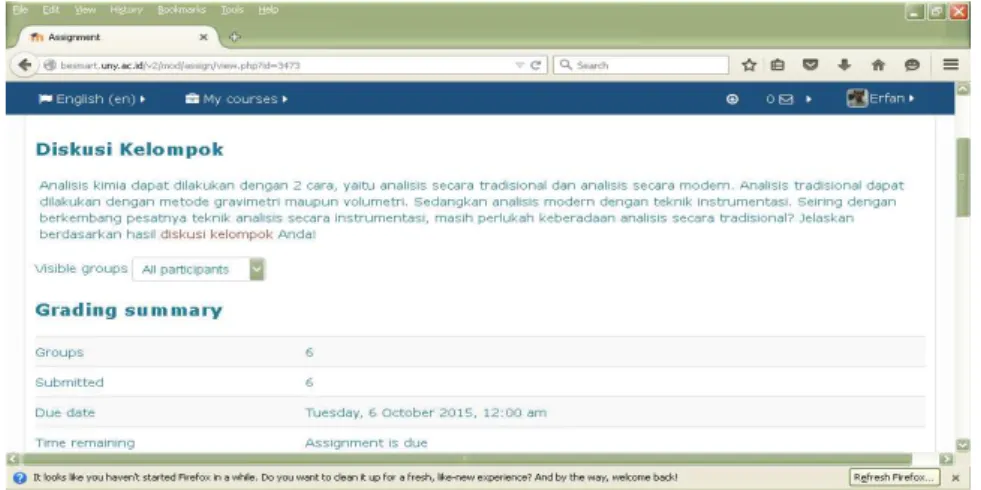
WRZDUG VWXGHQWV¶ 65/ ZDV XVLQJ H-learning facilities owned UNY, namely BeSmart UNY. The display and descriptions of this course is shown in Figure 2.
408
The Effectiveness of Collaborative Academic Online Based Learning through StudenWV¶ Self-Regulated LearningVocational School Chemistry course is compulsory for students of Chemistry Education. This course is taken in the 7th semester. The burden of this course is 2 credits. The focus of this course is on the structure of the curriculum in vocational school and strengthening chemistry concepts in vocational school, especially chemistry as subjects C1 (Fundamentals of Expertise). This study focuses on three materials, which are (1) volumetric analysis, (2) gravimetric analysis and (3) petroleum.
There were 25 students registered in this course. However, 2 students were left of this course. List of participants of this course shown in Figure 3.
Figure 3. List of Participants of Vocational School Chemistry Course
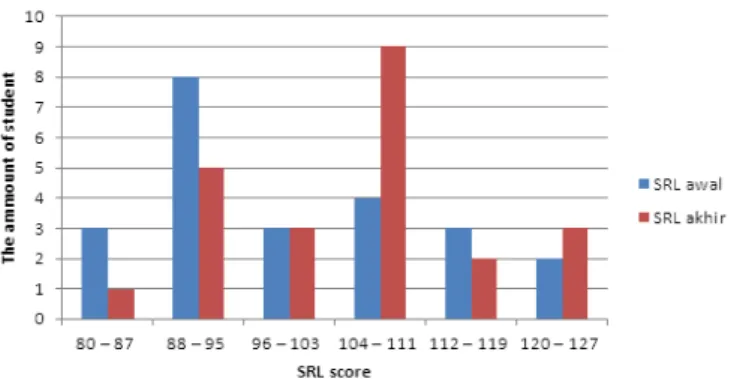
Through online course, students are trying hard to discipline theirself, particularly in terms of collecting the answer of tasks of this course. Collaborative group discussion (online) is applied as the main activity of this course. After their discussion, they send the results of their discussion through BeSmart. Lecturer was provided grade and also feedback on the group discussion. The summary of the results of the data of SRL questionnaire is presented in Figure 6.
Figure 4. A Group Problem in Vocational School Chemistry Course
Based on the chart above, it is clear that students have a tendency to lower the SRL decreased, while students who have a high SRL increased. This phenomena is in line with one study by Erfan Priyambodo and Sulistyani (2014) with the results is the students have SRL higher if they used computers for teaching and learning rather than print-based materials for teaching and learning.
Erfan Priyambodo (2016). Journal of Education and Learning. Vol. 10 (4) pp. 405-410xx.
409
Figure 6. Frequency Distribution of SRL Data
The paired sample t-test is used to determine whether there is a difference SRL student before and after the teaching and learning using the Collaborative Academic Online Based Learning method. Table 2 shows a summary of the results of paired sample t-test. Based on the analysis shown in Table 2,
LW FDQ EH VHHQ WKH YDOXH RI ³S´ DW WKH FRQILGHQFH OHYHO LV ,W FDQ EH FRQFOXGHG WKDW WKH YDOXH ³S´ . ZKLFK LQGLFDWHV WKH QXOO K\SRWKHVLV LV UHMHFWHG DQG DOSKD K\SRWKHVLV LV DFFHSWHG PHDQLQJ
that there are significant differences SRL students before and after the teaching and learning using the Collaborative Academic Online Based Learning method.
Table 2. The summary of Paired Sample t-test
Data SRL score pre post Mean 99.74 104.30 Standard Deviasion 12.088 10.550 correlation 0.770 p (correlation) 0.000 df 22 p (SRLearly-SRLend) 0.010
Gain score analysis conducted to determine the extent to which students SRL increase after the implementation of the Collaborative Academic Online Based Learning method. Mathematical equations to calculate the value of the gain scores (Hake, 1999) is as follows:
Normalized gain score (g) = 65/ SRVW ± 65/ SUH
PD[LPXP VFRUH RI 65/ ± 65/ SUH
%DVHG RQ QRUPDOL]HG JDLQ VFRUH DQDO\VLV WKH PHDQ JDLQ VFRUH RI VWXGHQWV¶ 65/ LV 1. It
VKRZV WKDW VWXGHQWV¶ 65/ ZDV LQFUHDVH DIWHU WKH LPSOHPHQWDWLRQ RI WKH &ROODERUDWLYH $FDGHPLF 2QOLQH %DVHG /HDUQLQJ PHWKRG 7KH FDWHJRU\ RI WKH LQFUHDVLQJ VWXGHQWV¶ 65/ LV ORZ FDWHJRU\ 7KH VFRUH JDLQ
analysis also supports data analysis paired t-test and prove that the increasing of SRL is true.
According to Zimmerman (1989: 329), SRL have a role in shaping attitudes that affect students' learning outcomes, students who have a high SRL tend to have high learning outcomes. Another study by Savoji et al (2013: 1164) also states that there is a positive relationship between SRL (cognitive, metacognitive) with student learning outcomes. Similar studies have also been done to look at the relationship with the learning outcomes SRL largely positive results.
Abidin et al (2011: 143) states that the learning outcomes are influenced by many things, one of which is a style of learning (learning styles). This learning style is one of the students do SRL, is a strategy adopted each student in learning activities. Therefore, with the increase in SRL student after attending the teaching and learning using Collaborative Academic Online Based Learning method, it is expected learning outcomes of students also increased.
410
The Effectiveness of Collaborative Academic Online Based Learning through StudenWV¶ Self-Regulated LearningConclusions
Based on this study, it can be concluded that the implementation of Collaborative Academic Online Based Learning methods in Vocational School Chemistry course is very effective for improving
VWXGHQWV¶ 65/
Acknowledgement
The author thank to SEAMOLEC through research grants PTJJ SEAMOLEC 2015 so that the study can be completed.
References
Abidin, M. J. Z., Abbas Ali Rezaee, Helan Nor Abdullah, and Kiranjit Kaur Balbir Singh. (2011). Learning Styles and Overall Academic Achievement in a Specific Educational System. International Journal of Humanities and Social Science. Vol. 1 No. 10: 143-152.
Brindley, Jane E., Christine Walti. (2009). Creating Effective Collaborative Learning Groups in an Online Environment. International Review of Research in Open and Distance Learning. 10
(3): 1-18.
Chao, Ining Tracy, Tami Saj., Doug Hamilton. (2010). Using Collaborative Course Development to Achieve Online Course Quality Standards. International Review of Research in Open and Distance Learning. 11(3): 106-126.
Erfan Priyambodo., Sulistyani. (2013). The Effect of Multimedia Based Learning in Chemistry
7HDFKLQJ DQG /HDUQLQJ RQ 6WXGHQW¶ 6HOI-Regulated Learning. Journal of Teaching and Learning 8(4): 363-367.
Greene, J. A., Daniel C. Moos, Roger Azevedo. (2011). Self-Regulation of Learning with Computer-Based Learning Environments. New Directions for Teaching and Learning No. 126: 107-115.
Hake, Richard R. (1999). Analyzing Change/ Gain Scores. Accessed from http://lists.asu.edu at 4 Oktober 2015.
Jahng, Namsook. (2012). An Investigation of Collaboration Processes in an Online Course: How do Small Groups Develop over Time?. International Review of Research in Open and Distance Learning. 13(4): 1-18
Palloff, R. M., Pratt, K. (2005). Collaborating online: Learning together in community. San Francisco : Jossey-Bass.
Savoji, Azar Pakdaman, Baheshteh Niusha, Leila Boreiri. (2013). Relationship Between Epistemological Beliefs, Self-Regulated Learning Strategies and Academic Achievement.
Procedia - Social and Behavioral Sciences. (84):1160-1165.
Turan, S., Özcan Demirel. (2010). The Relationship Between Self-Regulated Learning Skills and Achievement : A Case from Hacettepe University Madical School. H. U. Journal of Education. No. 38: 279-291.
Zimmerman, B. J. (1989). A Social Cognitive View of Self-Regulated Academic Learning. Journal of Educational Psycology : 329 ± 339.
Zumbrunn, S., Joseph Tadlock, Elizabeth Danielle Roberts. (2011). Encouraging Self-Regulated Learning in the Classroom: A Review of the Literature. Virginia: Metropolitan Educational