A Thesis Submitted for the Degree of PhD at the University of Warwick Permanent WRAP URL:
http://wrap.warwick.ac.uk/131589 Copyright and reuse:
This thesis is made available online and is protected by original copyright. Please scroll down to view the document itself.
Please refer to the repository record for this item for information to help you to cite it. Our policy information is available from the repository home page.
For more information, please contact the WRAP Team at: [email protected]
Behavioural science and financial capability: designing and testing complex interventions
by Krishane Patel
Thesis
Submitted to the University of Warwick for the degree of
Doctor of Philosophy
University of Warwick; Warwick Business School September 2018
i Contents
1.1 What is household financial and saving behaviour? 2
1.2 Financial Capability 4
Will financial education improve financial capability? 4
The limits of education 7
What does financial education miss? 10
1.3 Understanding and changing behaviour 13
Capability 13
1.3.1.1 Physical Capability – Genetics and Intelligence Quotient (IQ) 14
1.3.1.2 Psychological Capability - Parental behaviour 14
1.3.1.3 Psychological Capability - Knowledge 15
1.3.1.4 Psychological Capability - Literacy 15
Motivational Factors 15
1.3.2.1 Extraversion 15
1.3.2.2 Impulsivity/Self-control 16
1.3.2.3 Intentions and Goals 17
1.3.2.4 Executive function 18 1.3.2.5 Sense of control 18 Opportunity 19 1.3.3.1 Social Factors 19 1.3.3.2 Physical opportunities 19 Individual Differences 20
2.1 Understanding and changing behaviour 23
2.2 Model of behaviour 24
2.3 Intervention process 30
2.4 Future research: moving towards a unified strategy 33
3.1 Introduction 35 3.2 Intentions 37 3.3 Goal-directed actions 38 3.4 Prospective memory 40 3.5 Impulsivity 41 3.6 Executive function 42
ii 4.1 Introduction 46 4.2 Method 46 Advantages 46 Disadvantages 47 Participant recruitment 47 Materials 48 Procedure 48 Thematic Analyses 49 Secondary Data 49 4.3 Results 50 Participants 51
Keeping track: thematic analysis 55
4.3.2.1 Barriers 55
4.3.2.2 Enablers 57
Making-ends-meet: thematic analysis 61
4.3.3.1 Barriers 61
4.3.3.2 Enablers 62
Planning ahead: thematic analysis 66
4.3.4.1 Barriers 66 4.3.4.2 Enablers 67 4.4 Discussion 69 Financial education 70 4.5 Conclusion 71 5.1 Background 74
5.2 Summary of formative research findings 74
5.3 Behavioural diagnosis of sub-optimal behaviours 75
5.4 Intervention design and purpose 77
Keeping Track - Checking Intervention 77
Making-Ends Meet - Substitution Intervention 79
Planning ahead- Planning Intervention 82
5.5 Pilot study 85
Introduction 85
Method 85
5.5.2.1 Sample 85
5.5.2.2 Primary Outcome Measure 86
5.5.2.3 Secondary Outcome Measures 86
5.5.2.4 Savings 86
5.5.2.5 Distance travelled to Savings goal 86
5.5.2.6 Intervention’s assessment. 87
5.5.2.7 Data quality 87
5.5.2.8 Design 88
5.5.2.9 Interventions 88
5.5.2.10 Results 90
iii 5.5.2.12 Acceptability 92 5.5.2.13 Practicality 93 5.5.2.14 Adherence 97 5.5.2.15 Affordability 98 5.5.2.16 Safety/Side-effects 99 5.5.2.17 Equity 99 5.6 Modifications to Interventions 99
5.6.1.1 Problem solving in Habit-Based intervention 99
5.6.1.2 Interventions used in RCT 100
5.6.1.3 Use and submission of the behavioural tools 100
5.6.1.4 Frequency of contacting participants 101
6.1 Background 104 6.2 Aims 104 6.3 Design 104 6.4 Duration 104 6.5 Power calculation 104 6.6 Method 105 Sample 105
Inclusion and Exclusion criteria 106
Control Condition 106
Habit-Based Intervention 107
Goal-Setting Intervention 107
Participants 107
Measures 108
6.6.7.1 Outcome measures definitions and specifications 109
6.7 Hypotheses 111 6.8 Procedure 111 6.9 Results 114 Summary 114 Attrition 115 6.9.2.1 Conversion of currency 118 6.9.2.2 Model Specification 118 6.10 Exploratory analysis 120 Descriptive Statistics 120 Transaction Histories 120 Assumptions 120
Income over time 121
Outcome measures 121
6.11 Model Results 122
Raw Differences 123
6.11.1.1 Monetary Consumption 123
6.11.1.2 Monetary Savings (i.e. income – consumption) 125
6.11.1.3 Account Balances 127
Savings Ratio 129
6.11.2.1 Monetary Savings 130
iv
6.12 Overall Results & Trends 134
6.13 Intervention fidelity 141 Habit-Based group 141 Goal-Setting group 142 6.14 Intervention feedback 144 6.15 Conclusion 149 7.1 Introduction 152 7.2 Goal-directedness 153 7.3 Impulsivity 154 7.4 Executive function 155 7.5 Aim 156 7.6 Method 156 Data Analysis 157
7.6.1.1 Sequential decision-making task 158
7.6.1.2 Stop signal task 158
7.6.1.3 Monetary choice Task 159
7.6.1.4 N-Back task 159
7.6.1.5 Consumption 159
7.6.1.6 Saving 160
7.6.1.7 Account balances 160
7.6.1.8 Interventions’ effects and the effects of individual differences 160
7.7 Hypotheses 161
7.8 Results 162
SAVINGS Trial 162
Stop Signal Task 162
N-Back Task 163
Markov Decision Task 163
Individual differences effects in trial outcomes 166
7.8.5.1 Saving Rates - Monetary Consumption 166
7.8.5.2 Saving Rates – Savings 167
7.8.5.3 Saving Rates – Account Balances 169
Propensity to save 170 7.8.6.1 Monetary Savings 171 7.8.6.2 Account Balances 172 7.9 Discussion 173 7.10 Conclusion 175 8.1 Main Findings 177
8.2 Relation to previous studies 179
8.3 Strengths and Limitations 180
8.4 Implications 182
v
Appendix A Visit One: discussion matrix 228
Appendix B Visit two: discussion matrix 238
Appendix C Visit Measures 250
Appendix D Financial Diary 255
vi List of Figures
Figure 1; COM-B Framework (Michie et al., 2014) 25
Figure 2; Distribution of barriers for Keeping Track 53
Figure 3 Distribution of barriers for Keeping Track 54
Figure 4; Distribution of barriers for Making-ends-meet 59
Figure 5; Distribution of enablers for Making-ends-Meet 60
Figure 6; Frequency of barriers in Automatic Motivation 62
Figure 7; Distribution of barriers for Planning Ahead 64
Figure 8; Distribution of enablers for Planning Ahead 65
Figure 9; Credit-card sleeve provided as behavioural tool to participants 81
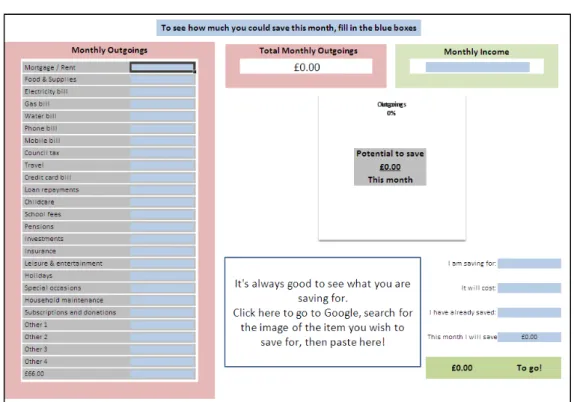
Figure 10; Spreadsheet based expense tracker tool given to participants 83
Figure 11: Behavioural tool for the Substitution intervention 89
Figure 12; Behavioural tool for the Planning intervention. 90
Figure 13: Cumulative distance to savings goal 95
Figure 14: Substitution tool usage 96
Figure 15; Updated version of the web-based expense tracker. 101
Figure 16; Trial flow of the SAVINGS Trial 117
Figure 17: Raw difference in consumption, error bars represent s.e.m. 136
Figure 18: Raw difference in savings, error bars represent s.e.m. 137
Figure 19: Raw difference in account balances, error bars represent s.e.m. 138
Figure 20; Difference in saving ratios of savings, error bars repesent s.e.m. 140
Figure 21; Distance reached by participants in Goal-Setting grou 143
vii List of Tables
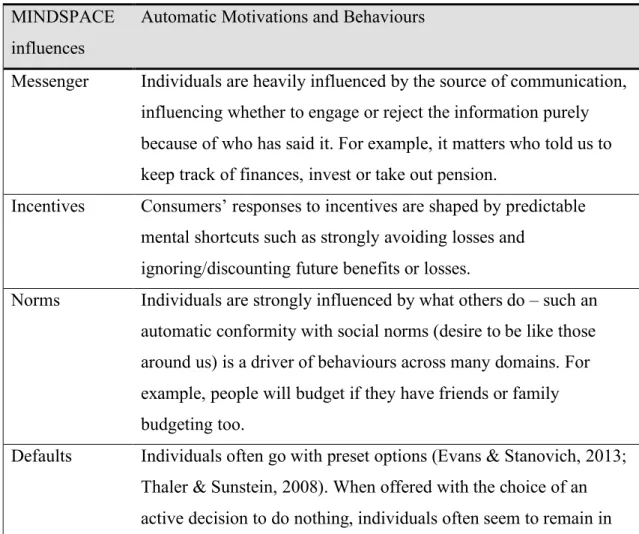
Table 1: MINDSPACE framework 27
Table 2; Demographic breakdown of participant families 48
Table 3; Frequency of enablers and barriers in financial capability 52
Table 4: Behavioural change techniques, behavioural diagnosis and COM-B factors 84
Table 5; Savings during trial from financial diaries 91
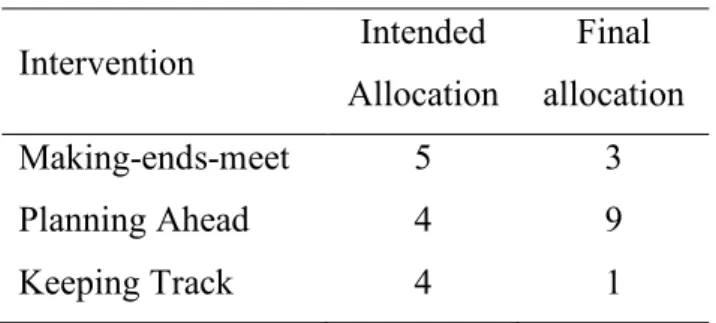
Table 6: Intended and subverted allocation 93
Table 7; Intentions to save as percentage of available assets 94
Table 8; Adherence rates for submissions and missing data 98
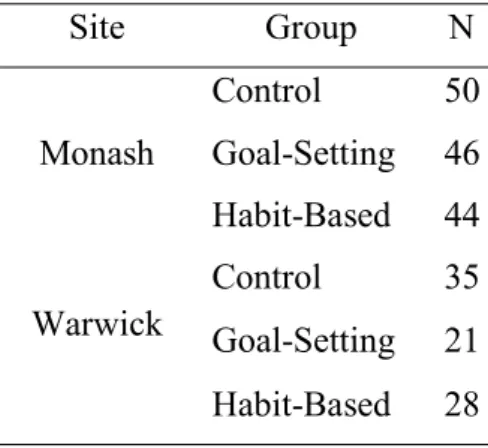
Table 9; Sample breakdown at population and site levels. 108
Table 10: Retained sample size in sites across sites 118
Table 11: Distribution characteristics by measure 122
Table 12: Regression results on monetary consumption differences 125
Table 13: Regression results on savings rates over time 127
Table 14: Regression results on account balances over time 129
Table 15: Regression results of monetary saving propensity differences 132
Table 16: Propensity to save in account balances from month three to one 134
viii
Acknowledgements
It is almost impossible to say how grateful I am to everyone that supported me throughout this process. Below, are just a few people who have made this journey possible.
To Prof Ivo, you have been an incredible source of support, discussion and assistance for the past four years. I have always enjoyed our discussions and ideas, which I am sure will be one of the driving forces behind my future career. To Dr Kelly Schmidtke, you have been and always will be a fantastic advisor and colleague to work with. You have gone above and beyond to always support me and help me grow as a researcher. With your help, you have taught me how to break down an intervention, how to make my work more engaging, how to ask the right research questions and best of all, how to make sure I stay real and true to what matters. An extended thank you to Dr Kristian Rotaru, who was always a constant beam of support throughout this project, and to Dr Elliot Ludvig who gives the best teas and discussions.
To the wonderful and amazing Abhirami Gautham, you are and always will be my rock. You have always provided me with endless love and support. For all those days you would have busy and hectic shifts on-call at the hospital, but would always be worried about me. For all those mornings you cooked breakfast just so I could sleep a little extra. You are the one person who will always take me by the hand and walk me, one step at a time to the finish line. You never gave up on me, and never will. You are and always have been my best friend, and I love you more than the world.
To my parents, for putting up with my endless rants about my work, to listen to me talk or yell about my work, in excitement or anger. You have always put me first and have given me the strength and courage to push myself. You have and always will support me no matter what.
To my brother for always going into the dark tunnels first, coming out and guiding me. You have been a huge influence on my life and I owe a lot of who I am to you. You have, and always will be looking out for me. You are the one who shows me the greatest songs to listen to, even if it is just the ‘Parks and Recs’ theme to stave off the insanity of writing. I can’t express how thankful I am, and always will be.
ix
I should mention a massive thank you to Tyson Haynes, who pretty much walked me by the hand with most of the coding in this project. Ty is corageously sefless and consistently one of the nicest and most helpful people that I had the privelidge to meet. Your desire to help others helped me get this far and for that I really am thankful.
Then there is everyone else…to everyone who helped me with coding issues! To all my amazing friends I have made on this journey, all of you were there to support me, make fun of me and laugh with me. You were the ones who climbed this mountain with me, making sure all of us reached the top. Then to the extra extras, to Google, who I am sure are responsible for all of my work and procrastination at the same time. To tea, who has always been there for me to help me focus. If you think managing a multi-site randomised controlled trial is difficult, believe me, tea always makes it better.
I wish I could say thank you to every single person who has supported me in the past four years and beyond. I would love to, but I am pretty sure there wouldn’t be enough paper or ink left for me to list all the names and how thankful I am, and I would never wish to give you the injustice of only a single sentence. Everyone in this list knows who they are, and how grateful I am for what you have done.
Finally, to my grandfather, who was always there for me ever since I could remember. I like to think you are so proud of me and Jay. I am certain that you would be happy to see me get so far. Every single day, whenever I wanted, you would always be there for me. Your support and values have shaped me into who I am, and I will never forget what you did for me. When I was little, you always lifted me up to sit on your shoulders to view from up on high, and I hope that now from your view you are and always will be a part of my life.
x Declaration
This thesis is submitted to the University of Warwick in support of my application for the degree of Doctor of Philosophy. It has been composed by myself and has not been submitted in any previous application for any degree. The work presented (including data generated and data analysis) was carried out by the author except in the cases outlined below:
• Part of this work (the analysis of formative research, 0) was performed on
secondary data from the Money Lives project, commissioned by the Money Advice Service. The presented findings in the chapter are comprised of the additional quantitative analysis. The data was supplied by Ipsos Mori.
• Chapter 6 was conducted in collaboration with Monash University with Dr.
Kristian Rotaru, who acted as a secondary researcher in data collection. Dr. Rotaru, recruited participants and supplied the data from the Monash site, but made no contributions to the project design, analysis or thesis.
Outputs from the Thesis
1. Chapter 1 has been accepted as a chapter in the book “A research Agenda for
Economic Psychology” (Erich Kirchler, Katharina Gangl), expected publication in 2019).
2. At the time of writing this thesis, it has been at two conference talks; at the Network
of Integrate Behavioural Science and the Behavioural Science PhD Research Exchange at the University of Warwick.
3. The project has spun off a grant funding from the Money Advice Service for £248K
to support an additional study with University students as well as with a working age adult population (Schmidtke, K., Patel, K., Scharf, S., King, D., Elliot, A. & Vlaev, I. (2017-2018). Using habits and goals to increase people’s financial capabilities. Money Advice Service.)
xi
4. A spin-off project was funded investigating avoidance behaviour in checking bank
accounts, in collaboration with Prof. Harmen Oppewal and Dr Kristian Rotaru (Monash Universtiy). The project was funded by the Monash-Warwick Alliance call
xii Abstract
Financial capability is a multifaceted concept that describes the skills and knowledge of managing one’s financial resources. This area has seen recent interest in identifying the underlying factors due to the increasing responsibility placed upon consumers. Policy makers typically use financial education to improve financial behaviours (based on economic assumptions), which has demonstrated mixed effects. To develop more reliable methods, the current thesis uses a comprehensive model of behaviour to understand the barriers and facilitators of financial capability, in addition to developing and testing interventions to improve financial capability.
The first chapter provides a conceptual review of financial capability through a behavioural science lens, to understand why greater financial literacy may not translate to optimal financial behaviours. The second chapter details the behavioural framework used in the thesis in greater depth, the third chapter details some of the issues why individuals fail to maintain their goals under the concept of cognitive control.
In the fourth chapter I present secondary analyses of previously conducted formative research identifying several key behavioural mechanisms affecting people’s financial capability. Firstly, individuals often fail to keep within their means due to automatic mechanisms to improve their social rank amongst peers. Secondly, individuals often struggle to save for the future due to deficits in more reflective mechanisms, e.g., goal-directedness. I provide a behavioural diagnosis from these findings in chapter five, from which I design and pilot three intervention. The pilot study’s findings are then used to inform the design of a randomized control trial.
The sixth chapter details a multi-site randomised-controlled trial. This trial uses Goal-Setting and Habit-Based interventions to improve participants’ financial capability, measured via their consumption, account balances, and savings. The Goal-Setting group demonstrated significant improvements across all three measures. In contrast, the Habit-Based group improved only in their account balances compared to the Control group.
The seventh chapter examines the moderating effects of individual differences which have been previously demonstrated to account for variations in consumption and savings. These results demonstrate that higher levels of goal-directedness can improve reductions in monetary consumption.
xiii Abbreviations
APEASE A framework for policy and intervention evaluation
ASVAB Armed Services Vocational Aptitude Battery
ATM Automated Teller Machine
BCT’s Behavioural Change Techniques
BMI Body Mass Index
COMB A framework model of human behaviour
ELSA English Longitudinal Study of Aging
FCA Financial Conduct Authority
IQ Intelligence Quotient
ISLAGIATT It Seemed Like A Good Idea At The Time
LCD Liquid Crystal Display
M Mean
MINDSPACE A mnemonic of commonly used behavioural mechanisms
MRC Medical Research Council
OCD Obsessive Compulsive Disorder
PIT Pavlovian Instrumental Transfer
RAM Random Access Memory
RCT Randomised-controlled trial
SD Standard Deviation
SSRT Stop Signal Reaction Time
UK United Kingdom
UPPS Lack of Urgency, Perseverance, Premeditation and
1
Aetiology of household financial behaviour SUMMARY
• Household and individual financial behaviour relate to how an individual
consumes and retains their financial resources.
• Sub-optimal consumption and savings are characterised as reduced financial
capability, which is an umbrella term that denotes the behavioural and psychological requirements to making financially sound decisions.
• Educational endorsements are still used as a method of interventional policy
to promote financial capability, however, educational policies may not necessarily produce desired outcomes. This may be due to how behaviour is understood generally and the assumptions made by financial capability.
• The COM-B model is a model to characterise and diagnose the components
that lead to a given behaviour. The COM-B model is primarily utilised in healthcare but the principles hold for financial capability and provide a more overarching model of the underlying factors and causes behind sub-optimal financial capability.
• Individual differences in financial capability can identify and characterise
motivational and psychological underpinnings that can lead to and predict sub-optimal financial capability, and can identify at-risk individuals requiring intervention.
2
1.1 What is household financial and saving behaviour?
Household financial behaviour describes how people, at the individual or familial level, use financial instruments and products to reach their objectives (Guiso & Sodini, 2013). Household financial behaviour relates to the consumption of financial resources and the extent to which financial resources can be retained. Understanding household financial behaviour is important because individuals are increasingly asked to take more direct responsibility for their financial future. For instance, people in the United Kingdom (UK) are now making more decisions about their retirement funds due to the shift from Direct Benefit pension schemes to Direct Contribution schemes (Lusardi, 2008). This shift in responsibility has meant that individuals are now required to reduce their financial consumption to set aside disposable income.
Much like how an individual’s physical and psychological well-being can fluctuate (becoming positive or negative), financial well-being can too, resulting in either excess or deficits in financial resources. One’s financial state can be captured by examining the difference between one’s income (wages, net property income, investments etc) and monetary consumption (expenditures on goods and services). Where monetary consumption exceeds income, an individual is spending more than they can afford to, and begin to incur debt. When income exceeds monetary consumption, an individual has more money than they can spend and therefore accumulate disposable income or more commonly referred to as ‘savings’. An individual’s savings amount captures the difference between their income and monetary consumption, where increasing savings can be driven by either increasing one’s income, or decreasing one’s monetary consumption.
In the current financial state of the UK, households are suffering from increased financial pressure, with rising debt and stalling income (Aviva, 2017). As a result, those in the middle and lower income brackets are starting to feel financially squeezed. A recent report from The Money Advice Service reveals that around 25% of the UK population, i.e., approximately 12.7 million people, fall under this category (Money Advice Service, 2016). The report also revealed that the mean amount of disposable income of financially-squeezed individuals rests at around £600 at any point in time. Approximately 3.2 million people have no disposable income at all. Notably, managing finances is often more difficult for these individuals than wealthier people, as one unexpected bill can lead to
3
turmoil when there is insufficient disposable income at hand. For instance, financially squeezed individuals often accept payday loans to cope with their financial situations. These loans feature astronomical annual percentage rates of charge (Bertrand & Morse, 2011; Bhutta, 2014; Stegman & Faris, 2003), which have been shown to leave consumers in a worse financial state (Financial Conduct Authority, 2015).
Individual and household saving behaviour (that is the behaviour of an individual or household trying to optimise the difference between their income and consumption) cannot be captured in raw values alone. Consider trying to compare the financial state of two individuals - it is difficult to take their savings at face value, as this does not account for differences in their income or monetary consumption. These two individuals could show identical savings, but one individual’s income may be twice that of the other’s; or one’s consumption may be half that of the other’s. Comparing raw, absolute savings gives a misleading picture and may distort the saving ability of households and individuals. The absolute values of savings must take into account income to portray a propensity to save, comparable across individuals. This is termed the ‘savings ratio’. The savings ratio is the ratio of disposable income as a fraction of total income. Savings ratio is calculated by expressing the amount of savings as a proportion of income, standardising this across individuals, making it possible to compare how well individuals save. Calculating ‘savings’ and ‘savings ratio’ permits the analysis of an individual’s or the public’s financial well-being.
We can exemplify the savings ratio by examining the current savings ratio across the UK, where the level of savings has fallen to their lowest level since 2005. In 2017 the savings ratio was 4.9% (Chu, 2018). This value denotes that the average household only saved 4.9% of the average household income.
To help individuals move to a stable financial position, one must first understand and identify the determinants behind optimal financial behaviour. Over the last decade, there has been considerable interest on the determinants behind implementing and maintaining optimal financial behaviour (Atkinson, McKay, Collard, & Kempson, 2007; Dolan, Elliott, Metcalfe, & Vlaev, 2012; Drever et al., 2015; Elliott, Dolan, Vlaev, Adriaenssens, & Metcalfe, 2010; Gale & Levine, 2011; Mason & Wilson, 2000; Money Advice Service, 2014). Implementing and maintaining optimal financial behaviour is often referred to as being financially capable (Money Advice Service, 2014). The term ‘financial capability’ is now commonly used and has gathered considerable interest in the
4
last few years. For instance, a Financial Capability week was established in the UK recently.
1.2 Financial capability
The term ‘financial capability’ describes the skills, knowledge, attitudes and behaviours underlying well-informed choices to manage financial resources (Arnold & Rhyne, 2016; Atkinson et al., 2007; Mader, 2018; Mason & Wilson, 2000). Financial capability conceptualises what people know and can do in relation to financial services available to them (Caplan & Sherraden, 2018). People who manage their money more effectively are more ‘financially capable’ (Drever et al., 2015). In recent times, people are likely to require greater financial capability than in the past, in part resulting from factors like higher life expectancy, the shift towards Direct Contribution pension schemes, as well as the higher cost of education. In this financial climate, those who feel financially squeezed, with a narrowly greater income than consumption, must be financially capable to live well. By understanding what makes people financially capable, mechanisms can be identified and interventions can be designed and implemented to aid those in financial struggle. For this, we need to understand and explain financial capability.
Financial capability is often conceptualised from three behavioural components (Arnold & Rhyne, 2016; Mader, 2018; Money Advice Service, 2014). The first component is ‘Keeping track’ which denotes the abilities and skills behind monitoring one’s accounts. This involves, understanding the flow of finances, knowing the available account balance and understanding available financial products. The second component is ‘Making-ends-meet’ which denotes the abilities and skills to remain within ones constraints of income. The third component is ‘Planning ahead’ which describes the skills and abilities required to consider future events and plan for them.
Will financial education improve financial capability?
In order to produce interventions to increase people’s financial capability, interventionists need to understand the barriers and facilitators1 of optimal financial behaviours. Such barriers and facilitators are often called behavioural mechanisms.
1 Faciliators and enablers are used interchangeably throughout the thesis to denote the behavioural mechanisms that lead to optimal behaviour.
5
From a rational perspective, individuals may not make the best choices or decisions because of incorrect assumptions or beliefs. Put simply, the information that individuals are using is biased or inaccurate. Therefore, common-sense approaches to behaviour change assume that individuals do not possess the adequate information to make the optimal choice. For instance, it is difficult for anyone to save optimally, if they do not understand the different financial products, or even how to invest. From this conceptual standpoint, the ideal intervention approach would be to disseminate financial information to educate individuals.
Financial education2 is already a common intervention approach, that has even been applied as policy intervention (Brown, van der Klaauw, Wen, & Zafar, 2013; Bruhn, Legovini, Zia, Leão, & Marchetti, 2014; Fernandes, Lynch, & Netemeyer, 2014). In this section we document the efficacy of educational approaches to increase financial knowledge to improve financial capability. Financial education can be assessed through comparison of financial literacy scores between individuals who attend financial courses and individuals who do not attend (through regression analysis). This can be done through experimental methods, either through randomised-controlled trials (where participants are randomly allocated to receive the educational training or not), or through quasi-experimental methods in which the allocation is not random but self-selected.
To determine if education increases financial capability, Gale and Levine (2011) reviewed previous evidence from financial education seminars and courses, and identified that improving financial education improves financial savings (Bernheim & Garrett, 2003; Lusardi, 2002). The researchers identified spill-over effects across an agent’s social network and across society in general. Gale and Levine’s finding is further supported by Hilgert, Hogarth and Beverly (2003), who showed that better financial practices were associated with higher financial knowledge scores.
In another line of research, Gutter, Garrison and Copur (2010) sought to see if different United States (US) State-level legislation affected students’ financial behaviours differently. To do so, they conducted a quasi-experimental study, where they collected data on over 1500 college students’ financial literacy, dispositions and behaviours. The researchers noted that states where there were more social-learning opportunities (i.e. learning from other people’s behaviour), were associated with higher
2 Financial education is operationalised as financial literacy (Huston, 2010), in the literature these two terms are used interchangeably.
6
levels of financial capability. They found students who received education were more likely to save, budget their finances and avoid risky credit behaviour. This was corroborated by the National Council on Economic Education (2007), which found that US states that offered mandatory, assessed financial education courses in their high schools created more students that budgeted, saved and avoided risky credit.
In a similar line of research, Brown, van der Klaauw, Wen and Zafar (2013) compared recent high school students’ credit scores and debt delinquency rates from US States with and without mandated high-school financial education over 10 years. States that mandated such education, showed improved credit scores and reduced default rates, whilst states without mandated education demonstrated no significant change.
Further positive effects of lower cost educational interventions are demonstrated by Walstad, Rebeck and MacDonald (2010). This research found that a DVD-based financial education course led to significant improvements in financial knowledge; a finding further corroborated by Harter and Harter (2007).
Outside the US, Bruhn, Legovini, Zia, Leão and Marchetti (2014) conducted a large-scale assessment in 868 schools in Brazil, with approximately 20,000 students to examine the impact of financial education courses on financial capability. The study used a randomised-controlled trial to identify causal links between financial education and financial capability. The researchers noted that students who enrolled in the course went on to report an approximate 2.3% decrease in monetary consumption, and 1.4% increase in monetary savings, when compared to students who did not attend the course.
The benefits of financial education extend from students to adult populations. For example, Bayer, Bernheim and Scholz (2009) found that employer-offered retirement seminars promote pension participation and contribution rates. The effect is even greater for employees who are not at the higher-end of the salary range. This may be due to a larger proportion of employees at the lower end of the salary range attending the seminars compared to those at the higher end.
In summary, the above studies show financial education can promote financial capability. These insights demonstrate the effects of limited financial education and its impact upon household behaviour. Financial knowledge can be considered a precursor to financial behaviour where knowledge structures offer a better behavioural policy to reach one’s financial goals.
7
The limits of education
Some leading experts disagree on the success of financial education programmes, with some research demonstrating little to no change in behaviour as a result of financial education. (Adams & Rau, 2011; Collins & O’Rourke, 2010; Hastings, Madrian, & Skimmyhorn, 2013; Hira, 2010; Thaler & Sunstein, 2008; Willis, 2009). These results raise concerns that educational approaches do not improve household financial behaviour. These concerns can be considered in two domains; methodological and conceptual or intellectual concerns. The following findings presented do not evaluate the previous studies given in section 1.2.1, but present general concerns.
First, let us consider the methodological issues in examining financial education policies as a means to improve financial capability. One issue is the operationalisation of measuring financial behaviour. Measuring financial behaviour requires either the use objective measures of finances, such as bank account records or consumption-level data; or the use of self-report measures where participants declare their consumption, saving and financial behaviours. Objective measures offer high reliability and validity, but data is often expensive and time-consuming to collect; whilst data from self-report methods is quick and easy to collect, but can be questionable in its validity.
Many of the studies that investigate financial behaviour are more inclined to use survey methods for respondents to self-report financial behaviour, usually due to the large-scale samples employed (Brown et al., 2013; Bruhn et al., 2014; Gutter et al., 2010; Walstad et al., 2010). Self-reported measures are highly susceptible to numerous biases, predominantly social desirability effects (Van de Mortel, 2008) or even demand characteristics (Nichols & Maner, 2008). A study by Collins (2013) highlighted differences between data collected from the same participants using objective methods versus self-report methods. This study used a pre/post randomised-controlled trial, in which clients were randomised to attend a financial education course for twelve months. Collins used objective measures of financial data (checking and saving account balances) as well as a purpose designed self-report measure, which used categorical responses to questions such as “How much would you estimate you and your spouse/partner have in combined total savings and investments?”. Collins found a greater effect of financial education for self-reported compared to objective measures, which highlights the social desirability issue, where people are more likely to declare a greater income when they do not have to prove them objectively. A social desirability bias could inflate the efficacy
8
of financial education studies that use self-report methods to measure financial behaviours.
A second limitation is that research is largely quasi-experimental in the sense that participants are not randomly allocated to groups (Hastings et al., 2013). Numerous quasi-experiments identify a positive association between financial education and financial capability (Bayer et al., 2009; Meier & Sprenger, 2008). The problem with using a quasi- vs truly randomised-experimental design is the potential for extraneous factors or the selection of participants to explain the findings independent of the intervention. As an example of an extraneous factor being a problem, research found financial education does improve financial savings, but when accounting for US state differences, the effects of education are diminished (Cole & Shastry, 2010). In other words, financial capability was not caused by the effects of state policy in financial education courses. For instance, examining the results of some of the research presented in the previous section (Bayer et al., 2009; Brown et al., 2013; Gutter et al., 2010), it is difficult to discriminate between the positive effects of financial education against any self-selection mechanisms that may lead more financially motivated individuals to sign up to such courses. Therefore one should be careful in drawing causal links between financial education and financial behaviour.
Compared to quasi-experimental studies, truly randomised-experimental trials have shown limited benefits in financial education. For instance, one study (Gartner & Todd, 2005), randomized first year college students to receive credit education. They found no statistical difference in participants’ saving behaviour or timeliness of payments post intervention. Similar findings were demonstrated by Servon and Kaestner (2008) as well as Choi, Laibson and Madrian (2011). Quasi-experimental research does not provide causal links between financial education and financial capability, but does identify a relationship between the two concepts. Randomised-controlled trials identify small causal effects, suggesting that financial education is a causal factor but may not be the sole factor in financial capability. This is further epitomised in the research conducted by Fernandes et al. (2014) which found that studies that manipulated and randomised financial education attendance explained 0.06% to 0.12% of the variance for low income and general populations respectively. When measuring financial education there is a sharp rise to 1.27% and 1.80% of explained variance for low income and general
9
populations respectively. This difference highlights the concern of translating financial education into change in financial behaviours.
Conceptual concerns identify that the evidence for financial education is not coherent, and research demonstrates mixed results. For instance, Choi, Laibson, Madrian and Metrick (2002) measured the effectiveness of employee seminars. The researchers found that 14% of those attending seminars joined the savings plan, compared to 7% of individuals who did not attend seminars, despite all employees stating an intention to save. Such empirical evidence identifies that although a diminished literacy can affect financial behaviour, much more needs to be done to improve financial capability (Drever et al., 2015). A meta-review was conducted by Fernandes, Lynch and Netemeyer (2014) included over 200 studies investigating the effects of financial education on financial behaviours. The researchers found that financial education only accounted for 0.1% of the variance in financial behaviour. This extremely small explanatory power does raise concerns over the assumed benefit of financial education. This finding was further corroborated by Mandell (2008) who examined the effects of different financial education courses between 1997 and 2006 and found that there was no difference between the financial capability of people after having taken the course to those who never took the course. These results suggest that financial education (measured through financial literacy) is a factor in financial capability, but the intervention approach of providing financial education does not produce a financially capable cohort. This would perhaps suggest that there is something wrong with the underlying factor(s) involved in the lack of financial capability. We can draw from similar findings by looking at the role of education approaches in public health, which demonstrates that education methods increase knowledge but do not actively change behaviour (McCluskey & Lovarini, 2005). These results highlight a lack of consensus in the effects of financial education, however, one should not completely discount financial education approaches. Some research has identified significant outcomes from financial education (Bayer et al., 2009; Brown et al., 2013; Bruhn et al., 2014; Gutter et al., 2010; Harter & Harter, 2007; Walstad et al., 2010), and we cannot discount the idea that people do require this information. These findings collated together identify a need for a more nuanced understanding of how financial education leads to financial capability.
10
What does financial education miss?
The mixed results from research exploring financial education as a means to improve financial behaviour, suggests that financial education is not the only factor and therefore its effects may be mitigated by one of multiple other factors required for behaviour change, the goal of policy implementation.
Behaviour change is inherently a multi-factorial process (Michie et al., 2013). Financial education is an inherent factor in financial capability but is not the sole factor. The distinction here is to separate the capacity to conduct a behaviour or action from the knowledge processes behind the behaviour. Put succinctly, just because an individual has the capacity to be financially literate does not guarantee improving their financial literacy will enhance their financial capability. Conversely an individual who is financially capable is not necessarily always financially literate.
Consider financial education like information in a computer. For the computer to produce any sort of output it must have the software and hardware capable of processing the information. Much like a computer, behaviour requires more than just information. The behaviour is an output of the individual. Therefore, to be capable of producing the desired behaviour, the individual must have all the necessary components required to produce the behaviour.
First, it is important to understand what is meant by capability. ‘Capability’ is defined as 'the power or ability to do something” (Michie, Van Stralen, & West, 2011). This definition demonstrates that capability relates to every component of a specific behaviour: psychological, physiological, and environmental. Capability includes the relevant knowledge and skills behind an action, but also includes the physical resources giving a person or a collective the ability to undertake a particular kind of behaviour. In summary, ‘capability’, or what defines a ‘capable person’, includes all the necessary and sufficient attributes that make it possible for an agent to execute a given action.
For instance, consider the example of catching a ball. It is not enough for an individual to understand how to catch the ball, or even be motivated to do so. The individual must be able to fulfil additional requirements, such as being able to view and identify the ball, and then pronate and contract their arms and cup their hands to catch it. These factors are physiological in nature and are mandatory to execute the behaviour. In addition, the individual must be able to compute the speed of the ball, its distance and trajectory. They must then move themselves to an approximate location that will intersect
11
with the ball’s trajectory. All of the above components are necessary to catch a ball. Whilst skill training and practice will assist, if the agent’s own physiology is unable to meet the demands of the task then they are incapable. This distinction is important for intervention and policy considerations. Similarly, within the financial setting, a consumer may possess great financial knowledge but lack the self-control and will power to avoid lavish expenditure. As such, this individual may end up living outside of their means, and would therefore not fit under the definition of being financially capable.
An additional issue with the financial education approach is the conceptual, underlying theoretical base that is being adopted, characterised by a lack of a psychological theory base. Behavioural economics and behavioural science can provide a unique insight into financial capability, by taking into account psychological constructs of behaviour and cognition, alongside economic theories of financial behaviour. In classical economics, economists are often concerned with the normative theory of how people should behave (McQuillin & Sugden, 2012), where sub-optimal behaviour is often regarded as irrational. However, a strongly grounded theoretical base can dramatically improve outcomes by utilising behavioural mechanisms to translate some theory of behaviour change into practice. For instance Karlan, McConnell, Mullainathan and Zinman (2010) utilised a behavioural economic approach grounded in theories of sub-optimal self-control. This allowed the researchers to integrate and suggest a model of behaviour that could codify interventional policies to be tested. The researchers ran a randomised-controlled trial in which individuals were randomised to a control or treatment group where they were sent SMS (short message service) messages through mobile phone channels to remind them to save. The researchers demonstrated the positive effects of SMS messages across three field experiments promoting savings behaviour in the Philippines. The results showed that those in the treatment arm produced a 6% improvement in savings, with a 3% increase in individuals reaching their savings goal, compared to the control group. In addition, account balances were shown to increase by 47% for those in the treatment group compared to the control.
In fact, empirical studies that utilise theoretically informed behavioural mechanisms, were more beneficial than financial education alone (Doi, McKenzie, & Zia, 2013; Hershey, Jacobs-Lawson, McArdle, & Hamagami, 2007; Howlett, Kees, & Kemp, 2008; Stawski, Hershey, & Jacobs-Lawson, 2007). The skills and knowledge educational interventions alone can promote may be insufficient to change behaviour. Other factors,
12
such as internal motivations and external opportunities to change people’s behaviour should also be considered. (Dolan, Hallsworth, et al., 2012b; Dolan, Elliott, Metcalfe, & Vlaev, 2012a; Michie, Atkins, & West, 2014).
Theoretically informed interventions and policies provide a more coherent framework to translate hypotheses about behaviour into action. The term to denote a non-systematic, non-comprehensive approach to designing interventions is often referred to as an ISLAGIATT or “It Seemed Like A Good Idea At The Time” (Atkins & Michie, 2015). Here we should distinguish between conceptual and methodological dimensions. Within the conceptual sphere, ISLAGIATT’s refer to common-sense models as opposed to a theory-driven approach. In this sense interventionists do not systematically understand or examine the underlying concepts driving the behaviour. In the methodological sphere, interventionists use intervention approaches based on what they assume to work, rather than a systematic approach based on identified determinants. A systematic, comprehensive approach pushes for interventionists to understand and diagnose the behavioural problem and then devise approaches that best fit given certain parameters.
Household finance policy can draw upon the health-care sector in their implementation of behavioural interventions and policy design. The health care sector is constantly pushing and setting the normative ideals of intervention design. For instance, take the Medical Research Council’s (MRC) guidance on intervention design which underwent successive reviews and changes (Campbell et al., 2000; Craig et al., 2008; Moore et al., 2015). The MRC approach identifies the necessity in drawing upon a solid theoretical and empirical evidence base to justify the behavioural mechanisms and treatment effects put in place within a policy or intervention. This MRC guidance has been cited over 8000 times, which further supports the usefulness of this approach. Policy-makers and researchers within the finance sector can learn from the MRC guidance to improve the outcomes of their intended treatment effects through solid basis of psychological and behaviourally grounded theories.
A broader, more useful conceptual mapping of financial capability is required. This will provide a more valid understanding of financial capability, through a behavioural lens. This notion will put forward the idea that the way people manage their money, and their financial behaviour in general, are subject to the same wide range of influences, as other human behaviour. This presents a broader picture of the factors influencing
13
financial capability, based on a model of behaviour, which goes beyond skills and knowledge. As a result, financial advisory services, should be employing such interventions as new services for a greater benefit to its users. This can be captured by the UK financial capability week in the United Kingdom, which puts forward a behavioural approach to achieving financial capability.
1.3 Understanding and changing behaviour
An existing model of behaviour to help interventionists understand how to influence behaviour is called the COM-B model (Fishbein, Triandis, Kanfer, Becker, & Middlestadt, 2001; Michie, Van Stralen, et al., 2011), which is based upon scientific evidence stemming across multiple fields of human and animal behaviour (Michie et al., 2014). The COM-B model is one of the most cited models used by interventionists and policy-makers, cited over 2000 times. COM-B is an acronym describing specific components that generate behaviour. The COM-B model consists of Capabilities, Opportunities and Motivations, which interact to generate Behaviour. The term ‘behaviour’ refers to a specific behaviour one wishes to change. In the current manuscript the term ‘behaviour’ is meant to capture people’s financial capabilities (for more information on COM-B see Chapter 2).
Before advancing, please note that the COM-B model was developed independently from the financial capability literature, and so some confusion may arise due to the overlapping use of the word ‘capability.’ Within the COM-B model, capability denotes people’s physical and psychological capacity related to a behaviour. In the following section, I present determinants of financial capability, specifically savings behaviour, modelled through the COM-B model. These examples are not exhaustive but sought to capture a sufficient number of determinants to illustrate the complexity in behaviour change for improving financial capability.
Capability
The first factor of determinants for financial capability is ‘Capability’ which refers to the psychological and physical affordance of enacting the behaviour (Michie et al., 2014). Capability has multiple factors and it would be impossible to review all factors below. Some examples of different factors are provided to exemplify how multiple determinants
14
exist for household financial behaviour. This is not an exhaustive list and there are likely many other factors contributing to an individual’s capability.
1.3.1.1 Physical Capability – Genetics and Intelligence Quotient (IQ)
Genetics are likely to play a role in the variation of people’s savings. Genetic variation may play a large role in savings behaviour by modulating income and risk preferences (Cesarini, Johannesson, Lichtenstein, Sandewall, & Wallace, 2009), which can account for approximately 25% of risky financial decision making. These genetic predispositions can have demonstrative effects on savings and therefore can influence individuals’ savings behaviour. A study which assessed the genetic component of savings behaviour in 14,930 twin pairs in Sweden found that 32-40% of the variance in savings was explained by genetic factors (Cronqvist & Siegel, 2015).
These genetic variations also play a role in income. One study by Taubman (1976) with a sample set of 4068 twins in the United States, found that genetic factors account for up to 50% of the income. As income is a prerequisite for savings, these genetic propensities have a knock-on effect in savings behaviour.
Research into intelligence has demonstrated that IQ has influencing effects on savings (Zagorsky, 2007). Researchers found that IQ raised income and consequently savings rates by over $300 per year even with other factors remaining constant. However, the researchers also noted a non-linear relationship between IQ and financial stress, suggesting that though IQ can improve income and financial savings, it can also negatively impact financial health.
1.3.1.2 Psychological Capability - Parental behaviour
Parental behaviour may also play a role in financial behaviour, with people learning financial savings behaviour through modelling their parent’s behaviour (Cronqvist & Siegel, 2015). Anecdotal evidence identifies that parents do generate some form of influence in their children’s saving propensity, by providing weekly allowances, opening savings accounts and even providing tools such as piggy banks (Bisin & Verdier, 2005; Cavalli-Sforza & Feldman, 1981).
Charles and Hurst (2003) examined a panel-dataset of over 1500 parent-child respondents. This demonstrated substantial parental-child intergeneration similarities in savings, where age controlled models revealed that parental influences account for
5-15
25% of the variance in savings behaviour. One of the issues of social behaviours, especially when clustered at the familial level, is that separating genetic from environmental factors is often almost impossible to do. However, investigation by Taubman (1976) demonstrated that familial environment accounts for 4-18% of the variance in income whilst controlling for other variables such as age, gender and genetics.
1.3.1.3 Psychological Capability - Knowledge
Please see section 1.2.1 to see how financial education has been shown to improve financial behaviours.
1.3.1.4 Psychological Capability - Literacy
Research has shown that the numerical literacy, i.e. one’s numerical ability, is important in financial behaviours (Banks & Oldfield, 2007a; Gerardi, Goette, & Meier, 2013; Rowell & Bregant, 2012). For instance, one study identified that individuals with greater numerical ability are less likely to default on mortgage repayments (Gerardi et al., 2013). A second study identified that numeracy levels were strongly correlated with measures of retirement savings and investment portfolios, even when controlling for factors such as education (Banks & Oldfield, 2007a).
Motivational Factors
The motivational component of people’s financial capabilities may be affected by their levels of extraversion, impulsivity, intentions, executive function, sense of control and opportunity. Each factor is reviewed below.
1.3.2.1 Extraversion
Extraversion, which is one of the big five personality traits (conscientiousness, agreeableness, neuroticism, extraversion and openness-to-experience), could be linked to savings behaviour. Extraversion is characterised as being associated with social potency and a heightened sensitivity for potential rewards (Elliot & Thrash, 2002; Lucas, Diener, Grob, Suh, & Shao, 2000). This psychological underpinning could affect an individual mindset by motivating more rewarding purchases leading to over-consumption. This is what Hirsh (2014) found when examining extraversion at three levels. The individual
16
over time level showed a decrease in savings for each unit of extraversion (r(21) = -.50). The state-level showed higher levels of extraversion were associated with lower savings (r(45) = -.29). Finally, the macro-level demonstrated again, a significant negative association of extraversion and savings amounts (r(48) = -.29).
1.3.2.2 Impulsivity/Self-control
Impulsivity is a multi-factorial construct, which is often characterised as the tendency to act without regard for consequences (Kulendran, Patel, Darzi, & Vlaev, 2016). There are multiple facets of impulsive behaviour that could potentially affect savings, where impulsive individuals find it difficult to inhibit automatic or dominant behaviours and intrusive thoughts (Claes, Nederkoorn, Vandereycken, Guerrieri, & Vertommen, 2006; Kulendran et al., 2016). For example, an individual in the checkout line at a supermarket may see a bar of chocolate and feel an impulse to buy it. An impulsive individual would struggle to overcome that impulse and would therefore be more likely to purchase the chocolate bar (Nederkoorn, Houben, Hofmann, Roefs, & Jansen, 2010a). Impulsive individuals also show a propensity for reward maximisation (Murray et al., 2014), which could reinforce impulsive behaviours further.
Impulsivity has been shown to influence savings through high levels of monetary
consumption. Researchers have demonstrated that impulsivity is predictive of compulsive buying (Desarbo & Edwards, 1996; Lejoyeux, Arbaretaz, McLoughlin, & Ades, 2002) as measured through trait impulsivity scales such as Zuckerman’s sensation-seeking scale. A result further demonstrated by Billieux, Rochat, Rebetez and Van der Linden (2008) who found that compulsive buying correlated with the UPPS’s subscales (Whiteside & Lynam, 2001) of lack of urgency, lack of premeditation and lack of perseverance.
One study examined self-control by examining consumption reduction techniques in a sample household panel survey (Rabinovich & Webley, 2007). The researchers found that techniques that sought to improve self-control, such as implementation intentions, as well as formulating goals and plans improved savings rates. A measure of self-control that is regularly used are temporal discounting tasks that assess preferences of immediate smaller rewards against delayed larger rewards. This discounting index has been used extensively in addiction and obesity studies (Bickel et al., 2007; Coskunpinar, Dir, &
17
Cyders, 2013; Kulendran et al., 2013, 2016; Zhu, Cortes, Mathur, Tomasi, & Momenan, 2015).
Temporal discounting could perhaps impede savings rates by moderating monetary consumption through the policy of maximising immediate rewards. Research by Ersner-Hershfield, Tess Garton, Ballard, Samanez-Larkin and Knutson (2009) showed a relationship between temporal discounting rates and savings rates. The researchers asked participants to complete a self-continuity task, to assess how they see themselves in the future vs now; participants also completed a temporal discounting task and a self-report packet of financial behaviour. The researchers found that self-continuity predicted a decrease in temporal discounting rates, and higher levels of savings, whilst controlling for age.
This research was further corroborated by Ottaviani & Vandone (2011) who examined the effect of impulsivity on household financial behaviour in the context of debt. The researchers used the Iowa Gambling Task and the Barratt Impulsivity Scale to measure impulsivity. They found that impulsivity predicted unsecured debt, i.e. credit-card transaction behaviour. This result suggests that impulsive behaviour improves the propensity for monetary consumption, which in turn reduces savings rates.
1.3.2.3 Intentions and Goals
Other factors influencing monetary savings are intentions and memory. ‘Intentions’ are goal-directed actions in which an agent expresses an interest in attending a given target. Intentions can be considered to be a predictor of behaviour (Fishbein, 1975), where an agent looks to express behaviour in a goal-directed manner.
One investigation into psychological determinants of a financial savings buffer revealed intentions were a significant predictor of savings (Magendans, Gutteling, & Zebel, 2017) across a sample of student and working age populations, demonstrating generalisable results.
Goals have been shown to predict monetary savings in retirement (Stawski et al., 2007). The researchers found that setting clearly defined goals was a significant predictor of increased retirement savings. These findings were further corroborated by Davis and Hustvedt (2012), who found that behavioural control and behavioural intention were the best predictors for optimal retirement savings, amongst a sample of 328 individuals who completed a personal finance course between 1982 and 2007. These results highlight how
18
goal-directed behaviour is imperative in savings, whereby intentions and goals are important in directing behaviour and in behavioural maintenance.
1.3.2.4 Executive function
One key psychological concept is the notion of executive function, the ability to integrate behaviour and motivation in light of goals and intentions. Executive function may play an important role in monetary savings and in diminishing monetary consumption as it is involved in self-control (Baumeister, 2002; Baumeister & Vohs, 2003; Diamond & Lee, 2011).
Karlsson, Gärling and Selart (1997) performed two experiments using Swedish undergraduates investigating if the propensity to consume varied with current income. The researchers found consumption rates were higher during an income increase than income decrease despite the same amount of money being available. This would suggest that cognitive control is diminished when opportunity costs are reduced.
In a different study (Selart, Karlsson, & Gärling, 1997), researchers examined working-age and student populations and found that monetary consumption was higher for lump sums than for future monthly increments, despite the total increase being equivalent. Such findings describe how executive function in maintaining goal-directed behaviour can be undermined when opportunity for reward-seeking arrives.
1.3.2.5 Sense of control
A person’s locus of control is the extent to which an agent believes they have a direct effect on the outcome of events in their life. For instance, some elevators contain a “close door” button despite them not actually having any impact of closing the doors at all. This still gives the user a perceived sense of control. A perceived sense of control is important in health and wellbeing – a greater perceived sense of control is associated with better health and well-being, even amongst individuals in lower-income brackets (Lachman & Weaver, 1998). The effects of a perceived sense of control is important in how we behave, which consequently has implications in the financial domain. Livingstone and Lunt (1992) investigated the role of psychological factors in savings performances. The researchers recruited over 250 participants to complete questionnaires regarding psychological characteristics as well as economic variables. The research demonstrated
19
that savings rates were associated with a sense of control, with those who felt less in control having demonstrably less savings than those with a higher sense of control.
Opportunity
The opportunity component of financial capabilities may be affected by an individual’s social network (social opportunity) or through instances that occur spontaneously (physical opportunities). Examples of each factor are reviewed below.
1.3.3.1 Social Factors
In an exemplar study demonstrating the role of opportunistic factors (Parker, Michael, & Wilcox, 2003), researchers ran an experimental design of ‘families’. Individuals were placed in three-member families, in which second and third generations could observe and/or communicate with past generations. The results show that those who took advantage of the opportunity to learn performed significantly better in savings. These results stipulate how social opportunities improve performances and are an inherent factor in monetary savings.
Gutter, Garrison and Copur (2010) examined the effects of incidences of social learning within one’s network. The researchers collected data on over 1500 college students pertaining to their financial literacy, dispositions and behaviours. They also asked participants how frequently their friends and family had engaged in some financial behaviour and if they had observed their behaviour. The researchers found that higher incidences of social learning improved financial behaviours and that this was higher for parents than for friends.
1.3.3.2 Physical opportunities
Physical opportunity are characterised as the local opportunities and options that afford themselves to the individual. Opportunities can be both positive (affording enablers and facilitators) and negative (affording barriers). For instance, an individual who struggles with self-control would want to see themselves commit to reducing consumption; whilst opportunity to learn money-management skills may improve household savings behaviour. Researchers collaborated with a commercial bank in the Philippines and designed a savings account that did not permit users to withdraw any deposits (Ashraf,
20
Karlan, & Yin, 2006). In this study, 202 individuals were randomised to one of two conditions: to either receive the savings product or to a control group. The researchers found a 47% difference in average savings balance at six months, and 82% at twelve months between the two groups, respectively. By reducing the opportunity to spend, participants in the intervention group were able to improve their savings by a significant amount, in comparison to the control group.
Individual Differences
It is important to note and consider that there is variation in household savings and consumption behaviour across the population and amongst individuals. These constructs can often have considerable explanatory power, but sometimes, less attention is paid due to the considerable statistical power often required to examine differences (Martin & Kraemer, 1987). An initial starting point is to examine behaviour that far exceeds the normative behaviour of the population. Compulsive shopping behaviour, for example is not a current psychiatric disorder registered in the current Diagnostic and Statistics Manual. However, it is currently receiving considerable interest and debate (Black, 2007a; Black, Gabel, Hansen, & Schlosser, 2000; Desarbo & Edwards, 1996). Compulsive shopping behaviour is typically displayed as an overarching obsession and need to shop that is typically exacerbated in stressful states (Black, 2007b; Desarbo & Edwards, 1996; Filomensky & Tavares, 2015; Racine, Kahn, & Hollander, 2014). These individuals typically demonstrate high levels of impulsivity (Desarbo & Edwards, 1996; Lejoyeux et al., 2002). Compulsive shoppers commonly exhibit higher levels of sensation seeking, which depicts reward seeking behaviour.
Compulsive shoppers also typically demonstrate a lack of perseverance, with a tendency to switch, rather than maintain their goal-directed behaviour. They also exhibit high levels of negative urgency, a tendency to act rashly when in a negative emotional state; and a lack of premeditation displaying a tendency to act before conscious thought (Billieux et al., 2008). Here, these individual isolate and identify extreme levels of hyper-consumption, and are a result of underlying psychological characteristics.
These psychological components are hugely important. For instance, the varying degrees with which individuals compute future reward has implications on savings (Ersner-Hershfield, Wimmer, & Knutson, 2009). The researchers found that the degree of consistency in self, predicted a decrease in temporal discounting rates, and higher
21
levels of savings, even controlling for age. This suggests that self-control and individual’s computation and processing of the future, are important not only in their behaviour but the outcome of those behaviours.
Furthermore, an individual’s impulsivity has an effect not only on their health (Claes et al., 2006; Kulendran et al., 2013, 2016), but also on their financial state. Researchers found that higher levels of impulsivity predicted propensity for unsecure debt in credit-card use behaviour (Ottaviani & Vandone, 2011). In addition, impulsivity is also associated with reward maximisation (Murray et al., 2014) - the degree to which an individual pursues momentary reward in competition with goal-directed actions. Reward seeking behaviour has been identified in compulsive shopping as a result of dopaminergic neuropharmacological treatments in Parkinson’s (Ondo & Lai, 2008; Valerie Voon et al., 2006).
Psychological processing of goals is important to overcome these behavioural predispositions. For instance, setting savings goals has been shown to significantly improve retirement savings (Davis & Hustvedt, 2012; Stawski et al., 2007). Setting outcome goals and behavioural goals, i.e. distinctive processes which refer to the outcome, whilst the behavioural goal dictates the action plan to ascertain the outcome, are important in persevering and maintaining goal-directed actions. By setting the intention and goal, the agent is then able to maintain some sense of trajectory and purpose behind their behaviour. This can help to overcome competitive motivational barriers.
As such, variation in how individuals process their state and propensity for a given action has knock on consequences in their behavioural outcomes. These individual differences require further study as the field is still relatively in its infancy when applied to financial behaviours. However, by examining individual differences, one can ascertain those at-risk and in need of interventional efficacy.
22
Theory and Frameworks
SUMMARY
• Designing interventions are a complex and in-depth process.
• Policy-makers and researchers can utilise frameworks and guideline
processes to build and specify simple and complex interventions.
• The COM-B approach allows for multiple behaviours to be understood in
aggregate and influencing effects to identify and target key parameters to leverage behaviour change.
• Use of the MRC’s guidelines for complex interventions can help to structure
a robust approach and provide a more likely success in intervention implementation.
• Step-wise consideration of the interventional processes yields multiple
checks and balances to authenticate, test and confirm interventional policies.
• Behavioural diagnostics are an important start and provide high utility in
constructing the intervention, through the selection of interventional policies and behavioural change techniques.