Central Washington University
ScholarWorks@CWU
All Master's Theses Master's Theses
Spring 2015
Behavioral Response to UVB Differs in Subalpine
Populations of Daphnia Melanica
Amanda Tompkins
Central Washington University, [email protected]
Follow this and additional works at:http://digitalcommons.cwu.edu/etd
Part of theOther Ecology and Evolutionary Biology Commons, and thePopulation Biology Commons
This Thesis is brought to you for free and open access by the Master's Theses at ScholarWorks@CWU. It has been accepted for inclusion in All Master's Theses by an authorized administrator of ScholarWorks@CWU.
Recommended Citation
Tompkins, Amanda, "Behavioral Response to UVB Differs in Subalpine Populations of Daphnia Melanica" (2015).All Master's Theses.
BEHAVIORAL RESPONSE TO UVB DIFFERS IN SUBALPINE
POPULATIONS OF DAPHNIA MELANICA
____________________________________
A Thesis Presented to The Graduate Faculty Central Washington University ____________________________________
In Partial Fulfillment
of the Requirements for the Degree Master of Science Biology ____________________________________ by Amanda K. Tompkins June 2015
CENTRAL WASHINGTON UNIVERSITY Graduate Studies
We hereby approve the thesis of
Amanda K. Tompkins
Candidate for the degree of Master of Science
APPROVED FOR THE GRADUATE FACULTY
______________ __________________________________________
Dr. Alison Scoville, Committee Chair
______________ __________________________________________
Dr. Clay Arango
______________ __________________________________________
Dr. Lucinda Carnell
______________ __________________________________________
iii
ABSTRACT
BEHAVIORAL RESPONSE TO UVB DIFFERS IN SUBALPINE
POPULATIONS OF DAPHNIA MELANICA
by
Amanda K. Tompkins June, 2015
Daphnia are a genus of freshwater zooplankton that inhabit ponds and lakes. They are commonly used as a model organism because they can reproduce clonally
and are considered a foundation species in pond ecosystems. Daphnia melanica that
inhabit the subalpine ponds of the Olympic National Park are exposed to high levels of ultraviolet radiation (UVR). UVR causes DNA damage that can be detrimental to the organism if not fixed. One way to avoid these harmful rays is to migrate to
protected areas. In my study, I looked at two behaviors in D. melanica: diel vertical
migration (DVM), which involves movement down the water column, and diel horizontal migration (DHM), which involves horizontal movement to shaded areas. I tested whether Daphnia from six populations varying in transparency differ in their DVM and DHM response to three different light conditions: cool light, low UV, and
high UV. As UV increased, the Daphnia showed significantly more pronounced
DVM and DHM. There were also significant differences between populations, as well as a significant interaction between population and light treatment, in DVM. I also measured a number of ecological factors for each pond, including characteristics
of the surrounding vegetation and water quality. There was no significant association
v
ACKNOWLEDGEMENTS
This thesis would not be possible without Dr. Alison Scoville’s help, support, and encouragement throughout my project. Dr. Scoville helped me sample and spent a great deal of time helping me with my project, especially with the statistics and writing portion. This project would not have been successful without the wonderful support and help from my committee members Dr. Clay Arango and Lucinda Carnell. I am heartily thankful for Dr. Arango’s help and encouragement in analyzing water samples and helping me prep for oral exams. I am also extremely grateful for Dr. Carnell’s guidance and support through my entire project.
I am grateful for the students in my research group who helped me sample. Specifically, I would like to thank Page Wooller for help in the field as well as his encouragement and advice. I would like to thank Dr. Brooks Miner for his help and advice in regards to sampling and his support thereafter. Thank you to Emil Babik and Jeff Wilcox for building my diel vertical migration tubes. I would like to thank the biology department for loaning equipment, autoclaving media, and providing facilities. I would like to thank Central Washington University and Graduate Studies for partial funding of my project via a Master’s Research grant.
TABLE OF CONTENTS
Chapter Page
I INTRODUCTION ... 1
II LITERATURE REVIEW ... 2
2.1 Ultraviolet Radiation Wavelength B (UVB) and DNA Damage ... 2
2.2 Daphnia ... 3
2.3 Diel Vertical Migration (DVM) ... 3
2.4 Diel Horizontal Migration (DHM) ... 5
2.5 Study System ... 6
III METHODS ... 10
3.1 Collection and Maintenance of Clones ... 10
3.2 Ecological Sampling ... 11
3.3 Measurement of DVM ... 13
3.4 Measurement of DHM ... 14
IV RESULTS ... 16
4.1 DVM ... 16
4.2 Vegetation and Water Properties ... 17
4.3 DHM ... 20 V DISCUSSION ... 23 5.1 DVM ... 23 5.2 DHM ... 26 5.3 Future Research ... 26 REFERENCES ... 28
vii
LIST OF TABLES
Table Page
1 Transmittance of water from ponds used in this study, measured using a
spectrophotometer ... 10
2 Invertebrates identified within each pond. ... 20
3 Results of post-hoc pairwise comparisons between light treatments. All
light treatments were significantly different from each other. P-values
LIST OF FIGURES
Figure Page
1 The Seven Lakes Basin of the Olympic National Park at the transition zone
between montane and subalpine forest. ... 6
2 Study site with the black circles indicating the location of my
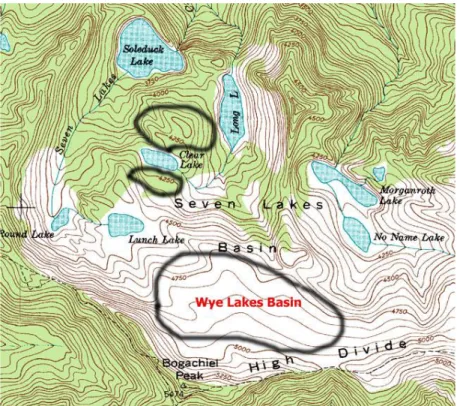
ponds. Courtesy of Wendy Palen ... 8
3 Under cool light all populations resided higher in the water column
compared to either UV light treatment. Under high UV, all populations resided significantly lower in the water column
compared to either cool light or low UV. ... 16
4 Relationship between vegetation and D. melanica behavior under three
different light conditions. Angles between lines represent the strength of correlation, with an angle of 90 degrees indicating 0 correlation.
Woody vegetation and D. melanica behavior under high UV treatment
are highly correlated. ... 18
5 Relationship between DVM behavior and variation in water variables
of each pond, including colored dissolved organic matter (CDOM), transmittance, phosphorous, and chlorophyll a. No correlations were
statistically significant. ... .19
6 Average preference of D. melanica for shade when exposed to cool,
low UV, and high UV light. Preference for shade increases
significantly with increasing exposure to UVB. Six populations were observed, four clones were measured for each population, and three
1
CHAPTER I
INTRODUCTION
Sunlight is essential for life on Earth; ultraviolet radiation (UVR) is part of the sun’s electromagnetic spectrum that hits earth and is of particular interest because it can cause DNA damage to organisms. There are three major ways that organisms can protect themselves from these harmful rays. They can repair DNA damage caused by UVR, protect themselves from UVR via pigmentation, or modify their behavior to avoid the
harmful rays (Rastogi et al. 2010, Williamson et al. 2011). Daphnia, a genus of
freshwater zooplankton, are ideal model organisms for studying how freshwater animals respond to increased levels of UVR because they are easy to maintain and they reproduce
clonally. Daphnia melanica from the Seven Lakes Basin of Olympic National Park have
adapted to high levels of UVR exposure (Miner and Kerr 2010). It has been observed
that D. melanica from highly transparent ponds have better survival rates when exposed
to UVR and faster rates of DNA repair compared to D. melanica from less transparent
ponds (Miner and Kerr 2010).
My study focuses on how high alpine populations of D. melanica modify their
behavior to avoid harmful UVR. Diel vertical migration (DVM), which involves moving
down the water column, is one way Daphnia can avoid UVR. Since UVR decreases with
increasing depth, DVM can provide protection to the animals that reside in the pond
(Williamson et al. 2001). The second way D. melanica can avoid the harmful rays is by
CHAPTER II
LITERATURE REVIEW
2.1 Ultraviolet Radiation Wavelength B (UVB) and DNA Damage
The three major groups of rays the sun emits are infrared, visible light, and ultraviolet radiation (UVR). Ultraviolet radiation is of particular interest to us because it is shortwave radiation that can damage DNA. Ultraviolet radiation contains three
wavelength ranges: UVA (320-400 nm), UVB (280-320 nm) and UVC (<280 nm). UVA is the least damaging and is the most abundant wavelength that reaches Earth’s surface. The most damaging wavelength range in the UV spectrum is UVC (<280nm).
Fortunately, this wavelength range is completely absorbed by the ozone layer and therefore does not strike the Earth’s surface (Rastogi et al. 2010). UVB causes DNA damage. Although it is mostly absorbed by the stratosphere, some rays hit Earth (Kollias et al., 2011).
There are three major ways that organisms can cope with UVB. They can repair damage, protect themselves by increasing their pigmentation, or avoid UVB by changing their behavior. UVB radiation causes many different types of DNA damage in animals, and for each type of damage, there is a corresponding repair pathway that coordinates specialized enzymes to facilitate repair (Rastogi et al. 2010). Many organisms produce pigmentation, such as melanin, which acts as a protective layer for the animal. The last way animals can avoid UVB is by modifying their behavior. For example, aquatic animals may seek shade or migrate down the water column to protect themselves from the damaging UV rays.
3
2.2 Daphnia
Daphnia are a genus of freshwater zooplankton in the order Cladocera that inhabit ponds and lakes, consume algae, and reproduce primarily by parthenogenesis (Miner et al. 2012). Parthenogenesis allows researchers to establish clonal lines, which makes
Daphnia a promising model organism for ecological genomics (Miner et al. 2012). Along
with being able to reproduce clonally, Daphnia are an excellent indicator species because
they are sensitive to toxins (Poynton et al. 2007). In addition, they play a central role in the food web. Their tractability in the lab, sensitivity to environmental stress, and
ecological importance makes Daphnia an ideal model organism.
Daphnia are exposed to many environmental challenges, including the need to simultaneously obtain enough food, avoid predation, and limit exposure to
DNA-damaging UVR (Williamson et al. 2011). Some possible solutions to the damage caused by UVR include increased rates of DNA repair, increased production of melanin, and behavioral escape through diel vertical and horizontal migration.
2.3 Diel Vertical Migration (DVM)
Diel vertical migration involves the daily movement of aquatic organisms such as zooplankton down the water column upon exposure to different kinds of environmental
stress (Williamson et al. 2011). DVM is thought to help Daphnia optimize foraging and
access to ideal temperatures with avoidance of predators and UVB. McLaren (1963)
hypothesized that zooplankton such as Daphnia can consume enough algae to survive
and reproduce during part of the day then migrate down to cooler waters to rest, and this would result in larger zooplankton that had higher fitness. Other researchers have
hypothesized that staying in the surface waters would be more advantageous because the surface waters contain more food and warmer temperatures, which increases fecundity in zooplankton (Lampert 1989). Orcutt and Porter (1983) suggest that there is an optimal
range of temperatures that increase fitness for Daphnia, but it might not be advantageous
for the organism to use energy to move down the water column to rest for part of the day.
Since Daphnia can survive across a range of temperatures, food may have a greater effect
on behavior. One study found that D .melanica were less likely to migrate in the water
column when food was abundant at the surface (Johnsen and Jakobsen 1987). Migration down the water column may also enable avoidance of predators.
Daphnia that migrate down the water column are less visible to predators and therefore less likely to be eaten (Dawidowcz and Loose 1992). Stich and Lampert (1981) studied a
lake ecosystem that had two different species of Daphnia: D. galeata and D. hyaline.
Daphnia hyaline demonstrated migratory behavior, while D. galeata did not. Despite
much higher reproduction rates, D. galeata remained at lower overall numbers compared
to D. hyaline because they were subjected to higher predation (Stich and Lampert 1981).
Although Daphnia that migrated down the water column had lower food availability,
slower growth, and fewer eggs that grew more slowly, they were able to persist in a high
predation environment (Lampert 1989). Other studies have shown that Daphnia magna
avoid the surface water when exposed to a chemical fish cue whereas D. magna not
exposed to fish cues stay in the warmer, food rich surface water (Dawidowcz and Loose
1992), showing that Daphnia are able to identify predators via kairomones, or chemical
5
Zooplankton can also change their behavior in response to abiotic environmental challenges, such as ultraviolet radiation, and recent research suggests that avoidance of
UVB may contribute to DVM patterns (Williamson et al. 2011). Daphnia have UV
photoreceptors called opsins that allow them to detect UV radiation (Williamson et al. 2001). Their ability to detect UV radiation allows them to adjust the behavior to access
optimal conditions. One study involved an in situ experiment where researchers placed
columns in ponds and tested if Daphnia migrated down the column during the day. They
found that in the presence of UV more Daphnia migrated down the water column (Leech
and Williamson 2001). Other studies also show that zooplankton appear to avoid the surface water when UV is present (Cooke et al. 2008). For example, Cook et al. (2008)
designed an experiment to test whether UV light or temperature played a bigger role in D.
catawba DVM. They placed D. catawba in columns that were exposed to UV light (+UV) or columns that were not exposed to UV (–UV); the columns also had a temperature gradient. The top of the column was the warmest and the temperature got
cooler the farther down the column the Daphnia migrated. In the +UV columns D.
catawba stayed in the middle or lower in the column, but in the –UV column D.catawba
migrated up the column to the warmer water (Cooke et al., 2008).
2.4 Diel Horizontal Migration (DHM)
While DVM has been heavily documented in the literature, diel horizontal
migration (DHM) has not. Many ponds where Daphnia reside have some sort of cover
and have stands of trees around them offering shade for at least part of the day. In addition to trees, big rocks and logs that reside within the pond can offer some shelter
from UVR. Daphnia could thus migrate into a shaded region of a pond to avoid UVR or predators. One study suggested that horizontal migration of cladocerans in shallow lakes increases with increasing macrophyte patch size, and with high predation by fish
(Lauridsen et al. 1996). Like DVM, DHM patterns can be altered by many factors, including biotic factors such as predators, aquatic vegetation, and food resources (Burks et al. 2002, Meutter et al. 2004). Additionally, abiotic factors such as light and
temperature can have an effect on Daphnia DHM (Burks et al. 2002). For example,
when given the option of being under photosynthetic active radiation (PAR), PAR with
UVA, or PAR with UVB, Acartia pacifica (copepoda) migrated horizontally to the area
with PAR or PAR with UVA and avoided the area with PAR and UVB (Zengling et al. 2010).
2.5 Study System
The Olympic National Park supports a range of habitats, from low elevation old
growth forest to subalpine and alpine habitats. The Seven Lakes Basin of the Olympic
Figure 1The Seven Lakes Basin of the Olympic National Park at the transition zone between montane and subalpine forest
7
National Park (Figure 1) is at the transition zone between montane and subalpine habitat (Miner and Kerr 2010). Lakes and ponds are scattered along this transition zone with the small ponds being the main focus of my research (Figure 2). The habitat around the small ponds varied. A cluster of ponds next to Clear Lake was surrounded by trees that
were high enough to provide shade. The vegetation was dominated by Tsuga mertensiana
(mountain hemlock) and Abies amabilis (Pacific silver fir) as well as Vaccinium spp.
(huckleberry and blueberry) and Phyllodoce empetriformis (heather). In contrast,
vegetation surrounding the ponds near the Wye Lakes Basin were dominated by dwarf
Vaccinium spp., Phyllodoce empetriformis and dwarf Cyperaceae (sedges) and a few
dwarf Luekea pectinate (partridgefood) by the water.
Subalpine ponds, such as the ones found in the Seven Lakes Basin, are exposed to more UVR compared to lower elevations because the amount of UVR increases with increasing elevations, about 20 percent with every 1000 meters (Miner and Kerr 2010). Effects of UVR in the Seven Lakes Basin have been studied for many years, with a focus
on amphibians (Adams et al. 2001 and Palen et al. 2002) and Daphnia (Miner and Kerr,
2010). In June and July of 1999 UVB was measured in the Olympics, 1-500 J/m2 to
4501-5000 J/m2; with most of the days ranging from 2001-2500 to 3501-4000
Daphnia melanica inhabiting the Seven Lakes Basin region of the Olympic National Park show evidence of adaptation to UVR (Miner and Kerr 2010). None of the
populations produce measurable amounts of melanin. However, D. melanica that inhabit
more transparent ponds, and are thus exposed to higher levels of UVB, have higher
survival rates when exposed to UVR than D. melanica from ponds with more organic
matter, which blocks UVB (Miner and Kerr 2010). Preliminary data shows that D.
melanica in more transparent pondsexperience as much DNA damage as less tolerant populations, in the form of cyclobutane-pyrimidine dimers (Miner, pers.comm.).
However, D. melanica that inhabit the more transparent ponds appear to repair this
damage approximately twice as fast (Miner, pers.comm.). One way D. melanica in clear
ponds may be repairing DNA faster is by up-regulating genes that fix DNA damage
Figure 2 Study site with the black circles indicating the location of my ponds. Courtesy of Wendy Palen
9
caused by UVB. An obvious candidate gene for adaptation to UVR is the photorepair enzyme photolyase, which specifically repairs cyclobutane-pyrimidine dimers and is activated by UVA (Rastogi et al. 2010). However, preliminary data indicate that high-UVR-tolerance clones have lower or equal expression of photolyase in comparison with low-tolerance clones (Miner, pers.comm.). This could indicate that photolyase may not be the enzyme facilitating repair.
There are multiple solutions to every environmental stressor. Populations of D.
melanica could use different strategies to obtain the same goal of decreasing damage due to UVR. The possibility that these populations use behavioral avoidance has not been
studied in these populations of D. melanica, and could be a mechanism that they use to
avoid UVR. The ponds sampled by Miner and Kerr (2010) are small, shallow ponds that are between one to two meters deep. Predators include invertebrates and amphibian
larva. Using multiple populations of D. melanica that are known to differ in UVR
CHAPTER III
METHODS
3.1 Collection and Maintenance of Clones
Daphnia melanica were collected from six different water bodies in the Seven
Lakes Basin using the methods outlined in Miner and Kerr (2010). All D. melanica,
except for D. melanica collected from NR, were taken from the same ponds as Miner and
Kerr (2010). Transparency of the ponds varied (Table 1) because of different amounts of dissolved organic matter (Miner and Kerr 2010).
Table 1Transmittance of water from ponds used in this study, measured using a spectrophotometer. Population Transmittance in % Y-023 100 Y-019 99.77 C 99.31 Y 97 E 96.34 NR 73.8
One hundred and twenty mature female D. melanica were collected from each pond and
split between three 500 mL Nalgene bottles. To ensure survival, caps were left off the bottles during the night. The next morning, parafilm was placed across the opening of the bottles, which were full to the top, to reduce splashing and mortality during transport.
11
with an insulating layer between the bottles and ice. This allowed the bottles to stay cool
without freezing. Once D. melanica were at the lab, 30 pregnant individuals per pond
were isolated in 30 separate 200 mL beakers containing FLAMES media. FLAMES
media is an artificial freshwater media that has the compounds D. melanica need to
survive (Celis-Salgado et al. 2008). Each beaker received 1 mL of dilute Cryptomonas
ozolinii, followed by placement of the beaker in an incubator set at 18°C with a
photoperiod of 16 hours of fluorescent light and 8 hours of dark. Daphnia melanica were
fed 1 mL of dilute C. ozolinii per 250 mL every three days. The remaining D. melanica
from each pond were kept in a 1000 mL flask for two weeks following collection. Mature
female D. melanica from the flask were used to replace D. melanica that did not survive
in the beakers. Only D. melanica that clearly originated in the pond were used for this
purpose. To ensure survival of clones multiple beakers were kept of each clone. Media
was changed as needed and Daphnia were kept in the old media until the clone was
established in the new beaker. Clones were allowed to reproduce for at least ten generations in the lab before experiments were carried out.
3.2 Ecological Sampling
Along with D. melanica, water samples were collected from each pond to allow
for measurement of transparency, biologically available phosphate, and colored dissolved organic matter (CDOM). To measure transparency of a pond a 0.2μm filter was attached to the end of the 60mL syringe to filter out bacteria, algae and other microorganisms (Miner and Kerr 2010). Filters were discarded after one use. Following filtration, the water was placed into a 125mL acid-washed bottle. Bottles were previously acid-washed by soaking in a 10% Hydrochloric acid solution for 24 hours, followed by three rinses
with nano-pure water (Miner and Kerr 2010). After samples were collected they were
kept cool and dark in the field and kept at 4°Cin the dark until they were analyzed.
Transparency of the ponds was measured using a spectrophotometer at 440nm (Miner and Kerr, 2010). Separate water samples were collected for measurement of phosphate and CDOM. They were collected using a 0.4 μm cellulose filter attached to a 60mL syringe and put into 500mL bottles. The bottles were acid washed for 24 hours in 5% hydrochloric acid and rinsed three times with nano-pure water. At each pond the bottle was rinsed out with the pond water. The bottles were kept as cool as possible during transport and were kept in the freezer until analysis. Soluble reactive phosphorus was analyzed using methods from Wetzel and Likens (1991). Colored dissolved organic matter was measured by using a fluorometer. Water samples were measured at two different wavelengths, 350 and 410nm, to determine the concentration relative fluorescence units (RFU) of CDOM.
The chlorophyll assay was modified from the procedure described by Hauer and Lamberti (2006). Chlorophyll was collected by using a syringe and filtering the water through a GF/F 47mm Whatman Glass Microfiber filters. Whenever possible, one liter of water was filtered per pond. In some cases, the filter became clogged after filtering a smaller volume. The final volume of filtered water was recorded and this variable was used to normalize measurements of relative chlorophyll concentration. The filters were wrapped in foil and kept cold during transport. They were then kept cold and dark until analysis. Cells were immersed in 90% buffered acetone and a sonicator was used to break them apart. The solution was then centrifuged and absorbance of the supernatant
13
was measured at 647nm and 664nm via spectrophotometer. Calculations to obtain
chlorophyll a were performed using the equations outlined in Hauer and Lamberti (2006). Vegetation was assessed in four one meter circular plots two meters away from the highest water level at each cardinal direction. Vegetation was measured in percent cover and was classified according to the following categories: bare ground, grasses, woody vegetation, forbs, and lichen/mosses. In addition, I identified and recorded the presence of predators in the pond. I took one UVB measurement at the Seven Lakes Basin trailhead using a stellernet Black-Comet Concave Grating Spectrometer close to
high noon on September 9th 2014. There were few clouds in the sky. The trailhead is
approximately 1200 meters lower in elevation than the ponds.
3.3 Measurement of DVM
Diel vertical migration (DVM) was assessed using methods modified from Loose and Dawidowicz (1994). Three 114cm glass tubes with a width of 4.7cm were placed in a wooden holder. Cardboard placed on top of the holder allowed UVB to hit the tubes from above, while preventing UVB entering from the sides. Each tube was filled with 350 mL of FLAMES media, which created a liquid column one meter in height, and kept at a constant 18°C. The meter of tube containing FLAMES media was marked off in ten
10 cm sections. Daphnia melanica were exposed to three different light treatments: cool
light containing no UVB, light containing a low dose of UVB, and light containing a high
dose of UVB. The low UV dose had UVB levels of 0.063 watts per meter2 at the water’s
surfaceand 0.004 watts per meter2 at the bottom. The high UVB dose was 5.498 watts
UVB measured at the trailhead of the Olympics was 0.034 watts per m2. UVB levels
were measured using a stellernet Black-Comet Concave Grating Spectrometer.
One D. melanica was placed in each tube and exposed to experimental light for one hour before I scored their location in the water column. One clone from each
population was selected for each day. Experiments took place between 9:00 am and 4:00 pm every day. The order of light treatment, population and clone were randomly selected
for this experiment. Six D. melanica clones were scored for each population by
measuring position in the water column during exposure to a light source. Three individuals were scored for each clone.
3.4 Measurement of DHM
In order to assess diel horizontal migration, a shaded and non-shaded region was created in a 14 cm petri dish, filled with 200 mL of FLAMES media. The shaded region was created by placing a thick piece of cardboard over half of the petri dish. Temperature was held constant at 18°C. The non-shaded region of the petri dish was exposed to one of three light treatments. In each treatment, lights were positioned 24 cm away from the top of the petri dish. Two different bulbs were used for the UV treatments; the low UVB bulb
emitted 0.303 watts per meter2 while the high UVB blub emitted 5.5 watts per meter2.
The high UVB bulb was identical to that used in previous studies (Miner and Kerr 2010, Williamson et al. 2001). All bulbs were allowed to warm up for thirty minutes before the experiment started. Each trial consisted of one clone from each population. Three petri
dishes were set up under the light and one individual D.melanica was put into each. The
15
at 10 minutes. Trials took place at the same time every day. Six populations were observed, four clones were scored for each population and three individuals were scored for each clone. The order of population and clone were randomly assigned. Each
IV
RESULTS
4.1 DVM
I applied a generalized linear mixed model predicting depth preference in meters as a function of UV treatment, population, and clone nested within population. Clone was treated as a random effect. I used a beta distribution of error terms. The diel vertical migration experiment showed that there was a significant difference in light treatment
(DF = 318, LRT = 10034.3, P <2.2e-16). There was also a significant difference between
populations (DF = 297, LRT = 11.56, P <2.2e-16) and a significant interaction between
population and treatment (DF = 286, LRT 21.81, P < 2.2e-16) ( Figure 3). Under cool
light all populations resided in the upper half of the water column with one high (C) one medium (Y) and one low transparency (NR) population residing almost entirely in the
Figure 3 Under cool light all populations resided higher in the water column compared to either UV light treatment. Under high UV, all populations resided significantly lower in the water column compared to either cool light or low UV
17
first 20cm of the water column. Under low UV, populations in general had a more
variable range in the water column, with medium to low transparent ponds (C, E) residing mostly in the top half of the water column (Figure 3 and Table 1). Under high levels of UVB all populations migrated down to the bottom of the water column, with C having the greatest range in the water column (Figure 3).
Because population differences were highly significant yet not clearly correlated with transparency, presence of invertebrate predators was added to the model to see if they explained position in the water column. Specifically, I applied a generalized linear mixed model predicting depth preference as a function of UV treatment, presence of dragonfly larvae or Chaoborus and population with clone nested within population. Clone was treated as a random effect. I used a beta distribution of error terms. The results were not significant (DF = 291, t-value = -2.039, P value = 0.30).
4.2 Vegetation, Invertebrates and Water Properties
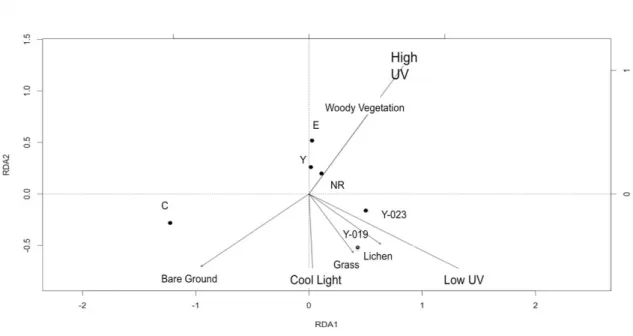
The transition zone between montane and subalpine habitats supported distinct types of surrounding vegetation, such as woody vegetation, bare ground, grass, and lichen, that varied between ponds. I used redundancy analysis to evaluate if the vegetation surrounding the ponds, which influences the water clarity and sometimes
provides direct shade, could predict D. melanica DVMbehavior. The results were not
significant (DF = 4, F = 2.3406, P-value = 0.28). However, there were some interesting trends. Ponds that have more grass tend to have more lichen and moss (Figure 4). Woody vegetation appears to have a negative relationship to bare ground, although neither is related to the presence of grass or lichen and moss. Interestingly, variation in behavioral response to high UV light appears to be correlated to woody vegetation, but this trend is
not quite significant (correlation coefficient = 0.78; DF=4, t=2.49, P-value=0.076). There was a significant correlation between bare ground and behavior under high UV (DF = 4, t
= -6.56, P-value = 0.002), with a correlation coefficient of -0.96. Variation in behavioral response to a low UV light appears to have a weak (and nonsignificant) relationship to grass, lichen and moss, but not behavioral response to high UV. Y-023 and Y-019 both had more grass and lichen and are more similar in vegetation composition, as well as response to cool light and low UV, compared to other ponds (Figure 3 and Figure 4). The ponds that were the least transparent had similar amounts of woody vegetation (E, Y, NR) and similar behavioral responses under high UV (Figure 3). Pond C had the barest ground compared to the other ponds, and tended to be an outlier in both vegetation
composition and behavioral response of its Daphnia.
Figure 4 Relationship between vegetation and D. melanica behavior under three different light conditions. Angles between lines represent the strength of correlation,
with an angle of 90 degrees indicating 0 correlation. Woody vegetation and D.
19
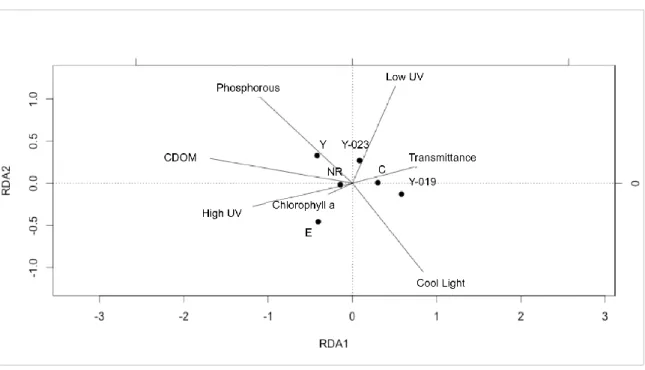
Different conditions within the water could also account for variability in behavior. In particular, transmittance of filtered water, presence of colored dissolved organic matter (CDOM) and concentration of chlorophyll a are expected to influence behavior because they affect water transparency and/or availability of food (Figure 5).
Figure 5 Relationship between DVM behavior and variation in water variables of each pond, including colored dissolved organic matter (CDOM), transmittance, phosphorous, and chlorophyll a. No correlations were statistically significant.
I used a redundancy analysis to test whether CDOM, transmittance, chlorophyll a, and
soluble reactive phosphorous could account for variation in D. melanica DVM behavior
under different light conditions. The results were not significant (DF=4, F=0.1518, P-value=0.9931). However, the triplot shows some interesting trends (Figure 5). Among
predictor variables, CDOM and chlorophyll a show a weak positive relationship with
each other and a negative correlation with transmittance (Figure 5). The response to cool light showed a negative relationship to phosphorous, while the response to high UV was related to transmittance. A pearson correlation analysis revealed a correlation of -0.16
between behavior observed under high UV and transmittance, which was non-significant (DF=4, t=-0.33, P-value=0.76) (Figure 5).
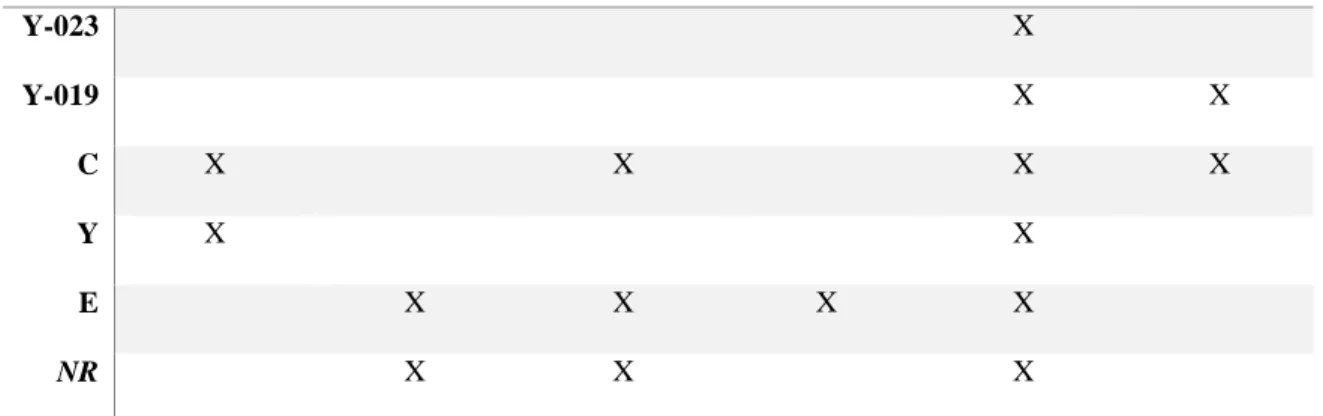
Along with identifying plants and pond characteristics I also identified
invertebrates within each pond (Table 2).
Table 2 Invertebrates identified within each pond.
Dragonfly Larva Phantom Midges Mosquito Larva Caddisfly Larva Amphipods Midges Y-023 X Y-019 X X C X X X X Y X X E X X X X NR X X X
Within the ponds chaoborus (phantom midges) were found in E and NR; these are known
be predators of Daphnia. Amphipods would most likely be competitors with Daphnia.
Salamanders were also identified. Ambystoma gracile (northwestern salamander) and
Ambysoma macrodactylum (long toed salamander) larva were found in every pond and
are likely predators of Daphnia.
21
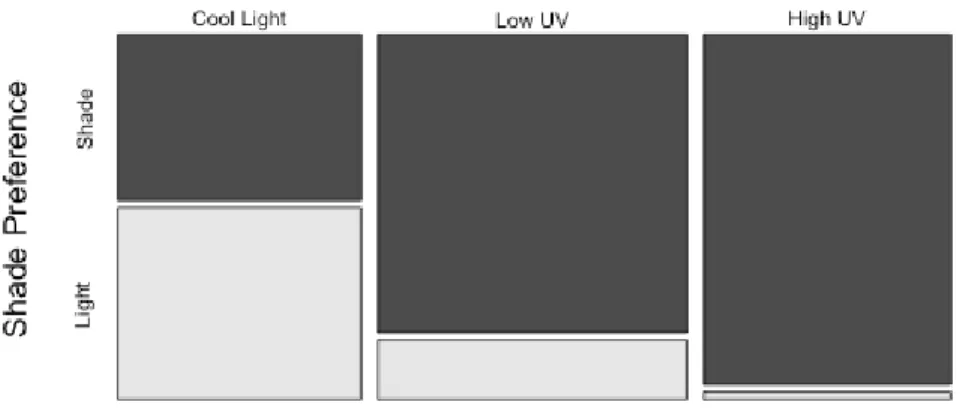
Analysis of DHM data was performed via nested logistic regression. Specifically, I applied a generalized linear mixed model with a log-link function, predicting shade preference as a function of UV treatment, time, population, and clone nested within population. Clone was treated as a random effect. Results from the diel horizontal
migration experiment revealed a highly significant effect of UVB intensity on Daphnia
behavior (DF=2, LRT=121.24,P <2. e-16). When exposed to a clear fluorescent light D.
melanica did not show preference for the shaded region (Figure 6). Under low UV light,
D. melanica spent significantly more time in the shaded part. Furthermore, the
probability of a D. melanica of being in the shade was significantly higher under high UV
light compared to low UV light (Table 2). Although D. melanica had a strong response to
Figure 6 Average preference of D. melanica for shade when exposed to cool, low UV, and high UV light. Preference for shade increases significantly with increasing exposure to UVB. Six populations were observed, four clones were measured for each population, and three individuals were scored for each clone.
light treatment, there was no significant difference among populations (DF=5, LRT=5.038, P-value=0.4115). There was no difference between the two time points (DF=1, LRT=1.307, P-value= 0.2529). All light treatments were highly significantly different from each other; this was analyzed via least square means test, with p values adjusted using the Tukey method (Table 3).
Table 3 Results of post-hoc pairwise comparisons between light treatments. All light treatments were significantly different from each other. P-values are corrected for multiple comparisons using the Tukey method.
Treatment Effect Size Standard Error Z ratio P value Cool light- High UV 4.05 0.61 4.27 <0.0001
Cool light-Low UV 1.79 0.27 5.03 <0.0001
23
CHAPTER VI
DISCUSSION
5.1 DVM
The purpose of this study was to test if D. melanica would alter their behavior to
avoid increasing levels of UVB and to see if populations differed in their UVB avoidance
behavior based on pond clarity. Daphnia melanica from all populations moved down the
water column with increasing levels of UVB, which is in concordance with results from
other Daphnia species (Leech and Williamson 2001, Cook et al. 2008). Interestingly, D.
melanica exhibited different behavior under cool light, low UV and high UV treatments, showing that they can change their behavior depending upon the degree of UVB
exposure (Figure 3). There was a significant difference in behavior among populations and a significant interaction between population and light treatment. This suggests that behavioral response to UVB has evolved differently among populations.
To further explore the differences in DVM among populations, I tested for correlation with habitat variables observed in the field, including water transparency and other aspects of water quality. I also tested for correlation with composition of the surrounding vegetation, which contributes to the unique ecosystem of each pond by influencing water quality, pond substrate, and availability of shade. Several trends are notable and may be worth additional study. Woody vegetation may play an important role in an organism’s ability to avoid UV. Most of the woody vegetation around these ponds was Vaccinium spp. These low, shrubby plants provide little shade, and only at the very edge of the water. On the other hand, they provide leaf litter that decomposes in the ponds, which increases the amount of dissolved organic matter. This dissolved organic
matter absorbs some of the harmful UVB rays, which provides more protection for the animals that reside in that pond (Miner and Kerr 2010). In my DVM experiment, under
high UV conditions, the D. melanica from the more transparent ponds generally resided
higher in the water column compared to D. melanica from less transparent ponds (Figure
3). Daphnia melanica from highly transparent ponds have better survival when exposed
to UVB and faster rates of DNA repair (Miner and Kerr 2010, Miner per comm.), perhaps explaining why they do not use DVM to avoid UV to the same extent as other
populations.
Along with avoidance of UVB, DVM has been extensively studied as a predator avoidance strategy (Meutter et al. 2004, Williamson et al. 2011). Nonetheless, I saw no significant effect of the presence of invertebrate predators in the ponds on behavior observed in the lab. It is possible that the lack of effect was due to the absence of predator kairomones, or chemical cues, in my study design. Such cues are known to prompt
evasive behavior in Daphnia (Dodson 1988). In addition, the presence and relative
abundance of invertebrate predators likely varies greatly over time, so that ponds do not experience consistently different selection pressure due to this factor. It is also possible
that D. melanica do not use DVM as a predator avoidance strategy, perhaps due to the
small size of these ponds.
Under all three light treatments D. melanica from Y-019 and Y-023 showed
similar behavior in the lab (Figure 3, Figure 4, and Figure 5). These ponds are located close to each other and had similar vegetation, water properties, abundance of salamander
larva and lack of invertebrate predators. In the field most of the Daphnia from Y-023
25
In contrast, the Daphnia from Y-019 were at lower depths and were at low abundance
compared to the amphipods. In Y-019 Daphnia may be migrating to lower depths to
avoid competition, as has been observed in lakes where there are more than one species of Daphnia (Geller 1989, Meerhoff et al. 2007).
Differences may therefore be due to some combination of genetic drift, evolution of different UVB strategies in different ponds, or other, unmeasured aspects of the environment. Alternatively or in addition, it is possible that my small sample sizes did not provide sufficient power to detect correlations with the variables I did measure.
Daphnia respond to simultaneous stressors such as balancing food consumption, predator avoidance and UVR, while optimizing fitness (Williamson et al. 2011). This means that the difference in DVM strategies between populations likely evolved from dealing with multiple stressors, some of which I did not address in my study. Different ecological processes and interannual variation within each pond probably drive evolutionary change in D. melanica. Phenotypic plasticity allows Daphnia to quickly respond to
environmental cues to increase their survival rates. One example of phenotypic plasticity
observed in Daphnia is the ability to change their appearance in the presence of predators
(Dodson 1988). Other studies suggest that zooplankton canbalance different survival
strategies such as pigmentation, migration, and DNA repair to increase survival (Hansson
and Hylander 2009). The strategies that D. melanica uses to increase survival rates when
5.2 DHM
Daphnia melanica from all populations preferred shade when exposed to increasing levels of UVB. There was no significant difference between populations. Shade offers protection from the sun’s harmful UVB rays by blocking direct exposure (Zengling et al. 2010). In the ponds I surveyed there were many forms of shade, including surrounding trees, rocks within the pond, and large debris such as dead trees that had fallen in the pond. There was only one pond that may get little to no shade
(Y-023), however, the D. melanica from that pond migrated to the shaded region under low
and high UVB. DHM allows the Daphnia to inhabit any part of the water column that they deem the safest.
Behavior can be measured in more than one way. I looked at D. melanica shade
preference with increasing levels of UVB. Not only did Daphnia move into the shade
more often, they also started spinning vertically until they found the shade, and this behavior was very prominent among populations under high levels of UVB. Under low
levels of UVB this behavior was less frantic and many of the Daphnia did not spin at all
as they sought the shade. These observations support the idea that behavior modification is an important aspect when teasing apart adaptations to UVB.
5.3 Future Research
My research points to a number of questions that need further investigation. Population differences in DVM behavior under different light treatments remain unexplained. To tease apart differences among populations, future studies should
27
help explain how D. melanica evolved their behavior to balance the stressors of UVB,
predation, competition, and other environmental factors. To address predation, DVM
could be assessed while exposing D. melanica to UV and predation cues. It would also
be ideal to perform DVM studies within each pond, to see if behavior under lab
conditions matches what happens in D. melanica’s natural environment.
Future research should include more investigation of each pond. Each pond is a unique ecosystem, with varying amounts and types of vegetation. Within each pond there are varying levels of heterogeneity that should be assessed. The redundancy analysis revealed that there may be some relationship between environmental factors and DVM behavior (Figures 4, Figure 5) that should be explored further. Along with measuring ecological aspects, UVB should be assessed again, because it has not been done since 1999 (Adams et al. 2001). I took one measurement at the trailhead of the Seven Lakes
Basin, which had UVB levels of 0.034 watts per m2. This one measurement at one point
in time is not an accurate representation of how much UVB the Seven Lakes Basin receives because it was taken at lower elevation, at one time point. It is hard to measure UVB accurately because many factors such as scattering or absorption of UVB by
particles in the air, cloud cover or composition of the atmospheric gasses alter attenuation of UVB as it passes through the atmosphere (McKenzie et al. 2001). There can also be a difference in reflectivity such as how much snow cover, or vegetation is on the ground (McKenzie et al. 2001). Although it may be hard to measure, it is important that we are
REFERENCES
Adams, M. J., D. E. Schindler, and B. R. Bury. 2001. Association of amphibians with attenuation of ultraviolet-b radiation in montane ponds. Oecologia 128:519–525. Burks, R. L., D. M. Lodge, E. Jeppesen, and T. L. Lauridsen. 2002. Diel horizontal
migration of zooplankton: costs and benefits of inhabiting the littoral. Freshwater Biology 47:343–365.
Celis-Salgado, M.P., Cairns, A., Kim,N., Yan, N.D. 2008. The FLAMES medium: a new, soft-water culture and bioassay medium for Cladocera. Verhandlungen des
Internationalen Verein Limnologie 20, 265-271
Cooke, S. L., C. E. Williamson, D. M. Leech, W. J. Boeing, and L. Torres. 2008. Effects of temperature and ultraviolet radiation on diel vertical migration of freshwater crustacean zooplankton. Canadian Journal of Fisheries and Aquatic Sciences 65:1144–1152.
Dawidowicz, P., and C. J. Loose. 1992. Metabolic costs during predator-induced diel vertical migration of Daphnia. Limnology and Oceanography 37:1589–1595. Dodson, S. 1988. The ecological role of chemical stimuli for the zooplankton:
Predator-avoidance behavior in Daphnia. Limnology and Oceanography 33:1431–1439. Dodson, S. I., T. A. Crowl, B. L. Peckarsky, L. B. Kats, A. P. Covich, and J. M. Culp.
1994. Non-visual communication in freshwater benthos: An overview. Journal of the North American Benthological Society 13:268–282.
Geller, W. 1989. The energy budget of two sympatric Daphnia species in Lake Constance: productivity and energy residence times. Oecologia 78:242–250. Hansson, L.-A., and S. Hylander. 2009. Effects of ultraviolet radiation on pigmentation,
photoenzymatic repair, behavior, and community ecology of zooplankton. Photochemical & Photobiological Sciences 8:1266–1275.
Hauer, F. R., and G. A. Lamberti. 2006. Methods in Stream Ecology. Academic Press. Holmes, R. M., A. Aminot, R. Kérouel, B. A. Hooker, and B. J. Peterson. 1999. A simple
and precise method for measuring ammonium in marine and freshwater
ecosystems. Canadian Journal of Fisheries and Aquatic Sciences 56:1801–1808. Johnsen, G. H., and P. J. Jakobsen. 1987. The effect of food limitation on vertical
29
Kollias, N., E. Ruvolo Jr, and R. M. Sayre. 2011. The value of the ratio of UVA to UVB in sunlight. photochemistry and photobiology 87:1474–1475.
Lampert, W. 1989. The adaptive significance of diel vertical migration of Zooplankton. Functional Ecology 3:21.
Lauridsen, T., L. J. Pedersen, E. Jeppesen, and M. Sønergaard. 1996. The importance of macrophyte bed size for cladoceran composition and horizontal migration in a shallow lake. Journal of Plankton Research 18:2283–2294.
Leech, D. M., and C. E. Williamson. 2001. In situ exposure to ultraviolet radiation alters the depth distribution of Daphnia. Limnology and oceanography 46:416–420.
Loose, C. J., and P. Dawidowicz. 1994. Trade-Offs in diel vertical migration by Zooplankton: The Costs of Predator Avoidance. Ecology 75:2255.
McKenzie, R. L., G. Seckmeyer, A. F. Bais, J. B. Kerr, and S. Madronich. 2001. Satellite retrievals of erythemal UV dose compared with ground-based measurements at northern and southern midlatitudes. Journal of Geophysical Research:
Atmospheres 106:24051–24062.
McLaren, I. A. 1963. Effects of temperature on growth of Zooplankton, and the adaptive value of vertical migration. Journal of the Fisheries Research Board of Canada 20:685–727.
Meerhoff, M., C. Iglesias, F. T. De Mello, J. M. Clemente, E. Jensen, T. L. Lauridsen, and E. Jeppesen. 2007. Effects of habitat complexity on community structure and predator avoidance behaviour of littoral zooplankton in temperate versus
subtropical shallow lakes. Freshwater Biology 52:1009–1021.
Meutter, F. V. de, R. Stoks, and L. D. Meester. 2004. Spatial avoidance of littoral and pelagic invertebrate predators by Daphnia. Oecologia 142:489–499.
Miner, B. E., and B. Kerr. 2010. Adaptation to local ultraviolet radiation conditions among neighbouring Daphnia populations. Proceedings of the Royal Society B: Biological Sciences.
Miner, B. E., L. D. Meester, M. E. Pfrender, W. Lampert, and N. G. Hairston. 2012. Linking genes to communities and ecosystems: Daphnia as an ecogenomic model. Proceedings of the Royal Society B: Biological Sciences:rspb20112404.
Orcutt, J. D., and K. G. Porter. 1983. Diel vertical migration by Zooplankton: Constant and fluctuating temperature effects on life history parameters of Daphnia. Limnology and Oceanography 28:720–730.
Palen, W. J., D. E. Schindler, M. J. Adams, C. A. Pearl, R. B. Bury, and S. A. Diamond. 2002. Optical characteristics of natural waters protect Amphibians from UV-B in the U.S. Pacific Northwest. Ecology 83:2951–2957.
Poynton, H. C., J. R. Varshavsky, B. Chang, G. Cavigiolio, S. Chan, P. S. Holman, A. V. Loguinov, D. J. Bauer, K. Komachi, E. C. Theil, E. J. Perkins, O. Hughes, and C. D. Vulpe. 2007. Daphnia magna ecotoxicogenomics provides mechanistic
insights into metal toxicity. Environmental Science & Technology 41:1044–1050. Rastogi, R. P., Richa, A. Kumar, M. B. Tyagi, and R. P. Sinha. 2010. Molecular
mechanisms of ultraviolet radiation-induced DNA damage and repair. Journal of Nucleic Acids 2010:1–32.
Stich, H.-B., and W. Lampert. 1981. Predator evasion as an explanation of diurnal vertical migration by zooplankton. Nature 293:396–398.
Storz, U. C., and R. J. Paul. 1998. Phototaxis in water fleas (Daphnia magna) is differently influenced by visible and UV light. Journal of Comparative Physiology A 183:709–717.
Wetzel, R.G. and G.E. Likens. 1991. Limnological Analyses, 2nd Ed. Springer-Verlag.
New York, NY
Williamson, C. E., P. J. Neale, G. Grad, H. J. D. Lange, and B. R. Hargreaves. 2001. Beneficial and detrimental effects of UV on aquatic organisms: Implications of spectral variation. Ecological Applications 11:1843–1857.
Williamson, C. E., J. M. Fischer, S. M. Bollens, E. P. Overholt, and J. K. Breckenridge. 2011. Towards a more comprehensive theory of zooplankton diel vertical
migration: Integrating ultraviolet radiation and water transparency into the biotic paradigm. Limnology and Oceanography 56:1603–1623.
Zengling, M. A., L. I. Wei, and G. A. O. Kunshan. 2010. Horizontal migration of Acartia pacifica Steuer (copepoda) in response to UV-radiation. Journal of
31
APPENDIX A
Maps of the Seven Lakes Basin of the Olympic National Park