The Data Source for
Making Maths and English Work for All
–
Conversations and Desk Research
Research report
March 2015
Pye Tait Consulting
Royal House, 110 Station Parade, Harrogate, HG1 1EP
Tel: 01423-509433 Fax: 01423-509502 Email: [email protected] Web:
www.pyetait.com
Cert No: 76000/GB/Q
2 | P a g e P y e T a i t C o n s u l t i n g
Acknowledgements
Pye Tait would like to thank the literally hundreds of employers who gave their time to participate in this research and all those organisations and individuals in the education and training sector who helped make the ‘Making maths and English work for all’ review happen and be as widely
promulgated during the short time in which it took place. This includes the Steering Group who helped ensure the links to the surveys were promoted widely and mailed out to industry. Additionally, we would like to thank the staff at the Foundation, particularly the project manager Sue Southwood and the communications team led by Rachel Malic.
3 | P a g e P y e T a i t C o n s u l t i n g
Contents
Tables and Figures ... 4
Acronyms ... 5
1. Introduction and Methodology... 6
1.1 Work-Stream 1: Raising awareness ... 7
1.2 Work-Stream 2: Desk research ... 8
1.3 Work-Stream 3: Consultation ... 8
1.4 Work-Stream 4: Analysis and reporting ... 10
2. Background ... 11
2.1 Introduction - Stubborn Issues ... 11
2.2 Current performance in maths and English ... 13
2.3 Government policy ... 16
2.4 The literature on employers’ needs ... 18
2.5 Issues with English and maths skills ... 21
3. The current (qualifications) environment ... 24
3.1 Provider capability ... 25
3.2 The condition of funding and context ... 27
3.3 Current non-GCSE maths and English qualifications ... 30
3.4 Non-qualification-based approaches ... 35
4. Employer Conversations ... 40
4.1 An Overview ... 40
4.2 What Maths Skills do Employers Value ... 45
4.3 What English Skills do Employers Value ... 48
4.4 Remedying Skills Gaps ... 51
4.5 Employers and Qualifications ... 53
4.6 Employers and Functional Skills (FS) qualifications ... 57
4.7 Summary of Employer views:... 62
5. Stakeholder/Practitioner Conversations... 63
5.1 The GCSE and non-GCSE Routes ... 63
5.2 New or Enhanced Qualifications? ... 67
5.3 Stakeholders/Practitioners and non-GCSE qualifications ... 68
5.4 Strengths and Weaknesses of Functional Skills ... 71
5.5 Learner Conversations ... 77
5.6 Stakeholder/Practitioner views summarised: ... 78
4 | P a g e P y e T a i t C o n s u l t i n g
Appendices ... 85
A1: Respondents ... 86
Employers Respondent profile:... 86
Stakeholders and Practitioners Profiles: ... 88
A2: The Army’s use of Functional Skills ... 91
A3: Summary comparison between GCSE content and Functional Skills Criteria ... 94
Comparison of GCSE English and functional skills. ... 94
Comparison of GCSE mathematics and functional skills. ... 96
A4: Behavioural view of mathematics ... 107
A5: Bibliography ... 109
Tables and Figures
Table 1: Number of participants involved in the conversations ... 9Table 2: Adult Standards for literacy and Numeracy, 2000/2001 ... 35
Table 3: Extent to which employers are satisfied with existing workforce skills... 45
Table 4: Satisfaction with Maths & English skills from different levels of entrant ... 45
Table 5 Employers scores for qualifications as benchmarks ... 53
Figure 1: Adults with Skills Equivalent to ‘C’ or Above at GCSE in England (2012) ... 15
Figure 2: Are qualifications, as such, the only answer (Stakeholders/Practitioners)? ... 36
Figure 3: Skills of Greatest Concern ... 43
Figure 4: Skills of Greatest Concern (by size of company) ... 44
Figure 5: Workforce Competence in Maths ... 47
Figure 6: Workforce Competence in English ... 49
Figure 7: Remedying Skills Gaps in English & Maths ... 52
Figure 8: Expectations that employees would pursue qualifications ... 53
Figure 9: “Very” familiar with non-GCSE Qualifications ... 54
Figure 10: “Very” or “Somewhat” familiar with non-GCSE Qualifications ... 55
Figure 11: Awareness of Functional Skills prior to interview (%) ... 55
Figure 12: Awareness of Functional Skills by size of company (%) ... 56
Figure 13: Functional Skills Qualifications and Work ... 60
Figure 14: Does the name Functional Skills convey a clear message? ... 60
Figure 15: Action needed to meet business needs ... 61
Figure 16: Views on the need for alternative routes to GCSE (Stakeholders and practitioners) ... 64
Figure 17: Are new qualifications needed? ... 68
Figure 18: Stakeholder/practitioner familiarity with Functional Skills ... 69
Figure 19: Stakeholder/practitioner value ratings for non-GCSE Qualifications ... 70
Figure 20: Barriers to greater take-up of Functional Skills (stakeholders/practitioners) ... 75
Figure 21: Stakeholder/practitioner views on the Functional Skills name ... 77
5 | P a g e P y e T a i t C o n s u l t i n g
Acronyms
ACL Adult and Community Learning
AELP Association of Employment and Learning Providers
AO Awarding Organisation
AOC Association of Colleges
BIS Department for Business, Innovation and Skills CPD Continuing Professional Development
DfE Department for Education
ESOL English for Speakers Of Other Languages
FE Further Education
FL Foundation Learning
FS Functional Skills
FSMQ Free Standing Mathematics Qualifications FSQ Functional Skills Qualifications
GCSE/IGCSE General Certificate of Secondary Education/ International General Certificate of Secondary Education
HE Higher Education
L&N Literacy and Numeracy
MMEW Making maths and English Work for all NatSpec Association of National Specialist Colleges NEET Not in Education, Employment or Training NIACE National Institute of Adult Continuing Education
NRDC National Research and Development Centre for adult literacy and numeracy QCF Qualifications and Credit Framework
SEND Special Educational Needs and Disabilities SME Small and Medium-sized Enterprises
6 | P a g e P y e T a i t C o n s u l t i n g
1.
Introduction and Methodology
In November 2014, Nick Boles, Minister of State for Skills and Equalities, through the Department for Business, Innovation and Skills (BIS) and the Department for Education (DfE) asked the Education and Training Foundation to lead a review on what employers and learners need from the maths and English qualifications taken by students who are not studying GCSEs.
GCSE is a recognised brand amongst employers and the public, and government policy is to enable as many young people as possible to have the chance to take and achieve GCSE maths and English at grade C or above at or around the age of 16.
The Foundation working closely with a Steering Group and hearing from expert witnesses, also commissioned, in January 2015, a delivery partner -Pye Tait Consulting- to conduct an open consultation involving employers, stakeholders, practitioners and, a small sample of learners (a separate study was on-going on behalf of the Foundation which directly focussed on learners). Making maths and English Work for All (MMEW) became the promotional name for the review, during which Pye Tait was involved by undertaking desk research and leading on the open
consultation. Pye Tait Consulting planned a range of opportunities and ways for all to get involved in, and contribute towards, the conversation on making maths and English work for all.
The methodology is explained further in sections 1.1 to 1.4.
It is important to stress that this was a ‘phase one‘ exercise, opening up discussions and identifying issues, but that it could not possibly be, in this very short time frame, a definitive, fully researched answer to the key research questions, which were:
What maths1 and English skills do employers value and need?
What awareness do employers have of other non-GCSE qualifications? and
How far do the other non-GCSE qualifications deliver the skills employers need? The Making maths and English Work for All review examined the routes (primarily using
qualifications as proxies for skills) available to those who could benefit from improving either or both maths and English skills to GCSE grades A*- C. This specific cohort includes current employees and new entrants, learners on Apprenticeships or Traineeships, people seeking work or those in offender learning. For many of these individuals, re-taking GCSEs is not the most appropriate route to
acquiring or demonstrating these skills.
Key to this review was open engagement with employers, stakeholders and practitioners to seek views on the effectiveness of, and if and where improvements might be required, on these
alternative education routes. Engagement focused on how to ensure current and future employees
1 Throughout the review and the report the term maths has been used instead of mathematics, unless it was appropriate to use the latter for a particular reason.
7 | P a g e P y e T a i t C o n s u l t i n g have the opportunity to achieve a level equivalent to GCSE A*- C in maths and English so that they can meet life and work needs and expectations.
The study is part of a lengthy history of research and reports on maths and English skills in England and across the wider UK. It stems from employer feedback – both anecdotal and statistical – concerning the levels of competence in these subjects in the workforce but specifically in the new entrants from schools.
It takes place against the background of government consideration of making GCSE at those grades (or future equivalents) the minimum standard of achievement with associated requirements for young people who are graded below that span of grades (i.e. at grade D and below) to re-sit their GCSE to achieve at least a grade C. Part of this consideration is being given to making GCSEs a requirement of Apprenticeships.
The principal work for the Making maths and English Work for All review was completed in a very short time span between January and late February 2015, with analysis and reporting, consisting of an interim report and several submissions of partially complete report sections, and the final source data report complete by March 23rd.
In response to the study’s tight timescale the research approach was based on four complementary work-streams running concurrently and, wherever possible, in a cross-supportive manner. The importance of the interim reporting target in the first few days of March meant that the vast majority of the surveying and interviews had to be completed within three to four weeks which necessitated a parallel research design and a period of initial analysis at the interim point. Following that report the surveys and qualitative streams were completed and a final period of analysis entered into. The final report is based on the views and feedback of just under 1,400 employers, stakeholders and practitioners.
1.1 Work-Stream 1: Raising awareness
Stringent engagement targets were set for Pye Tait Consulting by the Education and Training Foundation (the Foundation) (see Table 1) so it was clear from the outset that promotion of the review and of the mechanisms available for participation was an extremely high priority.
Following discussions with the Foundation these promotion activities were initiated in January 2015 and continued throughout the consultation phase almost to mid-March 2015.
The project was governed by a Steering Group with representatives from the Federation of Small Businesses (FSB), The UK Commission for Employment and Skills (UKCES), the Association of Employment and Learning Providers (AELP), the Association of Colleges (AOC) and the National Network of Local Adult Learning Providers (HOLEX). The project had an impartial chair, Professor Ed Sallis, OBE.
A complex, multi-channel communication plan was devised between Pye Tait Consulting and the Foundation.
8 | P a g e P y e T a i t C o n s u l t i n g It consisted, as well as word of mouth and cascade promotion, of large email mailings, a dedicated web-zone and promotion via other websites, a number of press articles, promotional hand-outs, and social media. All were used to raise awareness of the review and promote the consultation and engagement activities among employers, education practitioners and stakeholders.
This plan is further explained in Section 1.3.
1.2 Work-Stream 2: Desk research
The issue of maths and English skills at the level below GCSE grade C or its equivalent has been a concern for many years. Consequently a great many research projects and government studies are extant, in addition to papers and studies running concurrently with this study.
A literature review was, therefore, conducted in parallel to the other work streams (see section 2). The review of existing literature and data was mainly conducted in the early stages of the project but continued right through to its final analysis stage.
In total, well over sixty reports and data sources were reviewed from a wide range of different sources stretching back to the Newbold Report of 1921 and taking into account expert input from Steering Group members (see Bibliography in Appendix 5). These sources all focussed on one or more of the key topics of the maths and English debate, mainly:
the UK’s world ranking in maths and English and how this has changed over time;
knowledge and skills gaps and challenges in maths and English among young people;
the maths and English skills needs of employers;
existing alternative educational routes and non-GCSE qualifications.
The literature review overlapped with the consultation stream so as to include reports and data recommended and/or provided by consultation participants.
1.3 Work-Stream 3: Consultation
This took place over a five week period and operated concurrently with other streams. The target was to engage with a robust number of stakeholders in the system at this level including employers of all sizes, further education practitioners, stakeholders, and learners. Due to the very tight timescale it was agreed that it would not be possible to engage widely with learners. Four key groups were identified for the consultation:
employers – a coverage of small and large and across a range of primary, secondary and tertiary sectors in England2;
2 In order to focus more clearly on employers likely to employ entry-level employees at the level with which this review is concerned, the sample was partially focused on manufacturing and construction (35% of respondents) but also included a very wide range of sectors and sizes of company (see Appendix 1)
9 | P a g e P y e T a i t C o n s u l t i n g
education practitioners – teachers, trainers, tutors and teaching assistants in the Further Education sectors, private training providers, offender learning organisations and adult and community learning establishments;
stakeholders – representatives from: awarding organisations; subject specialist
organisations; trade associations; unions and sector, employer and learner representative organisations;
learners – post-16 participants.
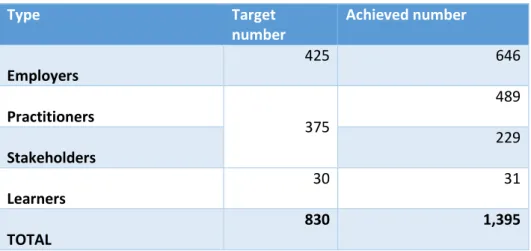
Table 1 below presents the target and achieved numbers of individuals consulting in each group. A range of activities were hosted across different channels to ensure maximum participation across four and a half weeks from 27th January to 27th February 2015:
Two online surveys: one targeting employers, the other for practitioners and other stakeholders;
Telephone survey with employers;
In-depth telephone interviews with employers, practitioners and stakeholders;
11 face-to-face group/workshop discussions with employers, practitioners, stakeholders (including awarding organisations) and learners;
Three webinars with practitioners and stakeholders (also including awarding organisations).
Table 1: Number of participants involved in the conversations3
Type Target number Achieved number Employers 425 646 Practitioners 375 489 Stakeholders 229 Learners 30 31 TOTAL 830 1,395
The variety of different consultation activities was chosen to allow for a more varied and comprehensive exploration of people’s views and experiences.
3 People were encouraged to participate in more than one of the consultation activities. A number of education practitioners and stakeholders completed the online survey and then elaborated on their responses in a telephone interview or workshop or webinar event. Therefore, there may be a small element of duplication among the practitioner and stakeholder achieved totals.
10 | P a g e P y e T a i t C o n s u l t i n g The follow-on, in-depth telephone interviews, plus workshop and webinar discussions built on issues raised in the predominately qualitative online and telephone surveys, and explored these in more detail.
Analysis began towards the end of Work-Stream Three and so the later consultation events took on a more reflective approach in which participants were encouraged to discuss emerging findings and recommendations.
The online survey scripts and telephone interview topic guides were all developed by Pye Tait Consulting in collaboration with the project Steering Group. These scripts were approved by the Foundation and Steering Group before implementation.
Time did not permit greater elaboration with employers beyond interviews and completions on the online survey. There were many examples of employers willing to talk to us about their skill needs and their use of routes other than GCSEs: however, the creation of case studies or named examples, approved by the employer, takes time to create. Although we know of many examples, the Army was able to respond within the very short time-frame with an excellent example of non-GCSE
qualifications being used in a stand-alone form as well as within Apprenticeships. This is a model of a large employer using a variety of routes to up-skill and improve the literacy and numeracy needs of new entrants and the existing workforce, via not just Apprenticeships, but also Functional Skills qualifications (further detail is also provided in Appendix 2).
1.4 Work-Stream 4: Analysis and reporting
The consultation revealed that the maths and English debate remains an important and contentious issue for many. It was, therefore, vital to accurately reflect the messages coming out of discussions with employers, practitioners, stakeholders and learners, and to explore differences in opinion. Although ideally a process to be conducted at the completion of all research activities, the analysis of the very large amount of data gathered through this study had to be analysed in a series of stages and repeated at least twice. This was due to the unavoidable necessity to present interim findings to government at a point several weeks prior to the official conclusion of the study in mid-March. However, the extensive data collected as part of this review forms a detailed evidence base on non-GCSE educational routes and qualifications available to post-16 adult learners as well as their value in the eyes of employers.
The findings from this review have informed the recommendations put forward by the Foundation on ways it considers provision and recognition of non-GCSE maths and English educational routes should be improved.
11 | P a g e P y e T a i t C o n s u l t i n g
2.
Background
2.1 Introduction - Stubborn Issues
Concern with maths and English is not a new phenomenon in England or the wider UK but, in the context of the current study, it is important to distinguish between those concerns which have arisen over the years with respect to technical issues regarding syllabuses, teaching methods and examinations at post-16 levels, and those which focused on the maths and English abilities of the 14-16 age group and among the adult population of those who had low attainment and capability in one or both of the subjects.
Across the critical subjects of maths and English scores of studies have been undertaken and reports written, many of which addressed the needs of those who were unable to acquire sufficient skill at school or who could not meet the “pass” standards of the day. What follows is a sample of those many studies illustrating pertinent findings and comments from each.
At the turn of the twentieth century the fundamental concern was with the immense problem of illiteracy and innumeracy in the working population. In 1921 the Newbolt Report made a number of recommendations of which a few resonate even a century later and were mentioned by employers and practitioners alike during the research for this current report4. Among its comments were that:
every teacher is a teacher of English;
children should be practised, not only in the art of speaking and reading, but also in the art of listening;
pupils specialising in maths or science should be taught to use English accurately. The issues with the General Certificate of Education (GCE) examinations5 and the lack of
arrangements for those who either could not sit them or did not have the ability to pass were reviewed for the Beloe Report of 1960 which looked at a wide range of “alternatives” to GCE exams and recommended the creation of a new system of exams for less academic 15 year olds, to run alongside the existing GCE O Levels. As a result, the Certificate of Secondary Education (CSE) was introduced in 19656. It was the increasing public perception of the CSEs as being somehow
“second-rate” which led to their amalgamation with GCE “O” Levels through the design and introduction of GCSEs (announced in 1984).
However, it was the Newsom Report of 1963 which perhaps did most to set in train the focus on “the other half” – that is, those who were unable to attain GCE passes but who had no real
alternative to achieving in important subject areas such as English and maths7. Some selected quotes
from that report are apposite:
4 Newbolt Report (1921);The Teaching of English in England
5 Formerly comprising Ordinary level – O Level, now the General Certificate of Secondary Education – GCSE, and the Advanced Level - A Levels - used as an entry qualification for universities in the United Kingdom, and further afield
6 Beloe Report (1960); Secondary School Examinations other than the GCE. 7 Newsom Report (1963); Half Our Future.
12 | P a g e P y e T a i t C o n s u l t i n g
There are … some objectives which can and ought deliberately to be pursued through every part of the curriculum. Very high in this list we should place improvement in powers of speech: not simply improvement in the quality and clearness of enunciation, although that is needed, but a general extension of vocabulary, and, with it, a surer command over the structures of spoken English and the expression of ideas. That means seizing the opportunity of every lesson, in engineering or housecraft or science as well as in English, to provide material for discussion - genuine discussion, not mere testing by teacher's question and pupil's answer.
Parents and employers are naturally anxious to be assured in all this that sufficient attention is being paid to basic skills. It is sheer common sense to urge that every possible
opportunity, throughout the whole of school work, be taken to provide the pupils with practice in reading, writing and elementary mathematics, and in searching out information for themselves.
Another feature which we should welcome would be an emphasis on oral work. Any test of the pupils' attainments ought to include their command of spoken English.
Reading skills were a major focus for the Bullock Report of 19758 which lamented the state of
language attainment in the English population and made a number of recommendations, including, that:
every school should devise a systematic policy for the development of reading competence in pupils of all ages and ability levels;
LEAs and schools should introduce early screening procedures to prevent cumulative language and reading failure and to guarantee individual diagnosis and treatment provision for the tuition of adult illiterates and semi-literates should be greatly increased, and there should be a national reference point for the co-ordination of information and support;
The Cockroft Report published in 1982 placed the spotlight on maths and specifically looked at the “real” needs of employers9. Its findings underlined the recognition of widespread functional
innumeracy and also cast stark light on one of its probable causes:
The extent to which the need to undertake even an apparently simple and straightforward piece of mathematics could induce feelings of anxiety, helplessness, fear and even guilt in some of those interviewed was, perhaps, the most striking feature of the study.
Cockroft described the basic skills which his Committee regarded as essential for adults – “the ability to read numbers and to count, to tell the time, to pay for purchases and to give change, to weigh
8 Bullock Report (1975); A language for life 9 Cockcroft Report (1982) Mathematics counts
13 | P a g e P y e T a i t C o n s u l t i n g and measure, to understand straightforward timetables and simple graphs and charts, and to carry out any necessary calculations associated with these” and stressed one of the skills which employers in the current study also emphasised:
… it is important to have the feeling for number which permits sensible estimation and approximation - of the kind, for instance, which makes it possible to realise that the cost of 3 items at 95p each will be a little less than £3 - and which enables straightforward mental calculation to be accomplished.
Although his study failed to replicate the findings, Cockroft mentioned the CBI’s evidence to the Parliamentary Expenditure Committee in 1977:
Employers are becoming increasingly concerned that many school leavers, particularly those leaving at the statutory age have not acquired a minimum acceptable standard in the fundamental skills involved in reading, writing, arithmetic and communication. This shows up in the results of nearly every educational enquiry made amongst the CBI membership, and is backed up by continuing evidence from training officers in industry and further education lecturers that young people at 16+ cannot pass simple tests in mathematics and require remedial tuition before training and further education courses can be started10.
The stubborn nature of the problem of low attainment and functional illiteracy and innumeracy is underlined by the 1995 study by the London Mathematical Society11 and illustrated in the
International Adult Literacy Survey (carried out between 1994-96), in which the outcomes for the UK were so poor they resulted in media headlines such as ‘1 in 5 adults cannot read’. This situation prompted a major national enquiry, led by Lord Moser, resulting in Government funding of the Skills for Life12 initiative which channelled millions of pounds into the development of basic skills
programmes for adults (see section 3.3.4).
Some seventeen years later, evidence of this continuing issue is being emphasised as the target of the latest initiative by Aviva (among many others) in 2015 to tackle these issues. Aviva states that its own research – almost 100 years after the Newbold Report –reveals that no less than two-thirds of parents cannot complete the maths homework given to primary school children.13
2.2 Current performance in maths and English
The results of the recent Aviva study is reinforced by research by NIACE in 2012 which found that “over eight million adults still lack functional numeracy skills and over five million lack functional literacy skills”, with the added, somewhat worrying, concern that maths and English competence had not improved at lower skill levels since 200314.
10 House of Commons, Tenth Report from the Expenditure Committee The attainments of the school leaver HMSO 1977.
11 London Mathematical Society (1995) Tackling the Mathematics Problem with the Institute of Mathematics and its Applications and the Royal Statistical Society, October 1995
12 Skills for Life: the national strategy for improving adult literacy and numeracy skills. Moser, 1998 13 Survey of 2000 parents of children aged four to sixteen (October 2014 by One Poll on behalf of Aviva); https://www.aviva.co.uk/sponsorship/premiership-rugby/form/tackling-numbers/
14 | P a g e P y e T a i t C o n s u l t i n g The issue of maths and English skills in England has been brought into greater clarity recently by OECD’s Skills Outlook 2013. This research found that England’s performance was not good. The nation’s literacy score is merely close to the OECD average, and the numeracy score is noticeably below average15. These statistics have subsequently been referenced and cited by a wide range of
stakeholders including the Education and Training Foundation, the Times Educational Supplement and BIS. The low ranking for England in numeracy is a particular cause of concern. Many sources, as cited earlier in this section, and more recent research including Vorderman et al16. note the
importance of maths skills to the UK when attempting to compete internationally in commerce and industry.
Mathematics is a 'critically important' subject. It is a language without which the entire global infrastructure is struck dumb.
Another agency with a dedicated focus and remit for numeracy also stressed in its latest annual paper the scale of the problem in numeracy facing the UK, its depths as calculated by OECD and the impacts on the economy and on individuals17.
In its overview, National Numeracy re-stated these findings from the recent OECD study in a powerfully concentrated format:
78% of UK adults are operating below level 2 in maths (cf 43% in literacy)
A quarter of adults (around 17million people) are operating with numeracy BELOW entry level 3 (i.e. the expectations of a 9 year old).
Since 2011, while adult performance in literacy appears to have increased, ability in numeracy has actually fallen.
The average annual cost to employers of low basic skills is £3.2 billion per year
The cost to the UK economy of low numeracy is estimated at around £20.2 billion which is roughly 1.3 per cent of GDP
Just over 1/4 of skills shortage vacancies result from a lack of numeracy skills
15 OECD (2013) Skills Outlook 2013 First Results from the Survey of Adult Skills.
16Voderman, C et al (2011) A word-class mathematics education for all our young people. 17 National Numeracy; The National Numeracy Overview; January 2015
15 | P a g e P y e T a i t C o n s u l t i n g
Figure 1: Adults with Skills Equivalent to ‘C’ or Above at GCSE in England (2012)
The Education and Training Foundation acting on these many concerns about numeracy in 2014, commissioned research to look overseas as well as in the UK at what works well in maths teaching. It found evidence suggesting that one in five 16-19 year olds are functionally innumerate. Moreover, the same research highlighted a perceived lack of applied or practical maths (as needed in the workplace) and its importance in the syllabus in addition to the underlying concepts of mathematics18.
This concern was partly behind the development, in Wales, of a new GCSE (available for teaching from 2015) that focuses on Numeracy. It meets a recommendation in the Welsh Review of Qualifications for 14 to 19-year-olds in Wales 19 and aims to develop confidence and a positive
attitude towards maths. A strength is its content on:
Number, measure and statistics plus some aspects of Algebra, Geometry and Probability’ and whereby assessment is in application of the content in context.
Some stakeholders for the MMEW mentioned the Welsh GCSE as going some way towards their preferred focus on the teaching of mathematical literacy.
A National Numeracy objective which resonates with the feedback from our participants is: “A separate and universally respected qualification in numeracy is needed alongside GCSE maths”. Many stakeholders and several employers in our research stressed the need for such a qualification to act in a number of ways:
18 The Education and Training Foundation (2014) Effective practices in post-16 maths. 2014
16 | P a g e P y e T a i t C o n s u l t i n g
As a means of boosting practical and business-related skills in maths and English,
As a stepping stone to higher (i.e. Level 2 GCSE) qualifications, and
As a means of enhancing confidence and removing the fear factor in maths (and English) in more achievable steps.
National Numeracy also launched an online campaign and tool designed to test and enhance maths skills at all levels and, in parallel, is working to understand the behavioural aspects of maths skills – some of which were mentioned by many employers and stakeholders in our conversations for this review (National Numeracy’s visual representation of the behavioural environment is included in Appendix 4).
Our participants summed this aspect up as a trend of “aren’t I cool, I can’t do maths/English” attitude. This attitude to maths in particular has been highlighted in many places20 - with many of
the media publicising the issue in words similar to those used by the Irish Times ‘ “I’m useless at maths”- should never be a boast’.
The Foundation’s Effective Practices in Post-16 Vocational Maths research completed in late 2014 referred to it as: ‘a negative culture of maths learning in the UK and an acceptance of failure in maths’21.
2.3 Government policy
The 2011 Review of Vocational Education – The Wolf Report drew close attention to the importance of Mathematics and English GCSEs for students’ future prospects and to the percentage of the cohort who are unsuccessful in attaining these qualifications between the ages of 16 and 18 at grades A* to C.
In response to the many other reports, and directly in answer to the Wolf Report the Government proceeded with its proposals by announcing in 2014 that it will strengthen the condition of funding regarding maths and English.
Full-time pupils who achieve a D in GCSE English or maths will continue with GCSEs rather than other types of qualification22,23. Those who do not achieve a D or above, or who are studying part-time, will
be expected to continue to pursue A*-C at GCSE, potentially after completing an approved ‘stepping stone’ qualification. To further emphasise the importance of these skills, English and maths are recognised in Ofqual grades for providers24.
20Irish Times: http://www.irishtimes.com/news/education/i-m-useless-at-maths-should-never-be-a-boast-1.2101716, 21 Education and Training Foundation, Effective Practices in Post-16 Vocational Maths, 2014
22 BIS (2014b) New English and maths GCSEs: Post-16 education and skills.
23 Kaczmarek, M. (2014) Maths and English in further education: Supporting the workforce. BIS and DfE. 24 BIS (2014b) New English and maths GCSEs: Post-16 education and skills.
17 | P a g e P y e T a i t C o n s u l t i n g The context of 2011 as presented by Wolf articulated a picture of institutions failing to offer GCSE maths and English for re-sits:
‘recent years have seen the near-elimination of maths and English GCSEs from post 15 study: most young people who fail both, or even one, at the end of KS4 are given no opportunity to re-take’. She went on to say that varying teaching approaches can be a successful strategy and that a second attempt at a qualification is not a pointless exercise. The Wolf report suggested that many teachers and trainers in those institutions were not equipped to teach maths and English.
Apprentices have to be offered a Level 2 Functional Skills or GCSE in maths or English if they failed to achieve a level 2 standard in these subjects. Level 1 English and maths are the minimum
requirements to complete an Intermediate Apprenticeships25. The expectation is that apprentices
are given the opportunity towards achieving a GCSE at grade A* to C in Maths and/or English if they have already achieved the equivalent functional skill at level 2.
These developments in policy link to Recommendation #9 in the 2011 Wolf review of vocational education, which proposed that students under the age of 19 should be given training which either directly leads to A*-C at English and maths GCSEs or provides significant progress towards entering and succeeding at GCSEs26.
Some sources have already noted the additional stress placed upon providers by these increased requirements for English and maths attainment. This additional stress was noted by the Education and Training Foundation in 2014. Macey in 2013 specifically noted a tension between employers’ desire for English and maths skills and their anxieties about their staff being able to achieve relevant qualifications. In one particular example, Macey remarked that some employers are concerned that the requirement for apprentices to achieve English and maths qualifications at GCSE Level could prevent some talented apprentices from finishing their course27,28. Identical concerns have been
expressed by the Care sector which is already labouring under the requirement for its apprentices to sit and pass GCSE English and maths.
Conversely, GCSEs forming an entry requirement to Apprenticeships is already the norm for some sectors (e.g. Financial Services and Engineering) and for some occupations.
BIS is investigating the possibility of mandatory maths and English training for those on Jobseeker’s Allowance who do not have Level 2 qualifications. A pilot was initiated in late 2014 to test the viability of delivering Functional Skills or GCSEs using a partially or fully online approach29. The
Labour Party is also interested in this possibility, stating in 2014 that they wish to make English and maths training mandatory for jobseekers lacking “basic skills”.
25 AELP, ETF (2013) English and Mathematics in Apprenticeships A step by step guide for providers. 26 Wolf, A. (2011) Review of vocational education- the Wolf report.
27 The Education and Training Foundation (2014) Effective practices in post-16 maths.
28 Macey, E. (2013) Employers’ views on youth literacy and employment. The National Literacy Trust.
18 | P a g e P y e T a i t C o n s u l t i n g
2.4 The literature on employers’ needs
Cockroft, in 1982, looked into the issue of employer needs in maths in great detail and virtually rejected the CBI’s then claims that employers had noted a genuine problem with a lack of skill in maths among new entrants. That was thirty years ago and, whatever the rights and wrongs of those claims and counter-claims, the business world has changed markedly since then. There are now very few job-roles whose requirements are minimal where maths skills are concerned, and the modern emphasis on excellent customer service and the use of written and spoken communication through telephones, emails, and texts (as well as face to face customer care) has led to enhanced
requirements in written and spoken English.
Several sources have noted this trend - that, in recent years, the number of low-skilled jobs which only require minimal maths and English skills has decreased, whereas jobs which require a higher level of English (and communications) and maths ability have become more common; a theme on which the majority of the extensive report by UKCES30 on jobs and skills for 2030 is predicated. For
example, when discussing mathematics, Vorderman et al. mention that employment in transport and machinery has decreased while employment in middle management, professional services and sales has increased31. BIS research into the benefits of English and maths qualifications found that
they have a positive impact on hourly earnings, with GCSE maths in particular having a noticeable benefit of an earnings increase of 4.5% in the first year, continuing with time to a peak of 19%32.
A presentation by the Department for Education and a report by Mathematics in Education and Industry (MEI) pointed out that achievement at Level 2 provides the basis for studying maths at higher levels. Higher level maths skills are an enabler for careers in STEM subjects, considered crucial to the UK economy, which is effectively fighting for business in a wider global economy33,34.
The problem has – alongside the rapid change in technology – increased during the first decade or so of the twenty-first century.
Smith35 reported in 2004 that employers in a range of sectors (engineering, construction,
pharmaceutical, financial and retail) need access to a larger pool of skilled statisticians. The same report mentions the need for mathematical skills at all levels in order to maintain the UK’s
international competitiveness. Smith suggests that the competitiveness of UK maths skills has been a consistent concern for over a decade but it could be argued that the concern with maths in
particular has been around for a good deal longer. Among others, Vorderman et al. referred to this issue again in 2011.
30UKCES, The Future of Work: Jobs and Skills 2030, February 2014
31 Vorderman, C. et al. (2011) A world-class mathematics education for all our young people. 32 BIS (2013c) A Disaggregated Analysis of the Long Run Impact of Vocational Qualifications. 2013
33 Mathematics in Education and Industry (MEI) (2012) GCSE Mathematics retake for vocational students: GCSE teaching from 2015. 34 Clarke, S. (2013) English and mathematics – opportunities and challenges. Department for Education (DfE).
19 | P a g e P y e T a i t C o n s u l t i n g Various sources provide evidence that employers need better English and maths skills from new entrants and/or existing employees.
Recently, a survey by the CBI discovered that 38% of employers were dissatisfied with the basic numeracy of entrants from school/college and 36% were dissatisfied with basic literacy36.
Results from the previous three years were very similar, showing no sustained changes in levels of satisfaction. Slightly older research by CBI found that over a fifth of surveyed employers provide remedial training in numeracy and in literacy for leavers from education37. Research from six years
back for CBI38 identifies a very detailed list of employers’ maths, English and ICT needs, which albeit
is showing some issues of age, is still very relevant to today and reinforced the findings of our survey (see sections 4.2 and 4.3).
Although it acknowledged that the specific requirements vary between sectors and job roles, CBI’s more recent research (2014) found that the greatest concerns among employers were about employees’ ability in the following areas (this is supported by other similar research39,40,41):
English
General communication skills;
Speaking clearly and comprehensibly;
Listening and reacting appropriately;
Vocabulary (a wider ability to use appropriate words accurately);
Punctuation and grammar;
Spelling;
The ability to write longer pieces of text than just a few paragraphs;
The ability to compose business-appropriate correspondence; and
The ability to research, communicate and redact information.
Maths
Awareness of different measures and converting between them;
Basic understanding of probabilities
Calculating and interpreting percentages;
Extracting necessary information, even from basic texts;
Calculate change, including calculating discounts; and
Estimate resources needed.
Interpretation of quantitative data;
Mental arithmetic;
Noticing possible rogue results/calculation errors; and
Using fractions, decimals and ratios.
36 CBI (2014a) Gateway to Growth Education and Skills Survey.
37 CBI (2011) Building for growth: Business priorities for education and skills.
38 CB1 (2006) ‘Working on the Three Rs: Employers’ Priorities for Functional Skills in Maths and English’. 39 Macey, E. (2013) Employers’ views on youth literacy and employment. The National Literacy Trust. 40 CBI (2010) Making it all add up: Business priorities for numeracy and maths.
20 | P a g e P y e T a i t C o n s u l t i n g The research by CBI in 2006 stressed that literacy is important for the transmission of information within companies (including between senior and managerial-level staff and supervisors and operatives), especially in a context of increasing use of work plans and performance reports. The same report also observed that even employees with adequate reading skills may struggle with writing skills, which can limit the variety of tasks that they are able to complete. Moreover, it is suggested that weak writing skills can become a barrier to starting work or changing jobs (including through internal promotion)42.
The same source noted that about a third of employers remarked that they would most like to see mental arithmetic improved amongst school leavers (an important priority amongst a list of maths skill gaps requiring attention).
The CBI presented one case study which includes the observation that operative-level staff at a manufacturing company have had increased requirements for literacy and numeracy skills in recent years. The tasks that operatives perform have changed to include learning lengthier production processes and understanding their targets when expressed as a percentage43.
Furthermore, employer requirements extend beyond pure academic achievement. Some
commentators have emphasised that employees must know how to apply maths and English within their workplace context – a requirement which is additional to, and potentially very different to, the academic understanding they may have developed 44,45,46.
The ability to apply maths and English skills to the workplace might involve using methods in
contexts that are unfamiliar from school, or judging the most appropriate way to use existing skills in the workplace (for example, when phrasing communications)47,48. Related to this, BIS suggested in
2014 that post-16 English and maths teaching should be linked to sectors or even specific vocations49.
Referring specifically to mathematics, Hodgen comments that although the majority of the UK workforce does not use high-level maths skills in everyday work, ‘simple’ skills are often used in specialised and/or complex situations leading to the development of specialised methods. Although these methods often do not use advanced mathematical concepts, they can be difficult for
inexperienced employees to adopt. This motivates Hodgen to suggest that maths education should include more problem-solving and contextualisation, to help learners to adapt their skills quickly when they enter a new workplace50.
42 CBI (2006) Working on the three Rs: Employers’ priorities for functional skills in maths and English. 43 Ibid
44 Hodgen, H et al (2013) The Employment Equation: Why our young people need more maths for today’s jobs. The Sutton Trust. 45 BIS (2014b) New English and maths GCSEs: Post-16 education and skills.
46 The Education and Training Foundation (2014) Effective practices in post-16 maths.
47 Hodgen, H et al (2013) The Employment Equation: Why our young people need more maths for today’s jobs. The Sutton Trust. 48 Macey, E. (2013) Employers’ views on youth literacy and employment. The National Literacy Trust.
49 BIS (2014b) New English and maths GCSEs: Post-16 education and skills.
21 | P a g e P y e T a i t C o n s u l t i n g While fundamental maths and English skills are required for many tasks within the workplace, and while they are essential for specific job roles, this literature review suggests some additional benefits of maths and English to employers. The CBI, for example, theorises that English and maths skills could act as “enablers” for the effective application of other skills within the workplace51 and
research by Hoyles suggests that mathematical competence allows employees to notice errors even when they are not actively checking for mistakes52. Similarly ability in English provides the bedrock of
higher specialisms in such areas as marketing and even operations (for instance in the explanation of technical processes).
The Education and Training Foundation notes two additional non task-specific benefits to maths competence: fewer mistakes and the costs associated with them, and a reduced need for supervision53. This can be set alongside the findings from interviews conducted for the present
report which found that employers devote resources to such activities as mentoring employees in maths and English, creating templates for written documents, creating standard scripts for
telephone conversations, and having to support employees when communications or calculations go wrong.
Hoyles, in 2002, and Hodgen in 2013, each noted that the use of ICT in modern workplaces has impacted upon the maths skills required by employees (when compared to previous generations). The impact of ICT has included increasing the need for employees to validate, understand and interpret mathematical information, contrary to the temptation some employees might feel to simply trust the output from computer systems. Employers interviewed for the present study emphasised that modern ICT, far from removing the need for maths and English skills, has actually expanded it considerably as the sheer volume of calculations and communications has increased.
2.5 Issues with English and maths skills
When asked for their top three priorities for future school-age education, 65% of employers
mentioned literacy and numeracy in response to a 2011 survey by the CBI54. Over a one year period,
among Ofsted subject-area reports for maths and English, over half recorded that the teaching was inadequate or required improvement55.
There also appear to be related difficulties within the FE sector, where only 33% of 16-18 year olds who sat a GCSE in English in 2011/2012 achieved grades A*-C56.
51 CBI (2011) Building for growth: Business priorities for education and skills.
52 Hoyles, C et al (2002) Mathematical Skills in the Workplace, Final Report to the Science, Technology and Mathematics Council. Institute of Education.
53 The Education and Training Foundation (2014) Effective practices in post-16 maths. 54 CBI (2011) Building for growth: Business priorities for education and skills.
55 House of Commons Select Committee report on adult literacy and numeracy, 2014, based on 54 inspections conducted between September 2012 and August 2013.
56 Adriaanse, Karen (2014) The role of the FE and skills sector in supporting learners to improve their skills in English and maths – an Ofsted perspective. Ofsted.
22 | P a g e P y e T a i t C o n s u l t i n g Two important but different types of issue with English and maths skills are identified in the
literature. They relate on the one hand to concern over English and maths skills per se and related to level, and, on the other, to the way in which those skills are applied in specific work-related contexts. Employers appear to be concerned with both but in different ways. Their concern with the former appears – at the levels pertinent to the current study – to be primarily the extent to which those skills form the basis for the second.
Although Hodgen notes that secondary school pupils had recently been found to have poor understanding of decimals and ratios (which might become important in later life), his work emphasises that the issues extend to an additional problem of being able to apply skills in a job57.
Moreover, research from the CBI found that some employers believe education leavers are simply not good enough at applying mathematics skills to work58 and that this may be due to the way in
which fundamental techniques and skills are taught at school, the depth to which pupils are exposed to the skills, and the extent to which they are required to memorise and internalise them.
Recent research by BIS identifies two possible reasons for learners struggling when attempting to achieve grade C or higher in English and maths. Firstly, it is noted that different learners may respond better to different ways of learning. BIS provides the example of adults who wish to study GCSEs, remarking that they might find the qualifications to be too much adapted to school-age learners (who approach GCSEs as part of a process of continuous education, and have a recent knowledge base to draw upon)59.
The House of Commons report on adult numeracy and literacy corroborates this to some extent by commenting that skills might well deteriorate over time (often referred to as skills fade), which process can then become a barrier to returning to study. The report also points to the fact that GCSEs suit the delivery methods used in schools but that these methods are probably not appropriate for all types of adult learner60.
Unionlearn has also commented on this topic in a consultation response to NIACE, arguing that those in employment receive the best results from training which relates its content to experience in the workplace61.
Secondly, the BIS report emphasises the importance of teaching which engages and motivates learners. The report also acknowledges the relevance of innovative and creative teaching methods in accomplishing this62. Recent research by Dalby underlines the importance of engagement/attitude
for the study of English and maths. While discussing Functional Skills maths, Dalby notes that
57 Hodgen, H et al (2013) The Employment Equation: Why our young people need more maths for today’s jobs. The Sutton Trust. 58 CBI (2006) Working on the three Rs: Employers’ priorities for functional skills in maths and English.
59 BIS (2014b) New English and maths GCSEs: Post-16 education and skills.
60 House of Commons Business, Innovation and Skills Committee (2015) Adult literacy and numeracy.
61 Unionlearn, 2014. Unionlearn’s response in New English and Maths GCSEs: Written evidence for post-19 sector. 62 BIS (2014b) New English and maths GCSEs: Post-16 education and skills.
23 | P a g e P y e T a i t C o n s u l t i n g learners who had been ‘disaffected’ with maths at school benefitted from positive attitude changes which often helped their understanding and confidence63.
Related comments are made in the House of Commons report, which proposes that negative experiences of English or maths at school age can deter people from studying these subjects in later life64. An older paper (2011) from MEI concludes, too, that: ‘retaking the same kind of GCSE they
have already failed has not proved beneficial to the large majority of students who fail to achieve a grade C in Key Stage 4; it serves instead mainly to reinforce negative views of mathematics amongst a large section of the population65.’
David Mallows, providing evidence as an expert witness to the Making Maths and English Work, suggests that encouragement and motivation can be wider social issues outside the schools, colleges and places of employment and suggests governments should encourage the enjoyment of literacy and numeracy66.
In his brief paper submitted to the Foundation’s ‘Making Maths and English Work for All’ study in February 2015, Mallows considered some of the issues in the light of data from the OECD’s
Programme for the International Assessment of Adult Competencies (PIAAC) Survey of Adult Skills67
and also of concepts taken from the report of the European Commission High Level Group of Experts on literacy68. He made a number of cogent points about the supply and demand for English and
maths skills and the validity of “credentials” (qualifications) which unfortunately lie outside the immediate remit of this current study.
However, he stressed that some countries which did well in the PIAAC rankings are also developing new strategies to address the literacy and numeracy needs of their population, and he described his contention that there may not be a simple or direct relationship between social issues and skills in literacy and numeracy (he quotes Anke Grotlüschen of the University of Hamburg):
“…it might be possible that many adults are quite at ease even with what might be
‘measured’ as low literacy skills and are therefore, unlikely to participate voluntarily in any class.”69
This resonates closely with what a good number of practitioners – in evidence to this study – spoke about: that is, their perception that society and business are adapting to lower English and maths skill levels within the cohort by reducing demands on individuals (automation, IT, pre-developed English templates, etc.) and taking into account the unwillingness to improve their skills in these areas of some school-leavers, adults and employers. Some practitioners in interviews mentioned
63 Dalby, D. (2015) A study of the experiences of vocational students learning functional mathematics in Further Education colleges. 64 House of Commons Business, Innovation and Skills Committee (2015) Adult literacy and numeracy.
65 MEI, Mathematics for all, Post-16 An MEI Position Paper, 2011
66 Mallows, D. (2015) Evidence to the Education and Training Foundation ‘Making maths and English work for all’ steering committee. NRDC and UCL Institute of Education. February 16th 2015
67 http://skills.oecd.org/skillsoutlook.html
68 http://ec.europa.eu/education/policy/school/doc/literacy-report_en.pdf
24 | P a g e P y e T a i t C o n s u l t i n g their concern at the way in which some learners regard their lack of maths and English skills as a badge of pride.
Mallows pointed to other evidence that aligns with practitioner responses to the current study which said that they felt that more should be done to create and then expand a maths and English culture among British adults – one which encourages reading and writing and which explains and promotes the use of number in everyday life. PIAAC looked at everyday literacy practices, finding that: “Adults who read frequently … outside work have higher scores on the literacy scale, on average, than their counterparts who rarely engage in such activities”70 (OECD 2013: p190). This
holds even when controlling for educational level and socio-economic status.
Learners from different backgrounds have different challenges in achieving in English or maths. Recent research by the CBI found that only 48% of disadvantaged 16-year olds achieve 5 GCSEs at A*-C (including English and maths) compared to 77% amongst the least deprived backgrounds71.
This is further corroborated by very recent research that the Sutton Trust commissioned from Oxford University on what promotes better achievement for bright and disadvantaged students72.
Research by BIS in 2013 suggested that a variety of background factors can affect the motivation of adult learners when studying English and maths (including age, gender, level of course and type of provision, amongst other more personal factors)73. In addition to the quality of teaching, the
personal attributes of the learner influence their motivation and have an impact upon their progress and success.
The Association of College’s review of ESOL qualifications noted that they are delivered to a wide variety of different learner types, particularly with respect to educational backgrounds. Some learners have strong educational backgrounds and are proficient at studying new subjects, whereas other may have struggled with educational systems (and literacy) in another country. Learner requirements have an impact upon the amount of tutelage and support needed by learners74.
3.
The current (qualifications) environment
This chapter provides a summary view of the current GCSE and non-GCSE landscape in England in terms of maths and English qualifications as well as non-qualification based approaches.
Ofqual pointed out in their submission to the BIS Select Committee on Adult Literacy and Numeracy (2014-15) that:
70 OECD (2013) OECD Skills Outlook 2013: First Results from the Survey of Adult Skills OECD: Paris 71 CBI (2014b) A better off Britain, 2014
72 Subject to Background, Katalin Toth, Kathy Sylva, Pam Sammons, March 2015
73 BIS (2013a) The International Survey of Adult Skills 2012: Adult literacy, numeracy and problem solving skills in England. 74 Association of Colleges (AoC) (2014) ESOL qualifications and funding in 2014: Issues for consideration.
25 | P a g e P y e T a i t C o n s u l t i n g
Qualifications are, of course, only a part of the picture. Qualifications represent a standard
and cannot in of themselves improve the quality of teaching, raise student achievement or motivate learners with poor literacy and numeracy skills to seek to develop their skills.75
This is an important point to make as while qualifications are a vital part of the system they should not drive teaching and learning. This is also the rationale behind the support and reinforcement by the various initiatives currently underway to provide teachers and trainers in the education and training sector with greater capability and confidence in their teaching of these two subjects.
3.1 Provider capability
The Foundation noted concerns about the capacity of providers to teach English and maths. Research focused upon the FE sector found that at GCSE-level, only 12% of those teaching maths and 6% of those teaching English have qualifications in their subject at a level above GCSE. Moreover, the research discovered that teachers aged 34 and below are on average the least qualified group, which may put additional strain on provision in the future76.
A presentation by the Department for Education in 2013 stated that around 12% more maths teachers and 7% more English teachers might have become necessary in response to reforms of the conditions of funding77.
In its report on adult English and maths skills, the House of Commons remarked that the quality of provision for adults is a ‘mixed bag’. Additionally, the report notes that teaching English and maths to adult learners is not a profession that receives wide awareness and recognition, meaning that it does not attract as many highly-qualified practitioners as other types of provision do78.
Guroo’s survey of Functional Skills providers found that 61% of respondents consider themselves very experienced, and 93% as experienced or very experienced. This is a notable increase on the previous year, where the results were 34% and 85% respectively. Furthermore, the results from 2015 found that 74% of respondents describe themselves as completely prepared to deliver Functional Skills and another 21% describe themselves as quite well prepared. This is in contrast to GCSEs, for which only 16% believed themselves to be completely prepared and 20% to be quite well prepared79. Further research on confidence and capability is being carried out by NIACE who will
report in April 2015.
In 2013, the 157 Group reported that several of their members had chosen to provide additional English and maths training to staff in advance of the 16-19 English and maths funding conditions. This suggests that some providers were not entirely confident about capacity to teach English and
75
Ofqual (2014) BIS Select Committee submission,
76 Frontier Economics (2014) The qualifications of English and mathematics teachers. The Education and Training Foundation. 77 Clarke, S. (2013) English and mathematics – opportunities and challenges. Department for Education (DfE).
78 House of Commons Business, Innovation and Skills Committee (2015) Adult literacy and numeracy. 79 Guroo Ltd (2015) The Functional Skills Annual Survey 2015.
26 | P a g e P y e T a i t C o n s u l t i n g maths at that time, although capacity increased for some providers before the funding condition came into effect80.
A blog on UK FE Chat noted that, prior to the funding condition, the number of students with a D grade at GCSE (in English or maths) who then went on to achieve C or higher after the age of 16 varied considerably across institutions. Within Sixth Form colleges for example, the range of
students increasing their grades to A*-C was from 0% to 93% (re-studying GCSEs was not mandatory at the time) - suggesting that some providers were well equipped for the change to the funding condition, whereas others were severely under-equipped81.
The Foundation, for example, is leading on the Maths Enhancement Programme (MEP)828384 which
is supporting teachers, trainers and tutors from all forms of provider in the delivery of maths. The MEP, delivered in partnership with the National Centre for Excellence in the Teaching of
Mathematics (NCETM) and the Centres for Excellence in Teacher Training (CETTs), aims to prepare further education practitioners to deliver GCSE maths by boosting their confidence in maths, enhancing their mathematical knowledge and equipping them with the relevant maths subject pedagogy.
The six-day training programme is open to all further education providers, particularly those currently involved in delivering numeracy or functional skills, and covers four main modules:
statistics and data handling
algebra
geometry
trigonometry
The Maths Enhancement Programme has been highly successful, with over 2,000 teaching practitioners having received training since the Programme’s implementation in 2014, and has inspired the development of complementary continuing professional development (CPD)
programmes, maths teaching workshops, and a Self-Evaluation Tools, to be launched during 2015. After the success of the Maths Enhancement Programme, the Foundation developed a sister enhancement programme which focusses upon improving the confidence and English skills of Functional Skills English teachers and trainers85. Participants can choose to follow a number of
specialist “training pathways” which address the specific needs of different practitioners and incorporate a range of different learning activities, including train the trainer activities and e-learning.
80 157 Group (2013) 16-19 Study Programmes: English and maths provision.
81 Jones, G. (2015) GCSE Maths Resits in Post-16 Education: What results can we expect? UK FE Chat. [Online] Available at: http://ukfechat.com/2015/02/10/gcse-maths-resits-in-post-16-education-what-results-can-we-expect-by-gary-jones-drgaryjones/. 82 http://www.et-foundation.co.uk/our-priorities/maths-english/ [Accessed 20/03/2015]
83 http://www.et-foundation.co.uk/supporting/support-practitioners/gcse-maths-enhancement/ [Accessed 20/03/2015] 84 http://www.et-foundation.co.uk/supporting/support-practitioners/maths-teaching-workshops/ [Accessed 20/03/2015] 85 http://www.et-foundation.co.uk/supporting/support-practitioners/english-enhancement-programme/ [Accessed 20/03/2015]