Back to Basics: Benefits of Developing Basic Math Automaticity University of New England
EDU-690 Action Research Project Lynn E. McGee
Statement of Academic Honesty: I have read and understand the plagiarism policy as outlined in the “Student Plagiarism and Academic Misconduct” document relating to the
Honesty/Cheating Policy. By attaching this statement to the title page of my paper, I certify that the work submitted is my original work developed specifically for this course and to the MSED program. If it is found that cheating and /or plagiarism did take place in the writing of this paper, I acknowledge the possible consequences of the act/s, which could include expulsion from the University of New England.
Abstract
Many middle school students do not possess automaticity of basic math skills in addition, subtraction, multiplication and division. Use of ineffective strategies to recall basic math facts, such as counting on fingers, consume a large portion of working memory, leaving little to no capacity for higher level mathematical concepts. This action research focused on a triangular evaluation of select 7th graders who participated in a numeracy intervention, known as the
Back to Basic Program, to help build mathematical automaticity. Various research-based strategies were implemented to build fluency, and timed assessments were used to
determine automaticity. Results show conclusive evidence that as students achieved automaticity of basic math skills, their confidence and attitudes towards learning
mathematics increased. It is recommended that standardized test results be comparatively analyzed at the conclusion of the school year.
Keywords: automaticity, basic math skills, intervention, mathematics fluency, working memory
Table of Contents
Abstract ... 2
Introduction ... 5
Rationale for Study ... 5
Need for research ... 5
Problem Statement ... 6
Participants and Site ... 7
Research Questions ... 7
Hypotheses ... 8
Administrative and Institutional Limitations ... 8
Action Plan... 8
Literature Review ... 9
International Rank of the United States in Mathematics ... 9
US Department of Education National Mathematics Advisory Report (2008). ... 10
Australian educational research. ... 10
Automaticity and Fluency ... 12
Benefits of automaticity. ... 13
Detection, practice and repair. ... 13
Conclusions of the Literature Review ... 14
Methodology ... 15
Research Design... 15
Student testing. ... 16
Quantitative data. ... 16
Qualitative data. ... 16
Data Collection Plan ... 16
Participants ... 18 Instruments ... 18 Interventions ... 19 Data Validity ... 19 Triangulation of Data. ... 20 Peer Review. ... 20 Results ... 21 Findings-Student Performance ... 21 Quantitative Results ... 21
Qualitative Results. ... 26
Findings-Parents and Guardians ... 28
Findings-Teacher Survey ... 29 Discussion ... 30 Limitations ... 32 Action Plan... 34 Conclusions ... 36 References ... 39
Appendix A: Student Opinion Survey ... 41
Appendix B: Parent/Guardian Opinion Survey ... 42
Introduction Rationale for Study
This action research project was designed, executed and analyzed by Lynn McGee who is a 7th grade Mathematics and Science teacher at Graham Middle School (GMS) in Graham, NC. GMS is one of seven middle schools in the Alamance-Burlington School District. It is a diverse school whereby more than 80% of the student body receives free or reduced lunch (Title 1). Currently, GMS is classified as a Focus School for the state of North Carolina as they have not met their Annual Yearly Progress (AYP) targets, in accordance with the No Child Left Behind
requirements, for two consecutive years. Overall math scores on the 2011-2012 End of Grade Tests for 7th grade Mathematics show that approximately 75% of the students are at grade level.
Mathematics teachers at GMS have all observed an alarming behavior in their
mathematics classes. A large portion of students perform basic math skills by counting on their fingers, drawing tick marks on their papers for performing multiplication, or use other inefficient strategies for computing basic math facts. Such strategies are being used across the spectrum of ability ranges which span from the learning disabled to the academically gifted. Many students cannot perform basic, rudimentary math operations, such as multiplying multi-digit numbers or perform long division, without a calculator. There is little fluency or automaticity in basic mathematics.
Need for research. As we enter the 21st century, the United States is no longer the leader of developed nations in mathematics and science. We are ranked 25th out of 30
participating countries on the worldwide standardized test, Programs for International Student Assessment (PISA), in math and science for 4th and 8th grade students. Something has drastically changed over the last several decades in our educational system to cause such lack-luster results. Why are our students underperforming in math and science? Why are students entering middle
school still counting on their fingers to do basic arithmetic? There is very little documented research originating in the United States on this subject. Educators are not identifying the root cause of this decline. Instead, our educational system focuses on pushing higher level
mathematics concepts further down into elementary school. Perhaps this is the opposite of what should happen? Instead of accelerating 2nd and 3rd grade students through basic mathematic skills so that algebraic concepts can be introduced; maybe we should focus on ensuring that students possess mathematical automaticity before they exit elementary school? This is why more research is needed in this area. The Australian educational system has focused their efforts on automaticity of basic math skills for middle school level students, and is now one of the top ranking countries in the world in math and science.
Problem Statement. A high percentage of the middle school students who attend GMS do not possess fluency or automaticity in basic math skills of addition, subtraction, multiplication and division. As students learn new mathematic skills, they should become fluent and be able to recall facts with accuracy and swiftness. Automaticity results after a student is fluent with these skills and can recall the facts accurately, timely and with little awareness of the task according to Axtell, Bell, McCallum, and Poncy (2009). Many GMS students, including the academically gifted students, use inefficient strategies, such as counting on their fingers, to perform basic arithmetic computations. Students with Learning Disabilities (LD) are even more reliant on inefficient cognitive strategies and non-strategic ways of processing information (Bellert, 2008). Their working memories become consumed with basic mathematical computations. According to Gagné (1983), as cited in Axtell et al. (2009), mathematical
computations are processed in the working memory which can only process a few computations at a time. Thus, higher level mathematic calculations, such as algebraic computations, cannot be completed if the working memory is consumed with basic math computations.
Participants and Site
Participants in this action research were selected from the 7th grade at GMS in Graham, NC. One hundred students participated in a numeracy intervention program known as the Back to Basics Program, specifically designed for this action research. The main function of the program is to assist students with achieving automaticity of basic math. Sixty percent of
participating students require Tier 2 Response to Intervention assistance. Twenty percent of the participants are academically gifted and the remaining 20% balance is regular education student. Twenty of the participating students were designated as Academically and Intellectually Gifted (AIG) students. They were asked to participate because many of these students still count on their fingers when doing basic math operations. All three of the 7th grade math teachers participated in the implementation of the program. Parents and guardians were also asked to complete an opinion survey.
Research Questions
1. Is it possible to improve basic math automaticity for 7th grade middle school
students, including those with identified learning disabilities and the AIG students, by using timed, on-line basic math skills assessments and direct instructional strategies developed specifically for increasing automaticity?
2. Do timed, on-line assessments with instant feedback increase student automaticity in basic math skills?
3. What do middle school students consider their most preferred strategies for building automaticity of basic math skills?
4. Does the improvement of automaticity of basic math skills improve standardized assessment results for middle school students?
5. Does the improvement of automaticity in basic math skills improve middle school students’ attitudes towards learning mathematics?
Hypotheses
Developing middle school students’ automaticity of basic math skills in addition,
subtraction, multiplication and division via research-based strategies and timed assessments with immediate feedback will 1) improve student performance on standardized mathematics
assessments, and 2) will improve student confidence and attitudes towards learning mathematics. Administrative and Institutional Limitations
School administrators strongly supported this action research. Administrators consider the Back to Basics Program a Tier 2 intervention for students identified via the Response to Intervention process. Necessary resources, including additional teacher support, were provided for the program. The main obstacle for this program was the weak computer network
infrastructure. Limited bandwidth and insufficient wireless connectivity are opportunities for improvement. Administration is aware of these issues and estimates that wireless routers will be installed by January, 2013 which should alleviate the slow computer response time.
Action Plan
To launch this action research, approximately one hundred 7th graders were identified to participate in the Back to Basics Program. Participating students were assigned to one of the three 7th grade math teachers who instructed, coached and taught strategies to develop
automaticity of basic mathematic facts in addition, subtraction, multiplication and division. The web-based program, Thatquiz, (Version 2012), was the software program of choice used to administer timed math drills. The mathematics teachers oversaw and led daily instruction for participating students, five days per week, during the 45 minute Mastery time period. Data was
collected weekly regarding the number of students who become automatic in the respective areas of addition, subtraction, multiplication and division. Students who attained automaticity of these four skill areas were rotated to another classroom where they were further challenged by taking timed assessments for adding and subtracting negative and positive integers, multiplying
negative and positive integers and various other computations involving fractions and decimals. Literature Review
International Rank of the United States in Mathematics
In 2009, review of United States performance in mathematics literacy on the Programs for International Student Assessment (PISA) unveiled disappointing statistics for our 4th and 8th grade students. The United States ranked 25h in combined mathematics literacy out of 30 countries. Our average score was 9 percentage points below the mean score of all 30 countries that participated. Although there was a slight increase in performance between the 2006 and 2009 results, there is no significant improvement in mathematical literacy as compared to the 2003 PISA scores according to Fleishman, Hopstock, Pelczar, and Shelley (2010). Table 1 shows the results on the mathematics literacy assessments for all three years of available data. Many students are not mastering, with speed and accuracy, basic mathematics skills which include addition, subtraction, multiplication and division (Adcock et al., 2009). As students enter middle school and high school, those who have not mastered these basic math skills rely on inefficient strategies, such as counting on their fingers, to determine answers. Unfortunately, such strategies occupy students’ working memory (short term memory) which has a limited capacity. Consequently, higher level thinking skills, requiring cognitive capacity within the working memory, cannot be employed to solve more challenging mathematical concepts (Byers, 2009).
Table 1
United States Ranking in the Programs for International Student Assessment (PISA)
Year
Mean Score
(30 Participants) USA Score USA Intl Rank
USA Points Below Mean
2003 500 483 24th 17
2006 498 474 25th 24
2009 496 487 25th 9
US Department of Education National Mathematics Advisory Report (2008). In 2006, President George Bush established the National Mathematics Advisory Panel to advise how to improve mathematics education in the United States as students’ math achievement is steadily declining on international assessments in mathematics and science literacy. The advisory panel concluded that mathematics achievement in the US begins to fall off when students reach late middle school. Coincidently, this is the time when students begin to learn algebra. Research shows that success in college and in the workforce is directly related to a student’s ability to successfully complete Algebra II level mathematics. After hearing testimony and suggestions from many organizations and individuals, the advisory panel framed their report on research related to how children learn. Their findings confirm the importance of having students master their basic math facts until they become automatic and stored in long term-memory. Only then will this leave room in their working memory to absorb and comprehend new math skills and concepts (National Mathematics Advisory Panel, 2008).
Australian educational research. Australian educators experienced similar trends with their educational system. Students with learning disabilities were up to five levels behind their average achieving peers by the eighth grade (Bellert, 2008). Socioeconomically disadvantaged students and those living in rural areas comprised a large portion of such underachieving
students. Upon further examination, Australian educational researchers identified that their mathematics curricula, primarily in the lower grades, use a constructivist approach which has limited benefits for students with learning disabilities. Swanson and Hoskyn (1998), as cited in Bellert (2008), identified that cognitive strategy instruction using a combination of direct instruction and strategy instruction is a highly effective approach to use with students who struggle with attaining automaticity of basic mathematic skills.
One of the most beneficial features of automaticity regarding mathematics is the augmentation of efficient and effective cognitive processing (Perfetti, 1992) as cited by Bellert (2008). Conversely, not possessing automaticity leads to labor intensive efforts regarding math computations students have seen many times before. Bellert and Graham, from the University of New England in Australia, developed the QuickSmart Program as a response to intervention to address these shortcomings. Their research disclosed that students must be taught effective strategies to overcome their roadblocks regarding simple math facts. The initial cohort of 20 students was comprised of 8 average-achieving students and 12 learning disabled (LD) students. All 20 students were pre-tested to establish a starting reference. The 8 average –achieving students did not participate in any interventions, but their automaticity abilities were monitored for comparison with students receiving in QuickSmart interventions.
The QuickSmartProgram uses the software package known as Cognitive Aptitude Assessment Software (CAAS) developed at the University of Massachusetts (Bellert, 2008). This software records responses of the participants as they speak into a microphone when they know the answer to a stimulus that appears on a computer screen. Use of this software for the
Back to Basics Program was not possible due to financial limitations and budget constraints for Graham Middle School.
Australian researchers were also interested if the improvement of automaticity in basic math resulted in increased standardized test scores. All 20 students in the Australian cohort were given the Progressive Achievement Tests in Mathematics, Revised (PATMaths Revised), before and after any interventions were administered. Using a meta-analysis, which combines the results of many tests to determine the average effect, the means and standard deviations for pre-tests and post-pre-tests were determined. The resultant effect size was determined to be 0.65
(Bellert, 2009). This suggests that mean scores from the post-PATMath Revised tests were 0.65 standard deviations above the pre-PATMath Revised test scores. This increase in standard deviation is also known as effect size. Cohen (1988), as cited in Bellert (2008), suggests that effect sizes of 0.65 are considered medium to large gains. Marzano, Pickering and Pollock (2001) suggest that an effect size of 0.65 translates to a percentile gain of 24 to 35 on standardized tests.
Automaticity and Fluency
There is a distinction between automaticity and fluency regarding math basics according to Adcock et al. (2009). Fluency refers to the ability to respond to stimuli quickly and
accurately. Automaticity refers to the ability to respond to stimuli quickly, accurately and require little cognitive effort. Many researchers focus only on students with learning disabilities
regarding mathematical automaticity. However, practicing mathematics teachers at Graham Middle School have detected that even students classified as academically gifted are not fluent with basic math skills. Research based strategies used to develop automaticity in students with learning disabilities are also directly applicable for developing automaticity in regular education students and the gifted. As stated by Graham, Bellert, Thomas and Pegg (2007), “the need for effective interventions to support middle school students with learning disabilities is clear.”
When the working memory of students is freed from basic math computations, higher level mathematical cognition will occur. The ultimate goal is to improve all students’ automaticity of basic math skills in parallel with providing essential strategies to retain such skills.
Benefits of automaticity. Results from several research studies from across the globe regarding the improvement of students’ basic math automaticity have many positive outcomes. The Australian-designed QuickSmart Program (Bellert, 2008) confirms that when students attain mathematical automaticity, effect sizes of .65 and higher (24 percentile points growth) are
possible for struggling middle school students on standardized math assessments. Researchers have also noted that participating students who attain automaticity seem to have an increased confidence regarding math. Students also seemed to be more willing to participate in math class. Geary (1996), as cited in Bellert(2009), stated that without intervention, middle school students will not become automatic with basic math if they do not already possess automaticity,
especially for those with learning disabilities.
An additional positive outcome for students who develop basic math automaticity is their improved proficiency in performing higher level mathematics. Once the working memory is freed from laboring basic math computations, they can process higher level math concepts.
Detection, practice and repair. Cates et al. (2003), as cited by Adcock et al. (2009), suggest that instruction of math basics should be adjusted such that mastered facts are not the focal point. Only the math facts that are not automatic should be focused upon. As a result, Axtell, Poncy, and O’Mara (2006), as cited by Axtell, Poncy and Skinner (2010), recommend a procedure known as Detect, Practice and Repair (DPR) to fortify math automaticity.
The DPR procedure consists of three phases. In the first phase, known as Detection, students are required to take a pre-test. Math facts are introduced at a metronome cadence of 1.5
seconds per math fact. Only those facts not answered during this timed test are focused upon during the next phase known as the Practice phase. The theory of this technique is to only focus upon facts that students do not have automatically. Once a fact is rooted in their long term memory, there is no need to practice it. Axtell, Poncy and Skinner (2010) suggest that during the
Practice phase, students apply the Cover, Copy and Compare (CCC) strategy multiple times until the students feel they have these facts implanted for automatic recall. The final phase is known as the Repair phase whereby students take fluency drills or sprints at one minute intervals. After each one minute sprint, students are given instant feedback on their performance.
A substantial number of researchers support this technique (Axtell, Poncy & Skinner, 2010) as evidence from this study show that math fluency was enhanced. The mean student score increased by 63% in a two week period using slightly more than two hours of instructional time.
Conclusions of the Literature Review
The review of the literature has confirmed that students who lack automaticity with lower level, basic math facts are hindered from learning higher level mathematical concepts. Cognitive capacity in humans, also referred to as the working memory, has a finite capacity. Students who use inefficient strategies to recall basic math facts are using their working memory capacity for these low level skills and cannot comprehend the more challenging skills. However, if students develop automatic performance of these lower level tasks, such that they become fast and routine, the working memory can be opened up for more challenging, higher order thinking and learning skills. Even though most of the literature on this subject is focused on students with learning disabilities, the benefits of automaticity can be applied to students of all ability levels.
Perhaps this could be one root cause as to why the United States has fallen behind other developed nations in mathematics and science literacy.
Students’ attitudes towards learning mathematics and their confidence while learning mathematics improves as students become automatic. Instead of being embarrassed when called upon for answers, they are more willing to volunteer in class. There is less of a tendency to have a defeatist attitude. Conversely, there is a strong need for teachers to identify effective strategies for students who struggle with their basic math facts. Frequent review of facts and use of mental math during class without the use of calculators could also benefit students who are not
automatic.
Methodology Research Design
This purpose of this action research was to determine if building students’ automaticity regarding basic math skills will improve their performance on standardized mathematics assessments and improve their confidence and attitude towards learning higher level
mathematics. The Back to Basics Program was developed for this action research to assist building student automaticity in basic mathematics across the entire spectrum of learning
abilities at Graham Middle School. Students classified as Learning Disabled, Academically and Intellectually Gifted and those who are in regular education classes participated in the program. The program was administered by the three mathematics teachers in the 7th grade at Graham Middle School. The main component for developing automaticity was the use of computer-assisted, timed quizzes. As students received immediate feedback from the timed assessments, various strategies were used to help them master the facts they were struggling with in addition, subtraction, multiplication and division.
Student testing. Students who participated in the Back to Basics Program worked on timed, basic mathematics assessments during their 45 minute Mastery block using Thatquiz.org (Version 2012). There were four independent timed tests in addition, subtraction, multiplication and division. Each assessment required students to answer 100 problems in a three minute time period. Students were deemed proficient when they answered 95% of the questions correctly in the allotted time. The assessments were designed such that students were locked out of the assessment if they achieve proficiency. Otherwise, students were able to take the assessments an unlimited amount of times until they reached the 95% proficiency level. Each student that participated in this action research was asked to complete a Student Opinion Survey.
Quantitative data. Student proficiency data was collected and analyzed each week by downloading the information from Thatquiz.org (Version 2012). The number of students that achieved automaticity in each assessment type was tallied weekly. Data regarding cumulative weekly proficiency were also collected from the Thatquiz.org software (Version 2012).
Qualitative data. Opinion survey data from students, parents/guardians and teachers were collected using SurveyMonkey software (Version 2012). The Student Opinion Survey (Appendix A) and the Parent/Guardian Opinion Survey (Appendix B) were designed using ten subjective questions. Likert Scale values were used so that quantitative results could be determined (Mills, 2011). Each survey question was analyzed, and the mean values were calculated for each question. All suggestions from the surveys were categorized and ranked in frequency charts. A Teacher Evaluation Survey, using Likert Scale questions, was used to provide feedback and strategies for opportunities to improve the Back to BasicsProgram. Data Collection Plan
Data were collected from a variety of sources. Students’ proficiency levels regarding their automaticity of basic addition, subtraction, multiplication and division were collected via
computer timed assessments using Thatquiz.org (Version 2012). These data were compiled into an Excel spreadsheet for analysis. District benchmark assessment results using Thinkgate (Version 2012) software and End of Grade standardized test data provided by the NC
Department of Public Instruction will be collected after this action research has been finalized. Student Opinion Surveys, Parent/Guardian Opinion Surveys and the Teacher Evaluation Surveys were created using SurveyMonkey (Version 2009) software (Appendix A, B & C). All surveys incorporate Likert Scale questions which facilitate the conversion of subjective results to quantitative results. The addition of student views and opinions makes this action survey
somewhat unique as most of the reviewed literature sources reviewed do not consider the
students’ points of reference. As in real world situations, the best solutions lie in the hands of the workers, or students in this case, and should not be ignored.
Parents and guardians are one of the structural supports in this research. This group is the most difficult to poll as many parents do not have access to computers or the internet. For those without internet access, telephone interviews are scheduled to poll parents using the survey questions taken directly from the Parent/Guardian Opinion Survey (Appendix B). These results were entered in to the SurveyMonkey (Version 2009) data manually.
When colleagues were asked to provide feedback on the Data Collection Plan for this action research, one excellent suggestion was to determine the students’ preferred learning styles and match instructional strategies for learning math facts accordingly. Matching a student’s learning style to various strategies would most likely have a positive impact on a student reaching automaticity in math.
Participants
Select Graham Middle School 7th grade students were chosen for this action research from two pools of learners. The first 60 students that began the Back to Basics Program were identified as Tier 2 Response to Intervention candidates by school administration. These students typically are one to two grade levels behind in mathematics in accordance with the North Carolina End of Grade standardized test results. Additionally, 20 Academically and Intellectually Gifted 7th grade students and 20 regular education students were also included in this action research as many of these students were noticed counting on their fingers to perform basic math computations.
All parents or guardians of the students involved in the Back to BasicsProgram at
Graham Middle School were sent the Parent/Guardian Opinion Survey to determine if they could detect a positive change in the attitude of their child with respect to learning mathematics. Although parental consent was not required for this action research per the administration of Graham Middle School, parents were informed of their child’s progress in the program (Mills, 2011). The principal at Graham Middle School suggested that an automated telephone
communication be sent to all parents advising them of the pending survey.
All three of the 7th Grade mathematics teachers at Graham Middle School were involved in this action research and used the same evaluative instruments. Data from all three teachers’ Mastery classes were combined into one database for analysis.
Instruments
The participating students used their student laptops and the Thatquz.org software (Version 2012) program as the main instrument for this action research program. Opinion surveys for both students and parents were generated using Survey Monkey (Version 2009)
software. The Microsoft Excel spreadsheet software (Version 2010) was used to manipulate data for analysis and graphing.
Interventions
One systemic intervention implemented early in the data collection phase of the program involved the installation of a classroom wireless router to permit student computers to connect to the school’s computer network. Prior to this intervention, limited or nonexistent connectivity to the internet was preventing student access to the Thatquiz.org (Version 2012) timed assessments for the Back to Basics Program. The implementation of this intervention resulted in strong connectivity to the internet in a relatively short period of time. Response time during testing was greatly improved.
Instructional interventions were implemented when students had 20 or more unsuccessful attempts on one of the four basic math timed assessments using the Thatquiz.org (Version 2012) program. Students were required to work in small groups that focus on just the facts that had not been mastered. Flashcards, manipulatives and activities were used until students felt confident to resume the on-line timed Thatquiz.org (Version 2012) assessments. Participants were remediated until they become proficient in all timed assessments. Once a student attained automaticity in the areas of addition, subtraction, multiplication and division, they were sent to another teacher to work on higher level skills.
Data Validity
Data validity is an important aspect of teacher-led action research which typically falls under the umbrella of qualitative research. Since this action research was based in the context of a program designed for 7th graders at Graham Middle School, the validity, credibility and
reliability of the research and all associated data are measured by the stake-holders of the school. Greenwood and Levin (2000), as cited in Mills (2011), suggest that the actions of such
stakeholders, based on the results of the research, lend credibility and validity to the research because actions will be taken in direct response to the findings. Action was taken based on the results from triangulated data sources. The contexts of automaticity of basic math skills for the stakeholders of GMS can be extrapolated and transferred well beyond the confines of this research.
Triangulation of Data. Triangulation of data was designed into this action research by soliciting the opinions and evaluations of parents, teachers and students. Subjective data were combined with tangible, concrete formative and summative assessments scores (Mills, 2011), which resulted in worthy triangulation. As shown in Table 2, multiple data sources are linked to the research questions.
Peer Review. The data collection plan was given to participating teachers and
administrators for review and feedback. All participants responded favorably to the plan. The principal suggested that the automated message system be used to notify applicable parents regarding their child’s participation in the Back to Basics Program. All solicited stake-holders agreed that the collection of student opinion surveys was a good idea.
Table 2
Data Triangulation
Research Questions Data Source
1 2 3
Do timed, on-line basic math skills assessments and direct instructional strategies improve student automaticity in basic math? Back to Basics Program assessment results Teacher Evaluation via survey (Appendix C)
Student Opinion Survey (Appendix A)
Does instant feedback increase student automaticity in basic math skills? Student Opinion Survey (Appendix A) Back to Basics Program timed assessment results
Teacher Evaluation via survey
Students’ preferred methods of building automaticity of basic math skills?
Student Opinion Survey (Appendix A) General Student Population Brainstorming Sessions
Teacher Evaluation via survey
(Appendix C)
Does automaticity of basic math skills improve standardized assessment results? District Standardized Benchmark Assessments Summative Assessments and Report Cards
End of Grade Assessments
Are students’ attitudes towards learning mathematics improved by attaining automaticity? Student Opinion Survey (Appendix A) Teacher Evaluation via survey (Appendix C) Parent/Guardian Survey paper survey (Appendix B) Results Findings-Student Performance
Quantitative Results. Beginning in early September, 2012, 100 select 7th graders from Graham Middle School participated in the Back to Basics Program as part of this action
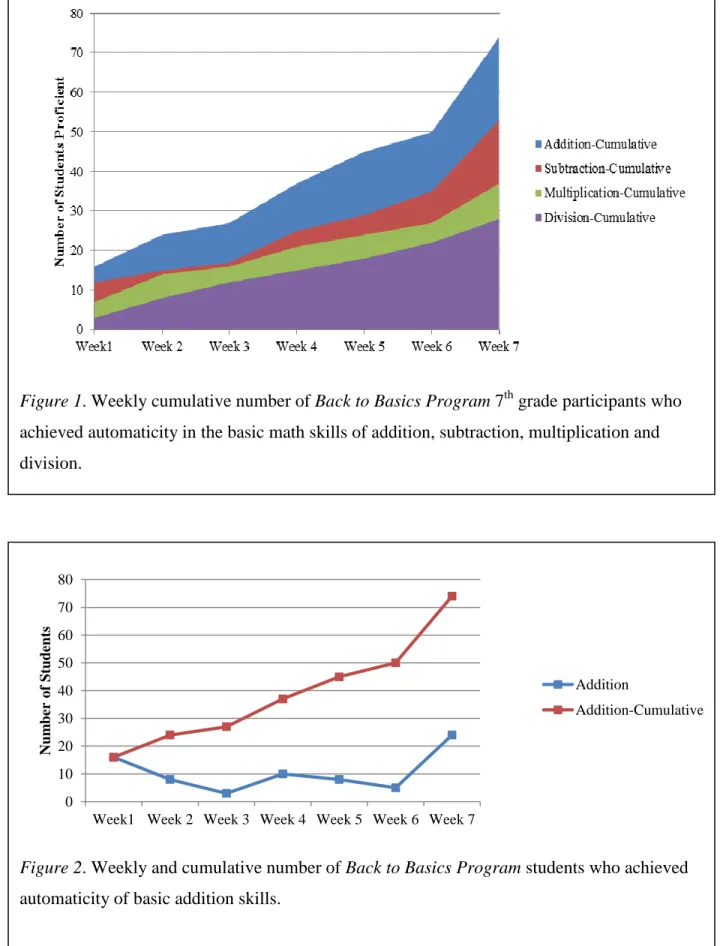
research. Table 3 shows a summarization of the cumulative number of participating students that ascertained automaticity in each of the four basic math skills of addition, subtraction,
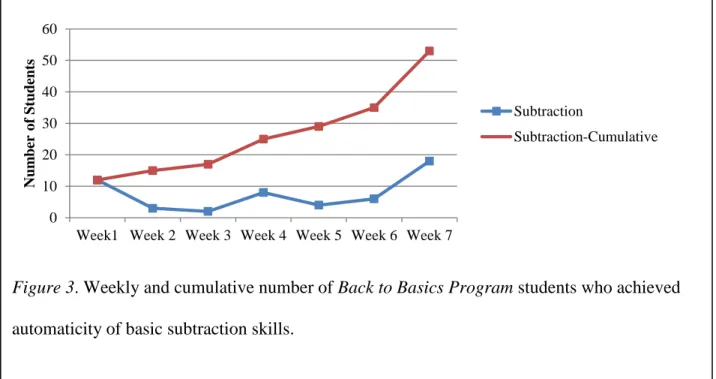
multiplication and division. By the end of the 7th week, 74% of participating students had achieved automaticity in basic addition. It is noteworthy that of the 100 participants, 20% were classified as academically gifted and 60% were considered below grade level in mathematics requiring Tier 2 Response to Intervention. The remaining 20% were classified as grade-level ready in mathematics. Figures 2 through 5 show cumulative and individual weekly growth numbers in each of the four basic math skills: addition, subtraction, multiplication and division, respectively.
Figure 1. Weekly cumulative number of Back to Basics Program 7th grade participants who achieved automaticity in the basic math skills of addition, subtraction, multiplication and division.
Figure 2. Weekly and cumulative number of Back to Basics Program students who achieved automaticity of basic addition skills.
0 10 20 30 40 50 60 70 80
Week1 Week 2 Week 3 Week 4 Week 5 Week 6 Week 7
Num ber o f Student s Addition Addition-Cumulative
Figure 3. Weekly and cumulative number of Back to Basics Program students who achieved automaticity of basic subtraction skills.
0 10 20 30 40 50 60
Week1 Week 2 Week 3 Week 4 Week 5 Week 6 Week 7
Num ber o f Student s Subtraction Subtraction-Cumulative
Figure 4. Weekly and cumulative number of Back to Basics Program students who achieved automaticity of basic multiplication skills.
0 5 10 15 20 25 30 35 40
Week1 Week 2Week 3Week 4Week 5Week 6Week 7
Num ber o f Student s Multiplication Multiplication-Cumulative
Due to the limited availability of student laptop computers, not all of the 100 participants were able to work on the computer timed assessments via Thatquiz.org software (Version 2012). There were 23-25 computers available every day in just one of the three teachers’ classrooms. As students reached proficiency in all four mathematic skills, they were cycled out of the computer classroom and new students were allowed to use the computers. Figures 6 through 9 categorize the percentage of students who passed the assessments with respect to the frequency of attempts at reaching a score of 95% or better.
Figure 7. The percentage of students out of 52 participants who achieved proficiency in subtraction in 7 weeks.
Figure 5.Weekly and cumulative number of Back to Basics Program students who achieved automaticity of basic division skills.
0 5 10 15 20 25 30
Week1 Week 2 Week 3 Week 4 Week 5 Week 6 Week 7
Num b er of S tud en ts Division Division-Cumulative
Figure 6. The percentage of students out of 73 participants who achieved proficiency in addition in 7 weeks. 0% 5% 10% 15% 20% 25% 30% 35% P rof icie n t S tud en ts
Number of Attempts to Pass Addition
Figure 7. The percentage of students out of 52 participants who achieved proficiency in subtraction in 7 weeks. 0% 10% 20% 30% 40% 50% 0-1 2-5 6-10 11-15 16-20 21-25 26-30 31-35 36-40 41-45 46-50 51-55 P rof icie n t S tud en ts
Number of Attempts to Pass Subtraction
Figure 8. The percentage of students out of 37 participants who achieved proficiency in multiplication in 7 weeks. 0% 5% 10% 15% 20% 25% 0-1 2-5 6-10 11-15 16-20 21-25 26-30 31-35 36-40 41-45 46-50 P rof icie n t S tud en ts
Number of Attempts to Pass Multiplication
Qualitative Results. Student Opinion Surveys were given to 40 of the Back to Basics Program participants as these were the first students to work directly on the computer timed assessments via Thatquiz.org (Version 2012). Surveys were given to these students after the 4th week of the program. At that moment in the program, 57% of the 40 students polled had
achieved automaticity in the four areas of basic math skills. The remaining 43% of the 40 students surveyed were at various stages of proficiency. Table 3 shows the percentage of students that agree on the effectiveness of various strategies to gain automaticity of basic math skills.
Table 3
Effective Strategies for Gaining Automaticity in Basic Math
Strategy Students Who Agree Strategy is Effective
Mean Scale Score (5=Highest, 1=Lowest Rating)
Receiving Immediate Feedback 95% 4.10
Timed Computer Assessments Use of Flashcards
85% 82%
4.05 3.85
Figure 9. The percentage of students out of 28 participants who achieved proficiency in division in 7 weeks. 0% 5% 10% 15% 20% 25% 0-1 2-5 6-10 11-15 16-20 P rof icie n t S tud en ts
Number of Attempts to Pass Division
Say Facts Out Loud Repeatedly
70% 3.63
Write Down Facts Repeatedly 65% 3.73
Students were asked to rank their preferred method for learning math facts. Table 4 summarizes the results. When asked for other suggestions, one student recommended homework as an alternate strategy for learning basic math skills.
Table 4
Students Preferred Methods for Learning Basic Math Skills
Strategy Students Who Chose Strategy as First Choice
Flashcards 25%
Computer Timed Assessments 23%
Math Competitions 20%
Speed Tests, Pencil/Paper 15%
Writing Down Facts Repeatedly
10%
Saying Facts Repeatedly 5%
Surveyed participants were polled regarding if their willingness to learn mathematics improved as they achieved automaticity of basic math skills. When asked if they believed that learning basic math skills without counting on their fingers helped them do better on math tests and benchmark assessments, 90% agreed or strongly agreed. This resulted in a mean Likert Scale score of 4.3, with 5 being the highest rating in agreement and 1 being the lowest rating in agreement. Additionally, 90% of polled participating students agreed or strongly agreed that learning basic math skills with automaticity helped them enjoy learning math a little better than before they were enrolled in the Back to Basics Program. This translated to a mean Likert Scale
rating of 4.15. Lastly, 95% of polled participants agreed or strongly agreed that learning basic math facts with automaticity has given them more confidence when learning mathematics. The mean Likert Scale score for this survey question was 4.43.
Findings-Parents and Guardians
A Parent/Guardian Opinion Survey, Attachment B, was sent home with students. Only three surveys were returned by the time of this writing. All of the parents that completed the survey believed their child was able to pass all of the timed proficiency tests in addition, subtraction, multiplication and division. None of these parents worked with their children regularly on their basic math skills. When asked if their child used the strategy of counting on their fingers to perform basic math skills, 67% disagreed or strongly disagreed their child used this strategy. Two thirds of the parents/guardians noticed an increase in their child’s confidence and attitude towards learning math since they have been focusing on their automaticity in the
Back to Basics Program. Lastly, parents were asked to rank, in order of preference from 1(most preferred) to 7 (least preferred), several strategies for learning math facts. Table 5 summarizes these rankings.
Table 5
Parent/Guardian Opinions on Their Child’s Preferred Strategies for Learning Basic Math Skills
Strategy Parents’/Guardians’ Opinion Their
Child Prefers This Strategy as First Choice
Flashcards 60%
Computer Timed Assessments 30%
Math Competitions 0%
Speed Tests, Pencil/Paper 10%
Writing Down Facts Repeatedly
0%
Findings-Teacher Survey
A Teacher Opinion Survey, Attachment C, was given to the three 7th grade mathematics teachers responsible for working with the Back to Basics Program participants. All polled math teachers felt their students, who they teach on a daily basis, did not know their basic math facts with fluency and automaticity. They all noticed that the majority of their students count on their fingers to do basic math computations, and that the lack of automaticity hindered them from learning higher level, more complex math skills. When asked if students should be allowed to use calculators to perform basic, rudimentary math computation, all polled math teachers felt that calculators should not be allowed. Teachers have also noticed that students who achieve
automaticity have a more positive attitude towards learning math and seem to be more confident when learning math in their classrooms. Table 6 summarizes each teacher’s priority regarding their preferred strategy to help students learn their basic math skills.
Table 6
Teachers Preferred Methods for Teaching Basic Math Skills
Strategy Teacher 1 Teacher 2 Teacher 3
Flashcards 1st 1st 1st
Computer Timed Assessments 4th 4th 2nd
Math Competitions 6th 6th 6th
Speed Tests, Pencil/Paper 5th 5th 5th
Writing Down Facts Repeatedly
2nd 2nd 4th
Discussion
Based on data collected from Thatquiz.org (Version 2012) timed assessments as summarized in Figure 1, 73% of the 100 active student participants in the Back to Basics Program are proficient in basic addition after 7 weeks. Additionally, 53% were deemed proficient in subtraction, 37% were proficient in multiplication and 28% were proficient in division after 7 weeks. Since there were only 25 computers available during the Mastery block time period, not all 100 participants could test using the Thatquiz.org software (Version 2012) at the same time. Therefore, conclusions should not be drawn regarding the speed at which
students acquired automaticity. One of the first research questions posed in this action research asks if it is possible to improve automaticity for middle school students in addition, subtraction, multiplication and division through the use of timed on-line assessments. Conclusive,
quantitative data from Thatquiz.org (Version 2012) assessments show positive results in this area. Student opinion surveys also provide evidence that 85% of the students polled agree or strongly agree that timed computer assessments helped them achieve automaticity.
When students were asked if they thought that receiving instant feedback on the timed tests was helpful, 95% of the polled student population agreed or strongly agreed. Students would write down the facts that they did not answer correctly at the end of each timed
assessment so they could focus on their attention on these to quickly build their automaticity. This strategy was also cited in the research literature know as Detection, Practice and Repair
recommended by Axtell, Poncy and Skinner (2010). There was no reason to focus on the facts that were already seated in the student’s long term memory.
Many students in middle school use inefficient strategies for basic math computations, such as counting on their fingers. When surveyed, 100% of the teachers strongly agree that their students do not know basic math facts with automaticity, and all feel that the majority of their
students count on their fingers to do math. This action research not only focused on teachers’ viewpoints regarding the most effective strategies to help students build automaticity in basic mathematics, but also focused on what students had to say about their preferred strategies to build automaticity. It is interesting to compare the student preferred strategies to teachers’ preferred strategies. Parents and guardians had yet an additional set of preferences regarding preferred strategies. Table 7 summarizes the strategy preferences by ranking them from 1 to 7, with 1 being the most preferred and 7 being the least preferred. The top three preferred choices from the students’ viewpoint were the use of flashcards (25%), computer timed assessments (23%), and math competitions (20%). Teachers voted unanimously that the use of flashcards was the most effective strategy and none of the teachers felt that math competitions were an effective strategy for students to learn basic math facts. Although there were only three Parent/Guardian Opinion Surveys returned, they were united in that the use of flashcards was their preference followed by timed computer tests and paper/pencil speed tests.
Table 7
Preferred Methods for Learning Basic Math Skills
Strategy Student Majority Teacher Majority Parents/Guardians Majority Flashcards 1st 1st 1st
Computer Timed Assessments 2nd 4th 2nd
Math Competitions 3rd 6th --
Speed Tests, Pencil/Paper 4th 5th 3rd
Writing Down Facts Repeatedly
5th 2nd --
Saying Facts Repeatedly 6th 3rd --
Students were surveyed regarding if improving their automaticity in basic math helped improve their attitude and willingness to learn mathematics. 90% of those polled agreed or strongly agreed they had an improved attitude about learning math. When asked if they believed that learning basic math skills without counting on their fingers helped them do better on math tests and benchmark assessments, 90% agreed or strongly agreed. Lastly, 95% of polled
participants agreed or strongly agreed that learning basic math facts with automaticity has given them more confidence when learning mathematics. Teachers were also in 100% agreement that students who had achieved automaticity seemed to have a more positive attitude towards
learning higher level math skills and had a greater confidence in learning math. Teachers commented that several students who never volunteered to answer questions in the past were now eager to raise their hand and answer questions during math class.
The timing of this action research precludes having any benchmark data or standardized assessment data for review to assess if acquiring automaticity helped improve standardized assessment scores. This is an action for further review and study. However, all three teachers involved in this action research have noticed a reduction in the number of careless errors when reviewing formative assessments.
The triangulation of data from students, teacher and parents all yield similar findings. In order to be successful in math, one must become fluent with the basic facts so that recall
becomes automatic and effortless. Only then can the working memory be freed up so that higher level mathematics can be processed. The working memory in humans has a limited capacity so it is imperative that students achieve automaticity in the basics.
Limitations
This action research has been met with just a few limitations. The main obstacles encountered were due to the technical limitations of the Alamance Burlington School System
computer network. At the onset of the Back to Basics Program, students were either unable to connect to the computer network system or the system response was so slow that their computers shut down from inactivity. An interim solution was implemented by placing a wireless router in one of the participating teacher’s classroom which enabled reasonable access to the internet for participating students. The other two participating teacher classrooms were unable to implement the temporary solution. Therefore, only 23-25 students per day could participate in the computer timed assessments via Thatquiz.org (Version 2012). This slowed data collection, but did not prevent the program from continuing.
A second limitation involved the prohibited student access to SurveyMonkey (Version 2009) which was used to create the Student Opinion Survey. However, when students clicked on the link to take the survey, they were unable to participate online because the website was
blocked by the school’s firewall. As an alternative approach, paper copies of the survey were given to students and their data were manually keyed into the SurveyMonkey database. Results were obtained, but with more manual effort than originally intended.
Another limitation of the action research was the limited involvement of parents and guardians of participating students. This was no surprise as many school functions requiring parent/guardian participation are met with mediocre response. Many parents work multiple jobs and often consider parental/guardian participation optional.
From a global perspective, educators may be reluctant to focus on 2nd and 3rd grade math skills for middle school students. It is surprising that middle school students do not have a good foundation in basic arithmetic skills. Therefore, educators may be very resistant to spending time on such low level skills and resort to handing students calculators to do the basics.
Teachers may be concerned that there is not enough time in the day to go back to 2nd grade skills as they have a large amount of grade-level math to cover. This mindset is certainly understood,
but should not continue if we are genuinely focused on increasing our students’ ability to learn and master higher level mathematics.
Action Plan
The main action required is to continue this program until the end of the 2012-2013 school year for the 7th grade. Data collection and analysis should continue until 7th grade
students achieve automaticity of basic addition, subtraction, multiplication and division. The goal is to enlist all 7th grade students in the Back to Basics Program before the end of the school year. For next year, it is recommended that all grade levels incorporate the Back to Basics Program as the issue of automaticity, or lack thereof, exists at all grade levels. However, until the internet infrastructure issue is resolved, it may be physically impossible to incorporate the Back to Basics Program school-wide.
Several summative assessments are forthcoming over the next several months and scores should be collected as the program is evaluated for effectiveness in answering the question: Does the improvement of automaticity of basic math skills improve standardized assessment results for middle school students? Assessment data should be carefully analyzed for all participating students in the Back to Basics Program. If data show positive trends in summative assessment scores, then results will be published to administration immediately. Upward trends in test scores are paramount and mandatory in order for the United States to remain a competitive and competent world leader. As concluded from the literature review, strong evidence from the Australian-designed QuickSmart Program show positive results for Australian students on international standardized assessments whose scores are far more impressive than the United States scores. We need to follow their lead and raise our international ranking in math and science.
Table 8 summarizes the Action Plan for this action research for the balance of the 2012-2013 school year. Presentations regarding the success of the Back to Basics Program are planned for GMS Administrators and Academic Coaches. A separate presentation for Central Office Administrators will be scheduled after the End of Grade assessments have been
administered, scored and proper analyses have been completed regarding the Back to Basics Program.
Table 8
Action Plan
Recommended Action Who Is
Responsible Timing Resources
Continue Back to Basics Program and cycle as many 7th grade students as
possible through the program Academic Coaches, Back to Basics Lead Teachers, Administration Through May 1, 2013 Student Laptop Computers, All 7th Grade
Students, Thatquiz.org software, Back to Basics
teachers Continue the use of
Thatquiz.org Back to Basics Teachers Through May 1, 2013 Student Computers, Thatquiz.org Software Continue Use of Flashcards, Math Competitions, Writing and
Saying Facts Out Loud
Back to Basics Teachers
Through May 1, 2013
7th Grade students, math manipulatives such as
flashcards Collect results from
Benchmarks, SMI Assessments and Report Cards in Jan and Mar, 2013
Administration, Academic Coaches, Back to Basics Lead Teacher Jan 15, 2013 April 15,2013
Benchmark Data, SMI Data, Universal Screening Data, Computer w/ Excel
Collect End of Grade Assessment results in May,
2013 Administration, Academic Coaches, Back to Basics Lead Teacher
June 1, 2013 EOG Data, Computer w/ Excel
Present Results of Action Research to Graham Middle School Administration Back to Basics Teachers Dec, 2012 Mar, 2013 June, 2013 Computer with PowerPoint Present Results of Action
Research to Central Office Administration Back to Basics Teachers June, 2013 Computer with PowerPoint Conclusions
This action research provides conclusive evidence that many students in the 7th grade at Graham Middle School do not possess automaticity of basic math skills in addition, subtraction, multiplication and division. Opinion surveys show that timed assessments and the use of
flashcards are amongst the preferred strategies recommended by students, teachers and parents to achieve automaticity of basic math skills. The students who participated in this action research worked daily for 7 weeks in a math intervention program known as the Back to Basics Program
to help build their automaticity. They used timed assessment via Thatquiz.org (Version 2012), flashcards, team competitions and unrelenting determination to build their skills. Some students achieved automaticity quickly whereas others required many hours of repetition and drilling of the facts. Regardless of the number of attempts each student made on the timed assessments, the majority of students agreed that their confidence and attitude towards learning math improved as they become proficient. Teachers unanimously agreed they saw a marked improvement in their students’ attitudes and confidence in their mathematics classes once automaticity was achieved.
This action research accomplished several important goals. It showed, through concrete results, that students in middle school need to possess automaticity of basic math so that
cognitive resources and the working memory can be used for higher level math concepts. Counting on fingers is an ineffective strategy that many middle school students use, even if
students are classified as gifted. Administrators and teachers need to allot time during the day to help all students build this automaticity. Summative assessments were not available at the time of this writing, but formative assessments using Thatquiz.org (Version 2012) show that it is possible for all students to achieve automaticity. Immediate feedback is necessary for students to identify which facts are not known fluently so these can be practiced in isolation. Positive
reinforcement when students successfully complete each timed test fortifies their self-confidence and their willingness to continue working hard on achieving automaticity.
The next step for this action research is to continue the Back to Basics Program until all 7th grade students achieve automaticity. Summative assessment scores from benchmark
assessments, report cards, and the End of Grade Mathematics assessment should be tracked and analyzed for each participating student in the Back to Basics Program. As results become
available in June, 2013, a presentation for administration and applicable Central Office personnel will be prepared regarding the findings of this action research. If administration chooses to continue the Back to Basics Program next year, all grade levels should establish a facilitator monitor and track program results. If successful, the program could then be applied to other schools in the district that have substandard results on the high-stakes assessments in
mathematics. Offering this program at the elementary school level may also provide improvements to overall mathematics performance.
The United States needs to embrace radical curricular changes in mathematics in order to change the trajectory of our rankings on international assessments in math and science literacy. There are serious consequences in the weakening of our math and science leadership as we enter the 21st century. We risk losing the technical foundation that has made the United States a world leader. By strengthening our students in basic mathematics and focusing on building their basic
math automaticity, they will be able to comprehend and learn higher-level mathematical concepts such as Algebra. The National Mathematics Advisory Panel states that Algebra is a demonstrable gateway to later success in the workforce (National Mathematics Advisory Panel, 2008). We can no longer afford to be complacent with the fact that our middle school students still count on their fingers. We should not simply hand them a calculator to do simple arithmetic. As educators, we must stop pushing students along to the next grade level when they don’t have a solid math foundation. We must stop this downward spiral. We must get back to basics.
References
Adcock, W., Luna, E., Parkhurst, J., Skinner, C. H., Yaw, J., Poncy, B., (2010). Efficient class-wide remediation: Using technology to identify idiosyncratic math facts for additional automaticity drills. International Journal Of Behavioral Consultation And Therapy, 6(2), 111-123.
Axtell, P.K., McCallum, R.S., Bell, S.M., Poncy, B. (2009). Developing math automaticity using a class-wide fluency building procedure for middle school students: A preliminary study.
Psychology in the Schools, 46:6, 526-538. doi:10.1002/pits.20395
Bellert, A. (2008). LDA student award winner, 2008 narrowing the gap: A report on the QuickSmart mathematics intervention. Australian Journal of Learning Difficulties,14:2, 171-183. doi:10.1080/19404150903264310
Byers, T. (2009). The BASICS Intervention Mathematics Program for at-risk students.
Australian Mathematics Teacher, 65(1), 6-11.
Fleishman, H.L., Hopstock, P.J., Pelczar, M.P., & Shelley, B.E. (2010). Highlights from PISA 2009: Performance of U.S. 15-year old students in reading, mathematics and science literacy in an international context. (NCES 2011-004). U.S. Department of Education, National Center for Education Statistics. Washington, DC: U.S. government Printing Office.
Graham, L., Bellert, A., Thomas, J., & Pegg, J. (2007). "QuickSmart": A Basic Academic Skills Intervention for Middle School Students with Learning Difficulties. Journal of Learning Disabilities, 40(5), 410-419.
Marzano,R.J, Pickering,D.J.,Pollock,J.E. (2001). Classroom instruction that works: Research-based strategies for increasing student achievement. Alexandria, VA: Association for Supervision and Curriculum Development (ASCD).
Mills, Geoffrey E. (2011). Action research- A guide for the teacher researcher. Upper Saddle River, NJ: Pearson.
Department of Education. (2008). National Mathematics Advisory Panel. Foundations for success: The final report of the National Mathematics Advisory Panel. Washington, D.C.:U.S Government Printing Office.
Ramos-Christian, V., Schleser, R., & Varn, M. E. (2008). Math fluency: Accuracy versus speed in preoperational and concrete operational first and second grade children. Early
Childhood Education Journal, 35(6), 543-549. SurveyMoneky.com (Version 2009) [Computer software].
Swanson, H. (2011). Working memory, attention, and mathematical problem solving: A longitudinal study of elementary school children. Journal of Educational Psychology,
103(4), 821-837.
Thatquiz.org (Version 2012) [Computer software]. Thinkgate.org (Version 2012) [Computer software].
Appendix A: Student Opinion Survey
Strongly
Agree Agree Neutral Disagree
Strongly Disagree
1. Do you know all the basic math facts (1-10) so that you can pass all the timed quizzes in the Back to Basics Program?
2. Do you think the timed math quizzes help you learn math facts until they become automatic?
3. Do you think the use of flashcards help you learn math facts until they become automatic?
4. When you do not know a certain math fact, does it help you to repeat the fact out loud many times (like 10 or more)?
5. When you do not know a certain math fact, does it help you to write it down many times (like 10 or more)?
6. When you take the on-line timed quizzes, does it help you to know which facts you got wrong (instant feedback)? 7. Do you think that learning these basic math facts without counting on your fingers has helped you do a better on math tests and Benchmark tests?
8. Do you think that learning these basic math facts has helped you like learning math a little better than before? 9. Do you think that learning basic math facts with speed and accuracy has given you more confidence when doing math?
10. In your opinion, what are your favorite ways to learn basic math facts with speed and accuracy? Place a 1 beside the most favored way, a 2 beside the second choice, etc…
_____ Flashcards
_____ Math Competitions
_____ Writing down the facts many times _____ Saying the facts out loud many times _____ Doing speed tests on paper
_____Doing speed tests on the computer _____ Other: ________________ ______
Appendix B: Parent/Guardian Opinion Survey Strongly
Agree Agree Neutral Disagree
Strongly Disagree 1. Do you feel that your child knows all the basic math facts
(1-10) such that they can pass a 100 problem quiz in addition, subtraction, multiplication and division in 3 minutes time?
2. Do you notice that your child counts on their fingers to do basic math?
3. Do you work with your child regularly (2 or 3 times a week) on basic math facts?
4. Do you think the use of flashcards would help your child learn math facts until they become automatic?
5. When your child does not know a certain math fact by heart, does it help them to repeat the fact out loud 10 or more times?
6. When your child does not know a certain math fact by
heart, does it help them to write the fact down on paper 10 or more times?
7. Does your child use a computer at home to learn math
facts?
8. If your child has just recently mastered their basic math facts by being in the Back to Basics program, have they become more confident in doing their math homework?
9. Do you think that learning basic math facts with speed
and accuracy has improved their attitude towards learning math?
10. In your opinion, what are your children’s preferred ways to learn basic math facts with speed and accuracy? Place a 1 beside the most favored way, a 2 beside the second choice, etc…
_____ Flashcards
_____ Math Competitions
_____ Writing down the facts many times _____ Saying the facts out loud many times _____ Doing speed tests on paper
_____Doing speed tests on the computer _____ Other: _______________________
Appendix C
Strongly
Agree Agree Neutral Disagree
Strongly Disagree 1. Do you feel that your students know all the basic math facts
(1-10) such that they can pass a 100 problem quiz in addition, subtraction, multiplication and division in 3 minutes time? 2. Do you notice that your students count on their fingers to do basic math?
3. Do you feel that students are hindered from learning more complex math skills if they are not proficient and possess automaticity in basic math?
4. Do you think a student should be allowed to use a calculator if they do not know basic math computations and facts?
5. Do you think a student should be allowed to use a calculator to perform basic math computations on formative assessments? 6. Do you think a student should be allowed to use a calculator to perform basic math computations on standardized mathematics assessments?
7. Do you feel that math games on the computer are helpful in building basic math skill automaticity?
8. Do you think that when students achieve automaticity in basic math facts that their attitudes and confidence improve with respect to learning math?
9. Do you feel that all students in elementary school should be required to pass timed basic math assessments in addition, subtraction, multiplication and division before entering the 6th grade?
10. In your opinion, what are the most effective strategies for students to learn basic math facts with speed and accuracy? Place a 1 beside the most favored way, a 2 beside the second choice, etc…
_____ Flashcards
_____ Math Competitions
_____ Writing down the facts many times _____ Saying the facts out loud many times _____ Doing speed tests on paper
_____Doing speed tests on the computer _________