ADOPTION OF CLOUD COMPUTING BY THE SOUTH
AFRICAN PUBLIC SECTOR
JUDIAN GOVENDER 211215503
Research treatise presented in partial fulfilment of the requirements for the degree of
Master of Business Management
In the
Faculty of Business and Economic Sciences
of the
Nelson Mandela Metropolitan University 2016
ii
DECLARATION
I, Judian Govender, 211215503, hereby declare that this treatise for Master in Business Administration (MBA) is my own work and that it has not previously been submitted for assessment or completion of any postgraduate qualification to another University or for another qualification (Refer to Appendix II for the signed declaration).
iii
ACKNOWLEDGEMENTS
I would like to acknowledge the following people for their support:
To my dear wife Dr Natasha Padayachee-Govender, thank you for being, you are a divine gift of joy.
To my supervisor, Dr Brenda Scholtz, thank you for your guidance, motivation, understanding and patience.
iv
ABSTRACT
Technology enables progress for individuals and organisations; however, adopting technology may not always be simple. Cloud computing technology has revolutionised how one consumes IT. Governments too can leverage the advantages of adopting cloud computing. A review of the literature reveals a gap in research on the adoption of cloud computing by the South African public sector. Limited research has been done on the topic of cloud computing and none of them are from a quantitative perspective. This study set out to answer the question, “What is the extent (current state, benefits, barriers and readiness levels) of the adoption of cloud computing by the South Africa public sector?” The study is of much value to the public sector of South Africa and other countries and organisations wanting to understand what to consider when adopting cloud computing.
The study used a survey research strategy that was exploratory in nature. The sample comprised government CIO’s and government Senior IT management. Questionnaires were sent via a web link and 51 responses were completed. The results revealed that more than half of the South African public sector has adopted cloud computing; however there is a lack of visibility of government initiatives that promote cloud computing. The study shows that public organisations that have adopted cloud computing significantly perceive more benefits of cloud computing than organisations that are yet to adopt. The Technology Organisation Environment (TOE) framework tested the barriers to adoption, revealing areas of concern that are limiting successful cloud computing adoption and adoption rates. The study uncovers a timeline for further cloud computing adoption in the South African public sector.
v TABLE OF CONTENTS DECLARATION ... II ACKNOWLEDGEMENTS ... III ABSTRACT ... IV TABLE OF CONTENTS ... V LIST OF TABLES ... VIII LIST OF FIGURES ... IX LIST OF ACRONYMS AND ABBREVIATIONS ... XI
CHAPTER 1 INTRODUCTION TO THE RESEARCH ... 1
1.1 BACKGROUND TO THE STUDY ... 1
1.2 PROBLEMSTATEMENT ... 5
1.3 RESEARCH AIMS AND OBJECTIVES ... 5
1.4 RESEARCH METHODOLOGY ... 6
1.4.1 Research Design Objectives ... 7
1.4.2 The Sample ... 8
1.4.3 The Measuring Instrument and Data Analysis ... 8
1.5 OUTLINE OF THE STUDY ... 9
CHAPTER 2 LITERATURE REVIEW ... 11
2.1 INTRODUCTION ... 11
2.2 CLOUD COMPUTING OVERVIEW ... 12
2.3 CURRENT STATE OF CLOUD COMPUTING IN THE SOUTH AFRICAN PUBLIC SECTOR . 19 2.4 LEVEL OF ADOPTION OF CLOUD COMPUTING BY THE SOUTH AFRICAN PUBLIC SECTOR ... 21
vi 2.5 BENEFITS OF CLOUD COMPUTING AS PERCIEVED BY THE SOUTH AFRICAN PUBLIC
SECTOR ... 24
2.6 BARRIERS TO CLOUD ADOPTION FACED BY THE SOUTH AFRICAN PUBLIC SECTOR . 29 2.7 LEVEL OF READINESS OF THE SOUTH AFRICAN PUBLIC SECTOR TO ADOPT CLOUD COMPUTING ... 32
2.8 CONCLUSION ... 34
CHAPTER 3 RESEARCH METHODOLOGY ... 36
3.1 INTRODUCTION ... 36
3.2 RESEARCH STRATEGY ... 36
3.3 SAMPLING METHOD AND RESEARCH INSTRUMENT ... 38
3.4 VALIDITY OF THE MEASURING INSTRUMENT ... 39
3.5 CONCLUSION ... 40
CHAPTER 4 DATA ANALYSIS ... 41
4.1 INTRODUCTION ... 41
4.2 DEMOGRAPHIC AND ORGANISATIONAL INFORMATION ... 41
4.3 ADOPTIONOFCLOUDCOMPUTING ... 48
4.4 BENEFITS OF CLOUD COMPUTING ... 56
4.5 BARRIERSTOCLOUDADOPTION ... 61
4.5.1 Technical barriers ... 61
4.5.2 Organisational Barriers ... 65
4.5.3 Environmental barriers ... 68
4.6 READINESS FACTORS TO ADOPTING CLOUD COMPUTING ... 71
vii
CHAPTER 5 CONCLUSIONS AND RECOMMENDATIONS ... 77
5.1 INTRODUCTION ... 77
5.2 REVIEW OF RESEARCH QUESTIONS ... 77
5.2.1 Review of Secondary Research Question 1 (SRQ1) ... 77
5.2.2 Review of Secondary Research Question 2 (SRQ2) ... 79
5.2.3 Review of Secondary Research Question 3 (SRQ3) ... 80
5.2.4 Review of Secondary Research Question 4 (SRQ4) ... 82
5.2.5 Review of Primary Question (PRQ) ... 83
5.3 CONTRIBUTIONS AND RECOMMENDATIONS ... 84
5.4 LIMITATIONS OF THE RESEARCH ... 85
5.5 FURTHER RESEARCH ... 85
LIST OF REFERENCES ... 87
APPENDIX A: QUESTIONNAIRE ... 94
A.1 Initial participant invite email ... 94
A.2 Initial reviewed questionnaire ... 95
A.3 Online survey ... 105
APPENDIX B: ETHICAL CLEARANCE ... 117
viii LIST OF TABLES
TABLE 1-1 SECONDARY RESEARCH OBJECTIVES AND QUESTIONS ... 6
TABLE 1-2SUMMARY OF CHAPTERS, DELIVERABLES AND LINK TO RESEARCH OBJECTIVES . 10 TABLE 2-1 BENEFITS OF CLOUD COMPUTING ... 28
TABLE 2-2 BARRIERS TO CLOUD COMPUTING ... 31
TABLE 4-1DEPARTMENTS AND MUNICIPALITIES THAT RESPONDED TO THE STUDY ... 46
TABLE 4-2 UTILISATION OF CLOUD COMPUTING TECHNOLOGIES ... 52
TABLE 4-3:BENEFITS OF CLOUD COMPUTING ADOPTION ... 57
TABLE 4-4 TECHNICAL BARRIERS TO CLOUD ADOPTION ... 62
TABLE 4-5: ORGANISATIONAL BARRIERS TO CLOUD ADOPTION ... 65
ix
LIST OF FIGURES
FIGURE 2.1 EVOLUTION OF CLOUD COMPUTING ... 14
FIGURE 2.2 SERVICE DELIVERY MODELS (CHOU, 2010) ... 16
FIGURE 2.3 DEPLOYMENT MODELS OF CLOUD COMPUTING (UBIRY, 2013) ... 17
FIGURE 4.1 GENDER PROFILE OF RESPONDENTS ... 42
FIGURE 4.2AGE PROFILE OF RESPONDENTS ... 42
FIGURE 4.3 LANGUAGE PROFILE ... 43
FIGURE 4.4HIGHEST QUALIFICATIONS ... 44
FIGURE 4.5 GENDER VS QUALIFICATIONS ... 44
FIGURE 4.6 REGIONAL DISTRIBUTION OF RESPONDENTS ... 45
FIGURE 4.7PERIOD OF SERVICE TO EMPLOYER ... 47
FIGURE 4.8 COMPANY STATUS VS TENURE ... 48
FIGURE 4.9ADOPTION OF TECHNOLOGY ... 49
FIGURE 4.10 USE OF CLOUD COMPUTING ... 49
FIGURE 4.11 SUCCESS OF CLOUD PROJECT ... 50
FIGURE 4.12UTILISATION OF CLOUD TECHNOLOGIES ... 51
FIGURE 4.13 MOVE TOWARDS CLOUD ADOPTION, ACTIVITIES ... 53
FIGURE 4.14INTENTION FOR CLOUD COMPUTING ... 54
FIGURE 4.15 CLOUD COMPUTING ADOPTION TIMELINE ... 55
FIGURE 4.16 SHORT TERM ADOPTION OF DIFFERENT CLOUD ENVIRONMENTS ... 56
FIGURE 4.17 BENEFITS OF CLOUD COMPUTING ... 59
FIGURE 4.18 BENEFITS ANOVA ... 61
FIGURE 4.19TECHNICAL BARRIERS TO THE ADOPTION OF CLOUD COMPUTING ... 64
x
FIGURE 4.21ENVIRONMENTAL BARRIERS TO CLOUD COMPUTING ... 70
FIGURE 4.22 AWARENESS OF GOVERNMENT DRIVERS TOWARDS CLOUD COMPUTING ... 72
FIGURE 4.23 EXTERNALLY INFLUENCED TO MOVE TO CLOUD COMPUTING ... 73
FIGURE 4.24 TOE RESOURCES LEVEL FOR CLOUD READINESS ALL - RESPONDENTS ... 74
FIGURE 4.25 TOE RESOURCES LEVEL FOR CLOUD READINESS – USING CLOUD COMPUTING ... 75
xi
LIST OF ACRONYMS AND ABBREVIATIONS
CIO Chief Information Officer DOI Department of Information G2B Government to businesses G2C Government to citizens G2G Government to governments GSA General Service Administration HHS Health and Human Services IaaS Infrastructure as a Service
ICT Information and Communication Technology IDC International Data Corporation
IoT Internet of Things
IT Information Technology LE Large-sized Enterprise
NASA National Aeronautics and Space Administration NIST National Institute of Standards and Technology NMMU Nelson Mandela Metropolitan University
PaaS Platform as a Service SaaS Software as a Service SLA Service Level Agreement
SME Small and Medium-sized Enterprise SOA Service Orientated Architecture TSC Thusong Service Centers
1
CHAPTER 1
INTRODUCTION TO THE RESEARCH
1.1 BACKGROUND TO THE STUDY
Cloud computing has redefined the computing paradigm by providing dynamically scalable resources on demand over the internet (cloud). These resources are a combination of SOA (service oriented architecture) and virtualisation techniques (Papazoglou, 2003). Garrison, Kim and Wakefield (2012) argue that organisations can focus on their core business activities since they would not have to worry about maintaining the IT infrastructure (Garrison et al. 2012). Berman, Kesterson-Townes, Marshall and Srivathsa (2012) assert that by using cloud computing, the requirements for infrastructure investments are taken out of the picture so that it changes the competitive landscape by giving a chance for companies that have innovative ideas but no capital to invest, to deploy their software and succeed (Berman et al., 2012).
Marston, Li, Bandyopadhyay, Zhang and Ghalsasi (2011) claim that cloud computing is a disruptive way in which public sector enterprises can consume data, communicate and how they deploy and deliver services to their constituents. Governments are eager to adopt the cloud; however, (King, McKean and Lee, 2011) worldwide survey stated that the penetration of cloud computing in the public sector is at 23% compared to 42% in the private sector. A follow-up survey in 2012 found that only 12% of the respondents had spent more than 10% of the total IT resources on cloud services (Baldwin, 2012). According to a 2015 survey report, 93% of the respondents are using cloud
2 computing out of which only 11% is from the public sector (Weins, 2015). Feuerlicht and Margaris (2012), in their comparative study about cloud adoption in Australia and Czechoslovakia, reported that the primary reason for cloud adoption is the improved support for business processes rather than cost savings. Australia ranked second amongst the countries that support growth of cloud computing (Business Software Aliabce, 2012; Feuerlicht and Margaris, 2012).
Jangra and Bala (2011) argue that cloud computing is an enabler for many different services due to its dynamic scaling capability, pay-per-use business model, the virtualisation it offers and the various business models available. These models include infrastructure as a service (IaaS), Software as a service (SaaS), and Platform as a Service (PaaS). Cloud computing is best suited for disaster recovery and device and location independence. Business agility is more or less infinitely scalable with cloud computing and it results in less capital expenditure (Jangra and Bala, 2011). Adopting cloud computing reduces the chances for over-provisioning, under-provisioning and under-utilisation of resources (Sahu and Tiwari, 2012). Adam and Musah (2015) argue that the situation in the developed world is better than the developing world as far as the adoption of cloud computing by Small and Medium Enterprises (SMEs) is concerned. Sultan (2011) argues that the developing world is not yet taking full advantage of adopting cloud computing to catch up with the developed world. In Africa, India, China, and Taiwan innovations brought about by cloud adoption are the leading reasons for economical and societal changes. (Chang et al., 2012; Kshetri, 2012, 2013; Lee and Yen, 2012; Lian, Yen and Wang, 2014) Cloud adoption gives developing countries a level playing field with respect to
3 applications, IT infrastructure and data centres so that they can compete (Kshetri, 2010).
A study of adoption of cloud computing in the government in the United States (US), United Kingdom (UK), and Asia shows that the US has adopted cloud computing to some extent in several government divisions. These divisions are the general service administration (GSA) (Weigelt, 2009), the National Aeronautics and Space Administration (NASA) (Phillips, 2015), the Department of Information (DOI), the US department of health and human services (HHS) the census bureau and the white house (Metheny, 2013). The UK has embarked on Digital Britain (G-cloud) as a strategic priority (Suffolk, 2009). Cloud computing efforts are taking place in Sweden, France, and Spain (Petrov, 2009). Wyld (2010) specifies that Denmark has started a pilot effort, Japan is undertaking the “Kasumigaseki Cloud” effort, China has an IBM developed cloud computing initiative, Thailand is undertaking the establishment of private cloud and Vietnam is collaborating with IBM for its cloud computing services and New Zealand started consolidating all its cloud efforts since 2009. Kshetri (2010) reported on cloud adoption in sub-Saharan Africa and found that the University of Pretoria uses cloud computing for Medical research. The Higher Education Alliance for Leadership through Health imparts education with the help of the cloud in Kenya, the Democratic Republic of Congo, Uganda, Tanzania and Ethiopia. South Africa’s Center for Higher Education Transformation uses a Google cloud platform. In South Africa, Mothers-2-Mothers (M2M) uses cloud for spreading HIV/AIDS awareness in nine African countries. Through the use of cloud computing Green Dreams’ iCow tracks fertility cycles in the Agriculture area. MPesa was launched by Safaricom for
4 mobile money transfer and the United Nations Educational, Scientific and Cultural Organisation (UNESCO) has taken up a project for checking pollution that uses cloud computing (Kshetri, 2013).
The scenario in South Africa (SA), according to Schofield and Abrahams (2015) is that the adoption of cloud is extensive at the informational level. Departments such as basic education, health, science and technology, and government, which share information to the public, have shown interest in adopting cloud. There is still a need for further improvements in the area of education, e-health, and sharing business processes across governmental departments, which require extensive data sharing and hosting (Schofield and Abrahams, 2015).
A complicating factor that makes these studies confusing is that the definition of cloud varies with each study. Although all the authors seem to agree on the various models of cloud computing, their definition of cloud computing could vary from simple data storage in the cloud to very complicated SaaS applications and an architecture which serves multiple customers with a single instance of a software (multitenancy). There have not been many quantitative studies or qualitative studies done for cloud adoption in Africa and specifically in South Africa. There is a lack of research on the level of cloud adoption, what the public sector in South Africa perceives they will gain by migrating to cloud, and the obstacles, if any, that are holding up cloud adoption in South Africa. There are also no comprehensive studies on the readiness of the public sector in South Africa to adopt cloud computing.
5
1.2 PROBLEM STATEMENT
From the preliminary look at the literature, it is evident that a third world country can leapfrog traditional economic development cycles by successfully adopting a public sector cloud computing strategy. There is much South Africa can learn from other countries who have successfully adopted cloud computing in the public sector; however, there are challenges that may be unique to Africa and South Africa. The South African public sector was unsuccessful in their government wide open-source adoption strategy. All the reviewed research on public sector technology adoption in South Africa has been limited to interview based qualitative studies on a few public sector organisations within specific provincial regions. There is a gap in research that empirically investigates the adoption of cloud computing in the South African public sector.
1.3 RESEARCH AIMS AND OBJECTIVES
The primary objective (PRO) of this study is to determine the extent (current state, benefits, barriers and readiness levels) of the adoption of cloud computing by the South African public sector.
The primary research question (PRQ) of the study is “What is the extent (current state, benefits, barriers and readiness levels) of the adoption of cloud computing by the South African public sector?”
The secondary research objectives (SRO) and questions (SRQ) arising from the primary objective are shown in Table 1.1.
6 Table 1-1 Secondary research objectives and questions
Secondary Research Objectives Secondary Research Questions To establish the extent of adoption
of cloud computing by the South African public sector (SRO1).
What is the extent of adoption of cloud computing by the South African public sector (SRQ1)?
To establish the benefits of cloud computing as perceived by South African public sector agencies (SRO2).
What are the benefits of cloud computing as perceived by South African public sector agencies (SRQ2)?
To determine the technical, organisational and environmental (TOE) challenges faced by the South African public sector in adopting cloud computing (SRO3).
What is the extent of technical, organisational and environment (TOE) barriers to cloud adoption faced by the South African public sector? (SRQ3)?
To determine the readiness of the South African public sector to adopt cloud computing by assessing relevant readiness factors (SRO4).
What is the level of readiness of the South African public sector to adopt cloud computing (SRQ4)?
1.4 RESEARCH METHODOLOGY
The aim of this study is to improve the knowledge and understanding of cloud computing to facilitate economic and social change. In this study, a mixed methodology will be utilised. Both qualitative and quantitative strategies will be
7 utilised. The study will perform a literature review and adopt a survey research strategy to answer some of the research questions. The scope of the survey will be limited to the public sector of South Africa. The data will be collected via an on-line questionnaire. The questionnaire will be a structured one with explanations to ensure all participants clearly understand the research.
1.4.1 Research Design Objectives
The research design objectives of this study are:
To conduct a secondary literature review on cloud computing, cloud computing and innovation adoption in the public sector.
Based on the literature review, to design a theoretical model;
Based on the theoretical model, to create a questionnaire that will be used to answer the research questions;
To submit the questionnaire to the statisticians to comment on its validity;
To get ethics clearance for the questionnaire from Nelson Mandela Metropolitan University (NMMU) ethics committee;
To collect data by sending a web link to the questionnaire to public sector line managers involved in IT;
To capture and analyse the data on MS Excel software; SPSS; Statistica and Survey monkey
To interpret the findings and make conclusions; and
8
1.4.2 The Sample
The research will evaluate the organisational cloud computing positioning of South African Government (public sector) agencies, on national, provincial and local levels. The research aims to achieve this by means of an online questionnaire administered to a minimum of 40 government senior IT leaders and decision makers of government departments or agencies. An initial email and a follow up with the research link will be sent through to the official government Chief Information Officer (CIO) contact list. In addition willing software vendors will invite their public sector customers to participate in the research by forwarding the research email and questionnaire link to their public sector customer contact list.
1.4.3 The Measuring Instrument and Data Analysis
The derived research instrument is an online questionnaire. The questionnaire will contain five sections and comprise of Section A: Demographic and organisational information; Section B: Adoption of cloud computing, Section C Benefits of cloud computing, Section D: Adoption challenges to cloud computing and Section E Readiness factors to adopting cloud computing. The questions will consist of a few open-ended and mostly closed-ended questions. The closed-ended questions include five point and three point Likert scale questions, along with true/false questions. The open-ended questions will supplement the closed-ended questions and will gather additional qualitative data to enhance the research. In order to understand the data, present the findings and resolve the posed research questions, the researcher will use academic theory.
9
1.5 OUTLINE OF THE STUDY
The study is divided into the following chapters.
- Chapter 1 will outline the scope of the study, the problem statement, the objective of the study, the research questions and methodology; - In Chapter 2 a review of existing literature on the research objectives will be
presented;
- In Chapter 3 the research methodology will be discussed; - In Chapter 4 the data will be analysed; and
- In Chapter 5 the empirical results of the study will be interpreted, summarised and the managerial implications discussed. Recommendations for future research arising from these results will also be presented.
The link between chapters, research questions and objectives, and deliverables for each chapter are as shown in Table 1.2
10 Table 1-2 Summary of chapters, deliverables and link to research objectives
Chapter Research Objectives
Chapter Deliverables
Chapter 1 Problem statement and definition
Chapter 2 SRO1
SRO2
SRO3
SRO4
Understanding of cloud computing (general overview)
Benefits and challenges of cloud computing
Cloud computing in the public sector (globally)
Cloud computing in the South African public sector
Chapter 3 Research design and research strategies
Sampling method and research instrument
Chapter 4 SRO1
SRO2
SRO3
SRO4
Adoption of cloud computing
Perceived advantages of cloud computing by South African public
Technical, organisational and environmental challenges of cloud computing in South Africa PS
Readiness of the South African public sector to adopt cloud computing
11
CHAPTER 2
LITERATURE REVIEW
2.1 INTRODUCTIONCloud computing is large-scale delivery of services as a utility, using remote servers and shared resources to store and process data rather than local servers so as to obviate the necessity of owning and maintaining the computing infrastructure (Cai, Zhang, Wang, Li, Sun and Mao, 2009). Recent developments resulting in affordable pricing models in cloud computing such as pay-per-use have brought about the growth of the adoption of cloud computing in organisations and a reduction in the cost of IT adoption. Organisations can now buy services that they need to ensure best results. For government adoption of cloud computing, however, there are issues such as risk mitigation and security (Dhiman, 2011). Other issues that need to be resolved relate to the satisfaction of legal and regulatory obligations such as multi-tenancy and offshore data hosting. Multi-tenancy regulations disallow multiple organisations data hosted on the same server, which is accessed by multiple organisations, limiting gains in hardware efficiencies. Offshore data hosting regulations prevents any government data to be hosted outside the country of origin (Mvelase, Dlamini, Sithole and Dlodlo, 2013).
Now that cloud computing is defined and the context has been set, this study will review the published literature to establish the current state of cloud computing in the South African public sector (PRQ). This chapter will provide a theoretical review of cloud computing, the current state of cloud computing by the public sector, the level of adoption of cloud computing by the public sector,
12 the benefits, barriers and level of readiness to adopt cloud computing by the public sector.
2.2 CLOUD COMPUTING OVERVIEW
The motivation for this literature review is to investigate what contemporary literature has to offer about how cloud computing has proliferated in the public sector particularly in South Africa and to determine what the various barriers are, if any, to its adoption. The IEEE Computer Society defines cloud computing as: "A paradigm in which information is constantly stored in servers on the internet and cached temporarily on clients that include desktops, entertainment centres, computers, notebooks, handhelds and so forth". Mell (2011) defines the cloud as a large scale distributed computing paradigm where a pool of virtualised, scalable, and manageable storage, computing power, platforms and services can be provisioned on-demand to customers via the Internet. The common and widely accepted definition for cloud computing is provided by the US National Institute for Standards and Technology (NIST), who defines cloud computing as a model for providing ubiquitous, adequate and on-demand access to shared and configurable computing resources (for example servers, networks, storage, applications and services) with minimal effort and service provider interaction.
Historically, cloud computing has evolved from grid computing to utility computing and then to SaaS and finally cloud computing (Figure 2.1). Mohammed and Ibrahim (2014) in their study, try to differentiate between the terms cloud computing, grid computing and utility computing. In a grid computing environment, the workload is distributed or transferred to nodes with
13 needed computing resources. Usually chains of nodes, such as servers, are networked to form the grid. These nodes are typically clustered and are kept ready to handle the distributed workload. Grid computing enables parallel computing (a communication type where several calculations run simultaneously), although it’s utility is best suited for large workloads. The emergence of virtualisation technology of storage, servers, and networks allows organisations to offer an on-demand, metered service similar to a public utility, hence the term utility computing. The main benefit of utility computing is capital and operational cost savings. Most datacentres have underutilised servers, storage networks and storage, due to over provisioning to handle peak workload, sudden spike and projected growth (Garfinkel and Abelson, 1999). Utility computing introduces ‘pay only for what you use’ models, allowing
organisations to hire computing resources when required.
Cloud computing has borrowed many concepts from grid computing; however, in cloud computing resources can be dynamically allocated or upgraded, even at a more granular level based on workload demand. Additionally, cloud computing can be developed with non-grid environments, such as a three-tier web architecture running traditional or Web 2.0 applications. The backbone of cloud computing is utility computing; however, it offers a wider picture. Utility computing can be applied internally to an organisation to build its own cloud infrastructure. It is the next generation of computing after the mainframe, personal computer, client-server computing and the web.
14 Figure 2.1 Evolution of cloud computing
Some of the main characteristics of cloud computing are:
User-centric design - a design framework whereby the end users wants, needs and limitation are given predominant attention (Mohammed and Ibrahim, 2015);
Quality of service (QoS) - a guarantee of an overall service performance level by managing priorities of different users, applications and data flows (Wang et al., 2008);
Virtualisation - creating a virtual rather than actual instance of a device or resource such as a network, server, storage device or operating system (Cwele, 2014);
High reliability - improving system stability through active management and redundancy thereby ensuring the reliability of customer data and application platforms (Macias and Thomas, 2011);
15
Extendibility - a cloud computing systems design that incorporates mechanism for system expansion and enhancement without having to uproot the systems infrastructure (Zhang, Zhang, Chen and Huo, 2010);
Ease of implementation and ease of maintenance - these are based on the design elegance and standardisation of code. It would be easier to write a patch for a modularised system with available source code that runs in isolation than it would be to patch spaghetti code – non standardised code with no clear modules (Keesookpun and Mitomo, 2012); and
Efficient use of resources - maximising system resources utilisation through optimized cloud computing software and hardware architecture and management, for example smarter cluster management, smarter server management and smarter hardware management (Jadeja and Modi, 2012).
Mell (2011) mentions the following NIST standards as the five characteristics of cloud computing:
Broad Network Access or ubiquitous availability;
On-demand Self-service or as needed availability of services;
Resource pooling or pooled resources are allocated as per need;
Measured service or optimising resources by assigning them in measured quantities and
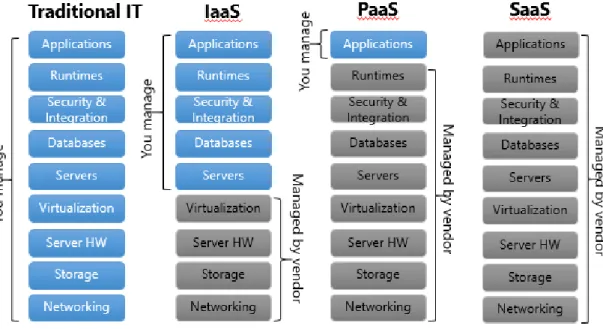
16 Busch et al. (2014) state that the three service delivery models for cloud computing are Infrastructure as a service (IaaS), Platform as a service (PaaS), and Software as a service (SaaS). IaaS, as the name suggests provides the infrastructure such as the virtual data centre and the customer is responsible for providing the software assets used PaaS is a superset of IaaS and provides the hardware as well as the operating systems, databases, storage, support and development environment. SaaS sits on top of IaaS and Paas, making the application easy to scale quickly without the customer having to expend too many resources. Figure 2.2 depicts the different service delivery models, the layers contained within each models’ stack and indicates if that part of the stack is managed in-house by the adopting organisation or if that portion is managed by the outsourced cloud computing vendor.
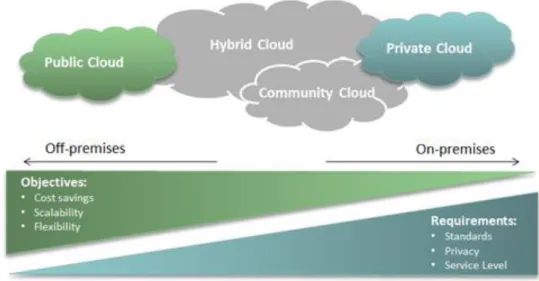
17 There are four possible deployment models in cloud computing (Figure 2.3), namely.:
Private cloud - provisioned by an organisation for its exclusive use;
Community cloud - provisioned for exclusive use of a community;
Public cloud - provisioned for use by the public, and
Hybrid cloud - an amalgamation of two or more of the earlier deployment models, bound together by standardised or proprietary technology.
Figure 2.3 Deployment models of cloud computing (Ubiry, 2013)
The problems with cloud computing faced by service providers are:
Ensuring high data availability (Khajeh-Hosseini, Greenwood, Smith and Sommerville, 2012);
Ensuring high standards of data privacy and security, similar to what the customer can provide for in-house data (Zhang, Cheng and Boutaba, 2010);
18
Addressing the lack of standards for interfaces between different cloud service providers making it difficult to migrate from one provider to another (Marston et al., 2011);
Resolving the issues in situations where different customers have data on the same servers due to multi-tenancy and segregating them when one customer faces cyber-attacks is a challenge (Cloud Security Aliance, 2011);
Resolving the lack of control on the data as the data is hosted on third party servers (Leavitt, 2009; Miller, 2008).
Trivedi (2013) researched cloud computing in many industries and governments of India, USA and Singapore and proposed various models for cloud computing adoption in government or large enterprises. These models are based on factors such as the need for capabilities, how they are placed in the cloud adoption spectrum and how long it will take to go to cloud.
Goldsmith (2014), in his article about cloud computing trends (in Govtech.com), proposes an interesting theory about how cloud computing changes things for cities. This change is due to its ubiquitous proliferation and cost effective pay-per-use models, bringing parity between small and large cities. Both get equal, on-demand access to computing resources thus hastening their move to the cloud. He proposes that government should push itself as a platform rather than a vendor of solutions (Goldsmith, 2014). The move by government to be a platform may not be the right move, as most governments’ bureaucracy will hinder the growth of this.
19
2.3 CURRENT STATE OF CLOUD COMPUTING IN THE SOUTH AFRICAN PUBLIC SECTOR
Maluleka and Ruxwana (2013) compare cloud adoption in South African government institutions with the adoption of Open Source Software (OSS). The adoption of OSS was hampered by user resistance, support and funding and as a result the expected cost savings were not realised. The study aimed to determineif cloud adoption in the South African government yielded cost savings or if there were any obstacles to that. The findings were that cloud computing was indeed cost effective and efficient and hence the study recommended cloud usage adoption for the South African public sector (Maluleka and Ruxwana, 2013). The Maluleka and Ruxwana (2013) study compared the adoption of cloud computing as an alternative to OSS adoption by considering the cost implications only and does not address other issues such as security, privacy, legal and regulatory issues.
Industry 4.0 is also referred to as the internet of things (IoT) and is where everything is digitised, sensors are everywhere and high-speed mobile connectivity as well cloud computing is harnessed. South Africa is not burdened by legacy software and therefore can move directly to Industry 4.0 (Gupta, 2015).
To compare the current state of cloud computing in other countries, this study investigates other literature, in order to set the baseline. Busch et al. (2014) performed a survey in Australia, and the findings revealed that most respondents (43%) were aware of cloud computing and only a few (7%) indicated non-familiarity. Only a few (10%) admitted to being subject matter
20 experts and 90% of them wanted to use cloud computing in their organisation and the majority (72%) of them do not see the adoption of cloud computing as a threat to their jobs. The majority of respondents (62%) preferred to use government cloud so that it mitigates the potential security risks by locally hosting a private cloud for exclusive use by the public sector. This survey carried out by (Busch et al., 2014) to determine the intent of the agencies of the government of Australia to adopt cloud computing, can help to determine a baseline for this study. However, the survey does not actually measure the adoption of cloud computing, the issues faced, the experiences (whether positive or negative), and any lessons learnt by the government agencies (Busch et al., 2014). Therefore, further research in this field is warranted.
Mutula and Mostert (2010) have researched the opportunities and challenges in implementing e-governance in South Africa. The study aims at the implementation of cloud computing in e-governance and poverty alleviation programs such as reconstruction and development programs (RDP), the Municipal Public-private Partnership pilot Program (MPPP), Black Economic Empowerment (BEE) and so on. The South African government has made rapid strides in formulating policy and regulatory frameworks for information handling. The study states that there has been an improvement in infrastructure such as undersea cabling (by SEACOM), proliferation of telecommunications (mobile), availability of internet and multipurpose community centres such as Internet centres and village knowledge centres are enabling factors for increased adoption of cloud computing. The study enumerates the problems and challenges facing South Africa in adopting cloud computing which are poverty, corruption, illiteracy and the skills shortage to name a few. There are still
21 infrastructure issues due to which reliable electricity supply is not guaranteed (Mbeki, 2008). The study lists a number of failures and successes of e-governance initiatives in South Africa. The introduction of IT into the National Welfare Agency (manages pension funds and worker’s compensation) failed partially whilst the e-procurement systems developed by the Independent Electoral Commission was a success (Heeks, 2008). The study concludes that the investments made by the South African government in administering service delivery through e-governance using cloud computing were not successful due to lack of monitoring and evaluating systems in place (Mutula and Mostert 2010). The paper does not talk about the causes for the failure of the e-Governance applications, if they were due to failure of the policies or infrastructure or lack of intent.
2.4 LEVEL OF ADOPTION OF CLOUD COMPUTING BY THE SOUTH AFRICAN PUBLIC SECTOR
A Gigaom/North Bridge survey of 1,358 respondents (users and vendors) in 2014 revealed the following findings (Skok, 2014):
Nearly half (49%) of the new businesses use cloud computing for revenue generation or product development;
Thirty five percent (35%) felt cloud computing gave a competitive advantage to their business;
Forty five (45%) are either already running their business in the cloud or want to
22
SaaS had grown from 13% in 2011 to 72% in 2014; and
Nearly three quarters (65 – 70%) of the respondents plan to move to cloud computing in the next year or two.
The significance of the survey findings are that respondents all showed an increased interest in moving to the cloud computing.
Schofield and Abrahams (2015) of the Johannesburg centre for software and the LINK centre at Wits University, did research to evaluate the enablers, constraints and other factors influencing the decisions to go for cloud computing. They state that those government departments planning to utilise cloud computing should be aware of the issues some of which are ownership of information, handling personal data (Hon, Millard and Walden, 2011), protecting the consumer (Reed, 2010), and government policy (Gillwald and Moyo, 2015). The government must remove unnecessary regulatory and legal barriers and encourage development of open standards to spur adoption of cloud computing. The public expects government information to be freely available at low or no cost (Dilmegani, Korkmaz and Lundqvist, 2014).
In South Africa, the national and provincial departments of basic education, health, municipalities, trade and industry are some of the departments that have their information available in the cloud for dissemination to the public, which does not require extensive hosting capabilities, as the data is not large. Thusong Service Centers (TSC) is a South African government programme that was initiated in 1999 as a primary vehicle for the implementation of development communication and information, to integrate government services into primarily-rural communities. The authors propose that services such as
23 TSC, its various interfacing agencies, and the State Information Technology Agency (SITA) could benefit by the establishment of a private government cloud environment. Schofield and Abrahams (2015) also note that South Africa has achieved success in implementing cloud services in the South African Revenue Services (SARS) and home affairs due to their implementation with little or no links to other departments. Fragmentation of departments and lack of oversight on budget spending for projects that span the different departments are preventing the government from building a private government cloud (Schofield and Abrahams, 2015). The new broadband policy, which formulates the new e-strategy for internet based applications for agriculture, rural development, health and other public services is in the formulation stage and is stated to be ready to achieve 70% of all such services to be e-enabled by 2019 (Department of Communications, 2013).
A green paper has been published which discusses innovation, applications utilising cloud computing, bring your own device (BYOD), and IT security (Department of Communications, 2014). The paper has invited comments, which is the next step in finalising the green paper (Cwele, 2014). This green paper does not preclude any government department in using cloud computing. The Gauteng education department already uses Dropbox and Moodle to deliver educational material to students (Millard, 2013).
The E-education green paper of South Africa 2004 promotes digitisation of education using Information and Communication Technology (ICT). This proposes provision of cheap internet to schools which has been given a stature of legal obligation so that broadband providers have to provide subsidised
24 broadband to educational institutions (Department of Communication, 2013). An E-Health policy has been formulated to ensure patient information protection and development of reusable information systems (Department of Health, 2012). According to the Department of Communication (2013) Minimum information security standards 1996, definition 4 are already available as the information security policy for the government of South Africa. The SITA act of 1988 provides the establishment of a centralised agency to provide ICT services for government departments. The Independent Communications Authority of South Africa (ICASA) Act 13 provides legislation for regulatory reforms for licensing telecom operators whilst ECTA 25 deals with issues of cybercrime. Various other acts, amendments and international treaties signed and ratified by South Africa help with the regulatory framework for implementation of ICT as a whole and cloud computing in particular. The Schofield and Abrahams (2015) paper is the most comprehensive study on cloud computing in South Africa that has been published to date.
2.5 BENEFITS OF CLOUD COMPUTING AS PERCIEVED BY THE SOUTH AFRICAN PUBLIC SECTOR
A study to find the impact of using cloud to deliver public services in South Africa was conducted (Mvelase et al., 2014). It focuses on a pay-as-you-go model and its application to the area of education, as it is the focus of the provincial and national governments of South Africa. The ICT4RED project was launched in the Eastern Cape Province as a proof of concept for adopting cloud computing to deliver government services. The ICT4Red project applied a
25 future-oriented, exploratory and qualitative action research methodology. The findings are that the cost of IT is reduced, no license costs are incurred, unlimited scalability, re-usable services are provided and e-governance applications can enforce security policies well. The Mvelase et al. (2014) study partially addressed the secondary question regarding the benefits of cloud computing as perceived by the South African public sector; however, this study was qualitative in nature with limited responses from a few public organisations. Mvelase et al. (2014) focus on interoperability between the various departments while developing a government-public cloud model. Three phases for this development are proposed:
Phase 1 - Investigating countries that are using cloud for their government services and adapt the design for the South African perspective;
Phase 2 - Present the design and implementation plan for the Government cloud model; and
Phase 3 - Will present the plan for monitoring and assessing the impact of the plan implementation.
Mvelase et al. (2014) believe that that businesses and organisations in South Africa are interested in adopting this model due to the cost effectiveness in developing and maintaining applications. Data storage and IT infrastructure is maintained by third parties and near instant scalability is provided. Due to the pay-as-you-go model, this level of elasticity comes at a very affordable cost. Therefore, there is no necessity to spend money on IT infrastructure and not much capex planning is required. While Mvelase et al. (2014) wholeheartedly
26 agree that SMEs can definitely benefit by cloud computing, government agencies, list a number of reasons for and against the move to cloud:
Reduce IT labour costs;
Reduces license costs;
Provides scalability;
Architecture built on Service Oriented Architecture (SOA);
Unlimited storage, CPU capacity, and bandwidth;
Designers can focus on features and forget about hardware;
E-governance projects may face data outburst, cloud computing handles this better while preserving QoS;
Disaster recovery can be easily handled; and
Integration between various applications of various departments is easy.
Nasr and Galal-Edeen (2012) propose 15 models of e-governance maturity models after studying the various implementations in the world. They use five countries as a reference for the implementation of a cloud infrastructure. Mvelase et al. (2013) propose a model for cloud computing in South Africa, which includes methods of managing the stakeholders. The stakeholders are:
Cloud consumers (G2C, G2B, G2G);
27
Cloud management which governs the entire landscape; and
Cloud auditors, which independently assess the cloud services, security and data privacy.
The effectiveness of the Nasr and Galal-Edeen (2012) model was not tested. There is also no evidence that this model is suited for a South African context as it has not been accepted by a South African governing body, or other renowned body. It is also not possible to know if this model is practical or efficient. Table 2.1 summarises the benefits of cloud computing as supported by various studies.
28 Table 2-1 Benefits of cloud computing
Benefits of cloud computing Reference
Reduces upfront costs Mvelase et al. (2013)
Helps the organisation to be more flexible Mvelase et al. (2014)
Allows the organisation to better focus on its core business
Nasr and Galal-Edeen (2012)
Is easier to implement than traditional on-premise technology
Nasr and Galal-Edeen (2012)
Increases staff mobility through remote and mobile information access
Mvelase et al. (2013)
Provides improved scalability of hardware according to demand
Gupta (2015)
Provides improved scalability of software according to demand
Gupta (2015)
Helps the organisation to react more quickly to market conditions and competition
Skok (2014)
Facilitates access to the latest technologies Gupta (2015)
Improves collaboration between different department, agencies, suppliers and citizens
Schofield and Abrahams (2015) Improves sustainability by reducing carbon footprint
through efficient economies of scale
Lin and Chen (2012)
Embracing cloud computing would make our organisation more effective and efficient ultimately leading to better service delivery
29
2.6 BARRIERS TO CLOUD ADOPTION FACED BY THE SOUTH AFRICAN PUBLIC SECTOR
Cruz (2012) reported that many companies that tried to establish datacentres in South Africa incurred heavy losses due to the perennial problem of electric grid outages. These electric grid outages is an opportunity for companies to pursue the cloud computing route, especially for delivering services through mobile applications, as there are five times as many mobile users as there are internet users. The cost of broadband internet is high in South Africa (Wyld, 2010) but coming down slowly from the exorbitant highs of 2001 and the electric grid is lacking in capacity as well as reliability resulting in companies wary of building datacentres in South Africa. This has spurred the success of mobile applications such as M-Pesa, which has very high usage statistics. The mobile internet bandwidth is not a problem for deploying as it is easier and since mobiles can be recharged through generator or solar cells, it is not necessary for them to be always connected to a power outlet (Cruz, 2012). Cruz (2012) feels that this is where Africa can excel in the use of cloud computing. While it is true that mobile applications may have better chance of success in Africa, not everything can be done with a mobile application and organisations need scalable resources available at a low cost to compete. (Cruz, 2012) study does not throw light on the status of availability of such resources in South Africa. Cloud infrastructure (or specifically data storage) could reside in a different area when related to the area where the data is produced (Reed, 2010) which could mean that the data production, storage and consumption could all be in different jurisdictions. Questions arise as to who owns the data, how to enforce
30 intellectual property rights, how to maintain confidentiality, integrity and availability of data and who is responsible if there is a failure to do so. Legal rights pertaining to contractual obligations are also difficult to resolve.
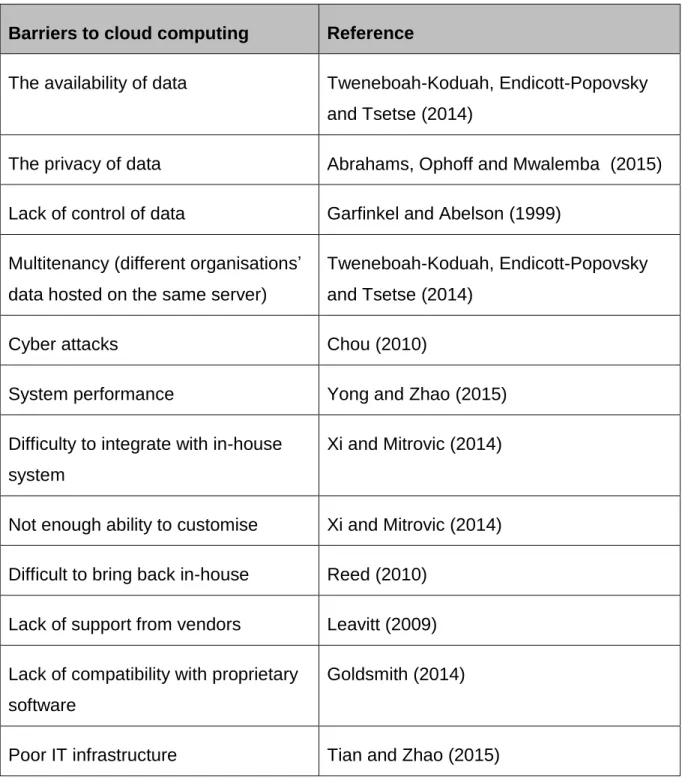
The adoption barriers to cloud computing faced by the public sector and financial sector are somewhat different to that of other sectors due to imposed regulations (Abrahams, Ophoff and Mwalemba, 2015). Multitenancy is one such regulation as remotely sensitive data is not allowed to reside on shared environments (Tweneboah-Koduah, Endicott-Popovsky and Tsetse, 2014). Public sectors unsubstantiated dire perceptions of cloud computing which are contrary to other sectors serves as an impeding barrier (Chou, 2010). Lack of awareness of current progress in cloud computing creates fears which impede further cloud computing adoption (Yong and Zhao, 2015). All perception fears which negatively impact cloud adoption decisions are considered adoption barriers, these include fear of cyberattacks as there is a perception of easier access to data in public cloud environments (Chou, 2010), poor system performance due to increased demand by other clients on shared infrastructure as well as current bandwidth and infrastructure (Yong and Zhao, 2015). Another concern is integration and customisation abilities of cloud systems into on premise systems (Xi and Mitrovic, 2014). Reed (2010) further raises concern in bringing back an on premises system should cloud model not work, voicing concern over cloud lock-in. Vendor relationship concerns are also raised by Leavitt (2009) and Goldsmith (2015) whereby the direct relationship with the software vendor and implementer is diluted by cloud computing models implementation and support interaction.
31 Table 2.2 summarises the barriers to cloud computing adoption as supported by various studies.
Table 2-2 Barriers to cloud computing
Barriers to cloud computing Reference
The availability of data Tweneboah-Koduah, Endicott-Popovsky and Tsetse (2014)
The privacy of data Abrahams, Ophoff and Mwalemba (2015)
Lack of control of data Garfinkel and Abelson (1999) Multitenancy (different organisations’
data hosted on the same server)
Tweneboah-Koduah, Endicott-Popovsky and Tsetse (2014)
Cyber attacks Chou (2010)
System performance Yong and Zhao (2015)
Difficulty to integrate with in-house system
Xi and Mitrovic (2014)
Not enough ability to customise Xi and Mitrovic (2014) Difficult to bring back in-house Reed (2010)
Lack of support from vendors Leavitt (2009) Lack of compatibility with proprietary
software
Goldsmith (2014)
32
2.7 LEVEL OF READINESS OF THE SOUTH AFRICAN PUBLIC SECTOR TO ADOPT CLOUD COMPUTING
Xi and Mitrovic (2014) in the thesis “Readiness Assessment of cloud computing Adoption within a Provincial Government of South Africa” focused on readiness assessment of a provincial government, which includes parameters that are both technical and non-technical. The thesis proposes three types of readiness indicators: 1) Organisational indicators, 2) Infrastructural indicators and 3) Environmental indicators (Nelson, 2009). A model with these three indicators and twelve sub-indicators was proposed. The proposed model was evaluated using a qualitative case study methodology in a provincial government to assess its readiness for implementing cloud computing technologies and services. The sub-indicators for the Infrastructural indicators are:
Availability and reliability supply; and
Broadband connectivity indicator.
The sub-indicators for Organisational indicators are divided into strategic business considerations and operational business considerations. The strategic business considerations are:
Strategy;
Top management support;
HR strategy; and
33 The Operational business considerations are:
Security;
Trust;
Compatibility and interoperability; and
Cost performance.
The sub-indicators for the Environmental indicator are:
Regulatory environment; and
Sustainability.
The Xi and Mitrovic (2014) study was limited to non-technological factors; it does not actually assess any province and no readiness indicators are provided. Only non-technological factors are considered and external factors are ignored because they could vary enormously. The study is thorough in establishing and explaining the factors underlying the indicators but there are no reasons explained as to why the study is only limited to those factors.
34
2.8 CONCLUSION
The Schofield and Abrahams (2015) research is the most comprehensive study which mentions all the factors that affect current cloud adoption in South Africa, the enablers, the barriers, the benefits and risks of adopting cloud computing, and the level of readiness of the public sector to adopt cloud computing. The study reports that the current cloud adoption in South Africa is all on the informational side and not the computing side. This situation can change once there is clarity of purpose, all regulations have been framed and a central authority is tasked with creating a private government cloud. It is true that, due to a lack of alternatives, some of the departments have been utilising commercial private or public cloud services currently; however if the South African government wants the usage of cloud to take off in a big way, it should create a private cloud platform. This platform will help integrate all the various departments’ efforts and utilisation of data by all departments instead of duplication.
Building on internal cloud (run by the government) is fraught with risks such as capacity constraints and bureaucratic decision-making processes resulting in loss of agility to scale on demand, access to government data, and so on. Schofield and Abrahams (2015) argue that there has been no work done yet to achieve this readiness. Neither are the individual departments working on formulating a strategy to address the risks, nor are there any overarching guidelines being produced. Issues such as building security protocols and avoiding vendor lock-in are not yet addressed (Schofield and Abrahams, 2015).
35 Mvelase et al. (2014) propose a cloud model, which can be used by the South African government and is based on different models and implementations worldwide. Mohammed and Ibrahim (2015) try to differentiate between different types of computing. Busch et al. (2014) have defined different service delivery models for cloud computing. Trivedi (2013) propose models fit for governments and large enterprises to adopt cloud computing. Goldsmith (2014) proposes the concept of ‘government as a platform’. Maluleka and Ruxwana (2013) compare the adoption of cloud to the adoption of OSS and alert us about encountering the same pitfalls. Gupta (2015) hypothesises that the lack of development so far in Africa is a blessing in disguise as they directly leapfrog to Industry 4.0, which is a euphemism of cloud computing, as it has no legacy applications to hold back the implementation. The Busch et al. (2014) survey in Australia gives a general idea of the situation in Australia. Mutula and Mostert (2010) studied the implementation of e-governance in South Africa and identified projects that have succeeded and some that have not. A Gigaom /North Bridge survey gives a level of adoption of cloud by the industry. Cruz (2012) lists out the different barriers faced by entities trying to move their computing to the cloud, such as the lack of reliable electricity supply, and suggests mobile applications as an alternative.
The next chapter will discuss the research methodology and design which will enable the validation of the theory revealed in this chapter.
36
CHAPTER 3
RESEARCH METHODOLOGY
3.1 INTRODUCTIONThis chapter discusses the adopted methodology for this research on the adoption of cloud computing in the South African public sector. This research process aims at answering the primary and secondary research questions of this study (Section 1.3). A survey research strategy is adopted in this study (Section 3.2). The research instrument used in this study is an online questionnaire (Section 3.3).
3.2 RESEARCH STRATEGY
Collis and Hussey (2003) advocate two research paradigms that are largely accepted. The positivist paradigm endeavours to uncover truth and present this by empirical means, maintaining that knowledge is quantifiable and objective. Quantitative research, which falls under a positivist paradigm, can be described as an objective (unbiased) method, which incorporates gathering and analysing statistical data by means of a statistical test. The phenomenological or interpretivist paradigm attempts to understand phenomena through meaning assigned by people. Qualitative research which falls under a phenomenological or interpretivist paradigm on the other hand is a subjective (biased) approach involving examining and reflecting on perceptions to further understand human and social activities (Collis, Hussy, 2003). Quantitative research is a data generating form of research that is customary to numeric presentation after
37 subjection to various statistical analysis; whereas the data produced by qualitative research is not readily formatted for statistical analysis (Clark & Dawson, 2000). This study adopts a mixed methodology, using both qualitative and quantitative paradigms. A mixed methodology allows for deeper insight into the studied subject matter (Caruth, 2013). Quantitative data is weak in that it struggles to explain the deeper meaning which is simpler done through qualitative data (Amaratunga et al., 2002). Qualitative data can be utilised to better understand and decipher quantitative data. The data collected in this study was both quantitative and qualitative.
Collis and Hussey (2003) state that research design can be descriptive, explanatory (analytical), exploratory or predictive. This study employs an exploratory research design. The study will allow for insight into the adoption of cloud computing by the South African public sector (Chapter 2). The literature allowed for the creation of a theoretical framework, which is empirically validated through means of a survey research strategy (Goulding, 2005). The theoretical framework incorporates opinions and perception about the use and adoption of cloud computing.
The study takes place across the South African public sector including all government local, provincial and national departments and agencies. The study population comprised of the entire South African public sector. The research endeavoured to attain a minimum of sixty (60) respondents comprising of government CIO, government senior IT management and IT decision makers.
38
3.3 SAMPLING METHOD AND RESEARCH INSTRUMENT
The study adopted a research questionnaire as the research instrument to measure the respondents’ perceptions of certain statements related to the research questions. The questionnaire comprised of statements measured on a Likert scale and opened-ended questions that allow respondents the opportunity to express their views. The questionnaire follows a logical sequence, is clear, unambiguous and of comfortable length to complete within 15 minutes (Clark & Dawson, 2000). The questionnaire is prefixed by a cover letter (Appendix A) explaining the purpose of the research.
The questionnaire consists of the following sections:
Section A is used to gather data about the demographic and organisational profile of the respondents;
Section B is used to gather data about the adoption of cloud computing (SRQ1);
Section C is used to gather data about the benefits of cloud computing (SRQ2);
Section D is used to gather data about the technical, organisational and environmental barriers to cloud adoption (SRQ3); and
Section E is used to gather data about the readiness factors to adopting cloud computing (SRQ4).
Responses will be analysed by means of statistical tools using methods of central tendency and inferential statistics. The link to the research questionnaire and a personalised introductory email were sent to the government CIO mailing
39 list as well as to contacts provided by the software vendors. The questionnaire was set up as an online form ensuring anonymity and was accessible to any smart device with an internet connection. The questionnaire’s mobility was set up for the respondent’s convenience so as to encourage participation. Those respondents without a listed email address were faxed or called up personally. Two reminder emails were sent out at two weeks and one week before the survey-closing deadline. The survey was also administered physically via iPads at the GovTec 2015 conference held in Kwa-Zulu Natal on 28 October. Non-probability and viral sampling were used whereby respondents and industry personnel were asked to recommend other respondents that could participate in the survey (Plowright, 2011).
3.4 VALIDITY OF THE MEASURING INSTRUMENT
The measuring instrument’s validity was evaluated by means of face validity. Collis and Hussey (2003) describe face validity as when the measuring instrument is deemed to measure and capture the phenomena that the research intends to capture. The research ensured validity by fully evaluating the objectives and literature reviewed and relaying this in the questionnaire. To test the structure and validity of the questionnaire, an industry expert, statistician and subject matter academic iteratively reviewed the questionnaire before finalisation. The questionnaire was piloted with sample participants before full distribution. The survey was granted ethics clearance (Appendix B).
40
3.5 CONCLUSION
This chapter presented the research methodology used in the study. The research paradigm adopted is a mixed methodology (qualitative and quantitative). The research design is exploratory and the research strategy used is a survey. The sampling technique used is non-probability viral sampling. The validity of the measuring instrument was measured for face and content validity and deemed valid. The data collected from the questionnaires will be analysed in the following chapter (Chapter 4).
41
CHAPTER 4
DATA ANALYSIS
4.1 INTRODUCTIONChapter 3 presented the research design utilised for the survey. The data collected from this survey will be analysed and graphically presented in this chapter. In total 51 completed responses were received (Section 4.2). The response rate cannot be measured as it is undetermined how many persons actually received the survey questionnaire. The results revealed the extent of adoption of cloud computing of respondents (Section 4.3), the respondent’s perceptions of the benefits of cloud computing (Section 4.4), the levels of TOE barriers to adoption of cloud computing experienced by the respondents organisations (Section 4.5) and the readiness of respondents organisations to adopt cloud computing (Section 4.5).
4.2 DEMOGRAPHIC AND ORGANISATIONAL INFORMATION
The analysis initially reviews and presents the demographic information of the respondents which corresponds to Section A of the surveyed questionnaire. This section aims to provide a clearer profile of the respondents, such as age, gender, highest qualification, employer, region, managerial level, and other demographic information. This information is important to the study to understand the spread and verify the validity of the results.
Less than a third (31%) of the respondents were female, with 69 percent being male (Figure 4.1). Nearly half (47 %) of the respondents were between the ages
42 of 40 to 49 years old (Figure 4.2). Thirty three percent were between 50 to 59 years and 4 percent were older than 60 years. Sixteen percent were between 30 and 39 years old and none were below 30 years old.
Figure 4.1 Gender Profile of Respondents
Figure 4.2 Age Profile of Respondents
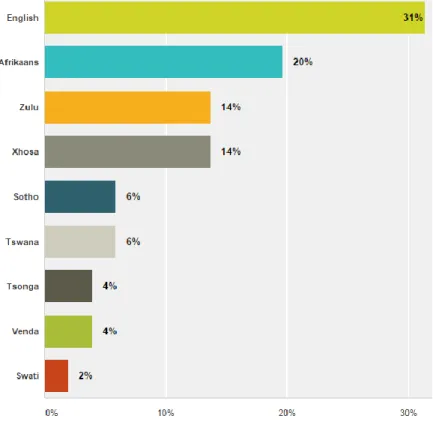
43 The majority of respondents (31%) had English as their first language followed with Afrikaans (20%) then Zulu and Xhosa (14% each) and Other African languages (22%). It is notable that 69% of respondents’ first language was not the dominant business language, which is English in South Africa (Figure 4.3). Figure 4.3 Language Profile
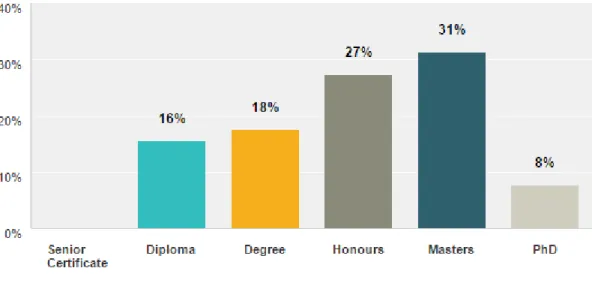
All respondents had some form of formal educational qualification, with 16 percent having diplomas as their highest qualification, 18 percent university degrees, and 27 percent honours degrees. Nearly a third (31%) held master’s degrees and 8 percent held PhD’s, refer to Figure 4.4.