Journal of Applied Accounting and Taxation Article History
Vol. 2, No. 1, March 2017, 15-21 Received July, 2016
e-ISSN: 2548-9925 Accepted December, 2016
The Six Sigma Approach for the
Development of Accounting Information
System Performance
Hendra Gunawana*, Himmatun Karimahb
aProgram Studi Akuntansi, Politeknik Negeri Batam, [email protected], Indonesia
bProgram Studi Akuntansi Manajerial, Politeknik Negeri Batam, [email protected], Indonesia
Abstract. The study investigates six sigma approach in manufacturing companies to prove its influence on the development of accounting information systems performance. Total of 80 respondent data from processed questionnaire consist of low management (64%), middle management (38%) and top management (7%). Statistically significant were found for application six sigma and development of accounting information systems performance. The result shows six sigma has significant effect to accounting information system performance. The findings show that companies implement six sigma at high altitudes. Six sigma has criteria such as support and commitment from top management, organizational culture, customer focus, and training. Criteria for support and commitment from top management and organizational culture are not proven to significantly influence development of accounting information system performance.
Keywords: six sigma, accounting information systems
16 H. Gunawan, H. Karimah | Journal of Applied Accounting and Taxation 2 (1) 15-21
Introduction
The rapid progress of the industrial world and the increasing competition between industries lead to the need for fast, precise and accurate information to assist management in many areas such as planning, controlling and decision making, so that the performance of an information system is very important in the priority hierarchy, one of which is the information system accounting. The accounting information system serves to enable management in making the right decisions, positively affect the survival and growth of the organization and strengthen the competitive position.
Performance or quality is the overall characteristics and features of a product or service resulting from the ability to satisfy some or all of the needs of the user. Various methods are developed to achieve an ideal condition in a production process, namely zero defect or without defects. One method that can improve quality is six sigma method.
Six sigma is a method or technique of dramatic quality control and improvement applied by the Motorola Company since 1986 which is a new breakthrough in the field of quality management. Many quality management experts claim that Motorola's six sigma method has been developed and widely accepted by the industry. This is because industry management is frustrated with existing quality management systems because they are unable to dramatically improve quality to zero defects. Many quality management systems emphasize only on continuous improvement efforts based on self-management awareness. But the quality self-management does not provide a powerful solution how breakthroughs must be made to dramatically improve quality to zero failure rates. The principles of courts and quality improvement of six sigma Motorola are able to address this challenge, and Motorola's proven companies for less than 10 years after implementing the six sigma concept have been able to achieve the 3.4 DPMO-Defect per Million Opportunities level of quality (Gaspersz, 2009).
Previous studies that tested the application of six sigma criteria. The research shows that companies apply six sigma criteria at a very high level. The six sigma criteria has a sequence in the following applications: support and commitment from top management, organizational culture, customer focus (system users) and training. The results showed that there is a positive relationship between six sigma with the development of accounting information
system information partially or simultaneously (Al-Zwyalif, 2012).
Literature Review
Quality Accounting Information System
Based on previous research models to measure the performance of information systems include: system quality, information quality, system usage, system user satisfaction, system impact on users, and their impact on organizational performance systems (Gunawan & Amalia, (2015), Al-Zwyalif, (2012) and McGill et al., (2003)).
Six Sigma
Six sigma as a strong management strategy has been developed from initially to exclusive the original goal of the target of less than four failures or defects from mistakes per million of opportunities, covering various approaches to incorporate quality into products and services from early stage design and development and throughout their economic life (Antony & Fergusson (2004), Cheng (2008), Harry & Schroeder (2000), Hensley & Dobie (2005)). The quality programs obtained through six sigma goes beyond just measuring the level of defects, the implementation of this approach includes the integration of various tools and techniques throughout the stages of improving performance and thereby enhancing profitability as ultimate objective (Breyfogle, 2003).
Training
Training is an activity designed to improve the worker's performance in the work left to them. The training takes place within a short period of two to three days to two to three months. Training is carried out systematically according to a proven procedure, with standardized and appropriate methods, and executed in earnest and orderly manner. Training related to the work being handled. Thanks to that training the confidence and morale of the worker can be improved (Hardjana, 2001).
Organizational culture
Organizational culture is a system of values that all members of the organization believe and which are
H. Gunawan, H. Karimah | Journal of Applied Accounting and Taxation 2 (1) 15-21 17
studied, applied and developed on an ongoing basis, serves as an adhesive system, and can be used as a reference to behave in an organization to achieve established company goals (Moeljono, 2006).
Customer Focus (App Users)
Organizations depend on their customers in terms of production, therefore organizational management must understand the needs of present and future customers, must meet customer needs and enterprising efforts to exceed customer expectations. It also applies to users or users (Gaspersz, 2002).
Hypothesis Development
Many previous studies have proven the influence of six sigma on improving quality management such as Ali & Ali (2013), which conducts research on the use of the six sigma approach for the development of the safety of health workers in hospitals. In addition six sigma can also be used in the development of organizational and management strategies such as research that has been done by Dreachslin (2007).
Liu et al. (2013) has conducted research on the influence of six sigma on the performance of management and the results proved six sigma greatly affect the performance or performance management to be better with effective and efficient. Previous research Ansari et al. (2013) conducts six sigma testing on the part of finance. This study uses DMAIC to improve financial performance, and it is evident that the six sigma method can help improve management performance.
The six sigma methodology has proven successful in other functional areas, including sales and marketing, supply chain management, accounting, and finance. The current financial reporting procedures of most companies contain many errors, excessive cycle times, data entry duplicated, and additional costs due to inefficient processes. In particular, six sigma is one tool that can enable the finance department to simplify their financial reporting process. Based on the above explanation, then in this study form a hypothesis:
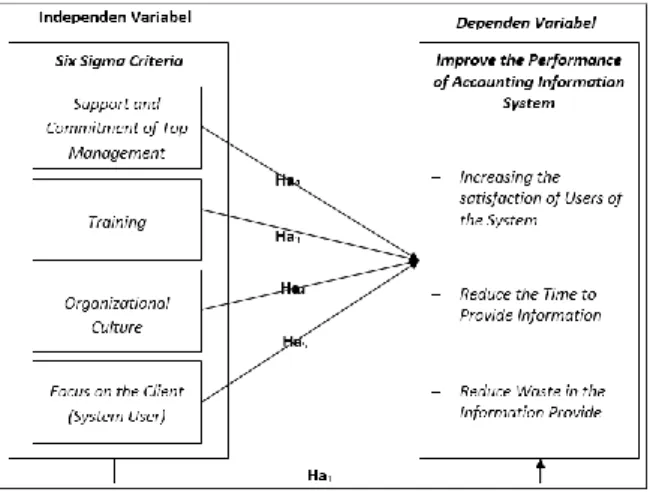
H1: There is a positive relationship between the applications of six sigma to the development of accounting information system performance Support and commitment from management is needed by the organization. According to Tee et al.
(2007), commitment can be demonstrated by the participation of managers, as managers who participate in the organization can be seen as an indication of commitment to achieve and maintain high data quality. Management commitment is needed in the implementation of information systems. This is based on a statement from Cooper (2006), that important management commitments in the implementation of information systems so that management, other resources and accounting information systems of the implementation process can receive good feedback and achieve the goals the organization expects.
According to Siakas & Georgiadou (2002), management commitment is a driving factor to motivate employees to strive for continuous improvement processes. An important point in top management commitment is one of the most important factors for making or breaking process improvements, determining decisions to improve processes, demonstrating organizational willingness to change, and perseverance of change, to encourage senior managers to become supportive of change.
Management commitment is very influential on the quality of data in achieving organizational goals and managers who participate in the organization committed to the achievement and maintenance of high quality data (Tee et al., 2007). Xu (2009), concluded that management commitment affects the quality of information systems. This is evidenced also by research Kurnia (2012) which proves that Management commitment affect the accounting information system partially and simultaneously. Proven with the results of the study resulted in a positive correlation which means that the higher the management commitment the better the data quality.
Based on the above explanation, then in this study form a hypothesis:
H2: There is a positive relationship between commitment and support from top management on the development of accounting information system performance Theoretically, the term training is a process in which people achieve certain abilities to help achieve organizational goals (Mathis & Jackson, 2002). In a limited way, the training provides employees with specific, knowable knowledge and skills used in their current work. While broader boundaries conclude that training is the scope of development as well as focusing individuals to achieve new capabilities that are useful both for their current and future work.
18 H. Gunawan, H. Karimah | Journal of Applied Accounting and Taxation 2 (1) 15-21
Al-Hiyari et al. (2013), has conducted research to assess the effect of human resources, data quality and management commitment on accounting information systems and information quality. Here the research links human resources with accounting information systems and proves to be interconnected. Researchers conclude that management must ensure adequate resources and comprehensive training for accountants to improve the quality of accounting information systems. While Medina et al. (2014), conducts research on training in accounting information systems for user satisfaction and decision making. Summing up the technological advancement without proper training on how to use it is almost not feasible right now because it will not yield results if the user is incompetent. The purpose of this study is to examine the relationship between employee training in accounting information systems and their impact on skills development to more effectively operate them. This is also evident in the way in which the relationship is reflected in user satisfaction of accounting information systems and decision-making processes. It is clear that training in accounting information systems does not help companies or employees develop new skills that can enable them to better understand their work, understand business management processes, and utilize effective information. Undoubtedly, all these negative aspects can affect the harmonious development of any organization that seeks for administrative excellence. Among the reasons that they may not receive proper training, training may not be provided by experts that the training is not continuous, or simply that employees are not getting any training at all even when they first start accounting information system operations. This is why there is a need for organizations to redesign training programs aimed at acquiring competitive advantage that can translate into higher productivity levels, more sales, more satisfied customers, market opportunities, and enterprise suppliers.
Based on the above explanation, then in this study form a hypothesis:
H3: There is a positive relationship between training on the development of accounting information system performance
Much research has been done in the modern world about the relationship between operational management and organizational culture. Dezdar & Ainin (2012), have studied the positive impact of organizational culture. This research is conducted in organizations and significant relationships have been
found in the implementation of operational management and organizational culture. According to this research, culture plays an important role in the implementation of operational management because organizations must stop their existing work patterns. Resultantly, new methods of control, management and work processes create disputes and conflicts of interest. Bai & Cheng (2010) found a positive relationship between organizational culture and operational management of assimilation with the mediation effect of user engagement. Studies show that indirect innovative culture through user engagement and result culture and control are directly oriented towards the effects of operational management assimilation. Shah et al. (2011) has conducted research to determine the critical success factors that affect the implementation of operational management. One hundred and sixteen responses have been collected from eight public and private organizations. The results show that organizational culture is one of the most influential factors in operational management projects that should be considered for successful implementation. In addition, Hameed et al. (2012) learn about the factors causing failure of foreign operational management system. According to them, internal barriers are one of the factors that influence the failure of operational management projects.
Based on the above explanation, then in this study form a hypothesis:
H4: There is a positive relationship between organizational cultures on the development of accounting information system performance The information system is a framework in which human resources (human and computer) are coordinated to transform inputs (data) into outputs (information) in order to achieve company goals. The results obtained by McGill et al. (2003), Livari (2005) shows that the quality of operational management information system has a positive effect on user satisfaction. Saleh et al. (2012), has conducted research on the influence of information system quality on the quality of accounting information in an effort to improve user satisfaction accounting software.
Based on the above explanation, then in this study form a hypothesis:
H5: There is a positive relationship between the focus on the customer (system users) on the development of accounting information system performance
H. Gunawan, H. Karimah | Journal of Applied Accounting and Taxation 2 (1) 15-21 19
Fig. 1 Research Model
Research Methods
Data collection in this study was conducted by distributing questionnaires to manufacturing companies implementing six sigma. After the questionnaires were distributed, validity and reliability tests were conducted to determine whether the questionnaire could be used as a tool to collect data and the data can be analyzed further or not. Empirically the results show that the whole item of statement is valid and reliable. Furthermore, data processing is done by multiple linear regression method.
Results and Discussion Descriptive Analysis
Total of 80 respondent data from processed questionnaire consist of low management (64%), middle management (38%) and top management (7%). The results of questionnaire processing based on duration of work showed most respondents had worked for about 5 years as many as 76 people (61%), 5-10 years 27 people (22%) and who had worked more than 10 years as many as 22 people (18%). Results of questionnaire processing based on the number of training shows most respondents have done as much as 1-3 times.
Evidenced by the number of respondents as many as 60 people (48%). Respondents who never received the training were 36 people (29%) and who had received more than 3 training times as many as 29
people (23%). All independent variables have a VIF value of less than 10. The results of the regression model testing show no multicollinearity symptoms in the regression model.
Table 1 Multicollinearities Test
Model Collinearity Statistics Tolerance VIF SCTM 0.494 2.022 T 0.482 2.074 OC 0.484 2.066 FC 0.557 1.796 Hypothesis Testing
Tests on the positive relationship between the application of six sigma and the development of accounting information system performance resulted in a significance value of 0.000. The result of the research shows that the six sigma variable has positive and significant effect to the development variable of accounting information system performance.
Variable support and commitment of top management obtained t-count equal to 3.822. The results of this study indicate that the support and commitment of management significantly influence the development of accounting information system performance.
Training variables obtained a significance value of 0.000. Based on the test can be concluded that the training significantly influence the development of accounting information system performance.
Tests on organizational culture relations and development of accounting information system performance obtained t-count of 3.567. The test results show that organizational culture has a significant effect on the development of accounting information system performance.
Tests on customer-focused relationships (system users) and development of accounting information system performance obtained t-count of 4.758. The results of this study indicate that the focus on the customer (system users) have a significant effect on the development of accounting information system performance. Table 2 Hypothesis Test Model R R2 T Sig SCTM 0.326 0.106 3.822 0.000 T 0.503 0.253 6.460 0.000 OC 0.306 0.094 3.567 0.001 FC 0.394 0.155 4.758 0.000
20 H. Gunawan, H. Karimah | Journal of Applied Accounting and Taxation 2 (1) 15-21
Conclusion
This study aims to explore the implementation of six sigma manufacturing companies for excellence and its role in improving the performance of accounting information systems. The findings of this study show that these companies implement six sigma at high altitudes. Six sigma also has criteria such as support and commitment from top management, organizational culture, customer focus (system users), and training. The results of research separately (partial) criteria focus on the customer (system users), and training proved to have a significant relationship in the development of accounting information system performance. Criteria for support and commitment from top management and organizational culture are not proven to significantly influence the development of accounting information system performance.
This study uses four independent variables, support and commitment from top management, organizational culture, customer focus (system users), and training. There may still be some other criteria that can be used as independent variables to test. This study only limits the population in manufacturing companies. Six sigma in general is also used in companies in other areas such as retail, services and banking. It is intended that the results of subsequent research can be compared with previous studies to prove the influence of six sigma on the development of accounting information system performance.
It is hoped that through this study other companies may consider using six sigma methods in their companies. Six sigma is a more modern quality management method. Six sigma has also proven successful in improving quality management to zero defect failure.
References
Al-Hiyari, A., Al-Mashre, M. H. H., Mat, N. K. N., & Alekam, J. M. (2013). Factors That Affect Accounting Information System Implementation and Accounting Information Quality: A Survey in University Utara Malaysia. American Journal of Economics, 3(1), 27-31
Ali Baddour, A. & Ali Saleh, H. (2013). Use Six Sigma Approach to Improve Healthcare Workers Safety. International Journal of Pure and Applied Sciences and Technology, 18(1), 54-68.
Al-Zwyalif, I. M. (2012). Using Six Sigma Approach to Improve Accounting Information Systems Performance. European Journal of Economics Finance and Administrative Sciences, 55, 132-142.
Ansari, A., Diane, L., Emil, T., Batoul, M., & Jessie N. (2013). Application of Six-Sigma in Finance: a case study. Journal of Case Research in Business and Economics. 1-13
Antony, J., & Fergusson, C. (2004). Six-Sigma in the Software Industry: Results from a Pilot Study. Managerial Auditing Journal, 19(8), 1025-1030.
Bai, H. & Cheng, J. (2010). The Impact of Organizational Culture on ERP Assimilation: The Mediating Role of User Participation. 2010 2nd International Workshop on Database Technology and Applications, 1-5.
Breyfogle, F. W. (2003). Implementing Six Sigma: Smarter Solutions Using Statistical Methods. New York: John Wiley & Sons, Inc.
Cheng, J. (2008). Implementing Six Sigma via TQM Improvement: An Empirical Study in Taiwan. The TQM Journal, 20(3), 182-195.
Cooper, D. (2006). The Impact of Management’s Commitment on Employee Behavior: A Field Study. American Society of Safety Engineers Middle East Chapter 7th Professional Development Conference & Exhibition Kingdom of Bahrain, 18-22.
Dezdar, S. & Ainin, S. (2012). Investigating the Impact of Organizational Culture on Enterprise Resource Planning Implementation Projects. World Applied Sciences Journal,17(9), 1125-1133.
Dreachslin, J. (2007). Applying Six Sigma and DMAIC to Diversity Initiatives, Journal of Healthcare Management,
52(6), 361-367.
Gaspersz, V. (2002). Six Sigma Terintegrasi dengan ISO 90001:2000, MBNQA, dan HACCP. Jakarta, Indonesia: PT Gramedia Pustaka Utama.
Gaspersz, V. (2009). Lean Six Sigma for Manufacturing and Serivice Industries. Jakarta, Indonesia: PT Gramedia Pustaka Utama.
Gunawan, H., & Amalia, R. (2015). Wages and Employees Performance: The Quality of Work Life as Moderator.
International Journal of Economics and Financial Issues, 5(1S).
Hameed, S., Butt, A. J., & Tariq, M. J. (2012). The Factors Causing Failure of Foreign Enterprises Resource Planning (ERP) Systems in Pakistan. African Journal of Business Management, 6(3), 946-955.
Hardjana, M. (2001). Training SDM Yang Efektif. Yogyakarta, Indonesia: Kanisius.
Harry, M., & Schroeder, R. (2000). Six-Sigma: The Breakthrough Management Strategy Revolutionizing the World’s Top Corporations. New York: Doubleday Publications
Hensley, L., & Dobie, K. (2005). Assessing Readiness for Six Sigma in Service Setting. Journal of Managing Service Quality, 15(1), 82-101.
Kurnia, S. R. (2012). The Influence of Management Commitment and Data Quality to the Implementation of Accounting Information System and Its’ Implication on Accounting
H. Gunawan, H. Karimah | Journal of Applied Accounting and Taxation 2 (1) 15-21 21
Information Quality in Public Sector. International conference.
Liu, Y., Li, K., & Mclean, A. (2013). Six Sigma Approach to Performance Management. Journal of Applied Science,
13(22), 5309-5317.
Livary, J. (2005). An Empirical Test of the DeLone-McLean Model of Information System Success. Database for Advance in Information System (DFA), 36.
Mathis & Jackson. (2002). Manajemen Sumber Daya Manusia, Yogyakarta, Indonesia: Salemba Empat.
McGill, T., Hobbs, V., & Klobas, J. (2003). User-Developed Applications and Information Systems Success: a Test of DeLone and McLean’s Model. Information Resource Management Journal,16(1), 24-45.
Medina, J. M., Jiménez, K., Mora, A., & Ábrego, D. (2014). Training in Accounting Information Systems for Users’ Satisfaction and Decision Making. International Journal of Business and Social Science, 5(7), 134-44.
Moeljono, D. (2006). Cultured: Budaya Organisasi dalam Tantangan, Jakarta, Indonesia: PT Elex Media Kompetindo.
Saleh, T., Darwanis & Bakar, U. (2012). Pengaruh Kualitas Sistem Informasi Terhadap Kualitas Informasi Akuntansi Dalam Upaya Meningkatkan Kepuasan Pengguna Software Akuntansi Pada Pemerintah Aceh. Jurnal Akuntansi Pascasarjana Universitas Syiah Kuala, 15, 110-124.
Shah, S. I. H., Bokhari, R. H., Hassan, S., Shah, M. H., & Shah, M. A. (2011). Socio-Technical Factors Affecting ERP Implementation Success in Pakistan: An Empirical Study.
Australian Journal of Basic and Applied Sciences, 5(3), 742-749.
Siakas, K. V., & Georgiadou, E. (2002). The Role of Commitment for successful Software Process Improvement and Software Quality Management. The 11th Software Quality Management Conference, 101-113.
Tee, S. W., Bowen, P. L., Doyle, P. & Rohde, F. H. (2007). Factors Influencing Organizations to Improve Data Quality in Their Information Systems. Accounting and Finance Journal.
47(2), 335–355.
Xu, H. (2009). Data Quality Issues for AIS’ Implementation: Systems, Stakeholders, and Organizational Factors. Journal of Technology Research. 1-11